It’s not your world. You arrive there and you’re a person, a creature, just like all the others. You see something shiny and think maybe you could go get it, so off you wander. You’re not controlling the game – you’re part of it.
It is often mentioned in the same context as The Hobbit, and this includes advertising from the time (“EAT YOUR HEART OUT BILBO!”) The setting is a “mythical place where two kings reside” who “hate each other”; you are an “adventurous, bounty hunting, greedy human” and your goal is to “finish the game with as much wealth as possible”. This is a standard treasure hunt, in other words, but it has illustrations for all the rooms, and it has dynamic NPCs (the latter point being why it gets compared to The Hobbit).
The author, Trevor Hall, has an unfortunate namespace clash with a more famous musician, but fortunately he’s done multiple interviews (1, 2, 3, 4) so I’m able to give some history.
P. M. Skinner is Pete Skinner, a friend of Trevor’s.
Trevor Hall studied Computer Science in Manchester, getting a taste of arcade games at the student union and obtaining his first computer, the text-only Acorn Atom. By 1982 he started publishing with Bug-Byte.
I think I did what many others wanting to publish did (and presumably still do):
1: Find a game publisher who already exists, and has some titles available, and adverts in mags etc.
2: Send the game for evaluation.
I think Bug-Byte was the first I tried, and they offered a good royalty rate. I don’t know where the company got its start up cash, but there were 3 main players who handled (or mishandled) all that. They had some advantages, like a good artist, a very good deal on rent in a new unoccupied building, their own tape duplication machines. They built a good name from the Spectrum Manic miner series, BBC micro stuff from me and others, and some C64, but lost the Manic Miner programmer to another company. That was probably a bad turning point for them.
In this case he did not simply send games to be independently evaluated (like Simon Wadsworth where his second game Time Warden fell down a black hole and he switched to making games for Artic): he had demo games impressive enough to be a regular contract worker for Bug-Byte. The company has featured here enough times (including the Manic Miner kerfuffle) I won’t recap their history other than to say they were one of the most prominent software houses soliciting games from anyone.
Bug-Byte was getting 20 or 30 games submitted some days and most of them were useless and went straight in the bin but some were excellent.
— Chris Cannon, who selected games for publishing at Bug-Byte, via Acorn: A World in Pixels
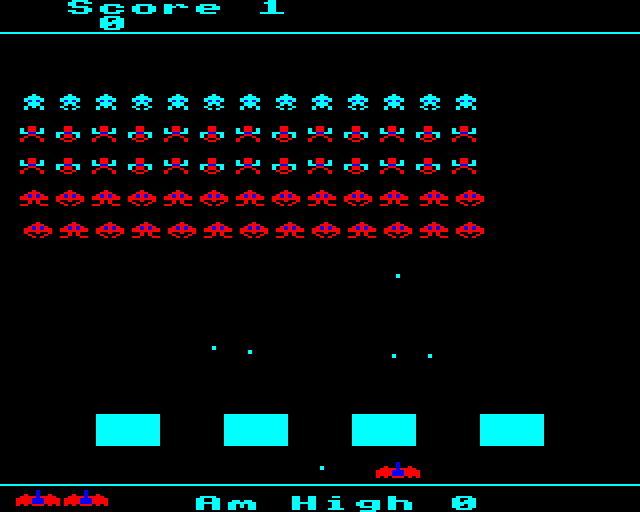
Hall has four games credited for 1982, and two more for 1983 prior to Twin Kingdom Valley, all for BBC Micro: City Defence, Galaxy Wars, Space Invaders, Dogfight, Sea Lord, and Oblivion. Space Invaders is worth a screen as Trevor credits working on the game as how he learned assembly language.
The single-pixel bullets mean the barriers last a bit longer than regular Space Invaders.
Hall’s first experiences with adventure games were his friends playing Crowther/Woods which appeared on “big computers” at the university:
I never got very far in Adventure. There was some version of some system at the university, which we found fun to play, but, time on those systems was limited, and we had to study sometimes.
He remembers one of his friends commenting on the characters “standing still” with the same puzzle to solve whenever a character is encountered. He saw some home computer games with the same issue:
The troll was always standing by the bridge. It made no sense! So I thought, why not make every creature in the game, including oneself, pretty much the same. Make everyone able to walk around, pick things up and fight. Let them interact.
In other words, he wanted a game where you are not the protagonist of a story, but rather part of a world.
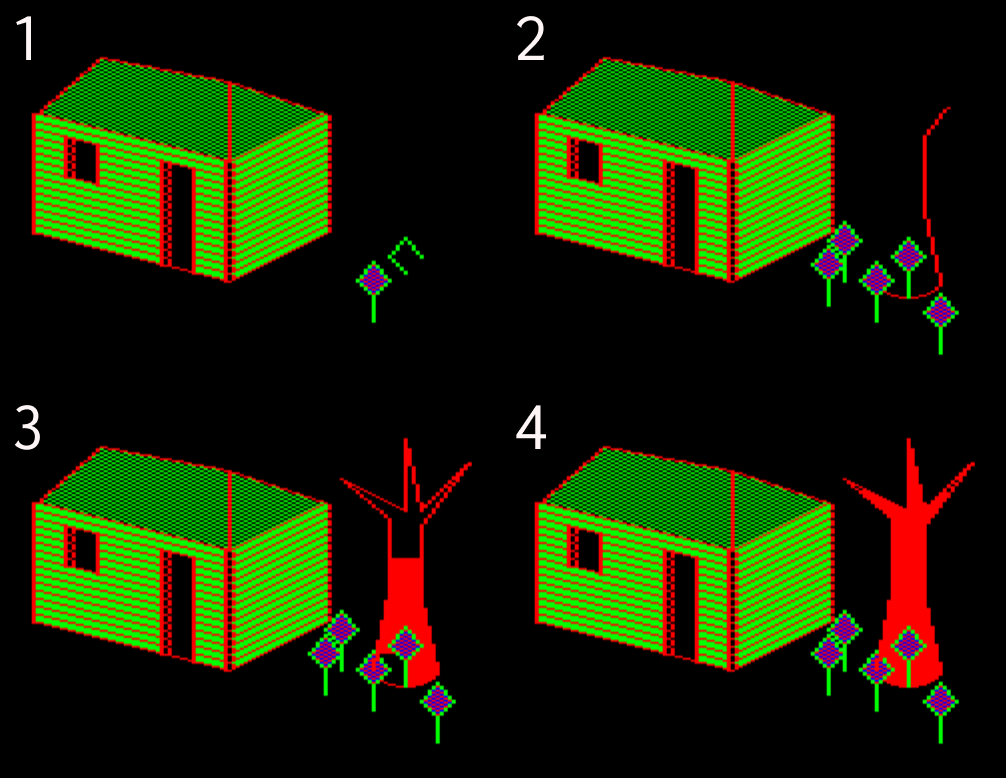
He and some friends drew maps (using “little green pieces of paper he’d swiped from the computer science lab”) and worked out how connections to other places could be described in a “few bytes”. He describes the parser as “easy” (“tokenize the text, and recognize a verb and an object”) but had more trouble with the graphics. He wanted 3D but found it to be too slow, so he used scaled pictures instead with flood fill. The general idea was to have scenes not thought of as being single pictures (like Sierra) but compositions of objects; he modified the code so “program wouldn’t attempt to draw underneath something that was already there.”
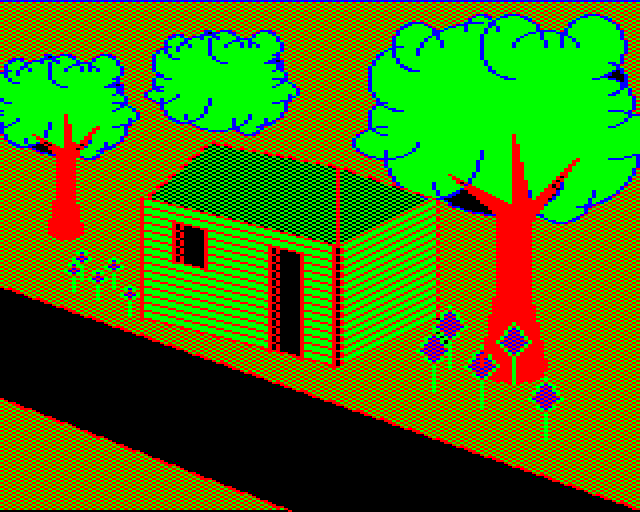
Road outside wooden cabin at the start of the game. The game states outright “the picture is your view north”.
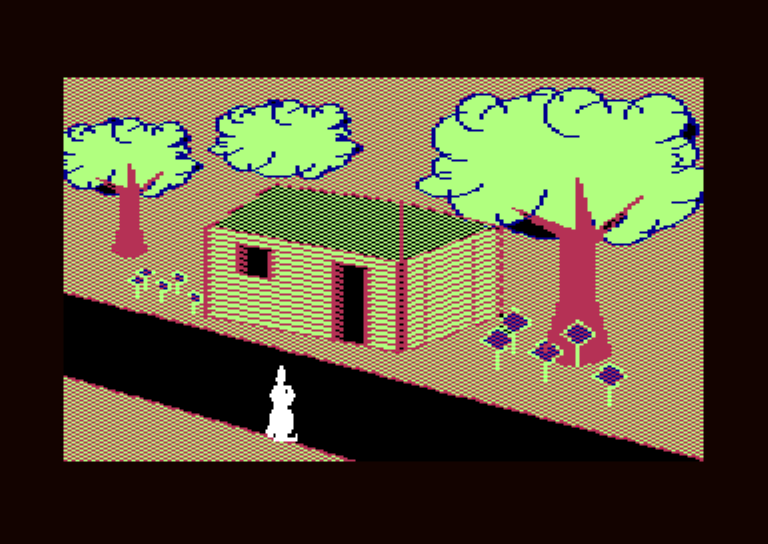
The trees from the scene above are both the same object image, drawn at different scaling levels. Sierra’s Time Zone and Melbourne House’s The Hobbit would have both trees drawn as individual graphics. Rather than a “picture book” model, Hall aimed to make an “environment” akin to modern 3D worlds. Note that Hall’s “priority drawing” system glitches a little bit with one of the flowers; it gets drawn in whole but then some of the tree lands on top, while most of the tree is drawn “behind” the flower even though it appears on the screen after the flower. When Hall talks about Pete Skinner drawing “many of the objects” he really means objects, not entire scenes.
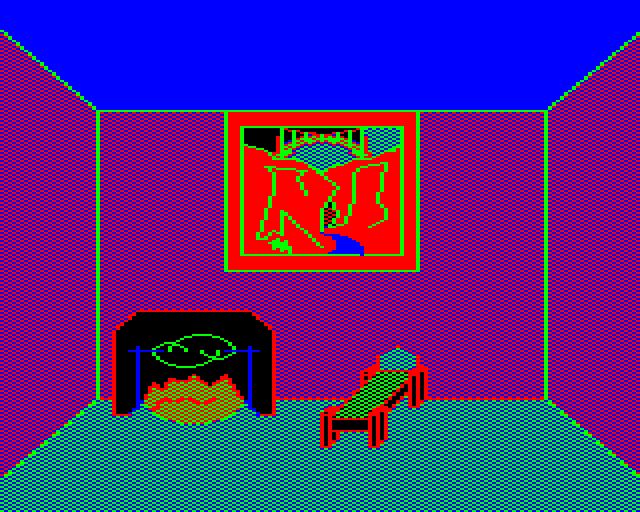
His world-representation paradigm (thinking of the world as “3D space” even though it isn’t) applies not just to graphics but to text. Graphics are reused where you see things from farther away or closer, but the rooms are designed such that things seen from afar can be included in the textual description. Despite the BBC Micro being relatively plentiful on space this sort of maneuver was needed in order to include all 175 rooms he was aiming for.
Hall talks more about his NPC design in his interviews but let’s come back to that when we have some more context, and get into the game itself. From the start there is again the eternal question: which version? The original is BBC Micro; there’s also the Electron, Spectrum, and C64, and I know at least the C64 has more rooms than the BBC Micro version does (so revisions happened, like The Hobbit). Still, comparing all the graphics, the BBC Micro version looks the most “intended”; the graphics appear designed for a screen with a particular color scheme and resolution.
C64 version. Notice how the flowers look a little mangled. There’s an animated hopping bunny, though!
The game helpfully gives six options for how text and graphics work:
1 Draw picture if room unvisited, give long description
2 Draw picture if room unvisited, give short description
3 Draw picture always, give long description
4 Draw picture always, give short description
5 Don’t draw picture, give long description
6 Don’t draw picture, give short description
For the moment I’ve set things to always show pictures and long descriptions, but let me show long vs. short in the starting rooms.
You are on a road.
North you can see a wooden cabin.
North east is a forest path.
East you can see a road.
West you can see a road.
South is a wooden fence through which you can see forest.
?N
You are inside a wooden cabin
South you can see a road.
There is an empty stone jug here.
There is a brass key here.
There is an unlit oil lamp here.
The “short” version cuts out all the direction descriptions: just “You are on a road” and “You are inside a wooden cabin” without mentioning what is east/north/etc.
The cabin is where the treasures go.
The map is not only large but immediately open, so I’ll save giving the lay of the land next time, but one quick visit to another place:
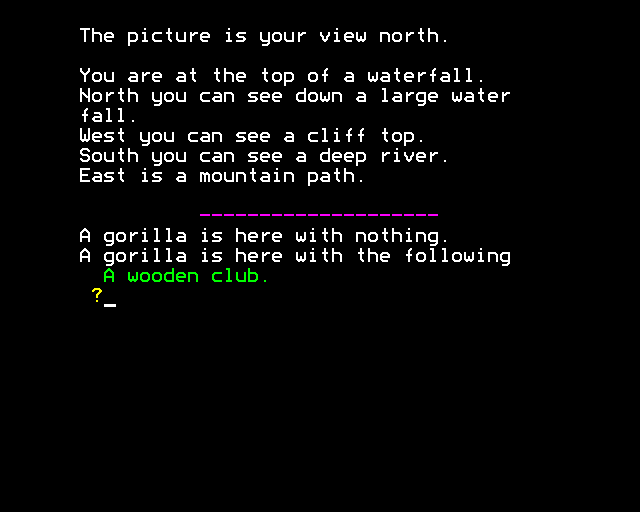
The gorilla is an enemy you can fight that can also follow and randomly thwap you with the club it is holding. The enemies can pick up weapons that happen to by lying around; again, this feels strongly like MUD behavior. An elf was nearby and later the gorilla had nothing and the elf had the club; it appears the elf simply stole the club.
A gorilla is here with nothing.
An elf is here with the following
A wooden club
Allegedly the puzzles aren’t elaborate (at least compared to The Hobbit) so this really does give a different feel than a standard adventure game. I’ll report back in next time if that holds up.
I may not have squeezed out every single piece of working game from The Temple, but I’ve squeezed out most of it. Once past the initial issue, the game’s crashes don’t come back until later, but they come back spectacularly.
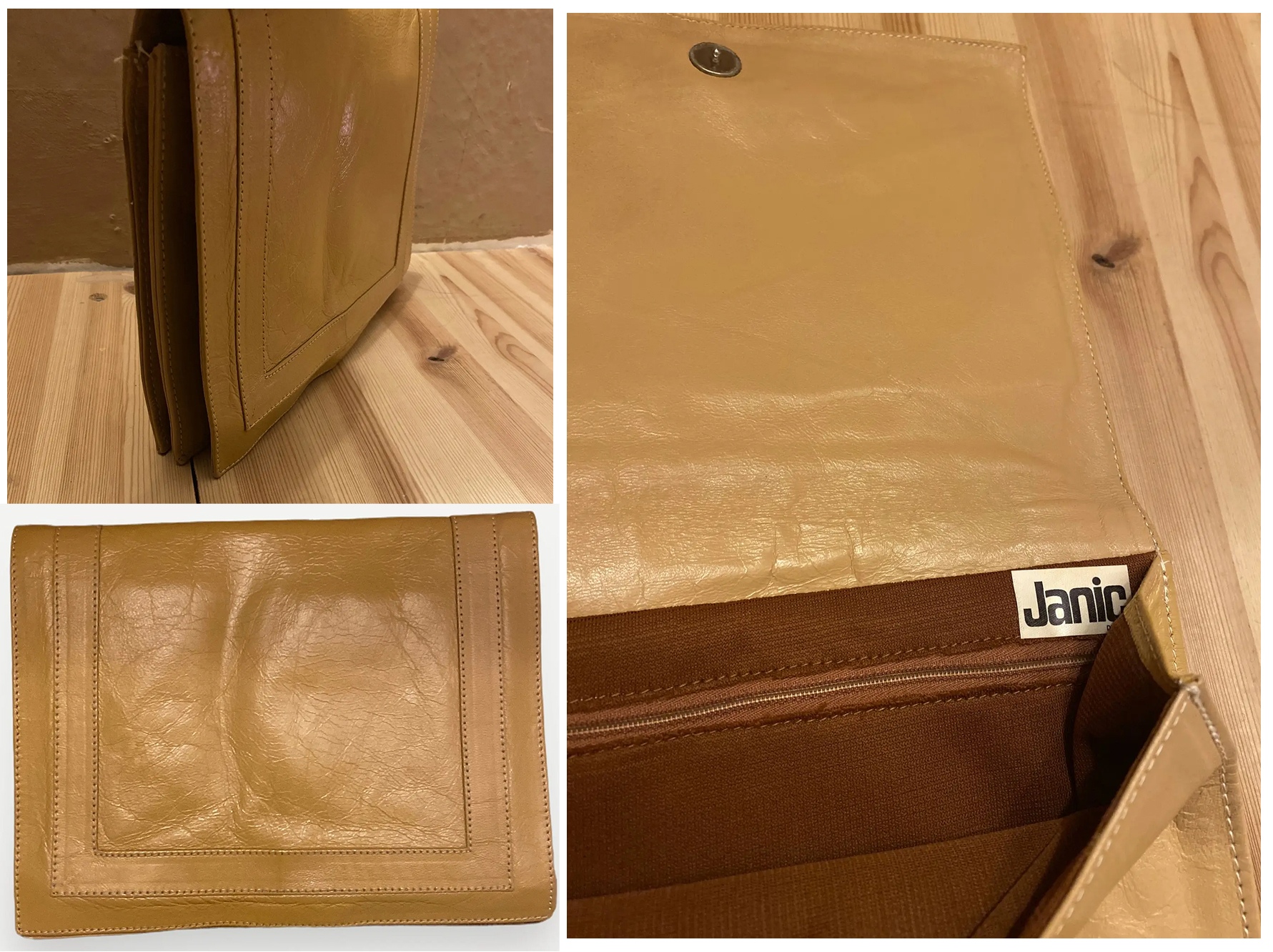
The only Janic bag I’ve found multiple pictures of, from Tradera. They were the company that later picked up Commodore products and ended up sending their PET computers to Datatronic when they went bankrupt.
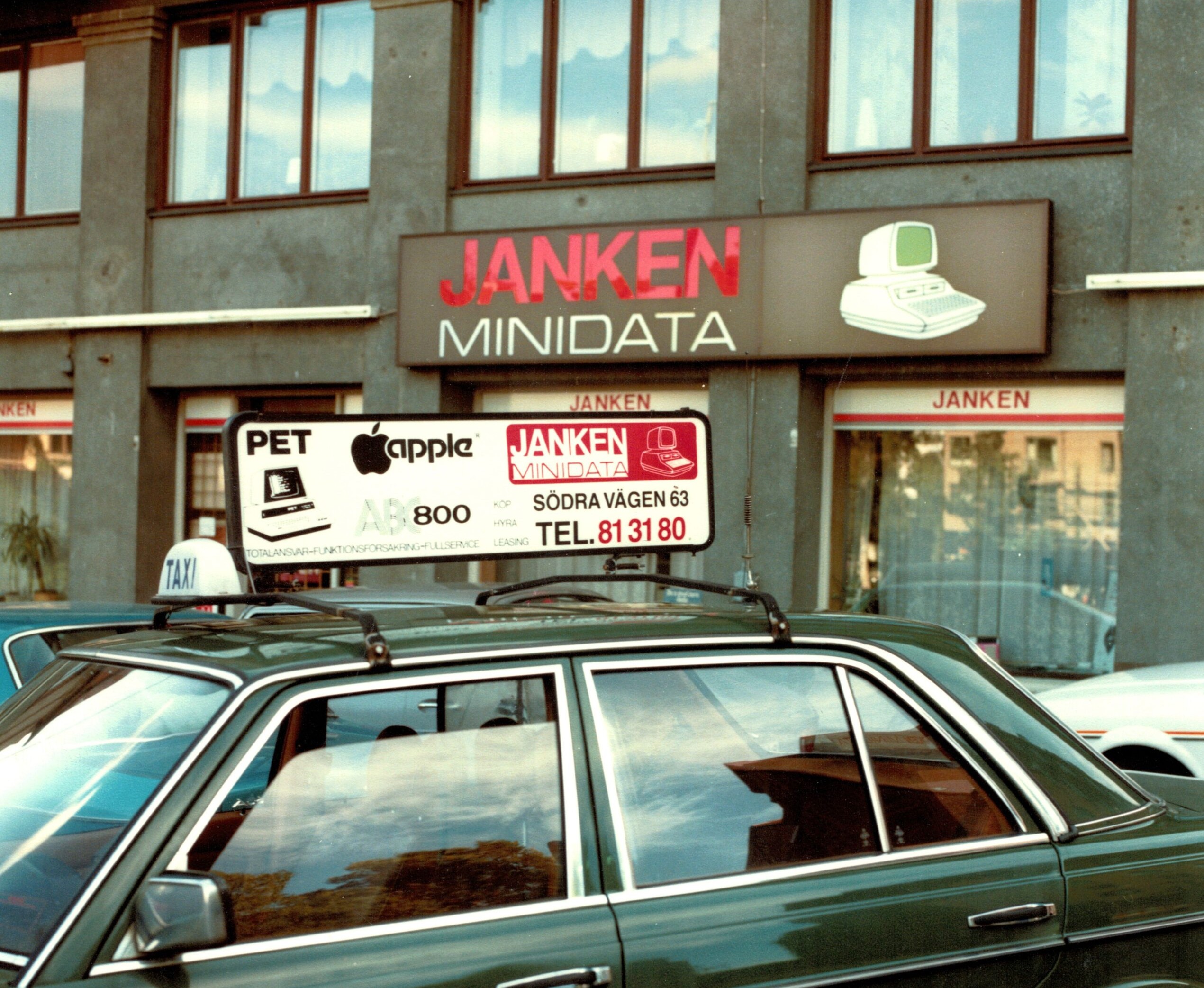
Exterior of Janken Minidata, where the PET computers eventually ended up. Source.
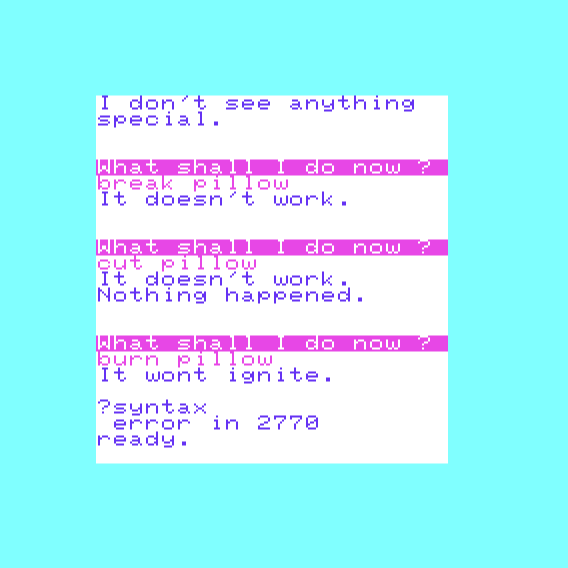
I switched to just using v1 (although anyone adventurous enough to edit the game might want to look at the early version of the game as well). After fixing the “burn” issue (where I changed “go” into “goto”) and I made sure to use directions with abbreviations (“n” instead of “go north”) I was off and running again. It took a while before another hard crash. I still am not clear if this was “left unfinished” or just undone by the bugs (caused by bad transfer issues, perhaps?).
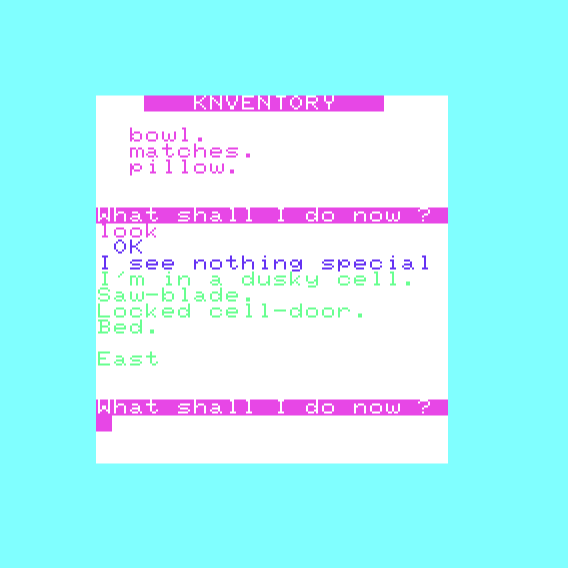
To recap the action, we start in a cell with a bed that has a pillow and matches, and nothing else useful. If you hang out long enough in the toilet room someone arrives to deposit an item.
Me messing around with random directions in case leaving room directions out is one of the game’s issues.
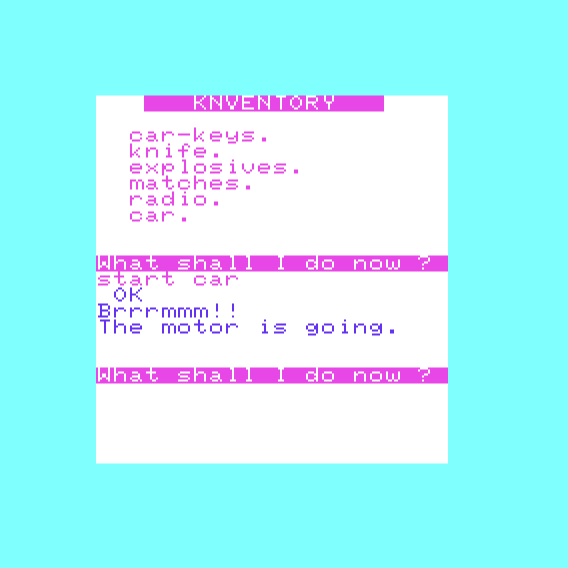
Regarding the “kn” typo above, I assume the intent is the word “in”. In PETSCII the binary for “k” is 01001011 and the binary for “i” is 01001001, exactly one bit difference; of course it could be a perfectly ordinary human-made typo, but this sort of thing does make me suspicious. (See “Scgtt Adams” from The Golden Voyage, clearly a one-bit error.) The game also uses KNVENTORY rather than INVENTORY.
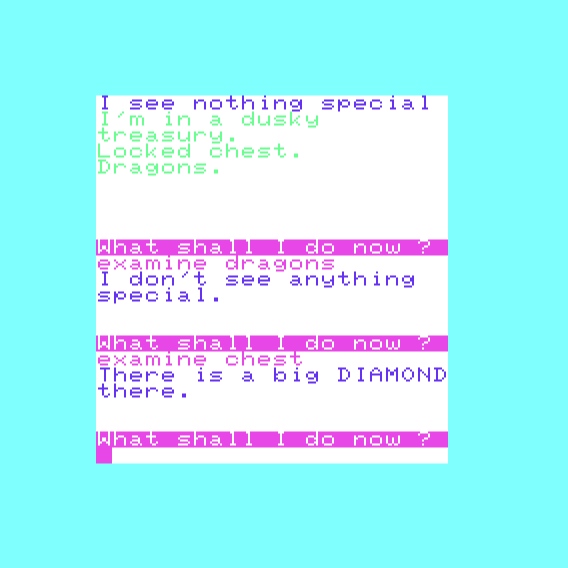
Going back to the main cell, there’s a bowl with food, and inside the food is a saw-blade. It looks like we have a friend on the inside, on our mission, which is to (????). (Really, I still don’t know. There’s dragons later and a diamond but the game just being a treasure raid doesn’t mesh with something else you’ll see later. Maybe it’s a mixed quest where we have multiple goals.)
You can then cut the door with the saw (“That was a hard work”) and get farther inside.
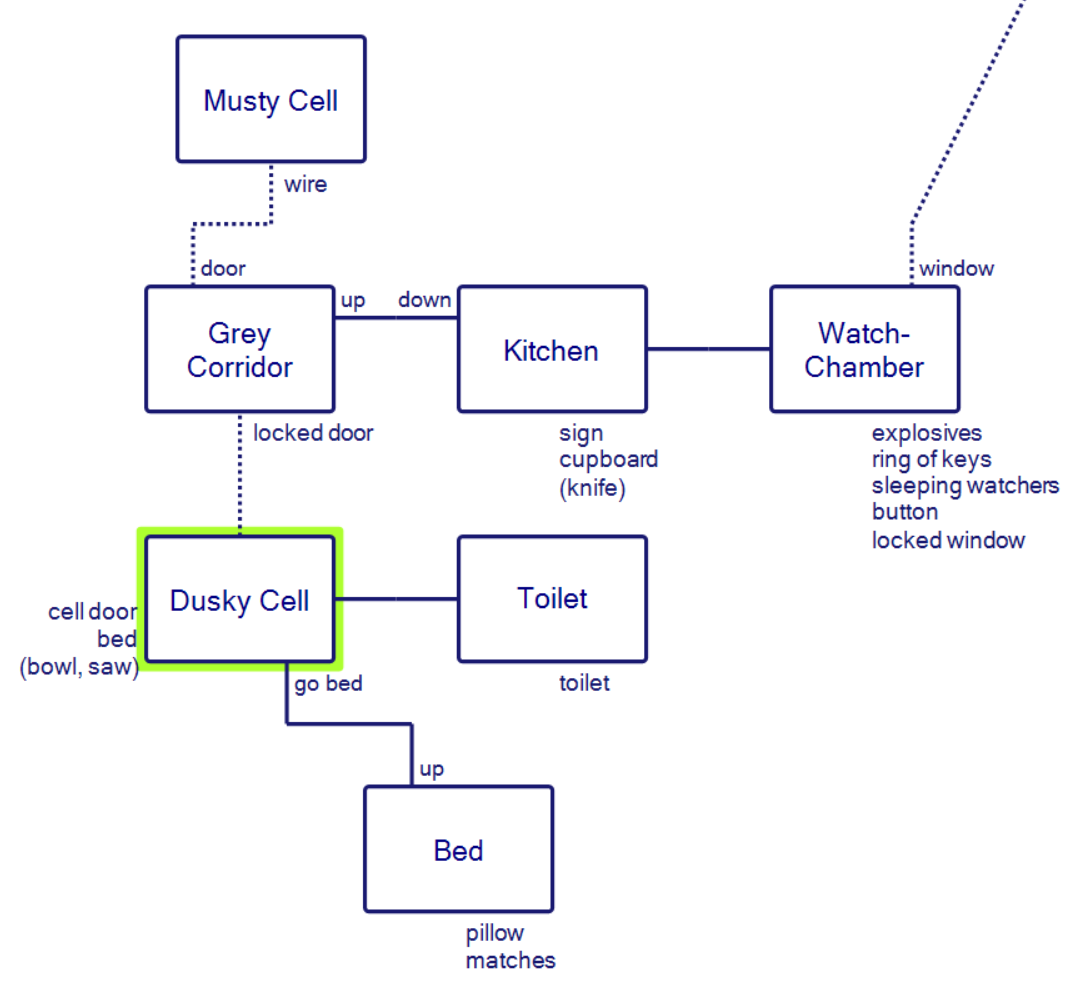
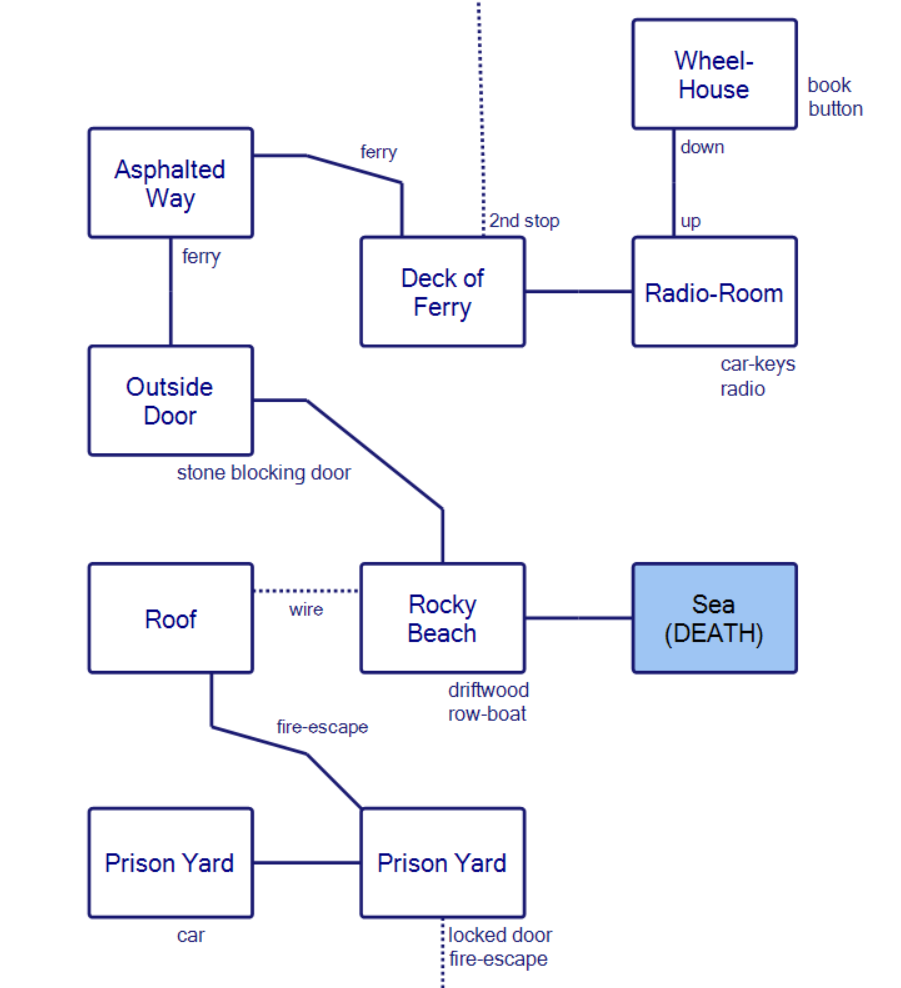
The first of three maps.
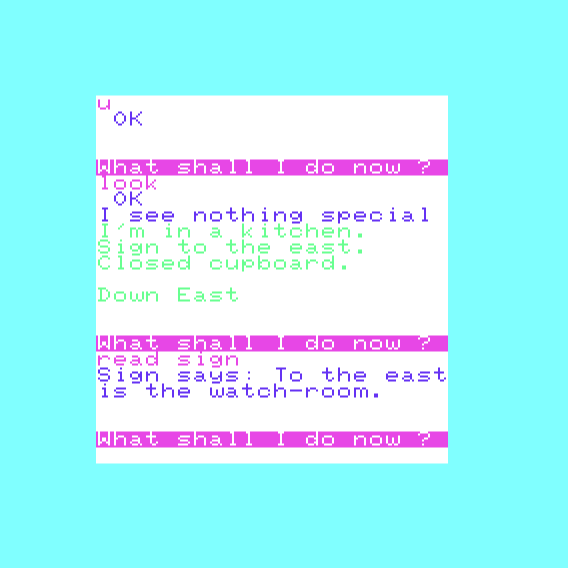
There’s a “gray corridor” with a locked door we can take care of in a moment; going upstairs to the kitchen, you can find a knife in a cupboard (which will get used much later).
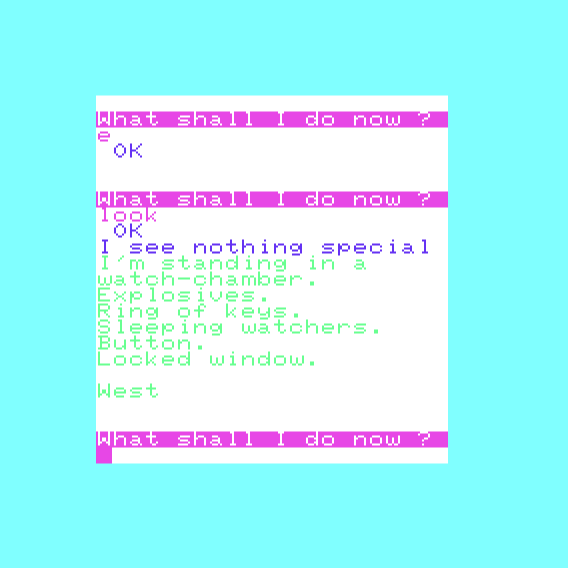
There’s also a warning about “watchers” in the room to the east which you fortunately don’t need to heed too closely.
They’ll only wake up if you PRESS BUTTON which sets off an alarm.
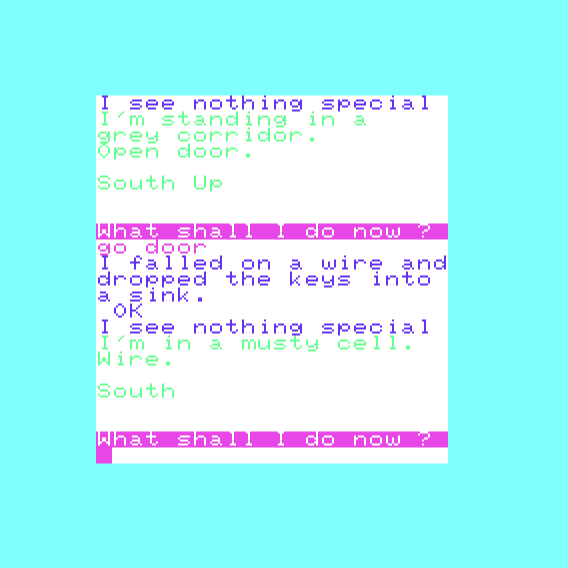
The keys can be used to both the window and the downstairs door. It’s better to unlock the window first because once you unlock the downstairs door (another cell) you’ll lose the keys going in.
You’ll lose the keys even if you drop them off elsewhere first and aren’t holding them, so this counts as a bug, but maybe it’s a bug in a “plot continuity” sense; you need the wire to get out of prison, and there’s more keys outside the prison, so this is a clean way to avoid referring to two sets of keys. Just: it’s a softlock if you lose them too early.
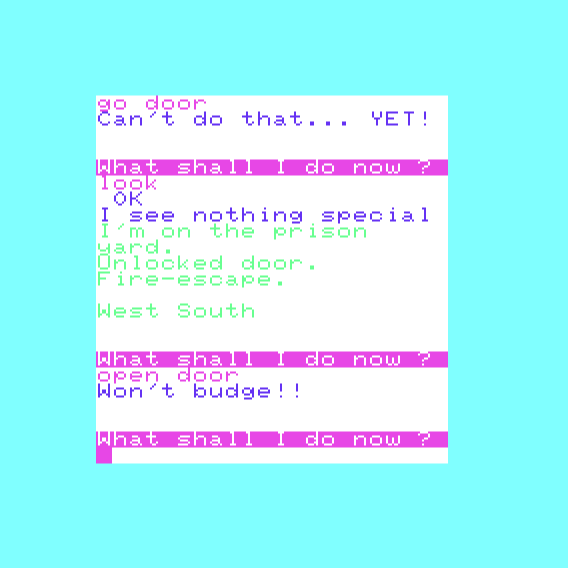
So far, the items: matches, pillows, wire, knife, explosives. Heading outside the window, there’s a fire-escape going up, another locked door, and an exit to the west. There’s another locked door (which you need those keys for!) although the door is jammed from the other side so you can’t go through anyway.
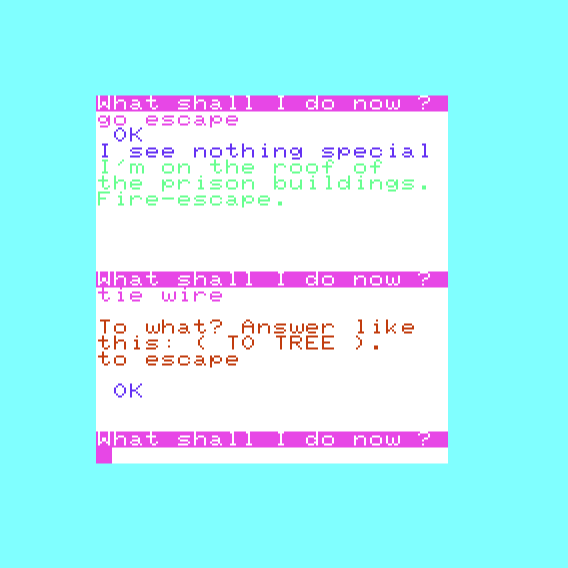
To the west in the prison yard there’s a parked car, but you can’t do anything with it yet, so it’s time to go up the fire-escape and use the wire as a rope.
Can you climb a wire in real life? It happened in Ferret as well.
This is not an intensely guarded prison, but I’m guessing our Man on the Inside might have helped with that.
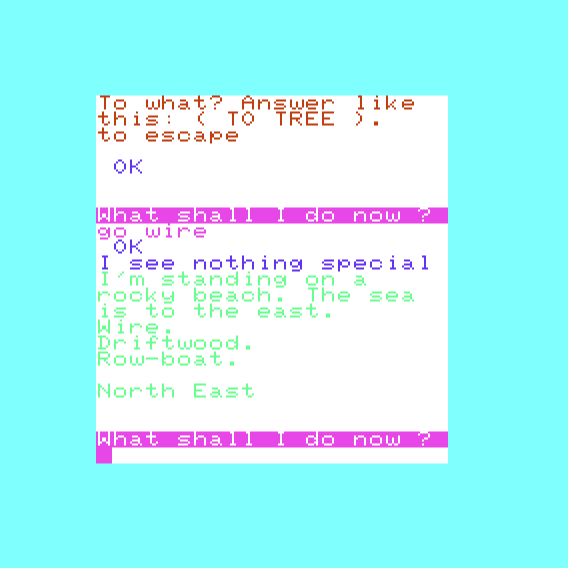
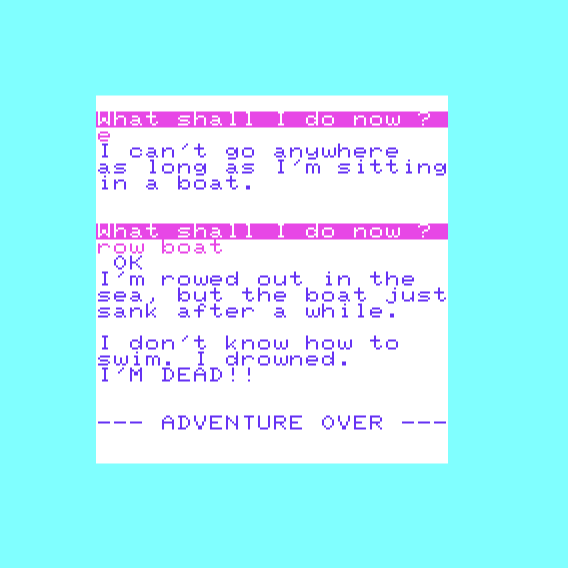
The landing spot has some driftwood and a boat at a sea. If you try to swim in the sea, you die; if you try to go via boat, you die.
It is faintly possible this is not just intended as a death-trap; while this is a “biome journey” of sorts like Wizard and the Princess nothing is one-way. In fact, it seems to be useful to maybe go back into the prison.
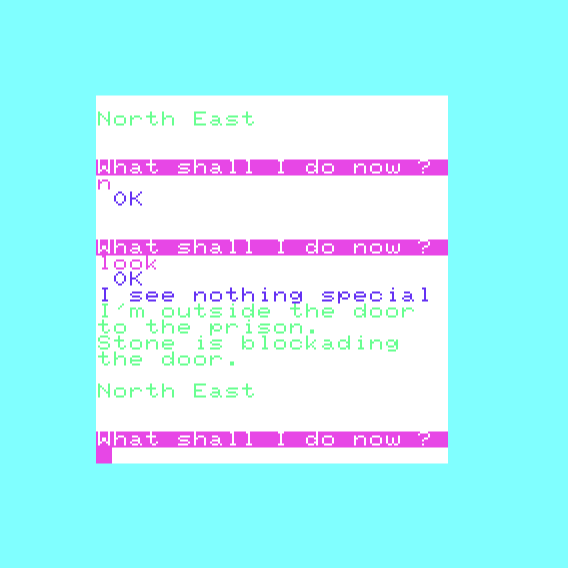
The reason you can’t unlock and go through the front door of the prison is the stone as seen above. I would think the explosives would take care of that problem but I never got them to work. If you do this, when you get the car-keys later (which you’ll see shortly) I think you can possibly drive the entire car out and do things with it.
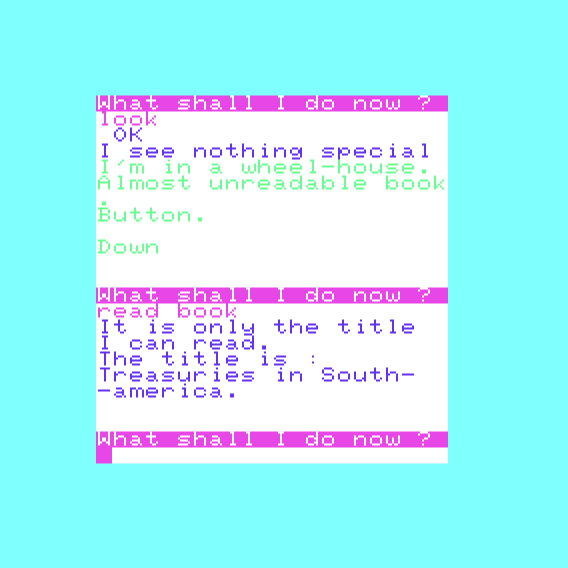
Moving on from the unexploded rock, heading north there’s a ferry. Get on and you can find a radio, the car-keys (told you) a book, and a button. Pressing the button causes the ferry to move to a new destination. You can re-press the button to go back.
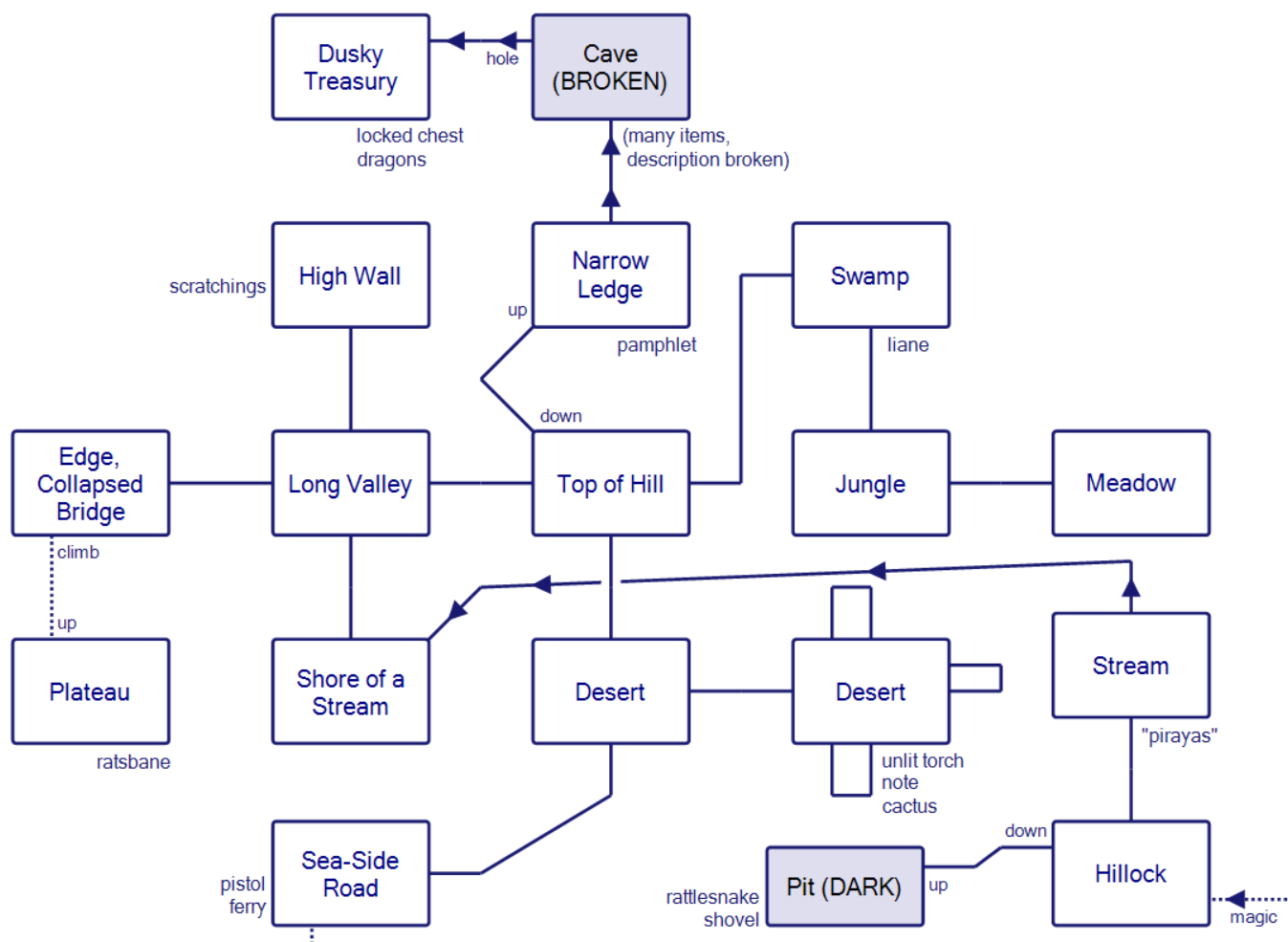
Voilà, the third map:
Straight off the bat you can find a pistol (if you try to KILL anything before finding the pistol the game says you need one). Then there’s a bit of branching, including:
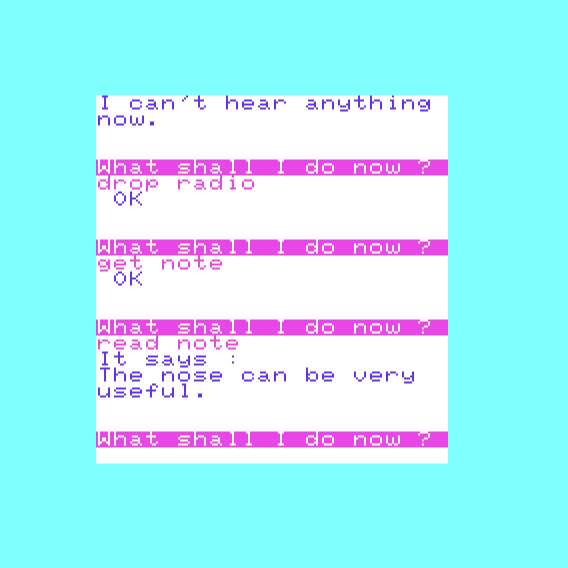
▸ a desert with an note, a torch, and a cactus; the note says the nose can be very useful.
▸ relatedly, on a “narrow ledge” you can find a pamphlet mentioning you can TURN the nose in all directions
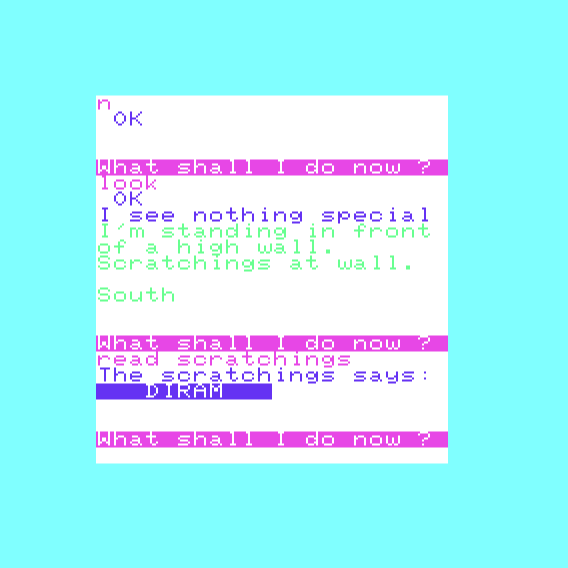
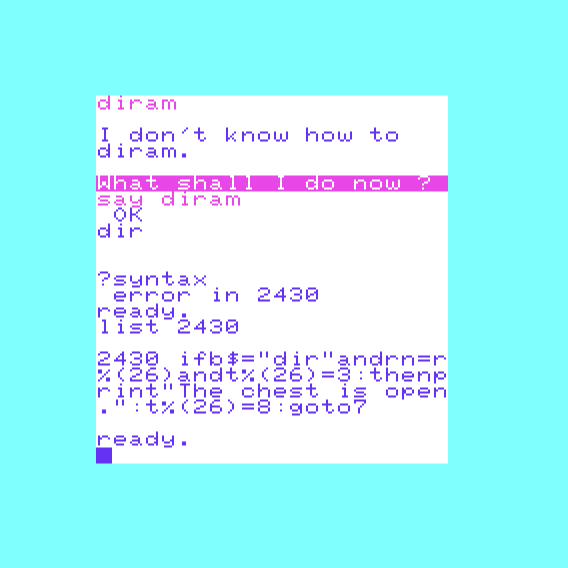
▸ a “high wall” with some scratchings; reading them reveals the word DIRAM, although I tried to use it and crashed the game
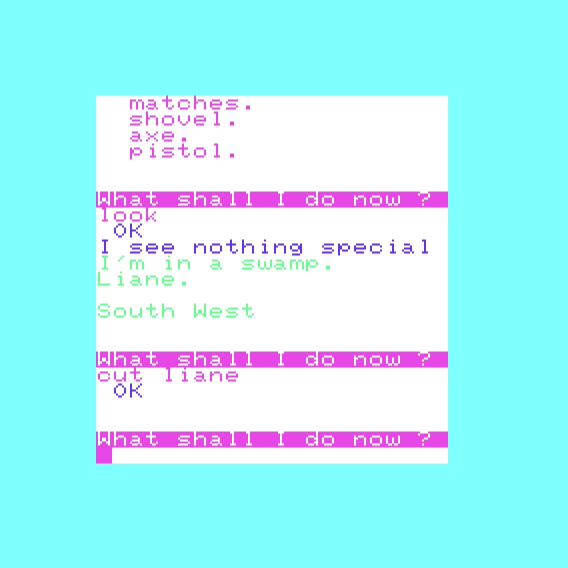
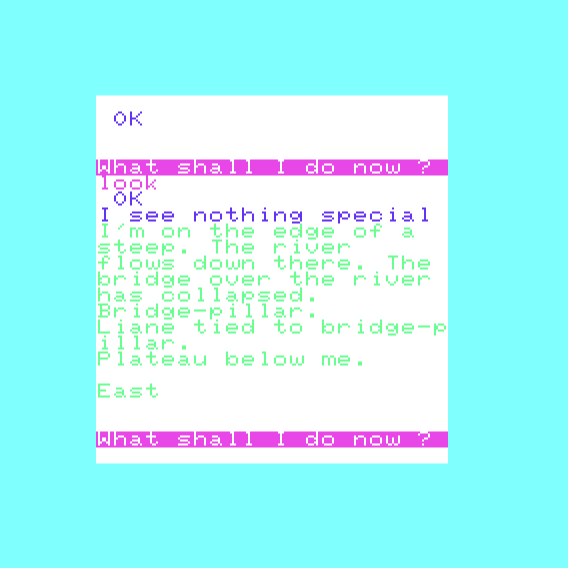
▸ a “liane” in a swamp which baffled me for a while; I realized after a bug I’ll show off later that it was referring to liana vines but for a while I thought it was a person and tried to talk to them
▸ with the liane you can tie it to a pillar at a collapsed bridge and retrieve some ratsbane
The use of the word reminds me of Citadel Adventure using the word “embrassures”. Sure, it’s technically a word in English (spelled wrong) but it’s extremely rare compared to all the other English words; this is the sort of move someone who learned English as a second or third language would make. I would guess the Swedish equivalent (lian) is more common? Mooware on Bluesky pointed out that liane is vine in German (spelled that way) so maybe Stefan Modin was just mixing languages generally.
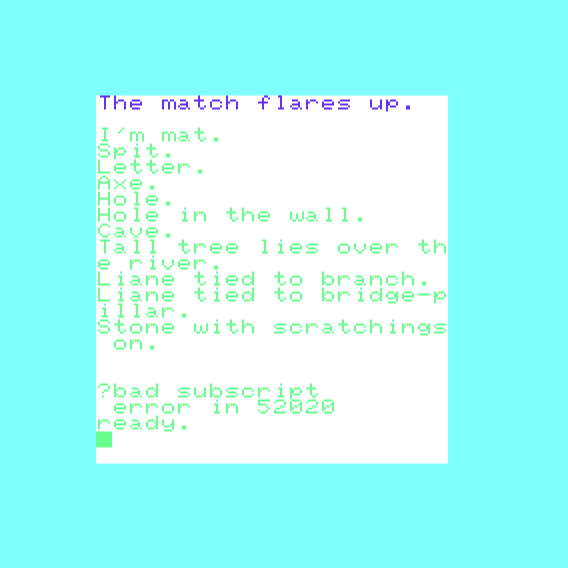
Now, for that bug that led me to realize it was a vine in the first place: if you go north from where you find the pamphlet, you’ll end up in a dark place.
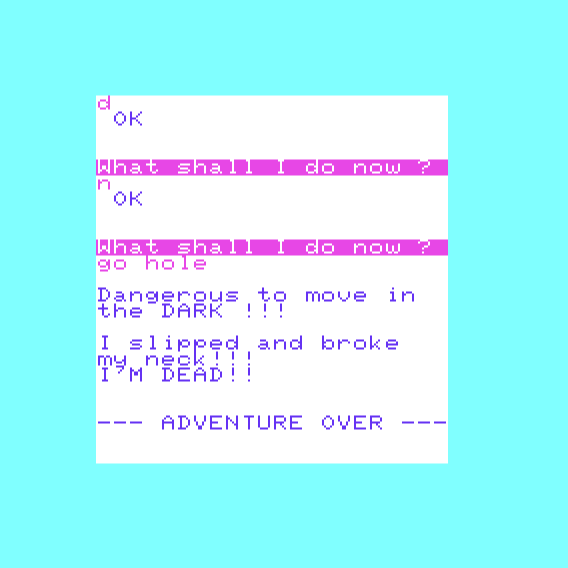
I was able to goto 7 and keep the game going, but without light. I tried “go hole” and usually died…
…but one time I successfully made it, coming across a treasure with dragons and a chest.
The buggy room has a letter you can read and find the word LOUZI; trying SAY LOUZI teleports you to a new area.
The new area includes a pit with rattlesnakes and a shovel. I have tried digging many places with the shovel although I admit I have not tried digging all the places with the shovel (that is, taking it all the way back to the prison yard etc.) I feel like I’ve hit the “broken threshold” enough that I can’t distinguish between a puzzle and a bug, so this seems like a good spot to close things up for now. If I ever get confirmation the game is fixed to the point of being completable (maybe not all the bugs) I’ll take another swing.
For now, we’re headed back to England, as coming up: Twin Kingdom Valley.
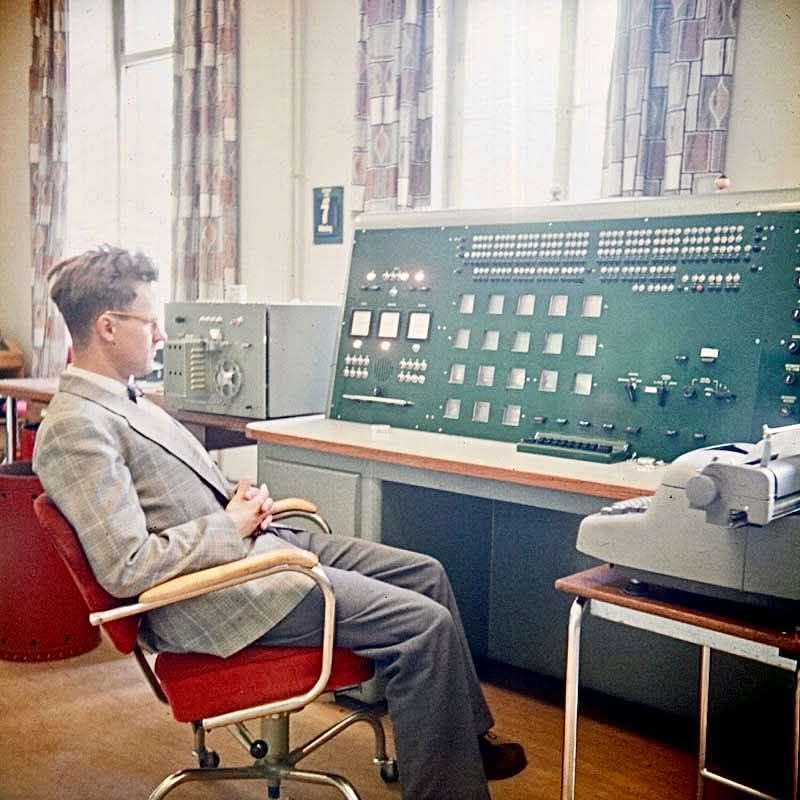
The last time this blog visited Sweden was with Stuga a full 15 years ago; one day, I will go back to that game and toss in the history of Swedish mainframes and academic computing alongside.
A 1963 photo of the BESK, via Stelios Kessanidis on Facebook. The BESK ran from 1953 to 1966.
However, we’ve got a complicated story with enough threads as-is. The threads will eventually unite in the late 70s. Let’s start in Italy–
I graduated in 1953, precisely the year the first transistor was presented by my old professor under a showcase in a display case. Those were truly different times, there was everything to do, everything to invent, everything to build.
One way to arrive at the mini-computer, the computer small enough for a regular business, was to start with the design of giant mainframes and work down; that’s how Data General worked, as told in my story on Thissala. Another way was to start with simpler machines and work up. This was the method adopted by Massimo Rinaldi.
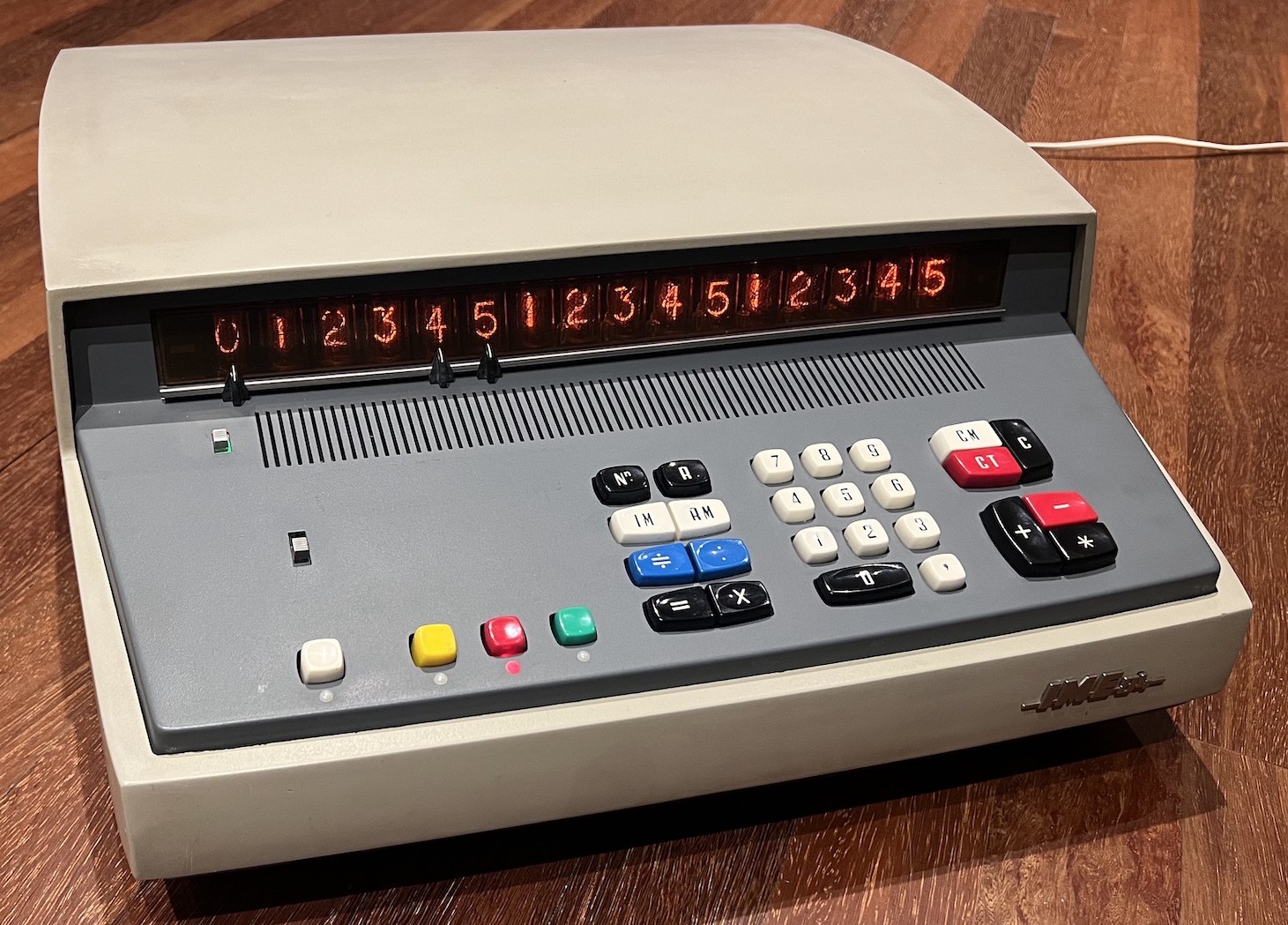
After his graduation in 1953 he spent a brief time with the company Hasler (design, they were a competitor to IBM) followed by some work at Raytheon (radar and telemetry). He broke out on his own in 1959 and founded Transimatic Italiana, intending to make his own calculating devices. He had great success in ’62-’63 selling what he dubbed the ED 114 straight out of his garage. It went for 3,135,000 Lira in 1962 (about $53,000 in modern USD) and had “addition, subtraction, multiplication and statistical functions, but not division”. Despite his success, when he made his next product (first dubbed the elma 3000 with his garage version, later named the IME 84) he had trouble getting it off the ground as he needed partnership with a real company with a real factory. (It was more of a mass-production product, rather than one expensive enough where he could custom-make one for each customer.) It took him a year (and multiple brush-offs with Olivetti) but he finally found one with Edison S.p.A., selling his company and becoming head of research and development.
The IME 84 came out in 1964, and while it was not the first desktop digital calculator (see my story on the British company Sumlock), it was one of first fully transistorized ones, or you could say “modern” ones. (The “one of the” phrase is because the Friden Model 130 and Sharp CS-10A both came out in 1964. Rinaldi did have patents and successfully defended his US patent against Sharp.)
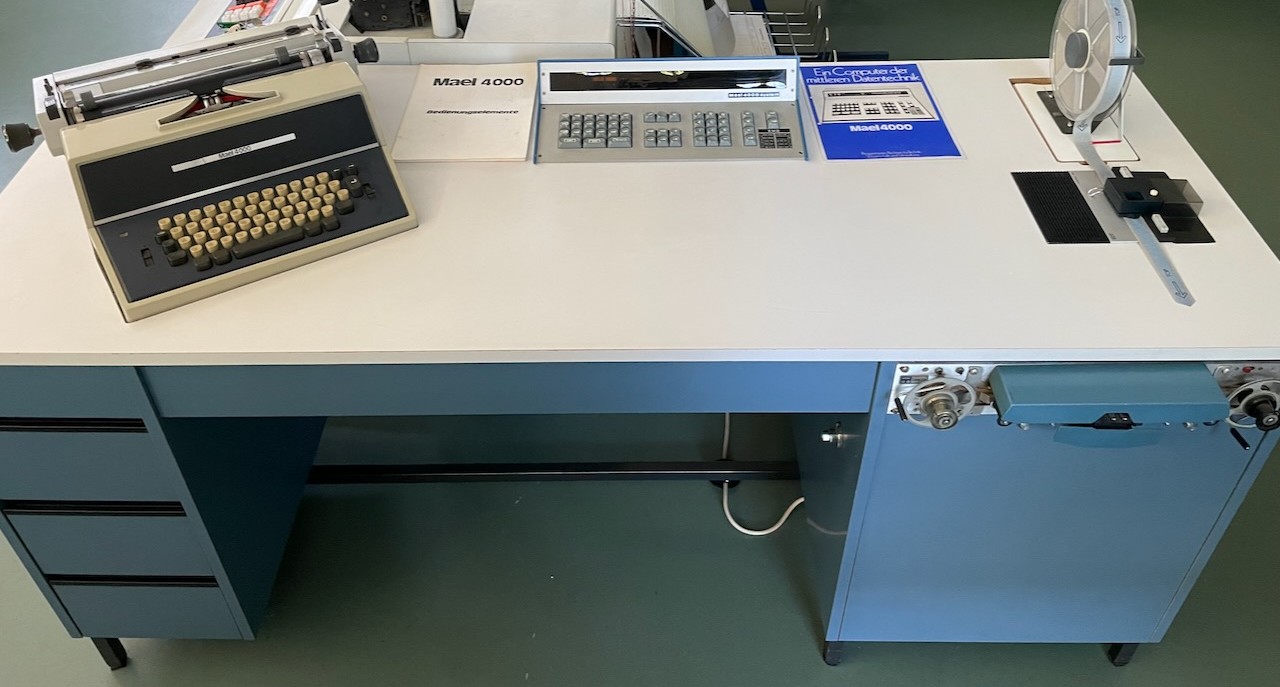
By the end of the 60s he had founded a new company with the Mael line, and while he called it a “calculator” in an interview, the Mael 4000 is sometimes cited as being a computer. It’s not really a “desktop computer” as much as a “desk that is a computer”, but it does do the majority of operations one might expect to buy a Data General Nova for, and it is technically programmable (although designed to stay only with accounting operations). It came with 2K of memory (expandable).
Via technikum29. Source. The electronics are in the cabinet to the right.
Mael’s products eventually diverged into regular computers, although nothing that was a serious “hit” for the general public; their products after tended to lean more to calculation devices for business, rather than trying to surf the hyperwave of personal computing.
Mael is the first company involved in this complex web; next up comes Diehl, from Germany.
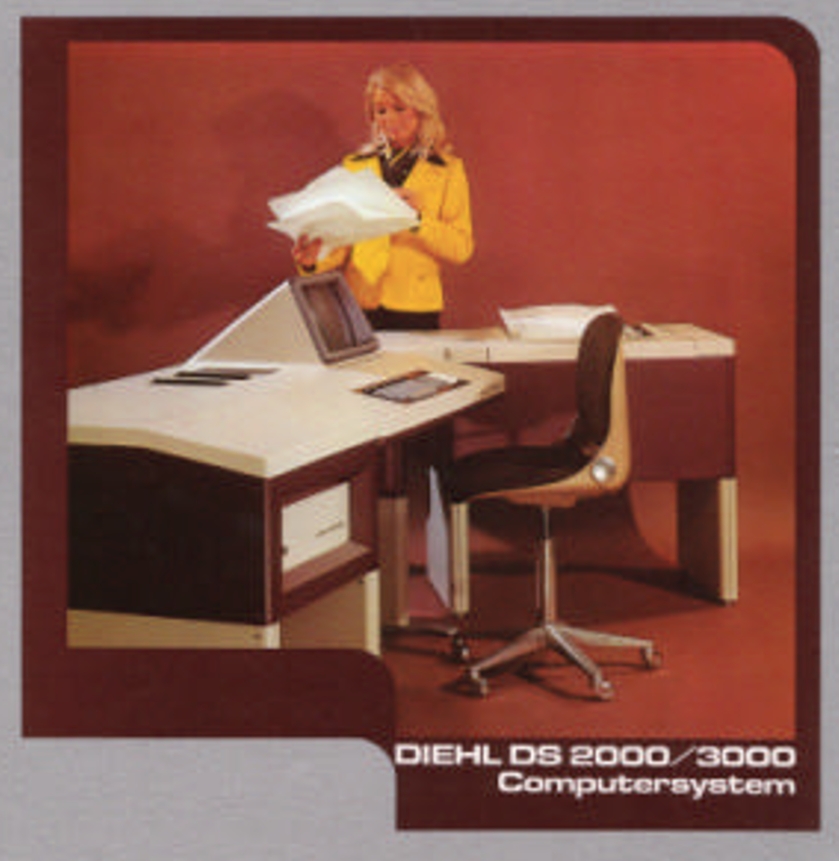
Diehl was founded in 1902 and did precision metal forging (like door handles); they started making mechanical calculators in the 1950s (see example video above) and by the 1960s made their own electronic transition. They landed a little later than the IME 84 (by two years) with the Combitron. The electronics were designed by an American, Stanley Frankel, formerly a physicist with the Manhattan Project.
A portion of the Combitron’s layout, via Facebook.
Similar to Mael, they entered the computer market from the bottom-up, making their computation devices elaborate enough to do the same accounting you could do on a computer (not play Spacewar, alas). Also similar to Mael, they finally had what people would recognize as “proper” computers by the late 70s, with almost no effect on the market.
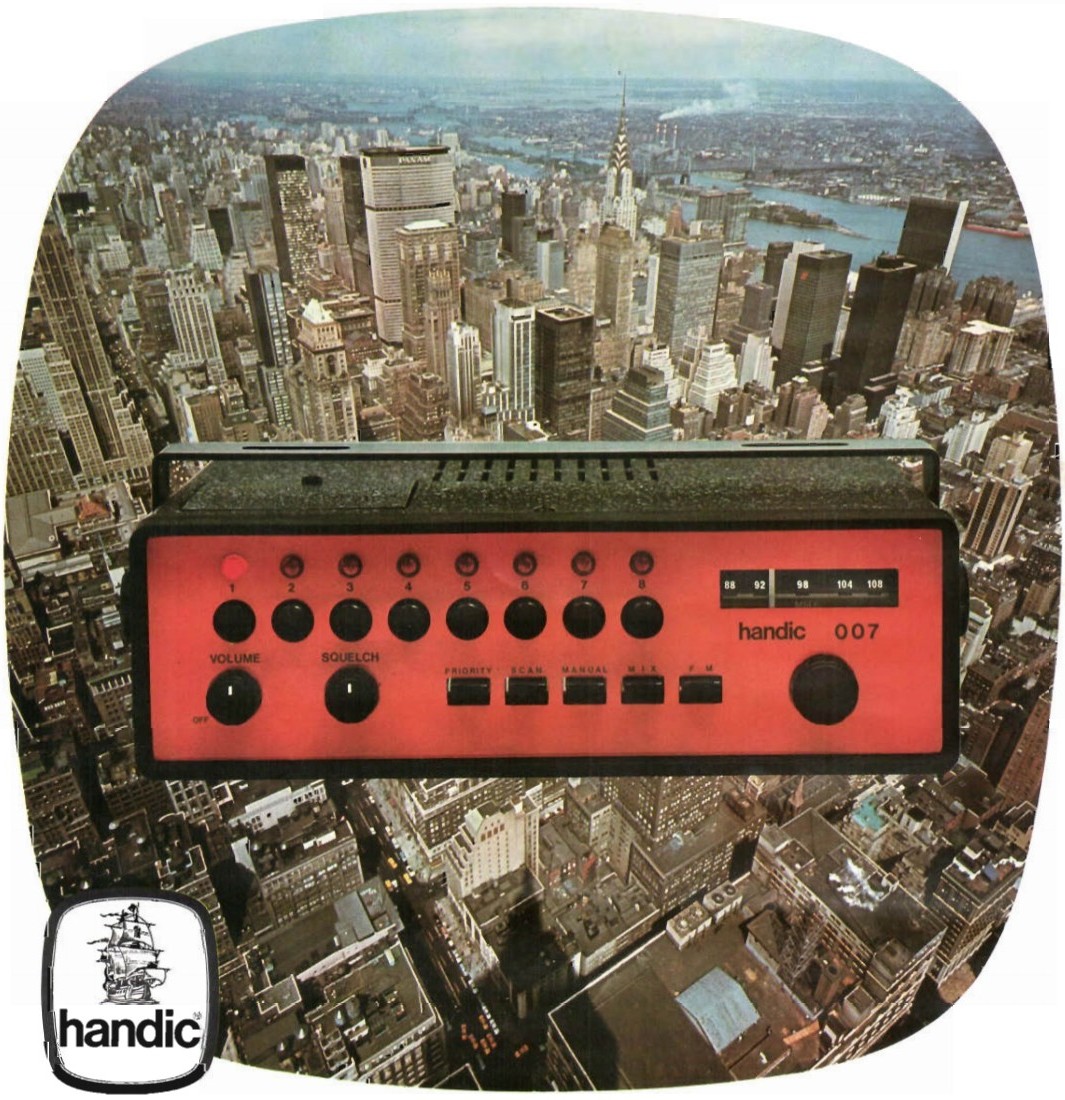
Since we’re not juggling enough balls yet, let’s go back to the 50s yet again, this time in Sweden. Handic Bolagen was founded in 1952 (president: Gunner Wennerström, vice-president: Stig Wennerström). They focused on audio equipment like radios and broadcast receivers, mostly produced with a distinctive orange color, although they also had a line of sports equipment (golf, skiing, boating, the “high end” sports).
In 1977 they were sold to the investment company Svenska AB Navigator. I’ve seen a source say this means they were now state-owned but it’s a little messier than that. Svenska AB Navigator was formed in 1969 as a sort of “collector of companies” with the main purchasers being affiliated with state enterprises and a pension fund. As of January 1976 28% was with state enterprise, a third was with the pension fund, a small portion was cooperatives, and the rest (28%) was holdings by private owners of the original companies; they had non-voting shares after selling out to Navigator. Essentially this was a back-door method of state company ownership without a vote from Parliament.
Two more threads to follow! The first is Datatronic. They were founded in 1968 by Torsten Frey and Hans Sundén and started selling mini-computers (of the “calculator” bent) to businesses in 1970, specifically the Mael line. They picked up the Diehl line in 1975; based on the timespan, this means they were selling the Mael 4000 (the combination desk-calculator) before switching to Diehl and then being bought by them outright. By 1977 Diehl wanted to drop them, although I’ll return to that point in a moment.
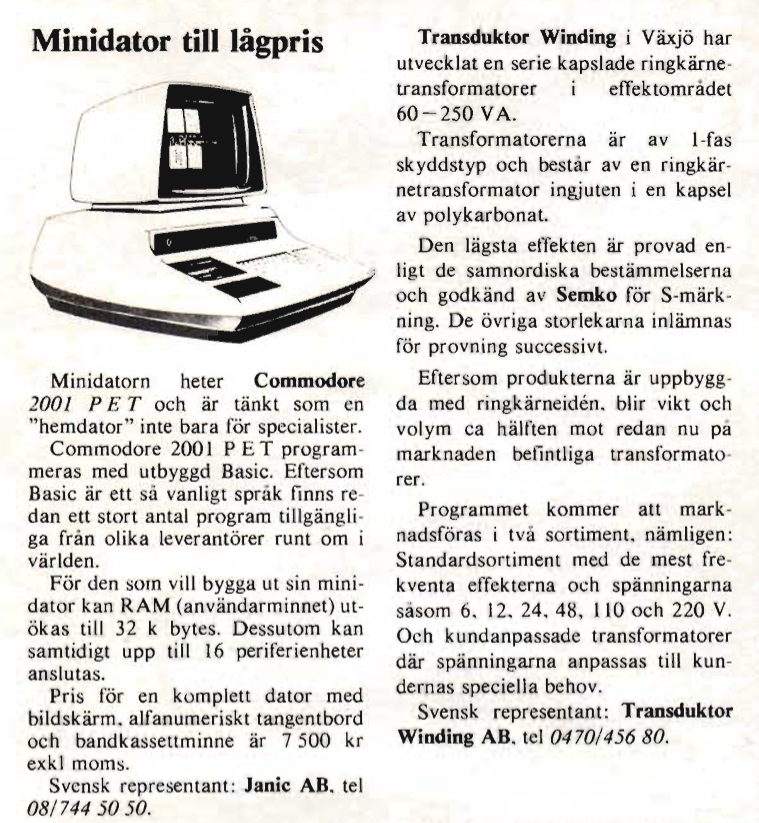
Our final thread is still in Sweden and the company Janic, founded by Jan Bergekrans. In the earlier years of the company they did handbag sales. The founder one day had read about Commodore and their calculators, and decided he wanted to diversify. (It’d be an absurd leap if he decided to sell the desk-computers straight off the bat, but these were devices where “you can fit it in your purse” was part of the sales pitch.) He had great success along with Commodore, and he started to add the Commodore PET to his sales in 1977.
So just to recap, before reaching the apocalypse of 1977/1978 that’s about to happen:
Mael: Italian calculator manufacturer, eventually getting into business computers Diehl: German calculator manufacturer, eventually getting into business computers Handic: Swedish consumer electronics, bought by a “state corporation” in 1977 Datatronic: started to sell (not manufacture) calculators, initially Mael before switching to Diehl and becoming wholly owned Janic: Swedish handbag manufacturer which got into calculators through Commodore and eventually the Commodore PET
All of these companies (except Handic) had major exposure to the calculator market, and while it was already dropping, in 1977 the market utterly fell off the map. Calculators that were going for $300 back in 1971 could now sell for $20 or less; price drops from warring companies like Sharp and Texas Instruments were so frequent that retailers were skittish about owning too much stock.
A retailers’ greatest problem occurs when Texas Instruments or some other manufacturer cuts prices without warning, leaving the retailer stuck with expensive inventories. Most manufacturers offer 30‐day price protection. This is little consolation however, for a store carrying a two‐month or three‐month inventory.
There was an entire ecosystem built around having slow, personal service around desk-sized calculators/computers; this was getting undermined by not only cheap calculators but by the ability of businesses to now buy personal computers. It was possible to transition and survive (Mael, for instance, still kept going strong with products like point-of-service machines) but certainly something in these companies needed to change.
Diehl in particular needed to get out of Sweden. Outside investor/consultant Mats Gabrielsson (and two employees of the company) bought the struggling company for a single Swedish krona, switching it over from Diehl back to Datatronic in name early in 1978.
Despite Janic hooking up with Commodore who went on to later success, the 1977/1978 period gave them too much exposure to the calculator crash, and Jans made a plan to declare bankruptcy. He contacted Mats Gabrielsson (from being a consultant through the 70s, he knew everyone in the industry) and asked about buying the Commodore agency, selling the 50 PET computers he had in stock as part of the deal. The contract was signed October 30 and the PETs were meant to be collected October 1. That was a Sunday, so the driver needed to be bribed with four Pong games.
One other company worth mentioning with the Janic bankruptcy story: Janken Minidata. They were the second computer store in Sweden, and the first to sell Commodore machines. The store was owned by Kenneth Palmestål and Jan Eliasson. Kenneth Palmestål had visited the Stockholm Technical Fair in 1977 and saw a Commodore PET 2001 (exhibited by Janic); he ordered one which arrived in December, and when he tried to start it up the computer broke because it had been too cold.
He still had a determination to sell computers, and with his friend Jan Eliasson (who had been working selling calculators, of course) he formed his computer store. He had heard about the approaching Janken bankruptcy and had made a deal with Jan Bergenkrans to buy the remaining machines, but when he rented a truck to pick them up he found out the machines had already been sold. He eventually got his supply from Datatronic instead.
Inside Janken Minidata. Source. They also sold the KIM-1, NASCOM, and TELMAC 1800 kit computers in ’79, and in later years sold the Apple II and the Luxor ABC (a Swedish computer I’ll discuss in some future post, as it does have adventure games, including the first in Swedish on a home computer).
Returning to Datatronic and their ambitions to sell Commodore, two important points: first, Commodore used Datatronic as an agent, and never entered the market directly until later in the 80s (this is in contrast to Denmark, where they did battle with the ZX Spectrum directly). Second, because of Datatronic’s past, their network contacts and sales expertise were hooked up with the business desk-calculator companies (Mael and then Diehl) so they didn’t have the reach needed for a mass-consumer product. While they (re-)launched with initial success (with computer stores like Janken Minidata), they needed to get the network of a consumer firm, which is why a few years later they purchased Handic.
This divested Handic from the “state” control into the hands of Datatronic. (One reason why it’s false to say Handic was nationalized is that this didn’t require an act of Parliament.) They created Handic Computers and Handic Software both as spinoffs although they weren’t strict about their naming conventions. The motivation for the purchase was straightforward access to the company’s distribution network, meaning nearly all foreign subsidiaries (Denmark, Germany, US) were sold; they only kept the one in Holland, as they were too tightly integrated, so they split operations of that subsidiary 50/50 with Commodore. They weren’t done building a network, also buying Ekman Import (a distributor of electronic equipment) in 1982. By this time the VIC-20 had come out in Sweden and was wildly successful.
This manual is marked as being from “handic electronic ab”.
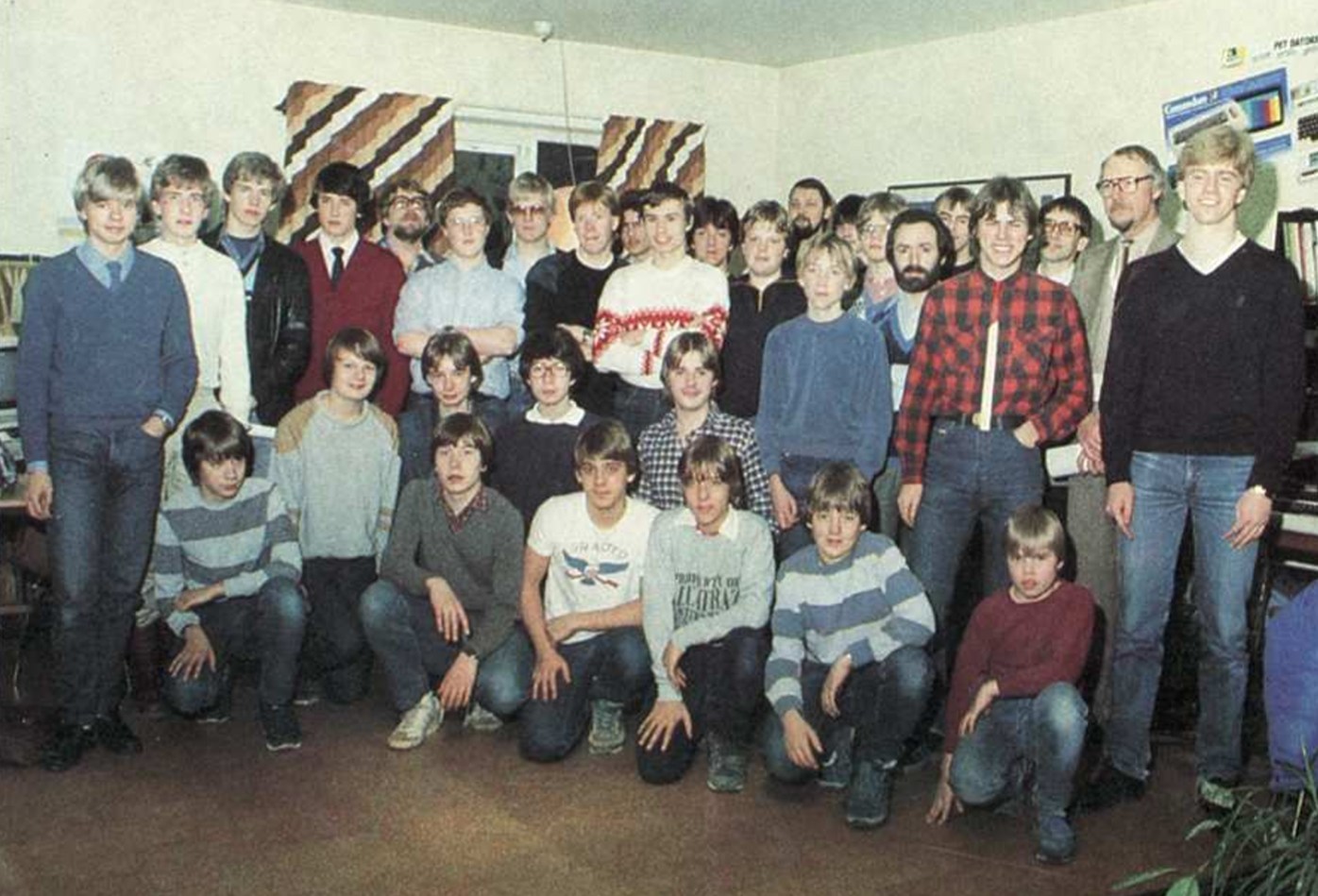
Datatronic/Handic heavily encouraged the growth of computer clubs. For example, the Westerås VIC club came from the company Rastionell Programutveckling (RPU); they became close with Handic, with members of the club sometimes going on to work there (quoting my source, “in some cases with the delay of a few years, as the young people first wanted to finish high school”).
Westerås club members via Vic News 2-1 published by Handic.
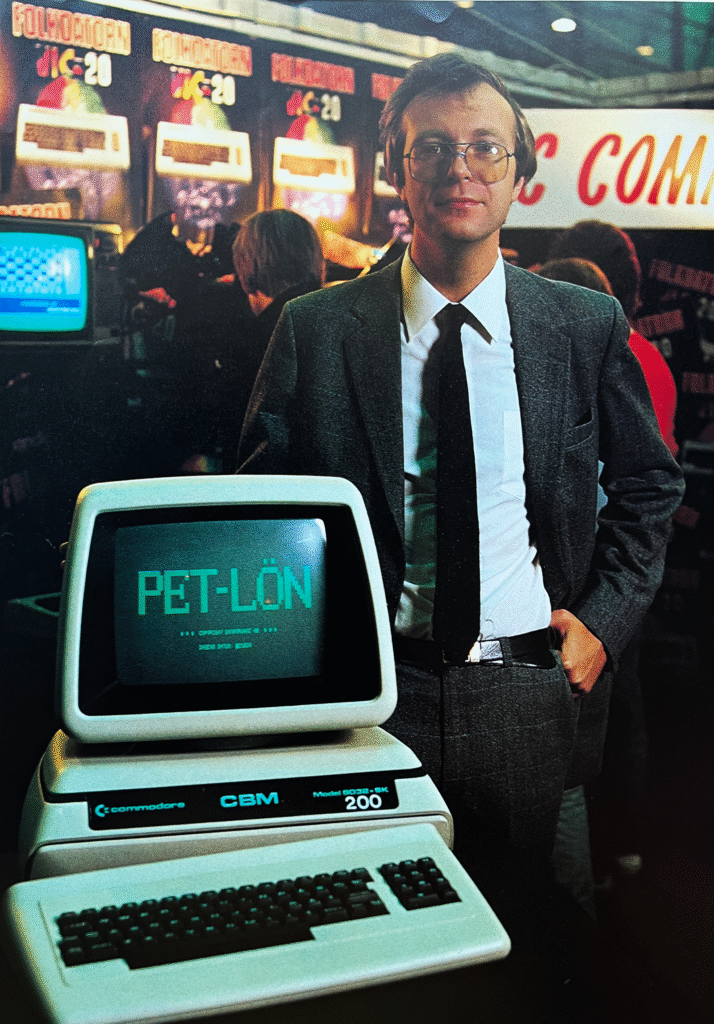
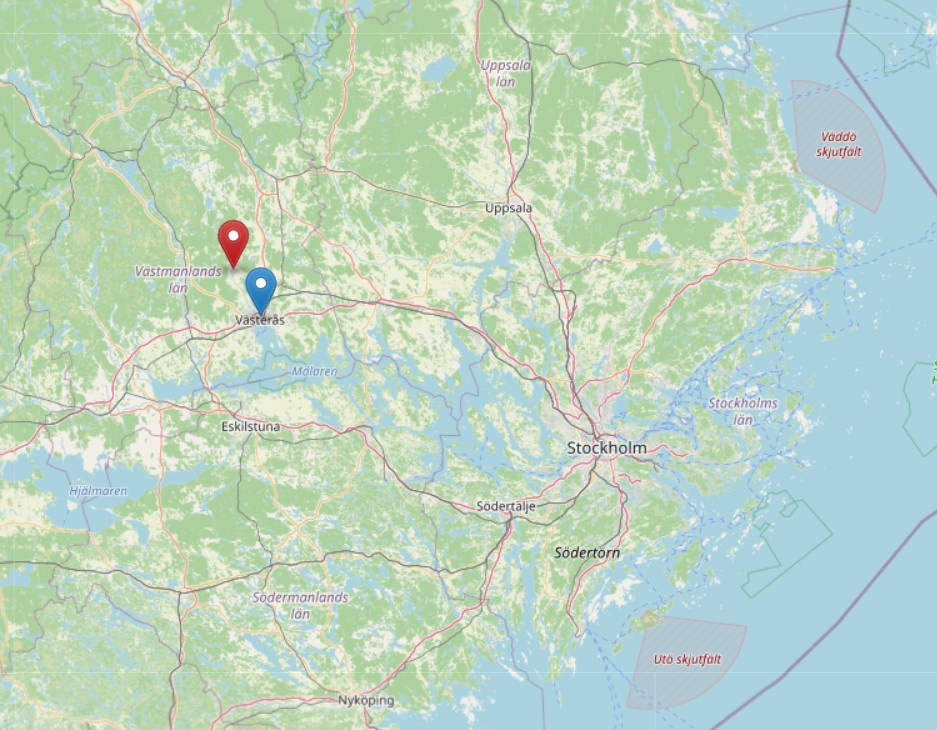
Our author today, Stefan Modin, hails from Skultuna, fairly close to Västerås (spelled Westerås in older documents). He is presumably somewhere in the photograph above.
Skultuna in red, Västerås and the club to the southeast in blue. Eskilstuna is also near and will be important in a future post.
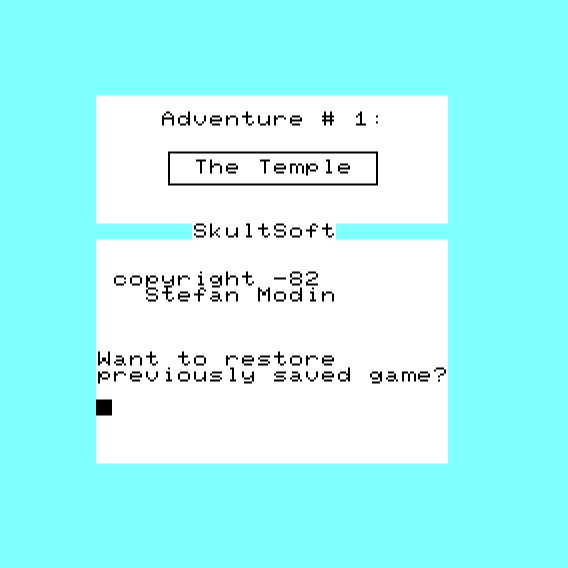
According to the research of regular commenter (and expert on Nordic computing history) Rob, Stefan Modin formed his own company name “SkultSoft” to riff off his hometown name, and wrote three adventures: The Temple, Spider Mountain, and The Mutant Spiders. The Mutant Spiders was picked up by Granda Software (we’ll get to them in a future post). For now, let’s just focus on The Temple, which you can download off a forum thread (look for “rpu-adventures.zip”).
Unfortunately the files we have are broken (according to Anders Carlsson who did the preservation, it’s “really tough to get somewhere”) but we’ve had this kind of situation here before. Poking through the source code, the game “feels” complete, just it’s getting some erratic bugs. Some may be linked with this being on a Swedish VIC-20. There were differences; the PET was (for instance) modified to include the letters Ä, Ö and Å. Since it’s relevant here, some VIC-20 specific details:
An expansion kit modified the [, £, and ] keys to print, respectively, the diacriticised characters Ä, Ö, and Å, but this required alterations to the Kernal decoding tables, the keycaps and the Char ROM; these changes obviously messed with programs using the brackets and £ symbols, and also, because the new keyboard mapping obliterated the graphic characters on the @ key, made it just about impossible to type in certain programs. Peter Karlsson says that the Swedish characters were added after the Z (in both lower and upper case modes) in the order defined by ISO 646-10, rather unhelpful because the ISO order is not alphabetical and so simple ASCII sorting didn’t work correctly. Some graphics symbols also got altered when shifting to upper/lowercase mode.
Based on the nature of the errors, I don’t think these modifications are what’s causing the problem, but given what happened with Citadel Adventure, I can’t discount anything at the moment.
Just as a reminder, on VIC-20 screens I have been squaring them up for readability. This would be twice as wide on a real VIC-20.
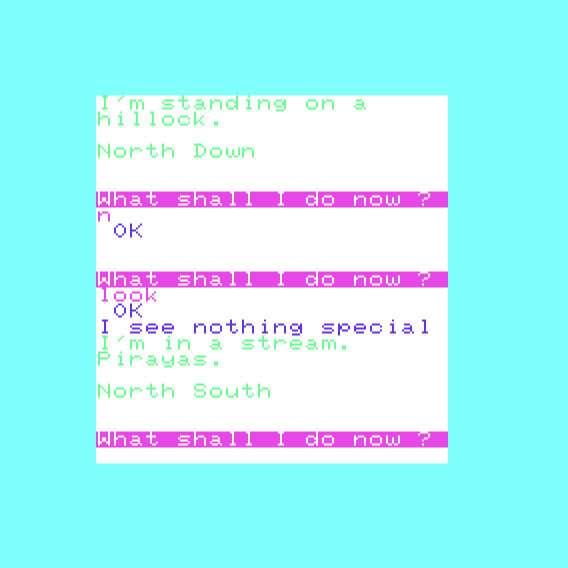
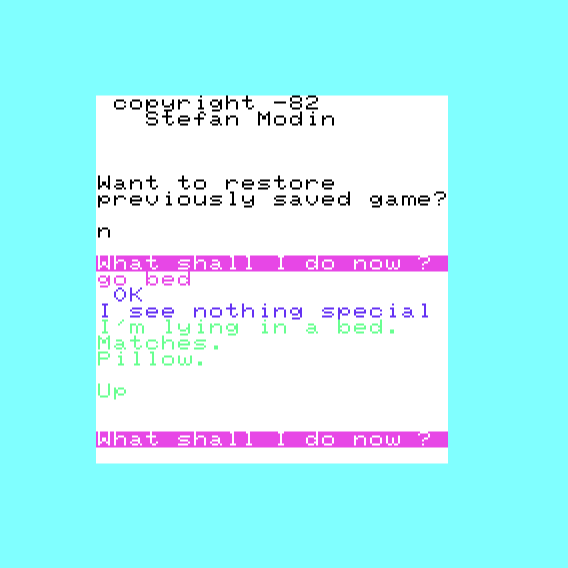
You start in a cell. There’s a toilet to the east, and you can also go on the bed. Note that it does not give a room description anywhere unless you “LOOK” first; it’s a little like playing an Infocom game on SUPERBRIEF in that way. It makes some sense on a VIC-20. The only previous games the author likely had access to (based on a VIC News article) are the ones from Scott Adams, and they don’t have that behavior (no “split screen”, but the screen clears and a room description displays when entering a place).
Trying to “go bed” in the “pre” version immediately results in a crash.
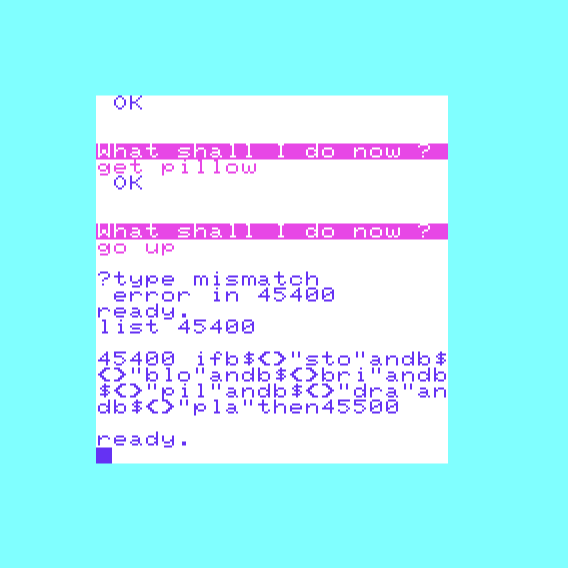
?type mismatch error in 45200
ready.
list 45200
45200 if b$<>”row”andb$<>”boa”andb$<>”fer”andb$<>car”andb$<>”bed”andb$<>”sta”then45300
Notice there’s a quote mark (“) missing from car. Retyping the line exactly as is with the quote mark fixes the problem. (It’s already fixed in v1.)
Getting the pillow and matches and then using “go up” to leave results in another type mismatch (in the “pre” version).
Trying to do the same thing in the “v1” game results in an entirely new bug.
Just typing “u” works though.
There’s one other accessible room to the east of the cell.
This is on v1, pre crashes when you examine the toilet.
Trying to “go toilet” gets the response “AH! That was better!”
I proceeded to then try to do something with the pillow and matches with no luck.
The source code in question has:
if x<>19orx<>20thenprint”It wont ignite.”:go7
The issue is “go7” which should be “goto7”. Line 7 is the main parser. That wouldn’t be caused by character issues, would it?
With the number of bugs I’m not going to put myself on the hook for going any farther (I don’t even know what the goal is!) but it quite likely is the first adventure game from Sweden on a home computer so it’s worth some effort. It doesn’t feel like a systemic kind of issue (one POKE in memory and everything works) but more like Marooned with an abandoned work in progress. Still, we were eventually able to get through Marooned (thanks to exploradorrpg) so I’m not going to call this one impossible.
First, a resolution of the technical mystery with the caps-swap, courtesy of Andrea Pachetti in the comments (who has a blog dedicated to the history of Italian videogames, I liked this post on patents).
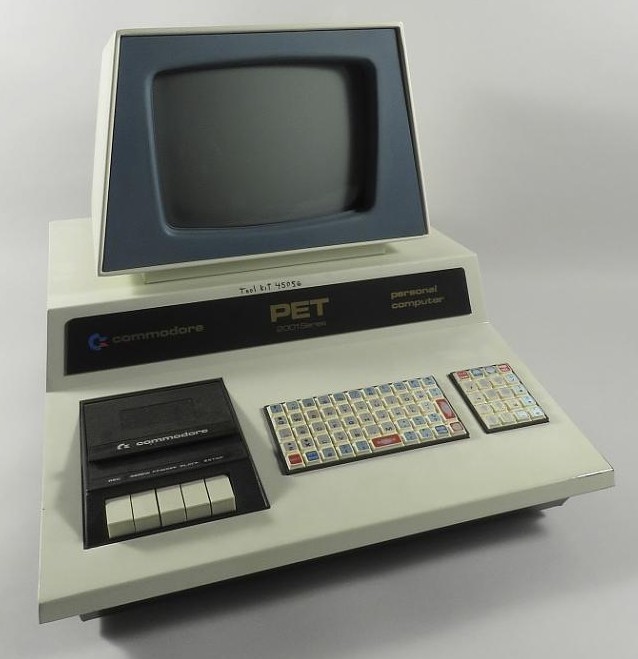
As I theorized, this was ported from a Commodore PET; Andrea found it was specifically a PET 2001 (the first model) with a 32K memory extension added. (The main smoking gun was a “POKE 59468,14” command in the source code which causes the PET to switch to a mode which “looks better for typing, but has fewer graphics characters”.) In the VICE emulator you need to choose that particular machine, then pick “32k” for memory which will make the model list as “unknown”, then load this file Andrea prepared; this allows for the original BASIC source to run with normal capitalization. For the remaining screenshots I’ll be giving them on PET. (For the most part. The save states were having issues due to the strange character set handling so I played on C64 first before making a run on PET.)
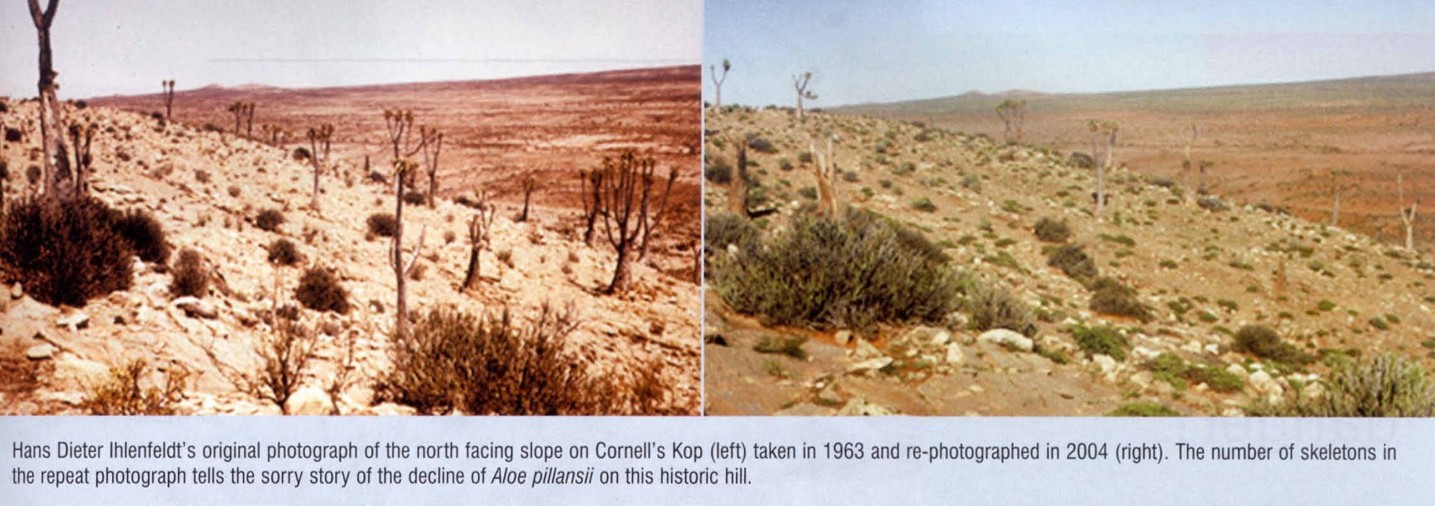
Using the PET clue, Andrea went on to find a classified ad with an address, then cross-checked that to find the likely author: Hans-Dieter Ihlenfeldt. He was a German botanist born in 1932 (died in 2023); Wikispecies lists him as authoring 15 taxon names and he has an incomplete set of papers up at ResearchGate. This ends up explaining something in the game you’ll see later.
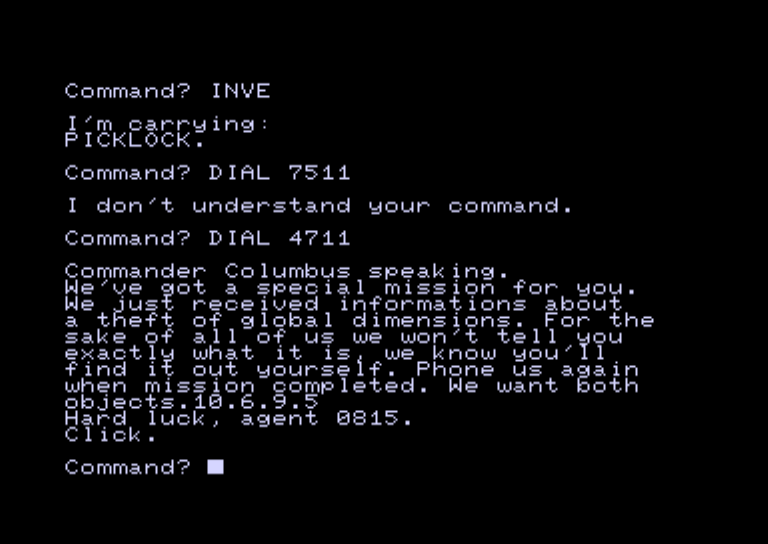
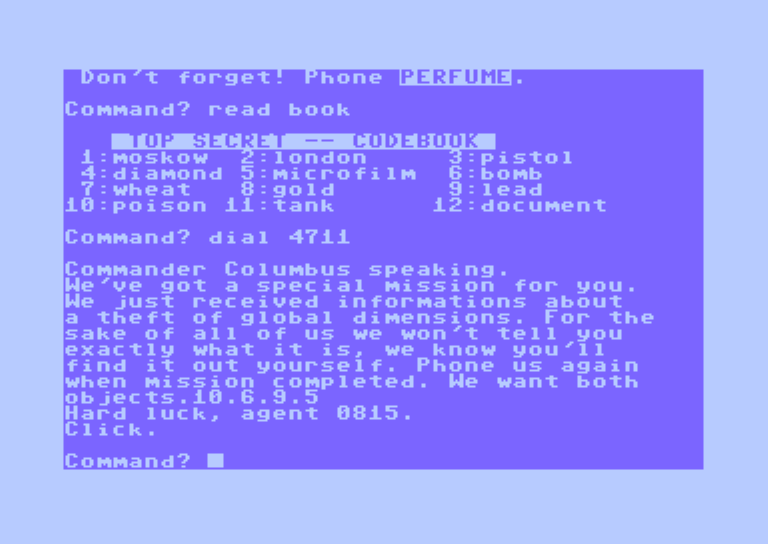
Past that: a resolution to the 4711 mystery, which I got from multiple people both on and off my comments (thanks to everyone)! There’s a particular German perfume with that name. It’s famous enough that searching “4711” alone gets a bunch of perfume hits; I admit I was in the mental space of assuming a self-contained puzzle (without outside references). Normally I’d still consider the puzzle unreasonable since we’re solving from the word PERFUME and getting a number too short to be a phone number (also, there’s lots of different numbers perfumes could be) but I am reliably informed that in Germany 4711 being associated with perfume is strong enough for meme-status.
Commander Columbus speaking.
We’ve got a special mission for you. We just received informations about a theft of global dimensions. For the sake of all of us we won’t tell you exactly what it is, we know you’ll find it out yourself. Phone us again when mission completed. We want both objects.10.6.9.5
Hard luck, agent 0815.
Click.
…which is named after a machine gun which was “run of the mill”, “ordinary”, or “uninspired”, like our main character apparently is. All this, plus some translation-dictionary-accidents you’ll see later, lead me to think that this was originally written in German and translated to English, as opposed to being written in English by someone struggling; we just happen to have the English version only (this happened with Caves of Olympus, although I was eventually able to find the German version).
The 10.6.9.5 part I guessed had to refer to the codebook, giving the message poison-bomb-lead-microfilm. I have finished the game and I have no idea what this means.
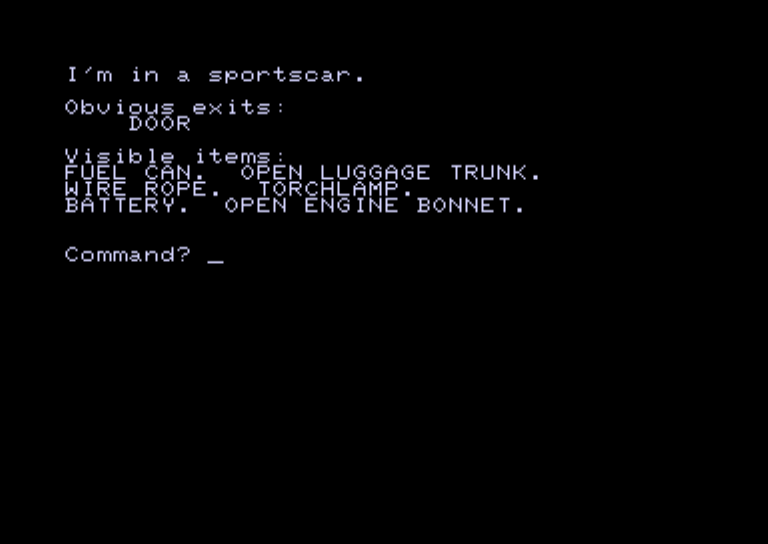
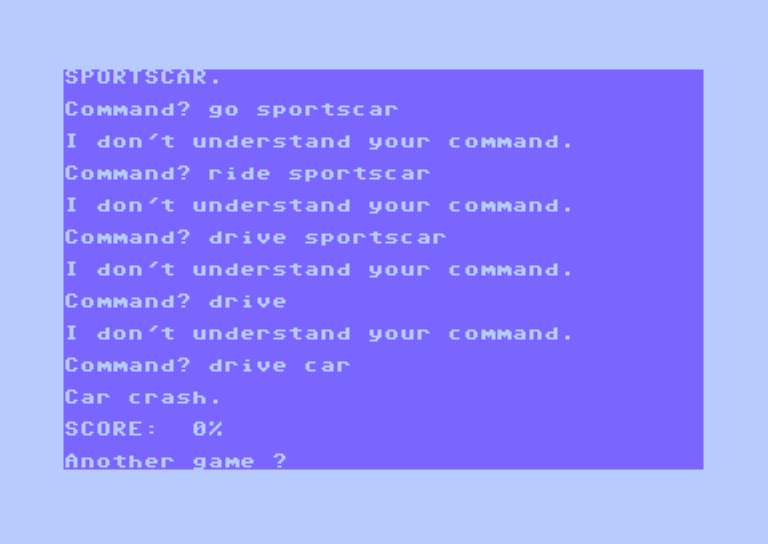
Back to the action! After the 4711 info I was simply unable to move a car. Before I get to how that works, I should mention that while the car appears empty, it has stuff in it if you OPEN TRUNK and OPEN BONNET, neither which are mentioned anywhere. (I had to look up the word “bonnet”. I use “hood”.) Also, the items you get from both you then find by going inside the car.
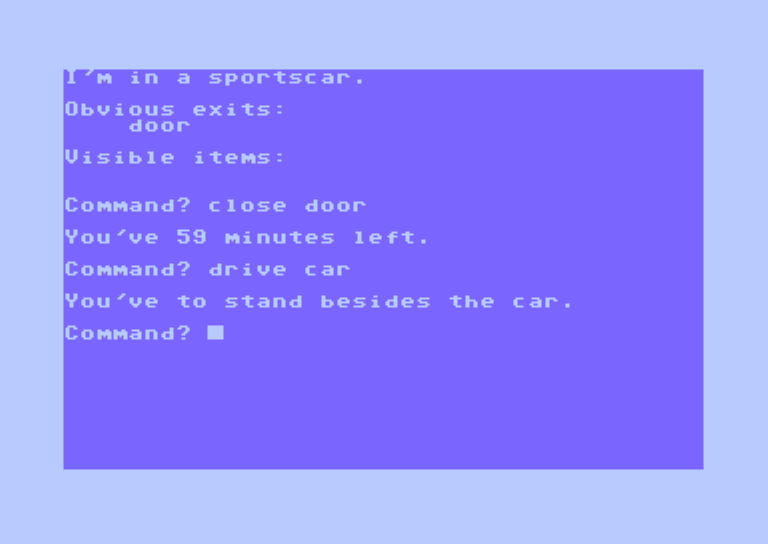
The fuel, torchlight, rope, and battery are all useful. I guess the idea is that it’s an open-top sportscar, but this still doesn’t make sense to me why you’d be outside the car to drive it.
So to be clear, you drive the car by standing outside the car, and then you get things from the trunk and hood bonnet by going inside the car. Also you need the battery in because it will be dark when you drive otherwise (so when you take it out, and you’ll need to take it out, make sure you put it back in!)
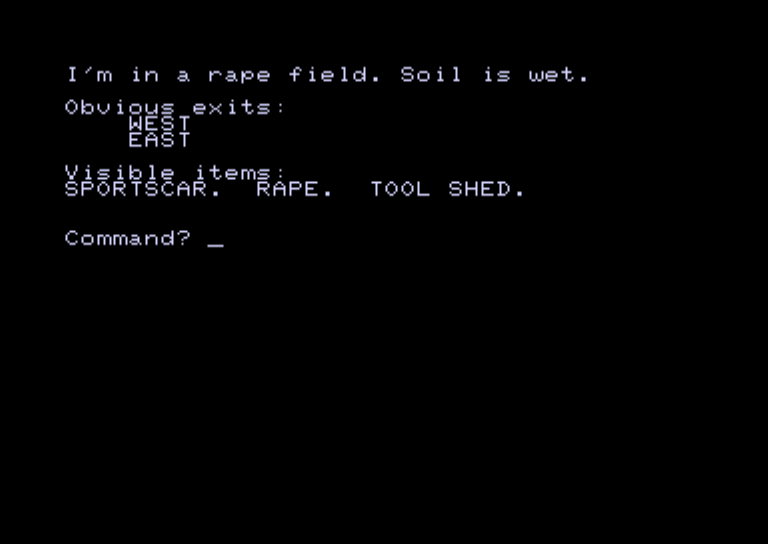
To drive the car without crashing, rather than typing DRIVE CAR, type DRIVE (DIRECTION), like DRIVE WEST to start. Then you can DRIVE NORTH safely to an intersection, then DRIVE EAST to a field with an unfortunate name, or rather a normal name with an unfortunate namespace clash.
It’s rapeseed. Language translation issues aside, I could easily see a botany professor not even thinking about this reading awkwardly.
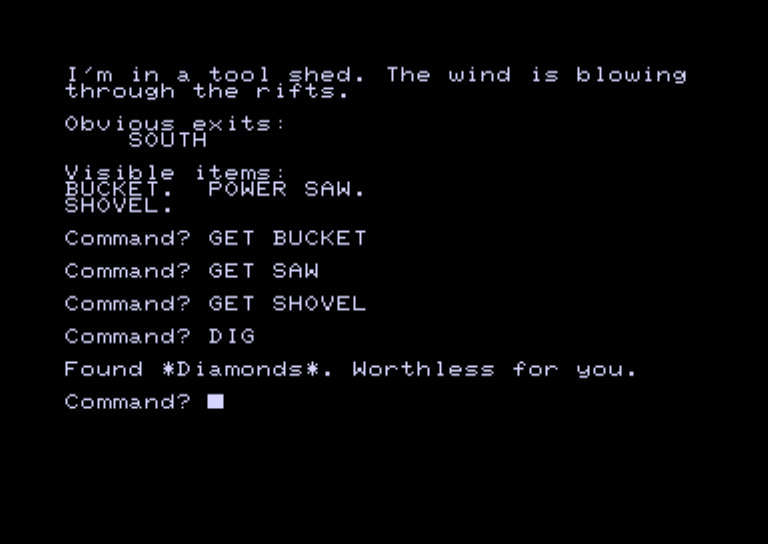
The tool shed contains a turn of phrase which suggests translation dictionary trouble (“The wind is blowing through the rifts”) as well as a shovel which is a complete red herring.
At least the initial result of using it suggests it might be a joke item. This is making fun of the Scott Adams style *treasure* hunt games.
The saw and bucket are absolutely required. Hopping back in the SPORTSCAR and driving east incidentally kills the player in a swampy bog; the only thing to do is drive west and north and arrive at a gate, the Citadel of the title.
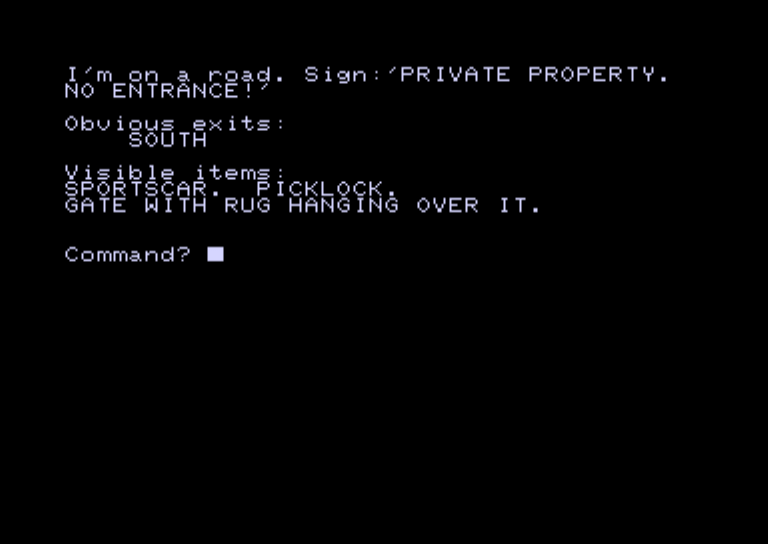
The deadliness continues if you try to GO GATE, as it is electrified and will zap you dead. I found I could DRIVE GATE and get through just fine. I later found out from the walkthrough you can PUT RUG which will interpret the act as covering the gate (as opposed to just dropping, like PUT does everywhere else) and the rug serves as protection against electrocution. You can then climb over.
This represents what I think is a true alternate solution on the author’s part. Maybe the car entering was a bug? The car gets trapped on the other side of the yard.
I’m in a yard of an citadel. Main building ahead.
Obvious exits: door
Visible items: SPORTSCAR. TREE. BLOWPIPE. CHAPEL. WELL. SWIMMING POOL. GATE.
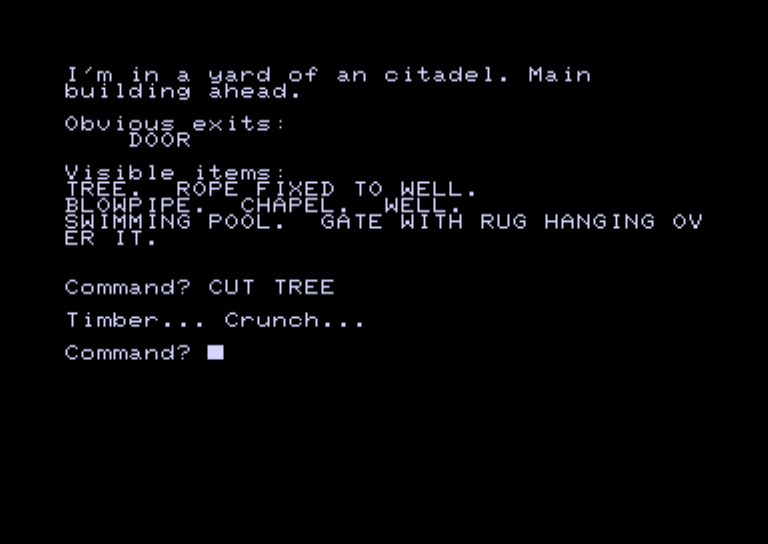
Yet: when the way to escape is made, it applies to both if you entered via climbing or car, and the car can’t escape until you’ve done it. As long as you are holding the fuelcan from the car you are able to operate the powersaw from the shed and CUT TREE:
This was the variant reality where I tested the rug-climbing entrance. The sportscar is parked to the south.
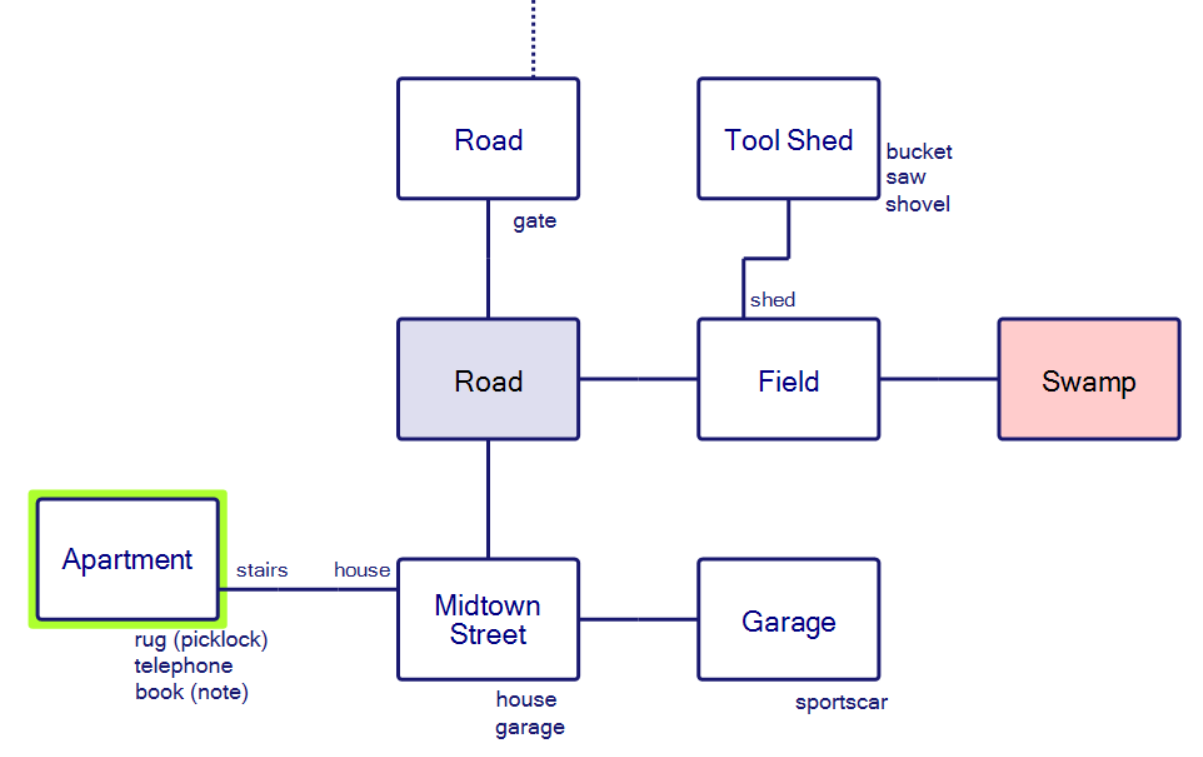
This crushes the gate and lets you escape south either by foot or car. Note though this is premature if you do it right away, as you need to climb the tree first before cutting it. Let’s get the map out and start explaining the layout:
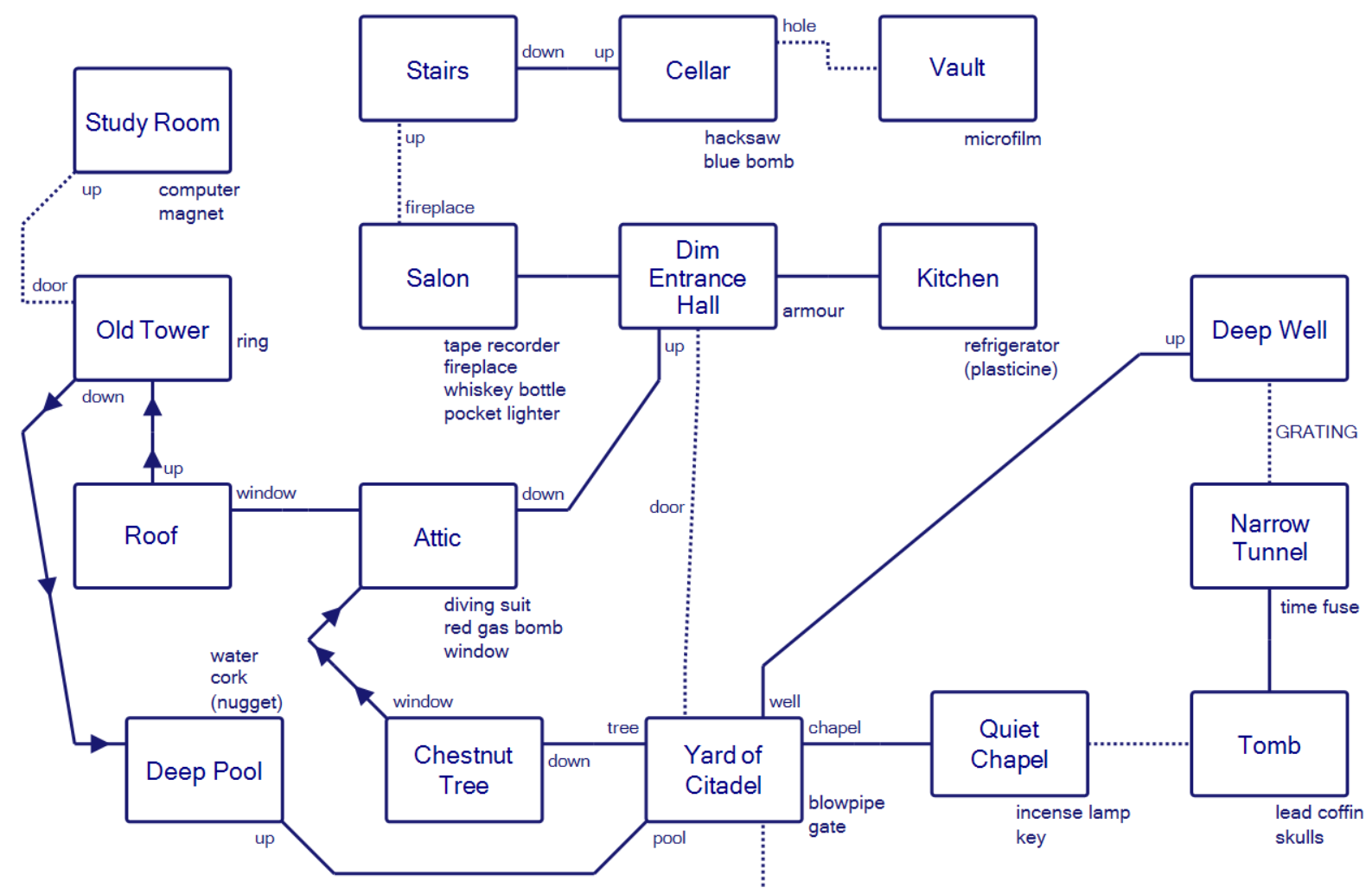
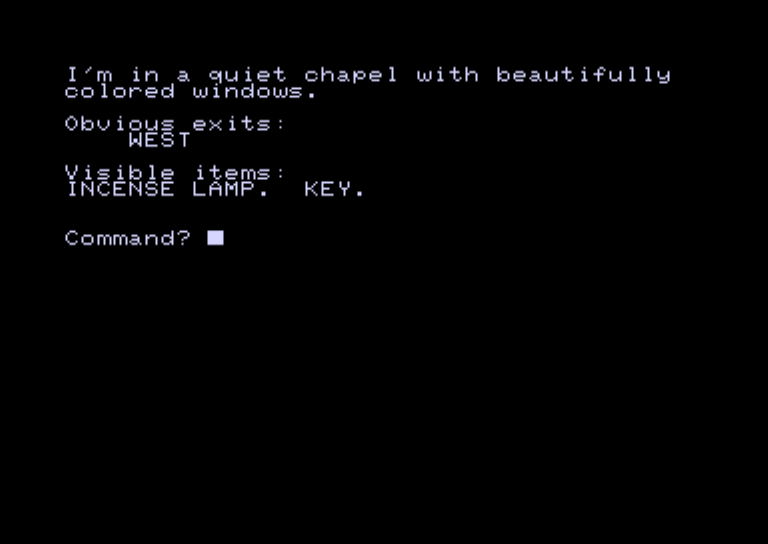
There are five exits from the yard: chapel, well, tree, pool, door. The door is locked; you can nab a key easily from the chapel…
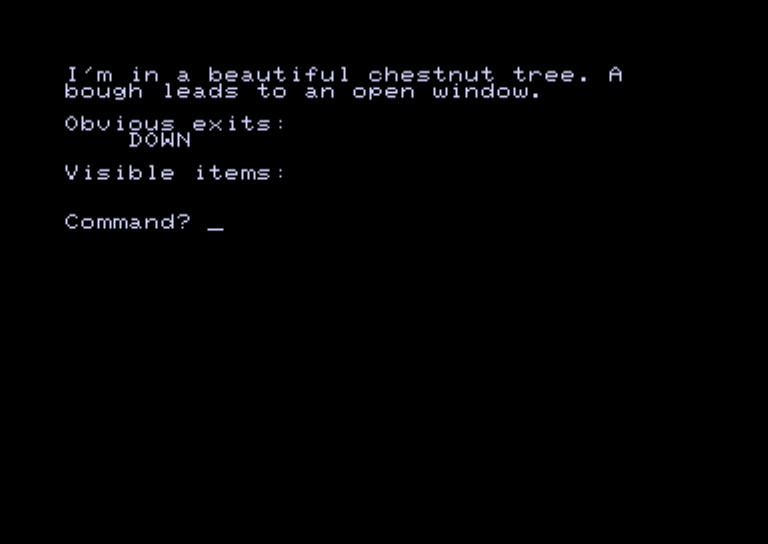
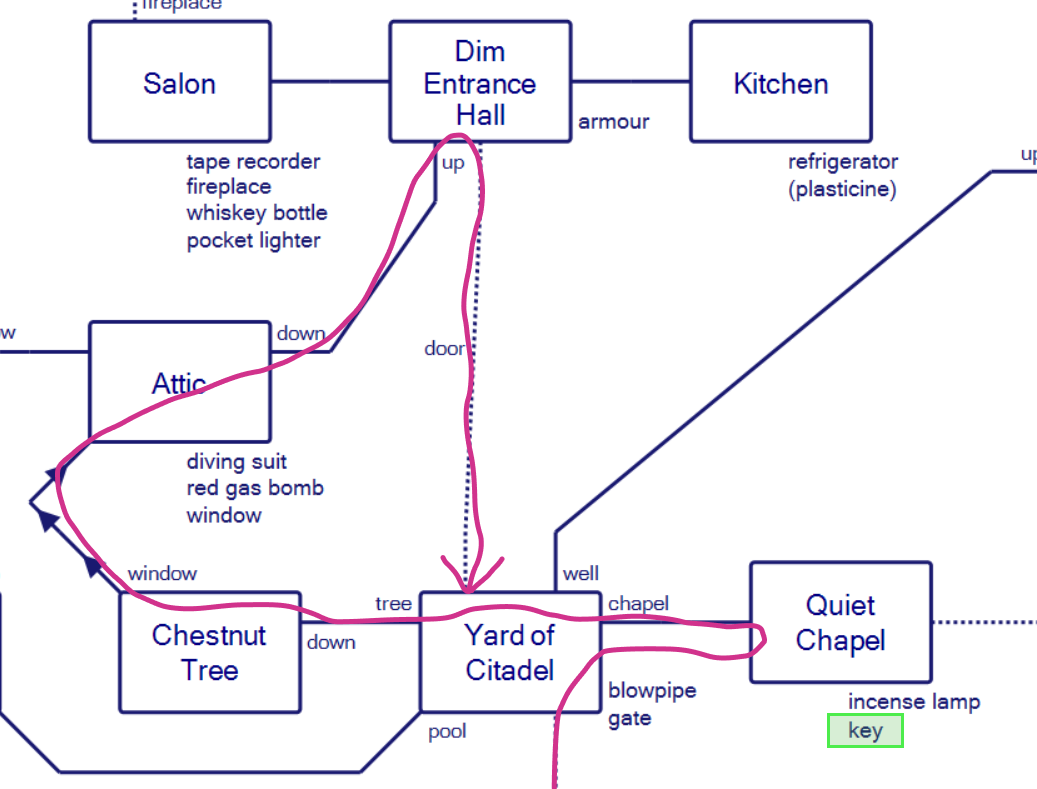
…but when trying UNLOCK DOOR from the yard the game informs you the key only works from the inside. Hence you need to climb the tree:
This gives you a route through the window and downstairs, where you can unlock the door from the inside and pass safely in and out of the building normally. After you’re done with this it is now safe to cut down the tree.
You might notice another passage linking out of the chapel, but I didn’t discover it until much later in my gameplay, so let’s visit the two other places connected to the yard, and then explore the building. You can find yourself a quick death by typing GO WELL.
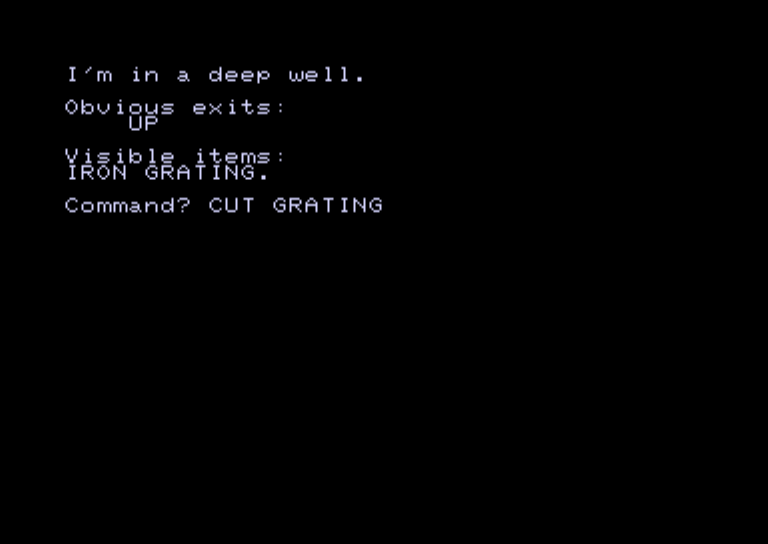
I’m in a deep well.
Obvious exits: UP
Visible items: IRON GRATING
Yaahhh… Falling.
SCORE: 0%
You can PUT ROPE (from the car) in order to get in safely, but you’re then just stuck by the iron grating. There will be an item to take care of this later.
Then there’s the pool, which I had trouble even parsing with the dictionary-accident troubles:
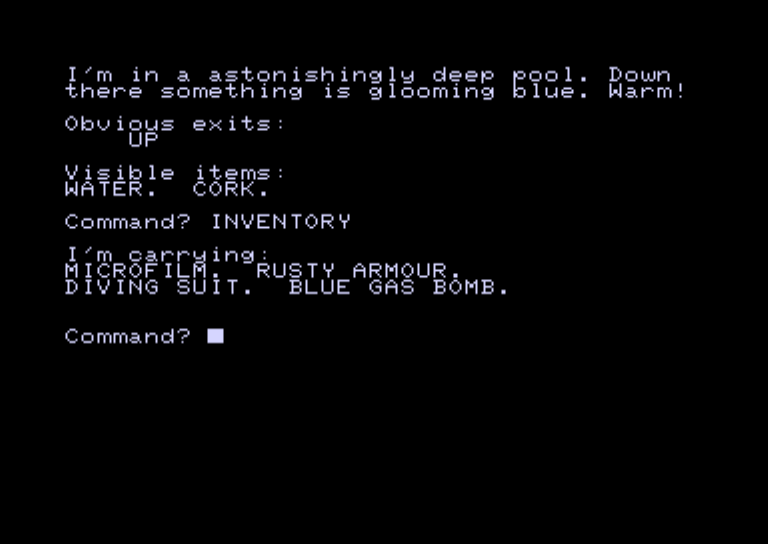
I’m in a astonishingly deep pool. Down there something is glooming blue. Warm!
Obvious exits: UP
Visible items: WATER. CORK.
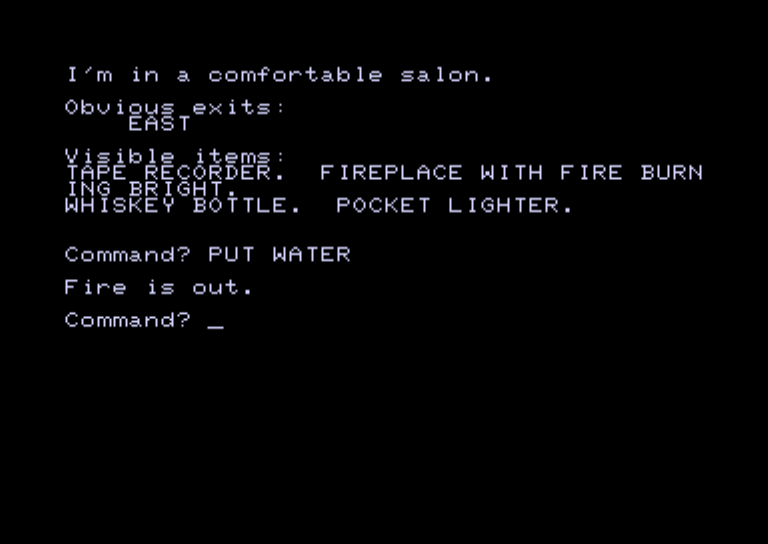
Just to recap, from the car we have a saw (used with a fuel can on a tree), a torchlamp (used with a battery), a rope (used on the well), and a bucket. The bucket, the only unused one, can scoop up some water here. Going inside the door and to the west, you can find a fireplace and put it out (PUT WATER)…
…then go downstairs to find a cellar with a MASSIVE WALL which is really the main obstacle of the game. (I don’t know what “concrete drops” are referring to.)
I’m in a musty cellar. Concrete drops on the floor.
Obvious exits: UP
Visible items: HACKSAW. MASSIVE WALL. BLUE GAS BOMB.
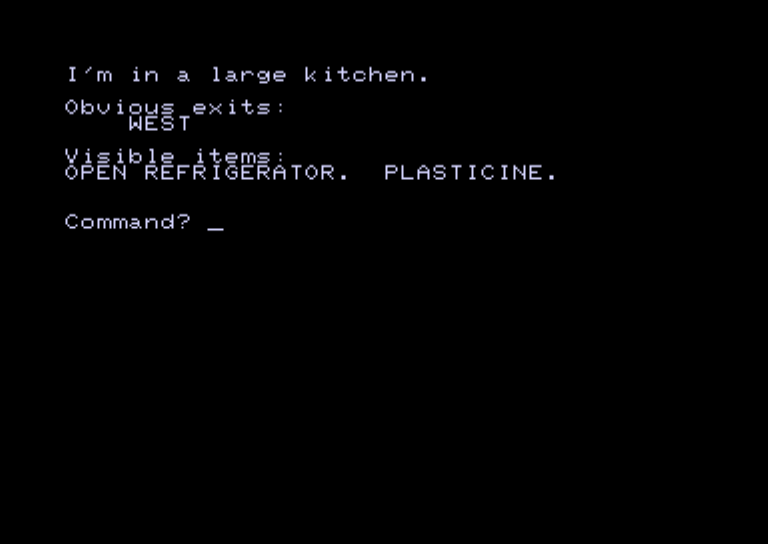
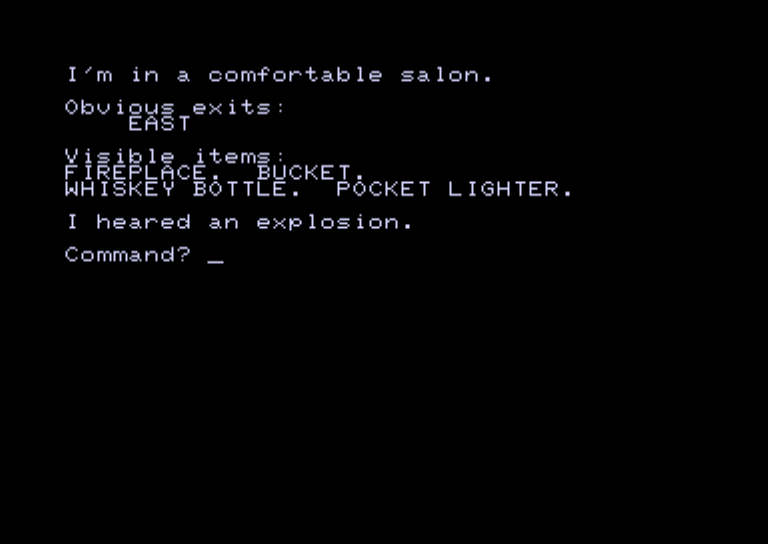
Other than the saw and the blue gas bomb added to our stash, and the TAPE RECORDER, WHISKEY BOTTLE, and POCKET LIGHTER next to the fireplace, you can find around the house you can find PLASTICINE in a refrigerator in the kitchen (tasty!)…
…a DIVING SUIT and RED GAS BOMB next to the upstairs window (entered via tree), and some RUSTY ARMOUR in the entrance hall (which we’ll get to last). Here I was incredibly stuck until I realized that while I entered the house’s attic through a window, if you go back through the window you land in an entirely different location.
I’m in a dusty attic. There’s a window with lots of webs in front of the pane.
Obvious exits: DOWN
Visible items: DIVING SUIT. RED GAS BOMB. WINDOW
Command? GO WINDOW
I’m in a shingle roof. There’s a window to the left.
Obvious exits: UP
Visible items: WINDOW
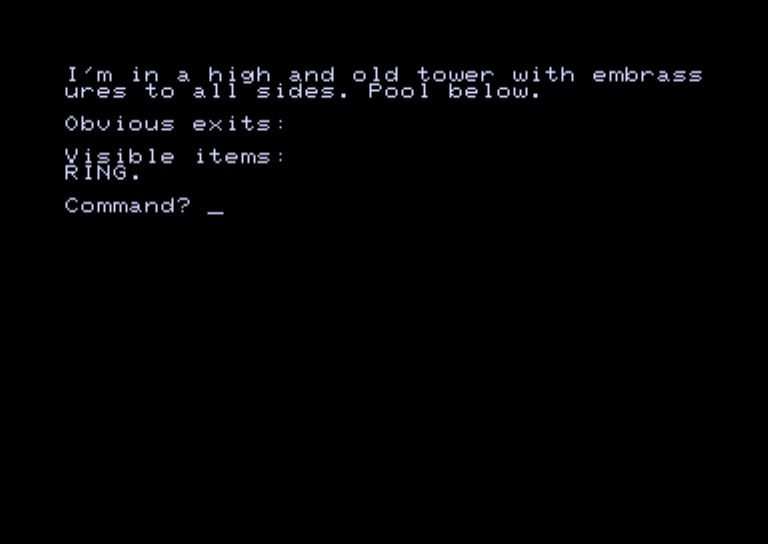
Going up higher there’s a roof with a RING.
GET RING responds with “it’s fixed” but I was able to PULL RING and yank out a whole trap-door leading to a study room.
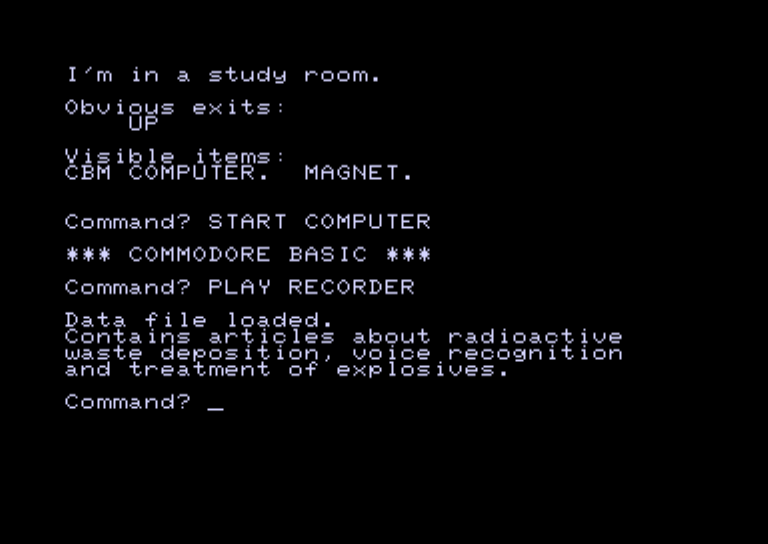
I’m in a study room.
Obvious exits: UP
Visible items: CBM COMPUTER. MAGNET.
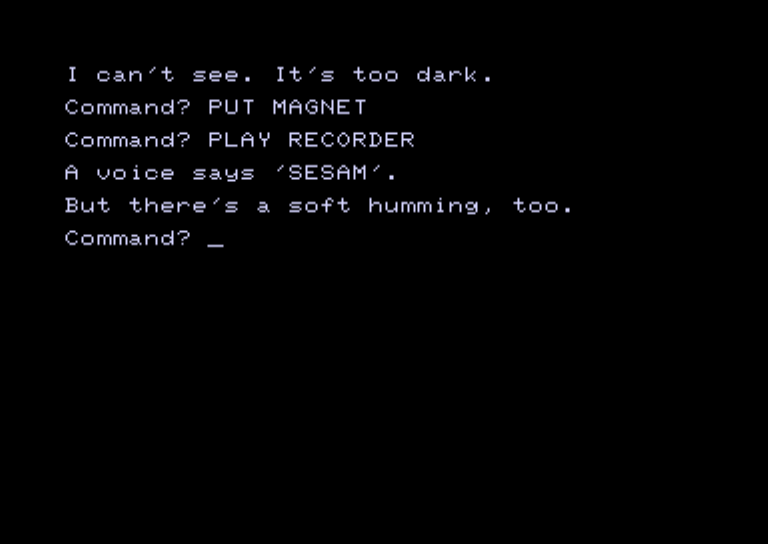
I had a lot of trouble working the computer, You can START COMPUTER and then PLAY RECORDER (that separate tape recorder, playing it somehow translates into playing it for the Commodore).
Keep in mind the “voice recognition”, that will come back later (in a baffling way). You can leave by heading back to the tower and going DOWN; if you peek back at the room description you’ll see the pool is below and you’ll land in safely. (The walkthrough puts in the dive suit before doing this; as far as I can tell you can do this entirely safely with no problem.)
Looking back at the obstacles left, there’s the wall still in the cellar, the grating in the well, and the item “glooming blue” in the pool. The hacksaw from the cellar takes care of the well issue.
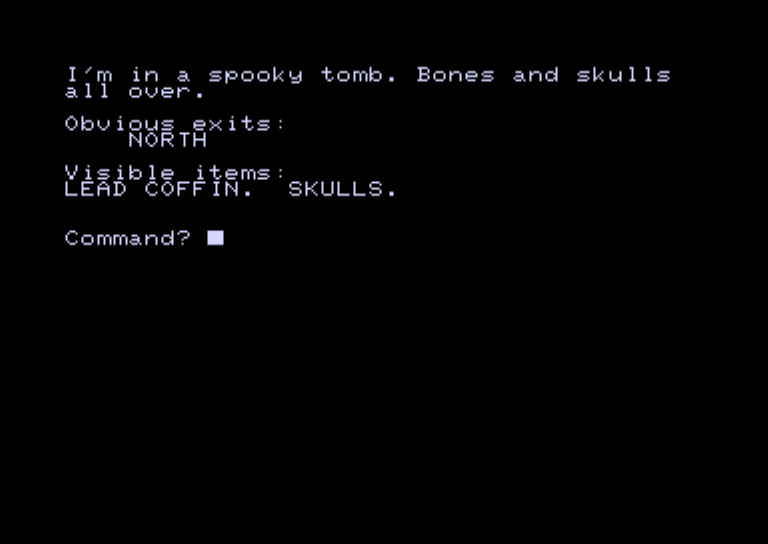
This leads to a tunnel where you can find a TIME FUSE, followed by a chapel containing a COFFIN and some SKULLS. The coffin is one of the treasures you need, bizarrely enough! (It also is heavy, so you pretty much need to dump everything and work in the dark. Fortunately there’s no tripping around in this game, and once you have your pathing worked out having a light is optional.)
There’s an alternate route here where you PULL LAMP while in the chapel, exposing a hole you can go down, but then you’re trapped at the grating if you haven’t sawed it open yet. This is still good in a seeing-what’s-ahead sense.
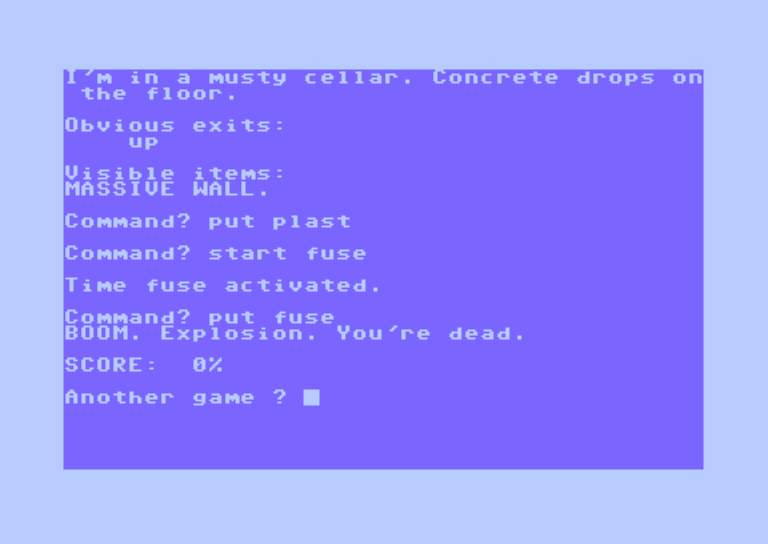
The TIME FUSE and the PLASTICINE are sufficient to handle the wall: DROP PLASTICINE, START FUSE (ugh), PUT FUSE, get out of there. I need to test some more but I don’t think the fuse even needs to be with the plasticine.
Slipping in with a C64 screenshot indicating this can go terribly wrong. I think it’s based on real-time and I had the system going too fast?
The explosion happening properly, although there’s a secondary explosion as well later.
With that taken care of there’s a vault with a safe inside further. I admit I had to check the walkthrough for this part, as you’re supposed to put the magnet on it, then play the tape recorder. This will let you nab a microfilm inside. (I tried to match the poison-bomb message to it but I couldn’t see a connection.)
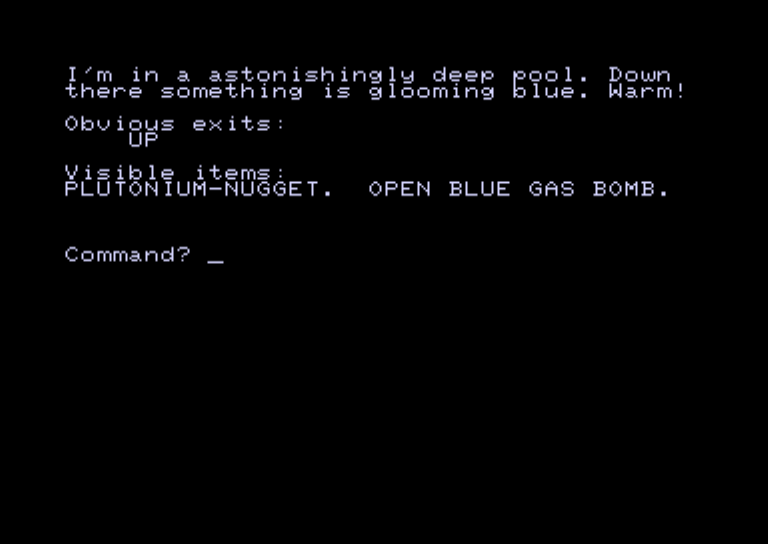
The microfilm is of course one of the items you need, but there’s one more, and this one’s very cryptic to get: the mysterious pool item. Take the blue gas bomb, dive suit, and rusty armour from the house. Hop in for a swim.
Now, follow this series of instructions: OPEN BLUE (the gas bomb), GET CORK, PUT BLUE. (I am copying direct from the walkthrough. No clue what’s going on.) This will somehow manifest a PLUTONIUM-NUGGET.
That’s everything, and it’d be nice to just go home, but there’s one last wrinkle.
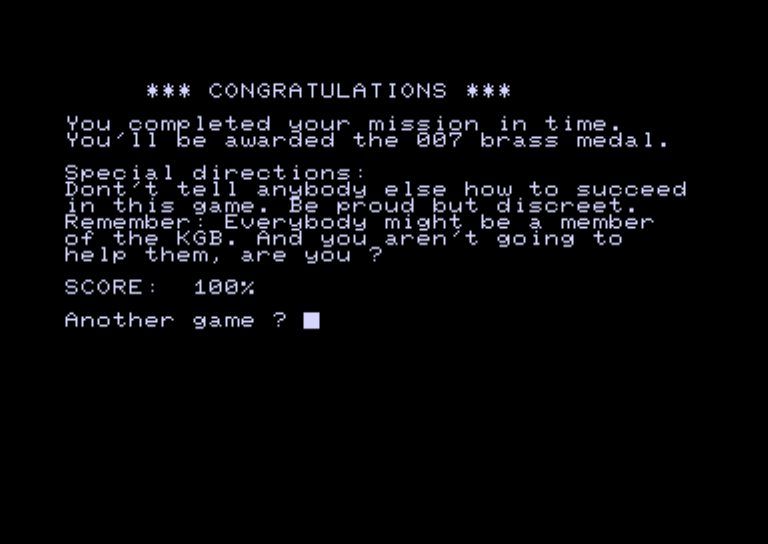
This isn’t nearly as bad as the previous shenanigans except for a verb issue. It turns out the telephone is lurking back in the shed (where we found the useless shovel and the useless diamonds). Take it back here and FIX TELEPHONE (!!!) and then you can DIAL 4711 and finish the mission.
I feel no guilt whatsoever at exposing the game’s secrets. I still don’t know what’s going on with the book’s message or the nugget, or why we were supposed to figure the magnet would work on the safe combined with the tape recording, and why the tape recording had data in one circumstance but when used a second time gave a voice command.
(It is fun, though, that once again Valley of Cesis is echoed. At the end of that game it says “don’t tell anyone else how to do it”.)
Some of this might be German-English confusion but some of it definitely isn’t. The strange thing is, looking back, I do see mounds of creativity: there’s some clever attempts at difficulty and trying to make a complicated world be as compact as possible. A careful editor and a saved-game feature might turn this from unfair into … well, maybe not fair, but playable.
Coming up: A game from Sweden the same year as Citadel Adventure, written in English.
In 1980, Commodore got their first factory in Germany (in Braunschweig). The CEO Jack Tramiel came to give a speech and was warned “don’t tell them you’re Jewish”. He handled it in typical Tramiel fashion:
So what did I do? I made a speech to them and told them all I was Jewish and that I was a survivor of the concentration camps. And then I said that I wanted everyone who was an SS officer in my office in the next two days. Over twenty of them came in and about six walked out, saying they will never work for a Jew. The others apologized, it wasn’t their fault, and all that. I saw it as honesty and that they were looking for forgiveness and I gave it to them. You see, at first, after the war, I had feelings of revenge, but that changed when a priest said to me: “If you are going to treat the Germans the same way they treated you, what’s the difference between you and them?” The way he said it just totally changed my outlook.
Commodore generally owned the German market all the way through the Amiga. Hence it’s not technically surprising we have a C64 game today, although the circumstances still have a wrinkle–
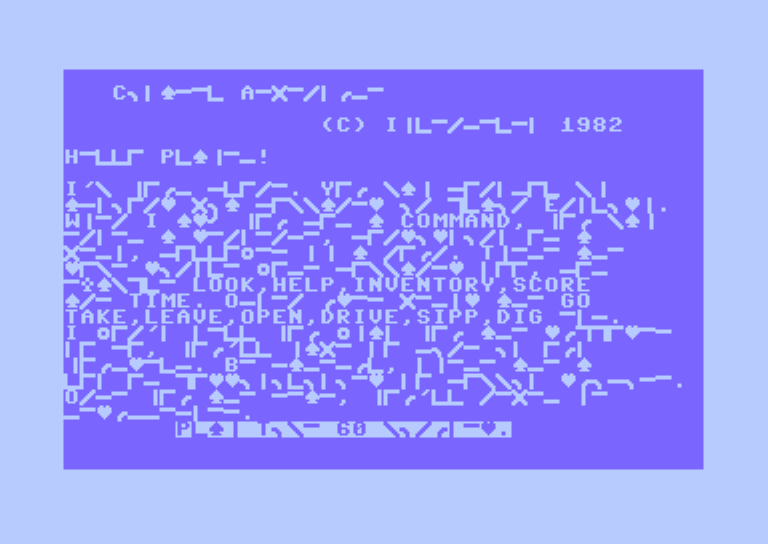
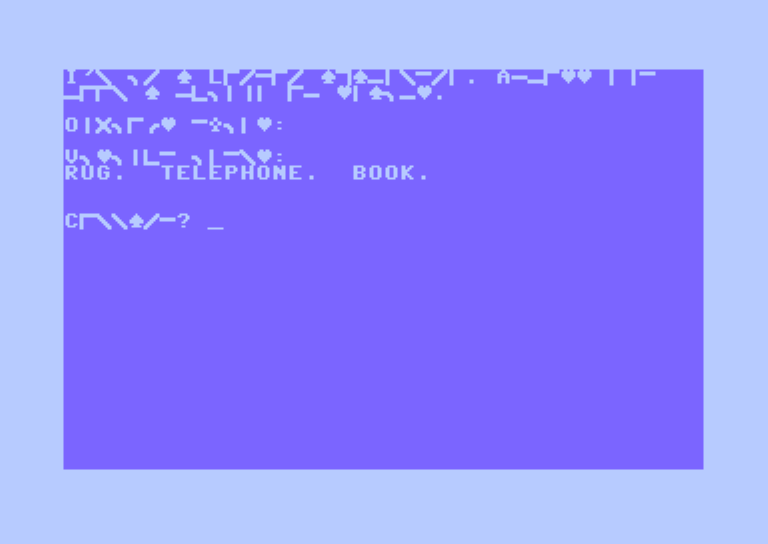
This is one of the rare cases of a game I had in hand during my 1982 run, but skipped anyway due to technical difficulties. The downloads I could find of Citadel Adventure have a “case reverse” that I could not resolve no matter what settings I switched things around to.
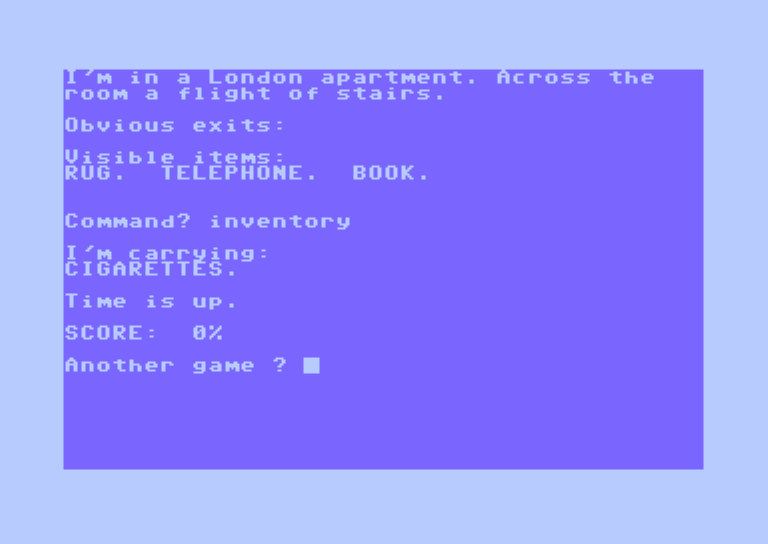
i’M IN A lONDON APARTMENT. aCROSS THE ROOM A FLIGHT OF STAIRS.
oBVIOUS EXITS:
vISIBLE ITEMS:
rug. telephone. book.
cOMMAND?
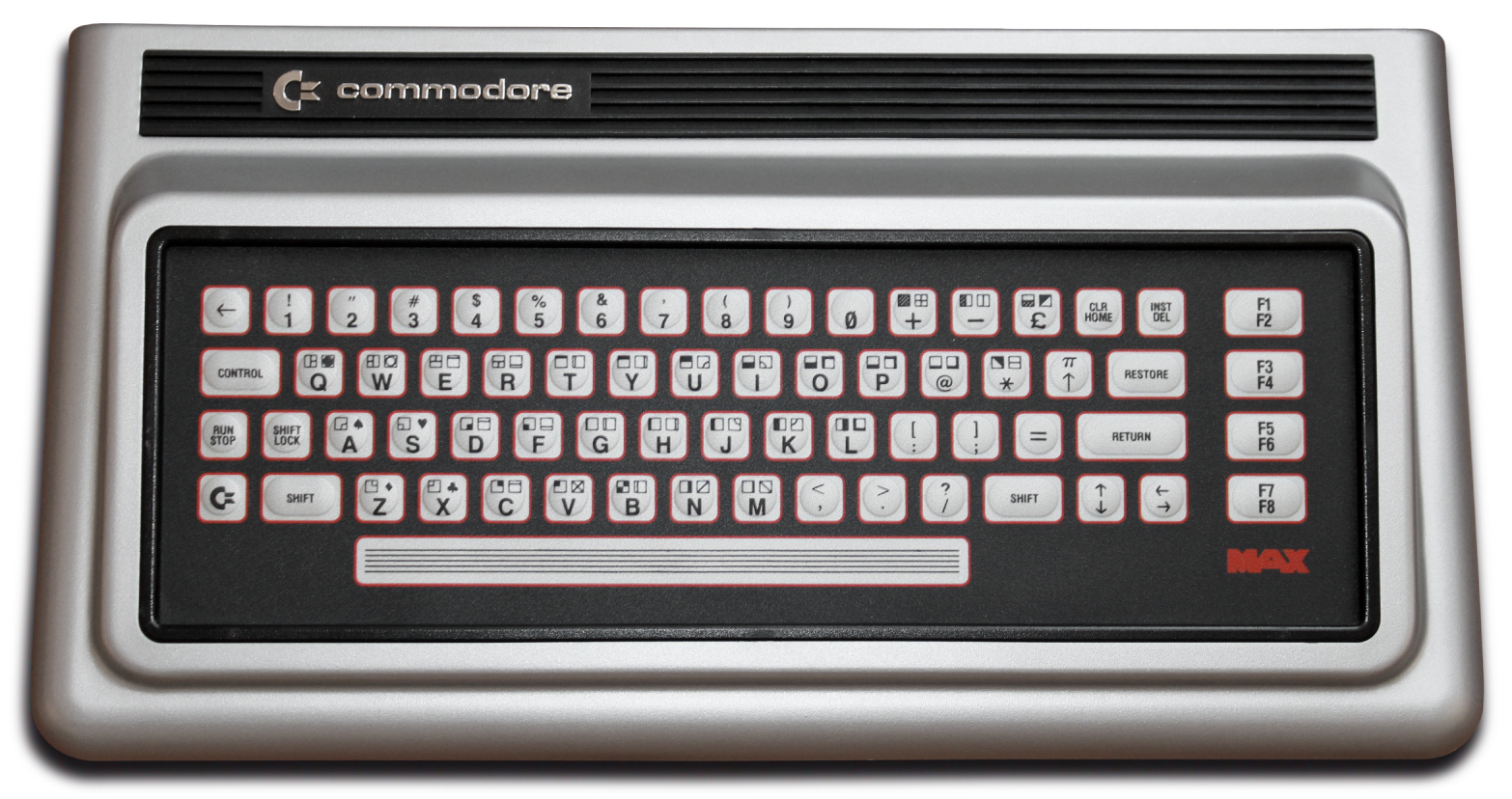
That’s after pressing the “character swap” key combo (shift + the Commodore button); if you don’t use the swap it looks even more nonsense.
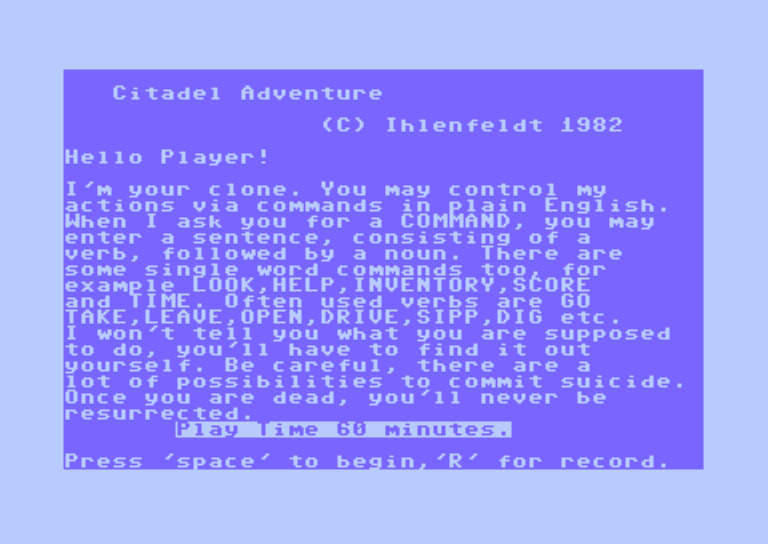
I recently approached the Mystery House II Rescue Team (including gschmidl, bsittler, and f_t_b) and after some noodling bsittler managed to create a “case fix” version of the game that has the capitalization swapped. The file here should work directly in a standard emulator without any tweaks.
10 rem*******************************
20 rem ‘citadel adventure’
30 rem*******************************
40 rem (c) ihlenfeldt 1982
50 rem*******************************
60 rem all rights reserved
70 rem*******************************
71 rem nicht listen, selber knacken
72 rem*******************************
The author only gives their name as Ihlenfeldt; there’s enough German text in the comments of the BASIC file that it’s pretty clear we are dealing with a German speaker, although it is unknown if the author was located in Germany in 1982 (or Austria, or Switzerland…); maybe they were in an English-speaking country when they wrote this but German is the author’s first language. Either way, the game text is in English. We’ll soon have a game from Sweden with a similar situation.
(The “nicht listen, selber knacken” is “don’t list, crack it yourself”, which means don’t try to solve the game by listing the BASIC code. This mirrors a directive in Valley of Cesis. Perhaps with public domain the temptation to “solve by source code” was stronger.)
Early issue (August 1984) of 64’er Magazine, a popular C64 magazine from Germany. Source.
Assuming the author was physically in Germany in 1982, it’s early for the C64; they were officially available only starting in 1983. They did have the ill-fated Ultimax in October 1982 — a C64 stripped down to more like VIC-20 specs — but it had a low amount of memory, lower than the size of Citadel.
“A very low price portable color microcomputer for the home market” according to the 1982 Commodore Annual Report. Image by Thomas Conté, CC BY-SA 2.0. Source.
It is of course possible to get an computer imported (see the backstory behind the completely different game called Citadel); it could be the game was written on a different system but ported with the year maintained (maybe it was ported from Commodore PET and the caps-issue happened upon transfer).
The opening screen gives no background on what the goal is. It does give some verbs (“GO, TAKE, LEAVE, OPEN, DRIVE, SIPP, DIG”; note that there’s no DROP, you can LEAVE or PUT items) and it also warns “there are a lot of possibilities to commit suicide” and mentions a “Play Time” of 60 minutes. That 60 minutes is not meant to estimate how long it will take to solve, but rather you have a hard time limit of 60 minutes real time, and if you exceed that the game is over.
This is after leaving the emulator running overnight.
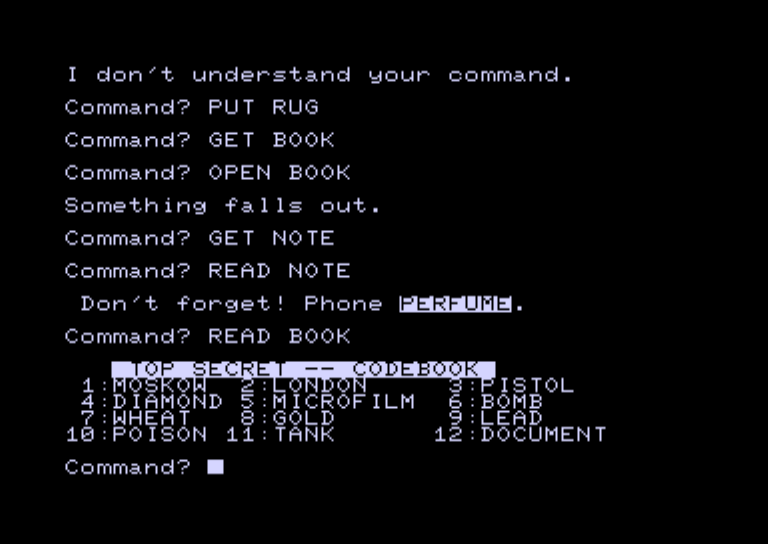
I was able to discover fairly quickly this was a spy story of some sort as the “book” is a codebook and there’s a “picklock” right underneath the rug. I was struggling to get more happening so I tried HELP which suggested OPEN BOOK (given you have to open the book to read the codes inside, I have no idea what that means in-reality) which gave a note that mentioned “Phone PERFUME”.
Regarding the “moskow”, the German exonym for Moscow is Moskva, so the “k” must have snuck in there via that route.
More on that in a moment; I took a brief step outside, tried to go north, and got run over by a car. Going east again, there was a SPORTSCAR in a garage, where trying to DRIVE it led to an immediate crash.
You also have to be standing outside the car to drive the car.
Baffled by both the inability to drive a car and the need to be standing outside the car to drive it, I went back to tackle the PERFUME clue some more; the weirdness with the car made me suspect I was missing something with the parser, so I peeked at the first line of the walkthrough (by Alex Dijkstra). It mentioned to PUT (drop) the cigarettes in inventory as the first action of the game; I guess those are red herrings. It also says to DIAL (not “call”, agh) the number 4711.
Now, I might normally plow ahead right here, but I really don’t want to just lean on the walkthrough the whole game, so a pause to make a post here helps me do a mental reset. But more importantly, I don’t understand the puzzle: why 4711? If you apply the “generic” phone code to the word PERFUME you get 7373863; I would assume the code book is what you really use but I can’t see any combination where diamond-wheat-moskow-moskow or diamond-wheat-tank has any connection with the word PERFUME. Anyone have some thoughts?
I thought this was going to be a quick one to solve but I’m starting to suspect it bears closer resemblance to Intercept (cryptic, difficult-to-handle game conventions) moreso than CIA Adventure (straightforward).
For the bookkeeping, one thing I didn’t linger on is: what should I be calling this game? On the side of the box, on the front of the tape, and on two of the title screens, the game is just
幻魔大戦
but on the front of the box, and on the third title screen, a subtitle gets added, using English text.
幻魔大戦: Harmagedon
Even the colon is questionable! There’s also no good way to convey the mixture of languages. The original film often just gets called Harmagedon but that also isn’t consistent.
From the press package which is absolutely worth a look if you’re a fan of the franchise.
On top of that, the film title either gets translated as “Genma Taisen” or “Genma Wars” depending on your source. I try to prioritize what English title gets used from Japanese sources, but I’ve seen that mixed too. I eventually just gave up and used the title given by Mobygames which seems to be the most common one.
On the meta-discussion: as I’ve emphasized in the past, this isn’t really a “review” blog, even though you could interpret things that way. I’m trying to approach with a “why did this happen” perspective; while I’ll still point out when something is painful, what’s more interesting to me is that a game got made in the first place, especially a game like this connected to a movie with both a high budget and high earnings (it was the top-earning animated film of 1983 in Japan). I’m trying to build a contextual history.
This game really stretched my patience, though. There is one person (the proprietor of the AVG walkthrough site) who liked the game, so I gave it the best shot I could.
Even if we buy into Takahashi’s idea for this game (or maybe it was the producer Kadokawa’s idea), which is to pick particular scenes from the movie and dramatize them (with essentially choice-based gameplay), the concept is erratic. It skips past the airplane being destroyed and Luna being recruited as a “psychic warrior” — fine, maybe that’s just a “cutscene” — but then it also skips by one of the earliest “dynamic” scenes where Luna talks the cyborg warrior Vega into arising from his slumber and joining the cause, invoking his past love for the psychic Arietta (which sustained him for thousands of years).
It skips a lot more besides, but I’ll get to the exact timestamp in a moment. One last detail before diving in: I played the PC-8001 (text-only) version of the game first and then went over to PC-98; I will share from both simultaneously and explain places where they diverge.
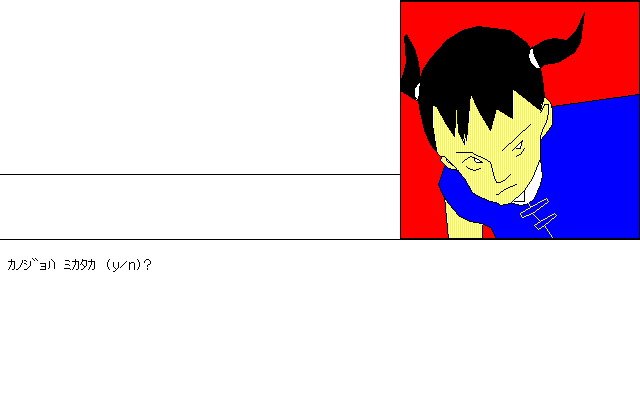
So Jo Azuma, Princess Luna, and Vega are already together, and Jo encounters what he thinks is his girlfriend Junko. You (the player) are then prompted to pick a fighter. This indicates which of the trio is going to do an action.
I tried 3, Vega, and got the following:
Could it be that you still think she’s a Genma?
If your guess is correct, this is going to be a big problem!
Should I attack her? (y/n)
If you pick “yes” the response is…
Oh no! She really is human…!
…and the game ends. This would seem to resolve that we are supposed to pick Jo, and everything should be fine … you might think.
You can do so, and she’ll request kisses, in repeated y/n prompts; you can keep doing y over and over again until eventually get:
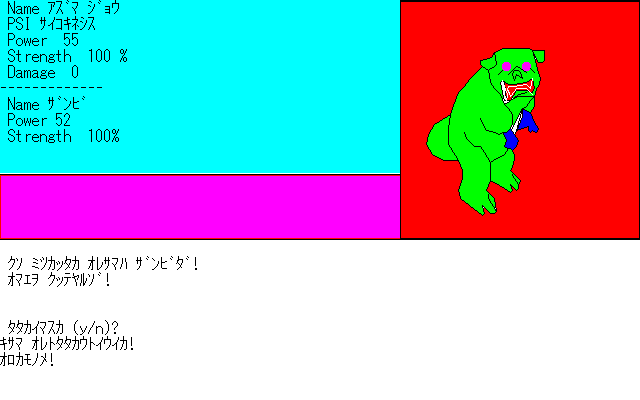
You fool! I am Zambida!
Wahahahaha!
(The actual line is “ワッハッハッハッハ”.)
The enemy will then reduce Jo’s strength to 0.
The “optimal” sequence seems to be:
a.) use Luna, who will sense Junko wants a “farewell kiss” from Jo
b.) do one kiss from Jo after
c.) decline to do another, after which you’ll get the reveal; Jo can then attack and win; if you don’t go through this process, Jo’s power level will be too low to win the fight and you’ll lose
Notice this is 100% inconsistent with what happens when you just attack with Vega. I’m also not clear why Luna wouldn’t sense the subterfuge.
This marks the end of “scene 1” in the game. Scene 1 matches with a scene fifty-three minutes into the movie. I have it cued with the timestamp below.
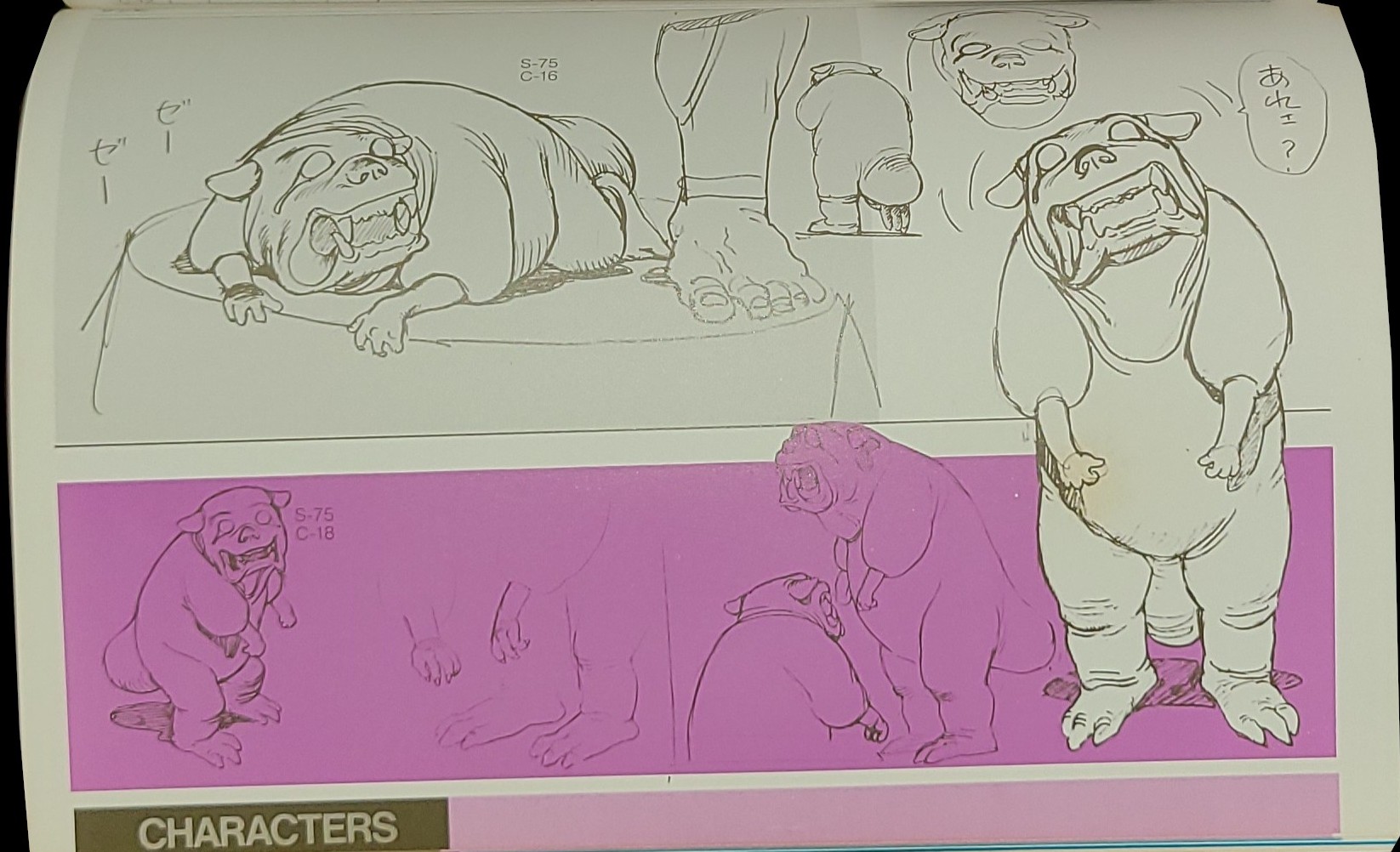
It works a little differently (Jo is alone, and senses the ruse from “Junko” having an odd smell). I couldn’t find the exact pose from the game’s art in the movie (although I didn’t check frame-by-frame). I did find a match in the artbook by the character artist Katsuhiro Otomo.
Source. Compare the game art with the sketch in the lower left. It’s close enough I suspect Takahashi had access and traced it to make the image.
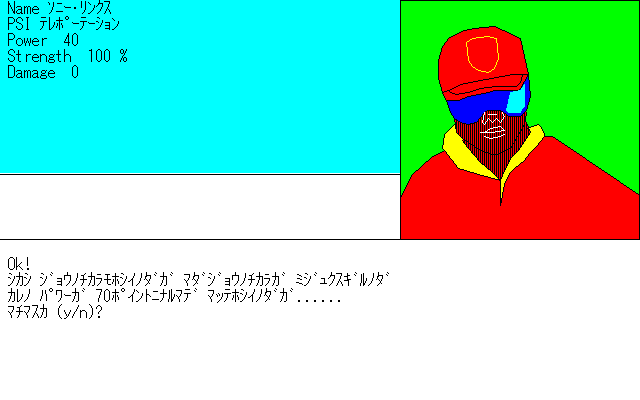
The next scene moves the action to New York (without any prompting what’s going on, although to be fair it’s sudden in the movie too) where Luna wants to recruit the psychic warrior Sonny.
In the movie, Sonny gets captured by the “police” while running away on roller skates and phasing through walls before being put in a cage by one of the Genmas. The way the sequence works in the game is first:
a.) You get asked if you should bring Jo along, who is weak; you should decline
b.) You find Sonny trapped in a “cage” by Zamedi, and are told attacking would be a bad idea because the “power gap” is too large. You then get asked if you should attack (say no).
c.) Then you get asked if you (Luna and Vega) should attack together; again say no otherwise it’s game over.
d.) The game asks about “taking another look” at the enemy’s true form (say yes)
e.) The game mentions an eye and asks if you want to attack it; surely now we can do something? … no, you need to decline again
f.) The game concludes that you have to now summon your allies; pick Luna (who in the movie does a lot of networking with the psychics) and you’ll suddenly have more characters appear, including Jo who had been left behind before but somehow is stronger for going through this process
g.) You’ll then get a prompt for which character to pick now; pick Jo and have the game crash
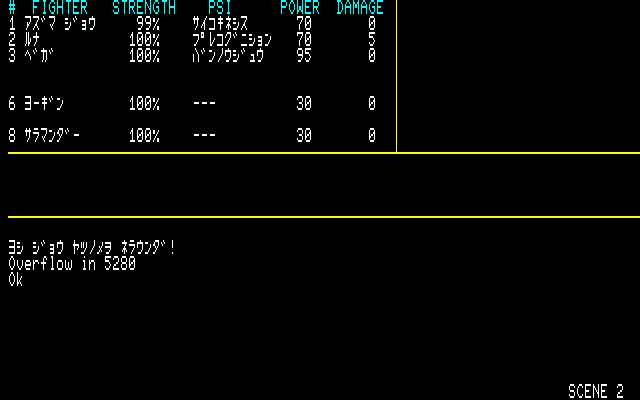
OK, that’s on PC-8001 only, and maybe just my emulator settings. But I had to change the line in order to go farther, changing
5280 FORI=1TOJJ*1000:NEXT:JJ=3:RETURN
into
5280 FORI=1TO1000:NEXT:JJ=3:RETURN
and then typing RUN to restart.
(The loop seems to be just a “dramatic delay”; the JJ value must have been too large making it break with JJ times 1000.)
The PC-98 version reduces this part down a little — there isn’t quite the long interrogation where you need to refuse to attack even after looking at the eye. I suspect the PC-8001 was made first and some edits were put in after the graphics, but no changes were backported while doing so.
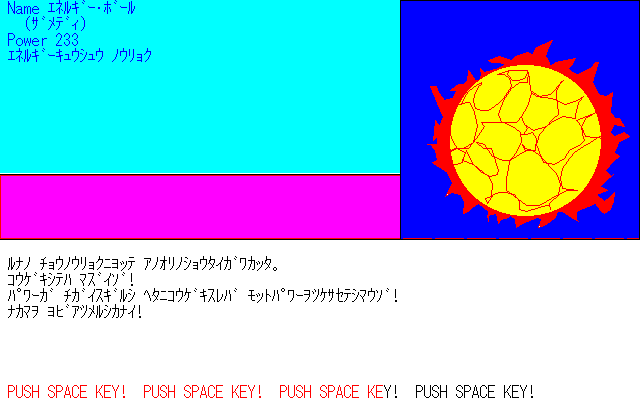
Going back to the action, Jo says he’s going to target the eye, but the game then asks what the power level of the enemy is (which is no longer on the screen, and was randomized; on that PC-98 screenshot it was 233). I was stuck for a while on the PC-8001 version before I realized you can’t type the number on the top-line number keys otherwise the game will end; you have to type the power level number on the numpad for it to be recognized. (Fortunately, the number pad issue doesn’t happen on PC-98.)
You then get power from other psychics and manage to win the battle…
Zamedi and Vega scene from the movie.
…and scene 3 begins. First you are interrogated about the power level of one of your characters from the previous scene (chosen at random) and if you get the number wrong, the game is over.
Then, Jo is overcome with rage about his sister being killed (not in the game, a scene you don’t see but you have to fill in from watching the movie, we were busy answering memory trivia instead). The PC-8001 version asks about resting and you’re supposed to say yes; the PC-98 version instead asks about if it is possible to fight alone (yes or no).
You’re supposed to say “no”.
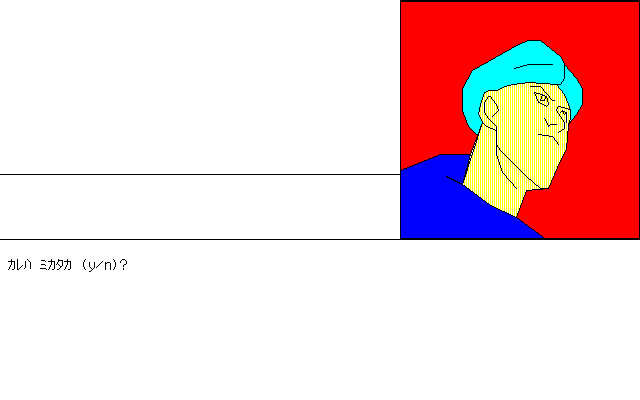
Then you get sort of a character trivia quiz. Which of these characters are allies? Say “yes” to the allies and “no” to the enemies.
Tao, a literal child who is fighting with us.
This one’s Doctor Kafu, the bad guy.
Asanshi, a stereotypical Middle Eastern character.
It’s sequenced slightly different in the PC-8001 version, where they come in a different order (the Doctor is at the end), and it’s more along the lines of them responding to Princess Luna’s psychic call; it makes slightly more narrative-ludic sense, not like this game is really trying for that much anyway.
Then you need to face off against the Doctor, with your three fighters in tow. You can’t choose Tao right away (game over, how dare you pick a child before the adults) so you can have Jo and Asanshi attack; they both get turned into stone, and the game then prompts if Tao should be attacking; you’re supposed to say “no” (logical, the other two just got vaporized).
Face-off against the Doctor in the movie. Jo actually takes out the Doctor while he’s turned into stone.
Tao is able to summon help so everyone comes…
Before that last scene, you’re asked if you are having fun. If you say “no”, the game immediately ends.
…and you’re able to use the power of love to de-stone the two other fighters to get your full set of 8.
Notice the 5 damage on Jo. More on that in a moment.
You can then say you want to attack, but it turns out if you have any damage on any of the characters you will lose. You can accumulate damage from wrong choices, but you can also accumulate damage over time. In the PC-98 version I never was actually able to get away with Jo having a damage of 0, but since I was able to beat the PC-8001 version I was able to answer that, yes, it is love that saves the Earth, thus winning the game.
Congratulations! Thanks to your love, the Earth has been saved! Never forget your love!
I will let the reader decide what level of kusoge all that was. Kazuma Satou points out in the comments that “You can at least see the end of this one with a lot of patience.” The heroic author at the AVG walkthrough site seems to have treated it as a bizarre computer-artifact to be reckoned with rather than worrying overly much about it making narrative sense.
I am mainly interested in: how did it happen?
It’s certainly tempting to blame the producer Haruki Kadokawa, who was on a hyperkinetic mission to merge all forms of media, fueled by cocaine. (Not a joke, he did some time in jail for cocaine smuggling in the 90s.) Takahashi additionally confirms in his Technopolis interview that the proposal “didn’t originate from me”. He felt it was “rushed” and was simply trying to make the deadline of matching the release of the movie. Computer games were still so new that this sort of anomaly was still possible.
At least it sold well; he estimated to have passed 10 million yen in earnings for the year (~$900,000 in 2026 USD), including his other adaptation game based on the movie Antarctica.
Clearly he had more passion for his own work; he talks in the interview about wanting to work on a sequel to Mission: Impossible (which never surfaced).
This is one of the most infamous computer games from Japan ever made. You can mostly blame the 1967 film The Graduate. I’ll explain along the way–
From the first issue that Genma Taisen appeared.
Genma Taisen, the manga, was serialized in Weekly Shōnen Magazine starting in 1967, with writing by Kazumasa Hirai and art by Shotaro Ishinomori. By then both men had established careers, with Hirai writing the 8 Man series (1963 – 1966) and Ishinomori launching Cyborg 009 in 1964; both are early important works of the Japanese superhero genre, and Ishinomori would not only later be called “the Stan Lee of Japan” but would be honored with an entire museum dedicated to his work.
Genma Taisen opens with Princess Luna (an actual princess from Transylvania who can see the future) in an airplane that gets smashed from space.
This is the first volley in a war waged by the demon Genma who seeks to destroy the Earth, as he has done on many worlds before. Luna and the alien cyborg Vega (whose own world was destroyed) gather together a team of psychics (starting with the main series protagonist Jo Azuma) in order to stop Genma.
They fail; or at least, the last issue ends mid-story on an ambiguity (that might imply Genma wins). There’s theories about either interpersonal conflict or conflict with the publisher.
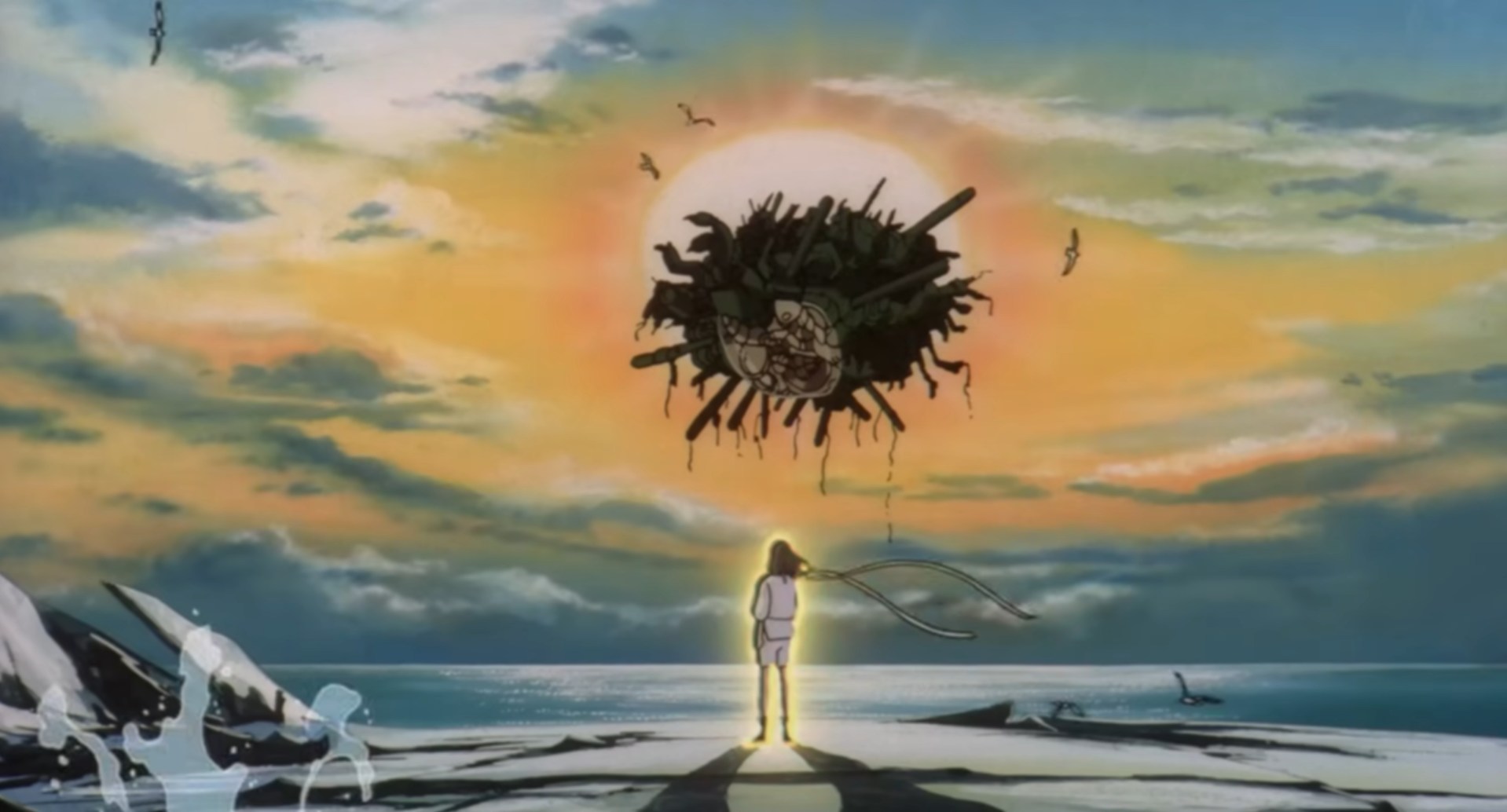
The Eye of Genma, watching from the sky.
The concept was still popular, so there were later spin-offs: another manga series, a novel, and an eventual TV series, all that take different story routes.
One series is post-apocalyptic (after Genma wins) where Princess Luna is still alive and able to use time travel to try to foil Armageddon (but Jo doesn’t exist, which means it’s really a different timeline than the original?); another alternate timeline has Jo discover his psychic abilities and the coming of Genma on his own. The more recent (2002) TV show also involves a time portal after the apocalypse but without Princess Luna involved. There’s a whole chart on Japanese Wikipedia dedicated to the multiple family structures depending on which version of the plot is happening.
The movie Genma Taisen: Harmagedon came out in 1983, and it bases its plot more on earlier books of the original story timeline, but this time ending with Genma’s defeat.
The movie was made at the instigation of the publishing/movie mogul Haruki Kadokawa. When Kadokawa took over the book-publishing company Kadokawa Shoten from his father in 1975 he said to the board (allegedly) “I am the Godfather” and had ambitions to expand into multiple medias from what was previously a print-only business. The essential idea was to take books and have movies that would go with them, which could then synergize into merchandising and music. He explained in a later interview the idea for this came from the movie The Graduate (1967) and how the movie caused the book and soundtrack to both be best-sellers.
For Genma Taisen, Kadokawa was a fan of the director Rintaro (being hot off the success of the movie Galaxy Express 999) and made him an offer he couldn’t refuse; from an interview:
One day, the president of the company Kadokawa, Haruki Kadokawa, who was considered the enfant terrible of the publishing world, wrote me some kind of a love letter telling me that he wanted to meet me. I came to see him, and he made me an offer to make something very different from what I had previously done, for example, at Toei.
I was excited to be able to make new things with that project, and I thought I could go to the top of my ambitions regarding creative freedom. I accepted his proposition with great pleasure. Haruki Kadokawa was an extraordinary man, and he told me I had total freedom for this movie and that he would never intervene in the content. He gave me 250 million yen to use freely for that film. It made me want to run away with the money [laughs]. It was just our first meeting,
The movie was released simultaneously in March 1983 with a computer game. An arcade game was announced at the same time and released a few months later; it was on laserdisc (one of the earliest such games, it came out before Dragon’s Lair) using clips from the film.
Sierra tried to hit similar synergy with The Dark Crystal but their deadline slipped; here, 7 different computer versions came out produced in a matter of 2 months, all by the same programmer: Yoshinobu Takahashi.
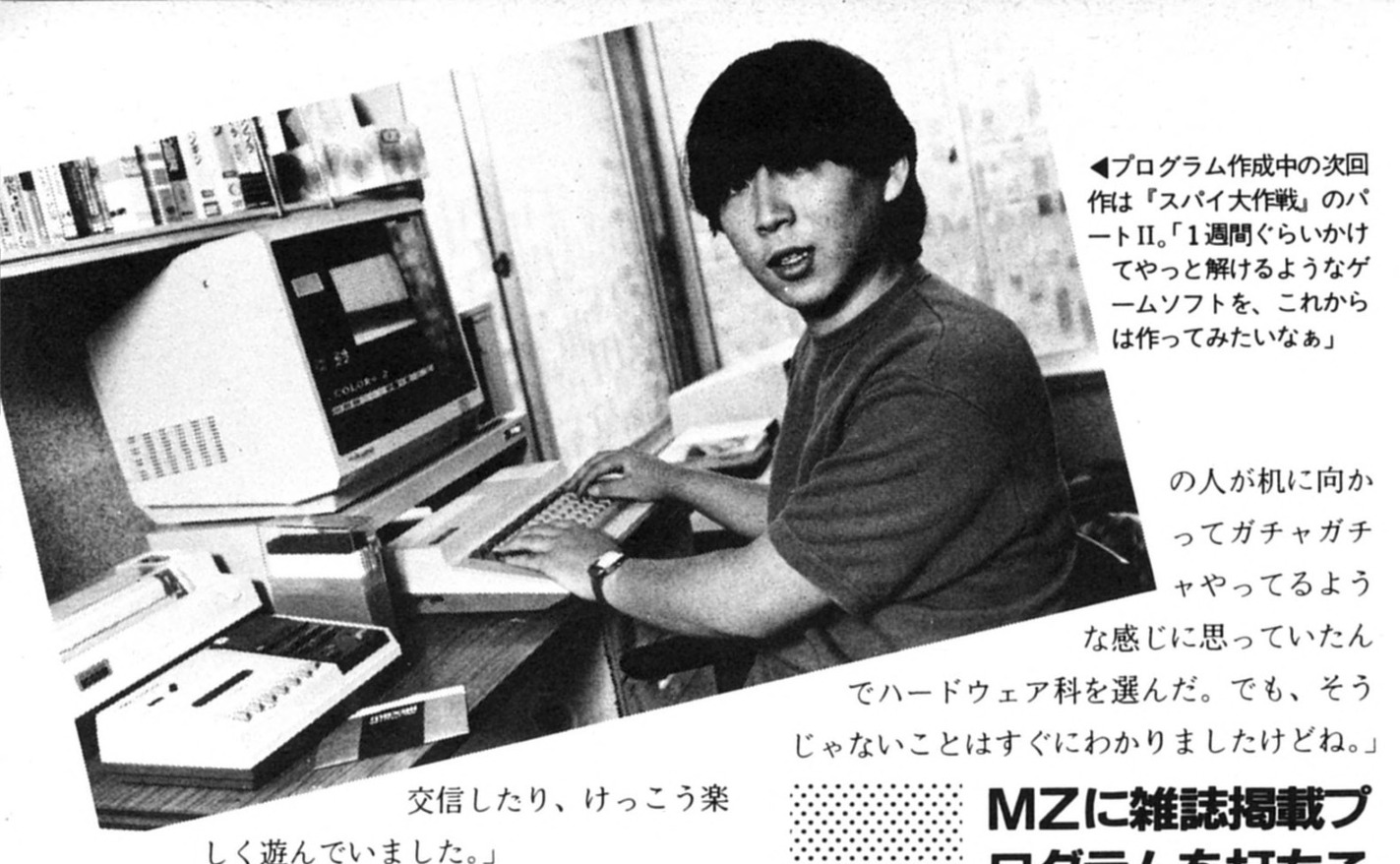
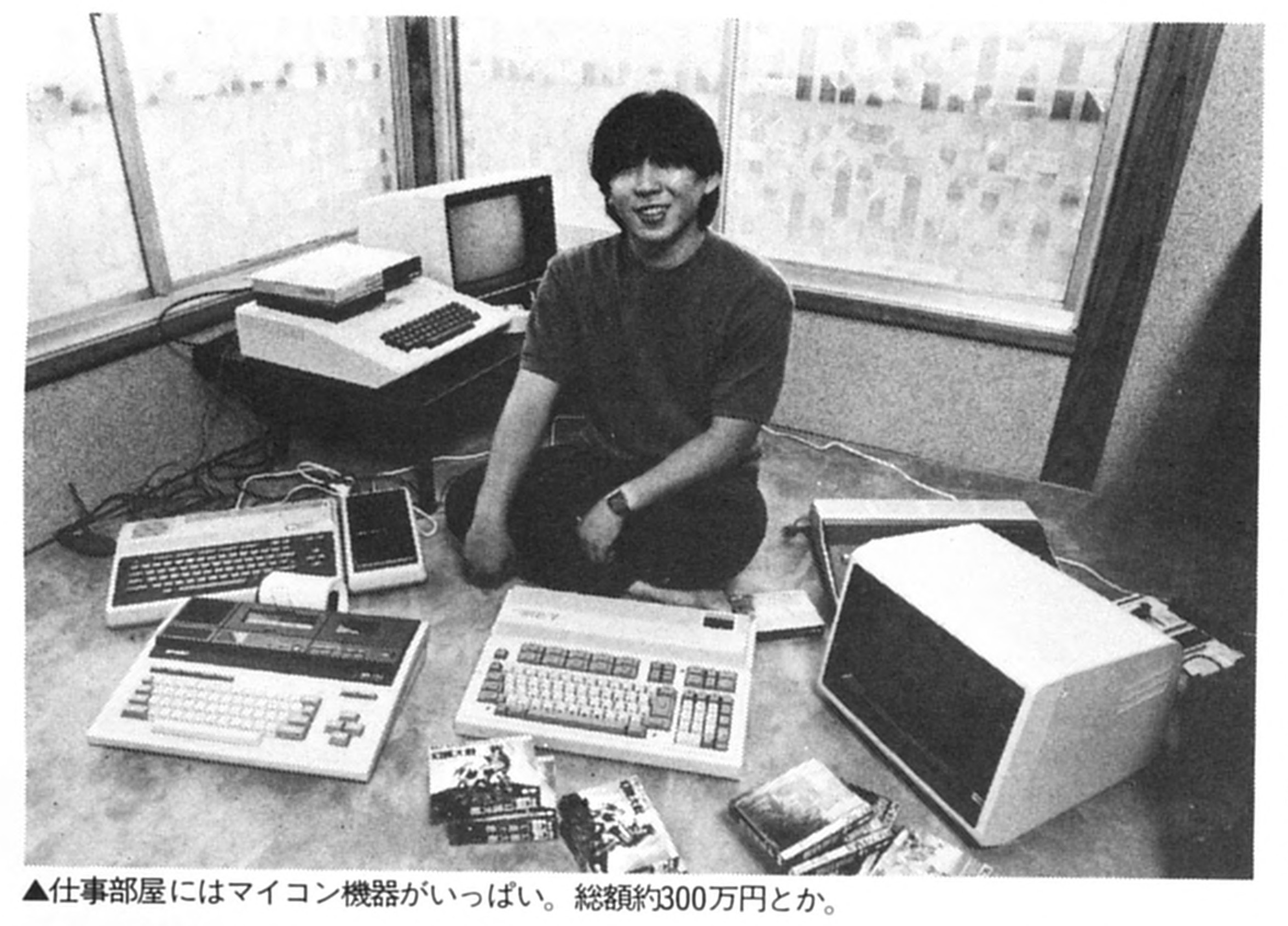
Our author, shown with “3 million yen” worth of computer equipment. Technopolis December 1983, with an interview that I’m pulling the biographical details from.
Yoshinobu Takahashi’s interest in electronics started in junior high school when he joined his school’s amateur radio club; he got a license in high school and chatted with a friend over radio while studying for exams. He hadn’t gotten interested in computers yet, but there wasn’t really an opportunity until the TK-80 kit came out. He had a friend that used an expanded version (COMPO-BS/80) in order to play Space Invaders. This was the first time he realized the world of computers and the world of games combined.
From NEC Retro. The original TK-80 was a loose-motherboard kit (like the KIM-1); the COMPO-BS/80 made it more of a regular computer.
After leaving high school he went to the Chiyoda Institute of Technology and Art to study computers, starting with hardware. Not long after he got a Sharp MZ, learning BASIC by typing in programs from magazines. His first game project was a (physical) slot machine; he soon found himself liking software more than hardware, although he didn’t start writing computer games until after graduating.
The standard Japanese route is to then take employment exams to get into companies (like his fellow graduates did, jobs were easy to get); the only exam he took was for ASCII Magazine to be an editor (he was rejected). What he really was aiming for was to be an independent programmer. He knew there were programming “stars” from the US (like Nasir) so he figured the same thing would happen in Japan, even if it hadn’t happened yet.
He took up part-time work with a company that managed inventory control terminals for supermarkets (and would go to supermarkets to fix their hardware personally); while doing this, he aimed to go professional and started making games on a PC-6001. He started with a version of Star Trek and sent it to Image Soft, and they agreed to publish it in July, only a few months after he graduated.
This gave him enough motivation to start programming full-time, and develop his first serious original game, スパイ大作戦 (Mission: Impossible). This is the official title given both in the game itself and on the packaging; it nearly always gets translated as “Spy Daisakusen” (Spy Mission) but since スパイ大作戦 is the name of the actual show (you can see it in the video below from The Dubbing Database), I think Mission: Impossible would be the more appropriate translation?
He described it as a “Role-Playing Adventure Game” but it isn’t really in a modern sense an RPG or an Adventure game; it’s more of a strategy game. You pick supplies to start and then infiltrate an enemy headquarters, while moving around in a 3d view while stealing classified documents. Aspects like the player’s starting stats are randomized.
He got the concept from watching the TV show. I studied the documentation and didn’t see any mention of official licensing. The reason the publisher may have gone through the effort is we aren’t talking about Image Soft any more; but Ponyca (or Pony Canyon). Their official company history traces all the way back to 1955 with the establishment of the Nippon Broadcasting System, which later launched a music tape business in 1966 and Canyon Records in 1970. Like Xtal Soft they made the natural transition in 1982 from putting music on tapes to putting software on tapes. They also started with anime video in the late 70s and ended up having licensing agreements with big companies; in short, they’re more likely to both have the ability and desire to do things through official channels.
It did sell well; Takahashi cites it as being the first hit for the distributor Ponyca, selling over 10,000 copies when accounting for all the different versions (PC-8001, PC-8801, MZ-1200, MZ-2000, MZ-600; all the ports except PC-8801 were his).
Official tie-in or not, the game associated him with tie-in games, and this is how he got to working on Genma Taisen which was official. Unlike Dark Crystal (where Roberta Williams explicitly talks about the game working without having seen the movie first) this game is deeply integrated; it literally doesn’t make sense without the extra plot context, starting with a scene a fair ways in the movie.
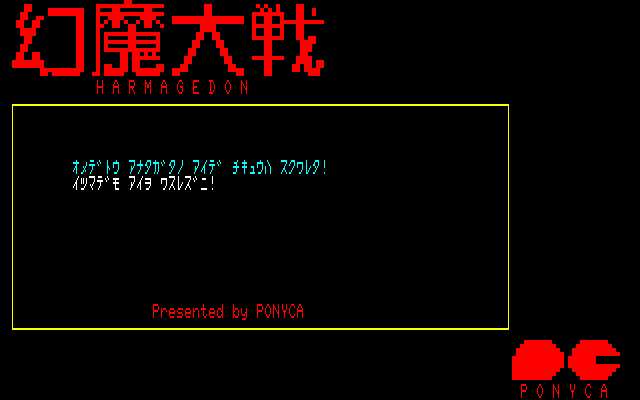
I have the PC-8001 version of the game and the PC-98 version of the game; the PC-8001 version is text only! For the most part I’ll be showing off the PC-98 version (people generally played the game with graphics). However, let me start with PC-8001, which manages some impressive starting screens anyway:
Notice the mention of Haruki Kadokawa (the publishing/film mogul) as a producer.
The last screen there is where the weirdness starts. The PC-98 version to compare:
The layout pretends this is like an RPG, although it really isn’t. The characters in the upper left are Jo Azuma, Luna, and Vega. The scene starts here at Jo’s girlfriend; it seems to be about 23 minutes in the movie. And somehow Luna helps with the situation? Everything is baffling enough I’m going to separate out the gameplay in part 2, so stay tuned, and find out if this really does deserve legendary kusoge status.
(Also, thanks to f_t_b and gschmidl for file assistance.)
People are going to buy these things and then after six weeks or so they’re going to put them up on a shelf in their closet and ignore them … we saw that there was a need for something that helped people to both socialize with other people and get practical life use out of these really significant investments.
Before getting to our author today, I need to revisit one of the prior games from this blog, Max’s Adventure. Max’s Adventure (or just Adventure) was given by the author Max Manowski to a shop in Seattle, and from there it distributed far enough across the US Northwest to catch the attention of the Atari Computer Enthusiasts club in Oregon. The club helped distribute the game farther before it eventually got the attention of Atari and was packaged as Wizard’s Revenge as part of their APX program; it became the only text adventure that Atari published made by someone outside the company.
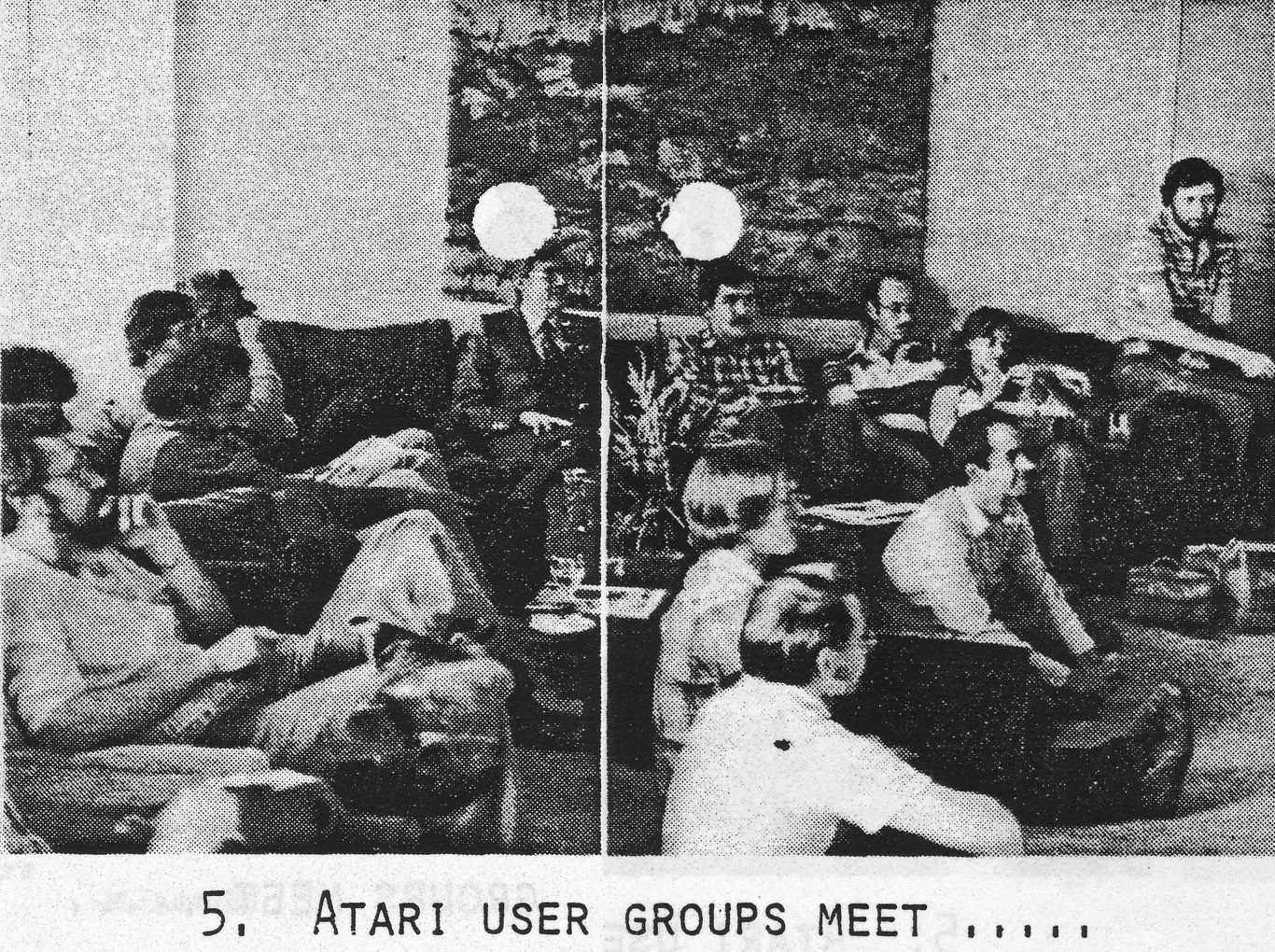
The same issue that talks about Max’s Adventure (April 1981) also discusses a San Francisco event where ACE members visited Atari, with pictures, so it’s possible the game was handed to Atari directly.
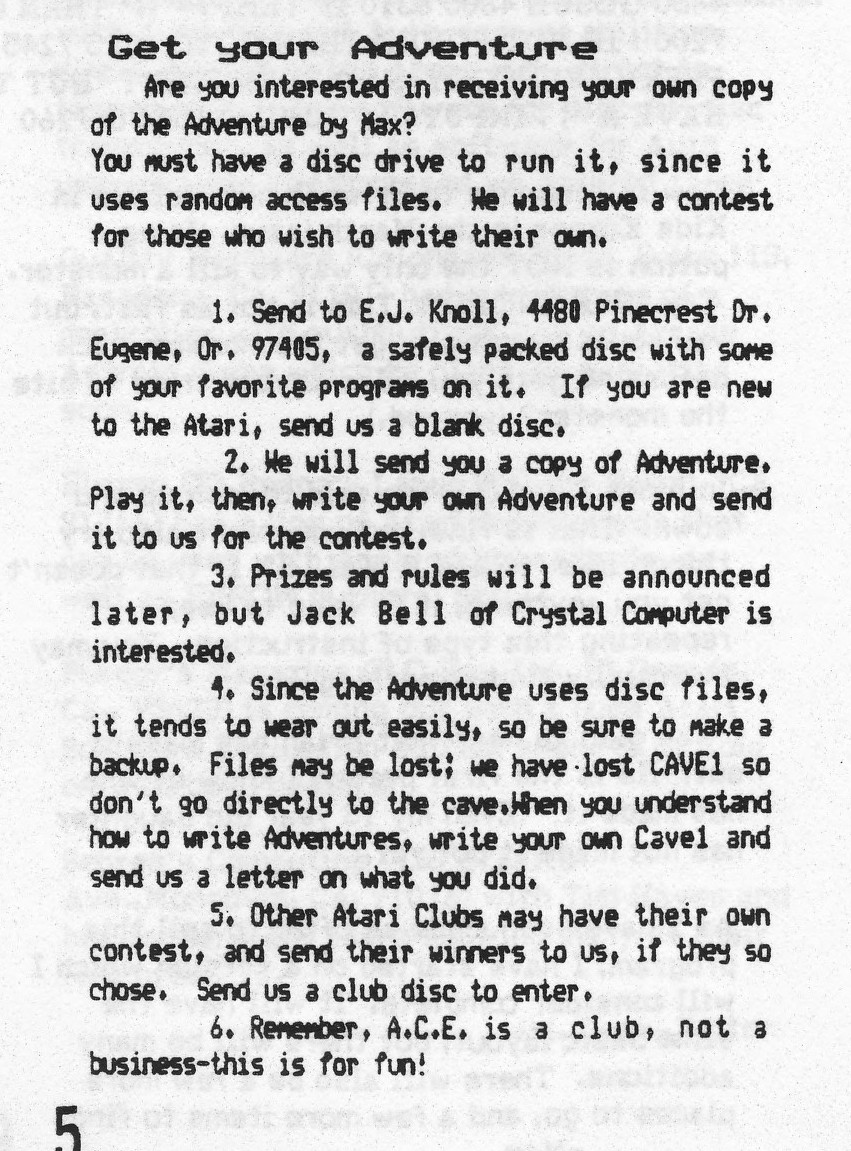
There was an effect beyond just getting Atari’s attention, as ACE had an unusual distribution plan, which they describe as a contest.
The offer was: send a disk to ACE (with some programs if you have some, blank if you don’t) and you’ll get a copy of Max’s Adventure. Write your own adventure based on it and send it back (prizes to be announced later, John Bell of Crystalware was interested). Even given the loose nature of the “contest” and their explicit mention “this is for fun” this does beat (in terms of being earliest) the Falk contest for Tandy CoCo. However, the contest does not get mentioned in later issues, so I think it ended up as vaporware.
At least one person picked up the challenge of modifying Max’s Adventure into a new game, even if it didn’t end up in the “contest”: George Schultz of New Jersey.
Schultz helpfully included his address in the source code as well so I was able to cross check on a few sources (1, 2, 3, 4) to get his biography. He was born in 1941 and after a stint with the Navy he went to Rutgers to get a degree, graduating in 1973. He moved to New Jersey as a journalist with the Newark Star Ledger before switching to being editor of Fuel Oil News in 1982; he stayed with oil business journalism until his death in 2002 from a heart attack.
This means he was in his 40s when he wrote Sherlock Holmes, which is the first fully Sherlock-Holmes branded text adventure for this blog. (Two Heads of the Coin from 1979 was clearly meant to be Holmes, but doesn’t mention his name, nor does it get into any lore — it’s a pure conversation with one person.)
As far as why it took this long to get a straight “you are Holmes” game, with text adventures of this era it has been rare to have major characterization at all. Usually “you” has been “you” in some sense, maybe with some extra conditions (like in Cyborg being merged with a robot) but not with a background that might justify a full 30 pages in a LARP session. Exceptions have included The Hobbit, Robin Hood Adventure, Sherwood Forest, and Aldebaran III; so while we have had developed characters, relative to the large number of adventures up to now it’s a short list.
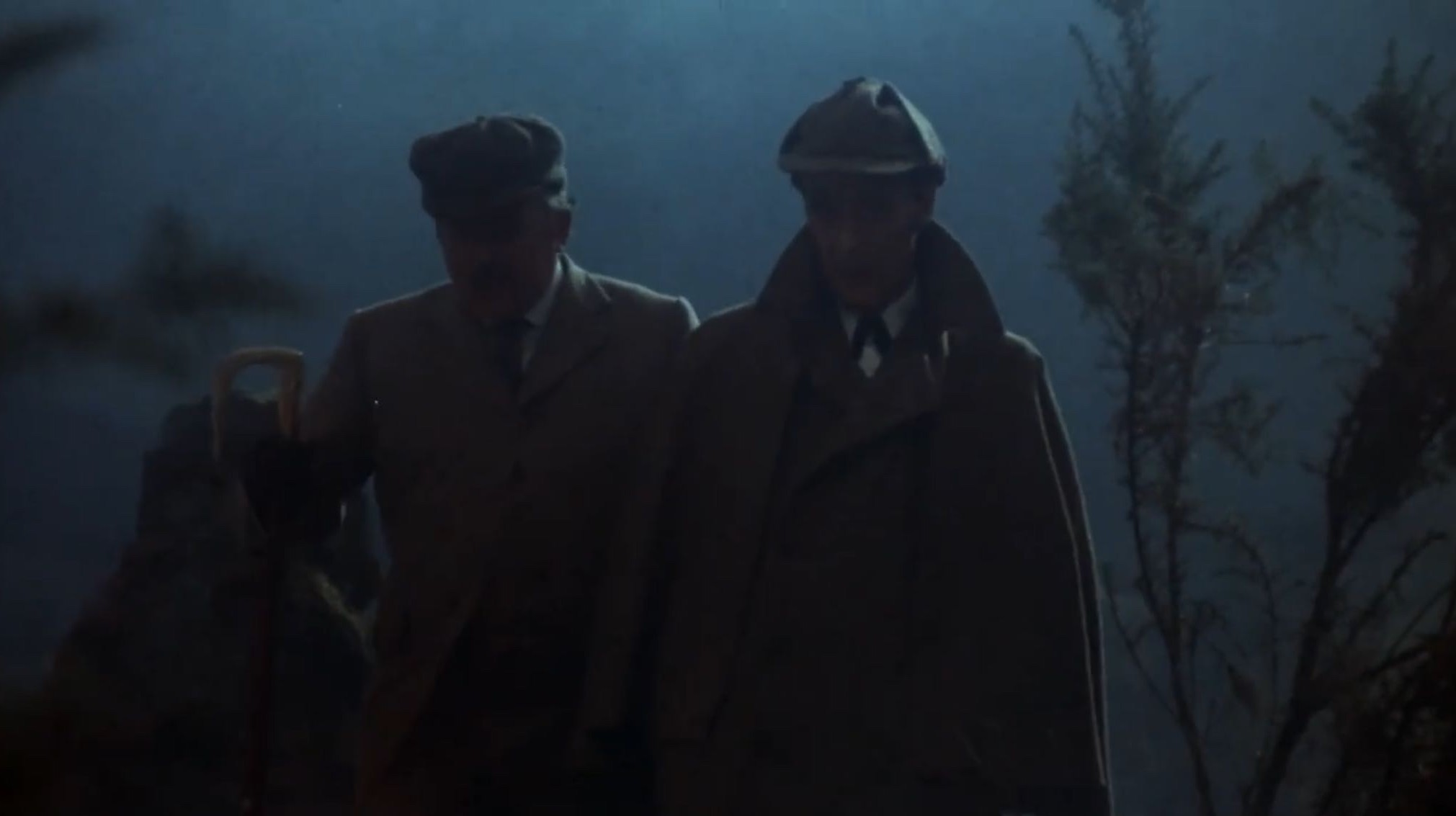
Roughly when Schultz was working on his game there was all sorts of Holmes media being made, like this BBC adaptation of Hound of the Baskervilles. There was also a Soviet adaptation from 1981 and animated films from 1983.
The reason I know the code is derived from the ACE game is that it says so; I’ve pulled out both pairs of source code alongside and can definitely say it uses the same unusual system where you can edit the game from within the game. These lines of code are identical amongst the two, even with the same line numbering:
3220 IF INPUT$(1,3)=”NEW” THEN 3400
3225 IF INPUT$(1,4)=”GOTO” THEN 7600
3228 IF INPUT$(1,4)=”LIST” THEN 8000
3230 IF INPUT$(1,5)=”PRINT” THEN 3800
3240 IF INPUT$(1,6)=”CHANGE” THEN 3600
3250 IF INPUT$(1,6)=”EXTEND” THEN 4000
The only comparable game that’s been on this blog is ZOSC based on the GROW system, and that was just repurposing a system intended more for learning applications. I theorize that having a system that emphasizes adding text content on the fly rather than programming might appeal to someone with an English/journalism background. Unfortunately, the parser is miserable in the way you might expect from a GROW-style game, as you’ll see in a moment.
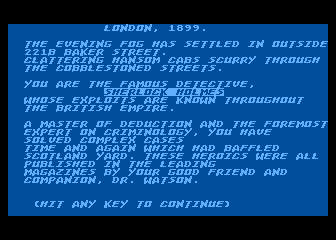
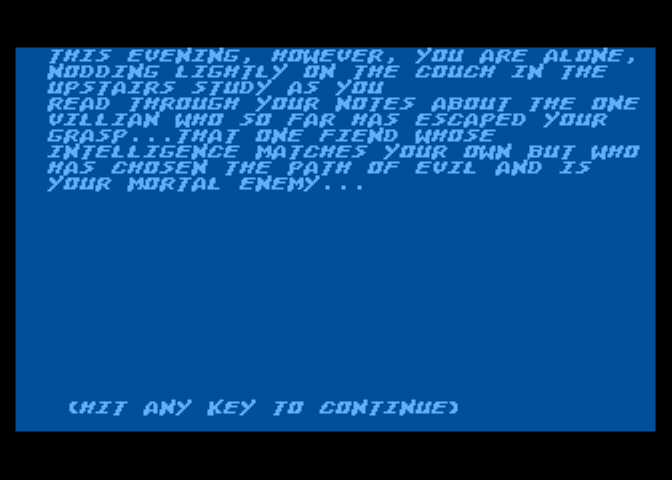
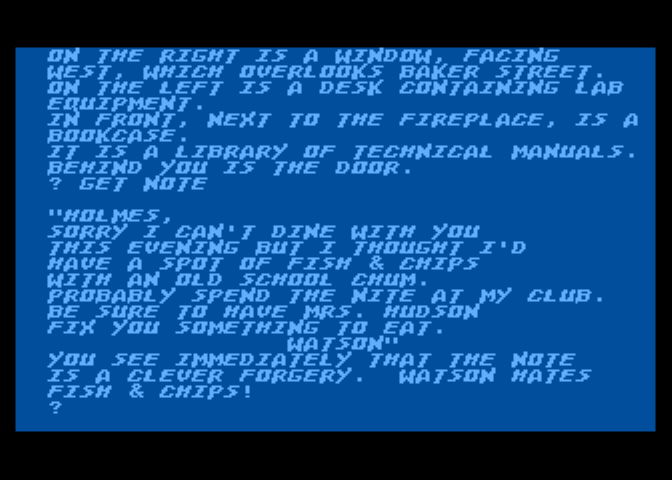
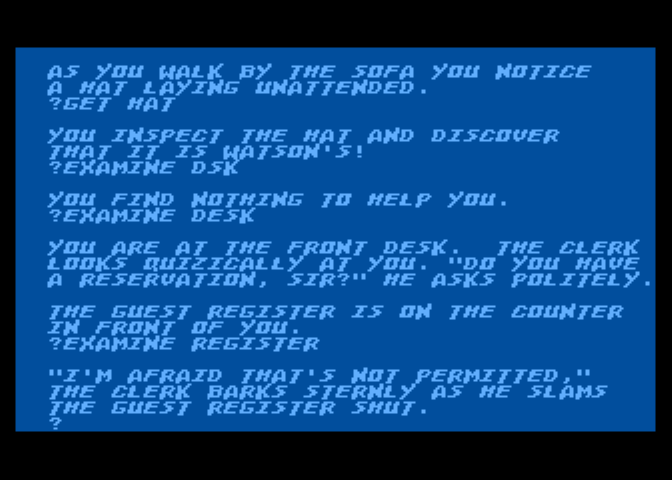
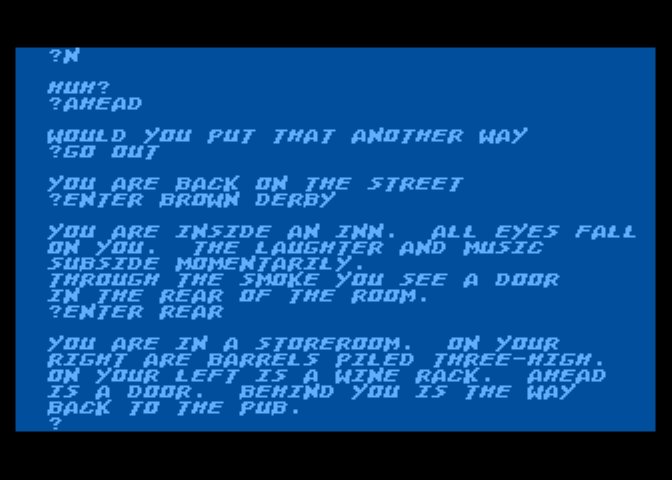
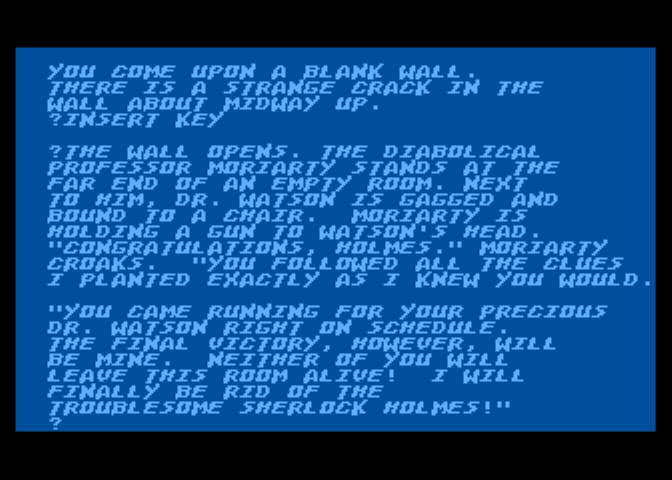
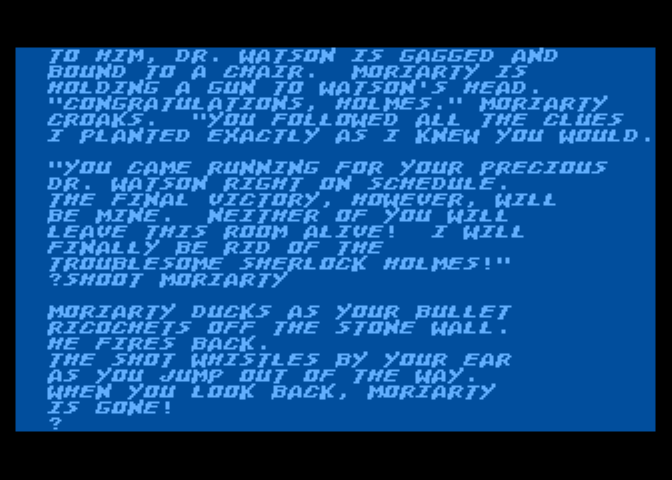
You are casually hanging about your study at Baker Street when Mrs. Hudson brings in a letter. You determine quite quickly it must be a forgery and Dr. Watson is in trouble.
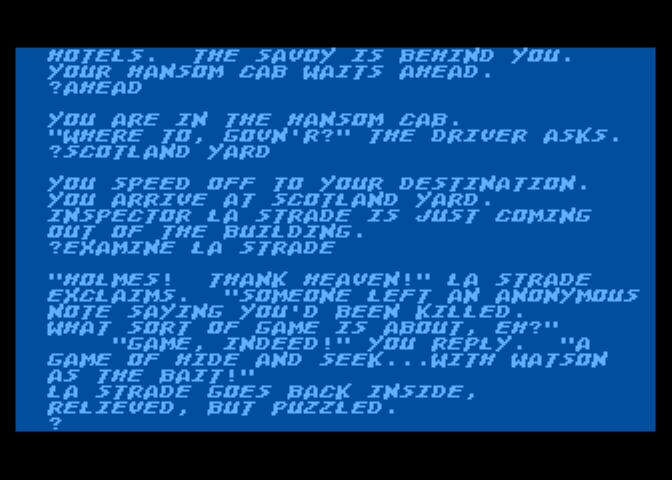
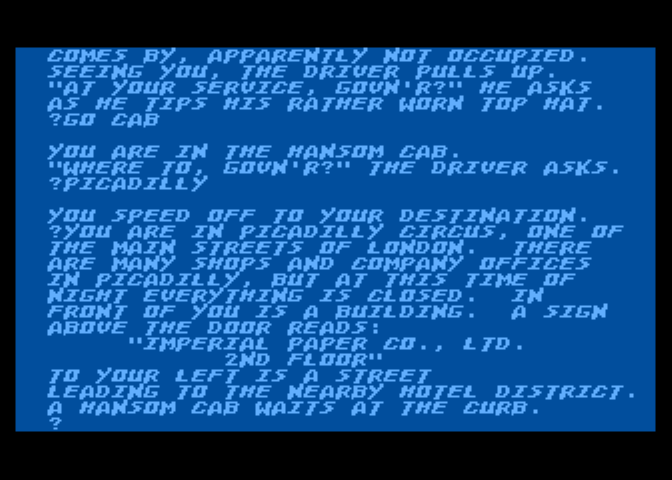
At this point you can try running off to at least Scotland Yard, but let’s hang out in the study for a while.
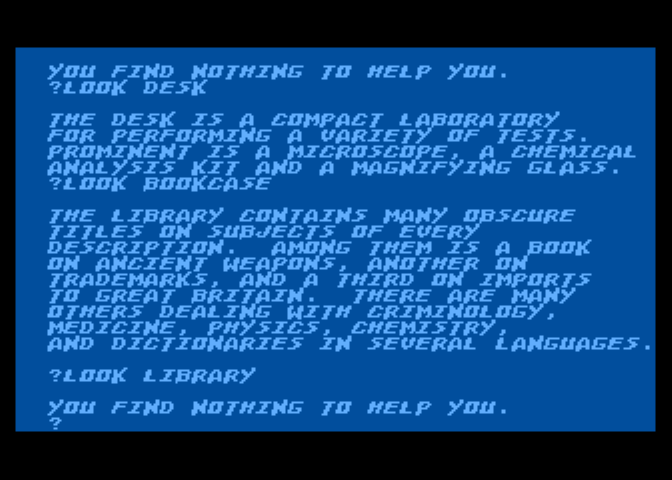
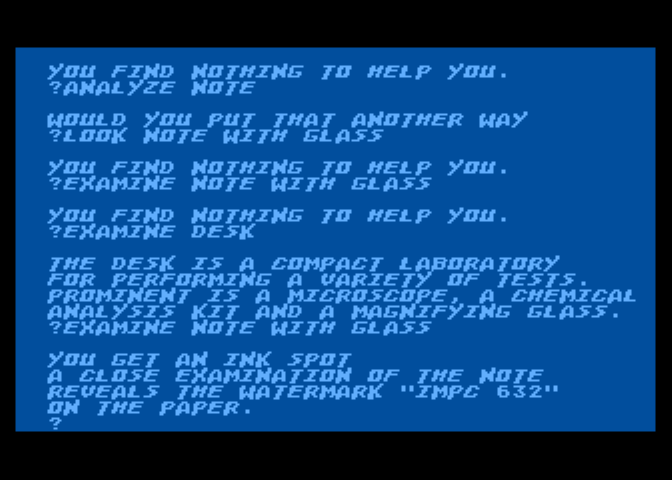
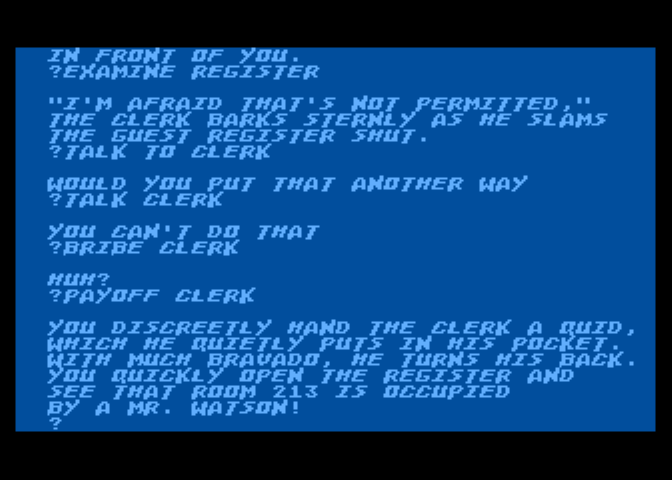
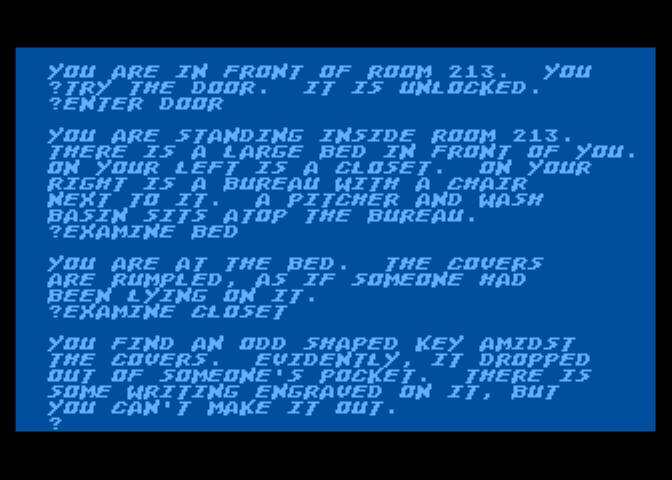
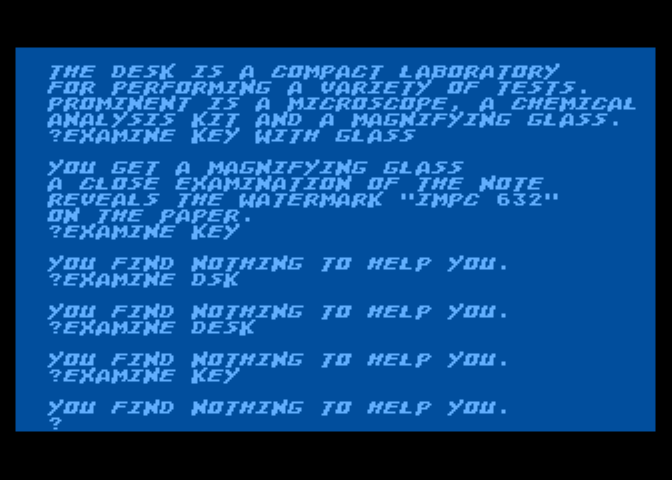
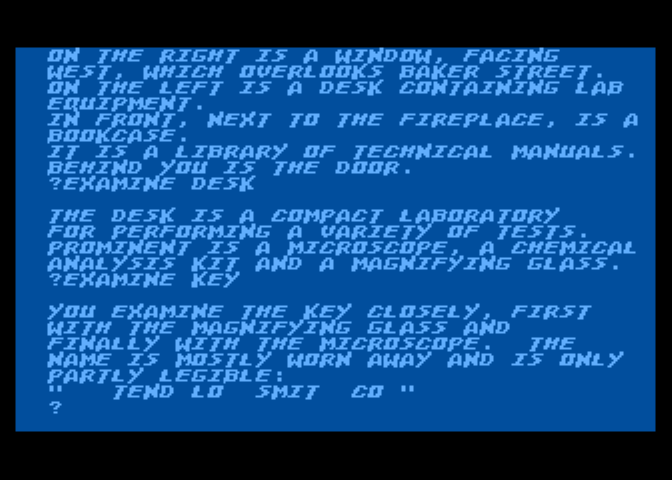
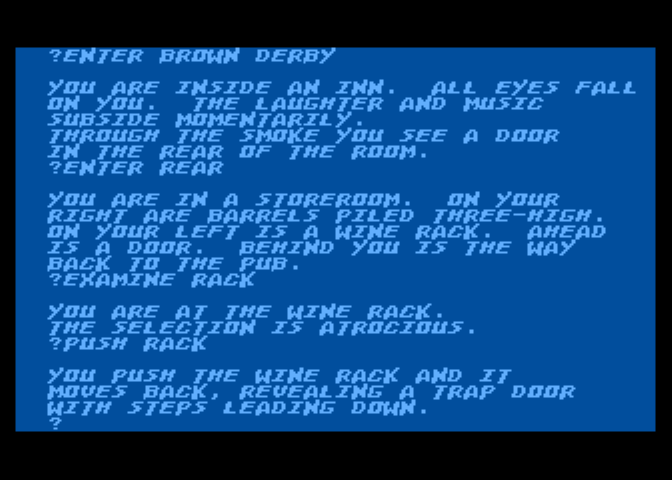
The various investigatory tools suggest you might be able to do something to trace the note, but unfortunately, I immediately ran into a stumbling block here trying to get anything to happen. Keep in mind this is a GROW-style game where it doesn’t really keep track of “world state” in a normal way; it’s jumping between nodes and fishing for particular prompts. In this case, it wants you to EXAMINE DESK, and then immediately use something from the desk on the note; if you examine the rest of the room first, the desk ceases to exist (this is roughly the behavior of The Phantom Ship, but this game has it even worse). There’s no world model storing the fact there’s a desk and a bookcase, just some central place where EXAMINE DESK and EXAMINE BOOKCASE work, and I found myself sometimes just in a labyrinth of “YOU FIND NOTHING TO HELP YOU” responses.
You also need to jump to this being a multi-word parser here.
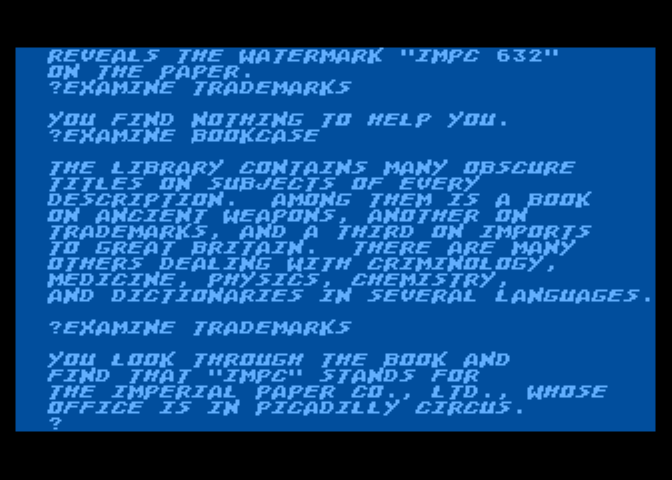
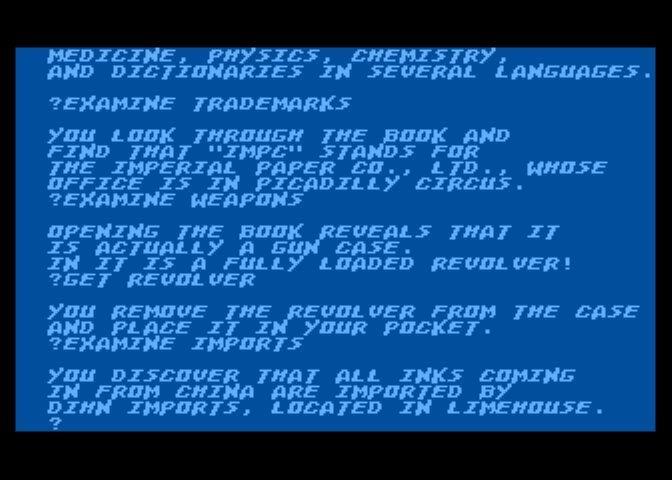
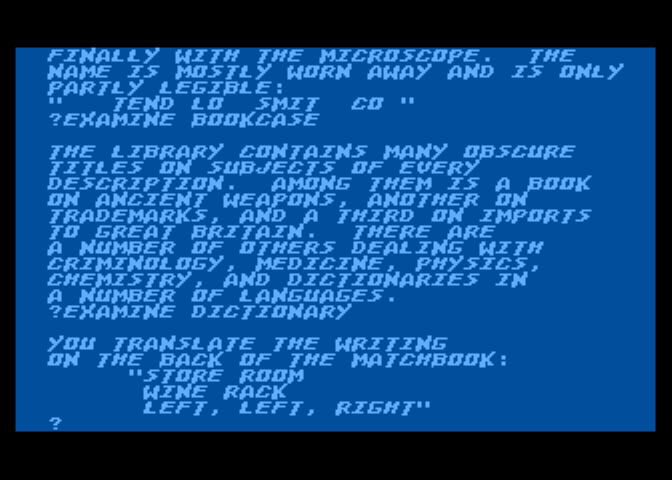
The note reveals a watermark which you can investigate further with the books; remember there was a book about trademarks. Well, actually, just remembering it is bad, you need to EXAMINE BOOKCASE immediately before using something on it.
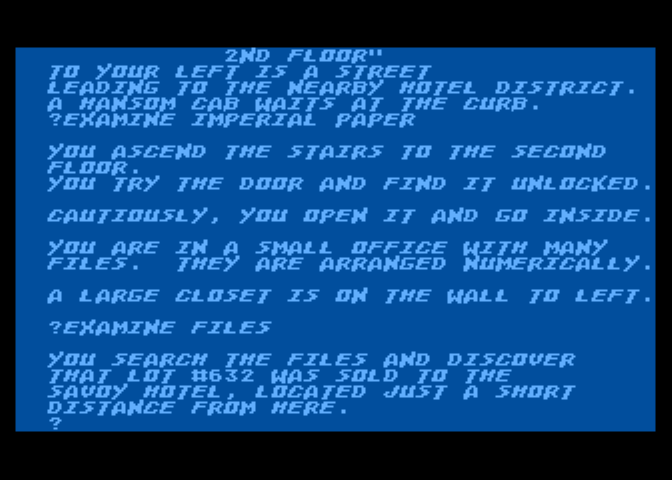
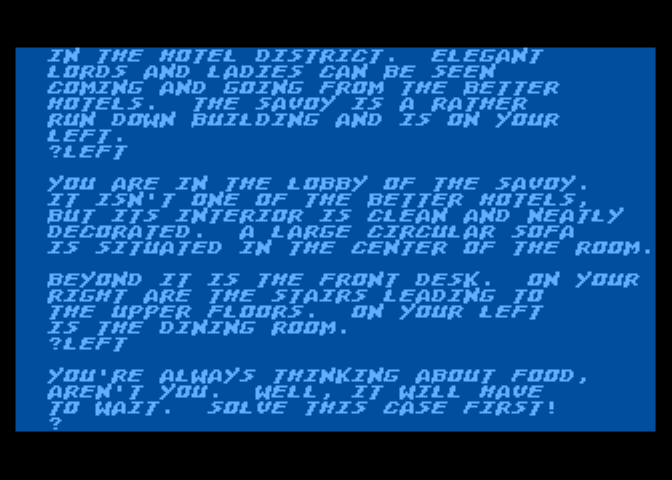
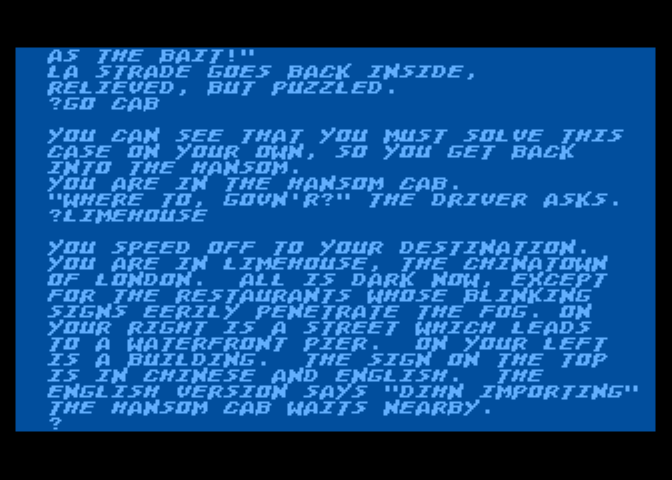
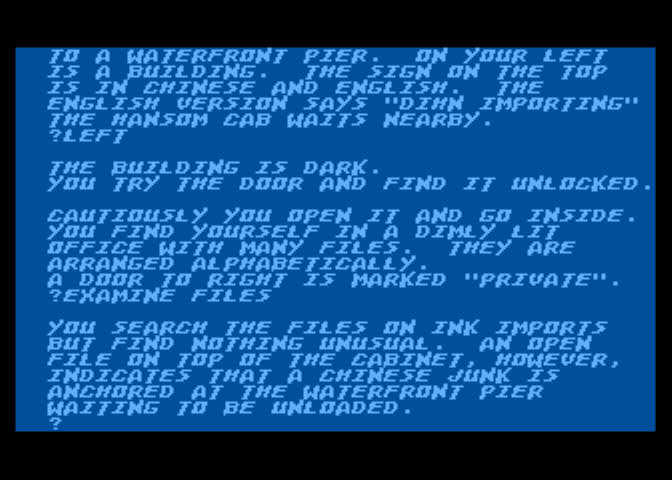
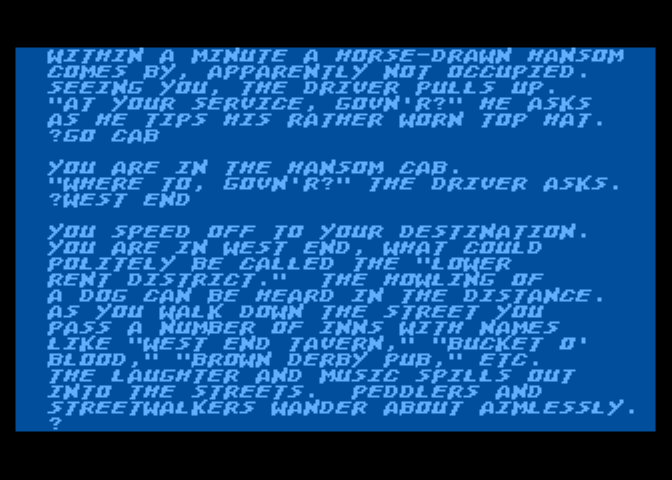
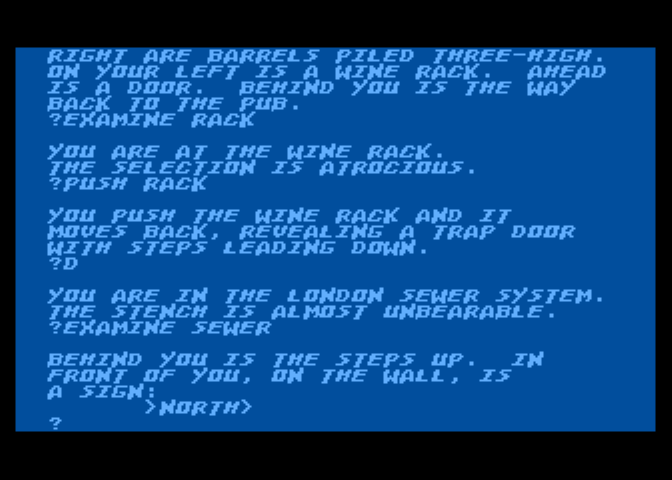
You can also follow this up with EXAMINE IMPORTS to find out that inks coming in from China are imported by Dihn Imports, in Limehouse.
Finally, you can EXAMINE WEAPONS mentioned on the bookcase. Somehow that gets interpreted as opening the bookcase and finding a secret revolver, which you’ll need for the end of the game. (It’s faintly possible the game keeps so little track of state you could skip taking the revolver and you’d still be able to use it at the end, but I haven’t tested that.)
I’ll pause and say in a conceptual way this is an impressive segment; we have an item that we apply both detection tools and research to in order to learn more. The parser simply isn’t able to sustain what’s going on (again, this seems to be a combination of the node system with the author’s perspective, thinking like writing from an author’s perspective rather than modeling a world).
The game is afoot; you can nab your famous outfit on the way out, and then hail a cab. As seems to be the standard for investigation games, you need to tell the cab-driver where to go, so this is a matter of hunting down key-words. So far other than 211 BAKER STREET (no “B”) we can do SCOTLAND YARD, PICADILLY (with that exact spelling), and LIMEHOUSE. Let’s try Scotland Yard first, since the visit is short.
The “La Strade” spelling suggests to me the author was watching the stories recently on TV/film as opposed to reading them.
Regarding Pic(c)adilly, hinted at from Imperial Paper…
…it’s not clear at all this is the way to do it, but EXAMINE IMPERIAL PAPER will let you enter the closed building. There you can find some files about the Savoy Hotel. This is entirely an optional section; I actually went over to the Hotel first and didn’t find out about this area until beating the game.
Leaving the hotel and going “LEFT” you can find the hotel (no north/south/east/west).
I’d like the in-character chastising more if it matched the character of Sherlock Holmes.
Going ahead, Holmes notices a hat (Watson’s) left behind on a couch; going forward and examining the desk reveals a guest register, which the clerk refuses to let you look at.
I ended up needing the walkthrough for this one. Trying to TALK TO CLERK didn’t work. While Holmes is not described as holding money, I tried BRIBE CLERK anyway and got “HUH?” The right command is to PAYOFF CLERK, shooting the puzzle to being at least in the top 5 Hardest Adventure Game Verbs to Figure Out Ever.
This process lets you go upstairs and find the room Watson was allegedly in, unearthing a key.
Again notice the stumbling parser. I tried to EXAMINE CLOSET but the node here just assumed I was examining the bed further and found the key. I’ll take a parser issue making the game easier over one making the game harder.
You can then take the key back to Baker Street to study it and find out what’s on it… maybe. I really had immense trouble here; there must be something exceedingly specific in how the nodes are implemented.
Even with checking the walkthrough it took me two tries to get something out of the key.
Back here in a moment: time to visit Limehouse.
Files indicate a dinghy on a pier. With a little bit of parser struggle I arrived there. The pier also has Dr. Watson’s medical bag (his items are being left suspiciously out in the open); you can row the dinghy over to the main boat, and find some matches with writing in Chinese.
West End represents the last destination, but we should probably translate that matchbook text first. Back in Baker Street there’s a dictionary on the pile of research items which reveals a set of directions.
I again want to emphasize, in a conceptual way doing research on clues is extremely neat; in practice it was extremely painful to get anything to work.
Time for the West End…
…and a serious… bug?
GO REAR reaches the next part of the game, but often it doesn’t work. It doesn’t seem to be a “random” flip; when it isn’t working, you have to leave and come back and try again. I tried various phrasings of GO and ENTER and IN and OUT and so forth to see if that would make any difference. I don’t know if it does; the walkthrough doesn’t know either.
There’s a wine rack you can PUSH to find a secret entrance to some sewers.
The sewers are where you apply the directions from the matchbook.
Following them properly leads to a crack in the wall where you can INSERT KEY.
Driving off Moriarty is a simple matter of trying to SHOOT him with your revolver; however, he’s left a trap for you if you try to just go in afterwards. You’ll fall into a trap door and die.
You need to JUMP OVER TRAP DOOR to get by.
Twist ending with the fish and chips! If this was “canon” I’d be more annoyed.
The artificial set of obstacles works as a set of challenges by Moriarty; it gets taken up by at least one author later. The presence of the hat and the medical bag especially felt like a trail-of-Moriarty plot element. The moment-to-moment action held at least some interest, and the research aspect was genuinely a good idea. Unfortunately, the parser was miserable all the way through. The author tried his best to implement his ideas with the system; honestly, it’s impressive how far he got, but there still wasn’t enough world model support and parser implementation to make the game work. In a big-picture sense, this reflects the technical barriers for making adventure games at this time, and why so many toolkits like The Quill became popular.
Coming up: back to Japan, and a famous anime movie.