Rendition of Sapas Mons on Venus, a volcano 400 km across and 1.5 km high, using coloration from Venera missions. Via NASA.
Last time I was thinking about the bug I had run across with the rod becoming two rods when entering the pool.
Despite the glitch here, some further mucking about confirmed the rod is the only item that this happens with, and the special coding indicates that it is meant as a puzzle to get the rod into the cave. (This type of logic I’ve called “structural solving”, although there’s two kinds. One is where there are restrictions based on the structure of the game that force certain things to be true, like an exit closing off meaning a puzzle behind the exit has to be solved first. The other is the “author suggestive” kind where they put work to incorporate some element to the map or plot sequence which doesn’t make sense unless it gets used in a certain way. The first type of solving is almost ironclad, the second relies on the author not leaving any loose pieces. Here, Leduc wouldn’t special-code the rod getting foiled by the dense pool unless the rod needed to get by.)
I realized I hadn’t tried xenoshifting and putting the rod into the hole at the ledge both in the same saved game, so I went ahead and tried it: start with the regular space suit and the boots, wear them both, take the rod to the ledge, PUT ROD / IN HOLE, go back in the ship, dump the boots and suit (you don’t need them any more the rest of the game), xenoshift, then go past the pool into the cave.
Oho! So I was in the same situation as before (nitrogen stream, cube) except with the rod. Given it could extend for very long I tried various ways of dropping it and applying CROSS ROD. Unfortunately, the parser hard-code interprets that as CROSS STREAM without the player attempting to use the rod as a plank. (The game never describes if the rod is thick or thin, so I don’t know how reasonable an ask this was anyway.)
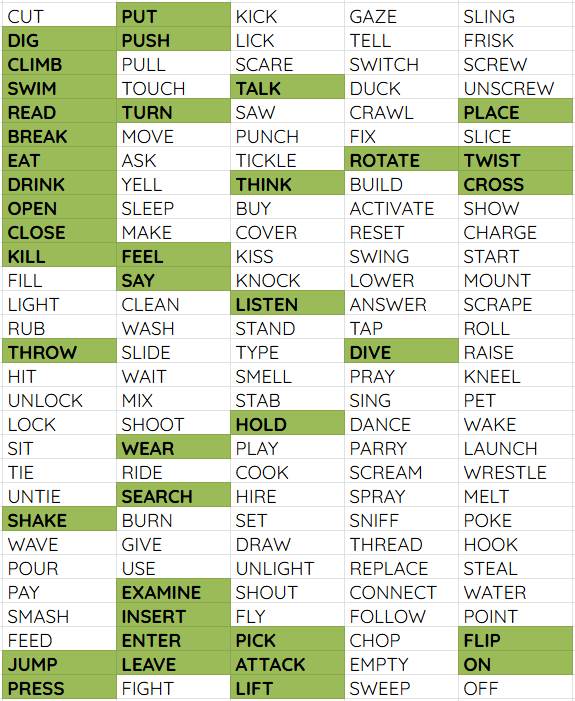
The extreme restriction here — for structural solving reasons, the obstacle has to be the stream, and the rod has to be important somehow — led me to tread through the entire verb list but still no luck. However, that doesn’t mean every verb is accounted for! (Especially in a game with REPROGRAM.)
Fiddling with the 11 foot pole, I suddenly recalled a very different game, Terminal City. The developer Powerhoof (who recently published The Drifter, one of the best adventure games I’ve played in the last few years) made as a gamejam project an endless runner that’s also a Sierra-style adventure game, and it’s as harebrained as that sounds.
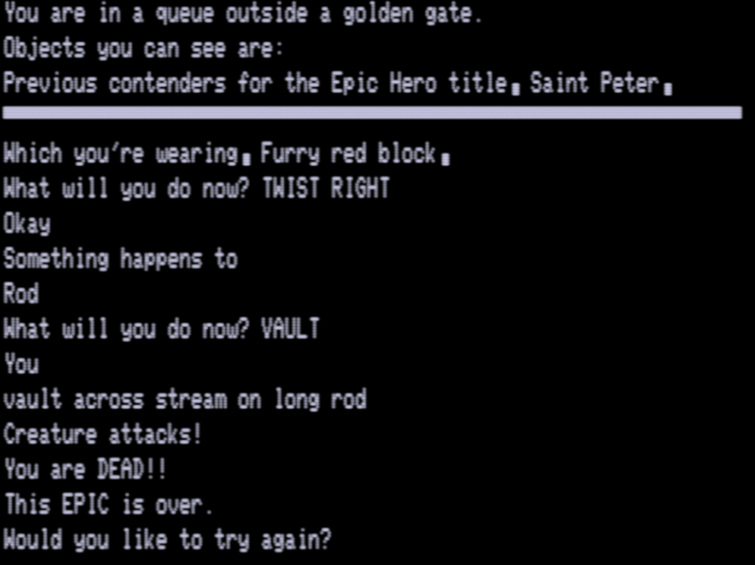
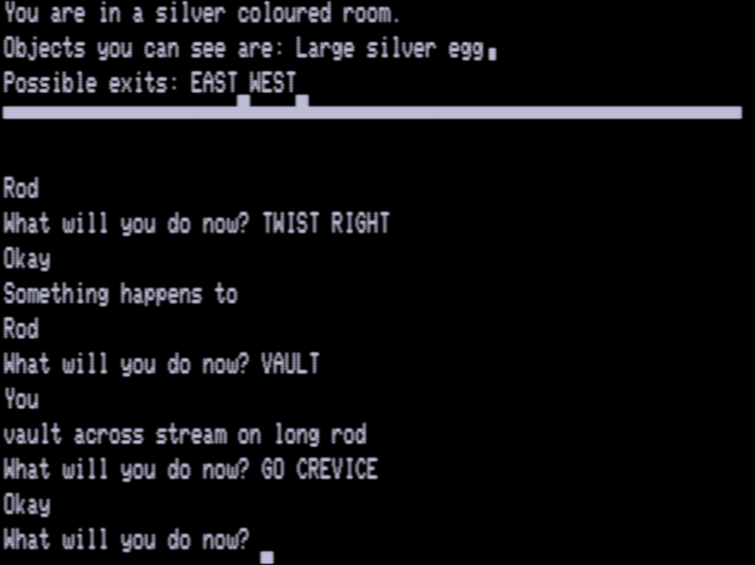
As part of Terminal City, I remembered a particular moment where you need to take a long pole and type VAULT. Well, it is a particularly long pole in Epic Hero 3:
This is a rare verb. We had it in Earthquake San Francisco 1906, but I can’t come up with any other games in the Project that have used the actual verb VAULT. I found out after the fact both CROSS and JUMP work, but you have to be holding the long pole (and the game makes you have some intentionality since you have to TWIST RIGHT three times to get it at the correct size).
The creature attack is the worst part of the design. It merely happens at random: it’s just like the vampire which can follow you all the way to the sunlight in Epic Hero 2 and not be affected. My first two times through it attacked right away, so I thought I was supposed to be solving some sort of puzzle, but no: you’re just supposed to do things quickly and ignore it.
You are in a subterranean cavern.
Objects you can see are: Narrow crevice ■ Large reptilian creature ■ Wide Stream ■
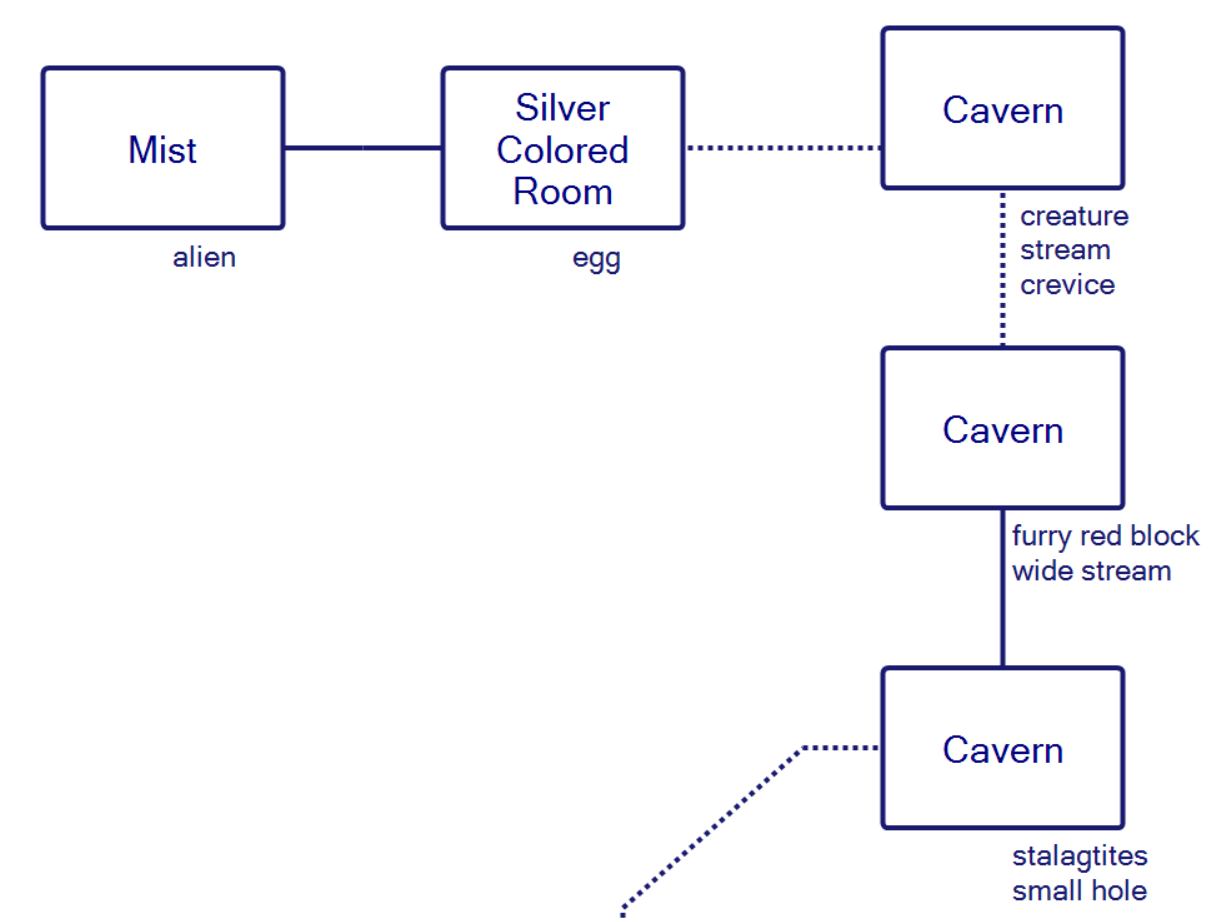
Regarding the narrow crevice, the idea is to widen the crevice so you can pass through (the creature won’t stop you). I didn’t know that at the time so I first was thinking about fighting the creature off. I didn’t have anything that suggested violence other than the bomb, so I dropped it, vaulted back, and used THINK to set it off. (The only catch is, as I pointed out last time, the rod needs to be set to 12 inches to be used as a relay. So you need to TWIST LEFT twice to restore the rod to a short size, do the explosion, then TWIST RIGHT twice to get back to vaulting size.)
Fortunately, this accidentally wanders into the solution of expanding the crevice to a “wide crevice” you can enter, and the creature doesn’t stop you if you saunter on by.
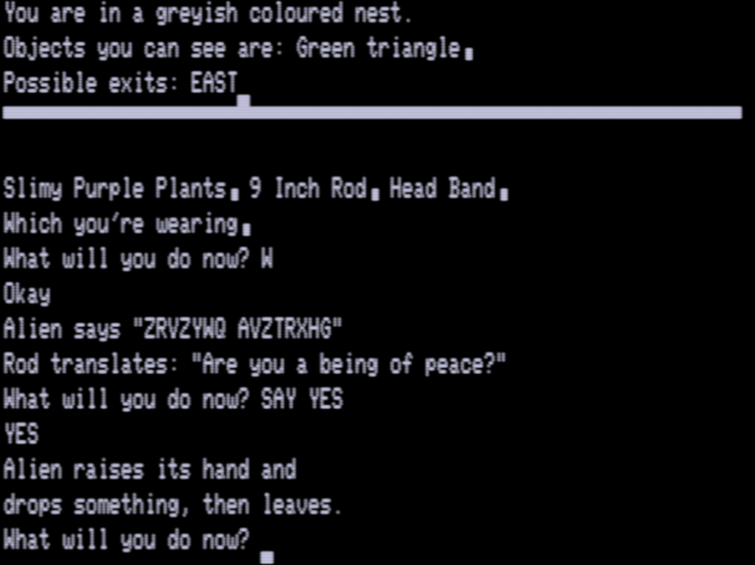
Past the room is the last room of the game, a silvery mist room with an alien. Remember earlier the alien had said they wanted to ask a question.
You are in a greyish coloured nest.
Objects you can see are: Alien
Possible exits: EAST⠤
Alien says “ZRVZYWQ AVZTRXHG”
Unfortunately, the alien speaks alienese, and if you don’t respond correctly here, you will get blasted.
Alien raises its hand and
fires a strange weapon at you !!
This final(-ish) puzzle required a lateral mental leap. Remember the rod has multiple functions: in its smallest size, it can fit into the small hole, in its largest size, it can be used as a pole vault, and at 12 inches specifically, it works as a “relay” for the bomb. I realized it might help communicate with the alien, so I tried all the sizes before hitting a result.
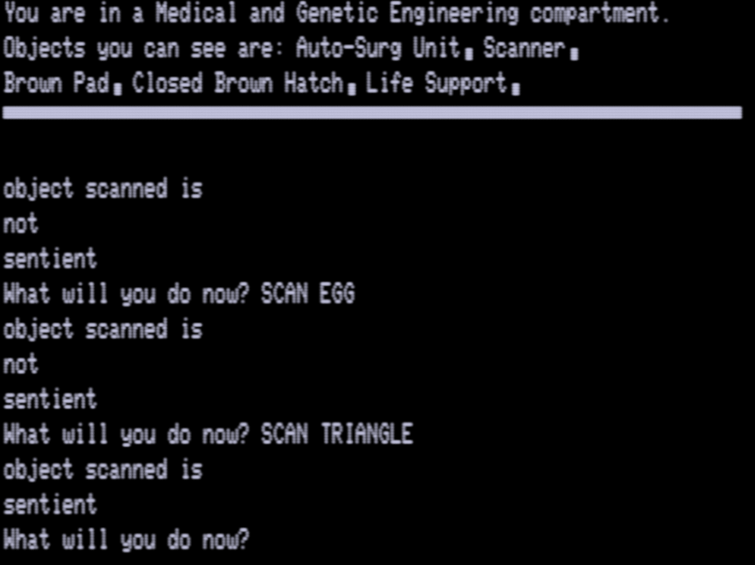
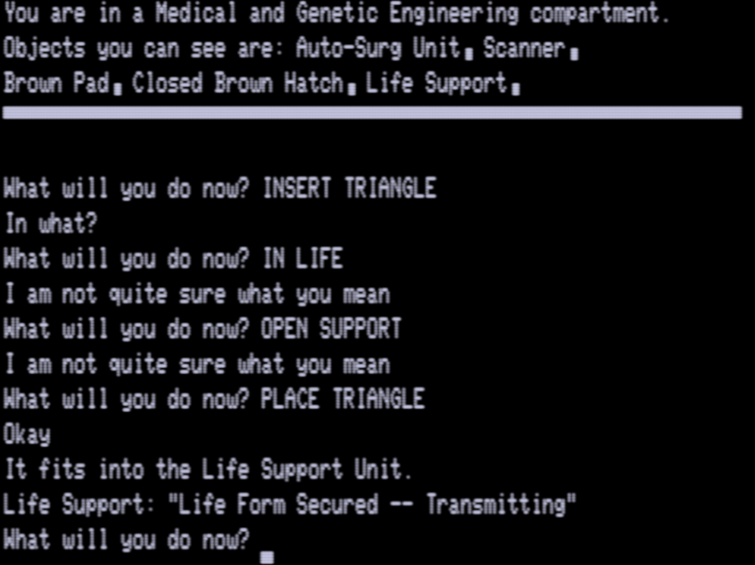
The egg from the previous room, the red furry cube, and the triangle all appear to be alive (when applying EXAMINE). But which one is sentient? Hiking everything back to the lab and turning back to human, I did SCAN on all three of the items.
It took a little parser struggle after to work out what the game intended with storing the triangle in life support. Dropping or placing gets special parser treatment here to be interpreted as the item being put into the right place, and PUT doesn’t work.
There was one last catch: I somehow messed up getting the Identi-Comp set correctly on my transformation back to human, and the pad wasn’t recognizing my touch. This made me wonder if possibly I could do a City of Alzan style ending.
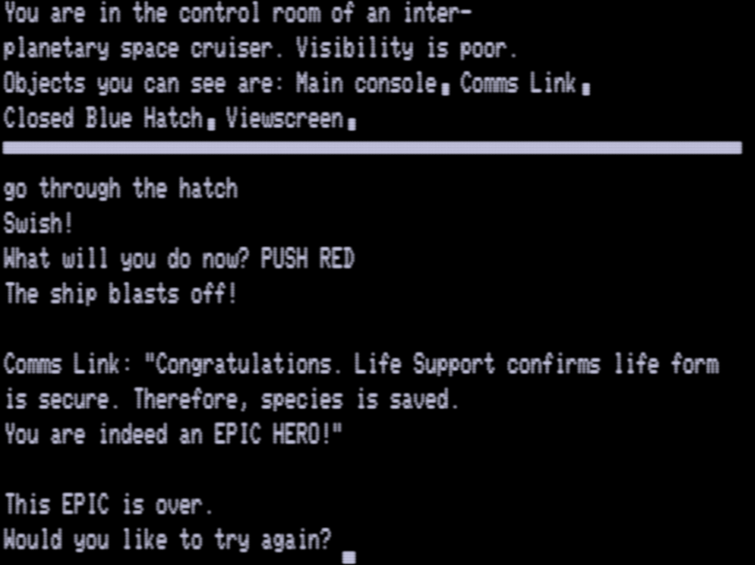
I dropped everything, switched back to alien in the medi-unit, held my breath, and made a beeline for the main control room. Then I pressed the red button to take off, whilst HOLD BREATH was still in effect.
I had a save state and it would have only taken two minutes to fix the computer, but I wanted to see if this would work. City of Alzan let you leave the city with a deadly disease still in effect but win anyway.
This game unfortunately did follow the pattern of increased difficulty pushing against the technical capabilities of the author, specifically here the capabilities of the parser (especially the weirdness of PUT being inconsistent, and the two part PUT ROD / IN HOLE applying itself to the rod even if you try to PUT some other item). However, the game still handled the various conditions far more skillfully than your average text adventure author of this time; Leduc deserves to be known at least as much as Brian Howarth.
The reason for obscurity, other than the first three games being trapped on TRS-80, is that his remaining games ended up on the ultra-obscure Colour Genie. Leduc’s Colour Genie club was nearly the only reason for activity in the UK at all on the system, so the games he wrote were restricted to a very small crowd. Which is exciting, in that we may have some gems coming up that hardly anyone knows about! However, we’re going to take a breather from Leduc for a while, as we have coming up: The Coveted Mirror, for the Apple II.
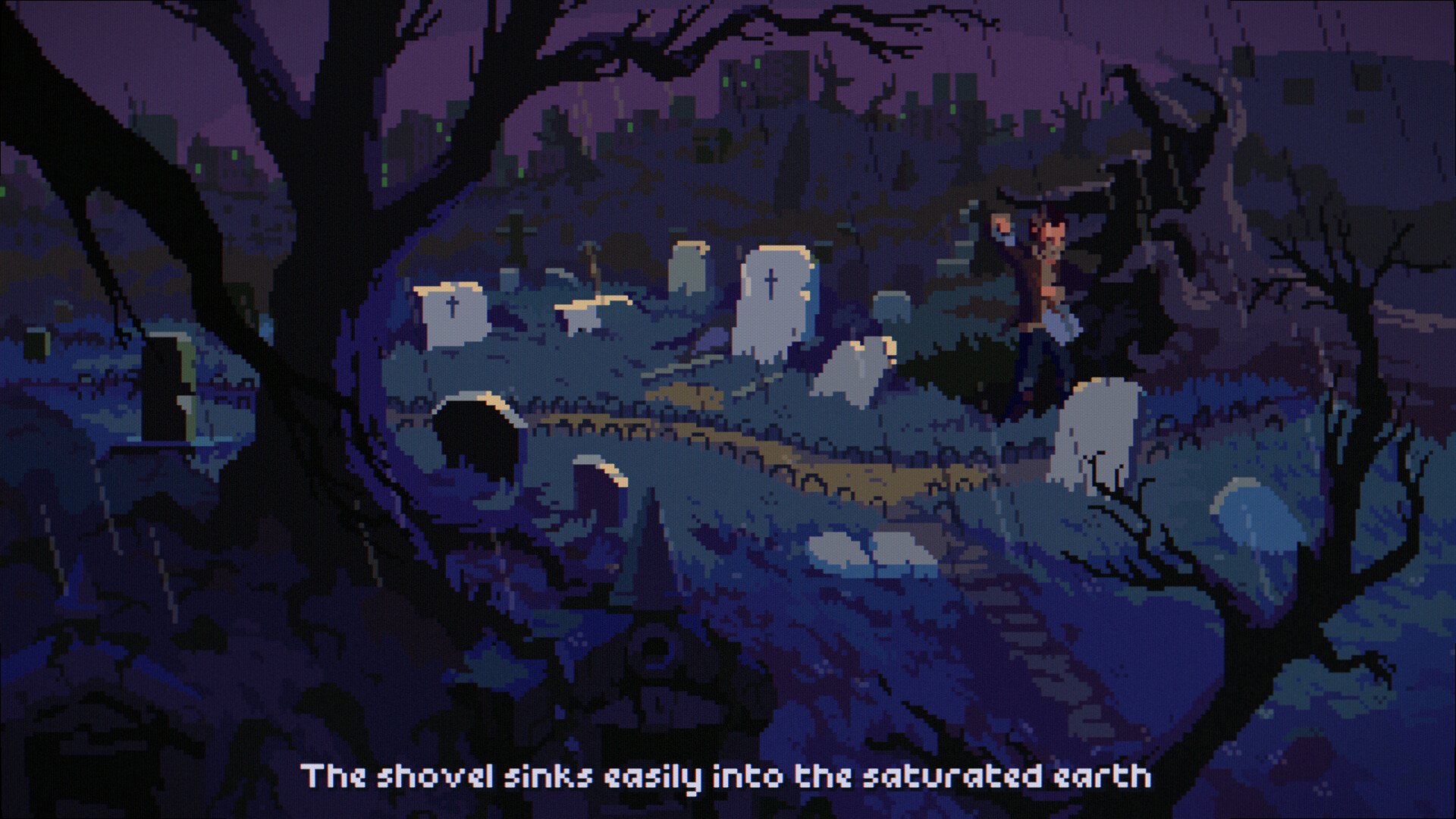
And since I have an excuse to drop this here, a screenshot from The Drifter, which I highly recommend. It includes a puzzle late in the game where you have to put all the pieces together into one action and the entire meaning of what’s been going on shifts.
I was trying to push to the end, but I still must be missing something fundamental. At the least, I can say (checking the list of rooms in the machine code) that there isn’t much more for me to explore; this is intended to be a “tight” game like Savage Island Part 2, and the way the alien-transformation works makes me think the author even had Savage Island Part 2 specifically in mind.
Progress hinged on two relatively obscure parser actions (one is from Savage Island and I really should have thought of it, I needed spoilers from Alastair). First off, the Identi-Comp.
What will you do now? EXAMINE COMPUTER
Notice on Identi-Comp: “Speak Clearly”
You
see numbers 1 and 2
A switch is set to
1
What will you do now? TO TWO
Okay
What I was missing (sleuthed out by Rob) is the verb REPROGRAM works on the system.
What will you do now? REPROGRAM COMPUTER
Identi-Comp: “Reprogramming commences after
second medical
usage”
The one-or-two part is setting whether the “reprogramming” happens after one or two medical uses (I’ll explain what that means shortly). I’m still not sure what “speak clearly” is all about; that may be the fundamental thing that’s keeping me from winning the game.
It’s a bit of an exhausting moment not only because this is the first time the verb has shown up anywhere, but it’s unclear what action the player is even doing. There was a moment in Seiko’s Adventure where you needed to “close hatch” while looking at a lot of buttons, essentially jumping over the first-layer interaction (which buttons are getting pushed, exactly) straight to the second-layer interaction (the hatch gets closed). Most classic text adventures stick with first-layer interaction and will come up with interfaces with five buttons that all happen to coincidentally be different colors to facilitate this; in Epic Hero 3, to launch the spaceship back off the planet you merely press a red button, as opposed to typing LAUNCH SHIP and letting the avatar in the world figure it out.
Just a reminder the Identi-Comp is in the central hub room on the ship, a fact that will be important later.
So what, exactly, is the avatar doing when the player types REPROGRAM COMPUTER? How do we even know (from the minimal description we get) that it’s got enough available parts to do that? I admit I visualized it smaller-scale with just the one-two switch, and was instead focused on potentially breaking the system open to fiddle with some wires. (For all I know, maybe that really is what the player-avatar is doing! Or maybe the “reprogram” action is actually a command spoken out loud?)
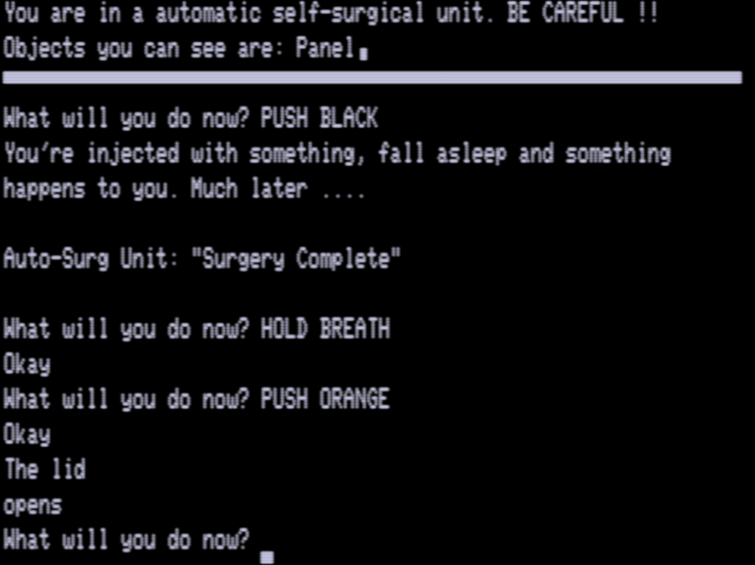
The second obscure command — the one from Savage Island — is HOLD BREATH. Back at the medical unit, you can transform yourself into an alien (made clear by the fact your space suit no longer fits based on your shape). Unfortunately, this means you breathe Venus-atmosphere but not ship-atmosphere, so opening the unit kills you.
With HOLD BREATH, you can safely hit the button.
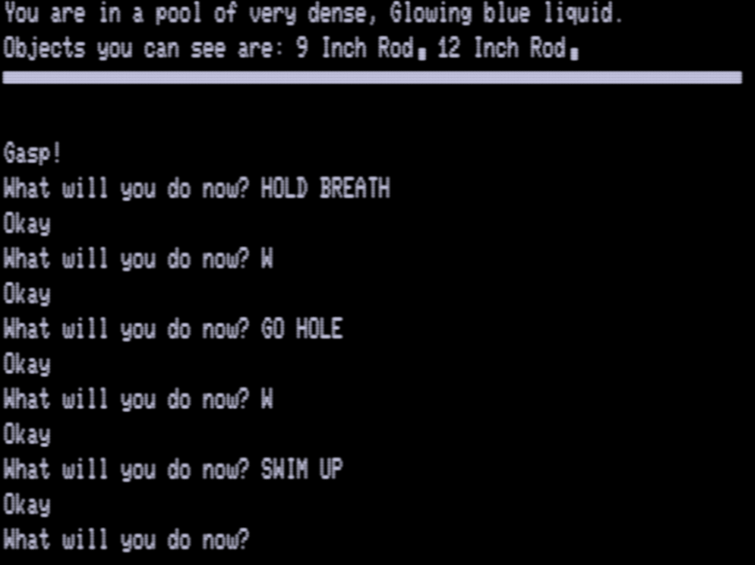
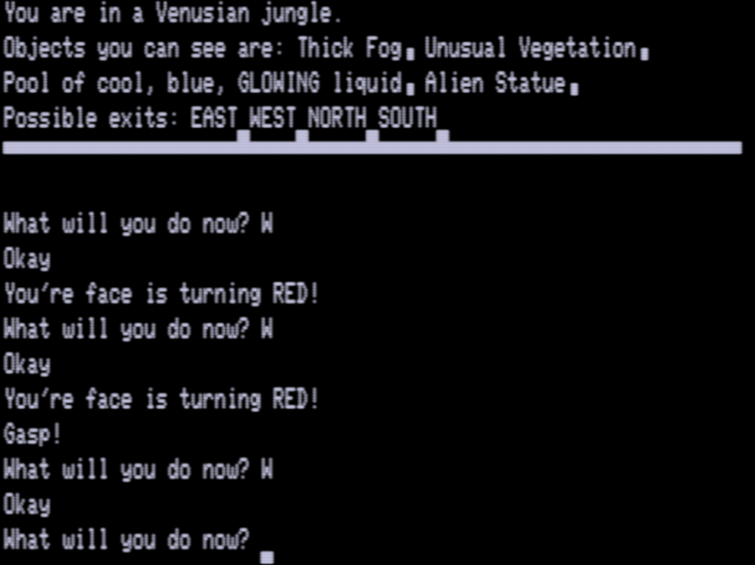
There’s no apparent way to unhold, just after enough time your face will start to “turn red” and after “Gasp!” you’ll start breathing again. In alien form, you should be on the planet when this happens.
One last catch before going there! If you haven’t gone through the Identi-Comp reprogramming, specifically with the setting on TWO, then you will no longer be able to operate the door in alien form.
You are in a Medical and Genetic Engineering compartment.
Objects you can see are: Auto-Surg Unit ■ Scanner ■ Brown Pad ■ Closed Brown Hatch ■ Life Support ■
What will you do now? PUSH BROWN
Okay
Nothing happens
I think pressing the orange button and closing the unit counts as one medical operation, and pressing the black button to convert counts as the second; once we are xenoshifted, the ship changes the controls to allow us to use them in our new (non-described) form.
Non-described protagonists are nearly 100% the norm for this era, but it’s absolutely fascinating to have this then extend to where we clearly aren’t “ourselves”. Do we have tentacles? Multiple eyes? A large hump on our back used for breathing? This is not purely theoretical since it extends to our body’s capabilities in the world (for example, it wouldn’t immediately occur to me that we still have the kind of body where holding our breath makes sense). Neither the suit nor the boots fit anymore, although the headband does still fit and work.
One small … step? … tentacle glide? … for xenokind.
This shows holding breath from opening the medical unit, all the way to getting on the planet and walking to the pool/statue, where “Gasp!” shows when we need to take a breath.
No running out of suit air at least! We can still go over to the alien statue and SHAKE HAND to get a message, although we need to be wearing the headband to do so (this is true in either human or xeno form).
“Enter my domain. I have a question for you.”
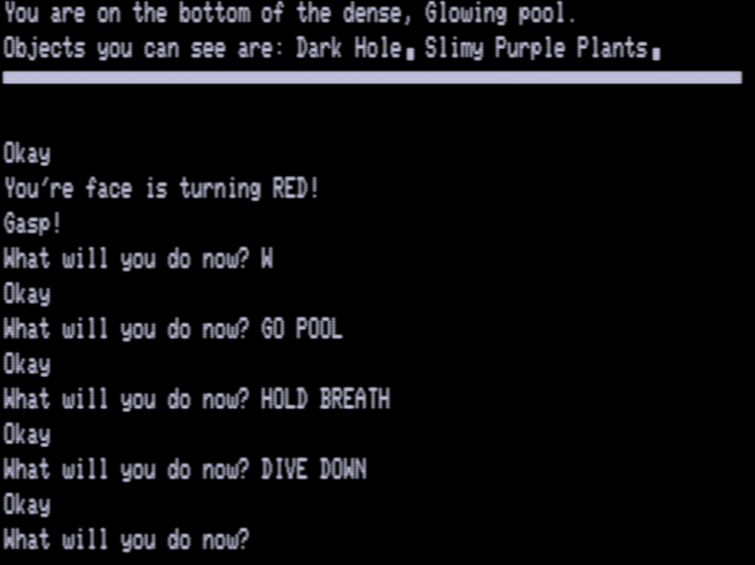
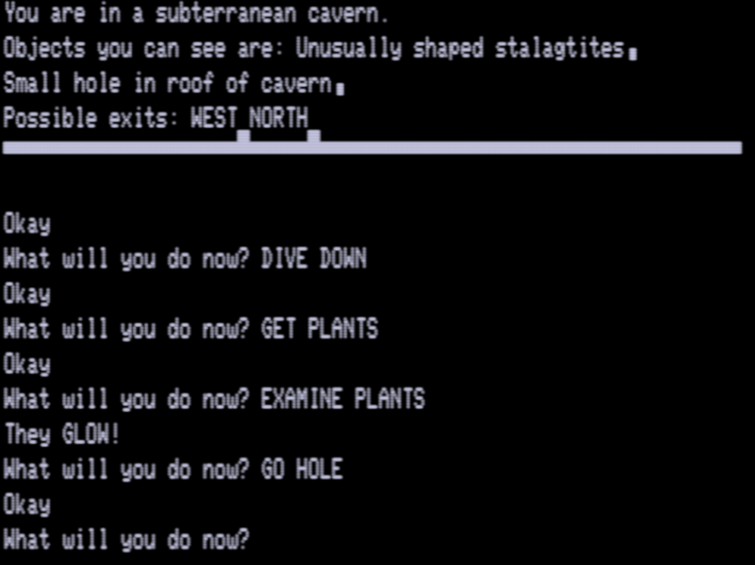
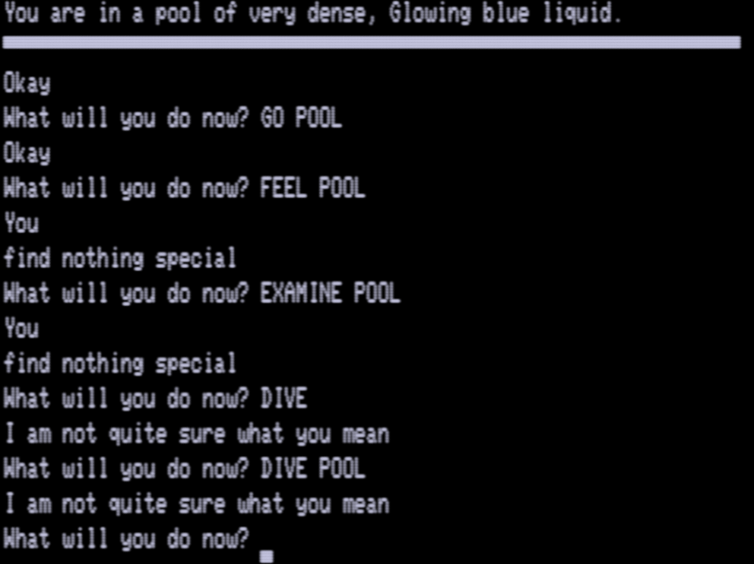
We are now dense enough to go in the pool, HOLD BREATH, and DIVE DOWN (my problem before was not putting DOWN there, this is not nearly as smooth a parser experience as Epic Hero 2).
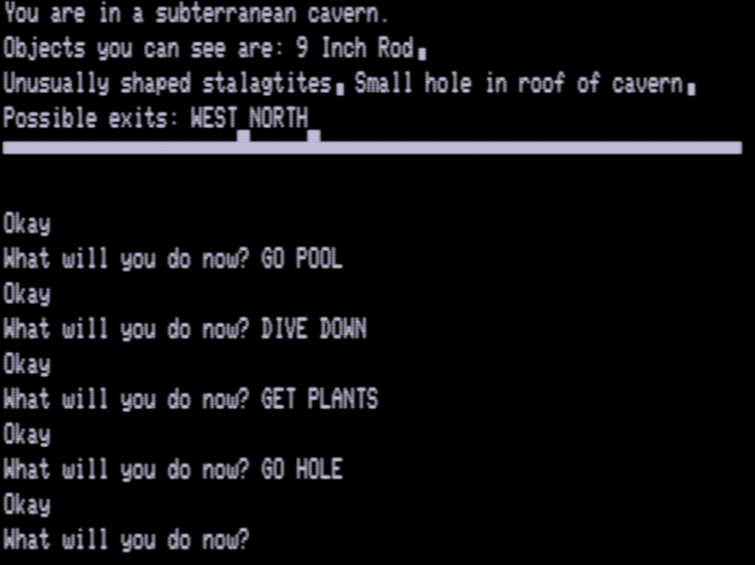
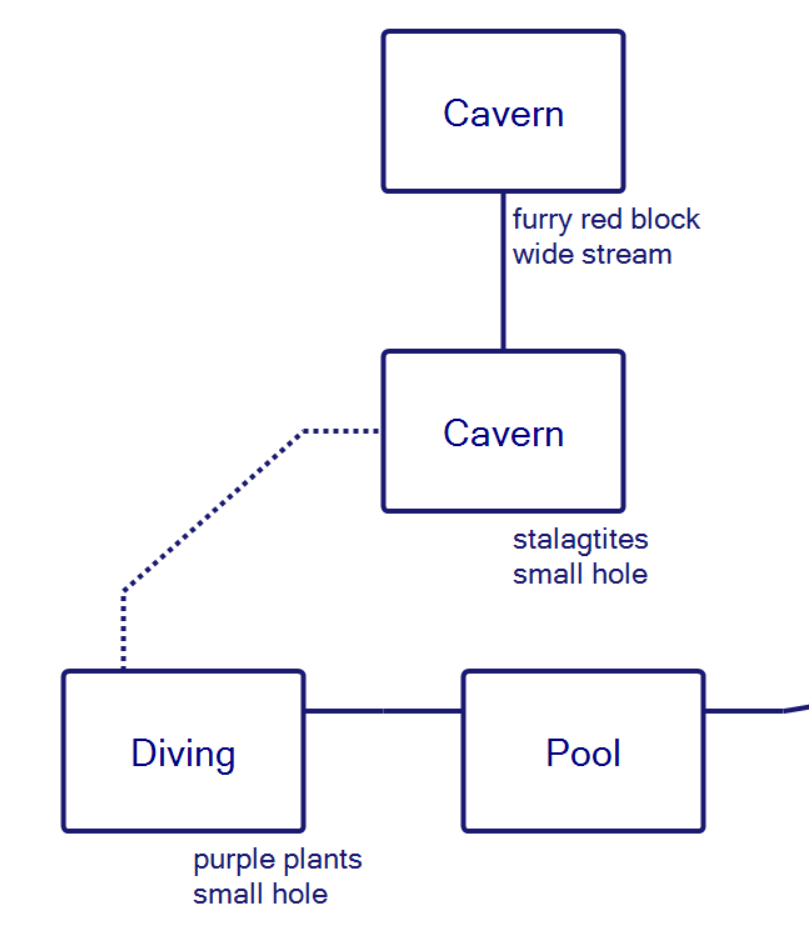
The purple plants glow and you need them in your inventory before going into the hole, leading to a small new area.
It took me a few beats to realize that the hole beneath the pool liquid does not lead to more liquid, but rather is an “open air” (in terms of alien atmosphere) room. There are circumstances where the tunnel winds in a way that this makes sense, but I was visualizing something entirely different at first.
That is, it’s fine if we run out of breath here and “gasp”. HOLD BREATH needs to happen again before going west (which leads back to the pool).
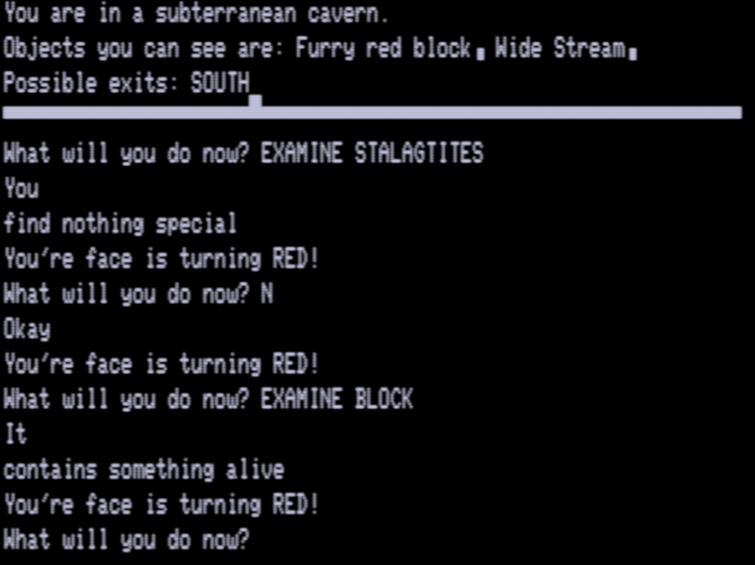
To the north is a stream which is smoky (it turns out to be liquid nitrogen) and a furry red block, which “contains something alive”.
You can break the block, resulting in just “red bits”. It doesn’t count as sentient though; if you take it back to the lab, and SCAN BLOCK (another new thing I discovered) the game informs you of this, meaning it isn’t our ultimate goal. I would expect that given this particular path hasn’t used either the explosive or the weird ledge found by jumping with boots.
I’ve tried taking the thought bomb into the hole and placing it either at the stalagtites or the nitrogen stream, but in both cases there’s a “crater” and no other result. The funny side result is I had the 12-inch rod with me, and when trying to dive it “floated up” and turned into a 9 inch rod and a 12 inch rod.
It turns out the thought bomb only blows up if you are wearing the band and holding the rod while in 12 inch form. (Without the rod, the game indicates a “relay” is missing.) The rod only goes in the ledge-hole if you have it in 9 inch form. This weird duplication bug means you can both have the rod deposited in the hole at the ledge and blow something up after, but clearly the intent was to have the rod be inaccessible (meaning the blowing up should happen first). I have not tested every single room but I have tested most rooms, and I’m worried there’s some special way to put the bomb in place that I’m missing (but is special coded for a particular room).
Any suggestions from this point (even guesses) please put in ROT13; I’m still going to try pushing to the end on my own.
I haven’t made real progress in terms of events happening, but I did manage to get more objects to do something, so it seems worth an update. Exploration across the inventory space rather than the locational space, so to speak.
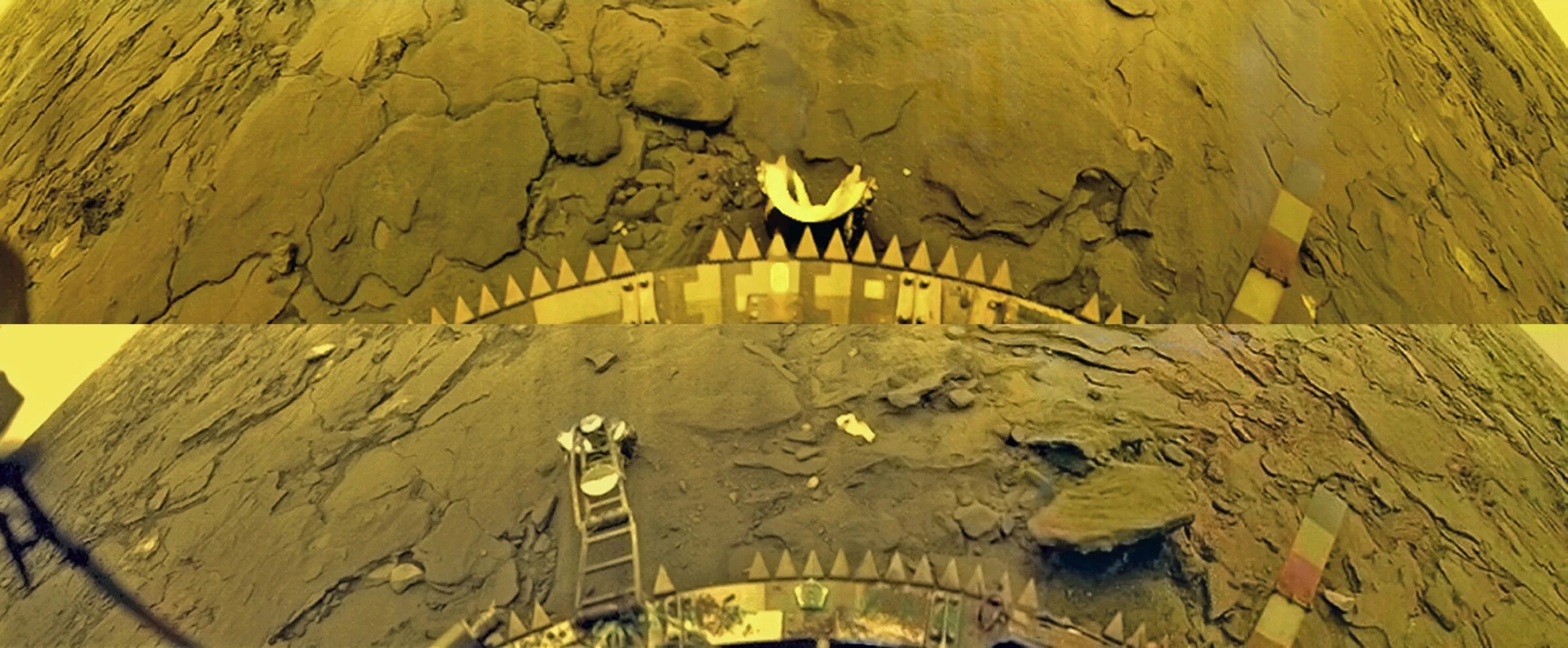
Actual pictures of Venus from the Ventura 14 probe, front and back cameras. Via The Planetary Society and Ted Stryk.
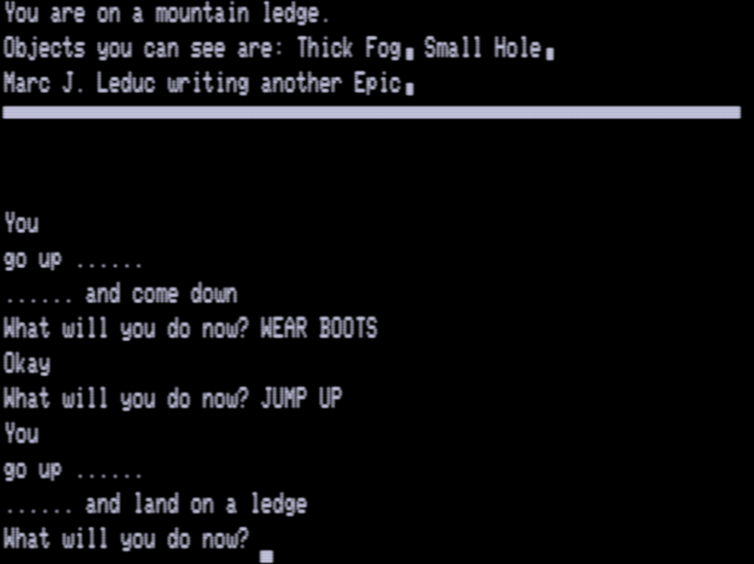
First, most straightforwardly, I figured out how to operate the boots: you need to JUMP UP (as opposed to just JUMP) while wearing them. This will allow you to scale the cliff up to a ledge.
Another Leduc cameo. I don’t know if he keeps this going through all his games. If you wait long enough he plugs his game Epic Hero 4, Camelot. This was written, but for the Colour Genie adventure series instead of the TRS-80 one.
Unfortunately, this only reveals the one new single room above. The small hole is not the kind you can enter, but the kind you can put things in.
I know this because PUT ITEM then prompts “IN WHAT?” while the command simply fails elsewhere (IN FOG for instance gets “I am not quite sure what you mean”) it has a different message with the hole.
You have in your possession:
Thought Bomb ■ 12 Inch Rod ■ Head Band ■ Space Suit ■ Which you’re wearing ■ Lift Boots ■ Which you’re wearing ■ Dial ■
What will you do now? PUT ROD
In what?
What will you do now? IN HOLE
Won’t fit
Regarding the rod, it is described as having “a DISK at one end” and I admit I was unsure for a while if they meant the kind you put in a computer. Playing around with my verb list, I ended up finding TWIST DISK worked, the game prompting for either TWIST LEFT or TWIST RIGHT. It starts at 12 inches, and twisting left makes it 9 inches, and twisting again causes the rod to explode.
What will you do now? TWIST LEFT
****** Kaboooooooooom !! ******
9 inches will fit in the hole. TWIST RIGHT will result in 5 feet, then 11 feet, then exploding. So to recap, the possible sizes are: 9 inches, 12, inches, 5 feet, 11 feet. The only one that fits in the hole is 9 inches.
Also, due to the two-part aspect of the parser (PUT ROD / IN HOLE) it doesn’t understand putting other things in the hole. I tried PUT BOMB / IN HOLE and (with the rod the right size) it put the rod in instead. I have no idea how to get the rod to do anything after it is in the hole; it seems to be lost.
Speaking of the bomb, let’s get to that next. I found that THINK UP is not necessary, any command with THINK as the verb will work to blow up the thought bomb while the player has the headband on. You do not have to be nearby to set off the bomb; I tried putting it down at the ledge here, setting it off, and coming back shows a “crater” and a completely intact Marc Leduc (alas!) Also, this implies that any thinking whatsoever sets off the bomb, which is pretty awkward if you, er, think about it.
You are on a mountain ledge.
Objects you can see are: Thick Fog ■ Small Hole ■ Marc J. Leduc writing another Epic ■ Small crater ■
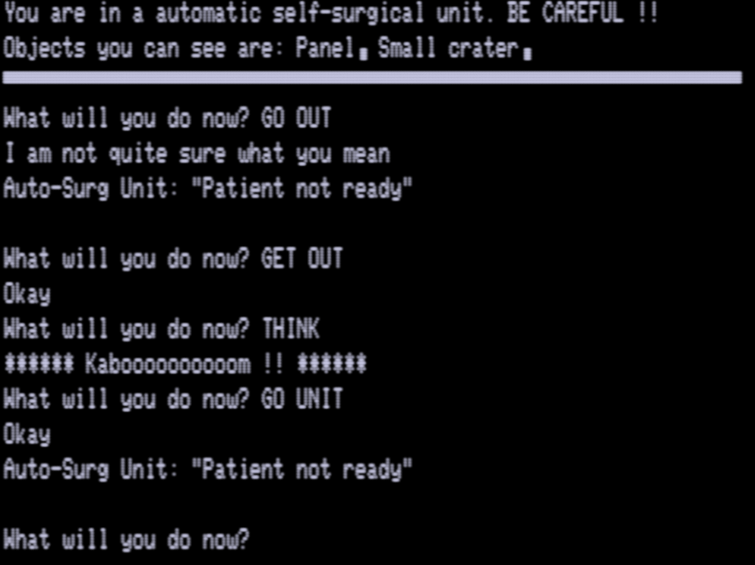
The small crater will also show up inside the pool (the one with the poison liquid), even though it doesn’t quite make sense. The same thing happens in the surgical unit of the ship.
The unit (with the white, black, and orange buttons) ends up being the most fascinating object of the game so far, so let’s save that for last and go back outside to the pool/statue area.
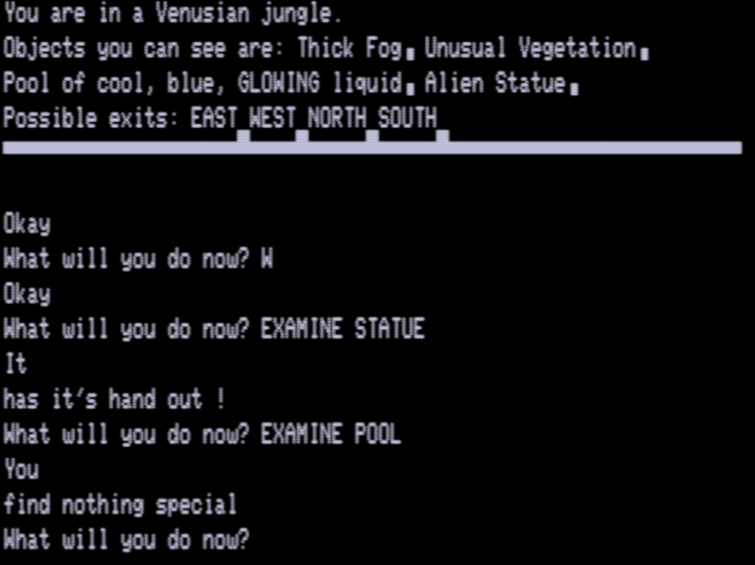
I rammed through the verb list on the statue and found that SHAKE STATUE repeats the message about it having its hand out; SHAKE HAND specifically gets a different response. (Rob theorized about this one in the comments, but it took me a while to realize the second noun was being introduced.)
What will you do now? SHAKE STATUE
It
has it’s hand out !
What will you do now? SHAKE HAND
Okay
You
grasp the hand and a voice in your mind says :
“Enter my domain. I have a question for you.”
What will you do now?
Unfortunately, I have no idea how to enter the domain as suggested! I would have thought the pool might be it, and ENTER POOL is still possible, but no command I’ve tried after (like DIVE) has seen anything productive.
One last outside-thing: the spacesuit itself that I’ve been wearing. A “dial” is mentioned in inventory and I used mindless verb-testing again to realize READ works: “Enough air for 65 moves”. This means that there’s a time limit to all this, so probably I’ll have to put together a “real run” at some point after stumbling my way to the right answers.
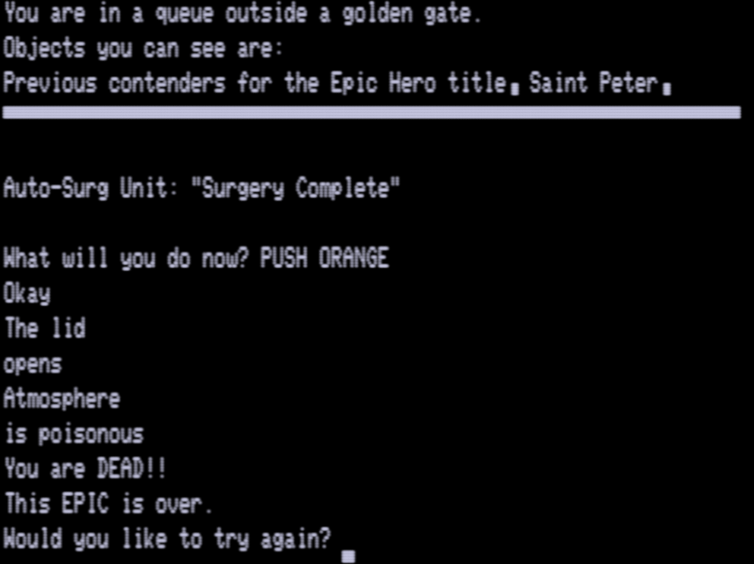
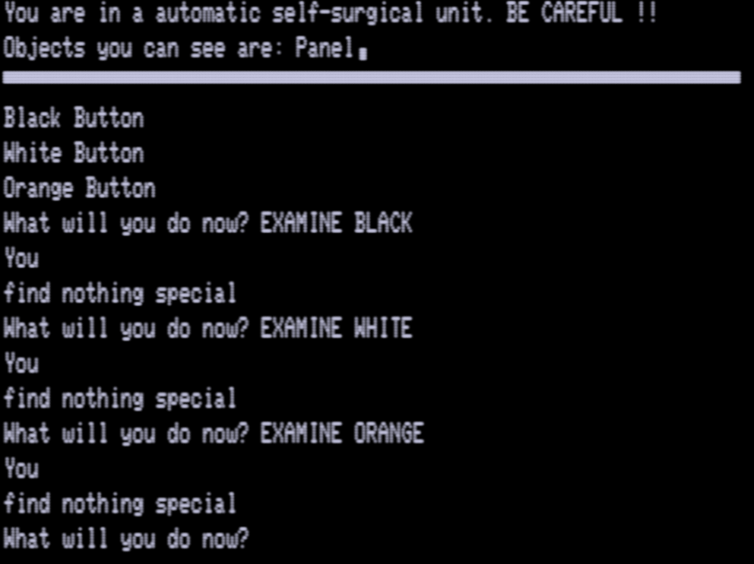
Back to the surgical unit! Remember orange closes the pod, black does some kind of procedure, and white (it turns out) undoes the procedure. What’s most interesting is if you try to leave the unit after pressing black but before pressing white.
What will you do now? PUSH ORANGE
Okay
The lid
opens
Atmosphere
is poisonous
You are DEAD!!
If you’re wearing or even holding a spacesuit, the unit will announce “Patient not ready.” If you drop your suit, go through the black procedure, and then try to put the suit back on, you’ll find that your body shape has changed and the suit can’t be worn!
Won’t fit
over
Strange shaped body
The boots also don’t fit; the thought head-band does (so you can set off the bomb while converted). You can kill yourself with the bomb while converted. If you try to put the bomb on the outside of the surgical unit and set it off, you get the message “Relay not present.”
So it seems the unit is literally turning us into an alien form unable to breathe oxygen; given the context, we likely could survive on the surface of Venus while converted, but I don’t know how to get down there and be in alternate-form at the same time.
Comments and suggestions still appreciated! I’ll even take hacking at machine code, although if someone goes that far, please use ROT13.
What will you do now? HELP
Use your imagination. Remember, I’ve got a weird outlook on
things and you must try to THINK the way I do.
Is it possible? – Signed Marc
I’ve now played Epic Hero #1 and Epic Hero #2 of the series by Marc Leduc. I’ve given the history already at those entries, but as a brief reminder: he was a Canadian who moved to England (and married and had children there); he was a fan of both the Video Genie and the much rarer Colour Genie and produced a series of three games (Epic Hero) followed by a series of six (Colour Quest), where two of the Colour Quest games were written by a different author and the sixth Colour Quest game is mostly a duplicate of Epic Hero #1.
I wanted to get the Epic Hero games off my list as they’re lingering 1982 games; I had them as 1983, based on CASA’s entries, but I found an ad that put them as coming out right at the end of 1982.
I enjoyed Epic Hero #2 as it was based on experimentation in a fantasy universe but had enough logic to how things worked I didn’t feel like the puzzles were just stumbling at random. Will Game #3 hold up? “This Epic is for the very cunning.” is announced on the opening screen, which is worrying. Most of our authors have stumbled when they’ve tried to crank up the difficulty.
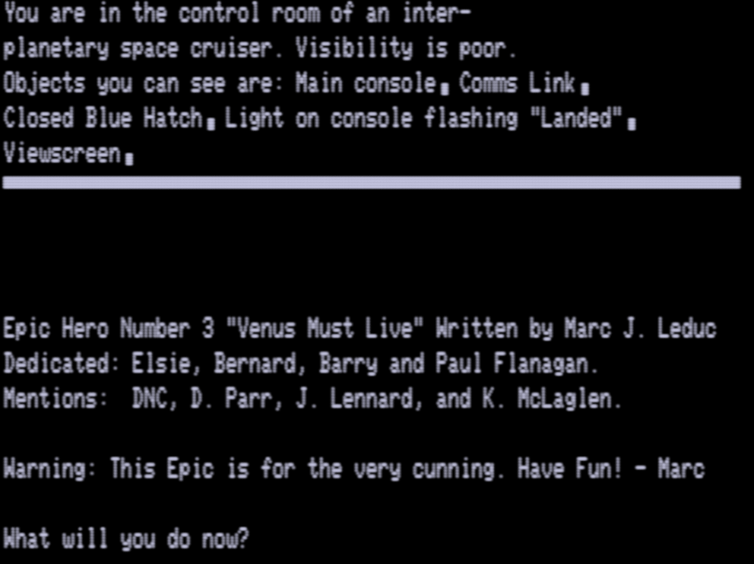
Venus Must Live places things in the future, kind of. We are in the far-flung distant year of 2023. Future?-Venus has mining going on, except there have been “electro magnetic disturbances” so we are sent to investigate.
Unusually for a Scott Adams derived game, LOOK no longer works as a generalized “examine” verb. That is, you don’t LOOK VIEWSCREEN on the scene above, but rather EXAMINE VIEWSCREEN (“Foggy!”) This was changed between Epic Hero #2 and #3; I’m guessing the author was bothered by the janky feel of LOOK OBJECT as a command (in regular English you’d expect “AT” in there). The only downside to dropping LOOK OBJECT syntax is that the generalized LOOK has had a meta-aura to it where it generically means “investigate this thing more thoroughly” so it might not just be visual feedback. EXAMINE implies eyes-only, so EXAMINE (COMMS) LINK giving an audio message is slightly off-kilter.
Comms Link: “This is a recorded message.”
“Colonisation of Venus is imminent. However, unusual electronical disturbances on planet indicate sentient life. Find and return a sentient being to preserve the race.”
“Message Out”
The console has a red button and a blue button. The red button blasts off, and doing so right away is a game over but at least one that gives helpful detail.
The ship blasts off!
Comms Link: “Fool! Either you have not found the sentient being or else it is not secure in Life Support. Consider the expense of this mission! We are anxiously waiting for your return! We are short of experimental animals”
That is, despite this ending the game, the message reveals that our real goal is put the creature we’re looking for in Life Support, and also that the spaceship doesn’t need any extra help to get back off the ground (it’s not uncommon to have “fix your ship” or “find fuel” be one of the tasks in this sort of game). One thing I’ve noticed talking with people about Old Multi-Death Adventures is a sense of annoyance at deaths in that “no progress” is made; however, deaths often give useful information, and the ones that don’t tend to be funny.
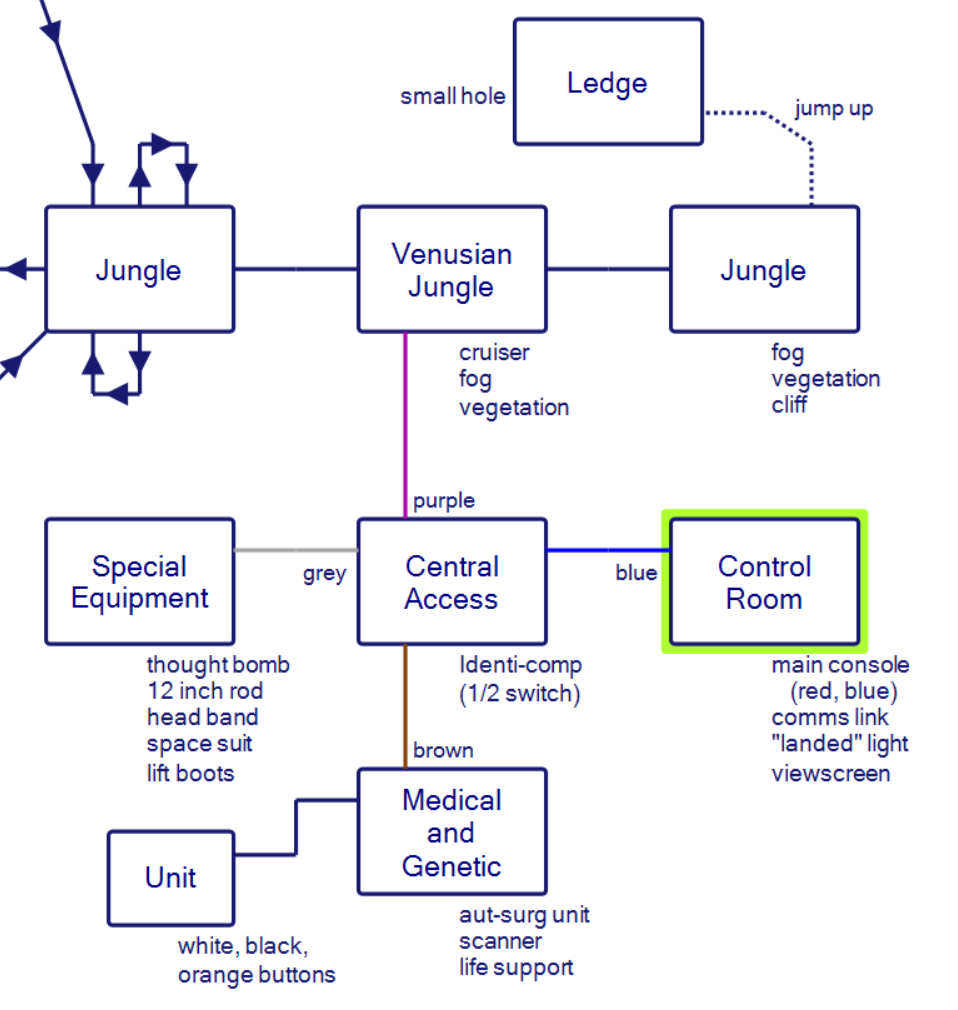
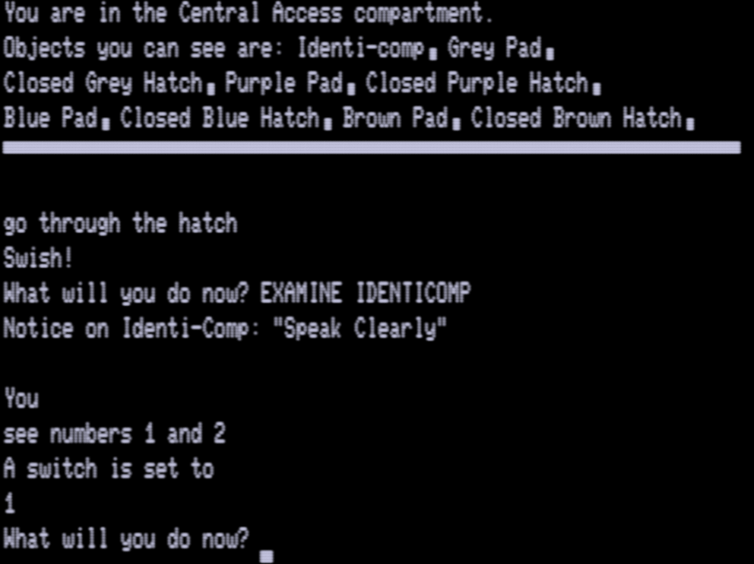
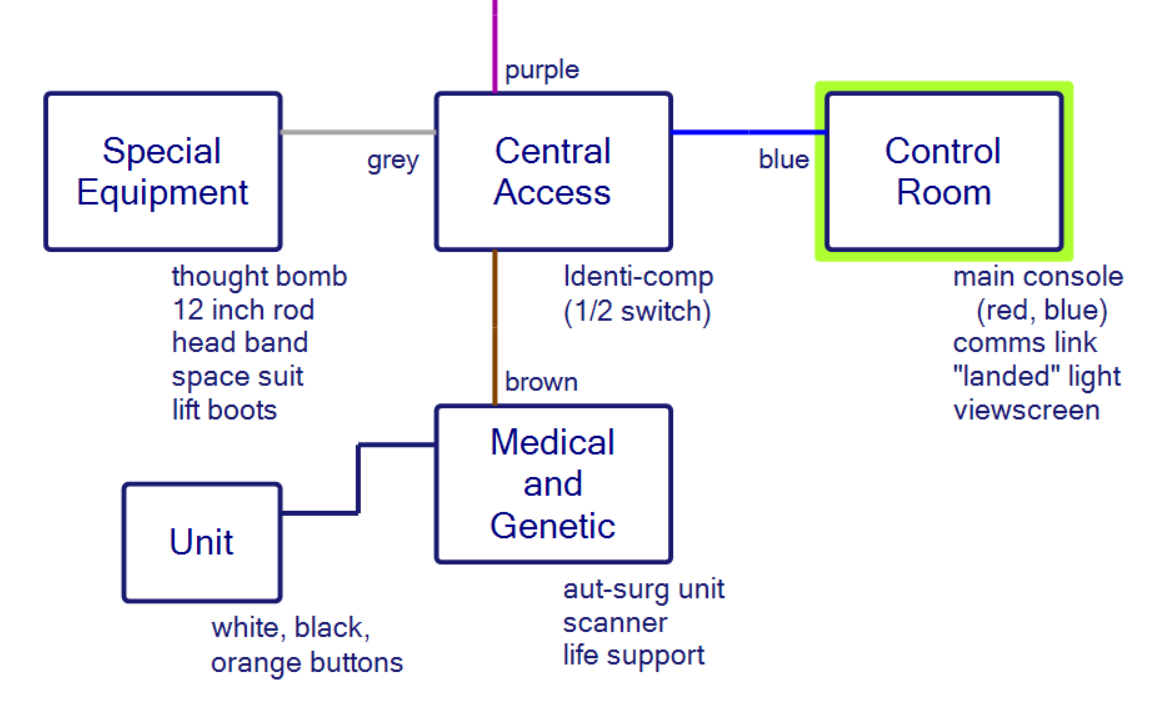
Pushing the blue button instead of red sends you to a “Central Access compartment”. The compartment has a mysterious Identi-Comp as well as four pad/hatch combos that lead to other parts of the ship (or outside).
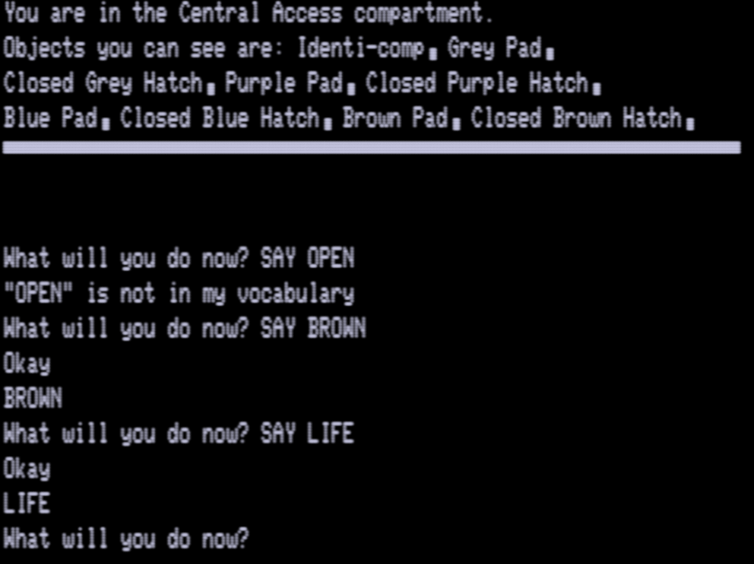
The Identi-Comp has a switch that can be swapped between 1 and 2 (TO ONE and TO TWO is the syntax explicitly given by the game if you try to noodle with the switch) but I haven’t noticed a difference, and my attempts to “SPEAK” or “SAY” something so far have not been recognized. It doesn’t allow arbitrary text, it only allows recognized nouns.
The game treats BROWN as a valid noun so you can say it, whereas the verb OPEN is not and so the game doesn’t let you give the command SAY OPEN at all.
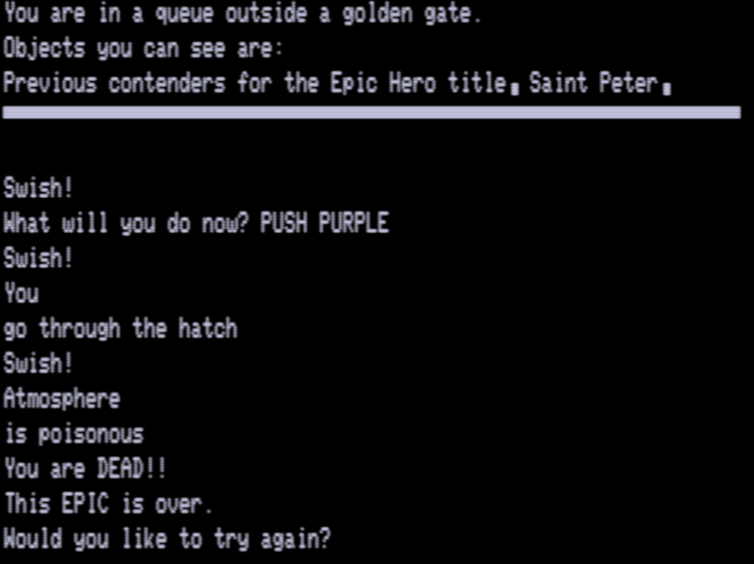
Purple goes outside, and without any kind of inventory (as the game starts) it leads to death, so let’s pass over that for the moment…
One of the best death screens I’ve seen in a while, though.
…and press the brown plate instead. This sends the player to the “medical and scientific” area.
You are in a Medical and Genetic Engineering compartment.
Objects you can see are: Auto-Surg Unit ■ Scanner ■ Brown Pad ■ Closed Brown Hatch ■ Life Support ■
The surgery unit is described as having its “lid” open, and the scanner and life support don’t have any description at all. You can go into the unit and find a black button, white button, and orange button.
The buttons give no descriptions (the author seems keen on “colour roulette”, where you just have to run through the possibilities to see what happens). At first white and black do nothing, but the lid is open; orange closes/opens the lid.
White then turns you into “instant mush”, while black does something … maybe useful?
What will you do now? PUSH BLACK
You’re injected with something, fall asleep and something happens to you. Much later …
Auto-Surg Unit: “Surgery Complete”
You can then PUSH WHITE safely and have the exact same text. Possibly undoing whatever the first effect was?
The last ship room comes from pressing the grey plate in the hub, leading to a big stash of equipment.
You are in a Special Equipment compartment.
Objects you can see are: Grey Pad ■ Closed Grey Hatch ■ Thought Bomb ■ 12 Inch Rod ■ Head Band ■ Space Suit ■ Lift Boots ■
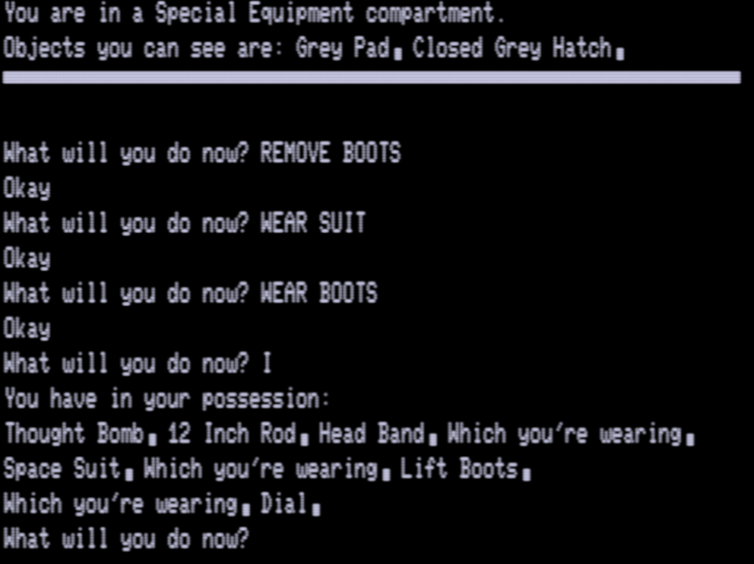
Again, not much helpful in the way of descriptions. The thought bomb gives nothing (nothing!?!?) the 12 inch rod mentions a DISK on one end. The head band, suit, and boots don’t say anything when examined. If you wear the suit, a dial mysteriously appears in your inventory (it took some experimenting before I was sure the two were connected). The game also enforces that the boots need to be placed over the suit.
After the shenanigans above, before moving on exploring the planet, I decided it was wise to go ahead and make a verb list.
Notable points: THINK which is rare and can be hard to come up with (I assumed at least the thought bomb is somehow controlled this way — you’ll see what happens with it shortly), the sense of SMELL gets used (which can be easy to overlook), SWIM and DIVE are both in (I sometimes neglect testing DIVE otherwise in water) and FEEL and HOLD are both in.
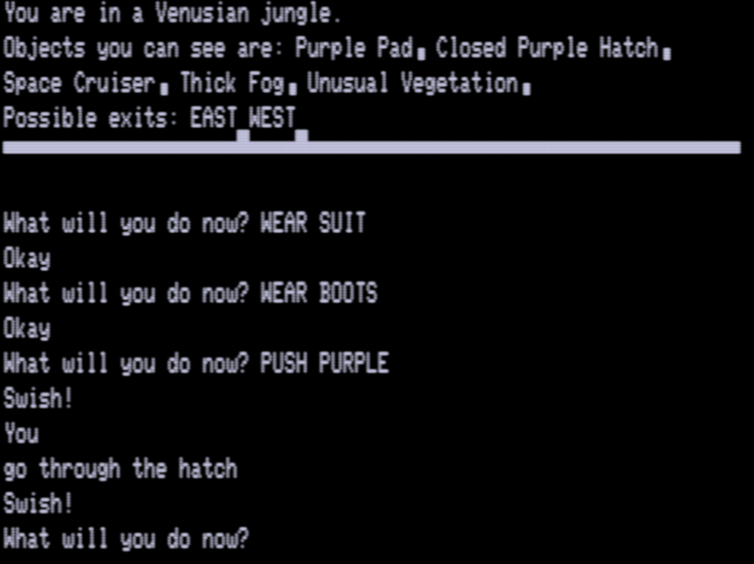
Disembarking leads to a Venusian jungle, with exits to the east and west. While the environment will kill without a space suit, this is done in old-school style, not with realistic planetary exploration.
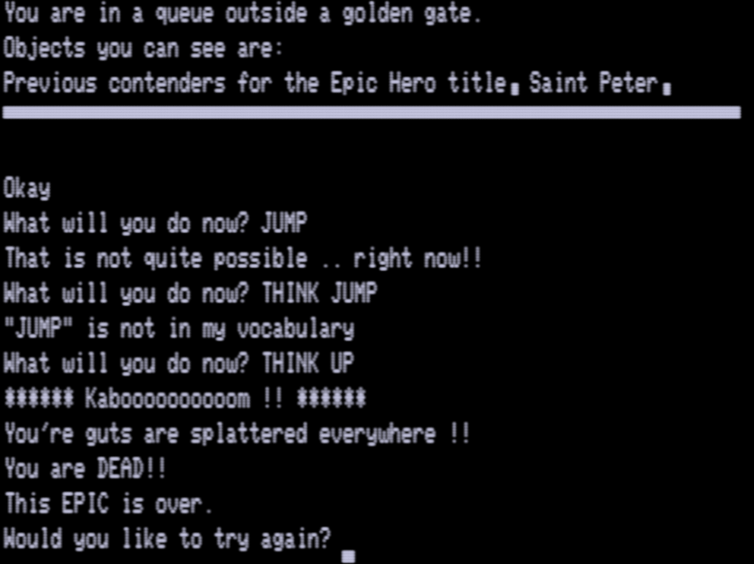
Heading east leads to a cliff that can’t be scaled. I would think the lift boots would work to then somehow float or maybe jump high, but nothing I’ve tried has worked (nor can I mess with the dial on the suit, which I thought might be connected). Theorizing that perhaps multiple items operative via thought I tried THINK UP with disastrous results. I guess UP is short for “BLOW UP” to the bomb. That’s useful information for later, at least.
I’ve also tried messing about with the dial on the suit, but nothing I’ve tried has been recognized, including TURN and ROTATE straight from the verb list. I have a feeling I’m missing some basic aspect to getting the equipment to work.
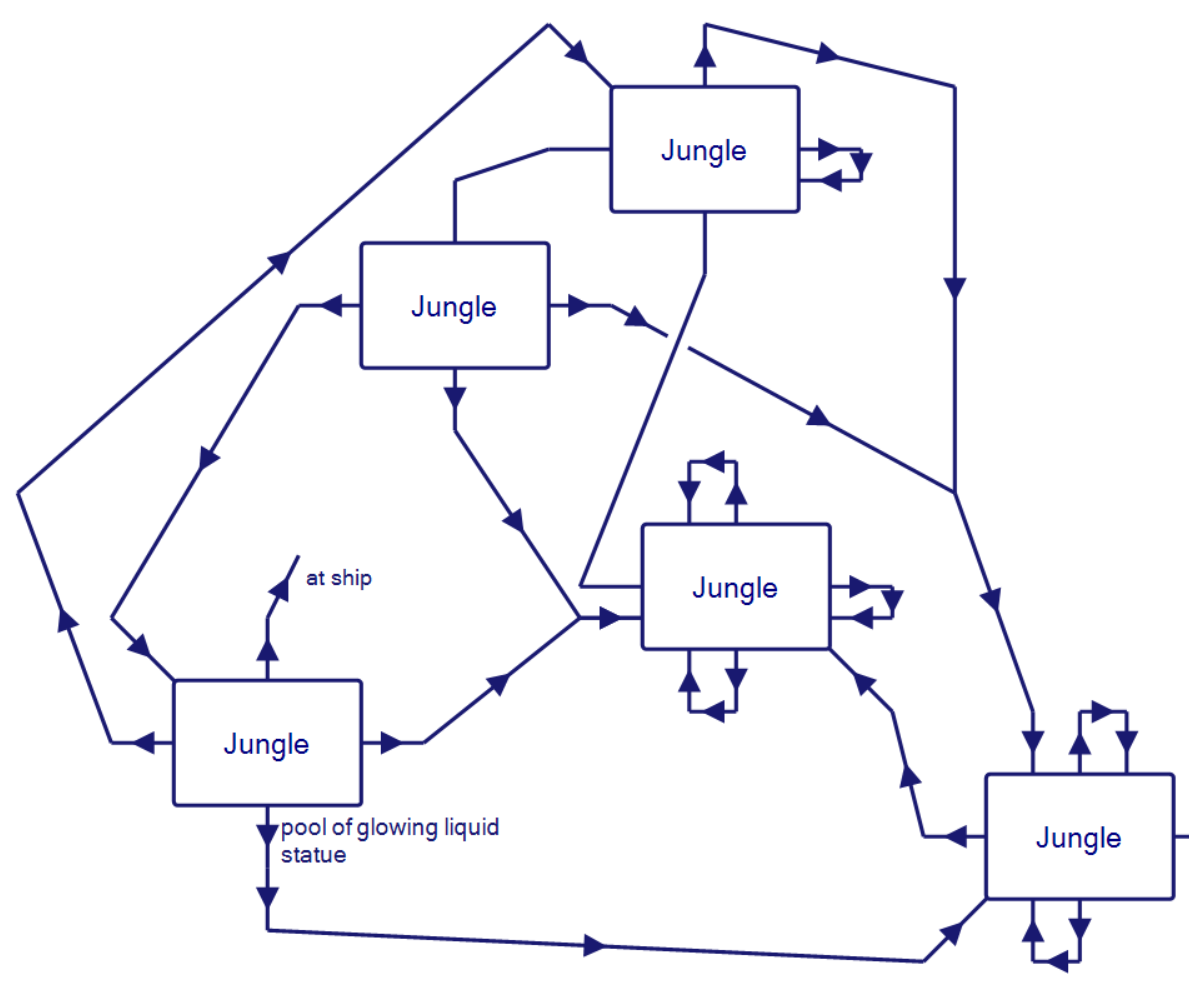
Going west instead of east at the landing point leads to a maze, a small-scale one identical in feel to Epic Hero 1 and 2.
Mappable via dropping objects. You’d think Leduc would get tired of these by now, but apparently not.
The notable place in the jungle can be found by just going west repeatedly: a pool of glowing liquid and an alien statue. The statue has an outstretched hand, but I have not found any method of getting the parser to recognize placing an item there (it may be I simply need the right object for it to be recognized). PLACE just puts an item on the ground.
What will you do now? EXAMINE STATUE
It
has it’s hand out !
What will you do now? PUT ROD
In what?
What will you do now? IN HAND
I am not quite sure what you mean
What will you do now? IN STATUE
I am not quite sure what you mean
You can enter the pool, but I haven’t found anything useful to do other than drinking the pool and finding out the liquid is poisonous and dying again. Even DIVE doesn’t work.
To summarize:
a.) I’m not sure what the injections at the medical pod do
b.) I don’t know what the Identi-Comp does or how to operate it
c.) I don’t know how to scale a cliff even given objects that seem like they’d work; this may be just parser-struggle
d.) I don’t know what the statue wants or what to do in the pool of poison water
I still have a fair amount of things to experiment with (an advantage of the game giving a big inventory load at the start) but I’m worried this game’s ambition may have passed out of the reach of the author, or at least the author’s ability to make a parser.
There are no walkthroughs for this one, so we’re on our own. Suggestions in the comments are welcome.
I wanted to knock down one more game from the Rainbow Book of Adventures contest (the first text adventure contest) before moving on to other things. There will be eight left to go (saved for some future time).
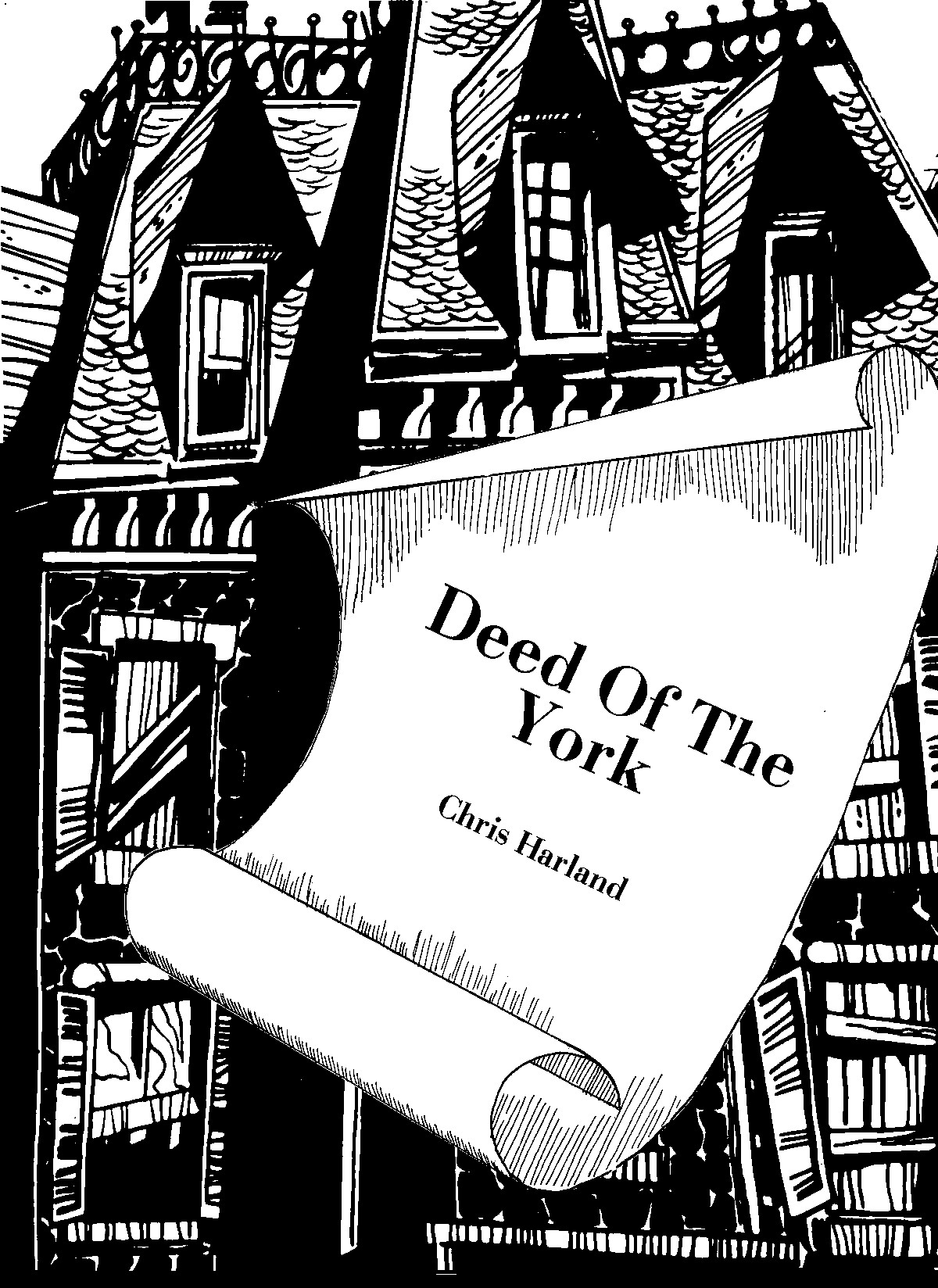
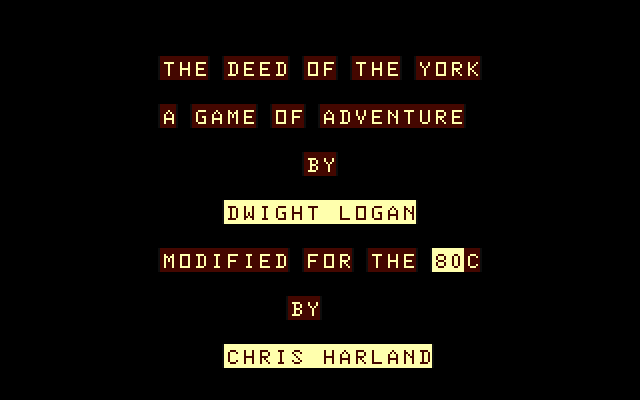
Deed of the York is another case like Escape from Sparta where something went awry in the credits. Specifically, the opening title screen indicates a different original author than Chris Harland (as seen in the image above).
So the game is actually by Dwight Logan, originally? (Oftentimes, the port author isn’t considered an “author” at all although changes can sometimes be major enough to warrant that title.) Further muddying the waters is the book’s biographical note:
Chris Harland is a bilingual high school student in the “Great White North” [Regina, Saskatchewan, Canada]. Some of his interests include sports, money, computers and rock music. Chris wishes to thank Dwight Logan and Gerald Nunn, whose initiative and help respectively ensured the program’s creation.
The description of Dwight Logan being the “initiative” certainly seems counter to the idea of him writing it in the first place. This ambiguity also raises a question on the nature of Gerald Nunn’s “help”. Just to be safe, I’m crediting all three.
The author-location also reinforces the point I made about authors coming from everywhere across the map for the contest; the author is not from Ontario or Quebec (the two computing hotspots at the time) but Regina, Saskatchewan. We have encountered the place once before with the deeply surreal game Fantasyland. (While “ranking” doesn’t make complete sense here, I’d say Fantasyland is still the most surreal game this blog has encountered.)
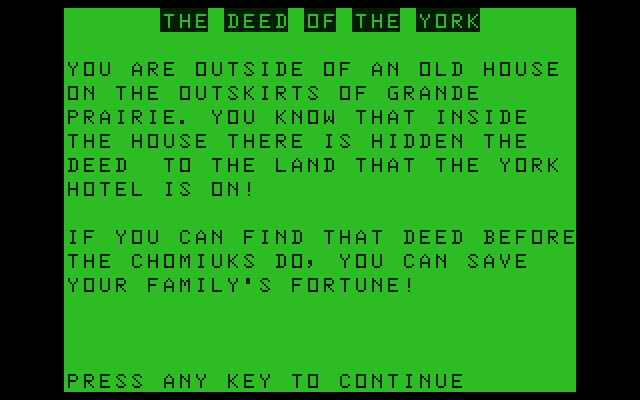
Your grandfather has died and the deed to the York Hotel is hidden somewhere in his abandoned summer home; your job is to find it without dying.
The game also informs you that you need to start by typing the word PIZZA. It then gives you an absolute blank prompt, no room description at all, before PIZZA is entered.
If you can’t tell yet already, this is another game in the wildly-bespoke category, where every location special-codes various commands. Some sample code to illustrate, which only operates in one of the map rooms:
56 IF LEFT$(C$,7)>="SMALLER" THEN 164

57 IF LEFT$(C$,5)="LARGE" THEN 69

58 IF LEFT$(C$,7)="FOLDING" THEN 69

59 IF RIGHT$(C$,6)="SHEETS" THEN 68

60 IF LEFT$(C$,4)="BACK" OR RIGHT$(C$,4)="LEFT" THEN 34

61 IF RIGHT$(C$,4)="DOOR" THEN 169

62 IF RI6HT$(C$,5)="CHAIR" THEN 65
What makes this even harder to deal with than other games of this kind is a.) a number of crashes, which I’m fairly sure are authentic bugs rather than issues on the emulator’s end…
My attempt to OPEN GREEN DOOR at one room.
…b.) and also the fact it uses LEFT/RIGHT/STRAIGHT/BACK as directions (as shown in the code), and the map is completely wrecked besides. To map things out I used west for LEFT and east for RIGHT.
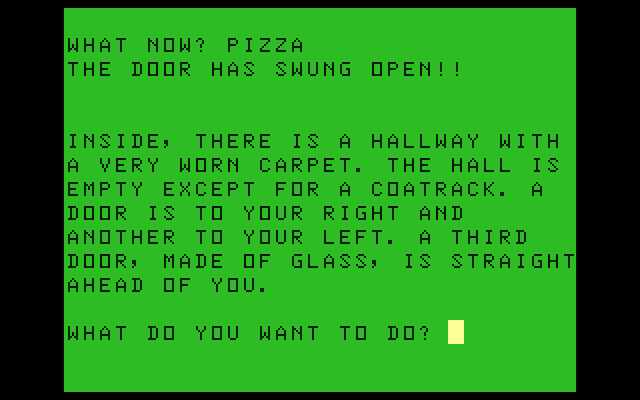
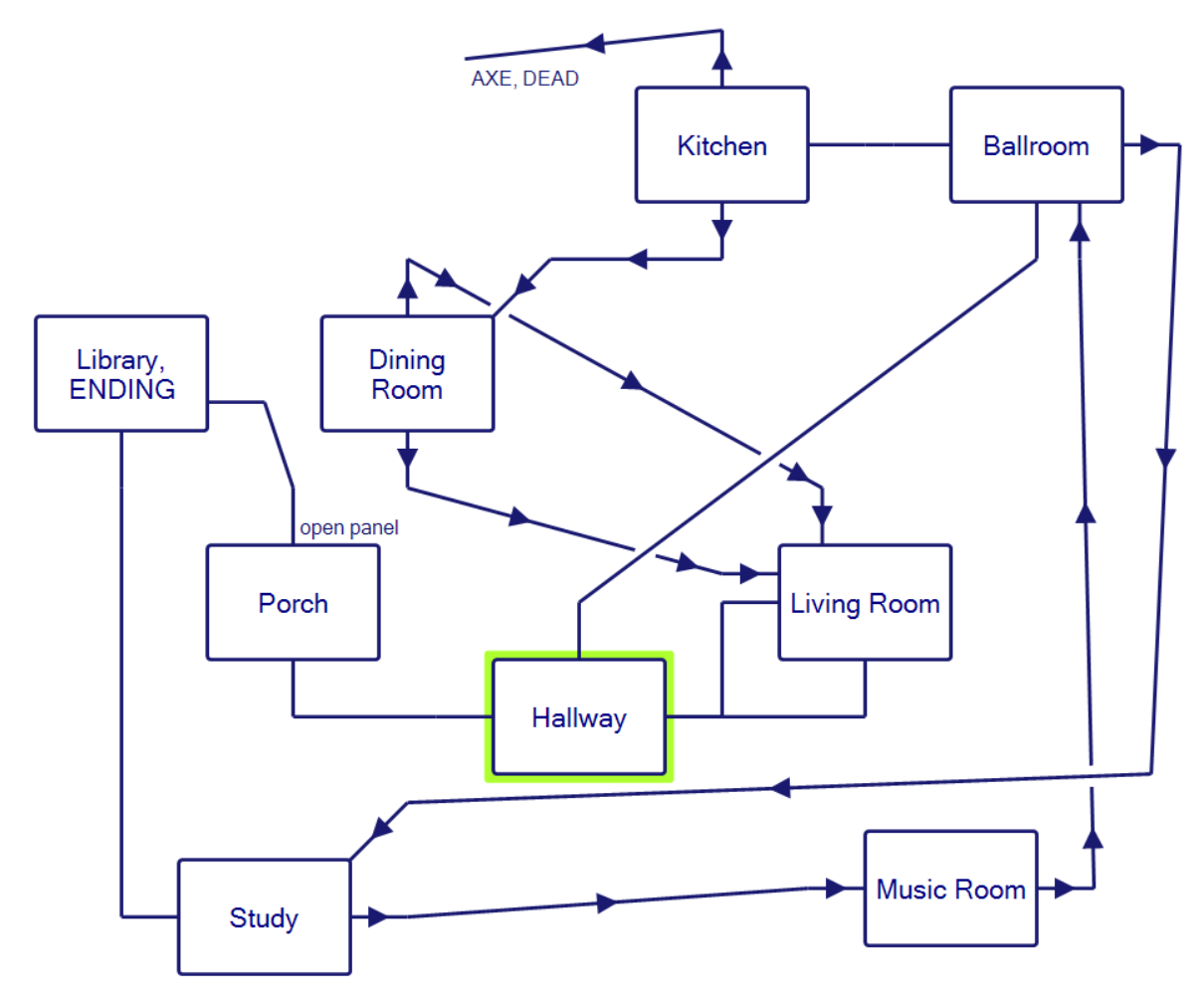
From the opening room (the hallway) you can go STRAIGHT to a ballroom or BACK to the same hallway, you can go LEFT and BACK or RIGHT and BACK as well. That is the end of the game’s consistency in terms of directions, as everything else is chaos.
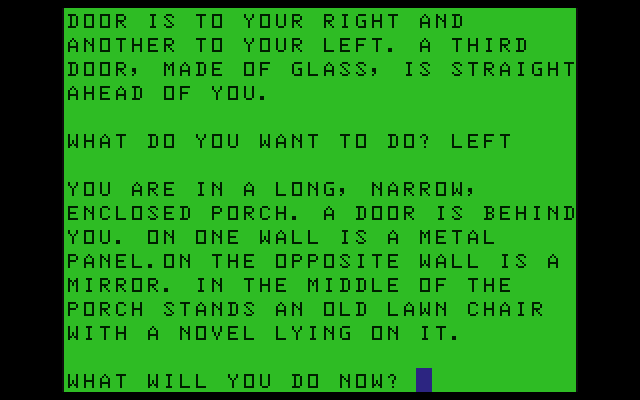
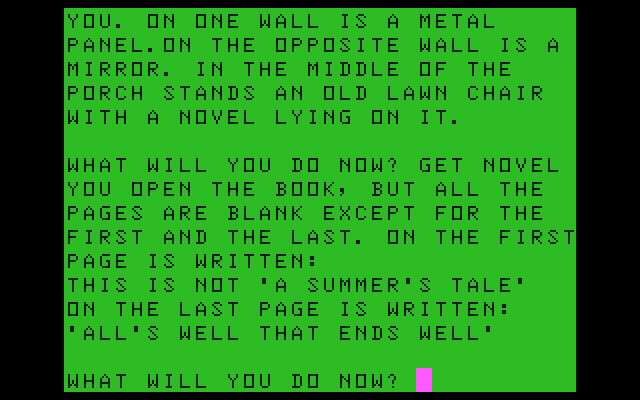
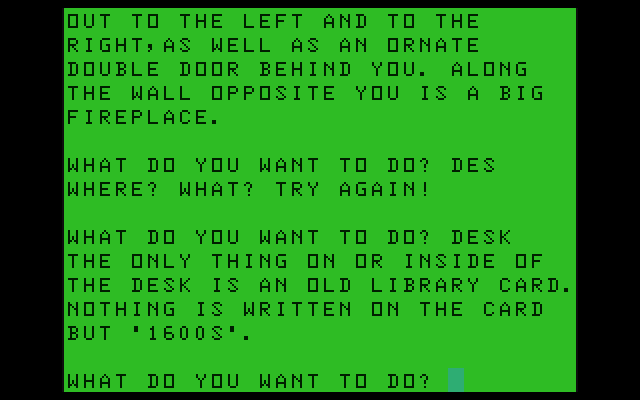
As the second screenshot indicates, there are no items. GET NOVEL is actually interpreted as NOVEL and then the game describes the novel. This is one hint of multiple ones around the house as to what the right action is to do to get the Deed (you need to type one specific thing in one specific room).
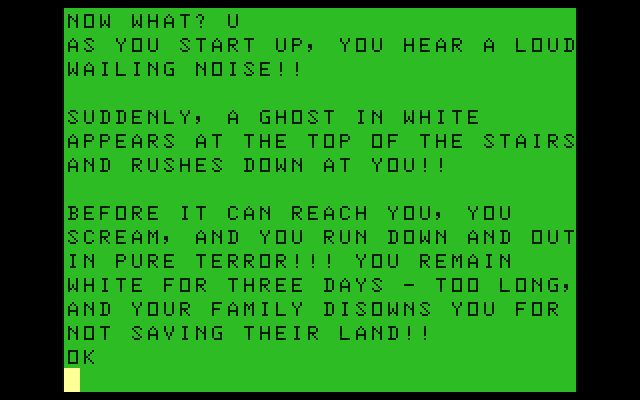
Otherwise, the house is full of deathtraps, or at least game overs. The ballroom has a stair, and going up results in meeting a ghost and losing you the game.
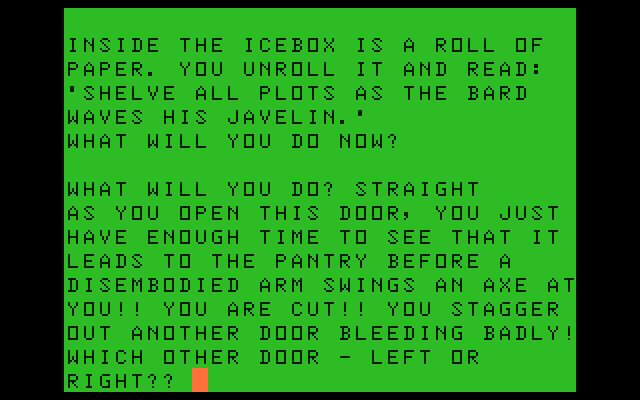
In the cheekiest moment, going through a door causes you to be hit by an axe, and this is followed by a left-or-right prompt.
Picking right ends the game (in a hospital) and picking left also ends the game (you end up dead).
Amidst all the chaos, the key is to realize in fact you are getting a consistent set of clues and all the game is really asking you to do is apply them. In addition to the ones I’ve shown, the starting room has a coatrack with the initials W.S., and a couch is engraved WILLIAM & ANNE.
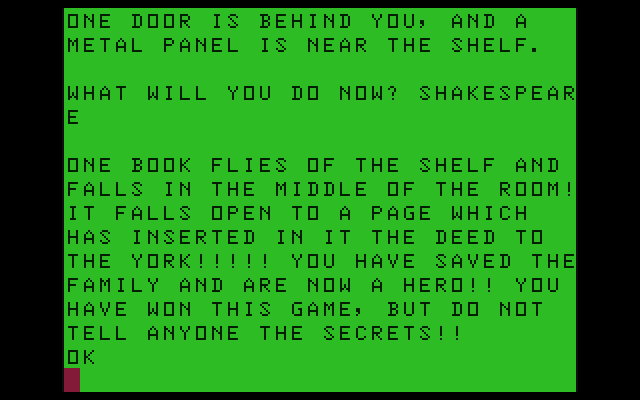
You need to get into a library (the only way I found was by referring to a PANEL, not any of the L/R/A/B directions) and then, at a library with books (where the game repeatedly insists you can’t refer to the words in the parser), just type the word SHAKESPEARE.
Conceptually, I like the idea of a one-puzzle game spread out across a house where you’re trying to find one hidden thing. In practice, the puzzle was not in solving what was getting hinted at (which was fairly incessant) but rather in dealing with the parser in the first place, and that saying the word SHAKESPEARE somewhere in particular might even be useful (usually it just gives a blank prompt!)
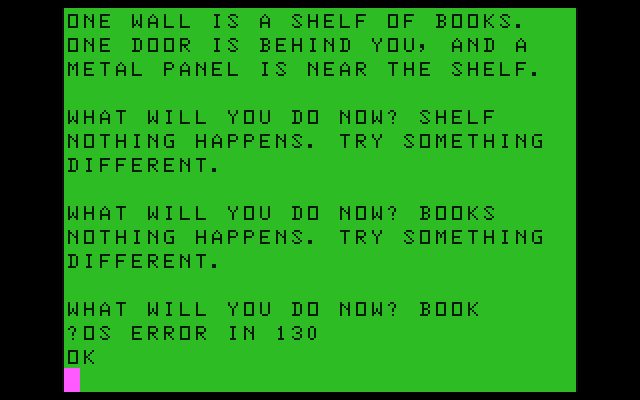
Also messing about with the books in the library can crash the game.
I’ll mark this on the list (along with Raymer’s The Room) as “interesting concept for the time, but implementation couldn’t rise to the occasion”.
Coming up: One more Britgame, and then The Coveted Mirror.
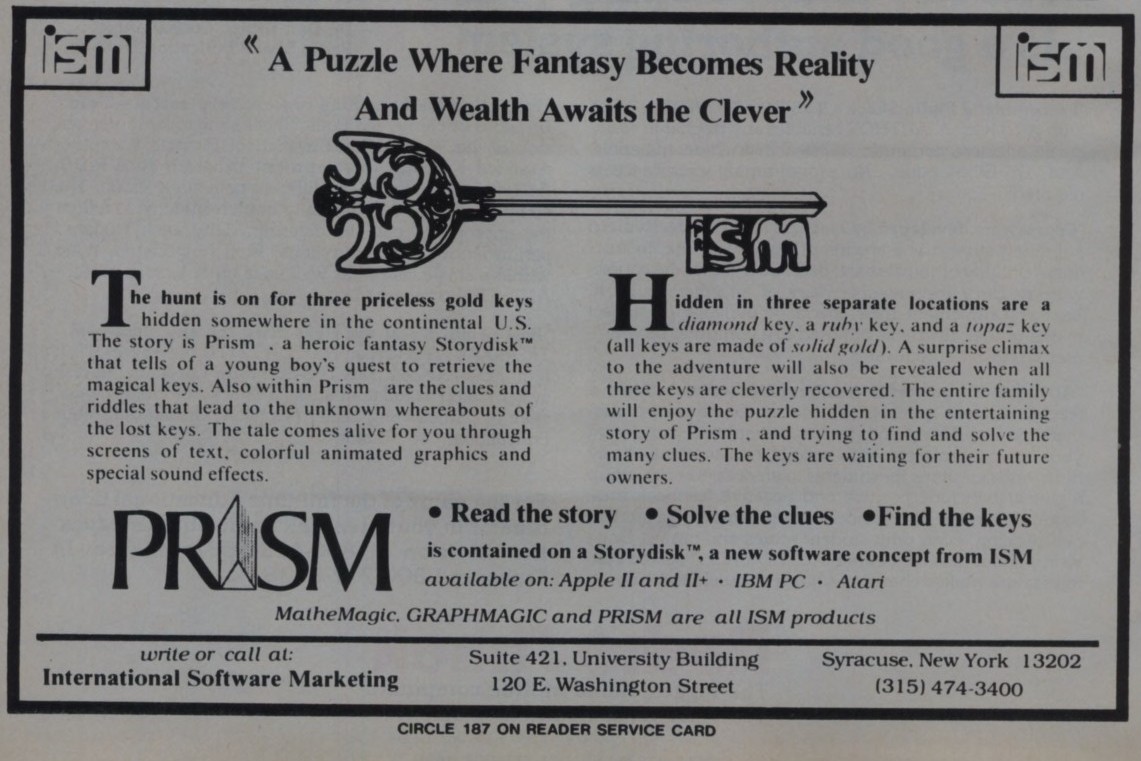
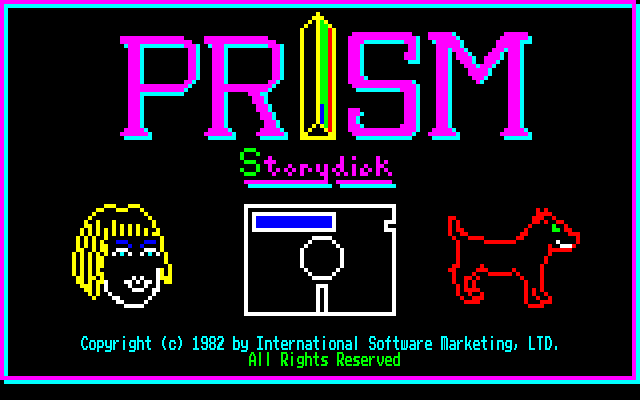
PRISM was a storydisk/game released by a business software company, International Software Marketing, in 1982. Inside are clues that lead to real life buried treasure: three golden keys. Back in January of this year, I wrote a series about the game and the commenters of this blog took a swing at solving the puzzles.
My original posts used the Apple II version (which still seems to be the original intended platform), but an Atari version surfaced as well (thanks to Atarimania). By comparing the two versions it became clear there was nothing special hidden in the layout of the text-only pages.
Via the January 1983 issue of Creative Computing. This is the first mention I’ve seen of a “surprise climax” that will be revealed when “all three keys are cleverly recovered.”
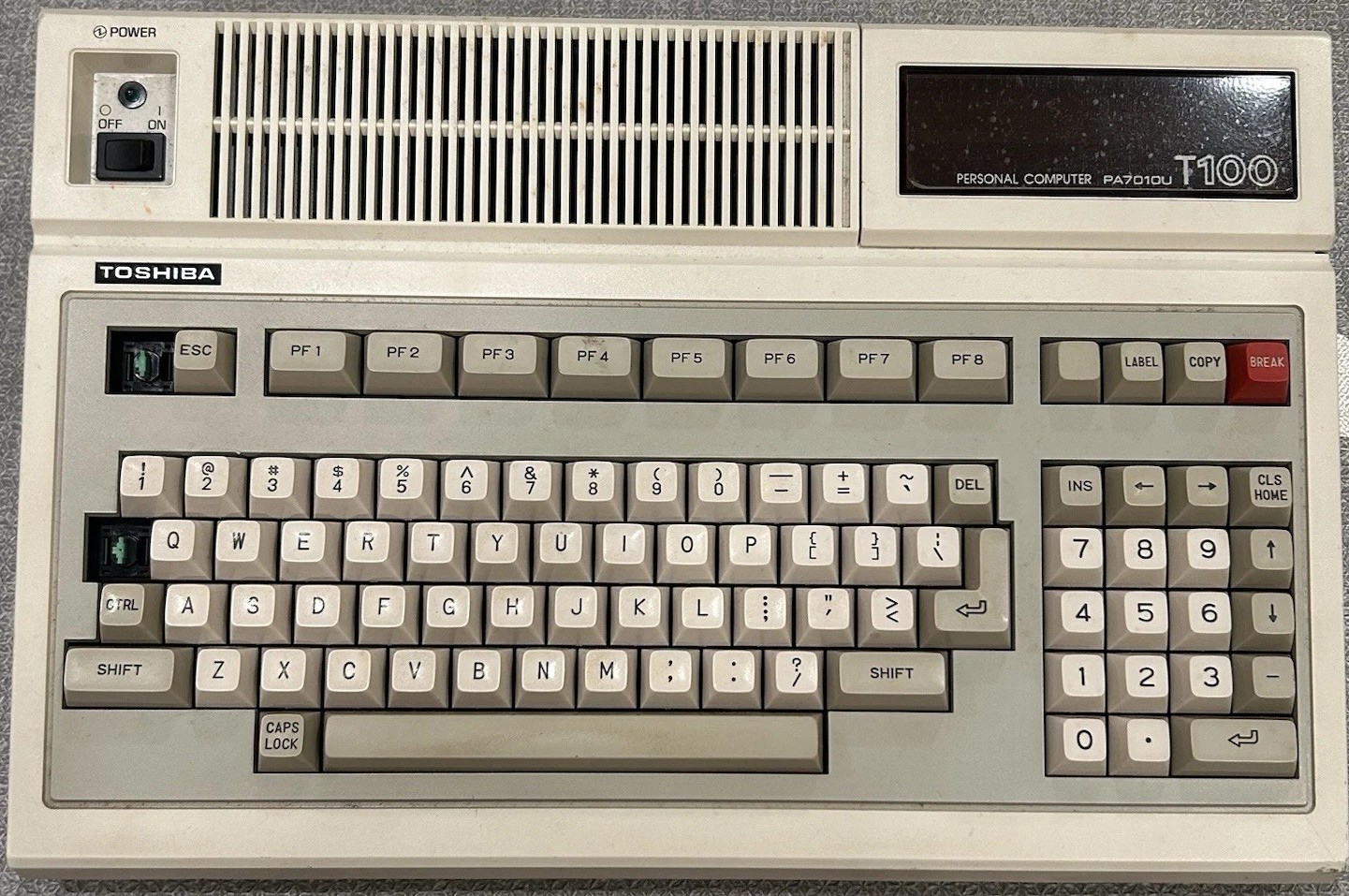
I wasn’t expecting to do any updates this week, but: back in February, velvetfistironglove had pointed out a mention of an IBM PC port in PC Mag, and linked to a CP/M version which might be related. (I had filed this away but I was burnt out on PRISM enough I figured I’d return to it later.) A few days ago, LocalH picked up the baton, and found that the CP/M file was for the Toshiba Pasopia computer, or more specifically, their T100 computer which launched in the United States. The only catch is the file did not want to run.
After some more work (from Rob, gschmidl, and the crew of folks who worked on rescuing Mystery House II including bsittler and eientei) it became clear the issue was the embedded copy protection, and after ripping that out, the storydisk/game became playable. (Download here.)
At least one of the puzzles is made harder, but a certain important aspect may have been made easier. (I have to hedge since we don’t actually know any answers for certain!) I will go through the new content just like I did with Atari, but I first want to explore how the program ended up on the ultra-obscure Toshiba T100 to begin with.
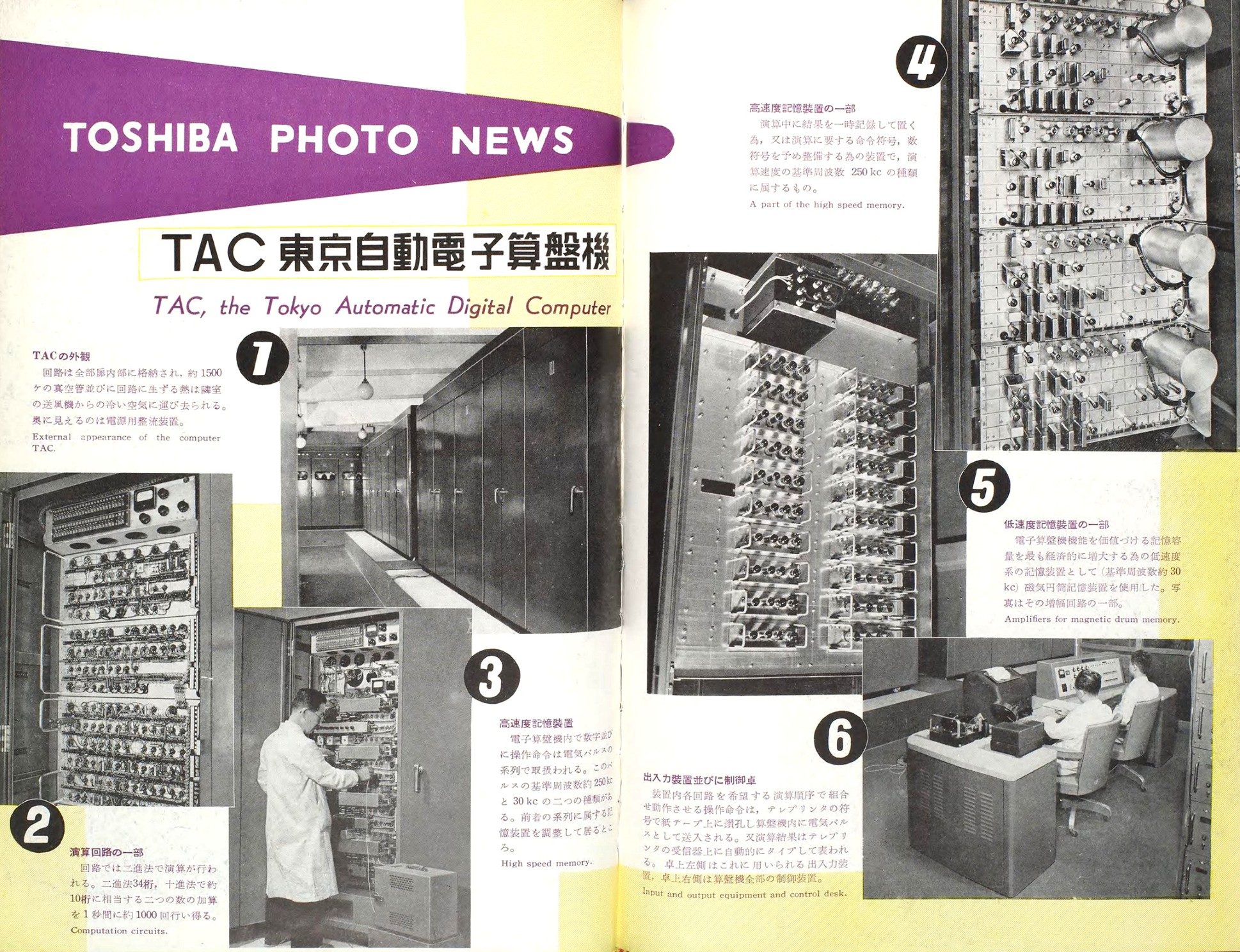
Toshiba had a long history with computers by this point, with work dating back to the 1950s with the TAC developed at the University of Tokyo and the TOSBAC series of mainframes developed in the 1960s.
However, a long history does not indicate commercial success for personal computers; while they did well with the Pasopia and Pasopia-7 computers in Japan, they never broke the top sales echelon over the heavy hitters (NEC PC-88, Fujitsu FM-7, Sharp X1, MSX). Like all the other companies, they wanted to give their shot in the United States; to do this, they hired Sorel Reisman, who had recently moved to the United States. Reisman was hired from IBM Canada to work with Discovision in California; it quickly became clear it wasn’t going to work commercially so he started shopping for another job, finding one when he met the Vice President of Toshiba.
Toshiba had just gone into the computer business here, and they had just started a division called the Computer Systems Division. The guy who was heading that up, I met him. They had essentially two groups; they had the printer group and they had the computer group. This was in 1981 Toshiba was trying to get into the computer business here, they wanted to compete with the IBM PC, which had just been launched — this was in 1981 — they wanted to bring their wonderfully better-manufactured personal computers over here (to the US) and compete against the IBM PC.
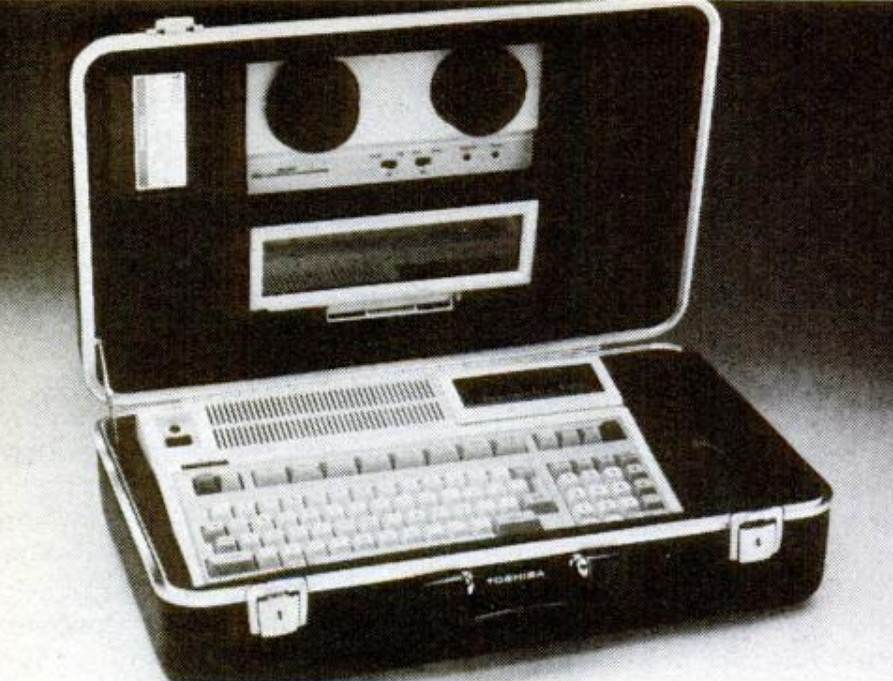
The T100, a Pasopia with some tweaks for the American market. From an old eBay auction. There’s a blank key on the top row (next to “LABEL”) because that was the kanji key in the Japanese version.
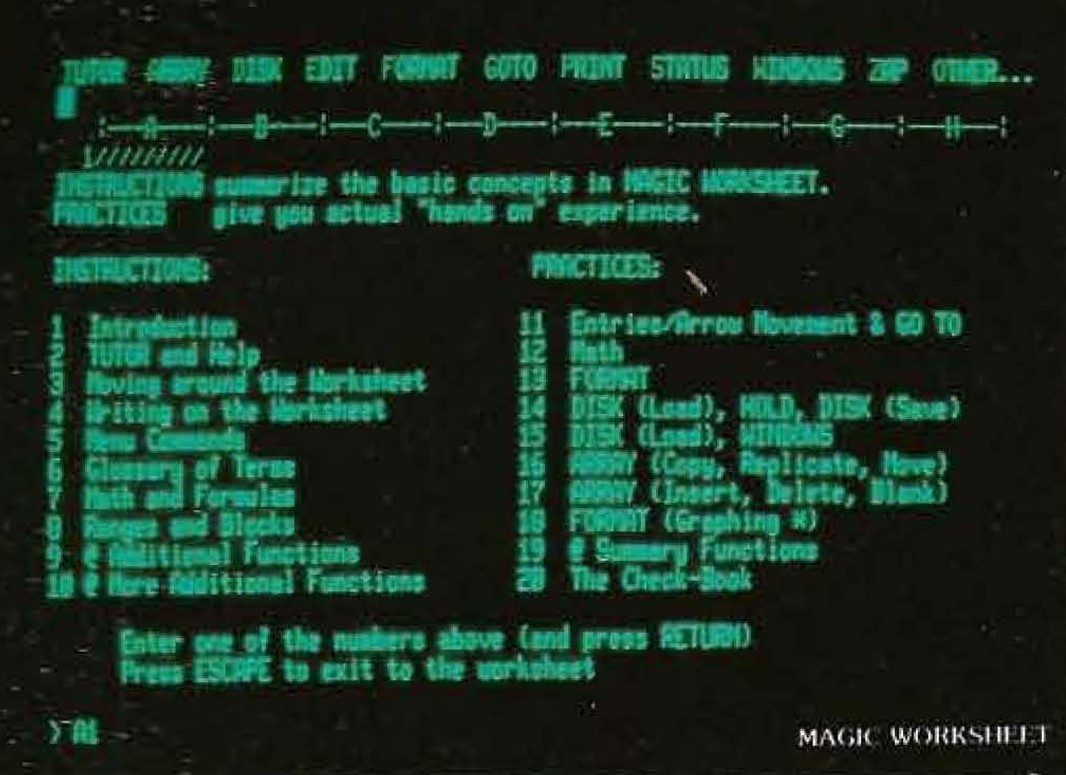
He was hired to head the computer division starting in 1982, but ran into an issue nearly all the Japanese companies were slamming into: software. The system used CP/M which is technically cross-compatible with certain software, but this still wasn’t the same thing as IBM compatible. As Reisman points out, clients were wanting to run Lotus 1-2-3 (the big spreadsheet software after VisiCalc) but couldn’t, so they weren’t interested.
Instead of Lotus, the computer came with Magic Worksheet, software barely anyone cared about. From a 1983 Multitech catalog.
In July of 1983 they tried “re-introducing” the computer to the market as “portable” by adding a LCD display, although coverage had a tone of skepticism (“the T100 runs solely on 110 AC cord power, rather than on AA batteries, thus limiting its usefulness in long distance travel.”)
InfoWorld Jul 18, 1983.
To take a stab at the software gap Toshiba introduced products scrounged from supportive developers, which is why they ended up hooking up with International Marketing Systems, and getting their Mathemagic, Graph Magic, and Prism software as part of the $1600 package. (Rob pointed out the connection a long while back.) Toshiba discontinued the T100 only a year later, in 1984, so this all represents a fast-moving blip in computing history. (They took another stab with the portable T1000 in 1987; learning their lesson from last time, they made it actually IBM compatible.)
While (as I already indicated) we don’t have the DOS version of PRISM, the T100 version is likely close, although modifications to the graphics would still be needed. The source code turns out to be pure BASIC. (Link here. A few characters are off.) The copy protection involves checking for an (intentional) error on the disk, and if that error is present, allowing the program to go forward; once this check was removed the game could run. The fact the porting isn’t 1-1 and that the CP/M port came after the other three versions is important: it means that this is essentially a “version 2” of the software. As LocalH points out, two typos are fixed.
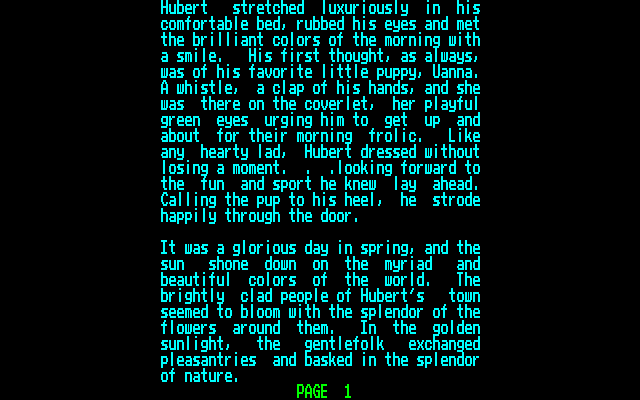
I notice that “Hubert’s” and “ecstasy” are correct in this version (surrounding the “TRET” screen, on pages 20 and 22) but “gazing redly” is still written exactly that way on page 20.
(I never thought “gazing redly” was a typo, given the story’s theming.)
An easier-to-read font compared to Apple and Atari.
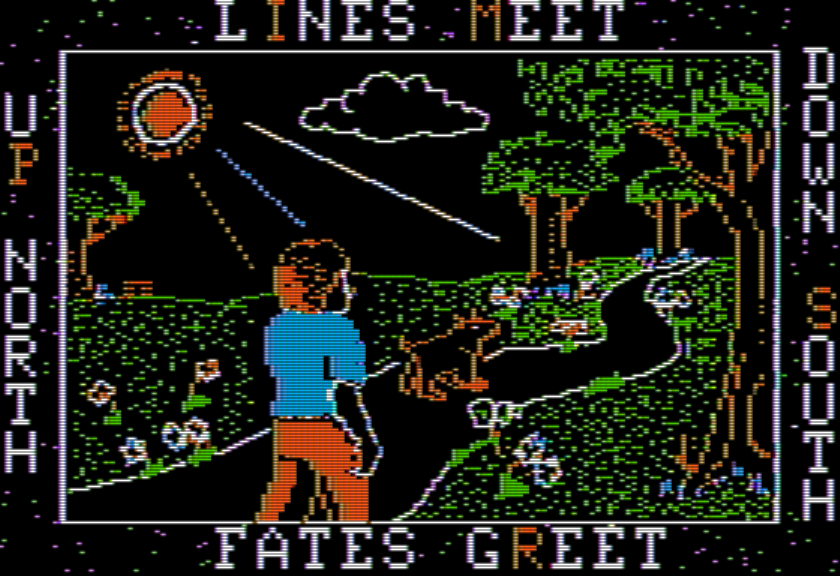
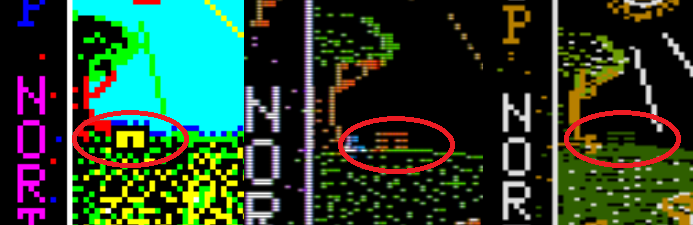
You can see a very curious difference from the first graphic, and the part that I alluded to earlier that makes for a harder puzzle. Apple and Atari first:
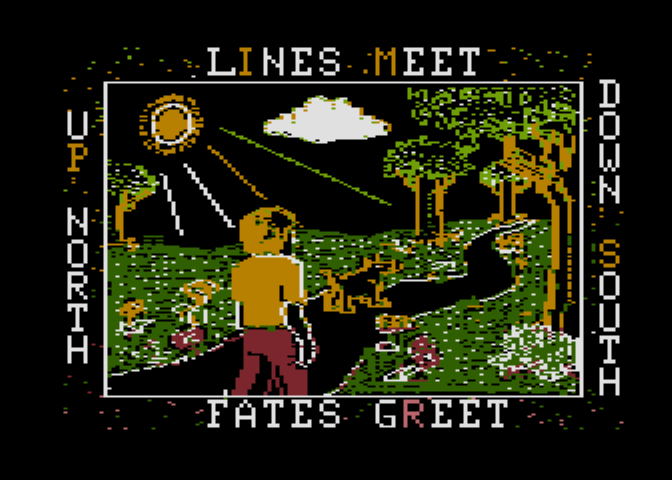
Now, the T100 version of the same:
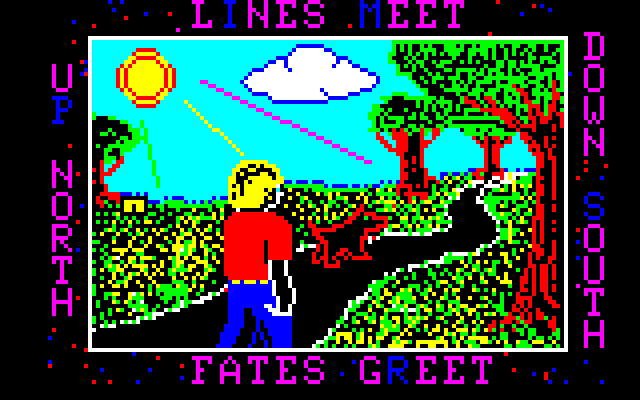
Everything is much more chunky. Positions have been slightly altered (and assuming they didn’t mess anything up, it means some positional elements to the images have to be unimportant). The I Ching reference is much muddier now:
Without the rows-of-lines element, I would not have the symbol identified as from the I Ching at all! Additionally, in the “broken tree” picture, as you’ll see later, the symbol is moved from a spot next to the tree to the corner. This suggests two things: a.) that the symbols really are important, important enough they spent the time to render it here despite the difficulty and b.) the exact position of a symbol is not important, but rather that it marks a particular page.
Enough preface; here’s the rest of the images. If you want to download them as a pack (including the text) I have them all zipped together here.
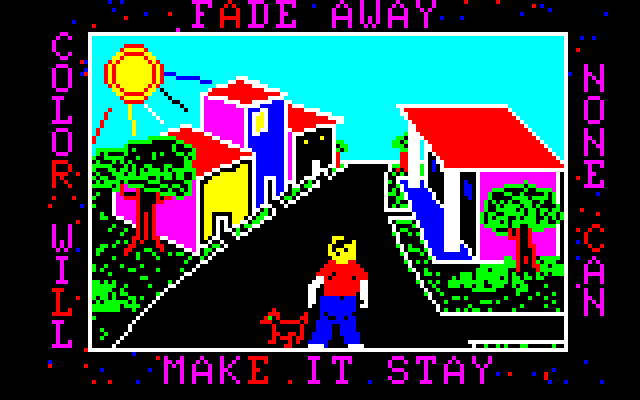
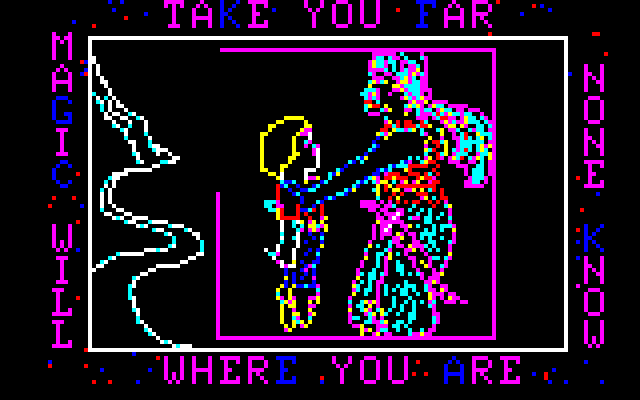
Besides the positional shifting, the other big change of note is the colors. The highlighted letters are now only either red or blue! I’m not sure if that really means the exact coloring is unimportant; it may be the developer simply lost control given hardware restraints (just like the Atari had some odd colors based on what row of the screen it was drawing). At the very least, any solution needs to be at least somewhat compatible with this variation (keeping in mind, like the I Ching puzzle, it’s possible some clue or clues were lost).
So far, out of the Falsoft contest adventures, I’ve played Polynesian Adventure, Search for the Ruby Chalice, and Escape from Sparta. I pointed out last time that these tend to be the only games published by the particular authors, although in the case of today’s author (Robert Mangum II) this isn’t true. He published two games, one that won in the first Falsoft contest and one that won in the second.
Robert Mangum, a 15-year-old sophomore at Astronaut High School in Titusville, Fla., purchased his TRS-80 Color Computer when he was an eighth grader. His hobbies include reading, playing the stock market, and writing Color Computer games. He aspires to pursue the latter hobby as a career.
As the “Astronaut” in the school name implies, Titusville is east of Orlando, close to Cape Canaveral and one of the US’s space launch sites.
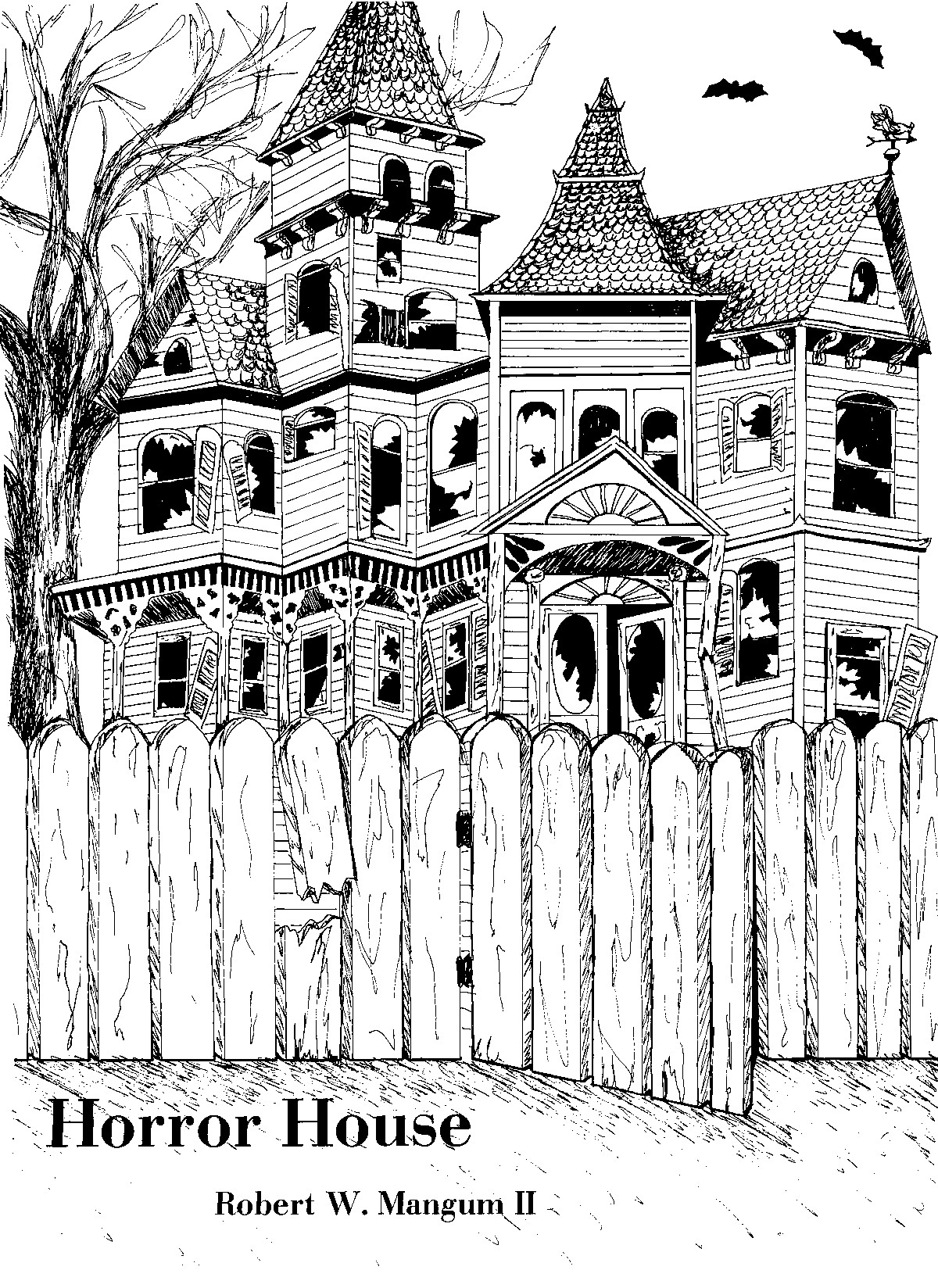
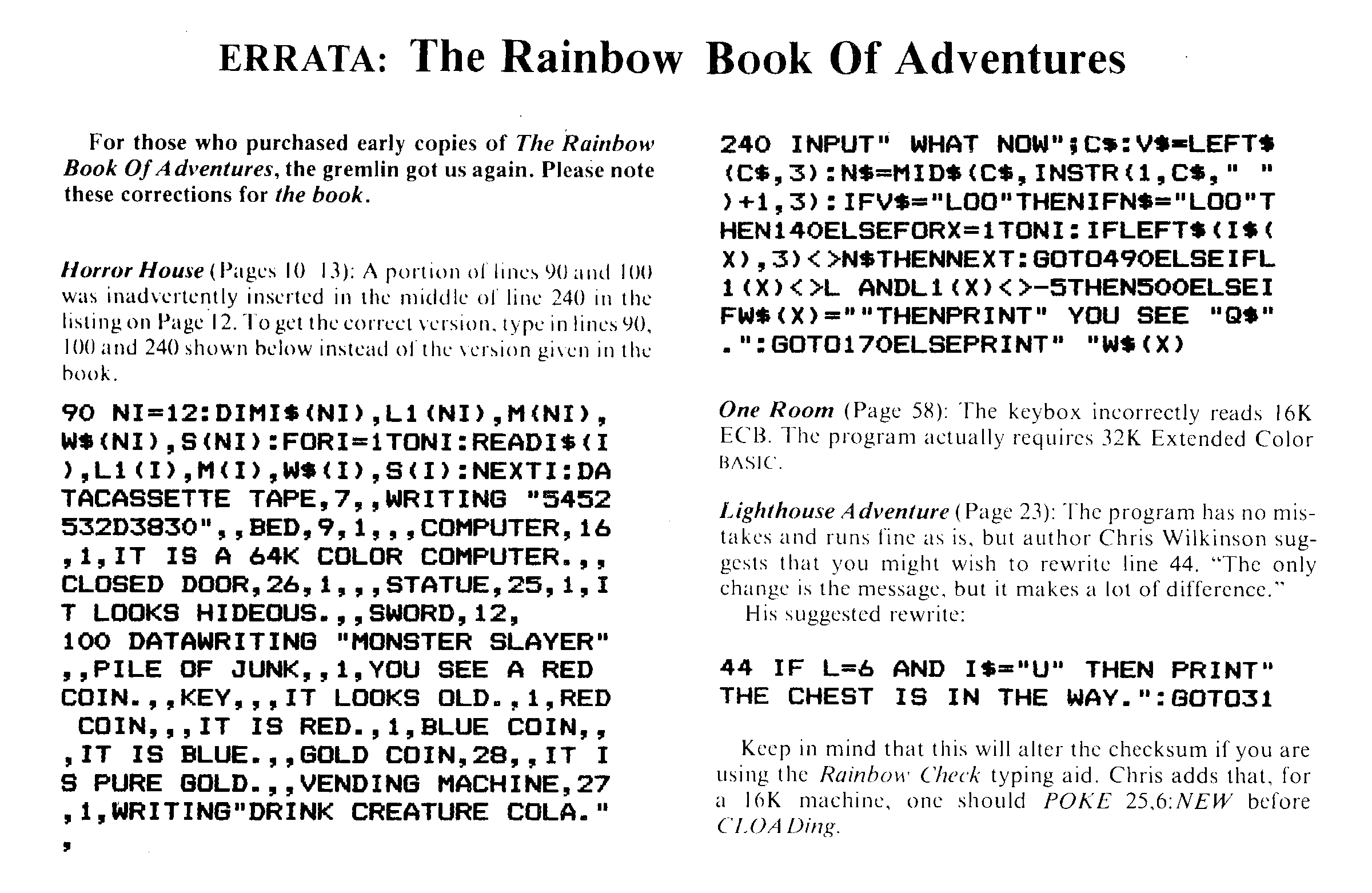
I’m unclear if the introductions to the various games given in the book are written by the author(s) themselves or by the magazine editors, although I suspect the latter for reasons I’ll get into. Horror House’s book-intro has a very Encyclopedia Brown feel to the writing, and even though the lore doesn’t affect the game at all I felt like reading this one out loud. No overdramatic Dungeon Master this time, I went with something a little more like Goosebumps.
In summary, in order to get into a local club, we have to prove we aren’t a “chicken” by going into the local Horror House and defeating the various “ghouls and goblins”. (!!) Not even pretending there aren’t any and you’ll be safe, nope, you actually gotta commit homicide, kid. Hope being popular is worth it!
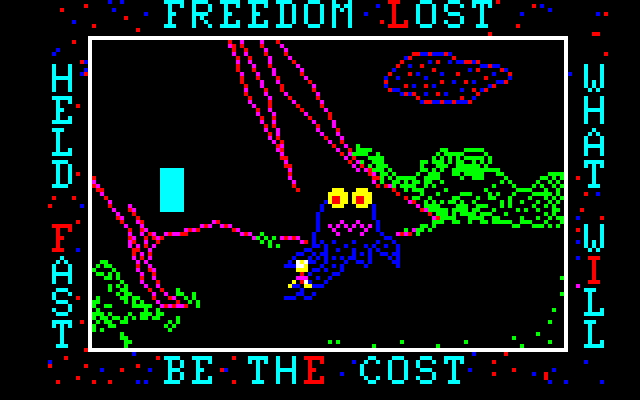
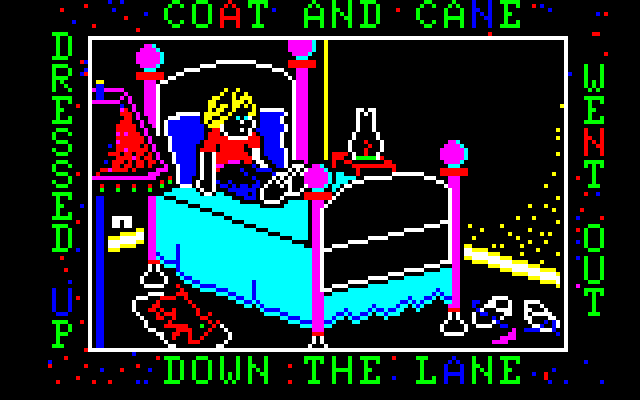
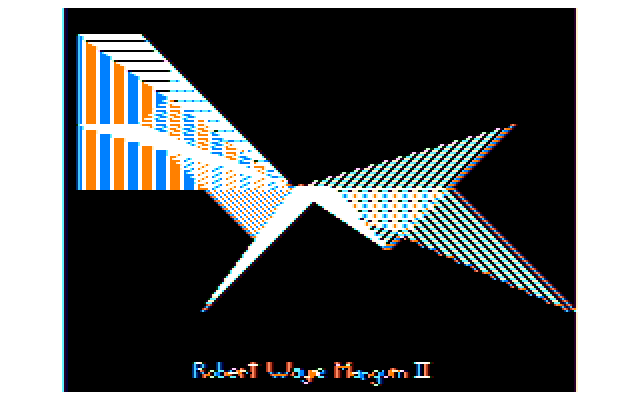
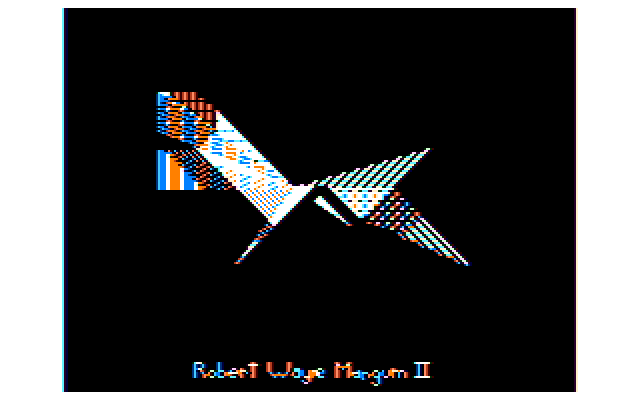
The game starts with an animated visual effect where the initials of the author draw themselves into the distance, then disappear.
I love it when cinematic ambition gets applied to the start of a regular type-in text game.
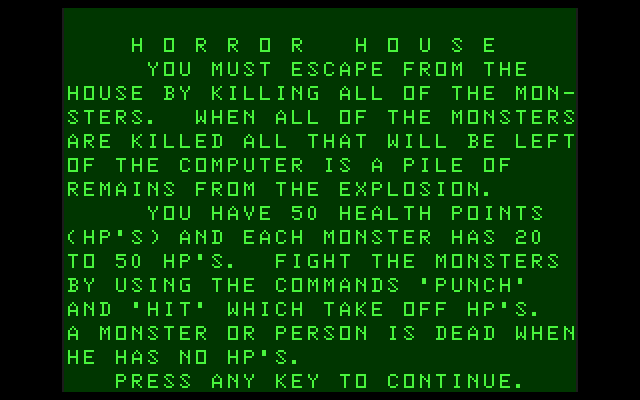
This is a game fairly similar to the last one we played (Escape from Sparta) in which there’s an overall “health” stat; Sparta called it Energy, but this game just calls it Health Points, similar to but not exactly like Dungeons & Dragons (which used “hit points”).
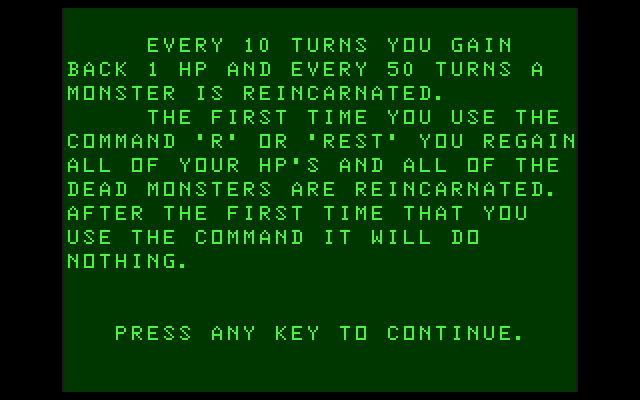
The game is up-front this is going to be combat focused, but with rules that are somewhat unusual for an adventure game: you regenerate health, and the monsters reincarnate. Specifically, you get 1 HP back every 10 turns, and one monster reincarnates every 50 turns. (If you see a loophole in this already, I’ll get back to you later.) You can “REST” only once but it will cause a total reset of your HP, at the cost of resurrecting all dead enemies.
The game also gives the complete (restricted) verb list.
MOVE, PULL, OR PUSH
PUT, LEAVE, OR DROP
PUNCH / HIT
N, S, E, OR W
INVENTORY
INSERT
LOOK
REST
GET OR TAKE
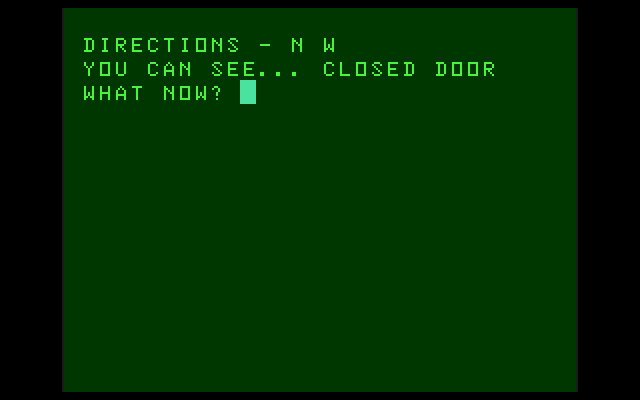
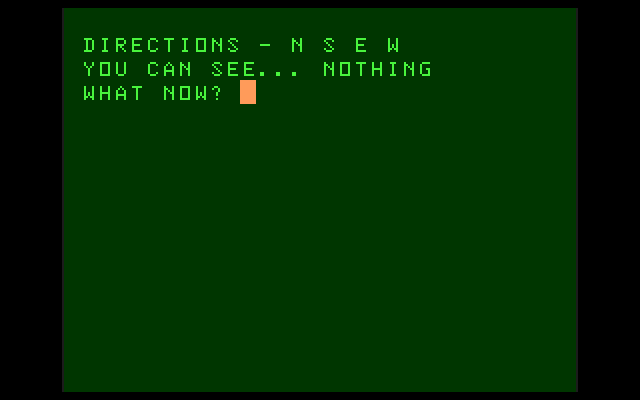
The game announces AS YOU ENTER THE HOUSE THE DOOR LOCKS but gives no room description. There essentially isn’t one. After LOOK:
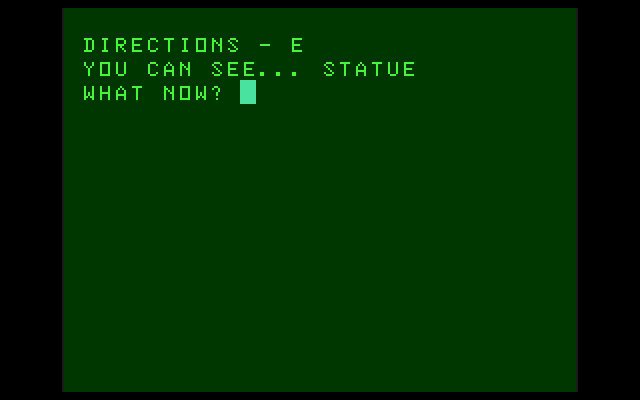
You are informed of any objects or enemies in a particular room, and if the room doesn’t have any, it just is described as having NOTHING.
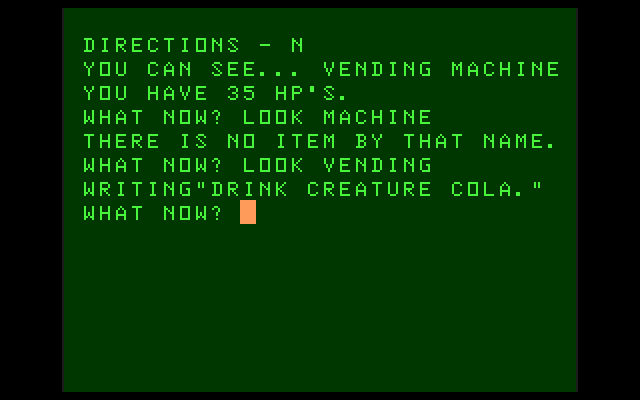
You can MOVE STATUE which reveals a blue coin, but it also turns the statue into a living statue (one of the enemies).
A more typical room, just north of the start.
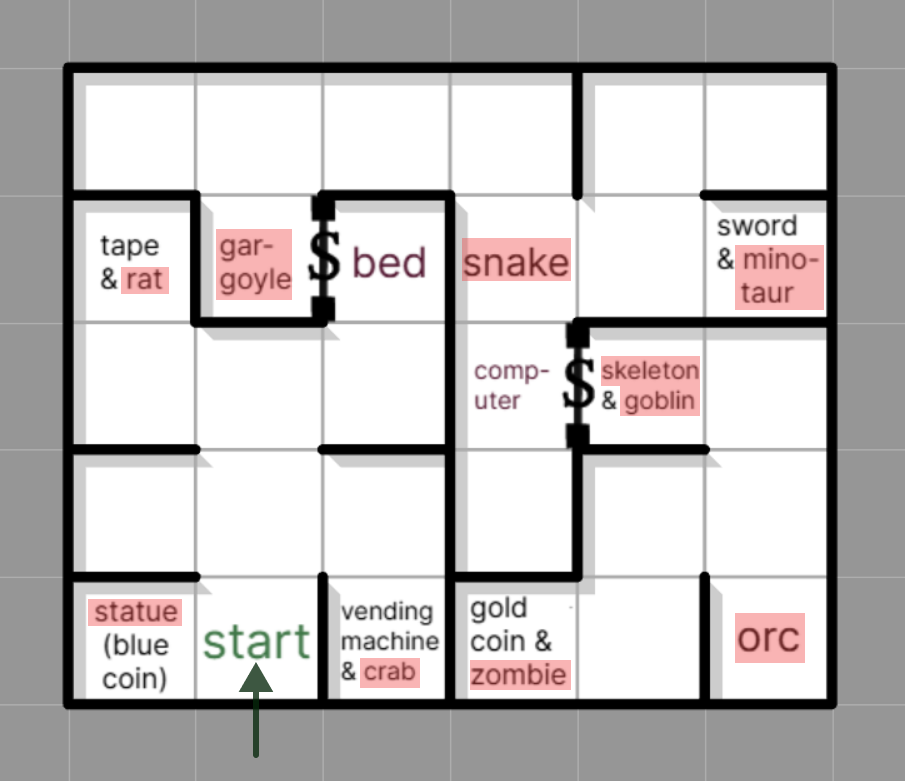
I started with a traditional adventure map but quickly realized I would be better off breaking out Dungeon Scrawl and doing a Wizardry-style map instead.
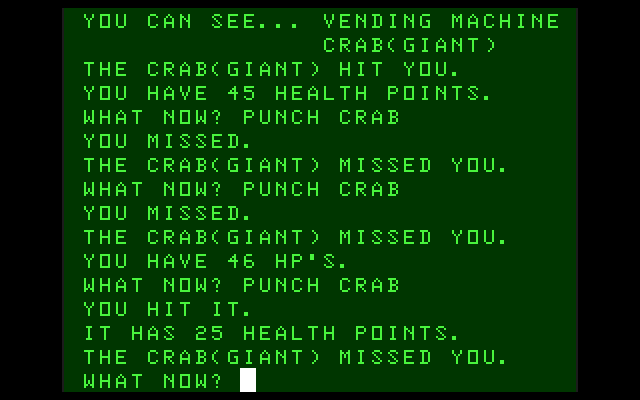
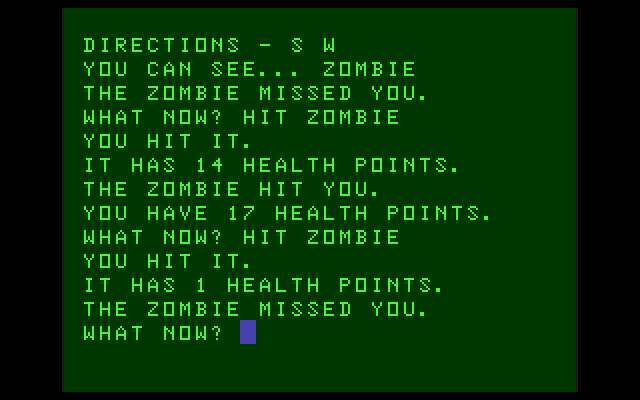
The enemies (where PUNCH and HIT must be applied) move around so I don’t know on a particular game if they’ll always be where I placed them, but at the very least this is a deterministic setup; there is no random rearrangement at turn one. My first battle was a giant crab at a vending machine where I punched it in the face (?).
No real time element here: just slowly exchanging blows while health points go down on both sides. Not all enemies have the same starting health (there’s a rat early that starts lower, for instance).
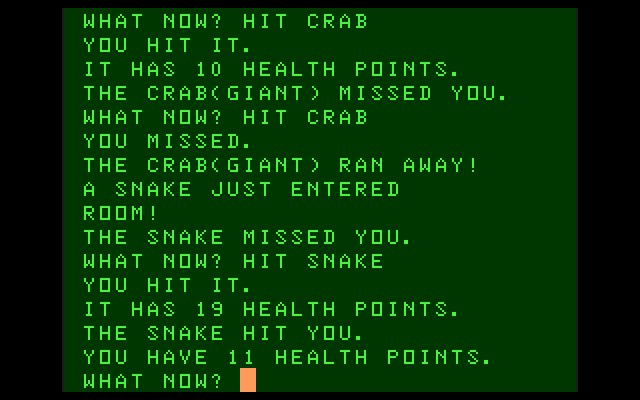
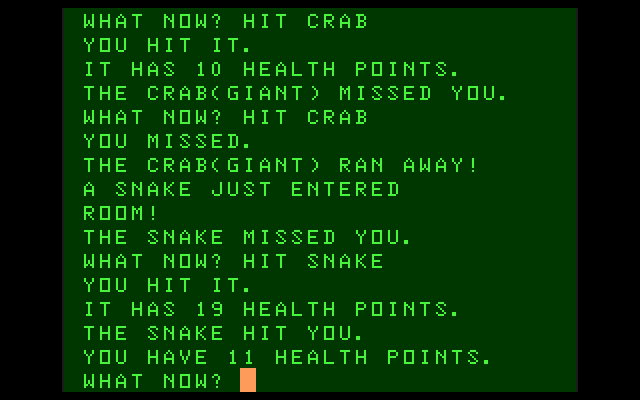
You are allowed to run away; enemies may chase you, and you can easily find a situation with multiple creatures clustering in the same room.
In the crab and snake vs. protagonist battle above, this is actually crab version 2, after resurrecting. Remember that enemies resurrect after 50 turns. Given that a fight can take up to ten, and walking from one side of the map to the other can take as much as fifteen (assuming you know where you’re going to hunt down an enemy) trying to get all the enemies to stay dead at the same time is a bit of a dilemma.
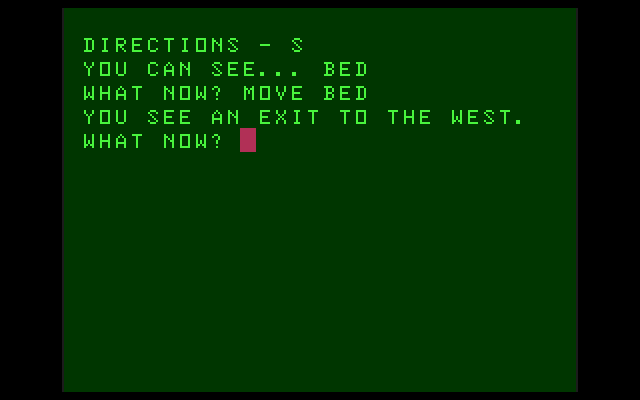
There are two puzzles (besides the blue coin); one is a bed that simply be moved to reveal an exit.
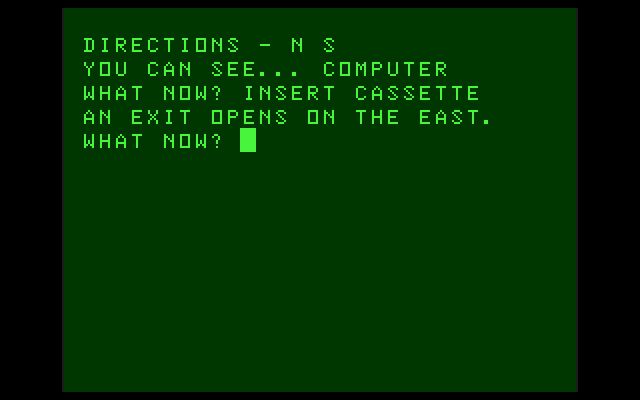
The other is a computer (“IT IS A 64K COLOR COMPUTER”); there’s a tape cassette elsewhere (guarded at least at the start by a rat) and INSERT TAPE will open a second secret door.
A sword is out in the open (past the first secret door) and it does seem to help a little so I found the best strategy was to make a beeline there first. (PUNCH explicitly is “attack with no weapon” while HIT explicitly means “attack with the sword”, and you can’t hit things without the sword. This gets at the “game-meaning of verbs doesn’t match dictionary-meaning” problem I had with The Phantom Ship.)
I tried just naively hitting everything but the tendency of monsters to cluster meant I was succumbing to too much damage, and REST seemed to reset everything so that didn’t help, until I realized the loophole I alluded to earlier: while you can personally restore health, and enemies can resurrect, the enemies cannot restore health.
This means the best strategy is to hit each enemy down to low health, but not kill them. It’s a little like catching Pokemon.
Once I had enough enemies whittled down to single digits, I picked a starting place just outside an enemy (the MINOTAUR which I knew I had at 1), did REST, and started a slaying spree. The goal is to kill faster than they resurrect, and my strategy worked such that I only had to deal with one resurrection, the minotaur I started with.
Enemies can run away as well. The movement of enemies keeps the combat from being ultra-dull like adventure-game-combat often is, but just regular dull. You need more options (like Eamon) for it to feel like more than just a sequence of dice rolls.
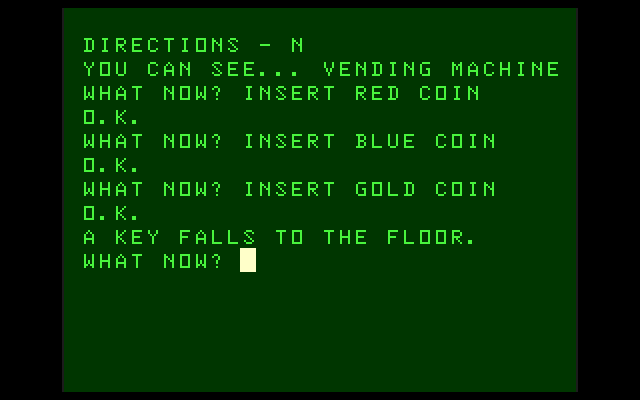
Once you’ve killed all the monsters, if you go back to the computer you’ll find it has fallen into a pile of rubble. LOOK PILE reveals a red coin; you can combine that with the blue coin from under the statue and a gold coin just lying out in the open and take them back to the vending machine.
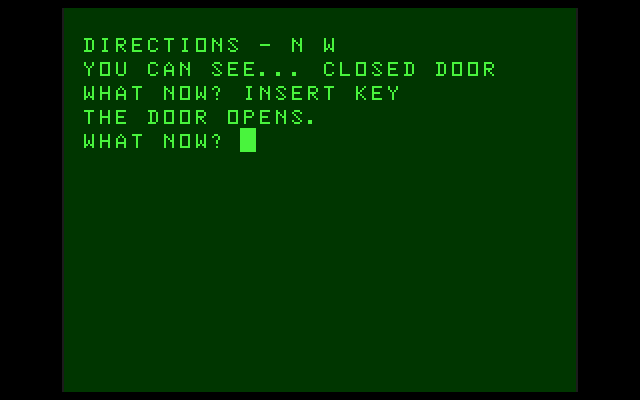
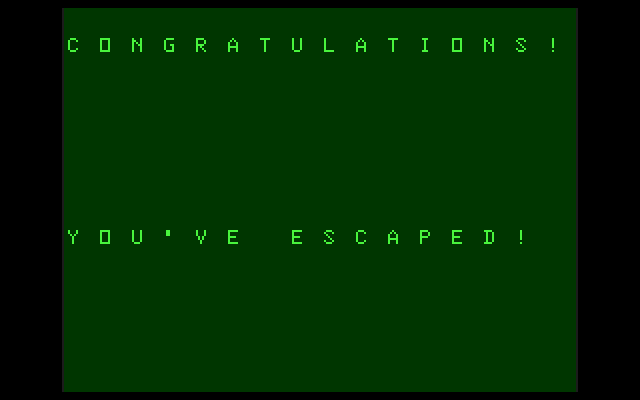
The key then can be inserted at the door at the start, letting you escape.
I should highlight that the opening text from the book (which I recorded) had falsehoods. Not only are there no ghouls (and just one goblin), but the text claims the house will explode when the computer does. I was genuinely worried by that last part but there’s no timer: the computer simply falls apart, and you are in complete safety once all the monsters are dead. Also notice that the screenshot-intro said nothing about us doing a dare and wanting to join a club. I think the opening was so abrupt that the book editors (Lawrence Falk, James Reed, Susan Remini) decided they needed to add some context; not only did the context not make sense, but it was actively deceptive and changed my behavior at the end of the game (until I realized no explosion was forthcoming).
I haven’t found any letters complaining about embellishment, so the authors must have just let it go.
Before signing out, I should add that JIMMY ADVENTURE 5 strikes again: the was a misprint in the original book that made the source code for this game entirely broken.
Coming up: I’m finishing something else (it’s related to the blog, but not another game) so the next post will be delayed by about a week.
This returns to the Tandy CoCo adventure contest from Rainbow magazine, culminating in thirteen games printed in The Rainbow Book of Adventures; I’ve played Polynesian Adventure and Search for the Ruby Chalice so far. I wanted to get a few more of the set taken care of. Even though I’m not following strict chronology by month, the book was released in January and I’d feel awkward being near the end of my 1983 sequence and still pulling games to play from the book.
Just as a reminder, this contest was run before both Scott Adams and Infocom were available on Tandy CoCo; there wasn’t many adventures to pick from at all. The authors of the contest tended to be enthusiasts rather than gaming professionals and most of the entries seem to be the only published game from each particular author or authors.
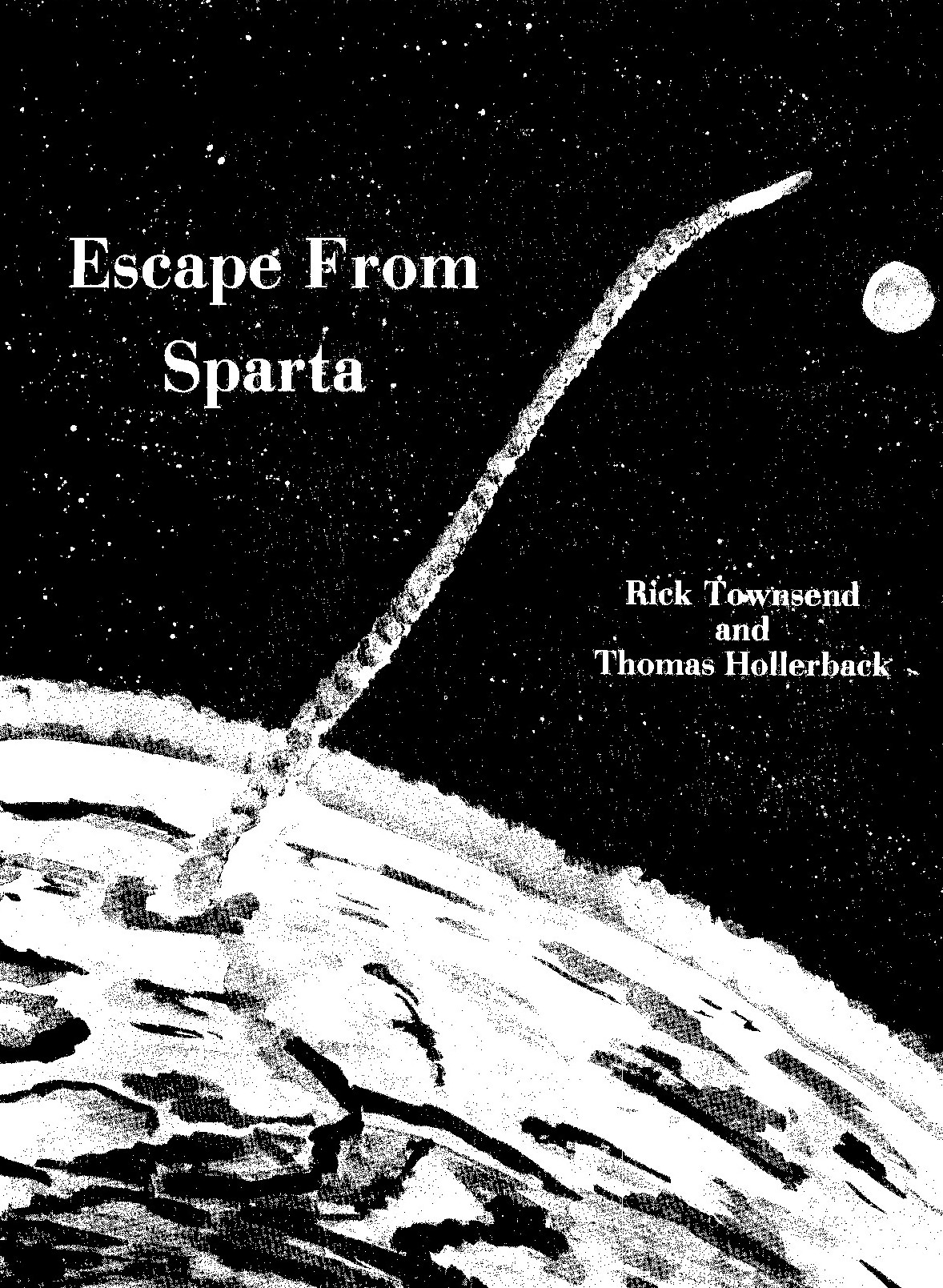
Today’s selection involves a pair of authors, just like Polynesian Adventure, although Rainbow magazine made a mistake and just credited Rick Townsend, leading to a correction letter.
I was very pleased to learn when I arrived home from vacation that my program Escape From Sparta was selected as a winner in your First Annual Adventure Contest. The following day I bought a copy of January’s issue and was excited to see that it had won Best Science Fiction Trophy. I was, however, extremely disappointed to see that the name of Thomas Hollerback, co-writer of this adventure did not appear with my own. Without his help I could not have written Escape From Sparta. Escape From Sparta was a joint effort and intended to be a joint entry. Apparently, I may have misled you when I enclosed a separate letter in reference to the game signed only by myself. Tom’s name appears along with my own in the program heading. Please give Tom the credit which he also deserves.
Rick Townsend
Bettendorf, IA
The book has things printed properly and biographical notes for both authors.
Rick Townsend is a self-taught computer enthusiast who works as a computer operator for United Totalisator International. Thomas Hollerback, co-author, is a 1983 graduate of Central Michigan University and a perspective CPA. Both men enjoy video and Adventure games.
Thomas Hollerback did indeed become a CPA and became quite successful in the profession, serving as chairman for various boards of directors and becoming named president & CEO of Yeo & Yeo in 2013.
Rick Townsend I’ve been getting too many nameclashes to be sure on, but United Totalisator is a curious company indeed to be located at the far east of Iowa (on the Mississippi River) in 1982/1983. Totalisator equipment is intended for handling betting (horse racing, dog racing, etc.) and while Bettendorf did become a center of gambling, it only happened after 1989 when Iowa legalized riverboat gambling. (Iowa was the first state to do so; I’ve written more about that here.) However, it was still possible to bet directly at horse tracks at this time, so it isn’t absurd as placement for a gambling company; Arlington track in particular was not far away in Illinois and had just recently had the first million dollar horse race.
The important point here is that programmers were spread out all across the country, not just hovering around Silicon Valley/California and MIT, and in a contest meant to encourage amateurs it’d drag some of the less-commonly-associated-with-game-development places out of the woodwork.
As the book’s plot intro indicates, we are part of a “superior race of robots” and our creator is a “highly regarded” person who is an “epitome of virtue.” (I guess the polar opposite of Davros from Dr. Who.)
You are a Combutron X robot, one of the most advanced and most loyal of his races, and your assignment is to defend the good side of the universe. Recently, the warlord, master of the evil alliance, has developed a secret plan to control all the planets. To succeed, he must capture and kill your creator. Then, the robot race will not be properly maintained, and the robots will expire — eliminating any resistance to the warlord’s evil clutches.
Our goal is to rescue Light Davros our creator.
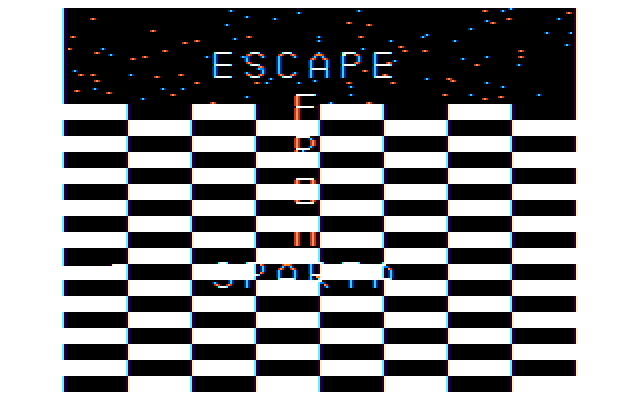
The game starts with an “instructions file” with a title screen (see above) and a bit more information about what’s going on.
YOUR MISSION: FIND THE CREATOR ABOARD THE SPACE STATION SPARTA AND ESCAPE.
PLEASE STANDBY TO BE BEAMED ABOARD SPARTA. GOOD LUCK!
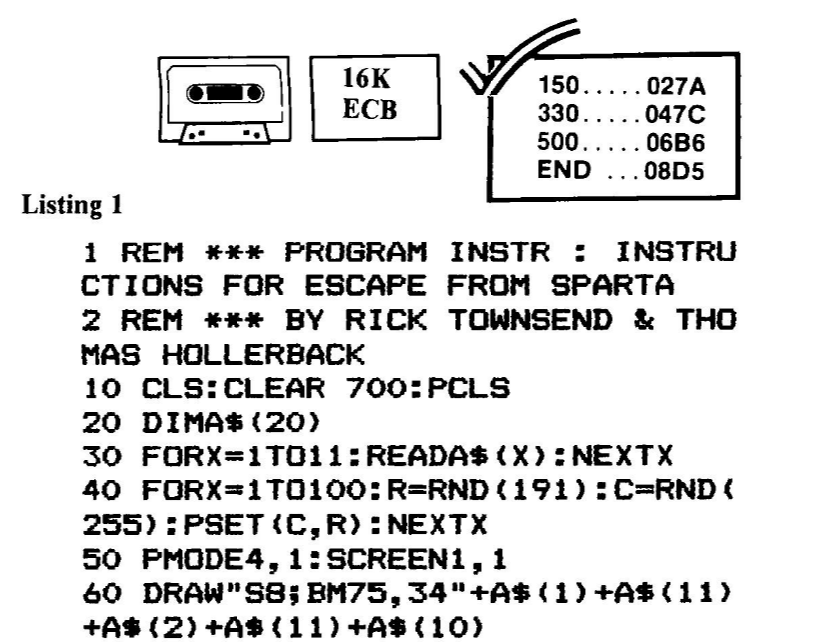
ENTER ‘POKE 25,6:POKE 26,1:NEW’ BEFORE LOADING WITH CLOAD
The instructions given here with the POKEs and the NEW command clear out the BASIC memory for maximum space. (This includes the program that just ran, which is why the player needs to type it in after the starting program is done.)
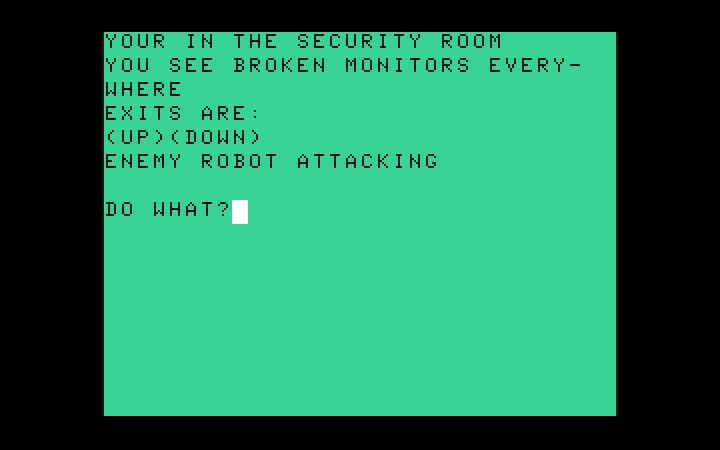
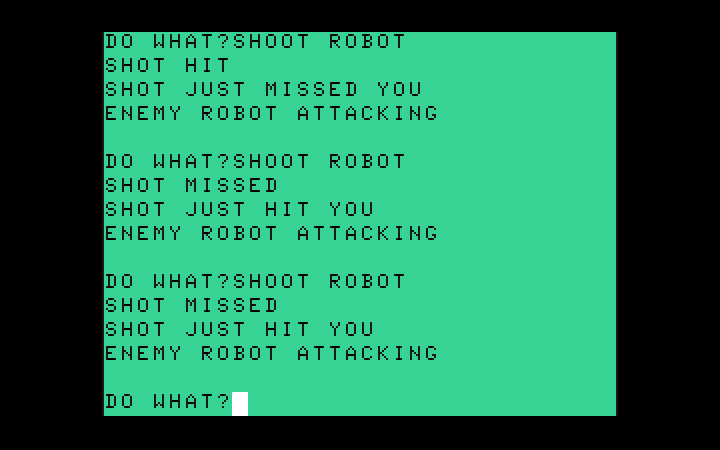
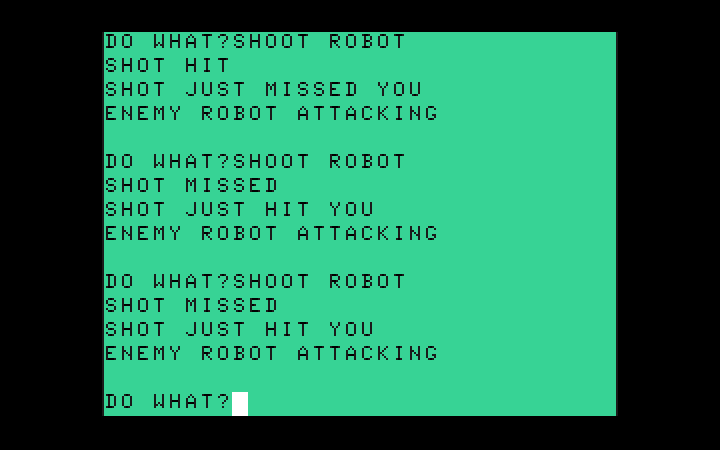
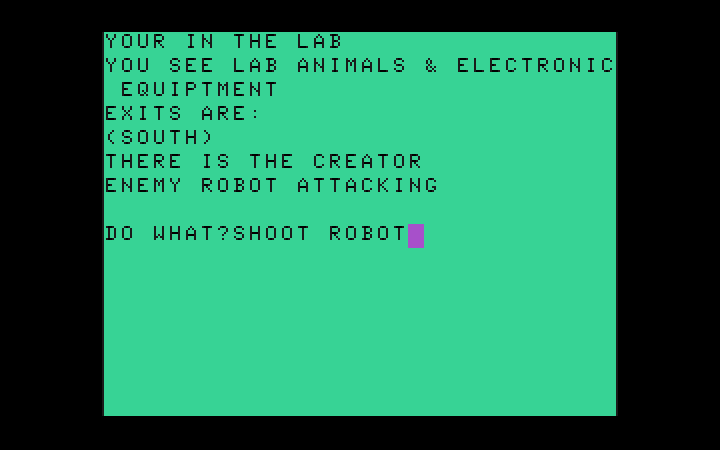
The game then puts you right in the action, and there’s a semi real-time component. If you are being attacked by a HUMAN or ROBOT (as you are at the landing spot here) you’ll get a rotation of the human/robot attacking over and over if you don’t press any keys. You need to press ENTER, which will then let you type a response (SHOOT ROBOT). The game does not require the actual typing to be done in real time (unlike Keys of the Wizard, which was willing to interrupt your typing mid-line).
It’s also possible to miss many times in a row. I discovered later after the first SHOOT ROBOT/HUMAN it was possible to just type SHOOT, but you have to be more specific the first time around.
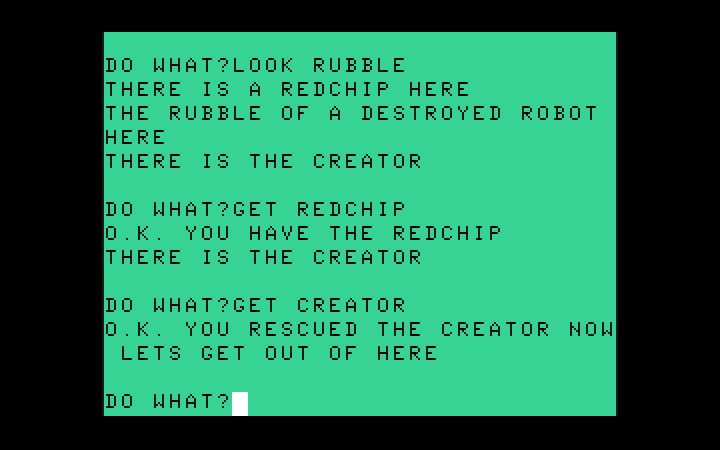
Once combat is done, you can search the corpse/rubble, and find either a GREENCHIP (from a human) or a REDCHIP (from a robot).
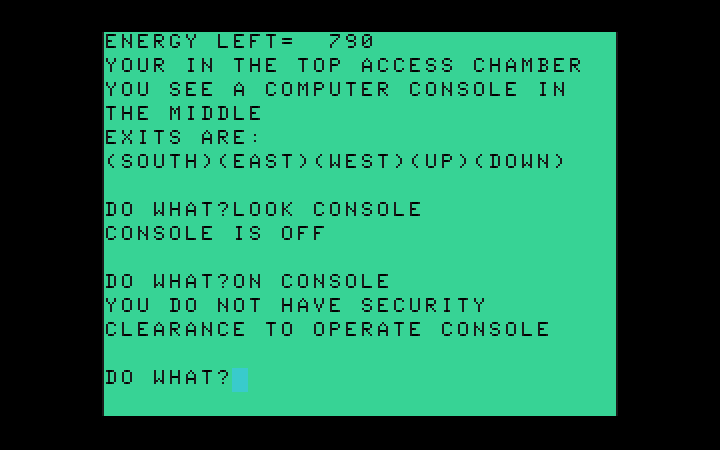
Other than that, the only thing to pay attention to is consoles. For example, if you go up from the starting room, you arrive at a console.
For the security clearance, you need to insert a chip. Redchips are the lowest level clearance, followed by greenchips, followed by a single silverchip (held by the captain). As far as I could tell there is nothing special about silverchips vs. greenchips, but for escape pods (which you need to use at the end) you have to have a greenchip rather than a redchip.
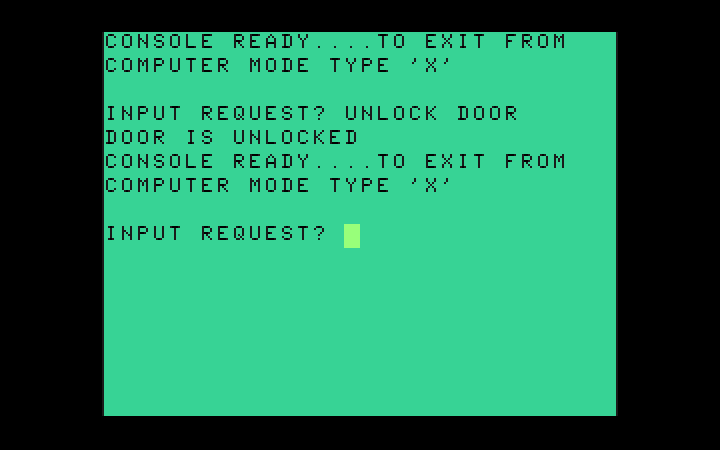
After inserting the chosen chip, you can start the console with $ and then enter commands to it. In the room above, the door to the east is locked, so if you UNLOCK DOOR it will take care of the problem.
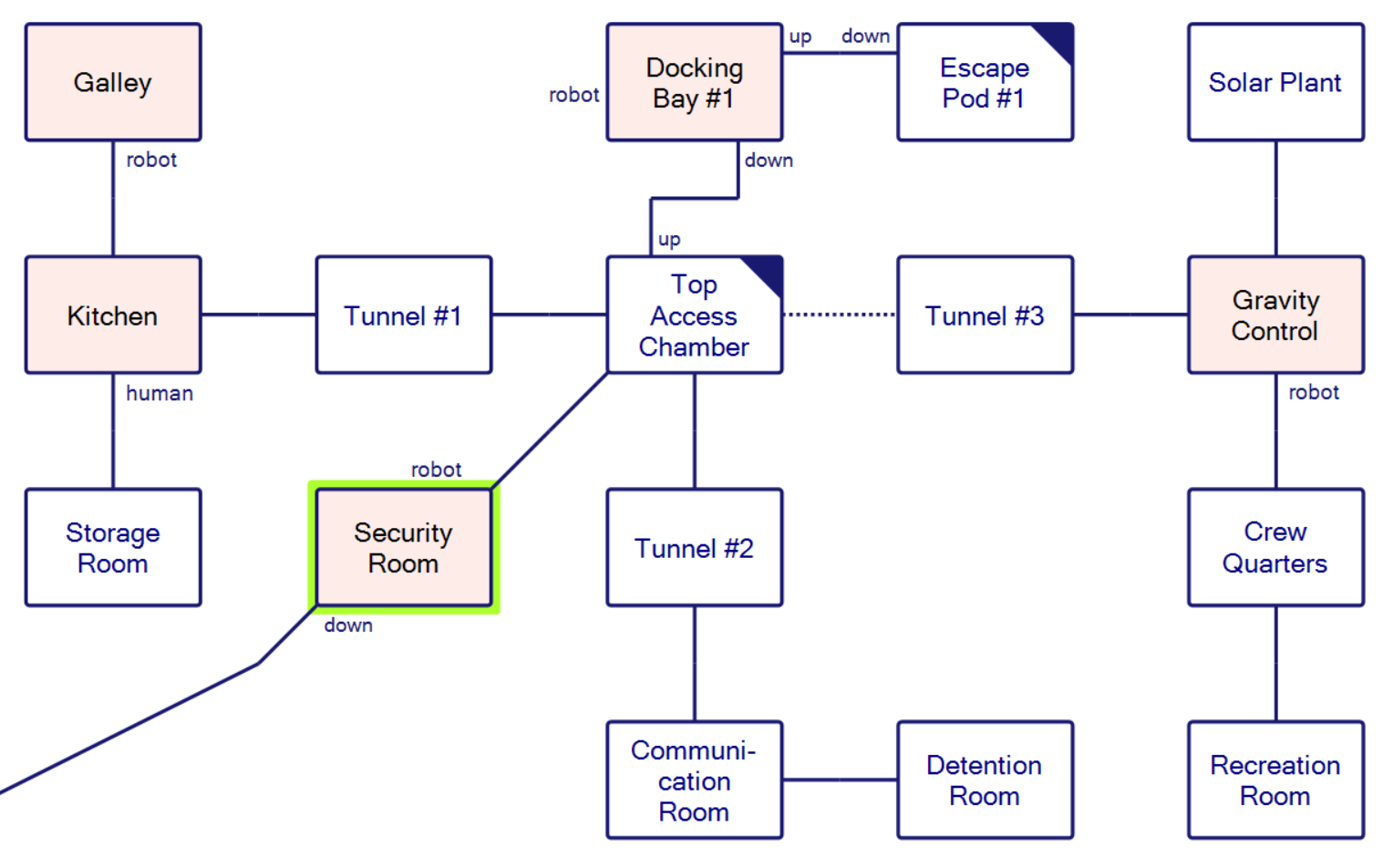
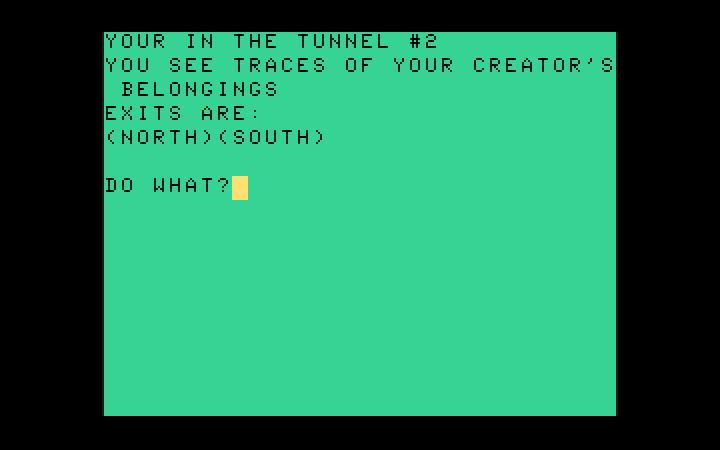
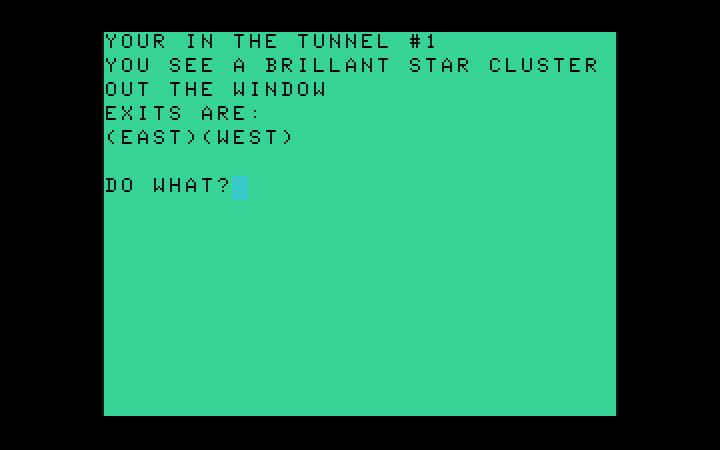
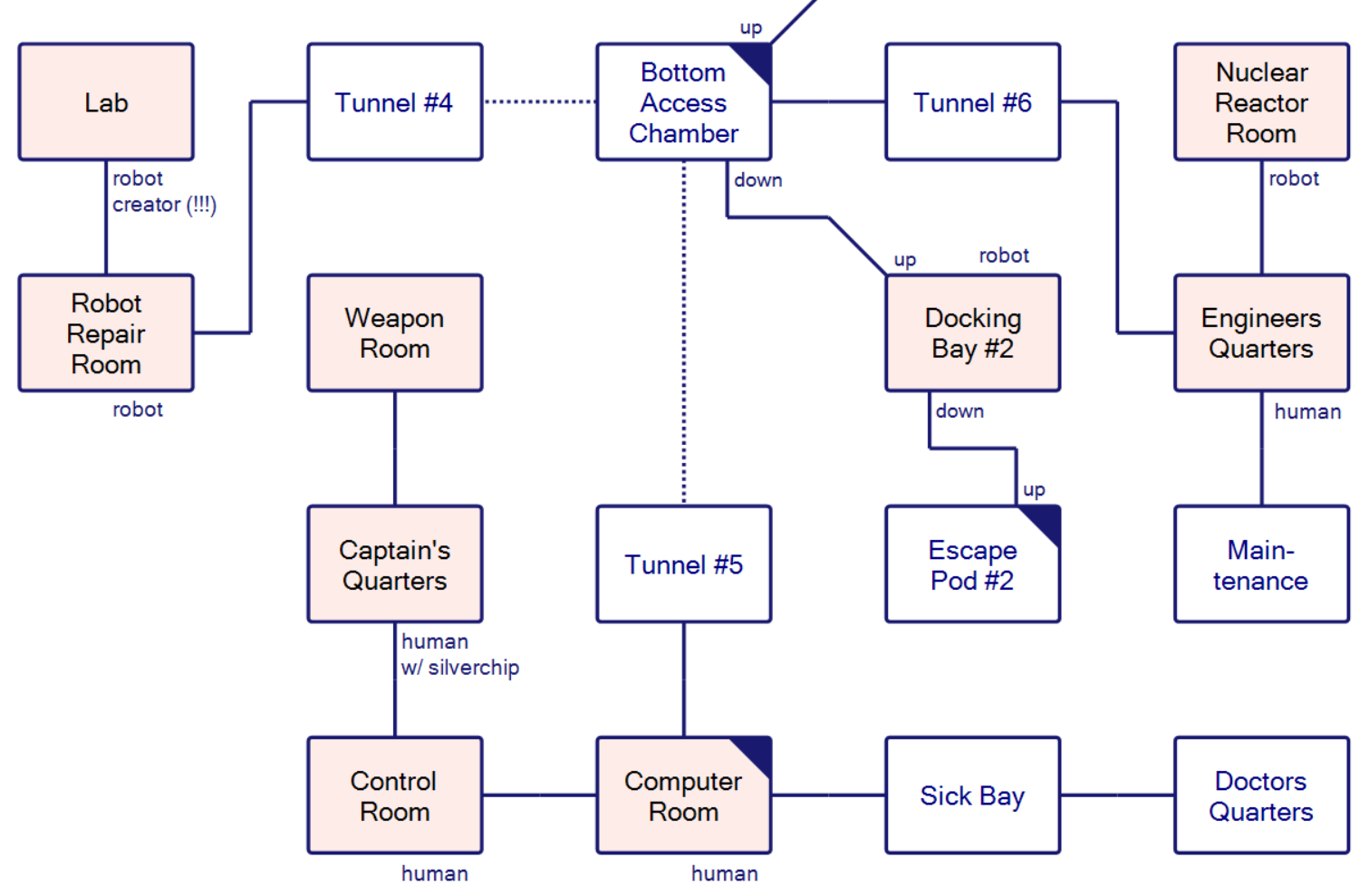
Here’s the rest of the upper-section map, although I believe there is some randomization in robot/human placement (there definitely is in finding the Creator):
There are some environmental aspects, and when I first started playing I was dutifully mapping them, and even trying to interact with them, but for the most part only the enemies and the consoles are important (with one exception).
Hence, this ends up being a little more like a strategy game (akin to the Apex Trading Haunted House with the odd bonus attribute that I didn’t know I was until I had finished the game. You certainly can’t visit everywhere, because your robot has a certain amount of energy and will eventually run out; not just from fights…
…but from the fact that walking around also drains energy.
Hence, it’s better to skip certain fights if you know you don’t need the chips you get out of them. You need at least one red or green chip for opening doors, and at least one green or silver chip for taking an escape pod away.
For my game, the best approach was to a.) shoot the robot at the start b.) use the red chip to go down to the “bottom access chamber” and unlock the door c.) head west and fight the human in the kitchen, taking the greenchip and d.) going north to the lab and fighting the robot.
You don’t need the robot’s chip.
You can then take the creator…
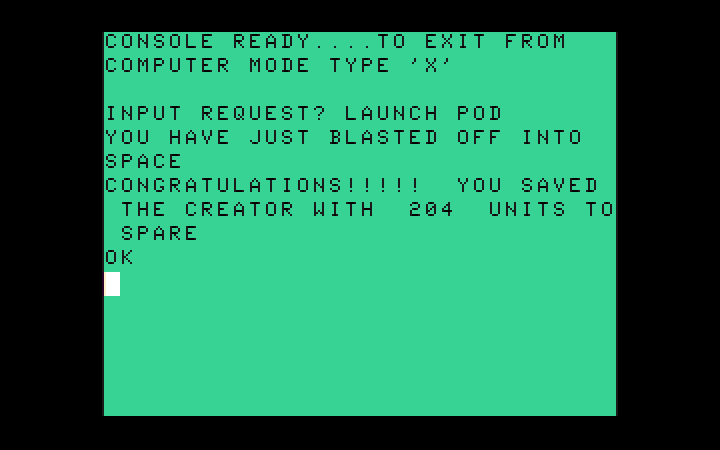
…and blast out the exit, using a greenchip to activate the pod.
The last command here is being typed in the “console” rather than being given to the robot.
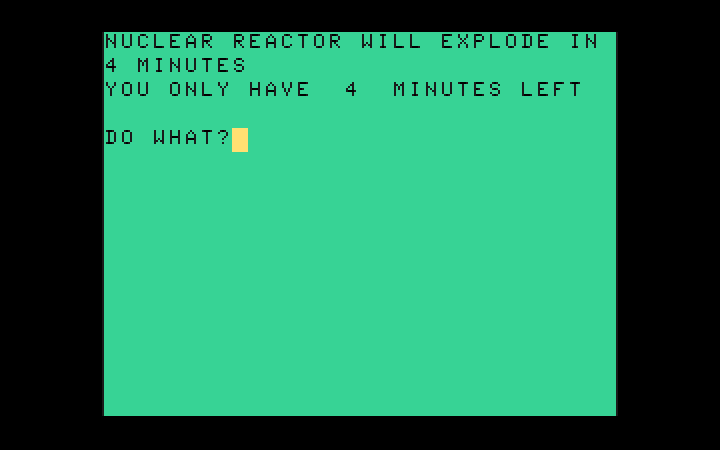
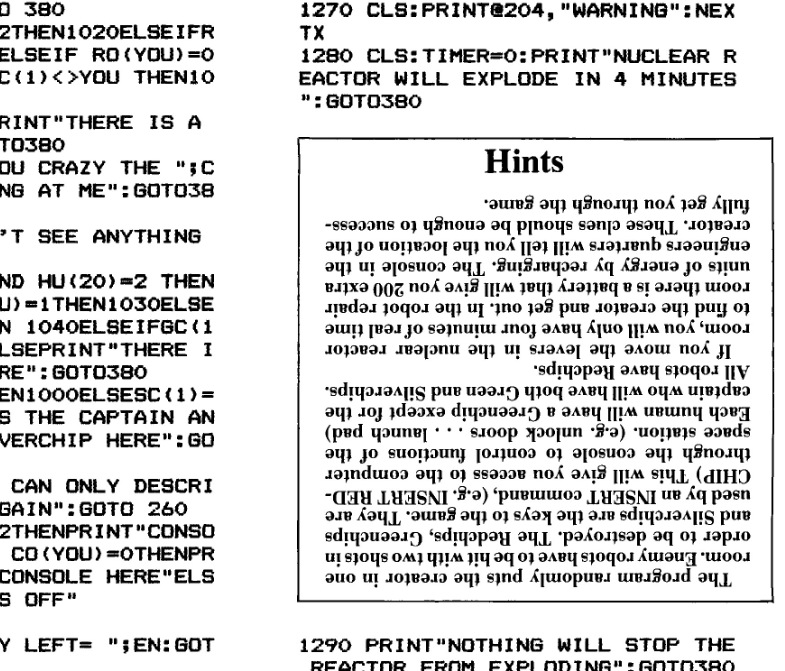
There’s one more entirely optional thing you can do, and it’s interesting that the game doesn’t mention it as a “bad ending” if you skip doing the thing: you can blow up the space ship. At the nuclear reactor (see NE corner of the bottom part of the map) there is a lever you can pull.
The four minutes here pass in real time. If you haven’t won by then, you blow up with the spaceship. Winning with the explosion coming doesn’t give a different winning message.
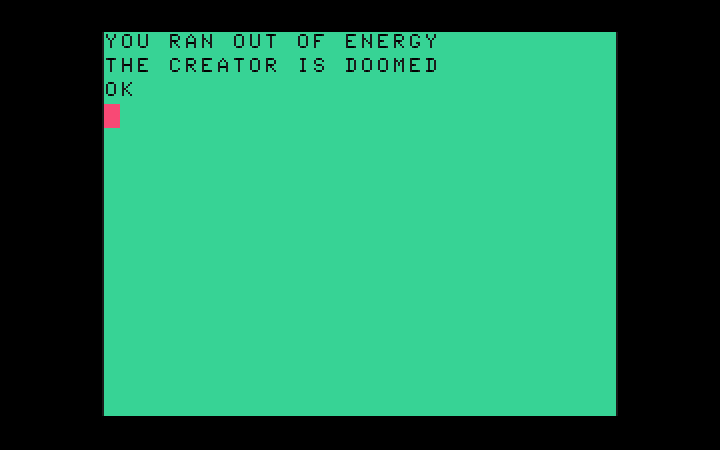
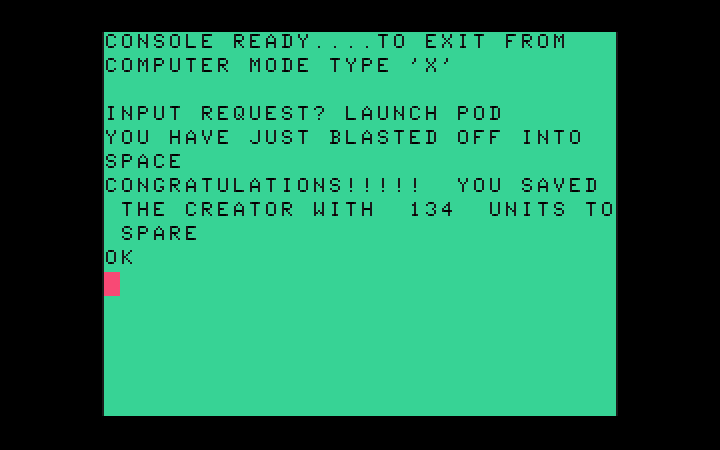
I ran past some robots rather than fight them, meaning my energy was lower than my other win.
While the random attacking is the same mundane thing seen in many of our games, the fact you can utterly bypass the enemies — yet also get a useful (and predictable) resource from killing them — makes this have a slight bit of interest as a strategy game. The game is too short and simple in the end to hold up historically, but it does suggest an maneuver that could be done in an adventure-roguelike format.
Thanks to gschmidl for technical assistance (the POKE/CLOAD setup seemingly doesn’t work when you load the game from menus in xRoar, I was only able to run the game using the command line).








 Renga in Blue
