I may not have squeezed out every single piece of working game from The Temple, but I’ve squeezed out most of it. Once past the initial issue, the game’s crashes don’t come back until later, but they come back spectacularly.
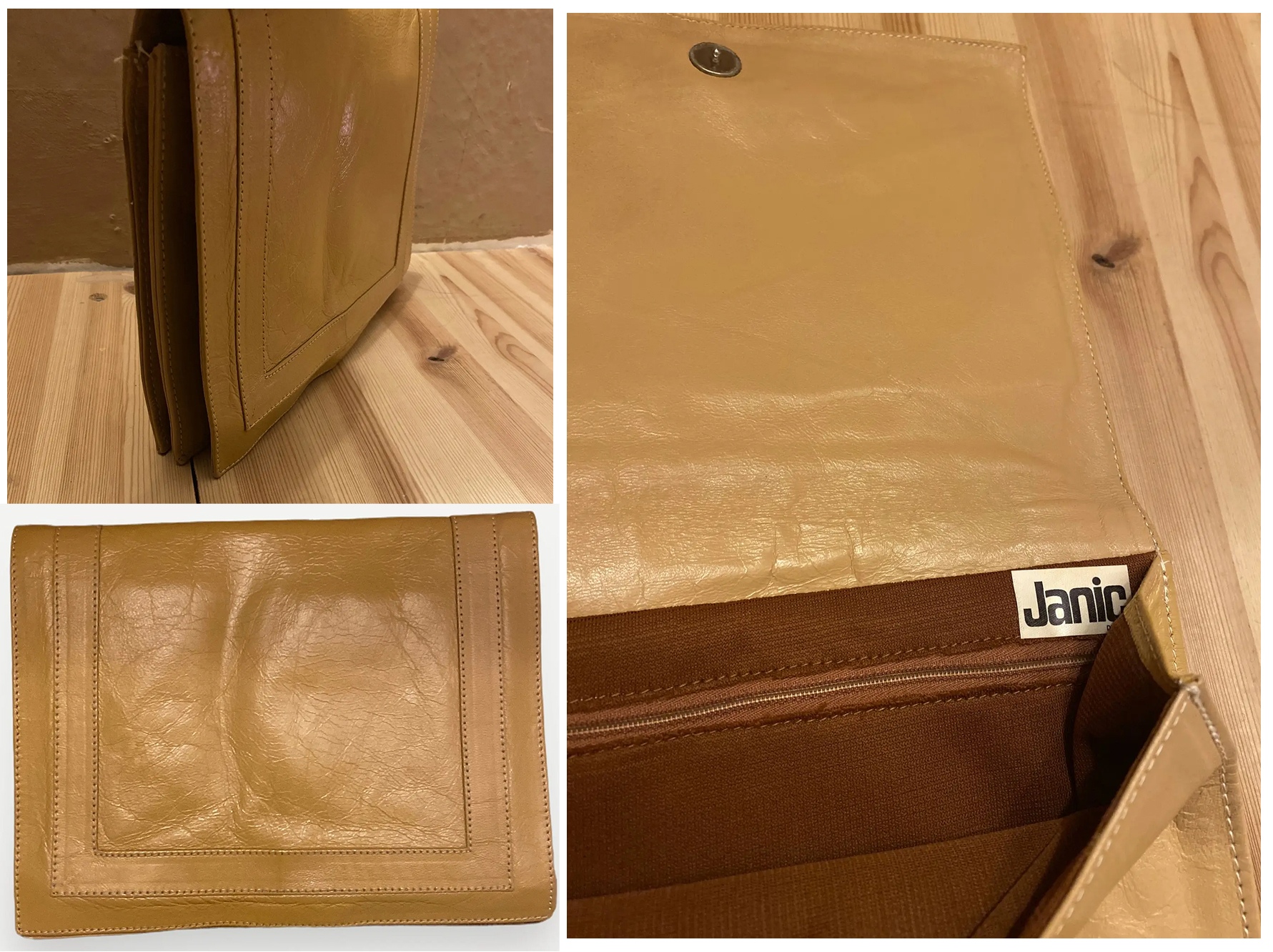
The only Janic bag I’ve found multiple pictures of, from Tradera. They were the company that later picked up Commodore products and ended up sending their PET computers to Datatronic when they went bankrupt.
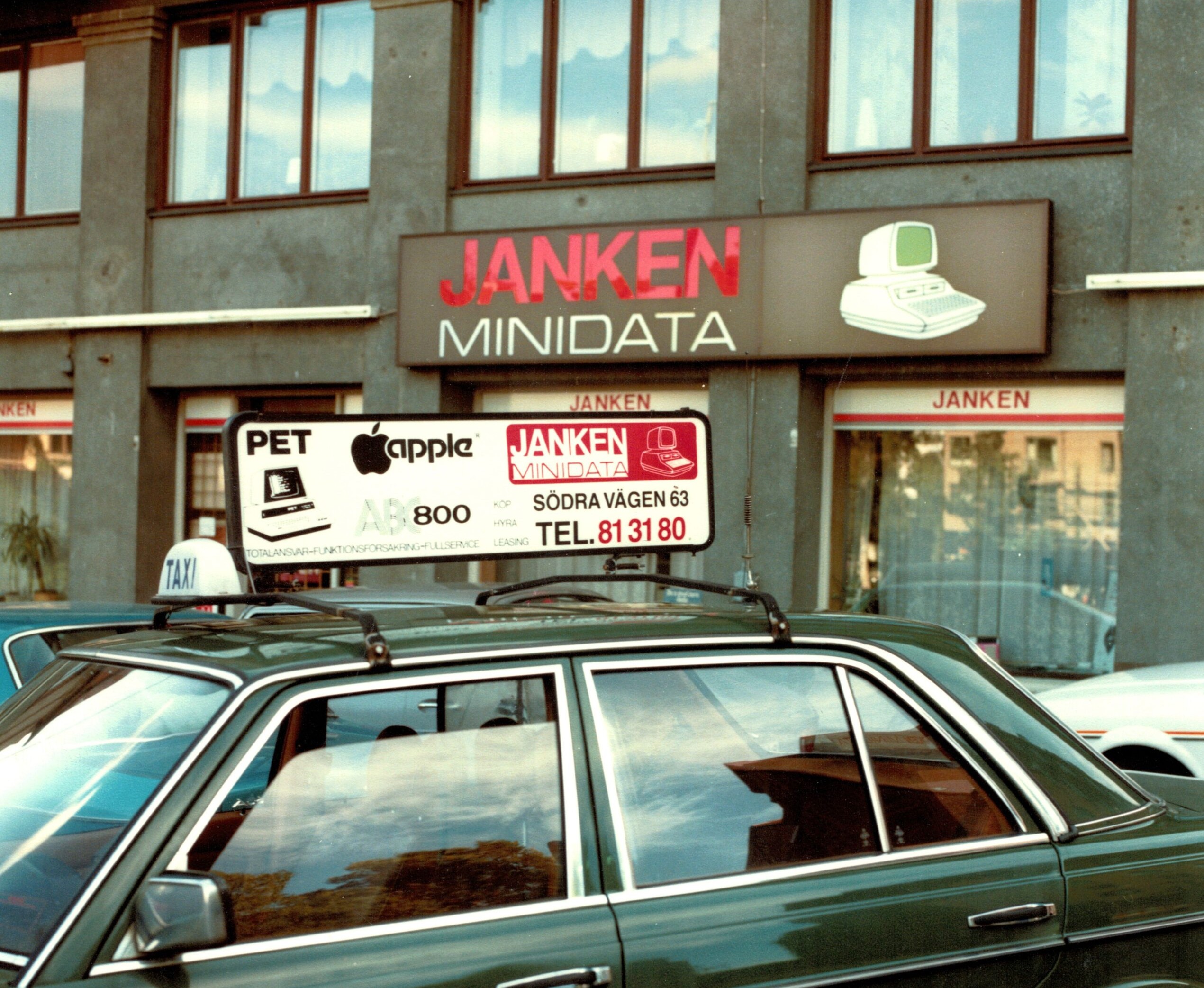
Exterior of Janken Minidata, where the PET computers eventually ended up. Source.
I switched to just using v1 (although anyone adventurous enough to edit the game might want to look at the early version of the game as well). After fixing the “burn” issue (where I changed “go” into “goto”) and I made sure to use directions with abbreviations (“n” instead of “go north”) I was off and running again. It took a while before another hard crash. I still am not clear if this was “left unfinished” or just undone by the bugs (caused by bad transfer issues, perhaps?).
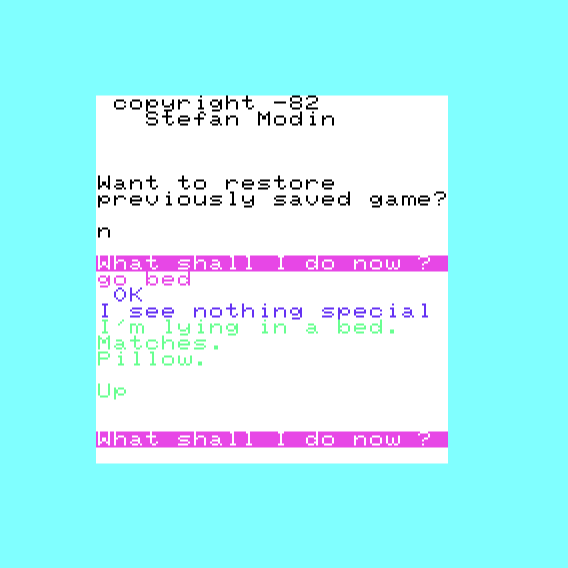
To recap the action, we start in a cell with a bed that has a pillow and matches, and nothing else useful. If you hang out long enough in the toilet room someone arrives to deposit an item.
Me messing around with random directions in case leaving room directions out is one of the game’s issues.
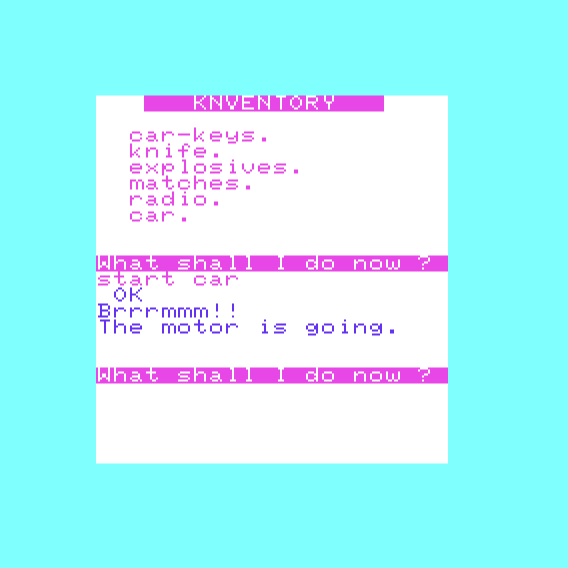
Regarding the “kn” typo above, I assume the intent is the word “in”. In PETSCII the binary for “k” is 01001011 and the binary for “i” is 01001001, exactly one bit difference; of course it could be a perfectly ordinary human-made typo, but this sort of thing does make me suspicious. (See “Scgtt Adams” from The Golden Voyage, clearly a one-bit error.) The game also uses KNVENTORY rather than INVENTORY.
Going back to the main cell, there’s a bowl with food, and inside the food is a saw-blade. It looks like we have a friend on the inside, on our mission, which is to (????). (Really, I still don’t know. There’s dragons later and a diamond but the game just being a treasure raid doesn’t mesh with something else you’ll see later. Maybe it’s a mixed quest where we have multiple goals.)
You can then cut the door with the saw (“That was a hard work”) and get farther inside.
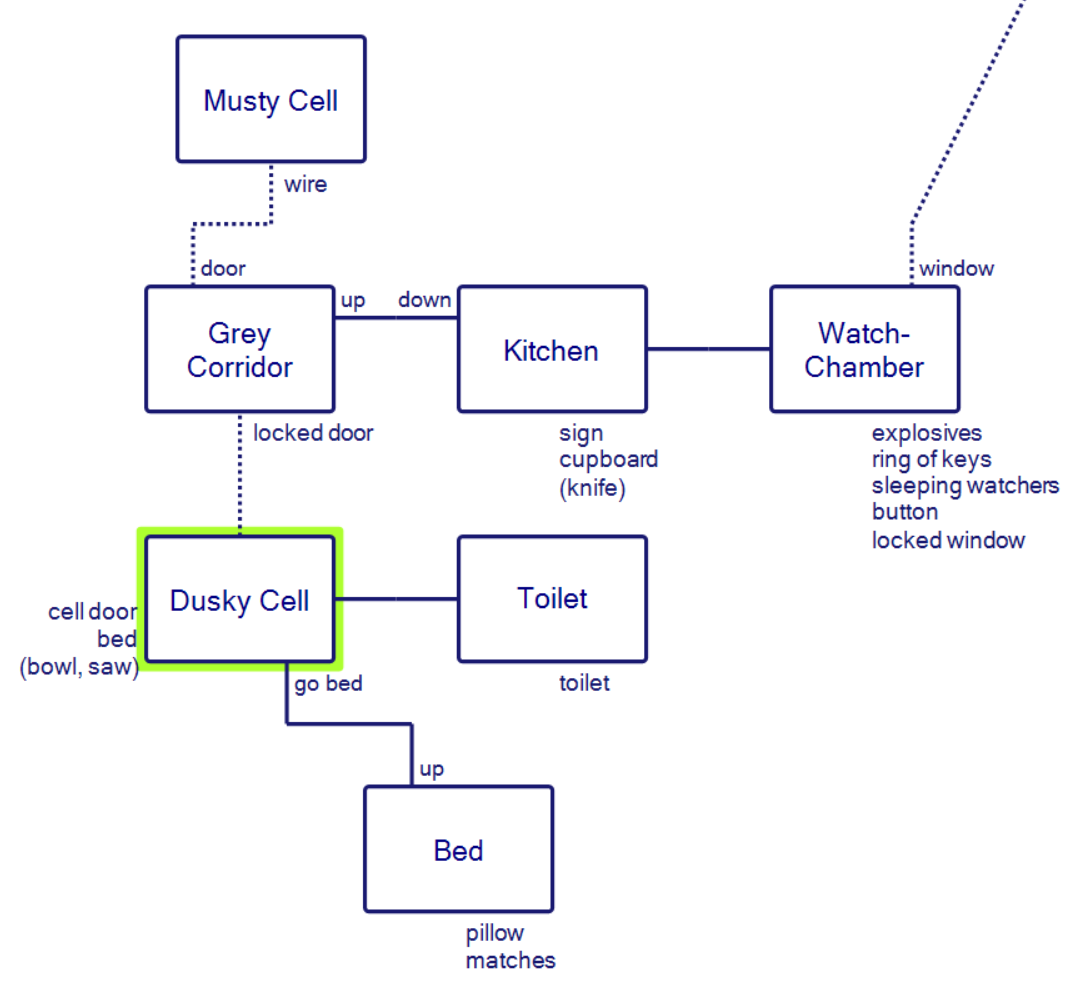
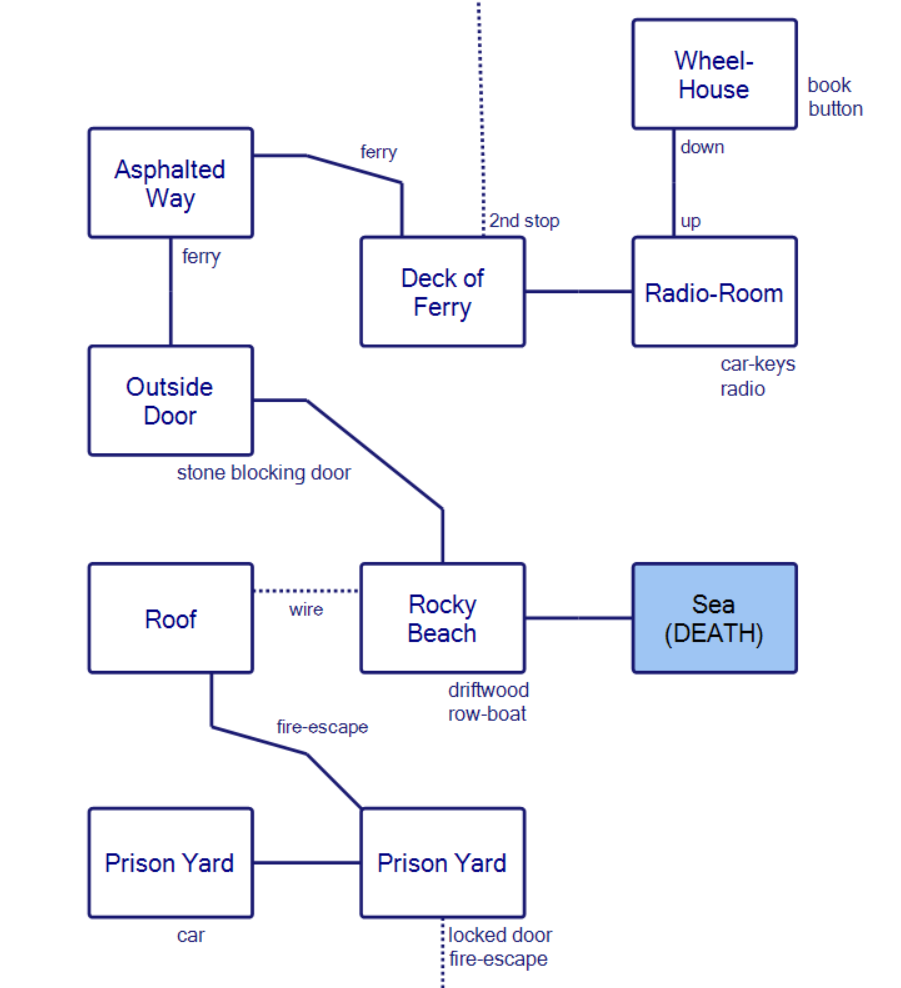
The first of three maps.
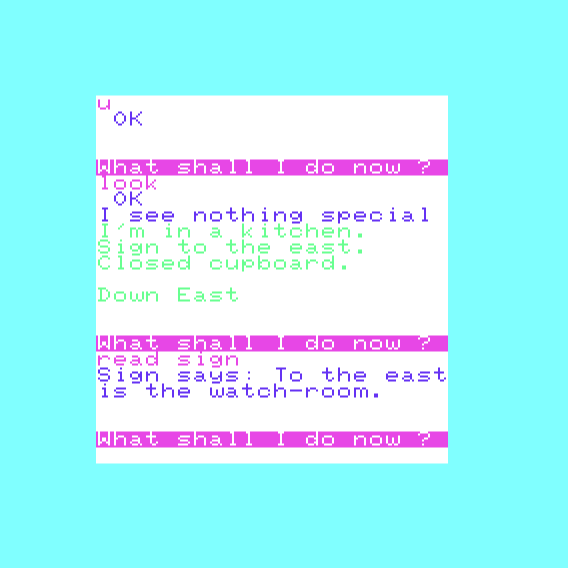
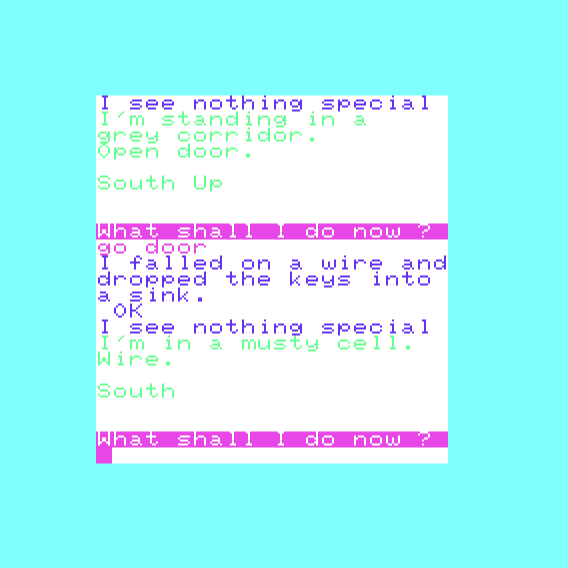
There’s a “gray corridor” with a locked door we can take care of in a moment; going upstairs to the kitchen, you can find a knife in a cupboard (which will get used much later).
There’s also a warning about “watchers” in the room to the east which you fortunately don’t need to heed too closely.
They’ll only wake up if you PRESS BUTTON which sets off an alarm.
The keys can be used to both the window and the downstairs door. It’s better to unlock the window first because once you unlock the downstairs door (another cell) you’ll lose the keys going in.
You’ll lose the keys even if you drop them off elsewhere first and aren’t holding them, so this counts as a bug, but maybe it’s a bug in a “plot continuity” sense; you need the wire to get out of prison, and there’s more keys outside the prison, so this is a clean way to avoid referring to two sets of keys. Just: it’s a softlock if you lose them too early.
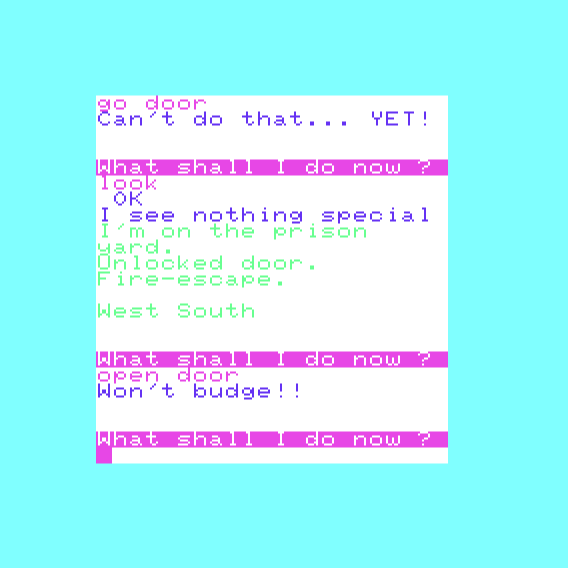
So far, the items: matches, pillows, wire, knife, explosives. Heading outside the window, there’s a fire-escape going up, another locked door, and an exit to the west. There’s another locked door (which you need those keys for!) although the door is jammed from the other side so you can’t go through anyway.
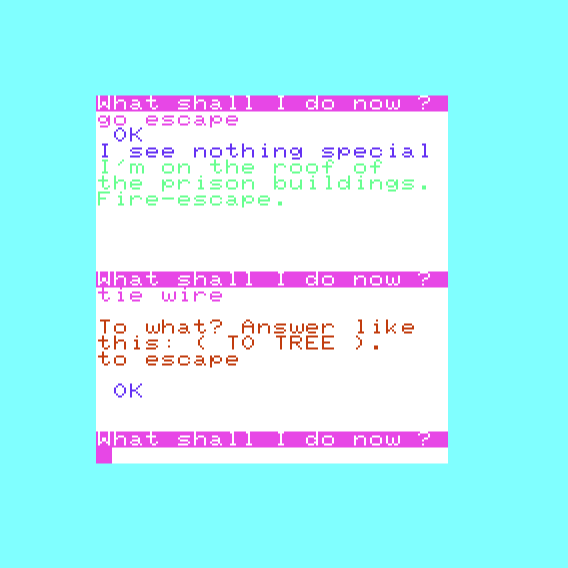
To the west in the prison yard there’s a parked car, but you can’t do anything with it yet, so it’s time to go up the fire-escape and use the wire as a rope.
Can you climb a wire in real life? It happened in Ferret as well.
This is not an intensely guarded prison, but I’m guessing our Man on the Inside might have helped with that.
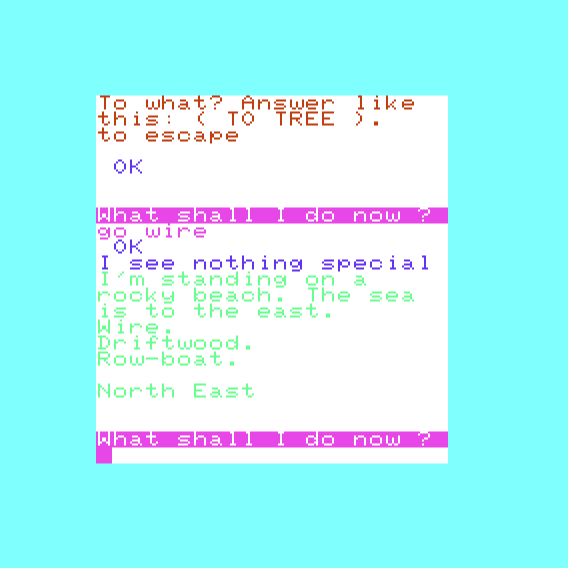
The landing spot has some driftwood and a boat at a sea. If you try to swim in the sea, you die; if you try to go via boat, you die.
It is faintly possible this is not just intended as a death-trap; while this is a “biome journey” of sorts like Wizard and the Princess nothing is one-way. In fact, it seems to be useful to maybe go back into the prison.
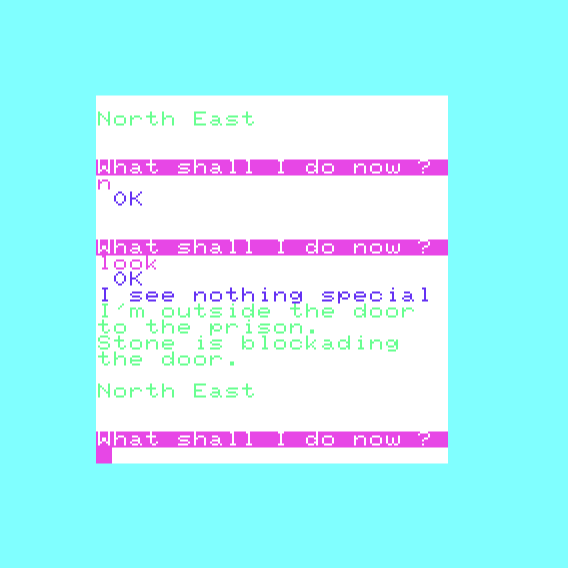
The reason you can’t unlock and go through the front door of the prison is the stone as seen above. I would think the explosives would take care of that problem but I never got them to work. If you do this, when you get the car-keys later (which you’ll see shortly) I think you can possibly drive the entire car out and do things with it.
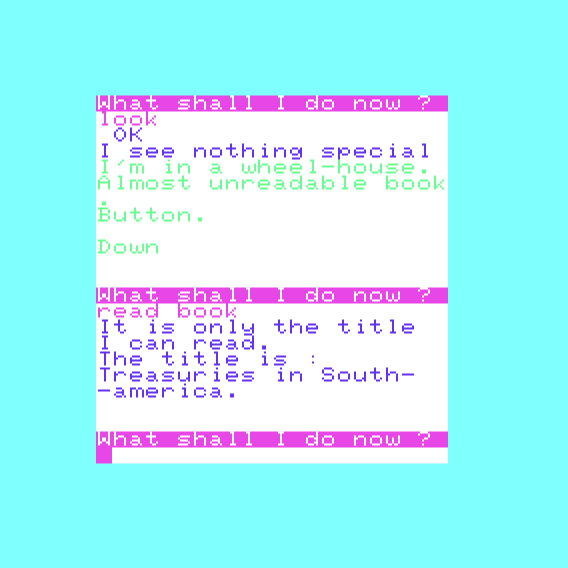
Moving on from the unexploded rock, heading north there’s a ferry. Get on and you can find a radio, the car-keys (told you) a book, and a button. Pressing the button causes the ferry to move to a new destination. You can re-press the button to go back.
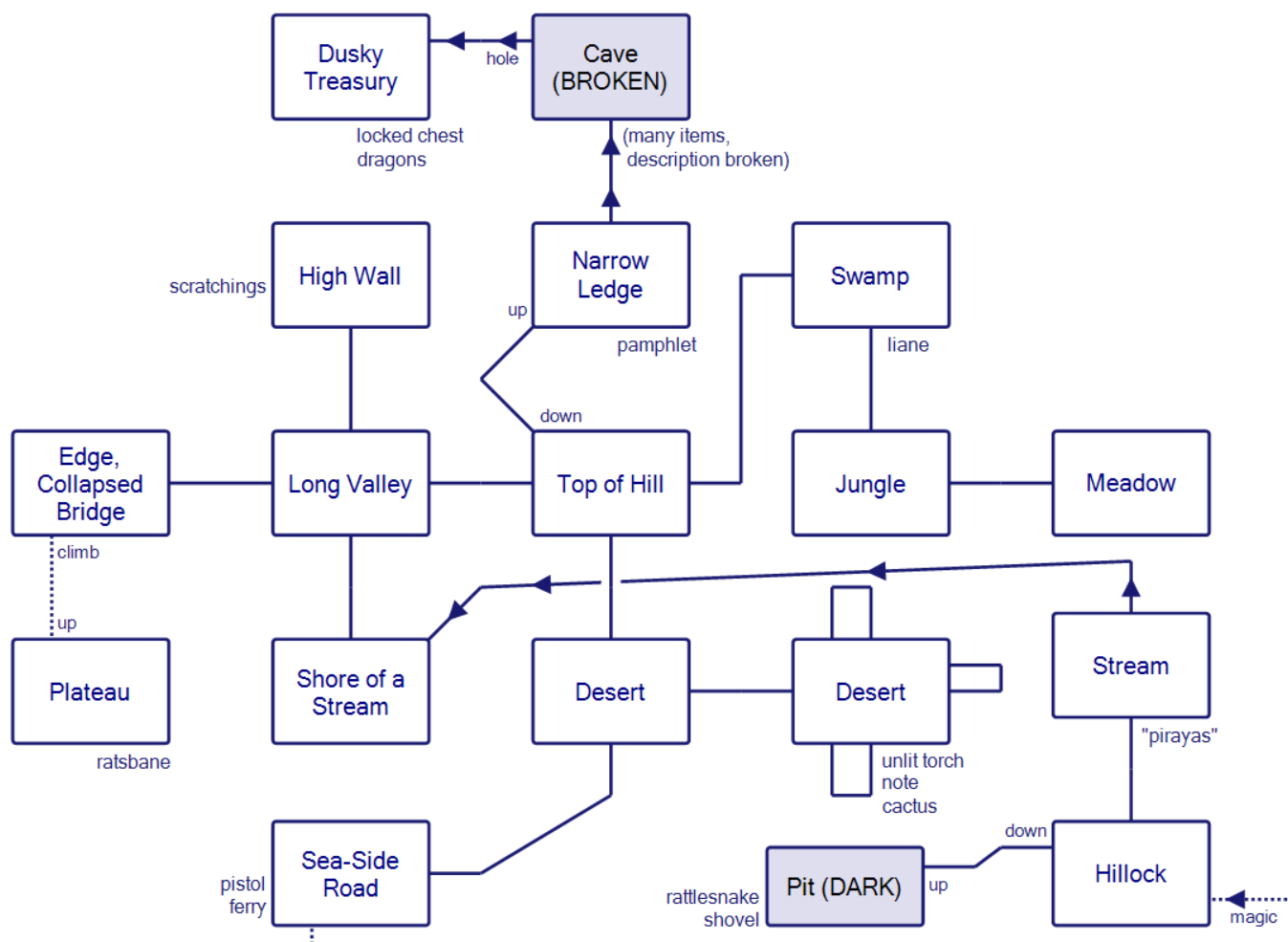
Voilà, the third map:
Straight off the bat you can find a pistol (if you try to KILL anything before finding the pistol the game says you need one). Then there’s a bit of branching, including:
▸ a desert with an note, a torch, and a cactus; the note says the nose can be very useful.
▸ relatedly, on a “narrow ledge” you can find a pamphlet mentioning you can TURN the nose in all directions
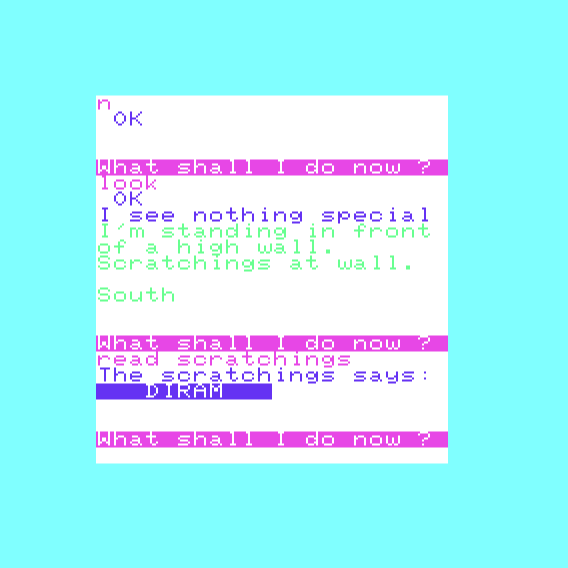
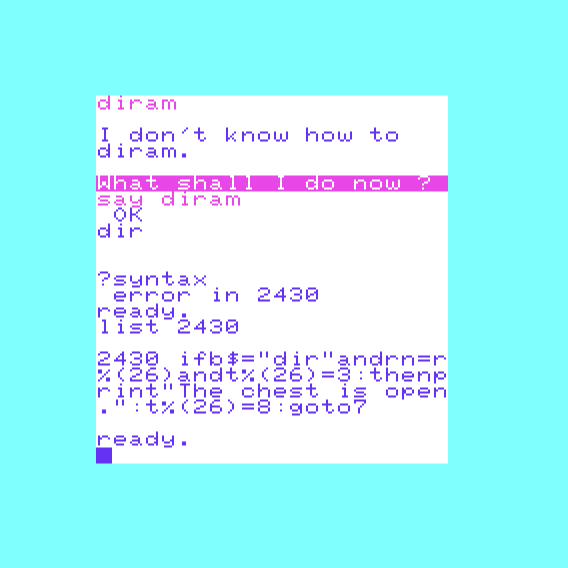
▸ a “high wall” with some scratchings; reading them reveals the word DIRAM, although I tried to use it and crashed the game
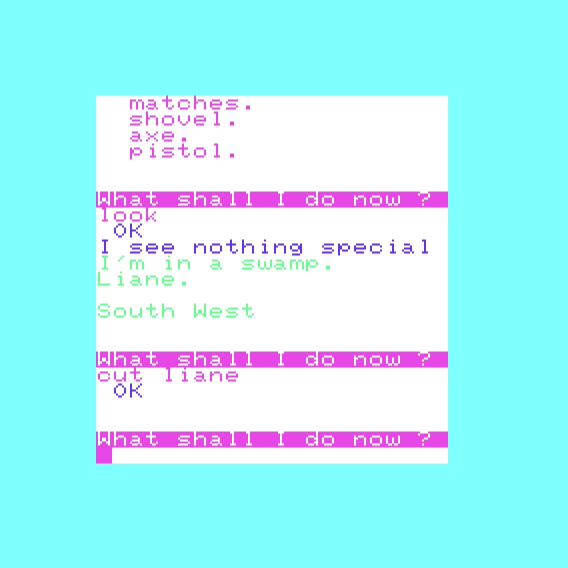
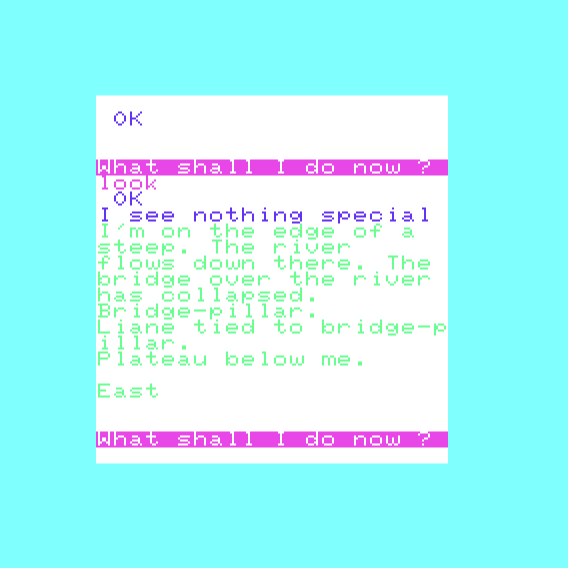
▸ a “liane” in a swamp which baffled me for a while; I realized after a bug I’ll show off later that it was referring to liana vines but for a while I thought it was a person and tried to talk to them
▸ with the liane you can tie it to a pillar at a collapsed bridge and retrieve some ratsbane
The use of the word reminds me of Citadel Adventure using the word “embrassures”. Sure, it’s technically a word in English (spelled wrong) but it’s extremely rare compared to all the other English words; this is the sort of move someone who learned English as a second or third language would make. I would guess the Swedish equivalent (lian) is more common? Mooware on Bluesky pointed out that liane is vine in German (spelled that way) so maybe Stefan Modin was just mixing languages generally.
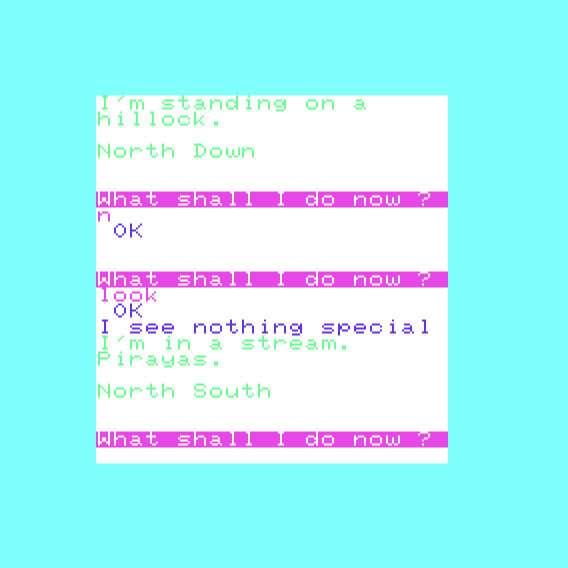
Now, for that bug that led me to realize it was a vine in the first place: if you go north from where you find the pamphlet, you’ll end up in a dark place.
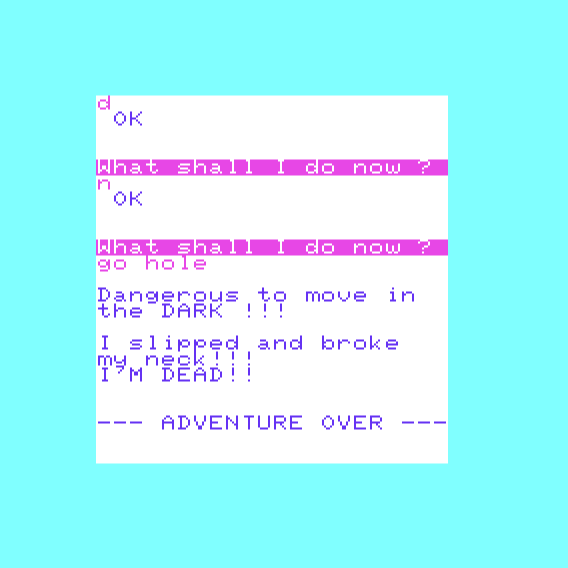
I was able to goto 7 and keep the game going, but without light. I tried “go hole” and usually died…
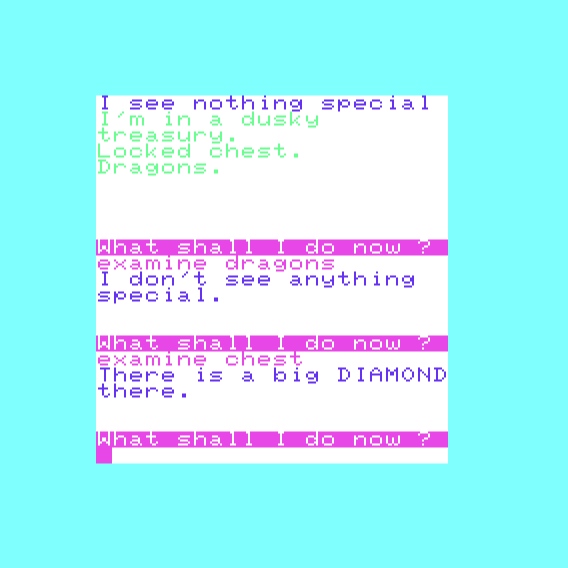
…but one time I successfully made it, coming across a treasure with dragons and a chest.
The buggy room has a letter you can read and find the word LOUZI; trying SAY LOUZI teleports you to a new area.
The new area includes a pit with rattlesnakes and a shovel. I have tried digging many places with the shovel although I admit I have not tried digging all the places with the shovel (that is, taking it all the way back to the prison yard etc.) I feel like I’ve hit the “broken threshold” enough that I can’t distinguish between a puzzle and a bug, so this seems like a good spot to close things up for now. If I ever get confirmation the game is fixed to the point of being completable (maybe not all the bugs) I’ll take another swing.
For now, we’re headed back to England, as coming up: Twin Kingdom Valley.
The last time this blog visited Sweden was with Stuga a full 15 years ago; one day, I will go back to that game and toss in the history of Swedish mainframes and academic computing alongside.
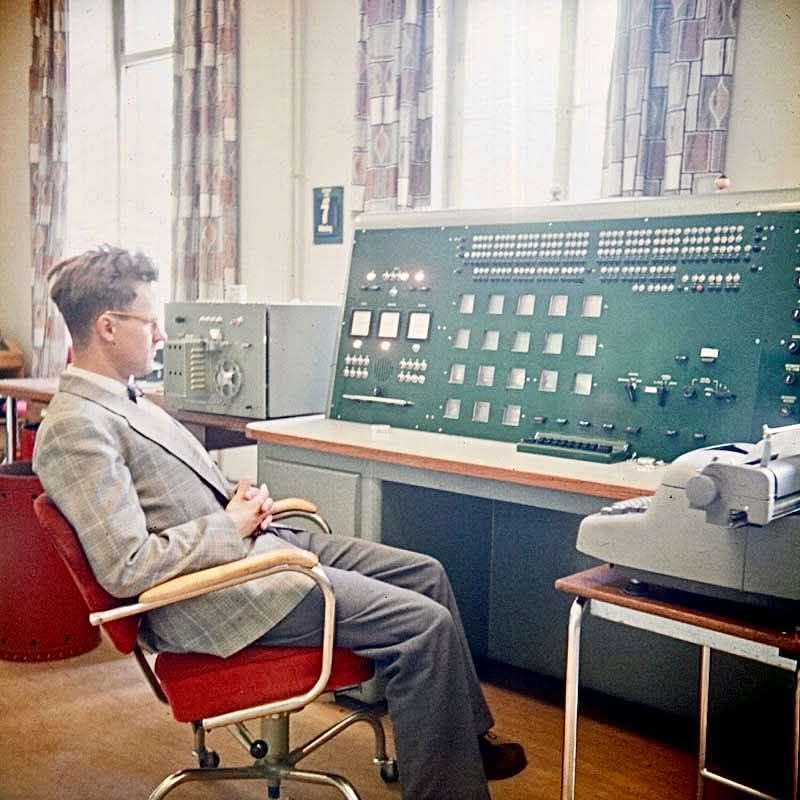
A 1963 photo of the BESK, via Stelios Kessanidis on Facebook. The BESK ran from 1953 to 1966.
However, we’ve got a complicated story with enough threads as-is. The threads will eventually unite in the late 70s. Let’s start in Italy–
I graduated in 1953, precisely the year the first transistor was presented by my old professor under a showcase in a display case. Those were truly different times, there was everything to do, everything to invent, everything to build.
One way to arrive at the mini-computer, the computer small enough for a regular business, was to start with the design of giant mainframes and work down; that’s how Data General worked, as told in my story on Thissala. Another way was to start with simpler machines and work up. This was the method adopted by Massimo Rinaldi.
After his graduation in 1953 he spent a brief time with the company Hasler (design, they were a competitor to IBM) followed by some work at Raytheon (radar and telemetry). He broke out on his own in 1959 and founded Transimatic Italiana, intending to make his own calculating devices. He had great success in ’62-’63 selling what he dubbed the ED 114 straight out of his garage. It went for 3,135,000 Lira in 1962 (about $53,000 in modern USD) and had “addition, subtraction, multiplication and statistical functions, but not division”. Despite his success, when he made his next product (first dubbed the elma 3000 with his garage version, later named the IME 84) he had trouble getting it off the ground as he needed partnership with a real company with a real factory. (It was more of a mass-production product, rather than one expensive enough where he could custom-make one for each customer.) It took him a year (and multiple brush-offs with Olivetti) but he finally found one with Edison S.p.A., selling his company and becoming head of research and development.
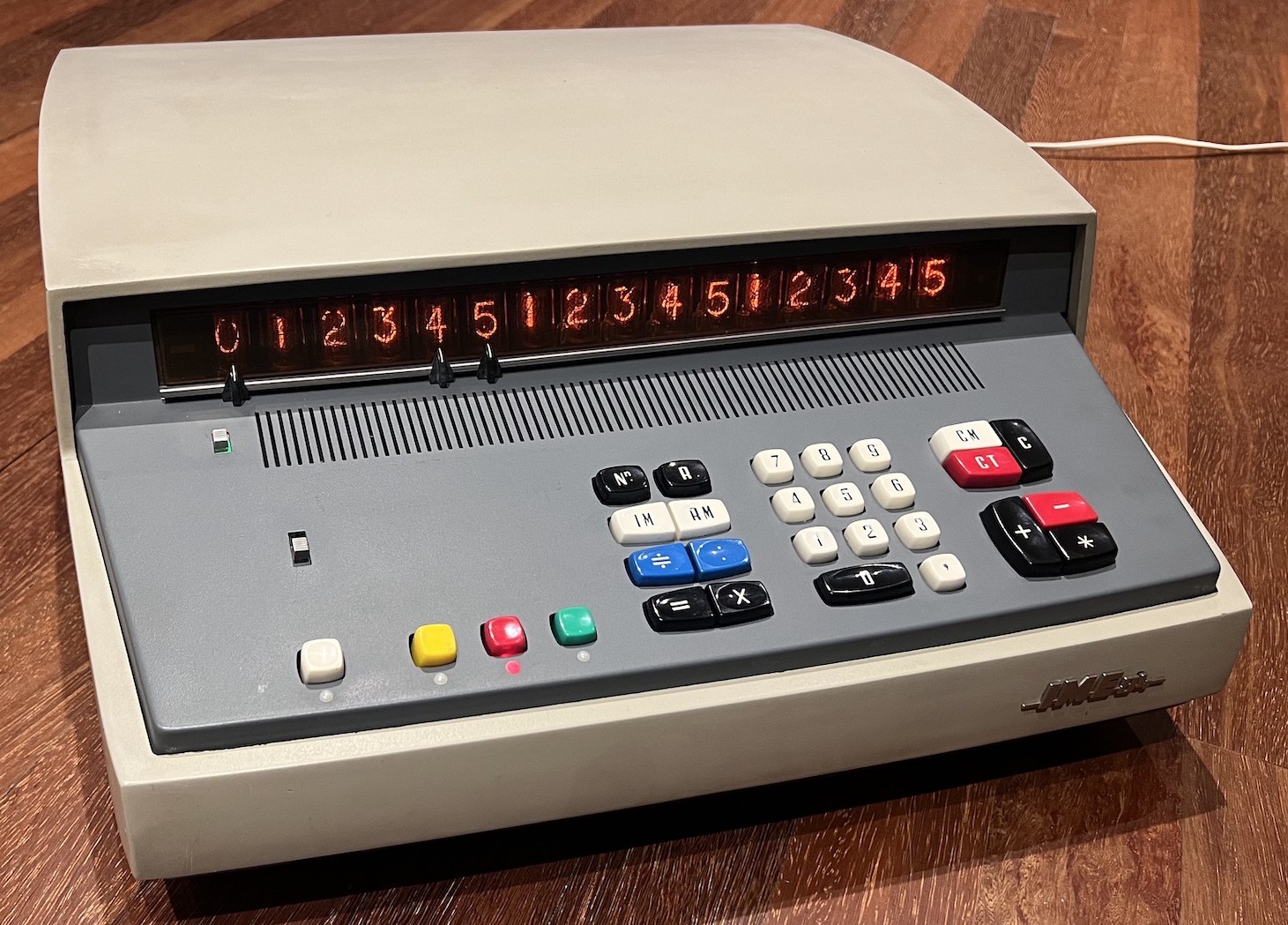
The IME 84 came out in 1964, and while it was not the first desktop digital calculator (see my story on the British company Sumlock), it was one of first fully transistorized ones, or you could say “modern” ones. (The “one of the” phrase is because the Friden Model 130 and Sharp CS-10A both came out in 1964. Rinaldi did have patents and successfully defended his US patent against Sharp.)
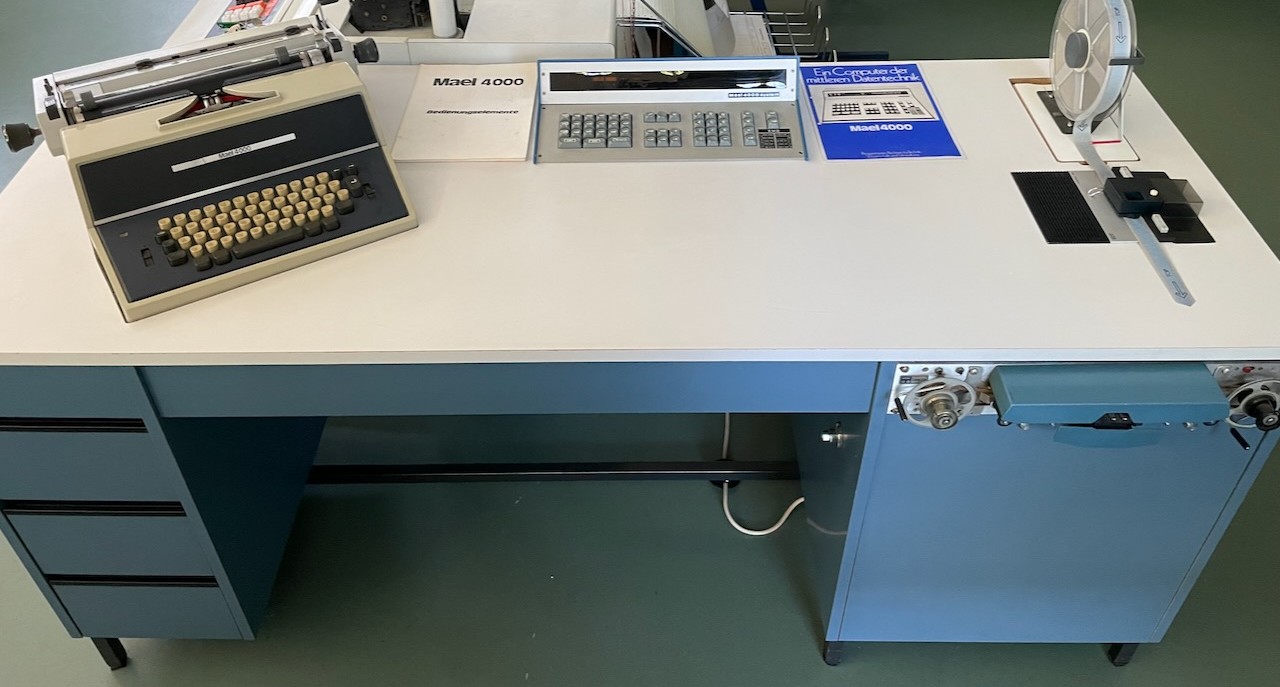
By the end of the 60s he had founded a new company with the Mael line, and while he called it a “calculator” in an interview, the Mael 4000 is sometimes cited as being a computer. It’s not really a “desktop computer” as much as a “desk that is a computer”, but it does do the majority of operations one might expect to buy a Data General Nova for, and it is technically programmable (although designed to stay only with accounting operations). It came with 2K of memory (expandable).
Via technikum29. Source. The electronics are in the cabinet to the right.
Mael’s products eventually diverged into regular computers, although nothing that was a serious “hit” for the general public; their products after tended to lean more to calculation devices for business, rather than trying to surf the hyperwave of personal computing.
Mael is the first company involved in this complex web; next up comes Diehl, from Germany.
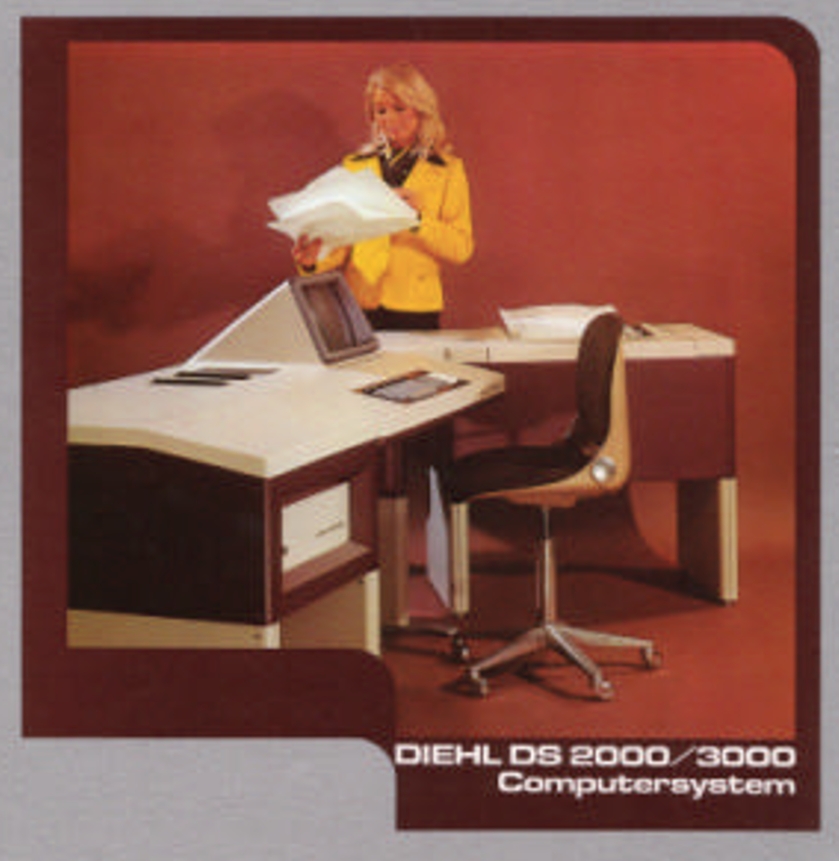
Diehl was founded in 1902 and did precision metal forging (like door handles); they started making mechanical calculators in the 1950s (see example video above) and by the 1960s made their own electronic transition. They landed a little later than the IME 84 (by two years) with the Combitron. The electronics were designed by an American, Stanley Frankel, formerly a physicist with the Manhattan Project.
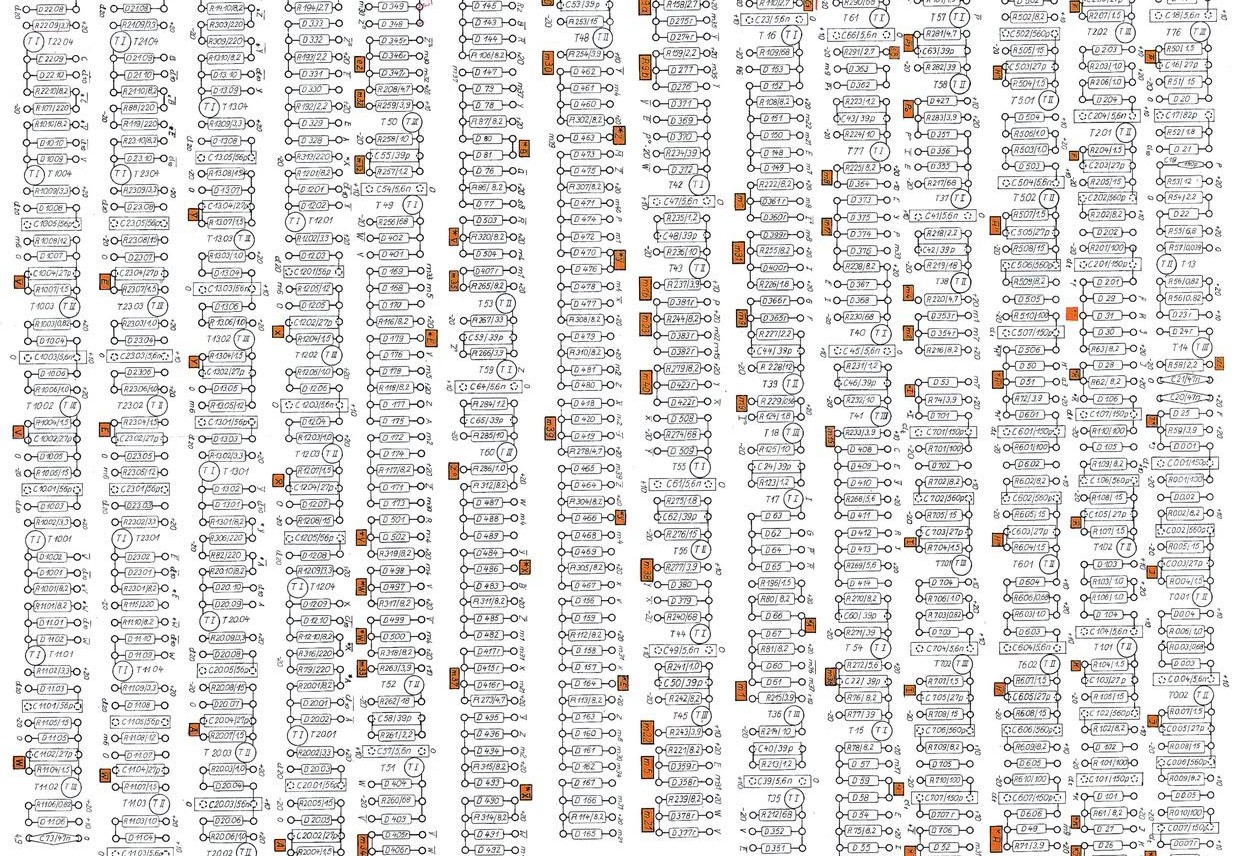
A portion of the Combitron’s layout, via Facebook.
Similar to Mael, they entered the computer market from the bottom-up, making their computation devices elaborate enough to do the same accounting you could do on a computer (not play Spacewar, alas). Also similar to Mael, they finally had what people would recognize as “proper” computers by the late 70s, with almost no effect on the market.
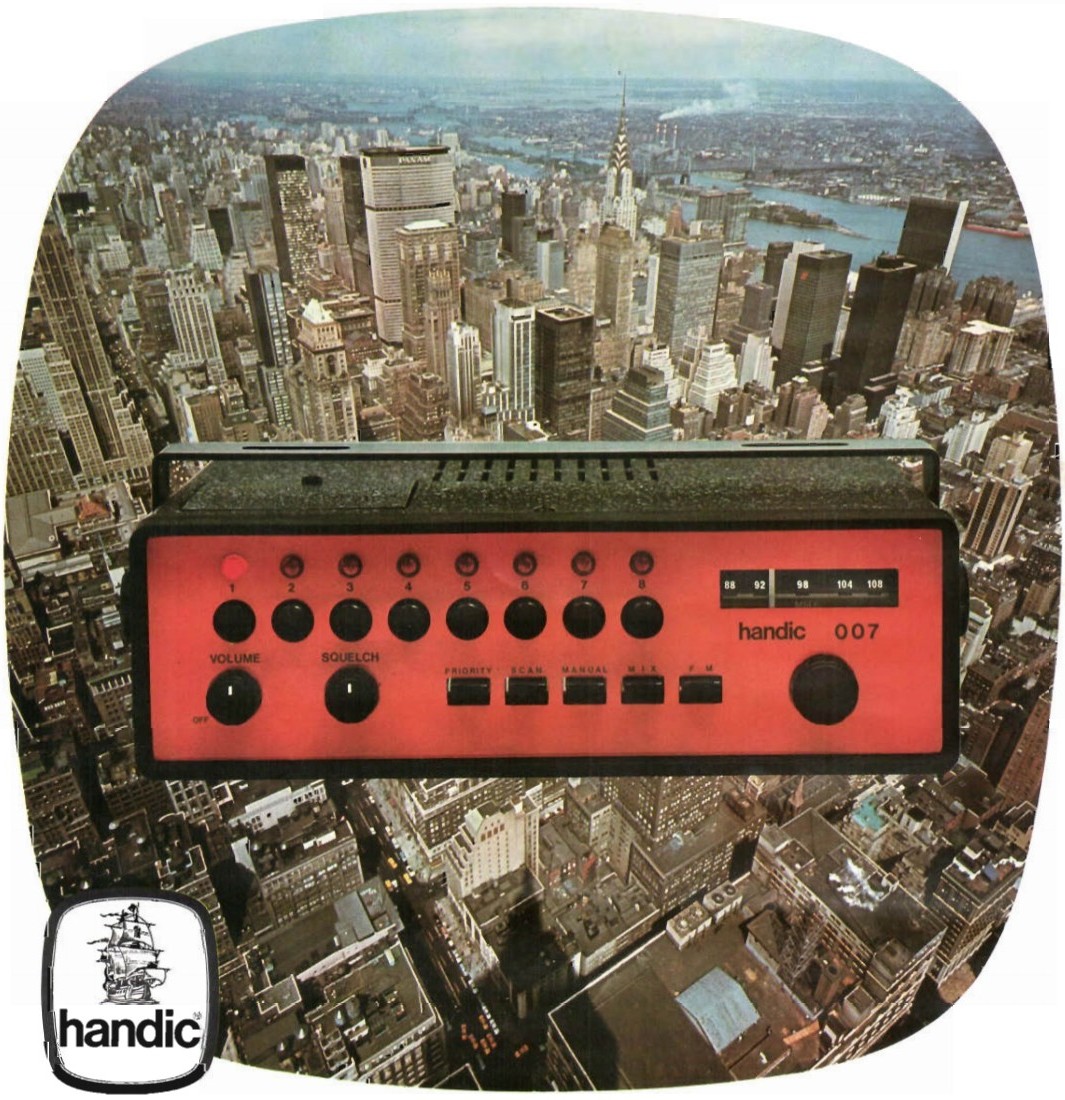
Since we’re not juggling enough balls yet, let’s go back to the 50s yet again, this time in Sweden. Handic Bolagen was founded in 1952 (president: Gunner Wennerström, vice-president: Stig Wennerström). They focused on audio equipment like radios and broadcast receivers, mostly produced with a distinctive orange color, although they also had a line of sports equipment (golf, skiing, boating, the “high end” sports).
In 1977 they were sold to the investment company Svenska AB Navigator. I’ve seen a source say this means they were now state-owned but it’s a little messier than that. Svenska AB Navigator was formed in 1969 as a sort of “collector of companies” with the main purchasers being affiliated with state enterprises and a pension fund. As of January 1976 28% was with state enterprise, a third was with the pension fund, a small portion was cooperatives, and the rest (28%) was holdings by private owners of the original companies; they had non-voting shares after selling out to Navigator. Essentially this was a back-door method of state company ownership without a vote from Parliament.
Two more threads to follow! The first is Datatronic. They were founded in 1968 by Torsten Frey and Hans Sundén and started selling mini-computers (of the “calculator” bent) to businesses in 1970, specifically the Mael line. They picked up the Diehl line in 1975; based on the timespan, this means they were selling the Mael 4000 (the combination desk-calculator) before switching to Diehl and then being bought by them outright. By 1977 Diehl wanted to drop them, although I’ll return to that point in a moment.
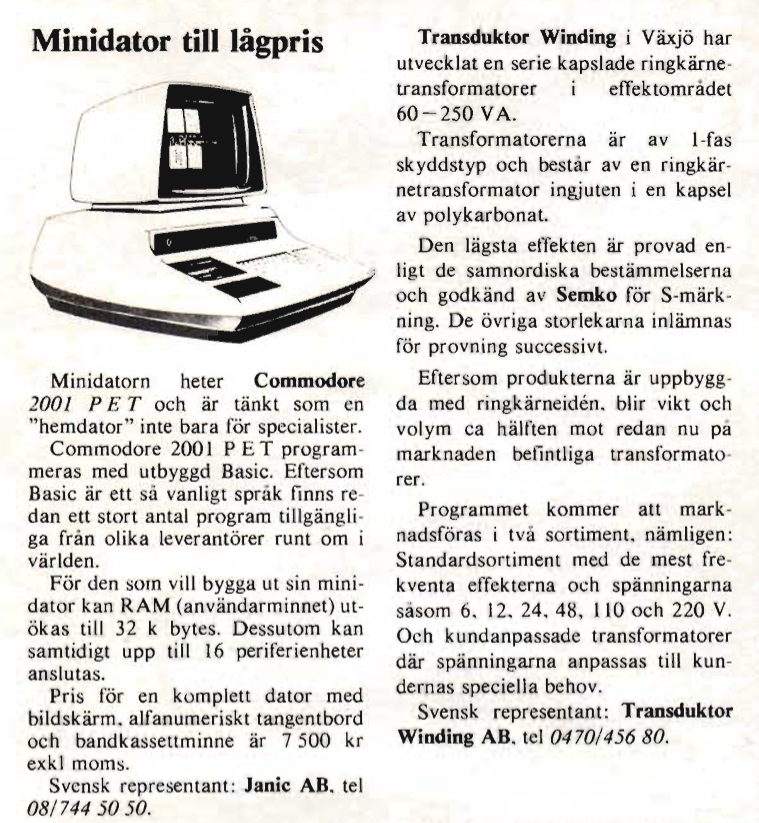
Our final thread is still in Sweden and the company Janic, founded by Jan Bergekrans. In the earlier years of the company they did handbag sales. The founder one day had read about Commodore and their calculators, and decided he wanted to diversify. (It’d be an absurd leap if he decided to sell the desk-computers straight off the bat, but these were devices where “you can fit it in your purse” was part of the sales pitch.) He had great success along with Commodore, and he started to add the Commodore PET to his sales in 1977.
So just to recap, before reaching the apocalypse of 1977/1978 that’s about to happen:
Mael: Italian calculator manufacturer, eventually getting into business computers Diehl: German calculator manufacturer, eventually getting into business computers Handic: Swedish consumer electronics, bought by a “state corporation” in 1977 Datatronic: started to sell (not manufacture) calculators, initially Mael before switching to Diehl and becoming wholly owned Janic: Swedish handbag manufacturer which got into calculators through Commodore and eventually the Commodore PET
All of these companies (except Handic) had major exposure to the calculator market, and while it was already dropping, in 1977 the market utterly fell off the map. Calculators that were going for $300 back in 1971 could now sell for $20 or less; price drops from warring companies like Sharp and Texas Instruments were so frequent that retailers were skittish about owning too much stock.
A retailers’ greatest problem occurs when Texas Instruments or some other manufacturer cuts prices without warning, leaving the retailer stuck with expensive inventories. Most manufacturers offer 30‐day price protection. This is little consolation however, for a store carrying a two‐month or three‐month inventory.
There was an entire ecosystem built around having slow, personal service around desk-sized calculators/computers; this was getting undermined by not only cheap calculators but by the ability of businesses to now buy personal computers. It was possible to transition and survive (Mael, for instance, still kept going strong with products like point-of-service machines) but certainly something in these companies needed to change.
Diehl in particular needed to get out of Sweden. Outside investor/consultant Mats Gabrielsson (and two employees of the company) bought the struggling company for a single Swedish krona, switching it over from Diehl back to Datatronic in name early in 1978.
Despite Janic hooking up with Commodore who went on to later success, the 1977/1978 period gave them too much exposure to the calculator crash, and Jans made a plan to declare bankruptcy. He contacted Mats Gabrielsson (from being a consultant through the 70s, he knew everyone in the industry) and asked about buying the Commodore agency, selling the 50 PET computers he had in stock as part of the deal. The contract was signed October 30 and the PETs were meant to be collected October 1. That was a Sunday, so the driver needed to be bribed with four Pong games.
One other company worth mentioning with the Janic bankruptcy story: Janken Minidata. They were the second computer store in Sweden, and the first to sell Commodore machines. The store was owned by Kenneth Palmestål and Jan Eliasson. Kenneth Palmestål had visited the Stockholm Technical Fair in 1977 and saw a Commodore PET 2001 (exhibited by Janic); he ordered one which arrived in December, and when he tried to start it up the computer broke because it had been too cold.
He still had a determination to sell computers, and with his friend Jan Eliasson (who had been working selling calculators, of course) he formed his computer store. He had heard about the approaching Janken bankruptcy and had made a deal with Jan Bergenkrans to buy the remaining machines, but when he rented a truck to pick them up he found out the machines had already been sold. He eventually got his supply from Datatronic instead.
Inside Janken Minidata. Source. They also sold the KIM-1, NASCOM, and TELMAC 1800 kit computers in ’79, and in later years sold the Apple II and the Luxor ABC (a Swedish computer I’ll discuss in some future post, as it does have adventure games, including the first in Swedish on a home computer).
Returning to Datatronic and their ambitions to sell Commodore, two important points: first, Commodore used Datatronic as an agent, and never entered the market directly until later in the 80s (this is in contrast to Denmark, where they did battle with the ZX Spectrum directly). Second, because of Datatronic’s past, their network contacts and sales expertise were hooked up with the business desk-calculator companies (Mael and then Diehl) so they didn’t have the reach needed for a mass-consumer product. While they (re-)launched with initial success (with computer stores like Janken Minidata), they needed to get the network of a consumer firm, which is why a few years later they purchased Handic.
This divested Handic from the “state” control into the hands of Datatronic. (One reason why it’s false to say Handic was nationalized is that this didn’t require an act of Parliament.) They created Handic Computers and Handic Software both as spinoffs although they weren’t strict about their naming conventions. The motivation for the purchase was straightforward access to the company’s distribution network, meaning nearly all foreign subsidiaries (Denmark, Germany, US) were sold; they only kept the one in Holland, as they were too tightly integrated, so they split operations of that subsidiary 50/50 with Commodore. They weren’t done building a network, also buying Ekman Import (a distributor of electronic equipment) in 1982. By this time the VIC-20 had come out in Sweden and was wildly successful.
This manual is marked as being from “handic electronic ab”.
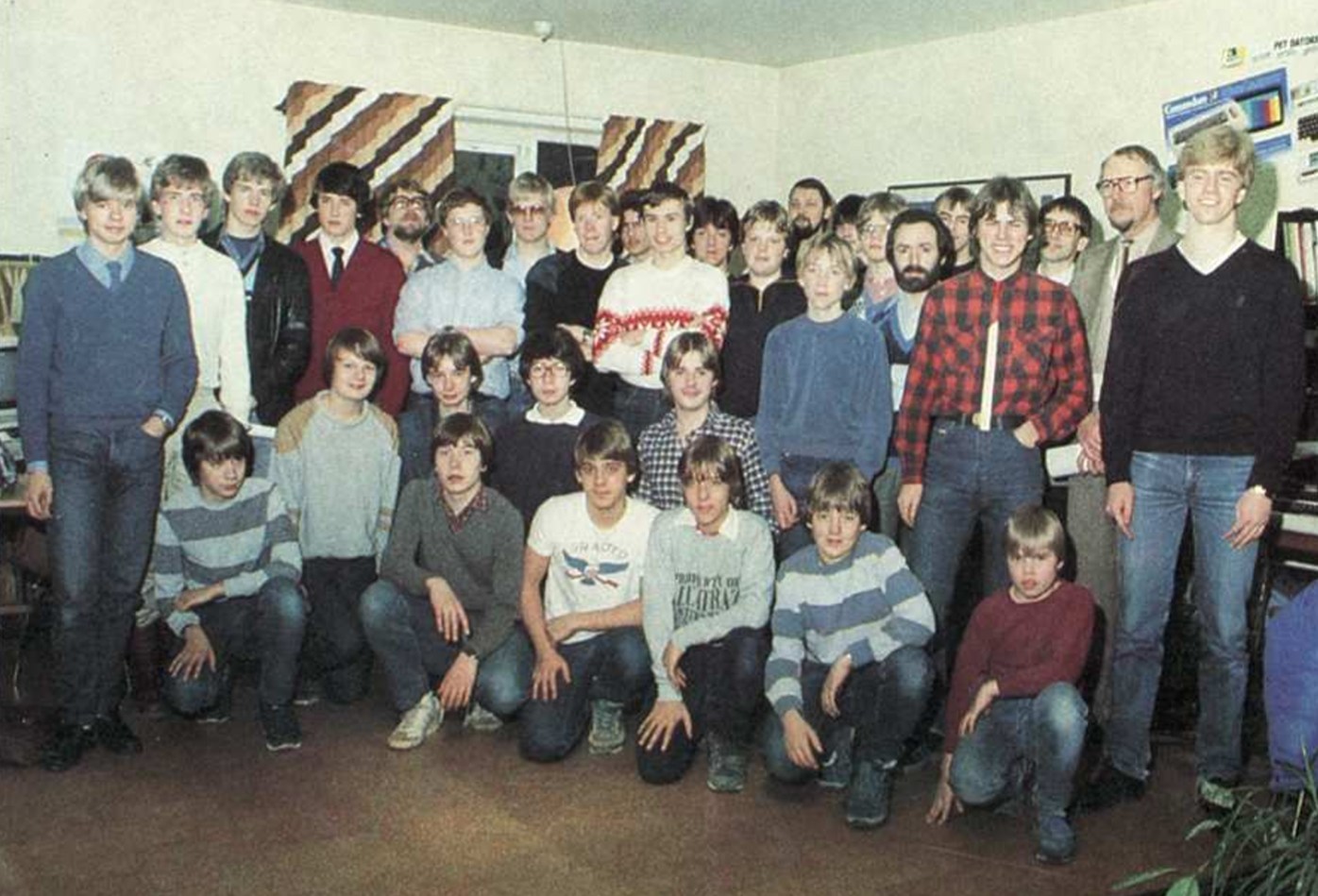
Datatronic/Handic heavily encouraged the growth of computer clubs. For example, the Westerås VIC club came from the company Rastionell Programutveckling (RPU); they became close with Handic, with members of the club sometimes going on to work there (quoting my source, “in some cases with the delay of a few years, as the young people first wanted to finish high school”).
Westerås club members via Vic News 2-1 published by Handic.
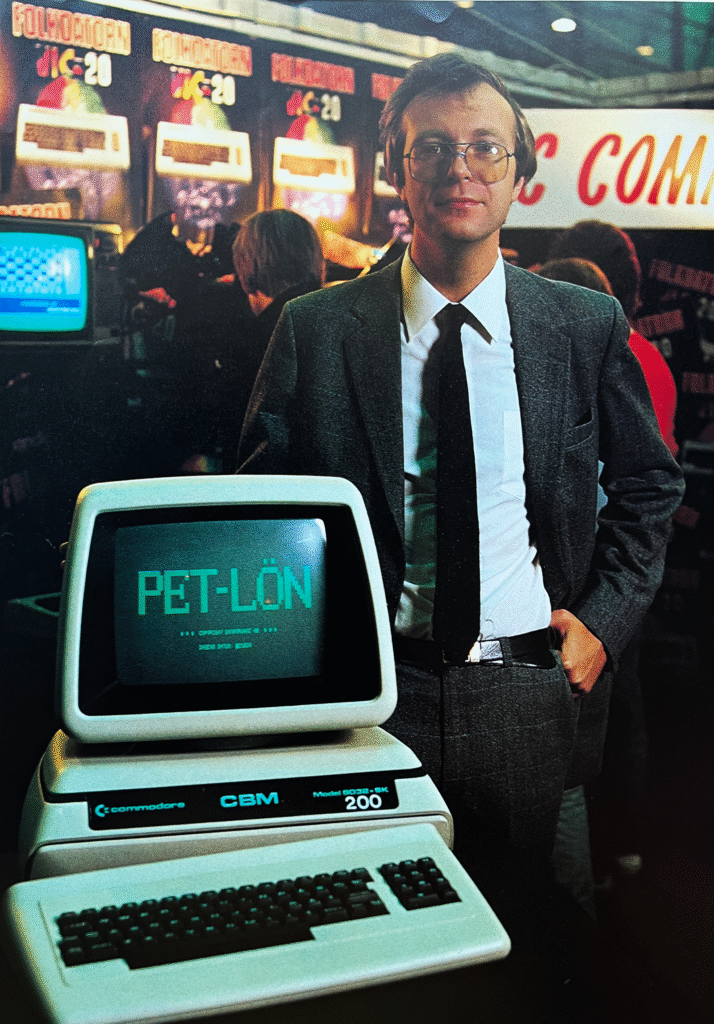
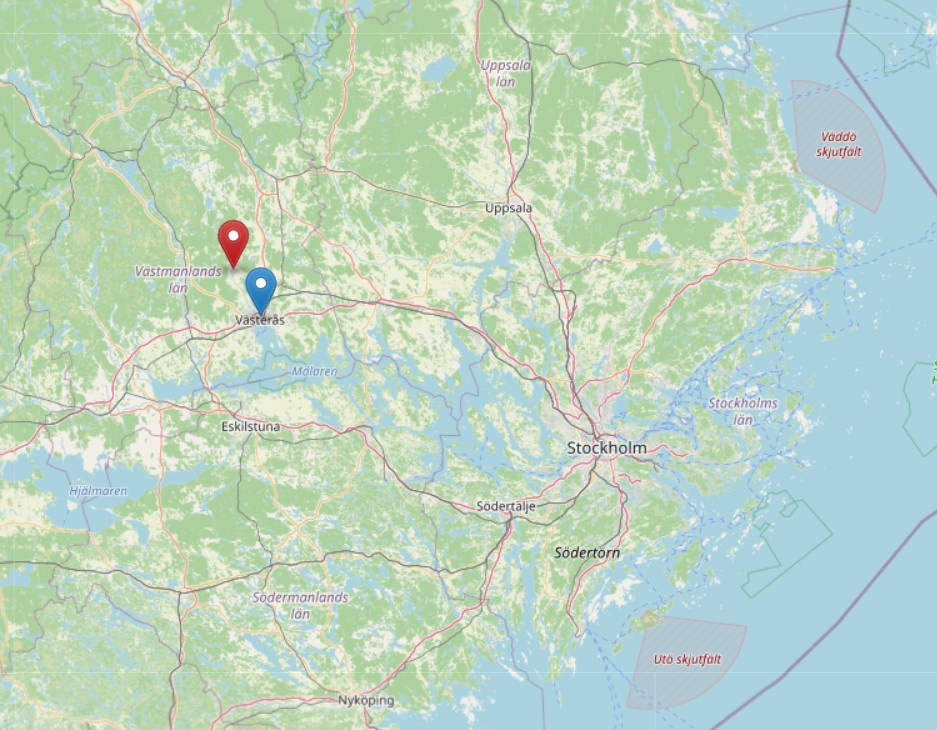
Our author today, Stefan Modin, hails from Skultuna, fairly close to Västerås (spelled Westerås in older documents). He is presumably somewhere in the photograph above.
Skultuna in red, Västerås and the club to the southeast in blue. Eskilstuna is also near and will be important in a future post.
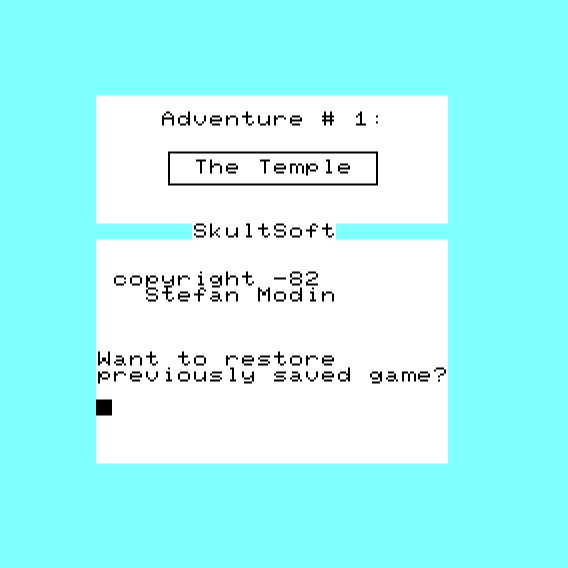
According to the research of regular commenter (and expert on Nordic computing history) Rob, Stefan Modin formed his own company name “SkultSoft” to riff off his hometown name, and wrote three adventures: The Temple, Spider Mountain, and The Mutant Spiders. The Mutant Spiders was picked up by Granda Software (we’ll get to them in a future post). For now, let’s just focus on The Temple, which you can download off a forum thread (look for “rpu-adventures.zip”).
Unfortunately the files we have are broken (according to Anders Carlsson who did the preservation, it’s “really tough to get somewhere”) but we’ve had this kind of situation here before. Poking through the source code, the game “feels” complete, just it’s getting some erratic bugs. Some may be linked with this being on a Swedish VIC-20. There were differences; the PET was (for instance) modified to include the letters Ä, Ö and Å. Since it’s relevant here, some VIC-20 specific details:
An expansion kit modified the [, £, and ] keys to print, respectively, the diacriticised characters Ä, Ö, and Å, but this required alterations to the Kernal decoding tables, the keycaps and the Char ROM; these changes obviously messed with programs using the brackets and £ symbols, and also, because the new keyboard mapping obliterated the graphic characters on the @ key, made it just about impossible to type in certain programs. Peter Karlsson says that the Swedish characters were added after the Z (in both lower and upper case modes) in the order defined by ISO 646-10, rather unhelpful because the ISO order is not alphabetical and so simple ASCII sorting didn’t work correctly. Some graphics symbols also got altered when shifting to upper/lowercase mode.
Based on the nature of the errors, I don’t think these modifications are what’s causing the problem, but given what happened with Citadel Adventure, I can’t discount anything at the moment.
Just as a reminder, on VIC-20 screens I have been squaring them up for readability. This would be twice as wide on a real VIC-20.
You start in a cell. There’s a toilet to the east, and you can also go on the bed. Note that it does not give a room description anywhere unless you “LOOK” first; it’s a little like playing an Infocom game on SUPERBRIEF in that way. It makes some sense on a VIC-20. The only previous games the author likely had access to (based on a VIC News article) are the ones from Scott Adams, and they don’t have that behavior (no “split screen”, but the screen clears and a room description displays when entering a place).
Trying to “go bed” in the “pre” version immediately results in a crash.
?type mismatch error in 45200
ready.
list 45200
45200 if b$<>”row”andb$<>”boa”andb$<>”fer”andb$<>car”andb$<>”bed”andb$<>”sta”then45300
Notice there’s a quote mark (“) missing from car. Retyping the line exactly as is with the quote mark fixes the problem. (It’s already fixed in v1.)
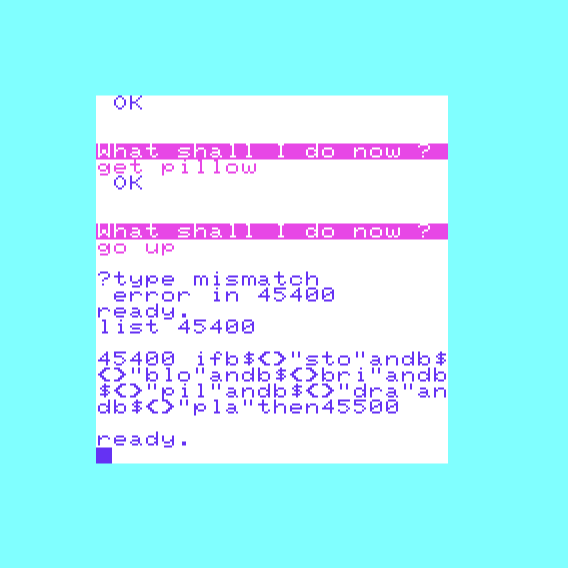
Getting the pillow and matches and then using “go up” to leave results in another type mismatch (in the “pre” version).
Trying to do the same thing in the “v1” game results in an entirely new bug.
Just typing “u” works though.
There’s one other accessible room to the east of the cell.
This is on v1, pre crashes when you examine the toilet.
Trying to “go toilet” gets the response “AH! That was better!”
I proceeded to then try to do something with the pillow and matches with no luck.
The source code in question has:
if x<>19orx<>20thenprint”It wont ignite.”:go7
The issue is “go7” which should be “goto7”. Line 7 is the main parser. That wouldn’t be caused by character issues, would it?
With the number of bugs I’m not going to put myself on the hook for going any farther (I don’t even know what the goal is!) but it quite likely is the first adventure game from Sweden on a home computer so it’s worth some effort. It doesn’t feel like a systemic kind of issue (one POKE in memory and everything works) but more like Marooned with an abandoned work in progress. Still, we were eventually able to get through Marooned (thanks to exploradorrpg) so I’m not going to call this one impossible.