I just played a type-in for BBC Micro from a British magazine; today I’ve got another type-in, this time from Japan.
Before getting into details, some meta-business about chronology. In general, once this blog has reached a particular year, I haven’t been strictly chronological past that; with early computer games, dates have such a wide-swerving error bar that it isn’t worth the effort. (I additionally need some freedom of choice for psychological health purposes.) With Japanese games, there’s enough data by month from various sites that I’ve tried to stick to a by-month sequence and not just by-year. At some point I may declare everything in the year fair game (especially once the number of games starts to multiply), but everything so far fits into the timeline below.
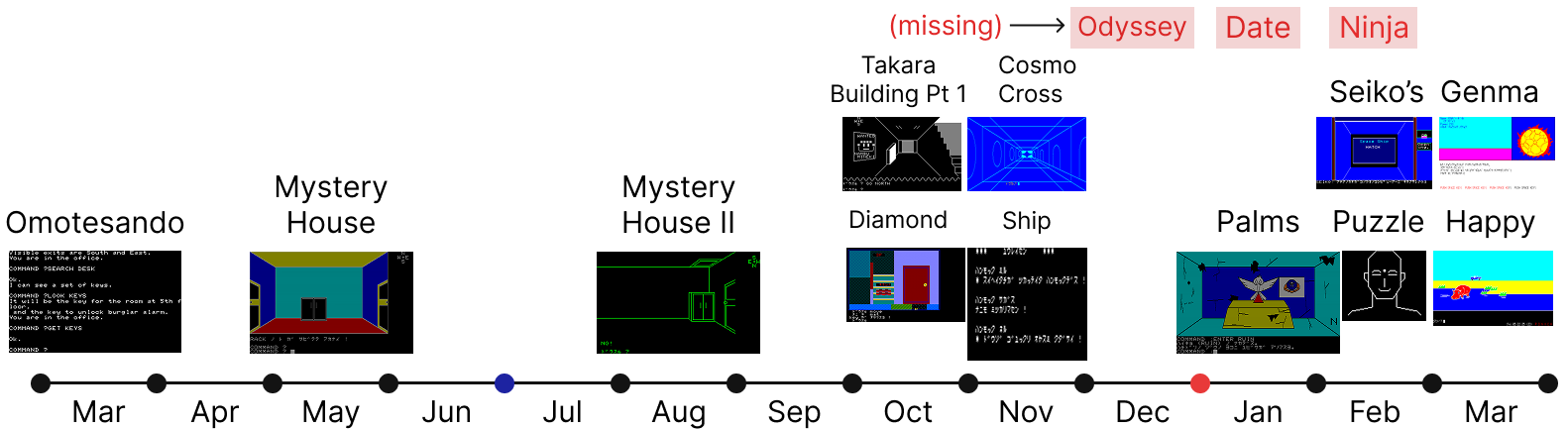
I’ve recently played Genma Taisen and Happy Bushman from early March 1983. Because of newsstand rules, magazines tend to show up a month early, so any “April” issues also fall into March. This includes the April 1983 “April Fools” Ah-Ski! issue from ASCII; Omotesando Adventure from the year prior is where adventures written in Japan started. The sequel tries to go in a very different design direction. In one of the competing magazines (I/O, April 1983 issue) there’s two adventure games that are much more clearly callbacks to prior adventures. I’m going to start with the I/O games first before visiting Ah-Ski!
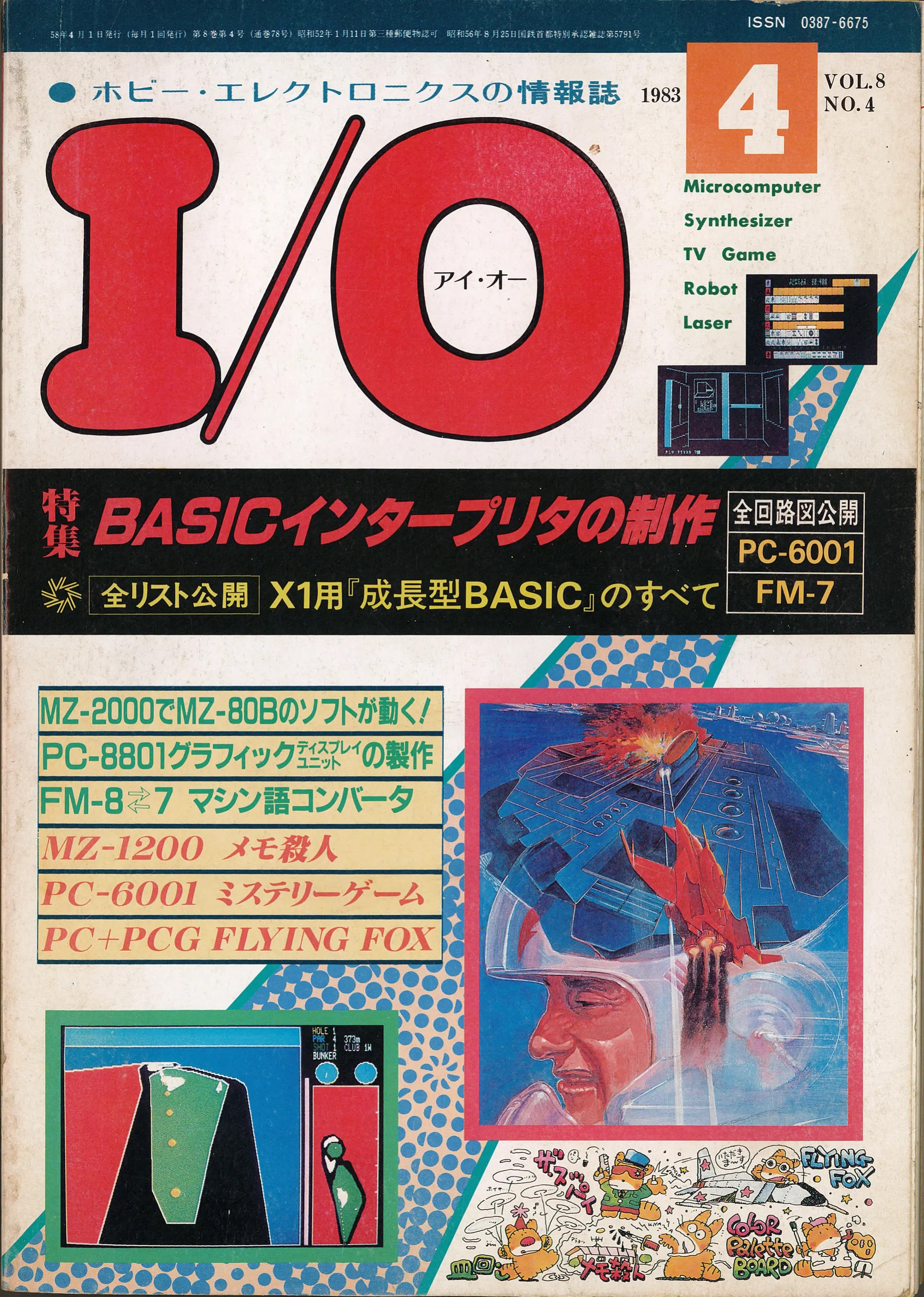
Out of the 600+ pages including type-ins, the two adventures are placed nearly next to each other (with a one-page Boxing game in-between) starting on page 215. The majority of the code of The Sppy is in BASIC, but there’s some hex code afterwards, mainly (based on what I can tell) for graphics. The author is given in the source as Momoki Todoroki.
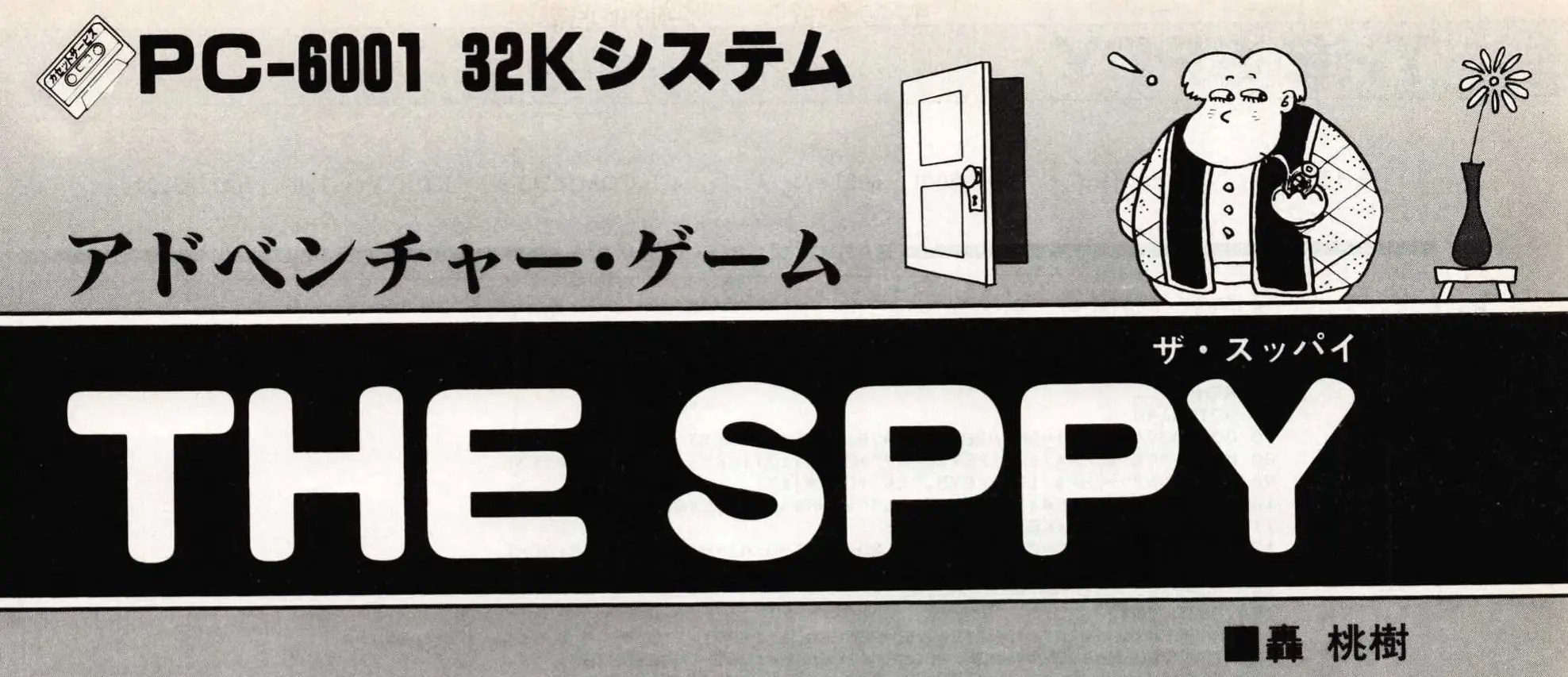
As the top of the page announces, this is for NEC PC-6001. NEC also made the 8001 and 8801 which we’ve seen a bit more of (Phantom Ship and text-only Genma Taisen variant were 8001, Seiko’s Adventure was 8801). Both were slanted in a serious/hobbyist way; the PC-6001 was instead targeted squarely at families, and a good analogy would be the original TRS-80 versus the TRS-80 Color Computer. I have here a 1982 TV ad which should give an idea of the framing:
The PC-6001 has shown up here once before with a variant of Mystery House II (ported by N. Minami). Back when I played Diamond Adventure (again by N. Minami), I briefly tried a PC-6001 version. In that same post I found a capture of a Micro Cabin catalog from mid-1983, which is worth highlighting:

This is important in that it includes yet another game by N. Minami, The Spy. I spent a significant amount of time trying to decide if N. Minami and Momoki Todoroki were the same person; maybe Micro Cabin’s published version of The Spy is just a variant of The Sppy, or maybe the author rejiggered the code to write a sequel, Steve W. Lucas style. Pseudonyms would not have been out of place in this era.
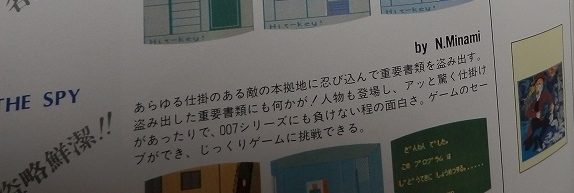
The main text of The Spy (the Micro Cabin game) says you will sneak into an enemy headquarters with traps in order to steal vital documents, and there’s surprising twists and a cast of fascinating characters; it’s “just as exciting as the 007 series” and features a save function. Diamond Adventure, by comparison, had you sneaking into a building to steal a diamond (and to go back even farther, this is strongly related to Omotesando Adventure, which had you sneak into the offices of ASCII to commit sabotage).
In The Sppy, you are Agent 006, ordered to steal a microfilm. The microfilm is meant to be used as a secret meeting, and your country will suffer greatly if the information in it is exposed. The microfilm is inside the Gemini buildings.
They’re clearly different games, but so close together in time (and on the same platform) the comparison is uncanny. The definitive thing to do would be to play both, but unfortunately Micro Cabin’s Spy has not yet been archived, so we’re staying with the Sppy type-in for now, which you can download here courtesy gschmidl (I used the emulator PC6001VX).
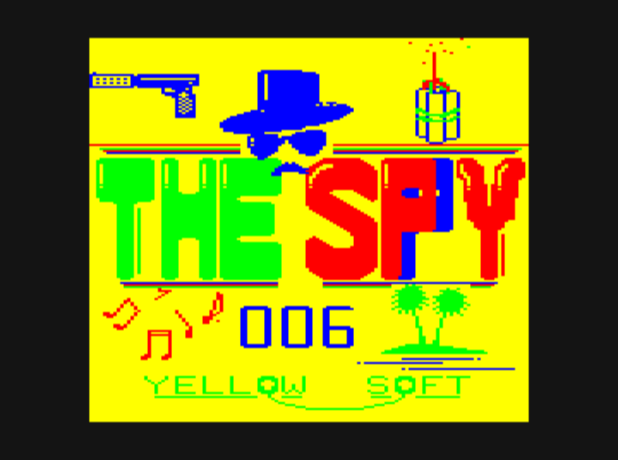
This is the only game I can find by “Yellow Soft”.
The controls are somewhat unusual: the instructions say to type two hiranga characters, omitting any voiced marks; if needed, the verb will also prompt for a noun afterwards. You start facing two buildings, and you enter みぎ (migi, right) to enter the right building but without the mark, so it’s actually みき (technically speaking, “miki”). This suggests an immediate issue, because ひだり (hidari, turns into hitari taking out the mark) is left and that’s three characters! You simply need to cut off the last character; that is, you want ひた (“hita”) for left. The British game Adventuremania had a similar parser where it needed all words to be cut to three letters.
There’s function keys with commands, but they enter the commands in katakana. Katakana does not work for controlling the game. The function keys do not work at all. I assume this was simply author oversight; the instructions even explicitly say to type in hiranga. (There’s a video that doesn’t get very far at all, but it shows the function keys in hiranga suggesting it’s a fixed version of the game. Maybe a later issue of I/O has a correction.)
BRIEF ASIDE: Katakana and hiranga are both syllable-based sets of kana for Japanese, and they have one-to-one mappings. So for example, “down” is “shita” which is した in hiranga and シタ in katakana; the sounds of “shi” and “ta” are exactly the same in both cases. Katakana is used for foreign words; hiranga is “smoother” looking and perhaps semi-analogous to using cursive rather than block capitals. The PC-6001 has hiranga written below the English letters of the keyboard. My own keyboard which I bought for playing Japanese adventure games also uses hiranga so it’s technically easier for me, even though my previous games so far have used katakana commands only.
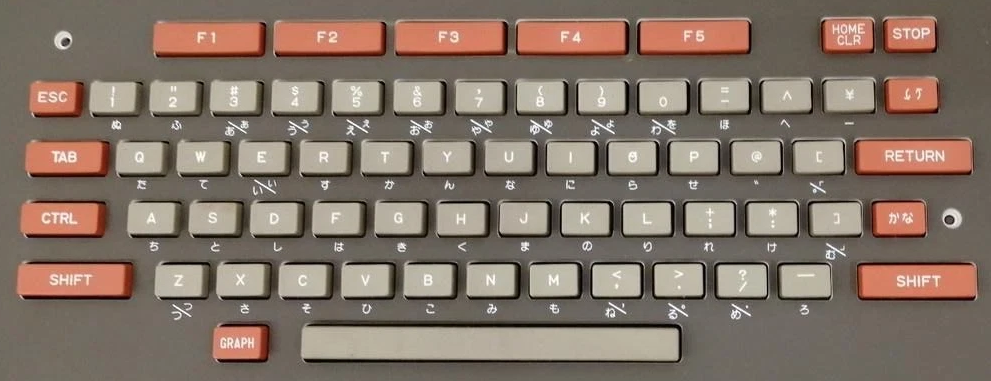
Returning to the game itself, remember there are two buildings…
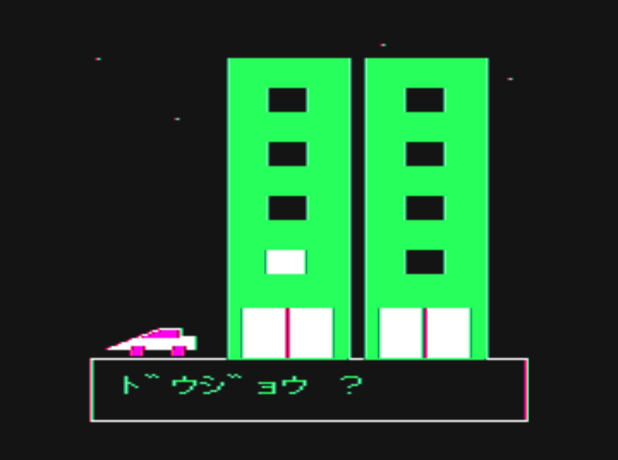
This screen is “mode 4” on the system, which lets you choose between monochrome and four other palettes.
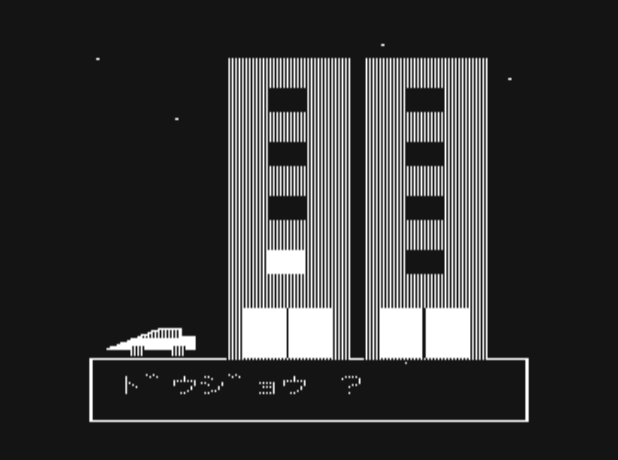
Black and white mode of the same picture.
…and you can start by simply choosing left or right. Let’s go left first.
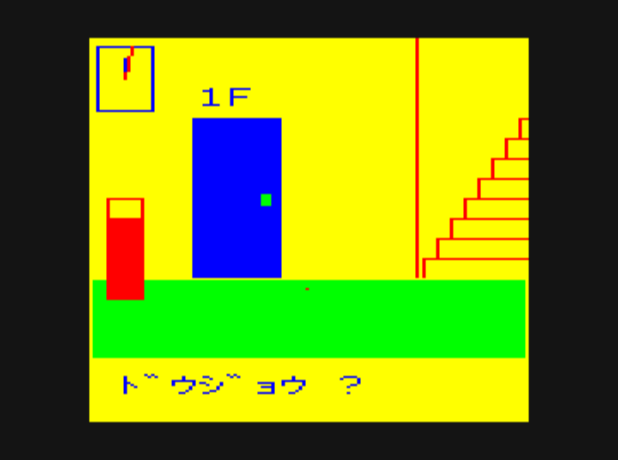
There’s a time limit (real time, not turn count) to the game, represented by the clock in the upper left. If the player exceeds the time the game says “time is up, it’s dawn.”
This is floor 1 of 5 floors and a roof. For this door, trying to open the door activates a minigame, where an “I” on the bottom of the screen is shooting at a “X” moving across the top of the screen. I’m unclear what is happening and if there’s any reward to be found.
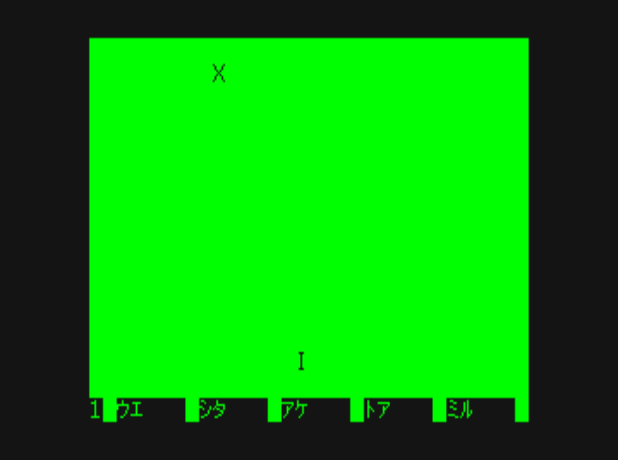
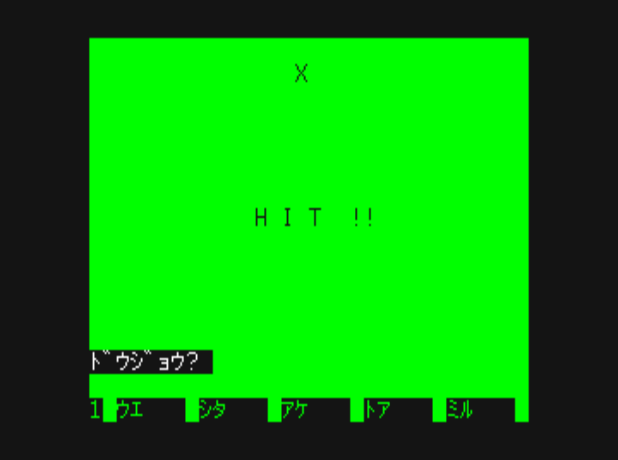
This is “winning” the game. If the X gets all the way across the screen without being hit it is game over.
On the second floor…
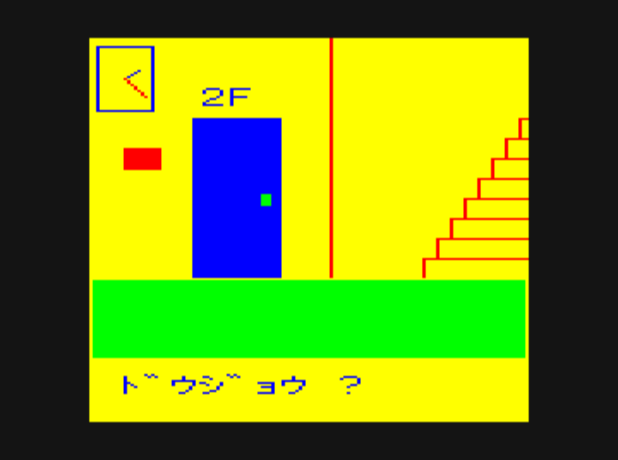
…trying to open the door leads to the screen flashing off and on and the game being over. I assume a bomb or alarm but even slow-stepping with pause I don’t see any message to this effect.
The third floor and fifth floors chastised me for not having a key; on the fourth floor I simply couldn’t use the verb “open” at all for some reason.
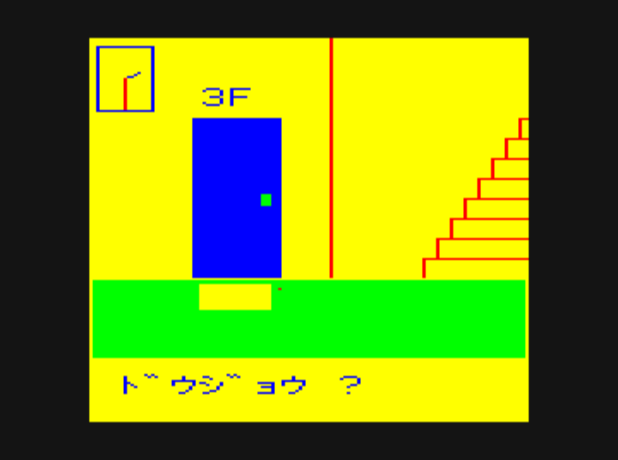
Also, that little pixel to the right of the door entrance moves to the right and back to the left upon first arriving at the floor.
Going up from the fifth floor leads to rooftop fireworks, whereupon you get returned to the fifth floor.
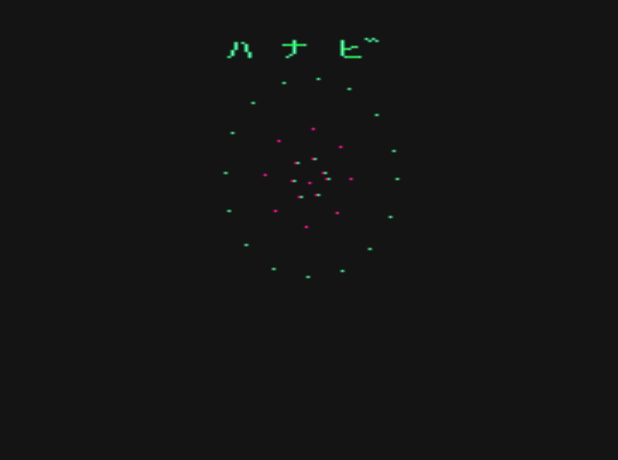
Cryptic! Note that I cannot swear all floors will always be consistent with what I just said; both Mystery House and Diamond Adventure had random elements, and even if Momoki Todoroki is not connected to Micro Cabin, they’re riffing off the games enough they may have decided that was a necessary feature.
Let’s try the right building instead.
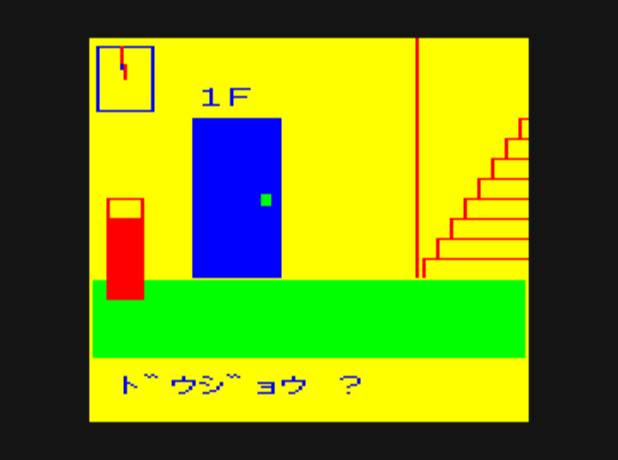
Floor 1, rather than open/door triggering a mini-game, simply has the screen blink and kills you outright. You then get sent back to the title screen.
Floor 2 has a dog. Also, the mini-game triggers (I’ve been winning by accident, I guess, by not touching any buttons). OPEN doesn’t work here (trying to type the verb just has the game go back to asking what you want to do) I assume because the dog is stopping you.
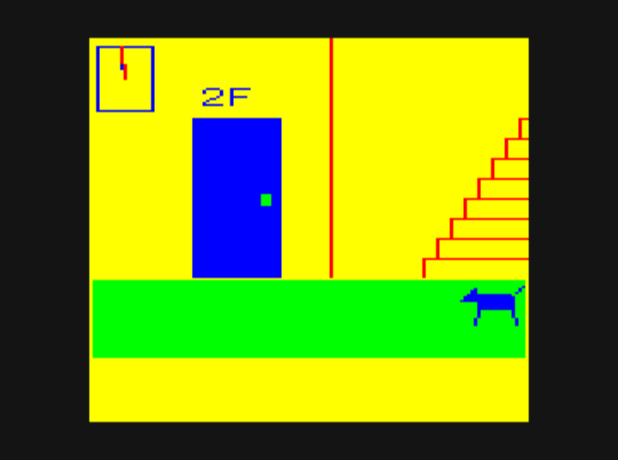
It does a little tail wag.
The third floor is just like the first floor; opening the door kills you.
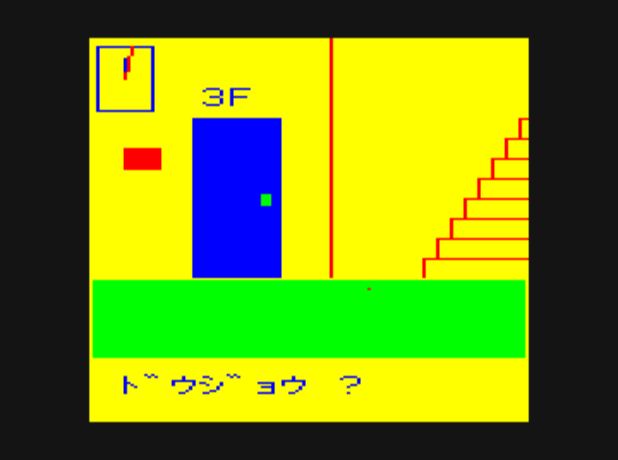
The fourth floor (upon open/door, which does work) has some message about doors exploding if you don’t have a key. Try to get up farther and the game says the stairs are broken.
So to summarize: there’s rooms that explode, a room with a shooting mini-game (and nothing else), a floor with a dog (and the same mini-game), and some fireworks on the roof of one of the buildings. I’m going to need to crack down and comb over the details to get by this one, and I feel safe in saying this one’s going to be tricky to finish.


