As a child I was obsessed with making stuff, it started with cardboard boxes and moved on to wood by the age of 5. By 10 I was constantly visiting rubbish dumps to find broken electrical stuff I could use to build what ever my imagination could imagine. Space ships, cars, satellite dishes to search for aliens – Of course all of this failed.
— Martin Webb, writing in a 2020 forum post
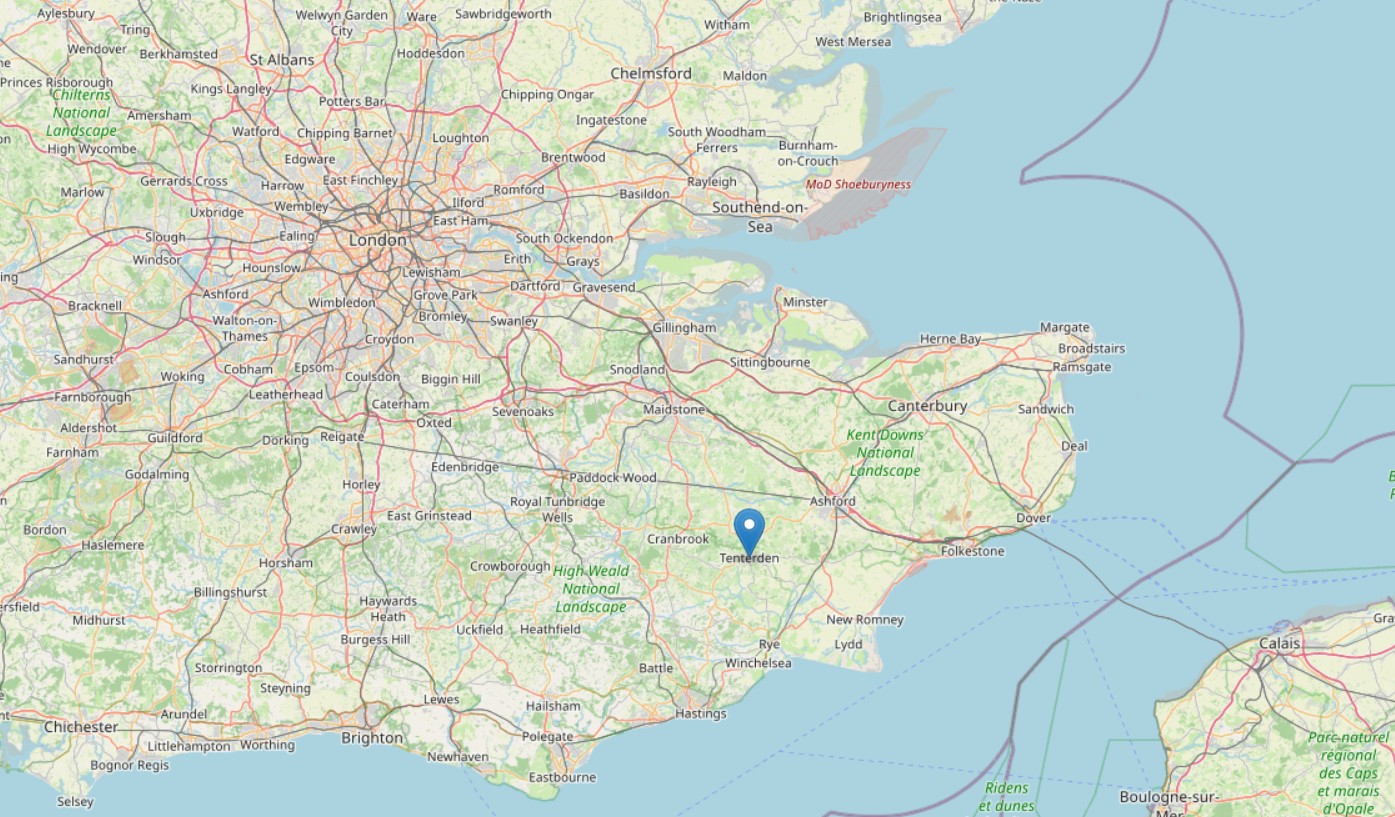
Tenterden, in Kent.
For all the games we’ve seen so far by teenagers, even when commercialization has happened, parents have either been standing by the sidelines or supportive. Software Innovations, founded by four 16-year olds, included “$100 investment donations from parents”. Greg Hassett, who wrote his work between the ages of 12 and 14, had his initial publisher contact (Mad Hatter Software) through the Boston Computer Society (founder, 13-year-old Johnathan Rotenberg). Alex Kreis’s parents sold their family upright piano to get him a computer and his initial publishing was through direct personal contact with the editor of CLOAD. We have a picture of Tim Gilberts (of later Quill fame) selling software with his parents and by his account it was a happy time.
This is in contrast to, say, child movie stars; Shirley Temple famously earned over $3 million during her film career but only had $44,000 in her trust fund, and horror stories about mental pressures abound. I would theorize that computers (and the idea of making a career selling software) were so new that parents didn’t understand enough to try intervening; the parents that did understand tended to be of the “engineering” slant so they were more interested in the technology than exploiting it for money.
Martin Webb is an exception to this; he was the programmer/artist behind Intrigue Software starting in 1983 (at age 13), and his father Dennis was the company manager. They started with producing games for the TI-99 computer.
It was a good money spinner. I had become pretty proficient at rolling out TI-99 games and that was good for business and keeping dad happy. When I made a game the orders followed.
When the TI-99 started to slack:
Dad kept dragging me to the bank telling the bank manager I was a whiz-kid, and the bank manager increased the overdraft. It was that easy. Dad would just tell them I was making a new game, roll off some sales figures and the money was given.
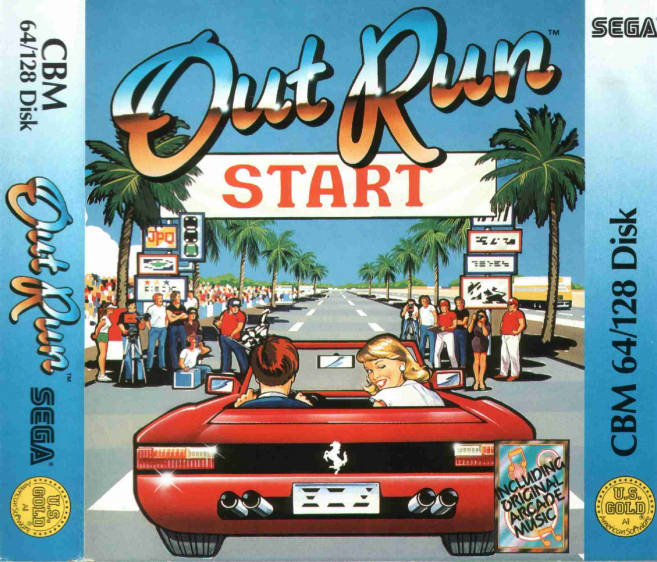
This seems to be a case where the parent was driving the production, rather than the teenager. Speaking of 1987 (the same year the teenaged prodigy produced the US Gold port of Outrun for C64, cover above):
Up until now dad came up with the game ideas. I would sit in my bedroom while my dad was in the spare room running the business, and of course trying to keep a 17-year-old on track to get the games finished. I’m a total perfectionist so I can’t imagine how hard that must have been. That said, teenagers and parents are not a good brew and we had a fair few problems, usually resulting in me running off into the Kent countryside and my dad driving around looking for me. I’m smiling now but back then it was really bad. The arguments started off verbally and soon turned to marginal fights and later got worse.
The family finances behind the scenes were be part of the issue; in other accounts of teenagers publishing the families seem to be relatively well-off (or even outright rich in the case of The Desecration) whereas Martin talks about money as an active motivator:
For some reason seeing the coloured tape cover of SANTA and the GOBLINS brings back the most Nostalgia – I think that time was very difficult at home when I made this game and as a child (14 or 15?) I guess i had dreams of making $$$ and solving family money issues.
The text adventures from Intrigue were
▸ Alpine Quest (1983?)
▸ Adventuremania (today’s game, 1983)
▸ Santa and the Goblins (also 1983)
▸ Mania (1984, and sequel to Adventuremania)
Alpine Quest is mentioned here by “Firefly” but not in a 1985 catalog so I’m unclear what’s going on:
The parser was a strange one; you couldn’t just type EAT FOOD … it wasn’t even a two-word parser, you had to type EATFOO so three letters of first word, no spaces, and three letters of last word …. I now realize why i couldn’t get off the first part of Alpine Quest because that would have been the same.
Maybe it was non-graphical, and consequently the Webbs wanted to prune it from the catalog? A different forum thread mentions going to someone’s basement to buy the game so maybe it had esoteric distribution. It isn’t mentioned on any of the usual archive sites, including the TI-99 Italian User Club which has a thorough collection of materials on Adventuremania.
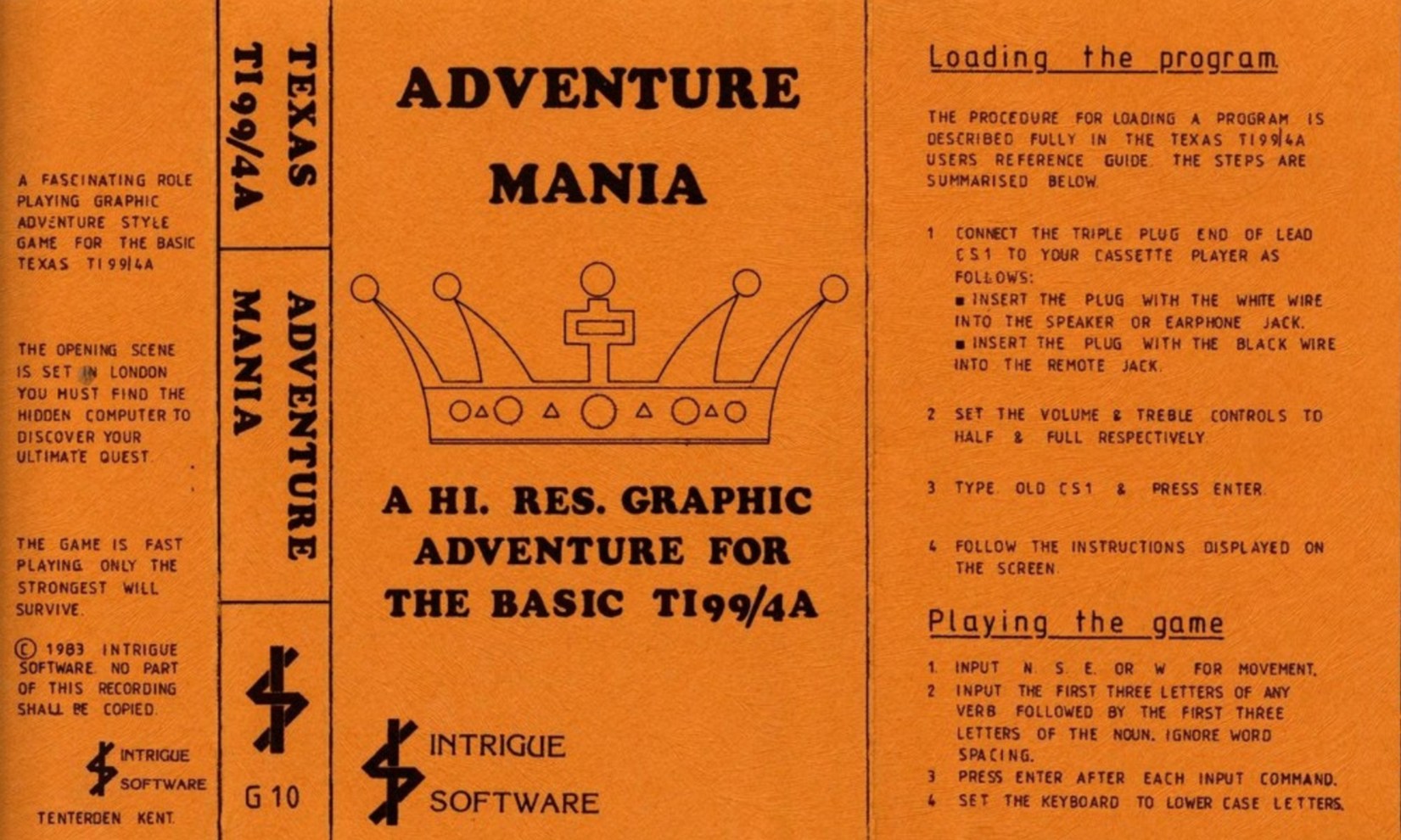
As the quote from the forum implies, this has a deeply odd parser. You’re essentially typing clumps of six letters, like TAKREV for TAKE REVOLVER. What I believe is the first printing (see above) doesn’t give much help in understanding this; fortunately, the game went through multiple printings, so we have more details. Specifically, we get a full verb and noun list:
verbs: tak(e), use, loo(k), res(t), ope(n), eat, bri(be), say
nouns: bin(oculars), bla(ck key), mem(bership card), pet(rol), mat(ches), lad(der), com(puter), rev(olver), bul(lets), mon(ey), foo(d), tap (water), tic(artridge)
“Say” gets its own special syntax examples; the game gives passwords and this is the specific case where you type more than six letters:
saynelson
saymaster key
sayqueens key
The initial goal is to FIND THE HIDDEN COMPUTER TO DISCOVER YOUR ULTIMATE QUEST although I’ll spoil right now the actual final goal is to steal the Crown Jewels of London.
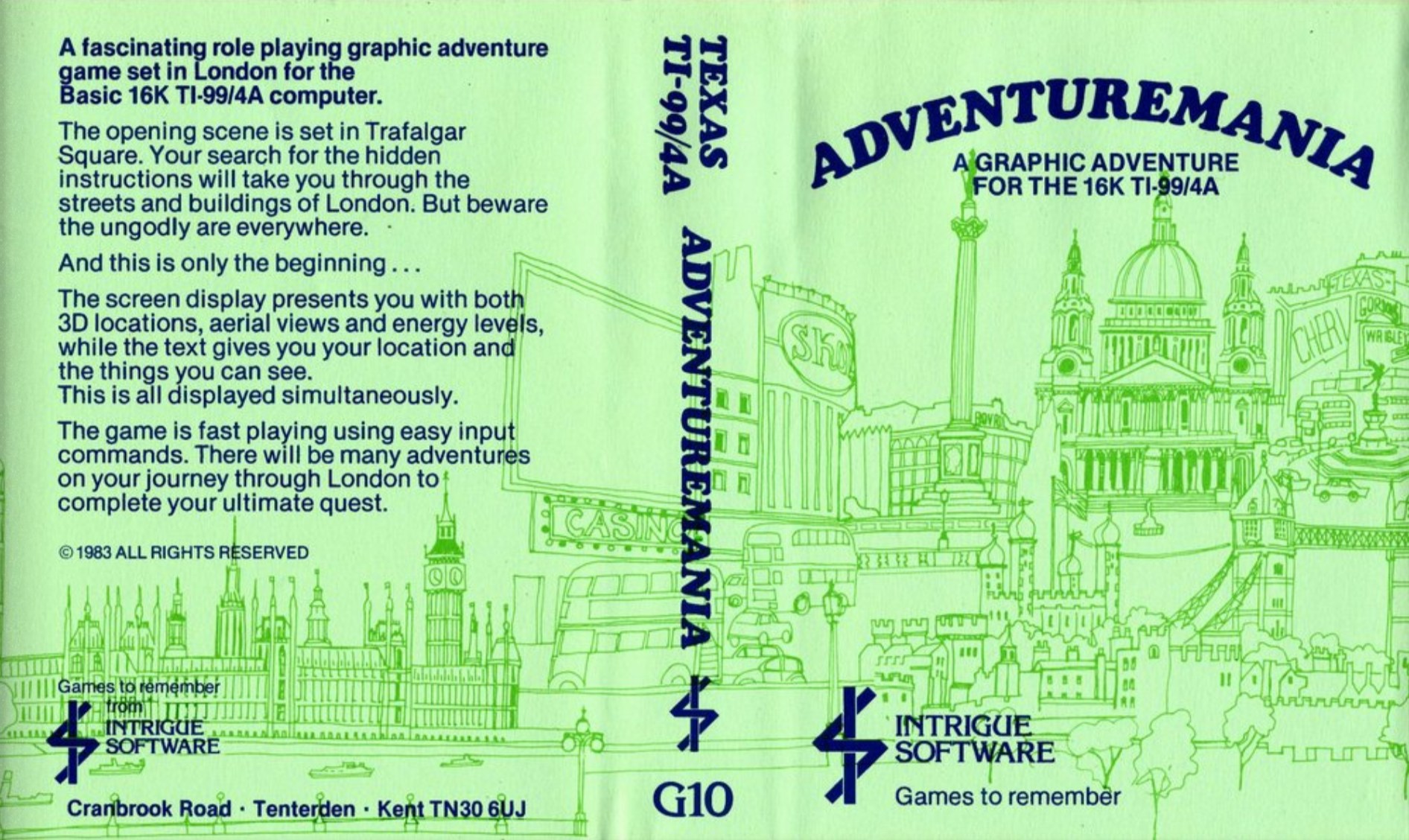
From the TI-99 Italian User Club.
The game has a bit more of a “strategic” layer than is usual, tracking “energy”, “money”, and “bullets”, and having “food” distributed across the map you can eat (and can’t take, I mean, “tak”). You start at Trafalgar Square, with a TI-99 graphical rendering of Nelson’s Column.
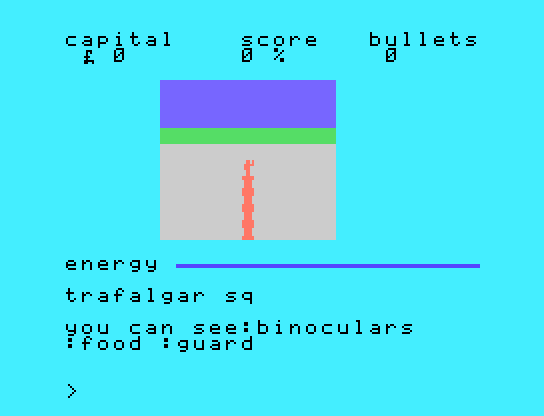
You would think using the binoculars here (“takbin”, “usebin”) would show something useful due to the Column, but the game just says “everything looks bigger” which is the default message for using the binoculars anywhere. The instructions include a hint that the binoculars will show one of the passwords somewhere but I never did see it.
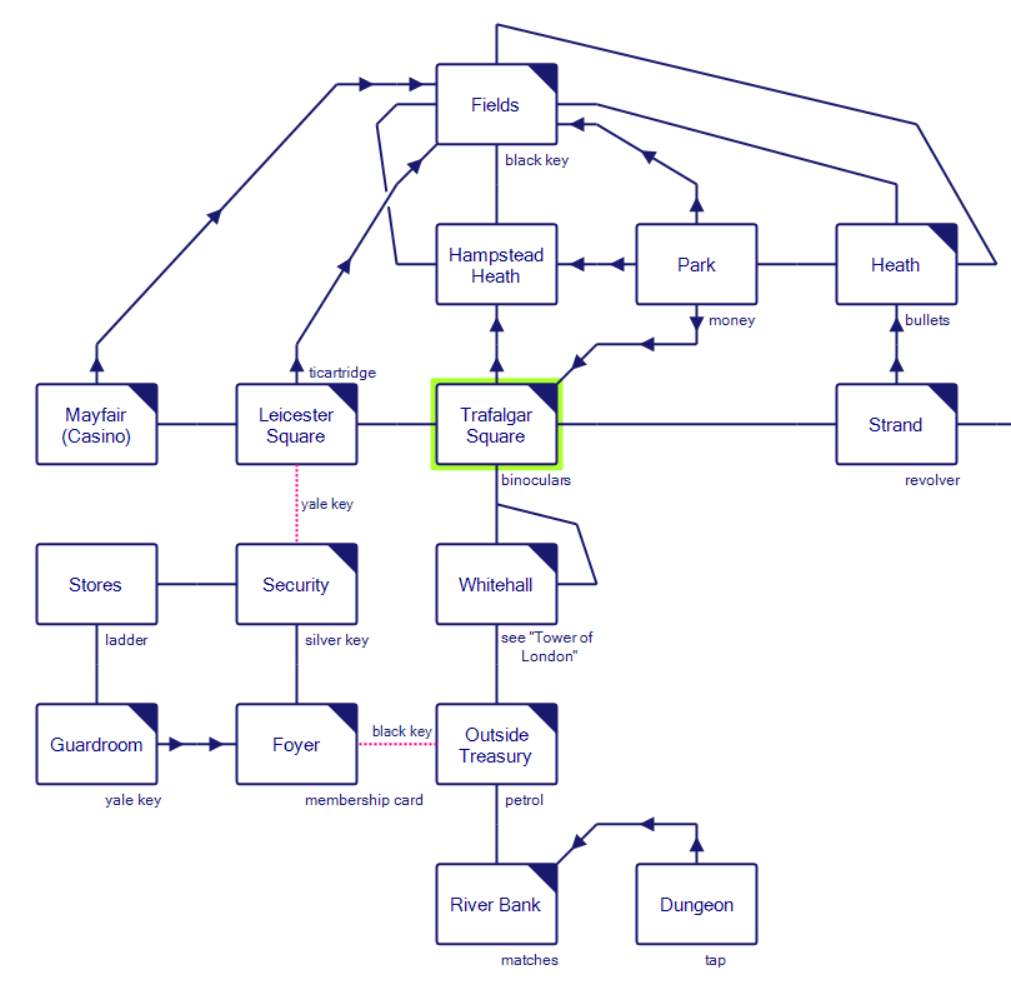
The corner markings are all rooms that have food in them; remember you can’t take the food. Your energy bar goes down each step you take, and the main obstacle to the game (other than getting thrown in the dungeon, which I’ll talk about in a moment) is just running out of energy. It feels a little bit like strategic Pac-Man, and when I eventually worked out my route I was using I had particular foods to eat in mind in order to keep energy reasonably high.
Often a room will have a “guard” or “security man”; there seems to be no difference between the two. For a while I thought the “revolver” plus “bullets” might do something but as far as I can tell the revolver is yet another gun-as-red-herring. There’s no command for shooting it and “use” on it isn’t understood.
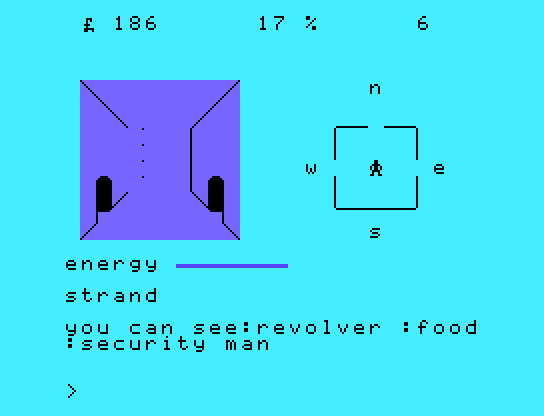
You can just try to walk on by when you see a guard; a fair amount of the time (maybe 80%) they’ll do nothing. The other 20% of the time they’ll toss you in the dungeon.
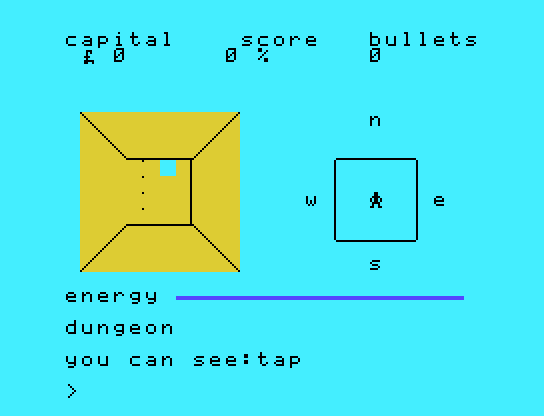
You keep all bullets etc. when this happens; thankfully the game doesn’t scatter your objects across the map.
After some fiddling I chanced upon OPEn TAP as starting to fill the room with water; it then asks what you want to do next, and if you type the wrong thing you drown. You’re just supposed to type “n” as in “go north”, but the game doesn’t make it clear that north represents a way out!
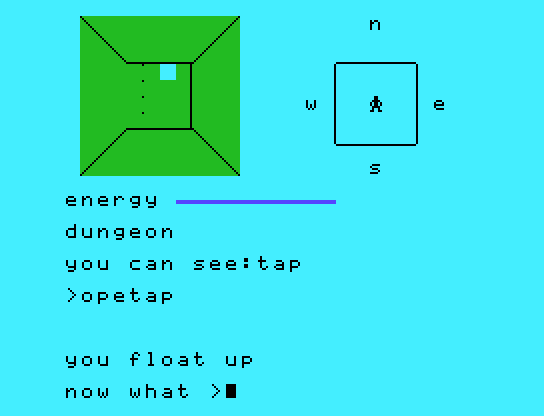
This means, theoretically, you can ignore all the guards, but I did still find it annoying to leave them un-dealt with; fortunately there’s another option: bribery. Two spots on the map have money you can pick up, and if you “brigua” or “briman”, you are prompted to ask for how much you want to bribe for.
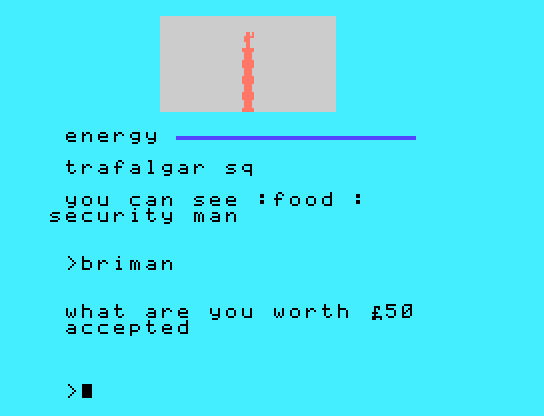
Checking source code (before winning, although only this element in particular), I found that the chance of success is based on the fraction of your wallet you’ve given out. So if you have only 1 pound, bribing 1 pound has a 100% chance of success. If you have 100 pounds, bribing for 80 will have an 80% chance of success. There likely is some interesting mathematical strategy to optimize this, but I found just going for 90%+ each time (and grabbing the money in the second spot it shows up in) was enough to get through the game.
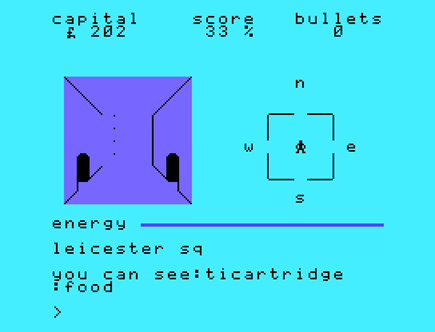
The TI cartridge goes in a computer which tells you your mission, but I never saw the computer. (Still won the game, though.)
To summarize, the strategy elements are:
a.) an energy bar that goes down, and you have to eat food to replenish it; you cannot pick up the food, you can only eat the food as it lies in particular location, like you were Pac-Man eating power pellets
b.) guards that are randomly in particular spots, and will sometimes toss you in the dungeon when you leave
c.) the guards can be bribed; the revolver makes it look like they can be shot as well, but that seems to be a red herring
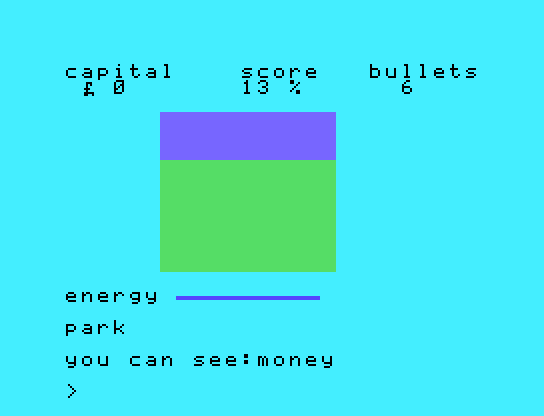
Ignoring various items that seem to be red herrings (like the petrol, which only serves to explode if you light some matches in an adjacent room), the goal is to first nab a black key out in the fields, then take it back to the “treasure” and unlock it.
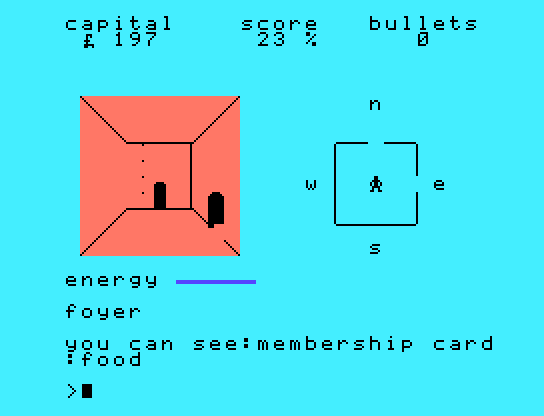
The membership card is technically not a red herring, but it just lets you enter a casino if you “usemem” at Mayfair. The casino game has you pick a random number from 1 to 6 and if you get it right you get your stake back. It’s not worth it.
You can ignore the membership card and the ladder in the treasury (no idea what the ladder does); what you need are the silver key and the yale key. The yale key can be used to get back outside (incidentally, the guards don’t toss you in the dungeon if you exit a room with a key), so you don’t have to bother with a bribe in such cases.
You can then make a beeline for a bridge to the east.
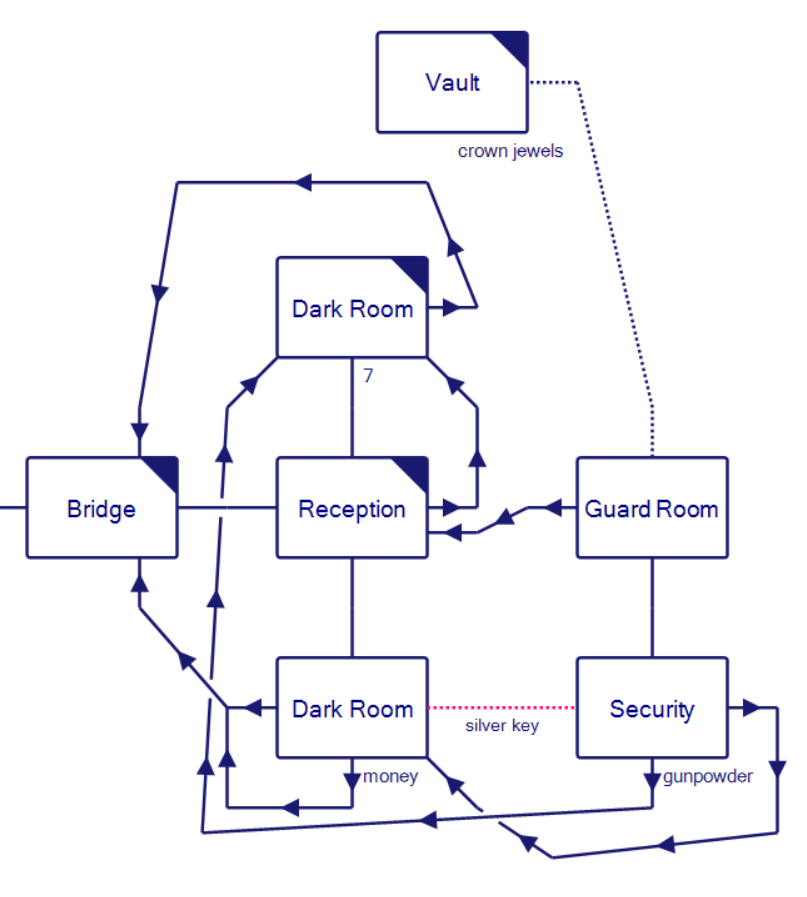
This is the Tower of London. A reception room is at the center.
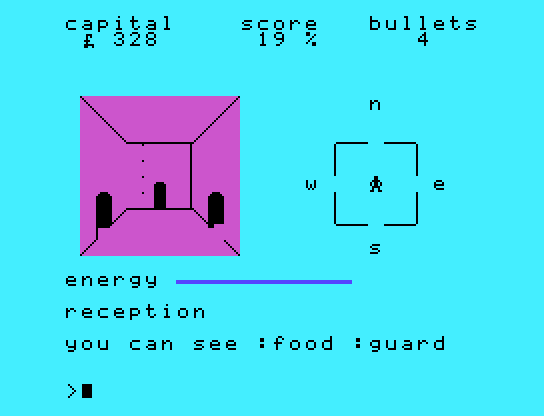
There may or may not be a guard. The food here was one of the ones I would always eat.
To the north there’s a “dark room” where if you use matches (without holding the petrol) you see a message about the password MASTER KEY, which I never used anywhere. There’s also an object which is just the digit 7.
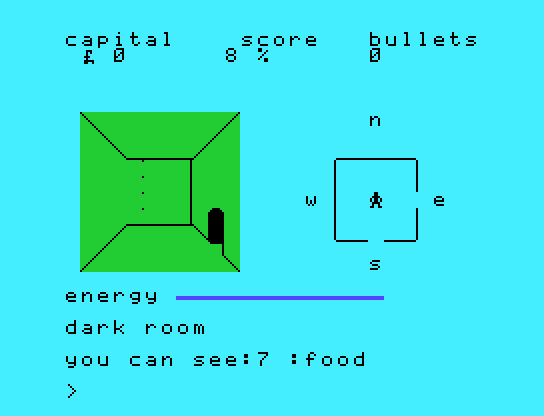
I don’t know what this is all about. I assume a typo in the BASIC?
To the south there’s a locked door where you need to use the silver key (which is why we needed the treasury run), then some guard rooms followed by another locked door. None of the keys work.
I went to the three words in the instructions, even though I only saw MASTER KEY. QUEENS KEY suddenly warped me to the jewels:
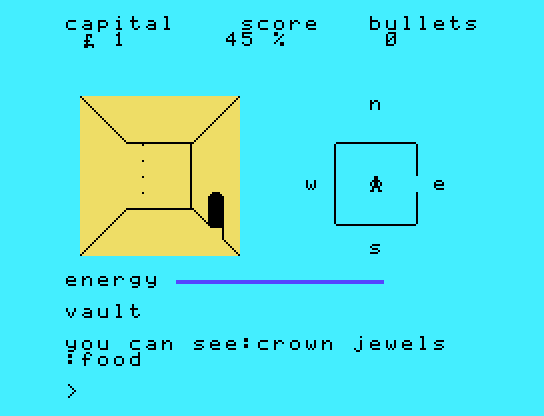
Take the crown jewels, and you get a “you win” screen.
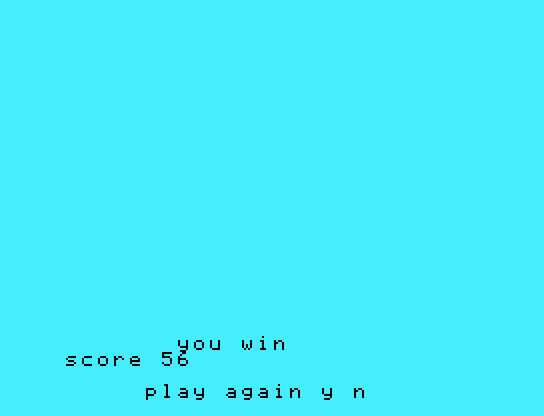
I admit I was not bowled over enough by the game’s quality to want to work out where the other two words were, or where the computer was hiding. I did check through the source code and it didn’t seem like I was missing anything; my assumption is MASTERKEY gets used somewhere to find the computer…
1153 PRINT TAB(8);”congratulations”: : : :
1156 PRINT: : : :”your mission is to steal thecrown jewels.”
1159 PRINT “on nelsons column is the keyto the vault.”
1162 PRINT “go sightseeing in whitehall.”
…and related to Nelson’s Column is the QUEENS KEY password, except all three passwords were in the instructions (on the back of the green one I showed earlier) so there isn’t really a need? If someone wants to noodle around in the comments they’re welcome to, but I can say I feel sufficiently wrapped up.
I do think the strategy elements ended up being more interesting than I expected once I understood what the rules were; I first thought guards were blocking particular passages before I realized they were acting truly at random. Certainly knowing the bribery was relative to how much the player had at that particular moment was useful.
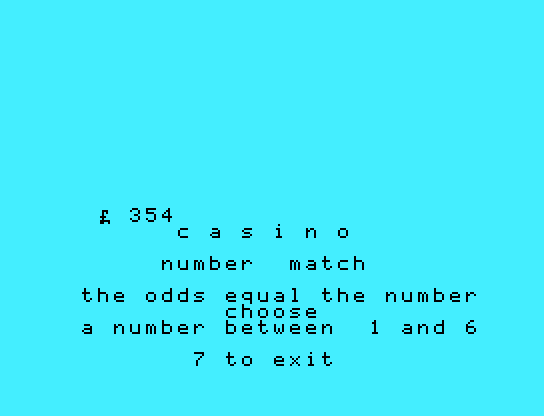
That’s part of the reason the casino is rubbish and you shouldn’t bother. Also the odds are rubbish and there’s no way to savescum (there’s no saved game feature).
The food-lying-around may have broken verisimilitude hard but at least the logic to planning a route (while simultaneously being unclear what actions are needed to beat the game) made gameplay sense. At least I’m not horrified at the thought of eventually going back to the sequel (Mania, in 1983).
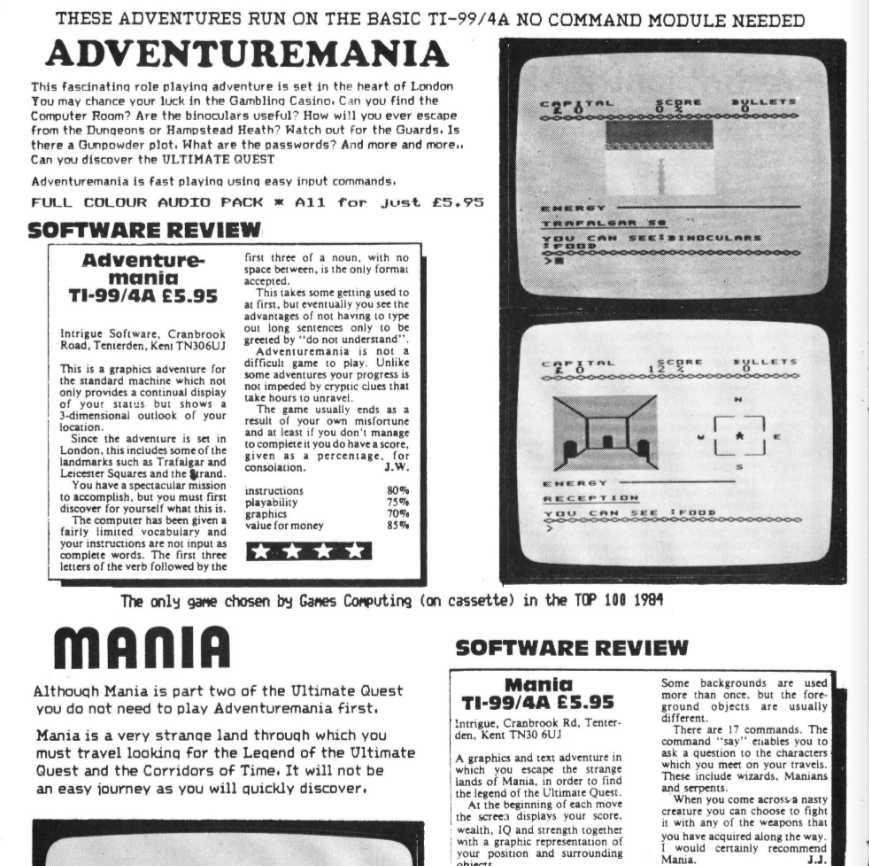
From the 1985 Intrigue Software catalog.
Thanks to gschmidl for helping me past some technical issues; if you want to play the game, I’ve dropped a package here that has it configured.


FrontCover.jpg)
btw, if anyone wants to check the author’s next game (it will be quite a while before I get there) it was covered by The Adventurers’ Guild; not their usual thing but they did it as a Christmas special
https://advgamer.blogspot.com/2022/12/missed-classic-118-santa-and-goblins.html
Includes some more detail on Dennis and his financial difficulties (from getting laid off of an engineering job)
I tried this game, but did not find much more than you did. Here are two things you missed:
When you USEBIN at Whitehall, you will first see the Tower of London. If you keep typing USEBIN, the game will cycle through a number of other things you see (such as the treasury), and you will eventually get a message like “you see the word Nelson at the top of his column.” I tried SAYNELSON and got an error message, as did SAYWORDNELSON.
SAYWORD NELSON got the response “OK” leading me to believe I was on to something, until I realized that SAYSHIT also got an “OK.”
I also tried to USELAD in Trafalgar Square to see if I could read the top of the column, but no luck.
Instead, you can USELAD at the guardroom with the Yale key (one room south of where you find the ladder). This takes you to an Office that is not on your map. I’m not sure if you are climbing up or down the ladder, as it’s not clear. There is a small box on the picture of the guard room that is perhaps supposed to represent a trap door? (Incidentally, there is a similar box at the top of the north wall in the prison, which might be the clue to go N after you OPETAP).
Anyway, the Office has several doors in it. W takes you to an Armoury with Ammunition that you can take. I have not tried it yet, but perhaps this ammunition works with the revolver instead of the bullets. From the Office, you can also go N to a Gallery which seems to consist of several rooms of different colors. All I found there so far is various ways back to rooms already on your map. I keep getting arrested or starving when trying to explore. I’ll have to try some more.
Okay, I found it. In rot13,
Jura lbh trg gb gur terra tnyyrel, FNLZNFGRE XRL naq lbh jvyy or gryrcbegrq gb n Inhyg jvgu gur qrfpevcgvba “Lbh frr gur cnffjbeqf dhrraf xrl.” Tb R sebz gurer gb gur Pbzchgre Ebbz. HFRGVP (GV pnegevqtr) gb trg gur zrffntr: ”pbatenghyngvbaf, lbhe zvffvba vf gb fgrny gur pebja wrjryf. ba aryfbaf pbyhza vf gur xrl gb gur inhyg. tb fvtugfrrvat va juvgrunyy.” Guvf vaqvpngrf gung FNLARYFBA fubhyq bcra gur inhyg jvgu gur pebja wrjryf, ohg nf lbh svtherq bhg, FNLDHRRAF XRL qbrf vafgrnq. Nyfb, lbh qb abg svaq gur pbzchgre hagvy n ebbz nsgre gur Inhyg jvgu “Lbh frr gur cnffjbeqf dhrraf xrl.”
hmm, maybe the Nelson password works somewhere totally different to find out where to use the master key password? If so, that’s a bizarre design move since it’s a lot easier to realize where the master key word goes
or maybe it’s just broken and the author linked the wrong thing