It’s not your world. You arrive there and you’re a person, a creature, just like all the others. You see something shiny and think maybe you could go get it, so off you wander. You’re not controlling the game – you’re part of it.
With this, we reach one of the most well-remembered games of 1983.
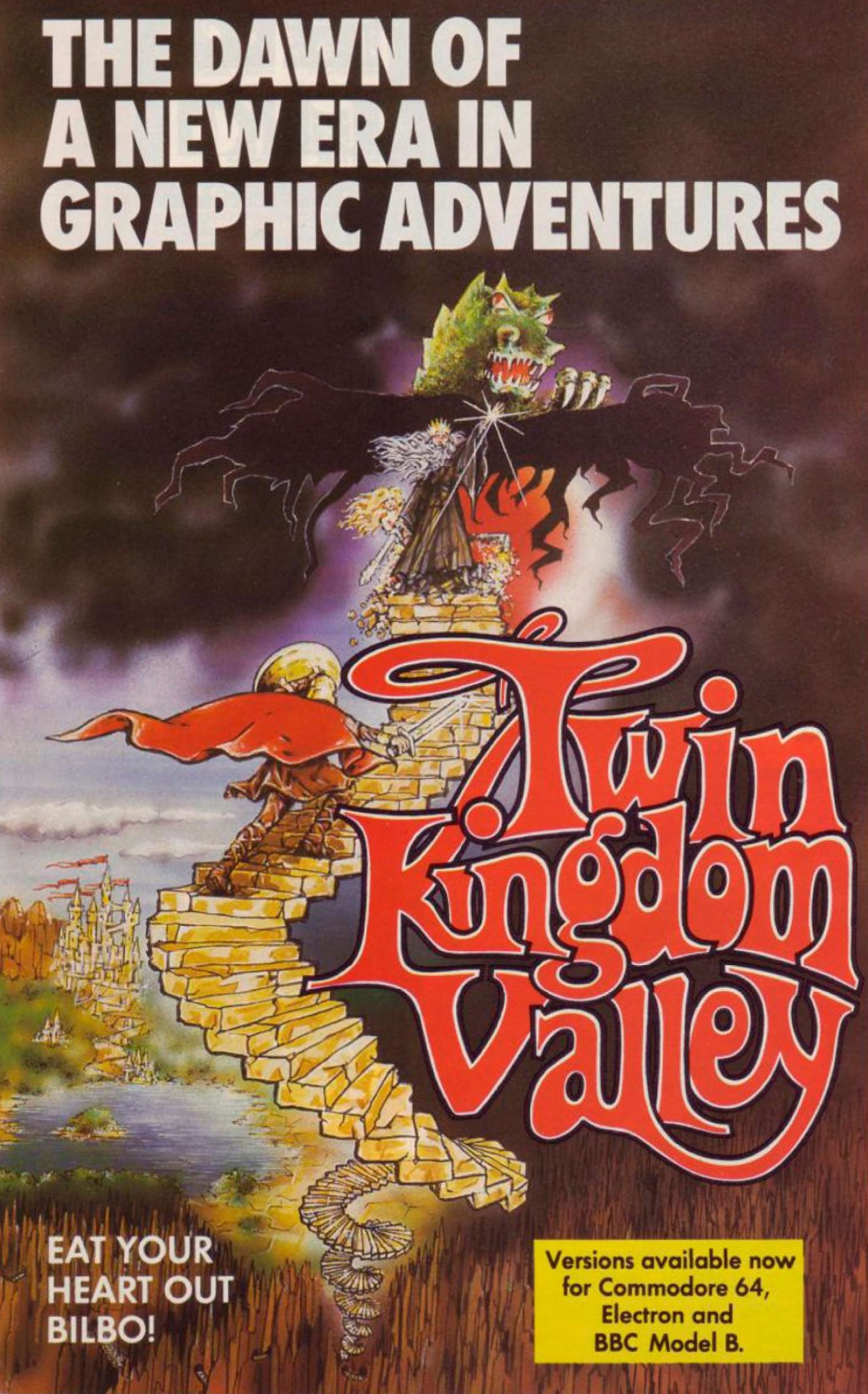
It is often mentioned in the same context as The Hobbit, and this includes advertising from the time (“EAT YOUR HEART OUT BILBO!”) The setting is a “mythical place where two kings reside” who “hate each other”; you are an “adventurous, bounty hunting, greedy human” and your goal is to “finish the game with as much wealth as possible”. This is a standard treasure hunt, in other words, but it has illustrations for all the rooms, and it has dynamic NPCs (the latter point being why it gets compared to The Hobbit).
The author, Trevor Hall, has an unfortunate namespace clash with a more famous musician, but fortunately he’s done multiple interviews (1, 2, 3, 4) so I’m able to give some history.
P. M. Skinner is Pete Skinner, a friend of Trevor’s.
Trevor Hall studied Computer Science in Manchester, getting a taste of arcade games at the student union and obtaining his first computer, the text-only Acorn Atom. By 1982 he started publishing with Bug-Byte.
I think I did what many others wanting to publish did (and presumably still do):
1: Find a game publisher who already exists, and has some titles available, and adverts in mags etc.
2: Send the game for evaluation.
I think Bug-Byte was the first I tried, and they offered a good royalty rate. I don’t know where the company got its start up cash, but there were 3 main players who handled (or mishandled) all that. They had some advantages, like a good artist, a very good deal on rent in a new unoccupied building, their own tape duplication machines. They built a good name from the Spectrum Manic miner series, BBC micro stuff from me and others, and some C64, but lost the Manic Miner programmer to another company. That was probably a bad turning point for them.
In this case he did not simply send games to be independently evaluated (like Simon Wadsworth where his second game Time Warden fell down a black hole and he switched to making games for Artic): he had demo games impressive enough to be a regular contract worker for Bug-Byte. The company has featured here enough times (including the Manic Miner kerfuffle) I won’t recap their history other than to say they were one of the most prominent software houses soliciting games from anyone.
Bug-Byte was getting 20 or 30 games submitted some days and most of them were useless and went straight in the bin but some were excellent.
— Chris Cannon, who selected games for publishing at Bug-Byte, via Acorn: A World in Pixels
Hall has four games credited for 1982, and two more for 1983 prior to Twin Kingdom Valley, all for BBC Micro: City Defence, Galaxy Wars, Space Invaders, Dogfight, Sea Lord, and Oblivion. Space Invaders is worth a screen as Trevor credits working on the game as how he learned assembly language.
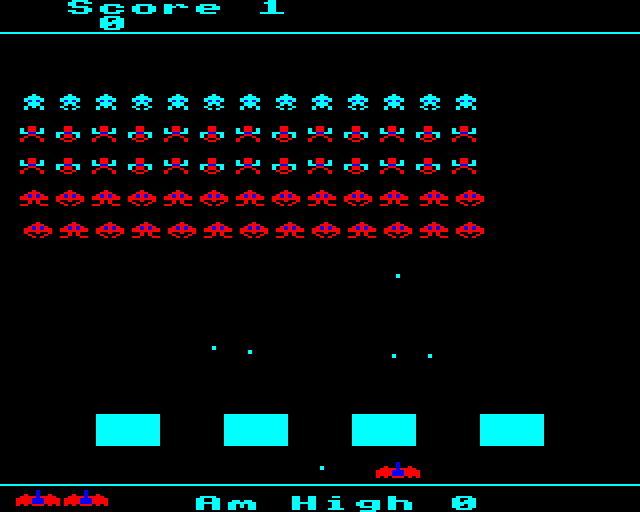
The single-pixel bullets mean the barriers last a bit longer than regular Space Invaders.
Hall’s first experiences with adventure games were his friends playing Crowther/Woods which appeared on “big computers” at the university:
I never got very far in Adventure. There was some version of some system at the university, which we found fun to play, but, time on those systems was limited, and we had to study sometimes.
He remembers one of his friends commenting on the characters “standing still” with the same puzzle to solve whenever a character is encountered. He saw some home computer games with the same issue:
The troll was always standing by the bridge. It made no sense! So I thought, why not make every creature in the game, including oneself, pretty much the same. Make everyone able to walk around, pick things up and fight. Let them interact.
In other words, he wanted a game where you are not the protagonist of a story, but rather part of a world.
He and some friends drew maps (using “little green pieces of paper he’d swiped from the computer science lab”) and worked out how connections to other places could be described in a “few bytes”. He describes the parser as “easy” (“tokenize the text, and recognize a verb and an object”) but had more trouble with the graphics. He wanted 3D but found it to be too slow, so he used scaled pictures instead with flood fill. The general idea was to have scenes not thought of as being single pictures (like Sierra) but compositions of objects; he modified the code so “program wouldn’t attempt to draw underneath something that was already there.”
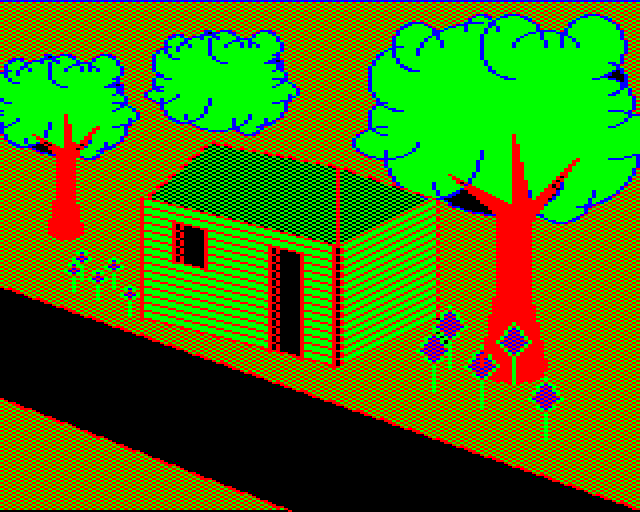
Road outside wooden cabin at the start of the game. The game states outright “the picture is your view north”.
The trees from the scene above are both the same object image, drawn at different scaling levels. Sierra’s Time Zone and Melbourne House’s The Hobbit would have both trees drawn as individual graphics. Rather than a “picture book” model, Hall aimed to make an “environment” akin to modern 3D worlds. Note that Hall’s “priority drawing” system glitches a little bit with one of the flowers; it gets drawn in whole but then some of the tree lands on top, while most of the tree is drawn “behind” the flower even though it appears on the screen after the flower. When Hall talks about Pete Skinner drawing “many of the objects” he really means objects, not entire scenes.
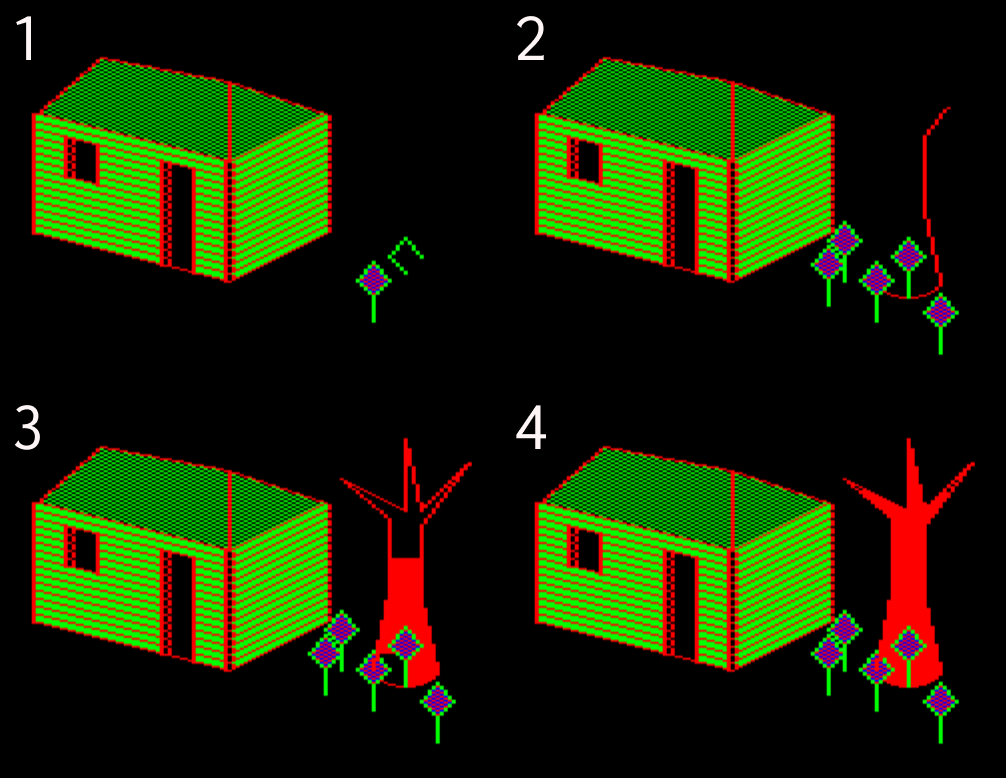
His world-representation paradigm (thinking of the world as “3D space” even though it isn’t) applies not just to graphics but to text. Graphics are reused where you see things from farther away or closer, but the rooms are designed such that things seen from afar can be included in the textual description. Despite the BBC Micro being relatively plentiful on space this sort of maneuver was needed in order to include all 175 rooms he was aiming for.
Hall talks more about his NPC design in his interviews but let’s come back to that when we have some more context, and get into the game itself. From the start there is again the eternal question: which version? The original is BBC Micro; there’s also the Electron, Spectrum, and C64, and I know at least the C64 has more rooms than the BBC Micro version does (so revisions happened, like The Hobbit). Still, comparing all the graphics, the BBC Micro version looks the most “intended”; the graphics appear designed for a screen with a particular color scheme and resolution.
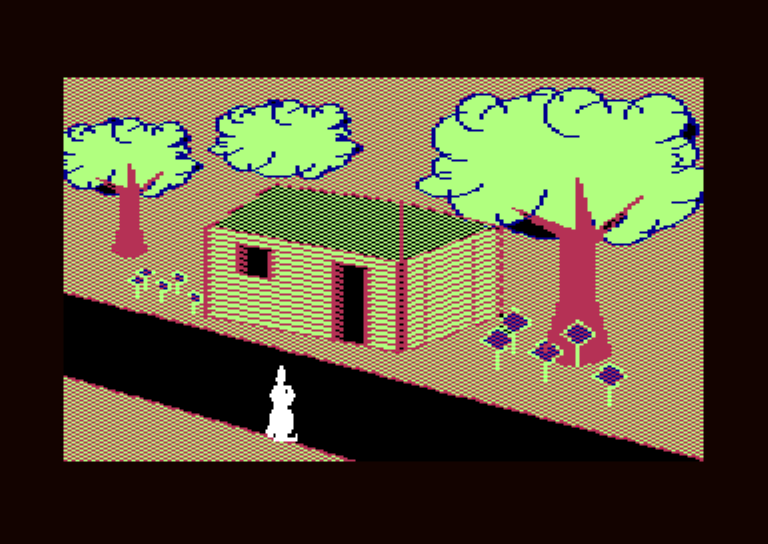
C64 version. Notice how the flowers look a little mangled. There’s an animated hopping bunny, though!
The game helpfully gives six options for how text and graphics work:
1 Draw picture if room unvisited, give long description
2 Draw picture if room unvisited, give short description
3 Draw picture always, give long description
4 Draw picture always, give short description
5 Don’t draw picture, give long description
6 Don’t draw picture, give short description
For the moment I’ve set things to always show pictures and long descriptions, but let me show long vs. short in the starting rooms.
You are on a road.
North you can see a wooden cabin.
North east is a forest path.
East you can see a road.
West you can see a road.
South is a wooden fence through which you can see forest.?N
You are inside a wooden cabin
South you can see a road.
There is an empty stone jug here.
There is a brass key here.
There is an unlit oil lamp here.
The “short” version cuts out all the direction descriptions: just “You are on a road” and “You are inside a wooden cabin” without mentioning what is east/north/etc.
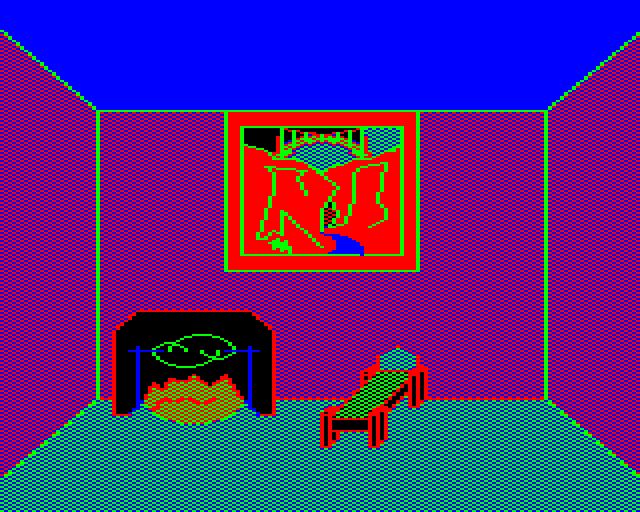
The cabin is where the treasures go.
The map is not only large but immediately open, so I’ll save giving the lay of the land next time, but one quick visit to another place:
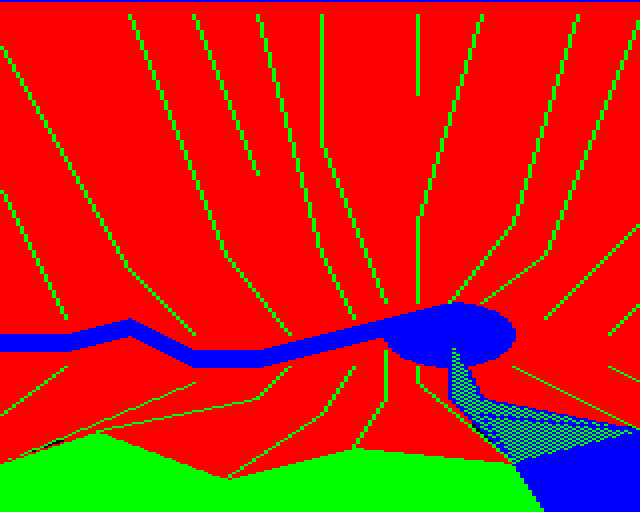
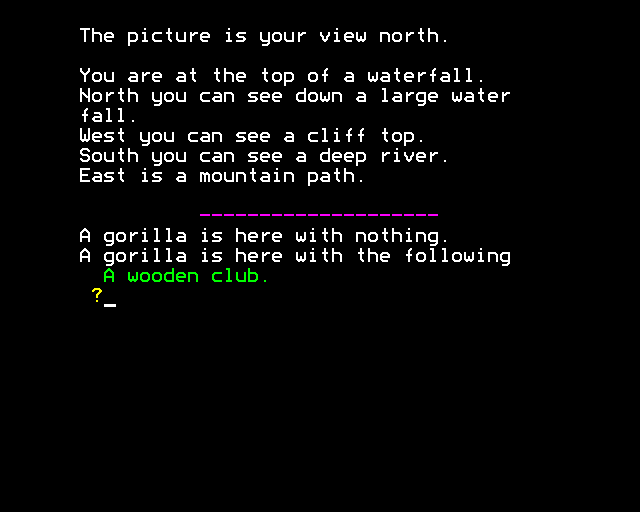
The gorilla is an enemy you can fight that can also follow and randomly thwap you with the club it is holding. The enemies can pick up weapons that happen to by lying around; again, this feels strongly like MUD behavior. An elf was nearby and later the gorilla had nothing and the elf had the club; it appears the elf simply stole the club.
A gorilla is here with nothing.
An elf is here with the following
A wooden club
Allegedly the puzzles aren’t elaborate (at least compared to The Hobbit) so this really does give a different feel than a standard adventure game. I’ll report back in next time if that holds up.


Wow, don’t know how this is going to play, but it seems amazingly innovative in several ways, and I’d never heard of it.
I was an active reader of the UK gaming mags starting in the mid 80s (several stores in my area imported them monthly), and I remember it being quite popular there, across multiple platforms. Not quite at The Hobbit levels, but definitely big for an adventure game.
The early British scene seemed very enamored with adventures that gave the impression of being part of an active, dynamic world. I’d guess the lack of a large domestic CRPG market and the strong early predilection for “arcade adventures” played a role in this. Plus, the teenage bedroom coders who wrote many of the standard text adventures and simple action games didn’t usually have the chops to pull these off, so they seemed more prestigious.
This, along with The Hobbit, was the first adventure game I got for my ZX Spectrum. My dad bought both of them in a computer shop in Östersund for my 11th birthday.
A boy in my school claimed to have solved Twin Kingdom Valley, so as I got stuck I went to him for clues. He gave me increasingly vague pointers that suggested fantastic yet-unseen locations. I took me months of playing and making progress until I realised that his clues made no sense. When confronted about this, he finally admitted to never having played the game at all.
I’d still like to play (or make) the amazing game I created in my imagination based on his made-up clues.
Pingback: Twin Kingdom Valley: Outdoors | Renga in Blue