People are going to buy these things and then after six weeks or so they’re going to put them up on a shelf in their closet and ignore them … we saw that there was a need for something that helped people to both socialize with other people and get practical life use out of these really significant investments.
— Stacy Goff, president and co-founder of Atari Computer Enthusiasts
Before getting to our author today, I need to revisit one of the prior games from this blog, Max’s Adventure. Max’s Adventure (or just Adventure) was given by the author Max Manowski to a shop in Seattle, and from there it distributed far enough across the US Northwest to catch the attention of the Atari Computer Enthusiasts club in Oregon. The club helped distribute the game farther before it eventually got the attention of Atari and was packaged as Wizard’s Revenge as part of their APX program; it became the only text adventure that Atari published made by someone outside the company.
The same issue that talks about Max’s Adventure (April 1981) also discusses a San Francisco event where ACE members visited Atari, with pictures, so it’s possible the game was handed to Atari directly.
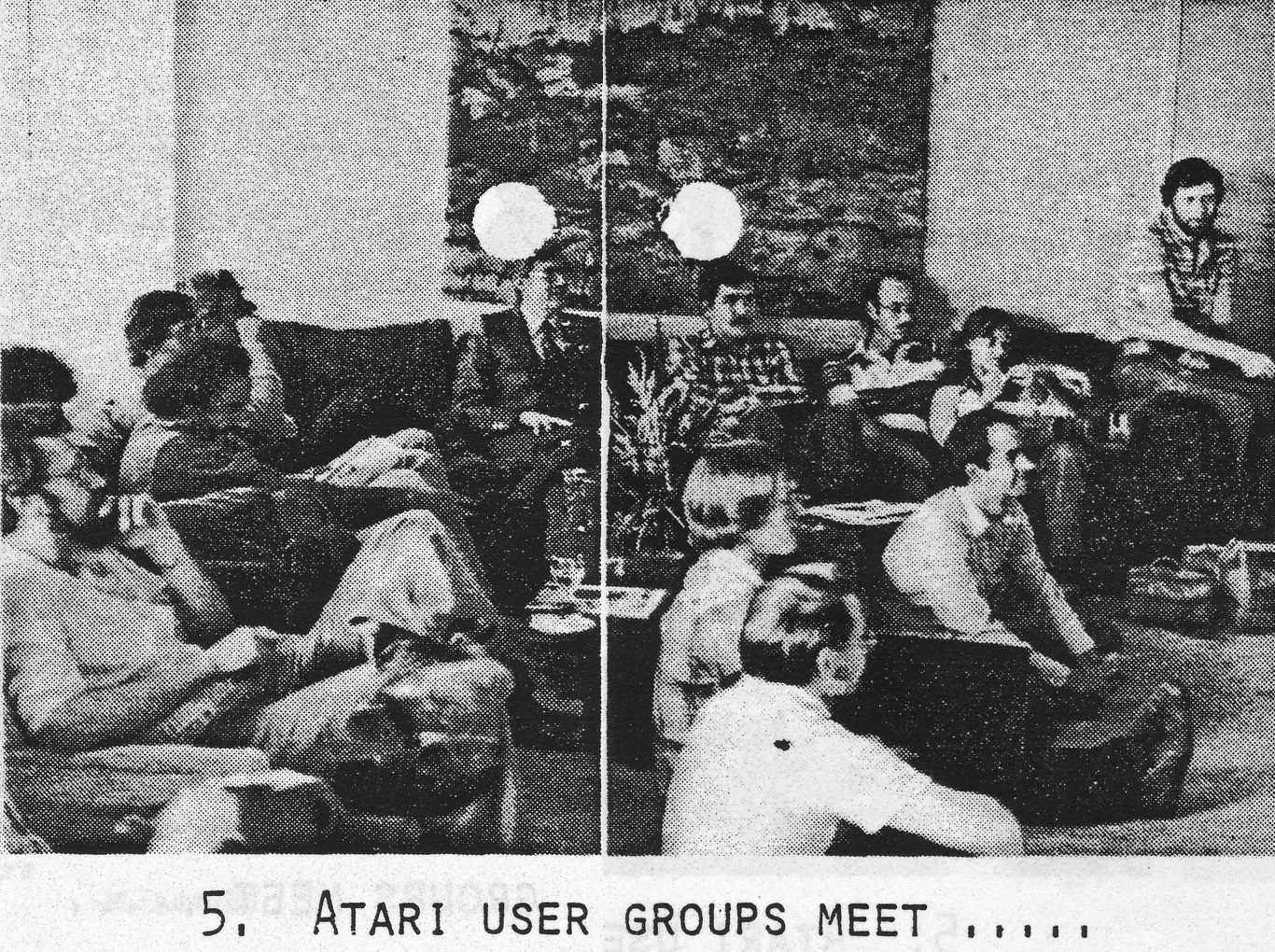

There was an effect beyond just getting Atari’s attention, as ACE had an unusual distribution plan, which they describe as a contest.
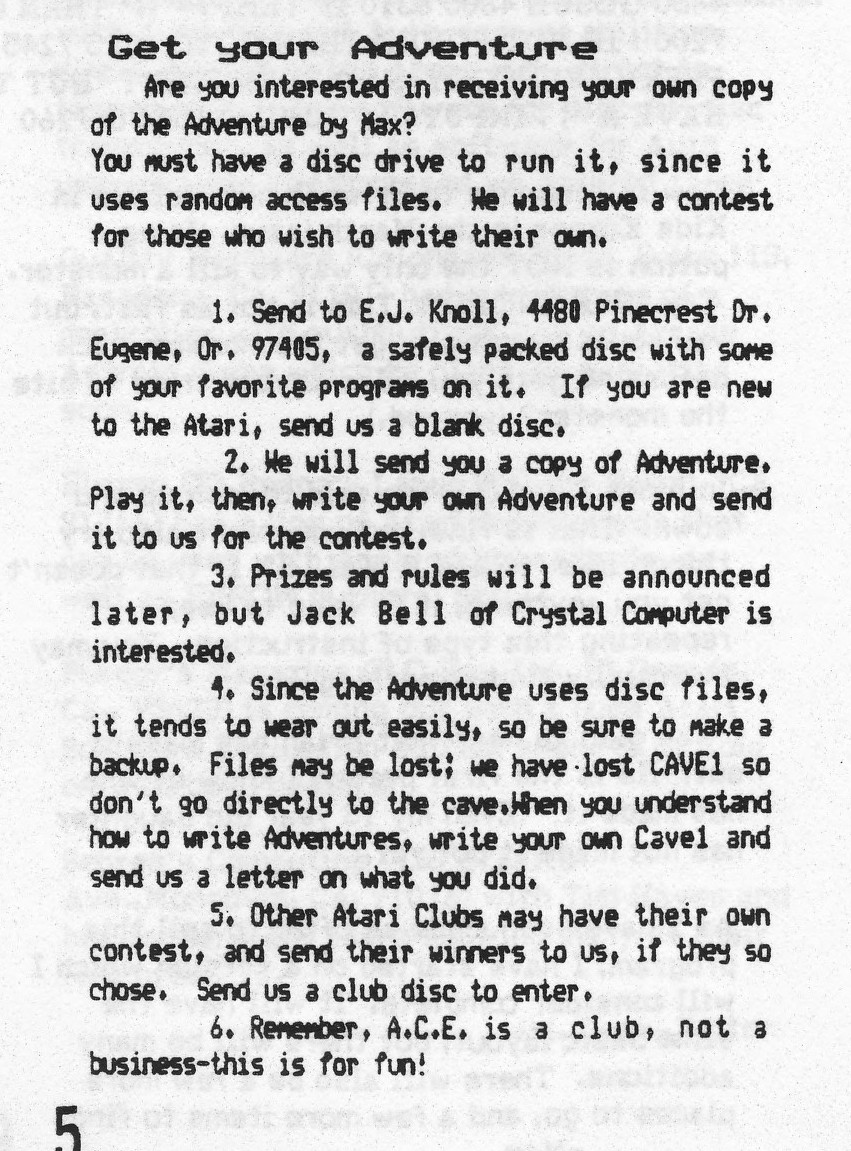
The offer was: send a disk to ACE (with some programs if you have some, blank if you don’t) and you’ll get a copy of Max’s Adventure. Write your own adventure based on it and send it back (prizes to be announced later, John Bell of Crystalware was interested). Even given the loose nature of the “contest” and their explicit mention “this is for fun” this does beat (in terms of being earliest) the Falk contest for Tandy CoCo. However, the contest does not get mentioned in later issues, so I think it ended up as vaporware.
At least one person picked up the challenge of modifying Max’s Adventure into a new game, even if it didn’t end up in the “contest”: George Schultz of New Jersey.
Schultz helpfully included his address in the source code as well so I was able to cross check on a few sources (1, 2, 3, 4) to get his biography. He was born in 1941 and after a stint with the Navy he went to Rutgers to get a degree, graduating in 1973. He moved to New Jersey as a journalist with the Newark Star Ledger before switching to being editor of Fuel Oil News in 1982; he stayed with oil business journalism until his death in 2002 from a heart attack.
This means he was in his 40s when he wrote Sherlock Holmes, which is the first fully Sherlock-Holmes branded text adventure for this blog. (Two Heads of the Coin from 1979 was clearly meant to be Holmes, but doesn’t mention his name, nor does it get into any lore — it’s a pure conversation with one person.)
As far as why it took this long to get a straight “you are Holmes” game, with text adventures of this era it has been rare to have major characterization at all. Usually “you” has been “you” in some sense, maybe with some extra conditions (like in Cyborg being merged with a robot) but not with a background that might justify a full 30 pages in a LARP session. Exceptions have included The Hobbit, Robin Hood Adventure, Sherwood Forest, and Aldebaran III; so while we have had developed characters, relative to the large number of adventures up to now it’s a short list.
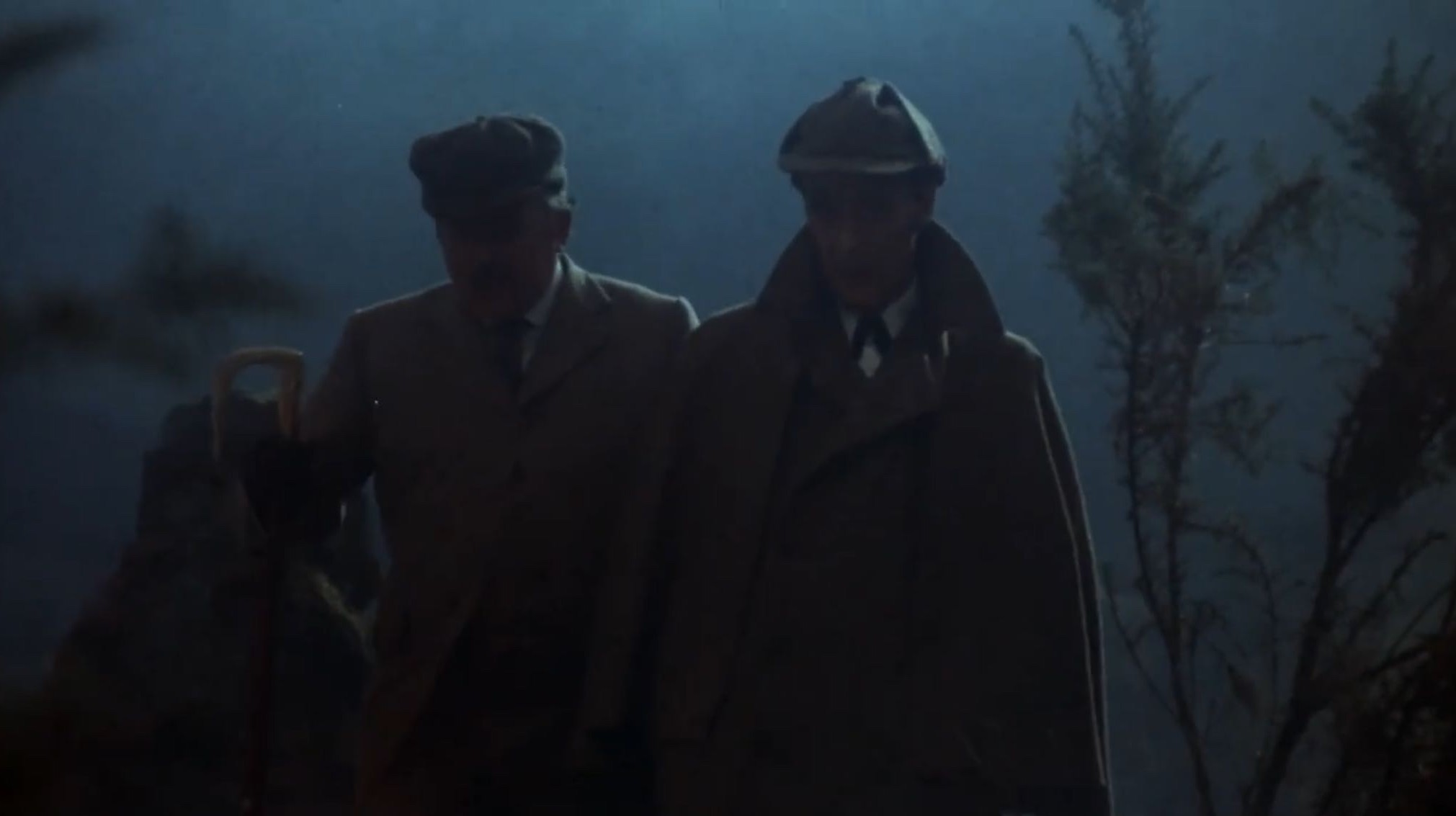
Roughly when Schultz was working on his game there was all sorts of Holmes media being made, like this BBC adaptation of Hound of the Baskervilles. There was also a Soviet adaptation from 1981 and animated films from 1983.
The reason I know the code is derived from the ACE game is that it says so; I’ve pulled out both pairs of source code alongside and can definitely say it uses the same unusual system where you can edit the game from within the game. These lines of code are identical amongst the two, even with the same line numbering:
3220 IF INPUT$(1,3)=”NEW” THEN 3400
3225 IF INPUT$(1,4)=”GOTO” THEN 7600
3228 IF INPUT$(1,4)=”LIST” THEN 8000
3230 IF INPUT$(1,5)=”PRINT” THEN 3800
3240 IF INPUT$(1,6)=”CHANGE” THEN 3600
3250 IF INPUT$(1,6)=”EXTEND” THEN 4000
The only comparable game that’s been on this blog is ZOSC based on the GROW system, and that was just repurposing a system intended more for learning applications. I theorize that having a system that emphasizes adding text content on the fly rather than programming might appeal to someone with an English/journalism background. Unfortunately, the parser is miserable in the way you might expect from a GROW-style game, as you’ll see in a moment.
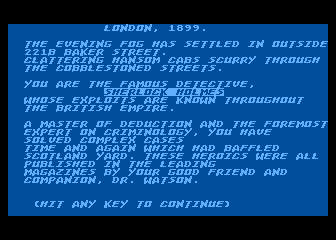
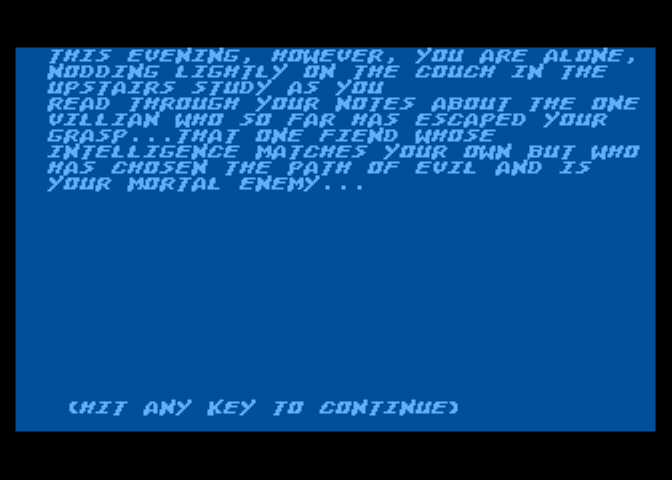
You are casually hanging about your study at Baker Street when Mrs. Hudson brings in a letter. You determine quite quickly it must be a forgery and Dr. Watson is in trouble.
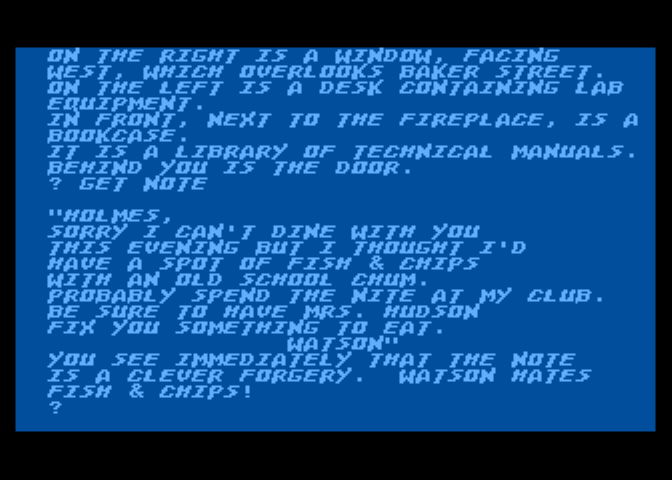
At this point you can try running off to at least Scotland Yard, but let’s hang out in the study for a while.
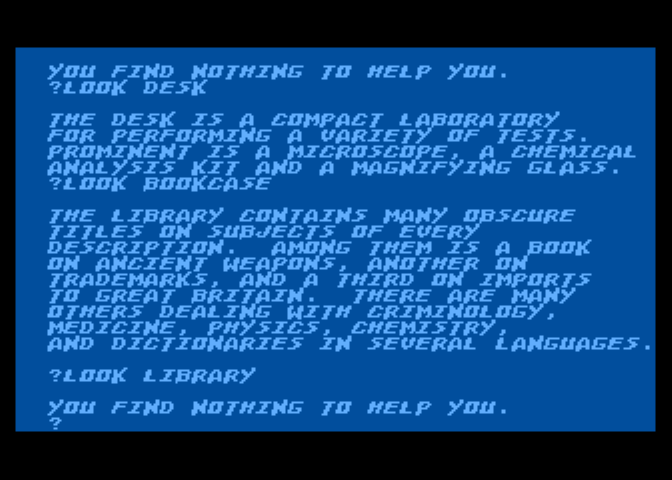
The various investigatory tools suggest you might be able to do something to trace the note, but unfortunately, I immediately ran into a stumbling block here trying to get anything to happen. Keep in mind this is a GROW-style game where it doesn’t really keep track of “world state” in a normal way; it’s jumping between nodes and fishing for particular prompts. In this case, it wants you to EXAMINE DESK, and then immediately use something from the desk on the note; if you examine the rest of the room first, the desk ceases to exist (this is roughly the behavior of The Phantom Ship, but this game has it even worse). There’s no world model storing the fact there’s a desk and a bookcase, just some central place where EXAMINE DESK and EXAMINE BOOKCASE work, and I found myself sometimes just in a labyrinth of “YOU FIND NOTHING TO HELP YOU” responses.
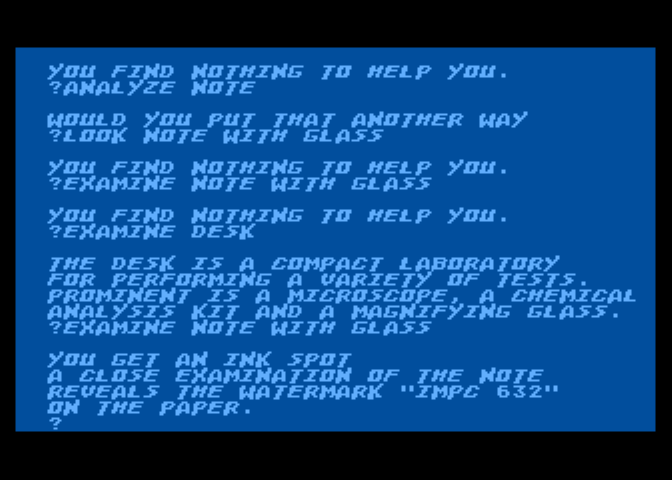
You also need to jump to this being a multi-word parser here.
The note reveals a watermark which you can investigate further with the books; remember there was a book about trademarks. Well, actually, just remembering it is bad, you need to EXAMINE BOOKCASE immediately before using something on it.
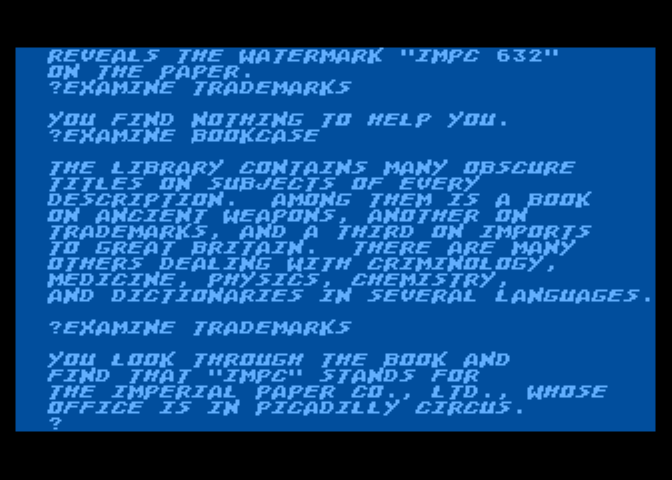
You can also follow this up with EXAMINE IMPORTS to find out that inks coming in from China are imported by Dihn Imports, in Limehouse.
Finally, you can EXAMINE WEAPONS mentioned on the bookcase. Somehow that gets interpreted as opening the bookcase and finding a secret revolver, which you’ll need for the end of the game. (It’s faintly possible the game keeps so little track of state you could skip taking the revolver and you’d still be able to use it at the end, but I haven’t tested that.)
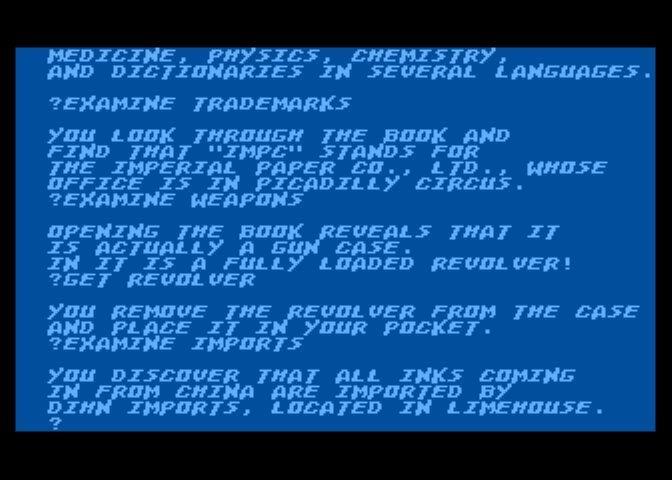
I’ll pause and say in a conceptual way this is an impressive segment; we have an item that we apply both detection tools and research to in order to learn more. The parser simply isn’t able to sustain what’s going on (again, this seems to be a combination of the node system with the author’s perspective, thinking like writing from an author’s perspective rather than modeling a world).
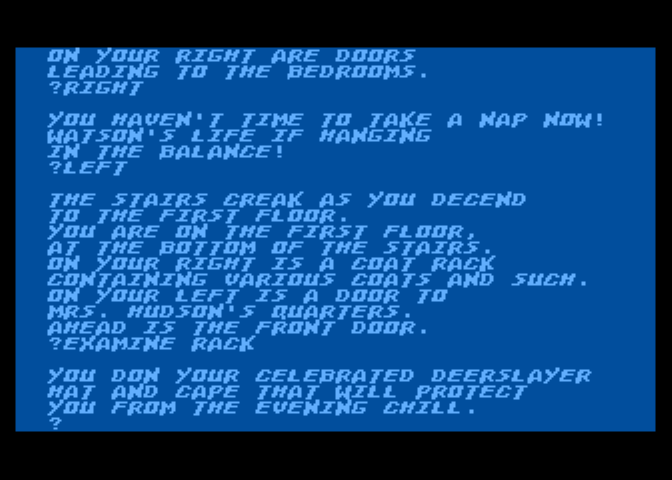
The game is afoot; you can nab your famous outfit on the way out, and then hail a cab. As seems to be the standard for investigation games, you need to tell the cab-driver where to go, so this is a matter of hunting down key-words. So far other than 211 BAKER STREET (no “B”) we can do SCOTLAND YARD, PICADILLY (with that exact spelling), and LIMEHOUSE. Let’s try Scotland Yard first, since the visit is short.
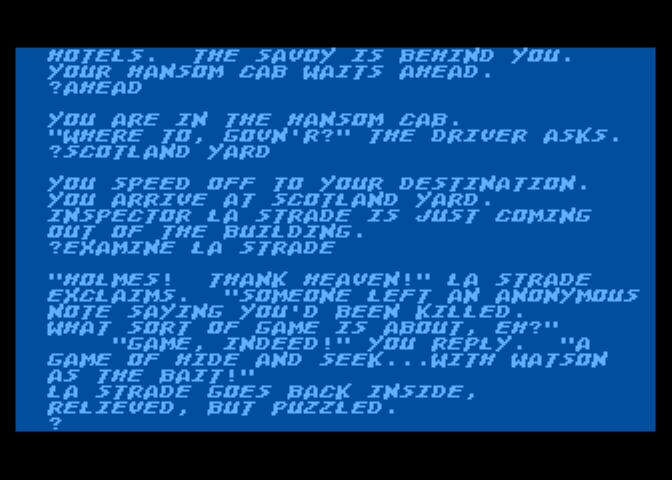
The “La Strade” spelling suggests to me the author was watching the stories recently on TV/film as opposed to reading them.
Regarding Pic(c)adilly, hinted at from Imperial Paper…
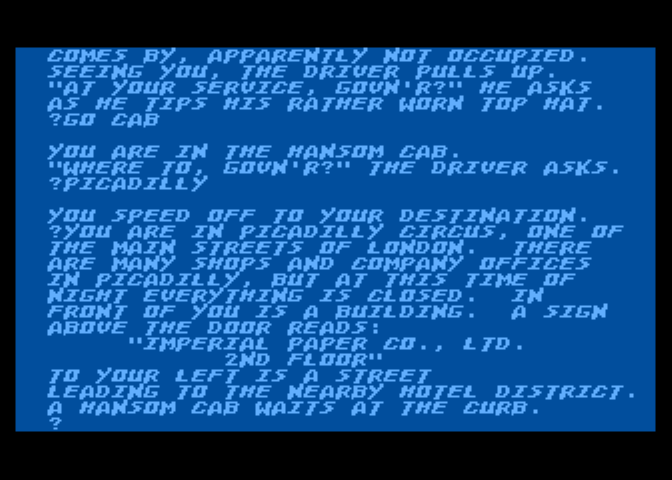
…it’s not clear at all this is the way to do it, but EXAMINE IMPERIAL PAPER will let you enter the closed building. There you can find some files about the Savoy Hotel. This is entirely an optional section; I actually went over to the Hotel first and didn’t find out about this area until beating the game.
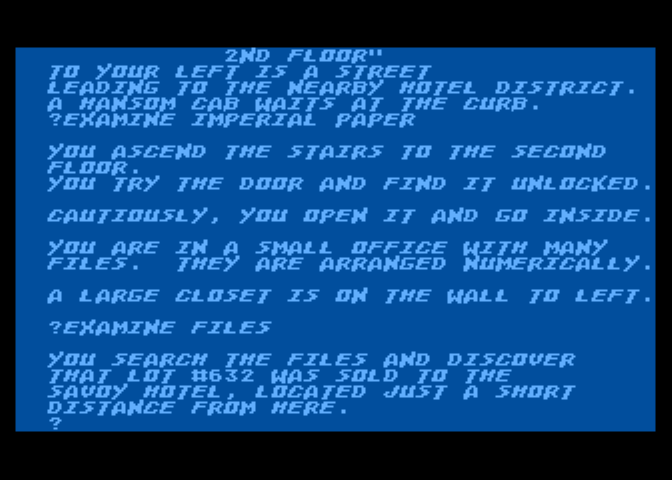
Leaving the hotel and going “LEFT” you can find the hotel (no north/south/east/west).
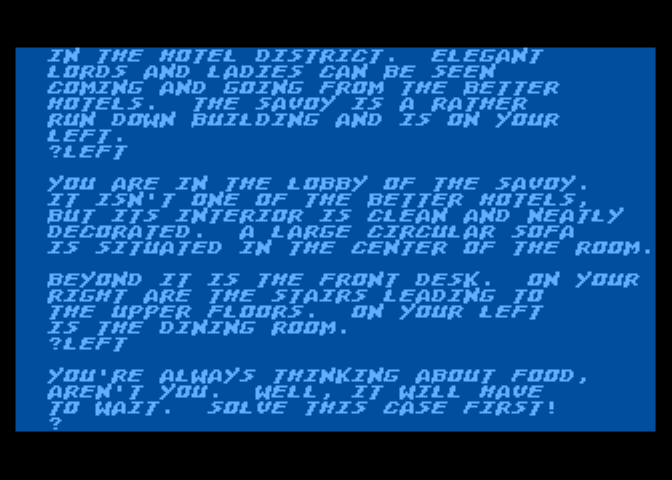
I’d like the in-character chastising more if it matched the character of Sherlock Holmes.
Going ahead, Holmes notices a hat (Watson’s) left behind on a couch; going forward and examining the desk reveals a guest register, which the clerk refuses to let you look at.
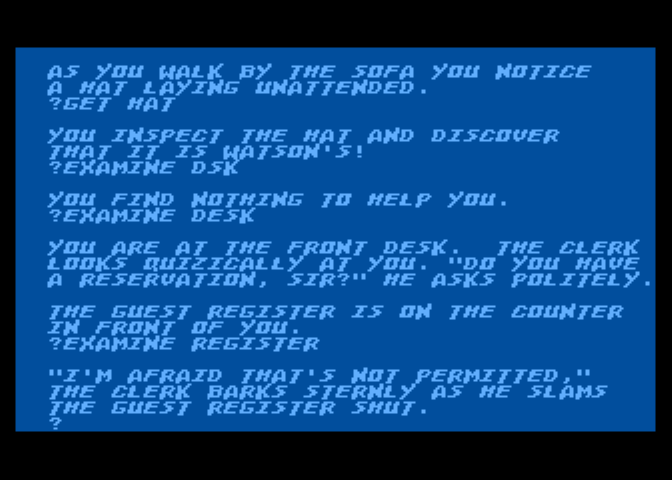
I ended up needing the walkthrough for this one. Trying to TALK TO CLERK didn’t work. While Holmes is not described as holding money, I tried BRIBE CLERK anyway and got “HUH?” The right command is to PAYOFF CLERK, shooting the puzzle to being at least in the top 5 Hardest Adventure Game Verbs to Figure Out Ever.
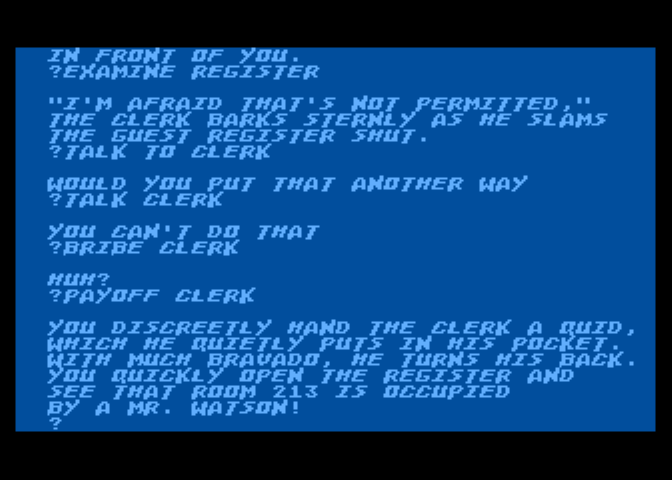
This process lets you go upstairs and find the room Watson was allegedly in, unearthing a key.
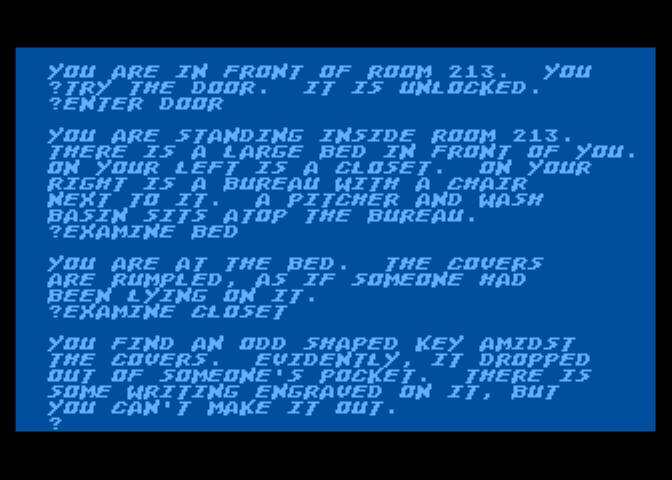
Again notice the stumbling parser. I tried to EXAMINE CLOSET but the node here just assumed I was examining the bed further and found the key. I’ll take a parser issue making the game easier over one making the game harder.
You can then take the key back to Baker Street to study it and find out what’s on it… maybe. I really had immense trouble here; there must be something exceedingly specific in how the nodes are implemented.
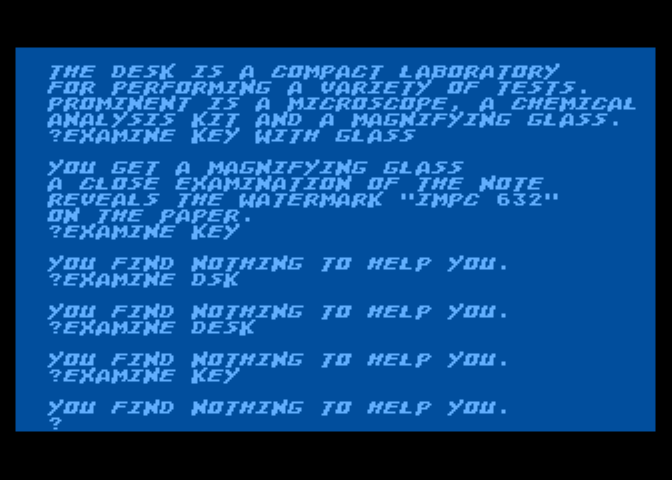
Even with checking the walkthrough it took me two tries to get something out of the key.
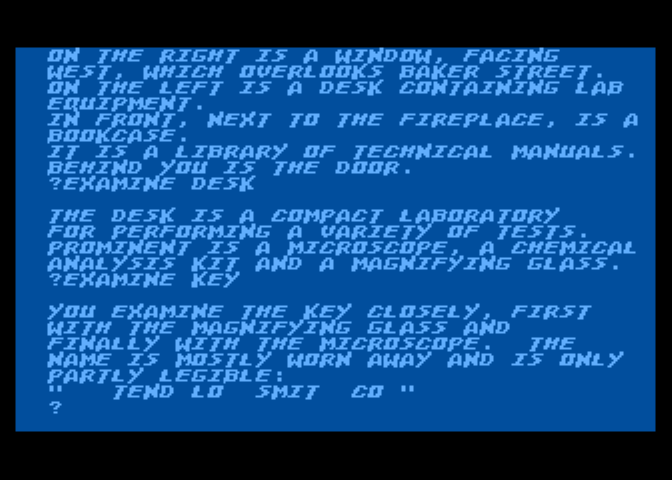
Back here in a moment: time to visit Limehouse.
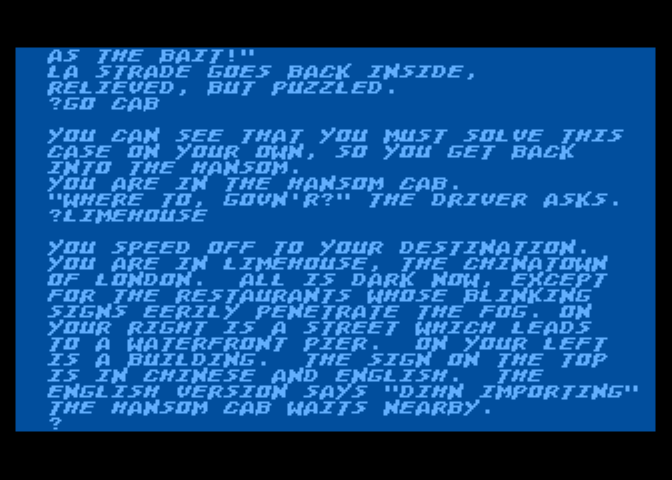
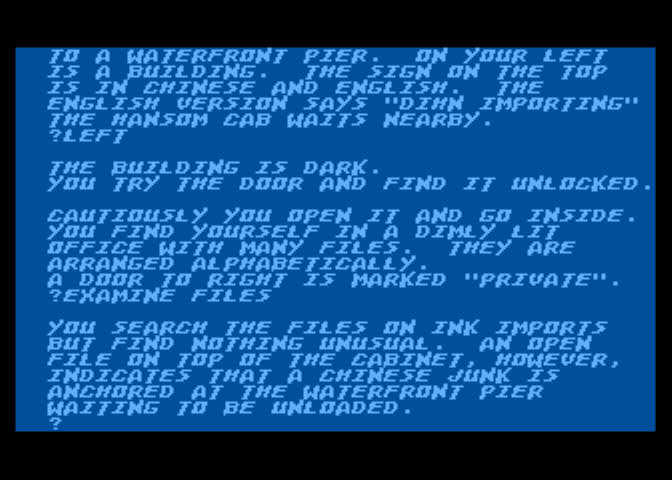
Files indicate a dinghy on a pier. With a little bit of parser struggle I arrived there. The pier also has Dr. Watson’s medical bag (his items are being left suspiciously out in the open); you can row the dinghy over to the main boat, and find some matches with writing in Chinese.
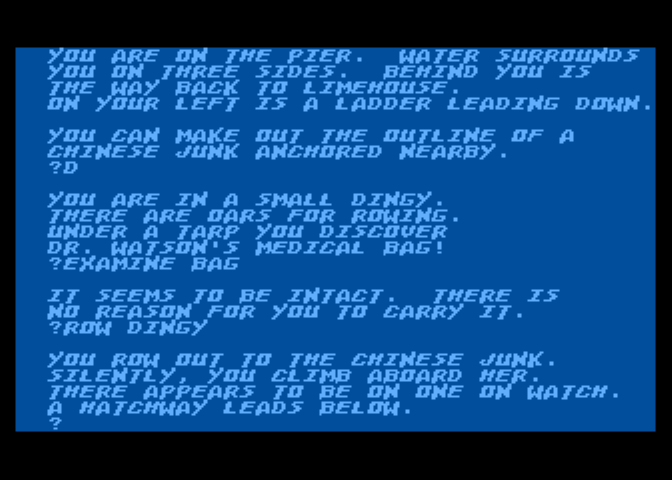
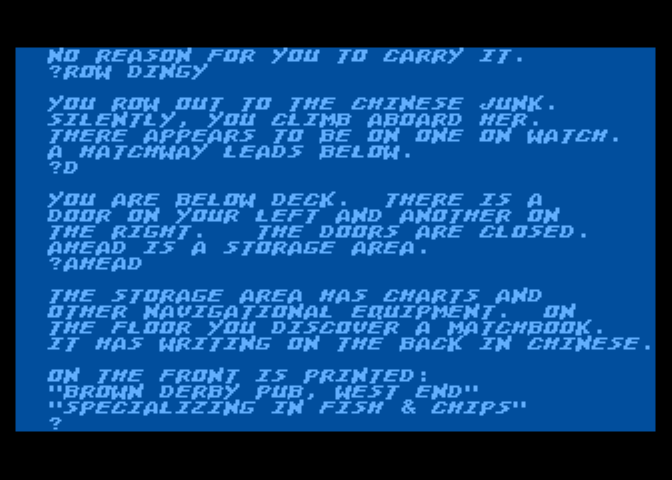
West End represents the last destination, but we should probably translate that matchbook text first. Back in Baker Street there’s a dictionary on the pile of research items which reveals a set of directions.
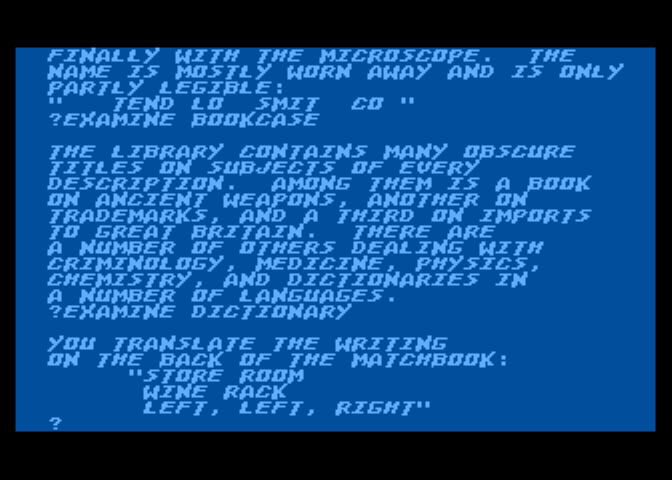
I again want to emphasize, in a conceptual way doing research on clues is extremely neat; in practice it was extremely painful to get anything to work.
Time for the West End…
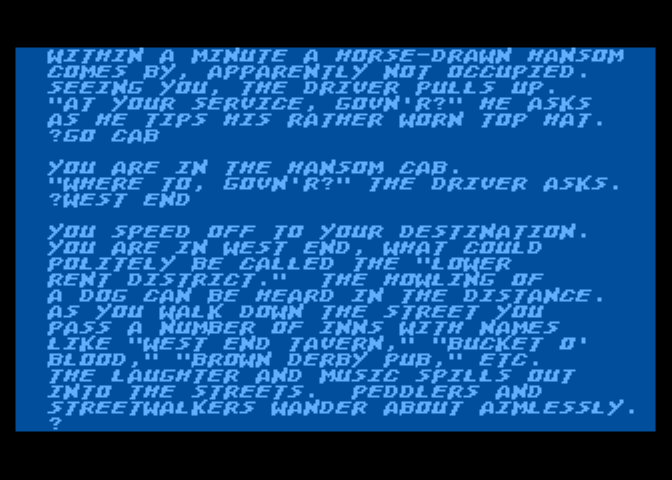
…and a serious… bug?
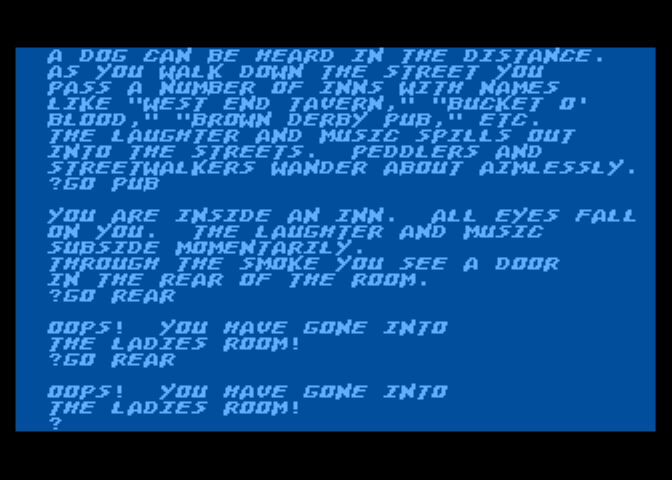
GO REAR reaches the next part of the game, but often it doesn’t work. It doesn’t seem to be a “random” flip; when it isn’t working, you have to leave and come back and try again. I tried various phrasings of GO and ENTER and IN and OUT and so forth to see if that would make any difference. I don’t know if it does; the walkthrough doesn’t know either.
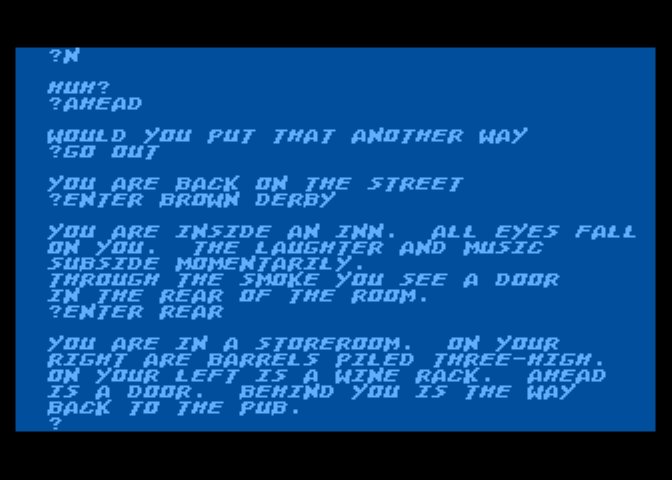
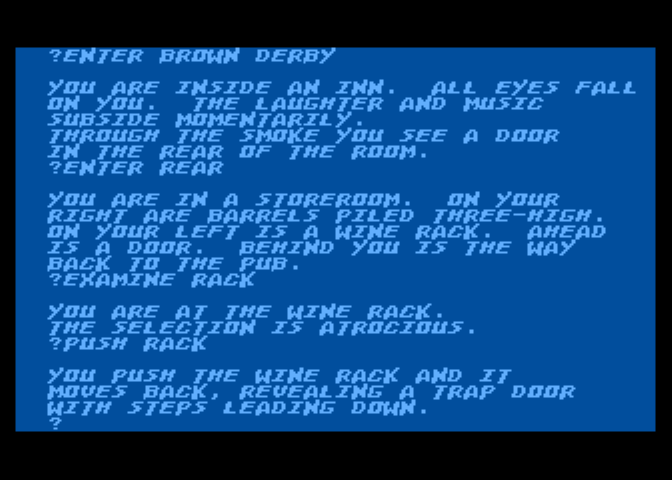
There’s a wine rack you can PUSH to find a secret entrance to some sewers.
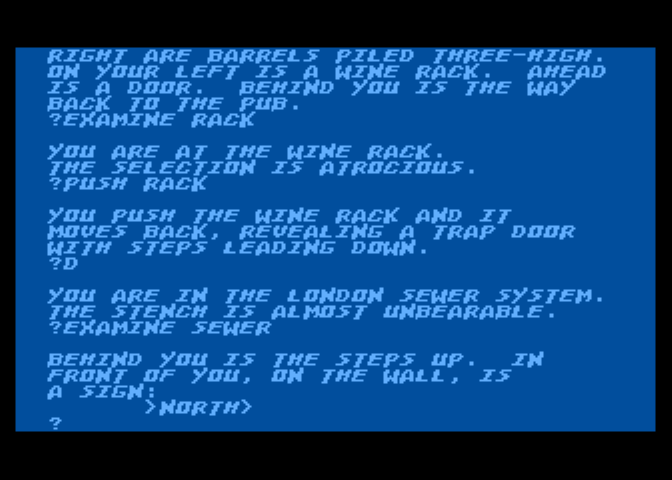
The sewers are where you apply the directions from the matchbook.
Following them properly leads to a crack in the wall where you can INSERT KEY.
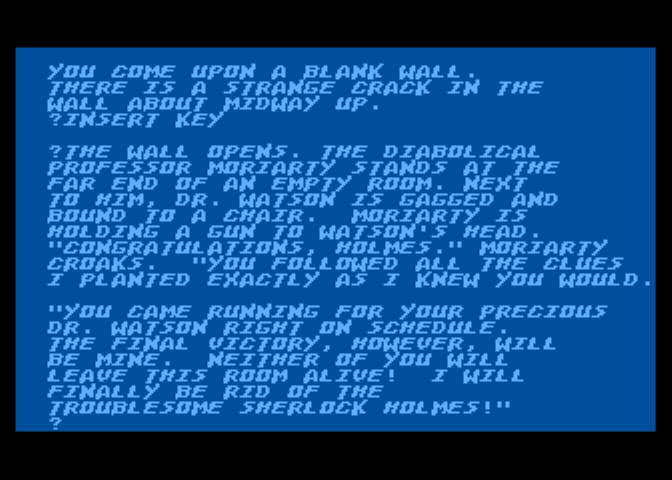
Driving off Moriarty is a simple matter of trying to SHOOT him with your revolver; however, he’s left a trap for you if you try to just go in afterwards. You’ll fall into a trap door and die.
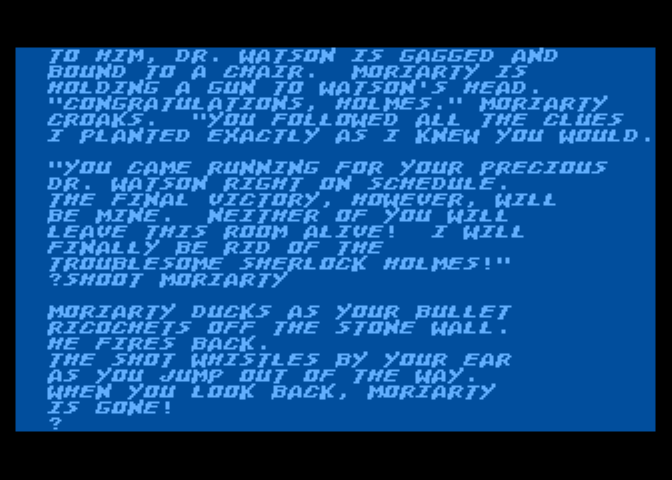
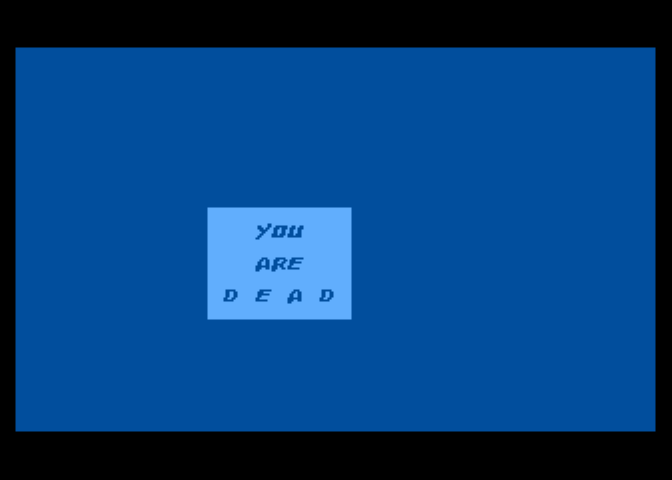
You need to JUMP OVER TRAP DOOR to get by.
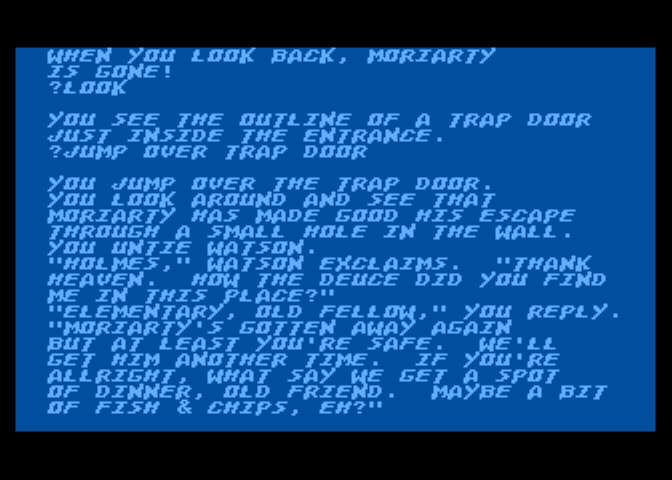
Twist ending with the fish and chips! If this was “canon” I’d be more annoyed.
The artificial set of obstacles works as a set of challenges by Moriarty; it gets taken up by at least one author later. The presence of the hat and the medical bag especially felt like a trail-of-Moriarty plot element. The moment-to-moment action held at least some interest, and the research aspect was genuinely a good idea. Unfortunately, the parser was miserable all the way through. The author tried his best to implement his ideas with the system; honestly, it’s impressive how far he got, but there still wasn’t enough world model support and parser implementation to make the game work. In a big-picture sense, this reflects the technical barriers for making adventure games at this time, and why so many toolkits like The Quill became popular.
Coming up: back to Japan, and a famous anime movie.


 Renga in Blue
