I’ve finished the game. Read my previous posts about this game first if you haven’t yet.
Saying the game was “difficult” is too light. I can reverse engineer at least some of the logic for the steps to win, but one moment in particular is so outrageous I don’t think it’s “solvable” in any regular sense. I would say this was created by the author for their own personal play and showing off to friends (yet it ended up in print somehow) but there’s a specific technical aspect I’ll be getting into that made me discard that theory.
Since source-diving is going to be involved in all this, I need to talk about the PC-6001 character set.
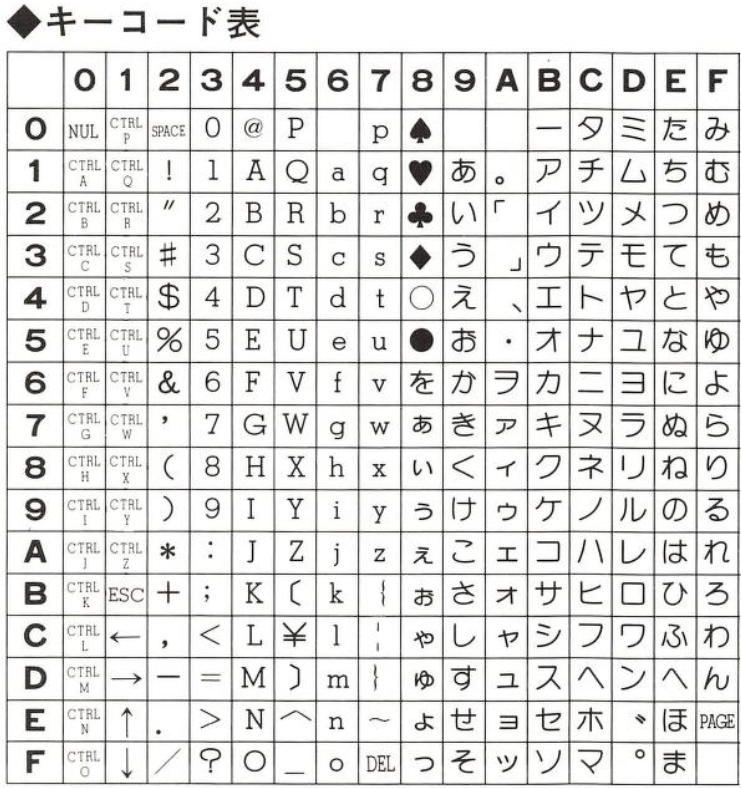
Via the PC-6001 mkII manual.
As an example of how the set works, let’s take a piece of the game I already got through: cutting through the cage. The game prompts the player with “オリ ヲ ヌクロ !” (“remove the cage!) at line 2770, while storing input in H$. The game is wanting “kiru”, that is, きる.
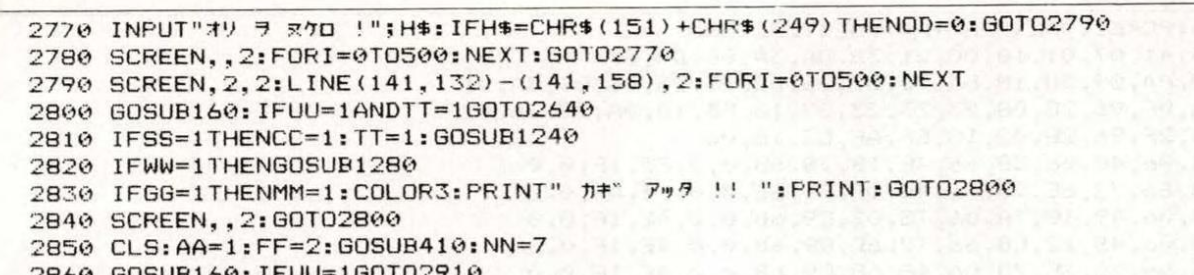
It checks H$ against the characters 151 and 249. The chart is in hexadecimal (base 16 rather than base 10) so we need to convert the numbers to check what characters they match. 151 in hexadecimal is 97 and 249 is F9.
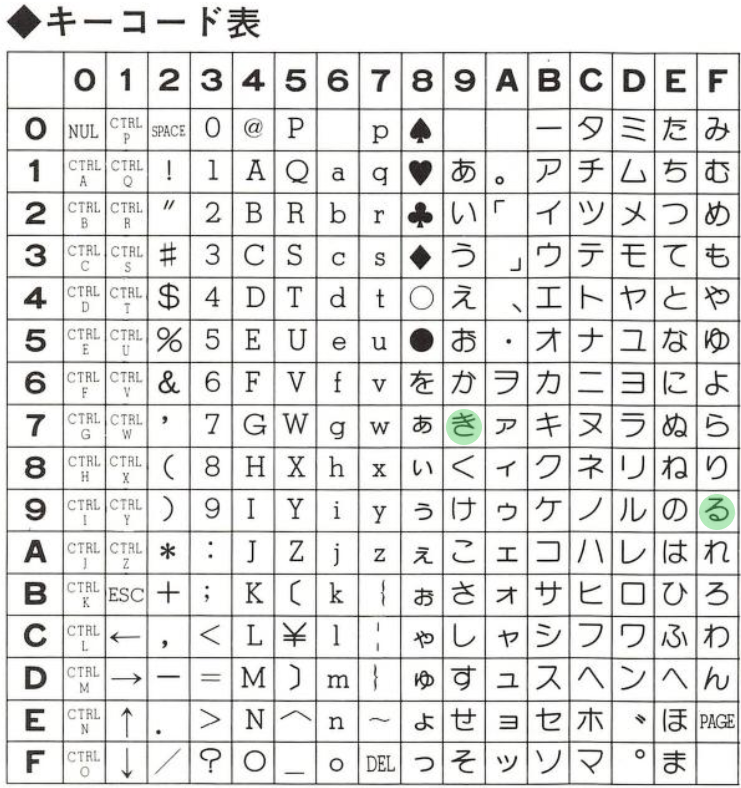
Reading column 9, row 7 gets “ki” (き) and column F, row 9 gets “ru” (る). Hence “kiru” works.
This is enough to get all the “bespoke” moments the game has (there will be two big moments later where this comes up) but it doesn’t get at the verbs/nouns generally. That’s because the BASIC has some data lines with character codes, but they aren’t stored “plain”; there’s an additional decipherment applied on top of that.
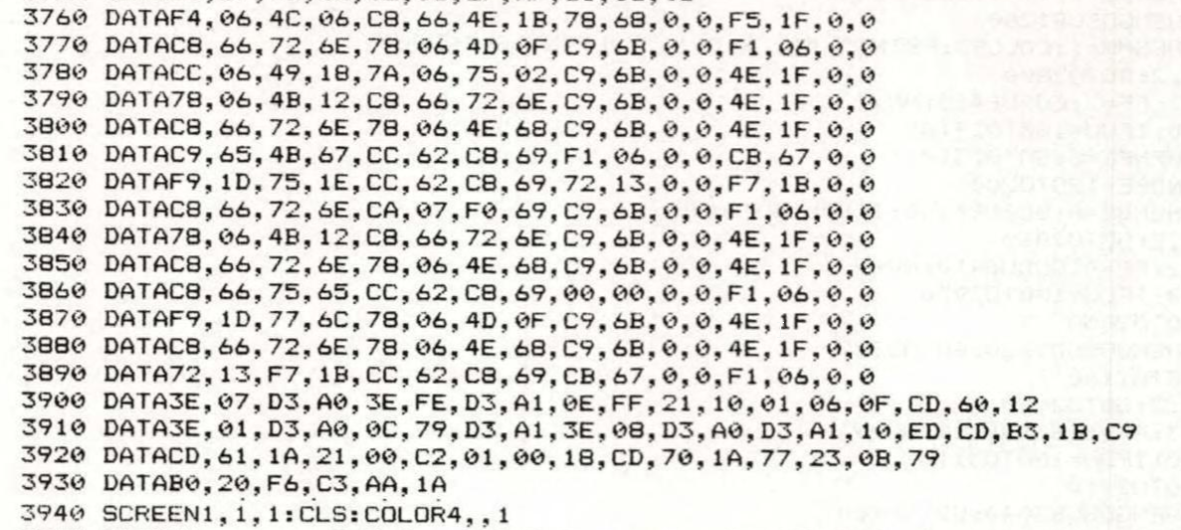
Let’s take the car (kuruma) as an example, written as kuru (くる). The word is stored as 4C 06 (you can see them as the third and fourth entries in line 3760). If you try to check the letters くる on the chart, you’ll get 98 F9 instead. What’s happening is that the actual bits undergo two different kinds of decipherment. I’ll lay them out for you in binary. First off, 4C (enciphered) to 98 (actual):
4C: 01001100

98: 10011000
Second, 06 (enciphered) to F9 (actual):
06: 00000110

F9: 11111001
If you squint at the binary digits, you’ll see in the first case, there’s a rotation one step to the left, and in the second, all 0s and 1s flip (a NOT is being applied). Since all words are given by the player in exactly two characters, every input that comes from the table goes through this process. These actions are listed in order of the rooms (so the car is mentioned at the very start because that’s the only place you can do an action on a car). Every room has its own small set of commands that work, and these commands are separate from other rooms.
The attempt to prevent anyone from reading the words here suggests this really was meant for print (adventure games being solved by just typing them in was a common problem). With the storage method worked out, I was able to dump a word list of sorts, and goodness this gets absurd. The overall map, first, to orient ourselves:
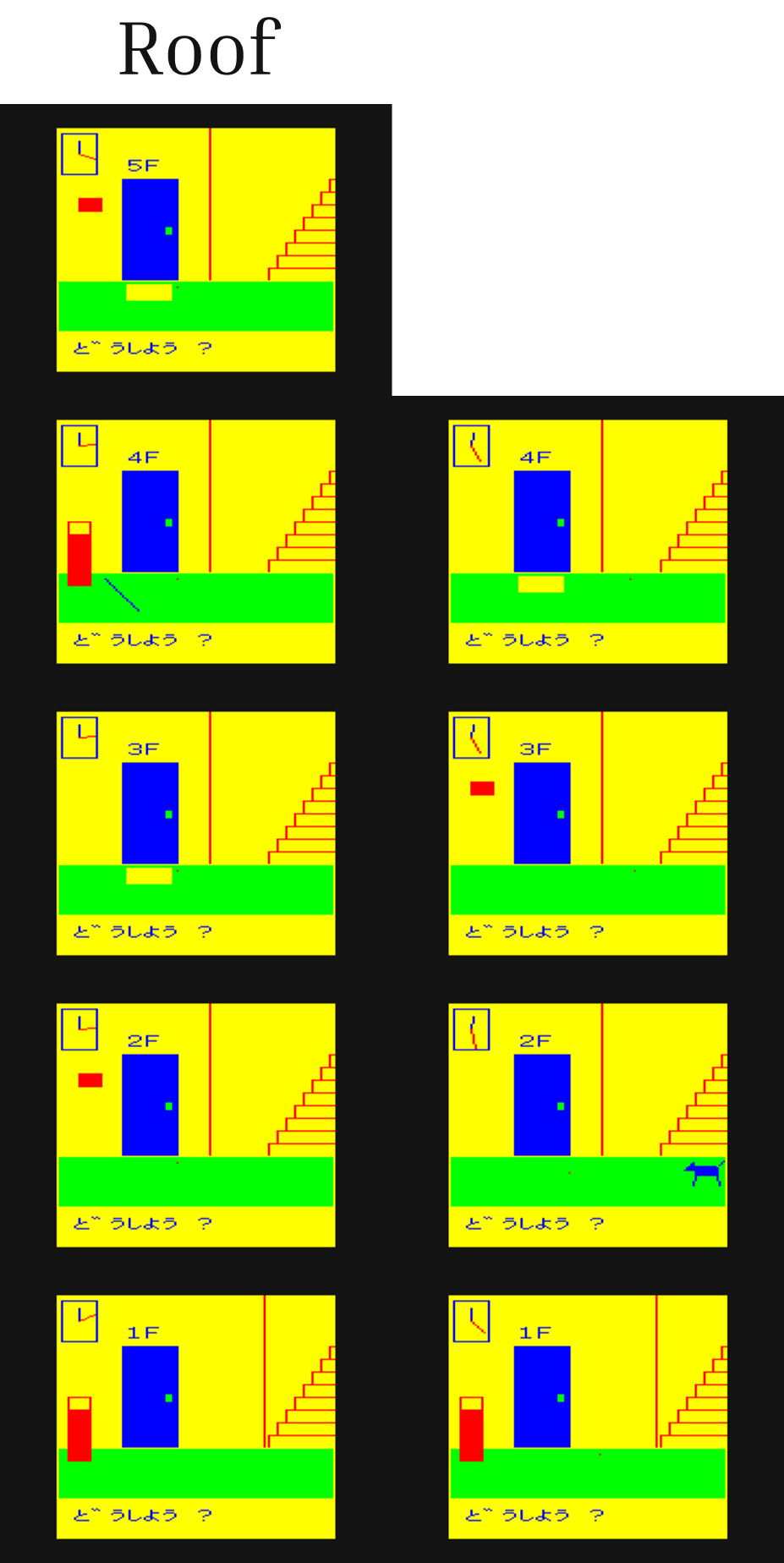
In the right tower there’s a dog on the second floor. After meeting the dog you go to the “shootout” minigame. (The animation below includes the moving dot which appears in many scenes; I never was able to figure out why it was there.)
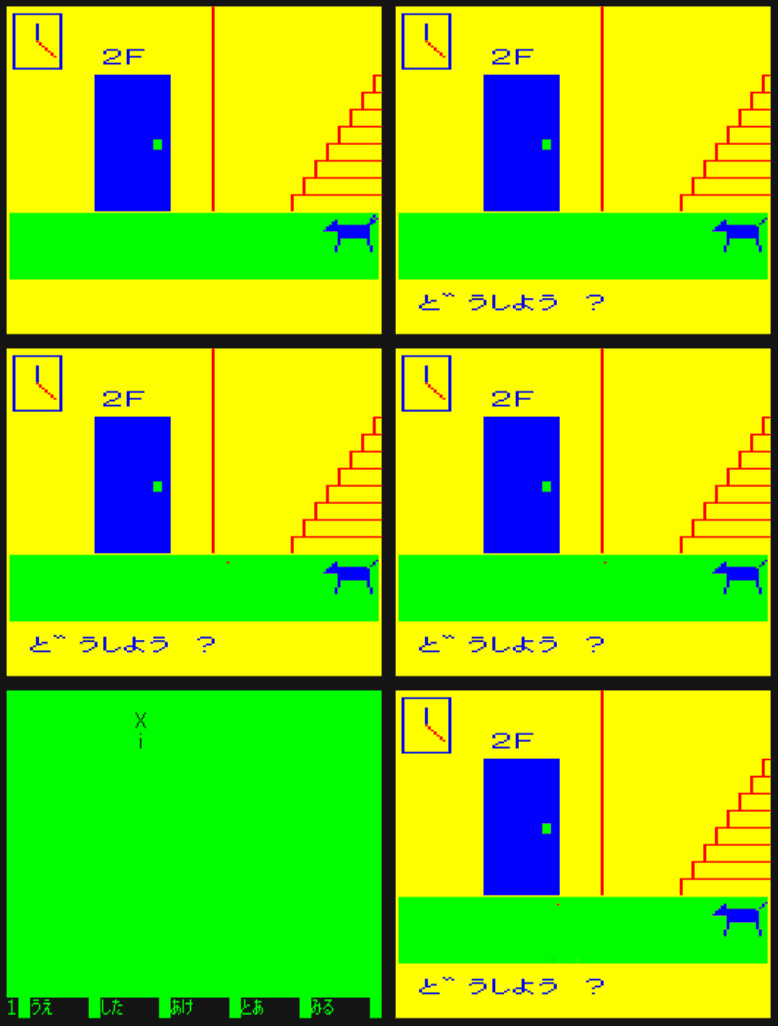
You can in fact ignore the dog entirely and win the overall game; one winning process (after getting the first key from the car) is to go to the top available floor of the right tower, go in and get the second key, leave (where I got stuck last time, I’ll explain how in a moment) and go back down past the dog a second time. Any time the dog is encountered a shootout begins. I assume it’s an “alarm” dog somehow but the circumstances are still befuddling of a new enemy appearing each time the dog barks at you.
There’s a slightly safer way of handling the right tower which only invokes the shootout once. You can get rid of the dog, and this comes straight from the deciphered commands in the source. You can kick the dog (not too outrageous, but rough in a limited parser) or you can “yaru han” (やる はん) which requires a little interpretation. Yaru (やる) in context here means giving food to a dog. With はん, remember that the voiced consonants are getting nuked, so my best guess is ぱん (“pan”) for bread. I don’t understand any reason why someone would think they’ve got bread with them (or any other food for that matter), but as we already saw with “cut” the author is comfortable with “invisible” implied inventory.
With the dog out of the way, what about escaping the cage room? If you look at the standard outside shot…
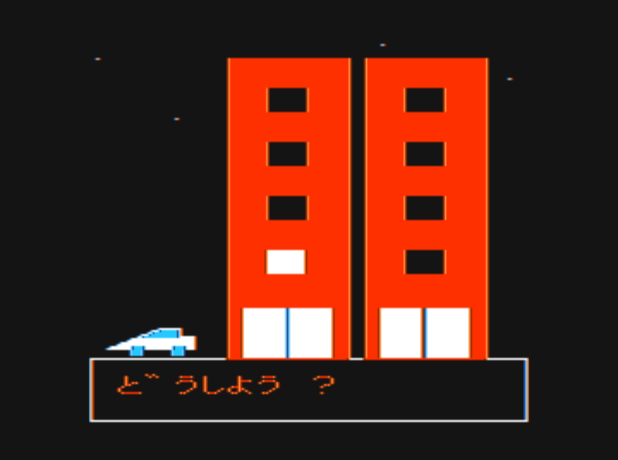
…the only room that’s pre-lit is the first floor of the left tower (that’s where you trigger the shootout minigame if you open the door; there’s no reason to do so). So when you enter the fourth floor of the right tower, the lights either go on automatically or there’s some unmentioned implied action where the player turns them on. (This is cleared up later; there’s a message I think the author forgot to trigger. Too bad the first time is where it’s really helpful!) In order to leave you need to switch off the light (kesu aka[ri]). There is no switch visible in the room, you’re just supposed to guess that it’s there.
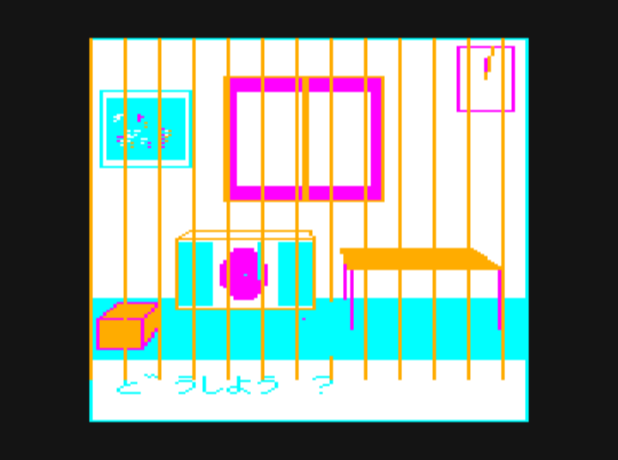
Now we’re done with the right tower! On to the left. Map again, just to stay grounded:
Floors 1 and 2 should be skipped (2 kills you outright if you open the door). The previously-locked third floor takes the second key. This incidentally has a message about the lights being turned on which I believe was missing on the prior door.
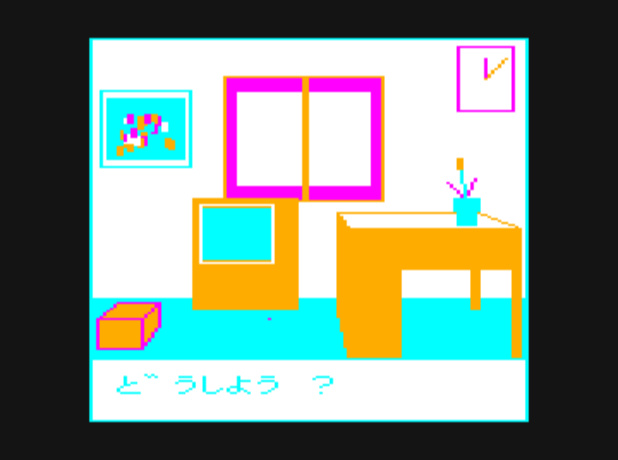
This room is relatively simple, except for the things you need to ignore because they won’t be recognized: just open the box, revealing a third key, and then make sure you turn out the light in order to leave.
Any mats or containers or wall plaques or mailboxes or whatever things we’ve been seeing don’t usually respond to commands (or give no useful information), with one exception. On the fourth floor you can find a stick if you search what turns out to be the trash.
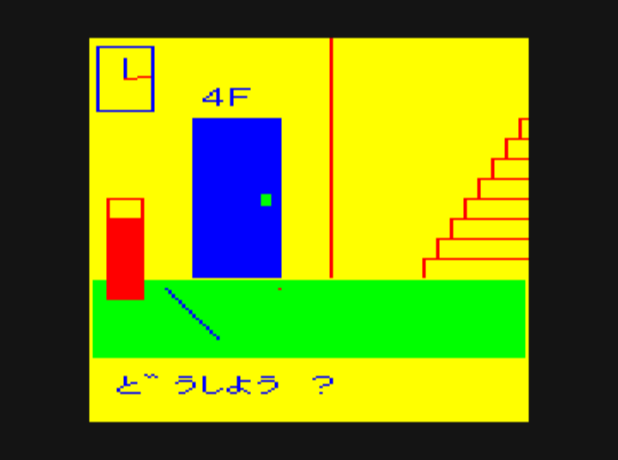
This was pretty much the last thing I worked out on my own.
The third key goes to the fifth floor, and this is the part where the game leaps past solvable (…not like the dog thing or the cut thing or the light thing were reasonable to get…) Applying the key to the fifth floor, you fall down a trapdoor.
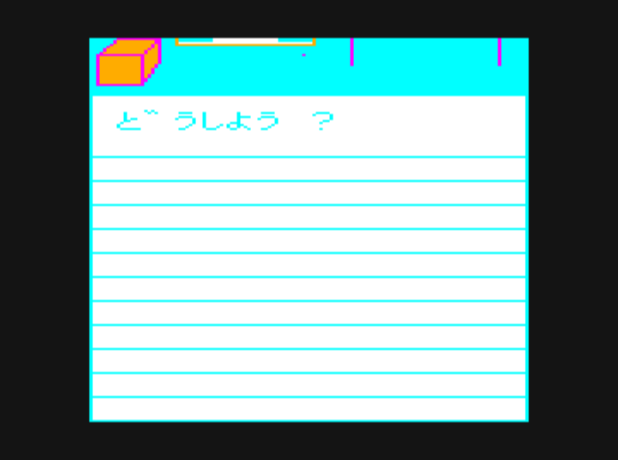
The game asks what you should do as you are falling, and while it isn’t clear from the screen, the game is hoping you press a particular keystroke, which will trigger using the stick from the fourth floor to brace yourself.
3420 COLOR3:LOCATE5,T:PRINT”ト゛ウシヨウ!”;:LINE(0,T*12)-(255,T*12+12),4,BF
3430 SOUND1,15:SOUND6,31:SOUND7,246:SOUND8,16:SOUND12,10:SOUND13,0
3440 IFBW=0GOTO3490
3450 A$=INKEY$:IFA$=CHR$(105)GOTO3470
The line in question is 3450, which checks for CHR$(105), or 69 in hexadecimal. Pulling up that PC-6001 chart again…
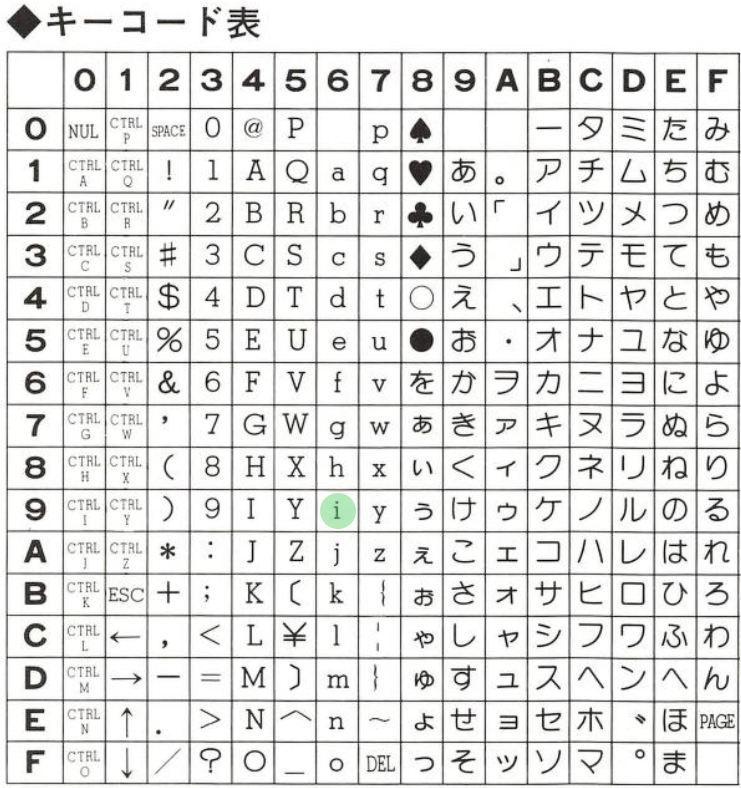
…reveals that the keystroke being looked for is the English lowercase letter “i”. Keep in mind the player will almost certainly be in hiragana mode, as that’s how the game is otherwise controlled. Somehow they have to know to switch back to English letters and to type lowercase “i”. There seems to be no clue or indication of this anywhere. This is why I characterize the game as “unsolvable”. It’s like if you put a cheat code in a game that is intentionally required to get by a particular section, but don’t bother to tell the player about it.
After being saved by a miracle, you can climb out of a pit (type anything, the game doesn’t check) and end up at the room you fell from. It looks identical to the room on the top of the right tower.
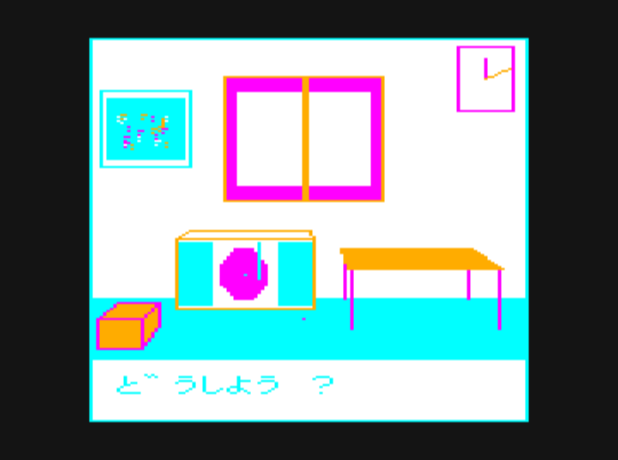
The big difference here (and this is purely from me dumping the commands) is that you can jump in the window now.
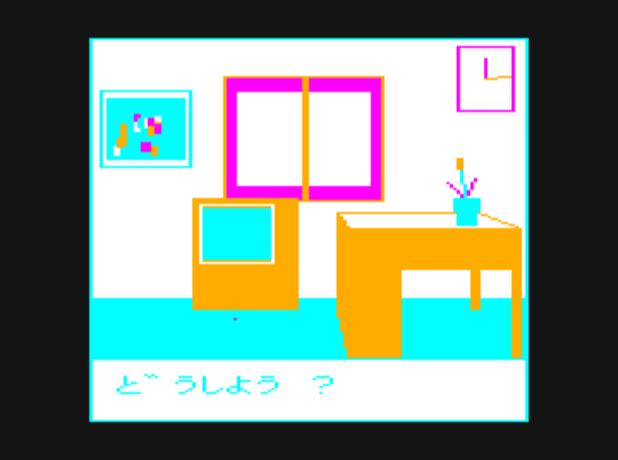
You need to grab the flowerpot (can’t refer to the other things). The game will tell you OK!! and that the microfilm you’re looking for is in the flower pot, but if you just try to grab it, it will explode.
With microfilm in hand, turn the lights out (as usual) and skedaddle. The big problem is “back” doesn’t work, nor does “jump window”; this time you need to just type “window” like it was a verb. This drops you back in the trapdoor room (fortunately no trapdoor again) so you can turn the lights off yet again and use “back”.
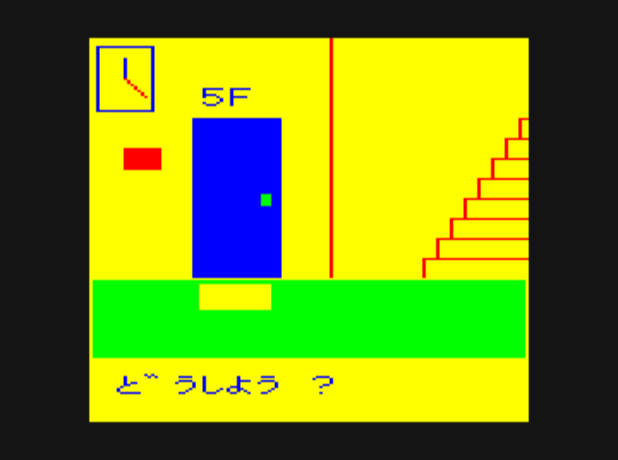
From here we once again reach an absolutely cryptic section akin to the “i” button. With flowerpot/microfilm in hand, you need to go back down to the first floor and then go down into the basement.
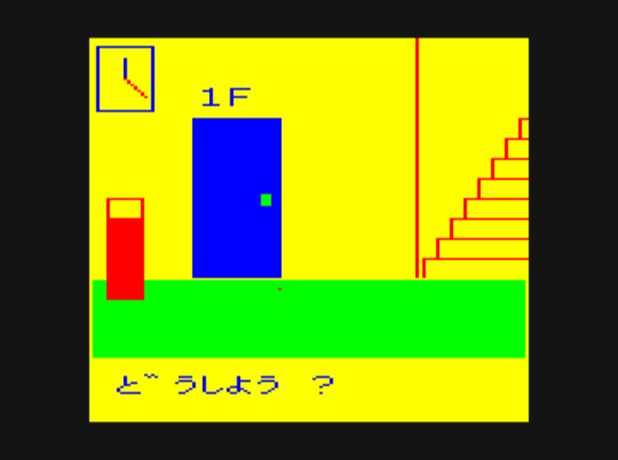
There is absolutely no indication there is a basement. This is only clear if you’re dumping the command list (with the 1-bit-shift / NOR alternating decryption method).
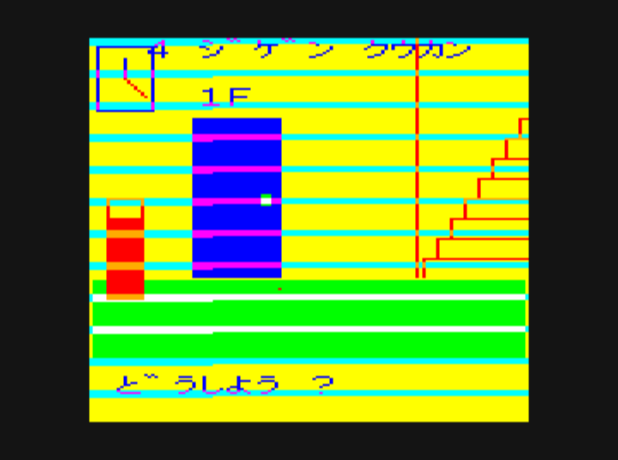

This shows a “waves” effect. From here to the end of the game is a decently accurate beach sound.
The game isn’t over yet; you end up on a beach with the flowerpot, and you are waiting for it to grow.
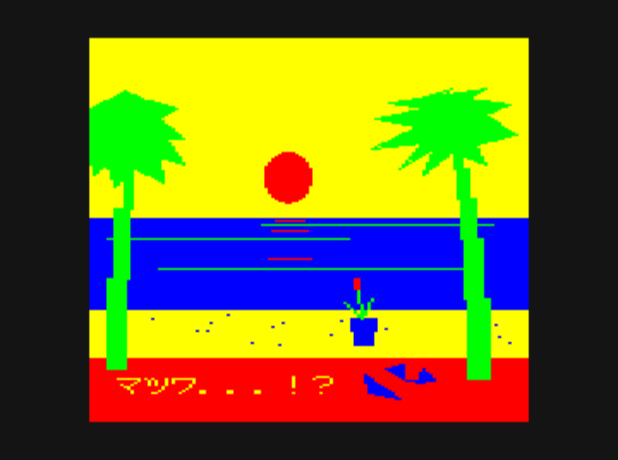
You then get a secret message about flowers blooming and the message “I found the microfilm!”
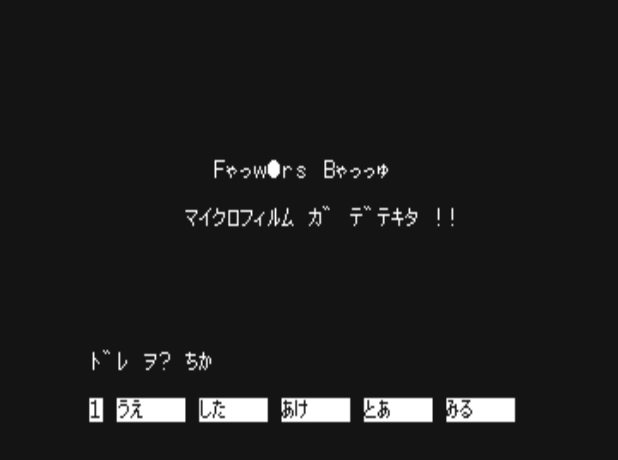
This is followed by a return to the scene where the flower is now visible.
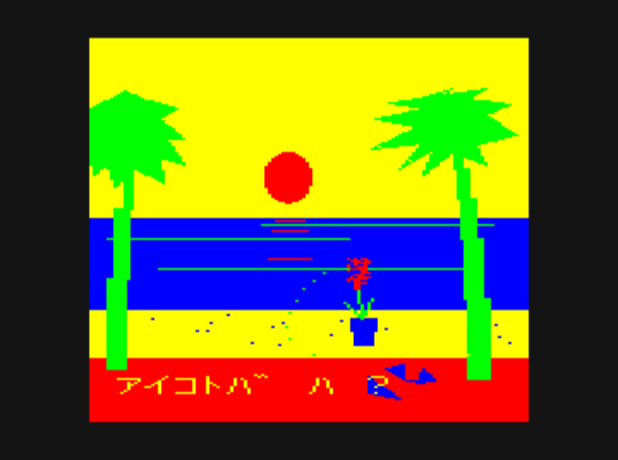
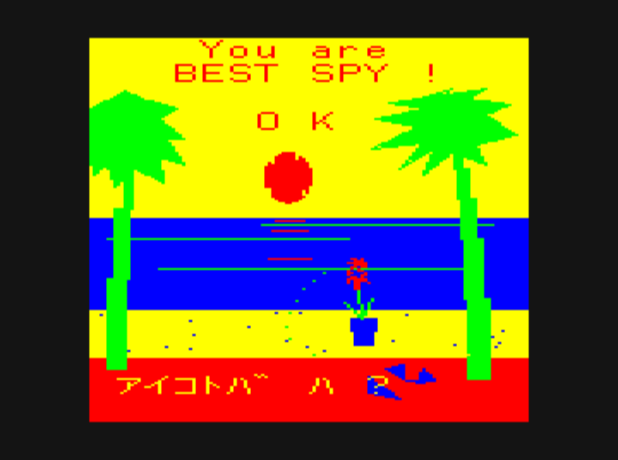
After the flower blooms comes one last prompt. It asks you to type a two character command, as usual, asking if the password is アイ (“ai”, probably “love” in this case). The right response isn’t “ai” but instead the type of flower, “ume”, Japanese plum blossom. You have only two shots to get it right otherwise the game resets. I tested with GOTO 2140 (so I wouldn’t have to play the whole game over again just to get two more attempts) but eventually just looked at the symbol table again.

Red is the closest the PC-6001 would be able to do.
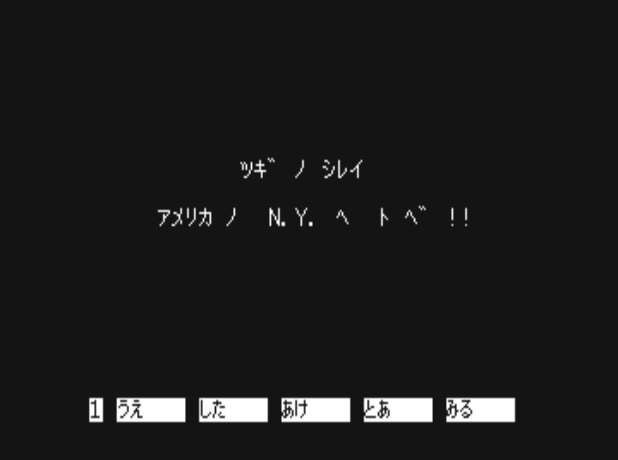
The game then suggests a sequel in New York. I’m good for now, thanks.
The wild and uneven parser and content are distant enough from Diamond Adventure (and what we know about The Spy) that I’m fairly sure the connection to The Spy is just a coincidence, or rather, the author saw Omotesando and Diamond Adventure and tried to copy Diamond Adventure specifically. The “leave no trace” aspect is specifically from Omotesando (where the player is positioned as a corporate spy of sorts, rather than a government spy) and I honestly might have solved that part on my own had the message about the lights turning on appeared in the first room where it applied.
Given the “i” button fiasco and the basement, this as printed was essentially unsolvable. I get what the author was aiming at but the custom parser system was far too confusing and restrictive, and winning via source dive can be satisfying in a meta-way but it still doesn’t make the game itself any better.
The curious thing about the experience is that the author (Momoki Todoroki) clearly poured a lot of love into the multimedia aspects, with a fully rendered title screen printed in hexadecimal, sound effects, multiple animations, and an attempt at a dynamic mini-game. The actual commands needed were just too cryptic to make it a real adventure experience. The Game Preservation Society has a tape-printed copy from I/O (head over there if you want to see the cover art, which turns the protagonist into an anthropomorphic creature with a tail) and there might be some hope it’s a later revision of the game that addresses the impossible parts.
Coming up: this one exhausted me, so I might change my schedule, but I’ve got a previously-lost long-sought-after game on deck.


Leave a Reply