I’ve finished the game; I was nearly at the end. My previous posts are needed for context.
From the Microbee Software Preservation Project.
I had left off on an apparent combination lock with four symbols, where you had to enter an “input” as a string of numbers. I had tried every permutation 1234, 2341, 4231, etc. with no luck.
I decided after enough further struggle that I must be missing an item, so I re-checked every location and item in case some of the ones that were previously red herrings were not (the locked chest at the rope, a shield on a wall, the swamp that kills you, a random broken dagger, etc.) One of those items turned out to be the key, but I wasn’t able to reach a solution by thinking from that direction.
What I did next was flip from thinking about nouns to thinking about verbs. This is something that I’ve written about long ago with mainframe Zork, although in that case I was thinking of simply finding which verbs work (which eventually changed into my “common verbs” chart). I didn’t need a chart in this game because it provides all the verbs from the start.
That doesn’t mean it isn’t useful to see what the verbs do! Sometimes they have a very specific failure response. I took a random tree near the castle and tried each verb in sequence; I was told after LEVER TREE that I needed the pick to do that (the broken pick from the start)!
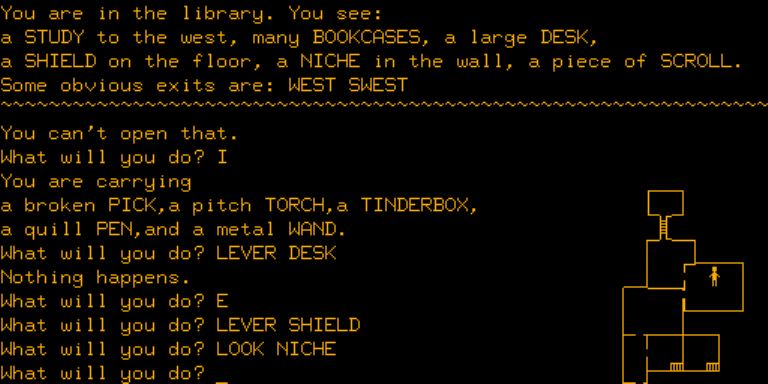
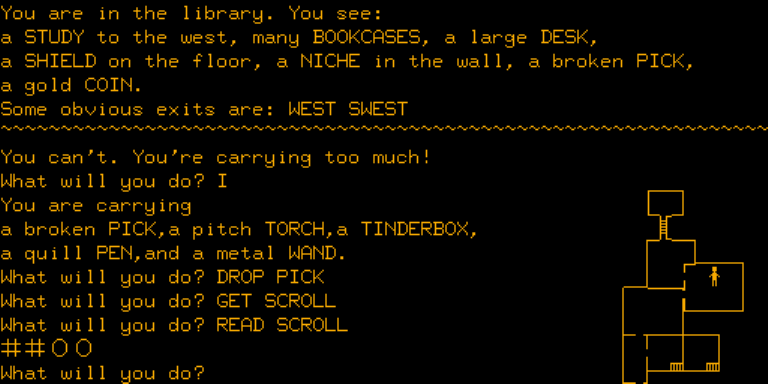
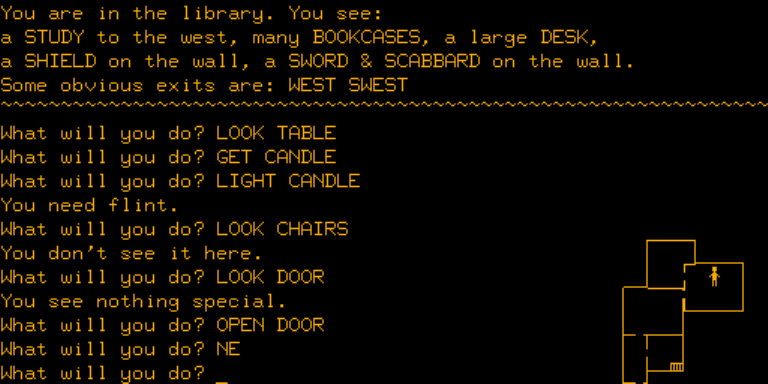
With the pick in hand tying LEVER TREE gets a “nothing happens” response, but that means — especially given the custom-coding to check if you have the pick — that it must work elsewhere! I went through every item in the game again trying LEVER THING, finally hitting upon LEVER SHIELD.
I see what’s going on now with it — you’re trying to yank the shield off the wall — but that’s never the language I would normally use, and while I’m fairly sure I’ve seen LEVER as a verb somewhere else it’s rather rare.
The niche has a scroll which gives the combination I was seeking. There are repeats, which indicates a brute force method with just the digits 1 through 4 would have worked (but that would have been painful, and of course it’s better to solve the author-intended way).
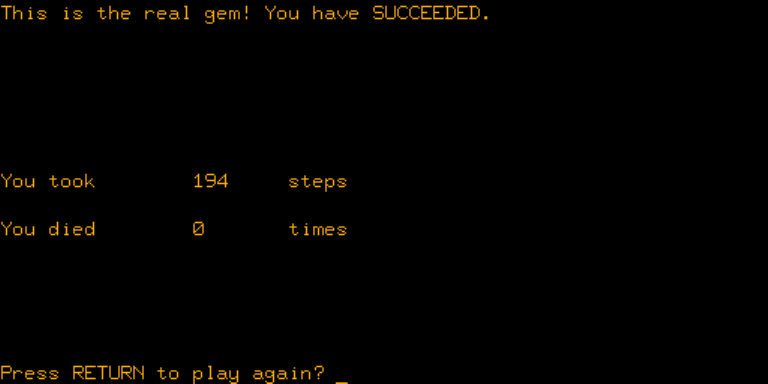
4411 from the scroll.
There was nothing deep and/or significant here in the general content, and barring the two obscure secrets (the cauldron and the shield) there was nothing elaborate as far as puzzles go, but the art gave a pleasant buzz to the experience and easy is better than too hard (and despite that, this ended up going to three posts). There’s still two more games from the same author which we’ll eventually get to so hopefully Chris Norman will show up one day to explain the process.
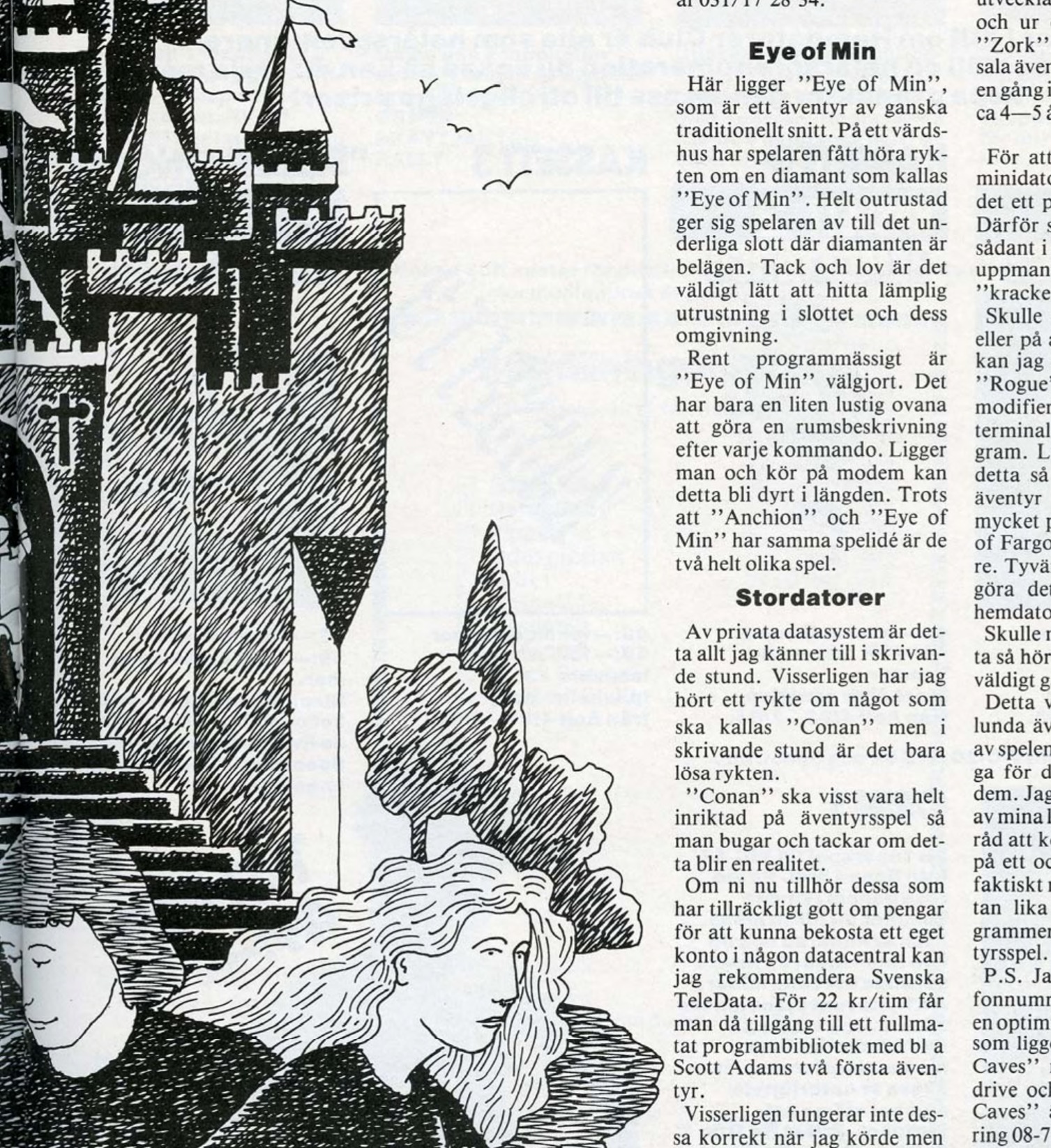
The mini-map really is novel: we’ve seen a few but very few, and none that have a visualization quite like we’ve seen here. Morpheus Kitami suggested that some games of the 90s may have been influenced by this series, although the Microbee itself was obscure enough it’d have to be a circuitous route if that’s the case. Still, an idea come up with independently and not repeated can be just as interesting as one that influenced the industry. The game does get a mention in a 1984 Swedish magazine; for reasons I’ll save for another time the Microbee did manage to make inroads in Sweden.
Interestingly enough, the review complains about how the game applies a room and description after every command, and this can be irritating when using a modem. I’m not sure what’s going on here, but I’m guessing for remote use the top part of the screen is sent after all commands (because sometimes that’s the only thing that changes). The Microbee developed strong network capabilities early (see Owen Hill’s background in telecom) but I don’t know the exact configuration.
Coming up: I’ve got a few things cooking, and I’m not sure what the order will be (there may even be another game tossed in the middle). One of them laterally involves a famous British TV show, one of them involves a Japanese conversion of a movie (produced jointly by companies in South Africa and Botswana), and one of them involves an Apple II game by two unexpected authors.
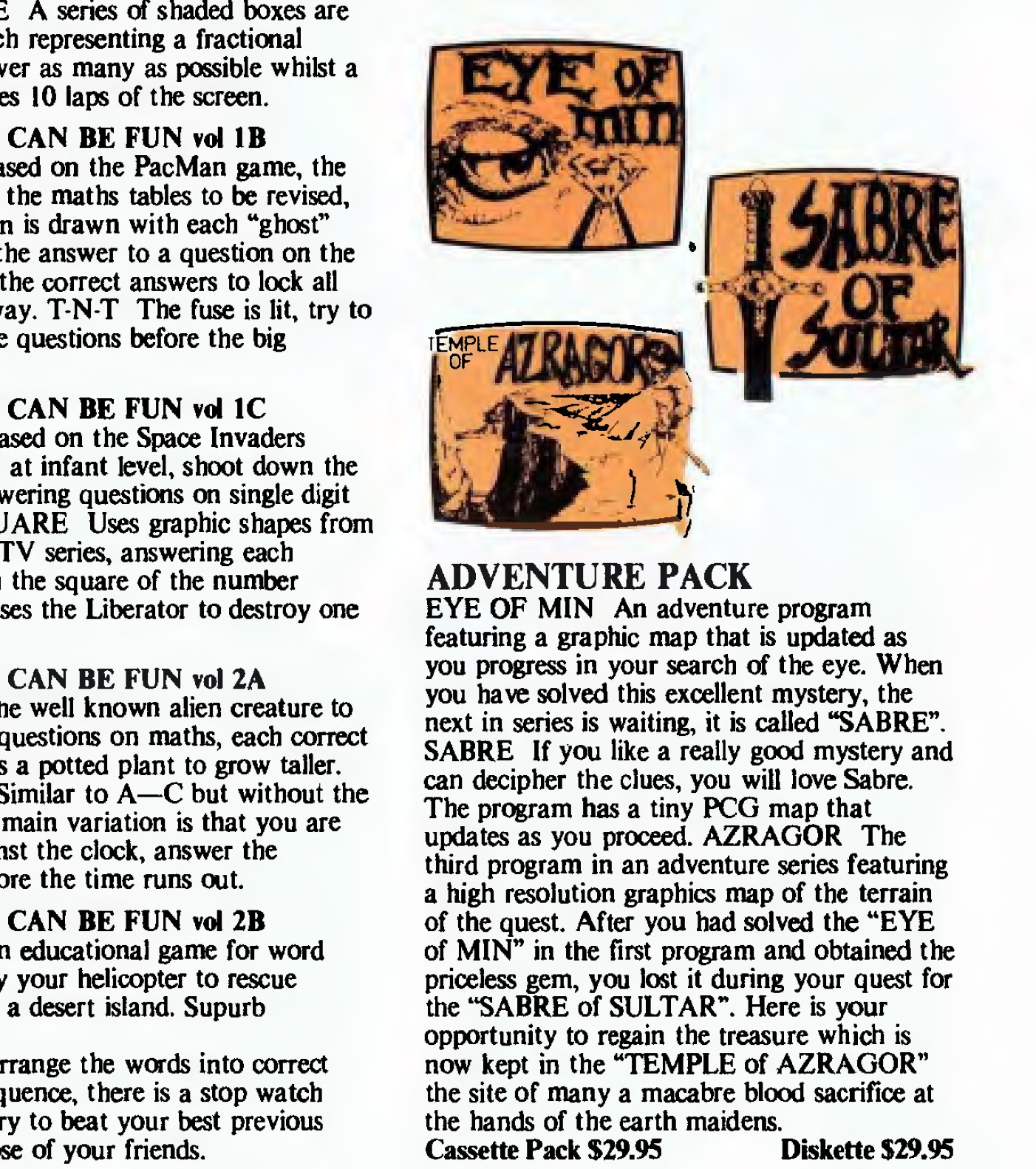
Eye of Min, as I previously mentioned, was part of a trilogy, the second and third games being The Sabre of Sultar and The Temple of Azragor respectively. They were originally sold separately. Clipping an excerpt from a 1983 catalog:
An adventure program featuring a graphic map that is updated as progress. in your search of the eye. When you have solved this excellent mystery, the next in the series is waiting, it is called “SABRE”.
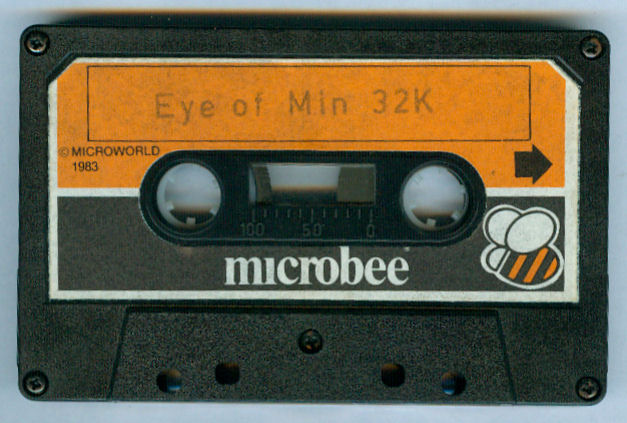
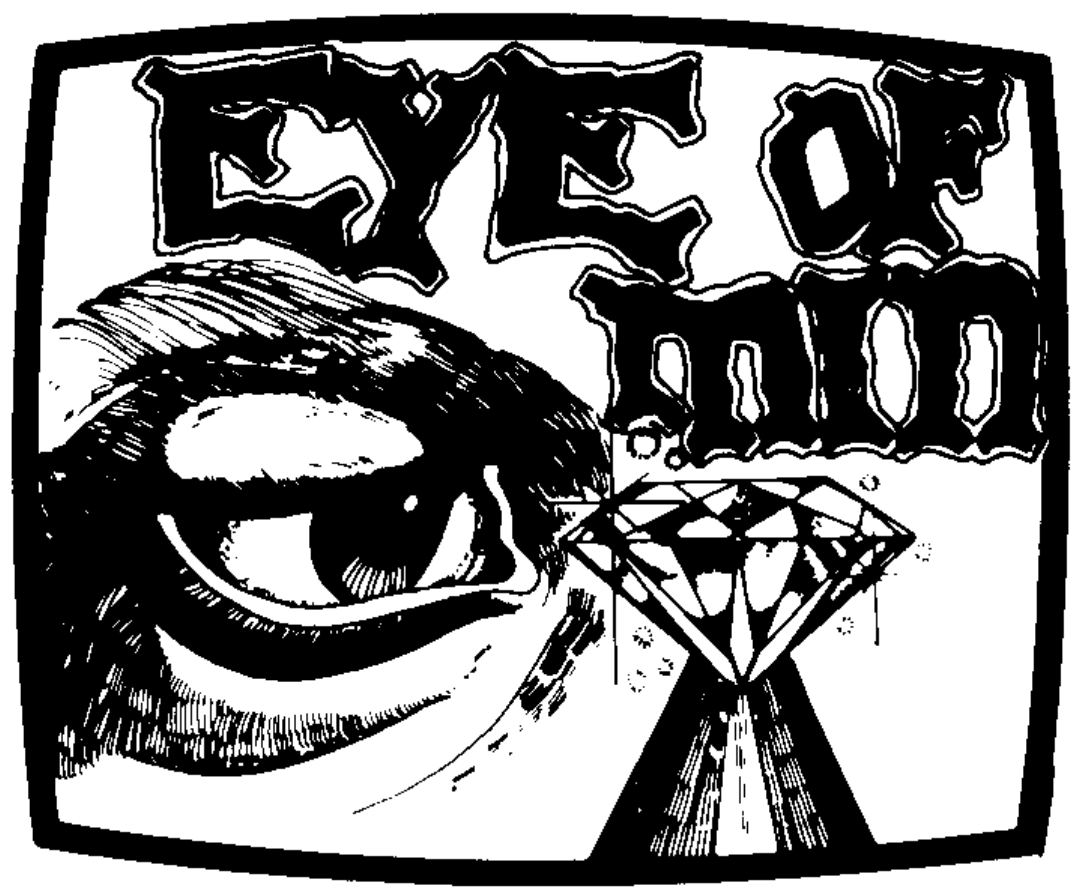
Because of this, I can give you the “cover art” for Eye of Min, scan from the Microbee Software Preservation Project, which I find fascinating, font like a old-school zine:
Or maybe fliers for an unlicensed heavy metal concert.
I’m not done, but what I’m stuck on is potentially a “self-contained” puzzle so I don’t want to start prodding at the walkthrough (or the source code in BASIC) yet. I suspect I am very close to the end otherwise.
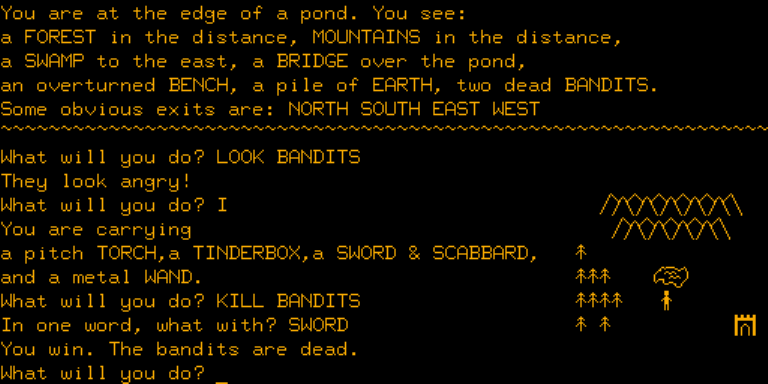
So last time I was stuck with a wand I couldn’t use (the solution will come up naturally later), a cave that only had 8 trees and nothing else, a well that I couldn’t enter without dying. Oh, and there were bandits, but that part was easy.
Just needed to actually hit them with a sword rather than a random item.
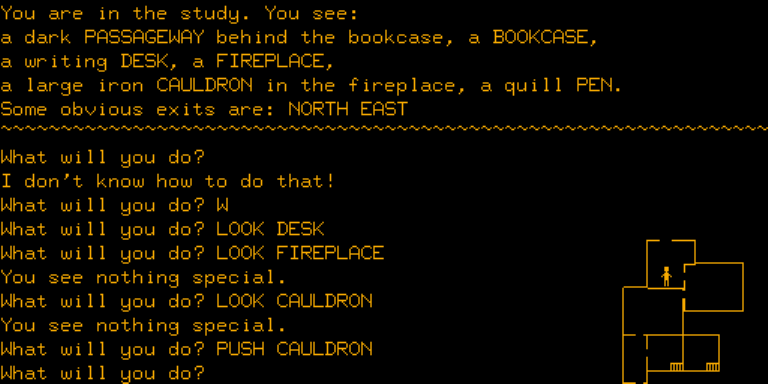
Nothing else seemed promising except the potential for something hidden. I had already tried PUSH and PULL on the bookcases but I went ahead and tried it on everything. Finally, I hit paydirt on the last item I hadn’t tested yet:
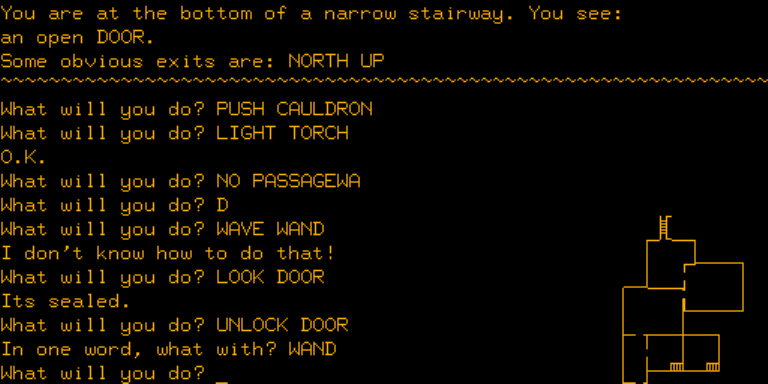
To be fair, I was thinking of the cauldron as a “utility” item to maybe mix a potion or two later (it still could apply for that later, but it’s now less likely). Heading north into the newly-found secret passage required lighting a candle or torch. This passage leads to a locked door. Trying to UNLOCK DOOR prompted me with what item. The “broken pick” at the start I figured was a red herring so I tried out the wand, and somehow that worked.
Not sure what I’m doing to invoke the magic. Or maybe it isn’t magic at all, and just applying the fact it’s a big metal stick.
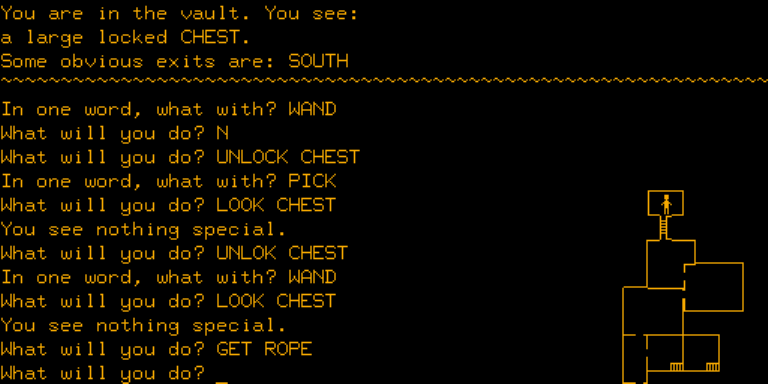
Further in was a room with a locked chest and a rope; neither the wand nor the broken pick works this time on the chest. (There is a FIX command, but it seems to do nothing with the pick, so unless there’s a tool somewhere to allow repair I believe the pick is a red herring.)
At least I was able to get the rope. I assume the chest gets unlocked later.
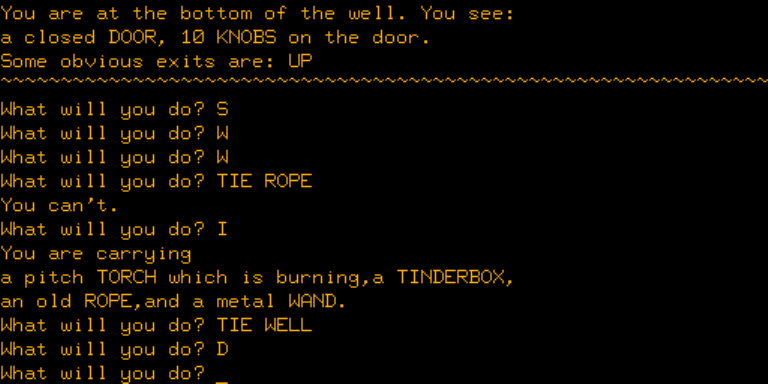
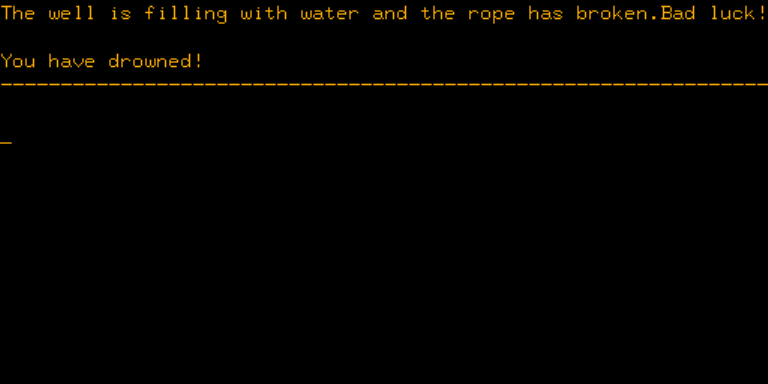
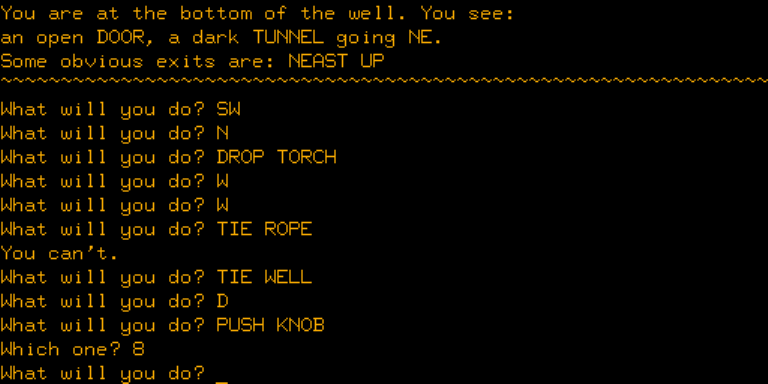
I took the rope over to the well and did TIE ROPE; the game didn’t understand that. It wants TIE WELL.
This turns out to be a “knowledge puzzle”. One of the norms of these games that it helps to know is “will you find random things in certain places that are clues to puzzles”; an escape room game from the Flash era of course will, but at this time period it wasn’t common, and especially not common for the code to be “indirect” (example: as opposed to the code just written on a paper, you see five circles followed by three circles somewhere, meaning a lock gets opened by 53).
If you PUSH KNOB the game will prompt you with which one. Most of the knobs will kill you.
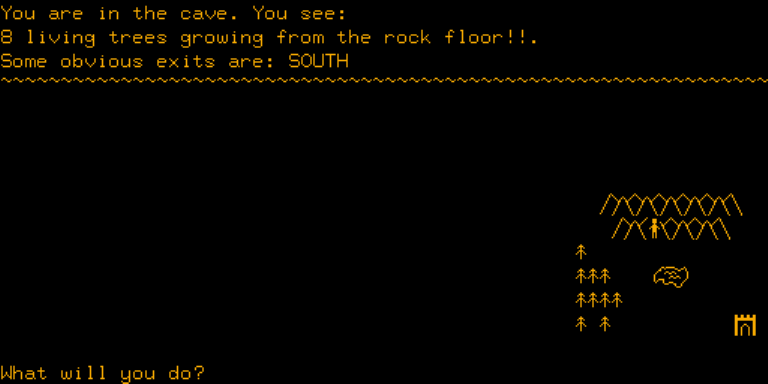
However, based on the fact the dead-end cave with no items had 8 trees, the answer to the puzzle here is 8. Pressing that knob specifically will open the next passage. I admit I solved this by brute force and only worked out what it was meaning after the fact. (Escape room logic has been done before in this era, but it isn’t common!) I also found out after the fact that the number of trees in the cave changes (randomization of a detail like that tends to be another clue that something is used for a knowledge puzzle).
Inside is what I assume is yet another knowledge puzzle.
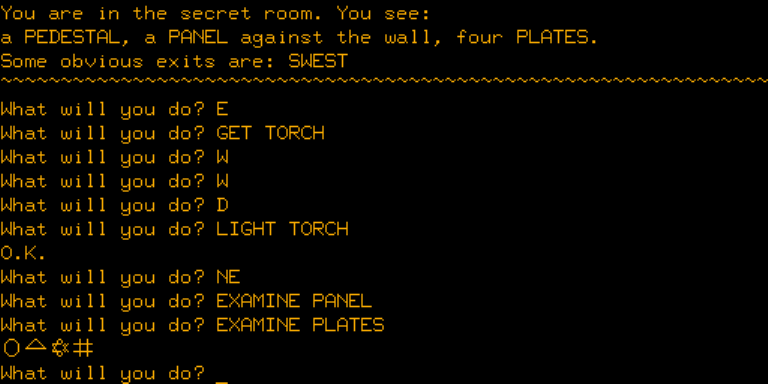
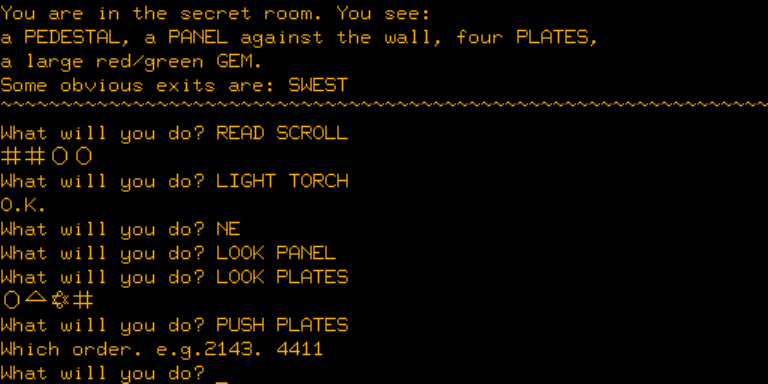
If you examine the panel there are plates, and you can push the plates. It asks you to push them as a sequence.
Which order. e.g.2143.
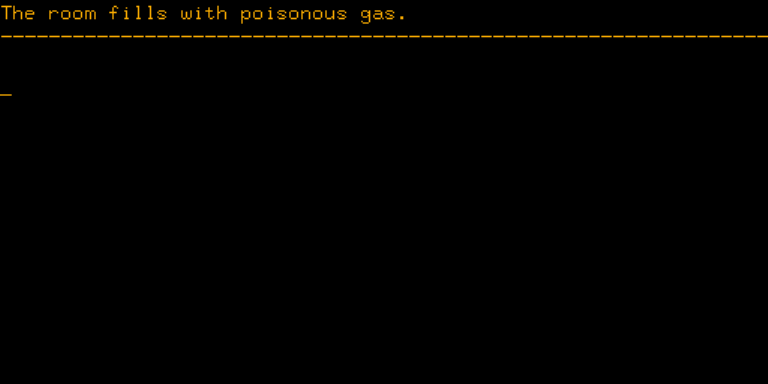
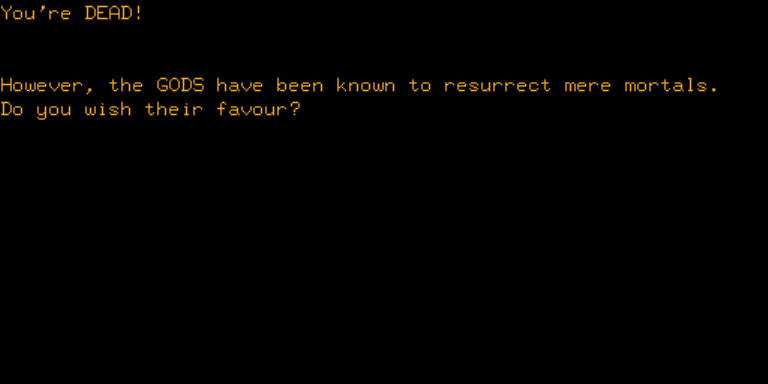
Entering the wrong code is death.
The room fills with poisonous gas.
I had a couple theories having to do with smallest-to-largest or largest-to-smallest but I ended up (via save states) brute-forcing all 24 permutations of 1234. None of them worked. It turns out any number sequence is possible, so it might be you need 2123 or the like. I’ve combed over the rest of the game and haven’t seen anything resembling a clue (or at least, one I can share with you) but I figure I’d toss one this out here to you, the readers, before I break down and check spoilers. (If someone does check spoilers, all I really want to know is if this is a self-contained puzzle, or if I’m missing a physical clue I’m supposed to read elsewhere like the trees in the cave.)
In the 1960s, Qantas wanted to improve their flight reservation system. At the time, reservation clerks would get tickertapes from travel agents and enter flights manually; every single sales office needed to be contacted whenever a flight was full. Cancelling involved, again, manually calling every office.
To make the company run smoother, they obtained three IBM S/360s (each with 64K of memory) and spent 18 months with IBM creating a new system.
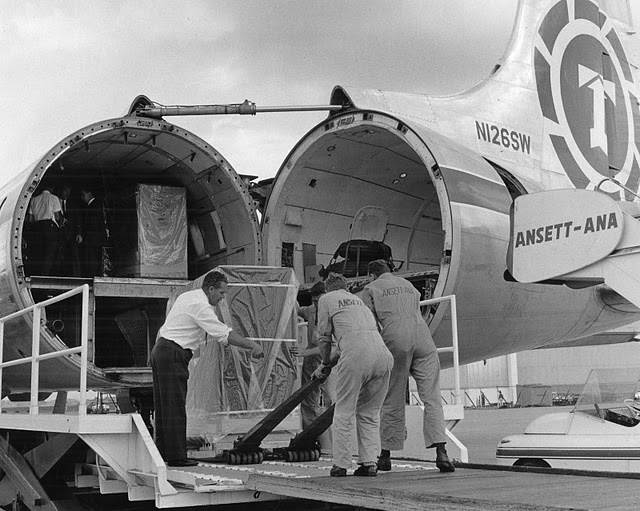
IBM S/360 being unloaded from a plane in 1966, from IBM Australia.
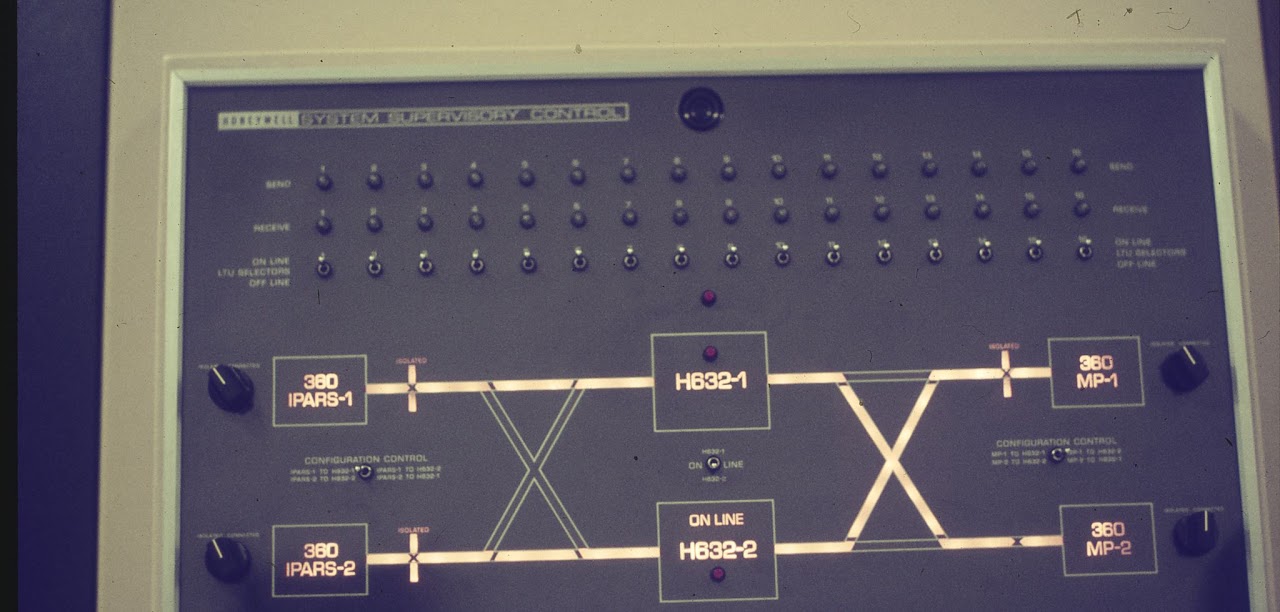
By the end of the decade the IBM systems were interlinked with Honeywell H632s, which weren’t even out when the reservation system was first being developed. Source.
The information on reservations still needed to be sent by wire; this meant engaging the PMG (Postmaster-General’s Department), which was responsible at the time for both postal and telegraph duties. The project manager for the Qantas job was Owen Hill (electrical engineering graduate in the ’60s, he was a “cadet” which means PMG paid for his degree while he worked three weeks a year for them). Tapes were sent at an approximate rate of 75 baud. The “end transmission” text was NNNN which was a problem in Australia due to the presence of Shannon Airport (SNN). While the system made everything run smoother it required constant nurturing, and Hill remembers being “down in Melbourne every two weeks” handling issues.
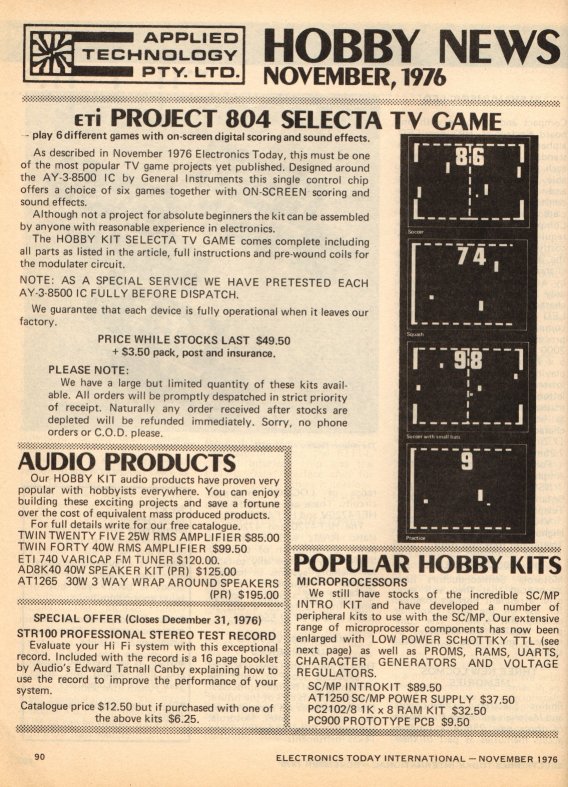
He found the situation frustrating enough that as soon as his contract was up he left for a job with IBM, and from there hopped to creating his own company: Applied Technology. He had discovered the magic of buying electronics in bulk and made his own mail-order business selling individual parts and especially kits.
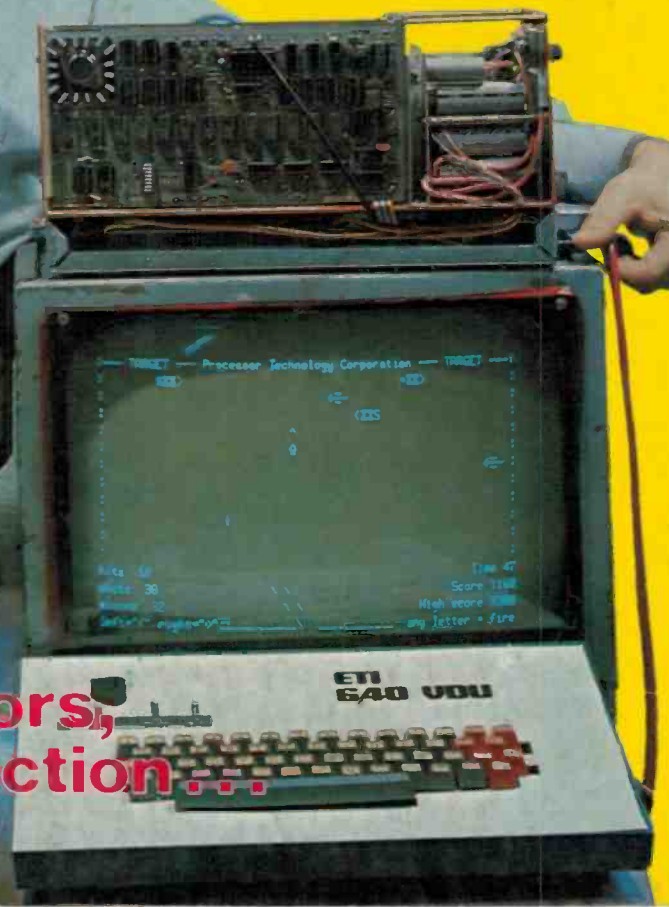
Applied Technology didn’t stay pure mail order; they had a shop in Hornsby (just northwest of Sydney). A group of enthusiasts started to cluster there, one of them being David Griffiths. Griffiths had designed his own video card, the ETI 340, with plans printed in Electronics Today International starting in their April 1978 issue. It had a resolution of 64 characters across by 16 down (same as a TRS-80). It slotted into an S-100 bus meaning it could be used with an Altair or other S-100 compatible computer.
From the front cover of the issue.
The hobbyist Stephen Dennis tried to embark on the challenge of building the machine, but even after soldering it together it wasn’t working; he called the magazine to get a hold of the designer (Griffiths) and the two collaborated to turn the plans into a more general kit. It started to be sold (in the kit form) by Applied Technology. The store in Hornsby became a tight-knit cluster of enthusiasts.
[Matthew] Starr, who was just finishing high school, had become a regular visitor to Applied Technology’s nearby retail hobby shop. He’d already built his own David Griffiths system and even helped fix customer problems while visiting the store.
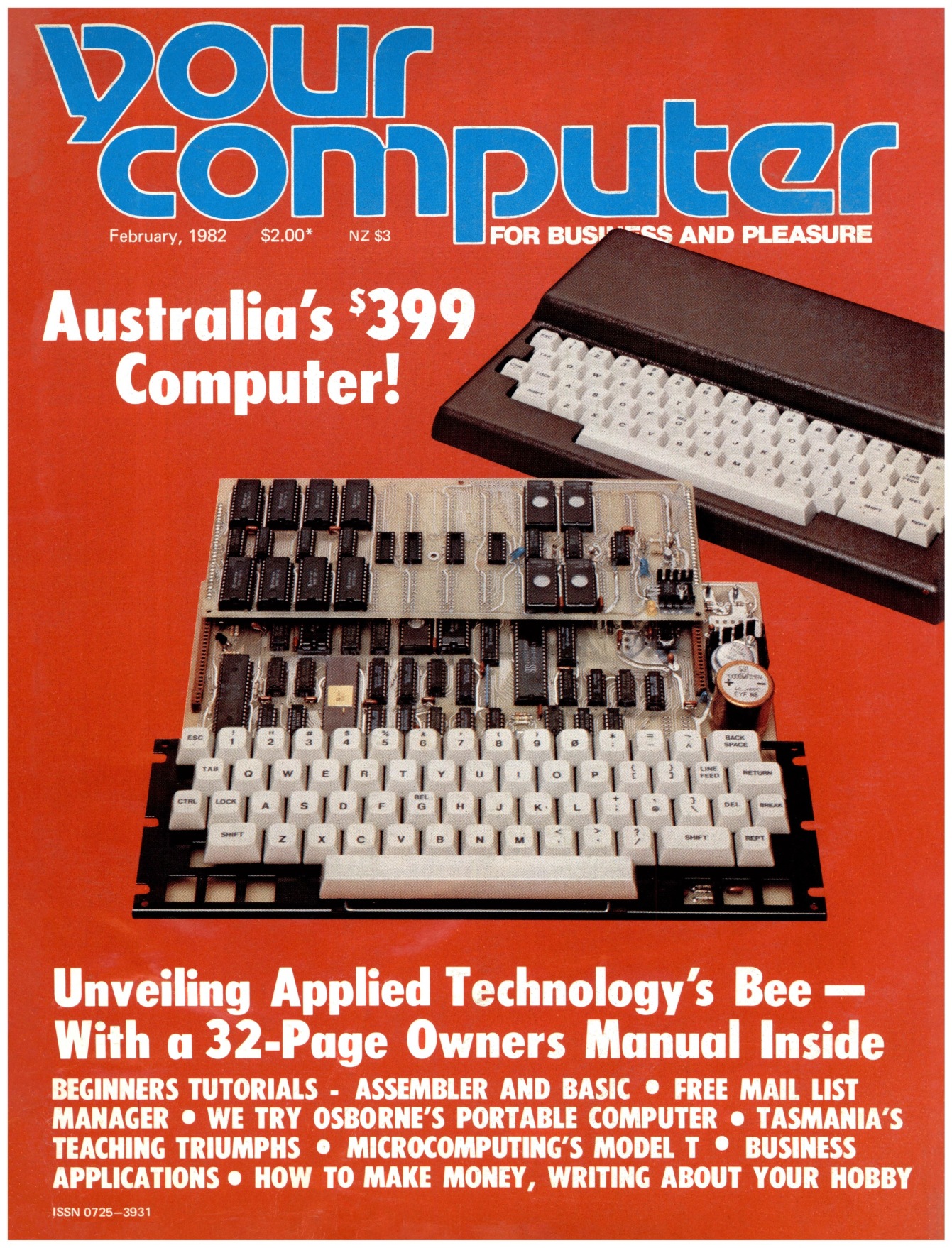
Matthew Starr (see above) and Owen Hill co-designed (along with some other Applied Technology regulars) a computer based around the already-created video card. It was codenamed “Granny Smith”. Hill and Starr went down to the offices of the publication Your Computer to do a pitch around Christmas 1981. Hill wanted to put a 32-page brochure in the magazine which essentially counted as a manual for the kit, with the last page giving ordering instructions. The editors agreed but thought the system needed a better name; on the drive home Starr suggested the Bee, which Hill improved to the Microbee.
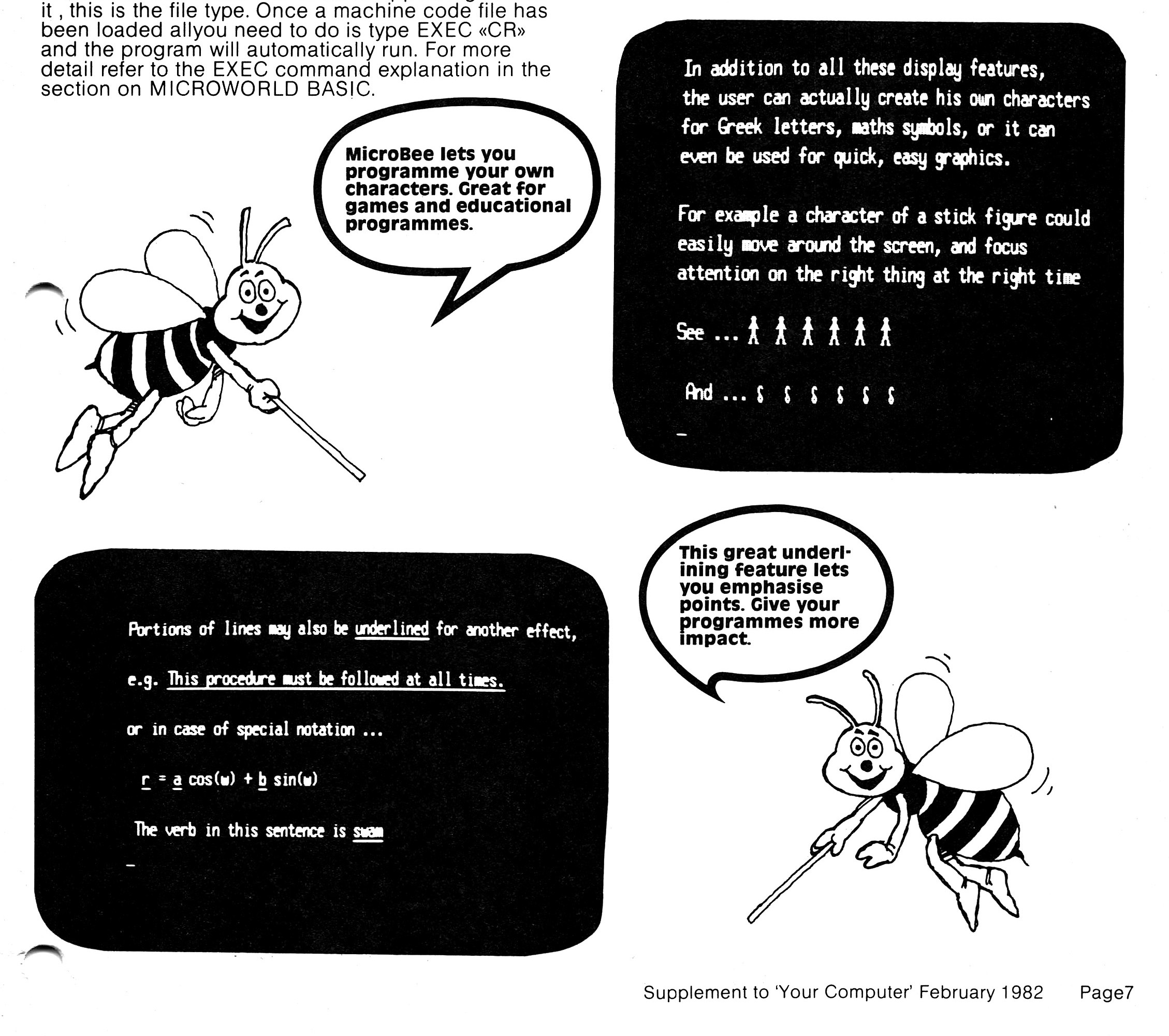
You can read the insert/ad that printed shortly after here. The brochure promised that users could “build the most powerful state of the art kit computer complete for $399.00”. (That’s worth about $1,785 Australian dollars today.) It’s heavy on technical details including schematics.
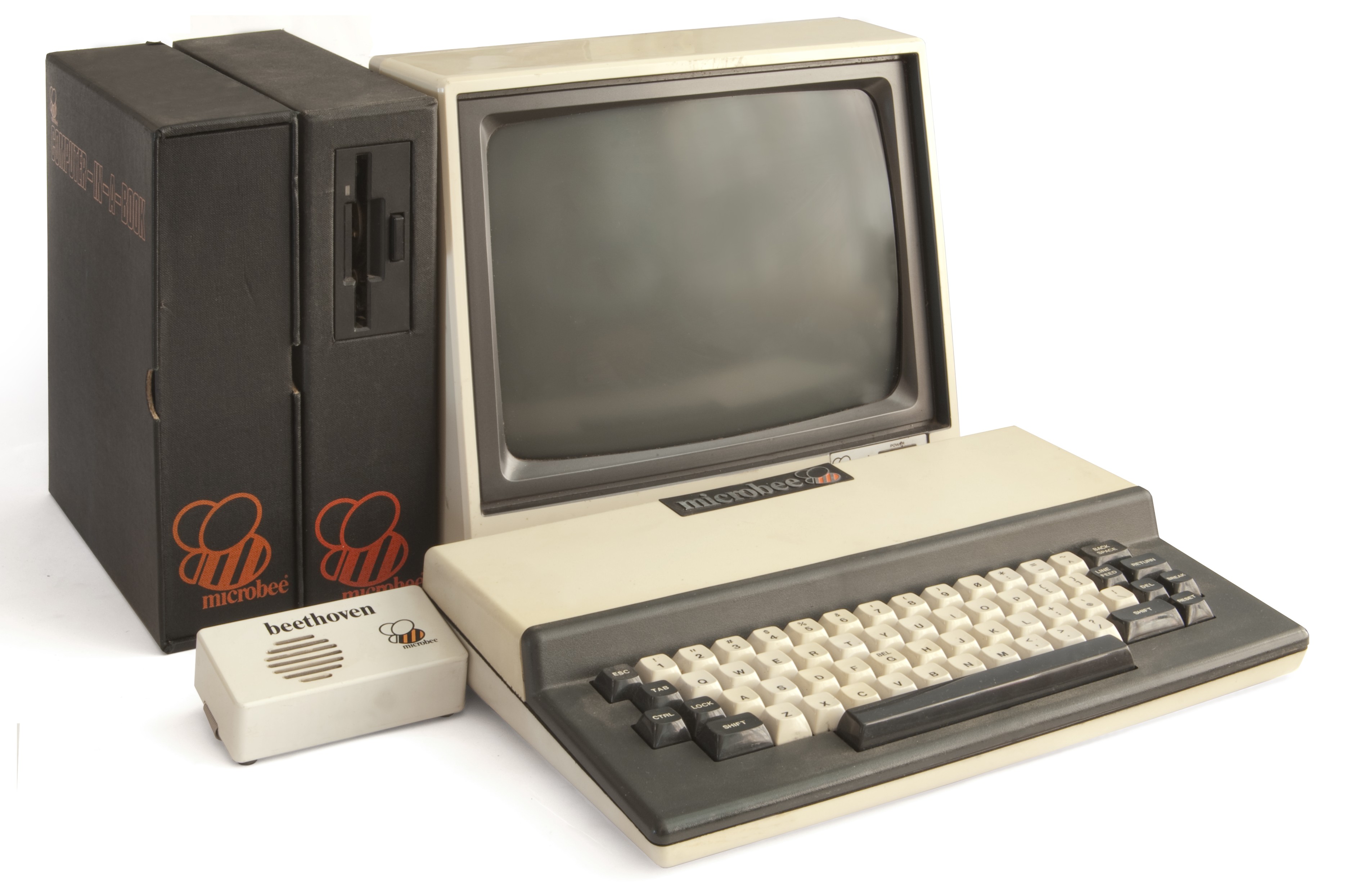
Technically, the Microbee is similar to a TRS-80 (not only the 64 by 16, but a Z80 processor) although it had more expandability (something the company emphasized in early advertising) and the character graphics are programmable enough to allow for arbitrary graphics. While dK’tronics had to make a custom graphics rom as a piece of hardware for new character graphics on the ZX-81, the Microbee has the character-modification feature built-in.
The upshot is a system whose graphics float between pixel-based and character-based and have a feel unlike anything I’ve seen before. To give a general idea, here’s Halloween Harry from 1985; this was later the basis for the much more famous Apogee game:
So: high-res relatively speaking, but also divided into tiles to enough an extent there’s a “Game and Watch” feel even though animations are quite possible? You’ll also see this distinctive look in the adventure game I’m about to get to shortly.
The kit sales took off and Applied Technologies soon after started selling pre-made computers; where they really hit their stride was winning (along with Apple) the New South Wales education contract in April 1982, so they became one of the embedded “education computers” of Australia. (Apple was the expensive option, Microbee was the cheaper option.) I have the video cued where Hill talks about how the shop was so busy customers starting stepping behind the counter to help:
They eventually peaked at 11% of the market in Australia and with presence in more than 3000 schools. Most of the software for the system was Australia-developed (despite some sales elsewhere, most notably Sweden).
Microbee had its own software branch, Honeysoft. Outside authors sent in products and received royalties; one of their products from 1983 was a trilogy of adventure games by C. W. Norman. I thinkthe name is Chris W. Norman but I haven’t unearthed anything else about the author yet; since I’m just doing the first game for now (and this is only part 1 of ?) there’s still plenty of time for information to come up, or even the author to find himself while Googling.
In high-res mode the ratio of pixels wide vs. pixels tall is 1:2. This makes for a much wider look than the TRS-80 despite the character counts matching.
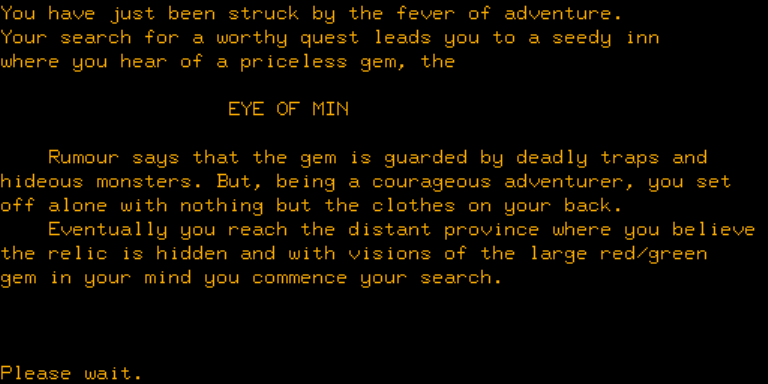
Eye of Min is a “single target” treasure hunt where you’re just looking for one treasure, the “priceless gem” in the title that is protected by “deadly traps and hideous monsters”. The game helpfully gives a complete verb list:
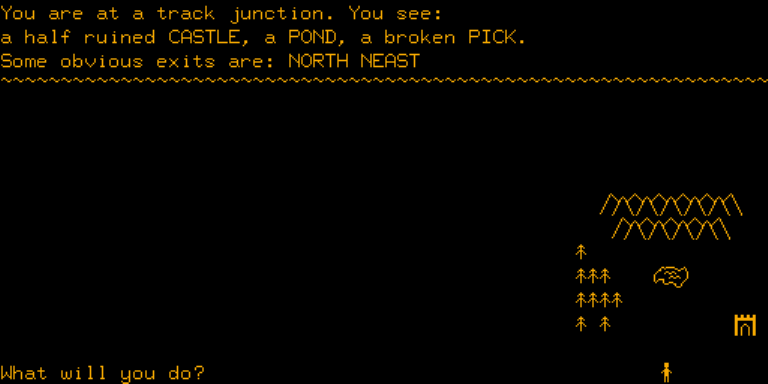
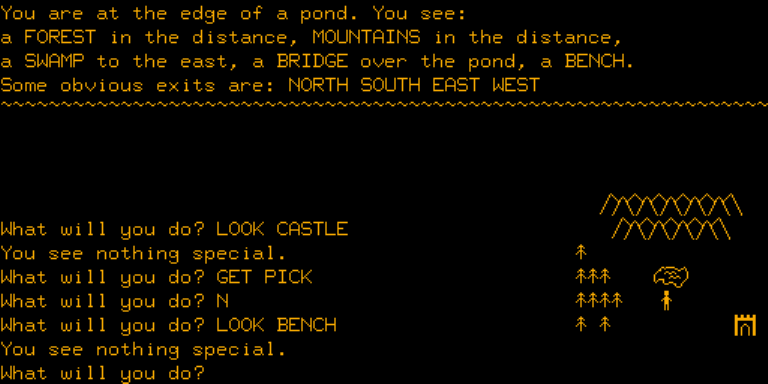
There’s a graphical window consistently drawn in the lower right corner of the screen; it’s top down somewhat like Ultima. I think the programmable-character style essentially encourages this, and if you flip back to the brochure excerpt you’ll even see the same standing figure used in both the sample and this game.
The figure moves around as you move around the map, and is actually quite lovely for an automap from this era. We’ve seen a few like with Time Adventure but they tend to be fairly abstract.
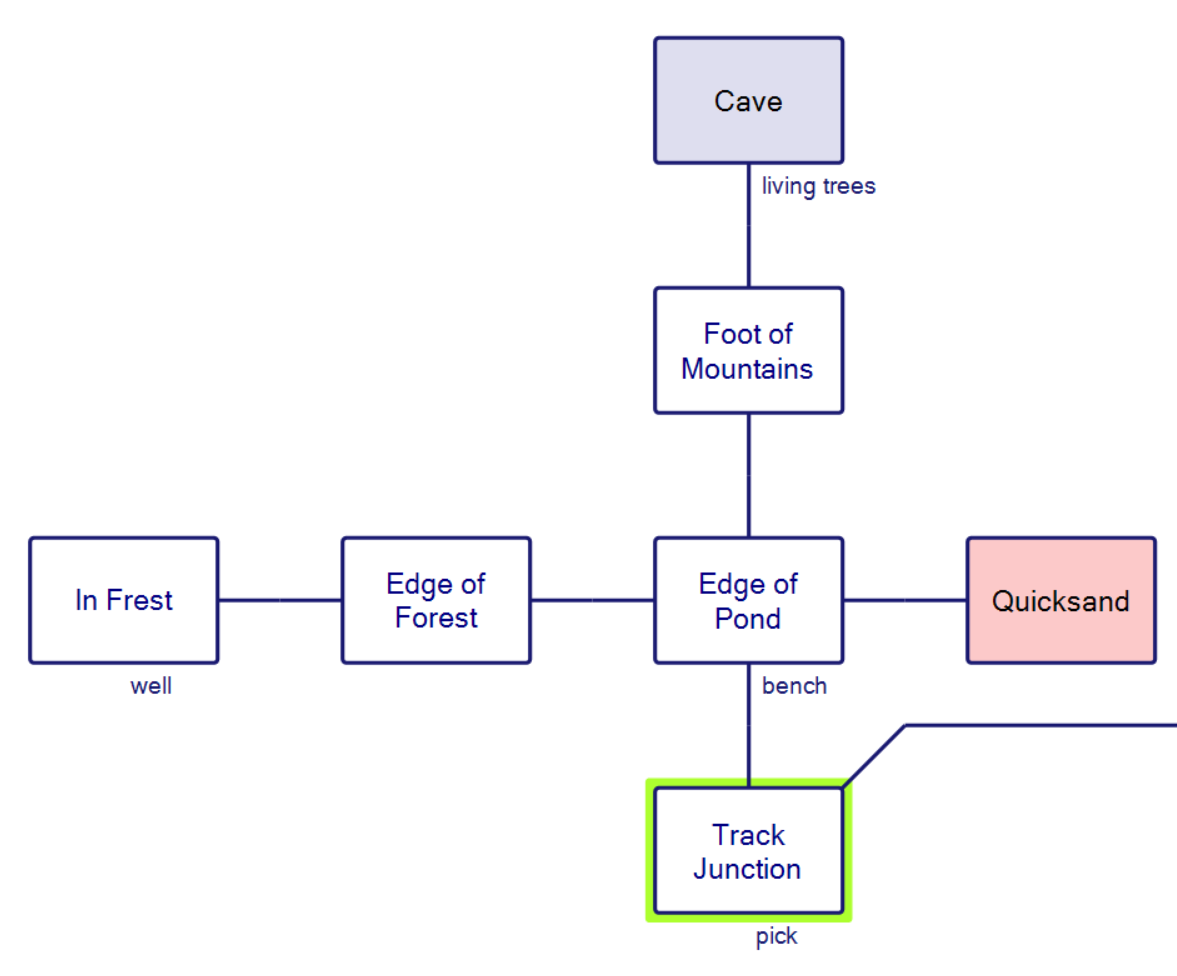
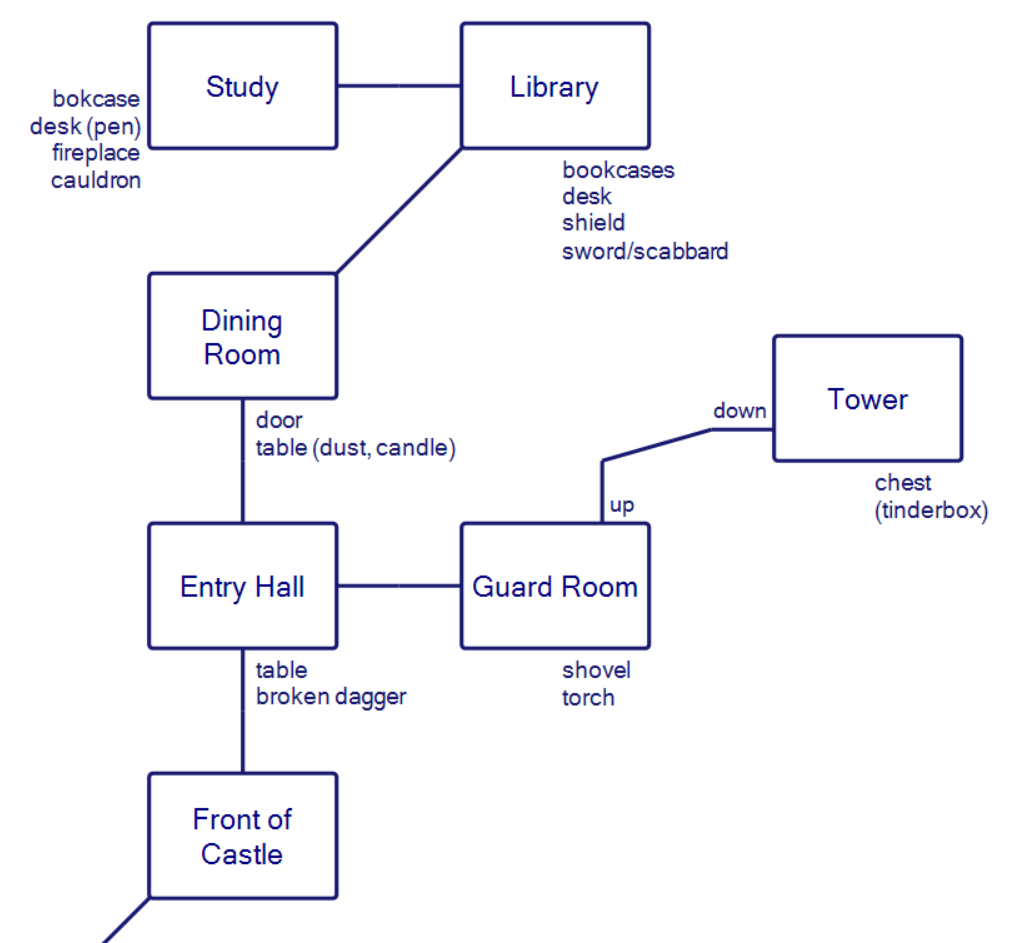
Here’s a map drawn by myself to compare:
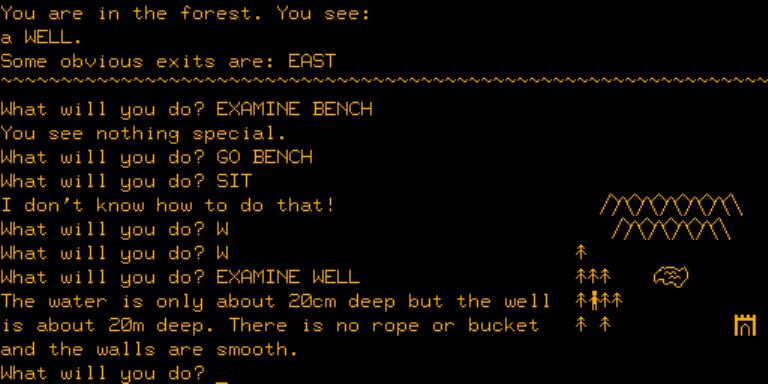
The action starts outside and is a little deadlier than it might initially seem. From the pond with the bench, going east into the swamp immediately kills you via quicksand; north is a dark cave where going in without light kills you; west is a well with no rope where going down kills you.
Heading back to the start (with the curious broken pick, no idea if that’s just scenery) and going northeast is the ruined castle, and a switch of map scene:
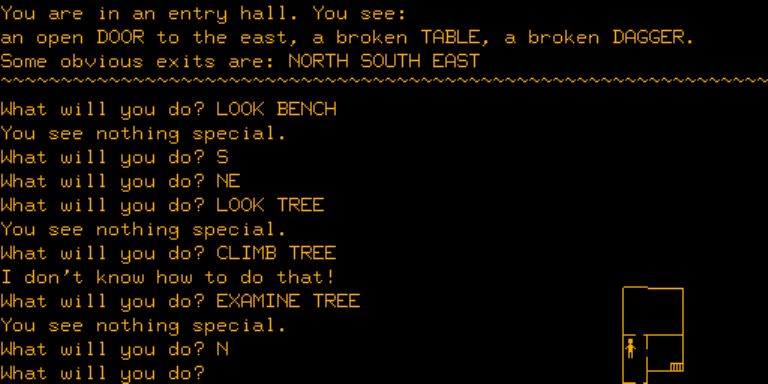
It’s less deadly than the outside. The ground floor has a broken dagger, not-broken sword and scabbard, candle (on a dining room table) and pen (on a writing desk). The inventory limit is tight enough that you can’t just take them all.
Also, there’s a door you need to open to reveal the northern part of the map.
Off the side of the entry hall there’s also a guard room (shovel, torch) and a tower with a tinderbox. You can use the tinderbox to light either the candle or the torch and safely go into the cave.
The cave is seemingly a dead end. I have not been able to find a noun that the game lets you use to refer to the “8 living trees” and it really might just be scenery (the game is consistently using CAPS for when there’s an object you can do things with).
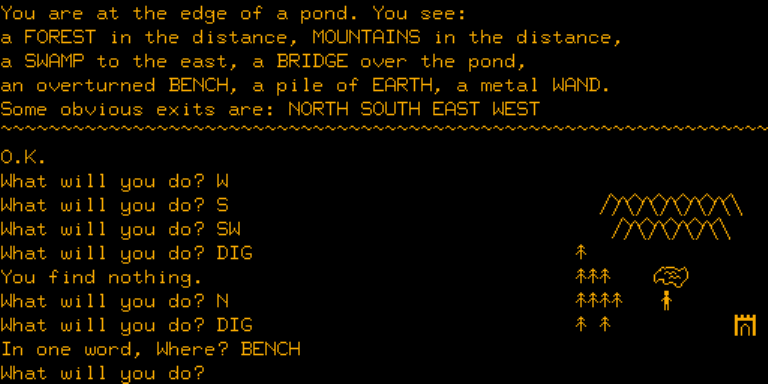
The only other piece of progress I made is with the shovel back at the guard tower; I did DIG while at the pond and the game asked me where, so I said BENCH.
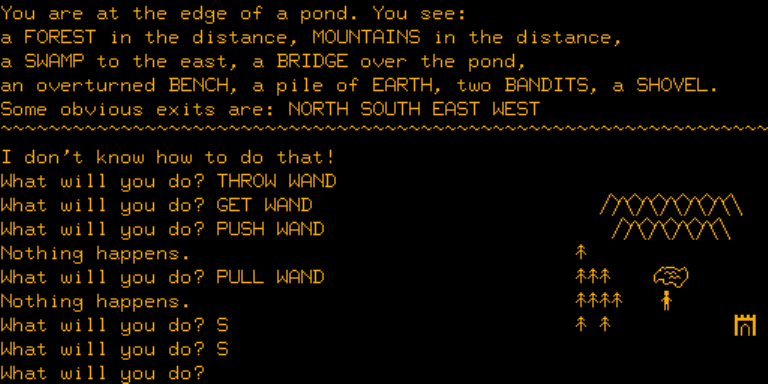
Unfortunately, I have no idea how to use the wand! The verb list has no “WAVE” verb or anything else typical; I ran through the entire list without luck. Perhaps it merely needs to be held at the right place, or there’s a magic word involved.
The game did warn about enemies, and after enough fiddling around with the wand, two bandits appeared blocking the way to the castle.
Unfortunately, due to the inventory limit (and me prioritizing the shovel) I hadn’t brought the sword from the castle along, so my attempts to beat the bandits over the head with a wand failed.
I suspect I’m just missing something basic that will break things open, but for now I’m stuck.
Testing the game isn’t as rapid as I’d like because the emulator I’m using (MAME) starts eating inputs if I try to speed the computer up. There is a walkthrough so I’m not looking for “spoilers” but I will take suggestions from anyone who hasn’t played the game. I sense this won’t be long and this will be part 1 of 2 (it’s just BASIC, and if nothing else, the graphics take up space) but I’ve been fooled before.
Enormous thanks to Sebastian Boell who (along with Graeme Philipson) interviewed Owen Hill and Owen Hill himself who gave permission to use the interview. Thanks also to Ewan Wordsworth, current owner of Microbee (he was formerly an employee and has a modern website).