I’ve finished the game; I was nearly at the end. My previous posts are needed for context.
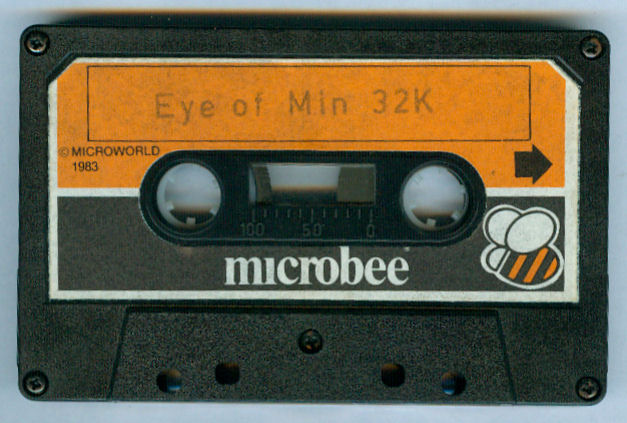
From the Microbee Software Preservation Project.
I had left off on an apparent combination lock with four symbols, where you had to enter an “input” as a string of numbers. I had tried every permutation 1234, 2341, 4231, etc. with no luck.
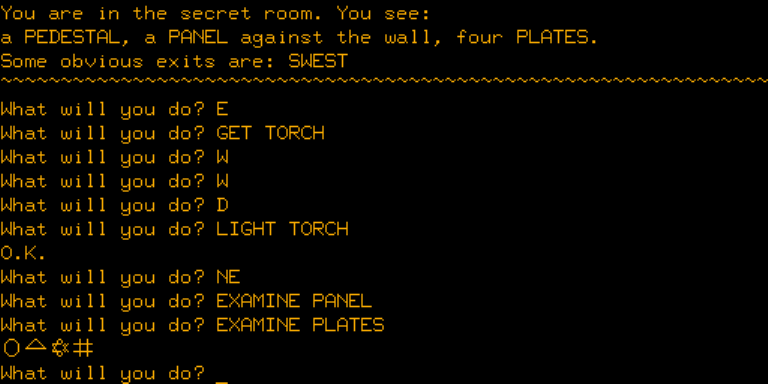
I decided after enough further struggle that I must be missing an item, so I re-checked every location and item in case some of the ones that were previously red herrings were not (the locked chest at the rope, a shield on a wall, the swamp that kills you, a random broken dagger, etc.) One of those items turned out to be the key, but I wasn’t able to reach a solution by thinking from that direction.
What I did next was flip from thinking about nouns to thinking about verbs. This is something that I’ve written about long ago with mainframe Zork, although in that case I was thinking of simply finding which verbs work (which eventually changed into my “common verbs” chart). I didn’t need a chart in this game because it provides all the verbs from the start.
UNLOCK, LOCK, OPEN, CLOSE, SHUT, GET, TAKE, PUT, DROP, GIVE, THROW, EXAMINE, LOOK, READ, PUSH, PRESS, PULL, LEVER, DIG, LIGHT, BURN, EXTINGUISH, KILL, HIT, ATTACK, INFORMATION, INVENTORY, FILL, FIX, TIE, DRINK, HELP, QUIT
That doesn’t mean it isn’t useful to see what the verbs do! Sometimes they have a very specific failure response. I took a random tree near the castle and tried each verb in sequence; I was told after LEVER TREE that I needed the pick to do that (the broken pick from the start)!
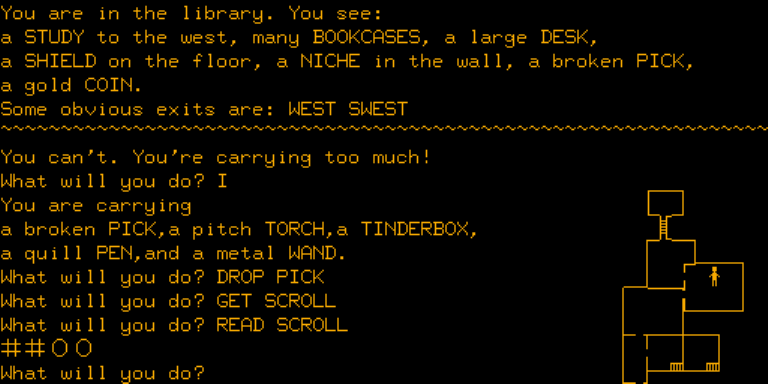
With the pick in hand tying LEVER TREE gets a “nothing happens” response, but that means — especially given the custom-coding to check if you have the pick — that it must work elsewhere! I went through every item in the game again trying LEVER THING, finally hitting upon LEVER SHIELD.
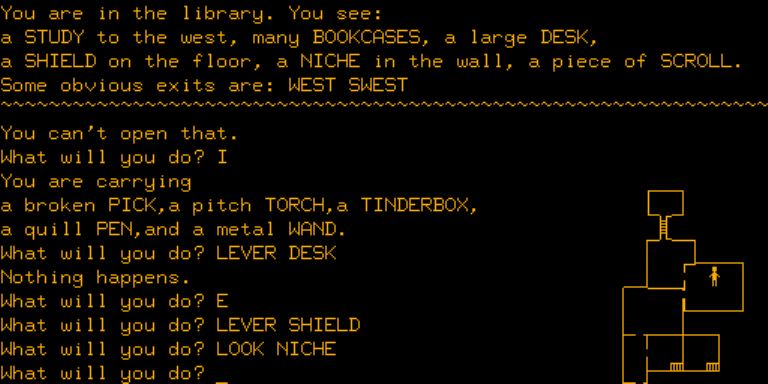
I see what’s going on now with it — you’re trying to yank the shield off the wall — but that’s never the language I would normally use, and while I’m fairly sure I’ve seen LEVER as a verb somewhere else it’s rather rare.
The niche has a scroll which gives the combination I was seeking. There are repeats, which indicates a brute force method with just the digits 1 through 4 would have worked (but that would have been painful, and of course it’s better to solve the author-intended way).
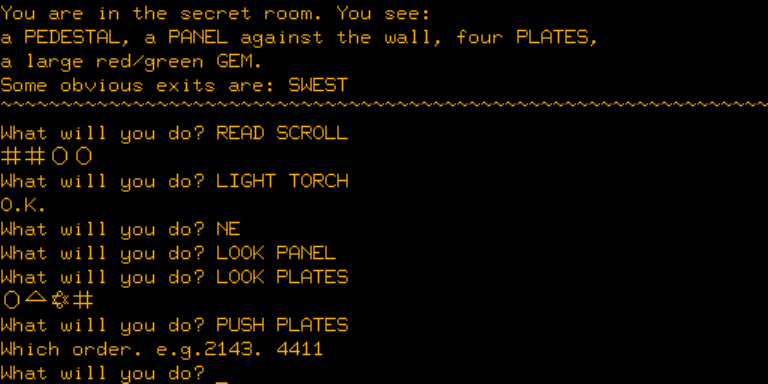
4411 from the scroll.
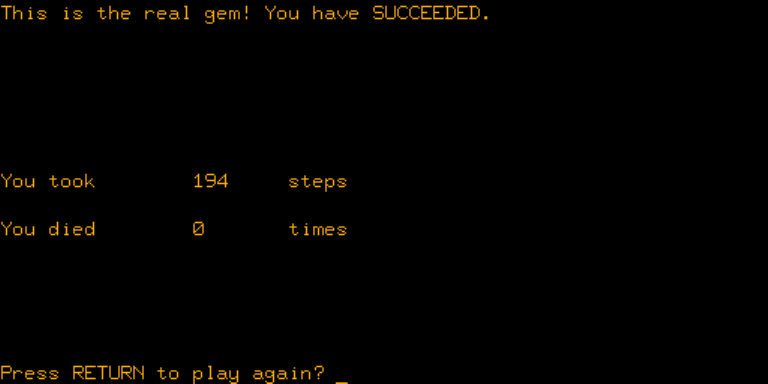
There was nothing deep and/or significant here in the general content, and barring the two obscure secrets (the cauldron and the shield) there was nothing elaborate as far as puzzles go, but the art gave a pleasant buzz to the experience and easy is better than too hard (and despite that, this ended up going to three posts). There’s still two more games from the same author which we’ll eventually get to so hopefully Chris Norman will show up one day to explain the process.
The mini-map really is novel: we’ve seen a few but very few, and none that have a visualization quite like we’ve seen here. Morpheus Kitami suggested that some games of the 90s may have been influenced by this series, although the Microbee itself was obscure enough it’d have to be a circuitous route if that’s the case. Still, an idea come up with independently and not repeated can be just as interesting as one that influenced the industry. The game does get a mention in a 1984 Swedish magazine; for reasons I’ll save for another time the Microbee did manage to make inroads in Sweden.
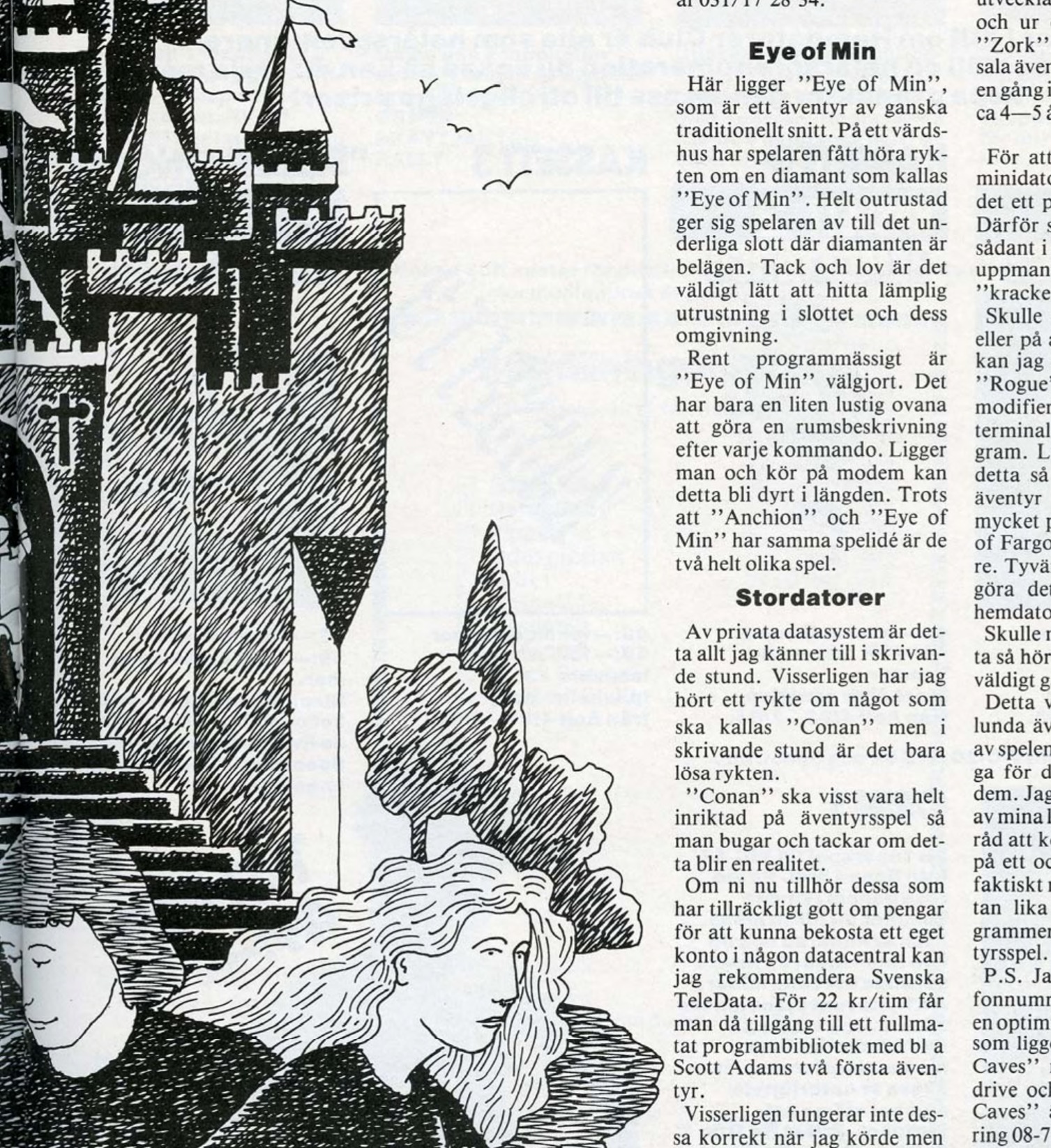
Interestingly enough, the review complains about how the game applies a room and description after every command, and this can be irritating when using a modem. I’m not sure what’s going on here, but I’m guessing for remote use the top part of the screen is sent after all commands (because sometimes that’s the only thing that changes). The Microbee developed strong network capabilities early (see Owen Hill’s background in telecom) but I don’t know the exact configuration.
Coming up: I’ve got a few things cooking, and I’m not sure what the order will be (there may even be another game tossed in the middle). One of them laterally involves a famous British TV show, one of them involves a Japanese conversion of a movie (produced jointly by companies in South Africa and Botswana), and one of them involves an Apple II game by two unexpected authors.


Leave a Reply