I owned an Acorn Electron as a kid. It wasn’t the greatest games machine in the playground, but it did have the best game of all-time, Braben and Bell’s Elite, and one of the finest adventure games of all time, Trevor Hall’s Twin Kingdom Valley.
For a boy with a fertile imagination, and an obsession with the Fighting Fantasy books, Twin Kingdom Valley whisked me through the screen, and into a fantasy world of babbling brooks, Forests, Orcs, Trolls, Goblins, Dragons, Kings and treasure!
— Mark James Hardisty, Classic Adventurer 13, 2026
I’ve finished (as much as a game like this can be “finished”) so final spoilers ahoy; you should read my previous posts about the game before this one.
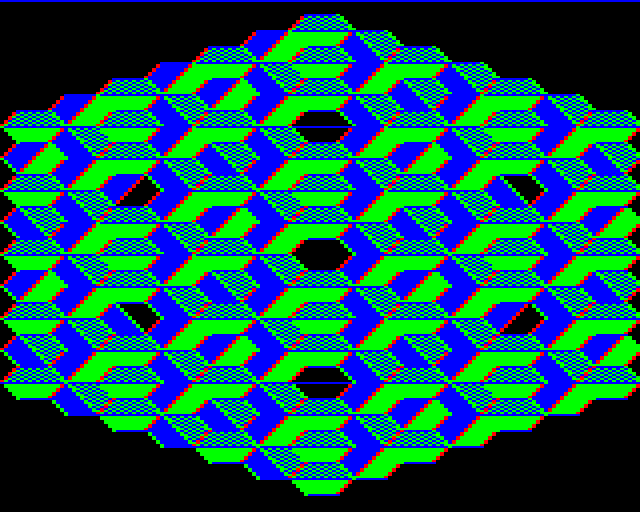
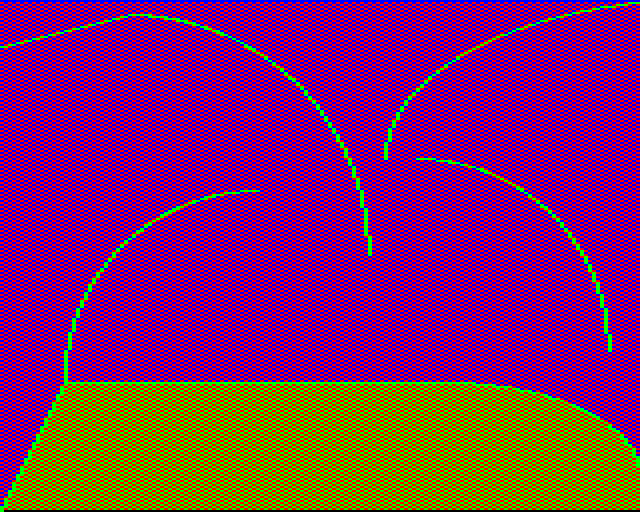
Mattias in the comments mentioned that some objects have images attached. Most don’t; LOOK BRASS KEY (or nearly any other item) gets the response “seems ordinary” and I had tried that enough times I assumed that there was no point to looking at items further (the intro text also doesn’t say anything about this as a feature). However, it turns out there are a few exceptions, like the diamond above (found at the start of the cave next to Watersmeet) or the picture in the cabin.
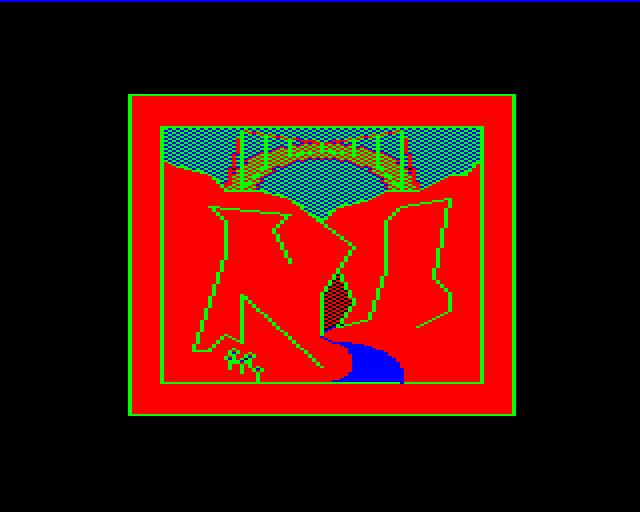
The picture ends up being a hint, because if you look at the wooden rod (back at the forest king area), you’ll notice a relation.
This turns out to be not needed to beat the game (and in fact I ignored it almost completely after using it) but that’s also true of the bridge in Crowther/Woods. You can WAVE WAND while at the fissure to get into the desert from the south, without passing through secret doors.
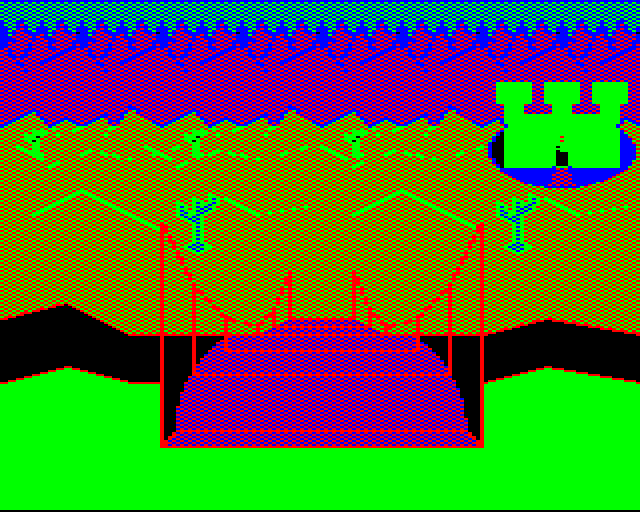
Since the secret doors are in close proximity to Watersmeet (and part of my gameplay involved going back there to heal up in between trips) it was better to use those anyway.
Incidentally, the desert has two “sand lurkers” (no idea what they look like, humanoid or not) and when I found them one was carrying a bag of silver…
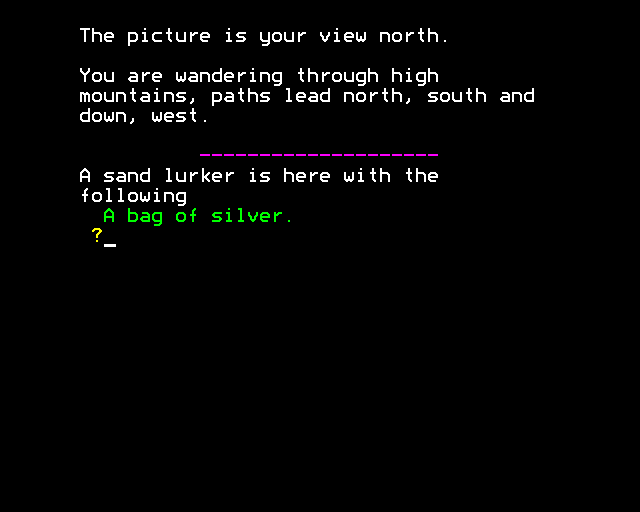
…so I used a mace I found lying around to chip away at their health until they died. This is more complicated than I’m making it sound because unarmed enemies will run away when you whack at them, and out in an open desert I found it easy to lose track of them. I accidentally fell into the moat of the castle a few times while searching (which causes serious damage). Additionally, the one holding the bag of silver dropped it in the process (and it got scooped up by a castle guard) so I ended up getting no treasure at all from the process (until I later killed the castle guard).
While dealing with this came later in my sequence, it’s easier to explain now what happened with the princess: I took the guess she might be related to the Forest King (since the two kings hate each other as part of the narrative). There’s also the meta-element that the Forest King doesn’t have a character that can be killed while the Desert King does, indicating to me the Desert King is the violent one and the Forest King is the peaceful one. The one thing I hadn’t tried is bribing the guard when getting tossed into the dungeon.
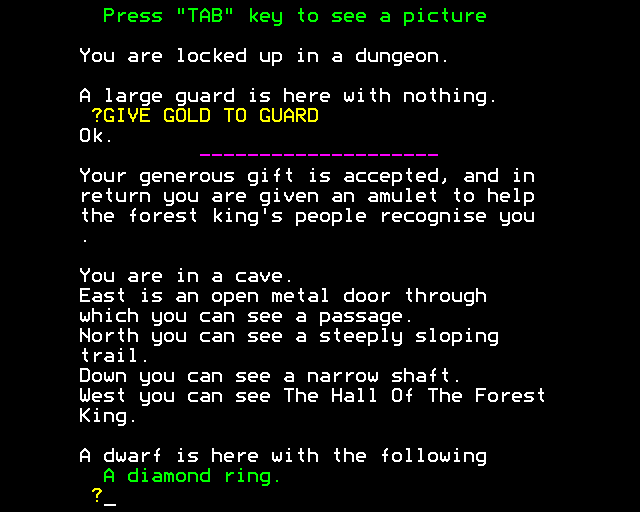
I decided to not worry about max score and leave the dwarf in peace. He’s still got his One Ring to pine over. I’m sure nothing bad will come of it.
With the amulet being worn, you can then free the princess (who is just past the gold-key door, so all you need to do is basically take the amulet into the basement).
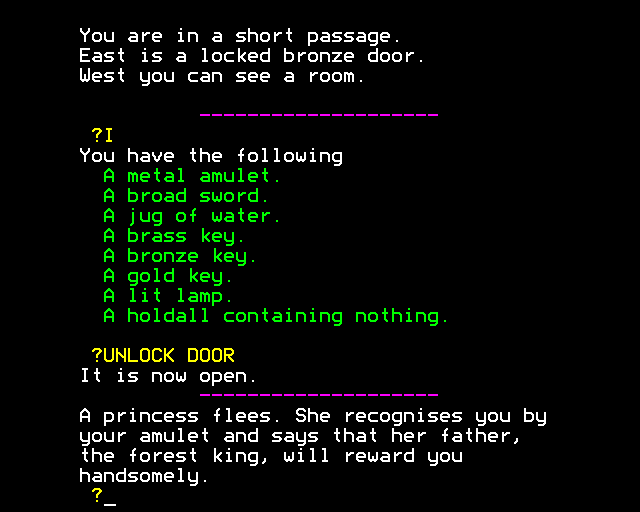
The silver key you get can then unlock the door at the bones; the bribe you handed over is right in the room. Given the circumstances, I think the intent is not that you’re stealing the gift back, but rather the Forest King is thankful enough about his daughter being returned that you’re welcome to take it back.
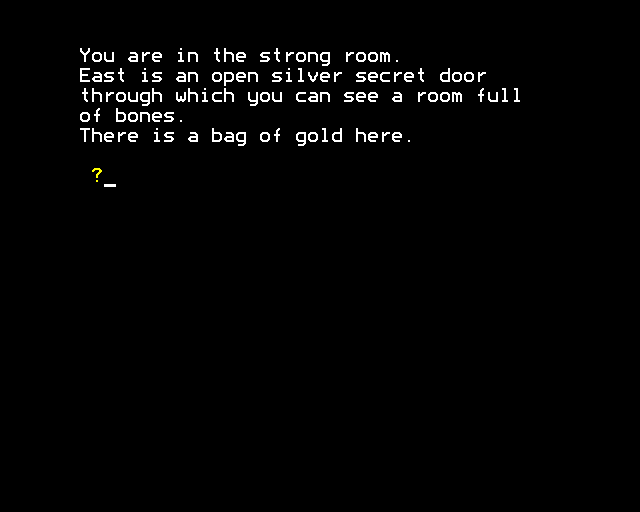
The diamond works too. According to Morpheus Kitami’s playthrough the bag of silver from the desert does not work so there’s some value threshold to the bribe.
With this all done, it was time to raid the castle and kill guards. As far as I can tell all you really need is a sword (which an elf happened to be carrying around, I did ASK ELF FOR SWORD and he handed it over); if there’s “experience points” muddling the experience it’s too small an aspect to notice.
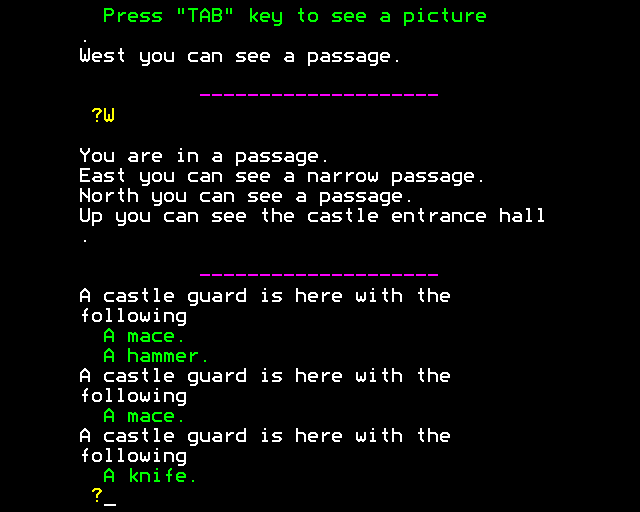
Don’t attack if they’re clustered like this.
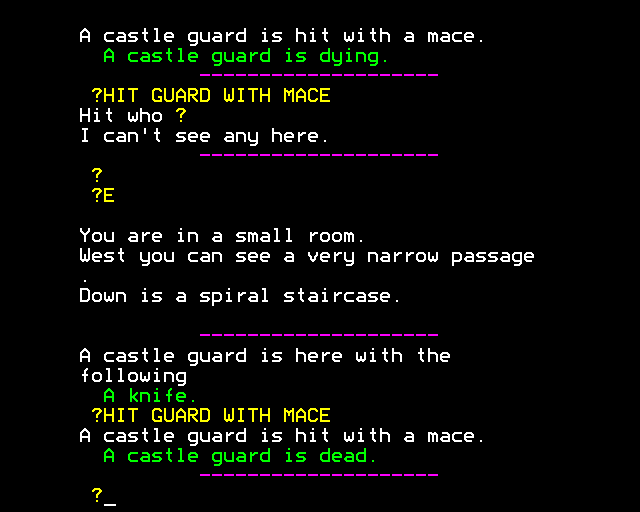
As long as you fight one-on-one (and go back to Watersmeet to heal) the guards are pretty easy.
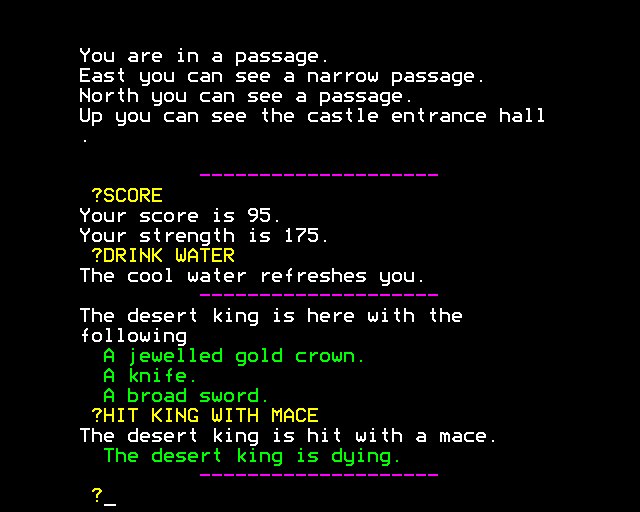
The Desert King is pretty straightforward as well, as long as you get him alone. On this run for some reason he was up near the storage room and cellar.
The combat incidentally brought out the feeling Trevor Hall mentioned about why there needs to be extra rooms: when physical placement of the guards (and juking them so they aren’t clumped together) becomes an issue, “ordinary” rooms take on new meaning. This is very similar to the treatment of rooms on MUDs that I’ve written about before. For a time I found this section of game to be nearly indistinguishable from playing a regular MUD (except it being single player, of course).
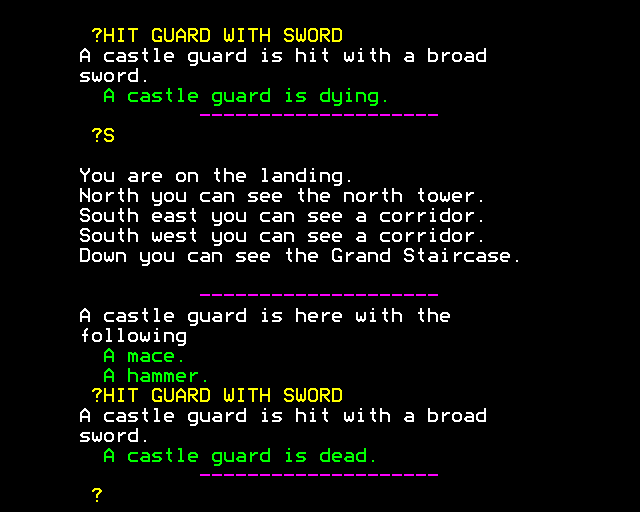
One more encounter, with the last castle guard hanging out near the dragon.
One other fun aspect is the giant. I mentioned last time arming him with an axe; he’s still effective but described the whole time as an “ill giant”. If you go back to Watersmeet and he follows, he’ll swim and heal himself! (This happened after I had already killed the dragon; I’ll explain why that’s important in a moment.)
With all that done, I still had a few things to mop up. One of them was a witch in a tower who had a gold staff and a dagger; I was able to kill the witch normally and get the staff. According to my check of the walkthrough later, it was supposed to be a lot harder; the gold staff allegedly prevents damage, and you need to hand over a dagger which will cause the wielder to harm themselves in order to defeat the witch.
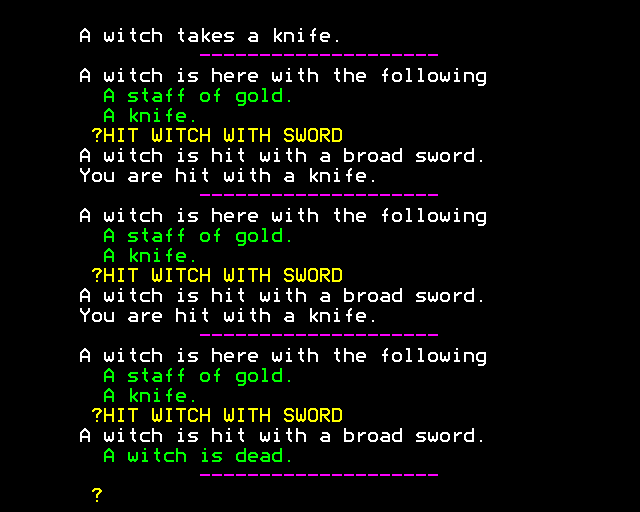
I found the moment so ordinary (see above) that I didn’t have a screenshot and had to reload a save state just now just to return to the fight. Maybe the gold staff only applies in the C64 or Spectrum versions? Or maybe the witch normally doesn’t have a knife? Did a guard wander in and suffer an unfortunate death, but in the process of grabbing the knife from the guard, the witch no longer had protection? Barring the BBC Micro version being different, this demonstrates how much chaos and variety the game has by relying on characters to be the “obstacles”; a hard-coded puzzle could have forced the player to reckon with the gold staff.
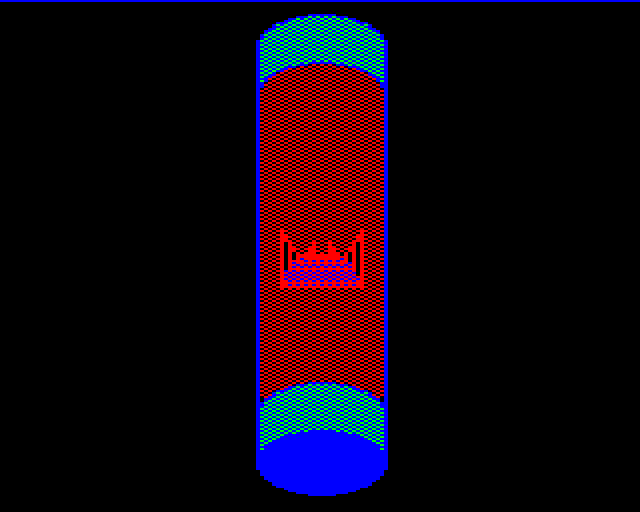
Another thing to mop up was the locked silver door in the Desert castle, and this one was fun to find. There’s a wooden staff locked behind the door, and this is another one of the rare cases where you get a visual:
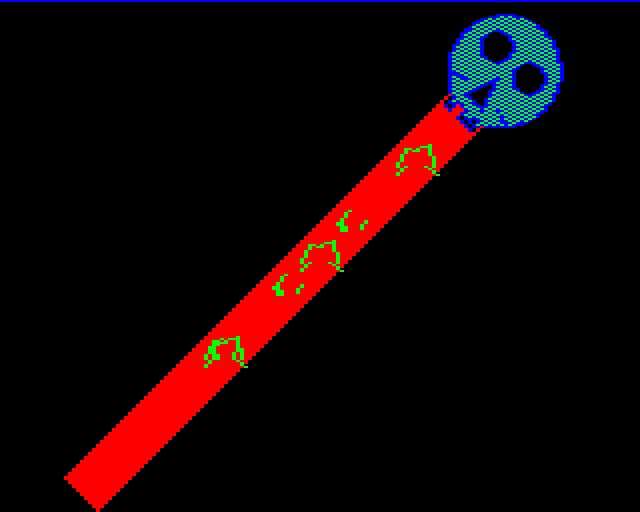
Waving the staff did nothing (WAVE is only for the wooden rod) but the skull was suggestive that it was a weapon.
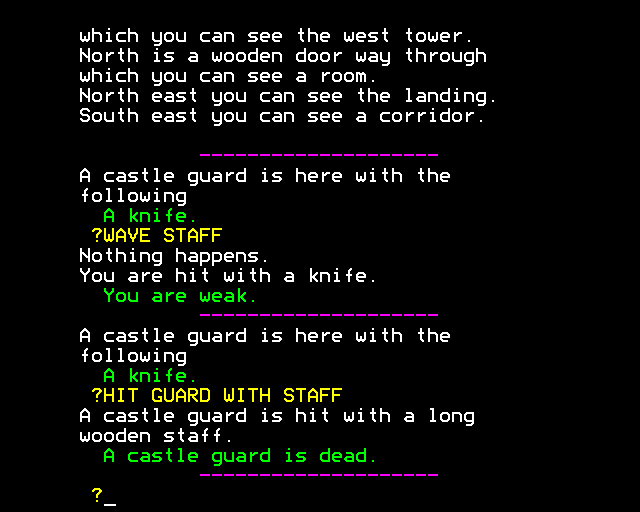
The staff is a one-hit-kill weapon. It’s pretty fragile (breaks after roughly two uses) but fortunately there’s really only one use that’s important: the dragon.
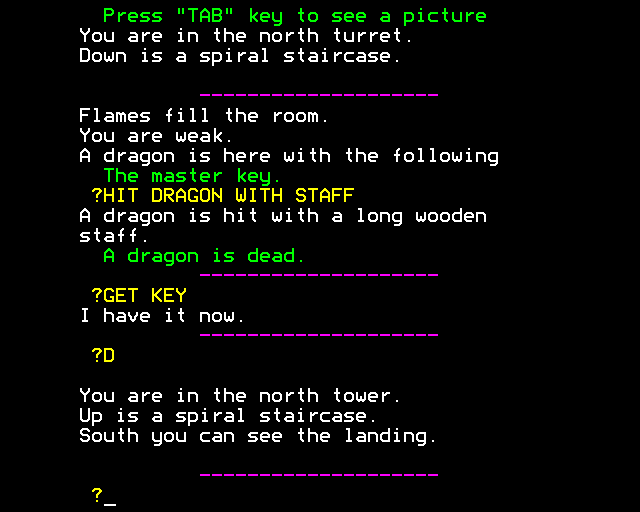
(Morpheus on his playthrough did not use the staff, but rather had healed the giant and went all weapons blazing with giant-buddy. I found the flames to be too dangerous to pull this off but there’s a lot of randomness involved; the best I could do before dying was get the dragon “weak”.)
With the master key I was able to get into the last remaining locked door, and as predicted, it had the Desert King’s chest. The chest is very heavy and you can’t be holding anything else at the same time (including the lamp!) I ended up toting it through darkness in the maze over to the rock fall and reached the final room.
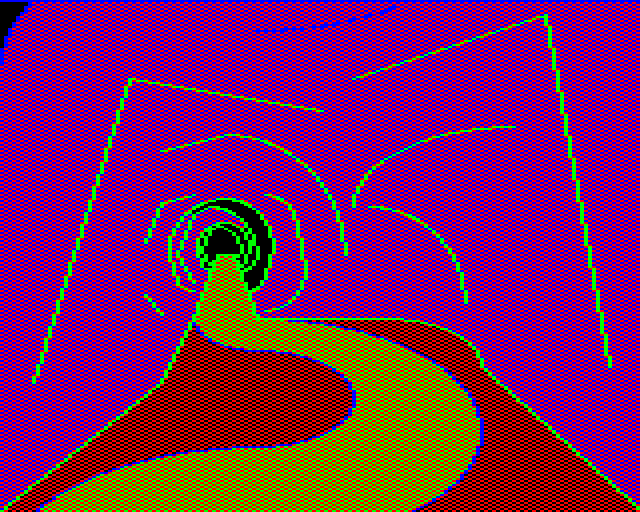
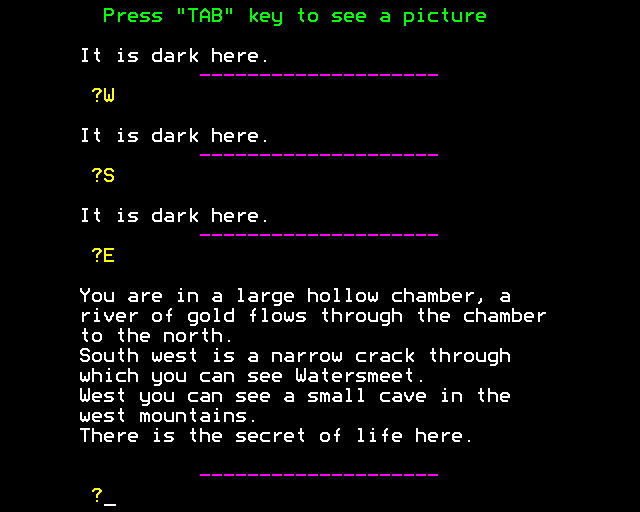
Once you’ve proven yourself with the chest, you don’t need to carry it to enter this place, so there’s the slightly odd circumstance of spotting the secret of life, turning around and leaving to deposit the chest at home, and then returning for the secret of life. I think I’m satisfied enough to say I’m done with the game.
The gold river, incidentally, was supposed to be the seed for the sequel:
Near the end, you find a river of gold. You have to wonder where it would go? And that’s where the next game would take you. But how could you travel the river? What boat could withstand molten gold?
I had started on a dynamic landscape tool such that forests, deserts, etc would be different in each game restart, but never wrote any game code. No story line was written, but you would be able to travel the river of gold to a vast land. No more pathetic 17 locations. I recall some ideas like “A wooden boat would burn in a river of molten gold”, so the game had to be started well. Some part of the original game would lead you back to that river.
Unfortunately, Bug Byte collapsed while owing lots of royalties (the same circumstances that caused Matthew Smith to jump ship with Manic Miner) so the sequel never happened.
Now that I’ve seen enough context, I’m going to quote Hall at length from this interview where he discusses how the characters work. He explains how other games only had characters “appear to come and go” without the ability to give chase, and then goes into technical details:
Location database: up to 256 locations possible, each with a description, and list of exits (a direction code byte [including locks]+ 1 byte target location). One byte “image number” per location. Locations also have a zone.
Object database: object with weight, value, throw damage, hit damage, fragility and location.
Creature database: Creatures with location and inventory of objects, friend/foe flag, permitted zones and health. One of the creatures is “You”.
Graphics database: 256 objects, (including sub-objects), drawn on a 16×16 grid. Giving about 80-100 location images, using about 200 objects in the BBC version, almost all 256 objects used in expanded C64 version.So: Your question on NPCs.
They could inspect the tables (except pictures, no need for that).
They have a decision tree including some random numbers, but basically:
Can I pick up a weapon?
Can I fight?
Should I flee?
Should I wander (in my zone)?All their fight chances were similar to yours, except “You” always got the first blow.
Note that even if you chose to run away, the other blows still came.
The game had a combat exception rule that running if your last action was to fight, let you run away.All in all, the rules were probably less than 1/2 K of code!
This 1/2 K code of code is what causes the game to be memorable, and for quotes like the top of this post (calling it “one of the finest adventure games of all time”). Just like The Hobbit, people did necessarily play to “win”; the experience could vary just based on where the NPCs roamed to. The game has a genuine air of replayability that many other authors of this time failed at; I’d say because of the lack of plot/minimalism it is even more replayable than The Hobbit.
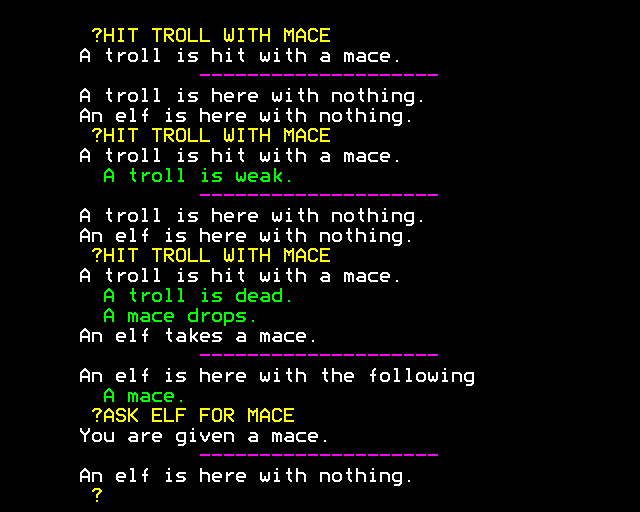
Another curious moment: there’s a locked brass door in the dungeon area where the room has nothing in it, but I tried locking the door anyway and an elf and a troll appeared from nowhere. I was able to easily kill the troll because it didn’t have any weapons.
I say all this because I’m still on board with the outside perspective of Morpheus Kitami, and others who were less impressed: “I have mixed feelings, the game was fun, but it’s hard to call it a good adventure game.” It was very easy to have objects that you needed snagged by NPCs and roaming around, which is both a demerit and a feature. I had tried to store some items (including the flint stone) in the “secret door” section but didn’t realize elves could get in there; I hadn’t lit my lamp yet so ended up typing ASK ELF FOR STONE in the dark section as I wandered around until I eventually found where it went. The fact that this encounter could even happen in the first place was both absurd but also stunning, and the feel of a world where “anything can happen” is what gave it such prominence to those who formed core memories around it.
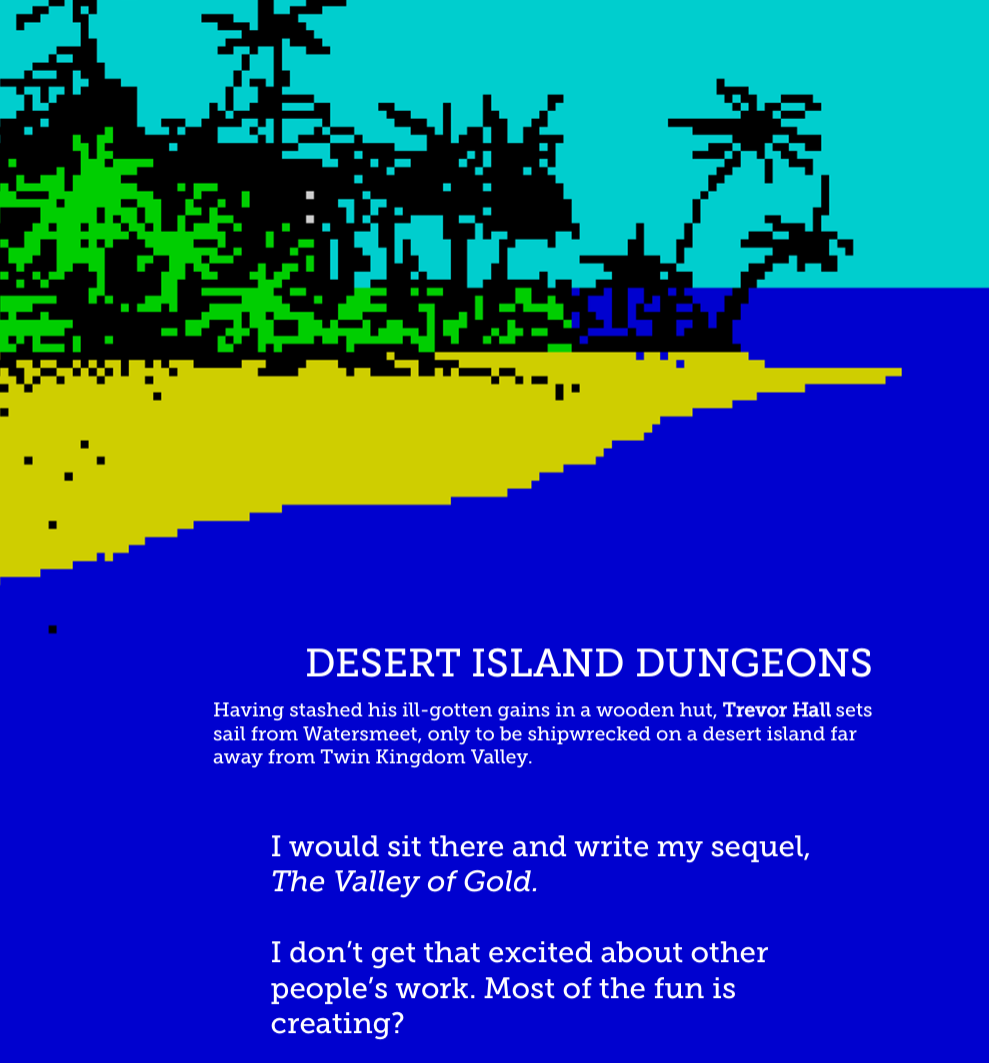
What Trevor Hall would do on a desert island, from The Classic Adventurer.
Coming up: our first encounter with the Microbee, a computer developed in Australia.


Did I miss something, or did you quit before the actual ending?
There isn’t an ending? I believe you can examine the secret of life to reveal sort of a silly message if you get max points but I didn’t bother (rescue princess + kill desert king + kill dragon + find secret of life + find most of the treasures is fine by me)
you don’t even need to drop the stuff in the cabin, necessarily; not sure how the rules on that works
Apparently looking at the secret of life with full points is quite literally the ending in the sense that it terminates the program, so you definitely did quit before reaching it.
You get points for each treasure if a) you have found it, and b) no NPC has picked it up afterwards, so while you can theoretically leave them anywhere and still get points from all of them, it’s not very likely.
oooooh ok that’s why it seemed arbitrary
I guess you could kill all the NPCs and do it that way, you’re most of the way there by the time you’ve seen everything
I’m still fine with my current score, I have no interest in murdering the dwarf
Yes, the versions have some slight differences. I can’t remember all the details now, but there are quite a few, and some suggest (or force) a different approach to some things.
By the way, the last picture is from the opening location of the Jewels of Babylon, Spectrum version. Recognising Terry Greer’s palm trees instantly is a reminder that I should have spent more time outdoors.
Regarding the references to Will, I think you’ll find that someone else was the one who covered this one over at TAG.
Meant to read along with this one, but only got around to it at this point. I don’t think I would have been of any use, since I forgot about most of it. Especially since for the most part I treated it as an adventure game trying to be an action game, whereas you were playing it more properly. I forget how extensive the manual is and how much it talks about, but I don’t think I figured out you could look at inventory objects and it took me a while to figure out that you could go NE and the ilk.
eek, he posted but didn’t write them!
I thought you posted all of yours?
Anyway, fixed that, sorry about that
Would not have figured out about looking at items until Mattias pointed it out
I only got admin privileges a few years ago. Up until then one of the previous group of admins handled it. Because, for me, at least, Blogger doesn’t work well with uploading multiple images at a time, if you dump a bunch of text the image gets thrown at the end, and the drag tool for images does not work well for me. It makes it a slightly more tedious process than it should be, especially if I also have to edit images from OS screenshots rather than in-emulator ones.