Recently I played Genma Taisen, published by Pony Canyon in Japan in March 1983 to coincide with the accompanying animated film. It was an official conversion; the “first” from Japan, maybe, although there were Space Battleship Yamato games (like this one and this one) and I don’t know if any were “official”. In the same month, Pony Canyon released another game, Happy Bushman. It was based on the live-action film The Gods Must Be Crazy, from South African filmmaker Jamie Uys (Uys is pronounced “Ace”).
Converting a slapstick comedy film might seem an odd choice, but there was logic to it. For me to fully explain what happened I need to start with Uys and the creation of the film:
Uys made his first film, Daar Doer in die Bosveld (Far Away in the Bushveld), in 1951, with what he describes as a “two-man crew” with just himself and his wife (the only exceptions being a few more actors and music). The plot has Hans Botha (played by Jamie Uys) being tasked to pick up a new schoolteacher, Martie du Toit (his wife Toit Hettie Uys) from a bus stop. The car has trouble with the brakes; Hans has trouble with speaking to women, zany antics ensue. The same character gets reused in a 1954 sequel, and then Uys does a remake in 1958.
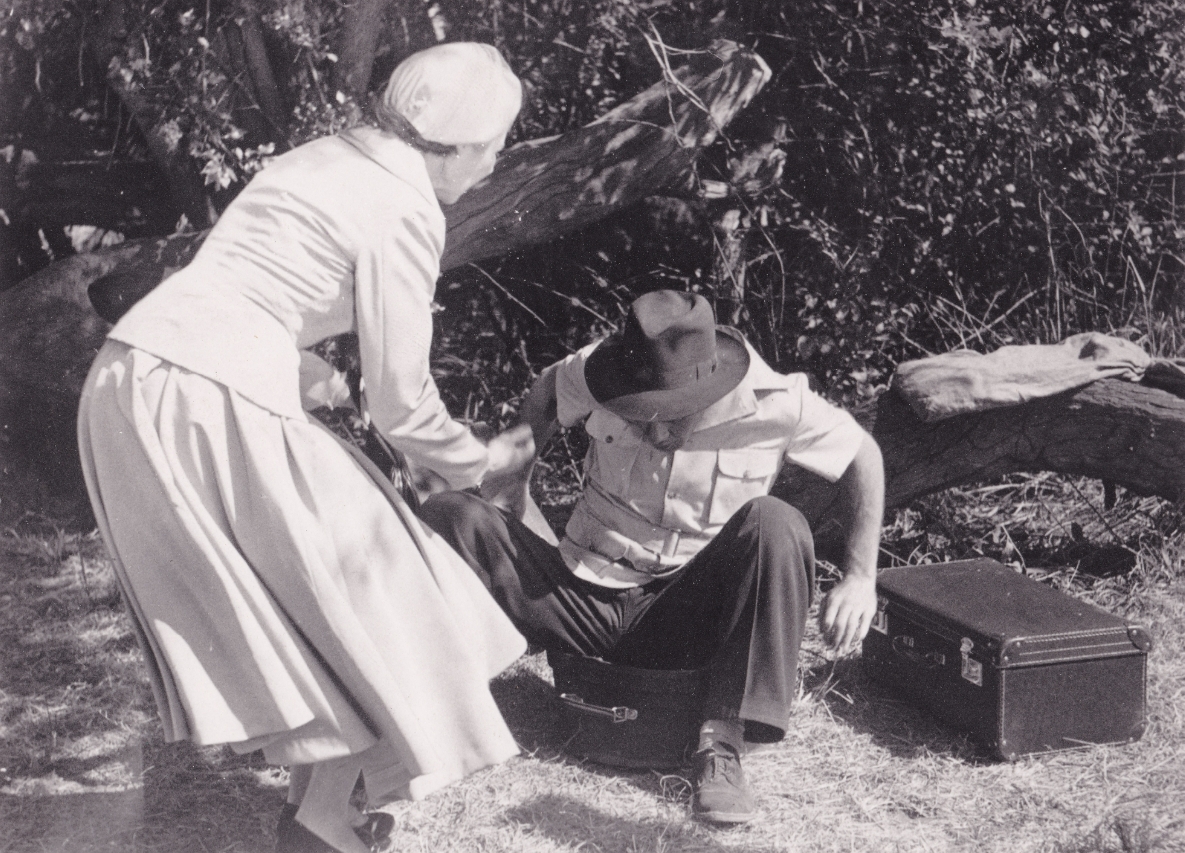
From the 1958 version. Source.
This was done amidst apartheid South Africa, and the same year as the remake shown above he made the short propaganda film The Condemned Are Happy at the behest of the South African government showing the “benefits” of forced removals. Quoting from the film: “one Sunday I went to look at the new town, my eyes grew big when I saw the houses they had built … truly the white man is very clever.”
Jamie Uys rose in prominence and while he was one of the first to bring films internationally, he insisted on growing the industry locally. His most “serious” work, Dingaka from 1964, is a court drama where an African tribesman is on trial for murder. Quoting a preview article in South Africa Digest from ’64, It contrasts the “hectic life of the city” with the “simple, unsophisticated setting of the South African veld”. (This idea gets mentioned explicitly at the start of The Gods Must Be Crazy.) The music is quite good and the film as a whole suggests to me Uys simultaneously had interest in local cultures while also holding an “idealized” vision of them.
The idealization shows up strong in The Gods Must Be Crazy (1980), which allegedly shows the authentic life of the ǃKung (one of the San peoples), starting in literal documentary style. The background was entirely made-up. The lead actor (Nǃxau) was a cook making a salary and quite familiar with modernity, but Uys claimed he “spent three months crisscrossing the Kalahari desert” to find his lead, and took photos and “marked the longitude and latitude” so he could find the people again. He claimed he met N!Xau in Botswana who had supposedly only seen one white man before (a missionary) and when he asked him to come work, he “didn’t understand, because they have no word for work.” None of this was true. To be clear: the issue isn’t that actors were acting — this was fiction, after all — but that Uys pretended the basic “documentary” frame held, and this was really showing the life of the San. More clicks were added to the soundtrack to make their language sound more exotic.
The film was test-screened in the US without much success; it was instead Japan where it first hit international fame. It was the biggest moneymaker of 1982, considering both foreign and domestic films. It turned out that N!Xau (and the idea of the San) attracted the Japanese imagination (Uye called him a “national hero” in the country); he flew to visit and did numerous interviews and learned to enjoy the taste of sake.
The Japanese loved this tiny star from Africa and couldn’t see and talk enough about his short khaki pants, shy smile and language.
— Via a 2003 news story
After a film makes money in theaters, it can make money in television. Early in April 1983 it showed on Fuji TV, combined with a media rush similar to Genma Taisen, with both a new music album (in February) and and a new computer game (in March). Pony Canyon’s advertising for the game explicitly mentions the premier of the TV show coming up on Golden Movie Theater (and the availability of the album).
The album was, significantly, via Canyon Records; in other words, the game and the album both came from Pony Canyon. The artist for the game, Takaomi Shibayama, was from the music side of the business and has a long list of credits as art director through the early 80s. (As far as I can find this was his only game.)
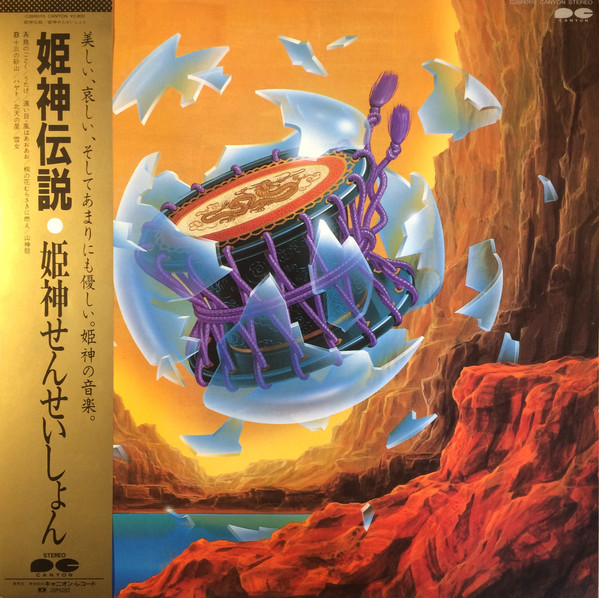
One of his 1983 albums, via Discogs.
The designer/programmer on Happy Bushman was Yasushi Numata, part of one of Japan’s computer clubs. I haven’t talked about Japanese computer clubs much; as an example, The Theoretical Science Group of Tokyo University is probably the most “famous” of Japan’s early computer clubs now (as much as late-70s computer history in Japan can be famous) because of their creation of Heiankyo Alien which originated the “digger” genre of game, leading to Space Panic and (by indirect means) the ultra-seller Lode Runner. (There’s a video from F_T_B if you want to know more about them and their rivalry with the University of Tokyo Microcomputer Club.)
I’m not talking about the TSG today, but rather FORESIGHT, situated in Yokohama. They were founded in 1980 by three high school students (as opposed to being a university club). They started just exchanging information and programs related to the PC-8001. They began their own zine; our author first appears in the August 1980 issue with THE GALAXY.
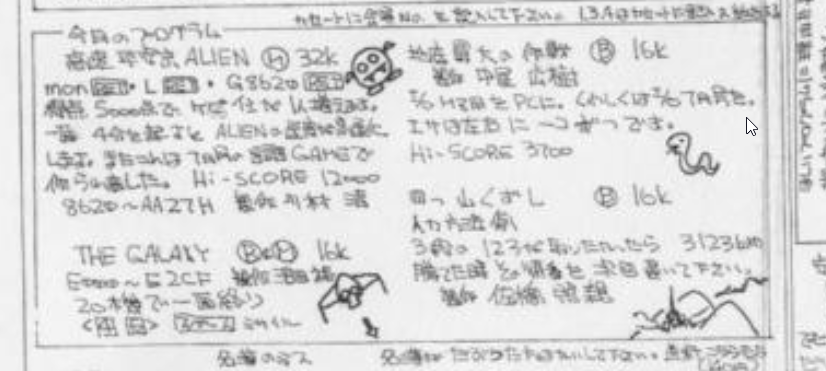
Yasushi Numata had some other programs appear (including a Star Trek variant and a golf game) but the most relevant item he made was a book about programming adventure games for the PC-88 series. It was published after Happy Bushman (in October) and is elaborate enough that Numata had clearly been thinking about the topic for a while (it includes 5 original games).
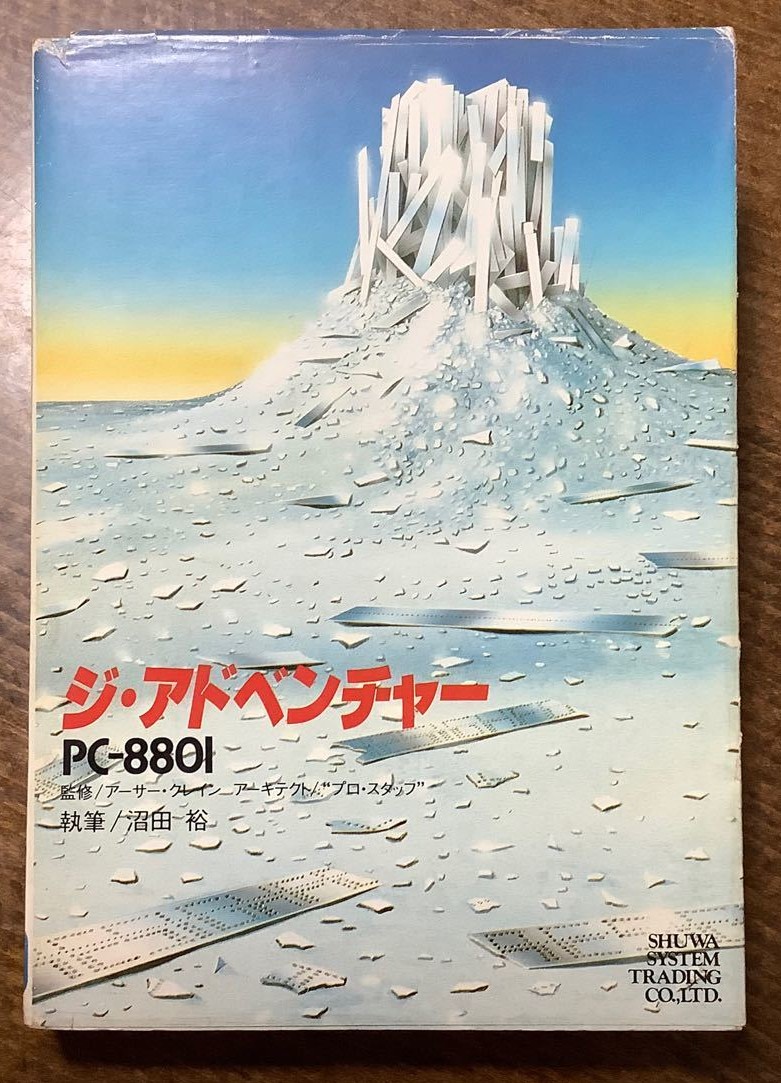
Source. The games are Treasure Hunt Adventure, High School Adventure, Planet Adventure, Survival Adventure, and Monster Adventure, the latter two being RPGs.
I do not know how Yasushi Numata got connected with the Pony Canyon production. Shuwa System Trading Co. (which published the book) is entirely unaffiliated. He does have FORESIGHT listed with his name in the credits; my guess is the club was contacted first and Numata was considered the best candidate for the project.

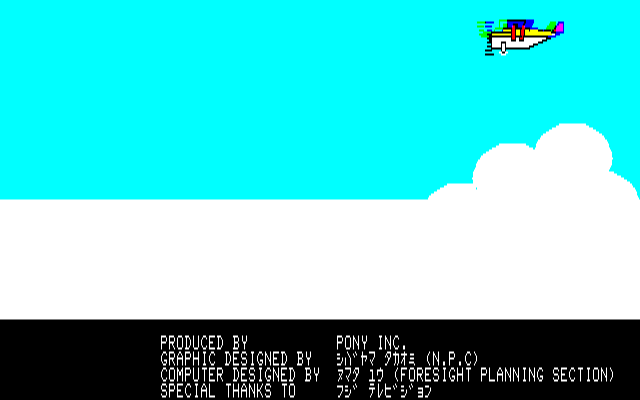
The plane is animated flying from right to left. The “special thanks” is to Fuji TV.
The PC-88, FM-7 (and 8), and Sharp MZ computers all got ports. I went with the FM version but I’m playing on an 8 rather than a 7 (the two are generally cross-compatible with BASIC programs on tape, just the 8 was made first and was slower).
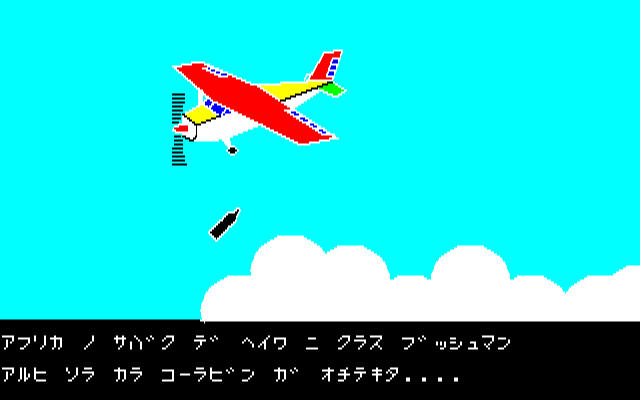
Just like in the movie, a plane drops a Coca-Cola bottle from above towards our protagonist. Unlike the movie, it doesn’t fall right next to him.
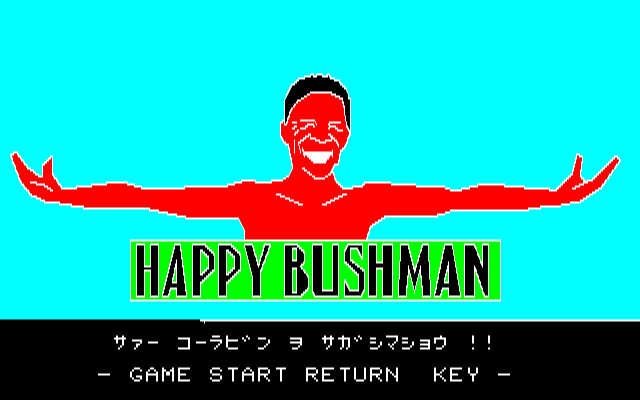
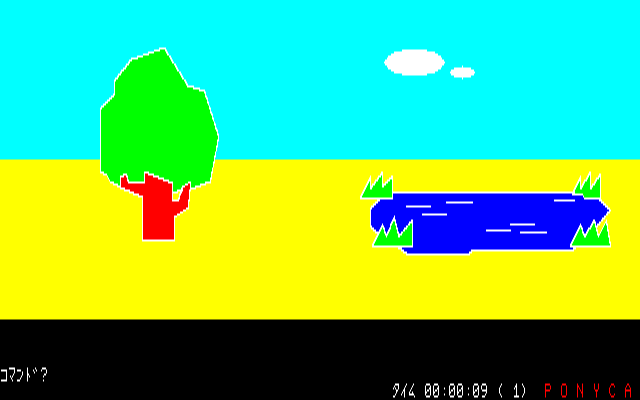
You play as the main character Xi from the movie, starting in the village. There are no compass directions, you can only move “ahead” (susumu) or “back” (modoru) so everything is strictly linear. I do not have a manual so I admit I had to consult a walkthrough immediately to realize this. I’ve tried to hold back otherwise for now.
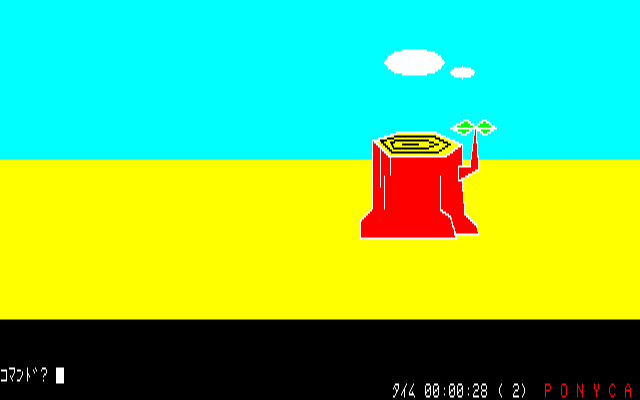
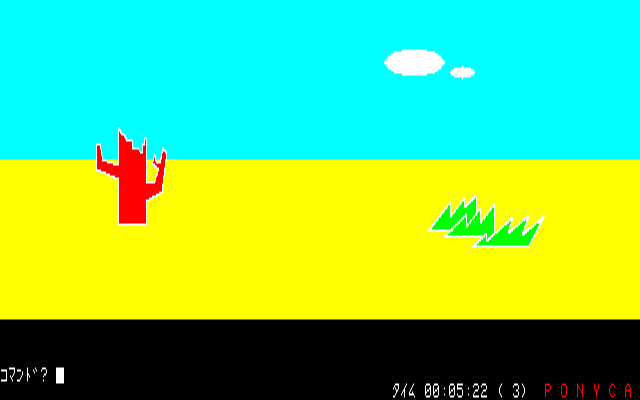
If you keep going forward, you eventually reach an elder who stops you and tells you that you can’t leave the village as it is against the rules. The key here is the grass shown above at about the halfway point, where you need to break out “miru” and LOOK GRASS. This reveals the bottle, which you can then take.
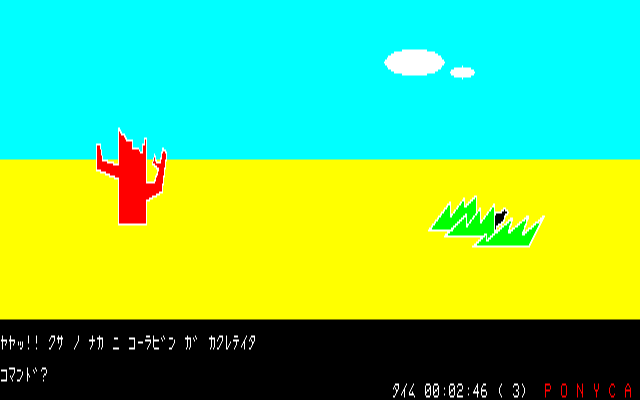
With the bottle in hand you now get told that you need to return it to God. (There’s no long sequence where the bottle is shown to be useful and people fight over it. The game seems to be aiming for a loose adaptation like The Dark Crystal.)
Leaving the village, there’s a baboon who will eventually nab your bottle as you pass on by. (You repeat typing “ahead” all this time — it’s essentially a way of advancing the clock on the story.)
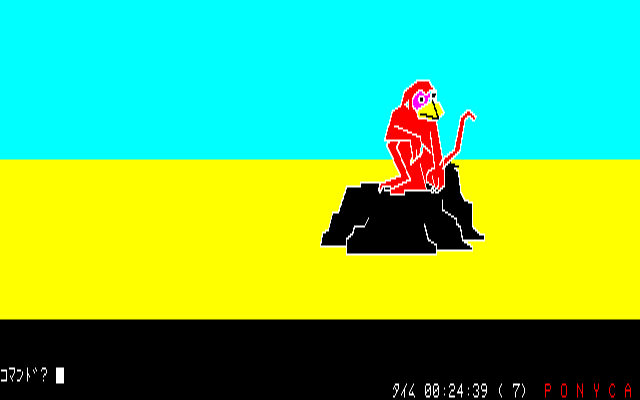
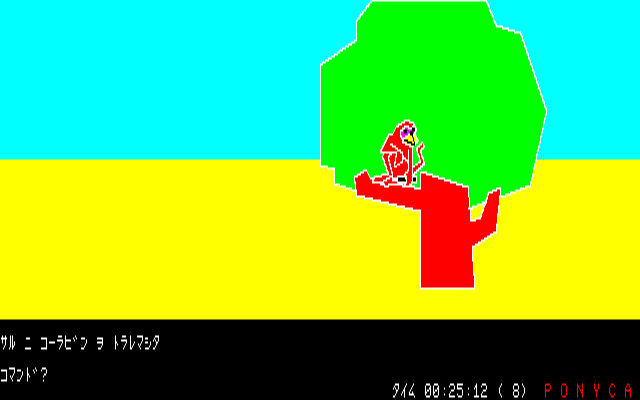
If you advance farther and come back, the baboon is gone. In the movie Xi talks to the baboon and explains how the object is evil which might be the solution here, but I’m going to save all that (and hopefully the remainder of the game) for part 2. Stay tuned!
(Special thanks to F_T_B for his help with research.)


Did the movie get another go round in the US? I definitely saw it in a theater.
yes, after it did huge in Japan they took it back for a second try and it worked
I first saw this movie in World History class in middle school, good stuff.
I played through this game a few years ago but I don’t remember much about it, except that I finished the whole thing with no hints in less than the movie’s runtime. I would have felt ripped off if I had bought it for a tenth of the original sticker price, much less the full value! One lesson you’ll learn quickly, if you haven’t already, is not to get your hopes up for PonyCa.
just finished
honestly the hardest part was where I left off! (I was trying to do things with the baboon and failing) Then it’s a bunch of “shoot bow and arrow when appropriate” “oh you came across a gate, now open it”
Very odd experience. Maybe not time to finish writeup until weekend, though.
Interesting – I knew the film, but didn’t know about the background, it being re-launched through success in Japan or about this game.
I’m also somewhat intrigued by the Yū Numata book with its original games you mention, including two RPGs. Depending on their elements and one’s definition of RPGs, in October 1983 those might have been among the earliest such games in Japan (not the first by far, but still early examples).
Haven’t seen them mentioned in any of the English-language articles online about the first Japanese RPGs I’m aware of (mostly those also quoted as sources in the English Wikipedia article on the history of Eastern role-playing videogames).
I realize you and this blog focus on interactive fiction / adventure games, not RPGs, but I wonder if it’s worth pointing someone more versed than me in the history of Japanese RPGs towards this fact. Though given the games are on Oh!FM-7, any such expert is probably aware of them.
BTW, your source link below the book’s picture does not work from everywhere. I’m currently in Spain and it leads me to a page stating that Yahoo! JAPAN’s services are no longer available to users in the European Economic Area and the UK. Apparently, the Wayback Machine has also not archived that URL.
And from the separately sold cassette tape as well as the FM-7 version of the book it seems there are six games. In addition to the ones you list it mentions “Sneak-and-Steal Adventure”.
it’s a current web site, so you can just request the Internet Archive save it, which I did just now:
https://web.archive.org/web/20261001140315/https://paypayfleamarket.yahoo.co.jp/item/z176770814
oh! one of the advantages of tossing it on IA is you can click “about this page” and you can see the images full-res without having to muck about (in this case, just scroll to the very bottom of the list to see them)
I just realized checking those that on the back (very small on top) we have the preferred English version of the name, Yasushi Numata, so I’ll change it
I went with Mobygames which I think was guessing
Neat! Wasn’t aware of this function. I knew about archiving current pages, but somehow that wasn’t possible for me when I checked it earlier. Maybe change the source link to the archived version now?
Here are the entries showing the six game titles on the cassette tape for the PC-8801 corresponding to the book, as well as the respective FM-7/8 versions of the book and tape. “Sneak-and-Steal Adventure” is the third in the list.
Nice that Oh!FM-7 has a page for it, screenshots help.
I’m not getting Sneak-and-Steal for
コソドロアドベンチャー
necessarily? It’s just “Kosodoro” which is naming a sneaky type of thief, so it’d be more like “Burglar’s Adventure”?
https://jisho.org/search/%E3%81%93%E3%81%9D%E6%B3%A5
Sorry, I don’t read Japanese myself, this was deepl’s translation. Maybe someone knowing the language might be able to confirm.
The other thing that confuses me is the index (which I was referring to) leaves the game out. Maybe there’s two editions? Or maybe it just didn’t get mentioned in the index.
Hmm, my best guess based on the sources so far is the PC-8801 book came out first in October 1983 with five games, then the FM-7 version plus tape followed in November, with that sixth game added, and the PC-8801 tape – with all six games now as well – was then published in January 1984. Which is what both the page I linked above for said tape as well as this one give as its publication date.
However, I have no idea how reliable and exact these dates are.
Doesn’t help with that question, I think, but talking about the book and its games, here is a post by someone who acquired the FM-7 book and tape, tested all six games and wrote a few lines on each.
Yeah, it’s possible there was a game added in there between versions – or maybe it’s just that one page fails to mention it for some reason.
Pingback: Happy Bushman: Meeting a God at the End of the Earth | Renga in Blue
It was one of the movies our parents showed us when me and my siblings were young kids and they had to keep us occupied. I knew nothing of the context of the movie, but it is certain that for a time it tainted my view of Africa.