Archive for the ‘Interactive Fiction’ Category
By Arthur DiBianca. Played on computer with Gargoyle. Finished, using walkthrough twice.
> u display
You tap the little display, and the message changes.
A panel on the top of the box slides open, revealing three buttons: white, gray, and black.
> u white
Click. A small hole opens on the bottom of the box, and a white rope unfurls from it.
Um, did I mention the box was levitating? Sorry, that was a real oversight. It’s levitating about three feet above the floor.
Grandma Bethlinda’s Variety Box drops the player in a blank room with a box, and invites the player the discover everything they can. The box proceeds in a series of stages that are akin to mini-puzzles. The only commands possible are USE and EXAMINE (U and X for short), resulting in a strikingly minimalist experience rather like the author’s game last year, Excelsior.
It reminds me of two game subgenres I generally enjoy. It’s missing crucial elements from both.
The first is the My Crazy Uncle’s House game, found in such exemplars as Hollywood Hijinx, The Mulldoon Legacy, and Finding Martin. The player tends to be tossed into a strange house full of random gadgets and the enterprise tends to be an excuse for puzzles.
The box felt like it could have easily been a side exhibit in Mulldoon. However, even though all those games have a cursory plot, it still has a plot and player motivation nonetheless. The fact this is just a set piece gives it faint momentum and I had initial trouble working up the energy to play. (Even the title is unclear: is this Crazy Grandma Bethlinda or instead Awesome Grandma Bethlinda Who Spoils Her Grandkids?)
The second genre is what I term the puzzlebox-clicker, with examples like Windosill (shown below) and Samorost.

While the interactions between objects in this sort of game can be arbitrary — the only way to find out what a thing does is to click and find out — the visual novelty carries interest even on clicks that make no progress. In GBVB, when nothing happens, it’s just nothing. The substitute would be engaging prose, but here it’s mostly just functional.
Still, I found this game a vast improvement over Excelsior and it held enough charm I wanted to see it to the end.
The charm comes from the fact that the box is not without character; there is a “voice” inside helping you out.
“Sorry. Rotate horse to engage crank.”
> u horse
You try twisting it. It shifts slightly, but refuses to turn.
The message on the display changes. A tray bearing a desk bell extends from the left side of the box.
> x display
“Whoops! Ring this bell to unlock horse.”
By making the puzzle structure essentially have an invisible character, Grandma Bethlinda’s neatly avoids the problem Excelsior had of feeling cold and distant.
Mild spoilers about a puzzle I was stuck on:
.
.
.
S
P
O
I
L
E
R
S
.
.
.
.
.
.
.
.
.
There’s a puzzle I’d normally approve of where you indirectly control a little robot figure by manipulating lights; the robot man starts by reading a newspaper and as you dim the lights the little robot goes to bed. Unfortunately the first few moves of the “correct” path give no feedback at all, so I assumed I was doing something wrong. The feedback only occurs after the player is already near to solving the puzzle. It would be helpful if the messages were more continuous so it’d be obvious to players they were on the right track.
By Chandler Groover. Not finished.
Sorry. Animal Cruelty Simulator 2015 (Now With Sound Effects) is not my thing.
By Megan Stevens. Finished on computer.

Let me get this out of the way first: the structure and interaction aren’t too enthralling:
So let’s talk about the story instead. It’s built of artifacts; a father has collected his daughter’s newspaper writings from different countries.
It is very fragmentary. I was often unclear what was going on. I know enough about Syria to give context to the screenshot at the start of this review, but it still comes off as a photograph of a story rather than a sequence of action. There are other passages suggestive in themselves but they don’t carry anywhere.
But at a time like this, in a place like this, justice is scarce for women. Worst of all, there was nothing Cat or I could do to help except stand back and let her try to reenter life.
At the end, Much Love details how the story is based on the life of war correspondent Marie Colvin. I found her brief biography the most compelling part of the work, which indicates to me the wrong story is being told. Perhaps this would have been better as interactive non-fiction?
By Alan DeNiro. Finished twice. Played on computer with the Firefox browser.
You start following the brook. Despite not being anywhere near your Poli Sci class, you feel at home. Silver minnows dart in your direction as you walk, as if you are a magnet and they are iron filings.
The brook widens. You don’t see any signs of human habitation, only animal tracks: deer, hare, red bear.
After an hour of walking, nothing looks familiar. The topography, if it’s mimicking the game, is procedurally generated. Meadows, mounds, faery rings of mushrooms beginning to sprout.
The plots of Alan’s games are often puzzleboxes in themselves. I’ve often found myself needing to re-read and take notes get to make sure I understand the setting.
Unbeknown is no exception. The main character is playing what resembles a modern survival game like Day-Z or Rust but things quickly go sideways.
It’s a lovely, short thing, and I do recommend everyone try it.
But–

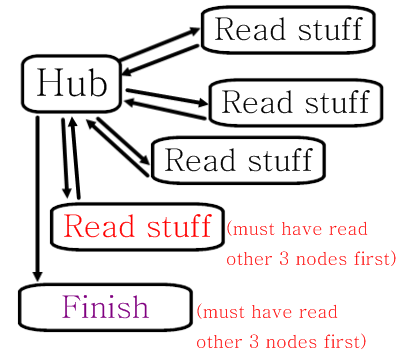
–it does suffer from a lack of choices. While this isn’t literal, my experience felt like the diagram above.
There are two endings which seem to hinge solely on a final choice. However, neither ending comes across as a “choose which ending you prefer” moment, rather, they give different knowledge and it feels like the puzzlebox is incomplete without both of them existing simultaneously.
RANDOM THEORY TANGENT
I’ve been trying hard to figure out why some minimalist Twine works bother me and some do not. Here is my current theory: if there are choices presented that look like they should affect the main part of the plot, it’s allowed at least the first time to “fake out” and railroad back to the main story, but at some point during the game there should be plot choices that feel like they have genuine influence. This feeling needs to be tangible; completely hidden stats don’t help with this. Just having a choice in one of X endings does not count. Having the only branching be alternate endings leads to what I might call “the home video Clue effect” (named after the movie which originally had 3 endings which showed randomly in different theaters, but the home DVD/VHS/bootleg Youtube clip/whatever has the three endings play one after the other).
I am expecting, given a plot-related choice, to have some role in shaping the story. That doesn’t even necessarily mean different nodes — perhaps passages are inserted in the main branch which acknowledge choices of the reader. When agency is presented as possible but then denied I feel like some sort of social contract has been violated.
Lots of adventure games have purely linear plots, but there is traditionally tons of room for variety at the small-scale level; trying to work out puzzles, examining and moving around at one’s own pace. If that interest is stripped out than what’s left is the ability to shape events at a macro level, but if that is denied there’s not much to work with at all other than clicking on the next word.
END RANDOM THEORY TANGENT
Sorry for the sidetrack there. By way of apology to Mr. DeNiro, I’d like to mention I’ve enjoyed all of his work and want to point everyone towards his very first IFComp entry from 2001, The Isolato Incident. It got 22nd place so I reckon many of you haven’t tried it, but it is very much worth a go.
By Wes Lesley. Played on computer with Frotz. Finished without walkthrough, but checked after for hidden endings.
With the Royal Coffee in one hand and the royal bunny slippers on your feet, you arrive in your office. Well, ‘office’. Just a fancy name for the room where you keep your chair. And ‘chair’ is just a fancy name fancy people use to say ‘throne’. Honestly. You’d almost think a throne was something special.
The blurb for The King and the Crown prepares us for a “very short game”, but I ended up playing for about an hour. What happened?
First, note that the blurb does not lie. This is a one room game where you play a king who needs to find your scepter and crown. For me this occupied all of 10 minutes.
On the way, I noticed the parser was rather more clever than the previous games I played from this comp, and even the error messages were fun to read.
> get crown
Okay, so you want me to ‘get crown’ and I can respect that and I totally get where you’re coming from but then it went [sounds of rocket taking off and crashing and exploding] and I hope you’re not mad at me because I really tried my best.
I mean, uh… You can’t see any such thing.
After finishing, the game mentions “five points to score, hidden in the game”, with some suggestions. This is where my hour playing comes in.
I probably had fun for 3/4 of it. This is the sort of game where the fun in playing parser comes out, where you have the freedom of thinking of something and trying it rather than seeing a list of things to try and picking one; even the failures had funny admonishments.
The other 1/4 I got annoyed because of the specifics of the hidden points.
S
P
O
I
L
E
R
.
.
.
.
.
.
.
.
.
S
P
A
C
E
.
.
.
.

There’s a hidden point obtained via an “abracadabra” magic word. I knew I was supposed to use it but the timing eluded me totally and I needed the walkthrough. (Also, I misspelled it every time I tried to type it, including right now in this very post.)
The worst (but in a way, most interesting) point came from optimizing the steps so that all the other points were obtained as efficiently as possible. This made no temporal sense and required cheap meta tricks like wearing the crown without first typing >TAKE CROWN. As grating as this was, I appreciated that it made me think of my parser commands outside the box. It was sort of “speedrunning for IF” which, like a real speedrun, leverages the glitches in the system (example: in Mario 64 jumping through walls to skip levels).
If the hidden points were true easter eggs like the Last Lousy Points of a traditional adventure, I wouldn’t be so annoyed, but the game’s structure made it feel like solving them was a requirement for a full experience.
By Alex Butterfield. Finished, but with extensive use of hints. Played on computer with the Gargoyle interpreter.
The main character, Bernadette, has burnt toast setting off a smoke alarm. She’s now trying to avoid a fine caused from the resultant “nuisance call” to the fire department by setting a real fire.
Ooooo-kay? Roll with it. I’ve seen stranger acts in News of the Weird.
All the action occurs in the five rooms of Bernadette’s apartment as she tries to set some sort of blaze. There’s the usual set of domestic obstacles including an obstinate fan and a stuck washer door.
What elevates this game somewhat above the typical “my lousy apartment” story is the backstory that the main character has just broken up with her boyfriend Ash, and there are telltale signs of story spread out among the items; not artificial things like diary pages, but rather a beard added on a Buddha by Ash or a gas oven that doesn’t work because the PC can’t pay the bills.
Unfortunately, bugs and verb issues are pretty prevalent:
> get pillow
Lifting up the pillow, you reveal an unopened bill. Apparently the tooth fairy wasn’t
fooled.
> get bill
Taken.
> get pillow
Lifting up the pillow, you reveal an unopened bill. Apparently the tooth fairy wasn’t
fooled.
or
> search sink
The square sink is empty.
> x sink
Hey, there’s a butter knife in there! Ash must have missed that one when he took the rest of the cutlery. Probably because he’s never been within three feet of the sink!
It took me five attempts on the cigarette lighter before I came across USE. (Tip: if your object requires USE, it doesn’t have enough verbs coded in.)
The worst offender had to be the branch, which requires a verb use so outrageous I would like to hear if anyone came up with that on its own. (I did use the appropriate item first, but the response was not helpful at all; the proper thing to do would be to _strongly_ hint at the correct phrasing after the failed attempt.)
I ended up losing faith in my ability to anticipate what the parser wanted and starting using hints through the entire rest of the game.
Then the fire started and part two of the game got going, and I hit the biggest “wait, really?” reaction I’ve had in any IF competition, ever. Switching to spoilers…
S
P
O
I
L
E
R
.
.
.
.
S
P
A
C
E
.
.
.
.
.
.
.
.
.
.
.
…I get that the ex-boyfriend is not very nice, but does anything he do imply he needs to go to prison for attempted murder? Trying to match the parts of a threatening message to frame someone is an interesting puzzle, but the in-world implications! — I’m used to amoral PCs, but this was staggering.
By Allyn Chen, Hannah Turner, Laura Weber, Shirley Park, Will Hagen, Chris Klug, and Scott Stevens. Intended for Android tablet, but read on computer with the BlueStacks interpreter (instructions here).

I really have to put “read on computer” rather than “played” — this is literally a 97-page ebook. The various illustrations throughout can be touched (or in the case of an emulator, clicked) so sound effects occur or things move. Touching the image above causes a glimmer from the father’s eyes in the rear view mirror. Some images can be “rolled” to a slightly different perspective by tilting the tablet (the emulator I used simulated this effect with the mouse).
After a traumatic incident involving mean girls and a collage, Sarah and Summer’s father tells a story, “a whole new one with treasure, toads, swamp witches … inter-species linguistic communication, acts of courage and valor.” And, most saliently for the title, Cat Scratches, cats with wings. The frame story is not forgotten, returning with the usual devices of interruption and objection (“At this point, Sarah interrupted to demand details on how Scratches could possibly know about human class systems from the middle ages.”)
However, the book is dominated by the inner story and is pretty much a straight fairy tale that only moderately held my interest; I cared more about the reactions of Sarah and Summer, which made for a stronger narrative (sample: at one point Summer catches herself listening to the story and hopes nobody else in the car notices).
I’m afraid the interactivity didn’t add much for me. I’ve seen some spectacular ebook effects with other works (like Alice for the Ipad) but here the occasional random disjoint sound effect or stiff animation removed me from the world rather than adding to it.
BONUS POST-REVIEW THOUGHTS: After some musing I have two suggestions I want to address directly to the authors.
First, the sound design could be more layered. I could see sound working throughout the entire fairy tale section as long as it is not as simplistic as “this is the page where crows play” and “this is where you can click and hear a cat”. In games set in a three-dimension world, there are multiple sound sources with volume based on proximity; a similar technique could work here.
Second, the animations could carry over pages to feel less like isolated set-pieces. For example, on one page you have a feather that floats by and off the page; the next page could have the feather continue moving from where it left off.
By piato. Finished. Used the walkthrough once. Played on iPhone.
Duel is sort of a mash-up of Invisible Parties and the endgame combat of Acheton. You participate in a duel of mental summoning and have a limited list of moves like “a memory of madness” or “a memory of mastery, painfully won” that each can be only used once. Thus this is a game of timing responses to your opponents attacks.
The nature of the overarching puzzle requires repeated plays. Hence: a lot of repetition of text and clicking. The “madness” summon is particularly noteworthy with an epic three-page story given before confirming. There likely is a more elegant way to handle this (possibly code acknowledging when text has been seen before and compressing it second time around) but since links are placed consistently at the end of the text it’s easy to breeze through.
The puzzle otherwise was quite enjoyable to work through and there was a lovely twist based on the summon being out of the protagonist’s memory. I would like to discuss one particular part in depth, but it is a heavy spoiler, and I don’t recommend reading until after you’ve tried the game yourself.
H
E
R
E
I
N
.
L
I
E
S
.
S
P
O
I
L
E
R
.
S
P
A
C
E
/
M
A
D
N
E
S
S
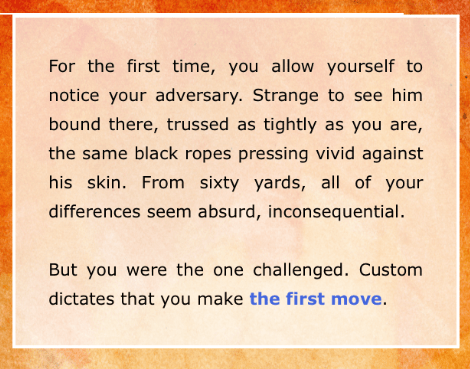
I was stuck on summoning the golem because the enemy destroys it almost immediately upon summoning (this is where I needed the walkthrough). What I needed was to ignore a directive given by the text, that custom dictates that you make the first move. I somehow had got the impression it was a requirement, but the only way to win is to ignore this and start the game by waiting. You are told “How unorthodox” but still can continue with the action (or inaction, rather).
One of favorite puzzle-types are ones which undermine unconscious assumptions; this was a perfect example.
By Nick Junius. Finished. Played on computer with the Gargoyle interpreter. Used walkthrough multiple times.
Straight up on loading I read…
You awake to the iciness of the floor on your hands, staring up at a nondescript ceiling. How you found yourself here is a mystery, why you’re here even more so.
…at which point I want to hop in a time machine, jump in front of the author’s computer, and shout “nooooooo” in slow motion.
Yes, everyone: it’s another amnesia game.
I anticipated Unknowable Things, Cryptic Messages, and The Vaguely Metaphorical Gadget of Arbitrariness being needed to solve the Poorly-Described Puzzles That Nevertheless Indicates Deep Feelings. I was not disappointed.
>x inscription
The glowing inscription reads as follows:
“This place…it’s almost alive…this room almost feels like a heart. Why would a structure need a heart? Am I an intruder? I was brought here…against my will…I think…was it against my will? It has to be.”
Fine: if treated like a pure puzzlefest, does Recorded hold up?
Still no. It suffers from what I call Magical Object Syndrome, which was common in the early days of adventure games. Basically, there’s some mystical object like a wand or necklace or trident which requires some manipulation like WAVE or RUB to activate, but it only works under special conditions. Unfortunately, because it uses magic rather than physics, there is no logical way to know what those special conditions are. The better games bridged the gap with some sort of hint in the form of a poem or whatnot, and the worse ones required the player to experiment, which might involve testing the object in every room in the game.
I hit the walkthrough early and it turned out the first object I needed to use was activated via TOUCH (I had already tried RUB and a few other things). Note that the object is still being held. You are touching an object you are already touching. I guess?
The other puzzles were equally mysterious. While it is possible the inscriptions like the sample above provided the aforementoned hints, even working backwards I can’t find any sense to what happened and particularly why (avoiding spoilers here) the last object needed to finish the game appears.
To end at least on a positive note, I did like this moment, which is only possible in a mystic-energy type game:
> take flame
Even before you reach out to grab the flame, you hear something, almost like the howl of the wind in some far off place. There was definitely meaning behind it and you decide it’s best not to disturb the flame. Someone, or something, obviously cares for it.

By Fred Snyder. Completed. First attempted on iPhone, then played on computer with Firefox browser. Used walkthrough once to overcome a parser issue.
Hector smirks. “I seem to remember you were an okay second-story man.”
“I was never a man.”
“You know what I mean, lady. You wanna see your brother again, you got a job to do. The workprint for your brother. What do you say?”
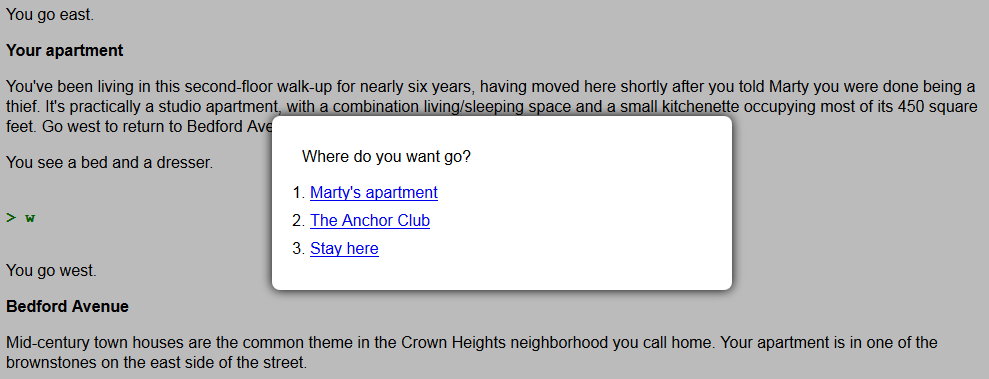
Second Story is a parser game with a web interface. (See: Gamefic.) It doesn’t work on iPhone (“‘Examine’ is not a verb I recognize.”) so I switched to computer.
The interface does one nice trick with menus: they are displayed as a popup and you can click on the option you want with your mouse.

You play a retired thief who gets pulled in for one last job.
Unfortunately, the parser isn’t as powerful as the typical Inform/Tads/Hugo game. >EXAMINE BED in the protagonist’s apartment gave me a blank response, and “get” is unrecognized as a verb (I had to use “take”). There are also a fair number of unrecognized nouns.
There’s very little character to the room descriptions. After a scene with distracting a guard and breaking in a room, the player is rewarded with:
A windowless room with a desk. Suitable for student conferences and not much else.
You carefully shut the door behind you.
All the lengthy prose is reserved for the “cutscenes” with conversation; this drains out the atmosphere.
The puzzles were straightforward (simplistic, even) until I reached a point I needed to use a ladder to progress, and I could not figure out the appropriate phrasing to place the ladder where I wanted. After about 15 minutes of struggle I resorted to the walkthrough.
There was a clever trick at the end with ensuring a safe ransom exchange, but the verb problems and minimalist prose had yanked me out of the story’s reality enough by that point I didn’t really get to appreciate it. It feels like author made some dialogue cutscenes and built a world around it, rather than the other way around, leading a flat parser experience.