Public attention, as well as the attention of groups such as this, has been focused on the design and application of large, expensive “super computers.” Our national preoccupation with size and power makes this fact understandable. However, the minicomputer, which I define as a stored program computer selling for under twenty-five thousand dollars, is deserving of much more serious attention than it has heretofore been given.
— Robert L. Hooper, from a paper presented at the 1968 Fall Joint Computer Conference
In the late 1960s, there was a technological gold rush in “small computers”. The PDP-8, developed at DEC by a team led by Edson de Castro, gave in 1965 both proof of concept and proof of market that a computer meant for a desk rather than a room was now feasible.
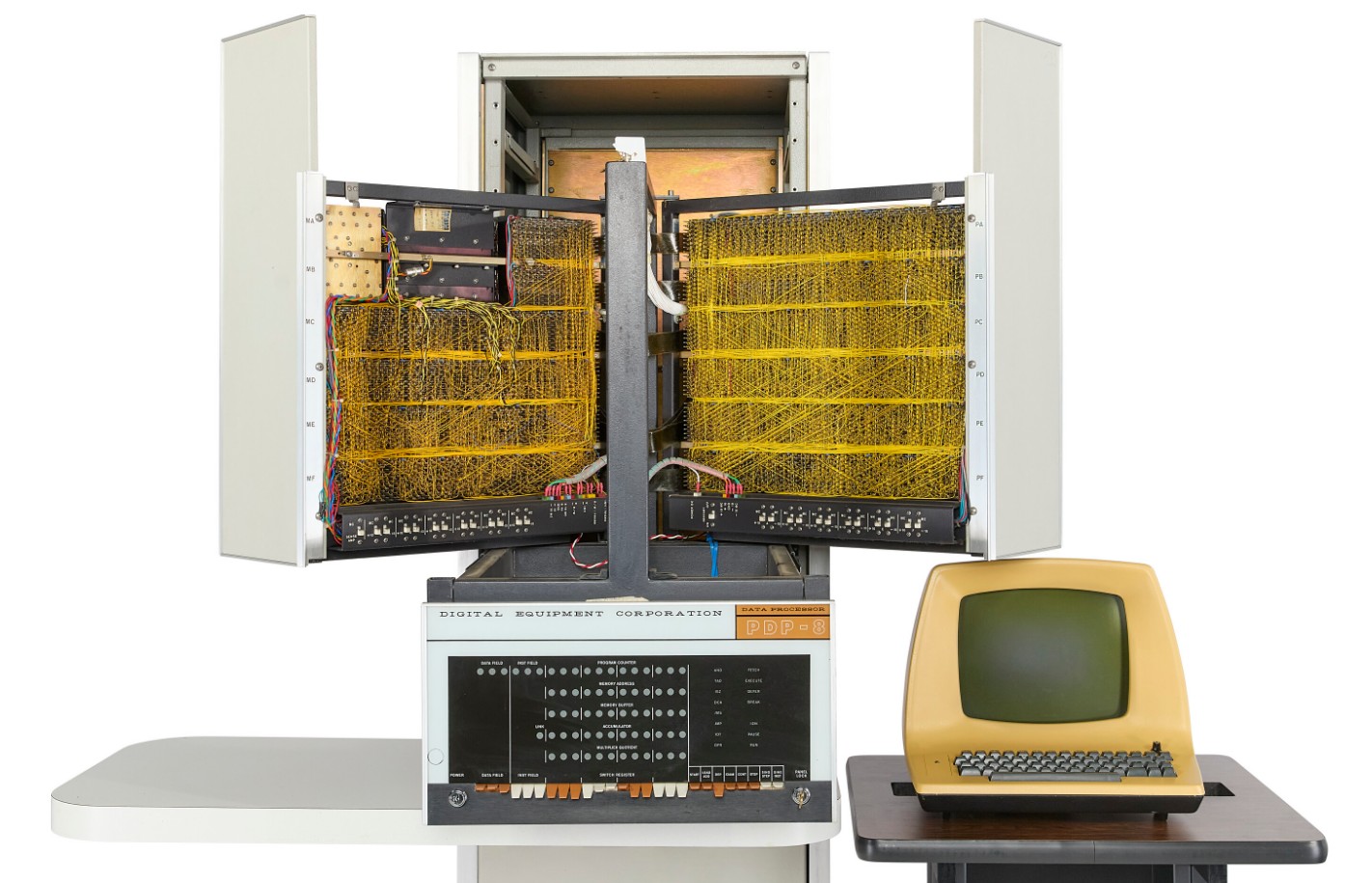
From Christie’s, a PDP-8. It was essentially the PDP-1 from 1959 but made into the bare minimum; it used a 12-bit design rather than the PDP-1 18-bit design.
By the end of the decade, small computer companies sprouted up in the legions; the Tracy Kidder book Soul of a New Machine claims “one every three days” in 1968 which is a bit of an exaggeration but not by much. You can compare it to the dot-com boom of the late 1990s; you could also compare it to the dot-com bubble popping, since most of these companies died.

The gold rush wasn’t restricted to the US; the Nixdorf 820 was from Germany. Image via the Computer History Museum.
A list of minicomputers from 1968 to 1972 includes plenty of companies (…Linolex, Minicomp, Multidata…) with “no data” indicating they were amongst the fallen.
The top competitor to DEC was spun out of DEC itself, as Edson de Castro, allegedly annoyed he couldn’t go forth with a new 16-bit design for a computer, left to form his own company (taking some DEC people with him), Data General. They made their public debut late in 1968 with a system they called the NOVA.
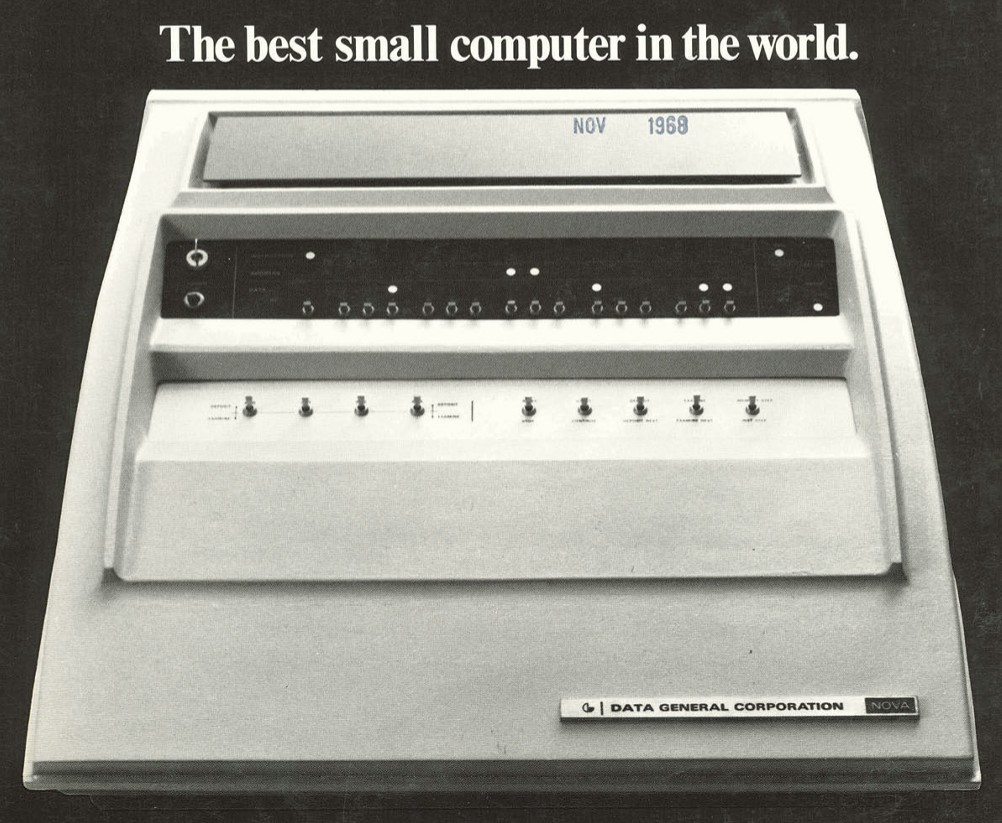
From a 1968 brochure, via the Computer History Museum.
The roll-out was at the Joint Computer Conference in December, where they had the mock-up unit above (finished two days before the conference started). One of the founders, Henry Burkhardt III, programmed it with Spacewar, demonstrating it was just as capable as a room-filling PDP-1. The conference was full of a technical audience and this is who they sold it to. They were just inside the front doors, across from IBM.
(The conference included Engelbart doing his “Mother of All Demos” which — in addition to showing off the invention of the mouse — showed hypertext, word processing, video graphics, and even collaborative editing in the style of modern Google Docs. You can watch a video circa 1968 here. It was purely for showing off research, which gives a good notion of the audience; you can find other sessions from the same conference here.)
Despite Data General having fantastic pedigree on their technology, poaching from DEC itself, it was still hard to stand out, and Data General went for pizzazz. The brochure I clipped the picture from above also included glamour photographs of the C-suite, trying to make them look like harbingers of a new age.
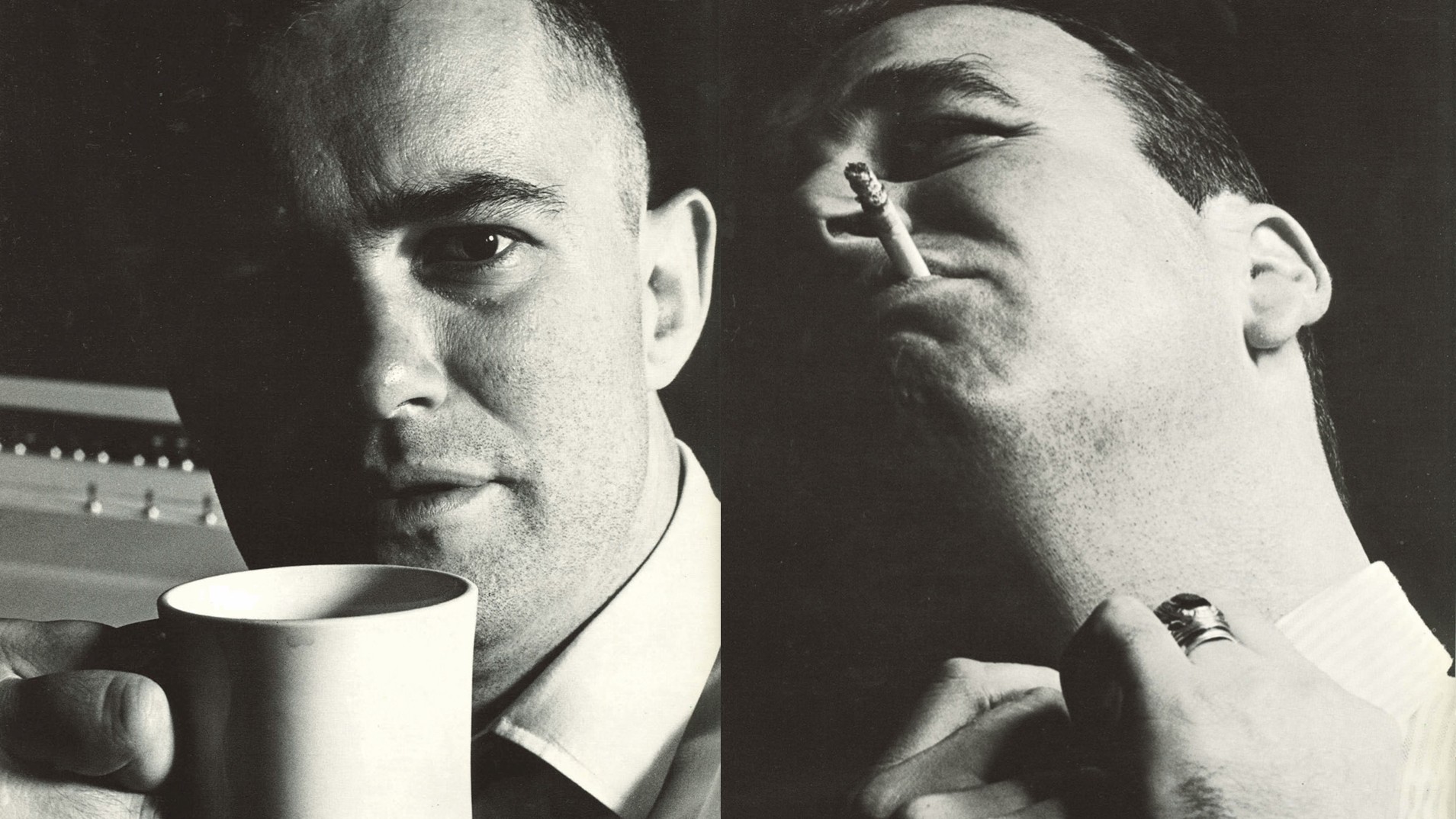
The President (de Castro) and one of the Vice-Presidents (Herbert J. Richman).
Contrast with a DEC pamphlet at the same time, which only includes one picture on the front, and is mostly text and a chart showing sales growth.

Their combination of competent technology and edgy marketing pushed them to the forefront of the market, and they went public at lightning speed (November 1969).
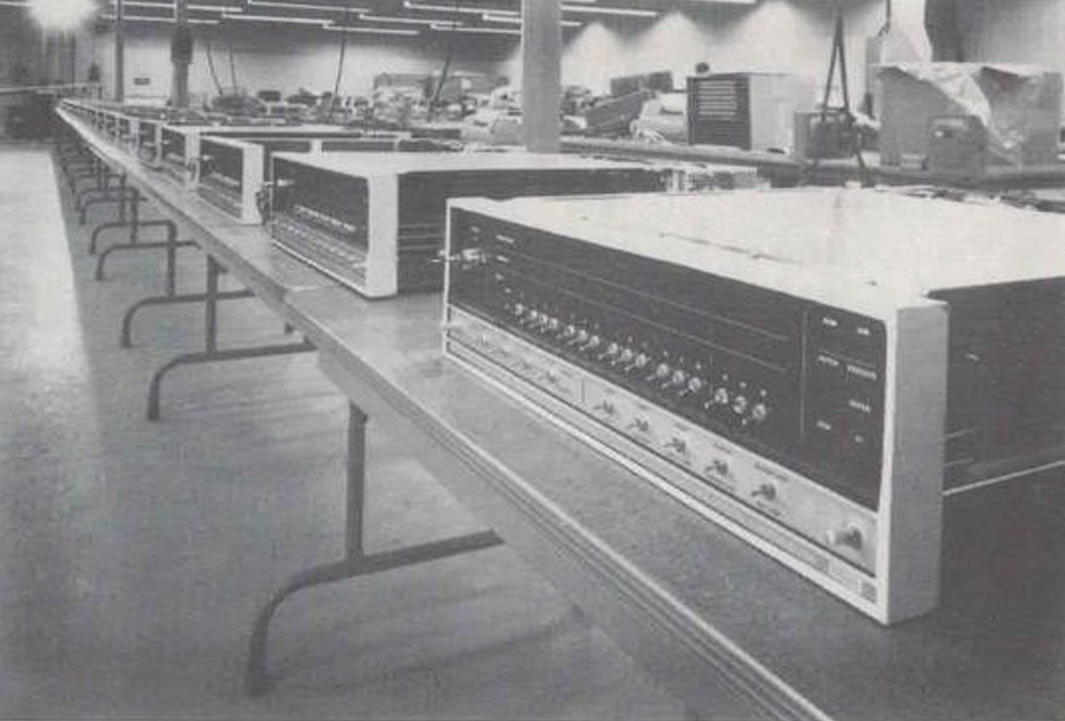
NOVA computers ready to ship in 1969, in “Building 1”. From Interface, May 1983, Data General’s internal magazine.
They got a reputation as the “bad boys” of the industry; a modern analogy would be to tech companies with the motto “move fast and break things”. Even from the very start they hired people with little guidance; consider the early programmer John Henderson hired from Bell Labs:
So Burkhardt gave him [Henderson] a pile of rough technical data on the NOVA and some examples of other companies’ software documentation and told him to go write some software manuals. It was a textbook example of how to mismanage a newly hired employee: assign a poorly defined, highly frustrating job, provide very little guidance, no well-thought-out schedule, and then ignore the “new hire” for weeks. But, Henderson loved it. He thrived in this atmosphere, and worked outrageous hours. Data General got a huge pay-off on its investment in giving a talented young person a chance to tackle challenging problems with very little bureaucratic interference. The process was to be repeated time and time again.
As Bill Foster (at Data General in 1976-1979, their greenest years) explains:
I was given very few orders from my boss. Just get the job done. I loved reporting directly to the president of the company — Edson de Castro, The Captain. The founder of what by 1976 had become one of the most exciting and successful computer companies in the world. Although I had a great job at Hewlett Packard I was way down the totem pole at that huge company. At DG I was close to the top. Close to being a star!!
At HP you felt secure, no matter how bad you screwed up. It would have taken an act of bloody murder to get fired. The contrast with DG was extreme. Employees were kept on edge. Your job was simple: help the company make a profit — that’s why you’re here. We were all given a lot of rope. But if you screwed up just take that rope and hang yourself before someone does it to you. It was clear that everyone was expendable.
The general chaotic handling of management really set in when Data General was ready to upgrade from 16-bit architecture to 32-bit architecture, and there were two competing teams within the company working on the same thing. This is the source of the events from the book Soul of a New Machine, and while the history is somewhat relevant to today’s game (the current existing version is on 32-bit) it’s past our scope. This is because our authors came from a different group altogether.
Instructions for the Eclipse MV/8000, the 32-bit project that was actually finished. The group was meant to only update the system without bit change but did the modification secretly, and kept compatibility with 16-bit systems. Image from Internet Archive.
Thissala’s authors were David Auerbach, Paul Chiasson, and Peter Macaulay, all members of Data General’s Corporate Systems Engineering Group. They were not working on new system architecture (or causing havoc with unreachable goals for new system architecture). If you don’t know what a Corporate Systems Engineering Group is, there’s a Data General job posting from Computerworld (September 15, 1980) that explains the idea:
CSE is a systems support group responsible for software support activities which require centralized control and are worldwide in scope. as such it provides a unique opportunity to provide technical leadership and direction through a team of sophisticated software professionals, over a broad range of state-of-the-art products.
In other words, they worked on the custom technical support for businesses. Of the three authors (David Auerbach, Paul Chiasson, and Peter Macaulay) I haven’t seen any mentioned in the literature on Data General, and in general Peter Macaulay is the only one that I’ve been able to find at all. He was born in Belfast, Northern Ireland, and went to Manchester for an Electrical Engineering degree, followed by a Master’s at Brunel.
In 1978, Peter’s spirit of adventure brought him across the Atlantic to the United States, where he made his home in Bellingham, MA. His love for exploration never waned, from piloting small aircraft to sailboats, hiking in the mountains of Ireland, New England, and Japan, he was always eager to embrace new cultures and experiences.
There’s still time for more historical information to surface, as this will be a multi-post game. It is allegedly very large. It claims 1000 rooms and 400 objects. The reason for the “claims” there is that the game seems to be unfinished; it is possible there are portions designed but too broken to reach; it is even possible the 1000 rooms/400 objects were planned but not fully made. We have version 0.60 which was ported to 32-bit Eclipse and the change notes read like a work in progress, including this:
The monster are again wondering the different sections. They will attack, but with no strength as of now. There was a bug reported that I believe is now fixed. This should prove or disprove this.
There’s instructions here how to play and some extra historical context by Rob on how the game was discovered; in 2025 the Novas are Forever site started uploading a series of drive dumps, and one of them had a number of lost items, like a novel variant of Adventure, a multi-player RPG called Quest, and an early version of Ferret. Prior to last year, Thissala was entirely unknown and not written about in any histories at all. (This is despite Soul of a New Machine making a big deal out of Crowther/Woods Adventure; there was a strong culture around the game at Data General. I’ll get into that connection more when I’m deeper in the game and have more context.)
ASIDE: I incidentally recommend the link in that post by gschmidl which already has everything set up to play Quest; change the third to last line in the mv.ini file which talks about Quest into
EXPECT “\n)”; SEND “dir :games\r”; CONT
which will land you (after booting the emulator up with mv mv.ini) into the games directory. You can then type games to get a menu or enter the name of the game you want directly. You still will want to follow Dan’s instructions for quitting out: type bye, pick y on the prompt, and then q for a total shutdown.
One extra caveat is that the game has “idle” messages if you don’t type for a while, which is annoying when you’re adding to notes or a map in a second window. I used the program Game Pauser to alleviate this (somewhat).
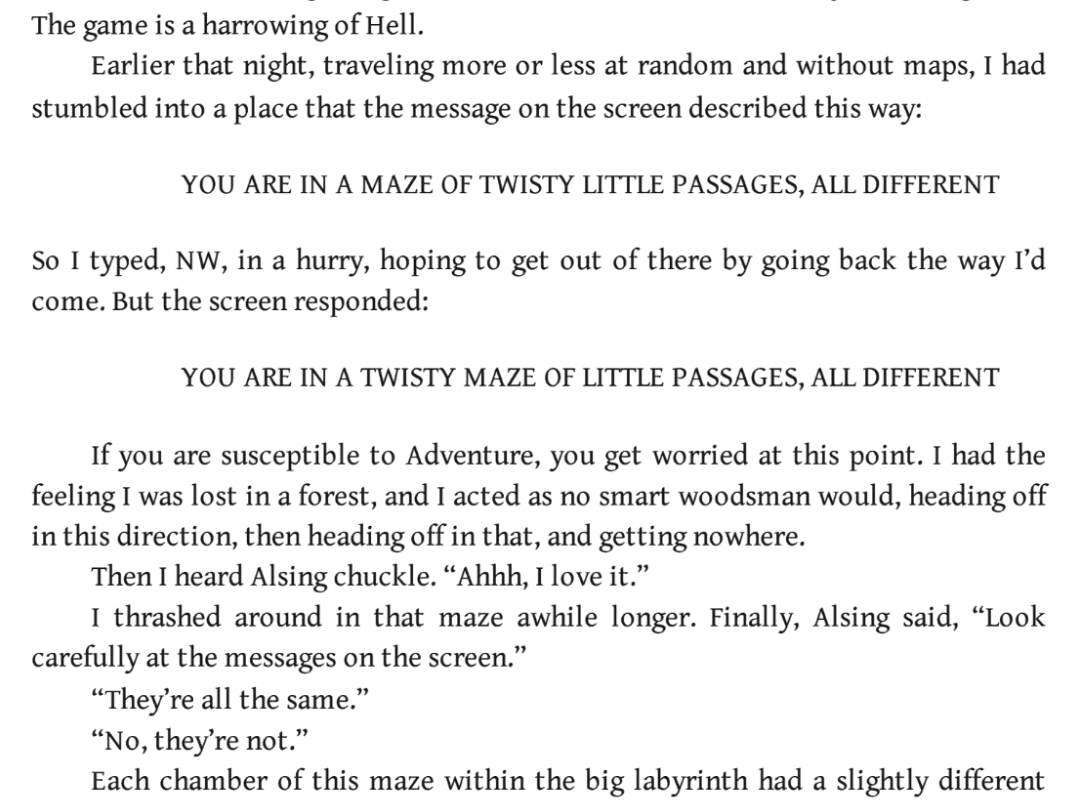
Tracy Kidder discovers the twisty maze of little passages, all different.
Finally, let’s get into the game, shall we?
Middle of the parking lot
You are in the middle of a large parking lot that stretches off in all directions. In the distant north you can see a large mountain. To the northeast you can hear the sound of water.
At your feet lies a long square dowel.
This follows the Crowther/Woods tradition of not being clear about the goal until you look at the help info, but even then the game starts with its cards close. The HELP command asks you to type THISSALA for a description of the game.
The fundamental difference between THISSALA and other games is that the goal in THISSALA is not just to get all the treasure, but to accomplish a substantial feat, that is, to save the world from the forces of evil, and restore the power of good. Hidden somewhere in the land is a parchment describing the tale of THAMOS and MAKASSAR. This scroll holds the initial clues to what must be done.
(The scroll, fortunately, is easy to find, although I’ll save it for the end of this post.)
The help also specifies some statistics, more than other text adventures from this time: POWER (strength), COOR (agility), MAGIC (magic ability increased via specific books), WISDOM, KNOWLEDGE (percent of the game explored). WISDOM is explained with “who the hell knows?” so maybe it’s there for fun?
status
Current power level: 0
Current coordination level: 0
Current magic level: 0
Current wisdom level: 0
Current knowledge level: 0
It incidentally takes 8 rooms visited to increase the knowledge level by 1, so assuming it’s out of 100%, there are in reality “only” 800 rooms rather than 1000. That still puts the game as enormous. (Ferret beats that by about double, but keep in mind Ferret took six months to beat.)
You can incidentally mop up the 8 rooms fairly quickly by just walking around the parking lot you start the game in.
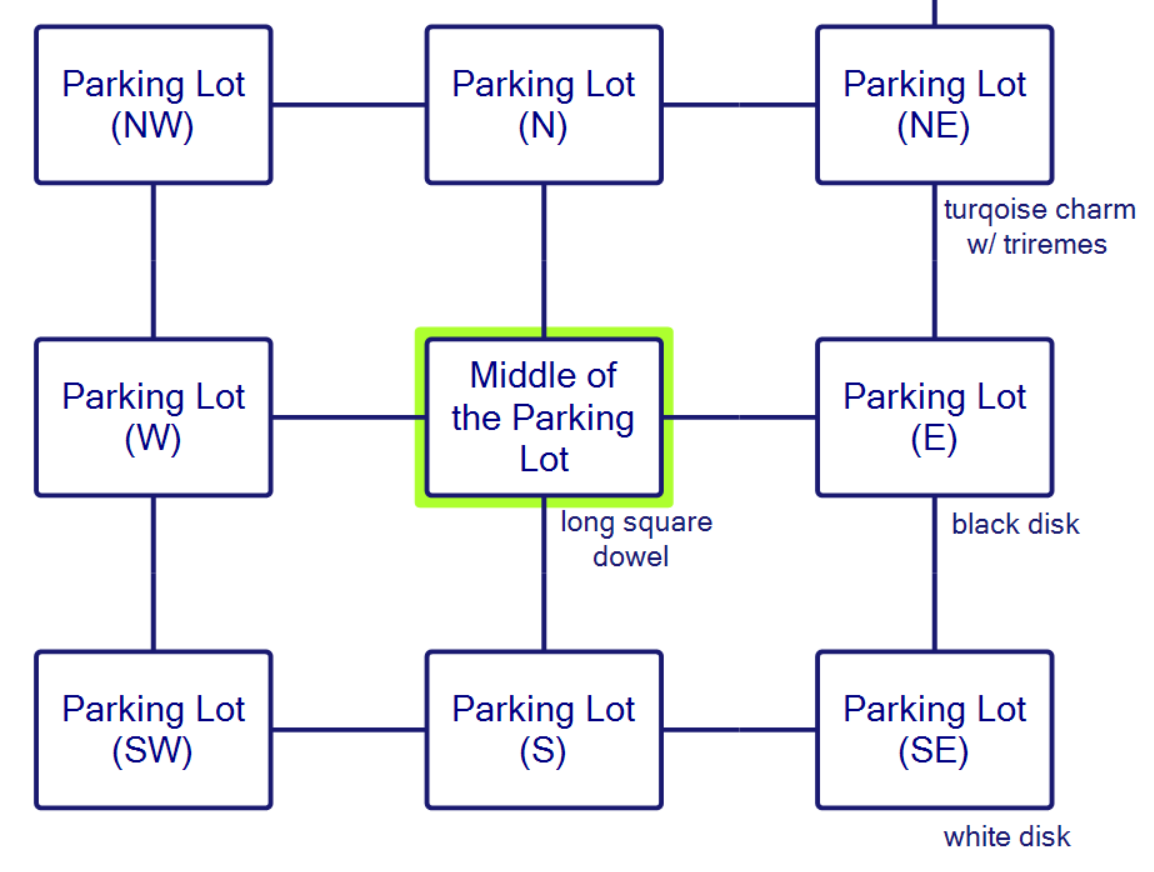
The room descriptions are not elaborate but the game already has thrown four items out, two which seem to be a complex mechanism.
First is the long square dowel. That’s all the game says. (There’s no “examine” feature, like the Cambridge mainframe games; the “on the ground” descriptions of objects try to be elaborate enough to cover.)
Go northeast and you’ll find a beautiful turquoise charm with the outline of a triremes on it. The game does not understand “wear” or “use” although you can wave it (to no apparent effect).
Parking lot (NE)
You are at the northeast corner of the parking lot. To the east there is a tall fence. To the north is a dirt trail.
Near the fence, is a beautiful turquoise charm with the outline of a triremes on it
(I assume the authors meant like the boat, but “a” triremes? Is that just a typo?)
To the east and southeast of the center are a black disk and a white disk. Both have instructions.
Magic stepping disk. To use, place on ground, and step on.
Warnings:Disks must be used in pairs. You had better know where the other disk is
Disks will have to recharge at various times, not always dependent on usage
Disks require, and drain, magic power
I did some serious fussing but I was unable to work out the parser command to use the disks.
step on black disk
I don’t understand the word ‘step’stand on black disk
I don’t understand the word ‘stand’step on
I don’t understand the word ‘step’step
I don’t understand the word ‘step’get on black disk
Don’t be sillystand on black disk
I don’t understand the word ‘stand’
I have yet to do my verb list test; probably next time. One last item of note before leaving the lot is there is the occasional random message, like
A thunder of rhinoceroses pounds by and miraculously, neither you nor anything around you is damaged
or
A murder of crows fly overhead, appearing from the north and vanishing to the south
I don’t know if these are meant just for color, or meaningful. If you don’t pause the game the backscroll can get filled with this kind of nonsense:
Excuse me … but are you still playing?
Hello … hello … is anyone still there?
Excuse me … but are you still playing?
Psst … hey you …
(Hence the Game Pauser. Although if someone knows a clever way to make Powershell just go idle when it isn’t in focus, that would also work.)
Heading north from the only exit away from the lot (north from the NE corner), there is a $10 bill along with a warning.
Dirt trail
You are on a dirt trail that runs north and south. There is a small
sign on the western side of the path
Lying in the path is a $10 billread sign
WARNING
DENSE FOREST TO THE WEST
DO NOT STROLL FROM PATH
IN THAT DIRECTION
Heading west leads into what seems to be a relatively standard Adventure clone (the kind with passages all different, too boot) but I haven’t had the energy yet to tackle it. If you wander long enough you’ll get help.
n
You are hopelessly lost in the woodsw
You are lost hopelessly in the woodsw
You are hopelessly lost in the woodss
You are lost hopelessly in the woodss
The game and ground keeper appears in front of you and says “Whats a matter … are we a little lost” and then muttering something about damn tourists, he leads you back to the junction in the paths
The aforementioned junction is just north of the dirt road.
Junction in the paths
There is one dirt path leading north, one leading south and a stone walk leading to the east. There is an old sign stuck in the ground on the eastern side of the path.read sign
HISTORIC HOUSE —>
The historic house in question is the one from Zork.
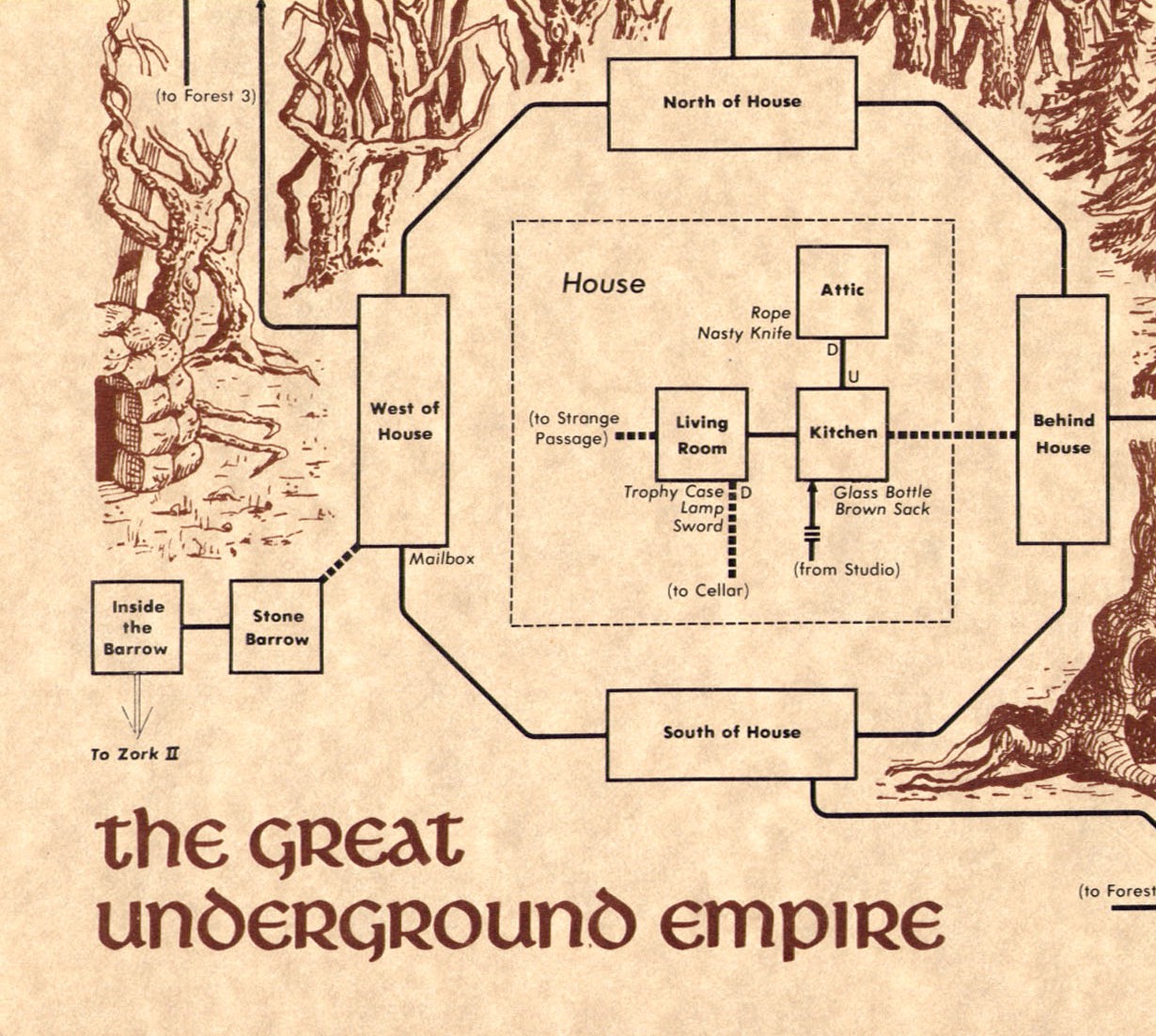
Zork User Group map, from The Gallery of Undiscovered Entities.
Most of the map is removed, though, indicating a long-decayed piece of the past.
West of house
You are in an open field west of a big white house with a boarded front door.n
North of house
You are facing the north side of a white house. There is no door here, and all the windows are barred.e
Behind house
You are behind the white house. In one corner of the house there is an empty window with no glass in it.w
Kitchen
You are in the kitchen of the white house. A table seems to have been used recently for the preparation of food. A passage leads to the west and a dark, boarded staircase can be seen leading upward.
To the east is a small empty window with no glass.
On the table is a can openerw
Living room
You are in the living room. There is a doorway to the east, and a large wooden door to the west, which appears to be nailed shut.
Lying on the floor of the living room is a sheet of parchment
In the very center of the room is an oriental rug.
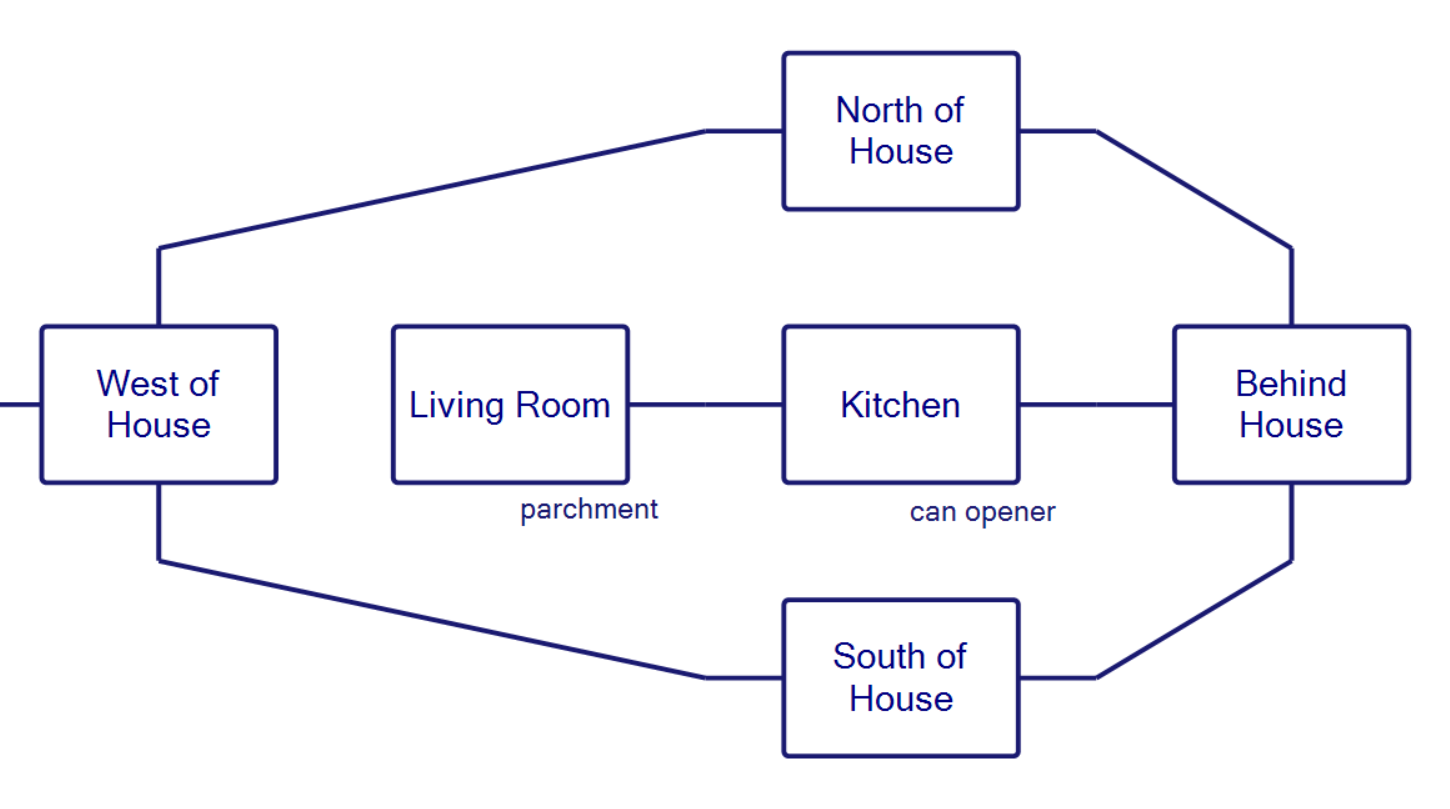
You can try moving the rug and opening the trapdoor, but you find if you try to go down that there is now a 30-foot drop instead (the game doesn’t kill you! it just warns you of the decay). The whole purpose of the section is to dispense the can opener and the parchment. The parchment gives the actual true plot of the game. It’s rather long but I’m still reproducing the whole thing, because there might be subtle hints.
Oh yee that find me … lend me your thoughts for an instant. Ensconce your eyes on this document, for you maybe the last to do so. Read and imbibe and if you be coureageous follow what follows, my tale and time are short, so I must write quickly.
Many years ago, a colony of explorers settled this region. They grew quickly in number and strength till they were larger and stronger than any people around. They were ruled by a kakistocracy for almost 100 years, during which time they expanded their geographical boundries by war and conquest. Eventually one leader emerged, his name was Makassar he was the most evil – and he continued and expanded the kakistocracy’s policy of conquest and terror. And that continued for thirty years.
At that point, a new leader replaced the just dead Makassar. His name was Magog, and he developed his abuse of humanity by turning on the weaker of his own people. He kidnapped children for his slaves and stole wealth for his pleasure. It was that same year that born to two mountain dwellers was Thamos, who could trace his lineage back to Thamos of Egypt, son of Tuktanfontmarranthon.
And after 20 years of Magog, Thamos came down from the mountain on the back of a great turtle, passed through the woods and accross the Dipestia and entered into Makassara. And he carried a carved oak flute. The good people, the abused, and beaten, joined behind Thamos, while the evil followers of Magog threw rocks and insults. The evil outnumbered the good, and the good were beaten and slain.
Seeing this, Thamos used his one magic power, and passed his hands in front of the people, and the world stopped. Thamos turned to his followers and spoke:
We shall sleep for many a year … and wait the music of the flute.
Thus spoke Thamos. Then he turned to the evils and said:
You shall remain awake … and continue your ways … but never again bear offspring.
Thus spoke Thamos. Then he turned to me and said:
Scribe … record accurately … cache well your parchment … for in your writings be our destiny … speak of the sleep … but more strongly of the flute for it is our future.
Thus spoke Thamos. He then raised his flute in his hand, then lowering his hands the flute remained suspended in the air. And Thamos said:
Go
The flute ascended and disappeared over the trees and into the mountains. And Thamos said to me:
Now hide your document … and return … you have but minutes before you sleep.
Thus spoke Thamos. And I followed.
Our goal seems to be to defeat a great evil by finding a flute that was used to put the people of Thamos to sleep. Thamos of Egypt is incidentally a reference to an obscure Mozart piece. The king is fictional.
The name-clash could be coincidence, but I don’t think so, since we’re on a quest for a magic flute, and (in contrast to Thamos, King of Egypt) The Magic Flute is one of the most famous of Mozart’s pieces.
I have at least a month blacked out for playing this game, it may go for two or longer depending on how much works and how much is broken. As I’ve only played the introduction for now, please keep speculations to this portion of the game; however, you can generally consider this a many-person game like Ferret where everyone can contribute as much as they are able.


Trying to set up the game is a bit above my paygrade, at least for now, but could GO DISK possibly work?
command not understood, alas
made the verb list (which will be on my next post, but since that might not be until Tue I’ll post this now)
“Thamos of Egypt is incidentally a reference to an obscure Mozart piece. The king is fictional.”
Yes, but from ancient fiction; spelled as Thamus, the name goes back to Socrates at least, and may be older than that.
Magog (most often used as “Gog and Magog”) is a Biblical name, which seems like an intentional reference considering how it’s used here.
Makassar is a region and an ethnic group in Indonesia, but that may be a coincidence since here it’s the name of an individual.
supposedly Thamos in the piece is a reference from Mozart to Thamus, but because it’s directly linked to a magic flute I think the authors really were referencing Mozart here
at the very least I’ll be plundering all of it for images to go with stuff
I assumed the name was a pun – if Thamos was working to counter Makassar that would make him an Antimacassar
…wow.
Two broken links: “other sessions from the same conference” and John Henderson.
thanks!
Pingback: Thissala: Dense in Timothy and Flora Unlike Any Other | Renga in Blue