Archive for the ‘Interactive Fiction’ Category
Please feel free to let me know about anything that should be added.

Hot off their success of 80 Days inkle is gearing up to finish their third Sorcery! game.
This one is big, complicated and different, and we think will up the ante on the kind of gameplay a text-driven choice-based game can achieve.

Using the same engine as Blood & Laurels, the folks at Versu are set to release Bramble House:
Bramble House is the only home that fifteen-year-old Penny has ever known. Penny is bound in service to the witch Stregma, forced to deal with everything from mundane dishwashing to evicting monstrous guests.

This one is enigmatic, but Brianna Wu has a new project intending to
…create an entirely new category of interactive novel you can play on your tablet or phone. It will be visual, it will interactive, and it will allow the reader to decide where the story goes.
I am unclear what’s going to be new here, but–
Our goal is to empower everyone out there to tell their own stories, and unleash a new wave of games from people of colour, members of the GLBT community, people with disabilities. Our long-term goal is to replace Twine.

Sunless Sea promises a release in February.
Explore a vast underground ocean in your customised steamship! A PC & Mac game in glorious 2D, Sunless Sea is a game of exploration, survival and loneliness set in the award-winning Victorian Gothic universe of Fallen London. Take to the helm and set sail for the unknown. Light and darkness are your greatest allies, but a stout set of cannon and a gunnery officer with a grudge will come in useful too.

Sol Invictus will be out for mobile devices Janurary 8th.
For three years the soldiers of the Black Lance Legion have watched as the Invaders turned their solar system into a hellish, desolate wasteland. Humanity’s most advanced fighting force lurked in the shadows, doing little while their species was forced to choose between eternal enslavement… or extinction.

Tin Man Games has created many gamebooks with an impressive engine for computers and mobile devices, and in 2015 intends to release
* Caverns of the Snow Witch, a conversion of the Fighting Fantasy book by Ian Livingstone
* Bloodbones, also originally a Fighting Fantasy book but by Jonathan Green
* To Be or Not to Be by Ryan North, a CYOA by the author of Dinosaur Comics
* The Gatekeeper’s Oath and Lords of Nurroth, both original gamebooks (the first more about spells and puzzles, the second more of a traditional combat outing)

Choice of Games (and their associated label, Hosted Games) has quite a few new works scheduled for 2015:
The Hero of Kendrickstone, by Paul Wang, author of Mecha Ace. You are a young adventurer, seeking fame, glory, and a square meal.
The Lost Heir. The start of a trilogy by @Lucid, author of Life of a Wizard and Life of a Mobster.
Choice of the Petal Throne. Takes place in the world of Tékumel.
Shadow Horror. The latest from Allen Gies.
Killing Time: You are a high-priced assassin, traveling the world and killing people in far away places.
Volunteer Firefighter.
Demon Lord of the Labyrinth. You are a demon lord, recently escaped to the Material Plane, trying to rehabilitate an old labyrinth.
A Wise Use of Time, by Jim Dattilo, author of Zombie Exodus. An insurance executive, you awake one morning to find yourself possessed of the ability to command the flow of time. How did this happen, and what are you going to do with your new-found powers?
MetaHuman, Inc., by Paul Gresty, author of The ORPHEUS Ruse. You’re a division head that suddenly becomes CEO of a huge multinational corporation that’s busy developing sorcery/cutting edge technology; you have to deal with typical corporate shenanigans (employee embezzlement, workplace romances gone sour) while trying to fend off the sinister “majority shareholders” and figure out what happened to the previous CEO.
Champion of the Gods, by Jonathan Valuckas, author of the Fleet. You are a demigod, striving to make your way in a sword-and-sandal world.
Hollywood Visionary, by Aaron Reed. You are a movie-maker in 1950s Hollywood, trying to craft your first feature.
Versus, a new series by Zachary Sergi. A sci-fi yarn where you are on a prison planet, fighting to return home.
Heroes Rise: The Hero Project: Redemption Season. A new game in the Heroes Rise world, with a new main character, where the player is a contestant in season two of The Hero Project.
Ratings War. You are a journalist in a cyberpunk future.

Reflections is a parser-based game that will be out in 2015. It is
a story about gypsies, magic, death, life, and the Power of the Blood.
Paul O’Brian and Christopher Huang’s work on Empath’s Gift is currently in limbo but should also hopefully see the light of day in 2015. It is about
a summer college campus where a group of gifted students gather.

Aaron Reed and Jacob Garbe project an April release date for Ice-Bound: A Novel of Reconfiguration, played via either iPad or a computer with a web camera.
Half of the Ice-Bound experience is an 80-page full color art book: the Ice-Bound Compendium. Filled with Holmquist’s personal files, unfinished chapters and alternate drafts, collages of research and strange, distorted transmissions, the book mingles Holmquist’s story with those of his creations. It isn’t clear where these images came from, but one thing is certain: KRIS desperately wants to see it.
Interaction involves showing pages of the book to the artificial intelligence in the game.

DestinyQuest is a web-based gamebook, based on the earlier paper-based version by Michael Ward. Act I is already available.

Robb Sherwin’s Cyberganked mashes together The Bard’s Tale, text adventures, and a CGA aesthetic.

Jim Aikin has been hard at work on The Only Possible Prom Dress, a sequel to Not Just An Ordinary Ballerina from 1999. Both are old school text adventures:
Same location, but greatly elaborated. Similar plot premise. Lots of new characters. A few of the puzzles are related to those in the first game, but most are completely new.

Sword Daughter, an adaptation of a gamebook from the 1980s, is currently in beta.
All your life, you dream of adventure: knights, dragons, magic rings, chests of gold, and all the danger and glory that awaits a professional swordswoman. But every dream has a cost. You are on your way across the desert wastes to compete in the Warrior Games when your caravan is attacked. Orcs and bandits murder your father, capture your companions, and leave you for dead.
Now alone in the world, will you choose to seek glory, vengeance, treasure… or love?
Back in 1987 GAMES Magazine printed an article titled They Take the High-Tech Road to Adventure profiling the company Infocom. I remember as a child reading the article many (many) times and dreaming of working there.
Because GAMES was (technically, still is) a puzzle magazine, they felt obligated to include a bonus; specifically, a transcript from Leather Goddesses of Phobos which included enough information to solve the puzzle from the game.
This is not a puzzle genre that ever took off, but I did find a perfect moment in Acheton for an experiment. Read this transcript and figure out how to get past the large sheet of glass.
There is a turquoise amulet here!
There is a bunch of keys here.
There is a lump of lead on the floor near you.
There is a small box of matches nearby.
There is a mink coat with bulging pockets lying in a heap nearby!
There is a large glass palantir here!
There is an antique porcelain plate here with a small pile of salt
on it!
There is a small earthenware pot here, labelled “London Dry” on one side.
There are some magnificent quartz crystals on the ground here.
There is a three foot black rod with a rusty star on the end nearby.
There is a small pair of scissors here.
There is a large old-fashioned mercury thermometer here.
There is a pair of dull brass tongs here.
There is a beautifully fashioned Stradivarius violin here!
> n
You are in a spacious room which has a large sheet of glass blocking
an exit to the east. Etched into the glass are the words “Find the
right key, though no lock there be”. Passages lead to the north and
south. An icy breeze comes from the north.
> u
You are in a small chamber above the slab room. An icy draught blows
in from a passage to the north.
> n
You are in a spacious room which has a large sheet of glass blocking
an exit to the east. Etched into the glass are the words “Find the
right key, though no lock there be”. Passages lead to the north and
south. An icy breeze comes from the north.
>
…this is a rotten hard and often unfair game. You can die easily. You can lose or destroy a necessary tool just as easily. This should not be seen as a fault, as such, in one of the earliest adventures ever written, by mathematicians for mathematicians; but Acheton is not only larger than nearly all other games, it also does take harshness to extremes at times.
— Richard Bos
I want to discuss two puzzles that are both brilliant and unfair.
Before I start, I should give the reminder that just like Adventure, the goal in Acheton is to collect all the treasures in the world. In this case, they then go in a vault.

> xyzzy
I’m afraid that magic word hasn’t got enough power to work in this universe.
The “famous magic word” of Acheton is ZOOGE.
> sw
You are in a low damp chamber. Mist appears from nowhere, rolls and billows around the room and eventually disappears equally mysteriously. A rough note on the wall says “ZOOGE”. There are two exits at opposite ends of the room.
Unfortunately, attempting to using it generally results in “Nothing happens.” There hence must be more conditions. In Adventure the condition was simply to be in the right place but it wasn’t tough to figure out. In Acheton it takes a more lateral jump: there are rooms spread throughout the game with stars.
You are in a small chamber whose walls show chisel marks and other signs of only recently having been cut out of the solid rock. The only exit is to the southeast. Somebody has painted a large purple star on the floor!
The reason this jump isn’t too absurd is there are quite a few rooms with the stars. It’s safe to assume they’re part of an underlying magic mechanism.
> zooge
There is a mighty rush of wind, blowing you off your feet. You pick yourself up and find that you have grazed your knee and that everything you were holding has been scattered round the room.
I thought maybe this was it — perhaps a puzzle surfaces where an item can only be dropped via this mechanism — but given the number of stars, probably not.
Fortunately, there’s another room with a suggestive hint.
You are in a 12-foot high rock chamber. There is a massive walk-in safe on the east wall. The west wall bears an inscription, and there is a bright yellow star apparently painted in the middle of the ceiling. A spiral staircase leads downwards.
The safe is open.
> read inscription
The inscription reads “Black magic should be practiced in obscurity.”
Unfortunately, I had no idea what to do with this. Hints were perused. It turns out the effect only happens with the lamp off. Unfortunately, still:
> zooge
Nothing happens.
I went back to one of the other star rooms and turned off my lamp again.
> zooge
There is a loud >>SNAP<< !
Ok, now we are getting somewhere. Except … nothing happened.
It turns out that if you have treasures on the floor in a star room that’s not next to the safe AND you have the lamp off ZOOGE will teleport the treasures next to the safe.
It’s kind of plausible someone could put all these parts together, especially if they were working as a group and sharing notes (allegedly, in 1978 the “black magic should be practiced in obscurity” hint didn’t even exist). I certainly don’t begrudge experimentation puzzles entirely, because they have a unique quality which only works in an adventure game, but there’s no better word for this puzzle as other than unfair.
Which is a pity, because there’s a followup puzzle which is brilliant.
> d
You are in a small dusty chamber. There is a hole in the ceiling and an obvious exit to the northwest.
> nw
You are in a long clean gallery. The walls are covered with frescos and the floor is a beautiful, intricately constructed mosaic of coloured stone tiles.
There is a large portrait by Rembrandt propped up nearby!
> get portrait
OK.
> se
The painting you’re carrying won’t fit through here.
> inventory
You are holding:
A Rembrandt portrait.
An aerosol can of paint.
A brass lamp.
Feel free to predict what happens next.
> drop portrait
OK.
> paint star
You paint a star on the ground nearby. The paint dries slowly and evenly.
> turn off lamp
The lamp is now off.
> zooge
There is a loud >>SNAP<< !
…
A year ago when I first blogged about Acheton I mentioned “one of the coolest yet also impossibly unfair puzzles I’ve ever experienced”. Here it is.
You are in a small deep chamber under the pyramid. The walls are decorated with ancient Egyptian drawings and hieroglyphics, and the floor is uneven and rocky. A dim light enters through the only exit, which is a staircase to the west.
There is a large cactus growing out of a cylindrical earthenware vessel fixed to the ground. The vessel bears an inscription: “BLEI AMEDI”.
> eat cactus
You break off a piece of cactus and eat it, finding to your surprise that it is delicious and even the spines melt in your mouth. After a moment, a feeling of dizziness overtakes you as the walls seem to recede into the distance and the entire room appears to expand around you.
Even what you’re carrying seems to get larger.
Eventually you realise that it is you who are shrinking, apparently without limit and not the room that is expanding, and this helps you to overcome your dizziness, though not your apprehension.
In the end, you are crushed by an object that you are carrying.
You appear to have died. Do you want to be reincarnated?
(The vessel inscription is I AM EDIBLE.)
The obvious solution here: not to carry anything.
This works, allows a good amount of progress, and is the irritating part. It turns out there are some objects that you CAN carry with you. There are two things small enough to turn into useful objects.
> inventory
You are holding:
A piece of thread.
A glass marble.
> look
As you look at the marble, it glows briefly. You get the impression that some vision is shown in it, but cannot see any detail.
> eat cactus
You break off a piece of cactus and eat it, finding to your surprise that it is delicious and even the spines melt in your mouth. After a moment, a feeling of dizziness overtakes you as the walls seem to recede into the distance and the entire room appears to expand around you.
Even what you’re carrying seems to get larger.
Eventually you realise that it is you who are shrinking, apparently without limit and not the room that is expanding, and this helps you to overcome your dizziness, though not your apprehension.
Your fears are groundless, as the shrinking stops suddenly.
You are holding:
A glass palantir.
Some rope.
You are in the middle of what appears to be a huge cavern with a boulder-strewn rocky floor. The walls are covered with pictures of giants and massive geometric shapes. There is an opening in the western wall through which light enters, but this is far above your reach, even if you were to get over there. A small opening can be seen under one of the rocks.
> look
As you look into the palantir, you see a brief vision which quickly fades. The ruling council of Acheton appears to be enjoying a grand banquet in their enormous council chamber. At present the banqueters are enjoying a fruit course.
This is the sort of moment I play adventure games for. I am still amazed just re-reading it.
Yet … while the thread/rope is necessary early on enough to stop the player, the marble isn’t. It is possible to get nearly to the very end of the game before needing the palantir. There’s brilliance enough for this era, it’s just still clouded by uncertainty about what makes good game design. (All the creators had access to before they made Acheton was Adventure and Zork.)

I know the standard frustration cliche in parser IF is guess-the-verb, but Acheton’s annoyances are more in guess-the-noun.
There is a small earthenware pot here, labelled “London Dry” on one side.
> get pot
OK.
> drink pot
I don’t understand that!
> drink london
I don’t understand that!
> drink dry
I don’t understand that!
> drink liquid
I don’t understand that!
…many variants and a Google search later…
> drink gin
You take a large swig of gin from the pot. It is very strong and you soon start to feel its effects.
Here’s another one:
> light match
OK.
> light pile
I don’t understand that!
> light driftwood
I don’t understand that!
> burn driftwood
I don’t understand that!
> burn pile
I don’t understand that!
> light fire
A few small flames are visible in the middle of the pile of wood.
I recently played the Tin Man Games conversion of Forest of Doom for computer.
The original Forest of Doom from 1983 was a gamebook in the standard style at the time, where a winning run takes many restarts. The first bit of the map has four choices:

If you choose wrong, you have lost, although you don’t find out until the very end of the book.
Maybe some emphasis would help: if you choose wrong on the first map choice, you lose at the very end of the book.
Sigh.

This got my thinking about restarts in general which are still a general style in both parser games (like Jon Ingold’s Make It Good) and modern gamebooks (like The Sinister Fairground from Cubus Games).
Acheton is a game that very much wants you to restart, on many levels:
* The near-comedic presence of death leads to short resets.
* The ningy, which I already wrote about, is nearly guaranteed to cause a total restart.
* Optimizing lamp life can require a restart deep in the game, 500 or so moves in, requiring the steps for finding treasures be carefully tracked.
* There’s occasionally a more moderate “explorer-restart”. A simple example would be when mapping a dungeon; it is understood that you map the dungeon thoroughly first, find a good route, and then restore to the point you started.
This is the sort of thing adventure gamers accept without thinking. Consider, though: it’s deeply weird. It’s almost like it is built in (to this and many other adventures) acceptance of the sort of time travel mechanic where a character makes a “fugue echo” of themselves to send out before resetting the timeline. This is true no matter what the genre.
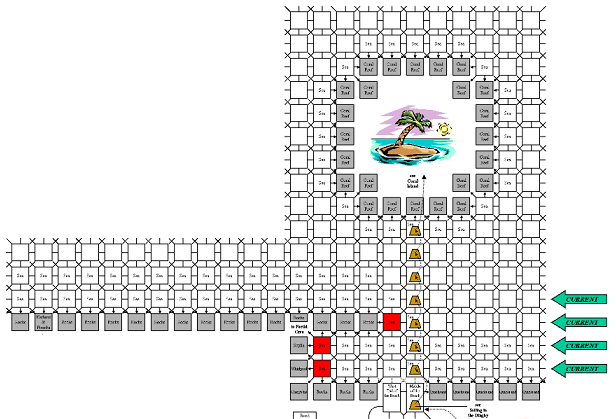
In my most recent play session, I came across an ocean.

[Map by Marco Cavagna.]
Fortunately I remembered this section when I played through Acheton 5 years ago, so I knew that mapping the entirety of the sea is not exactly useful; the first time around, I inspected each and every square I could because this game was evil enough I knew it would have no shame about hiding a secret.
I have finished reviewing every game from IFComp 2014, so have collected links to every review as a page on this blog.
You can check that page for just the list, but I reproduce it here along with some general comments about the competition:
Read the rest of this entry »
> flash
The camera flash reveals, for an instant, a pale arm reaching out of the dirt.
Transparent by Hanon Ondricek is a parser game that involves exploring a manor while wielding a camera. There is supposed to be a second unit helping take photographs, but they seem to have gone missing.
Read the rest of this entry »
One morning, a messenger arrives from Götaland, bearing a letter from Siggeir.
The letter reads, “Dear Sigmund, Signý and I hope this letter finds you well. We would like to invite you and your family to the harvest festival, here in Götaland. We hope to see you and your marvelous sword there.”
Sigmund’s Quest by Gregor Holtz is perhaps the most graphical of the IFComp entries this year, having scenes in a pixellated style:

Read the rest of this entry »
Attempts to locate the party failed, primarily because of poor villagers being paid for their silence by Kas’s crew.
The few reports that did reach the King’s court consisted of rumors about a dwarf who split the mountain and built a palace filled with riches before the sunset on a single day.
A.E. Jackson’s The Secret Vaults of Kas the Betrayer goes for fantasy heft straightaway with its title. I kept a running “word map” of all the references, because in this sort of game I find it easy to get lost in a sea of names. (I did end up finding the fantasy backstory to have the right amount of thickness; not too dense, not too implausible.)
Read the rest of this entry »
“And now you presume to speak to one of the hrrugh without a proper introduction? Insolent blorg!” (Great. Apparently your translator module is faulty.) “I cannot hold a grrbog under such conditions. Produce your rrha or cease wasting my time.”
Naomi Hinchen’s Tea Ceremony involves some awkward and under-prepared diplomacy with an alien.
Read the rest of this entry »



 Renga in Blue