Archive for the ‘Interactive Fiction’ Category
This is only a fraction of the overall map.
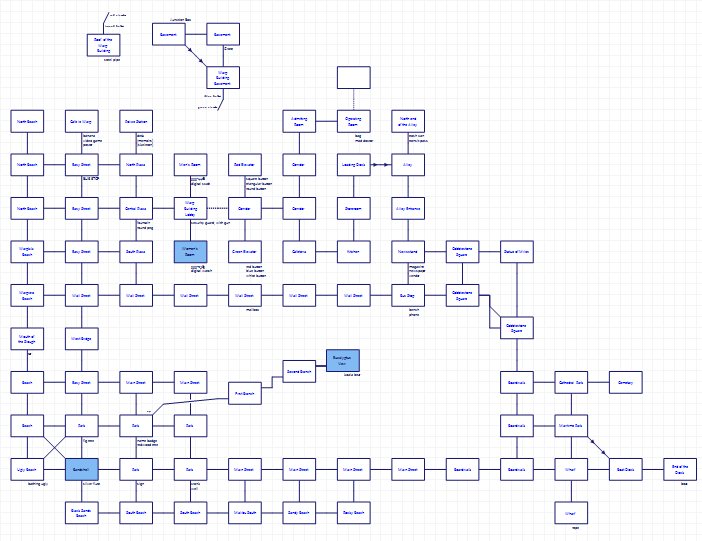
(3 out of 49 treasures found, no idea where to stash them!)
There’s a lot of sameness to the rooms to enough an extent I normally associate with MUDs, not single player games.
>w
Easy Street.
You’re in the middle of a long north-south street. To the west you can see the ocean in the distance, and to the east you can see a large building.
>s
Easy Street.
You’re in the middle of a long north-south street. The ocean is in the distance to the west, and a large building can be seen to the east.
>s
Wall Street.
You’re in the middle of a long street, extending primarily to the north and south, but also at this point there is a side street going to the east. The ocean is in the distance to the west.
>s
West Bridge.
This is the famous West Bridge of Warp, known primarily for no reason at all other than the fact that Warp needed a bridge and this was a convenient place to put one. The road extends to the north and south, and there is a river below running east-west.
>s
Easy Street.
You’re at a point where a north-south street meets an east-west street. To the south you can see what looks like a large park.
In a MUD, there needs to be some space so not everyone is crowded in small spaces, and even the most neutral of rooms can build up character if events occur in them throughout inter-character interaction (Battle of the West Bridge, say). Unfortunately, Warp is a single player game. The currently roaming NPCs just aren’t that impressive yet (I keep getting followed by a mugger with “A sordid individual is following you.” being displayed, which is far less interesting than anything in Adventure or Zork.)
I did manage to solve one puzzle (getting into the Warp Building by wearing a nametag) but otherwise my gameplay has consisted entirely of mapping.
Unfortunately I’ve also had crashes. Remember I playing by logging into an HP3000 terminal and the experience is much flakier than I’d like; while I haven’t built up a game yet and am simply in the gathering info phase, if I want to be serious about attempting a win I need to work out how to get a little more stability.
I haven’t played with the new parser features much other than to try a macro.
>DEFINE X
DEFINE X
(Define X)
=E LOOK @1
LOOK @1
(X defined)
>X PEG
X PEG
>LOOK PEG
Round. Made of wood. Not very big.
The command above reroutes the command “X” which is normally unrecognized into “LOOK”.
One last random observation before I sign off: I’m finding the “reject a command” response grating.
>s
Park.
This is part of the lush grounds of Warp Park.
I can see the following:
Fig Tree
>climb tree
That makes no sense.
>u
>FLAP FLAP FLAP< I think it's hopeless.
shake tree
"Shake" is Danish to me. Try English.
This is made worse by the existence of a nearby tree that you can climb (by going up). I know authors sometimes try to be colorful in their error messages, but it is highly unlikely the reason a player’s command is unrecognized is a lack of being in English. It’s like the game is expecting the player to apologize and not the game itself.
WARP \`wo(e)rp\ n 1: a series of yarns crossed by the woof 2: a mental twist or aberration 3: a computer fantasy simulation of adventure and intrigue ~ vt 1: to deplete weight by expungance of existance 2: to become warped
— via the WARP user manual
…
Rob Lucke and Bill Frolik’s Warp is a tricky game to date because it never had a “release”, and kept getting developed all the way to 1983. Work seems to have started very late in 1979 (and arguably people other than the authors weren’t playing until 1980). Hence I would normally save this game for later in my sequence, but
a.) The only way to play it is via logging in a HP3000 mainframe via telnet. The authors were very canny about not releasing their source so it never has had a modern port. Having this sort of circumstance makes me paranoid the game will disappear forever so I’d like to play sooner rather than later.
b.) Due to the long development time it is very large, with 49 treasures and 1216 points possible. I hence likely will be spreading it out amongst shorter 1979 games.
c.) I have had people reach this blog searching for Warp specifically so there’s at least one person out there waiting for this one.
So, random anonymous Internet person, here you go.
(ADD: I later moved this up to 1980. This makes Warp more consistent with my other mainframe games which start at when the game was first playable by others; I also had gotten worn down at my first attempt. My prophecy that the telnet server would disappear came true, but fortunately there’s a way now to play offline.)

Despite Warp being described as a “fantasy” above, it appears to be generally set in contemporary times. The objective seems to be to collect treasures about the world and put them in a “curator’s case” although I haven’t found any such case yet.
Central Plaza.
You are standing in what appears to be the central plaza of a small seacoast resort. There is a large fountain in the center of this square, and the plaza extends quite a distance to both the north and south. You can see the ocean in the distance to the west, and to the east there is a large building on which there is a sign that reads “WARP BUILDING”.
I can see the following:
Fountain
Round Peg
>GET PEG
Round Peg taken.
>E
Warp Building Lobby.
You’re standing in the lobby of the Warp Building. On the door to the north you read “MEN”; similarly, on the door to the south, “WOMEN”. There’s a security desk between you and the corridor to the east. The only other exit is to the west.
I can see the following:
Security Guard, who possesses:
a Gun
>S
Women’s Room.
Welcome to the women’s room. Looks a lot like the men’s room in many respects, except that there’s only one exit — to the north. A message carved into the wall says: “Call 333-2583”.
I can see the following:
Digital Watch
The digital watch is the first treasure of the game.
There’s a wandering mugger who will take your treasures and stash them in an alley, and a wandering policeman who will take your “weapons” and stash them … I’m not sure where, exactly. There’s a police station but I didn’t find anything there.
“Weapons” seem to include the round peg and a banana. Someone could slip!
I have just been trying to get the feel of the land, which includes dying:
Columbus was wrong.
You’ve floated right off the edge of the known world. All around you lie the remnants of past explorers and their vessels, coffins of worthless hulks. High above you, the waters of the ocean spill down from the world’s edge and splatter like grandiose raindrops all about you.
You begin to thrash madly in the waves as the shark fins come nearer. Your thrashing, however, only serves to send the man-eaters into a feeding frenzy as they home in on you. You hear the crunching of bones as the first shark removes your leg. Suddenly, everything grows dark around you …
You sense yourself leaving your physical body — A spiritual entity in a black haze. The bleakness begins to clear, however, and you begin to recognize familiar things, only everything appears in various shades of grey.
Cemetary.
This small cemetary appears to serve the City of Warp, but it does not have room to contain many graves. Small simple grave markers show the location of those in eternal sleep. A large fence prevents you from going east into a very deep ravine.
I can see the following:
Tombstone
Noteworthy is that even that you are *not* resurrected (“>DIAGNOSE” returns “You are dead.”) you can still wander around and look at things, although you can’t pick anything up. I don’t think I’ve hit another game with this feature before.
There’s some interest in Warp past obscurity and massive size; it’s got some monster ambitions for the parser which includes an attempt to make it “smarter than Zork”. It has: backtracking (letting you type BACKTRACK 4 and retrace your last four rooms, for instance), macros (letting you define a set of actions as one command) and conditionals (“IF SEE THE BEAR THEN LOOK AT IT. GO NORTH”). I’ll explore these (and the rest of the game, of course) and report back next time.
With the exception of more Wander games (which I will rotate back to) I am technically done with 1978 for the All the Adventures project. I will be diving into 1979 soon, but I did find some versions of Adventure from 1977/1978 I missed for various reasons.
In two cases I had compilation issues and in one case I can’t find any related files. Can anyone help?
…
Jim Gillogly, 350 points, 1977. A literal port into C. Given there are no changes I can skip this one.
Bob Supnik, 366 points, 21st of October 1977. While the original source is not available, Stephen Lidie’s port is. Unfortunately it is intended for MacOS and I have not been able to compile it on my Windows Fortran compiler. (Also, this Adventure Family Tree is currently wrong — Lidie’s is 366 rather than 365 points, and it is derived from the Supnik version which isn’t listed at all.)
David Long, 501 points, 1978. Fortran IV source is available, but nobody seems to have compiled it due to it being not compatible with modern Fortran.
Gordon Letwin, 350 points, available by August 1978. This was apparently not a literal port as (for instance) Carolyn VanEseltine reports remembering “an African gray parrot in a pirate aviary, accessible by a rubber raft”. It was available on the Heath personal computer as opposed to a mainframe.
I took the map I already had from Greg Hassett’s game King Tut’s Tomb, used Trizbort’s feature to export source, and made a “game” out of it, but “dadaist art experiment” might be more accurate.
Download EGYPTIAN WALKING SIMULATOR
Play EGYPTIAN WALKING SIMULATOR

Greg Hassett has already graced this blog in Journey to the Center of the Earth Adventure and House of the Seven Gables. The former felt incomplete and had only one real puzzle, and the latter had a few more puzzles but was still a goofy pastiche. They held in common a highly tenuous relationship with a work of literature (essentially just ripping off the title).
King Tut’s Tomb instead riffs off a Steve Martin routine. (Click the image to watch the video.)

It is clear the author meant this because there is a Steve Martin poster in one of the very first rooms.

So, the gameplay, such as it is, involves plundering treasures from a tomb 19th century archaeologist style. There are nearly no obstacles; it’s grab, tote-to-entrance, and drop.

(Click for a larger map.)
There was a mummy…
+=+= HOLY BANDAIDS!
SUFFERIN’ SUCCOTASH!
AN ANCIENT MUMMY WALKED IN TO TERMINATE ME!
-> WHAT SHOULD I DO? BURN MUMMY
THE MUMMY BURNS TO THE GROUND.
…and a snake that can be tamed with food.
As far as I can tell from studying the source, a 100% score is impossible, but erratic scoring would not be unusual for a Greg Hassett game.
…
That’s a wrap! There is almost nothing I can think of to say here, unless I wanted to compare the reckless cultural plundering of this game to the majority of grab-the-treasure adventure games.
So, I made something extra which I’ll post about in a moment!
Or rather, finished one ending. According to the source there’s three endings, but they require an action in the winning path that crashes the game. I’ve worked out enough to describe what happens, though.

(Click the image above for the full map.)
First, how I escaped the forest, which had the odd attribute of being acutely unfair in a game system but would make some sense in real life.
You’re in a dark and dreary woods with dense foliage in all directions.
Splashing sounds and bird calls seem to come from the east.
There is a shovel here.
TAKE SHOVEL
Done
E
The way is blocked by a deep river.
Woods
S
This spot looks awful familiar.
Woods
W
You’ve made a circle.
I am not ashamed to say I had to check the source for this.
GO UPRIVER
West end of bridge
I suppose if this was an episode of Survivorman and not an IF game, I could see this being the logical course of action, but “upriver” isn’t even a noun mentioned in the text. Even with that added, it’s hard enough to convey in text-form the thought “it looks like if I stay close and follow the river it will lead somewhere” that I suspect most people would not attempt it at all. (FOLLOW RIVER would have been ok, but it doesn’t work.)
…
A few minor puzzles later and I reached the titular Castle. It’s kind of an odd map in that there are a lot of rooms for “geography’s sake” that don’t get used for much. There’s multiple routes to different locations, including secret doors via pushing buttons that lead to places reachable from different directions. Other notable aspects:
1.) There’s a sack of potatoes inside. Once eaten I had no more problems with hunger.
2.) There’s a “true maze” of cells in the basement, but it is totally possible to ignore it. I only partially mapped it above because it was clearly not leading anywhere.
3.) There’s a missile silo which lets you launch at the portcullis to blow it up. Obviously the game didn’t have a lot of concern about sticking to a particular time period of technology.
…
As I already mentioned, there are three endings.
DAMSEL ENDING: The damsel is in a room named “Rapunzel’s Tower”.
You’re high above the castle in the east tower; in fact, you are so high up that you can see clouds outside the window. A spiral staircase leads down.
Oddly, doing “take damsel” results in
Don’t be lewd! (This is neither the time nor the place)
and some guessing the verb leads to instead
CARRY DAMSEL
The damsel gratefully climbs into your arms and whispers
“take me to the cross-roads and I’ll repay your kindness!”
You hear a sound like stone grating on stone.
Unfortunately, the sound indicates the staircase being blocked off. Escape requires an item from another tower:
There is a 30 foot long wig here.
Trying to CLIMB WIG results in
You get 9 feet down and find a little tag that says
“Made in Hong-Kong, Inspcted by no 1” — the wig starts to shred!!
You frantically scramble …
and just manage to get into a window as the wig falls apart.
I am very uncertain of the physics of this situation: How were you lugging around a giant wig? How would anyone wear such a wig anyway? What is the wig attached to as you’re doing this? How are you carrying a damsel at the same time?
In any case, after this rescue there’s a clear route back to the opening room (the “cross-roads” the damsel mentions) at which point you are taken to “nirvana” and win the game.
FROG ENDING: Getting to the frog ending seems to require using the missile silo I already mentioned, but also smashing a chain with a mace (which lowers the drawbridge). The bit that involves getting a mace is what crashes the game. I’ll just reproduce the raw source code.
#44 Armory
“You’re in the castle armory. There are suits of chain mail, maces, lances,
swords, suits of armor, axes, etc, etc here. Most seem to be made of either
crude metal, perhaps iron, or a smooth grey substance; all of them, even the
wooden lances, appear to be held to the wall by some magnetic, (or is it
magic?) force. A small black and yellow sign is posted on the wall.
A small doorway leads to some stone steps going up and down.”
e 51
up 52
down 58
read\ sign m=”The sign says: \”Danger — Shock Hazard\””
#44.0
take m=”You can’t budge anything, the strange force is stronger than you are.”
drop t?%INP_OBJ% s=44.1 o+mace o+%INP_OBJ% m=\
“clank … … K A B O O M ! !
The slight shock seems to have detonated some plastic explosive!
“
In any case, getting through both leads to a frog, which can be carted back to the Crossroads just like damsel. He then turns into a prince and you are taken to Nirvana to win the game.
DAMSEL AND FROG TOGETHER: Yes, the game is socially liberal enough you can both rescue the frog and damsel. You will all go to Nirvana together.
…
I’m not sure I’m ready for “final thoughts” here — I think I need to try the other offerings from the Wander system before I decide.
As a game, I found the parts after reaching the castle to be the most interesting, and I theorize they are also the parts designed before the influence of Adventure. The multiple routes simply suggest the author was trying to design a layout, and the opening linear-route-of-puzzles section was attached later to make it more of a “game”. This is pure theory, though, and it won’t be resolved unless the 1974 version written in BASIC is located. (And it’s perhaps too tempting a theory, knowing that before the original Crowther source for Adventure was located people assumed it was a pure cave exploration crawl with no magic, but this turned out not to be the case.)
The parser system in Castle is a little too erratic for me to recommend it just as a game, but it’s worth a try based on historical merits. The online version located here is the easiest to get to, although my original post has links to compiled versions.
Well, I’ve made progress, but the hunger timer is so tight that gameplay feels like an IF version of Paranoia where I send out clone after clone to die, each time using knowledge from the last clone to get a little further.

My suspicions from my last post were correct: I just needed to move the boat. and it was a silly verb issue.
CARRY BOAT
You can’t do that now.
GET BOAT
You can’t do that now.
TAKE BOAT
Done
Silly in that I had already discovered earlier that TAKE was the way to get objects, but somehow that knowledge didn’t transfer to the boat because it was entirely plausible to block taking the boat from sheer size.
Getting the boat moved led to getting a rope, and getting the rope led to getting some keys, and getting the keys led to access to a balloon and a ladder.
The balloon let me cross the bridge which had earlier stopped me due to a weight limit
W
You’re at the east end of a rickety wooden bridge crossing over a deep river. A road leads east toward a shallow valley filled with wildflowers. There is a large, official-looking sign here.
W
It must be helium in that balloon because you now weigh only 17.9 qwerts
You’re at the west end of a rickety bridge crossing a raging river.
at which point I found a shovel in a forest that I think I’m supposed to take back to the well (there’s a message “can you dig it”) but I seem to be 100% lost in the forest, and not in the maze sense — any direction loops me back to the same room. (It is possible the twisty-room type maze is purely a Crowther invention.)
There’s a river blocking one side of the forest I’m lost on, but trying to take the boat through results in:
As you start to cross the bridge you hear a loud groan and feel the bridge sag. You drop the boat and rush back just in time to see the boat and the bridge collapse into the river and get washed away.
Perhaps there’s a more clever way to get the boat safely to the right location, or another way to escape the forest with the shovel. I’ll report back when something happens.
In David Craddock’s book Dungeon Hacks: How NetHack, Angband, and Other Roguelikes Changed the Course of Video Games he uses the term “convergent evolution” to describe a phenomenon where multiple independent people (or groups) invent the same gameplay genre independently. In the case of roguelikes, Beneath Apple Manor (1978), Rogue (1980), and Sword of Fargoal (1982) all had some uncanny similarities that we now sort under “roguelike” but the creators weren’t aware of each other’s work. (In the case of Beneath Apple Manor, sales were low and the game remained obscure. Rogue was still restricted to a university mainframe while Sword of Fargoal was being developed.)
More recently, the games Scoundrel (2011) and Donsol (2015) both used the idea of a deck of cards as the basis of a dungeon crawl, and ended up so eerily similar they seem like clones. However, Scoundrel never had a digital edition, and the designer of Donsol (Devine Lu Linvega) had never heard of it until after Donsol came out. (More details on this story from The Clone That Wasn’t.)
All this means is that when Peter Langston designed the Wander system starting in 1974 (or possibly as early as 1973) the fact it is similar to Crowther’s Adventure is not without precedent. It indicates, instead, that perhaps there was something natural and inevitable about the act of moving a character around a world with verb-noun commands.

In any case, after the opening above there’s very little direction and no treasures to find. (I recall something about rescuing a princess, but that’s only from an external source.)

However, there are puzzles. There’s a locked door, a river which is raging too fast for a boat, a wire fence, a bridge with a weight limit (dropping everything doesn’t make you light enough), and a well that needs a rope.
The parser doesn’t feel as solid as Crowther’s. For example, at the bridge there’s a sign where you can “read sign”
The sign says,
DANGER!
CONDEMNED BRIDGE
Load limit : 18 qwerts (max)
cross at your own risk
You’re also holding a guide to playing, but if you are in the room with the sign:
READ GUIDE
The sign says,
DANGER!
CONDEMNED BRIDGE
Load limit : 18 qwerts (max)
cross at your own risk
That is, the verb is caught in a location-dependent way, and if the verb is usable in the location the parser gives it top priority and ignores the noun.
There’s a hunger timer, unfortunately, and it is possible to die of starvation. Upon death, rather than exiting the program, the game just displays this message over and over in response to any further input:
You have starved!
You Are Dead.
The general feeling is something similar to but slightly alien from Crowther’s world. I should point out this particular version was a later revision (1977-78 is the estimate) because the original ’74 source is lost, and hence it does have awareness of Adventure:
XYZZY
Nice try, but that’s an old, worn-out magic word.
In any case, despite the small size of the area so far I haven’t made any real progress. I do wonder if I’m missing something, because it doesn’t seem like there’s a lot of possibilities to hack at. I’m particularly suspicious of the boat, which I might be able to move further on land with just the right verb. I’ll report back when I have something actually solved.
So there was indeed one last treasure, and finding it was interesting, but unfortunately when the endgame triggers the game crashes. A glance through the code indicates the endgame is identical to 350-point Adventure, so I’m safe to call this one done.
The giant turned out to be the key, and the puzzle made clever re-use of something in a way that I was hoping I’d see — sort of an overlap of the original structure creating something new.
If you walk into the room with the giant carrying food, he’ll eat the food but complain it is too tiny (but at least not eat you instead). I admit I racked my brain on this one for a long time while missing the obvious, which you’ll see if you study this partial list of the treasures of the game.
THERE ARE RARE SPICES HERE!
THERE IS A JEWEL-ENCRUSTED TRIDENT HERE!
OFF TO ONE SIDE LIES A GLISTENING PEARL!
THERE IS AN EMERALD HERE THE SIZE OF A PLOVER’S EGG!
A SMALL VELVET PILLOW LIES ON THE FLOOR.
THERE IS A LARGE NEST HERE, FULL OF GOLDEN EGGS!
THERE IS A PLATINUM PYRAMID HERE, 8 INCHES ON A SIDE!
THERE ARE DIAMONDS HERE!
THERE IS A PERSIAN RUG SPREAD OUT ON THE FLOOR!
THERE IS PRECIOUS JEWELRY HERE!
THERE ARE BARS OF SILVER HERE!

Part of Will and Pat Crowther’s actual map of Colossal Cave, with game map locations superimposed. From Dennis Jerz.
The golden eggs! While they have the nice property of regenerating (allowing them to be used to placate the troll) I somehow never thought of them as a food item, but I can see why a giant might include them in their diet.
“AH….EGG FOO…..YUM YUM”
THE GIANT DRAWLS, AND GRABS THE EGGS LEAVING YOU SHAKEN BUT UNHARMED.
The giant leaving you alone gives access to a new passage, which leads to (unfortunately) another maze.
YOU ARE IN A TANGLED WEB OF INTERSECTING PASSAGES
I lacked the energy to map the entirety of it but fortunately you don’t need to in order to find the important room.
YOU ARE IN A TANGLED WEB OF INTERSECTING PASSAGES
A LARGE UNTIDY SPIDER’S WEB COVERS ONE CORNER OF THE CAVE.
A HUGE BLACK HAIRY SPIDER CROUCHES IN ONE CORNER OF THE WEB.
(From the giant’s room, south then down to reach the spider, west then north to go back.)
The spider presented the second (and apparently, only other) new puzzle of Adventure II.
Again, some overlap of concepts from the original Adventure applied here. A bird is good enough to chase off a snake. What about if an owl met a spider? Remember from my last post that hooting will summon the owl:
off
YOUR LAMP IS NOW OFF.
IT IS NOW PITCH DARK. IF YOU PROCEED YOU WILL LIKELY FALL INTO A PIT.
hoot
A DISTANT OWL CALLS “HOOT”.
IT IS NOW PITCH DARK. IF YOU PROCEED YOU WILL LIKELY FALL INTO A PIT.
hoot
YOU HEAR A FLURRY OF WINGBEATS AND SOUNDS OF A TREMENDOUS BATTLE
(RUSTLE .. RUSTLE .. HISSS .. HOOOT! SCRAPE .. GULP! .. HOOT?)
After defeating the spider you find some documents in the web, which upon bringing them to the giant (unavoidable since you have to go back that way) he’ll give you a ruby for the documents. The ruby was the last treasure I was missing.
…
After studying the source some more what I find most fascinating is the simulationist impulse. Rather than adding a host of new puzzles (as I might expect) there were new rooms (some purely for atmosphere) and a lot of effort put into augmenting systems (like with the tidy dwarves). I derided the thirst timer earlier, but I have to admire the fact it seems to be linked to how many items the player is carrying. The relevant line is boldfaced for emphasis:
203 CONTINUE
LIMIT1=LIMIT2
LIMIT2=LIMIT2+2+HOLDNG
IF(LOC.EQ.126)LIMIT2=440+LIMIT2/2
IF(LIMIT2.LE.800)GOTO 204
IF(LIMIT1.LT.800)SPK=270
IF(LIMIT2.GE.880)SPK=271
IF(LIMIT2.GE.900)SPK=272
IF(IABS(SPK-271).LE.1)CALL RSPEAK(SPK)
IF(SPK.EQ.272)GOTO 99
For a long time adventure games seemed to try very hard to avoid simulation elements, with the few experiments that embraced it (like Disch’s Amnesia) considered cautionary tales rather than models to emulate. Only recently has this been starting to change (see Onaar and Gotomomi from this year’s IFComp).
I think there’s a lot of unexplored territory here to explore. Despite the annoyances I found it interesting when working from a walkthrough (made by myself, recall) but having to improvise anyway; for example, at one point the pirate stole treasure I meant to deliver in such a place that a different route than I had previously written became more efficient (given how tight the lamp timer is, I needed all the efficiency I could get). This sort of flexible thinking might go part of the way to removing the static-set-piece feel a lot of IF has.
While I found Adventure II interesting to write about I unfortunately cannot recommend it as an experience to others. There’s just wasn’t enough novelty to justify the effort, and the balanced experience of 350-point Adventure (still a good game) felt reduced rather than augmented.
For some reason I missed the presence of a really nice online port of Adventure II that comes with a hand-drawn map. (Link here)

The map above alerted me to a treasure I missed for rather silly reasons. I’m not sure if I should blame myself or the game. I’ll let you decide.
You might notice the “chalice” on the map. You find it from here:
YOU ARE IN A MAGNIFICENTLY ORNATE ROOM THAT LOOKS LIKE A PLACE OF WORSHIP FOR SOME OLD AND MYSTERIOUS RELIGION. THERE ARE EXITS TO THE NORTH, WEST AND EAST AND A SPIRAL STAIRCASE LEADING BOTH UP AND DOWN. THE CEILING OF THIS CHAPEL SEEMS TO BE MADE OF LARGE WOODEN BEAMS. HANGING FROM ONE OF THESE BEAMS IS A THICK ROPE.
I assumed UP would go up the rope, but that goes up the staircase instead. There’s an entirely different way to go up:
climb rope
YOU HAVE CLIMBED THE ROPE AND CRAWLED INTO A SMALL RECESS IN THE BEAMS.
A MAGNIFICENT INLAID CHALICE LIES HERE!
To be fair, I might have hit this section first in the z-code version, which has a bug that makes “climb rope” not work and require “climb” instead; I might have got frustrated and assumed I was going up the rope anyway. This is possible because of the odd characteristic of IF to have all forms of travel often “feel” the same, so going up a staircase and going up a rope have the same responsiveness.
I have gathered now what seem to be all the treasures but I still don’t have the endgame triggering. I’m guessing I’m missing one? It might have to do with the cast of the game, which is worth examining in detail.
I. The Wizard
So one of the new puzzles is a room which has a treasure (a crystal orb) but has a slab that closes behind the player when they enter the room. (“AN ENTRANCE LEADS NORTH BUT IT IS BLOCKED BY A LARGE STONE SLAB.”)
With nothing else to do, I messed around with the crystal orb until I tried THROW ORB, and then…
THROUGH THE PORTCULLIS STEPS A TALL WIZARD CLOTHED IN GREY. “BE OFF!” HE COMMANDS, RAISING AN ARM. AS THE SCENE FADES HIS DISTANT VOICE CONTINUES “AND TAKE YOUR BELONGINGS WITH YOU!”.
YOU ARE IN A SECRET N/S CANYON ABOVE A LARGE ROOM.
A CRYSTAL ORB LIES HERE!
…did I solve that, or is it just something that happens?
After a few more attempts, it turns out it doesn’t matter — the wizard ejects you to safety no matter what you do. So this isn’t a puzzle, exactly. You just have to wait.
II. The Giant
“FEE FIE FOE FOO!” THE GIANT THUNDERS, AND AT THE THOUGHT OF FOO’ GREAT SLIVERS OF SALIVA ISSUE FROM THE GIANTS MOUTH AND FURTHER SOIL HIS ALREADY FILTHY SHIRT FRONT.
“STAY IN THERE UNTIL I AM READY TO EAT YOU!!” THE GIANT BELLOWS AND THROWS YOU INTO HIS DUNGEON.
YOU ARE IN A DUNGEON. THE WALLS AND CEILING APPEAR TO BE MADE OF SOLID ROCK AND THE FLOOR IS MADE UP OF TIGHTLY FITTING FLAGSTONES. HIGH ON THE WALLS ARE SOME STANCHIONS FOR CHAINS, BUT THE CHAINS ARE NO LONGER IN PLACE. THE ONLY SOUND, APART FROM YOUR OWN BREATHING, IS THE OCCASIONAL PLOP OF WATER AS IT DRIPS FROM THE CEILING. THE ATMOSPHERE IS DANK AND CLAMMY AND THERE IS AN UNUSUAL SMELL IN THE AIR. A PASSAGE LEADS BACK TO THE SOUTH.
After a little time the giant will grab and eat you, but there is a way out. Unfortunately, it involves abuse of the property that nothing in the descriptions seems to be usable by the parser … except for this:
get flagstone
THE FLAGSTONE LIFTS SUDDENLY AND YOU TOPPLE HEADLONG INTO THE DARKNESS BELOW.
YOU ARE IN A WINDING EARTHEN PASSAGE WHICH SLOPES DOWN TO THE SOUTH. THE LOWER END OF THE PASSAGE BECOMES NARROWER AND DAMP.
III. The Owl
THE LIGHT FROM YOUR LAMP DISTURBS AN ENORMOUS OWL WHICH FLIES OFF WITH A FLURRY OF WINGBEATS (AND A LOUD “HOOT”).
The only way to keep the owl from running away is to have your lamp off, but moving around with your lamp off gives a good chance you will fall in a pit and die. However, I discovered you can HOOT:
hoot
YOU HEAR A FLURRY OF WINGBEATS AND A LOUD “HOOT”.
That is, if you are near enough and you hoot the owl will come to you. If you’re in a room lit from some other source the owl just won’t enter.
IV. The Dwarves
I’ve already discussed the weird neatness habits of the dwarves, but there’s one more novel artifact that a dwarf will eventually drop: a little horn.
Using the horn, however, seems to be always fatal:
blow horn
THE LITTLE HORN EMITS A SURPRISINGLY LOUD SONOROUS NOTE.
AS THE NOTE DIES AWAY THE SOUND OF MANY HURRYING FOOTSTEPS BECOME APPARENT.
THERE ARE 4 THREATENING LITTLE DWARVES IN THE ROOM WITH YOU.
4 OF THEM THROW KNIVES AT YOU!
ONE OF THEM GETS YOU!
Ow? Perhaps blowing the horn at the right moment might make this survivable (I tried summoning the dwarves to the same room as the giant, but to no avail — and if one follows the player into the giant’s room, the giant ignores it anyway).
V. The Pirate
The pirate works exactly the same as classic Adventure — he takes treasures you are holding them and stashes them in the maze. This is required to happen so that his own treasure appears.
VI. The ???
I don’t know much about this one, but:
THERE ARE FAINT RUSTLING NOISES FROM THE DARKNESS BEHIND YOU.
I think whatever it is, it has a movement program like the dwarves do, because I once ran into the sound in adjacent rooms (as if I happened to go the same direction as the thing) but I haven’t seen any in-game effect like items getting stolen. Maybe it’s just for atmosphere?
(ADD: Scott Healey cleared this one up in the comments. It’s a message for when the pirate is close.)
…
I’m sadly suspecting what I’m missing is not some interesting character interaction, but a single pesky room or action (like I was doing with the chalice). I’m going to go finish-or-bust at this point and say if I post about Adventure II again, it’s because I won; otherwise this posting will be the end.

From IGDB.


