I’ve finished the game, and my previous posts are needed for context.
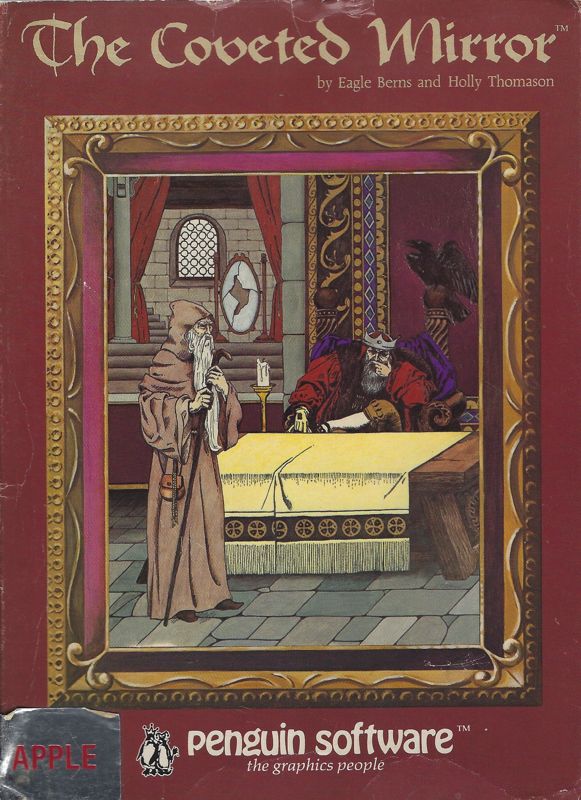
Cover from an early Apple release, via Mobygames.
To continue directly with the most immediately clear solve: the way the barrel works is as a teleporter. It’s not a new location at all, but rather is the dark place between the dungeon and the magician’s room. You can go east or west to get out; the reference to finding a nearby fire to light the candlestick is to the fire in the magician’s room I had already used before. The barrel is a 100% optional shortcut.
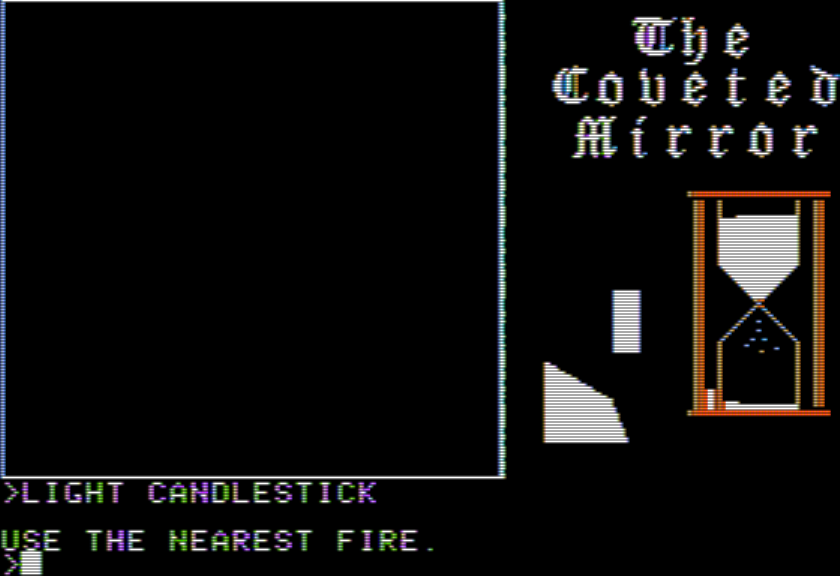
Speaking of optional, while struggling with a lack of vase I found one more optional puzzle, back at Lady Vainly.
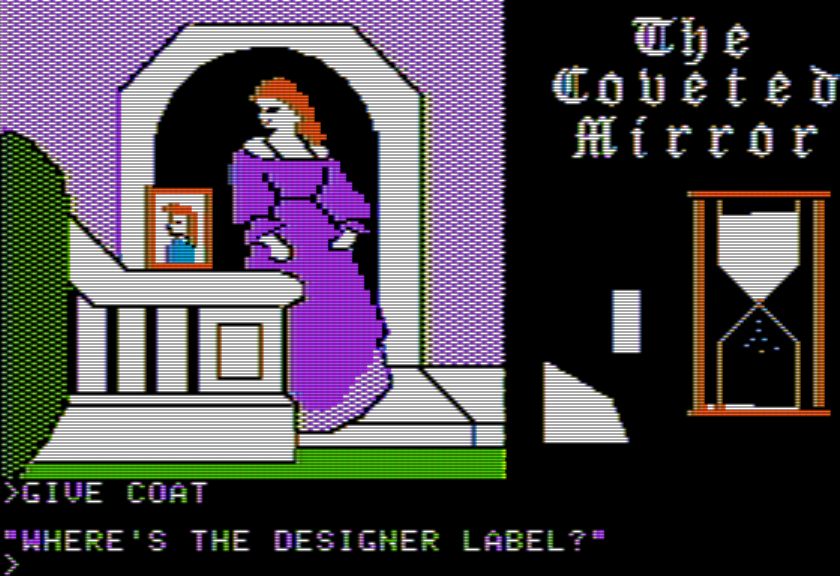
The main thing to note here on the game is there are two kinds of interaction
1. using TALK and getting some sort of comment or hint
2. randomly using GET on some item that the character possess, and rather than them getting angry at you they just tell you what they want in exchange
I had already discovered the GET earlier with the cookie at the baker (if you just TALK, it says nothing about the idea of trading chocolate moose for cookies) but it still wasn’t in my normal grab of tricks to simply swipe stuff in front of a character and see their reaction. With Lady Vainly you can try to GET the picture she is standing next to.
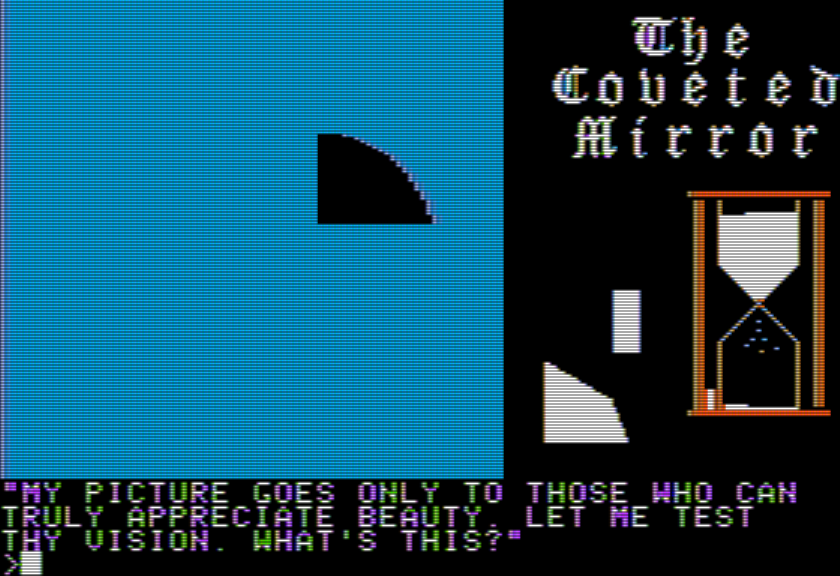
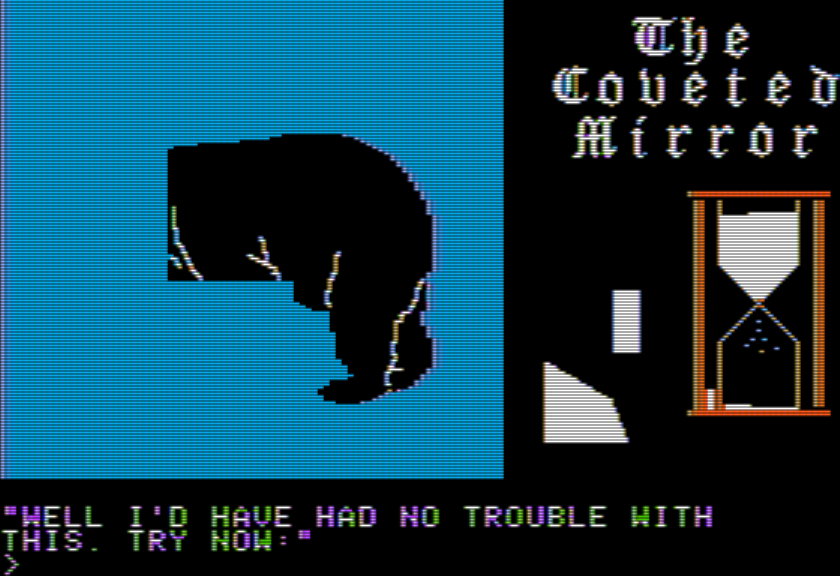
This is a BEAR. It strikes me as the sort of thing you’d find in a more generalized children’s game (not an adventure) but that seems to be the philosophical approach to the design in general (which is fascinating, and I’ll get more into that element after finishing the game).
She will give you the picture after you name BEAR, and she notes it is already signed. This picture is highly valued by the guard; I had plenty of items to give out (trying to be very efficient on my journeys) but I used this on my last pass before making it to the Peak of Shards.
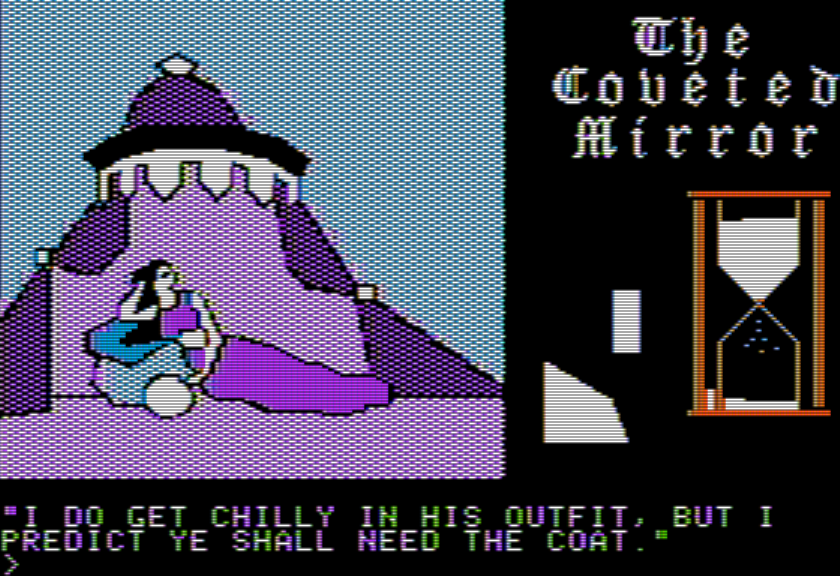
Past that, I decided the chocolate moose would only be solved once I came across the right item, and I finished trying to give the COAT to every single character in the game (all who have unique messages to that in particular!) The fortune teller gave a message that hinted you needed the coat for yourself, not for a trade.
That meant I was left with the pesky vase. I had earlier thought it might be hiding in the “treasure room” in the maze, but was not having any luck.
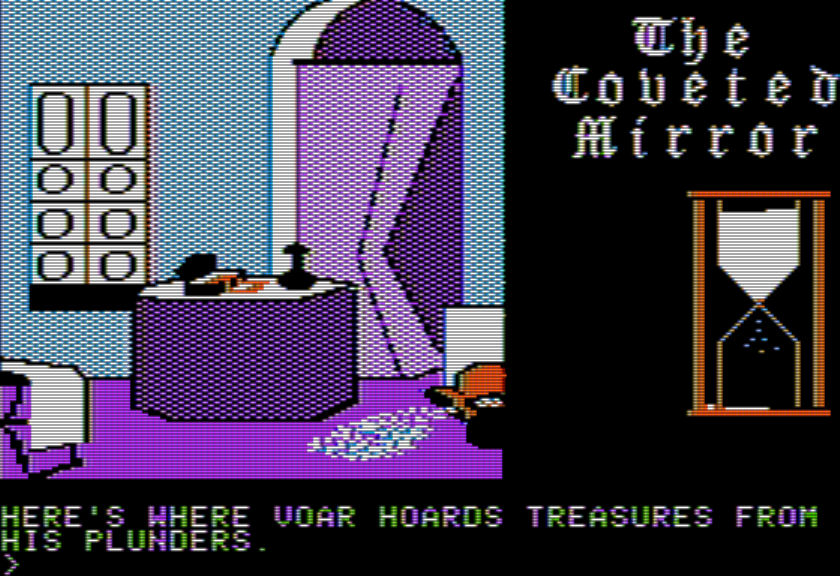
I tried referring to every item in the picture, being very unclear as to what nouns even to use; for example, trying to open a BAG (noun doesn’t exist) or move what appeared to be a TAPESTRY (noun doesn’t exist) or a CURTAIN at the back (noun does exist, but the game just says to try walking that way). I was thorough enough that I discarded this for a while and tried USE COLOR in every single room in the game, looking for an invisible vase appearing. No luck.
It was time to whip out the big guns.
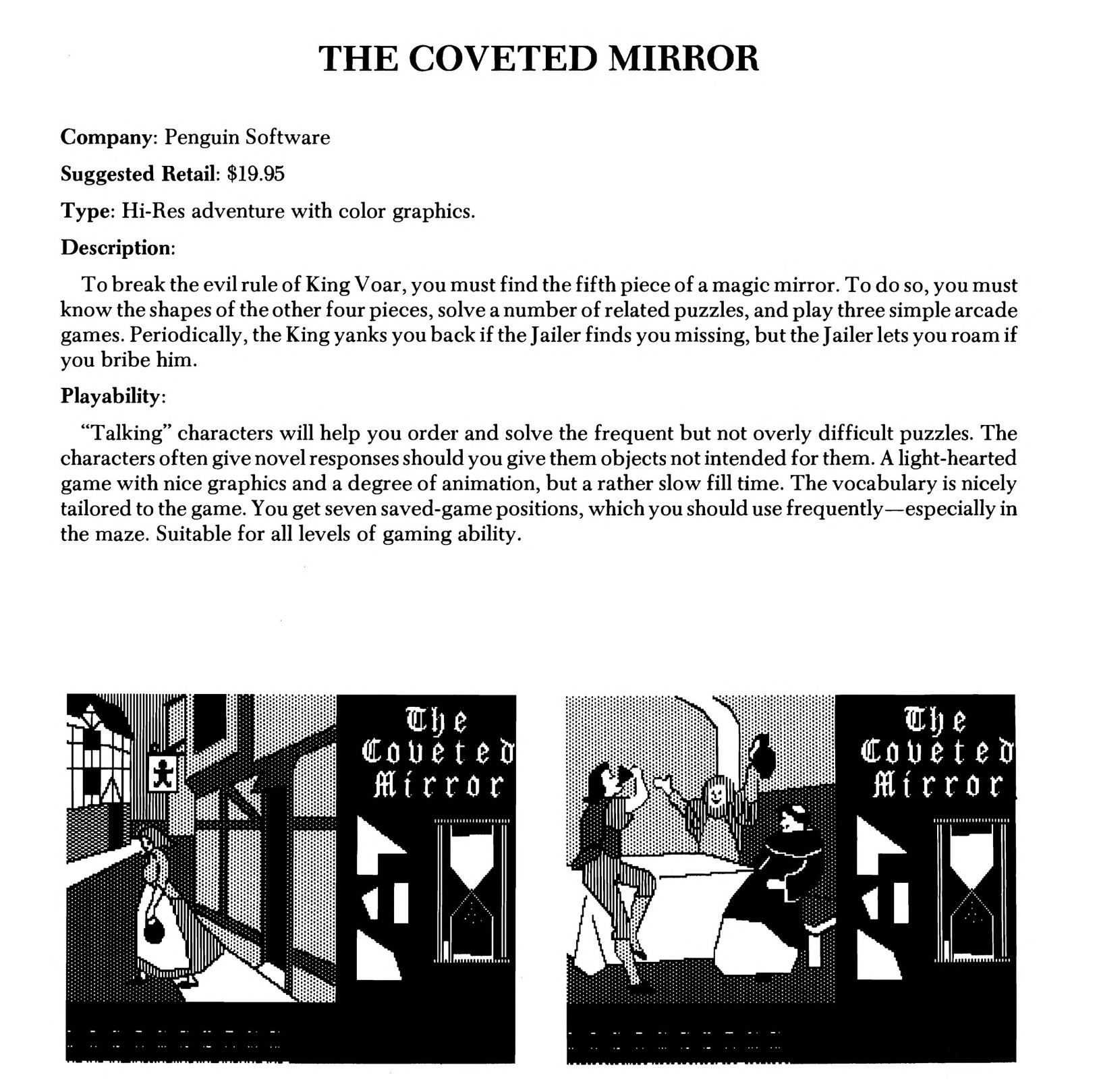
This is a page from Kim Schuette’s Book of Adventure Games, the most popular book of hints from the 80s (including maps of every single area in Time Zone, for instance). I checked the back hints for the vase that holds shadows, and was mystified to see a mention of the vase in a cupboard. The only cupboard I remembered was in the magician’s room, but trying OPEN CUPBOARD and GET VASE led me to finding no vase. Hmm.
That thing I thought was a tapestry in the treasure room was actually a cupboard.
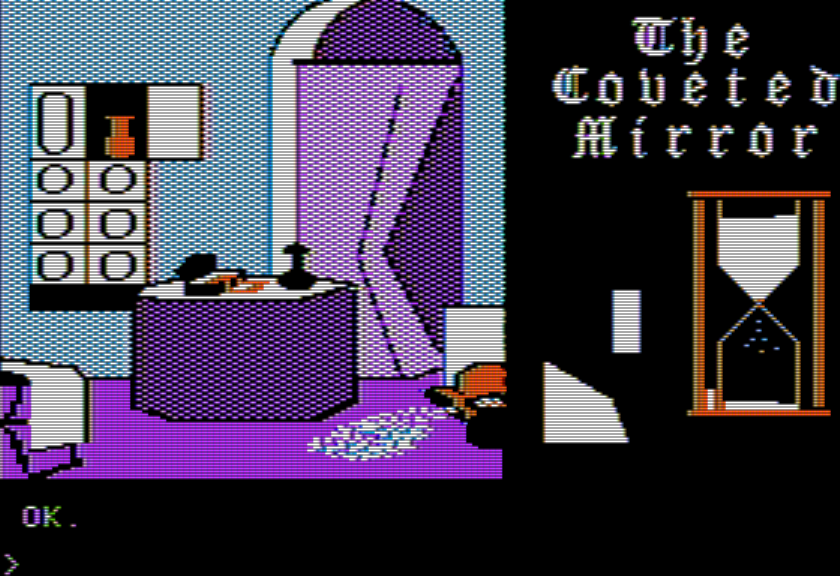
Even after the fact, that doesn’t look like a cupboard to me. What’s with that black portion on the bottom?
The funny side effect of all this is you can find the vase almost right away in the game; for such a player, the mystifying part might be its use, but I had already staked out where to find the shadow of a child.
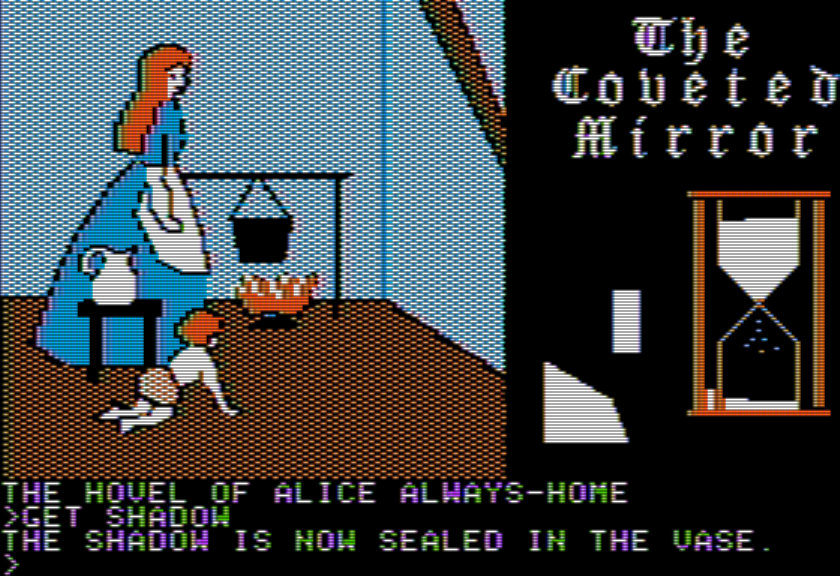
I found this deeply unsettling.
Returning the shadow to the witch…
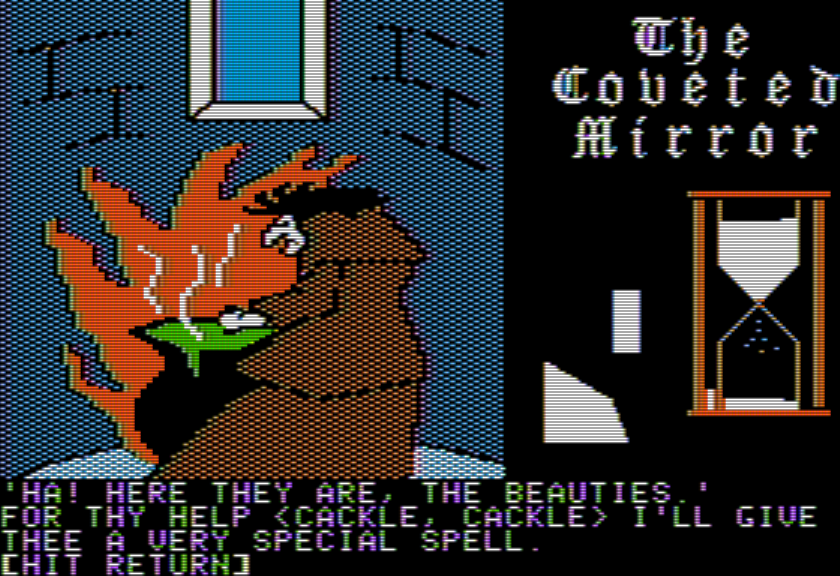
…I now had USE INVISIBILITY and USE VISIBILITY as spells. Finally I could wander the castle! It turns out the trapdoor-navigation lets you visit most of the rooms; only a handful were inaccessible. The first is past a guard stationed by the kitchen, which goes to a church. Since I heard the hint already about the location of the shard, I automatically got it added to my screen just for entering the room.
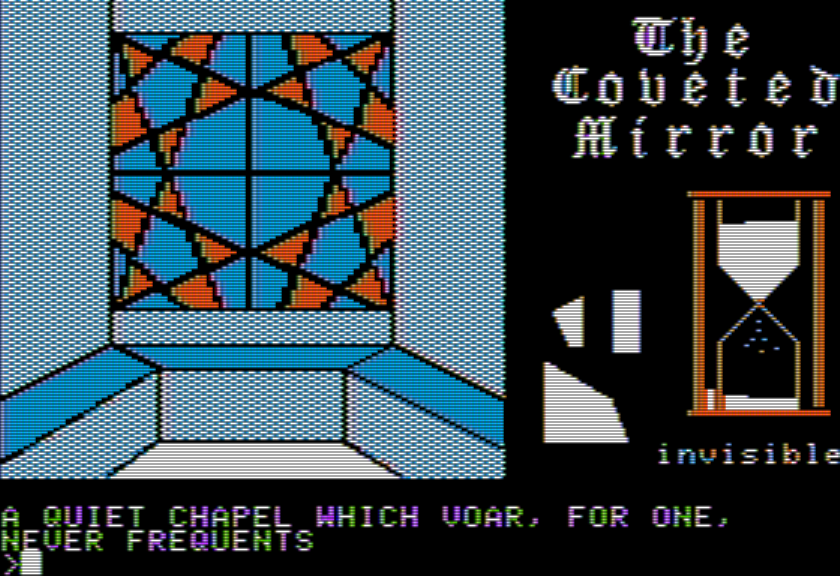
To the far east is another previously-unseen room, the King’s Royal Chambers.
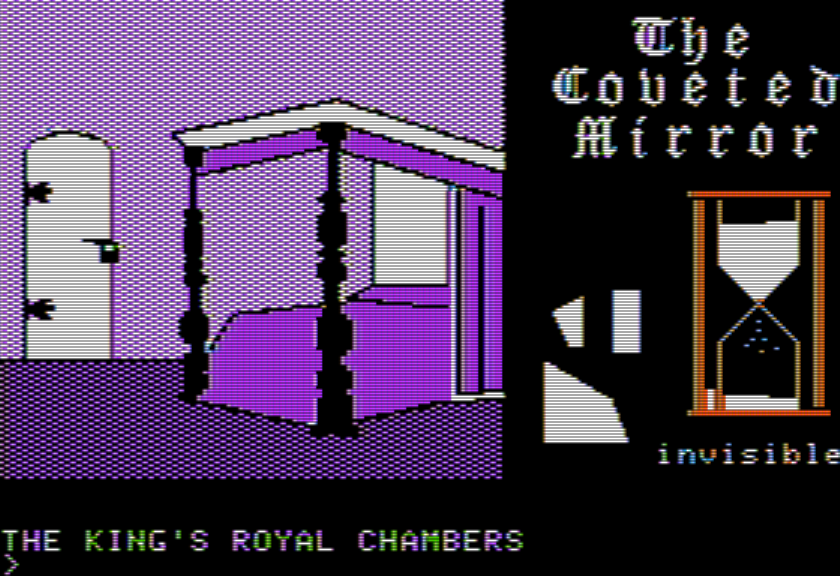
Going south from here leads to a place the jester hangs out, but also a moose on the wall.
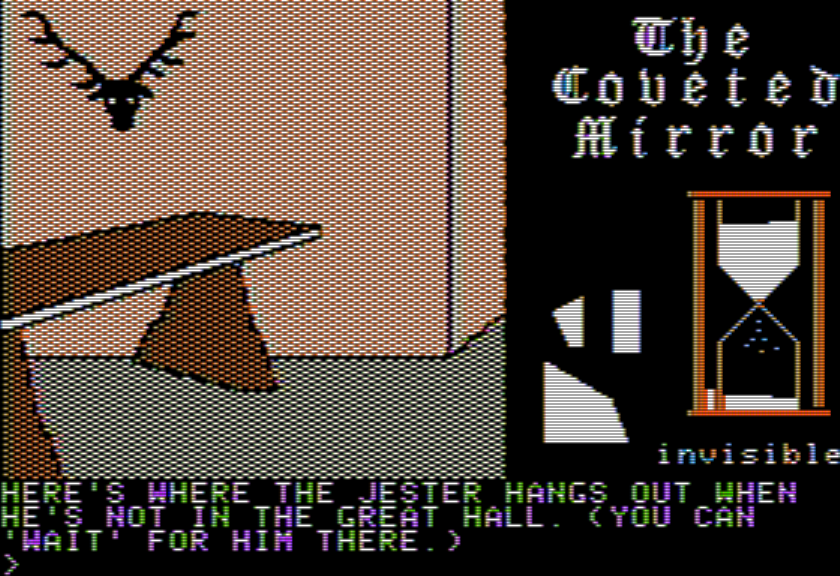
The moose is what the baker wants, but the cookie just serves as another bribe for the guard, so I ended up not using it.
The Royal Chambers have a locked door to the north and trying to unlock the door indicates Voar locked the door and swallowed the key, so I admit I spent a little time trying to trick him into eating a cookie while invisible and causing him to throw up the key somehow. Except: I still had the lockpick! (The game isn’t into object re-use otherwise, so it took me more time than it normally might have to come to this realization.)
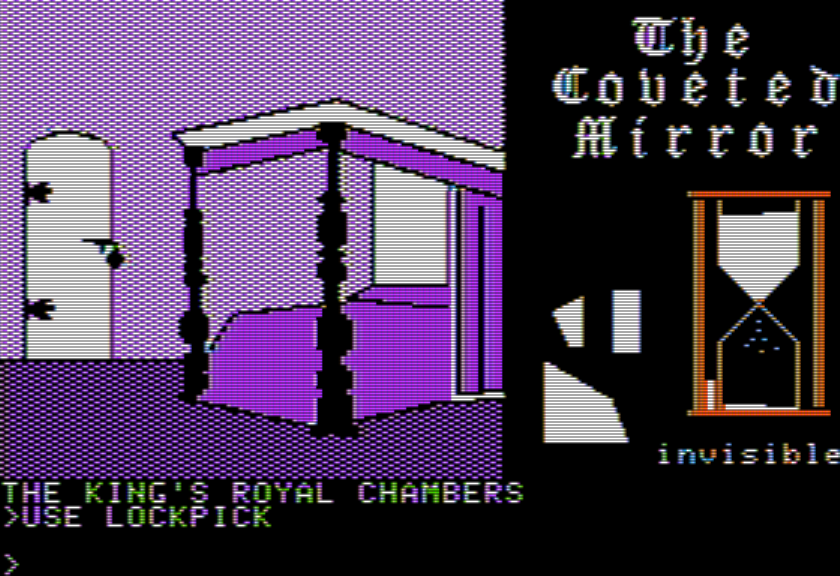
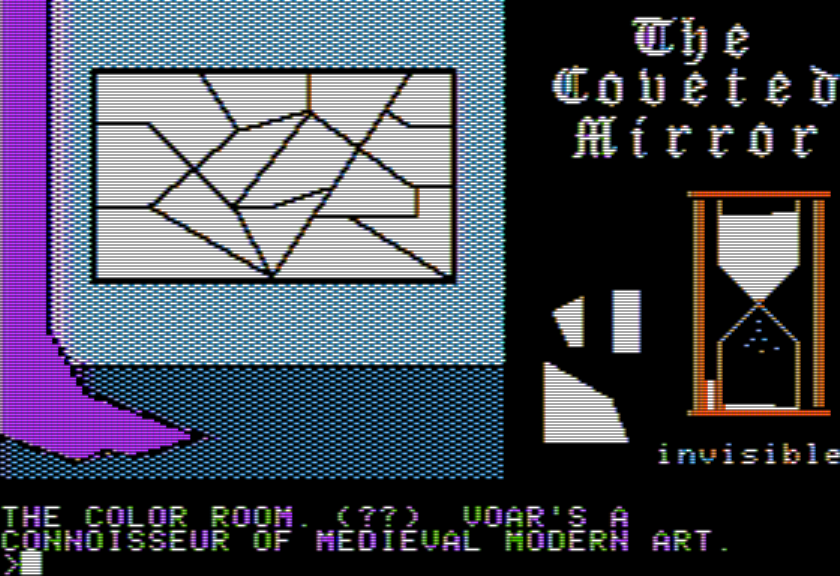
Having applied it on every single other room, knowing to USE COLOR to the painting was immediate.
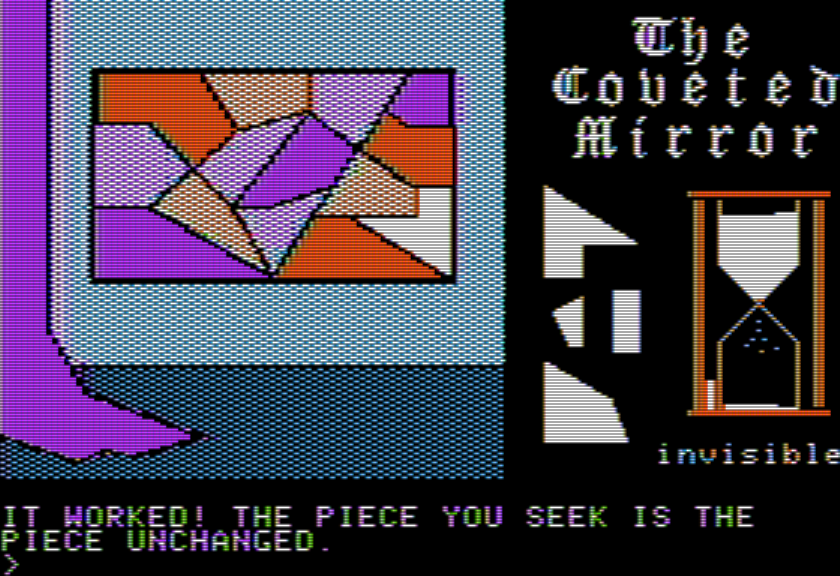
That’s all the shards in the castle! Following my guess earlier, I then went to the tavern to see if Brother Jon was there to teach sign language. (There’s a hint from the bard about getting wine after you’re prepared, although I only realized the connection after the fact.)
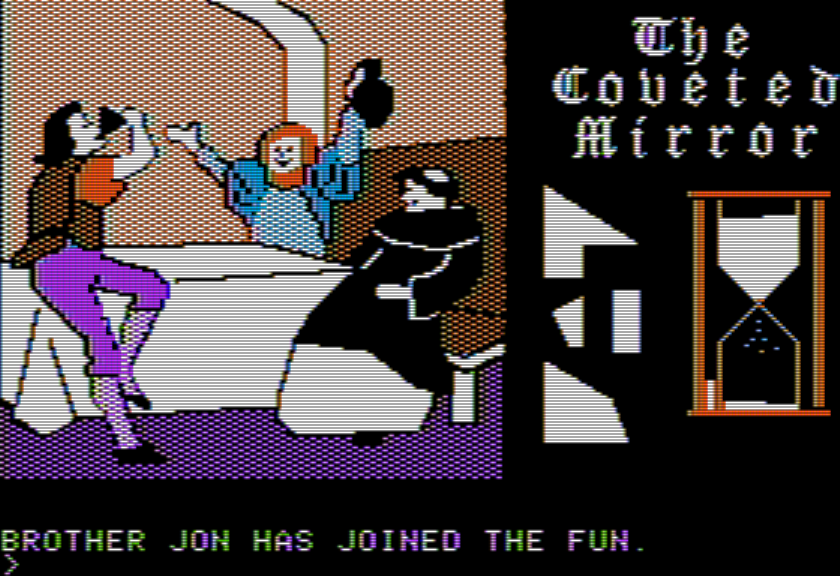
Having entering the tavern be a softlock prior to this point (since you get everything stolen, including required items) is astonishingly rude even for a game not targeted at children.
TALK now enters a mini-game. It’s just Simon but with hand motions. Q/A/Z for high/medium/low on the left hand, O/K/M for high/medium/low on the right hand, copy what the Father is doing enough times and you win.
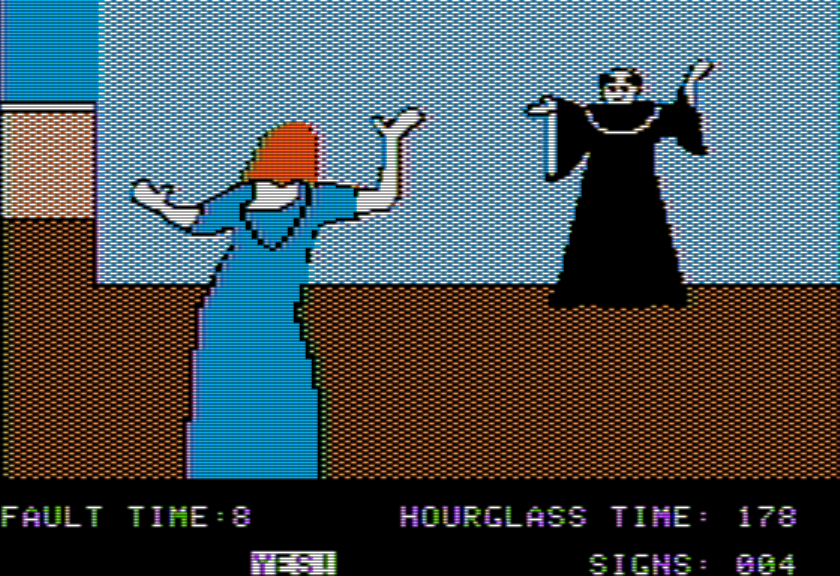
Solved the first time, but I honestly preferred an easy mini-game to the nonsense I had to deal with while fishing.
Now, with ring in hand, you can go over to the forest and TALK to the old man when he shows up.
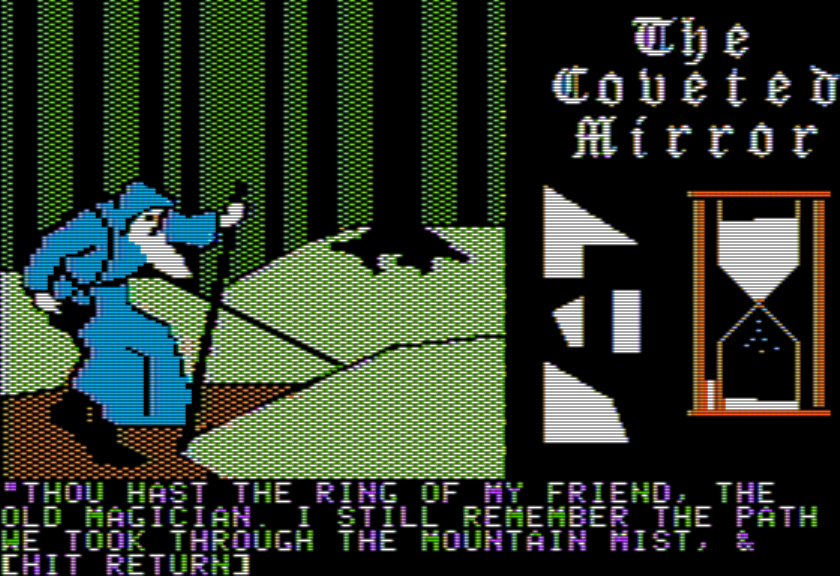
This allows you to get to the endgame section, which is mostly linear.
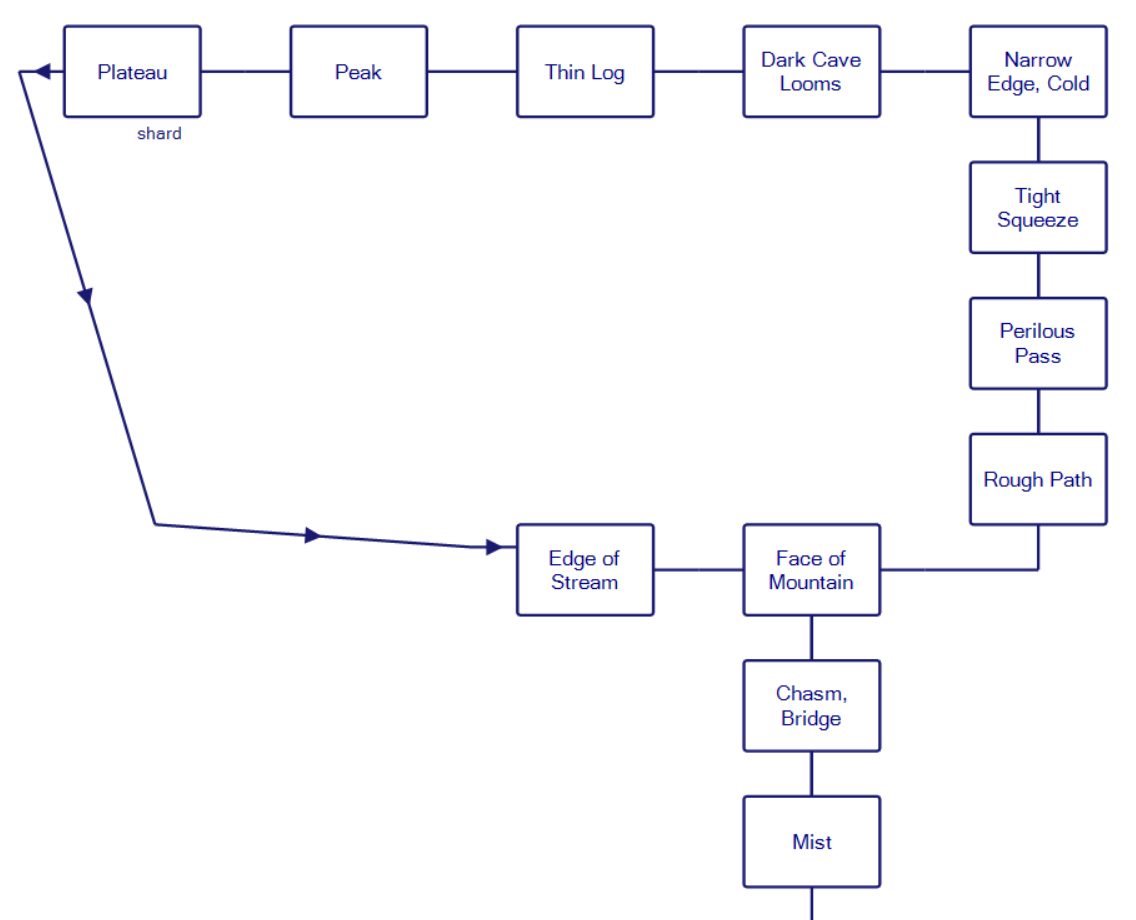
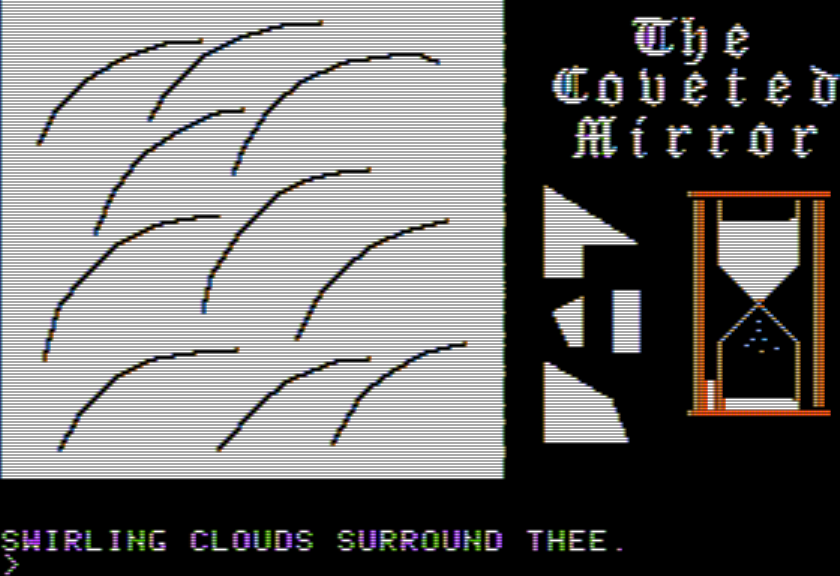
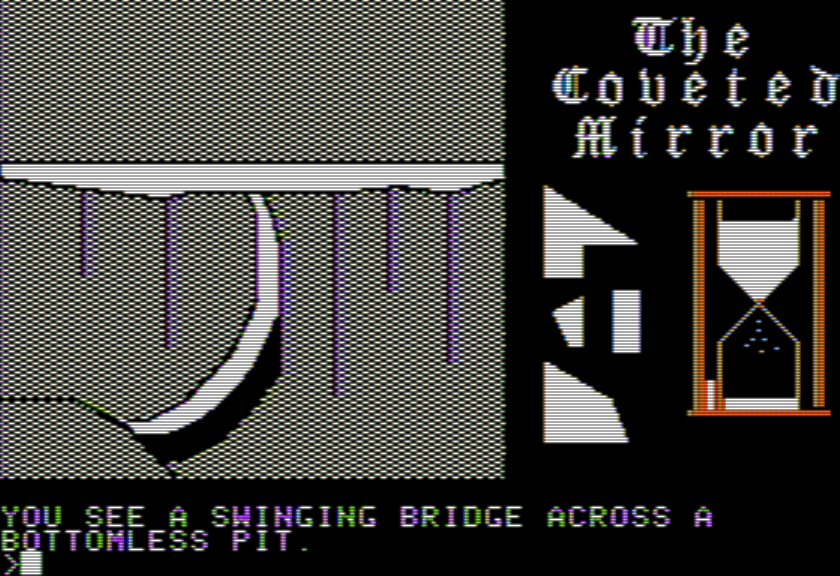
Once past the mist there’s a bridge (I was worried there was a puzzle here where you can fall, but it’s just meant to look epic) and then one side route where you can meet someone fishing at a stream and get a hint.
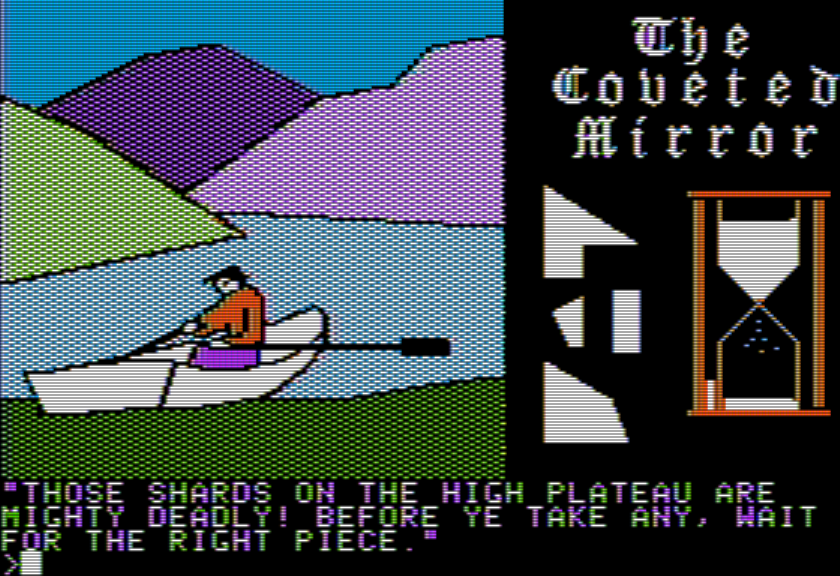
This is a random encounter like the others, so there may be nobody here. The map is designed so you can accidentally loop back here; I met the person here on the second-loop round.
The mountain then gets cold as you travel upward, and there’s a “tight squeeze” where you can only carry one item. This is meant to make you actively think about the coat as being useful (that is, the puzzle otherwise would likely be solved by most players “passively”; by actively making them choose the coat, the puzzle isn’t just solving itself).
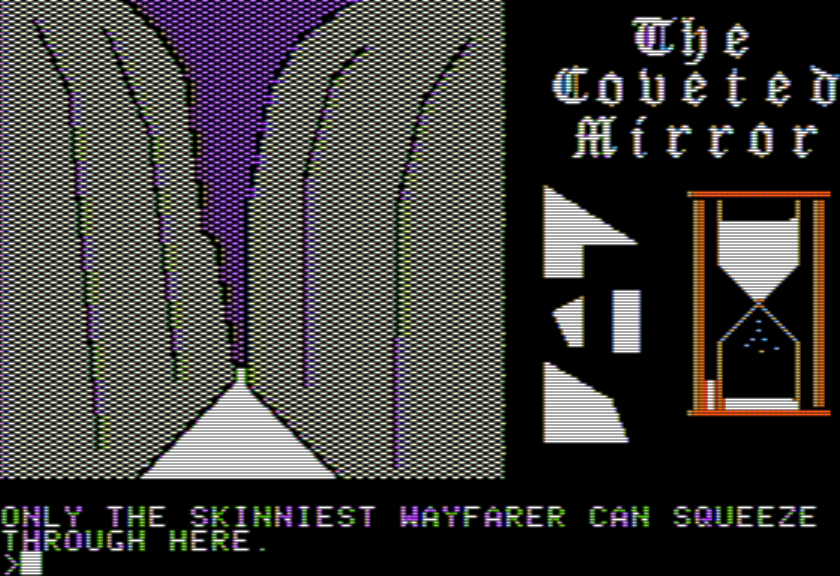
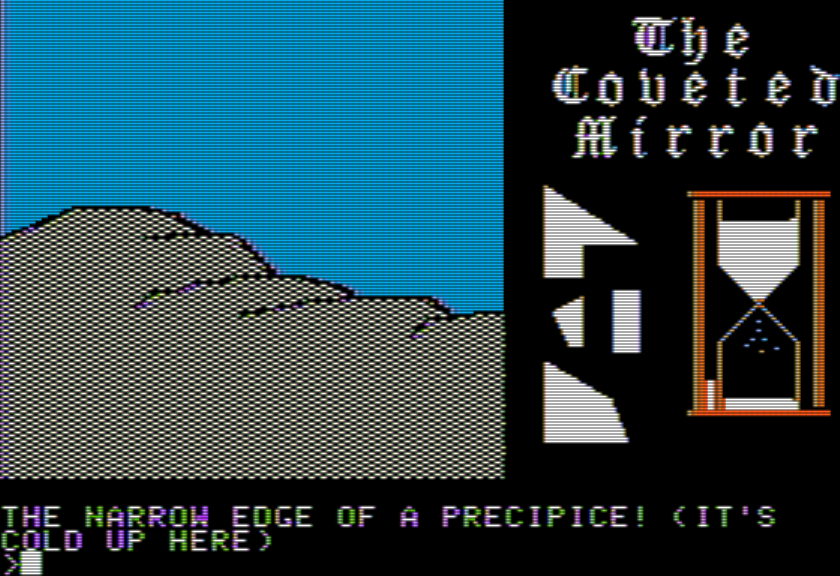
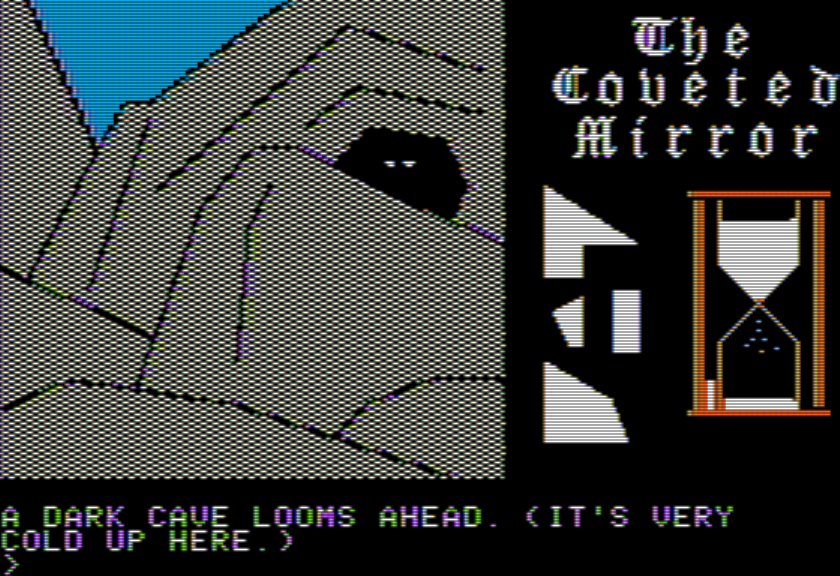
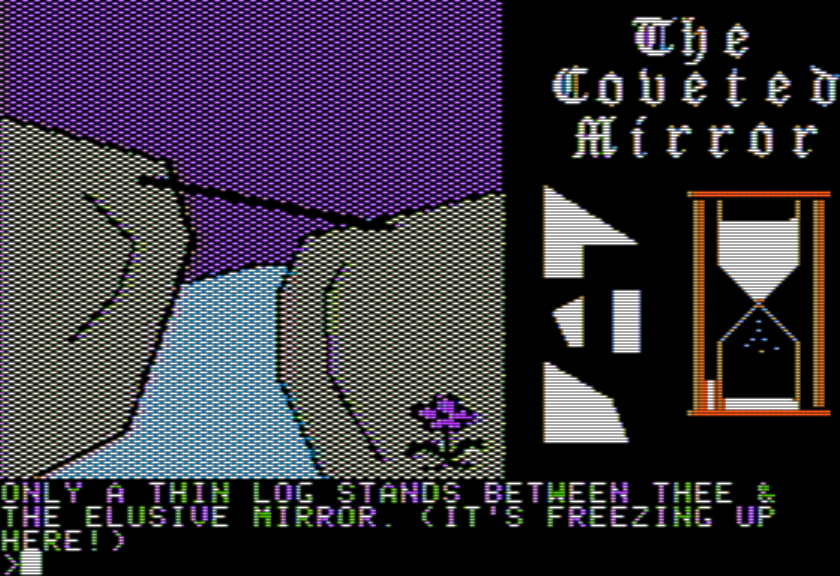
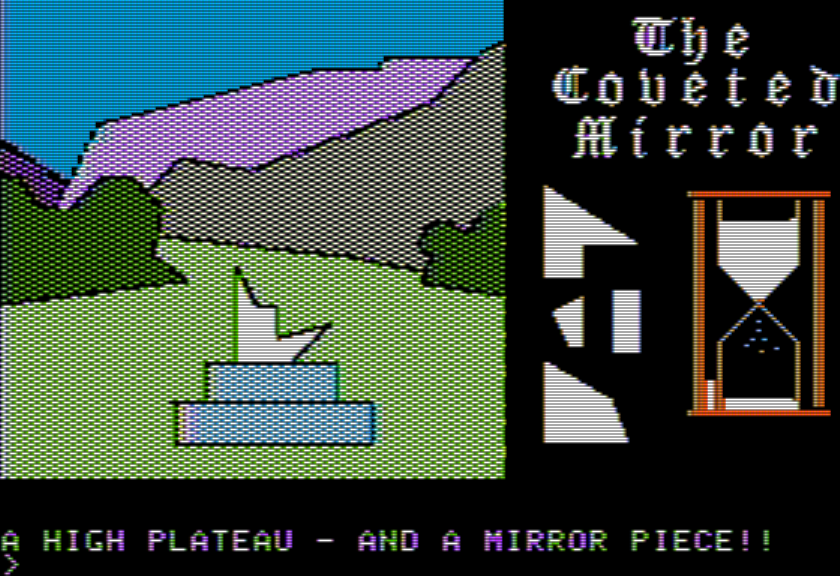
Above is a trap: trying to take the mirror shard now leads to a wailing alarm and you get captured. You need to WAIT for the right shard to appear in order to complete the picture. This entire setup does not make sense to me in a plot-coherence sense (why, if Voar was able to secure the mirror with fake mirrors, does he even have the real one show up at all?) but the entire game has played it loose with plot beats so I just rolled with it.
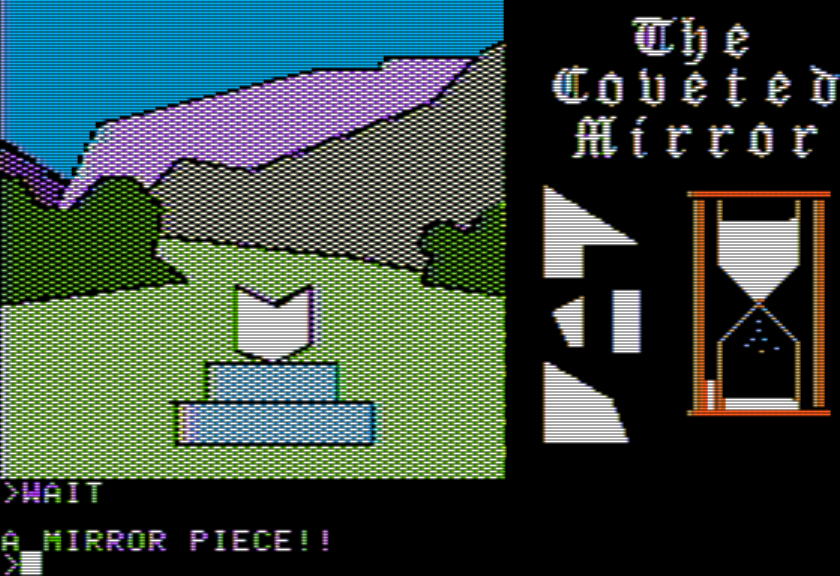
Or at least I tried to, but as mistertaster had been warning me in the comments, the shards don’t actually fit together correctly. I admit I went a bit meta; there’s that picture from the later printing…
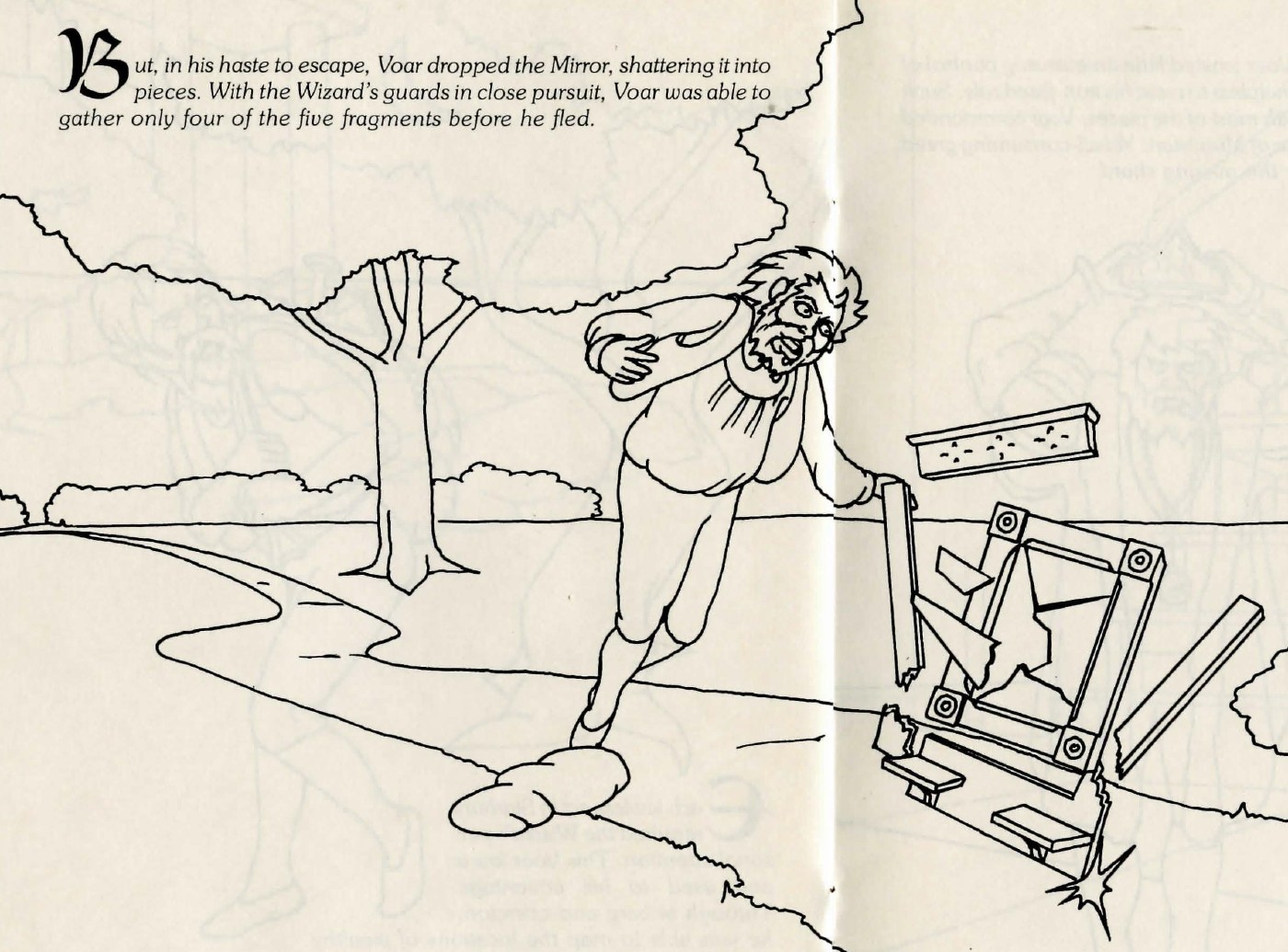
Via the Museum of Computer Adventure Game History.
…and one of the shards from that picture shows up if you wait long enough.
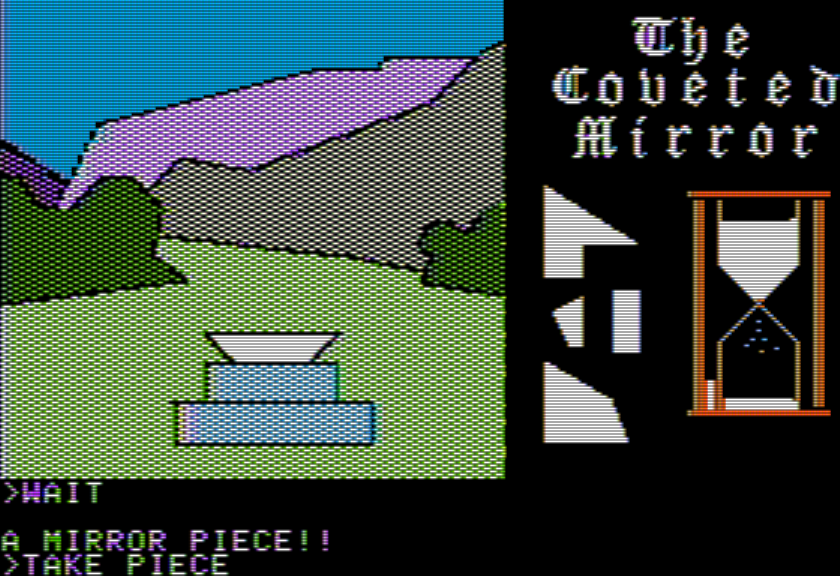
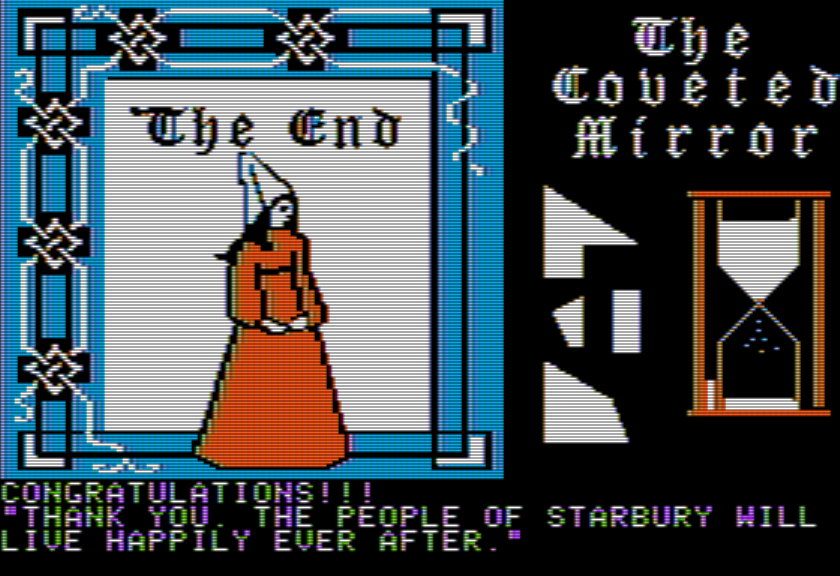
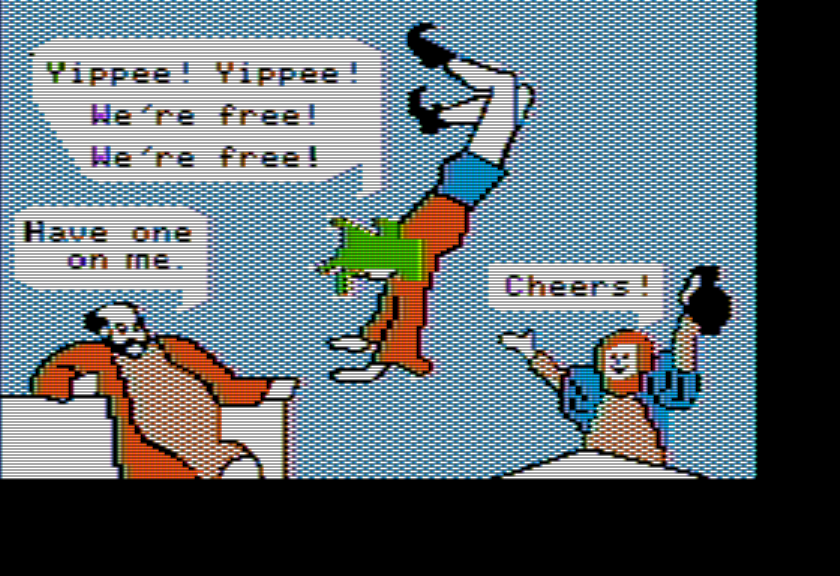
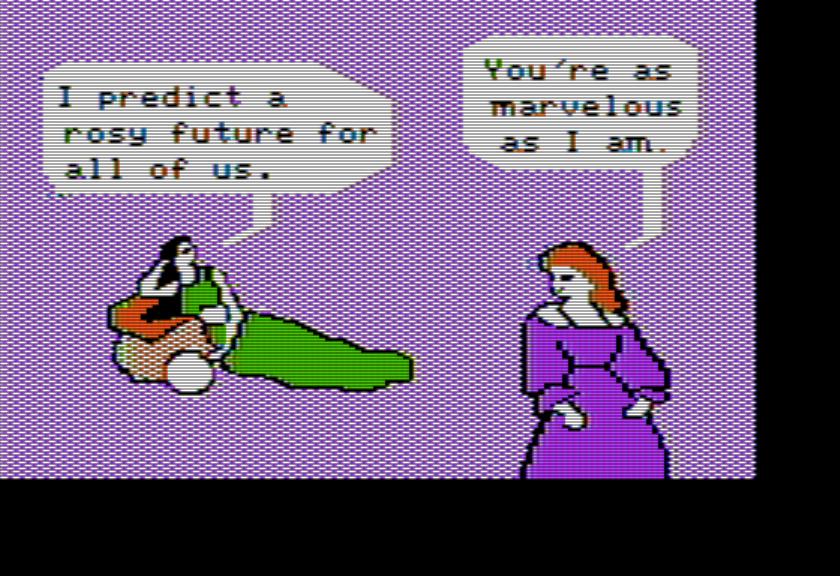
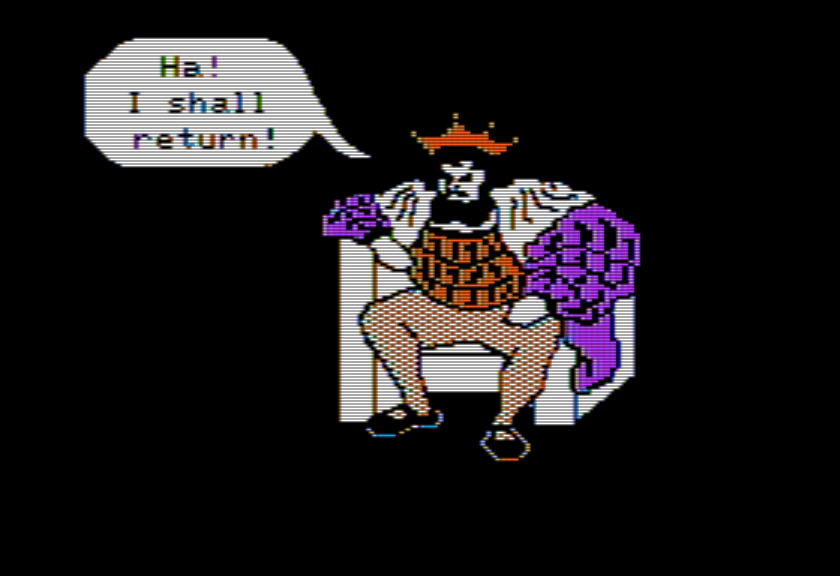
While I wasn’t clear before without playing the game, all the references to non-violence in the historical background hinted to me this was aimed as a “children’s game”. I now think this is the case and it isn’t a bad thing. It led to:
- strong emphasis on visuals that looked like they were supposed to, with many animations
- emphasis on interacting directly with the visual environment (not that words are bad, but the game took a genuinely original approach that went past anything Sierra On-Line had done yet)
- many straightforward puzzles throughout where you either told directly what is needed as long as you ask correctly (a crystal ball for the fortune-teller, grain for the inn-keeper) or at least the connection is not hard to make (fish for a cat)
- more feedback on giving items than is standard for a game of this era, so there’s some engagement even when the player is doing the “wrong thing”
Essentially, the authors leaned more to the easy side of things; while there were some hard and even obnoxious puzzles (the vase being the most extreme example) it was framed by enough simplicity I didn’t feel like I was being crushed. There was enough environmental atmosphere (and optional encounters) that it was genuinely enjoyable to just bop around the map looking for something new. Despite it not being in the character-in-an-environment format Sierra On-Line would start following after King’s Quest (evolving into the “point-and-click” adventure), it followed a similar sensibility (and was even willing to show the main character during the mini-games).
Mind you, not everything went well. I understand why the authors put a limit on the number of times Voar could catch you (otherwise all the work putting bribes for the guards lacks in importance) but in the end it’s like Hezarin trying too hard to keep a player from guessing at a puzzle solution and breaking the game; there isn’t enough benefit to punishing the few people that will go 25+ loops, so all it really does is create anxiety for players.
(Long term time limits are, in general, a horrid design choice. Fallout originally had a time limit for finding a water chip at the start and then ripped it out. I’ve been tempted to play Xtal Soft’s breakout CRPG, Mugen no Shinzou, but the game gives a turn limit of 30,000 meaning you might be 80 hours into the game and have to restart because you weren’t efficient enough. Something like Ancient of Domains of Mystery works better because “corruption” increases over time, but it can be managed rather than forcing a hard stop to the game.)
Some historical points to tie up before closing things off:
I had promised to bring back Michael Kosaka. Specifically, he is mentioned in the manual for doing the art for the joust.
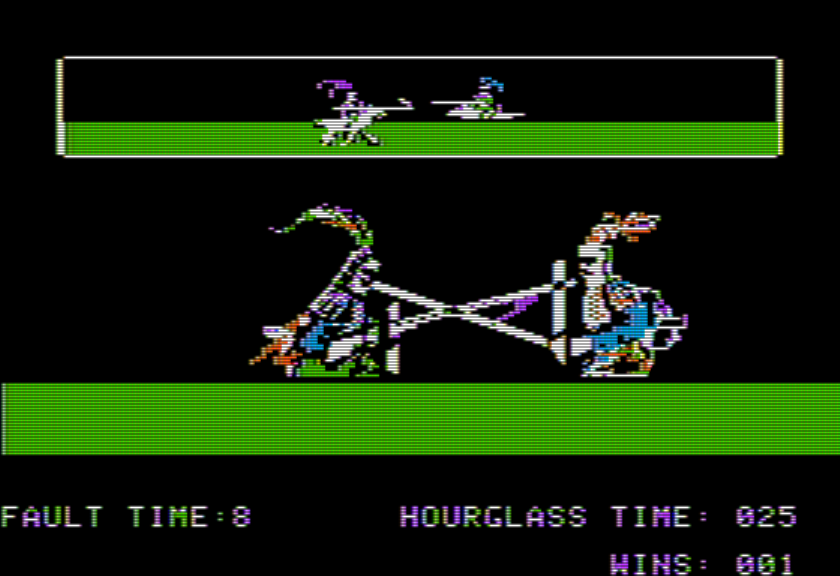
This would normally just be side trivia, but it’s more interesting than normal because his later career (as I already indicated) generally emphasized sports games, including Budokan: The Martial Spirit from 1989 (for Electronic Arts) which has combat with some aspects of the jousting in it.
Only a few years later he was positioned as Commissioner of the EASN.
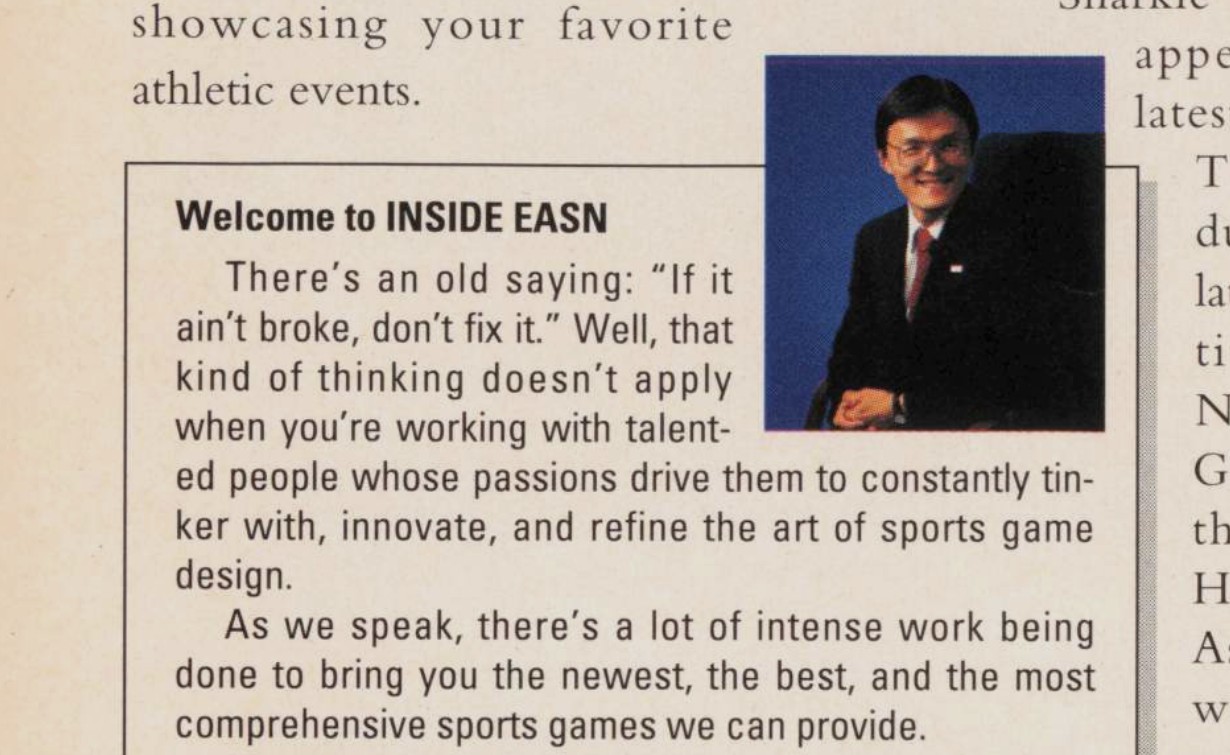
From the Video Game History Foundation, Inside Electronic Arts Sports Network, Volume 1, Issue 2.
You can thus draw a direct (if faint) line between The Coveted Mirror and the modern Electronic Arts sports empire.
Also, both Eagle Berns and Holly Thomason kept up a relationship with Penguin. Holly did the graphics for the Macintosh version of Transylvania; Berns worked on COMPREHEND (Penguin’s later “general” system for adventure games) as well as the Mac version of The Graphics Magician.
While it’s a little harder to find than her Penguin Software work, Ms. Thomason made another original game: In Search of the Secret Stone (Creative Publications, 1986). It is an “educational” game quite directly this time meant to teach mathematics, but it is also quite clearly an adventure game with graphics in the same style as The Coveted Mirror.
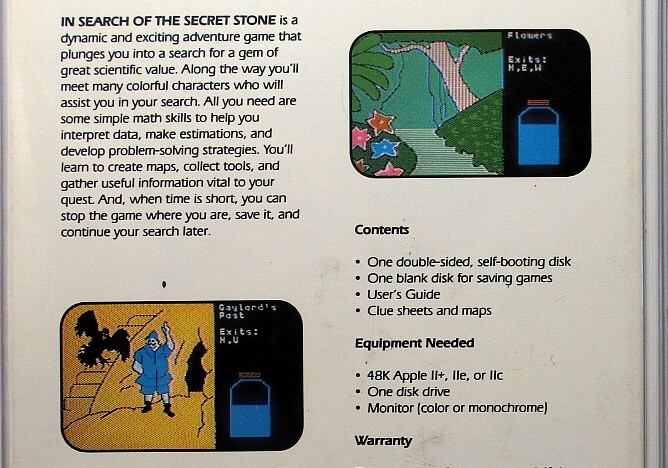
Back of the box, via the Internet Archive.
Finally, it’s worth at least looking at the screens for the Japanese translation of the game. Starcraft did the translation (just like with the Sierra On-Line games, such as the Time Zone game where they re-drew every single screen). What I find fascinating here is they tried to do heavy localization, changing the setting to Japan and radically modifying the graphics. Two screenshots of the PC-98 version via Mobygames:
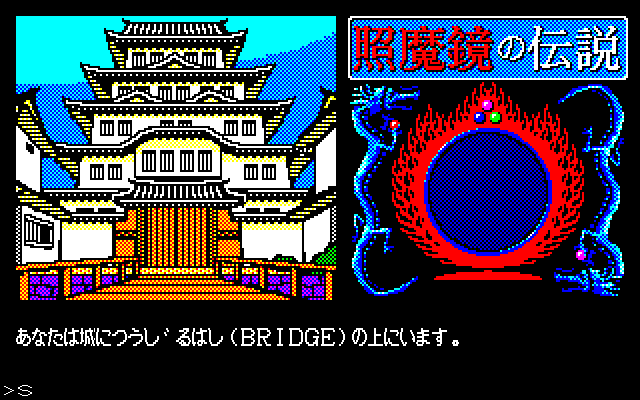
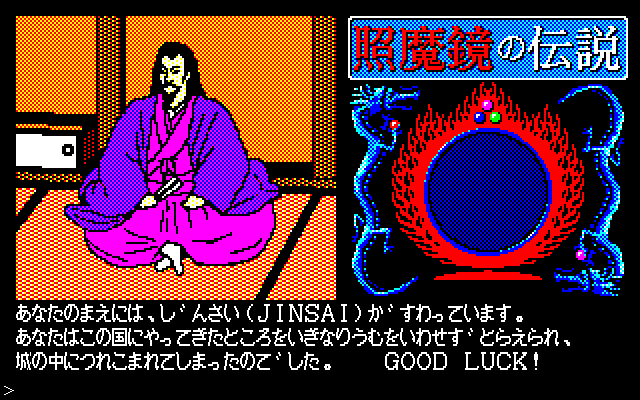
According to Rob in the comments, it changes gameplay aspects as well, like removing the mini-games, removing the 25-capture limit, and making the vase visible in the treasury. The pickpocketing is both more forgiving and meaner at the same time: it doesn’t happen instantly when you enter the tavern, but if you wait long enough you’ll get pickpocketed without any kind of warning.
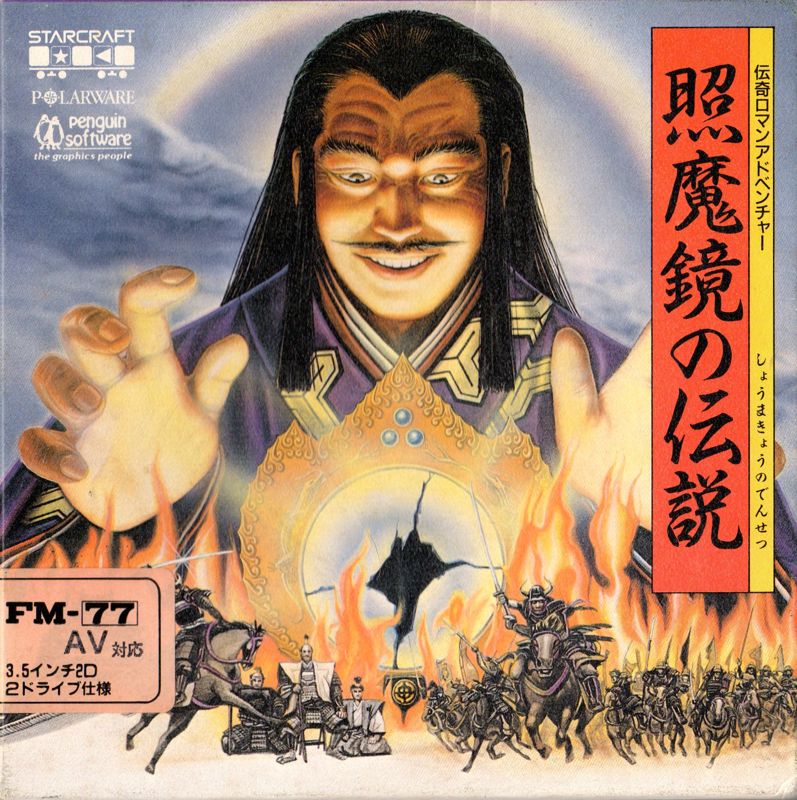
FM-7 box cover from Mobygames.
Coming up: An absolutely enormous game that was lost until quite recently.


One funny thing that would also point to your idea of it mostly being intended as a children’s game: The ginger cookies are a “bottomless” item. As soon as you use one, you can go back and get another, so you essentially have endless bribes to use at that point, ostensibly making things easier.
Shōmakyō was clearly NOT intended as a children’s game, so that whole puzzle is just stripped out (the king’s anteroom is empty, the bakery is replaced with a rice shop that has no takeable items, and Lady Vaine is substituted with an overly chatty girl who’s sweeping up in front of a tea house). There are also way less obvious clues (and several things are simply not clued properly), but the lack of purely visual puzzles somewhat ameliorates that. Overall, it’s still sort of the same game, but really very different at the same time. There’s one weird bug that may be emulation-related, as well.
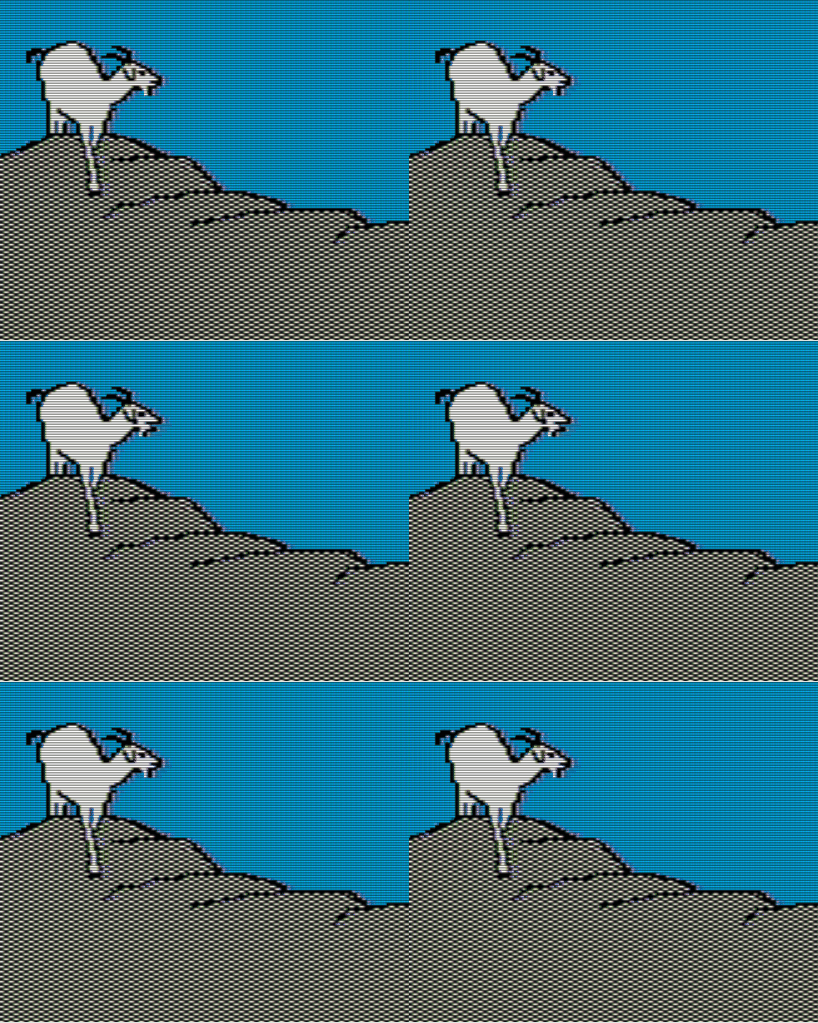
One last thing: that random goat you showed a picture of serves as one of the more surreal ways I’ve seen to get a hint in Shōmakyō. It’s one of a number of times in the game where the “narrator” voice goes meta and breaks the fourth wall.
By the way, Thissala has a couple of serious recurring bugs (one involving game saves) that you should know about. When you hit them let me know, as I basically figured out ways around them.
“Having entering the tavern be a softlock prior to this point (since you get everything stolen, including required items) is astonishingly rude even for a game not targeted at children.”
I vaguely recall getting back the items stolen at the tavern some place outside the castle, where it says it’s a good spot for stashing. You just have to look behind the bushes ot dig the ground or something like that, if I’m not wrong.
Very nice! I don’t blame you for looking up a hint – I didn’t remember the cupboard in the treasure room either. I also have a vague recollection of being able to retrieve the stolen items as well.
Also, to clarify, the mirror pieces DO fit together if you play fast and loose with the pieces (sizing them up/down, stretching them, etc.) Still, this seems a baffling puzzle to try and solve in 1983 without any hints, since the hint provided within the game (i.e. the mirror pieces themselves) are flawed.
I’m curious, did you try to let the hourglass expire when you were beyond the impenetrable mist? Doesn’t the game say that Voar cannot see beyond it?
I thoroughly enjoyed this one.
“I’m curious, did you try to let the hourglass expire when you were beyond the impenetrable mist?”
Based on Jason’s screenshots it looks like the hourglass doesn’t advance at all in that area.
Good catch, Aula. Of course within the context of the story it doesn’t make sense that Boris would stop looking for you. But I imagine from a programming perspective it is easier to suspend the clock advancing than it is to ignore a mechanic which underpins the entire game.