Archive for the ‘Interactive Fiction’ Category
The fourth game of the Scott Adams series is possibly the first adventure credited to a female author. Oddly, this credit does not appear on the game cover…
…but rather on the initial screen of the game.

These days Scott and Alexis Adams are listed as co-designers. The historian Jimmy Maher mentions that Scott Adams downplayed Alexis’s contribution to the game in later years, but Alexis herself stated she wrote Voodoo Castle on her own, so I’m going to stick with the game’s own credit as solely Alexis Adams. (Note also, this 1981 interview of Scott Adams in 80-U.S. Journal has Scott himself claim Voodoo Castle was “95%” the work of Alexis.)
Anyhow! Secret Mission (aka Mission Impossible) broke out of the “find the treasures” mold significantly to give a directed mission that had nothing to do with treasures. Voodoo Castle steps back from the innovation only slightly; the goal here is to wake Count Cristo via some unclear magic ritual. This hence doesn’t feel like a looting expedition with clearly labeled *treasures* but more like solving a mystery box, working out what puzzles to twiddle in sequence to slowly unlock the edges.

This is what one of my “maps in progress” looks like.
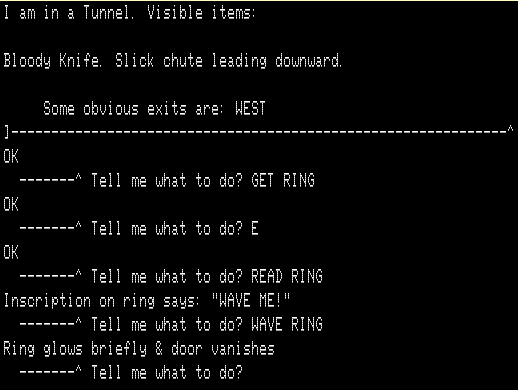
I actually have taken cracks (twice!) at this game in the past, but for some reason never could get any puzzles except for a trivial early one where you WAVE RING to open a door (the game pretty much gives this one away).

This time, however, I started making progress. I’d love to know what changed; maybe playing this after a bunch of other late-70s games put me in the right mindset, maybe I’m better at adventure puzzles in general, maybe I was more persistent because I knew I wanted to write about it, or maybe I just got lucky.
In any case, some spoilers follow.
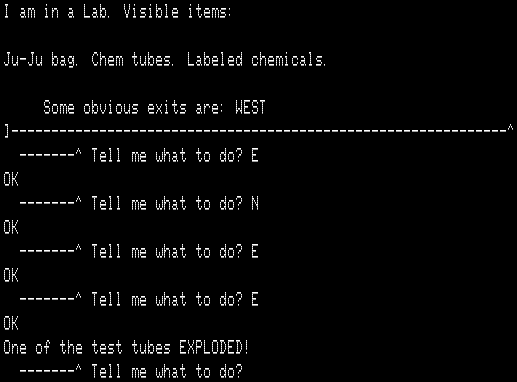
EXPLODING TEST TUBES: There’s a room with a ju-ju bag, chemicals, and test tubes. Fairly shortly after entering one of the test tubes explodes, and presuming you have no protection you receive a slightly unfair death / game over. I returned to this room on my second run but somehow the explosions weren’t killing me. I only realized after some experimentation I was being protected by a shield I was carrying since there is no message at all about how I’m managing to survive. This persists even when picking up the exploding tubes and carrying them around; somehow the shield is good enough to protect from a test tube exploding in one’s inventory.

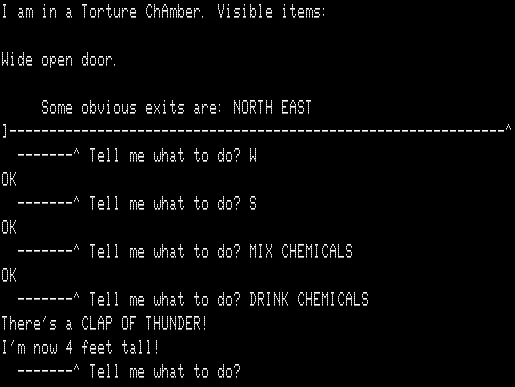
TINY DOOR: In sort of an Alice the Wonderland scenario, the chemicals from the exploding test tube room can be mixed and then drunk to get smaller. Not a lot smaller, just four foot tall.

This effect lasts the rest of the game, which is an odd visual image.
JAIL CELL: Getting through the tiny door leads to a graveyard with a saw. Taking the saw back to the dungeon, there’s a jail cell that if you enter the door locks behind you. However, SAW DOOR pops open the lock. I am unsure why this would work but not using other similar items (bloody knife, broken sword, hammer) and I am unclear even how to visualize what’s going on here, but I somehow solved this one pretty quickly anyway.
MEDIUM MAEGEN: There’s a pamphlet advertising a medium that can be reached via “SUMMON MEDIUM MAEGEN.” There’s a “medium room” with a crystal ball, but the medium is scared off and disappears. However, if you invoke >SUMMON MEDIUM she comes back and gives some information, the first time the game conveys any concrete way how to complete the main quest.

PLAQUE: This was for me the coolest puzzle so far: there’s a plaque with print too tiny to read. If you’re carrying some broken glass you can avoid the tiny print problem by using the glass as a magnifying glass (unlike the shield I thought this might work and intentionally brought the glass over to use it this way) but the letters are also luminescent and too hard to read in light. Hence you have to take the plaque to the only dark room in the game, inside a chimney; finally you can read the plaque which reveals the combination for a safe.
Hum, I’m sounding pretty negative, and in the cold rationality of logic the puzzles are only so-so. Somehow I’m having fun anyway. I think the compactness of the game (and complete lack of mazes, at least so far!) makes a nice counterpoint to the sprawling maps I’ve dealt with lately.
I have reached a glorious 225 out of 225 points by depositing all the treasures in the area just outside the castle door. This took some searching because this is not the room you start at, nor does it seem like the most logical place to store a treasure, so I had to wander the map a bit and do >DROP OPAL >SCORE >TAKE OPAL in each room until I found the right one.

It also remains for me to do the celebratory dance, as there is no ending message. Some trivia about the game’s characters before my final analysis:
The Knight: I mentioned earlier that the knight is defeated by a shot from a gold pistol. It’s also possible to simply luck out.

This is fortunate because the knight can reappear after being defeated, a fact I only found out near the end of my run when I had ditched my gold pistol already to have more room for treasures.
The Pirate: The pirate from Adventure makes yet another appearance here and behaves identically: he takes your treasures and stashes them in the maze. However, on my winning run he never appeared. Here’s the relevant line from the source.
112 IFZZ>2ANDRND(100)=50THEN5500
5510 PRINT”WELL SHIVER ME TIMBERS! NOT ANOTHER ONE! HAR HAR HAR, I’LL JUST SNATCH ALL THIS BOOTY AND HIDE IT DEEP IN THE MAZE. WITH THAT, HE STEALS ALL OF YOUR TREASURE!”
It is in other words a straight 1 out of 100 chance. Note this is different than original Adventure, where the pirate has a physical location which travels the map and it is very hard not to run into him (which is good since in Adventure the pirate has his own treasure you wouldn’t be able to reach otherwise).
Chester the Jester: He’s got a 1 out of 27 chance of appearing. Here’s everything the jester can say.
51135 C$(0)=”PAY ATTENTION IN THE MAZE, TO THE WORDING OF THE PHRASE! IF YOU DO YOU’LL BE UN-MAZED.”
51140 C$(1)=”GULP GULP GULP, DRINK IT DOWN, I’M NOT SUCH A STUPID CLOWN!”
51145 C$(2)=”OUT OF A WINDOW YOU MAY FALL. JUST LOOK OUT, THAT IS ALL!”
51150 C$(3)=”THE KNIGHTS CAN’T BE KILLED, AS FAR AS I KNOW. IF YOU FIND THEY CAN, PLEASE TELL ME SO!”
51155 C$(4)=”DON’T BRING THE SWORD TO THE SORCERER’S PLACE. IF YOU DO, HE MIGHT CONFRONT YOU FACE TO FACE!”
51160 C$(5)=”HOCUS POCUS, ALAKAZAM! DON’T READ THE BOOK OR YOU’LL BE SORRY! (YOU TRY TO RHYME ALAKAZAM)!”
51165 C$(6)=”PASSAGES THAT SEEM ALL ALIKE CAN SEEM QUITE DIFFERENT, JUST HOPE YOU’RE RIGHT!”
51170 C$(7)=”NOT ALL TREASURE LIES UNDER A ROOF. SOME MIGHT BE UNDER A TREE!”
The Sorcerer: For a while I thought I might never meet a Sorcerer in a game called Sorcerer’s Castle, but based on the hint C$(4) from Chester the Jester I took the gold sword to the study/sitting room part of the map and met the sorcerer in the Dungeon.

Well that was… anticlimactic. What I found most interesting is how even though the Jester gives a clue he also simultaneously gives bad advice. (The game only recognizes the first three letters of each word as a method of saving space, which is why I typed “SOR” instead of “SORCERER”.)

The inside of the castle. Hand-made maps can be fun once in a while.
I’ve officially finished the four games listed in this Mad Hatter catalog, so they definitely represent Greg Hassett’s first four games. Of course he was still 12/13 years old at the time, but it’s enough to spot trends.
In the case of Journey to the Center of the Earth, it seems like he was determined to write real descriptions for rooms (just like Adventure had) but ran into the TRS-80 memory limit and just found a stopping point and barely added any semblence of puzzles. By Sorcerer’s Castle Mr. Hassett has taken the same minimalist description tack as Scott Adams allowing him to add many more rooms but still not much more puzzles. It’s like he has discovered the freedom of space but doesn’t know what to do with it yet.
What’s common between Mr. Hassett’s later three games (House of the Seven Gables, King Tut’s Tomb, and Sorcerer) is randomly appearing characters. Seven Gables had the ghoul, ghost and cat; King Tut had a mummy, and this game had the menagerie listed above. They’ve currently been the only strength and interest (I’m still curious what’s going on with the cat from Seven Gables) and you can see the author slowing adding to a template. When he returns with Voyage to Atlantis we’ll see if he’s developed any further.
I have been occasionally hacking at Warp but I am still mainly just adding rooms to my map and don’t have anything interesting to comment on yet (other than it is ludicrously easy to die — my favorite was entering a desert and having a rock fall on my head out of the sky).
I did hit one puzzle that might be self-contained enough I can send it to you, the readers. Or possibly we’ve got a red herring here. I’m in the Warp Museum (which has the display case you need to put found treasures in, hurrah) and just next to the display case room there’s a room with a stone disc that has a green, red, blue emeralds embedded within. All three count as treasures (and the stone disc is too large to move) so they must be extractable somehow. There’s an inscription on the stone disc.

It might be a cryptogram. If not, then there’s likely some item that will clarify that I haven’t found. Either way, I’m curious what all of you can do with this.
(Incidentally, ASCII art such as the above is extremely common in Warp. It has the most ASCII I’ve seen of any text adventure game of the mainframe era.)
ADD: Definitely a cryptogram. I have rejiggered letters to put it in more traditional form if anyone else wants to have a go.
ABYC VECCEOH GISKNQC KISX AK BH DBK CKSFHC ABH CHNJHA KM ABH CAKIHC
I solved it with this website which is not an autosolver but lets you easily make substitutions and have them automatically carry to all letters.
Also, thanks to Tjeerd who has the solution in the comments.
All the issues from my last post have been smoothed over and I just have to put everything together into a single winning run. Before I do that, I’d like to discuss an issue that cropped up here and elsewhere during this project.
On many of these games there is not one canonical version. While Sorcerer’s Castle Adventure was originally for the TRS-80, it’s been ported for C64 (see cover above) and possibly other systems. Even if I focus on just the TRS-80 original, there are three different versions in BASIC.
I’ve been playing “sorcast3.bas” from the above website, with the logic it was the latest revision, but I found out that any interaction with the vault crashes the game. “sorcast1.bas” works correctly (although sorcast3.bas was rather more enjoyable in that it didn’t have an inventory limit).
There’s another very odd difference you can see by comparing the title screens (sorcast1 on top, sorcast3 on bottom).

Poor Mr. Hassett’s name is mispelled in sorcast3.bas (which explains why I was misspelling his name in my last post). The name change, the removed inventory limit, and the vault bug suggest to me that sorcast3 is actually some sort of hacked version as opposed to one of the originals.
What about sorcast1 vs. 2? 2 has some strange word wrap in the descriptions which isn’t in the other two versions.

This means I’m going to stick with sorcast1. All this makes it irritating when I just want to find the most representative version and play.
It can get much worse. The upcoming game Dog Star adventure has 7 TRS-80 versions in BASIC and 1 in binary.
More Greg Hassett! (Previously seen: here, here, and here.)

Not much preface or plot: looks like we’re at a castle and just here to rob the guy of his treasures. He’s probably evil. Or we are. Or both.

The map above looks fairly logical, but it has just enough trickiness with the endless loops and the turns that I had to map it like a maze; in fact I had to randomly wander until I got out, grab some items, and then use them as a breadcrumb trail to go back and map. But it doesn’t really look like a maze! The layout still forces the player to stall. I’m starting to suspect this at this phase in adventure games mazes were a technique to extend play-time, and when mazes persisted all the way to the late 80s they just became an expectation. I put them in the adventures I wrote when I was a child without thinking. It’s a sort of ritual.
Once getting inside the castle, there are two more mazes besides, both of the “twisting maze of little passage” kind. Mr. Hassett’s having a hard time getting over Adventure.

What I’ve enjoyed most so far are random appearances by Chester the Jester (seen above) dispensing hints. He reminds me strongly of the jester from Zork Zero. Just that single addition made the game better for me; somehow his presence made the minimally-described rooms feel like a real environment.
There’s also a “black knight” who appears quite briefly but is easily shot down by a pistol. I am presuming the sorcerer is somewhere as well.
There’s not been much in the way of puzzles, just exploration. I don’t think this one will take long to wrap up, because I’m only facing a few issues:
1.) A vault that I can’t open.
2.) A spell book with a word “ALAKAZAM” that I haven’t found the appropriate place to use (alas, it doesn’t work on puzzle #1)
3.) I still have to finish thoroughly mapping one of the mazes.
This game feels like what would happen if someone had played Adventure, tried to make a fangame on a TRS-80, and realized what a daunting task a real parser would be. (NOTE: There are some updates on the history of this game in the comments. It was originally written for the Commodore PET, and I have also revised the release date from 1979 to 1978.)
Roger Chaffee’s Quest consists solely of direction commands.

There aren’t even any “intermediate treasures” or such: the only objective is to get the pirate’s treasure and get out. There’s a score, but based on the number of rooms visited rather than any kind of treasure count.
The twisty little maze, the pit with a stream, and the pirate are all here. Also some deeply weird rooms, like
YOU’RE AT THE HOME OF THE GNOME-KING. FORTUNATELY, HE’S GONE FOR THE DAY.
or
YOU’RE IN XANADU. BELOW YOU ALPH, THE SACRED RIVER RUNS THROUGH CAVERNS MEASURELESS TO MAN, DOWN TO A SUNLESS SEA.
or
YOU’RE IN THE CRYSTAL PALACE. THE WALLS RESONATE WITH AWESOME MUSIC.
With only direction commands to work with there isn’t much here (Delightful Wallpaper this is not) but the game manages a few twists:
1. It’s possible to ignore the opening cave and tried to do something different:
YOU’RE OUTSIDE THE CAVE. GO SOUTH TO ENTER.
WHICH WAY (UDNEWS PQ)? E
YOU’RE LOST IN THE WOODS.
WHICH WAY (UDNEWS PQ)? W
I DON’T THINK YOU CAN FIND THE CAVE.
YOU’RE LOST IN THE WOODS.
WHICH WAY (UDNEWS PQ)? N
I DON’T THINK YOU CAN FIND THE CAVE.
YOU’RE LOST IN THE WOODS.
WHICH WAY (UDNEWS PQ)? U
YOU’RE NOT A BIRD. YOU CAN’T FLY!
YOU’RE LOST IN THE WOODS.
I was ready to give up, but: it turns out that this is a maze, you can in fact get to the cave, and taking this weird side detour gives you an extra 6 points. However, since the game never conveys what the maximum possible score is I imagine most people would just miss this entirely. With a possible high score this could have made an easter egg puzzle at least.

[Click on the image above for a full map. Note that there are dead ends which are not included, and the forest maze is not mapped.]
2. Here’s the scene of finding the pirate treasure:
YOU’RE ON THE LEDGE ABOVE THE GUILLOTINE ROOM.
THE TREASURE IS HERE!!
DO YOU WANT TO TAKE IT WITH YOU?
YES
OK, LETS GET OUT OF HERE!
However, trying to get to the exit results in being blocked because the gnome-king referenced above is no longer gone for the day, and the other possible passage to the exit is too narrow to fit the treasure through.
Hence an alternate exit is necessary, but while searching …
3. …the pirate of the aforementioned treasure appears.

Remembering the Adventure reference, I checked the dead ends in the twisty maze and found the treasure there. After claiming it back the pirate did not reappear.
4. The actual exit was pretty tricky to find. There’s a “labyrinthe” arranged such that any direction other than south loops back to the opening room. Going south four times leads to a “developer room” which teleports you out to a random part of the map.
There is an exception in the maze to the “direction other than south” rule, and that’s in the third maze room where going down leads to a chute and the exit. The first time through this series of rooms I figured the pattern continued so I missed the exit. This led to a “hidden in plain sight” type scenario.

James L Dean’s Mines, originally a BASIC game, feels a bit in the Wumpus / Treasure Hunt tradition: randomization and simplified controls. However, not only are item locations randomized, but the entire map and puzzle locations are as well.
“Mines” lets you explore mines. The mine you explore is determined by a mine number specified at the beginning of a game.
The object of a game is to visit all of the rooms and return all of the treasures to the entrance without making too many moves.
In a mine, the passages are straight. So, for example, if you go North to leave a room, you can go South to reenter it. The rooms are not evenly spaced. However, the distance between adjacent rooms is always a multiple of the minimum distance between adjacent rooms.
The author has recently made some ports (a *lot* of ports, the list below is incomplete), so Mines is easy to try.
a.) Online Javascript version
b.) Online HTML 5 version
c.) Downloadable Compiled Windows version
d.) Downloadable Java version
e.) Android version on Google Play store
To start play you enter a randomization seed, so you can stick with a particular map or have a set of player all using the same map.

As visible in the screen above, the possible commands are the cardinal directions, Carry, Drop, and Way Out.
Carry grabs all the items in a room, Drop sets down any treasure (really only useful for making a deposit at the starting room since there’s no inventory limit).
Way Out only works if you’re carrying a treasure. It gives you directions to the exit:
The pirate takes one of your treasures. As he leaves, he shouts the letters “WWNUWW”.
There are 100 rooms. Room descriptions seem to be assigned totally at random. Sometimes exits will have an obstacle like a bear or a gorgon, but those will be less random because the game contains objects that will help pass by the obstacles, and the game assures the correct tools will not be blocked off the map. For example, I found a mirror in the very first room of the game’s screenshot above because there was a gorgon as the very first obstacle, and it would have otherwise been impossible to move anywhere else.
The puzzle solutions happen automatically when carrying the correct item. This unfortunately leads to a sad feeling of Mines being less of an adventure than Treasure Hunt was. While Treasure Hunt had a very inflexible system where objects couldn’t be dropped unless the player stopped by the exit (and then they couldn’t be picked up again), this forced the player to think through puzzle solutions and actively try to bring particular objects to a problem (it took me a while to figure out the proper method of killing the dragon, for instance). Mines pretty much plays on automatic: the puzzles might as well be locks and keys because there’s no combinations going on, and since the solutions are applied automatically gameplay becomes an abstraction. There additionally aren’t any dynamic characters like the Wumpus (which could wake up and move around the map) so the entire process is very mechanical. If for some reason you haven’t scooped up the appropriate item for a puzzle yet, the game simply says “You carry nothing to overcome the -whatever it happens to be-” with no consequence.
The room descriptions are fun in themselves, but when a nuclear test site is placed next to a hobbit’s room and a hall of dinosaur bones and the first circle of hell (where “the living are not allowed” although there are no ill effects) I don’t get the sort of logical pleasure a sensible generation system like The Annals of the Parrigues has; it’s instead emphasized any text is just a placeholder.
You’re in the lair of a giant trapdoor spider.
The passage up is guarded by a vampire.
There is a silver bullet here.
There is an elfin sword here.
There is a wooden stake here.
There is a pepper spray dispenser here.
Eventually the inventory list gets large enough it’s not worth even thinking about what objects might solve what obstacles (apparently duct tape stops a crocodile, but I didn’t even remember I was holding the duct tape until the game told me).
I feel bad about ragging on this game given the author clearly has enough affection for his work it’s playable even on CASIO CFX-9860g calculator, but Mines seems most useful as a model of the problems with a.) excessive random generation and b.) automatic puzzle solving.
Still, keeping in mind this was 1979, I think there’s some wild innovation here. This is definitely the first (and for a while only) use of random generation ensuring puzzle-solving items are placed appropriately, and none of the prior games in the Wumpus family included room descriptions. I also appreciated the author was generous enough with his creation to make it easy to play (for once, I didn’t have to use a special telnet client or tangle with the workings of a strange emulator). Because of that, anybody interested in procedural methods applied to adventures should try it at least once.

While I finished, this just wasn’t nearly as fun as the last two Scott Adams games, I believe because of the a.) extreme linearity and b.) difficulty caused more by an obstinate interface rather than deep thinking.
Here’s the outline of what happened (complete spoilers follow):
1.) I got by the room from my last post by breaking the window. I had tried breaking the window before (at which point the game prompts you to ask what you are using and you type something like WITH PAIL) but the several items I tried gave me a message that read like an error (are you sure you are carrying it?) which made me think the parser wasn’t programmed to handle the interaction so I stopped thinking about it.
I ended up having to find out from a walkthrough that the recorder from the very beginning of the game is sufficient to smash the window. In retrospect this is logically the most heavy item (excepting the body of the saboteur, which I also previously tried with no success) and this might have been a decent puzzle and the response for non-working objects been more along the lines of “that’s too light to cause a dent” to hint that there was something there.
2.) In any case, after breaking the window, the camera turned on and I needed to show off my ID filched from the saboteur … to keep the bomb from going off? Still not sure what’s going on with the plot here. It’s sort of like everything is booby trapped, but there’s still the timed bomb element (if you wait too many turns everything will explode on its own), so why did the saboteur just not set the timer low and be done with it? Why bother with the traps?
3.) From below the window I got a blue key, which I was able to take back to the four-button room and use to “unlock” a new button. Random button mashing eventually led to a maintenance ID, letting me reach a new room.
4.) The new room had a mop with a yarn head. Picking up the mop led to the sound of something inside, where SHAKE MOP was required to shake it loose (another key). I’ll have to chalk this one up to semi-clever because if you look at the saboteur’s inventory from my last post, you’ll notice that they had a piece of yarn, indicating they were previously there.
5.) Toting the new key back to the four buttons and an even more extended button mashing sequence led to a security pass.
6.) The security pass led to a control room. The bomb was below in a room filled with radiation, although a radiation suit was nearby. I could cut the wire to the bomb (seemingly with no effect on the bomb other than letting me pick it up) but I couldn’t otherwise defuse it. However, using that same plastic pail I could find no use of before, I scooped up some heavy water, took the bomb to a safe-for-water-pouring location, then achieved victory by pouring the water on the bomb.
I’m not sure if the science here is “Indiana Jones hides in a fridge to avoid a nuclear blast” level dodgy, but I’m pretty sure that’s not how bomb defusing works. I’d be happy to hear corrections in the comments, though.

Image via Ira Goldklang. This cover uses the original title of the game.
There is one I’ll have to credit Secret Mission for (compared to everything up to this year), and that’s the presence of a plot. This includes both explicit plot (with the opening recording and the scripted death of the saboteur) and implicit plot (with the missing envelope and the piece of yarn). I’ve seen it most often in mysteries (where you have to piece together the details of a crime via the objects left behind) and it’s one of the things unique to interactivity, with the world environment leveraged to allow the player to make discoveries.
Well, the z-code version of this game is broken (I neglected to mention I started with that version so I could play on my phone), because while playing the TRS-80 version I got a message I hadn’t seen before.
In the distance you hear a dull thud; as if someone fell or dropped something heavy.
A bit of searching led to a dead saboteur, with quite an inventory.

(Also, I guess the tape recorder didn’t self destruct, he or she took it while I was away from the starting room of the game.)
Note: still no keys, and the map is shredded beyond use. The twist is intact!
In any case, even with my newfound loot, I wasn’t able to get anywhere until I started messing with the buttons in the room above (via hint nudge from Andrew Plotkin, belated thanks). There’s “-red white blue yellow-” buttons in order. My initial notes had these as the button effects:
Red: makes the bomb detector angrily buzz; pushing the button again causes the bomb to detonate.
White: gives a “click”
Blue: is locked
Yellow: is locked
Unfortunately and rather nonsensically, the useful thing to do is push red and then white immediately after.
CLICK!
There’s a Bright flash & I hear something fall to the floor.
I can’t see what it is from here though.
My bomb detector
politely beeps…
Getting off the chair, you find a photo pass marked “visitor”. I’ve been racking my brain on this one and I _think_ the intended button operation is “red: open camera” “white: take picture” but the saboteur rigged the red button to do Bad Stuff, although I have no clue at all why the white button would then cause the bomb to defuse again. If this was a moment of nonsense on a fast-paced TV show, I might let it pass, but being forced to tangle with the setup as a puzzle made me overly grumpy.
The puzzle is made doubly bad by the fact I’m guessing 95% of people who solved it lucked into it by simply pushing all the buttons in order. (I’m a rebel, I like to start in the middle.)
Grump grump. Ok, with the visitor pass it’s possible to get into one extra room (past the white camera on the map from my last post). Unfortunately I’m stuck again.
I am in a large white visitors room. Visible items:
Plate glass window with embeded red wires.
Panel of buttons -white green-. Tv camera mounted over window.
TV camera is powered down.
Somehow I think I need to activate the camera so I can wave the saboteur’s pass at it, but I’ve been so restricted in possibilities I don’t know what to do.
Solving puzzles in Secret Mission is an interesting contrast with Warp. In Warp when I can’t find an approach to a puzzle I can just work on mapping more: checking for exits I missed, swimming in the ocean, and otherwise doing things which while they don’t feel like puzzle solving do feel like productive movement.
The feeling of stalling is a large part of why people turn to hints so often in adventures in the first place. If there’s some productivity going on (if nothing else seeing interesting new failure methods) forward momentum is maintained. With a game as tight and apparently linear as Secret Mission there is so little exploratory leeway that 10 minutes of “nothing happened” messages gives the same mental impression as staring at the screen blankly for the same 10 minutes.
Scott Adams has previously been featured here with Adventureland and Pirate Adventure. Both games feature the virtue of feeling compact (by necessity for packing into a TRS-80) and hence the next in the series makes a good counterpoint to the gigantic sprawl of Warp.
Scott Adams allegedly tried to get a license from shamelessly rips off the TV series Mission: Impossible for this game, with an opening reference to “Mr. Phelps” (the main character for most seasons of the series) and a introductory recording which self-destructs. [ADD: Jimmy Maher makes an interesting comment about this.]

Picture via Ebay. The “IMF” on the cover stands for “Impossible Missions Force”, another reference to the TV show.
Unlike some “what is the objective, even?” games I’ve played lately, this one starts with energy:
Someone came in the room, he saw me and ran out!
WHAT SHALL I DO? play recorder
Good morning Mr. Phelps. Your Mission (should you decide to accept it) is to prevent this automated nuclear reactor from being destroyed by a saboteur’s TIME BOMB! The saboteur (who also rewired the security system) is a heart patient. He plans to SUICIDE with the reactor! He is still loosein the building. You’ll find Security keys & a map in the manila envelope lying next to the tape player.
WHAT SHALL I DO? inventory
I’m carrying: Surgically implanted bomb detector glows green (bomb’s -safe-)
In what might be the first “narrative twist” of interactive fiction, there is no envelope. I like how this uses the world and player participation to convey the twist rather than highlighting the fact in text as a traditional narrative would need to.
Unfortunately, I’m stuck pretty early. There’s someone who keeps running in the room, seeing me, and running out. There’s also three doors with cameras where
Metallic voice says: ‘Show authorization please’
and all I’ve got is an empty pail. I tried covering the camera with the pail but no dice. Perhaps I’m supposed to set up a trap for the running person but I can’t even think of how I’d do that with a pail in real life, let alone a two word parser.
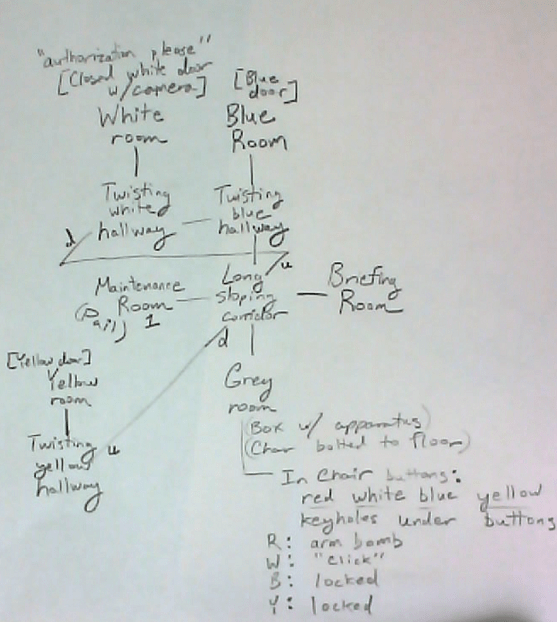
I went old-school this time with the map.