Archive for the ‘Interactive Fiction’ Category
I have made actual genuine progress (really!) but for the moment I thought I’d share the general feeling of playing Philosopher’s Quest.
> se
You find yourself in a short angular passage, with exits northwest and south.
There is a very smelly and ancient piece of gorgonzola here.
> s
The smell of the mouldy cheese hits your lungs like a sledgehammer, and you choke rapidly to death on the fumes.
Oh dear. You’re dead.
. . .
There is a small unopenable metal case on the floor.
> get case
As you pick up the case, you notice that it starts ticking.
OK.
.
.
(later)
.
.
> w
The case you are carrying emits a loud CLICK.
You’re at Piccadilly Circus.
> e
You don’t feel a thing as the bomb you are carrying blows you to pieces.
Oh dear. You’re dead.
. . .
You are in a bare anteroom. The exit to the north bears an overhead inscription, decorated with crossed human bones. It reads: Abandon most hope some of ye who enter here.
To the south lies a murky hole. There seems to be some sort of detection apparatus above the hole, but far too high for you to reach (or jump to).
> n
As you enter the room, your movement activates an air pressure sensor somewhere. Five spears shoot out of the wall at random intervals, at various heights. You simply can’t dodge them all, and one gets you.
Oh dear. You’re dead.
. . .
You enter the sea and begin to swim. Almost immediately the source of the buzzing noise becomes obvious – it’s lots of bees, all heading for you! After a few stings, you get the point and duck under the water. The bees hover overhead, waiting. You eventually run out of breath and drown.
Oh dear. You’re dead.
. . .
As you move along the plank, your weight causes it to tilt rapidly downwards, throwing you off into the air. You hit the ground exceptionally hard, killing yourself instantly.
Oh dear. You’re dead.
. . .
The old lady stares at your possessions as you enter. “You didn’t bring me my dog!” she cries, looking most disappointed. “I shall retire to my boudoir and never speak to you again!” She wheels her wheelchair off into the murky passage to the north. There is a sudden cry of “AAGH!” from the passageway, and an equally sudden thump. Everything goes still.
You are in the living room of the bungalow. The windows are boarded up in here, too. The only exits are north, through a dark passageway, and south to the kitchen.
> n
You are in the hall of the bungalow. To the north there has been a small earthquake recently, and a big pit has opened up. The old lady is lying at the bottom. She must have stumbled onto the pit in the dark, fallen in, and broken every bone in her body, poor dear! The only safe exit is back south.
> n
You stumbled onto the old lady’s pit, fell in, and broke every bone in your body.
Oh dear. You’re dead.
. . .
> n
You suddenly hear a dull rumbling noise and the floor starts to shake. Into the room stampedes an enormous elephant. It runs over you without noticing, squashing you in the process. Oh dear. You’re dead.
So based on my traffic I know people are very interested in the imaginary games-jam entries (original link here), but unless you’re an author you’ll just have to wait!
Just as a quick reminder, first authors wrote a set of reviews for “five games that do not (and possibly, cannot) exist in our universe.”
They then received randomly chosen reviews from others, and produced “a sequel, a prequel, a fan fiction, a critical response game, a sidequel, a remake, a demake, a parody, or an artifact of some genre category never before seen by humans.”
We are now on Phase 3, in which authors write reviews (or some other manner of response) to each other’s games. There are 16 in total, and while they include some “traditional” parser and choice type works, there’s also:
* A 3D game in Unity
* A procedural text generator
* A card game that is also optionally a story game
* A “four player collaborative/competitive writing event”
* A “hybrid between a roleplaying game and a piece of interactive theatre” with included soundscape
* A Microsoft Excel spreadsheet
* One game so weird and defiant of genre I don’t think I can adequately describe it in a sentence
The games will be made public on February 24th. Get hyped!
The Phase 2 entires are due midnight tonight, EST.
At that point only the authors are going to have access while we write reviews / dance / party. Final releases to the public will be Feb. 24th.
Please disregard the “protected” post. Move along. It doesn’t exist. Perhaps you remembered something from a past reality.
I’m going to make a clarification that might be a little too much inside baseball, but Jimmy Maher brought something up I felt deserved a more detailed response. I’ll get back to the main gameplay (and what might the cruelest maze ever) next time.
There are three versions of this game.
A mainframe version from 1979, titled Brand X.
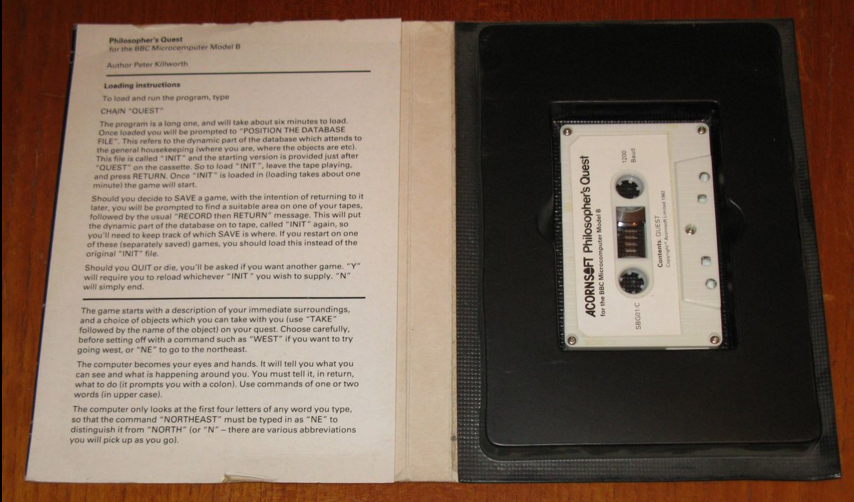
A commercial version for BBC Micro computer published by Acornsoft in 1982, titled Philosopher’s Quest.
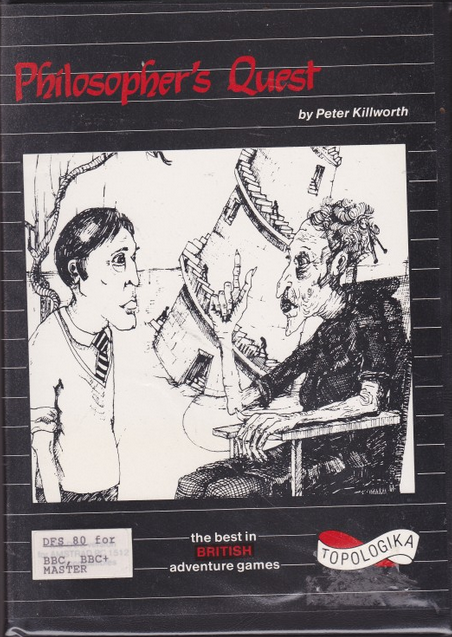
A commercial version for various computers published by Topologika in 1987, also titled Philosopher’s Quest.
I’m playing the mainframe version, ported to be playable on modern computers by Graham Nelson, Adam Atkinson, and David Kinder.
The 1982 version was shortened from the mainframe version. If that was the only version titled Philosopher’s Quest, I probably would consider the title assigned to a different game and say I was playing Brand X.

Via BeebMaster. No doubt tape capacity played some role in truncating the original game.
However, the 1987 version restored the original material (with some tweaks). I hence consider the title Philsopher’s Quest to be the “author’s choice” for the game and am calling it that, although I confess I had some angst over the decision (which indicates, possibly, I’m getting into this a little too much) but I have the side justification that most people searching for this game would know it by the latter title.
Here’s the 1979 version, reproduced from my last post:
You are standing in a small shop which normally has various goods displayed for sale. There are areas of the shop obviously intended for the display of treasure. There is an exit south, above which hangs a large sign, which reads:

There is an aqualung with a full tank of oxygen here. It
turns on automatically upon contact with water.
There is a fluffy lace-edged cushion here.
There is a bunch of keys here.
A piece of sausage is curled up here.
There is a small teabag on the floor here.
Here’s how the 1982 version starts:
You are standing in a small shop which normally has goods for sale. There are areas of the shop intended for the display of treasure. There is an exit south, above which hangs a sign, reading: “Leave treasure here. Please note that only two objects may be removed from this shop. So choose carefully!”
There is an aqualung here
There is a bunch of keys here
There is a cup of tea here
There is a steel rod here
Finally, the 1987 version:
You are standing in a small shop which normally has various goods displayed for sale. Areas of the shop are obviously intended for the display of treasure. Above an exit south hangs a large sign, which reads:
Adventurers please note only two implements may be removed from this shop under penalty of death.
So choose carefully!
A piece of sausage is curled up here.
There is a fluffy lace-edged cushion here.
A small teabag is lying close at hand.
There is a aqualung with a full tank of oxygen here. It turns on automatically upon contact with water.
There is a bunch of keys here.
Note that the references to Zork and Adventure are stripped away from the sign in both the commercial versions (kind of like how early Zork made a Wumpus reference but dropped it later, likely due to obscure injokiness).
Also not only does the 1982 version have some item differences, it mentions explicitly to drop treasures in the shop while the other two versions don’t. This makes me suspect treasures go somewhere else in those versions.
The difference in objects might be a sufficient hint to figure out which three are needed (remember, you can “cheat” and get one extra past the sign’s rule). Since the aqualung, keys, and tea are the only shared objects, I suspect those are the right ones (and indeed I think I know where all three are used).
Last we saw of the folks at Cambridge was Acheton, an extremely long and somewhat unfair attempt to one-up Adventure.
Philosopher’s Quest (originally Brand X) was written as if the authors (Peter Killworth and Jonathan Mestel) had played Adventure, Zork, and Acheton, and felt like what the world needed was a “master quest” version.
This is yet another “grab the treasures” type plot, although I am unclear at the moment where the treasures go. There’s a “purple star” which was last seen in Acheton. In that game it teleported treasures to the vault. I’m not sure if it’s the same effect here because I haven’t found a treasure yet.
You are at the south end of the long passage. There is a tunnel to the south through which light is faintly visible. Someone has scratched the word ‘BLACH’ on the wall!
> s
You are on a sandy beach to the east of an enormous cliff which bars the way to the north everywhere except a small cave entrance at its base. Rocks to the south and east block these routes effectively. There is a ledge vertically above you on the cliff, but far too high to reach. A track exits west, parallel to the cliff. There is a purple star drawn on the face of the cliff.
> say blach
A wizened old dwarf appears in a flash of light. Before you can react, he disappears as rapidly as he came.
> say blach
There is a vast explosion! On picking yourself up, however, you find that nothing seems to have happened to you.
> say blach
There is a loud < < S N A P ! ! > >
> w
I actually played this game about 7 years ago, but I hit difficulty so quickly I relied almost entirely on a walkthrough. The upshot of that is the only puzzle I remember the solution to is chronicled below as Unfair Twist #1. Of the rest I only remember that a.) the game is relatively small but b.) also ridiculously hard.
Unfair Twist #1:
Welcome to Brand X (Version 0.00)!
You don’t need instructions, so you won’t get any.
Problems, comments and suggestions to PDK1 or AJM8.
You are standing in a small shop which normally has various goods
displayed for sale. There are areas of the shop
obviously intended for the display of treasure.
There is an exit south, above which hangs
a large sign, which reads:
There is an aqualung with a full tank of oxygen here. It
turns on automatically upon contact with water.
There is a fluffy lace-edged cushion here.
There is a bunch of keys here.
A piece of sausage is curled up here.
There is a small teabag on the floor here.
The conceit of being allowed only a set number of items from a pile is sort of interesting, since you don’t actually need to grab the objects right away but can return for them as needed. There’s a locked door that needs keys I found early but I worry the keys are a red herring there’s some alternate way through the locked door.
In any case, here’s the unfair twist:
> get keys
OK.
> throw keys
You throw the keys neatly through the exit.
A thunderous voice from nowhere intones:
“VERY CLEVER! BUT YOU WON’T GET AWAY WITH THAT AGAIN!”
Yes, you can take three items out. This would be clever if it represented an actual loophole in the sign above, but the specific phrasing is “only two implements may be removed” which seems to disallow the trick above. If the phrasing had been “you can only carry out two items” or “you can only walk out with two of the items” or something of that sort I can see this being a genuine loophole puzzle, but as given it strikes me as reading the author’s mind.
Unfair Twist #2:
From the very first room (which you might notice has no light source item):
> s
It is pitch dark.
>
At first I assumed you were supposed to wander in the dark a bit until finding a light source. If you go straight south you do get outside (although there is a chance of falling down a pit and dying), but still: no light source. I did solve this on my own, but it was through such a meta method the puzzle easily still falls in the unfair category.
You are standing in the kitchen of the bungalow, which is usually lit by some rather dubious-looking electric wiring high up. The windows are all boarded up. There is a door to the larder to the east, and another room to the north. The house entrance is to the south.
There is a dubious-looking power source here.
There is an empty cup here.
The door is closed.
There is an empty electric kettle here.
> turn on power
You’re not holding the lamp!
I’m pretty sure the parser took only the first two words, so I was just misunderstood. (I still have no idea how to interact with the power source.) This led me to realize there was a lamp somewhere. I took a wild guess and went back to the very first dark room.
It is pitch dark.
> get lamp
OK.
I remember now why I hit the walkthrough so early. I’ll try to give this game more of a chance this time.
There are two ways to look for creative innovation.
The conventional way is to look at recent efforts in a field (see, for example, Emily Short’s post Experimentation in the Parser Domain).
The paradoxical way is to look at older work. Many times a work’s innovation is lost because the work itself is obscure or the implementation of a promising concept was badly done. Often you can find the future in the past.
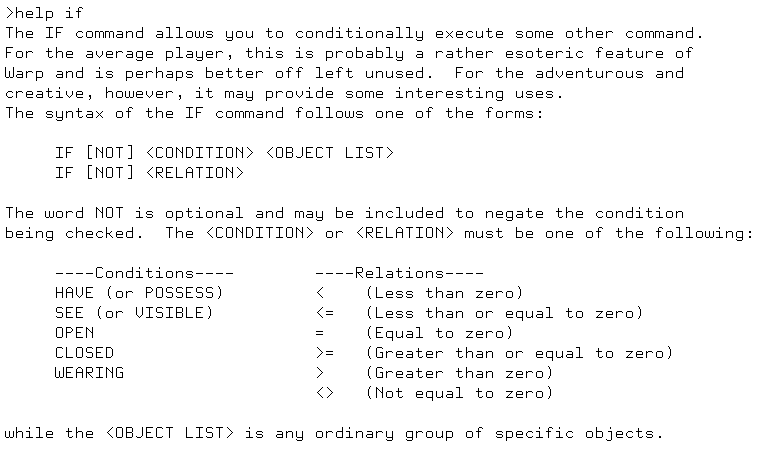
This seemed neat, but I had trouble making it work until I tried to ride a bus. The bus moves about the map at three stops travelling back and forth, and if you want to get on the bus it sometimes takes a long wait. Several times I accidentally waited past the bus arriving. I made a macro.
>X
=IF SEE THE BUS THEN RIDE BUS. I
Now every time I type “X”, the game will first check there is a bus. If so it will ride the bus (in needs to be in that exact syntax; for all the advanced tricks the parser can do it misses some obvious synonyms). If not then it takes inventory to wait a turn. (While WAIT is an actual command it causes a real-time delay.) The game still takes inventory when successfully getting on the bus, but it doesn’t cause an issue with timing.
Here’s the macro in action:
>X
>I
You are carrying the following:
Transit Pass
>X
The roar of an engine and squealing tires can be heard up the street.
>I
You are carrying the following:
Transit Pass
You look in the distance and see a large bus approaching. The bus
pulls to a stop before you and its doors open with a loud hiss.
>X
There is a large bus here that looks like it’s getting ready to leave.
>RIDE BUS
You wave your bus pass and the bus driver smiles as you climb aboard the bus.
Easy Street. (on bus)
The bus door closes and you hear the grind of gears as it pulls away
from the stop.
The bus rattles somewhat as it carries you ahead.
Easy Street. (on bus)
The bus rattles somewhat as it carries you ahead.
Easy Street. (on bus)
Now I can just rattle of Xs until the bus arrives and the player character hops on automatically as opposed to spamming just a wait command and missing the bus altogether.
ADD: I realized this would be a better way to write the macro:
IF NOT SEE THE BUS THEN I. IF SEE THE BUS THEN RIDE BUS.
This way there’s not the extra turn taken after riding the bus. This required a bit of a programmer’s sensibility; the player won’t see the “bus object” after getting on the bus, meaning if the statements are in reverse order the NOT SEE statement will still trigger after boarding the bus.
This is so convoluted it only seems thematically appropriate in a “robot character” game like Dan Shiovitz’s Bad Machine or Paul O’Brian’s LASH. I’m not convinced the “IF” command is that helpful in more standard text adventure games.
Phase 2 (That One Where You Have Produced Something That Can Be Called Interactive Fiction) ends February 7th, midnight EST; that’s midnight at the end of the day.
Most of the questions I’ve received have been along the lines of “is this too weird for the gamejam?” at which the answer is definitely “no”.
I was indeed quite close to the end.
I needed to move a soup kettle (which was described as having a hole underneath, but I somehow originally assumed the soup was in the hole; text-minimalism strikes again) and get a rabbit foot, and soon I had everything I needed, using the ritual described in my last post.
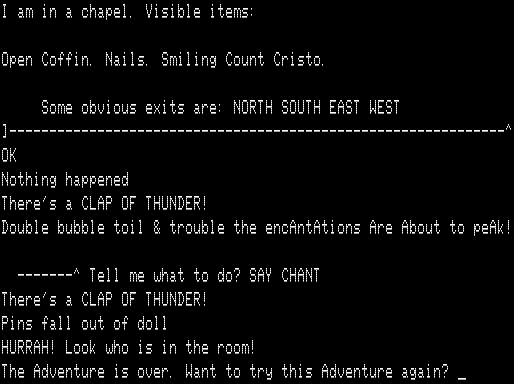
What’s with lots of the As being in caps? This happens through the whole game and this sort of text glitch happens in other Adams games too.
I had fun out of proportion to the puzzle quality, which was decent but not spectacular. I think this was due to the implicit plot, which I realize I’ve never defined very well, so now is as good a time as any.
EXPLICIT PLOT: The main plot events as described in the text; if you read a transcript which does a straight-to-the-end walkthrough you are just experiencing explicit plot.
IMPLICIT PLOT: The story the emerges from the actual actions done in the game (successful or not). If you wandering around every room in the game trying to DIG with the shovel but not getting any response, that’s part of the implicit plot (imagine your character frustratedly hitting each spot of ground) but not the explicit plot (since it advances nothing).
While we are at it, I’d also include:
LITERAL PLOT: The plot that includes meta-commands like saving and restoring. Occasionally this can be reflected in the main game — in Quondam (1980) the game kills you if you try to save too early, and a very recent game I will leave unnamed to avoid spoilers (it’s one word, nine letters) uses the literal plot quite extensively and remembers what you did in prior save games.
In any case, the process of playing Voodoo Castle involved criss-crossing over locations multiple times, in some cases (the chimney, the lower area with the medium) revealing new things at each pass. The implicit plot of the adventure was a good fit, and the game felt like genuine investigating as opposed to just finding the right key for the right lock.
…
In other news, Emily Short linked my initial post about Warp to her blog, which I’ll take as a hint I need to get back to writing about it. I did finally find a use for those crazy IF-THEN statements in the parser. I’ll try to explain next time I post.
I compared Voodoo Castle earlier to a mystery box, and the analogy seems to be holding up. I’m finding snippets of a ritual for waking Count Cristo, a little at a time. I’m still missing part but I think I might need to just use some guesswork or induction to finish the game. The feeling of peeling back layers of enigma is much stronger as implicit plot than greedily snatching up treasures.
Sometimes, writing these things is simply of matter of me playing terrible old things so you don’t have to, extracting design lessons and maybe some interesting quotes. I can gleefully spoil every plot element and puzzle without the feeling like I’m ruining it for everyone.
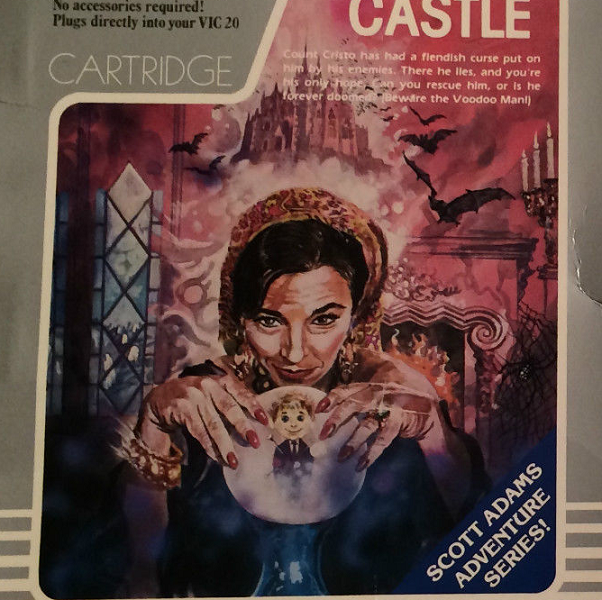
Then there’s games like Voodoo Castle, which are enjoyable enough that I actually want to recommend them. If you feel like you’d have any interest, you might want to just stop reading and go play. To make it easy, here is a link to play online.
First I had an odd sequence where I found a chimney sweep stuck high in the chimney. There was some anticipation built up for this with moaning sounds which suggest a zombie attack or the like, but it just turned out to be the unlucky guy we rescue in the screenshot below. He gives a paper explaining how the command ZAP turns stone things to life.

One ju-ju man statue and a ZAP later, I awoke a ju-ju man in the same room as a ju-ju bag (which I previously could not access because it was “stuck to the floor”) and for some reason this lets us make off with the bag and grab the things within. I think the ju-ju man would be upset, but maybe he’s just thankful we revived him? It’s like the pirate from Pirate Adventure who just wanted to get drunk and didn’t care about what we stole.

Based on the hint from the medium last time I took the ju-ju bag to a crack that was too tiny to enter (this is different from the tiny door) and did >WAVE BAG, leading me to a secret room.

The room contains a torn page from the recently found book. Putting the pages together:
With knife in hand you take a stand. Circle coffin and…
…wave the stick and hold the lamp and don’t forget to yell “CHANT”! Oh yes, to help it succeed, a doll you’ll need…
I don’t know if I’m close to the end and I just need to guess the rest of the ritual, or if I still have some things to collect including the final instructions. The only things I haven’t worked with are a.) a shovel, which hasn’t gotten a useful response to DIG anywhere I’ve tried, b.) a kettle of soup and c.) a witch’s brew that turns my character into a broom if I try it. Hopefully this will roll to the finish by the next post?