COME WITH ME TO COLOSSAL CAVE. WHERE MAGIC ABOUNDS AND TREASURES ARE FOUND. BID YOUR FINGERS FOLLOW YOUR COMMANDS AND I WILL BE YOUR EYES AND HANDS. YET BEWARE THE FIERY DRAGON, FOR HE KNOWS NOT WHETHER YOU ARE WIZARD OR SIMPLE CHARLATAN!
HOW BEST TO CONQUER COLOSSAL CAVE? WITH DARING AND SKILL … OH CLEVER KNAVE!
— Early 80s Adventure poster, from the CompuServe Incorporated Information Service Division
Adventure 751 has been, by my reckoning, the most sought-after variation of Crowther/Woods Adventure. It was generally available on the online portal CompuServe from nearly the beginning of the service and it disappeared when they shut down their games in the 90s. Arthur O’Dwyer started a web page in 2016 (with semi-regular updates!) dedicated to hunting down a copy.
To finish off a wild 2025 in game preservation, Arthur O’Dwyer announced the game has been found (by LanHawk, a regular amongst the comments here) and is playable.
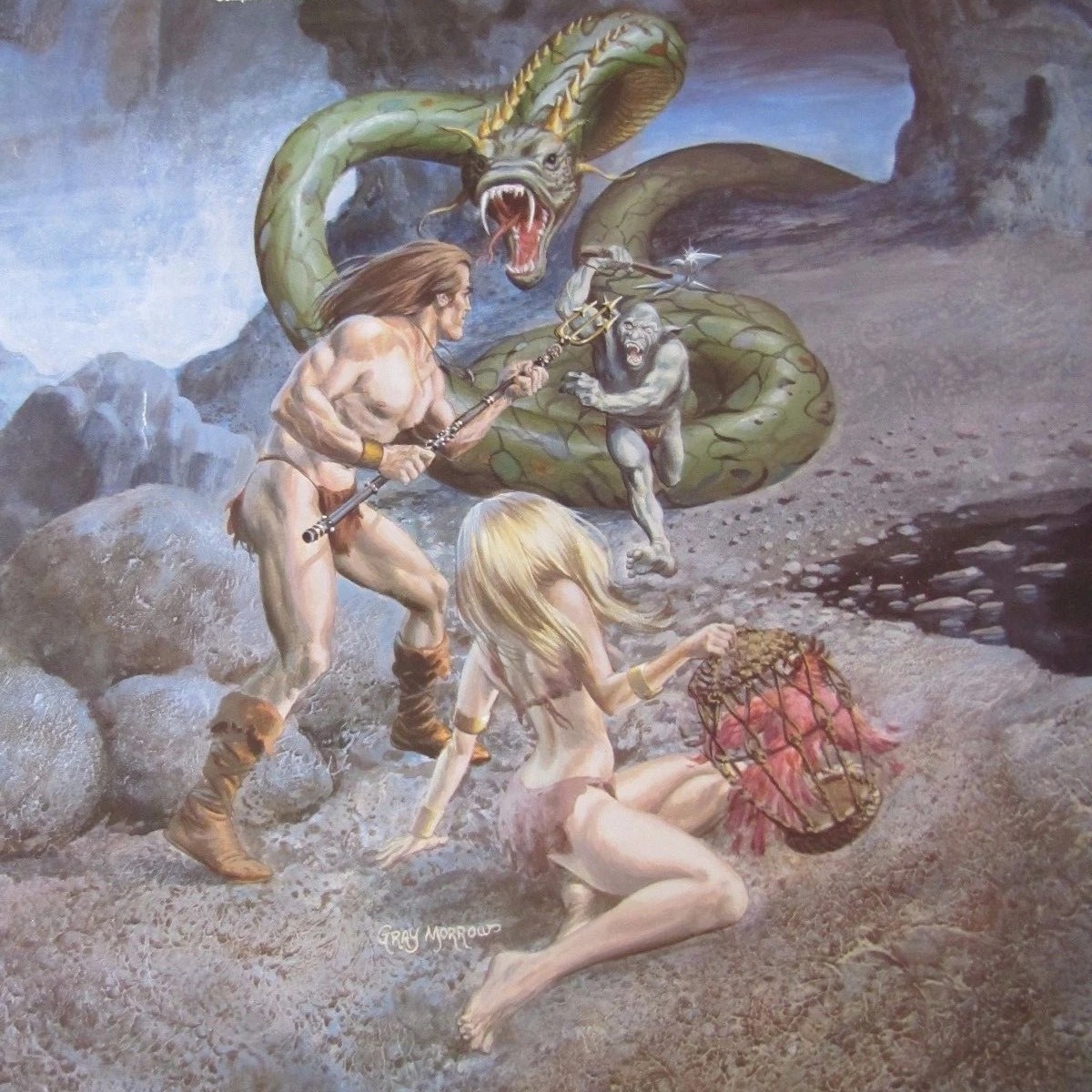
Via eBay. You could purchase this from CompuServe. I love how they tried to contextualize this like a swords-and-sandals epic, with a goblin-esque dwarf and the trident used as a weapon. It still includes the bird-in-cage, though!
In 1958, the Electrical Engineering Department of the University of Arizona in Tucson received a donation of equipment in order to form an Analog Computer Laboratory. Analog computers deal with full electrical signals rather than 0s and 1s (think music on record vs. on computer). These could do particular computations (like differential equations) faster than digital devices of the time.
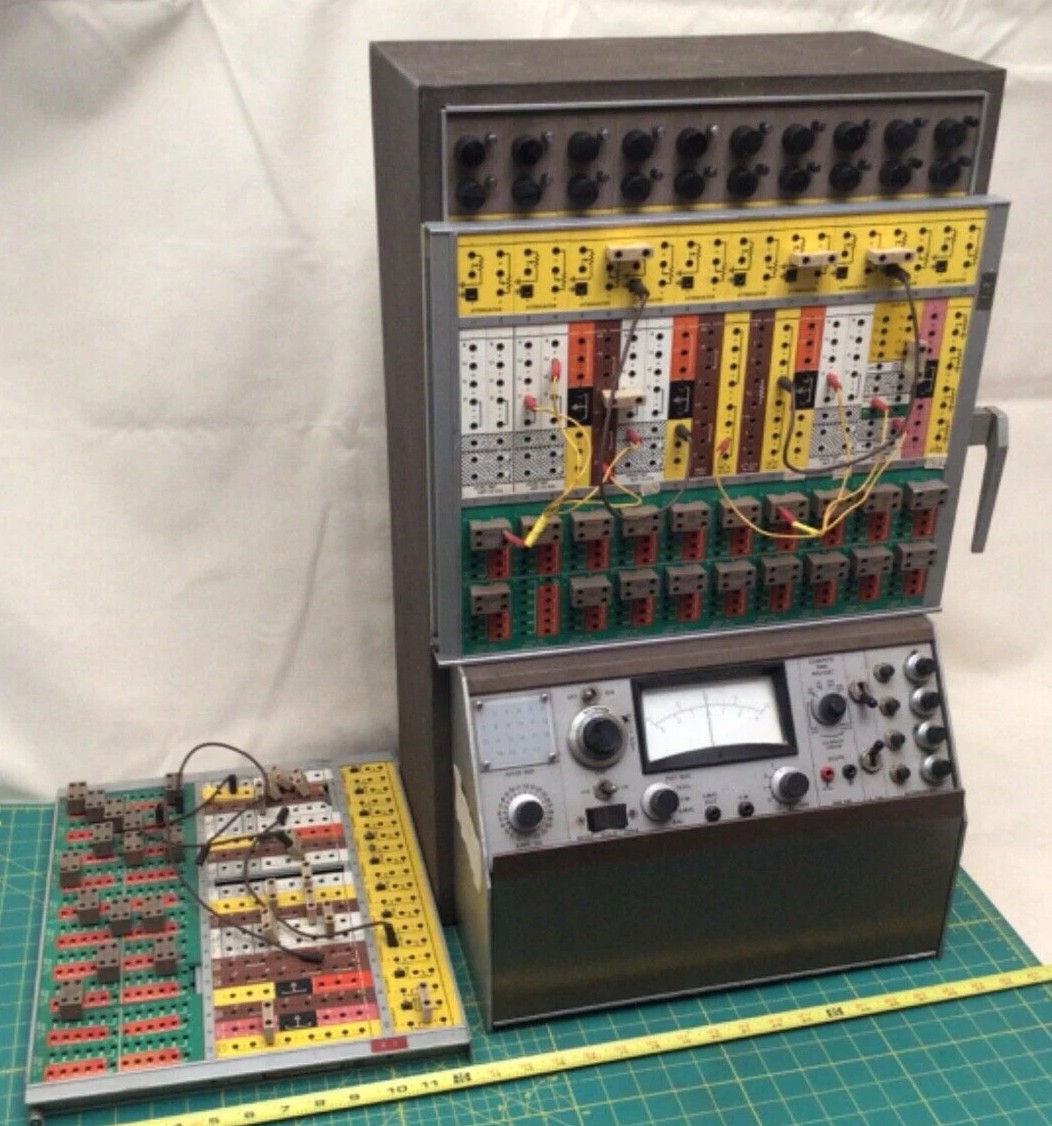
An EAI TR-20 from eBay. $7,495.00 or best offer. As the ad copy notes, “It offers up to 20 amplifiers plus components for addition, subtraction, multiplication, division, integration and generation of powers, roots, logs, antilogs, sine, cosine and arbitrary functions — in one cabinet, and available to one patch panel.”
The University of Arizona’s lab was more cobbled-together than the for-sale-new device depicted above, as they made “two small but flexible computers complete with homemade removable patchboards” to start with but quite quickly changed mission to be a hybrid laboratory. By hybrid, I don’t mean just having digital and analog computers side-by-side, but trying to make computers that use both digital and analog components. Their name officially became The University of Arizona Analog/Hybrid Computer Laboratory. Designs included the “ASTRAC I”, a “iterative differential analyzer”, “APE 1”, a “teaching aid in statistics” that followed a similar design, and an “ASTRAC II” which was now “solid state” and “ultra-fast” and was supported by both the Air Force and NASA.
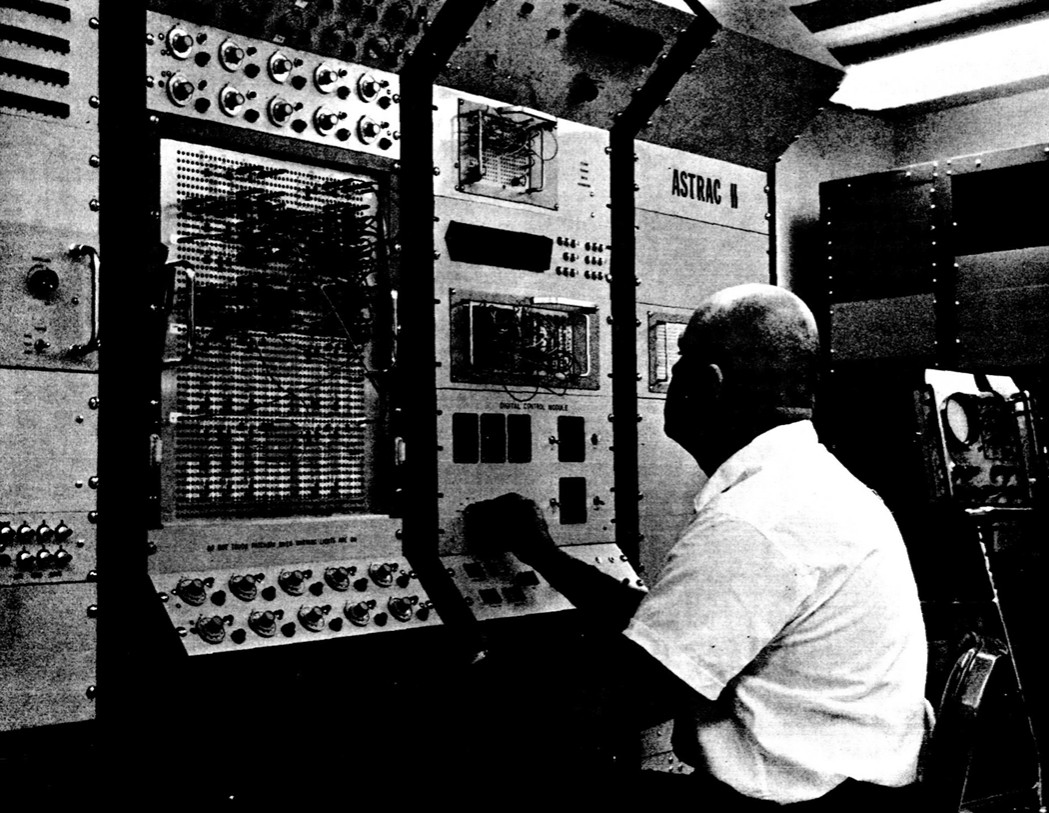
ASTRAC II. Source: “All analog computing elements other than coefficient potentiometers plug directly into the rear of the shielded analog patchbay.”
(Warning: My next three paragraphs consolidate three different accounts which differ somewhat.)
Three of the students in the 1969-1970 school year were Alexander B. Trevor, John Goltz and Jeff Wilkins. The trio were discussing the possibility of starting a time-sharing company. This was a little late to the game; Dartmouth with General Electric had developed the concept in the early 60s (where a large computer could have its time split into many parts allowing for multiple computers connected; including remote connections Dartmouth had thousands) and by the time Trevor, Goltz, and Wilkins came to the idea there were other companies like Tymshare and National CSS involved.
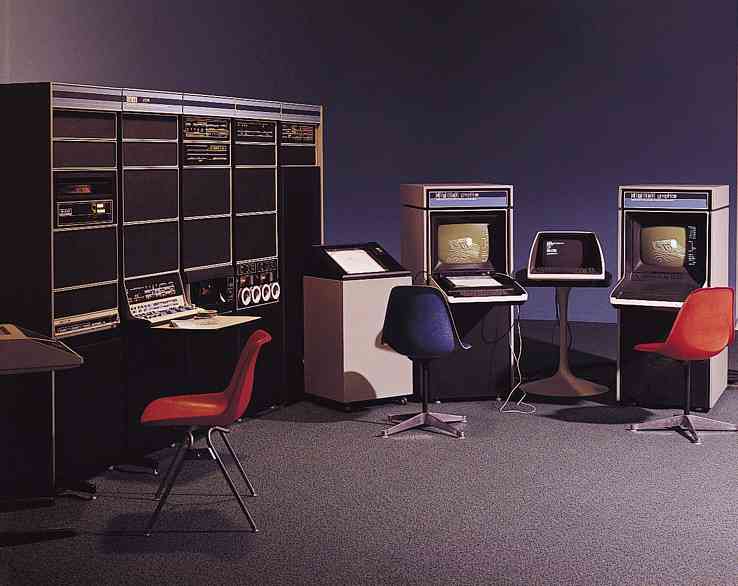
A PDP-15 mini-computer which the lab supposedly had. Trevor claims 1969 but the machine didn’t come out until 1970.
Jeff Wilkins’s father-in-law, Harry Gard, Sr., was a co-founder of Golden United Life Insurance; at the time the insurance company was still getting their computing via other companies, but Gard was keen on Golden United having a computer of their own. The original intent was to buy a mini-computer like the PDP-15 but Goltz (who was working with Wilkins and doing the purchase through DEC) got a call that he could have a KA-10 for just “a little more” (one of the PDP-10s, a full mainframe rather than minicomputer). While Goltz was an engineer and not a salesperson, John Goltz managed to persuade the board of Golden United to part with the money for the upgrade. This enabled the computer to more feasibly do time-sharing with many customers.
After graduating Wilkins moved to Columbus (followed by Goltz; Trevor was drafted to the Army so didn’t join them until ’71) to be at Golden United’s new spin-off, CompuServe; Wilkins at the age of 27 became President. Their first developed product was LIDIS (Life Insurance Data Information System); there were plenty of life insurance companies in Columbus to sell to.

Jeff Wilkins, photo from himself via the Columbus Foundation.
The company had rapid success; by 1973 they moved to a new building, and by 1974 had not one but seven mainframes “and were using them not only to support a thriving time sharing business, but also to heat our office buildings.” CompuServe stayed with corporate clients, although Wilkins was alert to trends in personal computers; he hired his brother-in-law to track computer magazine news, given the fact most of the operations done by time-sharing could be done more easily with PCs.
One of those personal computers was the TRS-80, launching in 1977 as part of the “Trinity” with the Commodore PET and Apple II from the same year. The TRS-80 was sold through Radio Shack stores that were already well-established across the nation, but it was still difficult to move product when the concept of a personal computer was only a vague notion to many buyers. A Radio Shack manager in Columbus named Bill Louden bought one of the early models (serial model 10) as Radio Shack refused to give out demo units; his purchase became the only demo available in the Midwest and people wanting to experience a TRS-80 went specifically to Columbus, driving and even flying in.
Simultaneous to this, Wilkins was watching the new market for “modems” which connected personal computers to networks via the phone. He also had computers sitting idle by night (as businesses using them were running them during the day); since he already had the resources, it would be a straightforward matter to have a new commercial-facing venture.
Wilkins thus laid out in 1978 an idea for a new product based on European Videotex services. Videotex is its own rabbit hole that I’m not going to touch on much here; starting in the mid-70s there were experiments with turning televisions into networked services.
The important point here is that the “television as an appliance” thought process was being applied to make “computer as an appliance” and this would help interest computing to the masses. Wilkins launched a new service MicroNET (“to get microcomputer owners’ attention and suggest the power of the computer network”) and tapped the previously mentioned Midwest Computer Club for a “beta-test”.
The test service was launched for free; Bill Louden called it “a hacker’s dream” and a good way to sell modems (110 and 300 baud). Quoting Bill:
We had access to many of the DEC-10’s features, storage, and better processing power, but of most significance we had started using two programs: One was a store-and-forward messaging system, called Infoplex, which allowed us to share text message files with one another even if we were not online at the same time. The other was a modified version of a program that allowed a user to send a live one-line text message to the CompuServe system operator. Our version, modified by Russ Ranshaw of CompuServe, allowed us to send one-line live messages to each other if we saw one another online. We called it the SEND program.
It had all the regular offerings later associated with CompuServe, including games. Both Star Trek and Adventure were available (this is before Microsoft Adventure came out, so it was the original mainframe version). Eventually in the early 1979 a price structure was added: $9 startup, prime time use $12 per hour, non-prime time use $5 per hour, 300 baud more expensive as a “premium” service. Q2 revenues in 1979 were $4.2 million; this was almost a rounding error in the scheme of the business as a whole, but of course personal computers were about to hit the time-sharing companies with fatal blows.
A competitor, The Source, was launched in 1979 but “from scratch” by the entrepreneur William F. von Meister (that is, not piggybacking off an existing time-sharing business). Their main relevance to the story here is not only did they have games (the usual like Star Trek) they also tapped Dartmouth College to work on new games. (Remember these are being developed for mainframes or minicomputers, so we’re not talking about typical personal computer programmers! Hence work being drawn from colleges with access.)
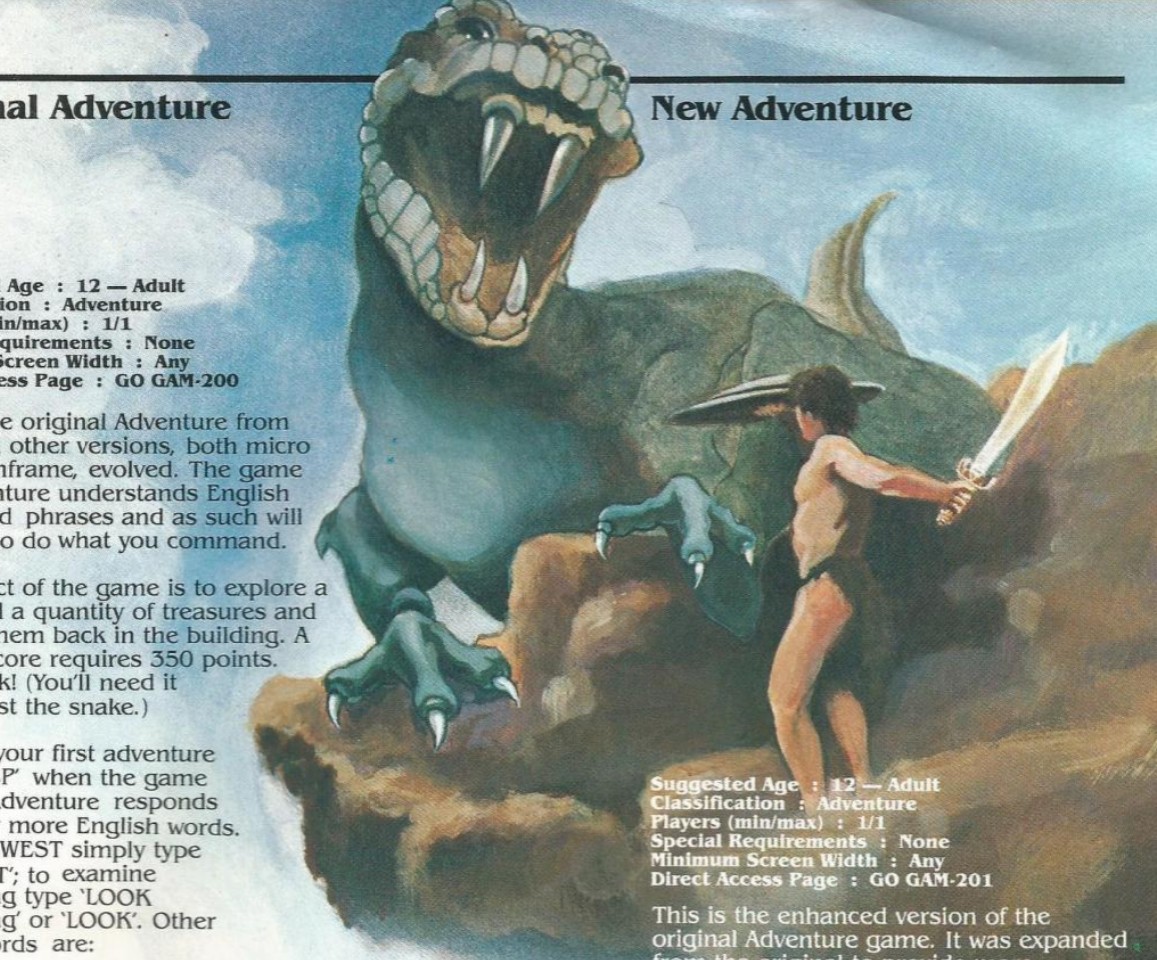
I don’t have an official notice of solicitation — it may even have come via word of mouth — but CompuServe also must have had contact with mainframe/minicomputer sites in order to get their own games. A 1984 games catalog lists House of Banshi, which is simply Dungeon/Zork (“CompuServe’s rendition of the original game of ZORK.”) Dor Sageth from the catalog is another famous “lost game” which started life on an institutional computer (mentioned by Jason Scott back in 2011). Listed on page 2 is both “Original Adventure” (as the service launched with) and “New Adventure”.
In 1977, David Long went to the University of Chicago to work as a computer operator. The college had just bought two of the newest computers from DEC, the PDP-20. One was for general use by the college and the other was for specifically the Graduate School of Business; Long “tended to work 50-60 hours a week on GSB stuff”. 1977 was also the year the “standard” Crowther/Woods Adventure was finalized, and David Long was able to get a copy direct from the author:
Don was kind enough to transmit the source program to the present author in mid-1977.
As he notes, given his work schedule, and the time he spent with GSB affairs, “no one cared if I spent another 10-20 hours on Adventure”. He finished “Adventure 501” by November 1978:
You are inside a building, a well house for a large spring. Off to one side is a small pantry.
There is a shiny brass lamp nearby.
There is a leather sack here.
Taped to the wall is a faded poster.
READ POSTER
The poster has a picture of a thin man with a long white beard. He is wearing a high pointed cap embroidered with strange symbols, and he is pointing a finger at you. Below the picture are the words: “I want you!–To report all good ideas for extensions to this game to me without delay. Remember: ask not what ADVENTURE can do to you; ask what you can do for ADVENTURE.”
“A public service of the John Dillinger Died for You Society.”
A safe is hiding behind the poster. Found treasures get dropped in the safe rather than on the ground.
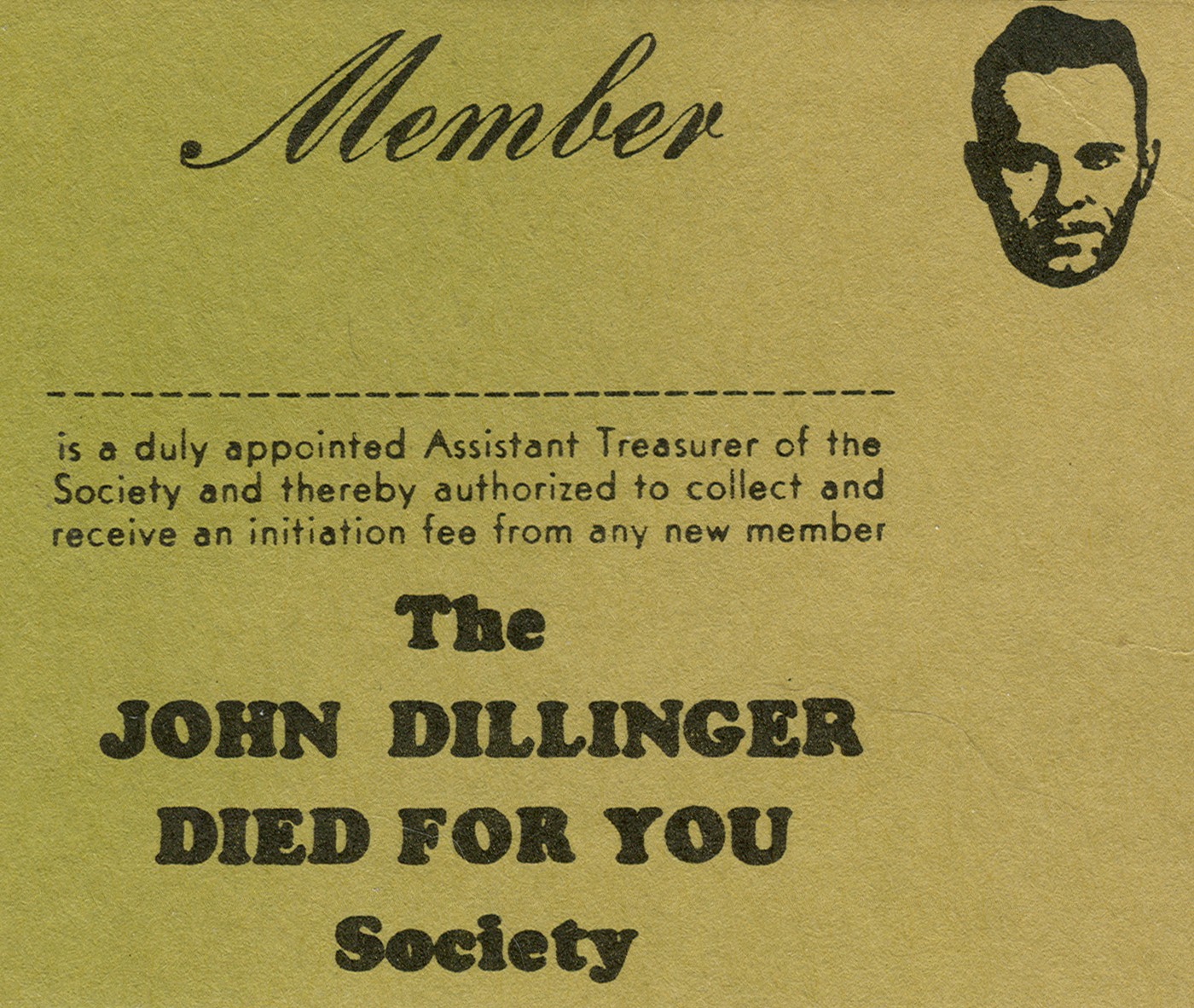
The John Dillinger Died For You Society was a spoof group made in 1966 at the University of Texas meant to parody Elvis fan groups and “Jesus Died For You” signs.
I’ve played Adventure 501 before; a version had been available for some time (with the mysterious addition of a spider, which isn’t Long’s). The archive LanHawk extracted also includes the authentic ’78 version of Adventure 501, so I was able to cross-check with what I already played.
Further expansions eventually led to a “version 6” in January of 1980, including a new area as well as an “improved syntax parser”. (More on the parser later.) An in game “billboard” gives version updates:
( 19-Jan-1980 ) Congratulations to Robert Silverman, the first adventurer to set foot in the Courtyard of Aldor’s Castle.
( 25-Feb-1980 ) Adventurers may now enter the Castle Keep, although construction continues within. Some scoring bugs have been fixed.
Who will be first to discover the secret of the black bird?
( 3-Mar-1980 ) There is a slight bug on the perfume. For full score, you must drop it somewhere, look, and take it again.
( 7-Mar-1980 ) 6.04 is released. Expansion of the castle continues — it is far from complete. Several unique new features and puzzles have recently been designed and are now being implemented.
The format of most hints has been altered. I hope you agree that the new hints are more in keeping with the flavor of the game.
The game I’m referring to as “Adventure 751” seems to have been entirely wrapped up by the end of the school year. Sometime before the end of the calendar year Long sold the game to CompuServe for “a thousand dollars”. (As they used the PDP-10/20 like Long did, no conversion work was needed and they could run the executable without compilation.) Long seems to have been somewhat protective of his source code so distribution past that point was relatively minimal, although he did give source copies of both 501 and 751 to the Illinois Institute of Technology. (See, comparatively: Woods and his regret freely sending out Adventure 350 to anyone who asked, making it so that when he wrote “v2.0” he was much more careful who had access.)
The parser is “improved” over both Adventure 350 and Adventure 501. There is some sense of trying to “outdo Zork”. (See relatedly: Warp bragging about its own system, and Synapse Software calling their system BTZ or “Better Than Zork”.) Quoting Long:
…Dungeon (Zork) and Adventure-6 were developed almost completely independently. The advanced parser, the object containment facility, and virtually all the game puzzles were designed and implemented prior to our receiving any version of Dungeon. With all due modesty (none), I will point out that Adventure’s containment facility is at least as powerful as Dungeon’s, if not more so, since Adventure’s facility permits searching for contained objects in open containers down to any desired level of containment. Further, the parser permits a few constructs not currently permitted in Dungeon (at least in the version we have at U.C.), such as permitting any number of objects (up to some limits imposed by compiled array sizes) to be specified following transitive verbs. In addition, Adventure’s parser can handle multiple verb constructs such as “GET AND THROW AXE” properly. Finally, Adventure’s parser is slightly better about doing the right things with the various applications of the group words “ALL” and “TREASURES”. A planned enhancement for Release 7 will permit such constructs as “PUSH ALL OF THE BUTTONS” or “TAKE BOTH SACKS”, etc.
GET AND THROW AXE is uncommon even in modern parsers. Trying to GET AND THROW BREAD in Savoir-Faire (2002) gets the response “You can’t see any such thing.”
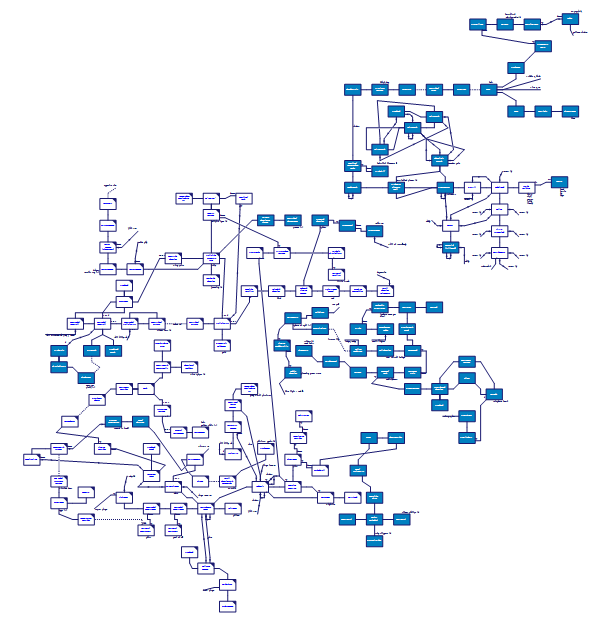
Dennis Donovan (of CompuServe) made a map in November of 1980 which Arthur O’Dwyer scanned in high resolution with some image cleanup by James Lindell Dean, so I’m going to use it to illustrate the journey.
Arthur tested the build with a walkthrough that has been around for a while to confirm this is indeed the “real” Adventure 751; I’m going to play it normally. I am re-mapping the 501 content although I am allowing myself to look at my old posts if I need to; you can also squint at a blurry version of my 501 map where the blue rooms are extensions to Adventure 350.
You are standing at the end of a road before a small brick building. Around you is a forest. A small stream flows out of the building and down a gully.
GO EAST
You’re in a flat circular clearing surrounded by dense forest. Not far away is a helicopter. Its engine is idling slowly. Several jac-booted Orcs are standing guard around the aircraft.
Going east normally enters the building. Unexpected! Trying to enter gets a message about needing a flight pass.
The building is still there, but you need to use the command IN to enter, and then can go IN again to get in farther.
You are inside a building, a well house for a large spring. Off to one side is a small storeroom.
There is a shiny brass lamp nearby.
There is a leather sack here.Taped to the wall is a faded poster.
There is a small matchbox here.IN
You’re in the caretaker’s storeroom.
A yellow pill-shaped tablet, as large as a doughnut, lies nearby.
There are some keys on the ground here.
There is food here.
There is a bottle of water here.
Helpfully, the leather sack works as a container; keep in mind this is not a two-word parser so to operate it you need to use PUT X IN SACK. In fact, it works with multiple items at once. That is…
PUT TABLET AND KEYS AND FOOD AND BOTTLE IN SACK
…will take care of scooping up all four.
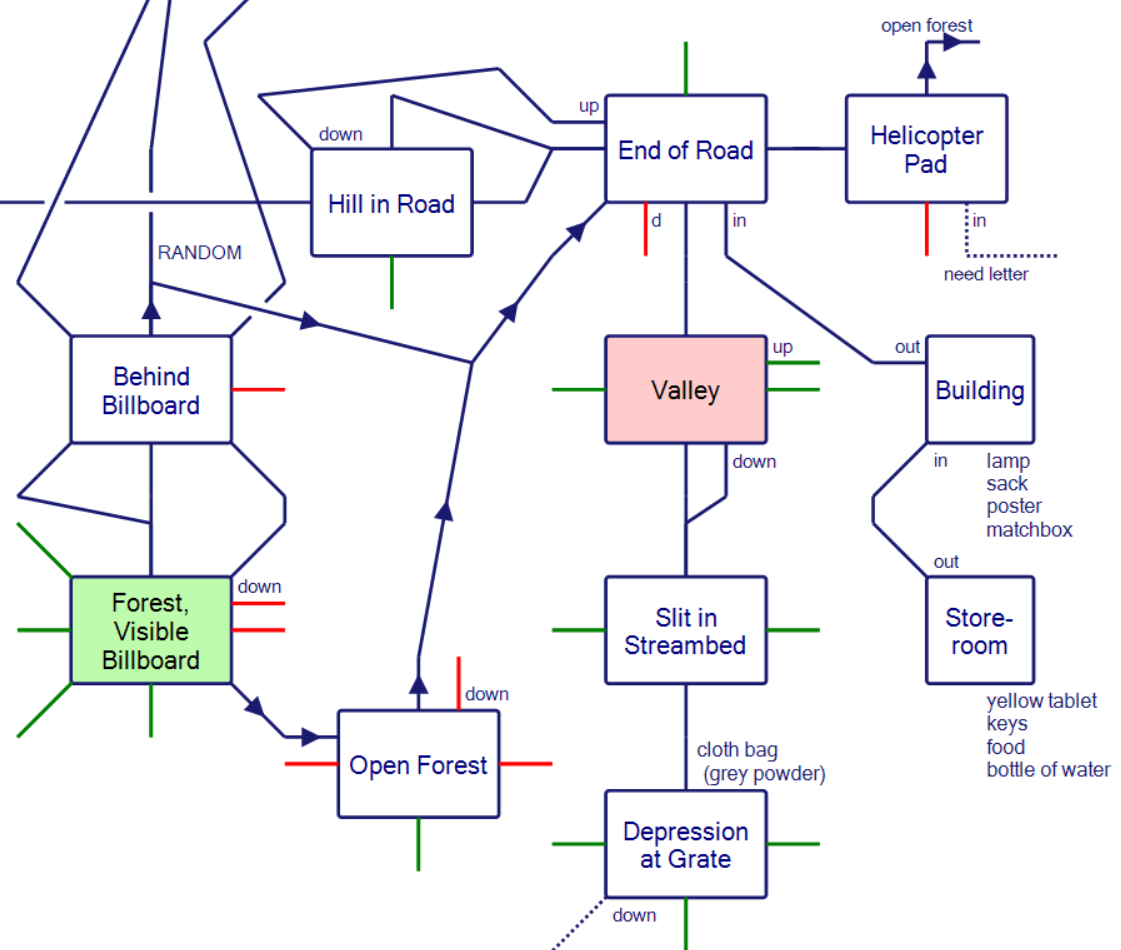
Other than the helicopter pad being different, and a slightly different building layout, there’s a new object at the grate that goes into the cave:
You are in a 20-foot depression floored with bare dirt. Set into the dirt is a strong steel grate mounted in concrete. A dry streambed leads into the depression.
There is a large cloth bag lying nearby.
The grate is locked.
The cloth bag is full of grey powder and if you EMPTY BAG it will scatter all over the place and you won’t be able to pick it up again: “Grey powder has been strewn all about.” I assume this is a softlock, simply from checking what’s inside the bag. (Crowther/Woods really was polite when it came to softlocks. It had the vase breaking when you dropped it, ruining a treasure, but the structure of the game was such that getting all the treasures was an aspirational goal rather than a requirement for having a satisfying playthrough. The various extensions, including the one from Woods himself, often were not so careful. You could eat the food early in Crowther/Woods rather than give it to the appropriate creature, but there’s a built in expectation that EAT FOOD is going to remove it from the object list; just checking what’s inside a container doesn’t suggest such a drastic change.)
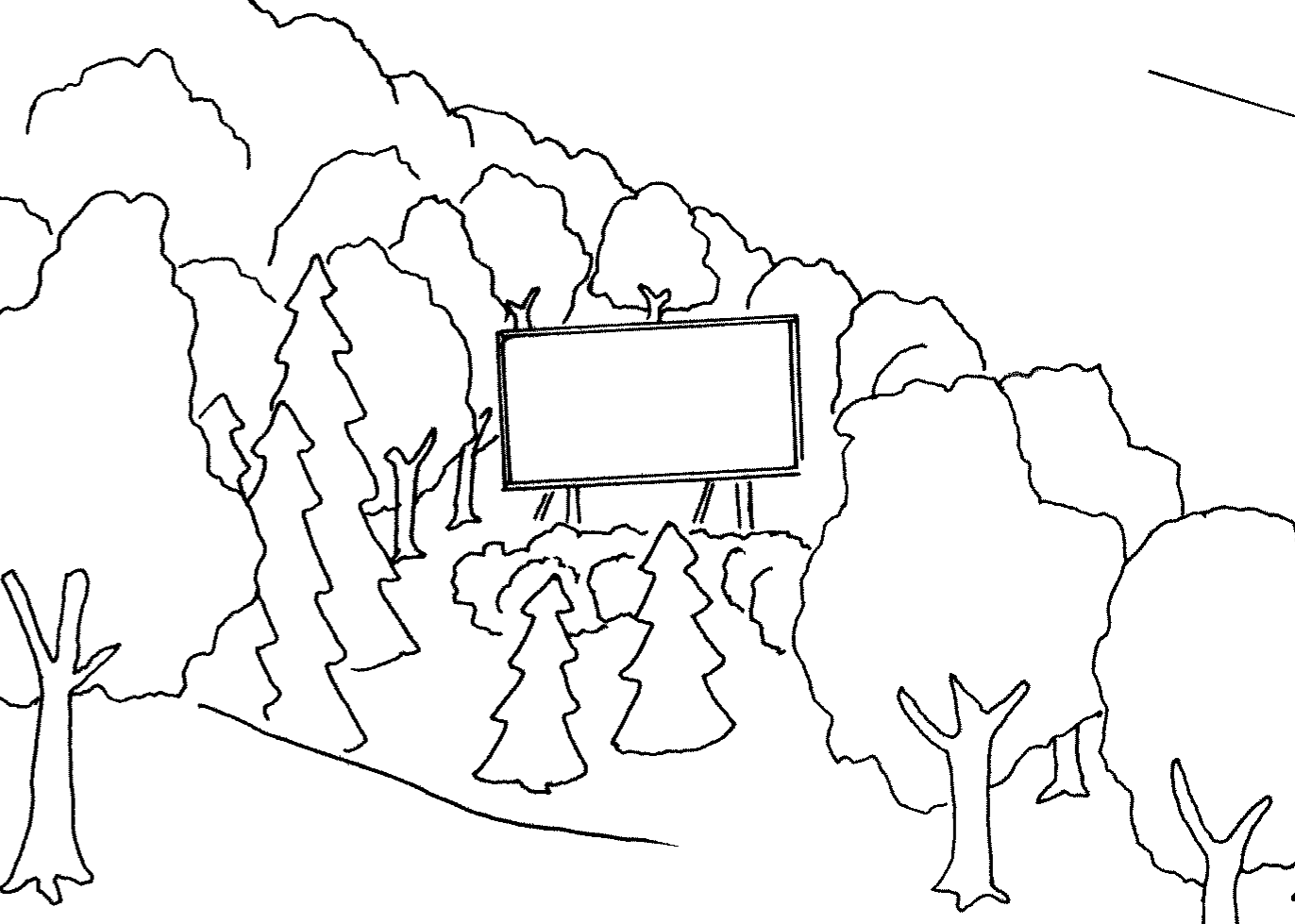
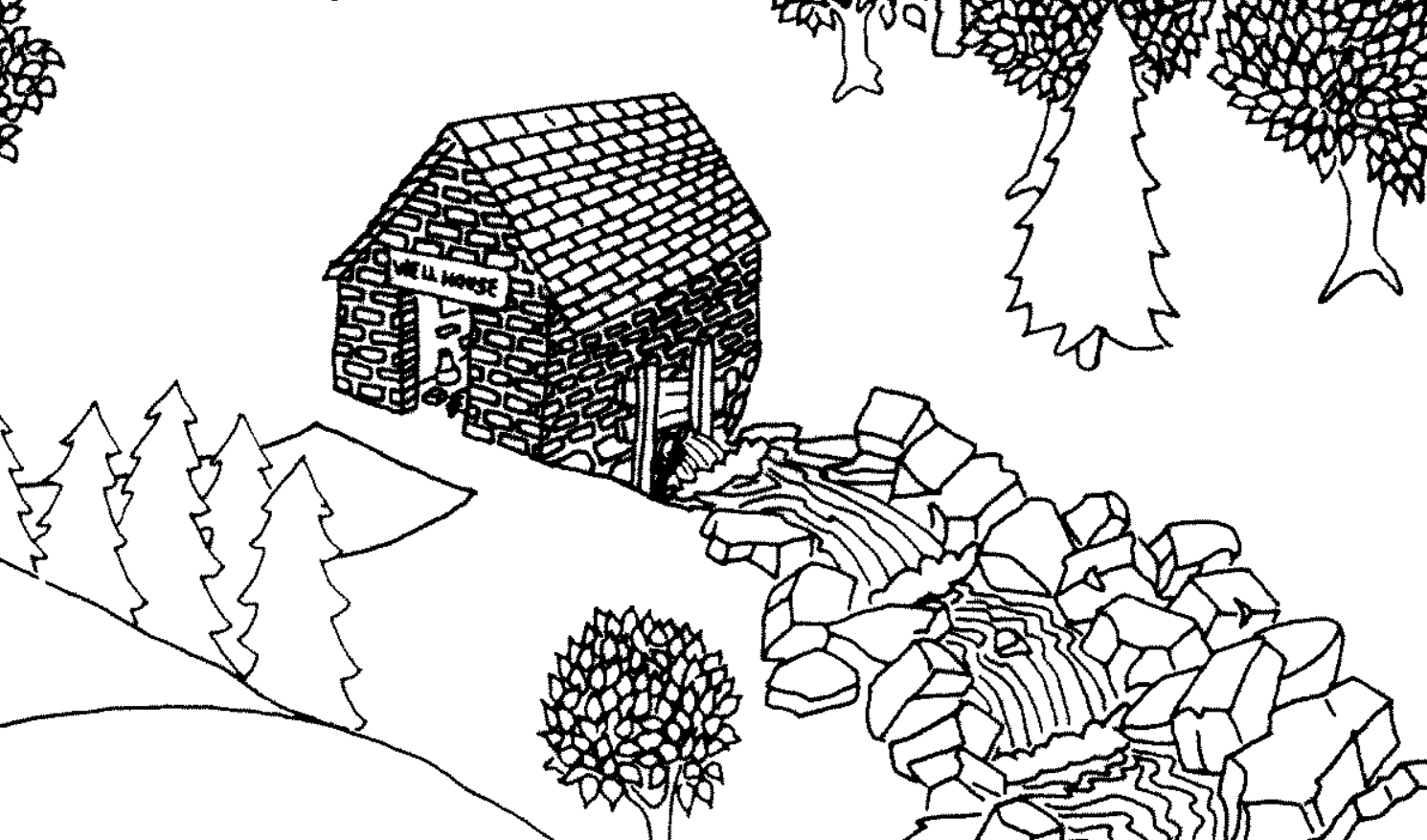
I’m not going to go underground at all during this session but rather stay outside. The forest, rather than being a method to steer the player back to the caves, includes a “billboard” (as seen earlier, also in the image above) and a castle in the distance.
You are in open forest, with a deep valley to one side. Not far off is a large billboard.
GO NORTH
You are standing behind a large billboard on a ridge above a deep valley. To the north, the forest gives way to dense swamp and then to open flatlands. Far beyond, the land rises sharply towards the impassible Misty Mountains. Nestled at the base of a distant cliff are the stone turrets of a tall white castle.
The outdoors keeps going. At least some of this area I recognize from 501, although it goes a little farther than that game did.
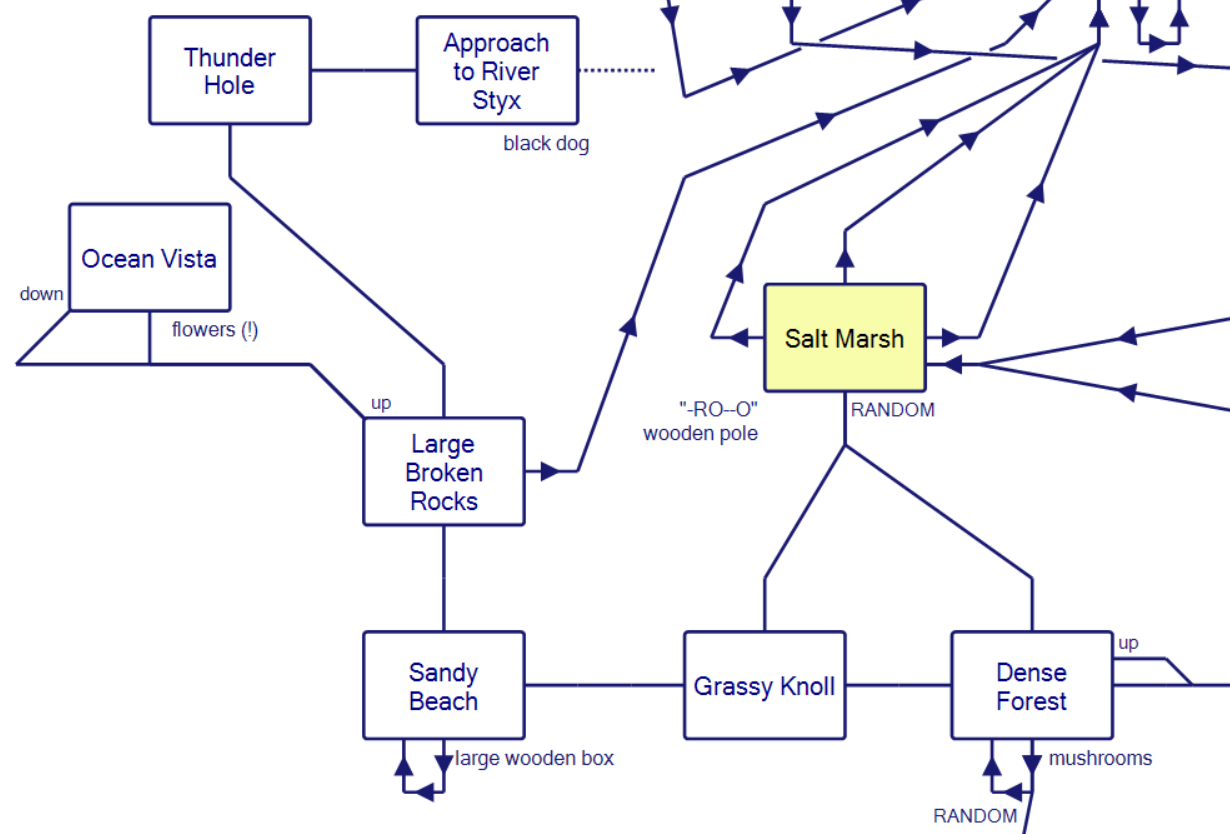
Going west of the building leads to a “dense forest” with some mushrooms…
You are in dense forest, with a hill to one side. The trees appear to thin out towards the north and east.
There are some oddly-colored mushrooms here.GO WEST
You are at the high point of a wide grassy knoll, partially surrounded by dense forest. The land rises to the south and east, and drops off sharply to the north and west. The air smells of sea water.
…and a sandy beach. The beach includes a “large wooden box” (the box is empty) where you can go up to find an Ocean Vista with some flowers, the first treasure I’ve found.
You’re on sandy beach.
A large wooden box has washed up on the shore.GO NORTH
You are at a jumble of large broken rocks and blackened shoals.
A gentle path leads up to the top of the nearby cliffs. A narrow treacherous path disappears among the rocks at the foot of the cliff.GO UP
You are on a high cliff overlooking the sea. Far below the rolling breakers smash into a jumble of blackened shoals. The thunder of the surf is deafening.
There are some beautiful flowers here!
The “blackened shoals” are incidentally a University of Chicago in-joke created by a friend of Long’s (Eric Weber); it refers to the professors Black and Scholes who made a famous mathematical model for financial markets. There’s an entire hour-long documentary called Trillion Dollar Bet about it (“this solved the ancient problem of risk and return in the stock market”); it is blamed for more than one market crash, including Black Monday from 1987.
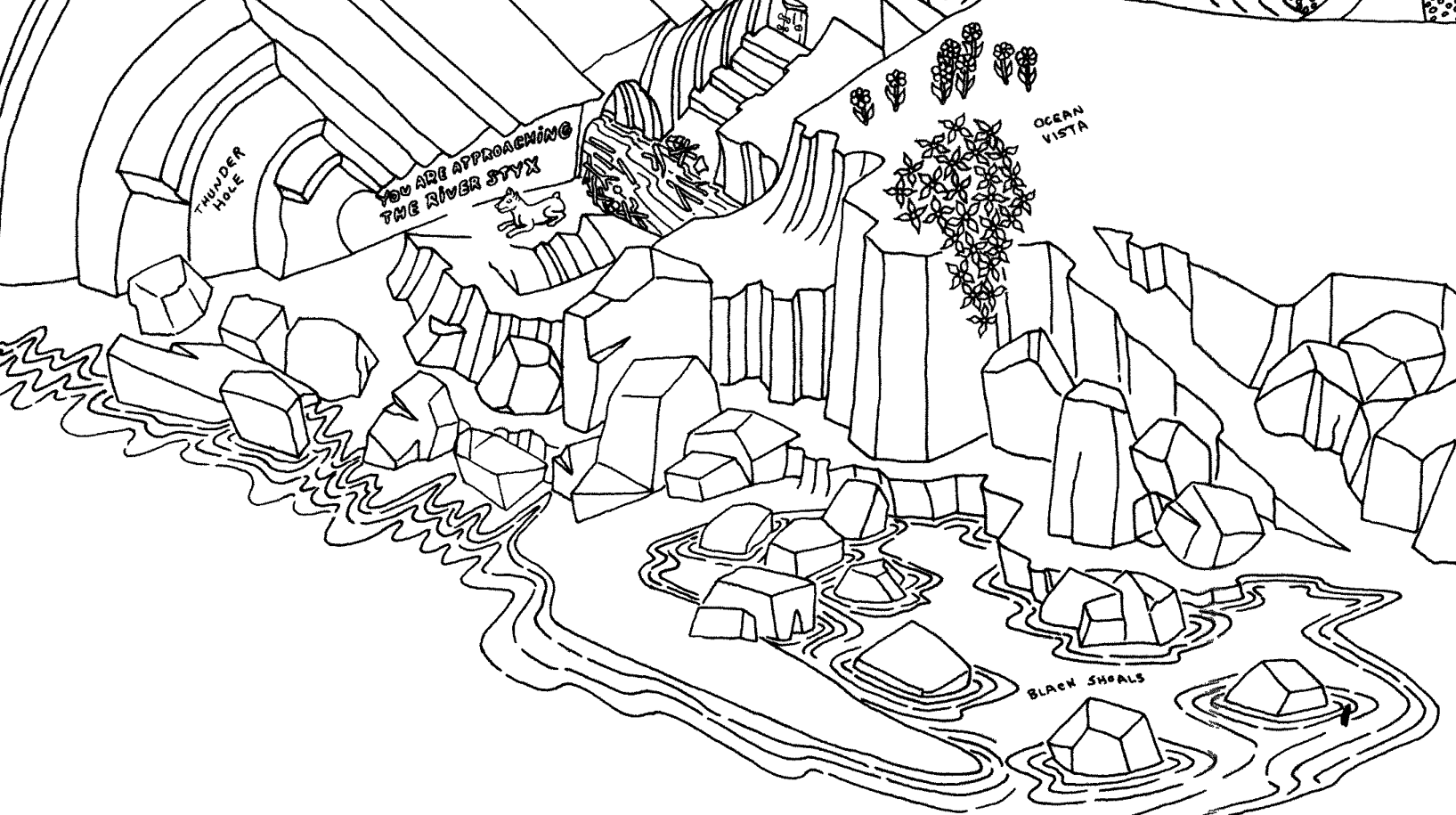
This is also the location I remembered something very cruel from Adventure 501 that carries over here. Original Crowther/Woods had a limited number of “random” exits that could sometimes go somewhere else (north goes to a different forest than the normal exit, for instance); other authors basing their games off Adventure sometimes ran with this (even affecting home games, like in Phantom’s Revenge). Going north from the shoals will sometimes go to the cliff already seen, and sometimes it will go to a new room altogether. Back when I played 501 I only found the new room by referring to the CompuServe map!
You’re at blackened shoals.
GO NORTH
You are at Thunder Hole, a funnel shaped cavern opening onto the sea. The noise of the surf pounding against the outer rocks of the cave is amplified by the peculiar shape of the cave, causing a thunder-like booming sound to reverberate throughout the cave. Outside, a narrow path leads south towards some large rocks.
GO EAST
You are in a dimly lit passage behind Thunder Hole. Etched into the rock wall are the ominous words:
You are approaching the River Styx.
Lasciate Ogni Speranza Voi Ch’Entrate.A hideous black dog bares his teeth and growls at your approach.
I do not remember the method for getting by the dog. I assume I need to go underground first. (I’m pretty sure all of this is 501 territory, though.)
If instead of heading west to the beach you head north from the mushrooms/grassy knoll, you arrive at some “salt flats”.
You’re on grassy knoll.
A tiny little man dressed all in green runs straight at you, shouts “Phuce!”, aims a kick squarely at your kneecap, misses, and disappears into the forest.
GO NORTH
You are at the edge of a trackless salt marsh. Tall reeds obscure the view. In the mud is the partial word “-RO–O”. The missing letters have been washed away by the tide.
A wooden pole has been stuck in the mud here.
I’m not sure what the tiny man is about, yet. Saying phuce gets the response “nothing happens.”
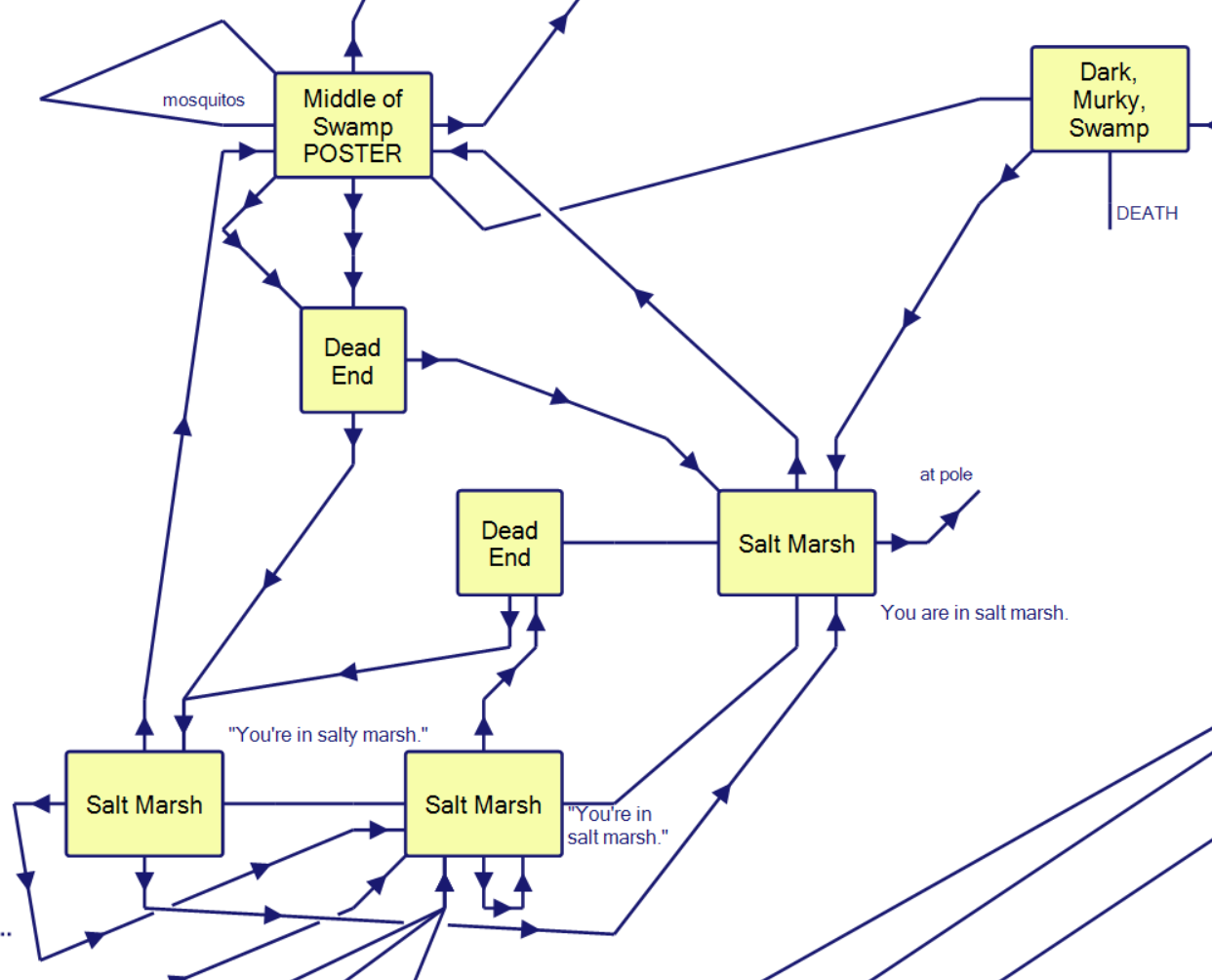
The salt flats are a maze that lead up to a swamp which is just a continuation of the maze.
Notice there’s a.) two “dead end” rooms which aren’t really dead ends and b.) one “death exit” from one of the swamp rooms which just kills you for going a particular direction (“You’ve wandered into a quicksand pit and drowned.”). Neither of these are polite and neither of these are used in Crowther/Woods (you could die walking in the dark by falling in a pit, but this was well-telegraphed by the game).
You are at the edge of an open area of wet sand. The dense foliage appears to grow thinner towards the northeast. A small sign stuck in the muck reads: “Site of Proposed Municipal Parking Lot — D.M. Witt, Contractor.”
Foul smelling gasses bubble up through the wet sand.
This room has multiple death-exits, which is obnoxious given the restore-a-save procedure (where you need to decline resurrection, leave the game, restart the game, decline instructions, RESUME to load as save, confirm you are loading a save game, and then finally type what you named the save). I think this is all a dead end although I haven’t checked every exit as of yet (see: obnoxious restore-a-save procedure).
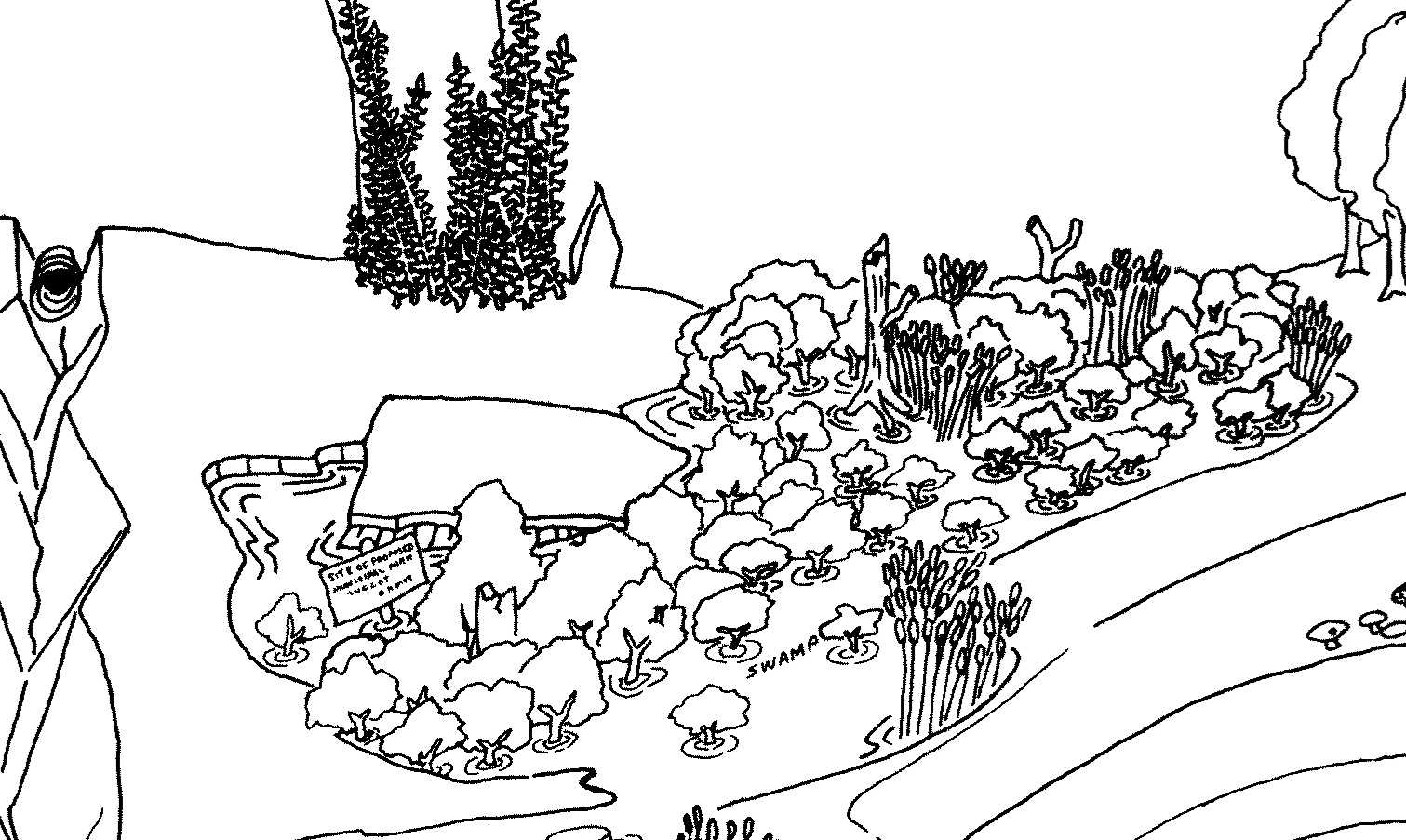
I believe from here I’ll need to plunge underground, so this seems like a good place to pause for now since I know that’s going to open things wide up. Happy 2026!
(If you still haven’t read it, be sure to check out Arthur O’Dwyer’s post; he is planning a follow-up which hacks a bit more at the data. Also thanks to Ethan Johnson for some source assistance.)


Wow! What a great way to end 2025!
Thank you!!!
It’s great that this has finally been found. I spent the last days of 2025 trying to get the Russian version ANTO0340 to run, including fixing the C code – it does something I don’t recall seeing in other major versions, namely moving the initial item locations around.
adv_events defines some probabilities for locations:
60% chance for keys in Forest.
20% chance for keys in Forest (but a different one)
30% chance for food in “Grotto of Debris” (not sure what that is)
60% chance for lamp at Grate
30% chance for lamp in Forest (same as the first one)
50% chance for cage on Hill
Due to changes on how seeding works, I had to modify the code to get this working (plus two other changes to make it compile at all).
Hey Gunther, just pinging you here to let you know I’ve sent you the email about those files we discussed. It has a million links in it, which sometimes dumps these into the spam folder, so I just wanted to give you a heads up.
Best of luck! I have a feeling this one is not for the faint of heart if trying to get a full score without hints.
Awesome work here Lanhawk!
Coincidentally, I’ve been working on finding and extracting the commercial Compuserve version of this game, and I hope to be able to share that and some other related stuff soon.
DId my initial runs (both above ground and underground) and this posts is all things I know.
Top score for me so far is 55 points. And that run ended when I got stabbed by a dwarf. Ah, well.
Two points of clarification:
The flowers at the top of the cliff are *not* a treasure. (They weren’t in earlier versions, and are needed for something later.) They got an exclamation mark because…I don’t know. (And I think Long was inconsistent about putting the “!” on new treasures too. Fortunately the game understands “treasure” as a group noun so you can check if something is a treasure or not that way.) On that note: a certain treasure that’s lying around in the open outside in adv501/551 is *not* present in this version.
You can always guarantee reaching the Thunder Hole by typing “down”. (Not that there aren’t other random exits later.)
Also, the game understands “examine”. It’s mostly useless so far, though I’ve been trying it on many objects i find anyway just in case. In particular I discovered the bag of powder has a message on it. Not that it clarified what to do with it, at least not yet.
Yes, EXAMINE is rather annoying because it works on *some* items but on most it just falls back (as in WOOD0350) to a synonym for “LOOK” (at the current location).
Jason: “if you EMPTY BAG it will scatter all over the place … just checking what’s inside a container doesn’t suggest such a drastic change” — But recall that EMPTY (e.g. BOTTLE) has always been a synonym for POUR. Long happily responds to LOOK IN BAG; if you ask to EMPTY BAG or POUR BAG, you get exactly what you asked for, IMHO! Btw, speaking of containers, beware that “FILL BAG” will corrupt memory and crash the game, as will “FILL PIPE” later on. (But “FILL SACK” rightly gives a clever refusal message.)
Jason: “something very cruel” — I still think this is fair. UP and DOWN go the places you’d expect, and NORTH flips a coin between them. The “dead end that’s not a dead end” is also in LONG0501. I find the marsh “maze” less sneaky than the forest “maze,” because the short descriptions in the forest are all alike even when the long descriptions are distinct. I vaguely recall some version of Adventure where some rooms’ short descriptions were identical to different rooms’ long descriptions, although I can’t place it now.
But yeah, the multiple exits-to-quicksand are pretty unfair. (The room description arguably has a hint: if the forest thins out it might be quicksand. But of course, this being an adventure game, you can’t *trust* that hint; you *have* to check.)
the other one that nailed me pretty hard was the random exit to the Wumpus
when mapping it today, I got to the Wumpus area first try, but I remember in 501 I hit a dead end, I don’t remember how I resolved finding the Wumpus (I think other than by that point there being lots of holes and me being burned already)
Oh yeah, I’ll agree the Wumpus randomization is rather unfair. But actually, recall that WOOD0350 has several randomized exits. There’s the SW exit from the Hall of the Mountain King which sometimes dumps you back to your starting point but *sometimes* goes to the secret canyon. But you can type “SECRET” to get in reliably. Bedquilt also has randomized exits, although of course they’re signaled by the room description, and again you can type things like “SLAB” to get where you want to go. There’s also “A large stalactite extends from the roof and almost reaches the floor below,” that sends you to any of three inconvenient places at random (but it turns out you don’t need to visit that room at all, not that an unspoiled player would know that). The Wumpus randomization is relatively unfair because you *do* have to enter to win (although, spoiler, LONG0751 adds a reliable entrance) — and the Throne Room randomization is *completely* unfair (you have to enter to win, and the *only* entrance is the randomized one: there’s no reliable entrance at all).
Yeah, the description (quoted in the post so won’t repost it here) clearly reads to me that both UP and DOWN are available exits, and when first playing 551 I never even thought to try NORTH instead. Long did have a number of descriptions that didn’t necessarily list all the exits (at least in earlier versions; haven’t gotten to the relevant areas in my 751 travels yet) but he can’t really be blamed for thisone.
On the bag: It also just lets you OPEN BAG without losing its contents. Although curiously, sometimes having both the bag and the sack from the building leads to disambiguation issues. Presumably it recognizes both nouns as synonyms. :)
Just from reading the description I get that “up” = top path but not that “down” = path among the rocks at the foot of the cliff, since it’s not clear to me that we’re any higher than the foot of the cliff. I’d expect “north” or “in” to default to the narrow treacherous path, if anything.
There’s an entire hour-long documentary called Trillion Dollar Bet about it (“this solved the ancient problem of risk and return in the stock market”); it is blamed for more than one market crash, including Black Monday from 1987.
Sorry for going off a tangent here but this hypothesis is utter BS imho.
People working with Black Scholes are and most likely were aware of the fact that volatility is not constant and lot of time and grey hairs have been spent on building extensions that allow for a richer structure while still being analytically solvable. Putting it differently, if your income depends on knowing these things you can rest assured that you know it, otherwise you wouldn’t be around in the market for long.
The real culprit was so-called Portfolio insurance (which has nothing to do with insurance for starters). The idea was that when the market goes down you just sell and get out. Limit your losses and be a happy camper. Easy, no? Yes, as long as you assume that there is always someone taking your sell order, i.e. buying from you. Unfortunately this assumption proved to be wrong, something people relearn every ten years or so, very much to their detriment. What happens is that you try to sell but can not, which in turn pushes the price lower (because if nobody buys at the current price maybe a bit lower works). The lower prices forces the next guy to sell, that is trying to sell, and so on. The more the price drops the more people get scared and won’t buy until a level is reached where someone with guts gives it a try. If enough people do this the price stabilises and the sell-off is over. Usually a little bit below where you thought you could sell but that’s the way it is.
It’s all good – for ’87 in particular I’d also point to the politicking around currency that was happening at the time which caused international pressure
the only time I ever see B&S in the news though is when someone is blaming it for a crash
Just in the same way you would blame your screwdriver after your carefully assembled Ikea sideboard collapses into a heap of wood…
A calumny, because the IKEA sideboard was surely assembled solely with an Allen wrench.
Pingback: Rediscovery of CompuServe's Adventure 751 (1980) — lost Crowther/Woods variant - LT Tech Blog
Pingback: Reliving the Magic of 1980: Why Adventure 751 Still Matters – Shaike IT
Pingback: Adventure 751 (1980) – Cyber Geeks Global
“D.M. Witt” is presumably meant to be pronounced like “dimwit” and I’m wondering if it’s a deliberate reference to Dimwit Flathead from Zork.
“Witt Construction Company” has always been a thing in Colossal Cave. See for instance, the anteroom with the magazines.
Wait, that gives me an idea *rushes off to try something*
Although “Witt” has always been there in Adventure as mentioned by bananathoroughly, Long was also directly influenced by Zork (see the “diagnose” command, which only exists in Long-related variants), so it’s definitely possible. Were there Dimwit Flathead references yet in the original mainframe Zork/Dungeon, though? I can’t recall…
Actually, I recently ran through a translation (into a modern Z-machine file) of a very early version of Zork (completely by accident, I just had the Zork IFDB page open for some reason). We’re talking a version with less than half the final version’s points. That version does have the Dimwit Flathead reference from Flood Control Dam #3 intact.
And as for my idea I had earlier? it worked. Will say more in ROT-13 on request. Now I just have two or three new conundrums to replace the one I just solved. The classic text adventure experience!
Answering my own question: Yeah, it’s in there.
This all made me think of something: Has anyone ever really tried to find the original Zork prototype game (“bandbox, peanut room” etc.)? It only seems to be known from that old Blank (or was it Anderson?) quote, saying that it had vanished. But I think we all know now that the idea of delving into old magtapes and the like for games wasn’t very common at the time, and most of the historical coverage of early Infocom is of the “lets tell the story…” variety, rather than the hardcore file archive ransacking that we like to engage in here.
Sometime a year or two ago, I took a look at the old MIT PDP-1 tapes on Bitsavers, and was amused to see some unknown files from the early/mid ’70s in there with placeholder names like “FROTZ”. It kind of makes you wonder what else might be out there somewhere…
Pingback: Adventure 751: All Hope Abandon Ye Who Enter Here | Renga in Blue
Pingback: Adventure 751: The Footsteps of a Thousand Fairies | Renga in Blue
Pingback: Adventure 751, from Compuserve, Recovered and Playable – Set Side B
Pingback: Adventure 751 (1980) - globalsustainabilitynews.com
mainly for personal reference, a thread I ended up never using from an old alt.folklore.computers conversation on Usenet about CompuServe
https://groups.google.com/g/alt.folklore.computers/c/8HDrmV2dL7M