I apologize for the delay, but I had the perfect storm of life-interference, the game being finicky, and me being slow to translate. Also, just to announce straight from the top (before any serious spoilers on the rest of the game): if you want to play the game in English, Jim and Charlie Gerrie now have a translated version available.
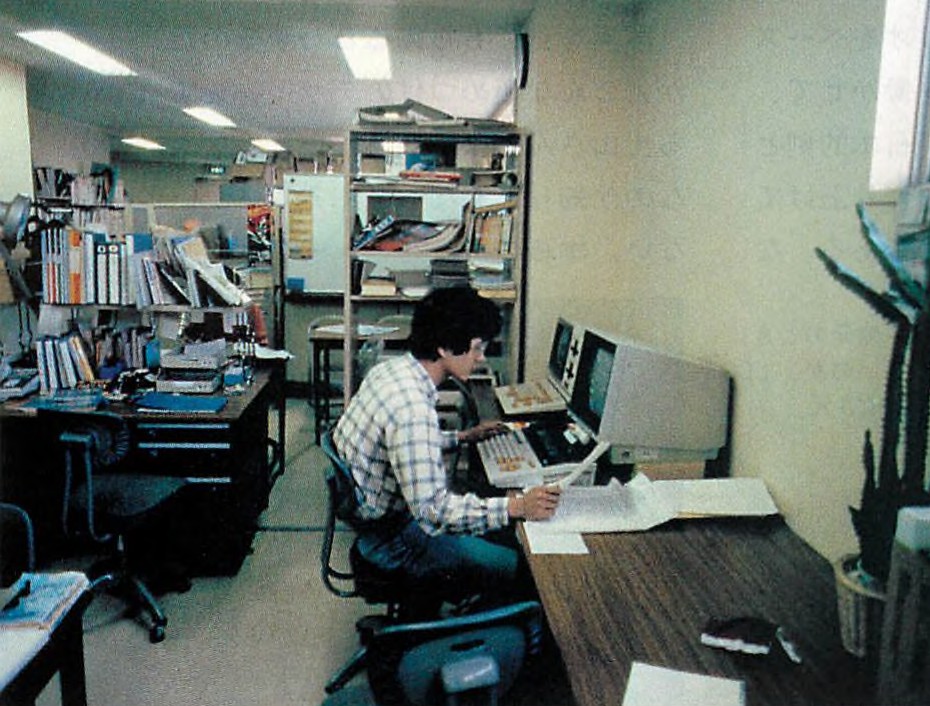
Inside Shinkigensha. LOGiN, August 1983. “For entertainment, people began making programs with humans in the lead role. This is how we see the emergence of the adventure game as a genre.”
Yasuhiro Kume is listed as the author, and he is also listed as the author on their next game (Takarajima, Treasure Island) which we will eventually get to, although the company profile linked above seems to indicate the second game was a more collaborative effort. Specifically, they tried to reproduce the “same kind of division of labor seen in film” with the original author working with a screenwriter, and a separate producer, director, and cinematographer. All this implies that while the “division of labor” wasn’t imposed yet, The Phantom Ship likely had some back and forth going on as it was made (unlike, say, Sword of Raschkil, which printed the source code as sent by a high school student directly as-is). I will discuss Yasuhiro Kume himself a little more for Treasure Island.
The article does not mention “Micro House” as a separate entity from Shinkigensha at all, which is part of the reason I’ve been suspecting they were always an “in house” spinoff, so to speak.
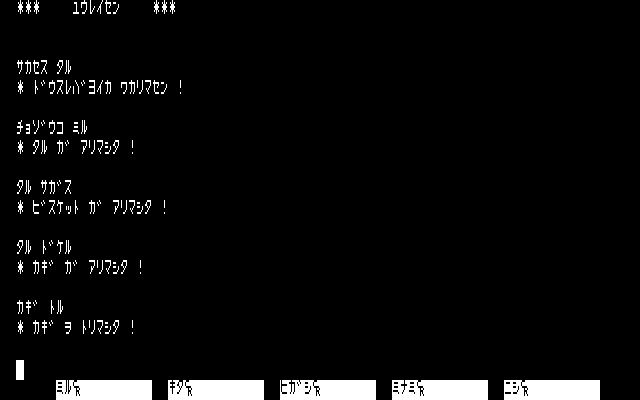
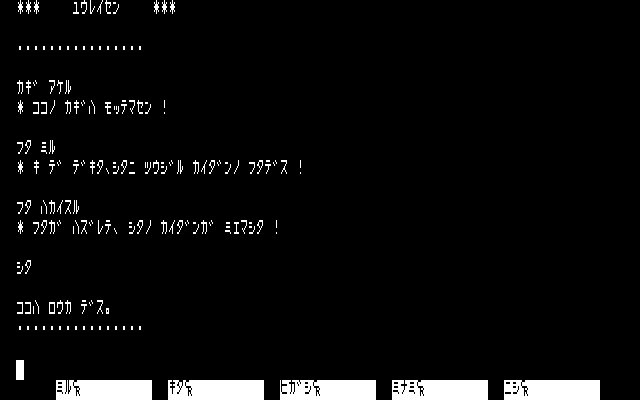
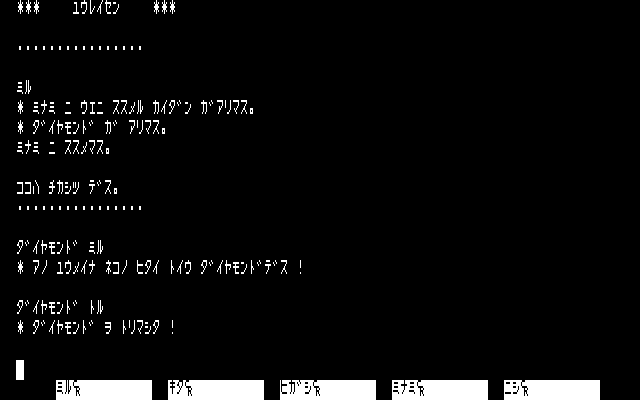
As a reminder from last time, I had discovered that things don’t exist until you LOOK (miru) at a room. What I also didn’t understand is that this goes even further: if you need to interact with an item more deeply (handwavy exactly what that means, I never figured it out) you need to also look directly at the item first. For example, back at what I was calling the “cook’s room” there’s some storage, and it turns out there’s a barrel visible if you look. I marked it down and didn’t come back until later, at which point I was getting messages that made me think I shouldn’t bother to drill down further. Rather, you can look in the barrel and find some biscuits (not good to eat) and you can move it to find a key.
The first key! (カギ on the last lines, or kagi). And I took it to my locked doors and … couldn’t find anywhere it would open. Agh!
By now I had poked around the source code enough to know there were multiple keys. After some discussion in the comments I realized the same “look closely before you apply something” also applies to the skeleton. As a reminder, I had listened to the skulls in the basement to find I was supposed to say “amen” (アーメン); I tried it on all the skeletons I had available but had no reaction. The reason I didn’t was I was supposed to LOOK SKELETON first before doing the action. Once you do that, they are at “peace” and you can safely search (although sometimes you’ll still turn up nothing).
The only catch is that you need to be careful that you aren’t typing the wrong letter in the katakana font. (I admit this is more a “me” thing than a “you” thing.) “Nu” (ヌ) and “a” (ア) look different in a modern font but awfully similar on the PC-8001.
My old nemesis from The Palms returns. The command on the left failed, but the first character of “amen” is different.
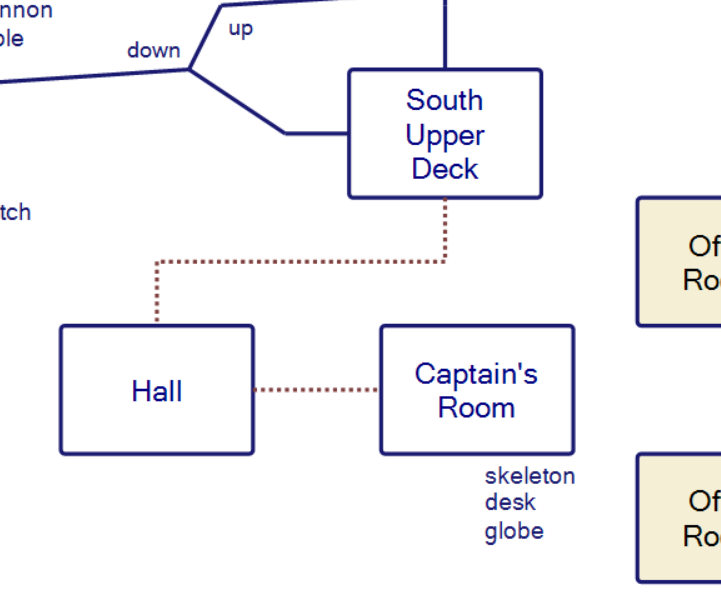
From a skeleton at the “officer rooms” I was able to find yet another key, with which I was able to unlock the two officer rooms I hadn’t been to yet. One of the rooms yielded a hammer and broom and the other yielded yet another key, this time going to the captain’s room.
This broke things open; from here I started to find keys at a fairly random rate. Checking the captain’s room first…
…I was able to find a safe at a desk (couldn’t open it yet) and get a key by spinning a globe. There’s also a paper that lets you know when you’re ready to leave you should use the boat in the middle of the ship. (It’s communicating in a meta way; it turns out you can leave almost immediately upon arriving, although I was missing a verb, also you’ll see later.)
After that, with the hammer I was now able to break the hatch and get down to the lower levels of the ship.
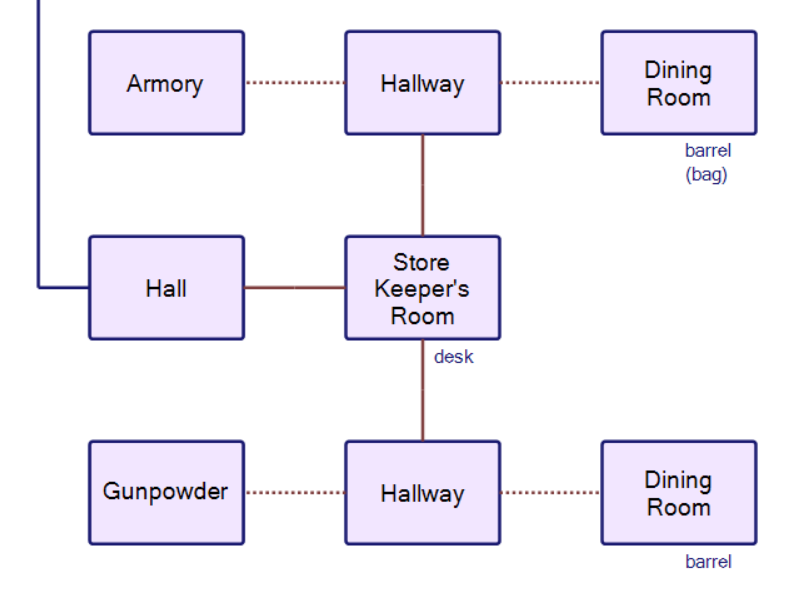
The lower part is in two layers. I started at the bottom, which turns out to have almost nothing, although it was long and tedious to realize this.
There’s a “sack” with some supplies you can grab at the dining room, but otherwise this area involved not only tediously checking each object with all my relevant verbs (look, search, move) but also tediously unlocking and opening doors as required. When there’s multiple locked doors, the process is…
>USE KEY
Which door do you want to unlock, west or east? EAST
OK, you’ve unlocked the eastern door.
>OPEN DOOR
Which door do you want to open, west or east? EAST
OK, you’ve opened the eastern door.
>USE KEY
Which door do you want to unlock, west or east? WEST
OK, you’ve unlocked the western door.
>OPEN DOOR
Which door do you want to open, west or east? WEST
OK, you’ve opened the west door.
…which gets so enormously tiring. The process is generally longer than this, because usually I would need to try an exit first, get a “you bonked into a door” type message, try to open it, find it is locked, and only then go through the use key – open door process, all the while having to specify which direction I mean if there are multiple doors.
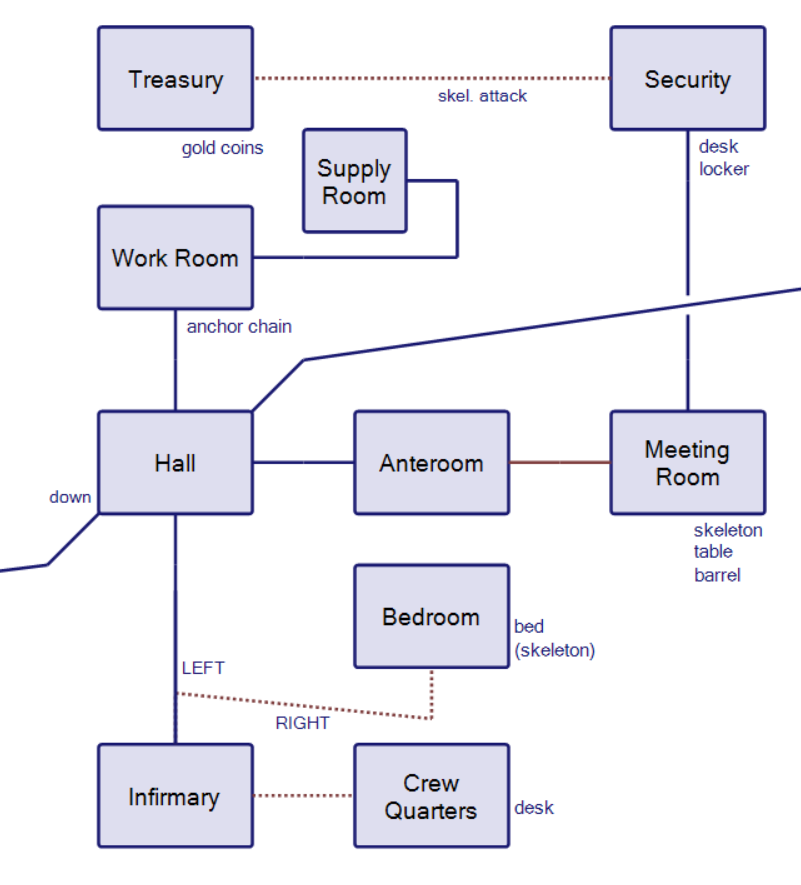
The other lower level is a little more interesting, but still had the same door tedium:
One branch has an infirmary with two locked doors, one to north-right and one to the east. (When you specify a door, you need to say north, then say right, you can’t just say right; you have to do this twice in a row, one to unlock the door and once to open it.) There’s a skeleton in a bed off the side which hides another key (don’t forget to “amen” first) and then that key leads to a “crew quarters” which hides yet another key leading to the commander’s cabin.
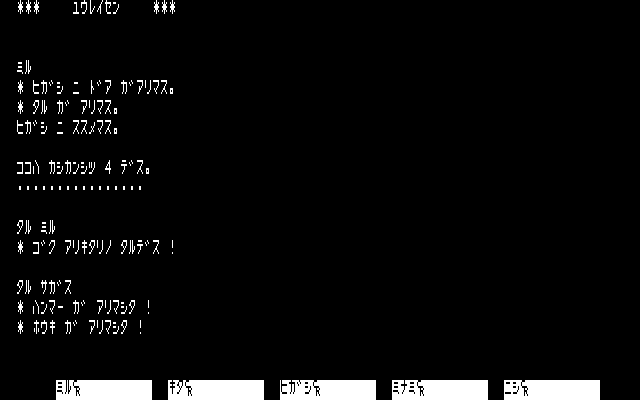
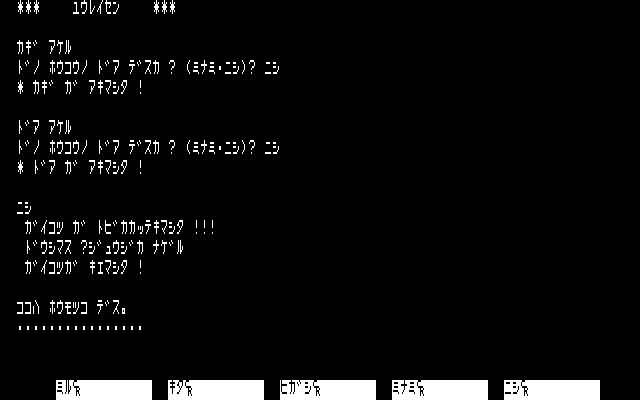
The commander’s cabin is on the same floor as the pile of skulls, and importantly as you’ll see in a moment, it has a cross, but also a bookcase which can be moved (I was clued on this ahead of time through my poking around the source code). Beneath the bookcase is a secret room with a diamond.
The cross is important because back at the same level as the infirmary there’s also a treasury (the key back in the captain’s room globe opens that). There’s a skeleton there that tries to kill you, and this is the only “active” menace in the game.
The spirit of the commander is protecting the treasure, and is now coming for your life…
I was stuck for a while here because not only did I not have the cross found yet (leading me to test a bunch of “amen” variants and methods of fighting like with the cannonball, no luck), but the exact parser command to type was elusive. You need to throw the cross.
This leads to some gold which is apparently enough to buy 1000 for the NEC 9800 series of computers. (This reference incidentally puts a hard limit on development of October 1982, since that’s when the machine came out. It was originally business-oriented and expensive.
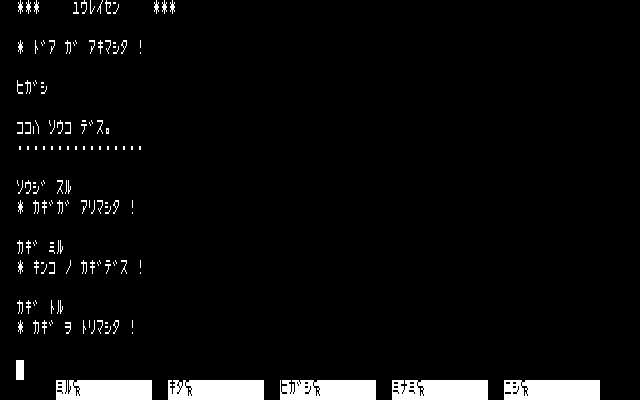
I still hadn’t opened the safe yet, and I admit I had to poke at the walkthrough to find: I needed to go back to the big trash pile (which was always resistant to my searches) and use the broom with a command that roughly translates as “clean up” (that is, without referring to the noun “broom”).
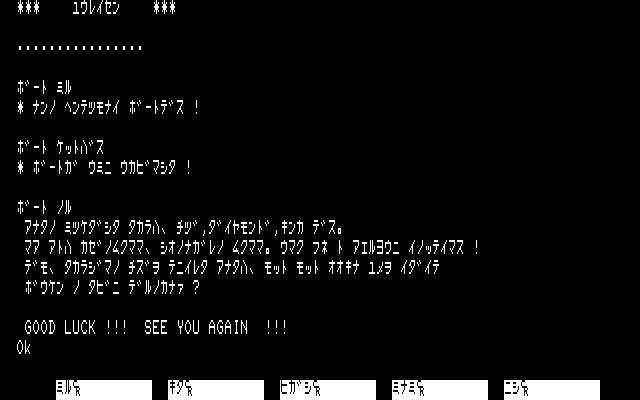
This reveals the safe key; the safe holds a pirate treasure map (and the next game might pick up where this one left off, but I haven’t checked it carefully yet). For now though we need to get off on the small ship, so we need to KICK it into the water. Sigh. It is common for both English and Japanese games to never make it easy to get a ship going, it seems.
“The treasures you discovered are a map, diamond, and gold coins. From here on, you’re now dependent on the wind and tides. I hope you manage to find another ship! Now that you have the treasure map to the island, I wonder if you’ll dream even bigger and set out on a new adventure?”
Rob pointed out one particularly bizarre katakana spelling: チヅ for map instead of チズ. I don’t have the energy or expertise to fully tackle this, but チヅ is an older form of the spelling (see “chidu” and “chizu” mentioned on this list of Classical Japanese word differences); it could also be an academic clinging to an old etymology. Shinkigensha had only just transitioned from their more academic publishing so the word might be a vestige of that. “Pick up” incidentally can be given by the player as “hirou” or “hirau”, the latter being non-standard but part of the Kansai dialect.
Conceptually, I found it interesting to have the game’s emphasis be on atmosphere and have the puzzles all essentially be optional. In practice, the endless barrels and tables and so forth that needed to be examined blurred together, and while keys were technically marked with where they went, there wasn’t a way to tell in most cases until after unlocking the doors in question! (That is, if you know a key goes to the captain’s quarters, but not which door that is, that’s not helpful information.) Still, this was fairly deep for a type-in, and of course the author was working essentially without precedent; there were no other text-only games written in Japanese to refer to.
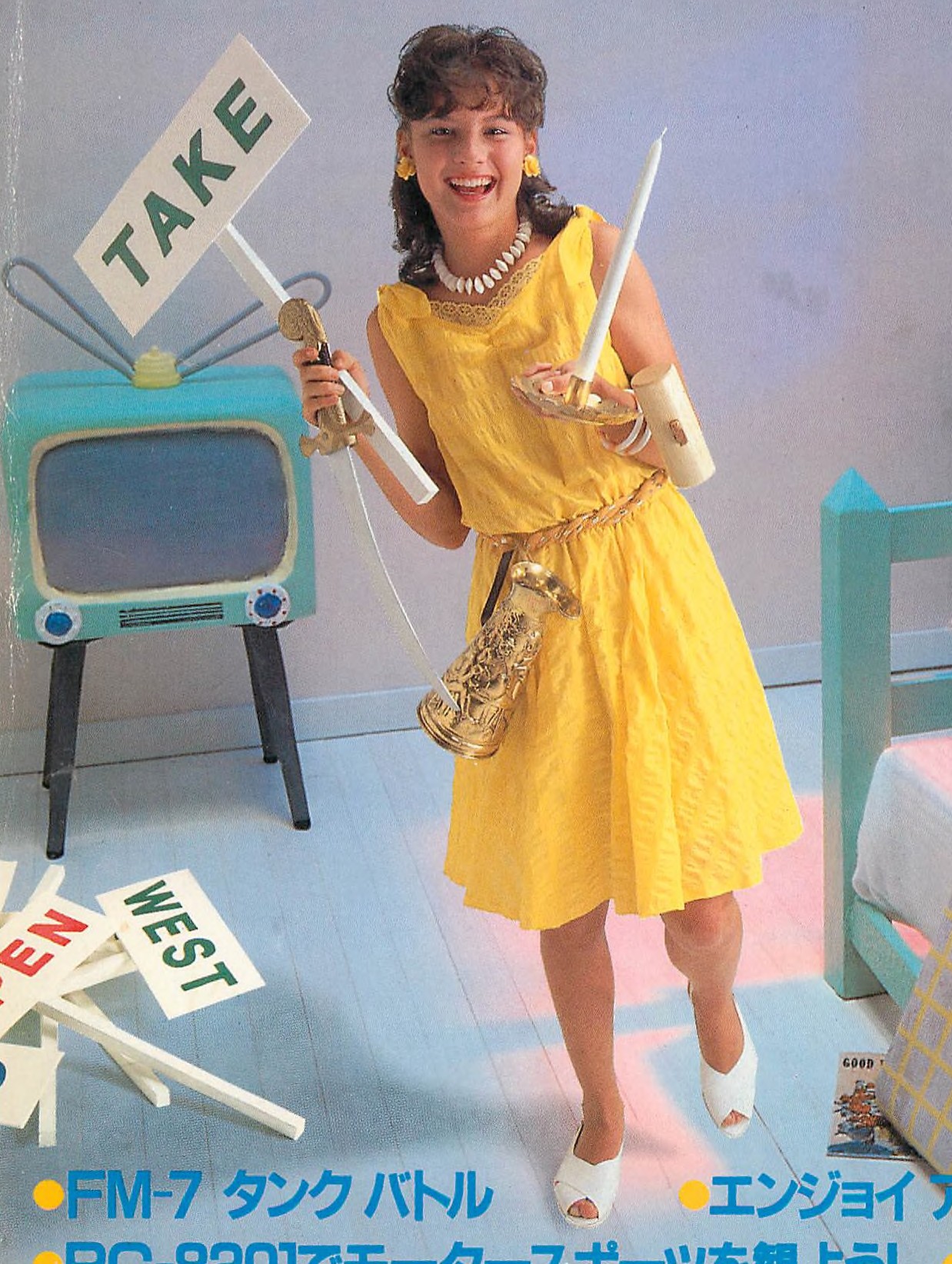
From the front page of LOGiN August 1983, showing an adventurer mid-game.
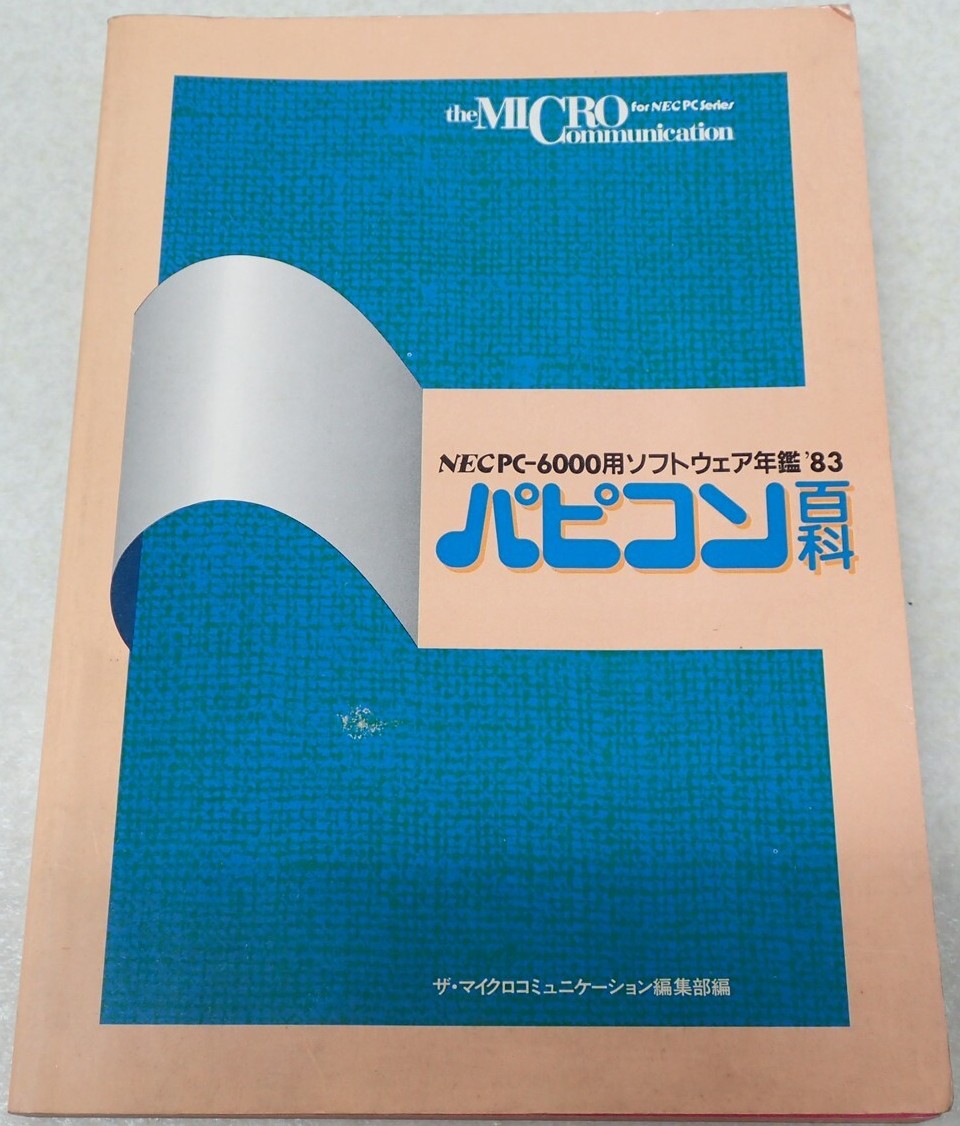
Last time, I mentioned three books published at the incorporation of Shinkigensha. One of them was an NEC PC “yearbook”, essentially an encyclopedia of software.
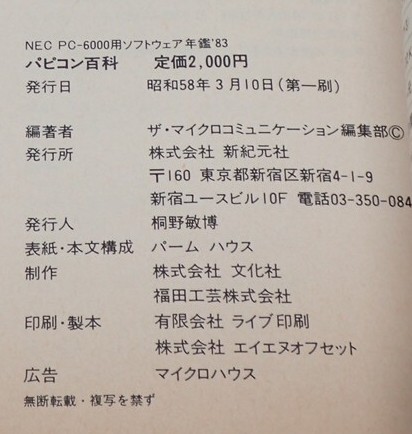
Looking at the inside front cover, you can see publication info.
This includes a publication date (March 10, 1983, noting it is a first printing), the creator (The Micro Communication Editorial Department), the publisher (Shinkigensha Co., Ltd.), the company responsible for the cover and layout (Palm House), the companies responsible for production (Bunkasha and Fukuda Kogei), the companies doing printing and binding (Live Printing and AN Offset), and finally the company doing advertising (Micro House).
There’s also the line
発行人 桐野敏博
indicating the individual publisher representative is Toshihiro Kirino. This is out of a staff of 10, and Bunji Yonekura was the President at this time.
Referring back to Toshihiro Kirino: later in life he became chairman of the education software company LINES (the website is education dot jp, just to give you an idea of their prominence) but he also has some history prior to Shinkigensha.
Most directly clear is a reference in a 1980 book (about a handmade newspaper from Japanese Prisoners of War on Leyte Island). The book cites Mr. Toshihiro Kirino of Live Printing (along with Mr. Atsuo Takeuchi of Saikosha, another printing company) as helping with restoring the old handwritten text. Note how Kirino is associated with a company that worked with Shinkigensha but not the company itself. (This might be another situation where the two were informally affiliated in some way, like it is possible Micro House and Shinkigensha were.)
Less clear to me is if he’s the same person associated with the Japanese New Left (specifically the “Kyoto University All-Campus Joint Struggle Committee”) and an incident of alleged attempted bombing at the residence of the Metropolitan Police Commissioner General. None of this is implausible, but given that this Toshihiro Kirino was indicted (and then acquitted) under the Explosives Control Act, I’d prefer some absolute confirmation before getting more into the story. (Also adding plausibility is the president of Shinkigensha in ’83 came from the same academic leftist circles; he authored various articles in socialist magazines in the late 60s.) This will likely all end up as a future standalone post. I’ll link something I wrote four years ago in relation to the movie Akira as compensation for now.
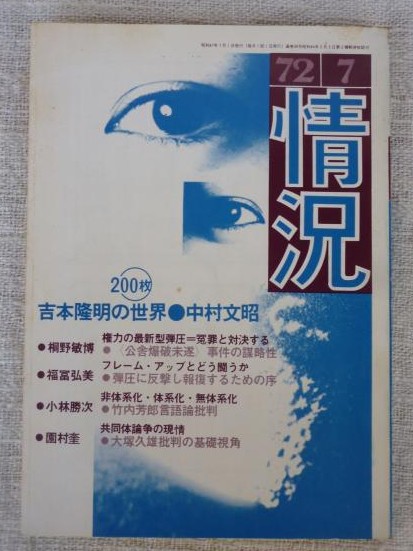
July 1972 cover of The Situation. The top article by Toshihiro Kirino is specifically about the incident.
Returning to the game, I suspected I was missing some mechanical aspect to how it worked. Indeed I was. It turns out that objects only exist in a room if you’ve applied LOOK (that is, miru or miwatsu) to the room. Doors are an exception but they aren’t treated as normal objects; they are hard-coded into particular rooms.
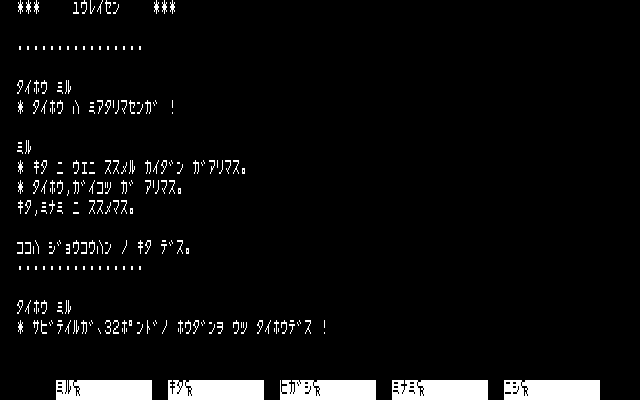
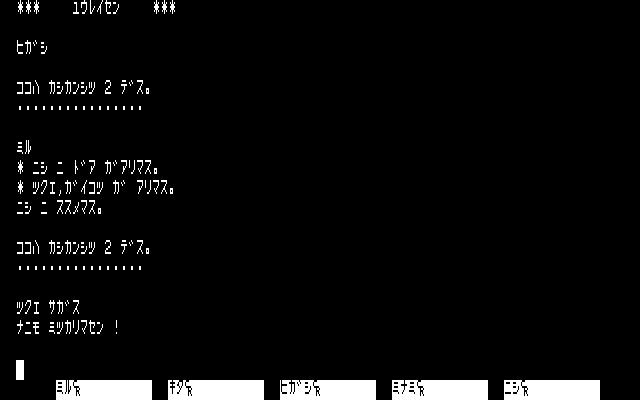
Entering the deck with a cannon, trying to examine the cannon and being rebuffed, looking at the room, then trying to examine the cannon again. We are then told it can fire 32-pound cannonballs.
This is extraordinary behavior and we’ve only seen this in one other game: Omotesando Adventure. I was a little faster to pick up on the issue in Omotesando because you can’t even open doors without looking; here it seemed like everything was normal, and I was doing LOOK during my exploration process just to keep oriented (since the game by default only gives room descriptions). It meant for a little while I could refer to objects, but on my pass where I was trying to search things or do other actions (but I didn’t use LOOK because I already knew what was there) I was failing because the game was pretending the noun I was using didn’t exist in the room.
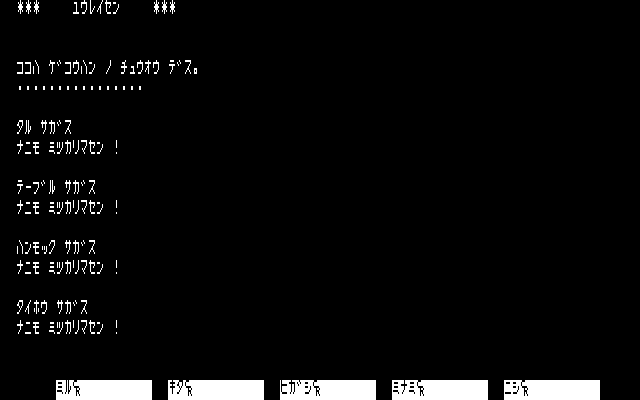
With that figured out, I set about systematically examining things and searching things, for real this time. The various masts explain what they are (the mizzenmast is the one at the back of the ship, according to the game). The barrels are still ordinary (I think I examined them right the first time) as are the desks (sadly, still didn’t find anything, ugh). I also tried various random verbs that seemed appropriate, like using SLEEP on the hammock.
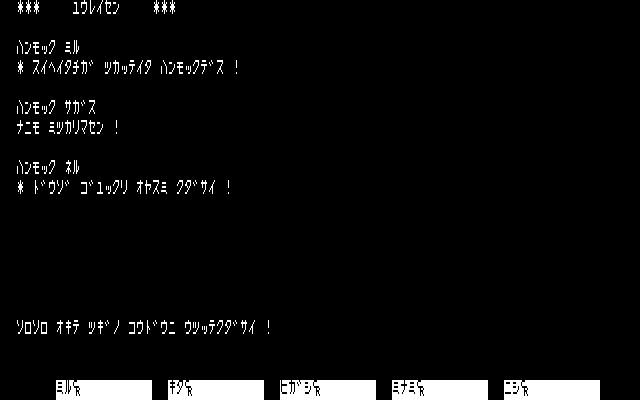
“Rest as long as you like.” (Real time delay.) “It’s time to wake up and get moving.”
I found out that I made a translation error in the armory and what I had down as a cannon was actually a cannonball (this may have been more a note-reading error than a translation error, since it went as cannonball in my notes but cannon on the map). I found I could take the cannonball, but I haven’t been able to do anything with it yet. (Before anyone asks, I did try to put it in the cannon, with the caveat that none of the verbs seem particularly appropriate for that. No luck, but the cannon would need more in it to work than just a cannonball normally anyway. I also tried all four of the “destroy” related verbs on the hatch while holding the cannonball, and also trying to throw it while I was standing there.)
Most interesting were the skeletons / skulls, who seethe with “angry spirits”. Searching them does not go well.
The sorrowful cries of the sailors echo through the ship.
“Grant us peaceful slumber!” they plead.
Pray for them… “Amen.”
Unfortunately, while SPEAK AMEN and SAY AMEN both are recognized (or rather, “amen speak” and “amen say”, in the order needed) the only response I’ve gotten is nothing happened. This perhaps needs to be done somewhere special.
Even after feeling I’ve got the hang of the parser, I’m terribly stuck. I’ll give things a little more time but I’m probably going to break open the rest of the source code (I’ve only just looked at the verb / noun data). Any more suggestions on what to try are welcome.
I haven’t made as much progress as I’d like — it’s still The Phantom Ship except in the sense of being a ship where searching reveals nothing — but I’ll give a report anyway.
Before starting on gameplay, I have a piece of history to cover. (Rather, I have three pieces of history, but I’m just doing one for now to spread it all out.) Technically speaking, the creator of Yuureisen was not Shinkigensha but Micro House.
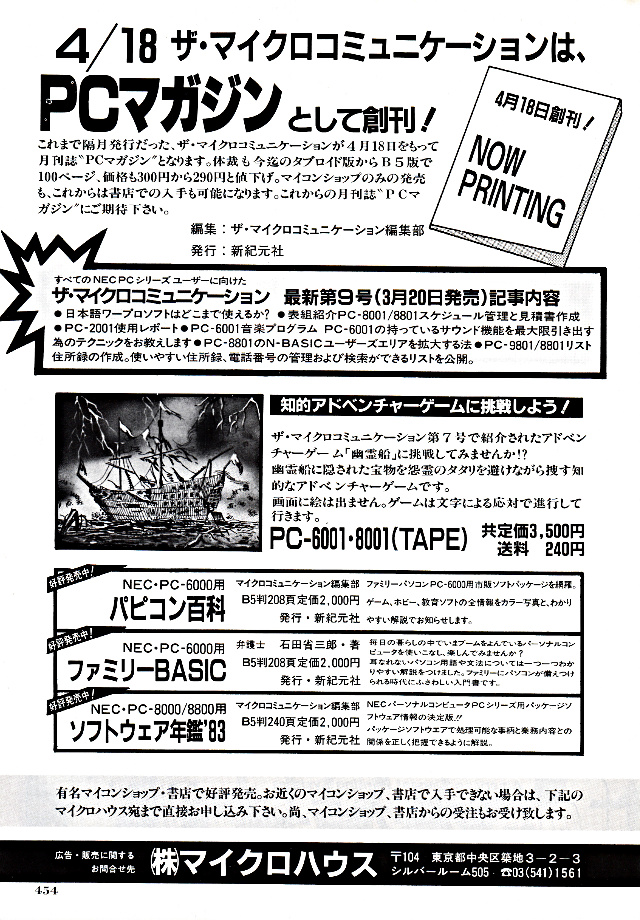
From the ad above — selling the game on tape, prior to PC Magazine launching — the publisher of the upcoming magazine is listed as Shinkigensha and the creator is listed as The Micro Communication, with a different address than Shinkigensha’s listed on the bottom. This doesn’t mean they were actually fully separate; they may have been essentially an informal spinoff that got pulled into the fold once the incorporation became official (exactly the month of the ad).
Three books are also listed as being newly published, and they aren’t the sort of thing that would have been created on the spot; this seems like a setup that was some time in the making (at least overlapping the exact publishing date of the original Phantom Ship type-in that Rob came up with, November 20 of 1982).
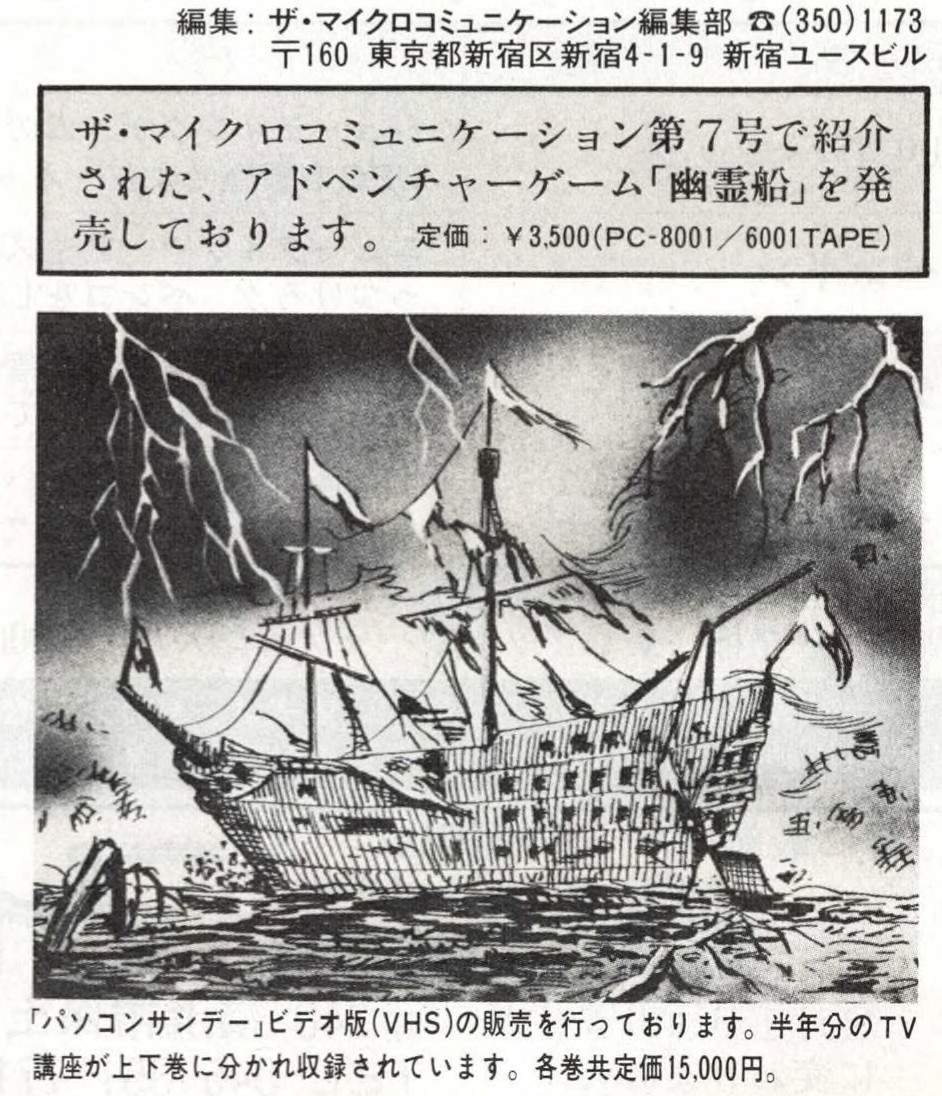
An ad the month before (see picture) doesn’t mention the Shinkigensha deal at all, but it does mention selling VHS copies of PC Sunday, 15,000 yen each!
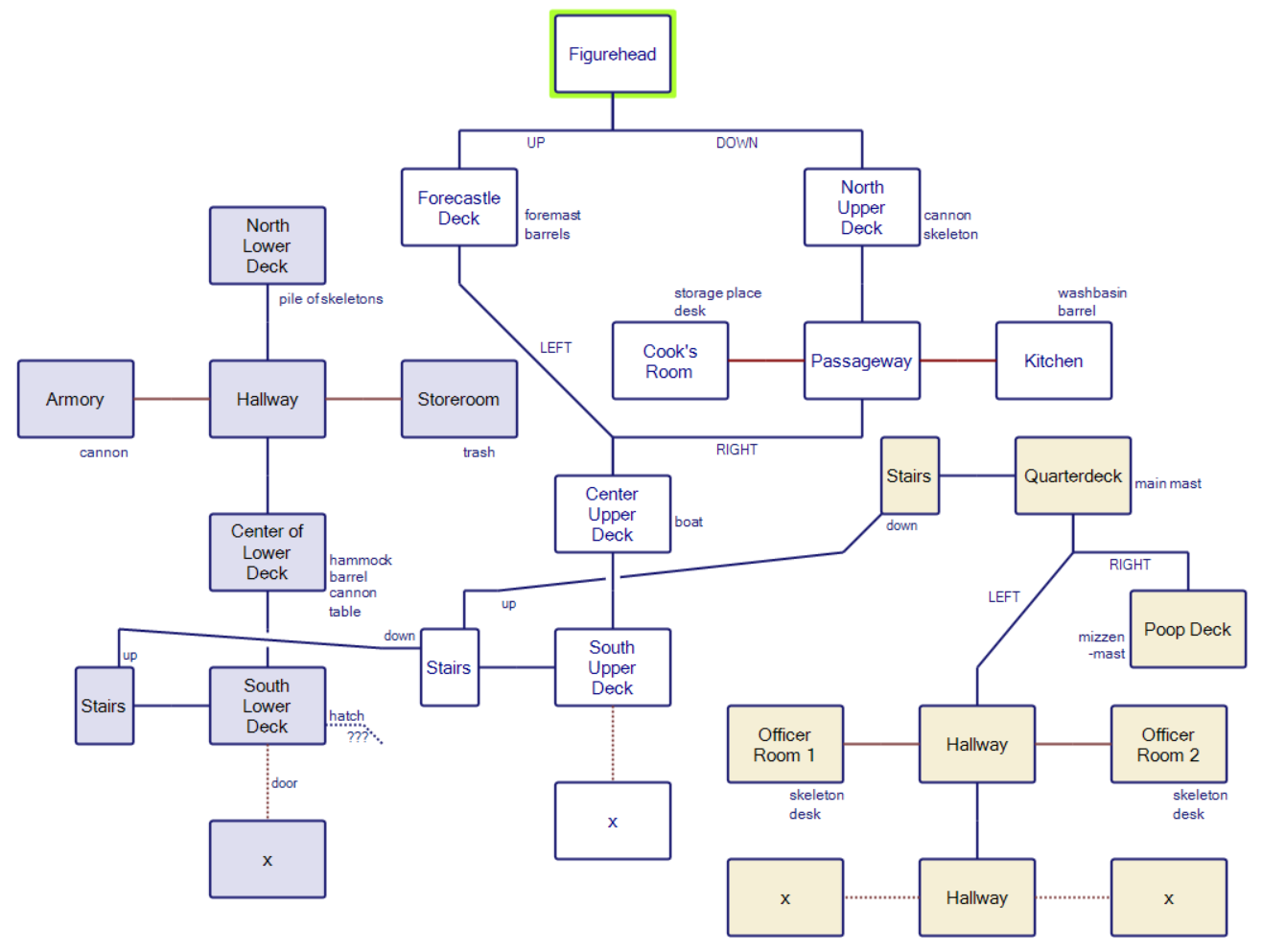
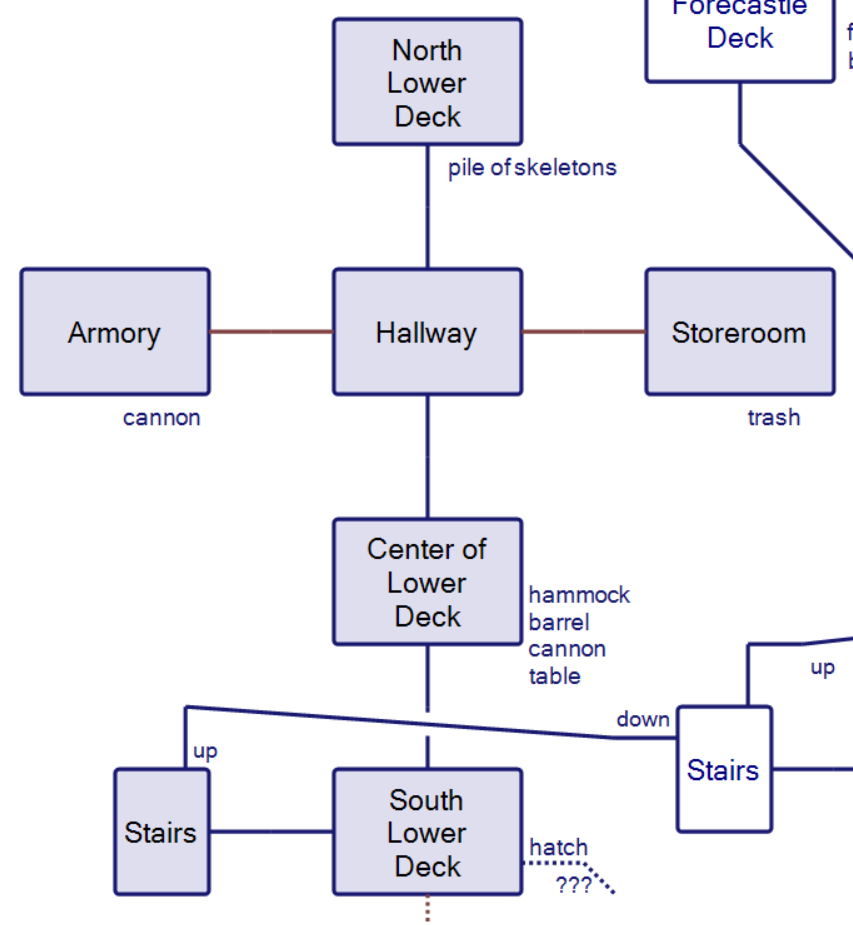
Back to the game: I have, at least, what I think is an accurate map.
As a reminder, there are some exits where after going in a particular direction, the game will give a prompt (either up/down or left/right) so some paths actually split (even though walking back the other direction may not have a prompt at all). Entering what I’m considering the three “floors” requires going west to a stairway, choosing up/down, and then having the game move you to the floor. That is, there is no real stairway room, but I put them on my map because otherwise I was getting befuddled.
Also, while I’ve been thorough, there’s a slight chance I still have a translation that’s off (especially as far as ship terms go) and any item that’s singular may actually be plural (“hammock” seems more likely “hammocks” in the lower decks, for instance).
Some of the doors can be opened right away and some of them are locked. I do not have a key.
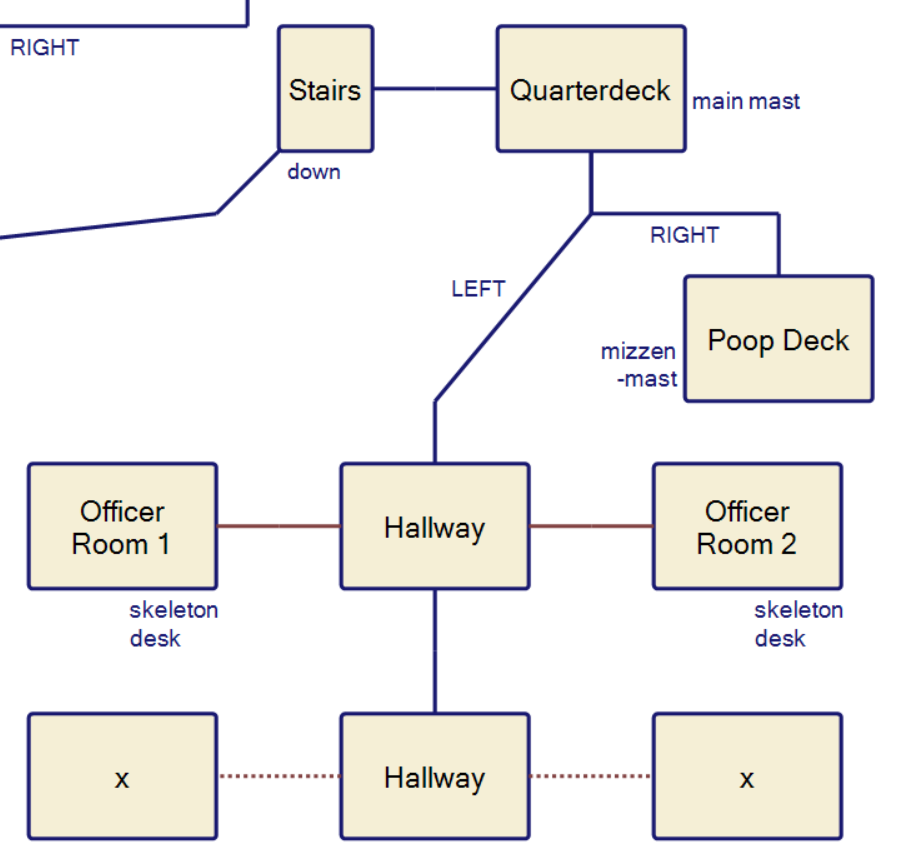
On the map below of the upper-back area there are four doors, two each lead to officer quarters (identical with a desk and skeleton) and two are locked. Here I am entering the Officer Quarters 2, trying to search the desk (“tsukue”, possibly “table”), and finding nothing:
More on the specific search verb later.
The bottom section seems like it ought to have something:
At the far south, a hatch I can’t do anything aside from the locked door; there’s also hammocks, barrels, cannons, and another desk/table just to the north of that.
At the center of the lower deck, searching all the items including the desk, with nothing found each time.
More locked doors are to the north: an armory with cannons, and a storage room with a mound of trash. You might think I’d find something searching the mound, but no luck. Finally, to the far north, is a pile of skeletons, which do nothing spooky other than hang out. This is like if Return of the Obra Dinn didn’t have the time-viewing mechanism and just had the bodies.
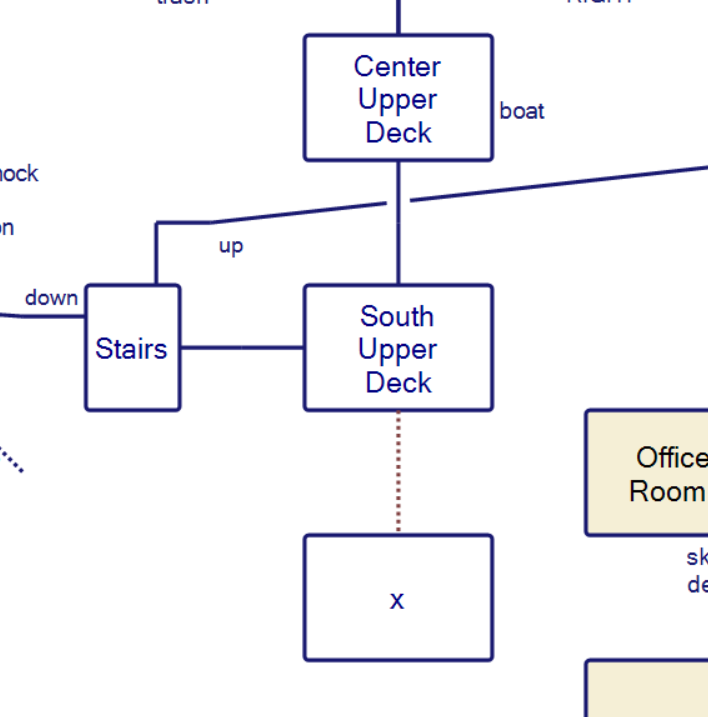
One last observation, this time on the main deck: there’s a boat in the center. One could presumably try to enter it and escape, and I tried to do that, but the game asked where I was going. Poking around the source code, there seems to be a map somewhere, so my suspicion is I need the map in hand first before escaping.
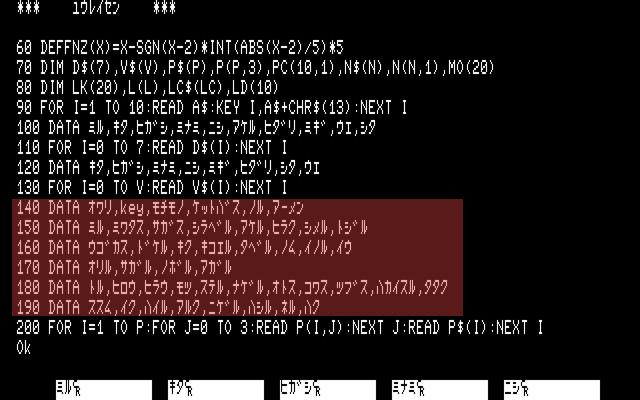
The next most obvious thing for me to do (which I do in my English playthroughs but also most especially in languages I’m not fluent in) was to make a verb list. The verb list is decently long on this one.
Fortunately, there’s no obfuscation, you can just do a LIST command.
Thinking about English for a moment: text adventures seem to have a very natural set of commands, but some of them are very much a product of standardization rather than what someone developing from scratch might come up with (or what an amateur playing might try to type). INVENTORY is a prominent adventure-specific example, being an odd word that Poker Night at the Inventory is clearly making a reference to adventure games. The very early game Mystery Mansion used LIST instead of INVENTORY.
Similarly, Journey uses DESCRIBE instead of EXAMINE or LOOK. It’s just cultural osmosis that EXAMINE LAMP seems more natural than DESCRIBE LAMP to an adventure gamer, and if Journey was the very first adventure, maybe the games that followed would use DESCRIBE instead.
EXAMINE also managed to get an early split in English with SEARCH, but in an inconsistent way. I’ve seen games with EXAMINE and SEARCH behave the same way but also ones where examine is “give a visual description” and SEARCH is “use your hands and check more thoroughly for something secret. SEARCH also may or may not imply opening a thing as you search it.
Every language stepping into adventures for the first time gets its own chance to interpret verb usage; Geheimagent XP-05 used AUSRUESTUNG (or “equipment”) for inventory, and put RUN as a command that was differentiated from other movement commands (it happens in English, but it’s still non-standard).
Back to The Phantom Ship: the act of examining something has four verbs associated with it:
I looked up all four on Jisho to get a sense of different shades of meaning…
(miru) to see; to look; to watch; to view; to observe
(miwatsu) to look out over; to survey (scene); to take an extensive view of
(sagasu) to search for; to look for; to hunt for; to seek
(shiraberu) to examine; to look up; to investigate; to check up; to sense; to study; to inquire; to search
…but this still doesn’t necessarily translate directly into the meaning of the actions! “Miru” and “miwatsu” both can serve the function of being given alone and giving a room description, but the other two words do not.
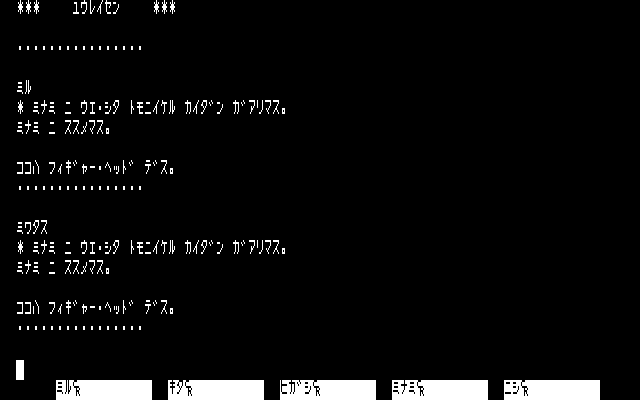
Applying miru and miwatsu to the start of the game.
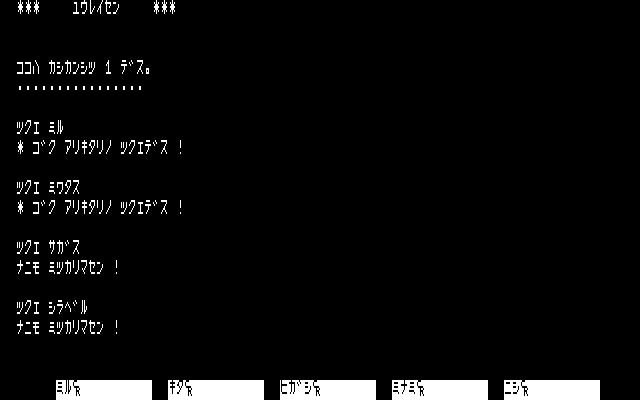
When applied to a noun instead, miru and miwatsu seem to function like EXAMINE, and sagasu and shiraberu seem to function like SEARCH (assuming a parser with a split where SEARCH involves a more active looking process). The screenshot below involves checking a desk four times; miru and miwatsu call it “ordinary”, while sagasu and shiraberu state that nothing is found, implying a search by hand.
I’m still not fully confident I have all the details worked out, because I’ve applied search to a great deal of the ship and still haven’t found anything!
It turns out in practice the opens and closes are equivalent, but I still had to test this because it was non-obvious to me when eye-balling the definitions.
(akeru) to open (a door, etc.); to unwrap (e.g. parcel, package); to unlock
(hiraku) to open; to undo; to unseal; to unpack
There are four “destroy” type verbs (kowasu, tsubusu, hakaisuru, tataki) and while I can presume they all mean the same thing, I can’t even assume HIT and ATTACK refer to the same thing in an English game (I’ve seen ATTACK only apply to live enemies but hit get used on inanimate objects).
Other than that, there are versions of move, listen, eat, drink, pray, speak, and throw. Pray is notable for potentially being a “for fun” style verb that’s in there to let the player mess around (like accounting for swearing). (Or maybe there’s an altar where we really do have to pray, like Epic Hero 2!) At the moment pray just responds “nothing happens.”
I could just keep plowing through the source code but I’m fairly certain I haven’t quite done sagasu on absolutely every item, nor have I really tried destroying things in earnest. My guess is once I get past my current roadblock the rest of the game should go smoothly, but I may still be missing some fundamental aspect about how the game works.
1940 was a curious year to be starting a publishing company, but especially one in Tokyo.
This was in the midst of WW2, and the same year Italy, Germany, and Japan signed the Tripartite Pact. Censorship was ongoing and total by 1941; The Japan Publishing Distribution Company (日本出版配給株式會社) was started to oversee all content, consolidating over 240 companies. There were essentially no notable literary works from 1941 until the end of the war; while The Makioka Sisters (considered Junichirō Tanizaki’s masterpiece) started serialization in 1943, it was stopped by the government and publication was only finished after the war.
August 1940 — a month before the Tripartite Pact — marked the founding of our company today, Shinkigensha. As you might expect, they came out from the very start with propaganda, like Showa Chronicles by Iwao Mitsuda (a year later the same author released a biography of Hitler with a different publisher) and A Guide to the New Order; the New Order refers to both the proposed “New Order in East Asia” (trying to cast Japan’s colonial project as a way of breaking from Western powers) and New Order as a movement, interested in imposing a state mass party and boosting nationalism.
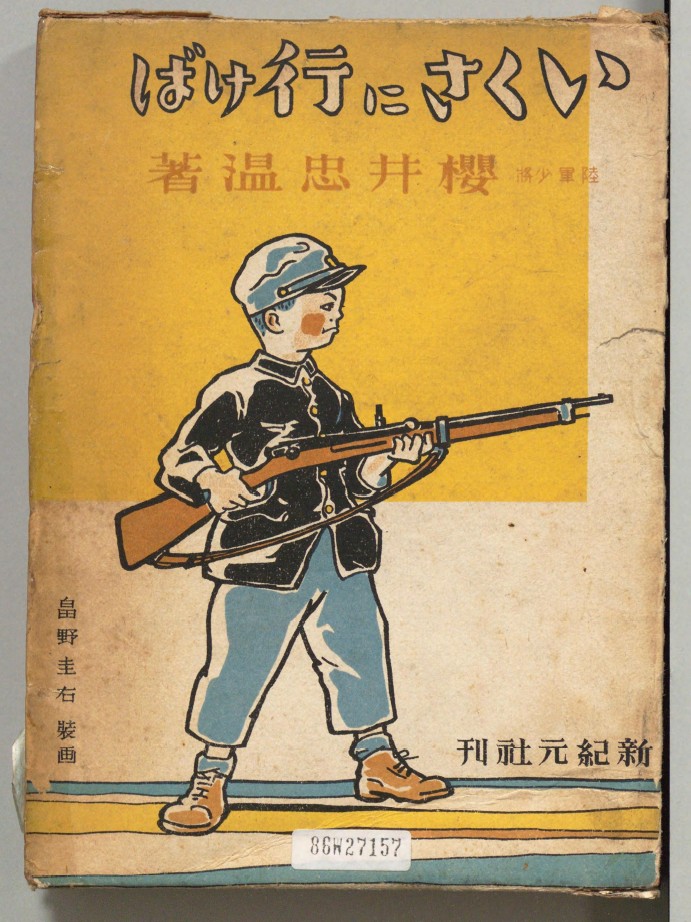
In 1942, Shinkigensha published a book by a military celebrity: If You Go to War by Sakurai Tadayoshi.
Sakurai Tadayoshi was a veteran of the Russo-Japanese War; he suffered so many bullet and sword wounds that he was mistaken for a corpse and was discovered alive while being transported for cremation. He wrote a memoir in 1906 (Human Bullets); the concept of the title was “using one’s own body as a bullet”, essentially fierce close-quarters combat.
Suddenly a tremendous shout arose throughout our whole line; all the officers, with drawn swords and bloodshot eyes, rushed into the enemy’s forts, shouting and yelling and encouraging their men to follow. A hell-like struggle ensued, in which bayonet clashed against bayonet, fierce shooting was answered by fierce shooting, shouts and yells were mingled with the groans of the wounded and dying. The battle soon became ours, for, in spite of their desperate resistance, the enemy took to their heels, leaving behind them many mementos of their defeat. Banzai was shouted two or three times; joy and congratulation resounded on the heights of Kenzan, which was now virtually ours. The Flag of the Rising Sun was hoisted high at the top of the hill. This stronghold once in our hands, shall we ever give it back to the enemy?
The new book starts with an author note asking “why did the war break out?”, blaming Chiang Kai-shek of China “looking down” on Japan and Britain and the US “pulling the strings from behind”.
Unless we defeat the United States and Britain, the war with China will never be finished; we must cut off their hands as they attempt to take hold of China.
A year later, the same publisher printed Returning to the Homeland by Goro Nakano. Nakano was a reporter with the newspaper Asahi Shimbun who was in New York at the outbreak of war and was detained; the book is “the Pacific War as seen from America”.
Only a miracle might delay the outbreak of war. With Secretary of State Hull’s outrageous response to Japan on November 26, the U.S. government had already trampled upon Japan’s restraint and peaceful efforts.
(This is the “Hull Note” that demanded that Japan withdraw from China and French Indochina.)
Post-war involved a rapid reverse, including the eight volumes of Dr. Sakuzo Yoshino’s Collected Works on Democracy (published in 1946) as well as literature by Matsutaro Kawaguchi and Osamu Dazai the same year.
This reversal could be a.) starting as a true believer in fascism, but changing course for survival during the US occupation or b.) the founder being reluctant with the propaganda to begin with, and they’d really rather be doing something else. Despite the founding date being a puzzle, there’s good reason to think the latter, because the founder appears to be the erotic literature scholar Kenbun Matsukawa.
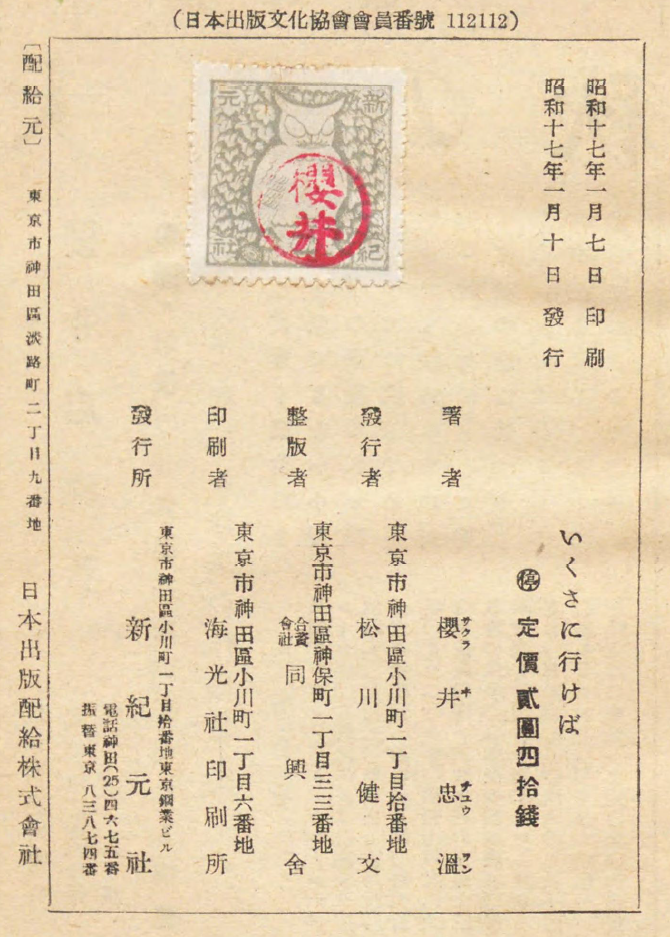
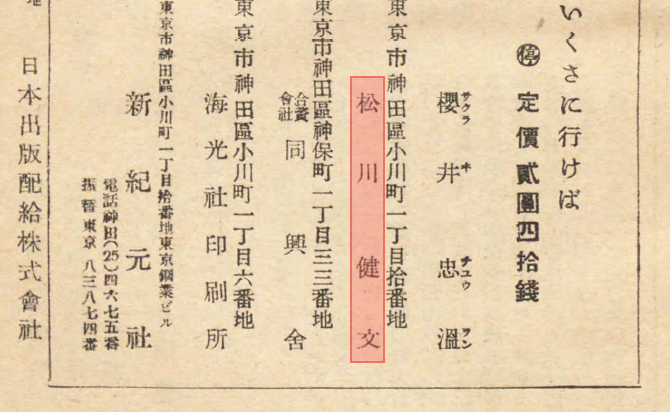
From the back pages of If You Go To War. The text along the top edge mentions The Japan Publishing Distribution Company.
松川健文 (Kenbun Matsukawa) is given as the publisher.
In a 1997 book, the scholar Toshio Takahashi calls Matsukawa “no mere purveyor of erotica, but instead a man of refined sensibilities”; in the early 1950s he published a series of booklets titled Curiosa through the “Tokyo Limited Edition Club” with essays (“Eroticism in Detective Fiction”, “Edo period sideshows”) and translations (with high-literary choices like Casanova, Henry Miller, and the ancient Greek play Lysistrata).
He also published A Study of Erotic Literature in 1948 (using the publisher name Logos), and it includes the important essay “On Obscenity”; despite the name of the author being different (Fumio Natsukawa) it likely was just Matsukawa using a pen name. This essay uses Havelock Ellis’s book The Psychology of Sex (in English) as a reference; instead of some absolute natural law, he calls the obscene an “emotional response under certain circumstances” and that it is simply a “violation of social etiquette” that is subjectively dependent on each individual person.
This was when it was possible to go to jail for publishing erotic material, and indeed he was sentenced to two months in 1950 for “selling obscene literature”; another scholar writing in 1969 called him a “nihilist” (in the same sense as Dazai Osamu) who made “significant” contributions in advancing the study of erotic literature.
These works were all in “alternative” presses; while all this was going on, Shinkigensha was busy with churning out “proper” work, including straight textbooks like “Stable Value Accounting: A Study of Inflation Accounting in Various Countries” (1949) and “Public Debt Economics” (1955). They also in the 60s published a “Collection of Literary Works by Junior High School Students” (for multiple years, for an annual prize) and in 1970 published “A Middle Schooler’s Guide to Daily Life”.
They switched gears starting in the 1980s, still with an underlying mission of conveying historical and technical information, but now aimed squarely at hobbyists. (Right before this, in 1979, they published the Comprehensive Research Study on Zainichi Koreans. It’s fair to guess this would not interest people playing with tabletop miniatures.) As far as why, it likely is because while they were founded a long time before, they only became incorporated on March 4, 1982. (Very loosely, it went from “family business” to “corporation”, allowing things like government contracts and limited liability.)
Their biggest niche after that became the Truth in Fantasy books.
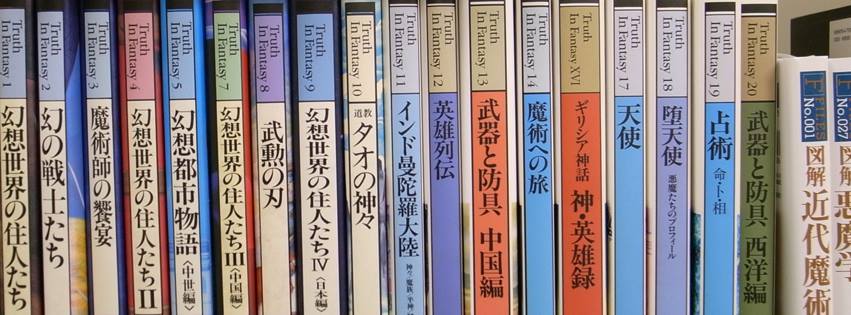
From Shinkigensha’s Facebook page.
They’re a bridge between textbook and fantasy: they’re meant to be guides pulling elements from history and mythology to help with TTRPG games. Truth in Fantasy 4, Residents of a Fantasy World, tries to show what kind of characters one might meet in a campaign. Truth in Fantasy 10 is a guide to the deities of Taoism.
The company has guides outside the series of a similar flavor. The artist Mitsuhiro Arita (mostly known for Pokémon cards) did some work with Shinkigensha; his art in the stand-alone Arms & Armor Encyclopedia impressed Kenichi Iwao of Square Enix enough that he was offered a job. He made Final Fantasy XI content for ten years.
Other than that Shinkigensha became after known for
For the story today, the technology is our focus; in late 1981 they started a tabloid newspaper about personal computing, and in 1982 they helped create the program Pasokon Sunday (lasting until 1989); I’ve embedded below an episode from late in the run (1988):
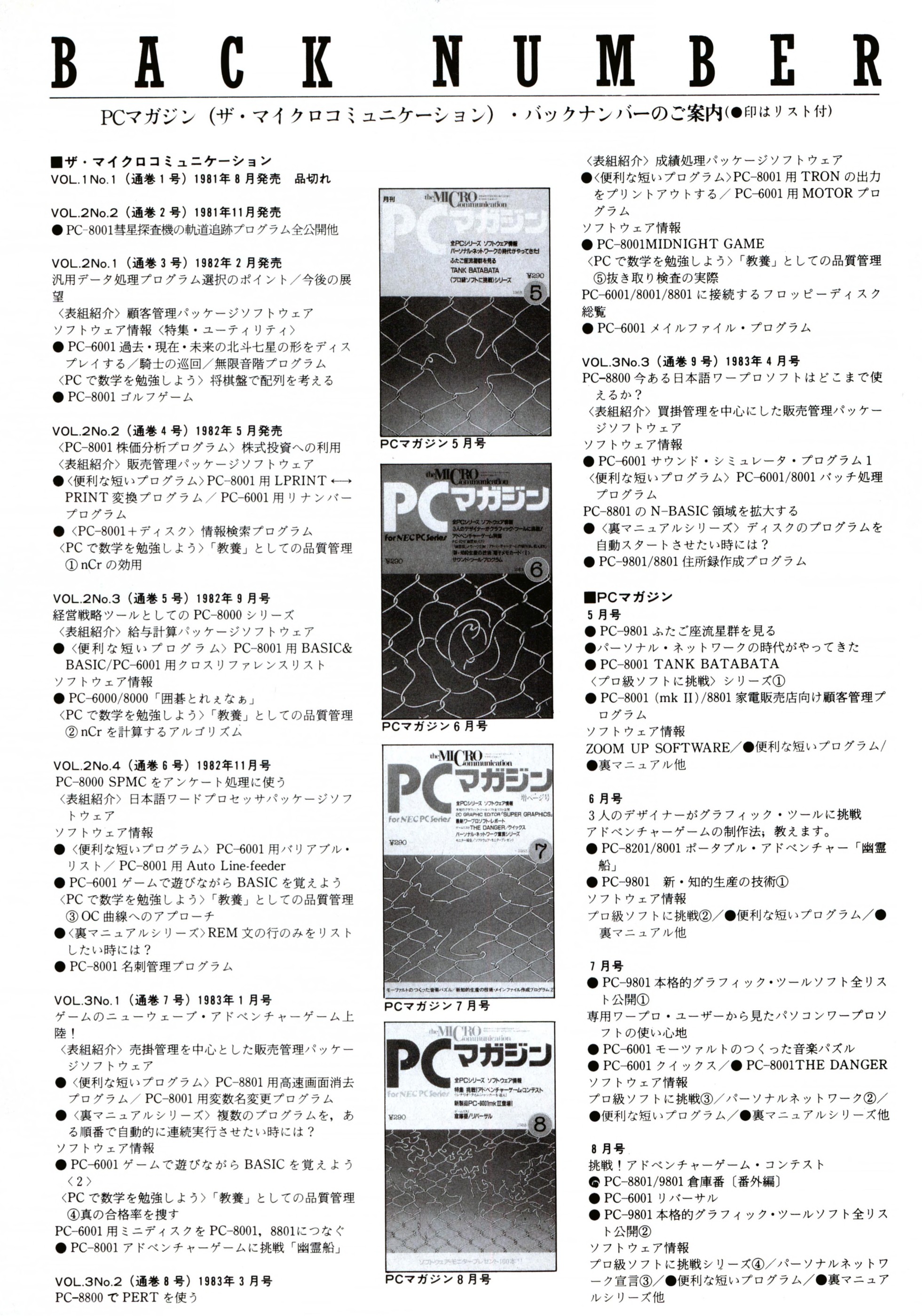
The tabloid newspaper was eventually turned into a monthly newspaper, PC Magazine. (Not to be confused with the American magazine of the exact same title.) Here’s a page from their September 1983 issue:
Included during the newspaper phase was one marked January 1982 (published one or two months before).
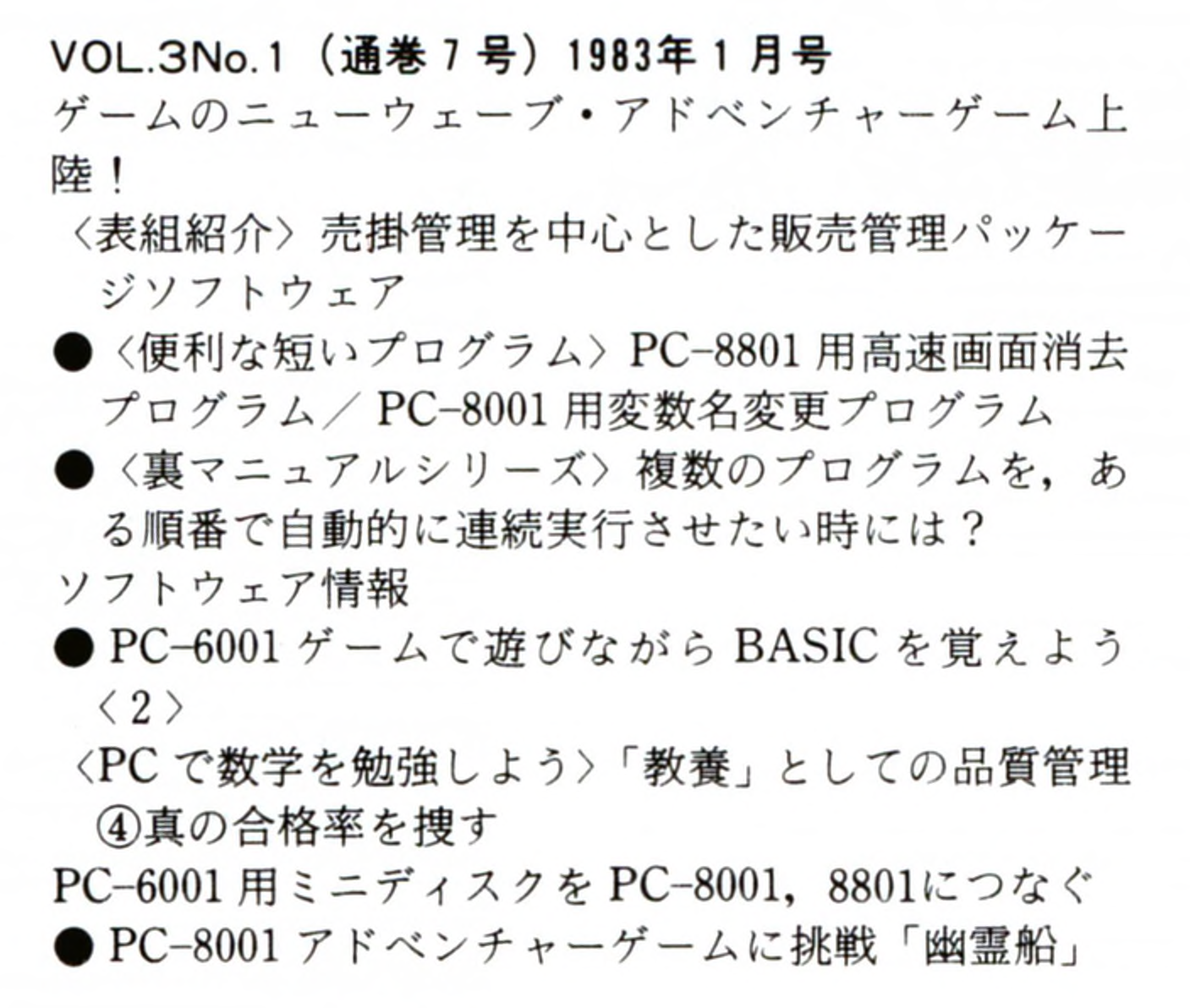
The very last line has our game: Yuureisen, or The Phantom Ship, by Yasuhiro Kume. It was for PC-8001, the same machine Omotesando was on. This gets listed in archives as Yuureisen, but I’m giving it in translation for English audiences. I could have used Ghost Ship as the translation of the title, but there’s the faint possibility that some inspiration came from the 1950s animated short, or the 1960s manga and anime, and in both cases they include Phantom in their official English translation.
I unfortunately don’t have a copy of the original printing, and as far as I can tell nobody else does either. Tabloid newspaper format does not lend itself to preservation unless done actively. The Game Preservation Society in Japan has copies of all the magazines and none of the newspapers.
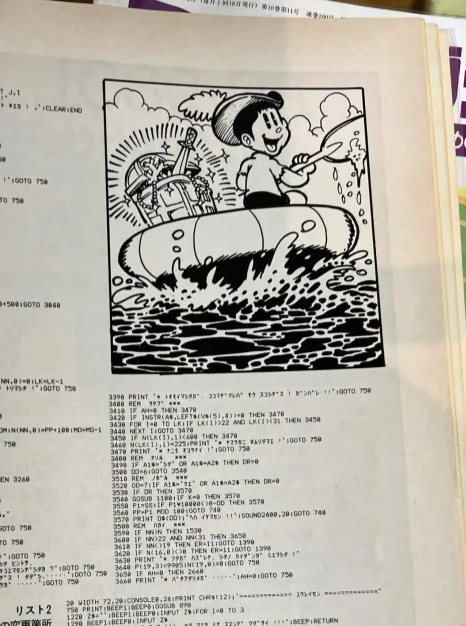
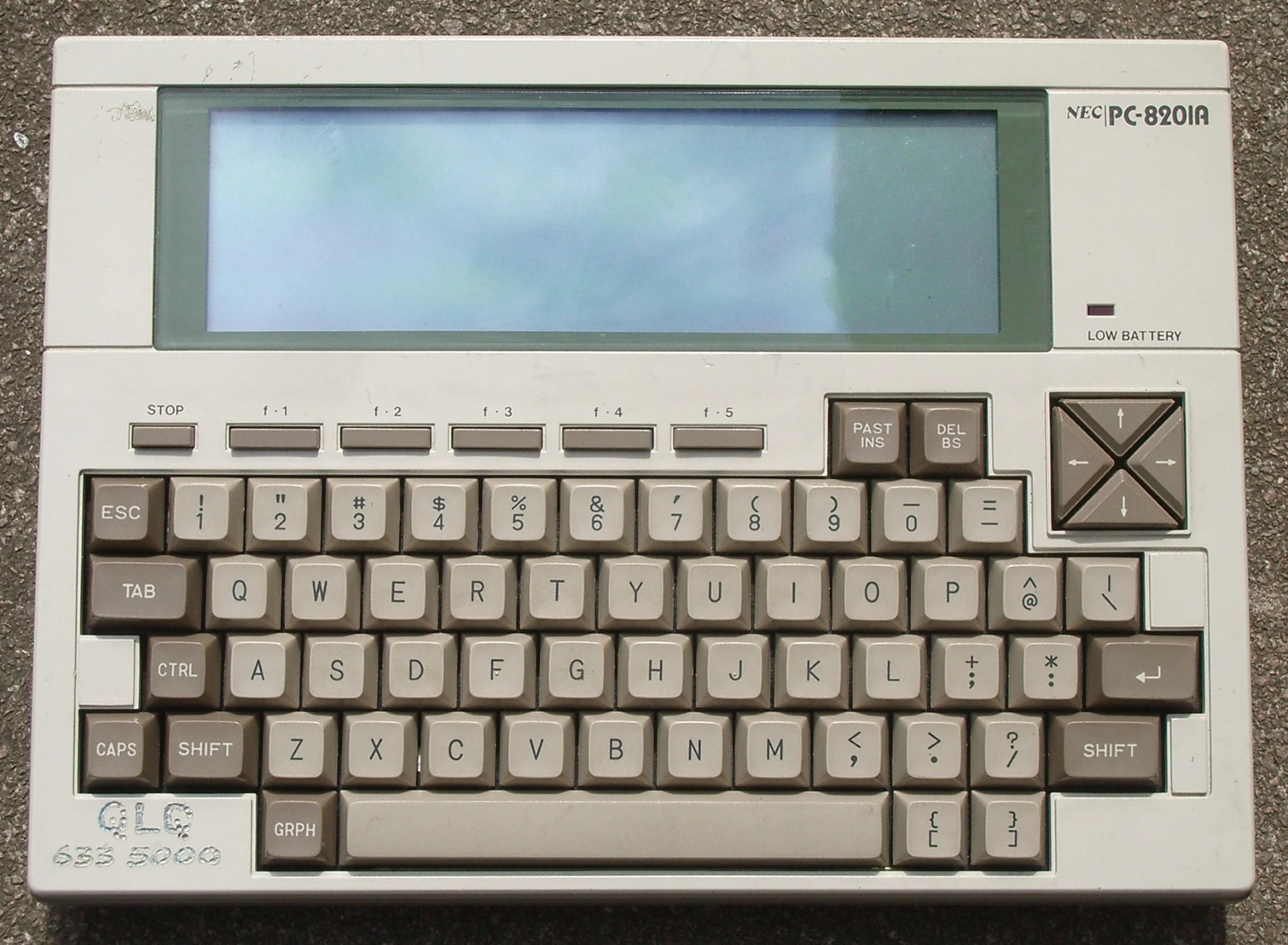
The game was reprinted in one of the magazines (June, by the time they went monthly), but the reprint is for a machine we haven’t had on this blog yet, the PC-8201. The one-digit difference hides that this is a much different system. The PC-8201 is a portable computer, NEC’s answer to the Tandy 100.
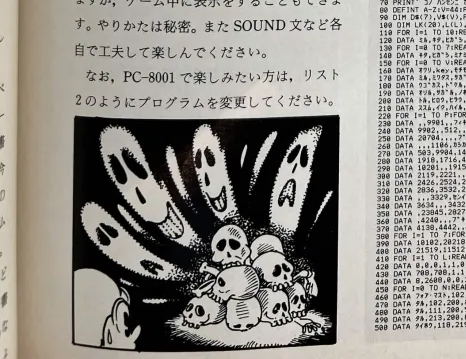
The game was actually published by Shinkigensha on tape before the June issue came out (price 3500 yen, shipping 240 yen), and the BASIC source code had bugs! In addition to the PC-8201 version, the June article has fixes for the tape release, and tells the readers to retype the BASIC lines with the fixed versions.
When I made this joke a few days ago, I didn’t realize it applied to this game.
In case you are curious, here are the two changes:
Correct: 2220 IF NN<>5 THEN PRINT “* アシヲ イタメマスヨ!”:PLAY “o7c4”:GOTO 1130
Incorrect: 2220 IF NN<>5 THEN PRINT “* アシヲ イタメマスヨ!”:BEEP:GOTO 1130
Correct: 2740 IFPC(P2,J)>10000 THEN D1$=D$(8-INT(PC(P2,J)/10000))+”ニ ススメル”
Incorrect: 2740 IFPC(P2,J)>10000 THEN D1$=D$(8-PC(P2,J)/10000)+”ニ ススメル”
(The missing INT rounds to a whole number; this sounds like a bug that could crash the game.)
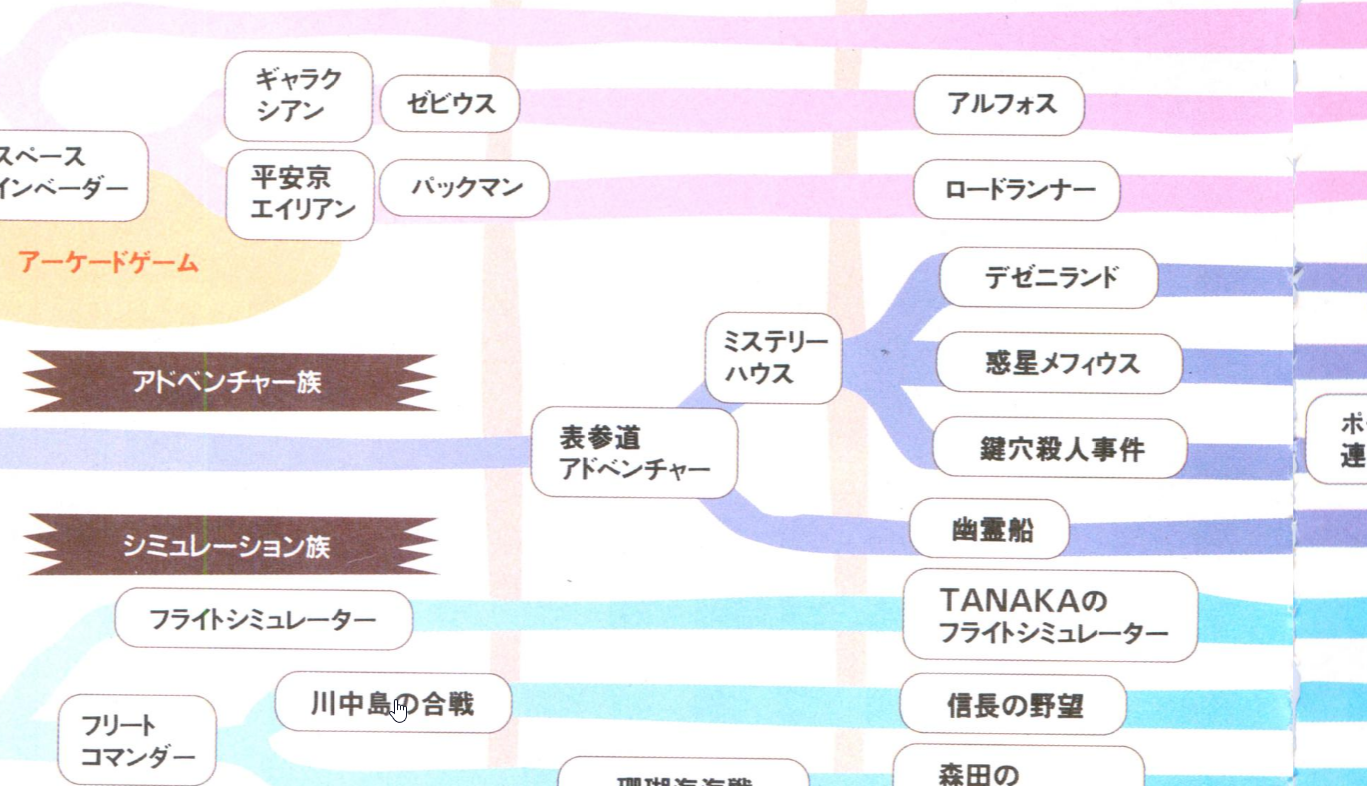
The image shows a branching chart of Japanese game history, subdivided into various genres. The middle blue timeline shows adventure games, starting with Omotesando Adventure, branching up to Mystery House and various other games on top. Branching down from Omotesando is one game, the only other text-only game listed: 幽霊船 (The Phantom Ship).
This is the first text-only adventure game in Japanese, and it was considered notable enough to be listed in a magazine 10 years later as one of the foundational games of the adventure genre as a whole.
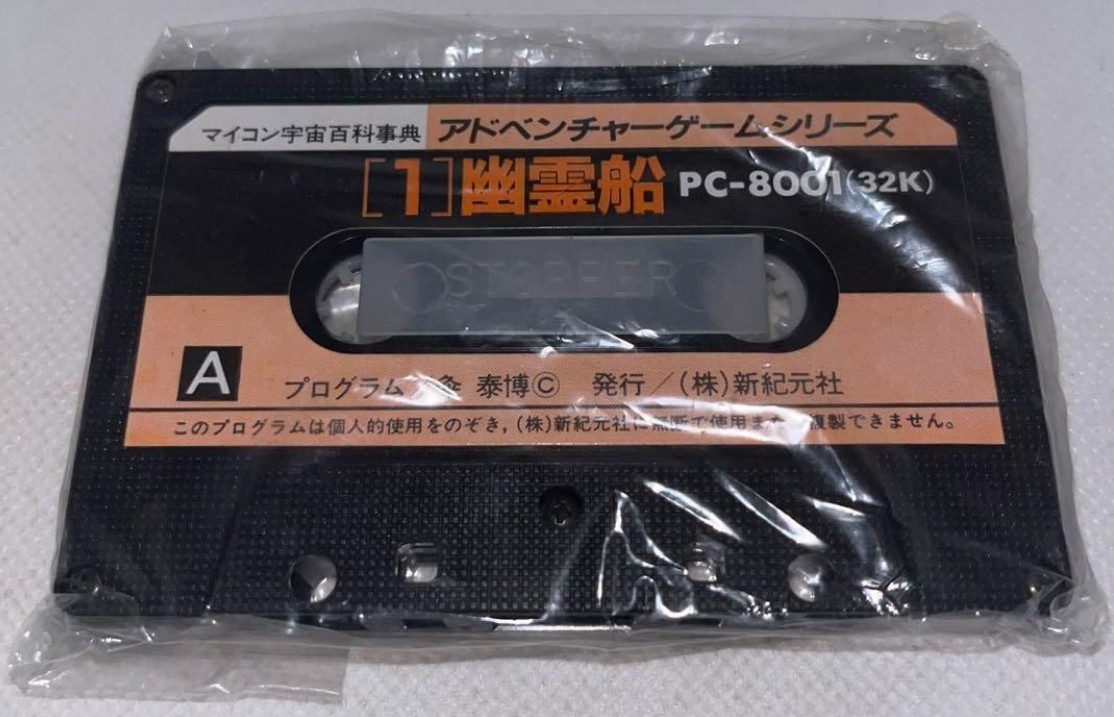
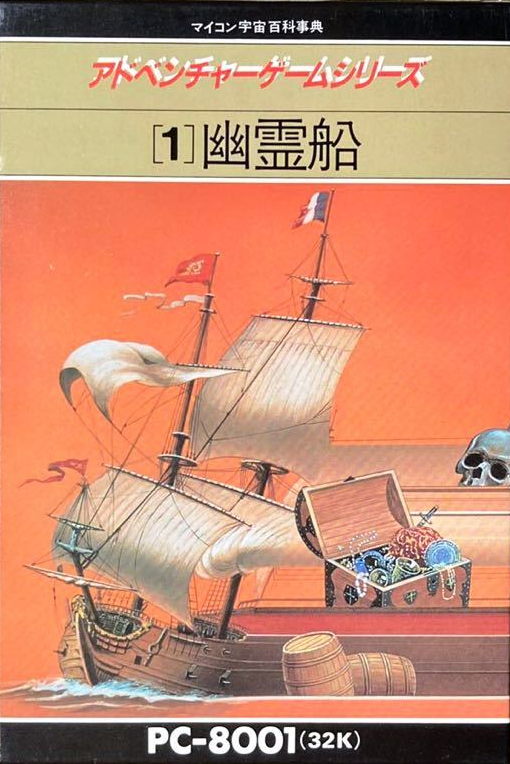
Cover of packaged version.
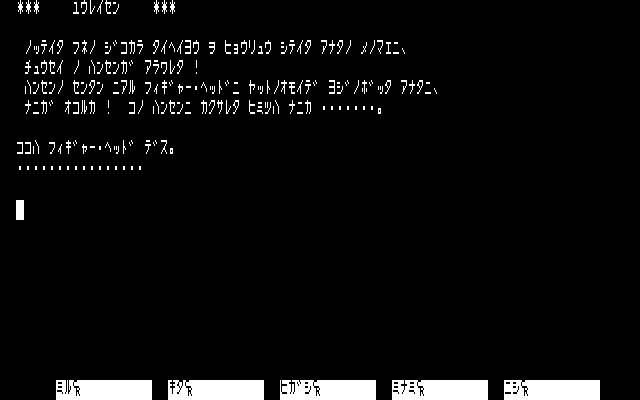
There was an accident on your ship, and as you drift in the Pacific Ocean, an old sailing ship appears before you. You “manage to climb up to the figurehead at the bow of the ship”, and this is where the game begins.
The function keys are enabled (the game also lets you change their assignment). By default they’re look, north, east, south, west, open, left, right, up, and down in order.
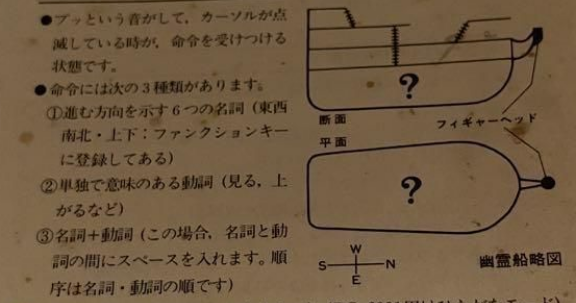
The instructions (see above) include a general map (the black point on the right is the figurehead) but also helpfully specify how to parser works: noun, followed by a space, followed by a verb.
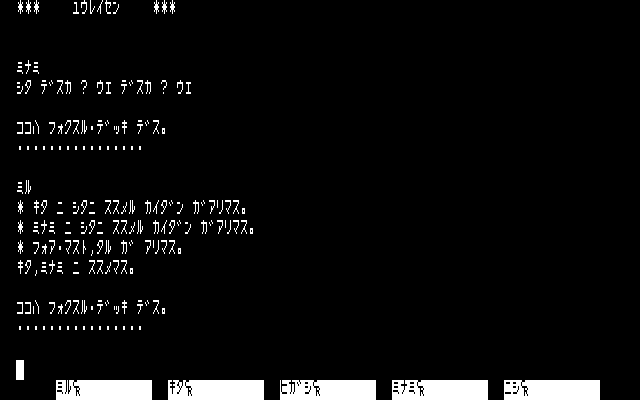
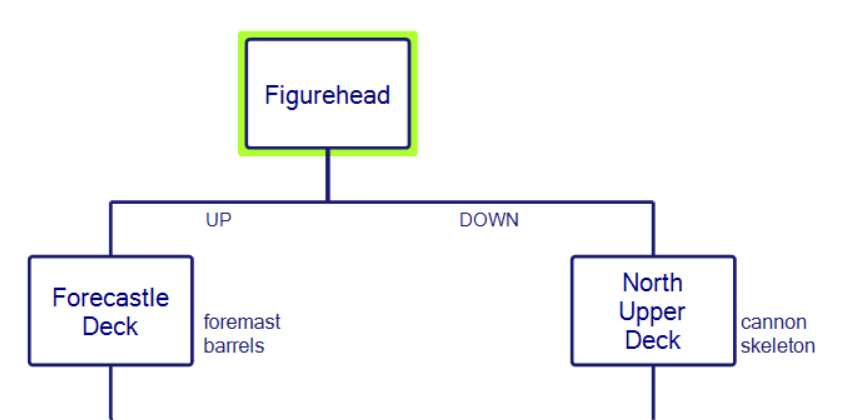
Moving on, I did LOOK to find that the game mentioned the exit was to the south, to a stair that goes up or down. Going south, the game prompts you (rather than having a stairs “room”) which of the two ways you wish to go. Up leads to a forecastle, which has exits to the north and south to stairs, and a barrel (タル) by the foremast. (Or maybe barrels. Japanese needs more context; for example you could put the equivalent of “many barrels”. Just “barrel” on its own could mean one or many. This is non-trivial in an adventurer sense, for a single container you might expect to open, but a whole pile of them is more likely to be scenery.)
At the opening stair, picking “down” instead leads to the north upper deck, including this text.
* There is a staircase to the north that leads upward.
* There are cannons (or is a cannon) and skeletons (or a skeleton) here.
You can go to the north or the south.
Later the game uses “pile of skeletons” so I think it’s skeleton singular, but cannon is ambiguous; generally speaking I’d expect there to be multiple cannons in a section of ship. Parsing the line タイホウ,ガイコツ ガ アリマス literally you get
cannon(s), skeleton(s) exist here
There’s even more trouble in just this room (and the forecastle room) in that it was entered via an up/down stair, but to get back to the stair (and the figurehead) you just go back north.
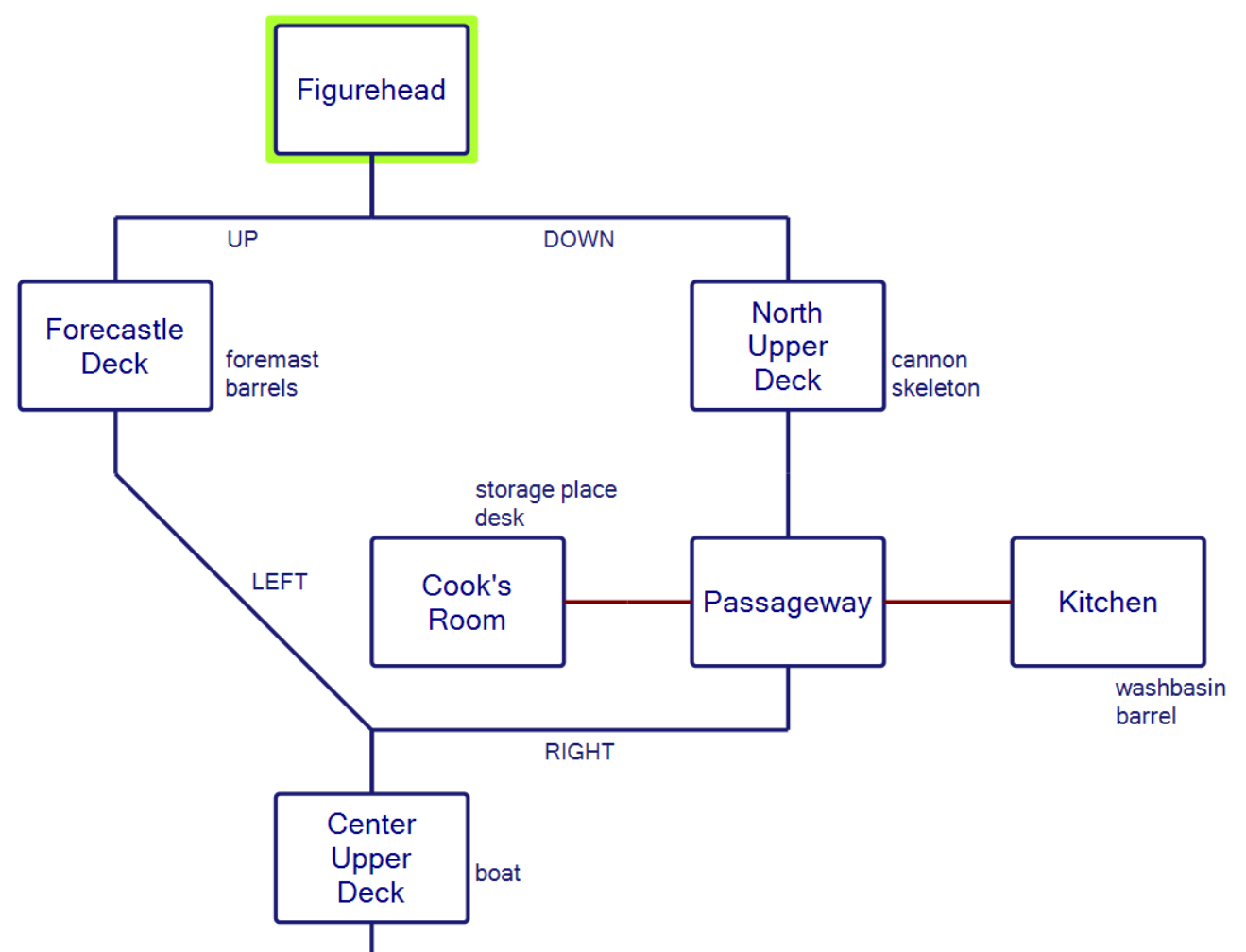
It feels like there’s a room you pass through while going south (even though it exists via simply an up-or-down prompt), but the room doesn’t exist and doesn’t get mentioned when going back the other way. This turned out to be non-trivial for mapping, especially because there are also directions that lead to left-or-right forks. Expanding the map a little:
Going south along either the up-stairs or down-stair paths eventually re-merges at the center upper deck, and then going north has the game prompt you for if you mean left or right. I was baffled for a full hour with multiple connections like this I originally had going the wrong way.
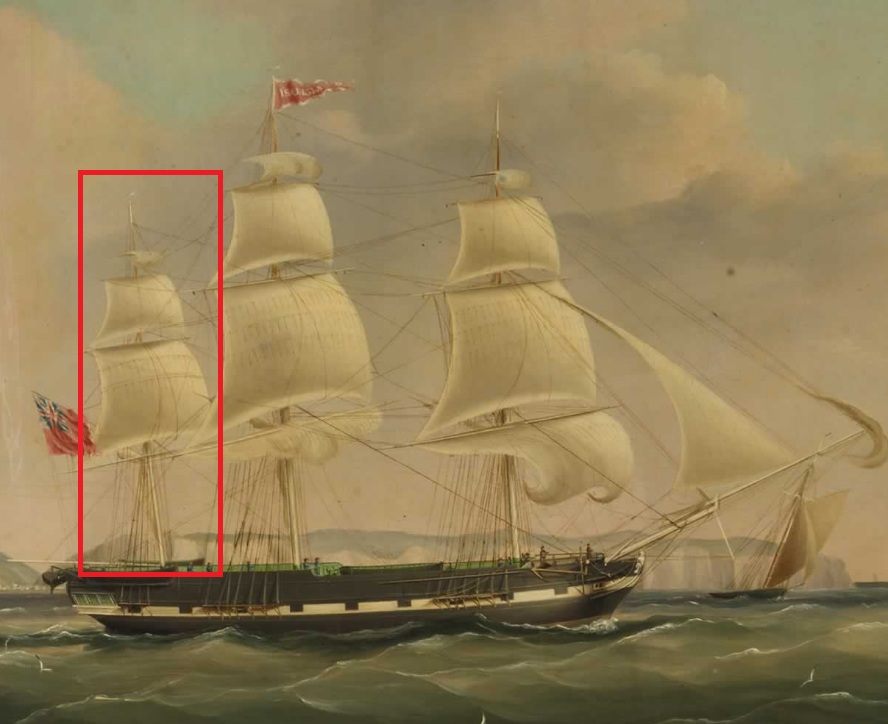
This is all compounded by the fact that I’m not good with ship terminology. For example, at one point I came across a “mizzenmast” (or rather “mizzen masuto”), which I could read off the katakana (having run across masts already I knew what “masuto” was) but I did not know I was looking at an actual English word so I wasted time translating a “mizzenmast” into “mizzenmast”.
It’s this one. I’m a landlubber, ok? Image source.
All this is to say I’m going to leave off here and continue with having everything mapped out next time (and maybe the game finished, if it’s straightforward enough). I can say this is not a game about obvious threats; there’s skeletons but none of them have risen up attacking with swords. There’s obvious locked doors at the back, er, stern of the ship, so I assume any rising action comes from there. This may end up like Death Dreadnaught where exploration and atmosphere are largely the point.
Special thanks to f_t_b (for scanning assistance) and the Game Preservation Society (especially Joseph who helped locate the June article).