I am also a big fan of the game Merlin. It took me 30 years to finally beat it and the feeling of satisfaction when I finally returned to Londinium with Excalibur… fantastic.
— zbfairlane from the Microbee Technology forums
I’m having some tech issues with my original planned game, so I went over to random.org to pull something unexpected off my list and came back with another game for the Microbee. Our last encounter with the Australian-local Microbee was quite recent; you can read all the details at my writeup of Eye of Min. Eye of Min was published by the software arm of Microbee, but other companies published for the Microbee as well, one of the more notable companies being Dreamcards.
Dreamcards didn’t actually start with the Microbee, but rather a different, even more obscure Australian computer known as the DREAM 6800.

Mike Bauer from 1979. Source.
Mike Bauer had been tutoring in Computer Science at Deakin University in the 1970s and had his eye on the new micro-computers popping up, but they tended to be too expensive. Motorola released their 6800 chip in 1974 (including work from Chuck Peddle who’d go on to lead design for the Commodore PET); a year later they put out a “D1 kit” which was a bare-bones version meant for hobbyist use, so hobbyist it didn’t even come with a keypad.
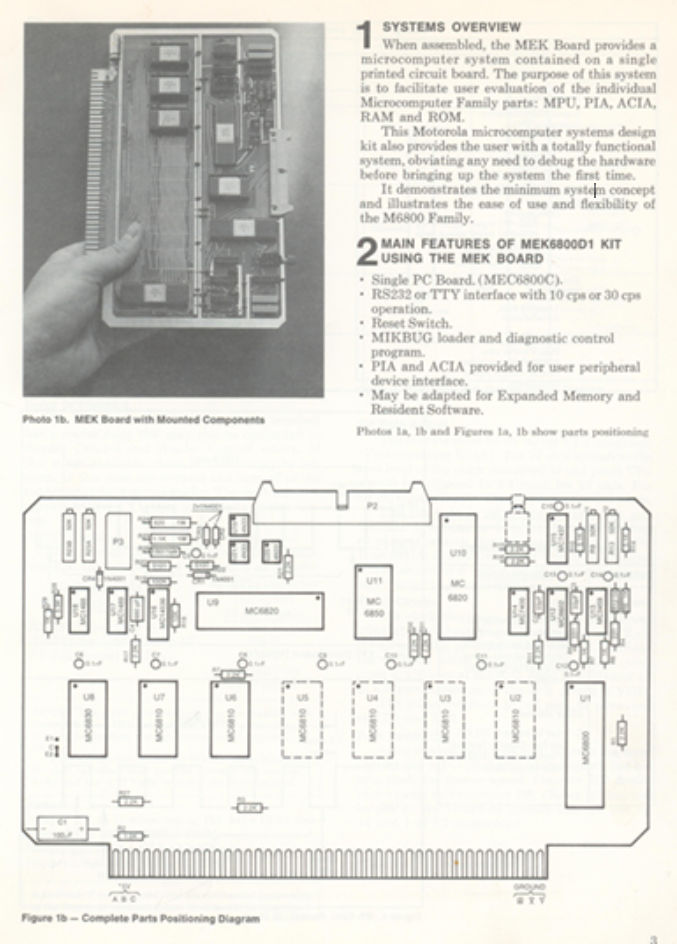
Via the MK6800D1 manual.
Mike picked one of these up and “made a RAM expansion board for the D1 with 4K bytes”. He used an old teletype for a user interface, and wrote an assembler in FORTRAN on his university’s DEC System 20.
He built a 64 x 64 pixel graphics controller and sent it in to Electronics Australia to potentially be published (they’re the same ones that published the ETI 340 plans that eventually turned into the Microbee). These plans were rejected by the editor (Jamieson Rowe) for being too expensive. A few months later, Bauer noticed an ad in Byte magazine for the RCA COSMAC as designed by Joe Weisbecker (which I’ve discussed in detail here with my writeup on Tiny Adventure). As he explains:
The VIP board had a custom video controller chip producing a 64 x 32 pixel monochrome display, a hex keypad, minimal RAM (1KB, I think) plus an EPROM with a clever interpretive programming language Joe called “CHIP-8”, coded using hex numbers instead of the more conventional ASCII text (as in BASIC, Forth, etc).
This inspired the DREAM 6800 which I admit was a blatant rip-off of the VIP concept, except that the Dream video controller circuit was designed around “discrete” 74-series and 4000-series logic IC’s to generate a PAL-compatible display format (50Hz vertical refresh rate, vs 60Hz for the VIP). And my audio tape modem circuit design was 100% original and much simpler than both the VIP and Motorola D2 kit tape circuits.
He also made a clone of Joe Weisbecker’s CHIP-8 language for the system, with permission:
He was really chuffed that his idea had caught on “down under”.
CHIP-8 is sort of a self-contained virtual machine for giant-pixel games, in much the same spirit as the developed-much-later Pico 8 virtual machine. (Bookmark CHIP-8 in your thoughts, as it will come back in a moment.)
Returning to the hardware design of Bauer, it became the DREAM 6800, and this time when he sent in the design to Electronics Australia it was accepted, and published in 1979. It was a minor hit amongst hobbyists; DREAMER magazine was published between 1980 and 1982 specifically to support the hardware.
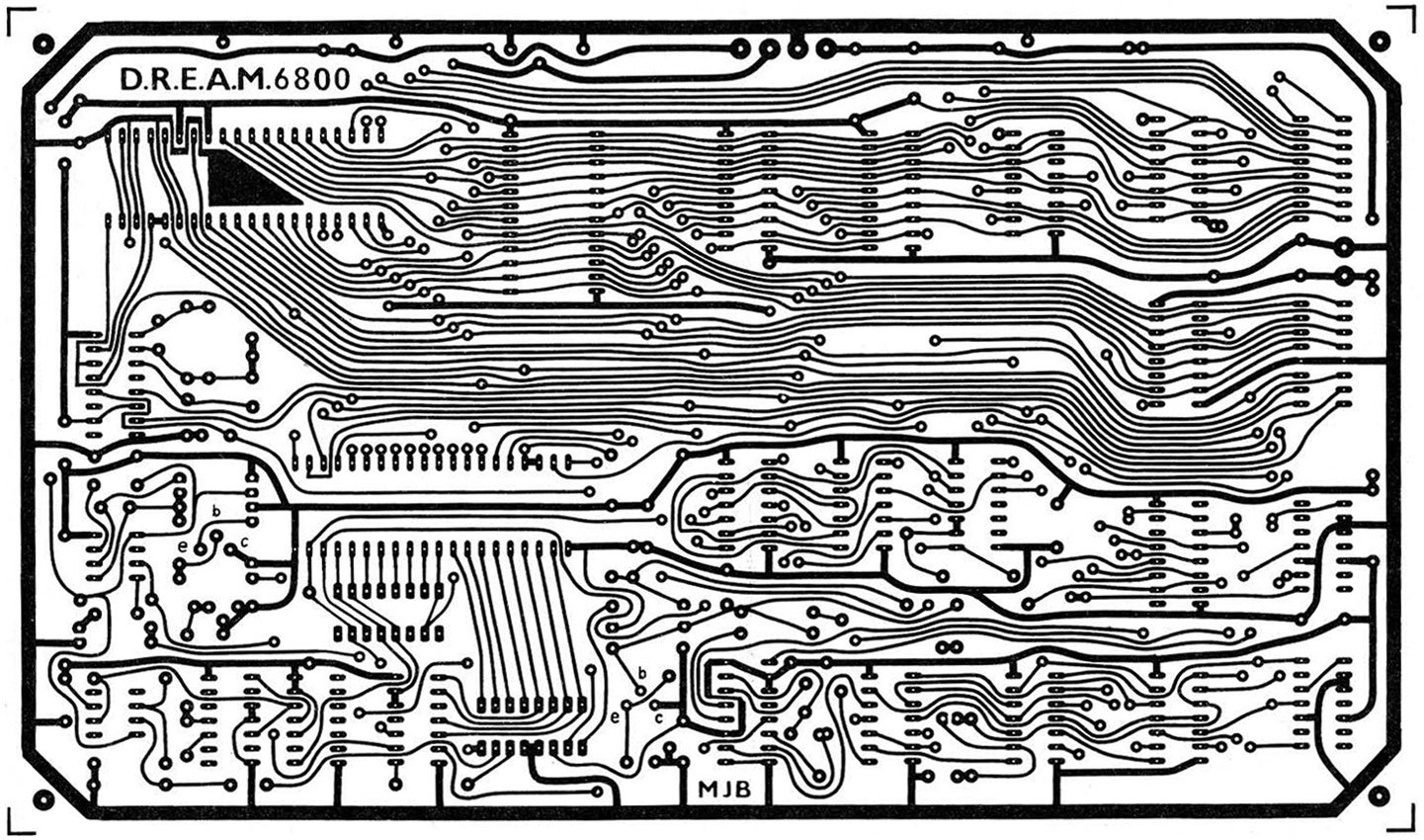
One of the chip designs in the original Electronics Australia article. Source.
Our main protagonist today was one of those hobbyists, Lindsay R. Ford, a lawyer from Victoria. His company Dreamcards started with mail-order for the DREAM 6800, writing games in the CHIP-8 language.
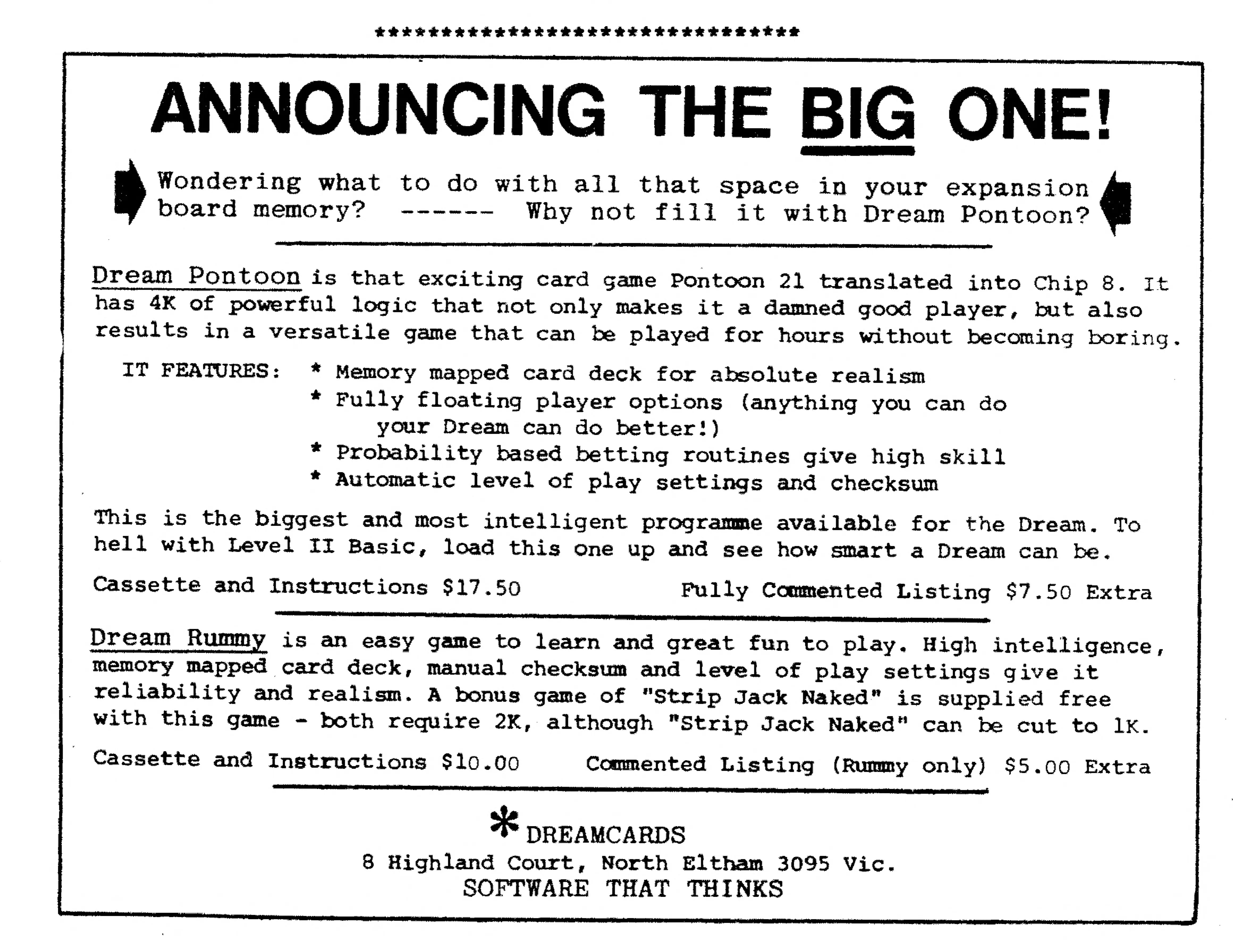
From the September 1981 issue of DREAMER.
When the Microbee came out in 1982 it took over the same niche as the DREAM 6800, and the hobbyists (including Ford) transitioned over; Ford started selling Microbee games, landing some products in stores by the fourth quarter of 1983. He hadn’t forgotten his love for CHIP-8 and released a CHIP-8 interpreter specifically for Microbee.
The language was originally developed in the US for use in video games (see Byte magazine, December 1978). It is a no frills, high speed, display-oriented language that uses 4-digit hex commands to carry out its various functions. Because of its execution speed, it is ideally suited to writing graphic sequences where animation is required or for fast “shoot-em-down” type games. CHIP-8 is a “higher level” interpreted language, so it is also considerably easier to write than machine code or assembler (the usual languages in which arcade games are written).
Ford always remained a lawyer first and a software hobbyist second, noting in The Microbee Owner’s Journal (October 1984) that for “anyone intending to write commercial software … it’s a great hobby, but a terrible way to make money”.
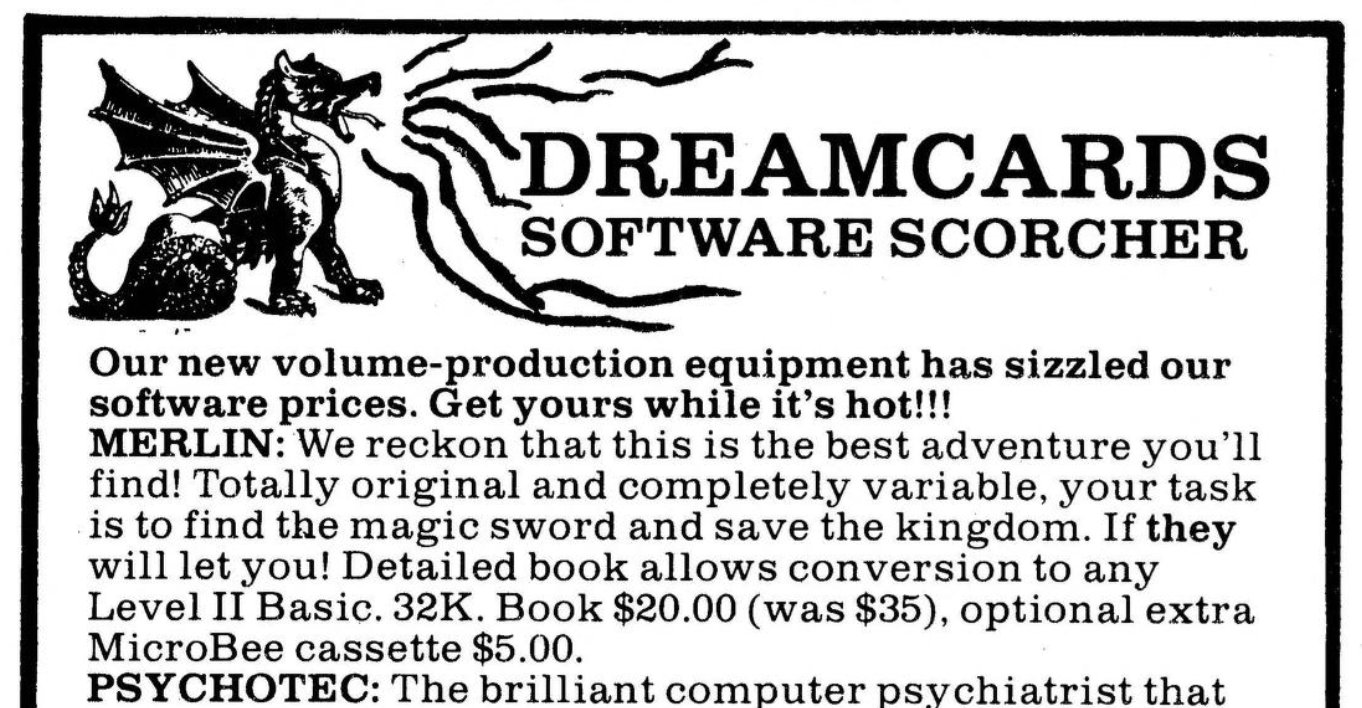
Your Computer (Australia), October 1983. As the ad implies, the “book” includes the entire source code.
This blog’s interest is in the Dreamcards adventure games, including three from 1983. The games Caverns and Hyperdrive by John Hardy were started on ZX81 but published on Microbee; you can read about them here and here (they’ll land on this blog eventually). Merlin was written by Ford himself, and was out by around April 1983.
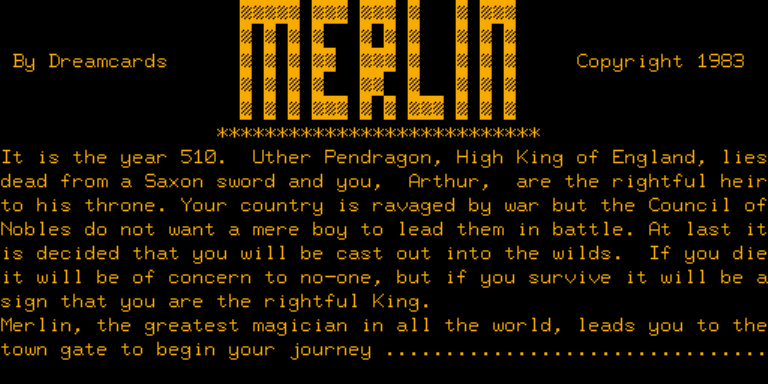
You play Arthur after the death of Uther Pendragon, allegedly rightful heir to the throne, but the Council of Nobles believes you are too much a boy to lead a battle. You are sent “into the wilds” by Merlin, and if you manage to return you can claim your place as king.
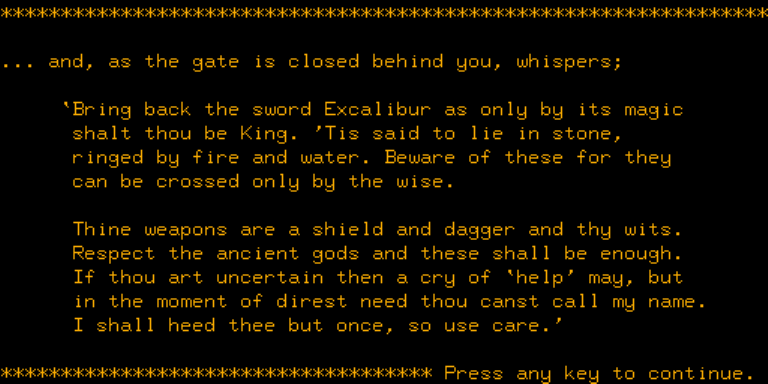
Merlin informs you that your quest is the sword Excalibur, which lies “in stone” and “ringed by fire and water”.
Thine weapons are a shield and dagger and thy wits. Respect the ancient gods and these shall be enough. If thou art uncertain then a cry of ‘help’ may, but in the moment of direst need thou canst call my name. I shall heed thee but once, so use care.
This does not have graphics like Eye of Min, only pure text here.
You are standing outside the high stone wall of the town of Londinium.
The wrinkle here is that this is one of the rare adventure-roguelikes, like Madness and the Minotaur and Lugi. The game is set out on a grid where the locations are randomized. so we’re in territory related to HOBBIT, Wizard’s Castle, and friends. The grid is 11 by 8 rather than 8 by 8. There’s even stats that suggest this might be CRPG adjacent…
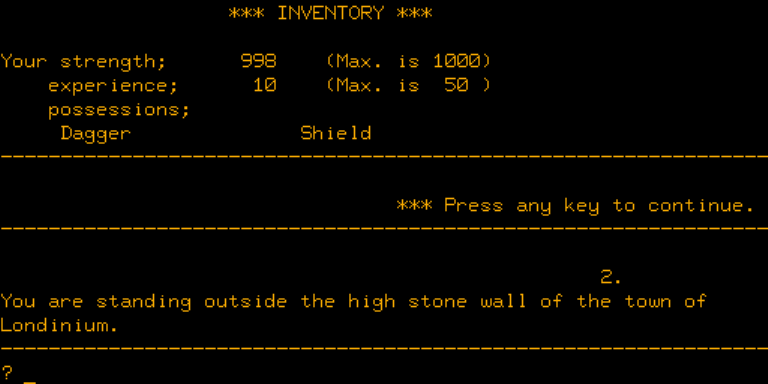
…although based on a brief glance at the walkthrough on CASA it’s got a sequence of events you’re trying to enact so this still falls into Adventure territory. (I’m being cautious because I had one game, Sato’s Adventure, which seemed like it might be a regular adventure at first but clearly stayed within its Wizard’s Castle origins. I didn’t mind playing it but I have an awful lot of games on my list.)
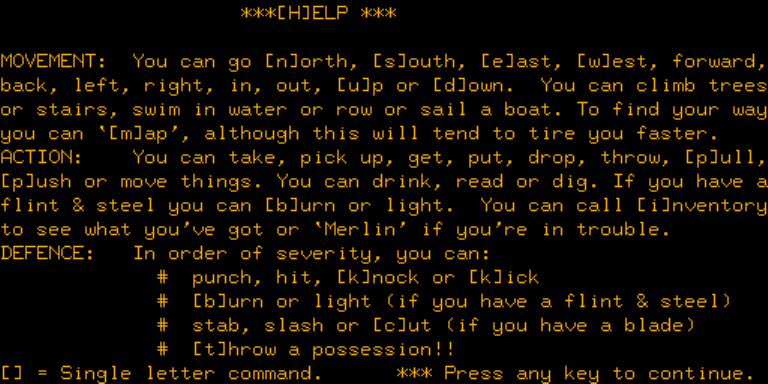
The [m]ap command doesn’t generate an automap, but rather tells you were you are located relative to the start position, written like “3n 1w”.
Whenever I approach one of these games I’m always fretting over my general approach: should I lock in a save right away (save state, in this case) so the map doesn’t change, nullifying the randomness, or is that a bad idea? Some games have a “slot machine” aspect with unwinnable scenarios (see: Conquest of Memory Alpha), and the only way to get a handle on the issue is to try out multiple runs; also, just in the interests of documenting a game for historical purposes, it’s nice to know how radically different the random elements can change.
What I decided to try this time was to map out a small area near Londinium two times to see what stayed consistent and what changed. Afterwards, I wandered a bit to see what would happen. I probably will lock in a run before starting my next post.
MAP ONE
I just mapped a 4-row by 3-column area; the start point at the gate to Londinium is always at the bottom of the map, and if you leave and return, there’s a sign about knocking to enter.
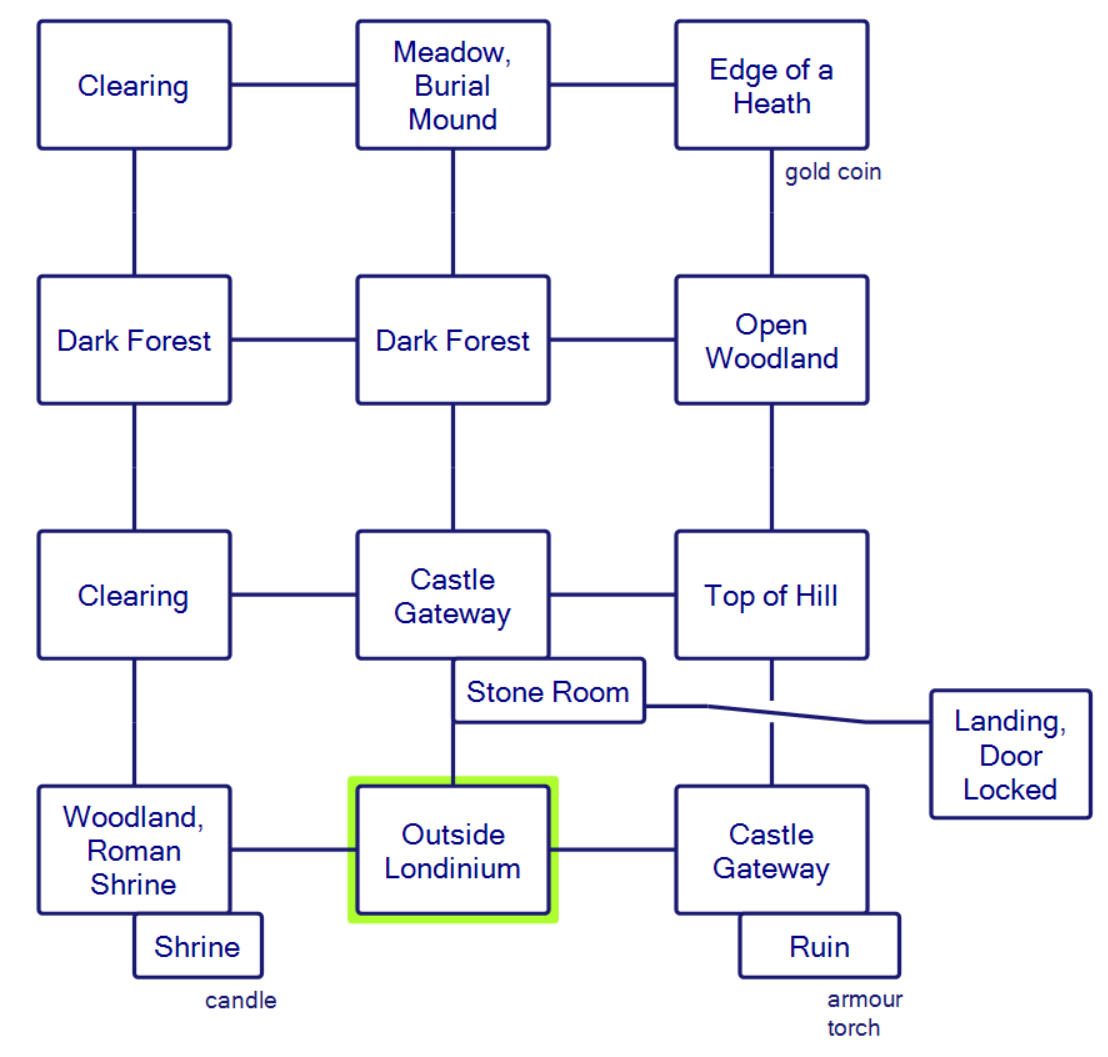
Heading just north there’s a castle; confusingly, the first time I went east from there I entered the castle, but didn’t do so on subsequent visits. It’s more reliable to simply use ENTER (then EXIT to leave).
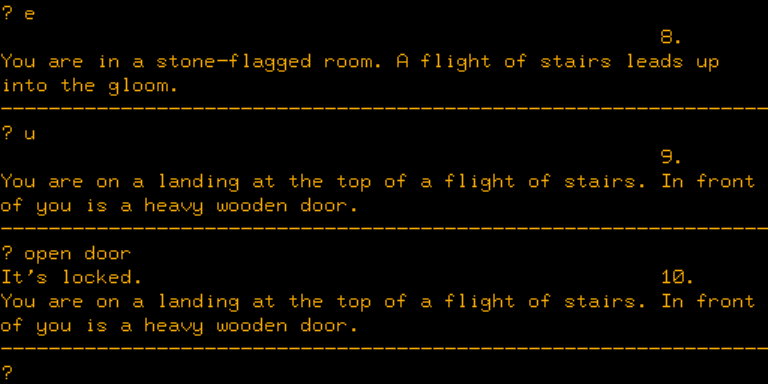
The castle has a top floor and a locked door. I have yet to find a key (but I am only exploring the 4 by 3 area at the start, so I wasn’t expecting to yet).
The map generated a second castle to the east of the start; this one is in ruins, but it does have a torch and some armour you can take. Strangely, I haven’t been able to “wear armour” but maybe it works by default.
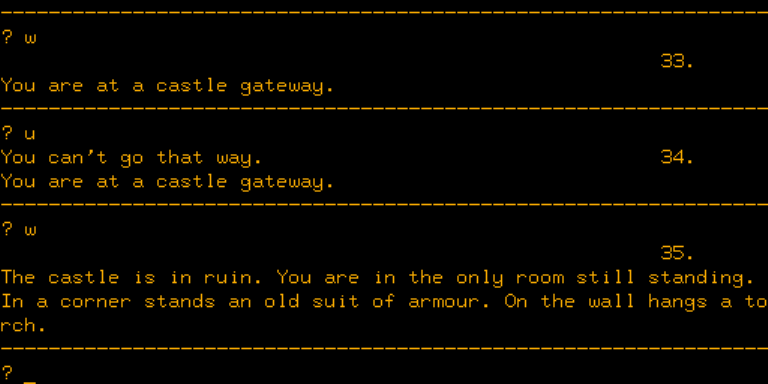
This castle can be entered by going west, but you’ll notice on the same screen the game said I couldn’t go that direction. Other times I could go west and travel along the map normally (in this case, back to the start room).
To the west of the start room is an old Roman shrine you can ENTER. I wasn’t able to use PRAY. I’m not sure what to do here yet.
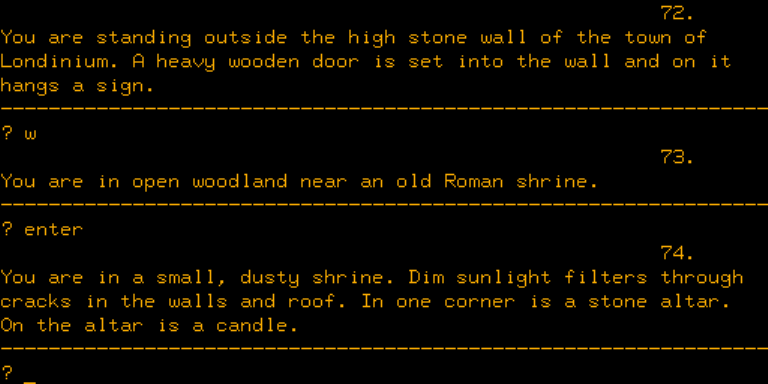
The other places are more generic “landscape” rooms although one place had a burial mound, and one place had a gold coin on the ground. Trying to pick up the gold coin resulted in me being attacked by a Viking, but I was already done with my map attempt by then and I didn’t want to deal with combat yet so I reset.
MAP TWO
I mapped the same starting area as before; this time the ruin still showed up but in a different position. The shrine and locked-door castle didn’t show at all, but a new castle with an oak tree did.
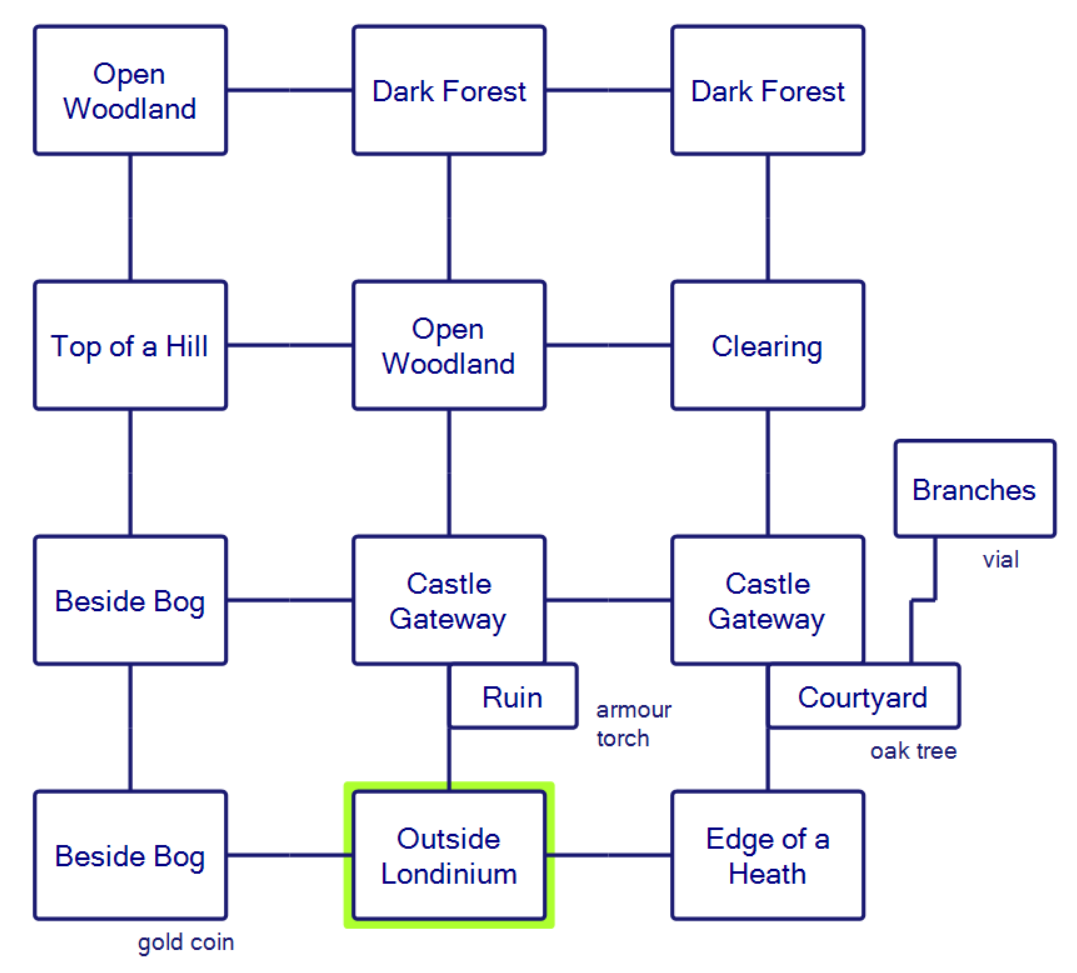
The oak tree can be climbed; it has a vial with a parchment label.
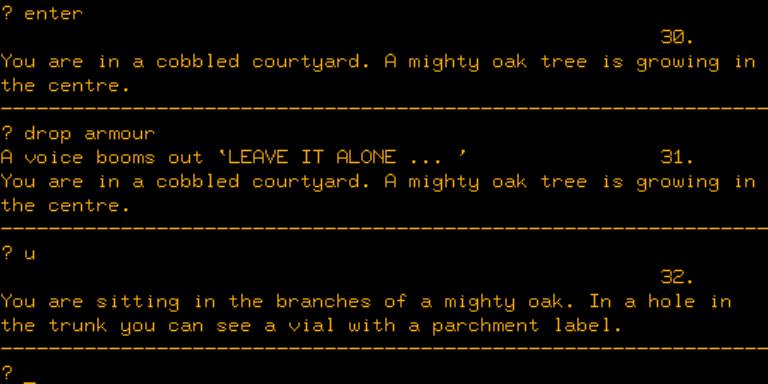
The “leave it alone” came from me dropping the armour with the theory it would be too heavy to go up a tree. This is a curse: it stays in your inventory.
The label says “My Magick Releas’d Imperils the Strong”. DRINK VIAL didn’t work but based on the label implying it was more designed for offense, I went and found an enemy and tried THROW VIAL.
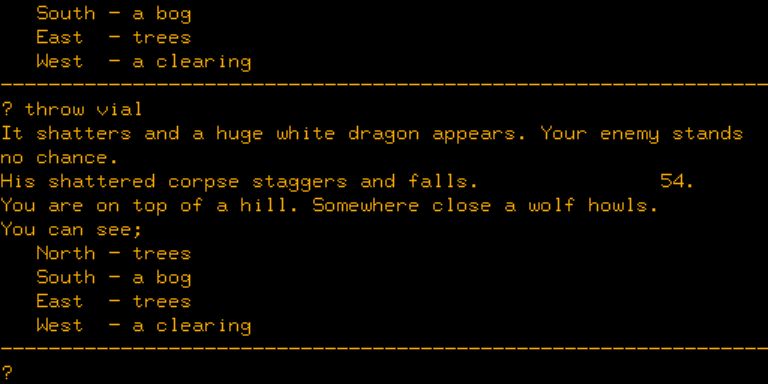
A fairly standard set of fantasy creatures roam about; early in my “map two” wanderings I encountered a goblin which fell to just attacking over and over.
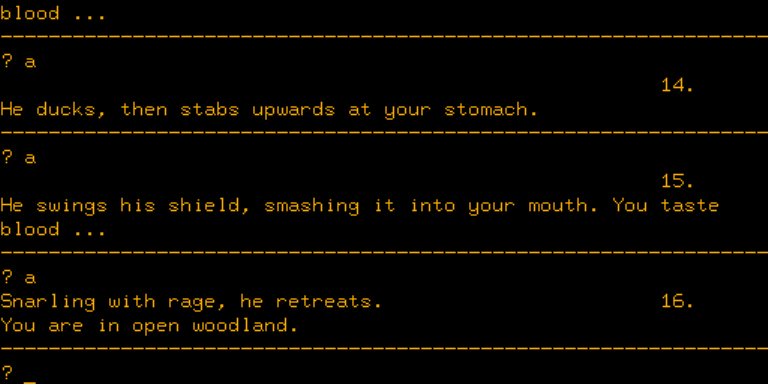
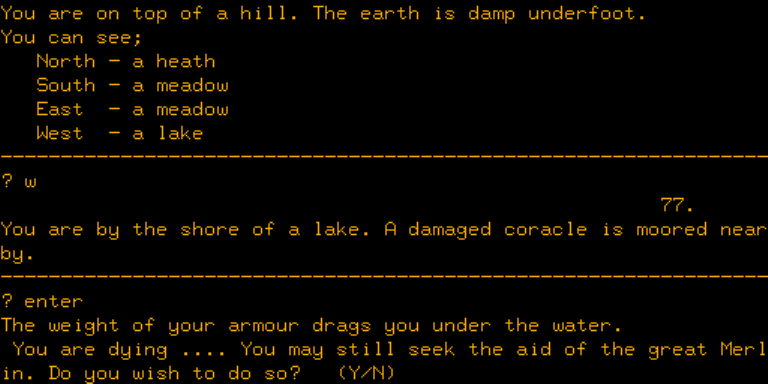
I followed this with some wandering, as promised; there’s a lot of regular wilderness rooms, although with enough variety it didn’t feel as “flat” as HOBBIT did. Eventually I ran across a “damaged coracle” and the armour curse I mentioned earlier triggered.
I’ll try to do a full map run next time and work out what I’m really trying to do in order to get to Excalibur.


