With today’s game, due to unique circumstances, I’m going to pull out a review first. Specifically, one from the November/December 1983 issue of Softline.
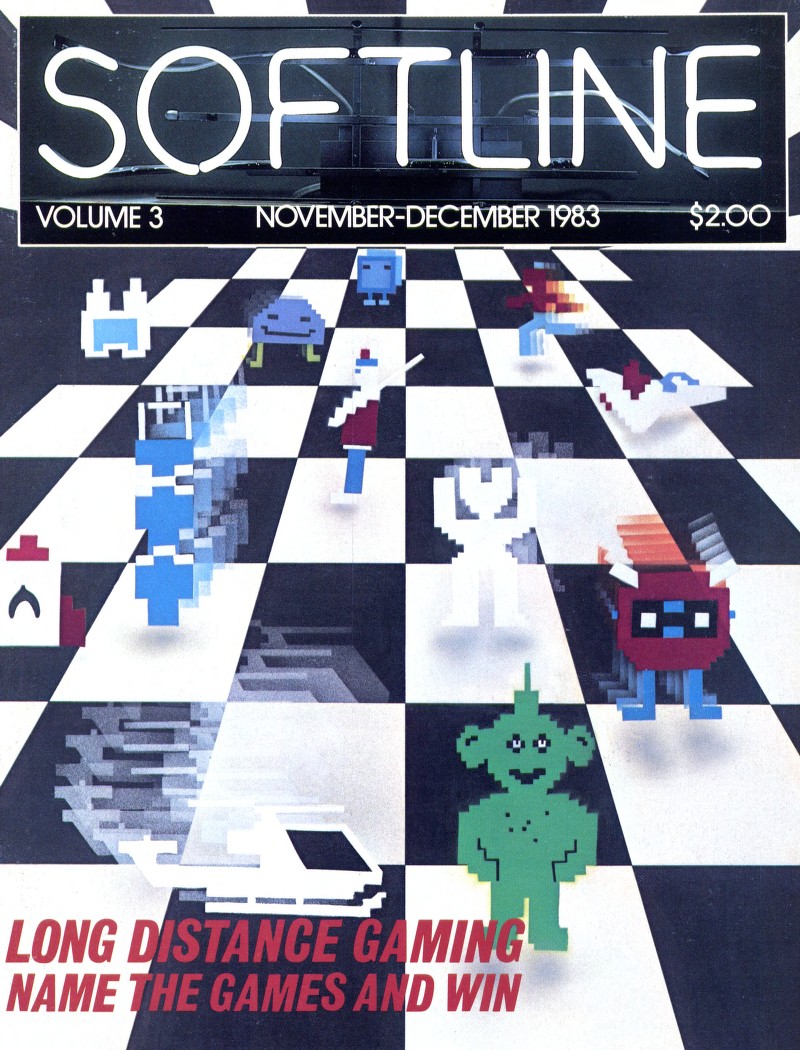
Quoting directly:
There are adventures, and there are adventures, and then there are adventures. And after them, there’s this. It’s Blood Quest. It’s new. It’s now. It’s happening. It rages. It melts. It burns. It’s free verse. It’s beyond description. It’s the last word in graphic adventuring.
This game has everything, and consequently it’s aimed directly at the adventure gamer who is tired of playing adventures. It is best approached with a completely open mind, and from the rear.
A similar tone continues to the end, which made me suspect something odd was going on.
But after a few days of playing Blood Quest, you won’t even be thinking of trying to sleep. You won’t even be thinking.
It isn’t often that one comes across something totally original. Perhaps, someday, someone will. AC
AC is “Andrew Christie”, the head game writer for the magazine at the time. I originally thought (despite there being a screenshot) this might be a prank review, and this extended to the company credit.
Apple, 48K. Price negotiated on a per-person basis; first come, first served. Brøderbund, H. Oaks Department, 17 Paul Drive. San Rafael, CA 94903.
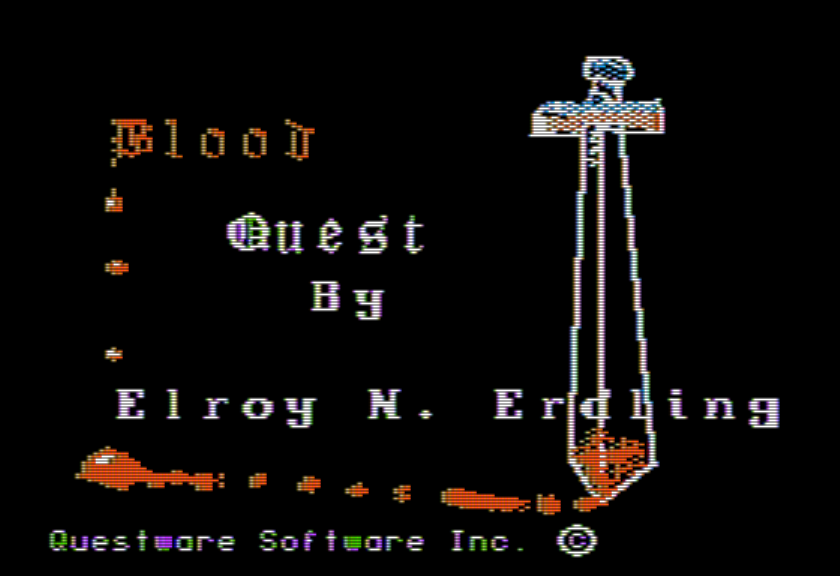
Brøderbund! I had never heard of them making an adventure game in 1983 (they did eventually publish the Ultrasoft games, but not yet). In fact, I didn’t think they had developed any adventures at all on their own, even though their story ties in via publishing the Synapse games (like Mindwheel) and the early Cyan games (like Myst). However, it turned out Blood Quest is indeed a real game, with a title screen proclaiming it by Questware Software, Inc. and Elroy N. Erdling. To explain, I need to backtrack and do the history of Brøderbund, earlier than I expected I’d be needing to.
Doug’s Carlston’s first taste of computers was in high school in the 60s during a summer program, and he felt comfortable enough working with them that when he went to college at Harvard (a self-described “scholarship kid”) he got a job at the lab; he sat at the desk and helped people with their issues. Before finishing his degree he spent time with the Peace Corps in Botswana (learning Swahili along the way, publishing a book about it the same year he graduated Harvard) and later received a law degree from Harvard as well (still making money working for the computer lab). From there he went to a Chicago office.
It was a large, downtown firm — what they called a LaSalle Street firm. It was on the 83rd floor of the Sears tower (in Chicago) and it did general law for hundreds of different kinds of clients. Young associates were bounced among the various departments to try things out. I found that in the tax and the trust departments it was easier for me to take the work home and run it on my TRS-80. I would crunch the numbers and come back rather than doing it at the office where you were expected to do everything using dictation. Nobody had typewriters in their office; that was secretarial work. It was a very inefficient process but I liked things that other people didn’t like because I liked things that were computation intensive rather than research intensive and so I did that. I eventually decided I didn’t want to work at a large firm.
He ended up bouncing over to Maine to start his own rural practice while simultaneously building homes (another side job he picked up in 1970), bringing the TRS-80 with him.
With the computer he didn’t stop at automating law-writing, but started creating a game, eventually finishing the strategy game Galactic Empire. He started selling the game through multiple venues (most notably Adventure International, but also Cybernautics and The Software Exchange).
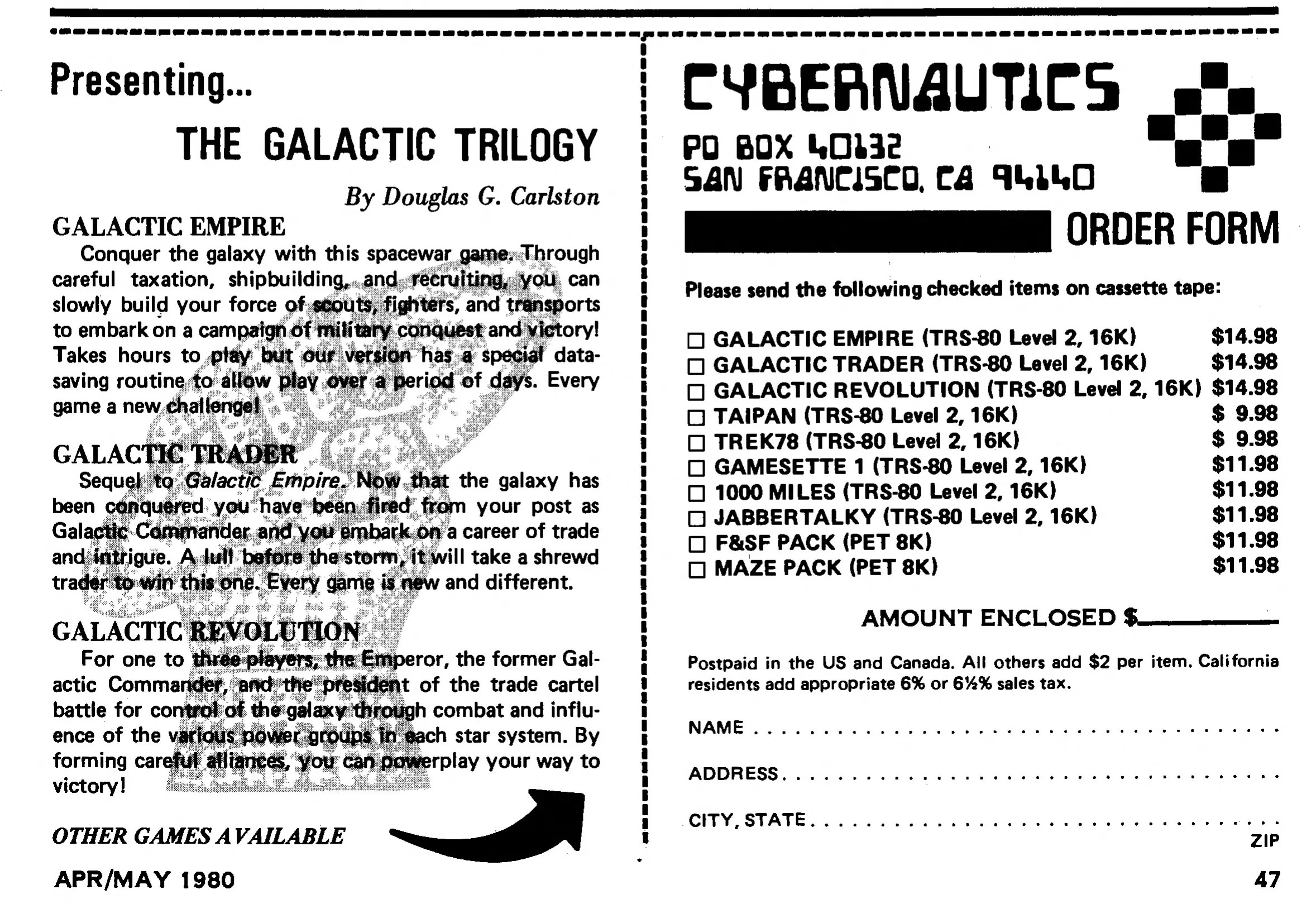
From Different Worlds, April/May 1980 issue.
The urge to program was compulsive, and he was starting to make as much money with his games than with his other work.
My legal briefs ended up with bits and pieces of programming code scribbled in the margins, and I could hardly wait to get back to the office to key my ideas into the machine to see whether they worked.
By October 1979 he had quit law entirely to focus on programming, eventually uprooting and driving cross-country to his brother Gary in Eugene, Oregon. They went in business together while Doug was busy cranking out the sequels of Galactic Trader and Galactic Revolution. The official first call went out in March as Gary called The Program Store in Washington D.C. and was able to move 30 copies of Galactic Revolution, 10 of Galactic Trader, and 10 of Galactic Empire. A mere week after they officially launched, they went down to San Francisco and the 5th West Coast Computer Faire; the legendary event where, in its first iteration, both the Apple II and Commodore PET were launched.
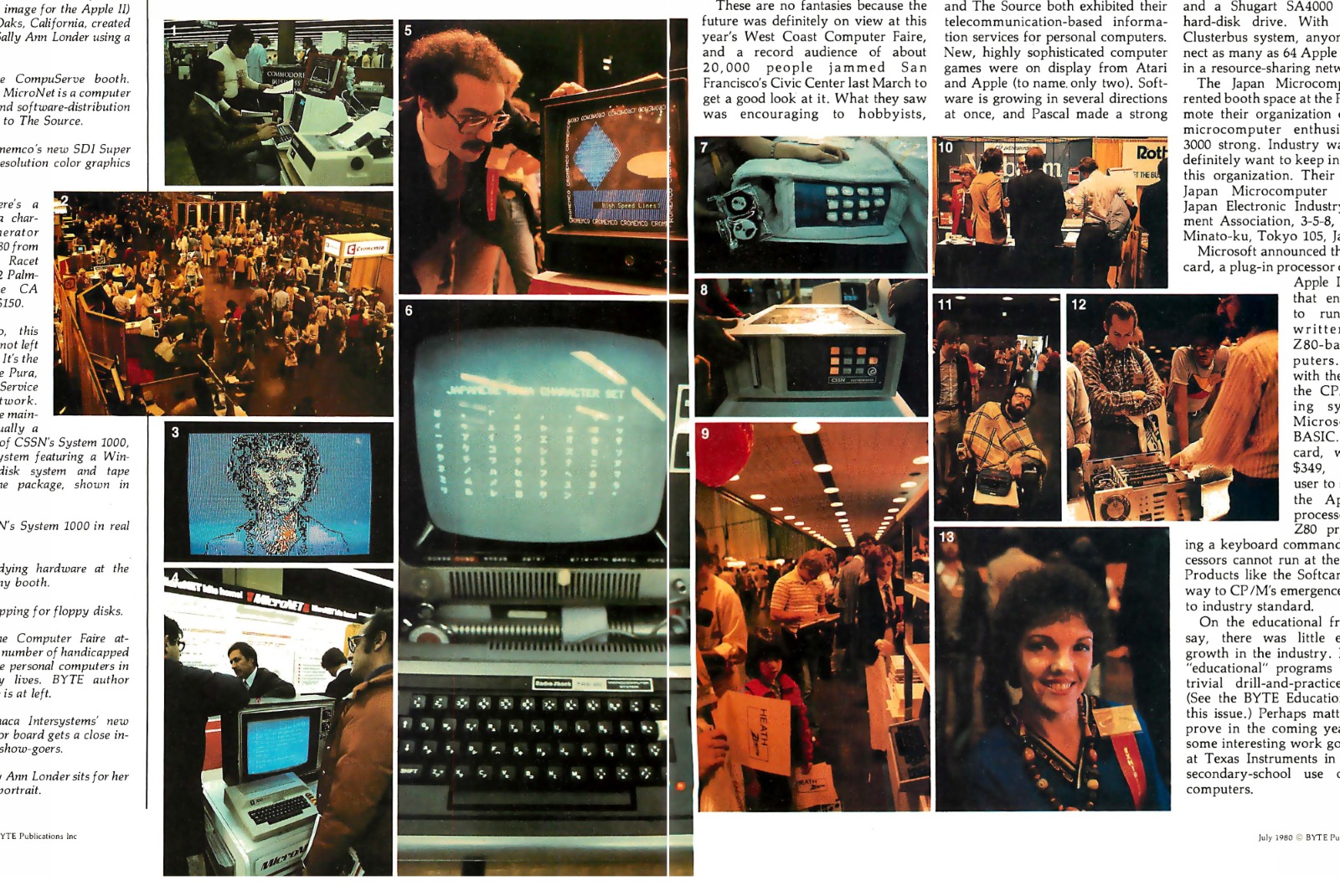
Photos from the July 1980 issue of Byte. Coverage emphasizes graphics were the big star of the show.
Brøderbund brought along the Galactic trilogy with a TRS-80, but also (crucially) an Apple II they had just bought to showcase a fourth game, Tank Command, written by younger brother Don (who was happy as an associate professor in Iowa so didn’t want to join the company; he had originally written Tank Command for the college’s PLATO system before porting it to Apple II).
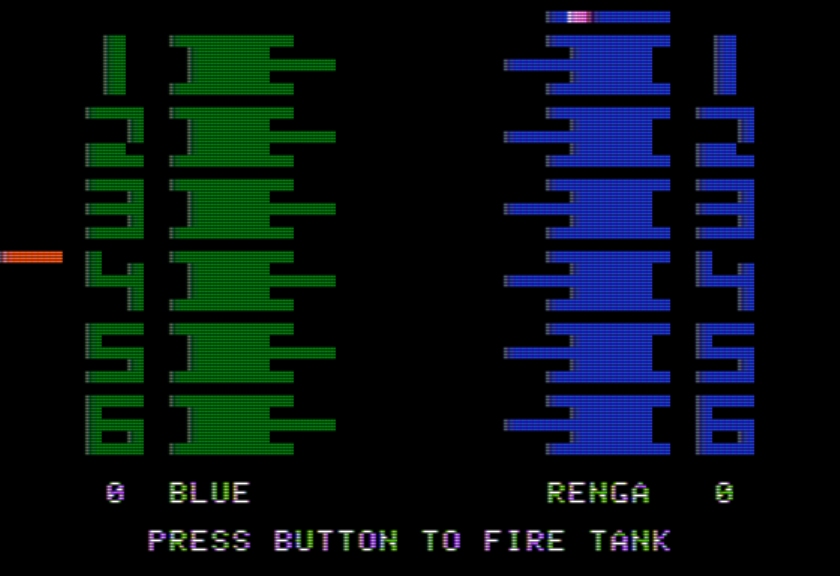
The Wargaming Scribe has previously covered Tank Command if you’d like to see more details.
Being financially on the edge, they had obtained a “microbooth” at low-cost, and happened to be placed next to Jack Hatfield of Placerville, California, as well as the Japanese trader Mioshi. Mioshi had a number of games from Japan for Apple II (mostly arcade clones from the company Star Craft) but no Apple II; the Carlstons were willing to share the one they brought. It didn’t have enough memory (only 16k) but Mioshi also sold memory, and was willing to trade a permanent upgrade for using the computer. (As Doug explains, this barter ended up being a “substantial” amount of the profit they made at the event.)
The fast arcade action was a huge draw; as Doug explains in the 1985 book Software People:
Even though they weren’t even our products, the Japanese games turned us on so much that we began pulling people out of the crowd to try them. But this became frustrating when everybody wanted to buy the games that weren’t ours to sell in the first place. And Mioshi himself had brought only one copy of each game!
In June, several months after the event, Mioshi called Brøderbund indicating he had copies of the game to sell; the Carlstons bought the lot but ended up not making profit due to markup. While they had been busy converting the Galactic series to Apple II, they were by now very short on cash, Doug having used up the money he had saved from his law practices, as well as $8000 loaned from relatives; they were resorting to maxing out limits on credit cards.
The pressure was on, to say the least. Here were two promising Harvard graduates who were losing their money at an astonishing rate.
The brothers had in the meantime sent letters to Japanese magazines soliciting games, hoping for more of the same magic they saw in March. (Allegedly. It’s mentioned in accounts by both brothers, but I haven’t found the letter or letters; however, I’m missing some rare magazines from 1980 like RAM and Interface. It’s also possible letters were sent but never printed.)
The major turn in fortune came at the end of the summer when Minoru Nakazawa (of Star Craft) called from the airport and announced he was going to stop by on short notice.

Minoru Nakazawa, via the November 1981 issue of Softalk.
(ASIDE: The accounts from Doug and Gary about what comes next differ. Doug’s is given in most detail in his book Software People from 1985, and Gary’s is given in Gamers at Work in 2012. I’d say the earlier account is more likely to get details correct but there’s the “politeness” factor to consider given both Brøderbund and Star Craft were living companies in 1985. Also, it looks like Gary was the one to meet Nakazawa first so saw events from a different perspective. I don’t think either account is “false” so I’m doing my best to consolidate.)
As Gary explains, “I figured I had about 15 minutes to make our apartment look like a legitimate business before he showed up. We had two computers but nothing else businesslike.” He had read an article in a dentist’s office about people in the Middle East being impressed with educational credentials (which he knew wasn’t Asia, but he had 15 minutes and that’s all he could think of), and both he and Doug had gone to Harvard, so he tossed a Harvard magazine to be visible on the table when the CEO of Star Craft arrived.
Minoru Nakazawa originally had only come to get an offer that he could use as leverage with a second “legitimate” company in Los Angeles he was going to visit next (I’m guessing Programma International which had been around since 1978; remember Brøderbund was about 5 months old and essentially bankrupt), but he had enjoyed himself so much (“talking about world events, literature, and whatnot”) that he made an offer to Brøderbund instead. As Nakazawa also pointed out, having a middleman do the import sales was a disadvantage to both Star Craft and Brøderbund.
Apple Galaxian (which they were able to start selling by December) became a giant seller. The other element that saved the brothers was the magazine Softalk. As Doug explains in a podcast interview, there was “no organized distribution” when they got started, and most national stores didn’t know who Brøderbund were until Al and Margot Tommervik featured them in their “top 30” in the back of the magazine.
The important thing to note for our story is that they rode action/arcade games to prominence, going on to publish Choplifter in 1982 and Lode Runner in 1983. They would pick up the “electronic novels” by Synapse in 1984 but up to 1983 they hadn’t published any adventure or RPG games.
And now, entering stage left, are our two authors: Gene Portwood and Lauren Elliot.
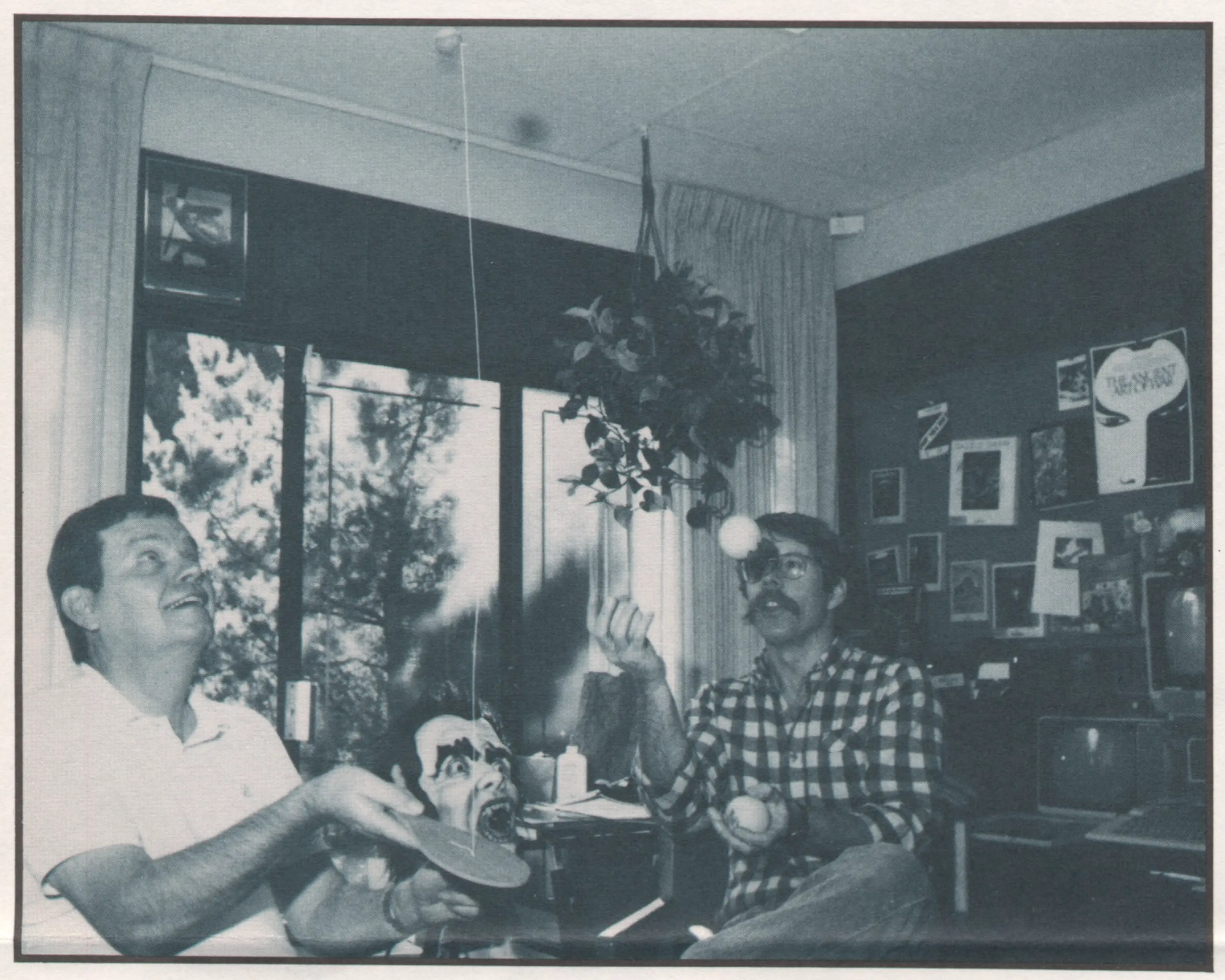
Gene on left, Lauren on right. From the Brøderbund Winter 1986 Newsletter.
The picture from above was taken after the two had co-designed (with Dane Bingham) their main claim to fame (the Carmen Sandiego series) but the article discusses antics from the same year they were hired at Brøderbund.
Portwood came over first. Quite early in life he started working on Disney films but left in the 1950s for more stable jobs at Security National Bank in Orange County, Honeywell International and UC Berkeley. He still kept interested in art and technology when Brøderbund put out a call for an animator; the interest in new technology (and the ex-Disney credentials) landed him the job.
Elliot started with a degree in architecture (and was extended to graduate work in ecology) when he decided to arrive purely unannounced at Brøderbund (while they still had a small staff) and showed his sketches to the brothers over lunch; by the end of the lunch they told him “if you can convince any of the programmers to do your games you’ve got a job”.
“We’re kids at heart, and we both love toys. My grandson always calls to ask if he can come over and play with my Gobots,” Portwood says unabashedly.
‘And we both enjoy computers,” Elliott adds, “though we got into the field in different ways.”
Portwood wasn’t the only artist of the pair (Elliot came from architecture, remember) and you can see below a small clip of them working on animation for Captain Goodnight in a 1985 episode of Computer Chronicles.
While in the creative “Rubber Room” they conceived the notion of Blood Sword as a joke game. It never was officially published; as explained in a different interview (PCjr Magazine, Sept 1984) they were able to “push it fairly far along the regular channels before the powers-that-were realized it was a hoax.”
So this was an act of whimsy (in a company that hadn’t published in either genre being tweaked) although before plunging into the content, I should point out that the third core Carmen Sandiego designer (Dane Bingham) actually started off in 1984 just trying to make a menu-based adventure game (wanting to make an adventure “for children”, being yet another case where aiming at children leads to modern innovation). While Blood Sword can be considered a lark, it can also be considered an act of frustration at things like a parser and confusing stats appearing from other companies. We’ve had comparable games before (most notably House of Thirty Games) but this is the first time we’ve had one for Apple II.
The game first asks you to enter your name, and then generates your stats and you push a button, including FOOT SIZE and MENSA STATUS.
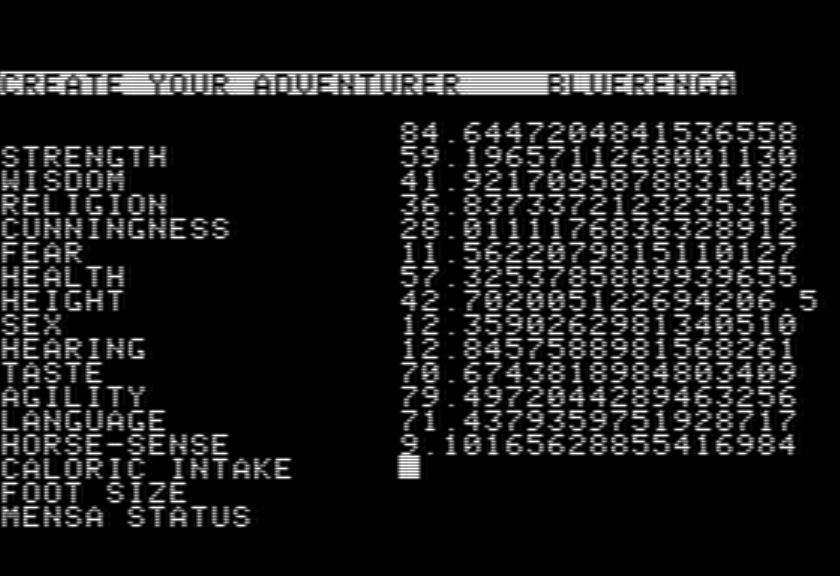
I like the extra “.5” tossed in there for height.
You then WAIT WHILE YOUR ADVENTURER IS MADE and the result is always the same thing: a female dwarf. This is one of our first adventures with a preset female protagonist; the exceptions are Alice in Thunderland (which faintly implies the player is Alice) and Alien Adventure (which strongly implies the player is Ripley). Or at least claimed preset female protagonist; the gender maybe (??? fantasy dwarf class is ambiguous) gets swapped in one of the pieces of art.
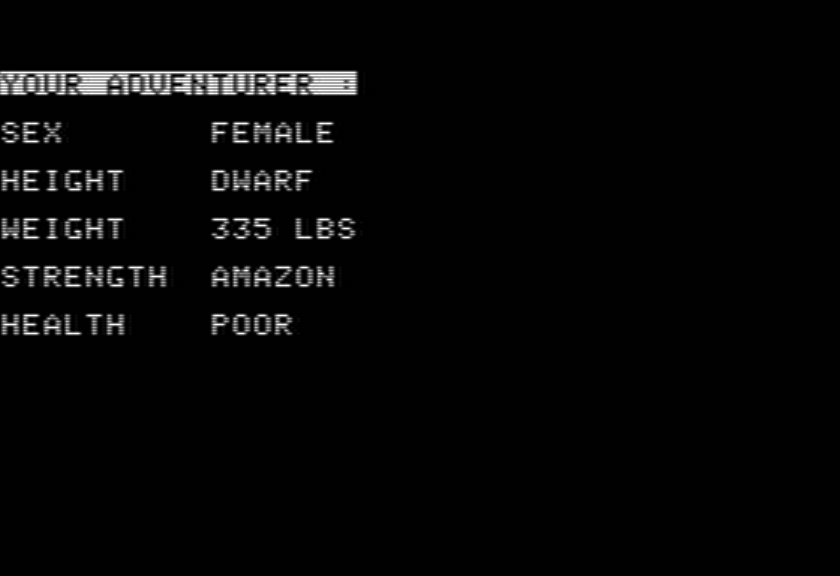
If you hadn’t guessed yet, despite the RPG-ish start there are no RPG elements in this game. Adventure gaming is light too, but at least it follows the form from here of a standard Sierra On-Line game.
Character creation is followed by a text scrawl giving lore, first moving slow but then moving faster and faster. There’s something about THE DEATH OF YOUR GREAT AUNT PHOEBE AT THE HANDS OF EINAR THE OFF before the scrolling gets too fast to read.
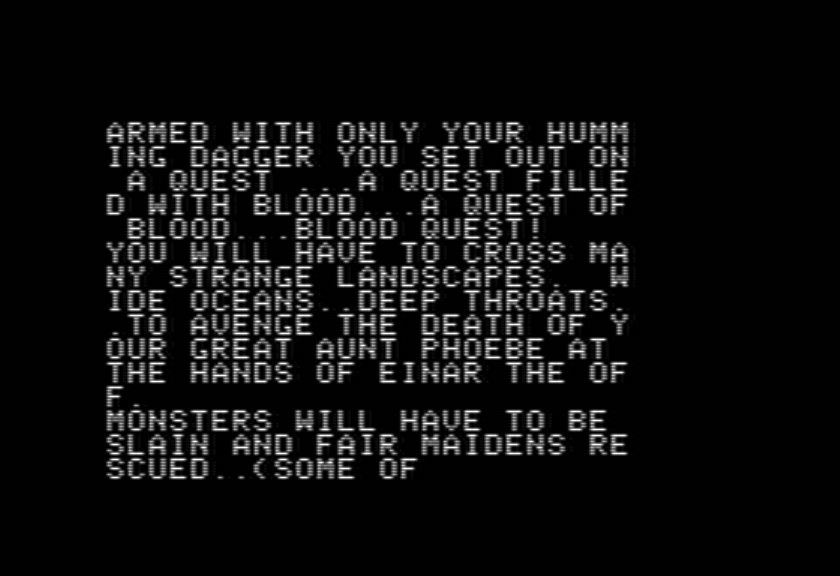
A QUEST … A QUEST FILLED WITH BLOOD … A QUEST OF BLOOD … BLOOD QUEST!
You then start in darkness.
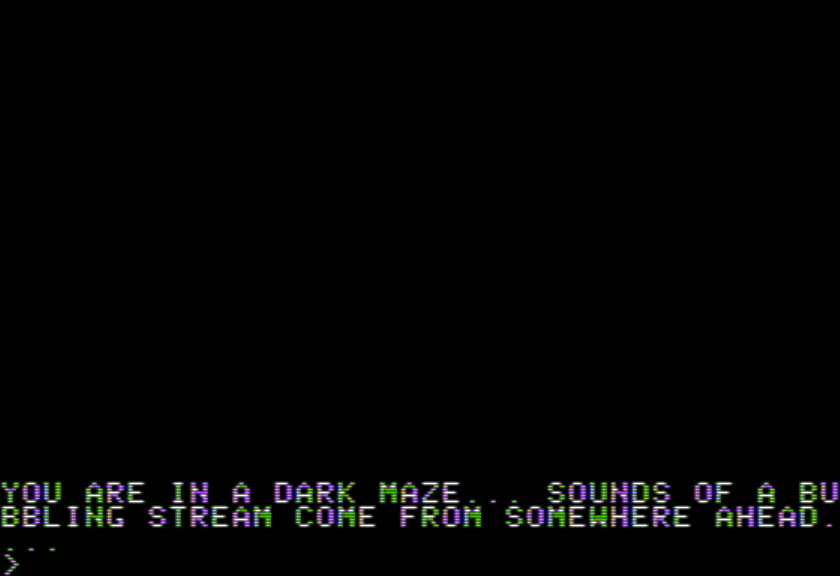
No items or anything; the only thing to do is type N for north and get chastised for not using complete sentences.
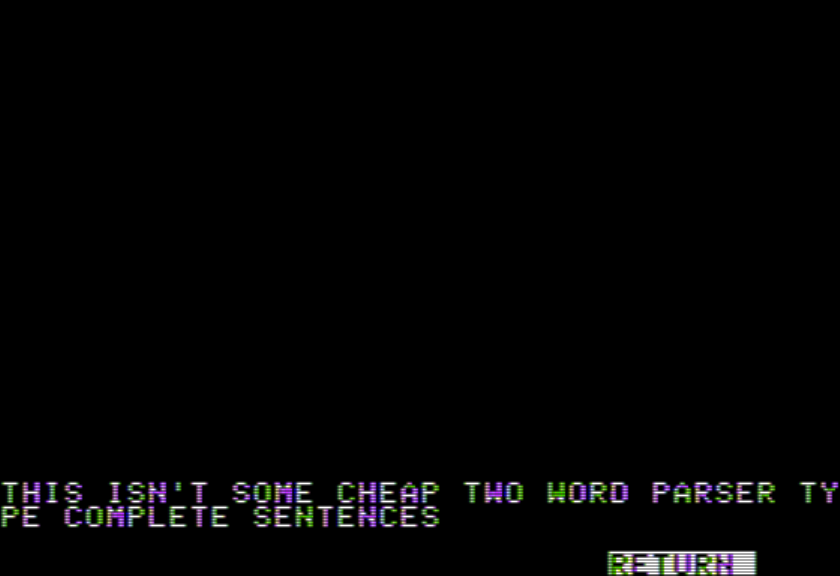
Generally speaking just N is fine, there’s just particular spots in the game where it triggers this.
Heading N enough times gets more ominous “you are in a maze” messages as well as “you will probably be stuck in this maze for eternity” and then the game explicitly says you should try to GO STREAM.
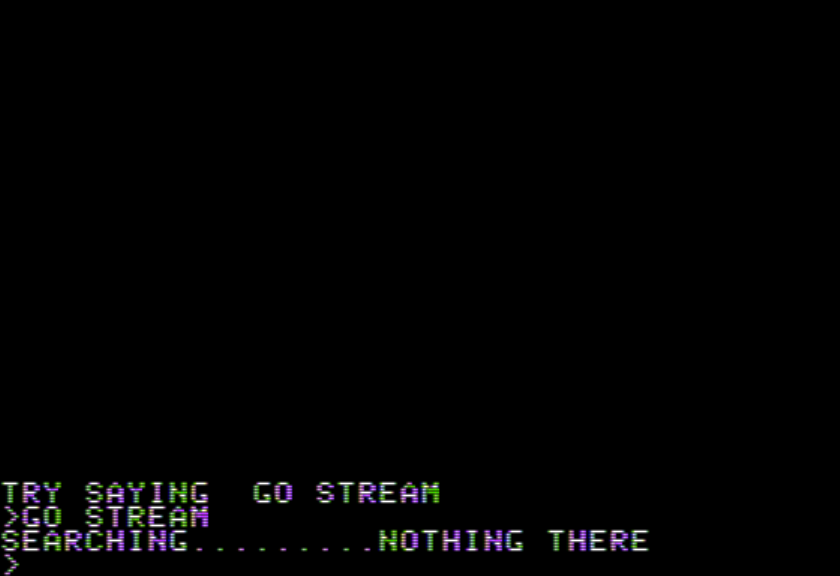
This is followed by a suggestion to LISTEN STREAM where the game tells you to TRY THINKING ON YOUR OWN. THINK STREAM gets you out (or maybe just any text with THINK; it’s a very loose idea of a “parser”).
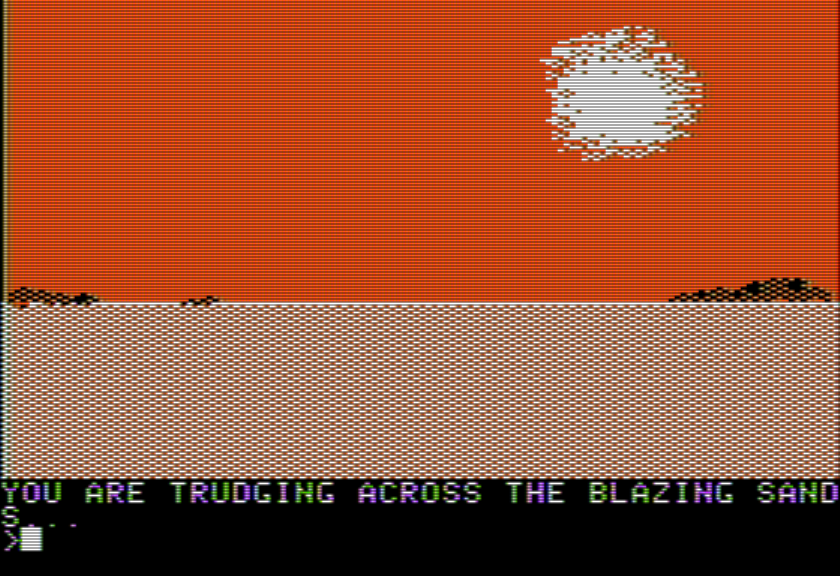
Moving any directions gets a message about PLODDING, before you are told to LOOK OUT as there are 10 DEFENSELESS ORKS. Slaying happens on automatic.
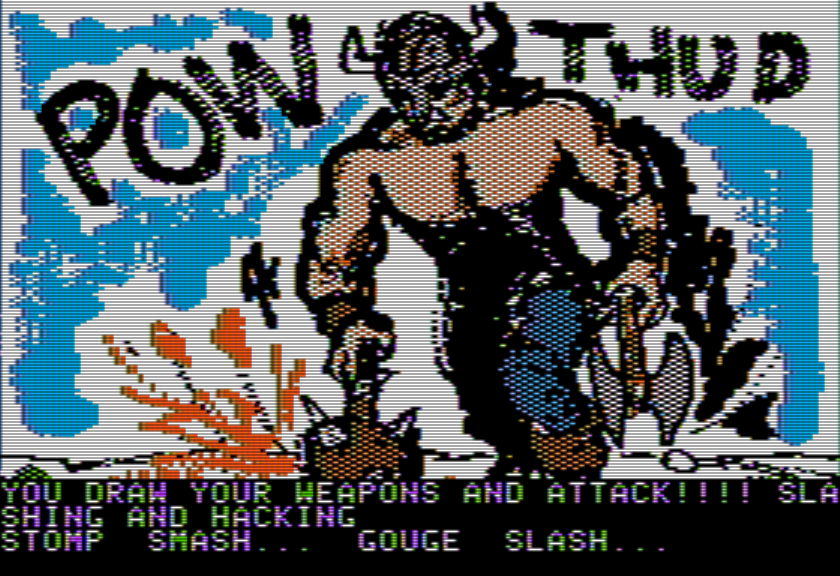
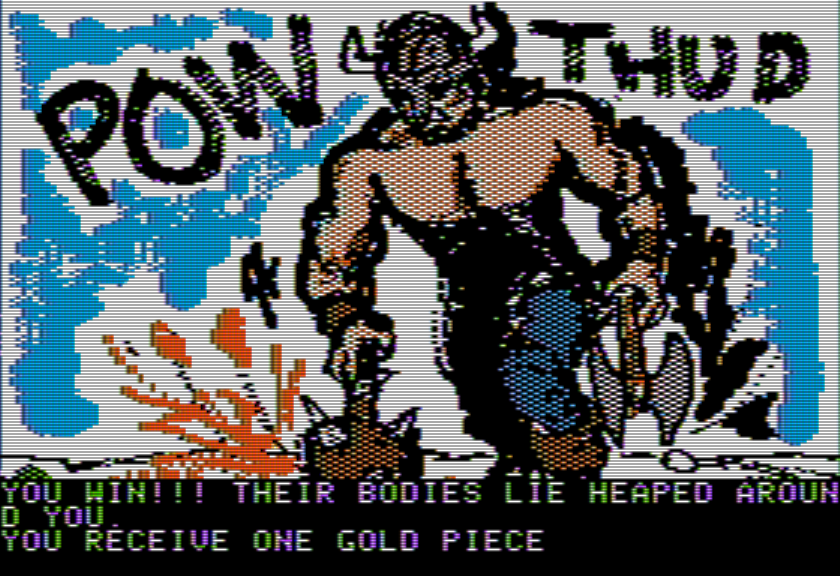
After more plodding, you find a cave.
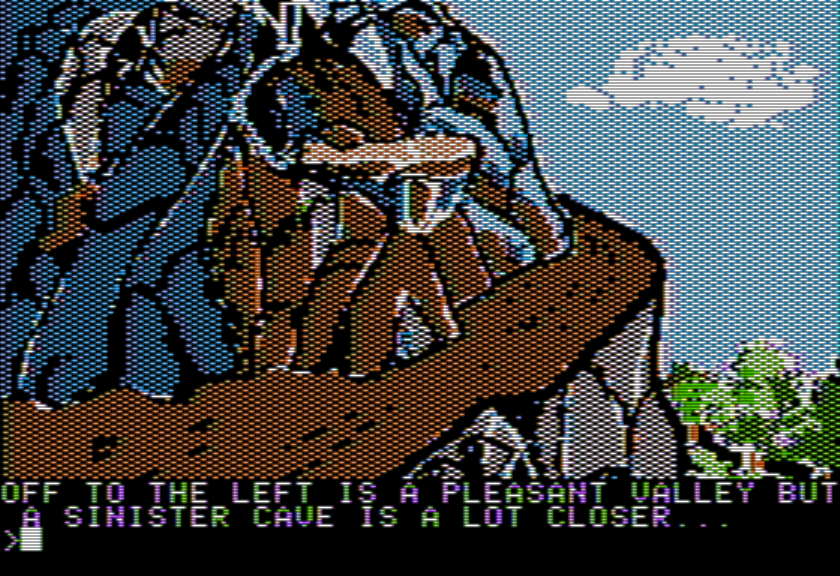
You get attacked from within the cave by a KLEVNIR, but the graphics are corrupted on the version I played (given this never got published, I imagine there aren’t many free copies of this lying around).
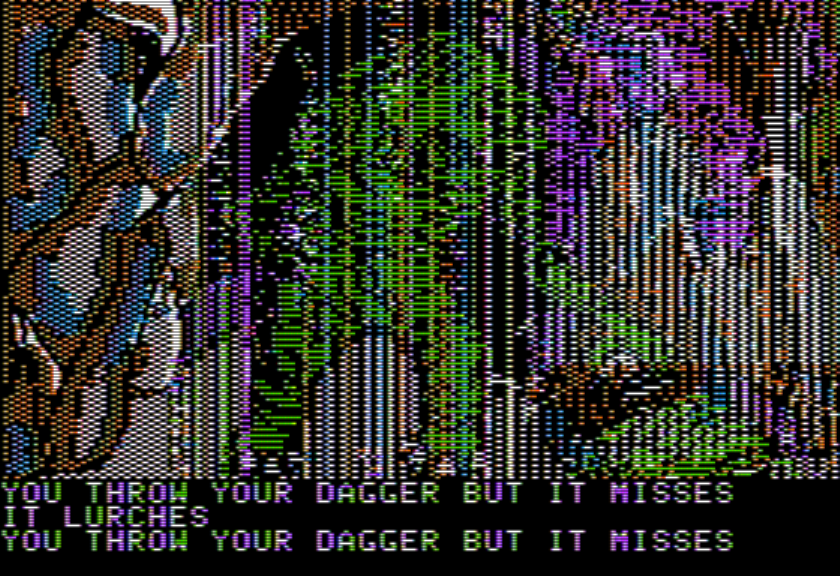
Again on automatic, this is followed by DEATH. But don’t worry!
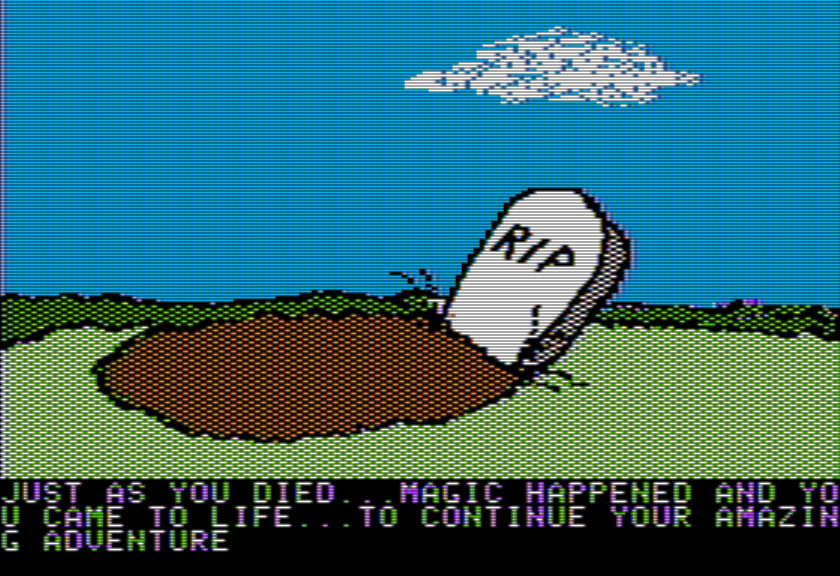
After resurrection you land in a new environment, with no explanation.
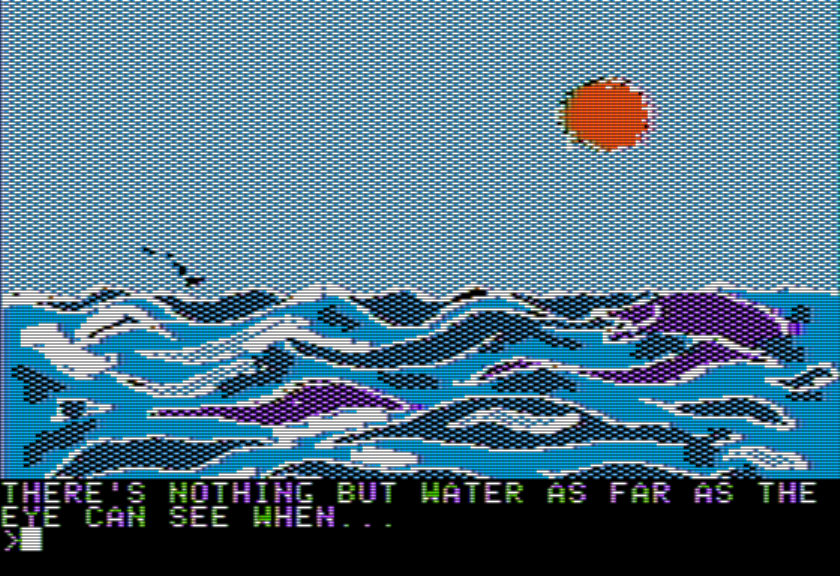
After multiple N commands (or whatever, it doesn’t matter what you type) you get ROWING messages until you end up at a GREAT CITY. Walk closer and you die.
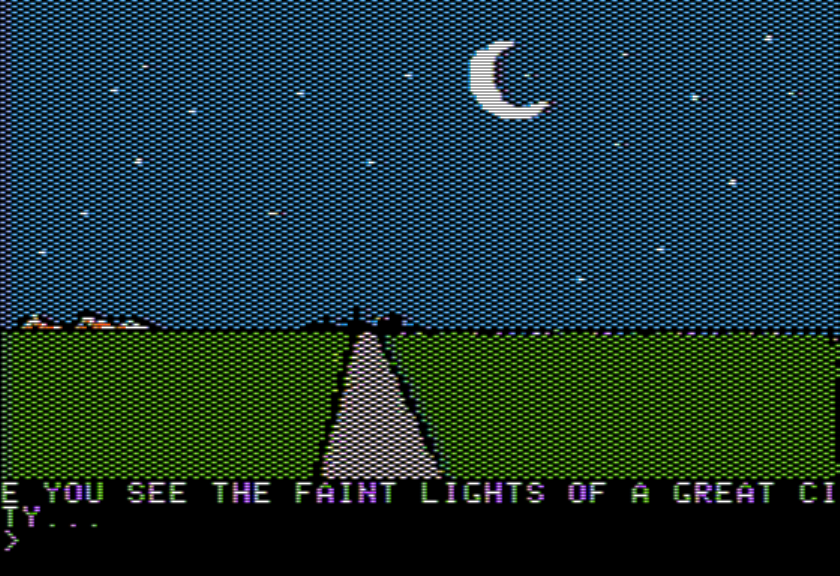
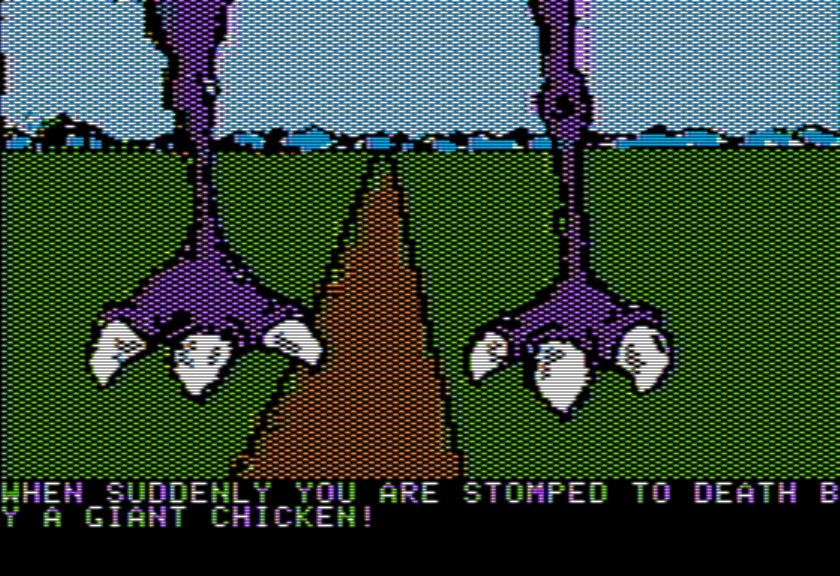
This is the screen that ended up in the Softline review.
But don’t worry!
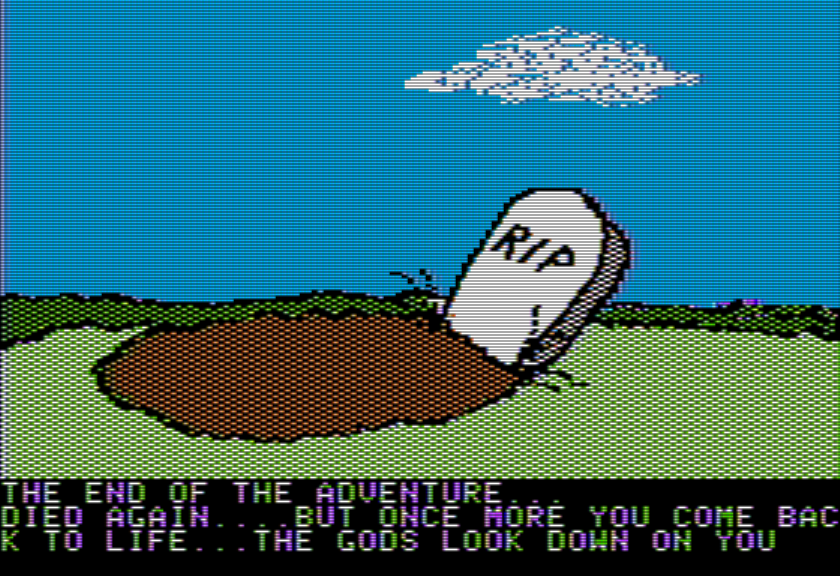
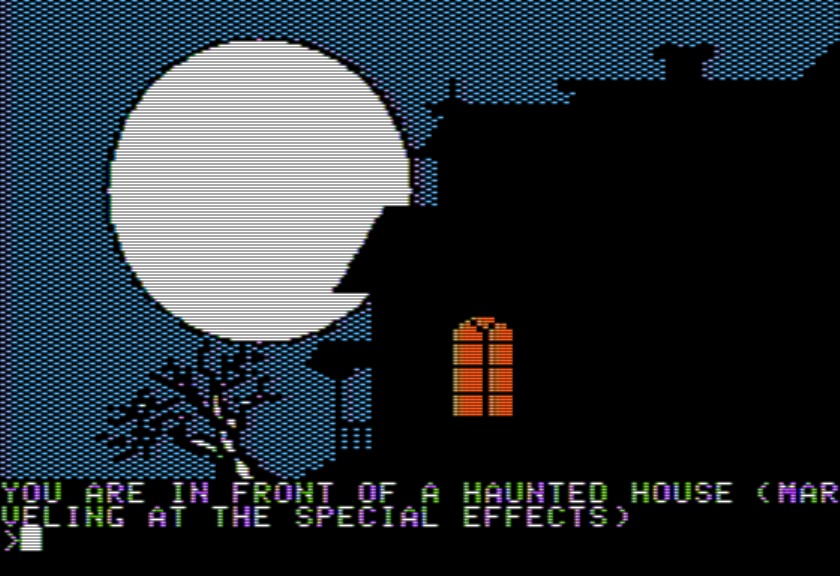
You’re now in an exact clone of the Mystery House cover.
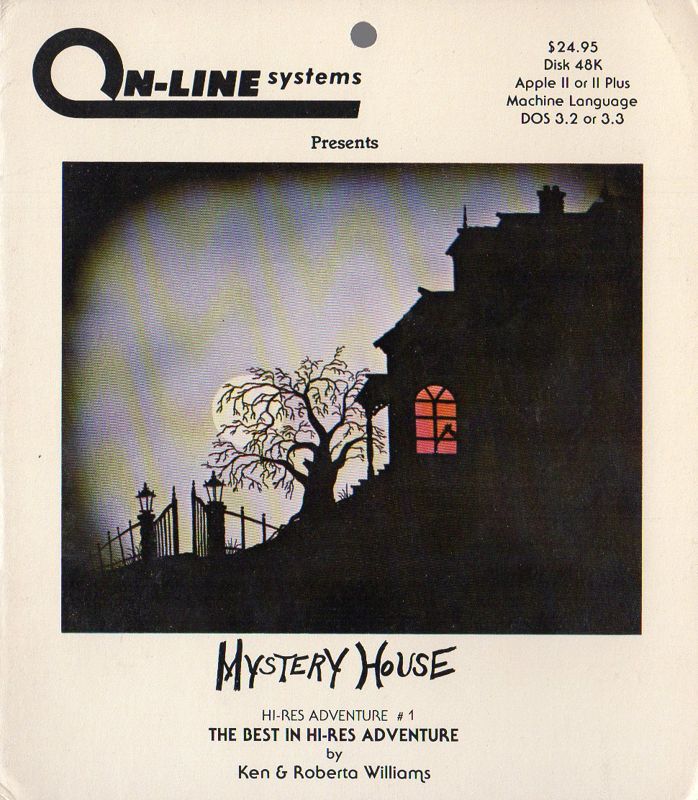
From Mobygames, for comparison.
Inside is a chest and the only real puzzle of the game.
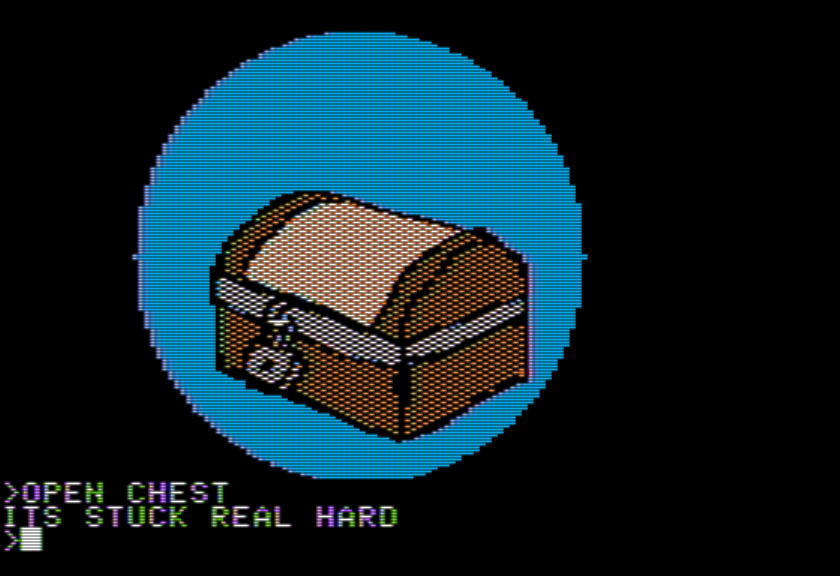
Most actions get the response GET A LOAD OF DIRTY HARRY ALREADY although LOOK gets the response LIKE TOTALLY AWESOME. Fairly normal commands like HIT and SMASH don’t work; you need to ATTACK the chest.
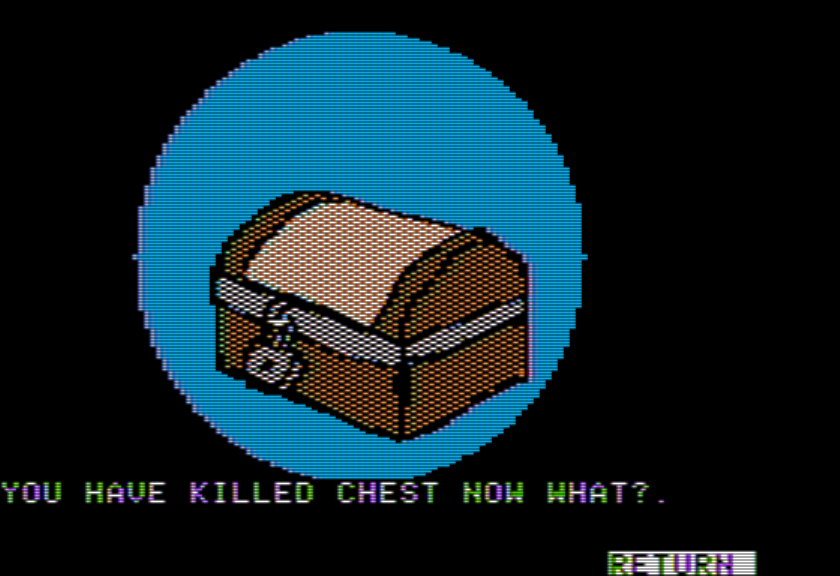
Trying to OPEN CHEST (or anything else I could find) gets you strangled by a previously unseen enemy but you win the game anyway.
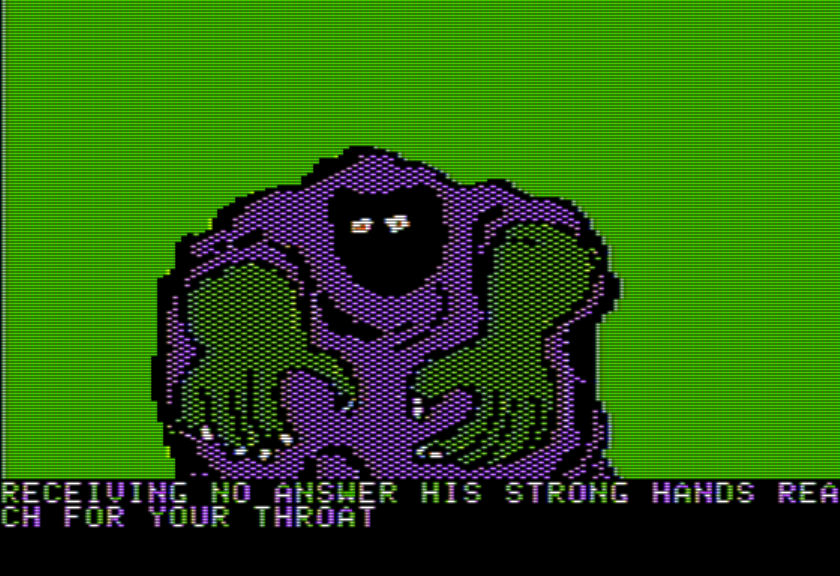
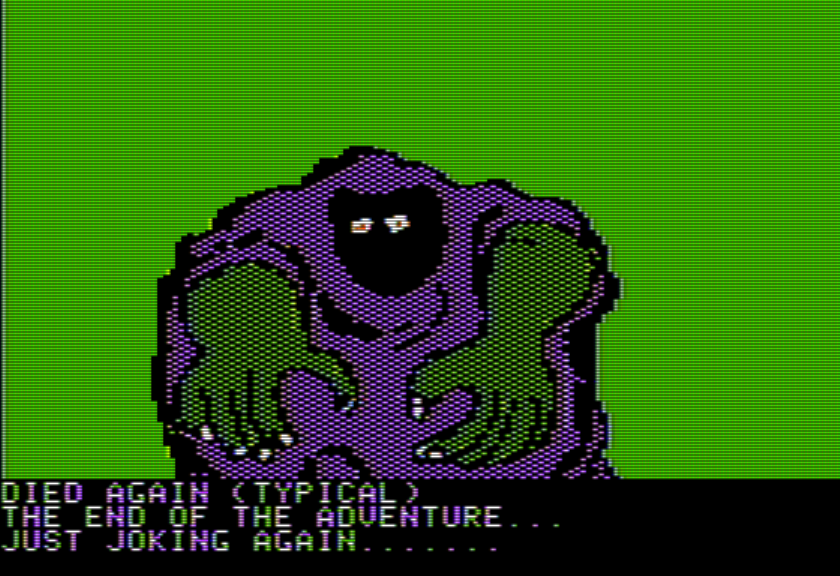
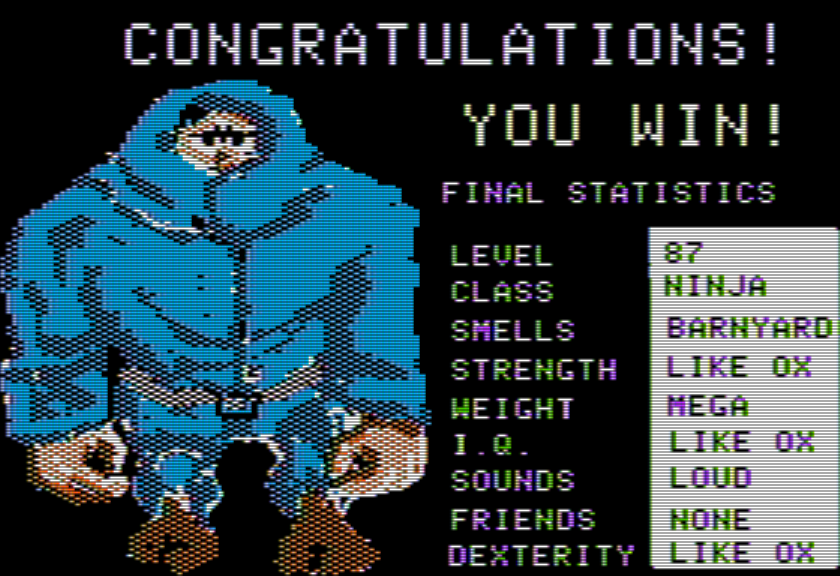
This wasn’t a coherent gag in a sense someone could write a long essay about what, exactly, was being satirized (I guess the expectation of getting loot from a series of encounters) but it was high-effort; most of the art beat pre-Dark Crystal Sierra. You could certainly peg this as a very early “walking simulator” along the lines of Gone Home, if you like.
It isn’t often that one comes across something totally original. Perhaps, someday, someone will.
(Special thanks to Ethan Johnson and f_t_b for help on some questions, and Kate Willaert who shared her research on Brøderbund. Ethan’s essay on early Brøderbund is worth reading; Ernst Krogtoft has his own history with a complete photo collection of Brøderbund’s games from Star Craft.)


