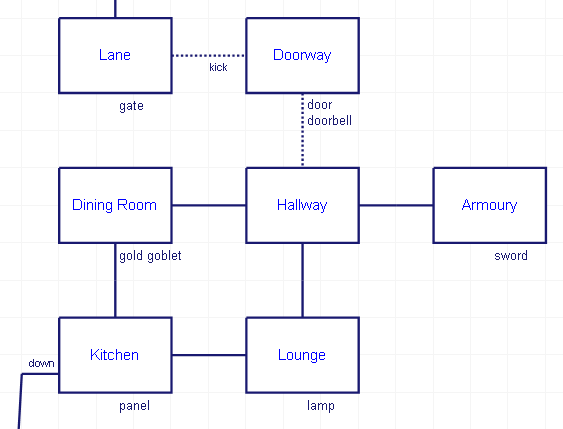
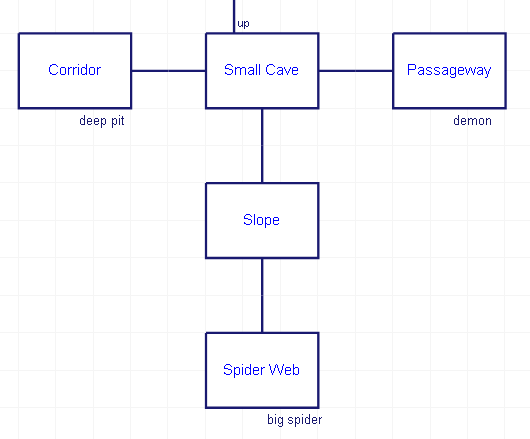
There’s a confusing meta-feeling playing one of these ultra-minimalist games (where all that gets conveyed to indicate a single place is a word, like “LOCATION: SLOPE”). In book form, this would be atrocious. Somehow, the act of gameplay boosts the significance, like receiving a writing prompt and filling in the blanks, but rather than “writing” the spaces are colored in with the mental effort of playing. This is true even when there’s a lot of flailing at nothing. But what gets colored in isn’t plot, exactly (I’m not imagining my avatar try to lick, kiss, poke, and kick every single thing) but just tension. Feelings. Unrealized ideas for puzzle solutions.
To pick up from last time, I had a door with a doorbell that caused electrocution. Poking through my inventory with LOOK doesn’t reveal anything, but I eyeballed the verb list (reproduced above) and occurred to me the OLD BOOT I had might respond well to SHAKE. It did, having a key fall out, so I was able to unlock the door and go in.
This led to another item dump; a golden goblet that says MELT ME (referring to the crystal ball vision, no doubt), a sword, and a lamp.
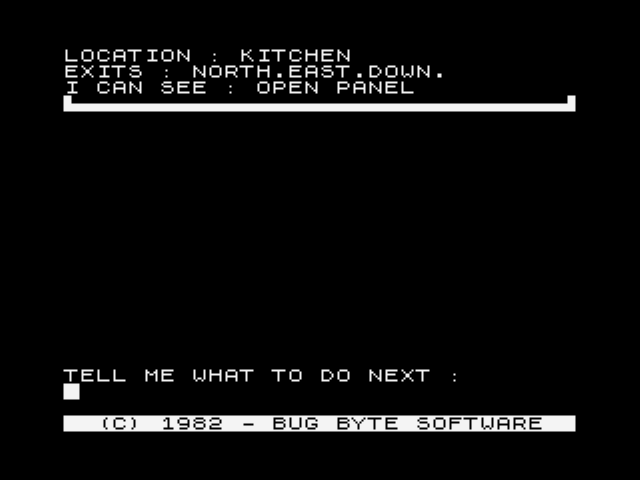
The kitchen had a PANEL and it took me a lot of struggle with verbs like PUSH, OPEN, SLIDE, and so forth before I hit upon LIFT, which I am fairly sure is the only verb that works. It didn’t feel like solving something as much as–
–okay, here’s an analogy. Sometimes the old Fighting Fantasy books, with numbered sections, had a bit that asked a riddle. Since you can’t “type in” a word you are supposed to convert it to a number, so if you get the one correct riddle answer, you can move on, but because you’re staring at a static book it isn’t going to react otherwise.
Solving “puzzles” like “what verb to open a panel with” is like fighting the right section to jump to in a Fighting Fantasy book; no responsiveness until you’ve done the task, and the whole process can feel arbitrary.
Back to the action: going down further led to a SPIDER, a DEMON, and a PIT.
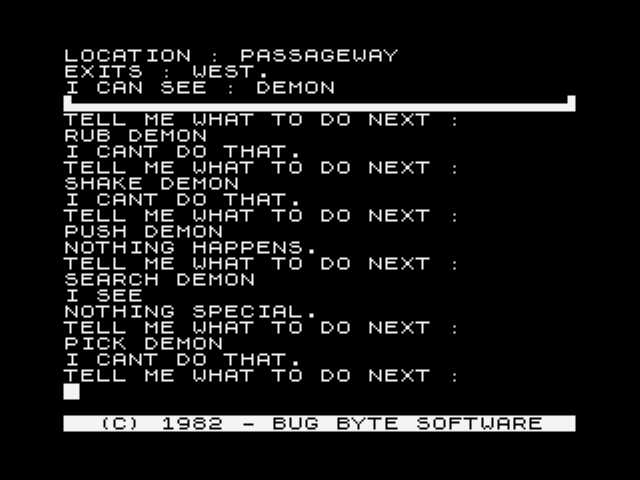
This sounds like it might be exciting! Engage the demon in combat, realize just the sword isn’t cutting, and enhance it by solving another puzzle before engaging again, or something like that. No, this is how the demon scene ran:
The spider was similarly pacifist:
No responsiveness to anything (including the obvious KILL and KICK), nor do they try to kill me back. At least you can jump down the pit and die, but that’s a little like “I hurt myself in order to feel alive”.
In normal circumstances I would have reached for hints already, but I want to re-iterate that this game was a massive pain to get emulated correctly. I have sunk investment.
However, at this point, I am totally happy to get hints from you, the readers, either in:
a.) speculation [again] what to do in normal text form
b.) hints telling me exactly what to do in ROT13 form, and feel free to plunder the BASIC code although there’s a walkthrough up at CASA so you might as well use that
One quick side note: the tree you can climb at the start to get a WALNUT you can also chop down. The chopping seems to serve no purpose.
I tried every single verb on my chart with no response. Maybe it is meant as a red herring.
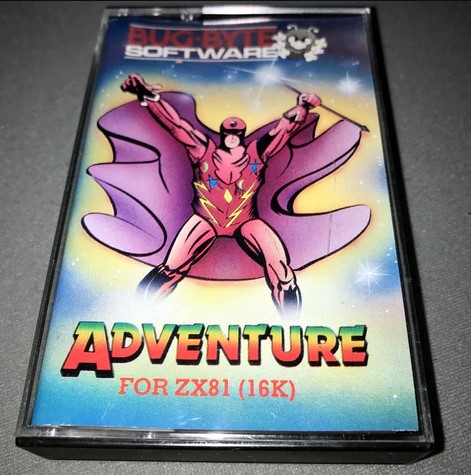
The publisher sold this one as “Adventure”, so I’ll hope you forgive me going with the alternate title on the intro screen, which the author (Simon Wadsworth) has stated was always the real name of the game anyway.
Bug-Byte was founded in 1980 by Tony Baden and Tony Milner while they were students and neighbors at Oxford. Tony had bought a ZX-80 and the duo — after playing around with the machine — realized that software selection was scant.
They formed their own company (using Tony Milner’s address from Coventry as the business mail, since a student residence didn’t seem professional) where “at first we pretended we were bigger than we were”, making a peak of 150 pounds in weekly sales by the end of the year.
They tried spending for a full page ad in March 1981 for ZX-80 software; that same month is when the ZX-81 launched.
We had doubled our advertising and halved our sales.
After graduating Oxford the duo went full time into business, finding an office in Liverpool and cranking out ZX-81 software (“I wrote eight in one day once”) eventually growing to the point of having sold 500,000 cassettes by August 1982.
They later became famous as the publisher of the adventure Twin Kingdom Valley, which we’ll hit in 1983, and the platformer Manic Miner, which we won’t be reaching at all (although Data Driven Gamer gave it a play-through you can read, or you can watch the video below).
For today’s game, we’re firmly still in the summer of 1982. The author, the 16-year old Simon Wadsworth, describes how “my school friends and I spent countless hours battling the creations of Scott Adams, Brian Howarth, Level 9 and Artic Computing” and decided to write his own, using ZX81 BASIC (with some machine code). Note how there’s been enough time for the early British games to be influential, it isn’t just original Adventure and Scott Adams.
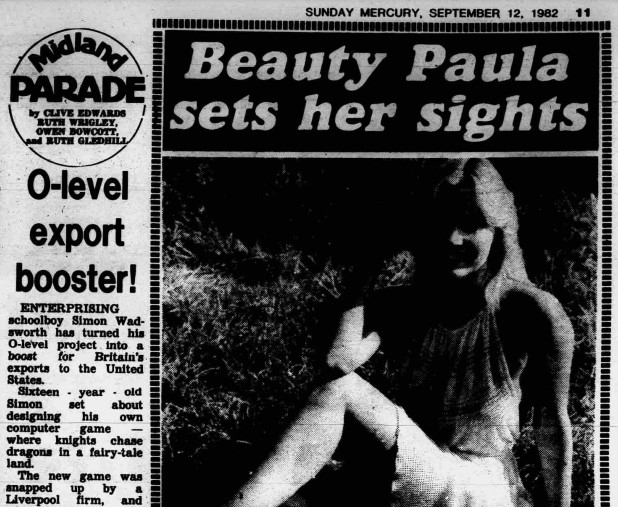
I have no idea what made me submit it to Bug-Byte for publication, but I’ve always been glad that I did. This was the first step in my career as a software developer. It was written while studying for my GCSE O-Levels. When the Head of Year got to hear about it she contacted the local newspaper; so I achieved my fifteen minutes of fame.
I wasn’t expecting much. When they accepted it, I could hardly believe it.
Simon sent in a second game to Bug Byte which never got published (for unclear reasons) followed by two for Artic, so we’ll be visiting him again, but for now, let’s check out his first effort.
This was incidentally a giant pain to emulate. EightyOne, the typical recommended emulator for ZX81, has been acting very slow for me (pushing a button for a menu taking 2 minutes+ to respond). JtyOne, the online emulator at zx81stuff, had input problems, I presume because of the ZX80 machine code (at least that site makes the BASIC source code easy to read). I went through some even more obscure emulators like no$zx and ZEsarUX which had the same input error, and finally had luck with reverting to an old version of EightyOne (version 0.52) which you can find here.
The “collect pieces of the magic gizmo scepter and assemble them” plot gives vibes of Howarth and the Arrow of Death (remember he was an inspiration!)
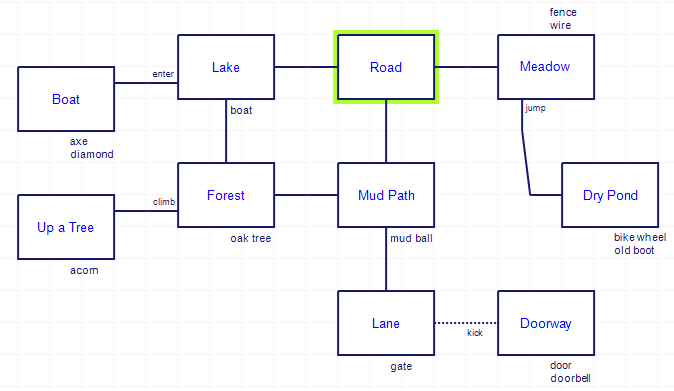
The opening just has a handful of generic-forest-adventure rooms (lake, meadow, forest, mud path, …) but a wildly unusual number of items just lying around. To get to the pond above I needed to JUMP over a fence, and the fence itself had a wire. There’s a boat you can enter that just has an axe and a diamond you can grab, there’s a “mud ball” that turns out to be a crystal ball if you just “clean” it (LOOK CRYSTAL: “I SEE A GOBLET AND A FURNACE”), and there’s an acorn up a tree.
Without doing much other than kick down a gate I had 8 items and I was stuck on a “doorway”.
You don’t pick up the bag of dirt: you start the game with it. I can just imagine some emperor sending you on your journey and reminding you “don’t forget your dirt!”
The “doorbell” is strange in the description since this is a “first three letters only” style parser, so it first seems like the game only lets you refer to the door, not the doorbell. The trick is to use the noun BELL, but alas, that doesn’t translate to progress:
PRESS BELL
BUZZ…
IM ELECTROCUTED
THE GAME IS OVER
So I find myself stuck, yet again, on some teenager’s simple BASIC game stuck on what seems like a very simple obstacle. I did go through my verb list…
…but despite the large item list to play with I’m out of ideas. Suggestions welcome! (Please no plumb-the-BASIC-source spoilers yet, though, at the moment I only want to hear if you haven’t looked anything up.)
The line between “tight, difficult puzzle box” and “impossible puzzles” is fine enough that making a good difficult adventure is one of the tightest of high-wire acts in all of game design. Every puzzle — in the standard formulation at least — is bespoke and potentially a disaster. Combine that with the general lack of beta-testing in the early ’80s and a gem that remains super difficult is rare indeed.
So when Masquerade fell down hard near the end, well, at least I had sympathy. There were still some clever moments, though–
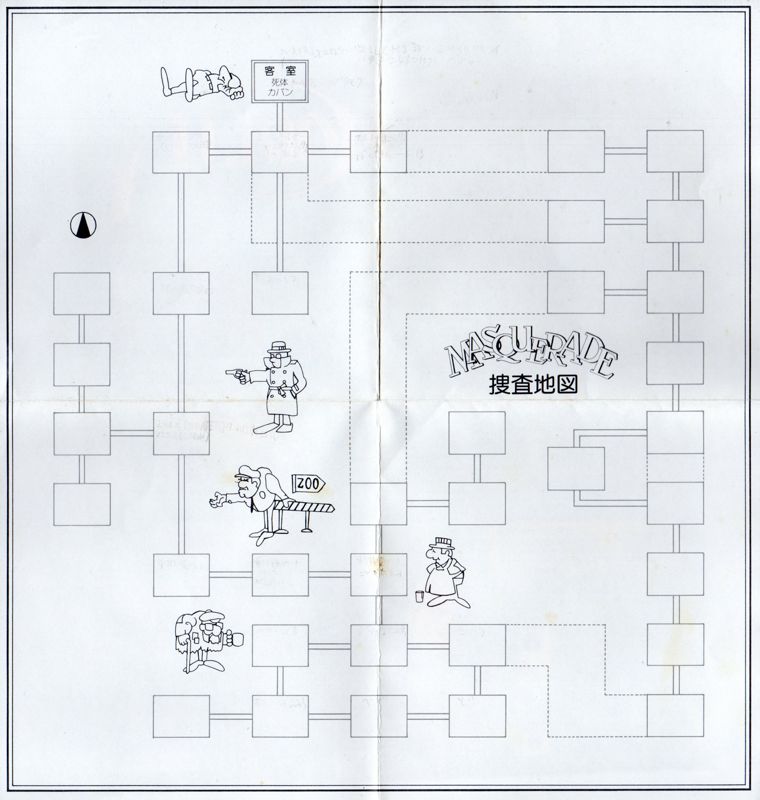
Map from the FM-77 version, via Mobygames.
–so to kick off the pain right away, let’s return to the popcorn I received by spending a dollar, and fed to the bird.
From this point I had softlocked. Now, it wasn’t the mere existence of softlocks that was a problem — I had ample forewarning and it is an intentional style — but rather, the popcorn had something concealed in it, which you can find if you SEARCH POPCORN.
I had mostly given up on SEARCH as a verb, as it only worked on the body beforehand, but also wouldn’t the bird leave the badge behind? Or at least it would be very obvious something went horribly wrong upon eating the large piece of metal?
With the badge I could breathe a bit easier, as I could a.) go in and out of the zoo freely and b.) get into the office, where as predicted, I could turn off the switch to the electric fence.
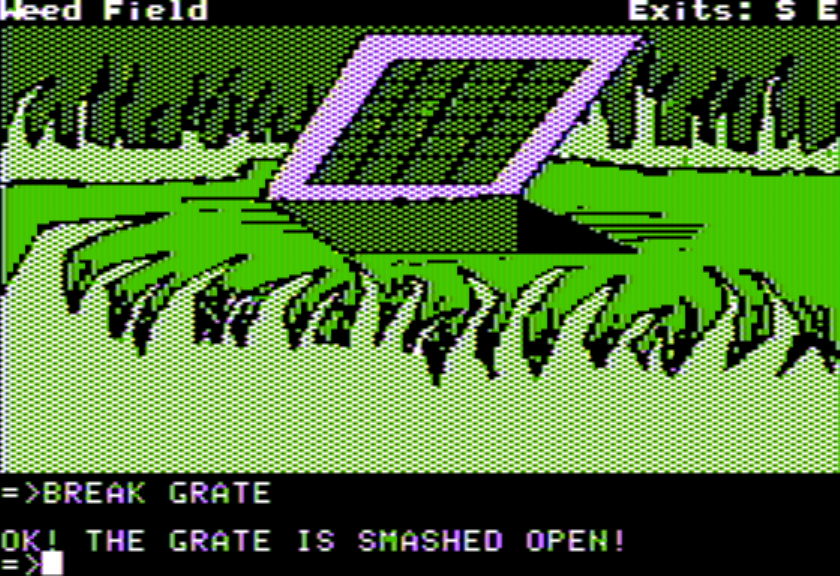
Inside the electric fence area I found a grate near some grass (more on that in a second)…
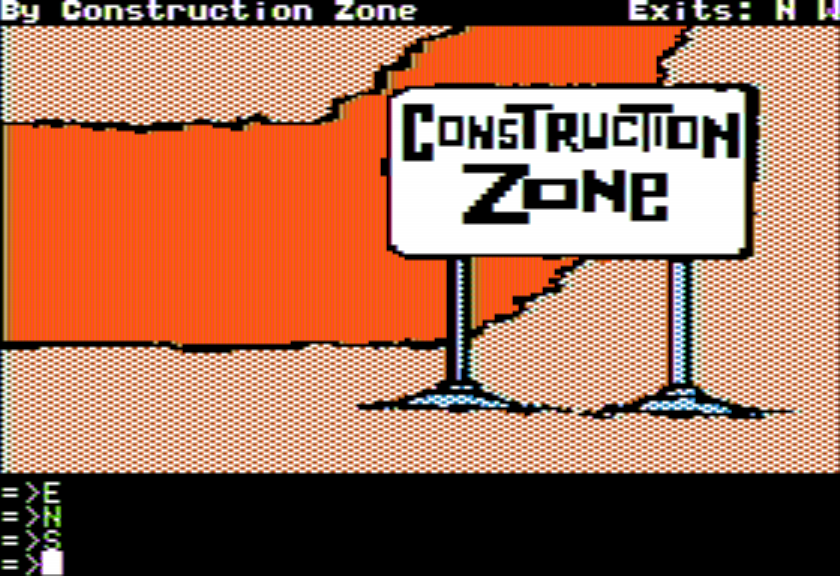
and a construction area.
There was a helmet back in the theater that served as protection (never mind it’s a safari helmet, not a construction one) and hence I was able to retrieve a hammer and some dynamite.
I also discovered by trying to juggle inventory in this area — and it will become important later — is that if you drop off some items, they will disappear as you see something furry run by.
The hammer does not pass through the electric fence, though (too big to carry) meaning it had more immediate use. Specifically, you can use it to smash open the grate.
(The magic button works too, but you need to keep one of the uses. Just as a reminder, it was used once to get in the trapdoor, but it hasn’t been used since; I used it to open a gorilla cage but that was speculative.)
This leads back down to the tunnels, which was interesting since I didn’t have anything in particular I needed to do down there.
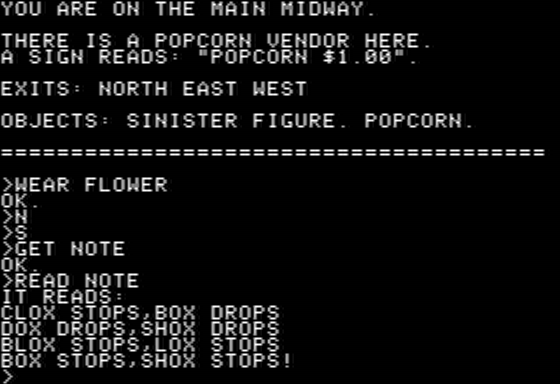
The reason for a second visit (there’s going to be a third!) is to apply the hint from the note:
IF YOU’RE REALLY SHARP, YOU’LL TAKE A SHORT CUT AROUND THE BLOCK!
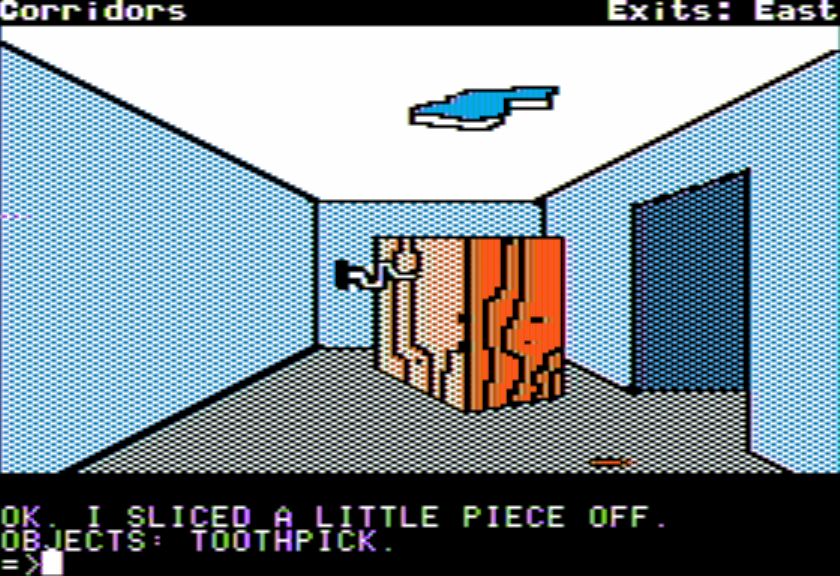
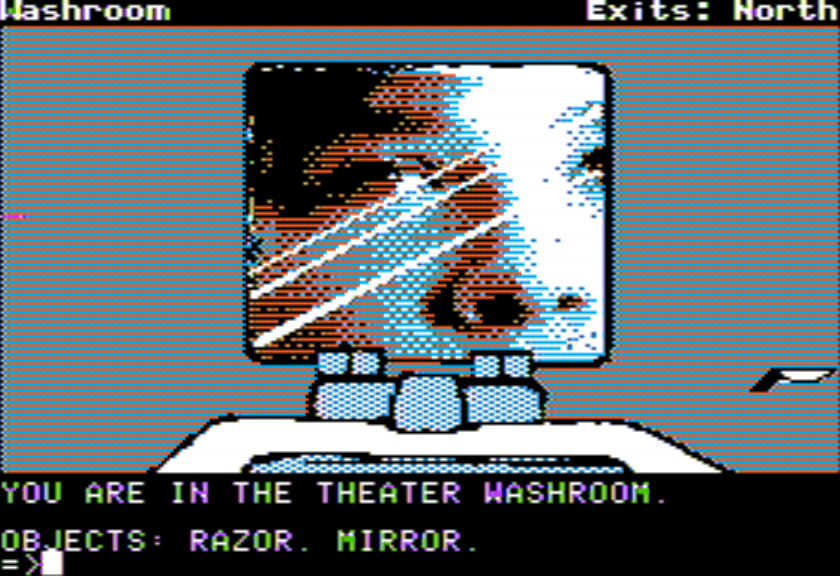
Specifically, now that the theater is open, the player has access to a RAZOR. And the razor can be taken back to the balsa block of wood in order to cut it.
I don’t think this is a terrible puzzle — the note is explicit about what to do — but it does mean from this point the elements of the game are best not thought of “realistically” (why would we get a note from the bad guys on how to defeat the bad guys)?
Moving on, what use does a toothpick have?
Picking a lock, with a wooden toothpick? Suuuuuuuure. (It’s easy after the fact to say “well just don’t think of it realistically, but coming up with the puzzle solution is required before doing it!)
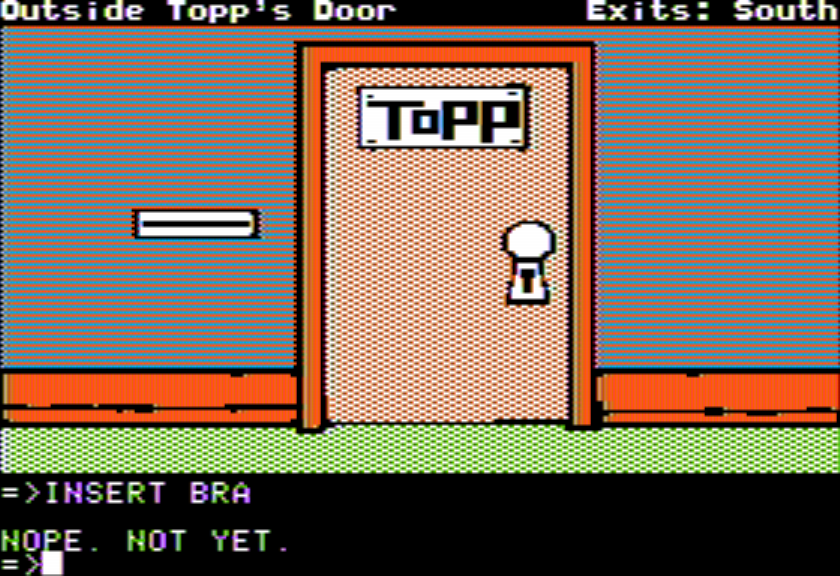
I still had the weird mystery of the cage to work out. I did find out a new way to kill the gorilla by accident. I was messing around with the slot at Mr. Topp’s (to look for other potential objects that might cause a reaction) when I found out the bra had a curious message:
Some more experimentation revealed the message didn’t have to do with the slot at all, but rather having the rock also being held. With both rock and bra in hand either INSERT ROCK or INSERT BRA forms a makeshift sling, so SLING GORILLA because an alternate method of doing away with the animal.
…yet, I still didn’t know why I was doing this? And here I was truly and completely stuck and needed to check hints.
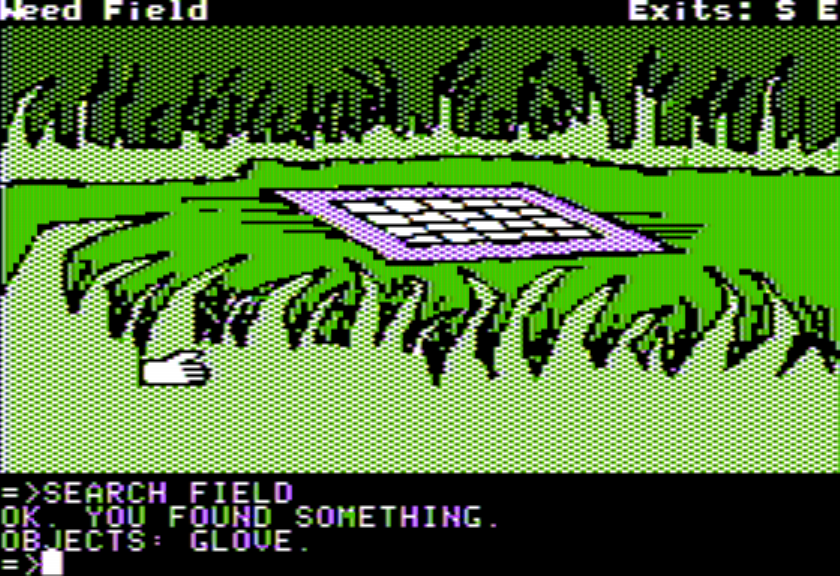
First off, I needed the bird for some other purpose other than scaring off; furthermore, I needed the snake for something so scaring it off was bad besides. What I had missed was SEARCH WEED or SEARCH GRASS or SEARCH FIELD north of the electric fence. No, that’s no explicitly a noun mentioned in the main text, unlike every other puzzle in the game, it’s a noun from the title of the room.
grrrrr
With the glove you can safely grab the rock and the snake.
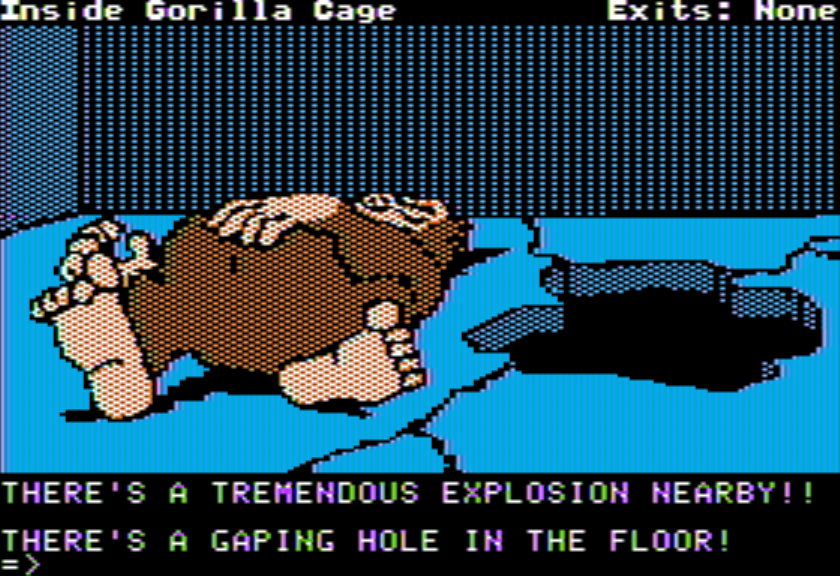
With the bird in hand, you can then: go in the cage and get trapped, drop the bird who will fly out, get a match, and come back…
…and then drop the dynamite and light it causing a hole to appear.
This could have yielded to a “structural solving” moment insofar as there is nothing to do in the cage, therefore there must be something to do, so might as well try seeing if the bird will do something special that happens nowhere else. Mostly I was just grouchy. The puzzle after is kind of interesting but pulls yet another absurdity:
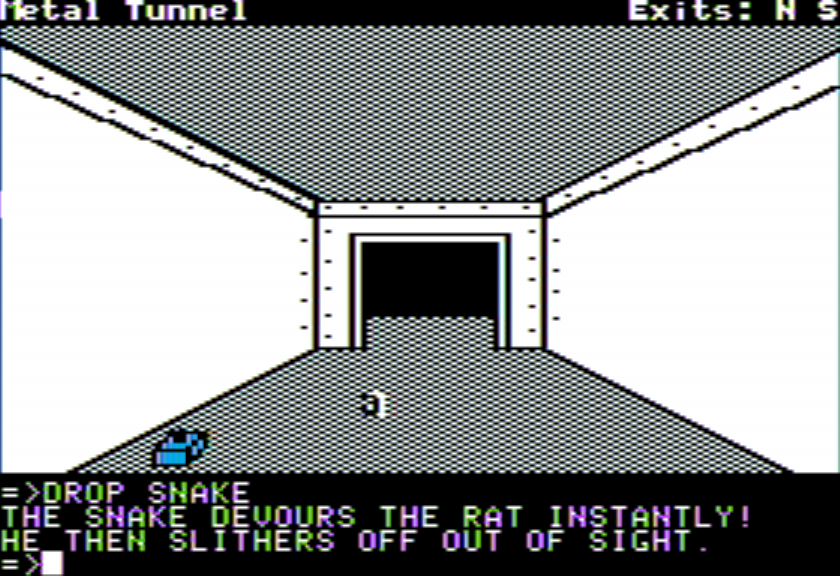
Specifically, there’s a rat with an earring, and an elevator just past. To deal with the rat, you drop off the snake…
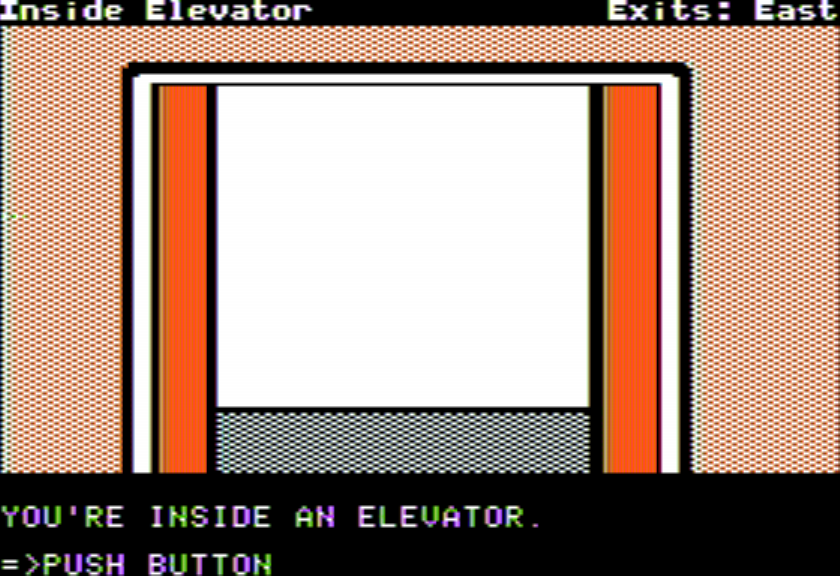
…but the elevator is a little trickier. Assuming you picked the lock rather than used the magic button, there should be a magic button use left, but for some strange reason it “drains” if you walk by a generator. It is unclear that this is happening and I’ve never deciphered why.
The draining doesn’t even happen in this room, it is the room right after with the rat in it.
However, the upshot is that you are stuck if you’ve carried the button down here. Do you remember the furry stealing thing? That’s the rat. You’re supposed to drop the button off at the construction zone, and then somehow the rat can take it safely to the elevator without it being drained, and that means there will be a use left over that you can use on the elevator.
Believe it or not, we’re essentially at the end of the game. There are no new lingering threads. Everything from the zoo is taken care of, but what do we have that works on Mr. Topp? This is one of the puzzles I’m sure someone got by accident but I don’t know how you’d do it intentionally. You have to wear every wearable item in the game, all of them at once. This reaches your max inventory limit.
Then you go in to see Mr. Topp.
I’d definitely say the game vaulted over “difficult” into “just nonsense”. I always try to be careful using words like “moon logic”, which I think get over-used in the adventure community; it really is useful and helpful to distinguish between nonsense and just plain hard. I’m fine with something esoteric like the balsa wood toothpick, and at least there was a sort of halfway-sense to picking a lock with a toothpick. The endgame here was a case where the player is prompting to do something with no clues whatsoever. Just to be clear, with one item missing, all you see is the “imposter” message. There is no indication or comment on your clothing or the amount you’re wearing.
Before leaving here, some historical clarifications, thanks to A2Can:
Both the copies of the text game and the prototype-graphical game (which I have now) are from the founder of Phoenix Software himself, Ron Unrath. Despite my getting stuck on the text game (I still think there’s a way to get a key…) it might be “done”; the graphical version definitely is not. It isn’t “programmer art” then, it is sincerely intended as “temp art”.
Interestingly enough, the object art is in already, and seems to be identical to the final game. That means the pictures of objects are by Dale Johnson, not by Rick Incrocci!
If I had to rank the games so far, I’d put Palace in Thunderland on top, a genuinely solvable game that just happens to be enormously hard, followed by this game, with Mad Venture below. I certainly thought the atmosphere in Masquerade was fantastic, but having a couple nonsense puzzles was enough to ruin sticking the landing. While I’m describing things quickly, each moment of stuck-ness represents a long time of me struggling in the wrong direction.
We’ve got one Dale Johnson game left to go, although this one has him teamed up with yet another person, Dav Holle, and allegedly lightens up heavily on the difficulty. Sometimes an experienced author can produce their best work when they try to write something “easy” (at least, it baselines down to what a more modern game would be like, with less softlocking) so I’m definitely looking forward to that! But first we have another visit across the pond with a publisher we haven’t visited yet (which later published one of the most famous ZX Spectrum games ever made), followed by a return to Japan.
Well, I’m geographically close to the end. With this game that might mean I’m still far away.
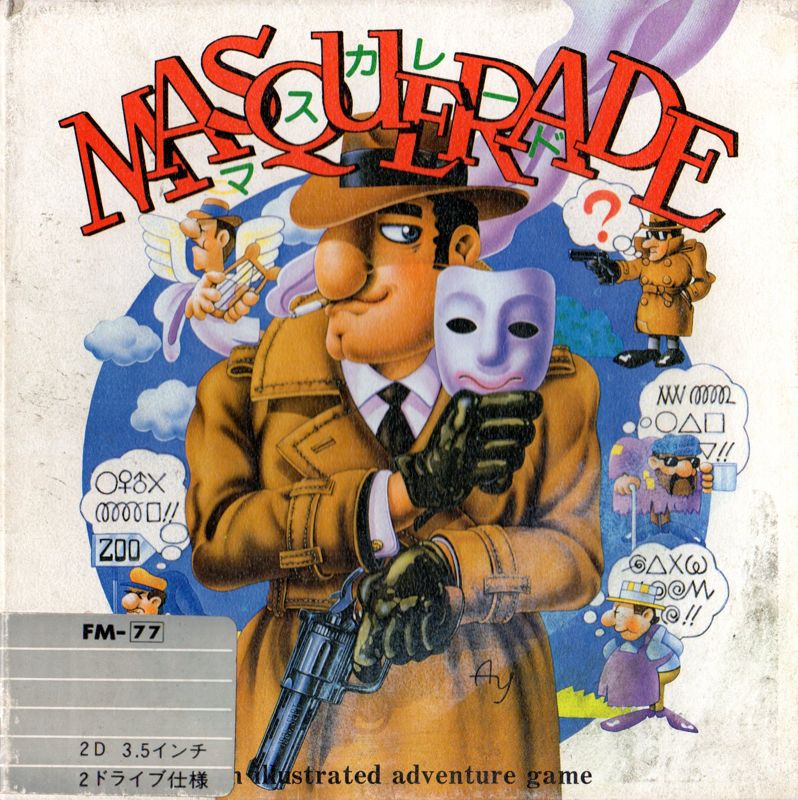
From the Japanese FM 77 AV version of the cover, via Mobygames.
As a bit of a mental break I decided to test out the text version of the game. It seems fairly similar except it is missing the key from MOVE BODY at the beginning, meaning I can’t open the suitcase, meaning I can’t get at the mask and the magic button. Since the button allows travel into the tunnels I was stuck earlier than the other version of the game. Given how complete everything else feels I think it’s just a matter of the puzzle getting changed.
Four changes of note, though:
1.) the player shoots the assassin dead with six shots rather than knocking him out; that’s better at explaining why the gun is empty at the start
2.) the telegram is slightly less nebulous
IT READS: “DISREGARD “ZILCH”
NEW WORD IS “ZORCH”.
P.S. – BOMB SET FOR 6:15 –
GET OUT OF THE HOTEL BEFORE THEN!
that is, ZILCH is simply the old password, superceded by ZORCH, although I’m curious on the whole reason for the bomb in a plot sense, since my original assumption was the assassin himself planted the bomb, otherwise, why have him go there in the first place?
3.) the beggar at the zoo explicitly is asking for treasure
4.) the note from the popcorn vendor is very different
Point 3 turned out to be helpful. I was ready to approach the beggar and just give each and every one of my inventory items to see if any would get a reaction, but since I knew the original game had him ask for treasure, I tried the LEWIS CARROLL book.
The dollar can then be used to buy the popcorn. I already had in mind to take the popcorn to the bird to feed it, and while it consumed the popcorn happily, there was no other visible change. Still, I decided the bird + snake combo from Adventure was worth another try:
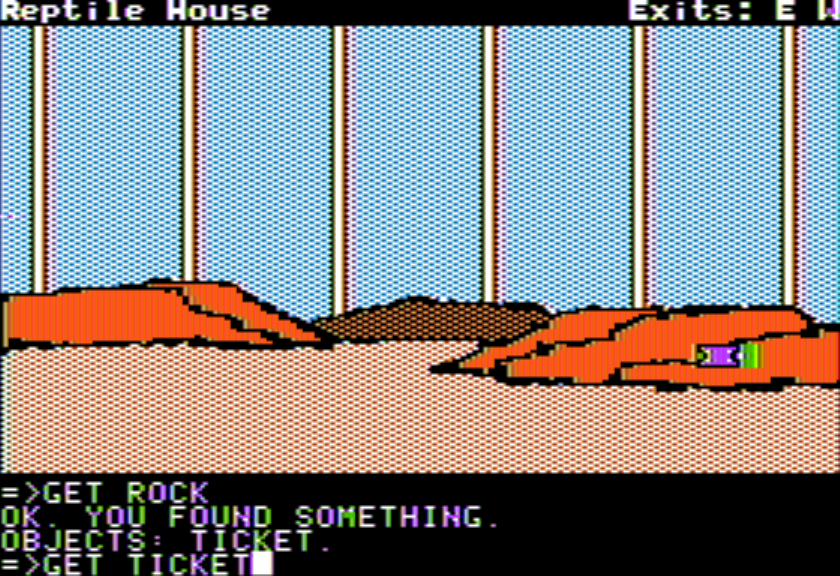
This leaves behind the rock and a ticket. The ticket is for the movie theater.
The theater just has the lobby, a bathroom…
…and the lair of Mr. Topp.
The slit ended up falling into what I call a plot-dependent puzzle. This is a puzzle where the solving of it involves applying some information obtained by paying attention to the plot. Many adventure game puzzles are not plot dependent and if you port the exact same items over but with a different scenario nothing gets affected. (Realizing what the Dungeon Master wants in Zork III is plot-dependent; getting by the grues in the dark room is not. While the grue section creates a memorable plot event, it could easily have been tossed in Zork I with no changes, whereas realizing the motivations of the Dungeon Master requires transplanting essentially the entire plot of Zork III.)
I think the most spectacular variant of this is the central puzzle in Spider and Web, where you have to understand where the entire plot structure of the game was leading. Here is a similar moment. I’d been bouncing around more or less trying to get past the next obstacle, but I realized up to this point I had substituted for and was pretending to be the assassin; that was the masquerade of the title. That is, the assassin is summoned via a telegram and isn’t “in the club” yet; we’ve tracked the assassin and either killed or knocked him out depending on what universe we’re in, then not only took his mask and used it but gave his password out, followed by giving another password and receiving the flower to let the criminal organization know we were “safe” (even if we looked like a detective otherwise!)
Hence I deduced what could go in the slot was the assassin’s business card.
Plot-dependent puzzles tend to be extremely satisfying (and unique for adventure games!) This only has the flaw that it is quite possible to brute force through (just test every item in the game on the slot and eventually you’ll get through) so it isn’t like the Zork III or Spider and Web instances where you can’t get through via luck.
The ruse falls apart if you try to go in.
So the question here is: does this mean I need another “disguise element” so Mr. Topp is off guard? (Maybe literally take the assassin’s face like in Asylum II?) Or does this mean my disguise is now “complete” and I need armor and/or an appropriate weapon?
Whatever is going on, I’ve got a few loose threads left. I still never found any method of surviving the elevator or reaching the grates in the tunnels. I’ve managed to kill the gorilla by throwing him the flower (!) but that doesn’t seem to have any use.
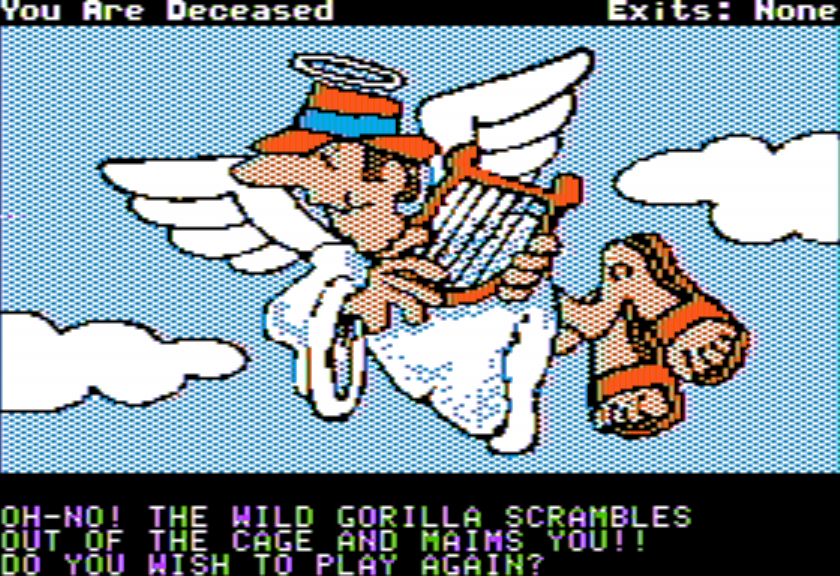
You can then use the magic button to safely enter but the cage gets locked behind you, and there’s no new items or the like.
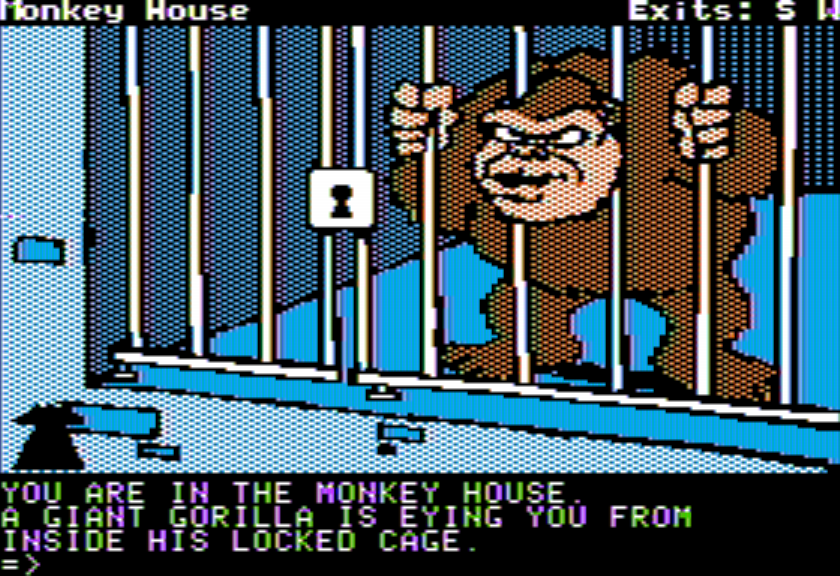
You can, weirdly, throw the rock in the monkey house and it will “roll under the gorilla” as opposed to flying off like it does everywhere else, but I have found nothing useful come from this.
I haven’t gotten into the office of the zoo yet either — still getting stopped by sercurity. My suspicion is there’s some control in the office that turns off the electric fence, revealing another route.
Rather more importantly, I haven’t found any real “alternate solutions”. Remember, part of the setup on this game (according to the ADVENTURER from the text version) is that you can use up items in “wrong ways” to solve puzzles in different ways than the real route. That doesn’t mean for sure I’m doing things wrong — maybe I lucked out! — but I still nevertheless am missing a chunk of content for the game.
Winning post either next time or four posts from now, who knows.
I’ve opened a new area, but it just made things more rather than less puzzling.
First, a revision of something I previously said: I mentioned that when wearing the mask, that the mysterious figure following would eventually pick up the trail anyway. I thought it was a time-based thing, but rather, it is location based:
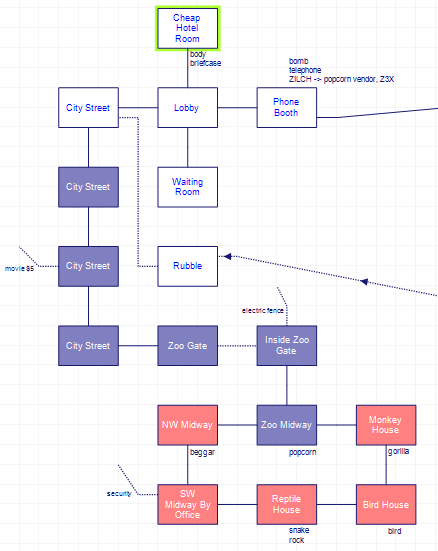
While in the area marked blue (“City Streets” to “Zoo Midway”) you are safe while wearing the mask. In the red area the figure appears, and you have a random chance of dying to a knife.
Consequently, I made a structural solving decision: I figured that in the “winning run” of the game it was intended for the player to be “safe”, that is, there is no point (unlike Adventure 430) where you can do everything right and still die. This was consistent with the prior games by the author; what this meant is I needed to ignore everything in the red until I had the means to be safe there as well.
(More on structural solving here: roughly, it involves solving puzzles by making deductions about the intended flow of the game.)
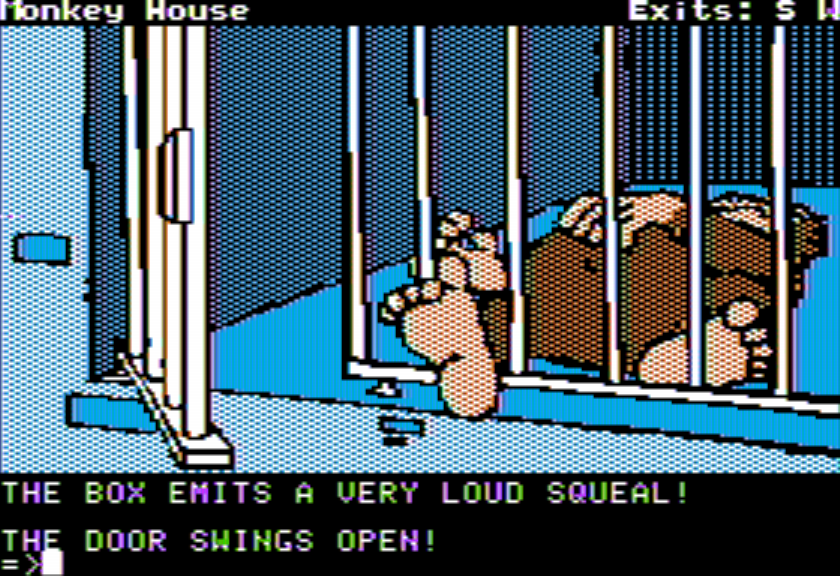
There was one bit of hintage at least (although not progress) from the red area. I tested the mysterious box with a button everywhere. It gives a squealing noise twice, and any further button presses there’s just a “click”. That suggests a resource is being used up that only works twice. The special power I discovered at the “monkey house”.
Specifically, pushing the button caused the cage to open. It seems to be a “open the locked door” device. This discovery became important soon after.
Turning back to the initial area, I combed over for things I had missed. One thing I’m sheepish about missing, in that I wrote down the words some things may need to be examined over twice, is that at the body at the start you need to SEARCH twice. The second time you get a telegram.
I wasn’t sure at the time how to interpret this, but I decided — in the spirit of combing over everything very carefully — to hang out at the telephone a little. I didn’t have anyone to call, but ANSWER PHONE gave the message NO ONE IS ON THE LINE. This suggested to me perhaps there would be some moment the line would would be used. The bomb goes off at 6:15, and at 6:09 the phone rings:
Answering the phone has someone ask “what’s the woid”? I figured it had to be one of the telegram words.
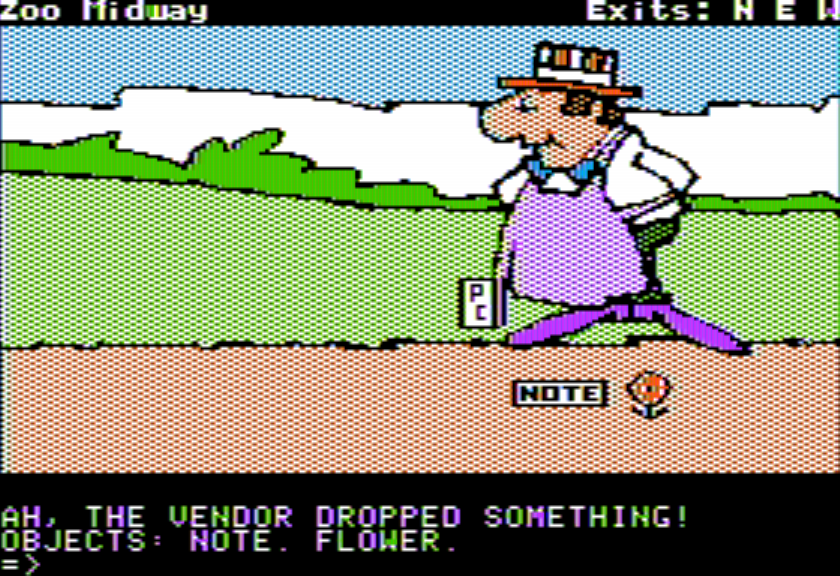
ZILCH (“OUT”) gives the password Z3X, and ZORCH (“IN”) gives the password W3E. I think this is meant to be an “are you out or are you in (the gang)” question. Saying Z3X (that is, picking “OUT”) to the popcorn seller gets a NOTE
BEWARE OF THE SQUEALER! IF YOU’RE REALLY SHARP, YOU’LL TAKE A SHORT CUT AROUND THE BLOCK!
and saying W3E gets both the note and a flower, which you are told to wear.
Once you have the flower on you are safe in the red zone on the map, so that’s clearly the better choice. (Incidentally, the popcorn vendor doesn’t respond to either word unless you’ve been through the phone call scene, but it makes sense that he hasn’t been told to expect a code word signal yet.)
I still suspected I wasn’t done with the hotel yet. While you have enough time to leave immediately after the phone call, I wondered what would happen if I waited until the explosion (“SQUEAL BOMB”) from the telegram.
The bomb starts giving the same squeal that my door-opening gizmo gives when I push the button. What if I push it when the bomb is squealing too?
This drops you down a secret trapdoor! Note that this doesn’t work early: You have to hit the button right when the bomb is about to explode.
This is the previously-mentioned brand new area I found.
This is a relatively standard maze, except:
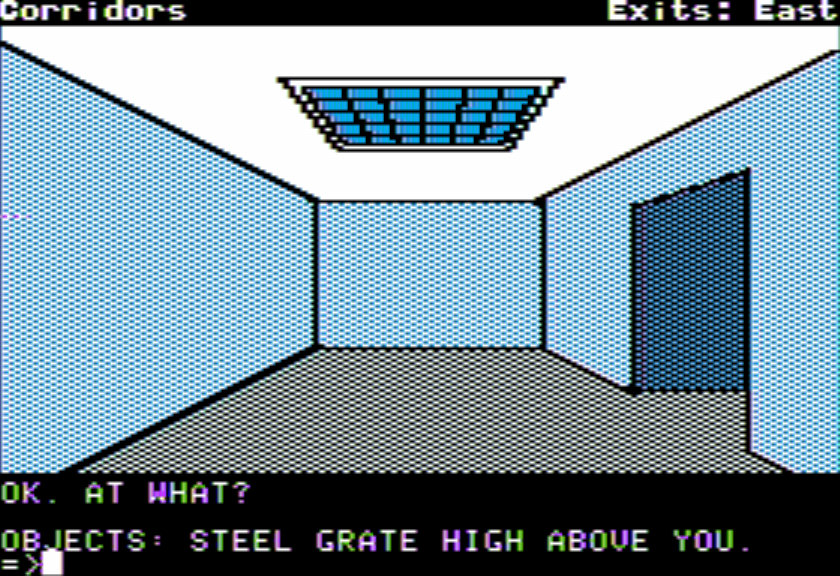
a.) there’s a grate where you land that is unreachable, and a grate in another spot, also unreachable; I don’t know if they’re just for flavor or part of a puzzle, but knowing the author, we need to reach at least one of the grates
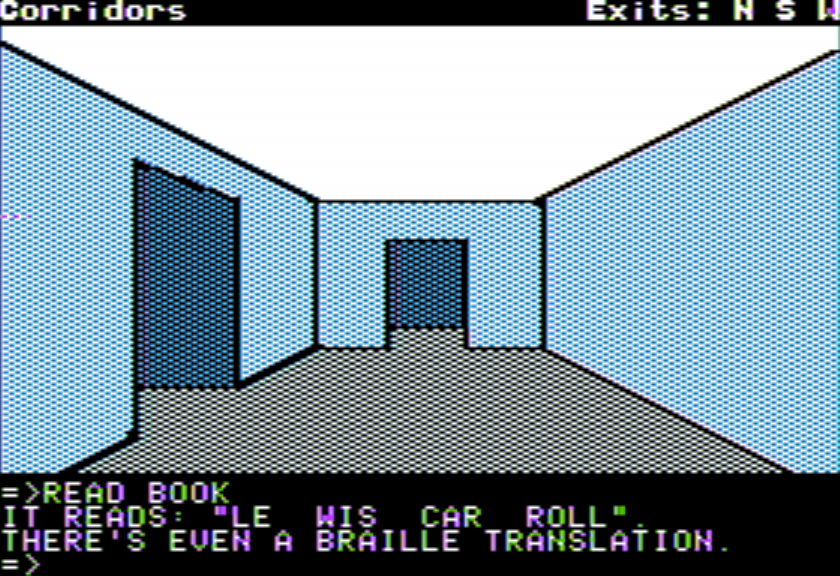
b.) there’s a book (LE WIS CAR ROLL) and a bra (MODEL 36EE-2-BBL) just lying around
The Braille has to be a hint, right?
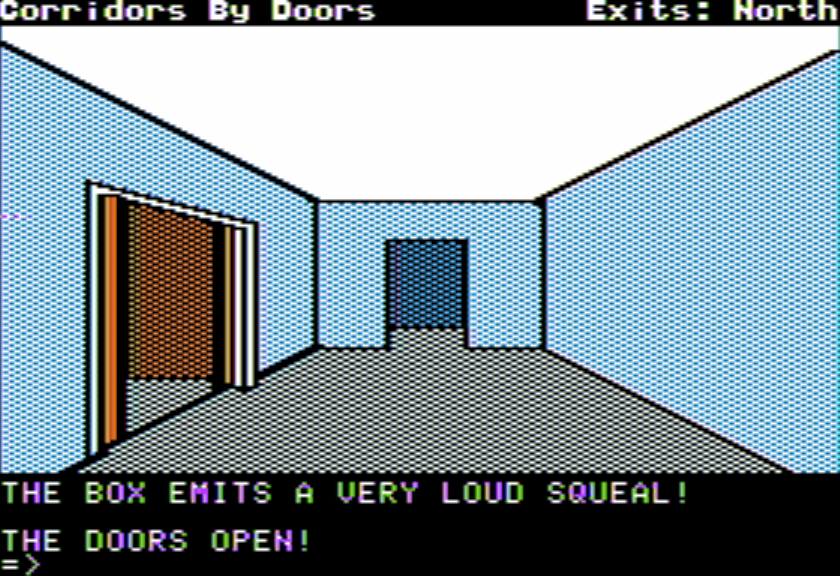
c.) there’s a pair of double doors where the magic button works; however, trying to step inside and you just drop down an elevator shaft
d.) there’s a wood block under a gap in the ceiling; you can move the block to reveal a corkscrew, which you can jam into the block as a sort of stepstool in order to reach the ceiling and get out of the whole complex
This of course could be the “block” referenced in the note the popcorn vendor dropped, but I don’t know how to apply the information.
Climbing up is a one-way trip as far as I can tell, so if there’s a way to safely get in the elevator it needs to be done before this exit.
I’m still very stuck; I guess the model number might be some new key-code and the book might be as well, but I’m making no progress on any of the obstacles I now am blocked by with either. That’d be the movie theater ($5 entry), the electrified fence, the office at the zoo (stopped by security), the snake with rock (can’t pick up the rock without dying), and the gorilla (who as shown earlier, you can free with the magic button, but then he just kills you).
Still, everything is coded very tightly and I don’t feel like I’m stuck because of jank programming, so I’m happy to keep whacking at the puzzles and hoping something falls out.
We’ve so far seen two games by Dale Johnson, Mad Venture (with Christine Johnson) and Palace in Thunderland (with Ken Rose). In Mad Venture there was an item that mentioned Palace, and in Palace there was an item that mentioned Mystery in Madness, Dale Johnson’s third game.
>READ BOOK
IT READS, “LOOK FOR THE NEXT ATTRACTION, MYSTERY IN MADNESS” AT YOUR LOCAL COMPUTER STORES SOON!”
The game never was finished as Mystery in Madness, but there was a 1982 version called Mission in Madness.
This was followed by another 1982 version called Madsquerade, which added what I might call “programmer art” to the game.
From A2Can’s Twitter feed.
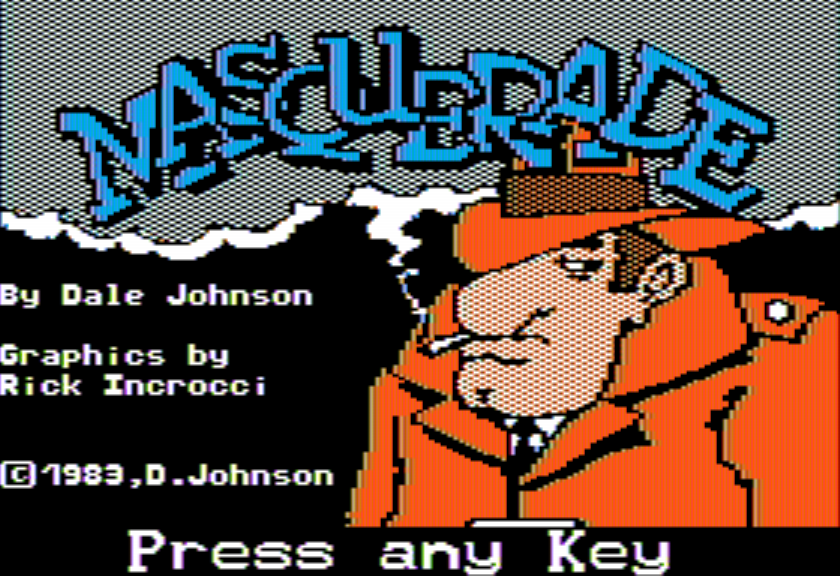
Neither of these versions are that famous, and in fact I have no access to the early graphical version. What I do have access to is the version from 1983 called Masquerade (eventually dropping the “mad” bit altogether) as published by Phoenix Software. It includes new art by a name that might be familiar.
Back in ’82 I bought my first Texas Instrument Computer – then an Apple II. I fell in love with computers and things just started happening. I had been a cartoon illustrator for many years prior – so making the move to computer graphics was no big deal (I bought two very expensive graphics tablets that Apple used to make – back then, they were about $800 each). I was doing computer graphics for a few Chicagoland educational houses – then places like Phoenix and Penguin Software just started calling me out of the blue. It was a small world back then – just a few computer artists in Chicagoland and a lot of small software companies that actually worked out of their homes. Not any more.
I wish could explain exactly the history sequence here, but it is still a little mysterious. Dale Johnson died in 1999 so nobody can ask him. I especially don’t know where or how the earlier two versions surfaced — were they published? I haven’t found any ads indicating such, and Mad Venture and Palace in Thunderland had both fairly prominent spreads. Maybe they were just given out at the Northern Illinois Apple Users Group, or even shown off without distribution? Everyone in the Chicago area knew each other, so at least it isn’t shocking that Madsquerade landed into the hands of Phoenix for publishing.
I’m going to play the Incrocci version but I may refer back to the text game sometimes, especially if the puzzles start to get gnarly; perhaps there will be a different description or puzzle sequence that will help decipher what’s going on in the 1983 version of the game.
By “everyone seems to know”, there later was a French version called Marmelade, which is the sort of thing that can only happen if your game gets widespread; additionally, it made the charts at Softalk. Still, the Gallery of Undiscovered Entities, who got their numbers from Ron Unrath, founder of Phoenix Software, gives an estimate of 1500 copies sold. 1500 is not huge even for that era, but I suspect widespread piracy; Paul Berker (of the prior Phoenix games Birth of the Phoenix and Adventure in Time) mentions at “pirate parties” most people he bumped into at Apple II meetings knew about his games but hadn’t bought them.
Masquerade has our hero a detective on the hunt for the crime lord Mr. Topp. In both of the early versions the intro reads:
YOU’VE BEEN TRACKING A NOTORIOUS HIT MAN FOR WEEKS. YOUR MISSION IS TO FIND THE “TOP MAN” IN THE ORGANIZATION AND DO AWAY WITH CRIME!
For the 1983 version:
YOU’VE BEEN TRACKING A NOTORIOUS HIT MAN FOR WEEKS. YOU TRAIL HIM TO A SEEDY HOTEL ROOM, BREAK IN, AND WITH THE BUTT END OF YOUR TRUSTY .44 MAGNUM, KNOCK HIM COLD. THIS COULD BE THE LEAD YOU’VE BEEN WAITING FOR.
This makes it a little clearer what’s going on at the start:
That is, we weren’t hanging out in a hotel room and got ambushed; we did the ambushing. Searching the body reveals a wallet with one (1) dollar and a business card.
Ivan Tupickemoff — Professional Assassin — Hours by Appointment
Plot-wise I’d think we’d want the assassin awake for interrogation, but maybe things went a bit wrong. Perhaps we need to wake him up as part of the game (there’s a tricky aspect to that you’ll see in a moment).
Moving the body reveals a key (note: SEARCH and MOVE revealed different things — this also is probably a game where you need to SEARCH multiple times). The key unlocks the briefcase which has a mask and mysterious box that gives a high-pitched squealing sound; I have yet to find a use for the latter.
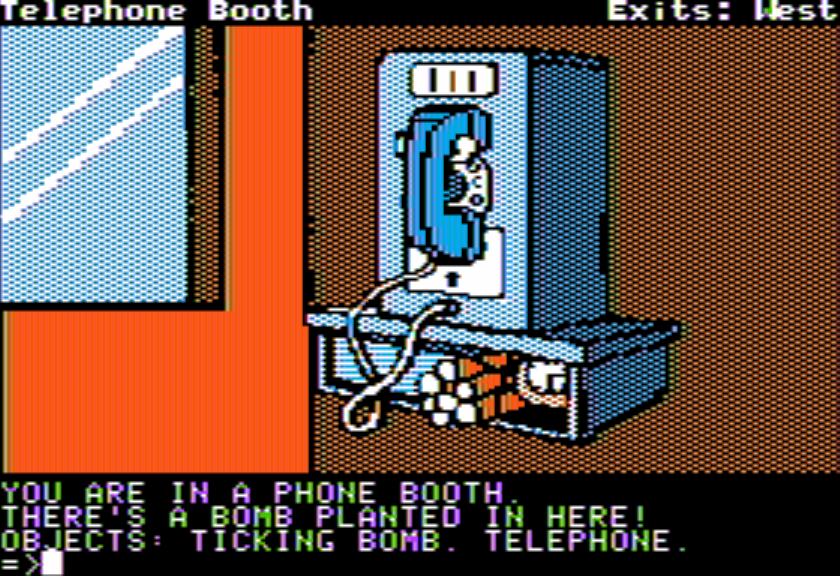
Just outside the hotel room is a phone booth with a bomb. The bomb is set to explode at 6:15 exactly. In addition to the gun we start with a watch indicating that’s about an hour away.
Just as a test, I went outside the hotel and waited, and you can indeed witness demolition followed by rubble. Since no items seem to result, this seems to be more of a general time limit we have to worry about than a return-later style puzzle.
Before moving on to town, I want to mention one difference in the text-only version of the game. There’s a meta-conversation where there’s a room in the hotel with an adventurer.
YOU ARE IN A PRIVATE HOTEL ROOM
EXITS: EAST
OBJECTS: ADVENTURER. APPLE.
>LOOK ADVENTURER
HE IS EXHAUSTED. HE MUTTERS, “AT LAST I FOUND THE TOP MAN, BUT, AS USUAL, GOT KILLED. LET’S SEE, THAT’S ABOUT 17 DIFFERENT WAYS I MANAGED TO KILL MYSELF. (GASP, COUGH!) THE PUZZLES SEEMED SO EASY AT FIRST, BUT THEN I REALIZED THAT THERE WERE MULTIPLE SOLUTIONS AND ONLY ONE IS RIGHT. BUT WHICH ONE…”
This is explicitly discussing up front one of the game’s patterns, which is that you can solve puzzles in a “wrong way” using up an item that’s needed for later. I know one bit where I’ve likely already hit this. I’ve never seen the “main text” of a game — as opposed to hints from the game’s manual — explicitly call out one of the gameplay patterns early like this.
(Aside: is there a better term than “gameplay patterns” here? That’s all I’ve been using in the past but I’d love a term that implies “things that aren’t true about all text adventures generally, but just about some games in particular, and they can take some work on the player’s part to extract out and might even be subconscious tendencies of the author they aren’t aware of”.)
Moving on past the hotel room to the main town, there’s not any explicit investigating going on: rather, you are being followed.
The “mysterious figure” who is watching you shows up in the graphical game in the lower left corner as a shadow. Once the figure is following it has a random chance of throwing a knife and killing you outright like one of the dwarves from Crowther/Woods Adventure. You might think to use your gun to just shoot the person, but alas, your gun has no bullets.
There is a way to forestall the figure appearing for a while: wear the mask. The figure normally appears immediately upon leaving the hotel area, but the appearance is delayed at least slightly if you’ve got the mask on.
Here’s the map of the town I have so far:
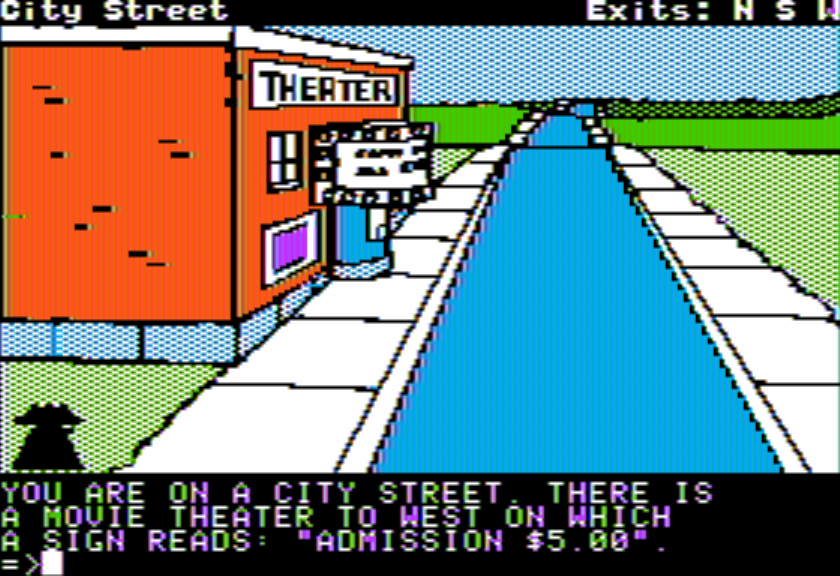
Due to knives it took a couple passes through to see everything. There’s a movie theater early that wants $5 for entry (only a dollar to start from the assassin’s wallet, alas) and there’s a zoo that wants $1 for entry.
While paying the $1 works for the Zoo, there’s a popcorn seller immediately inside who wants $1, so I suspect you might get in the Zoo via a different route and save the dollar for popcorn.
Other scenes in the zoo: a fence that’s electrified and will kill you if you climb it, a building with security that will kill you if you try to go in, and a snake by a rock that will kill you if you pick up the rock.
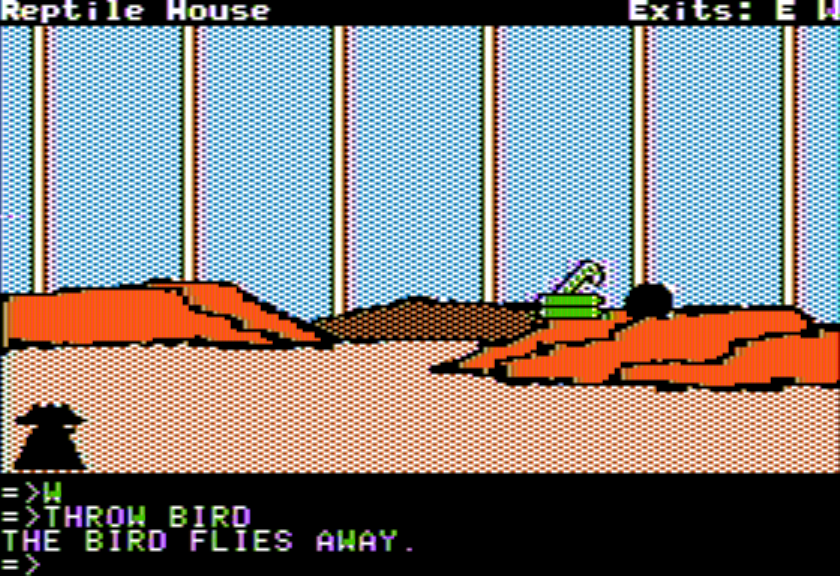
Another part of the zoo has a bird, but if you try to take the bird and throw it at the snake (copying the Original Adventure solution) it just flies away.
Finally there’s a “beggar” and a “monkey house” I’ve done nothing yet with.
This one’s going to be tricky, I’m sure. I’m not just basing this on the previous Dale Johnson games (Alice in Thunderland was delightful but absolutely personified tough-as-nails puzzlebox) but the fact there was a contest with $1000 for a solution to the game, invoking the same shenanigans as various UK companies. The contest was eventually won and paid out but after Phoenix already got sold to another company (American Eagle) for reasons I’ll save for another time.
For this, we return to Bruce Robinson, Victory Software and the absolutely miniscule games they wrote for the VIC-20. (Previously: Adventure Pack I and Jack and the Beanstalk.)
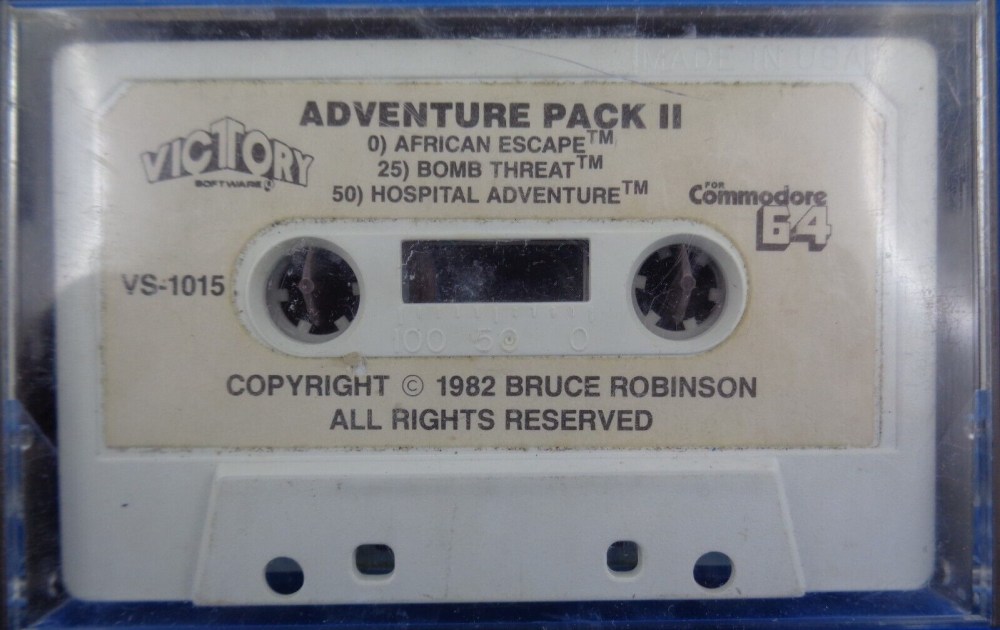
Although they came out on C64 too. Picture via eBay.
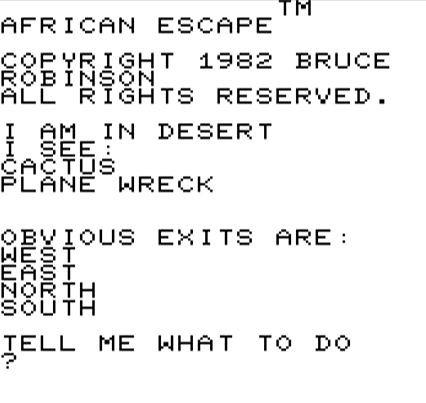
The first adventure pack had a game get swapped by circumstances I discuss in those prior posts, but this second pack has a fixed set of games: African Escape (you crash in the desert and need to get out), Bomb Escape (stop the terrorists) and Hospital Adventure (do an assassination).
They get progressively higher in intensity, and one intrepid artist for the UK version (as published by Mogul) tried to put all three games in the same picture.
From the Museum of Computer Adventure Games.
I admire the commitment to the bit. I originally was planning a three-in-one post like I did with our first visit to Victory Software, but the initial game in the set, African Escape, ended up being a massively painful experience, so rather like Greedy Gulch I’m going to punt on the other two for now.
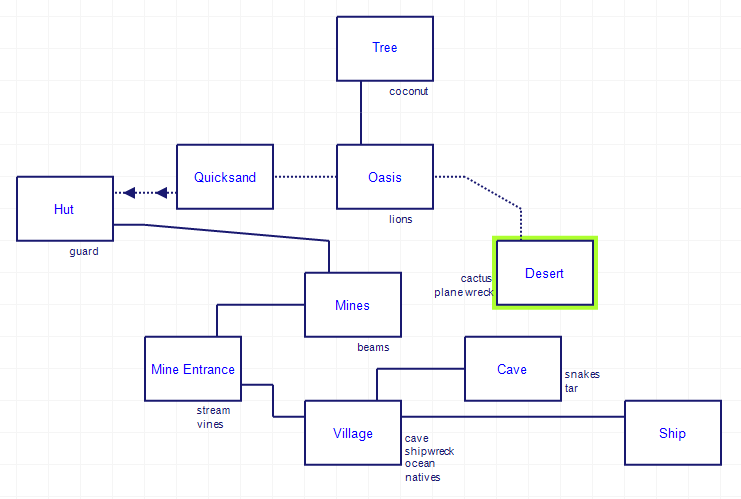
And it is a tiny map. I mean, look at this thing:
There’s not even much depth to it (like with Big Bad Wolf). The game has a parser that is so minimal that only the “correct” action at any given point will give any feedback; that sort of concept can work of the actions are very intuitive, but that’s not the case here. For example, at the start…
…trying to LOOK WRECK or LOOK CACTUS get nothing useful in particular. By all appearances this is the sort of game that drops the player outright in a maze — and the player is started with food and a knife which could theoretically be used to map things out — but DROP is not understood as a verb. (Nor any variants like LEAVE. There is no way to drop objects in this game!)
After a bunch of hassle trying to figure out a creative way to map things out, I gave up and looked up a walkthrough, which starts with CUT CACTUS.
AHA! WATER. NOW I CAN SEE STRAIGHT.
Now rather than there just being a wreck and a cactus, there’s also an OASIS.
The idea that you’re hallucinating enough to not see the oasis is a reasonable one (it seems like that’d trigger after we’re dehydrated a bit longer though, this seems to be happening right after the wreck). However, there’s no indication of this and you just have to muddle into a guess that cutting the cactus is useful.
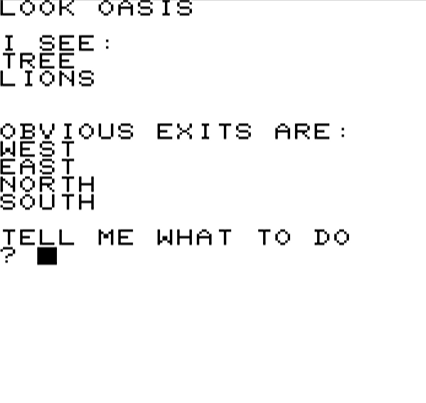
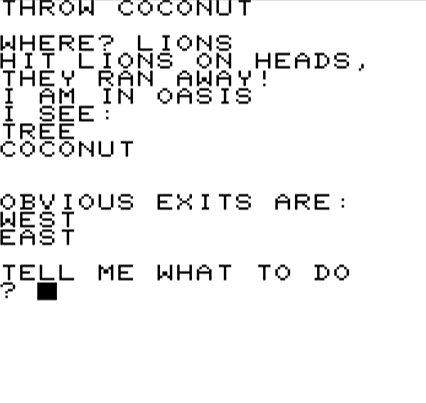
Once in the oasis, you can climb a tree and get coconuts, but are blocked from further progress by lions (keep in mind deserts are wide open, I don’t know why we’d be blocked). I did manage to find out the right action here, to throw the coconuts at the lions which scare them away. Of course.
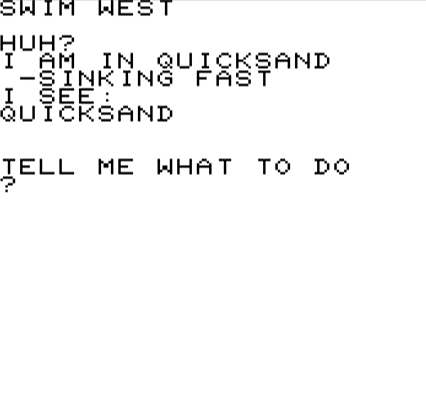
However, it’s bumpy from here on out, and the next two puzzles basically caused me to drop trying to solve anything at all. Going west from here drops you in some quicksand.
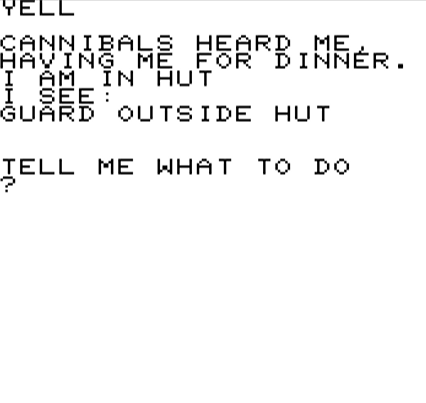
From here you need to YELL. I wouldn’t expect anyone around to hear in the desert area, but given we have now rapidly changed biomes to jungle (??) I guess it sort of makes sense.
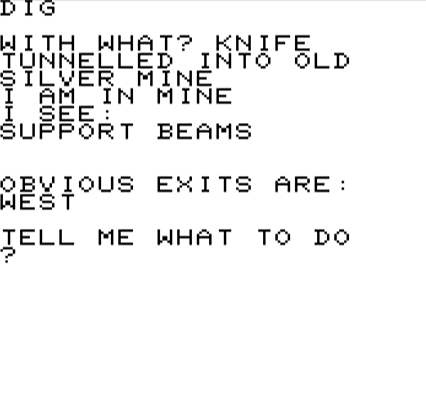
Now, apparently without the guard noticing, you can DIG using the KNIFE and somehow do it long enough to make it into a silver mine.
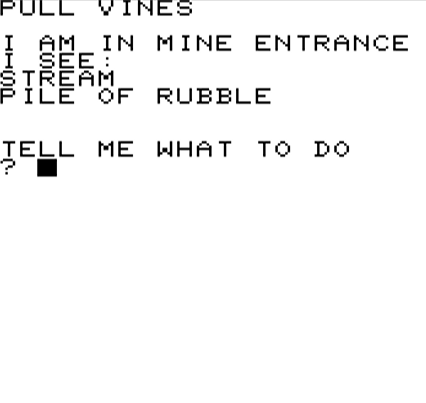
Outside this mine are some vines, where you can bring them back to the mine and tie them to the beams … I mean to the SUPPORT (beam isn’t understood as a noun) and then go back outside and yank to collapse the mine. The whole purpose is to get some rocks.
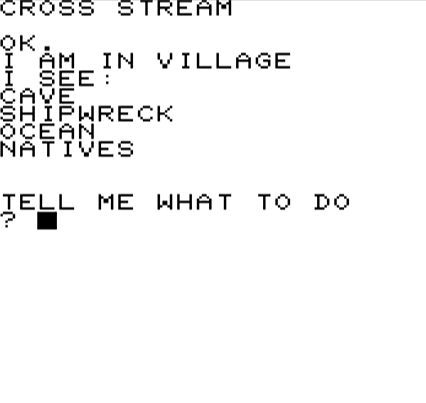
The rocks go to make a path across the stream, and you don’t build a bridge or anything, you just THROW ROCKS at the stream and apparently they land how you want them.
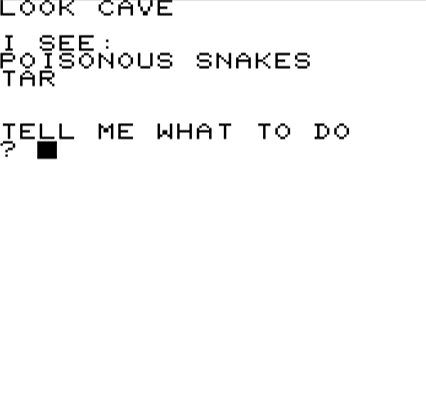
You can FEED NATIVES (not GIVE FOOD) and get traded a flute, which you can then use to get into the cave where there’s some nasty snakes.
But make sure you type CHARM SNAKES, because if you thought PLAY FLUTE to work for making flute music you’re thinking of an entirely different, better game.
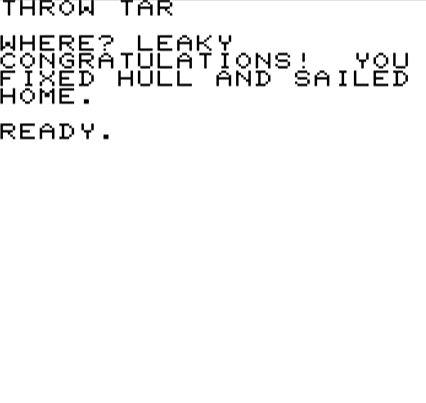
With the TAR from the cave you can then go back to the shipwreck outside which is apparently not that wrecked because all you need to do is THROW TAR at some holes and it’ll become seaworthy and you can escape. Oh since we’re at the ocean I guess we changed biomes again?
I don’t typically rank my games but I will say here this is one of the worst games I’ve played for the entire project. The parser was at Deathship-level (without that game’s clever use of geography) and the plot somehow managed to be both minimal and nonsensical at the same time.
I swear the original four of the Victory games weren’t this bad, even though the parser was constructed in roughly the same way. All of those games involved a relatively wide-open map and somewhat intuitive actions (well, not Computer Adventure, but you could at least get a good chunk of exploration done before being stuck). The author’s style — when dropped into a linear-scene game which requires guessing-the-right-command — became far more abrasive.
In order to be fair to the other two games in the trilogy, I’m going to punt them down my list (not too far, just a little) so I can approach them with a fresh mind. In the meantime, for our next game let’s relax with some pleasant Apple II graphics, shall we?
I have reached a point where I started to think I was hitting at least one of the “broken moments”, and after doing some more research I ended up reading all the way through this thread discussing the issue.
There’s enough “open threads” to the game that it is a mystery what might be caused by broken source code and what might be caused by our inability to solve the last lingering puzzles. From that thread, someone hacked the game in order to get a “dark hooded figure on horseback” to appear (which seems to be bugged to never appear).
>EXAMINE FIGURE
You have looked upon the Dark Angel. This is the angel of death: to be more specific, your death. It has cost you your life to look upon it.
If you avoid the death, the horse will drop some manure that will be useful later. Without that item it drops a whole chain of puzzles from being solvable, and there’s one moment after (testing with hacking in the manure in one of the rooms) where the game just outright crashes.
I’ll try to report what remains in the game that I needed to and was able to solve (less than I thought!) followed by what maybe is happening with the broken parts.
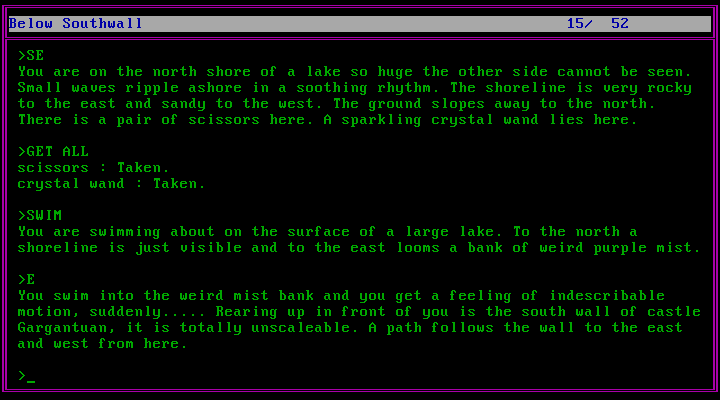
Returning to parts that did work — I had quite thoroughly checked all cardinal directions on my map, but I hadn’t tried all permutations of GO or ENTER or the like that seemed logical, and I realized at a lake, I had neglected to SWIM.
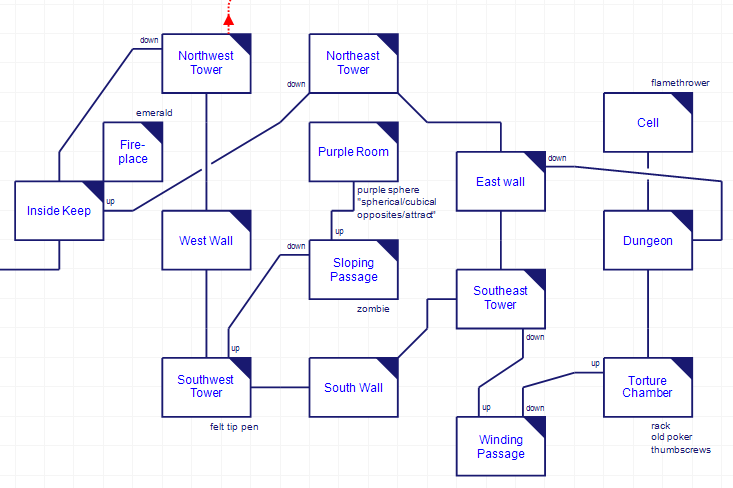
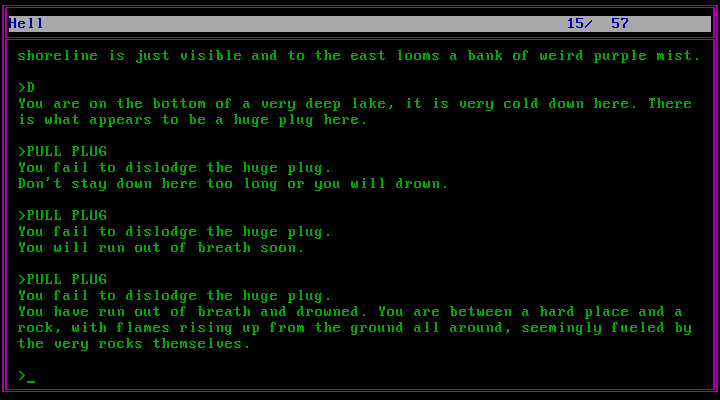
Instead of going east into the purple mist (which teleports you to the castle, as shown) you can dive and find a “plug” at the bottom of the lake, but let’s save the plug for later and explore the castle:
On the outside portion there’s a garden that will be important later.
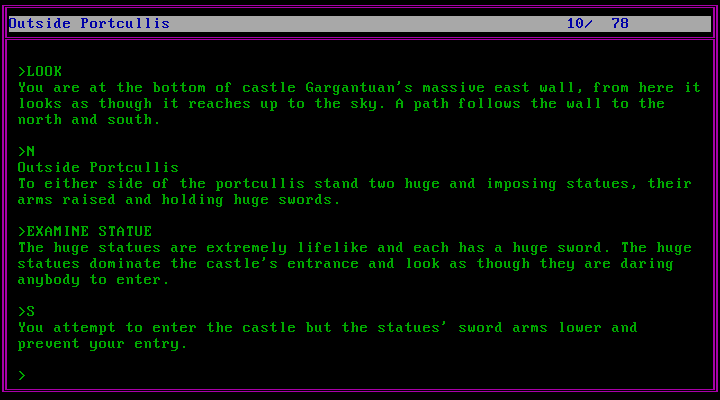
Soon after I hit one of the gnarliest, most extreme examples ever of the Parallel Universe Problem. (Condensed: imagine you go from A to C in an adventure, with no issues. You restore a saved game. You try going from A to C but you get stuck at B, which you didn’t get stuck at before. What was different? You’re in a parallel universe but it is non-obvious what changed. That’s the Parallel Universe Problem.) I cheerfully explored around castle Gargantuan, including visiting a portcullis…
To either side of the portcullis stand two huge and imposing statues, their arms raised and holding huge swords.
…and went in what I thought in was another direction, to explore even more of the map.
Lots of juicy things over here: an emerald in a fireplace…
…a zombie nearby a weird room with a purple sphere…
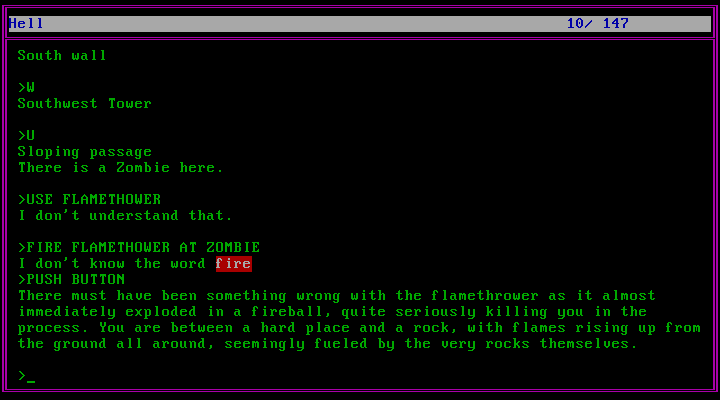
…a flamethrower which explodes when you try to use it…
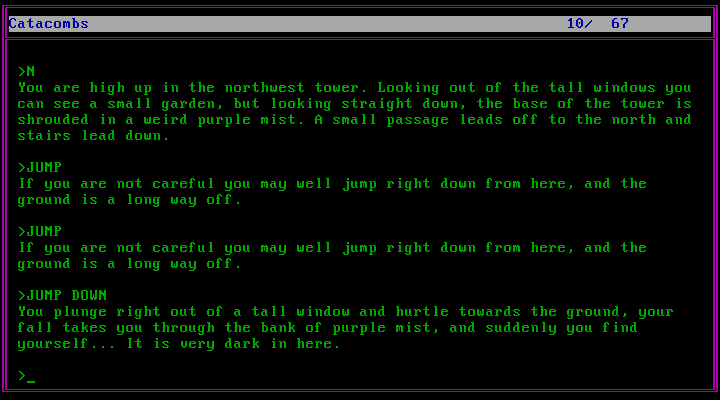
…and a decently clever way out, where you spot the same purple mist that teleported you to the castle, and jump on down to what otherwise seems like doom.
Mid-exploration I was wanting to try bringing in a different object, so restored a saved game and went through the swimming process again and…
…got stopped by the statues. First of all, I didn’t even know by going south I was entering the portcullis, I somehow had assumed it was to the north (given there is no description of opening and the like, it was a puzzle I had earmarked to check out fairly soon). Second, I was utterly baffled why I got stopped on one run-through but not the other.
Fortunately, there’s not that many items in the game, and some more experimentation revealed I had the cloak with me and worn on my first trip through, which makes the statues let you through. So I had solved a puzzle without realizing I had solved a puzzle!
Returning to thwacking at various puzzles throughout the game, I found that back at the church where there’s a rope at the bell, you can CUT ROPE rather than ring the bell. The rope then works at a railing up higher, allowing you to steal a minute hand off the church clock (which is a treasure).
Not really stealing, remember. This all goes to the altar.
I was now truly stuck — including puzzles from last time — on the spider, the creature, and the geyser. I also now had a flamethrower, zombie, garden, and purple sphere all puzzling me. I also found if I dived into the lake I could find a plug which the game suggests you can pull but I had no way of doing so.
Roger Durrant suggested in comments I check out the “Crystal Grotto” some more. I ran across a completely undescribed “wall” while poking around:
There doesn’t seem to be any way to reveal by normal means there’s a special “wall” object; I just was prodding for secret passages and gave the noun a try, despite it being unmentioned.
The tap will cause boiling water to start flowing. This affects the geyser out past the Charon area, and lets you go on through to a sewer and a train line:
If you avoid reading the warning sign (which only applies if you’ve read it, like Wile E. Coyote) then you can find a platinum cup, which was visible earlier as being on top of the geyser, then escape entirely through the geyser hole itself.
So all that was handy, but I was still horribly stuck, and I finally got around to reading that entire thread I mentioned at the top of this post. There I found I was stuck exactly where everyone else was, namely:
a.) the flamethrower doesn’t seem to do anything useful; it seems like it ought to fry the spider but it doesn’t work (the thread indicates some way to fix it with the pen so at least it doesn’t blow up, but I never could find the right verb combo for that; since it doesn’t work anyway, I didn’t try too hard)
b.) there seems to be no purpose to picking up the critter (that prevents you from picking up the harp, sticks to you when you try to set it down, etc.)
c.) there seems to be no purpose to killing the vampire (the stake does nothing)
d.) there seems to be no way of pulling up the plug
From game hacking, we know pulling up the plug lets you enter Neptune’s realm, which has a trident which is a treasure, but also, importantly, lets you enter Elysian and bypass Charon. This lets you also keep the coin (assuming the route can even be taken).
The missing and buggy-to-obtain manure can be dropped at the garden, to then obtain a purple cube which the gardener gives you, which can be taken to the purple sphere to get the purple sphere, and then have the game crash when the zombie tries to follow you.
Some or all of this might eventually be fixable by hacking the game to its intended form, so I will leave this game off on an open question mark for now. I’ve touched all the treasures but I don’t feel like optimizing a “run” when the run is obviously incomplete. I will keep an eye out for updates (or the PET version of Catacombs miraculously being found, although that one has been sought after now for a long, long, time).
Let’s return back to 1982 for now, shall we? I’ve got a trio of short games up next in the hopper (one where we need to pull off an assassination in a hospital) followed by an investigation game for Apple II which starts with a dead hitman in a hotel room.
I’ve made a smidge of progress nibbling at the edges, enough for an update.
The tough thing about writing about adventure games is how often progress isn’t plot really as much as baby steps not made with any continuity, and certainly not delivered in a way that lends to clean narrative.
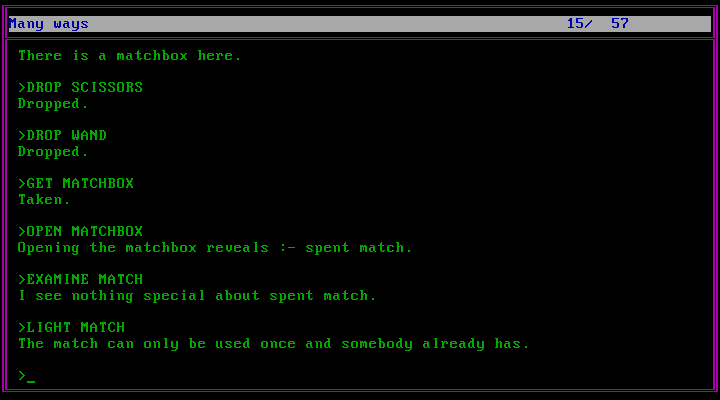
For example, one of the things I tried that failed was handling the spider and web. I had a matchbox and I thought perhaps I needed to bring it over to causes a fire (I’ve set many a web on fire now in adventures) but I hadn’t opened the matchbox yet. It only contains one “spent match”!
Additionally, the web and spider both were parsing LIGHT in such a way I suspected fire was the wrong direction (LIGHT WEB: “The web can’t be lit.”) so I decided to go a weapons route instead.
So, a sword isn’t a weapon? That’s curious. (Neither is a wooden stake, which I’ll get a hold of later.) The parser message does suggest that the right weapon will work, as trying to kill random objects doesn’t provide a similar response (“I think you should see a psychologist about your kill happy tendency!”)
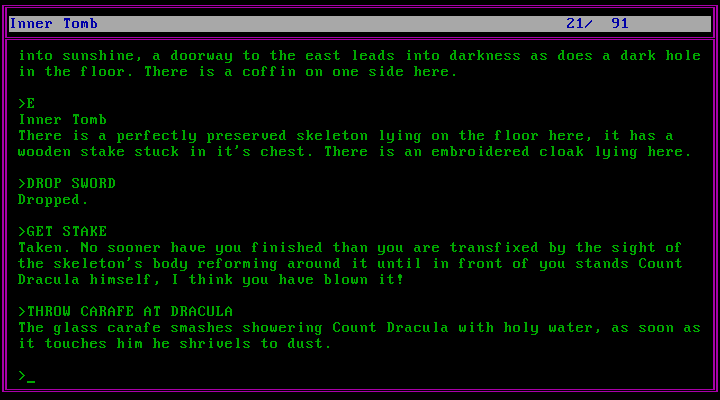
The next thing I had earmarked to try was filling the glass carafe with holy water, which I had more success with: it worked! I then took the holy water over to Dracula, where I struggled for a while with verbs (POUR WATER didn’t work, either before or after waking DRACULA) finally coming up with throwing the entire carafe (you can’t just throw the water):
The wooden stake is the only thing achieved from this, and I haven’t used it for anything yet. I still have the suspicion Dracula gets some other use before getting taken down.
Despite what seemed like a fairly robust parser, I was running into enough verb difficulty I decided I need to do my big list again:
That’s pretty sizable, but it is interesting how much I’m still running into gaps; for example, there’s a puzzle with a geyser and a hole (still haven’t solved, but it seems like the hole needs blocking) where I tried to INSERT CLOAK (which of course isn’t understood).
I incidentally went on and tried my “extended comedy list” of verbs that I’ve really only seen in one place (mainly because it was discussed in comments recently), and guess which verb I found?
I suspect this is fishing and not sailing a boat, but with this game who knows?
One other extended verb I tested was STAMP, being hinted at from the inscription at the catacombs. I had originally assumed an item that you then stamp things with, but the response indicated STAMP was standalone:
Little happens except your foot is smarting a bit.
Oho! I expected to try it in the catacombs and die (given the warning) but I got the same response. Not Subterranean Encounter style to the warnings, then. After some experimentation I found STAMP worked at the Cube rooms, allowing teleportation from one room to the other.
This doesn’t unlock anything new (you can simply walk between the cube rooms), but I suspect later there will be good logistical reasons to do this.
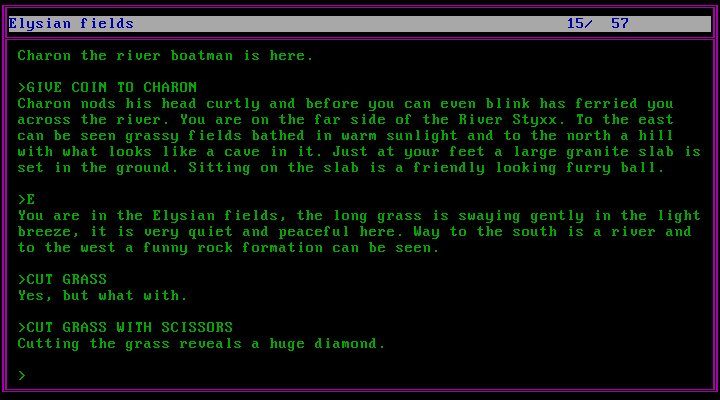
Having done all that, I browsed back in the sea of green verbs and looked for anything helpful. I was staring at the very first word (CUT, I have no idea why I have it first) and realized I could try it back at the grass at the Elysian Fields:
If you try to visualize in a completely literal way this makes no sense — an entire supernatural field, and scissors will really reveal a secret item? — but I think this suggests not to get too fixated on physical reality in this game, and as long as two things go together in some sense (cutting and grass) they might be a solution to a puzzle.
Speaking of puzzle solutions, another verb that struck me was PRAY, which for some curious reason I hadn’t tried yet at the lost souls.
The failure to enter the gates shown above might be necessary at some junction for logistics purposes, but there is a way through the gate — you just need to open that Good Book from the church.
Yes, the furry ball seems to mostly serve as a way to prevent you from picking up objects, much like my own cats. If you go down you’ll land in front of the church.
To recap what’s needed for this part of the narrative
a.) you need to hand a coin to Charon to enter the land of the dead
b.) you need to cut grass at the Elysian Fields, the immortal rest place where the heroes go, with some scissors, in order to find and take a large diamond
c.) you can then pray to get sent to heaven, and use a Good Book to enter within
d.) then use the opportunity just to swipe a golden harp and get away
A fun clash of kleptomaniac adventurer and religion. (Although remember all treasures go to the altar! The instructions even chidingly remind you that the treasures aren’t really yours. I think it best not to read too much into the symbology of it all.)
I’m not left with much to ponder over: just the spider and the geyser and the small creature. Maybe the creature and the spider will fight, I haven’t tried that yet. However, being a hunt-the-object adventure there are no doubt some hidden puzzles, so I should probably comb over the whole map again looking for things to poke at.
If nothing else, I should try putting together gathering all the treasures I’ve managed so far into one “run” to see where I’m at scoring-wise (technically out of 250, although remember due to bugs potentially only 240 are possible). The inventory limit is pretty tight so this is one of those games where you solve the puzzles first and then do the “real walkthrough” where you only take the items you need when you need them.
This continues directly from my previous post, although a brief technical note before getting to the blog post proper: there is a saved-game feature but it is very fussy to get to work on DOSBox (Canalboy in his instructions says it took five hours to figure it out). I am sidestepping all that entirely with the emulator DOSBox-X which has very good save state features so I can ignore the issue.
…
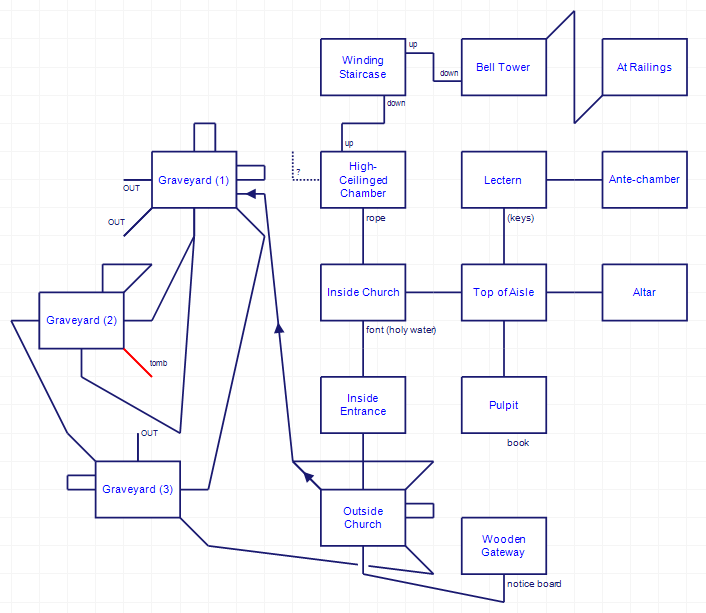
For any large-scale and relatively wide-open treasure hunt, the first order of business is mapping things out. Let me take you on a tour.
From a pamphlet advertising the Classic Quests.
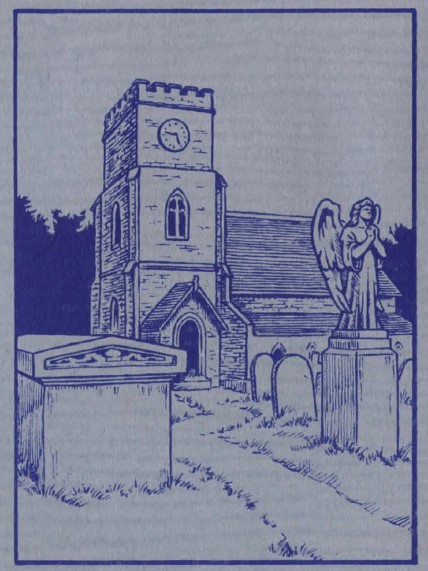
The game starts at a church, and all treasures go on the altar.
There are a few dark niches which require a lamp we’ll get to fairly soon. It is in one of these niches that I ran across my first death.
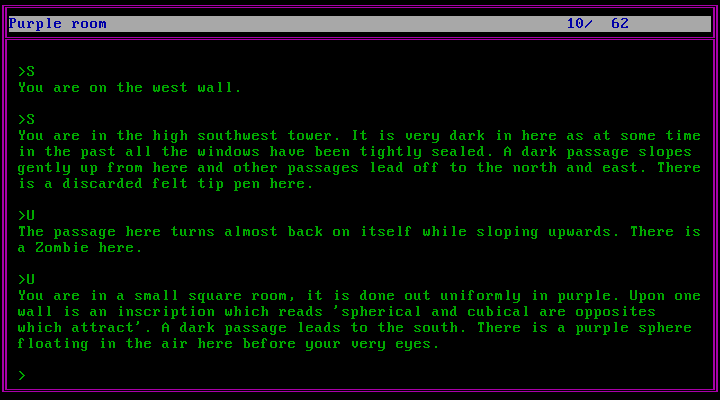
You are in a high ceilinged chamber, there is an exit to the south and a dark passage leading up. The west wall looks as though it used to contain some kind of doorway, but not now. There is a rope hanging almost in the centre of the chamber, it disappears up into darkness.
>U
It is very dark in here.
>U
Something nasty in the dark has found you very tasty. You are between a hard place and a rock, with flames rising om the ground all around, seemingly fueled by the very rocks themselves.
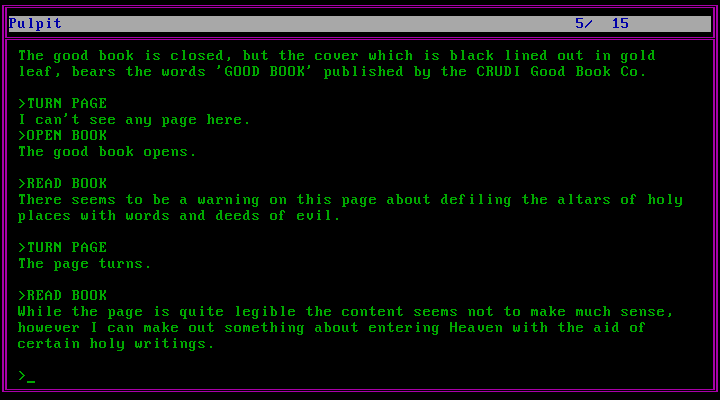
When you die you go to Hell, and this might be like Acheton where there could be a way out. This is indicated by a Good Book elsewhere in the church.
The “entering Heaven with certain holy writings” bit at least suggests it might be possible to go to Heaven on death rather than Hell. The “defiling the holy altars” part incidentally also indicates swearing at the altar will also kill you; this is true, but not with the word “shit”, which is apparently a noun rather than a verb (it maps to “manure” which is an object, and I think the one that’s supposed to be buggy).
Nearby the Good Book — on the opposite side of an Aisle — is a podium hiding some keys. Open questions are:
there’s a font with holy water, where is there a container that allows getting it?
and
is there some secret associated with the “west wall looks as though it used to contain some kind of doorway”?
The holy water I incidentally suspect will got to a vampire we’ll see close to where the lamp is, and the west wall I suspect is one of those secrets that gets resolved “from the other side” (that is, this is a placeholder for arriving via elsewhere on the map) but with less confidence, as there’s some nonsensical map connections elsewhere.
(Nonsensical map connections are more of a schtick in ’77-’82 games than they are in ’86 games, but I suspect the geography is mostly matching the original. However, I’m going to try to avoid speculating too much about the early version of the game because whenever I play Brian Cotton’s next game, there’s both early and “revisited” versions so I can compare so I can get a sense of how much fiddling was going on.)
Popping around outside there’s a graveyard I got lost in last, but the maze is fairly small (don’t worry, there’s a bigger maze later) and I was able to get to a tomb, which unlocks with the keys.
Just inside there’s a closed coffin with a lamp and sword. I can’t confirm — that’s not a bizarre combo to just come up with independently — but I’m wondering if there was more influence from Zork than Adventure on this game. Zork had some religious bits with the Land of the Dead, but original Adventure is squarely secular (resurrection in that game is from the computer-narrator itself).
To the east of the coffin is Dracula. (Guessing it was his original hang-out point, but the big stake in the chest messed with his sleeping arrangements.)
Dracula doesn’t immediately try to kill you (“Count Dracula is looking around to see what’s for tea.”) so may have some utility behind putting him down again (you can’t stab again with the stake, alas). You can run away and he doesn’t follow, although he does take the stake from you, so there doesn’t seem to be a reason to wake him up early.
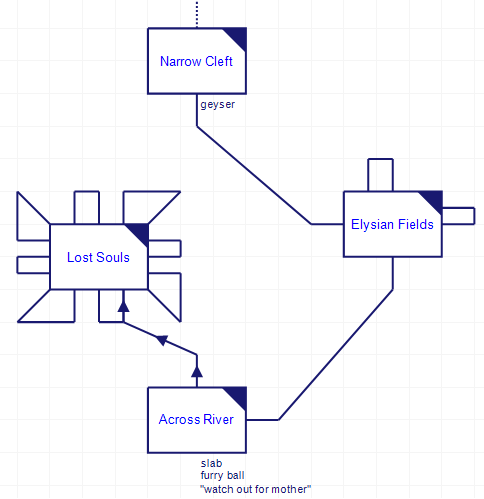
Just a bit farther there’s a coin marked OBOLUS and a ferry at the river Styxx. The coin can go to Charon for a one-way trip.
The “you can’t carry anymore” in the screen above hints at the fact there’s a fair number of items and the inventory limit is pretty rough. Based on Roger Durrant there’s going to be a lot of strategic juggling to get the right items to the right places. It isn’t done by absolute number of objects either, items have weight, so a cloak is heavier than some keys. Have I mentioned yet — like Zork — there’s limited battery to the lamp, so the whole game is under a timer?
The area isn’t large, or at least I haven’t made it large yet. The fuzzy ball covers a slab which indicates to watch for the fuzzy ball’s mother, and if you try to set the critter back down it just jumps back into your arms.
Is there something hidden in the grass at the Elysian fields?
How do you deal with the geyser?
You can also land yourself in a room just described as “Lost souls” with no apparent escape…
All about can be heard the wailing and gnashing of teeth of many lost souls, who cannot find their way to heaven or anywhere else.
…leading to the natural question: is the lost souls room just a trap or is there a way out?
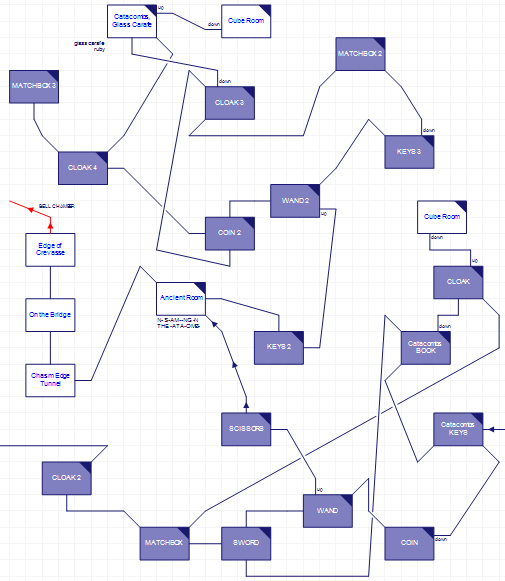
Ignoring the river and proceeding on, there’s some catacombs. I have the “maze with no other purpose to be maze-y” rooms marked in blue.
There are two mysterious rooms that are “almost perfect cube[s]” where the north wall has a “shadowy figure”. What can be done in the cube rooms? Next to ne of the cube rooms is a “glass carafe” and a ruby. I have not yet had the opportunity to test if the carafe works on holy water.
There’s an “ancient room” with a message
N- S-AM--NG -N THE -ATA-OMB-
which I assume says NO STAMPING IN THE CATACOMBS, which is fine because I haven’t run across anything to do stamping with yet. I assume this is to prevent the traditional item-dropping solution to the maze, but honestly wouldn’t using a stamp be more clever?
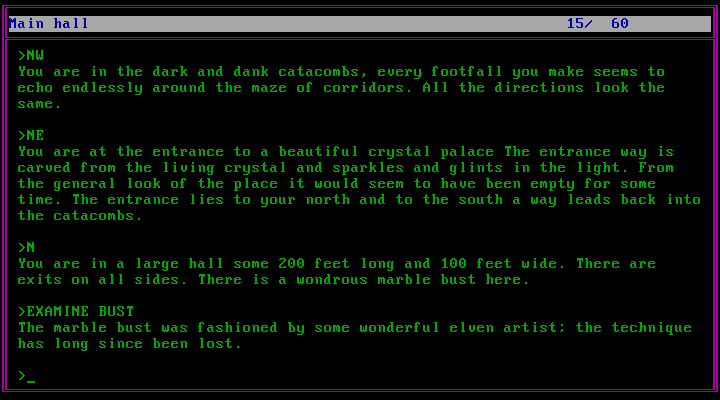
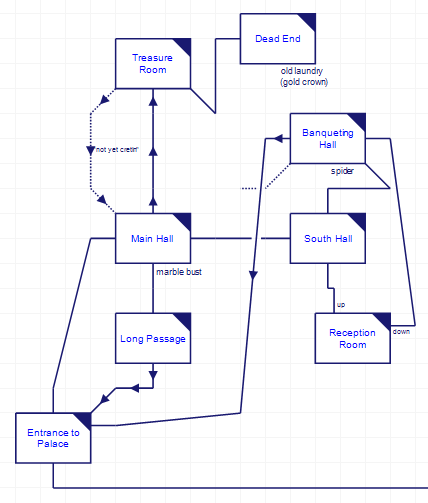
One last section I explored — an offshoot of the catacombs — was a crystal palace.
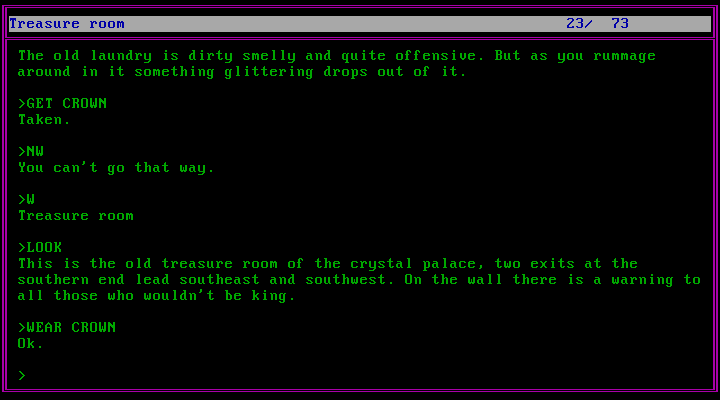
There’s a treasure room with a “warning to all those who wouldn’t be king” adjacent to a room with some laundry. If you try to leave, you get told “not yet cretin”, but the laundry has a crown hidden within. If you wear the crown you can get out of the “cretin” passage.
The only real puzzle otherwise is a spider (“hairy with lots of legs”) with a web blocking one direction.
I scissors on me so I can safely say they aren’t the answer to how do I pass the spider web? It may be none of the puzzles are that hard individually but the logistics of solving order is where the real suffering lies.
For me to be sure, I have to solve a real puzzle first (I don’t count the crown or mapping out mazes as puzzles). Maybe next time?