Archive for the ‘Interactive Fiction’ Category
By Steph Cherrywell. Finished using Gargoyle with two hints.
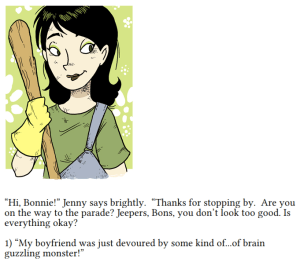
You are a girl (Bonnie) in a generic 50s town (Canyonville) and your boyfriend was just eaten by a monster.
The game is oriented as if the characters are in an actual 50s B-movie, with occasional references in the parser itself.
>
(We’re still rolling here!)
> x wall
(That’s not one of the available props in this scene.)
There’s a lavish illustrations and Ms. Cherrywell manages to pull off harder-than-it-looks comedy writing with aplomb.
You hop into the car, which rolls forward into the haunted house. A metal cuff snaps shut around your wrist. What an experience! The laziness and lack of attention to detail on the part of the staff is truly TERRIFYING! The implications of this shoddy workmanship, when you consider the importance of the American work ethic to beating the Russians, are enough to fill you with BONE-CHILLING FRIGHT! However, you don’t actually die. As the car creaks its way past the last cardboard tombstone and into the light, the cuff on your wrist squeezes and a hidden heart monitor beeps. “Ah, a heartbeat! You’ve managed to survive!” a recorded voice chortles tinnily, “…THIS TIME!”
What’s even more rare is that Brain Guzzlers also manages to nail participatory comedy in the puzzles. At multiple points I was laughing at puzzle solutions that I was enacting myself (I especially liked making the spork).
There’s a crazy-science cannon that took me a beat before I realized what it was used for.
> x cannon
A sleek, futuristic gun with three brass barrels. It’s bulky and looks powerful, but it’s light enough to hold in one hand. There’s a dial you can turn on the side under a display. Currently the display is showing an image of a hand with the palm and all five fingers lying flat, like a fascist salute.
> turn dial
You turn the dial until you hear a click. Now the display shows a hand with the index and middle fingers extended.
> turn dial
You turn the dial until you hear a click. Now the display shows a hand curled into a fist.
> turn dial
You turn the dial until you hear a click. Now the display shows a hand with the palm and all five fingers lying flat.
Really, this is terrific and exactly the sort of game I’d toss to a beginner who wants to see what parser IF is like. However, since a critic’s grumpy work is never done, I do want to quibble with two puzzles near the end (after spoiler space).
.
.
.
.
.
.
.
.
.
.
S
P
O
I
L
E
R
S
.
.
.
.
.
.
.
.
.
.
.
.
Both of these puzzles were where I needed hints.
Issue #1) There’s a bit where you have to talk to plants. I’ve read over the description multiple times and other than being in a weird-science universe I don’t see any motivation for the action whatsoever. Probably it would help if a.) the plants were mentioned more prominently in the room description and b.) there’s some vague hint that talking might help.
Issue #2) There’s a screen at the drive-in from the beginning of the game. The screen is not mentioned at all and the only way to know about it is to remember the scene from the very beginning of the game (and even then, I just assumed it got destroyed or was a bit of scenery I wasn’t supposed to care about).
Both problems are fixable by the author, presuming they are reading this and are accepting my mentally-enhanced telepathic waves ( … you feel them, right?)
By Cat Manning. Finished three times on iPhone.
In Crossroads you are on your way to see a witch in a forest.
The reason can vary. Based on the choice of gift for the witch, the story seems to split into three different branches. While the branches themselves are relatively linear it is conceivable that three people (presuming they don’t replay) complete Crossroads and gather radically disparate impressions.
Of course, a single person can have the same experience via the magic of temporal fuguing, or perhaps less dramatically by hitting the restart button.
Temporal Me #1 experienced something I would call “touching, but vague”. My character needed absolution for something unnamed, the remedy involved something unsaid, and I left the story unenlightened.
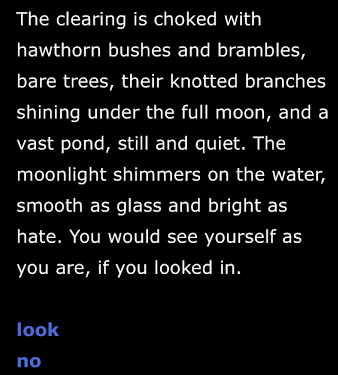
Temporal Me #2 had reasons for seeing the witch even I was unclear about, participated in a minor philosophical conversation, collaberated in a magical ritual that involved music somehow, and left following a light.
I was still not compelled.
But Temporal Me #3!–
My third avatar was a monster. They wanted to stop being one.
The witch’s method of therapy was to send Me #3 back to memories of atrocities committed. Then when those atrocities occurred, she sent Me back again to try things differently; again and yet again.
It’s the least you can do. You pull a pair of gloves from your jacket pocket. You’re careful, in the ways you still can be. You’ve come to value these small rituals, ways of clinging to your humanity. Always cover the body. Never leave fingerprints. Every once in a while, report a missing person from a pay phone 40 miles out of town, waiting in the booth until your hands stop shaking.
I found this story delicious enough that I wish the author had simply focused on this one, with more expansion and depth, and omitted the other two. It was human and heartfelt and while the prose included some magic and a labyrinth where geometry is no help, there was felt purpose to all the noise.
By Marshal Tenner Winter. Not finished at the writing of this review; no hints or walkthrough used.
In The Sueño you are participating in a sleep study with a pill that gives lucid dreams.
The plot is a slow burn. After a fairly ordinary visit to the lab, dreaming starts in a standard-looking house. After leaving the house, drama starts to rise.
You dread heading to the southeast, down the rocky path. Something stops you. Something tells you that dark entities guard it. In your mind, you see large, black rabbits. Strange, yes, but terrifying for some reason. They are in your mind only for now, but something also tells you that you will lose your lucidity and wake up screaming should you head that direction.
I aborted play a bit after 2 hours rather reluctantly, so that’s a good sign. It’s not as tightly-made as I’d like — I hit jarring responses for reasonable commands at frequent intervals, and I found typos here and there, but the puzzles I solved were reasonable and the overarching mystery grabbed me.
There was one really clever idea, which I’ll discuss after some spoiler room.
.
.
.
.
.
.
.
.
.
S
P
O
I
L
E
R
S
.
.
.
.
.
.
Because this is a lucid dream, it’s possible to DREAM OF things that don’t already exist.
> dream of richard
You try to conjure Dr. Lynch into your dream, but you feel as if you don’t have enough power or something to do it yet.
Once I accidentally teleported to an object just by dreaming of it. This seems like a mechanic that oozes puzzle potential, but unfortunately since I am only part of the way through the game I don’t know if there’s a real payoff. At the moment I get the feeling that there are too many “that’s not useful” instances and the mechanic doesn’t reach the real joy of unleashed possibility.
I also liked that while there’s an underlying current of horror, it’s uncertain whether the story will really reach that genre. At one point I “died” in the dream, but rather than the expected bloody mess there was a gentle exit.
You awake, terriffied, but Dr. Lynch assures you everything is fine. You are paid for volunteering in the sleep study and you go your merry way. Too bad you didn’t unlock the mysteries that The Sueño had to offer.
Is something evil happening (other than the typos) or is the intensity simply in the main character’s head?
By Phantom Williams. Finished using Firefox.
I never quite landed on a single word to describe Summit. Thesauri did not help.

Using a minimal Twine interface, you play a traveler who has left their home to travels upward to a summit, having fantastical encounters on the way.
The inhabitants of the world, including yourself, have a fishstomach in addition to a regular stomach. At regular intervals you feel compelled to eat a fish.
You begin to feel the stomachfish swimming around in your fishstomach.
It’s a nagging feeling.
There’s enough alchemy to the experience I kept going even though the choices were often minimal.
Tourists come to the bone cathedral to sit and weep as the wind, blowing through the notches in the bone, constructs possible iterations of his most famous piece, a remembrance of a much-loved ancient scientist.
Your father makes tiny replicas of the cathedral. Children blow through them to hear snatches of the famous music. Your father takes great delight in the minute variations he programs into the souvenirs: the barely-discernible deviations from the harmonic possibilities imagined by the great master, he says, taken all together, in each of the altered souvenirs which rest, now, in far-flung corners of the world, constitute his life’s work.
Unfortunately, because there’s lots of timing effects, a replay to search for alternate timelines is more irksome than enjoyable.
There’s sound, but: I was not a fan. It starts as gentle environmental sound and builds to a droning chord which literally hurt my ears. I had to mute.

However, the stark scenery, memorable set-pieces and sharp writing are worth experiencing.
The people who pass on the road are good.
A family built a wooden shelter around me.
Another woman tiled it.
Another man hung a curtain across the front.
Everyone leaves food.
Random theory: the game would be improved by real time. That is, it would be a journey that could be returned to over a span of days, and the next part of mountain would only be traveled after an actual day passes. It would lend the same sort of meditative quality to playing as the protagonist experiences. (Granted, it would also be far out of the playtime bounds of IFComp.)
By Mark Stahl. Not finished.

Questor’s Quest is of the Extremely Old School, with a hand-made parser and an outdoor grid-like map and a series of typical fantasy-cliche encounters (dwarf, stone titan, witch).
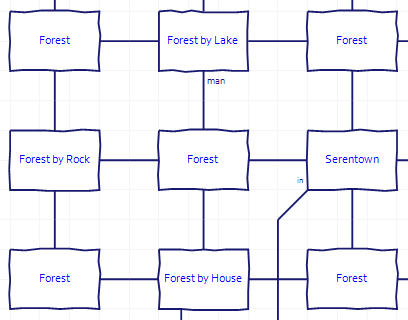
For a hand-made parser, it isn’t the worst I’ve seen from an IFComp entry, but it does lack things like GET as a synonym for TAKE or the ability to use the pronoun IT when referring to the last used noun.
UNDO doesn’t work but I did once reach an auto-undo upon death.
The best part I saw was in a empty house with a sword on a shelf:
COMMAND> take sword
This valuable sword was not offered to you.
You mean I *can’t* take everything that isn’t nailed down? Sacrebleu! (Seriously, I could see an entire game based around an “honor” system where you lose points if you steal too much stuff, and too low a score results in gods smiting you with lightning or some such.)
The main virtue of this sort of game would be the puzzles, but the only aspect of note I’ve found is a fake-out solution on the witch (try throwing a bucket of water at her). While I made a little progress (17 out of 100 points) I think it is fair to say this game is too long for the competition. (Perhaps Spring Thing next time, if there is a next time?)

By kaleidofish. Played on iPhone to completion.
Nowhere Near Single is a Twine game about a young woman (Jerri) in a polyamorous relationship with three other women (Nayeli, Sarai and Taya), while simultaneously trying to have a successful pop music career.

The world universe is slightly adjacent to our own, because there’s an agency (“Estrella Entertainment”) that supports a plethora of solo pop stars and a “Pickford Top 100” chart that rates singers. It has the feel more of J-Pop rivalries than the current system in the US, but it’s certainly plausible.
In the Nowhere Near Single-verse (and to some extent J-Pop), being a pop star means keeping up kayfabe manufactured by the company. In this case, being a lesbian but pretending to be monogamous, causing Jerri the need to hide the poly part of her life in public.
This dynamic is terrific and prevents the story from getting caught entirely in the morass of Jerri’s relationships, which is a good thing because I found the interaction between public and private the most intruiging part. While I felt like the characters were well drawn, I just couldn’t bring myself to care about the relationships the same way I did kaleidofish’s previous IFComp entry (Venus Meets Venus). Perhaps because the personal events felt somewhat like a sitcom? (Presuming we lived in a universe where someone could have a polyamorous sitcom.) It also might be the old danger in multi-character stories of losing focus and not painting every brushstroke as solidly as it deserves.
I found the most affecting part of the story to be when Jerri becomes a gay icon but is prescribed what advice to give young gay fans (go back to your parents who threw you out!) even when she feels the advice is false.
What do they think of you now? Are they ashamed that you’re known as Estrella Entertainment’s queer idol? They shunned you for something that’s turned you into a solid star. You’ve risen above them.
Do they ever pick up the phone and think about calling you, just like you’re doing now? Do they wish, do they hope that you’ll be around for the holidays? Have they kept your spot at the table empty?
There’s a lot more choices in this game than in Venus Meets Venus, which is good because there’s stronger implication the viewpoint character is “you” and issues of consent start to arise pretty quickly. Even though there’s long stretches of straight click-ahead narrative, the story is even longer (I hit just under 2 hours) and has plenty of possibilities for decision.
This includes the final choice, which like Switcheroo, was the type where I could easily go back and pick differently but where I felt there was only one right ending for the story. The world convinced me to care.
By Jeremy Pflasterer. Not finished.
I know what is wrong. (At last.) Three seasons of planning has made me all twisted up. It’s not me, it never was. I can’t worry about the pashvod, or the shadows, or the crannies or shapes of the rock. Or the direction, or the destination. There is no rhyme or reason to the direction; if there were, it wouldn’t be my direction. There is no particular destination; if there were, it wouldn’t be my destination. So the plans must go. That is the only way I’ll ever go. Therefore: farewell, journal, at least for now. And Koustrea, whoever you are, if you are still reading this, I’m sorry I couldn’t wait for you. But we will meet yet if everyone is right and the world is as small as they think. I assume we won’t.
I’m not exactly sure what’s happening in Koustrea’s Contentment. Here’s my best go: the main character, Koustrea, has arrived in a strange building with geography that mimics a real house. There’s a series of people that may or may not represent things from Koustrea’s life. The primary feature is a golden door. One of the characters (Draydee) sits on a bench merely waiting for it to open.
I assume the final goal is to open the golden door. It has a series of panels which can be depressed like a code, so I’m guessing (like Myst) once knowing the secret it should be possible to win straight from the opening.
Other than the door and a kitchen one character is blocking (for reasons not disclosed) Koustrea’s Contentment doesn’t seem to have any visible puzzles whatsoever. Back in 2007 I termed the style hidden puzzles. In a traditional large IF game you might come across items that can’t be reached, or clear obstacles, but other than the aforementioned kitchen there seems to be no direction for the player at all.
I spent a lot of time talking with the characters, of which I found five. They are somewhat cardboard. Here’s the liveliest one, Zeolt:
>ask zeolt about jukebox
“How about this jukebox, eh?” you say to Zeolt.
“There’s nothing I enjoy more! And so easy to use,” says Zeolt.
>ask zeolt about zeolt
“How are you?” you ask Zeolt.
“Very well, thank you,” says Zeolt.
>ask zeolt about door
“What are your thoughts on this Golden Door?” you ask.
“My thoughts? Let me try to find them….” says Zeolt. “Well, maybe it opens, maybe not, but in the meantime, it sure does give Draydee something to do, doesn’t it?”
While I did play the entirety of the two hours, my gameplay mainly consisted of asking characters about everything I could think of and getting noncommittal answers.
Spoilers upcoming.
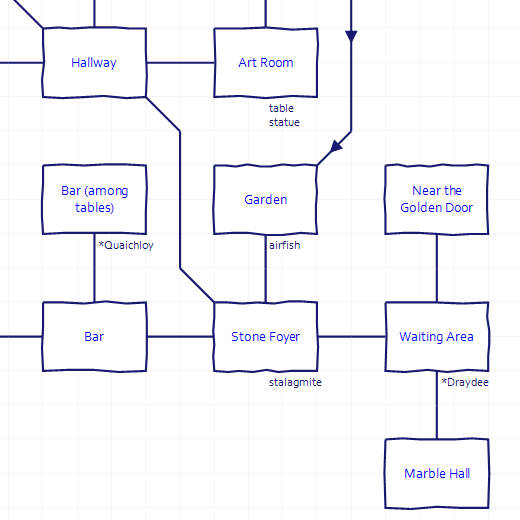
A partial map.
.
.
.
.
.
S
P
O
I
L
E
R
S
.
.
.
.
.
.
There’s one character (Quaichloy) who makes sports references that can be looked up. Those entries mention numbers, and those numbers can be then looked up in a series of journals (the top excerpt is one example). However, the journals are equally cryptic, and the whole process felt like running in circles.
I did, finally, manage to get to a basement by moving an object. There was no particular reason for me to move the object other than it could be moved. Hence I missed the usual tingle that accompanies a puzzle solve, because I was only aware a puzzle was there after I solved it. It’s possible to have pleasing secret puzzles. I remember a well-done secret door in Theatre (from 1995) but the game was careful about setting the expectation that systematically checking things for secret door catches was a useful thing.
I could see a good IF game coming from primarily secret puzzles, but there needs to be an extra motivation to play. Perhaps high writing quality might do the trick, or absorbing layers of philosophical depth, or just having characters that are actually fun to hang around. In the time I spent with Koustrea’s Contentment I could find none of those.
Oddly enough, I do want to try to play more after the competition. There’s certainly some craft here, and it feels like somewhere past the 2 hour mark things might come together.
By Jack Whitham. Completed with two hints.
Dear candidate 27501,
You must be wondering where everyone has gone. Let me explain.
A serious situation has developed, and I have been forced to take emergency steps to isolate the Administration Centre – and ourselves – from the outside
world. This isolation prevents my communicating with you normally, and at present I can only do so via this screen. I will explain more in due course.
Excluding Grandma Bethlinda’s Variety Box (where the minimalism makes it slightly avant-garde) and Darkiss (which has a really dark vibe), Final Exam is the most pure traditional parser puzzle game I’ve played of the competition so far. (It’s even written in old-school Inform 6.)
You’re a candidate for the ambiguously defined Administration (who seem to be something of a world government) and wake up on the day of your final exam to find everyone missing. Sinister events are afoot.
The mechanism of being directed by remote instructions (see the excerpt above) was fairly good at a generating a linear set of puzzle tasks without seeming artificial. There’s a series of technical tasks which have enough of a veneer of realism to feel satisfying and one really good puzzle involving extending a cable.
I had to use hints twice because I rather blindly missed connections on the map. (I was trying to play without making one. It’s doable with this game but my own memory tends to forget things when I multitask.)
I wasn’t expecting prose pyrotechnics or characters of any sort, so I didn’t have any disappointment there, but I did feel like the “world government” background was wasted. All the events that occur could easily happen in another context, and the game never does a good job in conveying what the actual duties of the Administration are or what might happen if outsiders orchestrate an overthrow.
By Bob McCabe. Played to completion.
‘Now is the time of the cleansing. This place is to be forgotten.’
The words lodge in your head, but it takes time to understand — as if it’s a foreign language you barely remember. The words are spoken by many voices, competing and complementary at the same time. They warble and blend as you recover from the message’s, and messenger’s, arrival.
You are on an island fated to be destroyed, and you have just over two hours to explore it.

Everything plays out like a board game of sorts, with a set of 25 locations to travel through and characters with random traits and random items and strange “MacGuffins” about the island that might as well be cardboard disks that get shelved next to the dice.

Exploring an area leads to a longer description and the occasional chance to do more (attempt and try to figure out the code to a safe, say) but in general the atmosphere maintains a sort of solo-strategy-game feel where you are dealing with locations number 1 to 25, not real places.
Eventually murders start occuring, signaled by lightning in the distance. Bodies begin appearing.
As gameplay continues you automatically update a “notebook” with observations.
Eva is slender.
Heather is stylishly dressed, and is passive and meek, avoiding any conflict.
Jacob is tall.
James has large, round eyes.
Jessica is wearing a long jacket.
One of the “special encounters” lets you ask for more detail about a particular person.
Jessica is wearing a long jacket, has freckles,
and smiles frequently for no apparent reason.
Now, at this point (presuming you haven’t played the game any) you might be confused why these facts are useful, but this game is set up like Clue where from specific events you can suss out small details of the killer.
You float through the darkness, adrift at sea, black velvet smothering the heavens, nothing but the sounds of water lapping at your sides. Then you see something. You look closely. You see a shadowy figure who is tall.
Near the end of the game, waves start to destroy various locations in the island before eventually everything is gone.
Some issues I had:
1.) While the notebook is useful, I found it frustrating during special encounters. For example, in the part I mentioned earlier when you are allowed to get detail about a character, you can’t go to your notebook to doublecheck who is still a viable suspect; in fact you can’t go back to check what a viable name to type might even be.
2.) Even with all the information the notebook holds, the thing I really want (have I visited a location before?) is lacking. It tried to just go in sequence but occasionally events happen which confused that.
3.) There’s weird, arbitrary restrictions on what constitutes a “turn” and requires time to pass. For example, you can give MacGuffins to a person to improve their mood towards you and make it possible to ask questions about others (say, if you’re searching for tall people who may be the killer). You aren’t allowed to do both on the same turn, but you are allowed to chat to assess their own disposition in the same turn. Why? I feel like there’s a complex manual of rules that comes in the packaging but got thrown out. It was fun to learn about mysteries like “what does the bunny do” without any prior knowledge, but the basic conditions of interaction need to not be mysterious.
I overall found the experience intriguing and unique but I think before I make another attempt I need some sort of strategy guide. I have no idea if there’s a systematic way to find the killer; I found the system of character interaction hard to deal with and never got any useful information out of it.
I did appreciate at the end there is a “high score” to give this true board game status. An excerpt:
Your Score:
+50 points for meeting the killer and getting to the final turns.
+10 points/Survivor: You earned 100 points since 10 people survived.
By Cha Holland. Played using Firefox.
All in-game imaginary alchemical systems suffer the problem of needing to teach the details “from scratch” — assumptions from the real world do not apply. I’ve generally seen this solved with a recipe manual (given slowly or all at once), so that the player gets some starter recipes and is able to extract some sense about what the bluespan and the whirlbowheel and the whitegrass do in a logical way. There’s still a feel of experiment and the necessity of failure, but at least there’s no rudderless flailing about.

Growbotics is entirely composed of an imaginary system for combining “essences”. There is, as far as I can tell, not enough of a system for a player to work with, so they’re forced into a random clicking method.
After making an object (via the trio combination method above) there’s an epilogue. I’ve seen one involving amusing reactions on social media and another where
As PROFESSOR G you keep the world safe for science, with special powers including particle acceleration and chromatography.
although I’m pretty sure I hadn’t earned it, because I was clicking just as randomly as before.
I did love the presentation and graphics and sound, and I’m not against games playing more like experimental toys, but my experience with GROWBOTICS was so random I just didn’t have fun with it.


