Archive for the ‘Interactive Fiction’ Category

The back of a PDP-10, the mainframe upon which Haunt runs. Via Sun-collector at English Wikipedia, CC BY-SA 3.0.
The backstory mentions that previous visitors to the house fell into madness. This is not an idle threat – while there doesn’t seem to be any light source timers or the like, symptoms and warnings start appearing, until:
You can’t stand it anymore, you are now totally crazy!
You start laughing uncontrollably, but choke on your tongue.
Ugh! Well at least you died happy!
The game hints there’s a way to cure the affliction (that is, you don’t just need to outright beat the game fast enough) but I’m currently at a loss. It may have to do with the plot, which I’ll get into later.
. . .
First, a tour of the map.
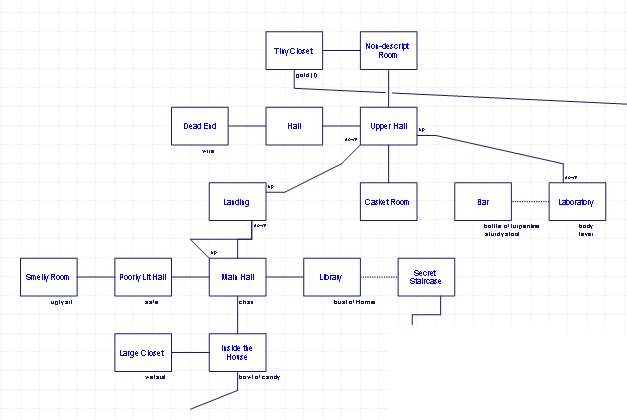
The main entrance to the house leads to a monster (easily placated by candy), Dracula (not so easily placated, I haven’t defeated him yet) and and Alice Cooper Greatest Hits album being run on a loop which causes general screaming through the house until it is shut off.
When you open the casket you notice that a well dressed man
with pale skin is inside. He appears dead.
There is a huge diamond ring on his left hand.
Suddenly his eyes blink open, you notice the irises are red.
It is Dracula. Oops.
The casket is open.
Dracula has left his casket and is approaching you.
>KILL DRACULA
Look turkey breath, this guy isn’t the jolly green giant.
You’ll never kill him in this room.
>N
Dracula stays in the dark room.
You are in upper hall .
You hear clanking and screams coming from the hall.

There’s incidentally a back entrance you can get to by climbing up some ivy, but there’s essentially just a master bedroom where I am stuck.
You are in what looks like the master bedroom of the mansion.
A large doorway opens to the balcony to the north.
To the east is a opening to the bathroom.
The main doorway to the rest of the house is boarded up and impassable.
There is a king-size bed in the middle of the room.
Some noise can be heard through the boarded up door.
There is a mirror on the ceiling above the bed.
You can sleep in the bed, but the game just makes fun of you:
Snooze…
.
.
.
.
.
… snort. Ah that was refreshing, but useless, you’re still ugly.

This “duct” section confused me for a while – if you go “up” or “down” you go endlessly. It appears to be an Escher “endless rising staircase” style setup, and there are only in reality 3 levels. If you’re careful, you can find a kitchen and then an elevator.
You are in the elevator.
There are a bunch of buttons on the wall.
They are labeled: P, H, B, HALT, OPEN DOOR.
Scrawled on a wall is ‘Homer kisses dead goats’
and ‘Homer turns my head’
On the floor it says, ‘L__t g_e_ _ere!’
The H is lit.
The “L__t g_e_ _ere!” suggests perhaps “Loot goes here!” but there is no score increase from dropping loot in the elevator, which perhaps suggest the elevator is greedy and merely lying.
Also, the instructions claim you get extra points for dropping the treasures on the lawn outside the house, but I haven’t been able to do this yet to find out if the instructions are lying too.

I mentioned this area in my last post – you go down to a secret wine cellar (which seems to have an infinite number of rooms, but there may just be more than anyone would have patience to map) and then into the “Cheese Room” which intercepts all inputs. I still haven’t gotten past this part.

Finally, the elevator leads to a giant ocean (modeled in by 6 by 6 by 6, with all the rooms present – I started just coloring squares on graph paper) which includes a giant monster, and octopus, and an eel:
The water is a little cooler here.
Something grabs the speargun from you and tosses it away.
There is a vicious eel here. He grabs you and starts squeezing.
You have time for one last request.
There are huge pearls here!!!
I’m not sure what last request would be helpful here. There’s also this place:
As you go up, you come out of the water and are on dry ground.
You are in a warm cave. There is a hot spring down below.
The PLACE is lit with luminous moss. The only way out is by the spring. There is a rusted old diving helmet on the ground that is immovable. Next to it is a skeleton and a note scrawled on the wall.
Dear B___ie,
I ran out of air and had to come here. The moss isn’t nutritious enough to survive on. I hope you can use the diamonds.
Take care of _ec_l and he will take care up you.
Diver Dan
There are diamonds here!
. . .
One other location has this scene (where “wife” can change based an earlier choice):
This is a tiny closet. Against the wall is a skeleton.
Scrawled on the wall, next to the skeleton is:
Dear Bas,
So the mystery man finally decides to come home.
Well you’re a little late.
I was never able to resurrect your mother, but I saw in the paper that you have a beautiful redheaded wife, and a lovely child. I only hope she hasn’t inherited our disease.
I finally succumbed to the illness when I was unable to take care of the crop.
Good luck,
Dad
If you’re puzzled, you may want to go back and re-read the opening text. In any case, the “Orkhisnoires sakioannes” reference earlier occurs again, and since the intro claims it plays some part in the general madness of the house, my guess is that figuring out what’s going on with the hereditary disease is crucial for survival and winning the game.
It’s a weirdly poignant dollop on top of what is a generally wacky and geographically confused game. I’m still enjoying myself, but I worry about I’m getting close to hitting a wall on puzzles. We’ll see next time.
I’ve made it inside the House and am trying to build up a substantial enough map to discuss it in detail. In the meantime, I’ve run into a trick I’ve only seen a handful of times before (once in Philosopher’s Quest) where a puzzle intercepts nearly every possible input:
*e
There is a trap door on the floor, stuck open.
Written on it is ‘Only way out, Cantor’
You are in rows of wine racks that stretch out of sight in all directions.
*d
This is the cheese room. The only opening is a trap door
above, too high to reach. The walls are made of cheese.
There is a ghost in the room.
Its nose is pink, I believe it has been drinking too much.
*inventory
Although inebrious, the ghost blocks your attempt to inventory
*u
Although crapulous, the fiend hinders your attempt to u
*s
Although soused, the fiend stops your attempt to s
The only thing I’m able to do without getting stopped is >DROP items and to >QUIT the game.
>QUITting mentions it was more scared of me than I was of it, which I suppose is supposed to be a hint.
Thanks to my hardy commentators, I got past the self-referential in-joke trivia puzzle that starts the game, and made it to a big empty map.

Outside the House. This map omits another row of rooms on the west and south sides that are all empty.
Some of this is clearly the side effect of being a mainframe game. But some of it is philosophy.
I should note that while Zork and Acheton were large and full of rooms, there wasn’t a lot of “wasted space”. Even piling on yet another maze room lent something to the gameplay (not necessarily a positive thing, but a thing).
Here the map is of a style with a grid containing so much empty space it might be better (perhaps originally was) on graph paper. You’re at a wall -> a wall -> a wall -> a lawn -> a lawn -> a lawn -> a lawn.
With this style in adventure games one can’t simply skip checking every room, because of course there’s got to be something different hidden about. In this case, the northeast corner contains a grave you can dig. There’s also an empty garden and empty garage that might be used later for something, but it’s hard to know at this point.
We’ve seen a map resembling this before with Warp (another mainframe game) but what I really associate this style to is early Sierra games. Time Zone, for instance, is full of maps like this one:

One of the time periods in Japan, via Kim Schuette’s Book of Adventure Games.
This carried on to the King’s Quest games (up to King’s Quest V, at least) where the player might need to swim about an entire ocean just to find one special location.
Really, the logic isn’t bad – you’re outside, you should be able to go all four directions, the map should just be a grid. Still, the actual effect is close to literal lawnmowering and it’s interesting how little this style gets used any more.
The author of Haunt, John Laird, states it was developed at Carnegie Mellon around 1980-1981, so while the game itself claims the wide span in the title, it’s fair to call this one a “1980 game” (but not wrong if someone puts it at 1979 either).
The setup is strange enough I’m just going to quote verbatim:
Along time ago, a young couple was picnicing near the woods on the outskirts of town. They were celebrating the birth of their first child. Unfortunately, a crazed moose inhabited that area and attacked them. The child and husband were unharmed, but the wife was gored to death by the moose.
After the funeral, the man bought the land where the incident occurred and constructed a large mansion: CHEZ MOOSE. He filled it with the treasures of his family and claimed that his wife’s soul was still in the area. He vowed to remain in the mansion until he had returned her soul to human flesh. He tried to bridge the gap between life and death to reclaim her. Some say he was insane with grief, but others claimed that the madness was in his blood, and his wife’s death brought it to the surface. After he entered the house, he never returned, and was declared dead seven years later. Several people have entered the mansion looking for him but none of them have ever returned. There were rumors that he and his wife now haunt the house.
That would be the end of the story except that the house still stands and is filled with priceless treasures. The house and all its contents are willed to his only descendant. Oh yes, I forgot to tell you, the day the mother was killed, the child was stolen by Gypsies. The Will claims that only the descendant will know how to avoid going crazy and committing suicide while spending a night in the mansion. An obscure hereditary disease, Orkhisnoires sakioannes, is supposed to play some part in this.
So if your heritage is in doubt, you may be the descendant that can claim the treasure in the mansion. Many people, claiming to be descendants have died trying… or at least never returned.
The terms of the Will say you get to keep any treasure you get to the lawn, but of course you must also get off the premises alive. Because the house is haunted it must be destroyed, and nobody would be crazy enough to try and recover the rest of the treasure. If you do get out, the government has agreed to buy the land and destroy the house.
You start at a bus stop, hop in, and end up outside the house mentioned above. A bit of wandering leads to a button with a speaker. Pressing the button enough times leads to … a Monty Python skit reference?
‘Alright, I’ll let you in if you answer three questions.’
‘First, what is your name?’
*Odysseus
‘Second, what is your quest?’
*Chez Moose
‘I always wanted to do that. I hope you don’t go insane trying.’
‘What was the first production system with more than 1500 productions?’
There’s supposedly multiple trivia questions, but this is the one I keep getting. I have no idea how to answer it. Any takers? I tried various movie studios but no dice. Getting the answer wrong sends me back to the bus stop.
I did, indeed, discover the 20 treasures and survive. As this is my endgame post, the usual spoiler warnings apply.
. . . . .
Last time I left off, I was stuck in a Temple where I couldn’t get back up a rope. Regular readers of this blog may remember my old nemesis: missing an exit:
Temple
This is the north end of a large temple. On the east wall is an ancient inscription, probably a prayer in a long-forgotten language. Below the prayer is a staircase leading down. The west wall is solid granite. The exit to the north end of the room is through huge marble pillars.
There is a brass bell here.
I went down, to find
Egyptian Room
This is a room which looks like an Egyptian tomb. There is an ascending staircase to the west.
The solid-gold coffin used for the burial of Ramses II is here.
and assumed that was it. I was foiled partially by how I drew my map: my “down” connection was somewhat to the south of the Temple, so I conflated the two exits. The room does state it is a “north end” which suggests a south end, even though there’s no explicit mention of a south exit. Back in the Temple:
> S
Altar
This is the south end of a large temple. In front of you is what appears to be an altar. In one corner is a small hole in the floor which leads into darkness. You probably could not get back up it.
On the two ends of the altar are burning candles.
On the altar is a large black book, open to page 569.
The “small hole” drops you back into the dungeon proper. However, the difficulty isn’t over yet! The large gold coffin (which is a treasure) in the Egyptian Room is too heavy to tote down.
> D
You haven’t a prayer of getting the coffin down there.
This is a case where I got stuck on the easy part (misparsing the room and missing an exit) but immediately realized how to solve the hard part.
> PRAY
Forest
This is a forest, with trees in all directions. To the east, there appears to be sunlight.
My experience held me through here. Mainframe Zork didn’t have this puzzle but it did have one involving the matchbook where I needed to >SEND FOR BROCHURE as a literal command as it was mentioned in the text. This sort of literal-typing-what’s-in-the-text still doesn’t have a good name to it, although it probably should (anyone with some candidates?)
The mental twist needed to interpret an aside in the “running monologue” of the game as a command is a little like how a clue in a cryptic crossword often needs the solver to reinterpret a noun as a verb or an adjective as a noun. Example: “Drunk rested in bars (6)”. At first read, “bars” is a noun. The way to solve this clue is to make an anagram of “rested” (make it drunk, so to speak) in order to define the verb bars. This sort of mental shift of meaning and assumption is a common tactic for writing all puzzles, but again I don’t know of it having a particular name.
. . . . .
-> The Thief is constantly moving about.
[1 hint left.]
-> There is a high probability that he will take valuable objects (except the gold coffin) which you have seen. There is a much lower probability that he will take a nonvaluable object (again, only if you have seen it), and he may later decide to drop it.
The above text is from the “Invisiclues” for the game.
The thief is what makes the game still interesting and worth playing today. There are various narratives with “constant antagonists” (say, Kefka in Final Fantasy VI) but they still only appear at set moments. The thief can appear at any time when underground and often requires a change in intention and plans; even though he focuses on treasures, some of the treasures are used for solving puzzles. Because of the random yet universal nature of his appearances, even when he isn’t there, he is there.
The way to defeat the thief is to get a high enough score that you have good luck in battle. (In other words, gathering more treasure makes you better in combat … which makes a CRPG sort of sense, although it certainly puzzled me back in the 1980s when I first played this game.) However, since the thief is trying his best to steal treasure (either directly form your hands or from the ground) he is taking away those very points you need to eventually meet him in a final battle. It became a genuinely tense race as I tried to stockpile enough points / treasures that I would be able to survive a direct confrontation. I eventually tried it at a little less than 200 points out of 350, and after multiple tries, got to this sequence:
> kill thief with sword
The blow lands, making a shallow gash in the thief’s arm!
The thief neatly flips your sword out of your hands, and it drops to the floor.
> kill thief with sword
You don’t have the sword.
> get sword
Taken.
A quick thrust pinks your left arm, and blood starts to trickle down.
…[about five more exchanges of blows go here]…
> kill thief with sword
Your sword misses the thief by an inch.
The thief stabs nonchalantly with his stiletto and misses.
> kill thief with sword
A savage blow on the thigh! The thief is stunned but can still fight!
The thief stabs nonchalantly with his stiletto and misses.
> kill thief with sword
A good slash, but it misses the thief by a mile.
You parry a lightning thrust, and the thief salutes you with a grim nod.
> kill thief with sword
It’s curtains for the thief as your sword removes his head.
Almost as soon as the thief breathes his last breath, a cloud of sinister black fog envelops him, and when the fog lifts, the carcass has disappeared.
As the thief dies, the power of his magic decreases, and his treasures reappear:
A stiletto
A trunk of jewels
A jewel-encrusted egg, with a golden clockwork canary
A crystal trident
The chalice is now safe to take.
Your sword is no longer glowing.
After the constant antagonism – and truly constant, not just once in a while – this was a deeply satisfying moment. While coincidence / luck, I especially appreciated the salute a turn before the thief died.
There is one major downside, which you can see from the items dropped. The “jeweled egg” is one of the early treasures you can find, but you can’t open it – however, the thief, with nimbler fingers than yours, can. The golden clockwork canary counts as a separate treasure.
In other words, if you haven’t passed the egg off to the thief by this point in the game, you will not be able to win the game, and likely not discover this fact until the very end. It’s perhaps even crueler than the usual Cruel because it’s unclear that opening the egg is even a required action, so you have to first conceive there might be a puzzle in a first place and then realize your method for solving it is already gone.
. . . . .
This happens on death, at least once you’re far enough in the game:
As you take your last breath, you feel relieved of your burdens. The feeling passes as you find yourself before the gates of Hell, where the spirits jeer at you and deny you entry. Your senses are disturbed. The objects in the dungeon appear indistinct, bleached of color, even unreal.
Let’s pause for a moment with that last sentence.
The objects in the dungeon appear indistinct, bleached of color, even unreal.
Why did this make me stop and admire? Here’s the sentence de-evolved just a step:
The objects in the dungeon appear indistinct and bleached of color.
While “indistinct” and “bleached of color” are strong, they’re essentially descriptive. There’s no sense of the mystical. It describes the events directly.
Change back to “indistinct, bleached of color, even unreal” and the effect (for me at least) returns. “Even” is a curious word choice here. It can mean “free from variation” or essentially “flat” but also “this outlier is included” (he ate all the candies, even the sour ones). Indistinct and bleached of color are already unreal, so it’s on the same “flat” level, but the specific phrasing suggests the unrealness is an outlier. So the unreal is both congruent with the bleaching of color but also discordant. The unreal is suggested in a way that is … skeptical, perhaps?
. . . . .

Back cover for the Japanese Playstation version of Zork I, via Mobygames.
> ENTER TOMB
Inside the Barrow
As you enter the barrow, the door closes inexorably behind you. Around you it is dark, but ahead is an enormous cavern, brightly lit. Through its center runs a wide stream. Spanning the stream is a small wooden footbridge, and beyond a path leads into a dark tunnel. Above the bridge, floating in the air, is a large sign. It reads: All ye who stand before this bridge have completed a great and perilous adventure which has tested your wit and courage. You have mastered ZORK: The Great Underground Empire.
Your score is 350 (total of 350 points), in 711 moves.
This gives you the rank of Master Adventurer.
This is the first game in my series that you can still buy; it’s in the Zork Anthology sold on Steam and GOG. (There’s also a multitude of online versions.) It really is worth a try if you’ve never experienced it.
I’m not 100% sure on my schedule after this, but I will likely take down a simple TRS-80 game or two next and then dive into Haunt, one of the strangest of all the mainframe games.

I’m at the point where I have a mostly complete map, so I’m in the “logistics” phase where I am planning what order to visit the rooms and gather treasures.
It’s fairly tricky because of the thief. Just like original Zork, there’s a “lean and hungry gentleman” who can go most places on the map and will try to take any treasures you have (or ones that are lying around), and possibly stab you with his stiletto while he’s at it. You can eventually fight the thief with your sword, but it takes a higher point score to manage (like “experience points” in Dungeons and Dragons I suppose) so the fight has to wait until later in the game. Here is a result of trying to start the fight early:
Someone carrying a large bag is casually leaning against one of the walls here.
He does not speak, but it is clear from his aspect that the bag will be taken only over his dead body.
Your sword has begun to glow very brightly.
> kill thief with sword
A good slash, but it misses the thief by a mile.
The thief draws blood, raking his stiletto across your arm.
> kill thief with sword
You charge, but the thief jumps nimbly aside.
The thief just left, still carrying his large bag. You may not have noticed that he appropriated the valuables in the room.
Your sword is no longer glowing.
The other tricky element is perhaps the most clever finesse in the game, and one of the very first thing that happens.
> move rug
With a great effort, the rug is moved to one side of the room, revealing the dusty cover of a closed trap door.
> open trap door
The door reluctantly opens to reveal a rickety staircase descending into darkness.
> d
You have moved into a dark place.
The trap door crashes shut, and you hear someone barring it.
It is pitch black. You are likely to be eaten by a grue.
Your sword is glowing with a faint blue glow.
I’m not referring to the iconic “you are likely to be eaten by a grue” (which is indeed lovely) or “your sword is glowing with a faint blue glow” (which always happens with enemies nearby, and gives a nice texture to the world-building even if it is cadged from Tolkien).
I’m referring to the fact the way you came in is locked behind you, so you cannot take the same way out.
First: who barred the door? One might think the thief, but at least in this version of Zork, he never gets into the upstairs house. It can’t have happened on its own (“you hear someone barring it”), which is what I imagined when I was a child. Spoiler theory in rot13 (from a later Zork, so don’t reveal if you only know this game): gur qhatrba znfgre sebz gur irel raq bs gur gevybtl oneerq gur qbbe, gb sbepr gur cynlre punenpgre gb rkcyber engure guna whfg eha njnl.
Second is simply the design finesse of forcing the player to look for another exit. And there are plenty, including one a couple steps away: a chimney which is too narrow to carry much of anything, including a large treasure that is in the same room.
I overall count four distinct methods (not including the fact the trapdoor eventually will stay open), which really gives the feel of player choice. There are enough routes and it is non-obvious what the most efficient one is (I’m guessing every walkthrough of this game is very different).
One last catch is that while most of the edits from original mainframe Zork seem to be simply rooms removed (along with exits that don’t exist any more) there is one section that is changed enough I’m not sure what to do.
> e
Dome Room
You are at the periphery of a large dome, which forms the ceiling of another room below. Protecting you from a precipitous drop is a wooden railing which circles the dome.
> tie rope to railing
The rope drops over the side and comes within ten feet of the floor.
> d
Torch Room
This is a large room with a prominent doorway leading to a down staircase. Above you is a large dome. Up around the edge of the dome (20 feet up) is a wooden railing. In the center of the room sits a white marble pedestal.
A piece of rope descends from the railing above, ending some five feet above your head.
Sitting on the pedestal is a flaming torch, made of ivory.
The rope is too high to climb back up, and there doesn’t seem to be any normal exits.
There’s a few other locations with the torch room, but otherwise this seems to be a dead end (note the rope is too high to climb back up). There’s a granite wall that I recall should let me teleport with just >TOUCH GRANITE WALL, but it doesn’t work. My theory is I need to defeat the thief first, because the other end is in the thief’s lair, but it’s possible there’s another angle altogether I haven’t thought of.
This is unfortunate because the torch is the “unlimited turns” light source of the game; the lantern will eventually run out of battery and go dark. I’m confident there was a lot of intention here on the part of the authors; they probably felt like being able to walk anywhere with an unlimited light source too early would undercut the tension they did a good part building by barring the initial way out. (I remember my childhood self having particular dread of the dark in this game, especially the time my lantern winked out and all I was left with was a book of matches.)
I’m otherwise in the clear on all the rest of the puzzles, so it’s possible I’ll have won this by next time I report in.
Usually, when I see people apply traditional plot structures to games, they’re thinking of the traditional rising action-climax-falling action “mountain”. Generally, the overarching story is said to have such as structure, as well as the incidents along the way; sort of a fractal mountain, so to speak.
However, I’ve been wondering if this is always the most appropriate game structure, because it relies on conflict; in some Western theory texts, you can find the claim that story always relies on conflict.
Kishōtenketsu is a structure that shows up in in Chinese, Korean and Japanese stories which can be, to a real extent, conflict-free. Instead of a Three-Act Structure, it has four:
Ki: Introduces characters and other necessary information.
Shō: Follows any lead characters, but without major changes.
Ten: Provides an unexpected development. This is the essential substitute for the climax, because it may not be a “confrontation”, but can be just an unusual change in the environment, or enigmatic development.
Ketsu: The conclusion, which unifies the original elements with the “twist”.
The key here is the the unexpected development or “twist” might not even be something resolved by the main characters, or even “resolved” in a traditional sense. Example:
1. Karen and Mira pack for a roadtrip.
2. Karen and Mira alternate turns driving, and talk about their lives.
3. Around midnight, they see what appears to be a flying saucer. They park, step out of their car, and take photos. The saucer never gets closer and eventually disappears.
4. They finally arrive at a hotel, talking about what they just saw.
And, sure: with this example you could say the conflict is “in their minds” or some such, and do the same with any other kishōtenketsu plot, but after a certain point Traditional Three-Act starts to look like person with a hammer desperately searching for nails (or maybe one of those people who tries to apply The Hero’s Journey to everything).
The rule of thumb seems to be: ten is about contrast, not conflict (conflict can arise from the contrast, but that’s a subset of the bigger idea). The ten phase can also resembles a traditional adventure game puzzle.
> e
Round Room
This is a circular stone room with passages in all directions. Several of them have unfortunately been blocked by cave-ins.
> e
Loud Room
This is a large room with a ceiling which cannot be detected from the ground. There is a narrow passage from east to west and a stone stairway leading upward. The room is deafeningly loud with an undetermined rushing sound. The sound seems to reverberate from all of the walls, making it difficult even to think.
On the ground is a large platinum bar.
> look
look look …
> take bar
bar bar …
Maybe? The first act here is the preceding actions, the description of the loud room is the development, and the parser’s reaction to any action other than movement is the twist. There’s two possible resolutions: one entirely logical involving finding the source of the noise and shutting it off (spoiled in rot13: gur arneol qnz), the other being almost hilariously abstruse (Vs lbh fnl rpub lbh trg gur zrffntr “Gur npbhfgvpf bs gur ebbz punatr fhogyl.” naq gur rssrpg fgbcf.) The first resolution is particularly satisfying and unifying — it resolves and explains the contrast.
Perhaps I’m reaching a little, but I have read people who exclude incidents such as the puzzle above from being part of a plot; yet, in terms of actual effort, and my mental memory of the trials and struggles of a game, these enigmatic elements form a story in my head. For me, the change in parser message comes across more as contrast rather than conflict. Maybe that’s why it goes unrecognized.

This map came with the commercial packaging. I’ve never been quite sure what part of the Zorkiverse this shows.
One significant difference between playing this game compared to the original mainframe version is that back then, it was second in my project after Adventure. This time, it’s after I’ve played a long sequence leading up to 1980, and the effect is like stepping from silent movies into sound, or black and white into color.
I’m not meaning just the parser (which does allow all the full features of Infocom and modern games we’d expect, as opposed to requiring two words only). I haven’t been using the expanded parser that much. I even had to adjust at one point went finding the lantern at the start of the game; I typed ON which works just fine in some of the two-word games, but Zork was expecting TURN LANTERN ON. Whoops.
It’s more just the detail and atmosphere. You start outside, by the famous boarded-up white house, with no direction at all. Then you’re left to discover there’s a world underground. This matches a lot of the games from the same era, but even outside, it feels like all the senses are being used.
> listen to trees
The pines and the hemlocks seem to be murmuring.
You hear in the distance the chirping of a song bird.
> s
Storm-tossed trees block your way.
The small, quiet details feel like writing, not just functional description, but writing for its own sake. There is still one foot in the just-the-facts style:
Clearing
You are in a clearing, with a forest surrounding you on all sides. A path leads
south.
On the ground is a pile of leaves.
but enough extra detail to be satisfying.
> count leaves
There are 69,105 leaves here.
> jump in leaves
Wheeeeeeeeee!!!!!
> move leaves
Done.
In disturbing the pile of leaves, a grating is revealed.
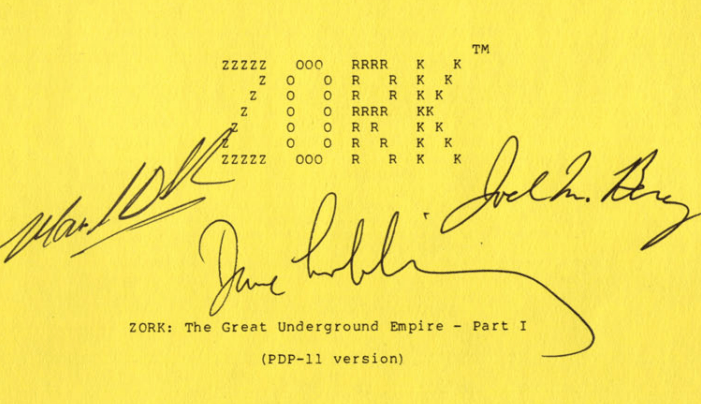
I’ve already written about the original mainframe version of Zork (by Tim Anderson, Marc Blank, Bruce Daniels and Dave Lebling). The common wisdom is that when Infocom was formed, the game was too large to fit onto a floppy, so it was split into three parts: Zork I, Zork II, and Zork III.
The reality is more that the majority of the game became Zork I, some of the spare locations and puzzles made it into Zork II, and Zork III has almost nothing in common except for some elements of the endgame.
The ramification for me is that I still have essentially all the notes necessary to complete the game! I’m going to map it fresh to still feel like I’m playing, but this is definitely going to be more like a replay than the epic multi-month struggle mainframe Zork turned out to be. I’ll still try to slow down and make design observations, and see if I can find any new secrets.
There were quite a few Zork releases; I have release 2 (the original TRS-80 release), release 88 (the most common version, and the one I believe you get if you buy this game from gog.com) and the Solid Gold release (which comes with in-game hints). I’m probably just going to do most of my playing in the newest version, because mucking about version 2, it doesn’t look that different from the last release! There just seem to be numerous bug-fixes, but others have already done an excellent job of tracking which bugs appear in all 14 known releases. (An even more extensive bug list is here.)
The earliest releases of Zork I (Versions 2 and 5) can become very confused if you nest objects too deeply in your inventory, such as putting the lunch in the sack, then the sack in the coffin. You may get very spurious output from the INVENTORY command like “Such language in a high-class establishment like this!” messages, with other random junk interspersed in it. This can also lead to the object hierarchy getting screwed up, in such a way that an INVENTORY might claim that you are carrying a bunch of rooms around!
Finding this game was like opening a secret door.
I first spotted it on The Big List of TRS-80 Software where it’s listed as “Adventure # 10- Marooned (124480)”.
Opening it up makes it look like an ordinary Scott Adams game, in fact, the last one I played, with the option to select an adventure all the way up to Ghost Town (#9).

If you take the leap and type in “10”, it still has a normal Scott Adams instruction screen …

… but then leads to something entirely different.

Kim Watt was prolific programmer and legend among the TRS-80 community for his utility software. This was clearly written between Scott Adams Adventure #9 (1980) and #10 (1981) although because this was an “unofficial” game, I don’t know if I can get more exact than that. Mr. Watt did start making significant money from his utility software starting at the end of 1980, so I’m going to guess this was a lark between mid-1980 and the end of 1980.
Unfortunately, the game also seems to be incomplete. I have below a complete transcript as far as I’ve gotten. It doesn’t look unreasonable, but that’s only because I have included just the commands that worked.
I’m in the passenger section of an airplane
Obvious exits: North, South.
I can also see: Empty seats
>GO NORTH
I’m in a cockpit
Obvious exits: South
I can also see: Control panel
>LOOK PANEL
I see
guages everywhere.
[Typo is in the game.]
>READ GUAGE
Plane is rapidly descending.
Steering mechanism is broken.
>S
>S
I’m in the tail section of an airplane
Obvious exits: North.
I can also see: Broken rudder cable – Tool box – Knapsack
>WEAR KNAPSACK
OK
[Note: This is a parachute. You cannot TAKE KNAPSACK.]
>OPEN BOX
OK
>LOOK BOX
There’s something there!
[Finds Wire cutters – Screwdriver – Wrench]
>GET CUTTERS
OK
[This is the only item out of the toolbox you can get]
>PULL CABLE
I found something!
[Hidden knob appears.]
>TURN KNOB
OK
Whooosh!
A secret door opens.
>OPEN DOOR
I can’t do that yet.
There’s an island you can get to according to the source code, but I haven’t been able to make it any farther past this point, and it’s so broken there’s a strong chance it’s impossible.
Alas, that means this is more of a historical curiosity than a game. Pyramid of Doom came out of a fan deconstructing the Scott Adams file format; it’s interesting to see someone even attempt roughly the same thing with the notion of making the next numbered game in the series.