(Continued from my previous posts.)
I’ve finally finished filling in the map of the desert, and found absolutely no items whatsoever. It’s all just rooms and more rooms. If there are any puzzles, they’re of the “hidden” variety. This presents an opportunity to do something I’ve done only marginally on this blog: analyze the prose.
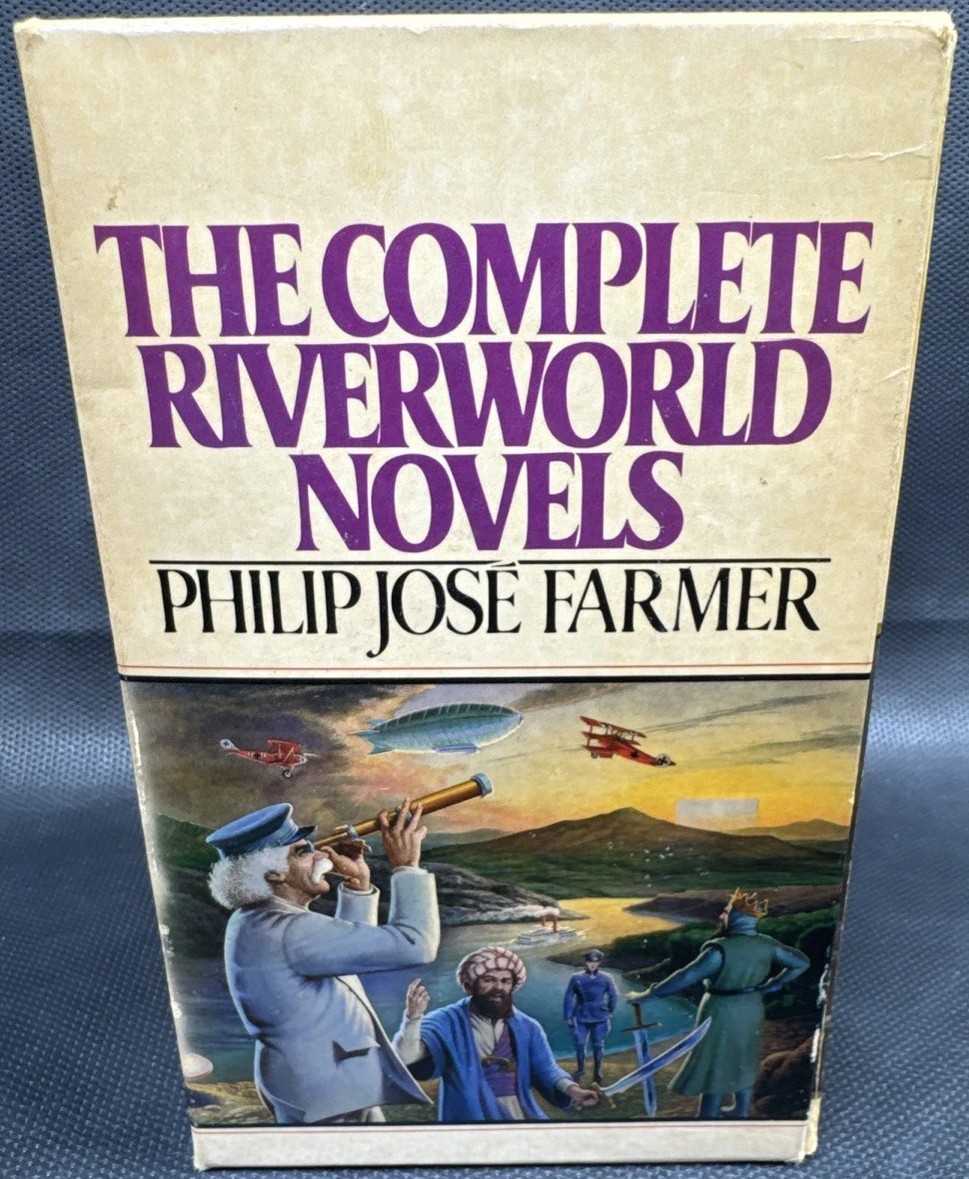
Via eBay.
Before I get that, let’s lay out the rest of the geography.
I mentioned a rusty key after a rock slide; heading farther northwest leads to a view by a cabin (the one with unimplemented rooms)…
Canyon edge overlooking cabin
You are on a northwest-southeast track which runs along the rim of a canyon. A small ruined cabin lies on the canyon floor far below to the west, and beyond it you can just see the entrance to a mine. The canyon walls are too steep to get down there.
…and is followed by a series of paths leading finally at the far north to a tower (which I gave the description of last time). I hadn’t mapped every nook and cranny here but I can now say they just go around in a circle.
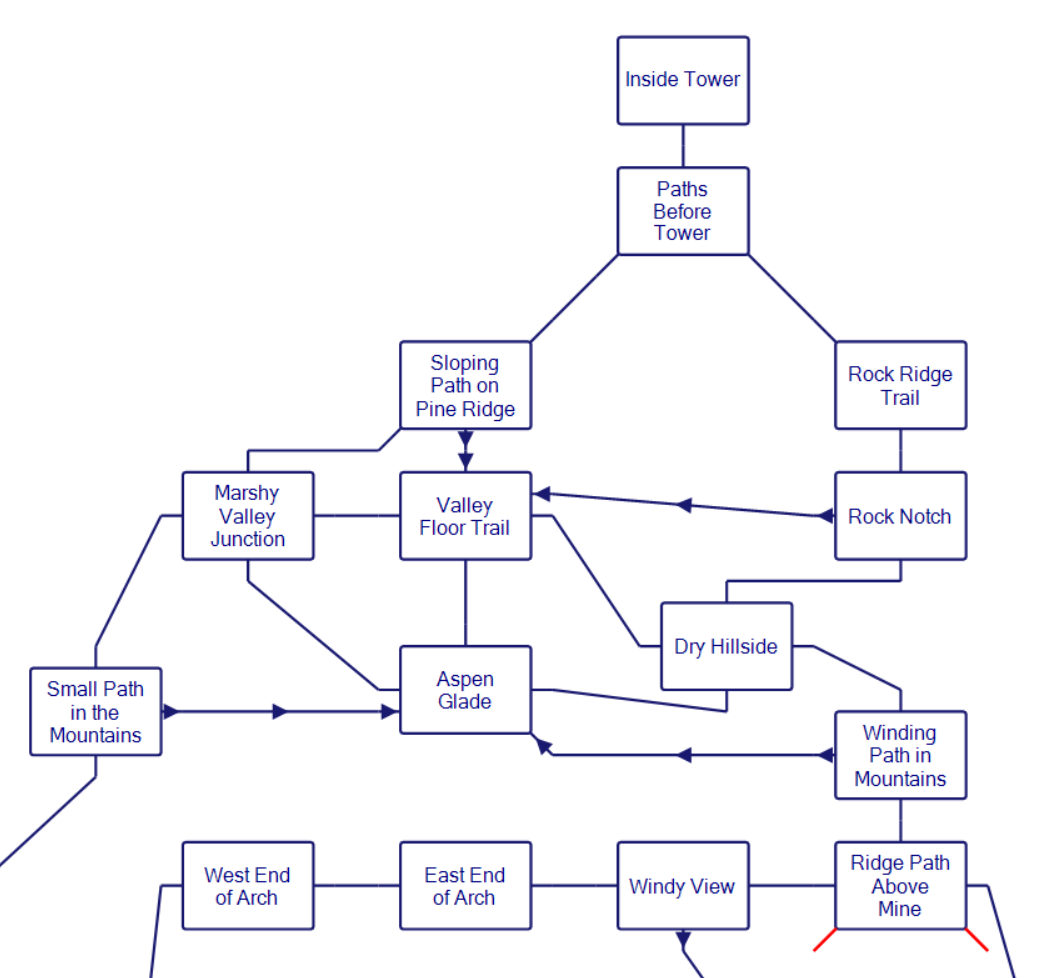
The map has a strange mixture of realism and confusion. So many of our maps essentially have dropped the next place at random; however, the author who made this section clearly cared about how one aspect merged into another, and it all likely made sense in their head. In practice, having (for example) a north exit turn so going back requires going southeast and having some exits be only one-way (without absolutely clear reasoning given why) makes whatever reasoning the author had opaque to me.
Winding path in mountains
The small winding path where you now are is crossed by what could be various tracks in all sorts of directions, and winds so much that you are totally unsure of which direction it is heading. You have the impression that recognisable territory lies to the south of where you now are. The mountains all around are dry and bare.N
Dry hillside
You are on an open dry hillside at a point where an East-west trail crosses a faint North-south path. The path to the north seems to head for a notch in the ridge of hills which lie across the horizon in that direction, and the Westward path goes into a dip in the hills which could be the beginning of a valley. The open bare rocky landscape surronding here is niether interesting nor attractive, though it is slightly impressive in a bleak sort of way.N
Rock notch
You are on a path just beside the place where it runs through a notch in a rocky ridge of hills. The ridge runs more or less in an East-West direction,and the path on one side leads downhill to the South. On the other side it runs through the notch to the North and curves round and out of sight to follow the line of the ridge just below the crest on the northern face. You could also get over the rocks to the West (or amost any other direction) since the slope is not terribly steep.
I haven’t been fussing much about the typos; notice both “surronding” and “niether” at the dry hillside. I generally have given these a pass given the circumstances of the game either being a snapshot in progress or abandoned due to circumstance. (Just a reminder we knew nothing about Thissala prior to the Novas Are Forever dump appearing last year; for all we know there is some build from 1988 that completes the game, just like Ferret eventually came to an end.)
The other part I had left to fill in was the Opal Mine. (There’s a Goblin Mine mentioned which seems like it might have been intended as a separate place, but maybe the authors forgot about it? … or maybe there’s some ultra-obscure puzzle to get there.)
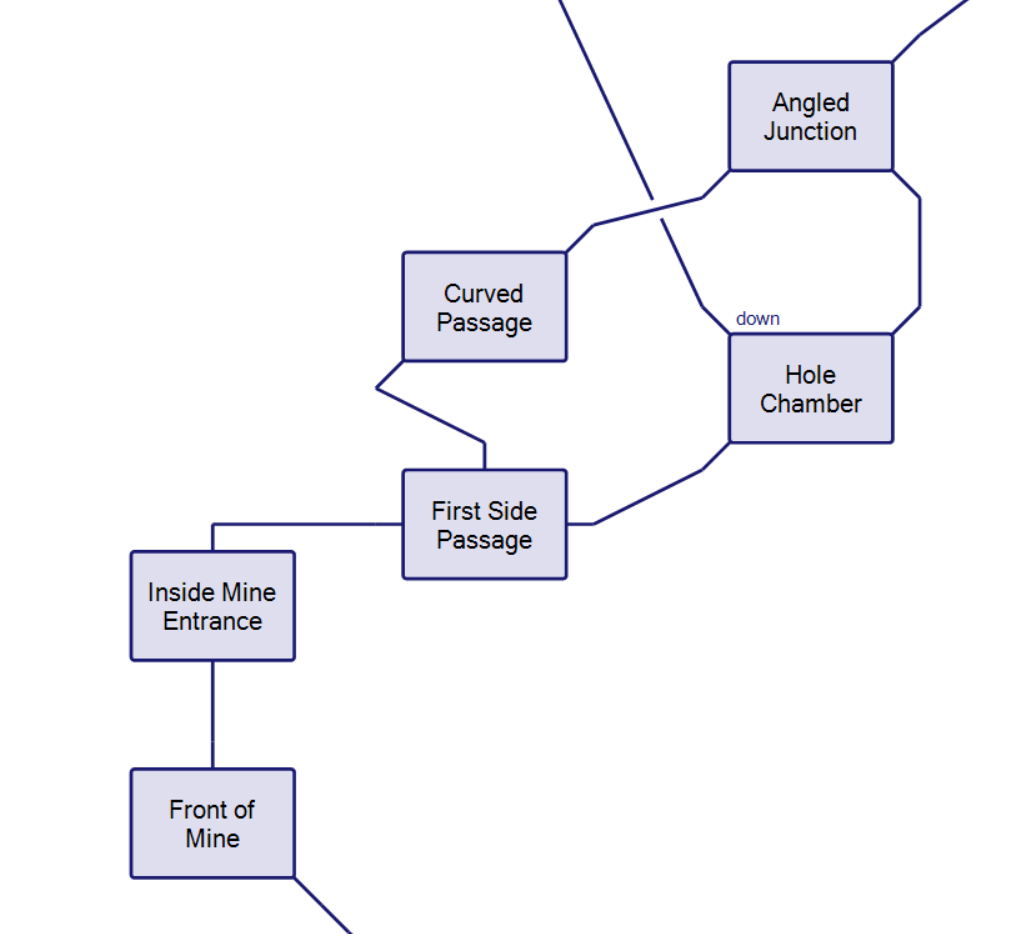
It started out seeming like it might be essentially linear.
Inside mine entrance
You are standing just inside the entrance to an opal mine. To the south the sunlight spills in through the doorway onto the rocky floor. The mine passage heads north from here and begins to twist about.N
First side passage
The main gallery of the mine runs in an East-West direction here, and there is a small passage leading off the gallery to the north.N
Curved Passage
You are in a narrow curving passage which runs Northeast-Southwest at this point. The passage appears to get broader to the Northeast.NE
Angled junction
You have just come around a curve in the passage to this junction. From where you are standing a wide passage runs in a Northeast-Southwest direction, and a hewn rock passage enters this from the Southeast.
From there the map branched out a bit, enough that I would occasionally run into a room I’d seen and then have to shift my map around to make everything fit.
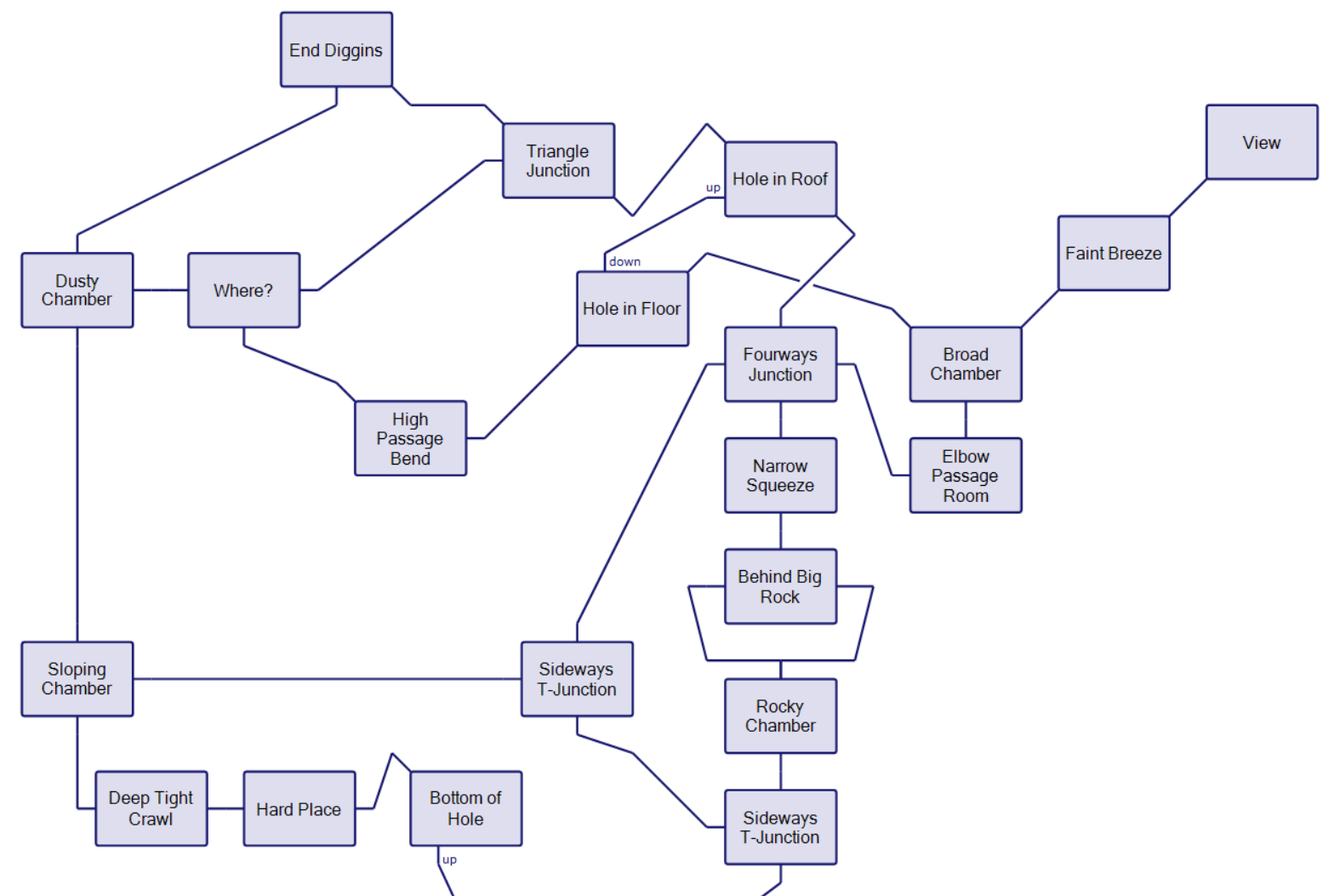
I still wouldn’t call my layout optimal, but again, there seems to be absolutely nothing here. For people without many virtual rooms to spelunk, just the sheer act of discovery I suppose might be interesting, but I really am not sure where the author of this section was going for.
Narrow Squeeze Passage
You are in a narrow North-South passage. The roof of the cave, which is quite high to the north, descends as the walls narrow, making the passageway to the south very tight.N
Fourways junction
You have come to the middle of an arched and faintly reverberant cavern. Trails, which are faintly marked in the floor of the cave, lead North, South, East and West to passages dimly-glimpsed on each side.N
Hole in roof
You are standing in a narrow twisty passage with walls of dryish dark coloured stone, which runs Southeast-Northwest at this point. There is a hole in the roof here.
There are only two rooms I found somewhat of interest (in a “maybe there’s a puzzle here” way), the first being a mysterious room marked with the word END DIGGINS. Maybe it signals a magic word, but more likely it signals the place the author ended (it’s essentially the farthest north you can get).
End diggins
You are in a very roughly excavated circular chamber with entrances only to the South and Southeast. Scratched in large rough letters against the north wall of the chamber are the words “END DIGGINS”. This would appear to be about as far as you can get.
Not too far away, going up a hole and heading northeast, there is a “View” which follows the same model of longer text than usual as other Views.
Faint Breeze Passage
Yoy are in a straight Northeast-southwest passage mined through some dry grayish rock. A faint breeze is blowing from the Northeastern end of the passage.NE
View
You are standing where a hole emerges from a mine into the middle of a sheer cliff face. The rock is unscalable on all sides. From this vast height you can see over a vast and windy desert of golden sand, which ends in a mountain range far to the north of where you are standing. The mountains contain some of obviously volcanic origin, and just on the edge of the desert beside the mountains is an isolated and still active volcano, whose stark vertical sides of black basalt rise up from the harsh desert, and are topped by a craggy lava cone. Smoke or steam appears to be coming from several blow holes on the volcano, and from the caldera on its crest a plume of smoke and dust rises to a great height before being blown sideways in the wind. The hole in the rock leads off to the southwest and safety.
As I already mentioned, I don’t think lingering on the typos (“Yoy”) is worthwhile, but I think I can treat the View here as the author-intended prose. Is the prose effective?
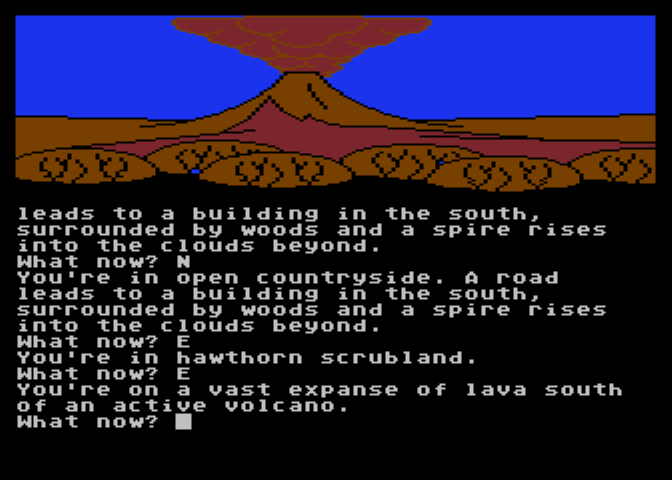
Colossal Adventure from Level 9 didn’t have the space to put a long prose chunk so didn’t copy the Volcano View composed by Woods and his friends, but they compensated with actual art of a Volcano outside.
You can look at both in a holistic sense and in a micro sense. In a holistic sense, it’s trying to emulate the Volcano View of Colossal Adventure, so let’s pull that text up alongside.
You are on the edge of a breath-taking view. Far below you is an active volcano, from which great gouts of molten lava come surging out, cascading back down into the depths. The glowing rock fills the farthest reaches of the cavern with a blood-red glare, giving everything an eerie, macabre appearance. The air is filled with flickering sparks of ash and a heavy smell of brimstone. The walls are hot to the touch, and the thundering of the volcano drowns out all other sounds. Embedded in the jagged roof far overhead are myriad twisted formations composed of pure white alabaster, which scatter the murky light into sinister apparitions upon the walls. To one side is a deep gorge, filled with a bizarre chaos of tortured rock which seems to have been crafted by the devil himself. An immense river of fire crashes out from the depths of the volcano, burns its way through the gorge, and plummets into a bottomless pit far off to your left. To the right, an immense geyser of blistering steam erupts continuously from a barren island in the center of a sulfurous lake, which bubbles ominously. The far right wall is aflame with an incandescence of its own, which lends an additional infernal splendor to the already hellish scene. A dark, foreboding passage exits to the south.
This maybe goes a bit too long (and was ALL CAPS in the original) but still has two advantages over the View in Thissala. One, the scene is vibrant in a way that allows picturesque words (“jagged”, “sinister”, “brimstone”, “gorge”) such that the prose level matches the melodramatic swarm of the vision. Second, the scene is totally isolated: there is nothing like it elsewhere. Hence, the length of prose lends a significance that the Thissala text lacks; even though there are absolute clichés in here, the fact this is the only place this happens in a work that can take 20+ hours to solve makes them more forgivable. You can think of it as the perspective of the avatar being overwhelmed and suddenly becoming loquacious; when I came across the scene for the first time (as a child!) I found this aspect to be moving.
In a micro sense, the Thissala prose is functional; despite this being in person something that would look at least semi-epic, it tries hard to describe what’s there in an almost scientific way.
Smoke or steam appears to be coming from several blow holes on the volcano, and from the caldera on its crest a plume of smoke and dust rises to a great height before being blown sideways in the wind.
This isn’t bad! But the language with “smoke or steam appears” is too hedging to be effective, and the idea of a giant plume going up and then sideways is conveyed but doesn’t have a sense of poetry. Let’s take, comparably, the first room of Beyond Zork, as written by Brian Moriarty:
The horizon is lost in the glare of morning upon the Great Sea. You shield your eyes to sweep the shore below, where a village lies nestled beside a quiet cove.
A stunted oak tree shades the inland road.
The prose here is similarly trying to depict what “your eyes” sees in a direct way, but makes it more dramatic: it establishes a “glare of morning” causing you to “shield your eyes” which segues into using your eyes to “sweep the shore below”. While it is never the absolute case that less text means more — Thoreau’s advice isn’t “simplify” but rather “simplify, simplify” — Moriarty manages to pack more into what’s going on via his choice of words. Both have the very similar technique of description-by-eye-movement (not conventional!) but Thissala needs a few more rounds of edits to hold the same amount of poetry.
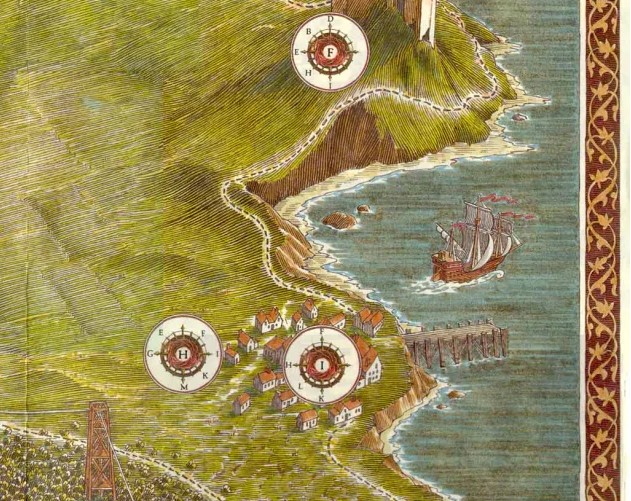
From the original Beyond Zork map, packaged with the game.
Of course, those “few more rounds of edits” is the sticking point now — I really am out of places to explore, although Rob reports I’m missing something … somewhere. I think I’m done with Riverworld (see image on the top), although I haven’t tried dying multiple times yet to see if anything different happens on a return visit. I still haven’t resolved the fuse section, which I highly suspect is a matter of finding the right phrasing (in other words, not really a puzzle); I don’t foresee that opening up a large area. I am still suspicious of the curtain, but I haven’t had any luck getting it to move or do anything (Rob hasn’t had any luck either).
Library
This is the king’s library. Along each wall are shelves of books on all subjects, some old, and some new. Breaking the shelving on the east wall is a doorway, and on the north wall, a set of curtains.
Next to the curtains, on each side, are small hooks to hold the curtains
Sitting on one of the library shelves is a hardbound book
The book (Dream Park) I tried reading a bit of and I didn’t find any clues related to the game. Things do not go as badly as they do in Westworld; the environment is sort of a mega-LARP involving fancy holograms and the book plays more with combining the two layers of story than having one destroy the other; it doesn’t go apocalyptic. If the book indicates anything to me it might be there’s a “control room” somewhere that affects the world as a whole, but did the authors ever get around to implementing it?
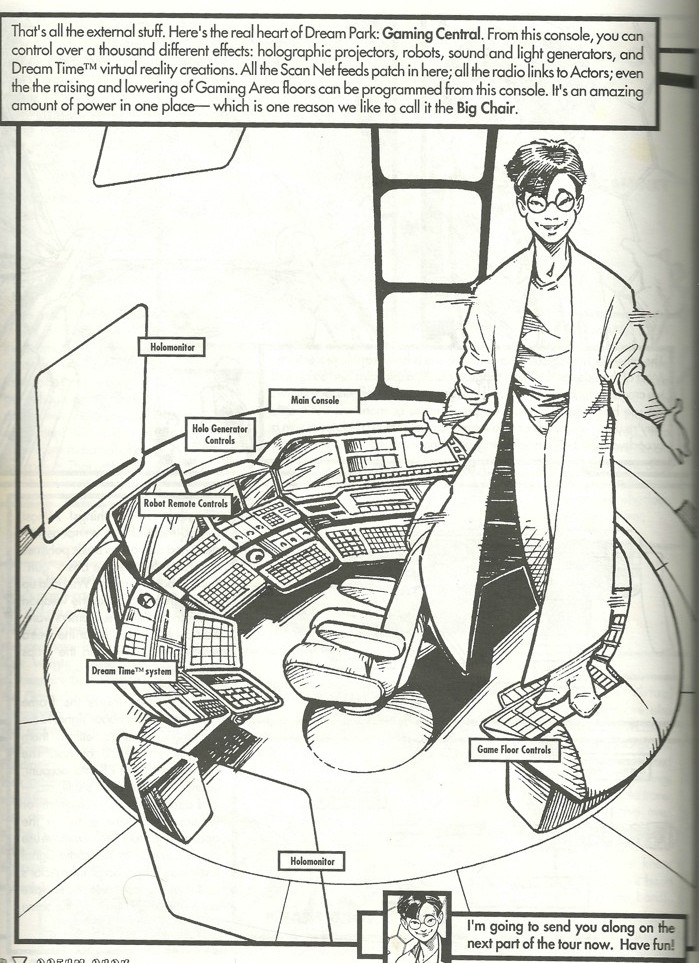
There was a Dream Park RPG from 1992. Since the characters are LARPing with holograms, it means they don’t really “die” when they die. Source.
I suspect, no matter what, I’m winding down on my entries. I’ll still do a big push on the remaining puzzles and locations but unless something major happens I’m likely going to finish by my next entry.


I don’t know what “Dream Park” you’ve got hold of — the only one I know is a single novel with a cargo cult theme and a murder mystery taking place within it. Still no likely connection to this game.
Hmm, it’s probably just the collection of all the Dream Park novels, now that I look at it.
I could see there being an intended “man behind the curtain” twist being signaled but otherwise it isn’t that similar
Okay, so according to my playthrough/map, you have two puzzles left to solve and two sections of the game left to visit in order to sync up with where I was finally stymied:
– Henhouse puzzle
– Dumbwaiter puzzle
– Small joke/parody map section
– Large integral map section
The puzzles will provide you with two treasures, and the smaller map section is just silly/optional (I think?), but the larger one is integral to the game and you’re going to need to see it before wrapping up. As I mentioned before, it contains a specific puzzle/encounter that may be one of the last hopes for figuring out a way to break through to other hidden sections of the game (which I do believe were at least partially implemented in some way – I’ll save my description of what I found by examining the visible parts of the code for your final entry), as well as a reference to a possible fourth author of the game. So, let me know if you’d like some hints to send you in the right general direction.
Regarding this:
“Just a reminder we knew nothing
about Thissala prior to the Novas Are Forever dump appearing last year; for all we know there is some build from 1988 that completes the game, just like Ferret eventually came to an end”
Unfortunately, I’d say that seems pretty unlikely, and that the game was ultimately abandoned and left in this state sometime in 1981, when it was “rehosted” to AOS/VS. The first fact pointing to this is that it’s this exact same version of the game that was found on both an earlier (1983/1984) set of tapes that contained a confused mix of both AOS and VS programs (including the unique 500 point version of Adventure, which is only on those) and the official NADGUG distribution tapes, which is where the version you’re playing was restored from, and were released every year from some time in the ’80s all the way up to around 1996. So if a newer, more complete version of Thissala was ever available, you’d think it would have been included on those at some point. The other thing making it seem unlikely is that on those earlier tapes, the dump of the game also preserved a number of vintage save files, all dated from 1983/1984. I actually loaded these in and played around in them, and nobody ever seems to have gotten any farther than we did. I was even able to trace one of the save file user names, and it turned out to be a guy who was attending a university in Pennsylvania at the time, so we at least know that the game had spread around a bit back then, despite it subsequently being forgotten and lost to history for so long. Again though, this was all from a few years after this version had been released, so it would seem that no further updates ever arrived. All that we appear to be missing are even earlier iterations, where if you read the info/help files carefully, it would indicate that they may have once featured more of the partially implemented RPG elements, like monsters that actually attack, etc.
rot13 on everything?
I do know about XYZZY (will save for last post) if that’s the joke thing you mention
btw I managed to get by the pirate fight (did some object rejiggering and used another save, and there was only the pirate and the rat, which was manageable to survive as long as I ate the tuna first). It’s just an empty pirate den after, I’m assuming the authors meant to have the pirate steal stuff like Adventure but never implemented it.
extra note: my top candidate is the rope at the moment, since TIE ROPE TO X _does_ seem to kind of maybe get parsed, but I have yet to find anything near a notable hole/cliff where there simultaneously is something to tie it too, there’s a ton of missing nouns (like “fence”)
Yeah, the XYZZY thing is the joke area, and can be seen as a callback to the infamous AOS CLI joke and DG’s overall obsession with Adventure in general, just like the name of the game itself.
I also managed to win the combat, and there’s no reward. The implementation is really janky when you save/recall during the encounter, so the whole thing was probably never fully ironed out.
Henhouse:
1 – Whfg qebc vg.
2 – Gnxr n uvxr!
Dumbwaiter:
1 – Pbzcbhaq jbeq.
2 – Abg n qelre ohg n…
3 – Fgnl tebhaqrq.
Missing map section:
1 – Haqrfpevorq rkvgf fhpx.
2 – Whfg jura lbh gubhtug lbh pbhyqa’g trg nal uvture…
“I think I’m done with Riverworld (see image on the top), although I haven’t tried dying multiple times yet”
The Suicide Express _is_ kind of the canonical solution to brute forcing a Riverworld solution, isn’t it!
“fortunately” it turns out KILL ME works for immediate death
unfortunately you can get softlocked,, although I think the game intended for it not to
the coins get reset, but I had the penny go missing once
and also the boat position does not get reset; you can plan ahead of time and press the “S” button while at the tower and disembark before the boat starts moving, and the boat will return back to the shore so if you die again you have a way out