Last time, I mentioned three books published at the incorporation of Shinkigensha. One of them was an NEC PC “yearbook”, essentially an encyclopedia of software.
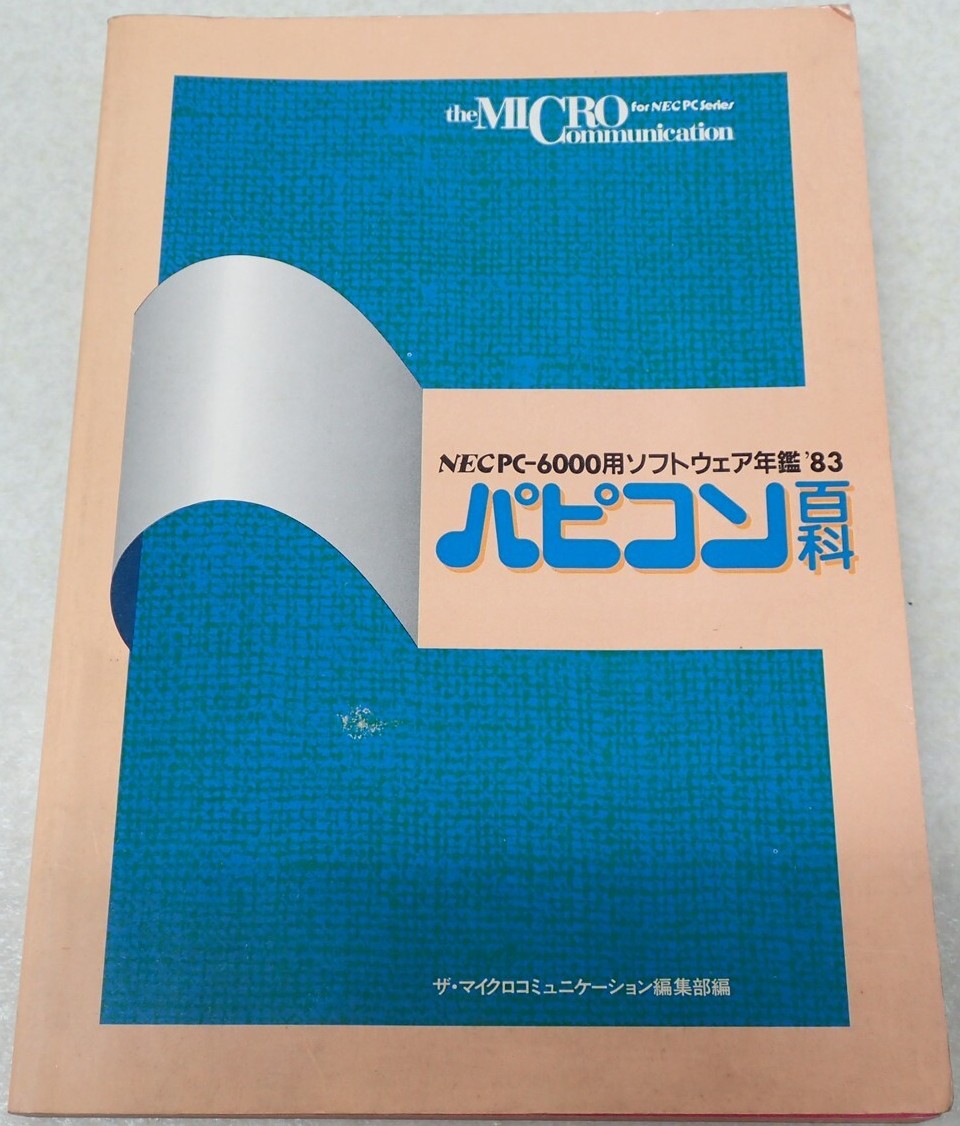
Via Yahoo Auctions.
Looking at the inside front cover, you can see publication info.
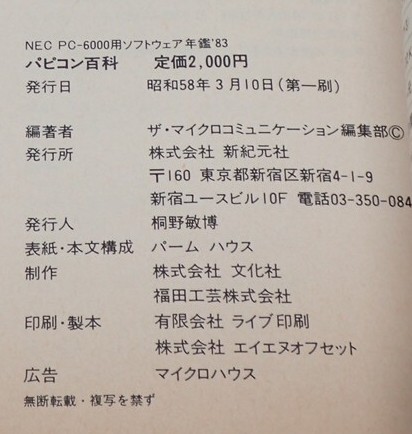
This includes a publication date (March 10, 1983, noting it is a first printing), the creator (The Micro Communication Editorial Department), the publisher (Shinkigensha Co., Ltd.), the company responsible for the cover and layout (Palm House), the companies responsible for production (Bunkasha and Fukuda Kogei), the companies doing printing and binding (Live Printing and AN Offset), and finally the company doing advertising (Micro House).
There’s also the line
発行人 桐野敏博
indicating the individual publisher representative is Toshihiro Kirino. This is out of a staff of 10, and Bunji Yonekura was the President at this time.
Referring back to Toshihiro Kirino: later in life he became chairman of the education software company LINES (the website is education dot jp, just to give you an idea of their prominence) but he also has some history prior to Shinkigensha.
Most directly clear is a reference in a 1980 book (about a handmade newspaper from Japanese Prisoners of War on Leyte Island). The book cites Mr. Toshihiro Kirino of Live Printing (along with Mr. Atsuo Takeuchi of Saikosha, another printing company) as helping with restoring the old handwritten text. Note how Kirino is associated with a company that worked with Shinkigensha but not the company itself. (This might be another situation where the two were informally affiliated in some way, like it is possible Micro House and Shinkigensha were.)
Less clear to me is if he’s the same person associated with the Japanese New Left (specifically the “Kyoto University All-Campus Joint Struggle Committee”) and an incident of alleged attempted bombing at the residence of the Metropolitan Police Commissioner General. None of this is implausible, but given that this Toshihiro Kirino was indicted (and then acquitted) under the Explosives Control Act, I’d prefer some absolute confirmation before getting more into the story. (Also adding plausibility is the president of Shinkigensha in ’83 came from the same academic leftist circles; he authored various articles in socialist magazines in the late 60s.) This will likely all end up as a future standalone post. I’ll link something I wrote four years ago in relation to the movie Akira as compensation for now.
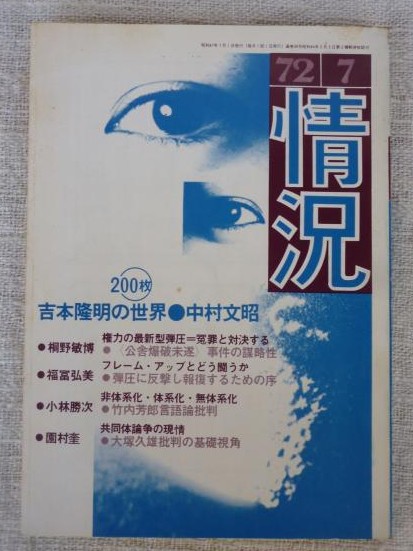
July 1972 cover of The Situation. The top article by Toshihiro Kirino is specifically about the incident.
Returning to the game, I suspected I was missing some mechanical aspect to how it worked. Indeed I was. It turns out that objects only exist in a room if you’ve applied LOOK (that is, miru or miwatsu) to the room. Doors are an exception but they aren’t treated as normal objects; they are hard-coded into particular rooms.
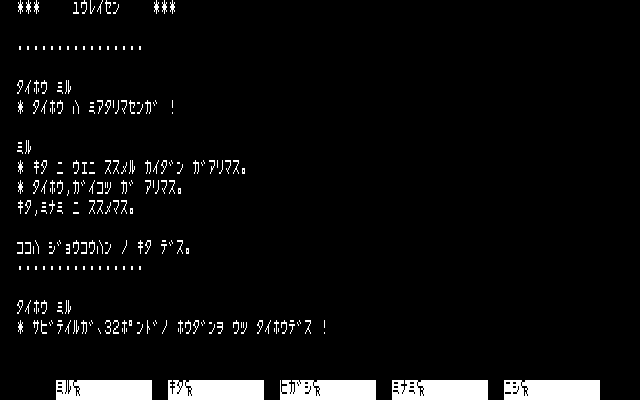
Entering the deck with a cannon, trying to examine the cannon and being rebuffed, looking at the room, then trying to examine the cannon again. We are then told it can fire 32-pound cannonballs.
This is extraordinary behavior and we’ve only seen this in one other game: Omotesando Adventure. I was a little faster to pick up on the issue in Omotesando because you can’t even open doors without looking; here it seemed like everything was normal, and I was doing LOOK during my exploration process just to keep oriented (since the game by default only gives room descriptions). It meant for a little while I could refer to objects, but on my pass where I was trying to search things or do other actions (but I didn’t use LOOK because I already knew what was there) I was failing because the game was pretending the noun I was using didn’t exist in the room.
With that figured out, I set about systematically examining things and searching things, for real this time. The various masts explain what they are (the mizzenmast is the one at the back of the ship, according to the game). The barrels are still ordinary (I think I examined them right the first time) as are the desks (sadly, still didn’t find anything, ugh). I also tried various random verbs that seemed appropriate, like using SLEEP on the hammock.
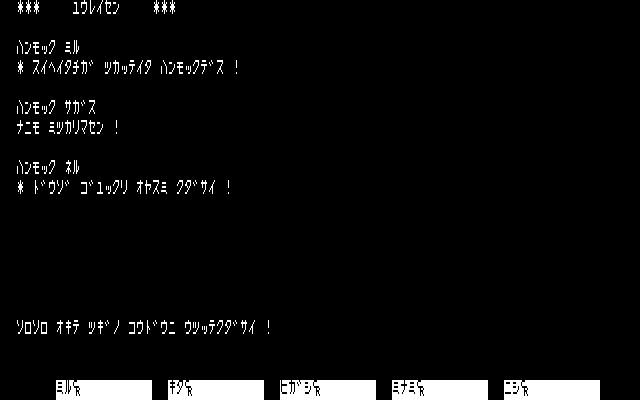
“Rest as long as you like.” (Real time delay.) “It’s time to wake up and get moving.”
I found out that I made a translation error in the armory and what I had down as a cannon was actually a cannonball (this may have been more a note-reading error than a translation error, since it went as cannonball in my notes but cannon on the map). I found I could take the cannonball, but I haven’t been able to do anything with it yet. (Before anyone asks, I did try to put it in the cannon, with the caveat that none of the verbs seem particularly appropriate for that. No luck, but the cannon would need more in it to work than just a cannonball normally anyway. I also tried all four of the “destroy” related verbs on the hatch while holding the cannonball, and also trying to throw it while I was standing there.)
Most interesting were the skeletons / skulls, who seethe with “angry spirits”. Searching them does not go well.
「 ワレワレ ノ イカリノ コエヲ 1ドデモ キイタカ !
バチアタリモノハ タイカイ ノ モクズ ト キエヨ ! 」
which I translated as
Have you not even once heard the sound of our anger! Cursed defiler, vanish into the depths of the vast ocean!
The game cuts off right there with no description of what happens or a “you have died” message.
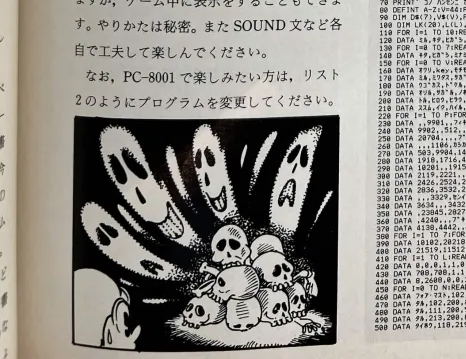
The scene in the lower deck as depicted in PC Magazine, June 1983.
With the big pile of skulls, I was able to listen.
スイヘイタチノ カナシイ サケビ ガ フネジュウニ キコエル。
「 ワレワレニ ヤスラカナ ネムリヲ アタエヨ! 」、ト。
カレラノタメニ トナエヨ ・・・「 アーメン 」
The sorrowful cries of the sailors echo through the ship.
“Grant us peaceful slumber!” they plead.
Pray for them… “Amen.”
Unfortunately, while SPEAK AMEN and SAY AMEN both are recognized (or rather, “amen speak” and “amen say”, in the order needed) the only response I’ve gotten is nothing happened. This perhaps needs to be done somewhere special.
Even after feeling I’ve got the hang of the parser, I’m terribly stuck. I’ll give things a little more time but I’m probably going to break open the rest of the source code (I’ve only just looked at the verb / noun data). Any more suggestions on what to try are welcome.


 Renga in Blue
Have you tried to “ugokasu” everything? Maybe moving a barrel, cannon, etc. will reveal an item or hidden passage.
“It turns out that objects only exist in a room if you’ve applied LOOK”
That’s some solid virtual solipsism right there!
ok, I’m trying to avoid going _too_ crazy poking at source code but
I’m guessing I just need to catch the trail of the right start point and I can move on
aaaaa
ok, at the storage place where the cook’s room is, you can LOOK there to find a barrel. if you _immediately_ do something else with the barrel, you can refer to it, otherwise it will disappear again from scope
finally got a key (also you can look in to get some biscuits)
Don’t eat those biscuits. If you look at them (before picking them up), you’ll get a message telling you they’re moldy. I’ve got a working version of the game in English now and have figured out how to get into the officer rooms and down through the hatch to the levels below. The North Lower Deck is the place for the clue that will allow you to search/move skeletons without being cast into the sea. That will crack the game open. Thanks for the map! It was absolutely essential for my porting efforts.
if you’re meaning you can pray amen at random skeletons, I get either
“nothing happens”
or
“I don’t know what to do”
this is after hearing the clue from the skulls
It seems that you need to not only “look” at rooms before you can interact with objects, but also AT the objects before certain other actions.
No genius insights on my part here, I just went ahead and checked the walkthrough a little on the old Retro AVG Kouryaku page.
This game seems completely nuts, btw. Where did he get the idea that you’re supposed to interact visually with everything like this? Omotesandou wasn’t THIS absurd, right?
For what it’s worth, even some Japanese reviews of it note that the nautical terminology is confusing, the map is confusing, and that they had a hard time figuring it out even after checking the code.
You always have to go and visit the Pile and “Listen” for the message before praying over the other skeletons (Or break and type in AH=1 and then enter CONT). I think you might have to use a specific formula in the original game (I changed it in my English version). If I recall that formula is something like “PRAY AMEN” or maybe “SAY AMEN”. I made my English version work if you said either “PRAY” “SAY AMEN”, “PRAY AMEN” or “SAY PRAYER”. I recall thinking that the phrase “PRAY AMEN” seemed a little unusual in English. If you do that over each skeleton, you can Examine and Move them without trouble. If you look at them before doing that, they are described as “Filled with restless spirits” (thanks for the translation of that msg btw), but if you Look after, they are described as “Sleeping peacefully.”
And yes, you have to “Look” at rooms before interacting with items, and you sometimes have to Look at individual items, before you can have further interactions. And there is a difference between Examine and Move in terms of effects. I actually enjoy these complications/subtleties, but it can get a wee bit tedious having to do all 3 actions on every item.
You mention that the Amory and Storeroom on the Lower Deck level have “closed” doors. But in my code I had some trouble with the doors routines (they were ALL locked!). I think there might be a slight difference regarding rounding between my machine and the Japanese PC. In fixing that problem, the doors to the Amory and Storage room are now open without a key, as are the Cook’s room, kitchen (I call it Galley), Officer 1 and Officer 2 rooms. Is that how it works in the original?
yes, that’s correct as far as the unlocked doors go
also, I had already listened to the skulls below, did LOOK SKELETON before interacting, and did every variant of pray/amen, so something else is wrong
if all else fails I’m going to just step-by-step through the walkthrough up to that point
Oh, and if you get the right prayer phrase, you should get a message saying “Rest in Peace” or something to that effect.
I finally managed to get through, and it’s _terrible_
I was doing the right action (you can just type the “amen” phrase and it will technically work) but you need to have both listened to the skulls _and_ drank the rum
this makes no sense because the rum (which I finally found) gave me a clue about breaking the hatch
but apparently if you drink the rum before listening to the skulls you get a clue about listening to the skulls
and somehow the game thinks you haven’t listened to the skulls until you’ve also drank the rum
it’s pretty much a flat-out bug
And I don’t know if this effects the original game (probably not due to the Noun-Verb order of Japanese), but if you input phrases with more than three spaces (words) the parser will consider the last word of the three to be the 2nd word (the verb in the Japanese, but noun in my English version). Caused me lots of trouble with my English translation, but fixed now. Again, thanks for your write up which made me aware of this nuance (after I went back and read more carefully).
There might be a bug in the code in the prayer routine:
Check following line:
4040 IF LEFT$(A$,4)=LEFT$(V$(5),4)=0 THEN 4090
My Microsoft BASIC chokes on this. By normal BASIC standards it should be expressed like this:
4040 IF (LEFT$(A$,4)=LEFT$(V$(5),4))=0 THEN 4090
OR even better (for a Microsoft variation) like this:
4040 IF LEFT$(A$,4)<>LEFT$(V$(5),4) THEN 4090
There is another possible bug like this one too. Check:
1450 IF LEFT$(A1$,3)=LEFT$(N$(NN),3)=0 THEN 1490
Should read:
1450 IF (LEFT$(A1$,3)=LEFT$(N$(NN),3))=0 THEN 1490
OR
1450 IF LEFT$(A1$,3)<>LEFT$(N$(NN),3) THEN 1490
Looking at the code, I can’t see anything that indicates that the Rum hint must be got. But line 4040 checks (if it works as I think it is suppposed to) to make absolutely sure that you have typed AMEN first in your input. So something like AMEN PRAY or AMEN SAY might be the required format. Or maybe just AMEN.
The hint given varies if you have listened to the pile first. If not, there are a number of different hints depending on other things you have already accomplished or not.
there’s clearly something going on! these are both in the same room and are the same commands but one works and the other doesn’t, and they were both done after hearing about amen from the skulls
the only difference is in one I drank the rum and the other I didn’t
and now that I have zoomed in, the first character is ever so slightly different, agh
“Hello JERRY…”
“Hello NUUMEN…”
yeah low-resolution fonts don’t help with the classic Similarly-Shaped Kana Mixup (as someone whose reading practice is often augmented by retro games)
[I wasn’t allowed to reply to the benevolentchum’s comment direclty.]
Interesting. By reading benevolentchum’s comment, I have just now discovered that Comodore 64’s Microsoft BASIC does not support the inequality operator!
This is why the author first tries to check whether the result of both LEFT$ is equal, and then that that value is zero, since zero is false in this BASIC. In Sinclair BASIC, the BASIC I learned when I was a kid, you certainly have an inequality operator:
GW-BASIC certainly supports it as well (but it is obviously a later product). But anyway, instead of checking inequality the way the author did, I’d have just written:
Which is semantically the same, and I’ve just verified it and runs correctly in a C64 emulator. It also seems more natural and readable to me.
Interesting trivialities.
“GW-BASIC certainly supports it as well (but it is obviously a later product).”
No, that’s not obvious, and is actually incorrect. GW-BASIC was just a self-contained MS-DOS build of the version of Microsoft BASIC embedded in the ROM of the original IBM PC (you could either boot directly into it, or access it from PC-DOS by running BASICA). So even though GW-BASIC under that name was released a little later, its *code* already existed in 1980. OTOH while the first incarnation of Sinclair BASIC in ZX80 was also available in 1980, it didn’t yet have the inequality operator, which was added for ZX81 in 1981. Therefore Microsoft BASIC wins this race.
Of course you might ask why Microsoft BASIC for C64 (and some other 8-bit computers) didn’t also have the inequality operator, given that by then MS was clearly aware of the possibility. I don’t know the answer to that question.
Low res back in the day. So frustrating that detail of the Japanese scripts could be so easily lost among the pixels. Today is obviously better.
Can I ask… is the language of “LEFT” and “RIGHT” being used in the Japanese (what CoPilot gave me)? Or is the program actually using something like PORT and STARBOARD? Is this what the complaint about obscure “nautical terminology” was referring to?
I’ve also fixed my problems with doors. Turns out, you have a system requiring Unlocking doors (KEY OPEN in the Japanese) and then a distinct OPEN DOOR (they are not the same… so weird). Kume really liked making you jump through the hoops. Oh well, programmers probably felt that encouraging more typing added “play value.”
Looking at the walkthrough, the game prompts for “right? left?” (migi? hidari?) a couple of times, so no special terms there.
The use of “kagi akeru” just means “unlock” (dropping the “を” or “ヲ” in a two word parser), as opposed to “doa akeru” for “open door”. The use of “akeru” in the first instance doesn’t have the exact same meaning as in the second, which is why it sounds awkward when translated literally to English.
There’s one bizarre katakana spelling choice here, though. “チヅ” for “map” instead of “チズ”! Even the Retro AVG Kouryaku guy complained about that one.
And maybe you should lay of the rum while playing mate. It’s affecting your eyesight;)