1940 was a curious year to be starting a publishing company, but especially one in Tokyo.
This was in the midst of WW2, and the same year Italy, Germany, and Japan signed the Tripartite Pact. Censorship was ongoing and total by 1941; The Japan Publishing Distribution Company (日本出版配給株式會社) was started to oversee all content, consolidating over 240 companies. There were essentially no notable literary works from 1941 until the end of the war; while The Makioka Sisters (considered Junichirō Tanizaki’s masterpiece) started serialization in 1943, it was stopped by the government and publication was only finished after the war.
A 2000 Knopf edition, From Elephant Bookstore.
August 1940 — a month before the Tripartite Pact — marked the founding of our company today, Shinkigensha. As you might expect, they came out from the very start with propaganda, like Showa Chronicles by Iwao Mitsuda (a year later the same author released a biography of Hitler with a different publisher) and A Guide to the New Order; the New Order refers to both the proposed “New Order in East Asia” (trying to cast Japan’s colonial project as a way of breaking from Western powers) and New Order as a movement, interested in imposing a state mass party and boosting nationalism.
In 1942, Shinkigensha published a book by a military celebrity: If You Go to War by Sakurai Tadayoshi.
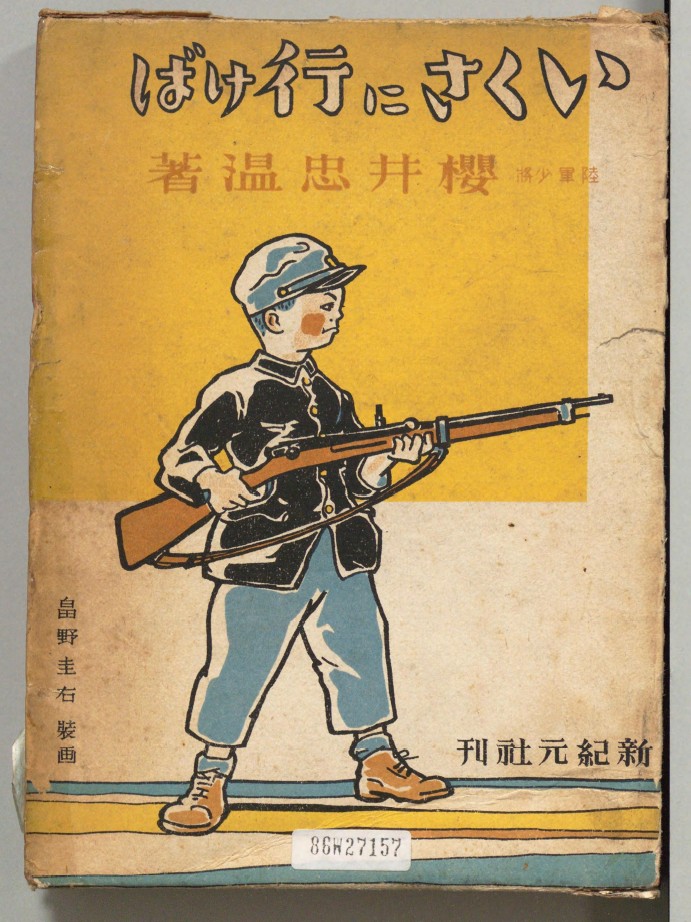
Photo from the National Diet Library. Source.
Sakurai Tadayoshi was a veteran of the Russo-Japanese War; he suffered so many bullet and sword wounds that he was mistaken for a corpse and was discovered alive while being transported for cremation. He wrote a memoir in 1906 (Human Bullets); the concept of the title was “using one’s own body as a bullet”, essentially fierce close-quarters combat.
Suddenly a tremendous shout arose throughout our whole line; all the officers, with drawn swords and bloodshot eyes, rushed into the enemy’s forts, shouting and yelling and encouraging their men to follow. A hell-like struggle ensued, in which bayonet clashed against bayonet, fierce shooting was answered by fierce shooting, shouts and yells were mingled with the groans of the wounded and dying. The battle soon became ours, for, in spite of their desperate resistance, the enemy took to their heels, leaving behind them many mementos of their defeat. Banzai was shouted two or three times; joy and congratulation resounded on the heights of Kenzan, which was now virtually ours. The Flag of the Rising Sun was hoisted high at the top of the hill. This stronghold once in our hands, shall we ever give it back to the enemy?
— From the translation by Masujiro Honda
The new book starts with an author note asking “why did the war break out?”, blaming Chiang Kai-shek of China “looking down” on Japan and Britain and the US “pulling the strings from behind”.
Unless we defeat the United States and Britain, the war with China will never be finished; we must cut off their hands as they attempt to take hold of China.
A year later, the same publisher printed Returning to the Homeland by Goro Nakano. Nakano was a reporter with the newspaper Asahi Shimbun who was in New York at the outbreak of war and was detained; the book is “the Pacific War as seen from America”.
Only a miracle might delay the outbreak of war. With Secretary of State Hull’s outrageous response to Japan on November 26, the U.S. government had already trampled upon Japan’s restraint and peaceful efforts.
(This is the “Hull Note” that demanded that Japan withdraw from China and French Indochina.)
Post-war involved a rapid reverse, including the eight volumes of Dr. Sakuzo Yoshino’s Collected Works on Democracy (published in 1946) as well as literature by Matsutaro Kawaguchi and Osamu Dazai the same year.
This reversal could be a.) starting as a true believer in fascism, but changing course for survival during the US occupation or b.) the founder being reluctant with the propaganda to begin with, and they’d really rather be doing something else. Despite the founding date being a puzzle, there’s good reason to think the latter, because the founder appears to be the erotic literature scholar Kenbun Matsukawa.
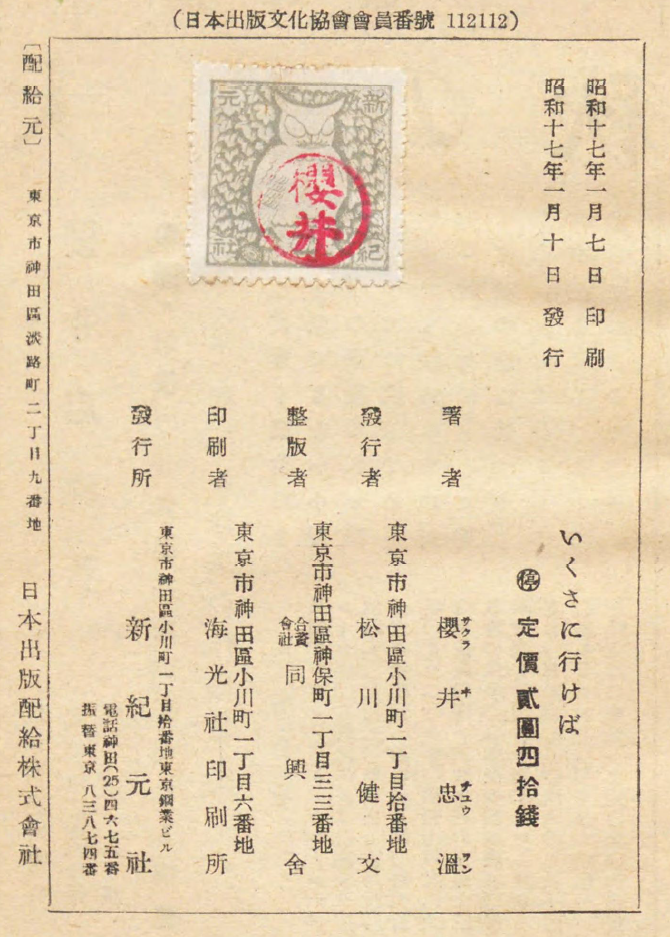
From the back pages of If You Go To War. The text along the top edge mentions The Japan Publishing Distribution Company.
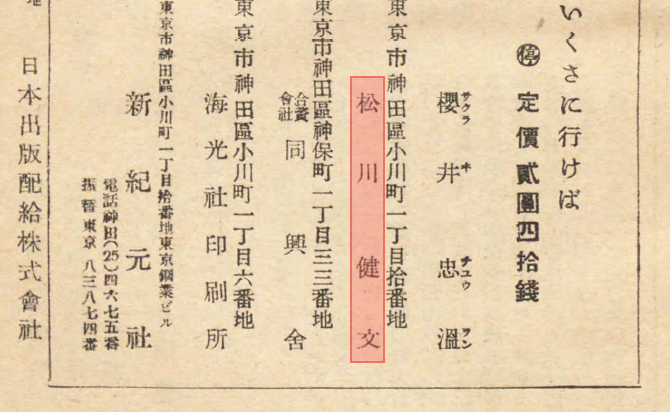
松川健文 (Kenbun Matsukawa) is given as the publisher.
In a 1997 book, the scholar Toshio Takahashi calls Matsukawa “no mere purveyor of erotica, but instead a man of refined sensibilities”; in the early 1950s he published a series of booklets titled Curiosa through the “Tokyo Limited Edition Club” with essays (“Eroticism in Detective Fiction”, “Edo period sideshows”) and translations (with high-literary choices like Casanova, Henry Miller, and the ancient Greek play Lysistrata).
He also published A Study of Erotic Literature in 1948 (using the publisher name Logos), and it includes the important essay “On Obscenity”; despite the name of the author being different (Fumio Natsukawa) it likely was just Matsukawa using a pen name. This essay uses Havelock Ellis’s book The Psychology of Sex (in English) as a reference; instead of some absolute natural law, he calls the obscene an “emotional response under certain circumstances” and that it is simply a “violation of social etiquette” that is subjectively dependent on each individual person.
This was when it was possible to go to jail for publishing erotic material, and indeed he was sentenced to two months in 1950 for “selling obscene literature”; another scholar writing in 1969 called him a “nihilist” (in the same sense as Dazai Osamu) who made “significant” contributions in advancing the study of erotic literature.
These works were all in “alternative” presses; while all this was going on, Shinkigensha was busy with churning out “proper” work, including straight textbooks like “Stable Value Accounting: A Study of Inflation Accounting in Various Countries” (1949) and “Public Debt Economics” (1955). They also in the 60s published a “Collection of Literary Works by Junior High School Students” (for multiple years, for an annual prize) and in 1970 published “A Middle Schooler’s Guide to Daily Life”.
They switched gears starting in the 1980s, still with an underlying mission of conveying historical and technical information, but now aimed squarely at hobbyists. (Right before this, in 1979, they published the Comprehensive Research Study on Zainichi Koreans. It’s fair to guess this would not interest people playing with tabletop miniatures.) As far as why, it likely is because while they were founded a long time before, they only became incorporated on March 4, 1982. (Very loosely, it went from “family business” to “corporation”, allowing things like government contracts and limited liability.)
Their biggest niche after that became the Truth in Fantasy books.
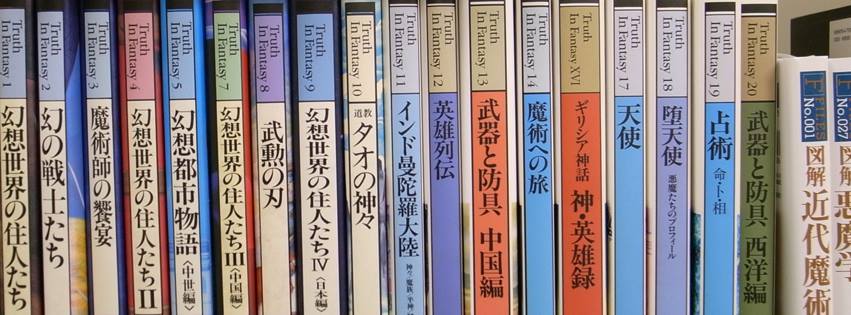
From Shinkigensha’s Facebook page.
They’re a bridge between textbook and fantasy: they’re meant to be guides pulling elements from history and mythology to help with TTRPG games. Truth in Fantasy 4, Residents of a Fantasy World, tries to show what kind of characters one might meet in a campaign. Truth in Fantasy 10 is a guide to the deities of Taoism.
The company has guides outside the series of a similar flavor. The artist Mitsuhiro Arita (mostly known for Pokémon cards) did some work with Shinkigensha; his art in the stand-alone Arms & Armor Encyclopedia impressed Kenichi Iwao of Square Enix enough that he was offered a job. He made Final Fantasy XI content for ten years.
Other than that Shinkigensha became after known for
▲ military manuals for hobbyists
▲ art books
▲ guides to games
▲ and technology.
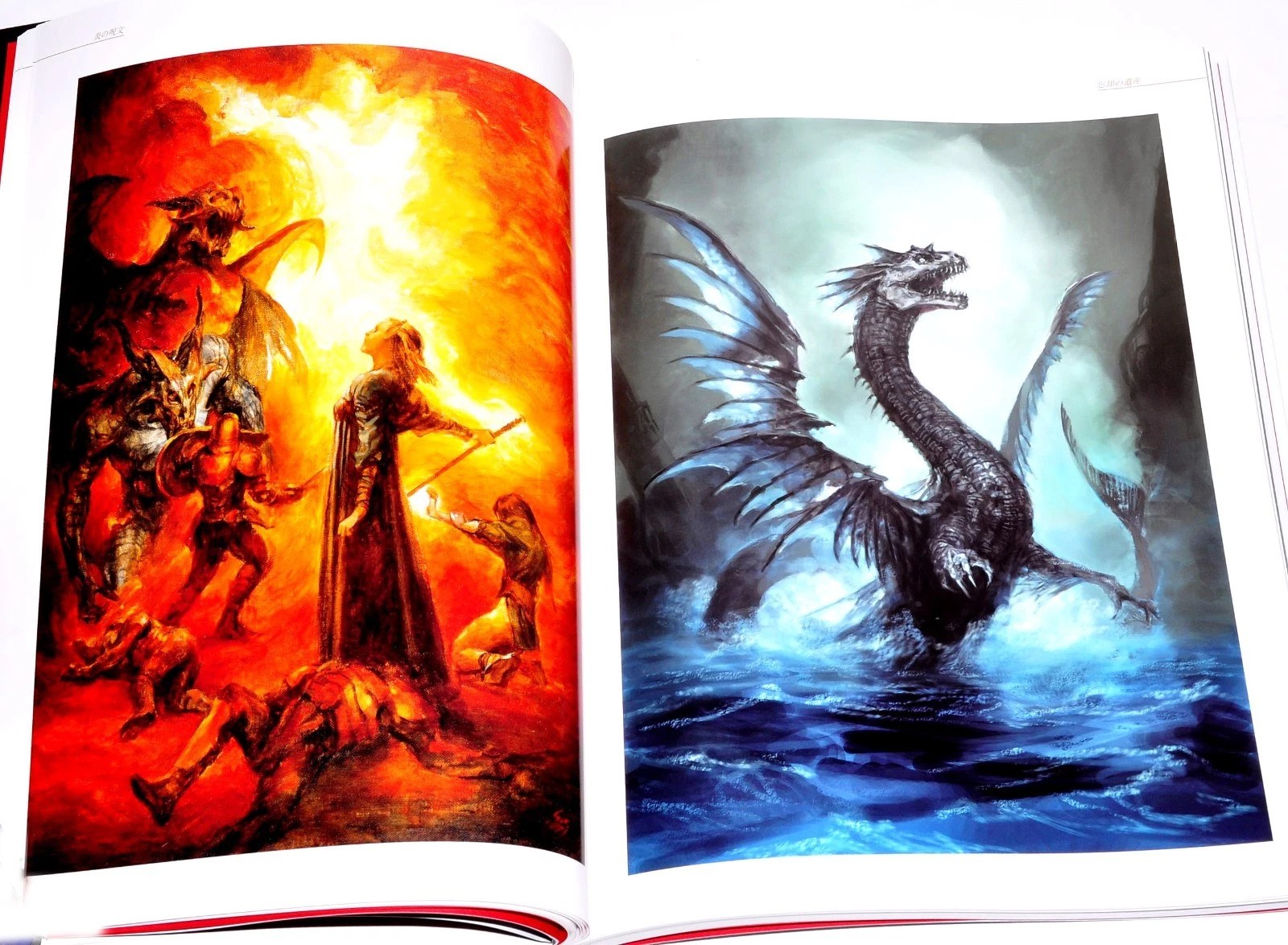
From a Wizardry art book by Jun Suemi.
For the story today, the technology is our focus; in late 1981 they started a tabloid newspaper about personal computing, and in 1982 they helped create the program Pasokon Sunday (lasting until 1989); I’ve embedded below an episode from late in the run (1988):
The tabloid newspaper was eventually turned into a monthly newspaper, PC Magazine. (Not to be confused with the American magazine of the exact same title.) Here’s a page from their September 1983 issue:
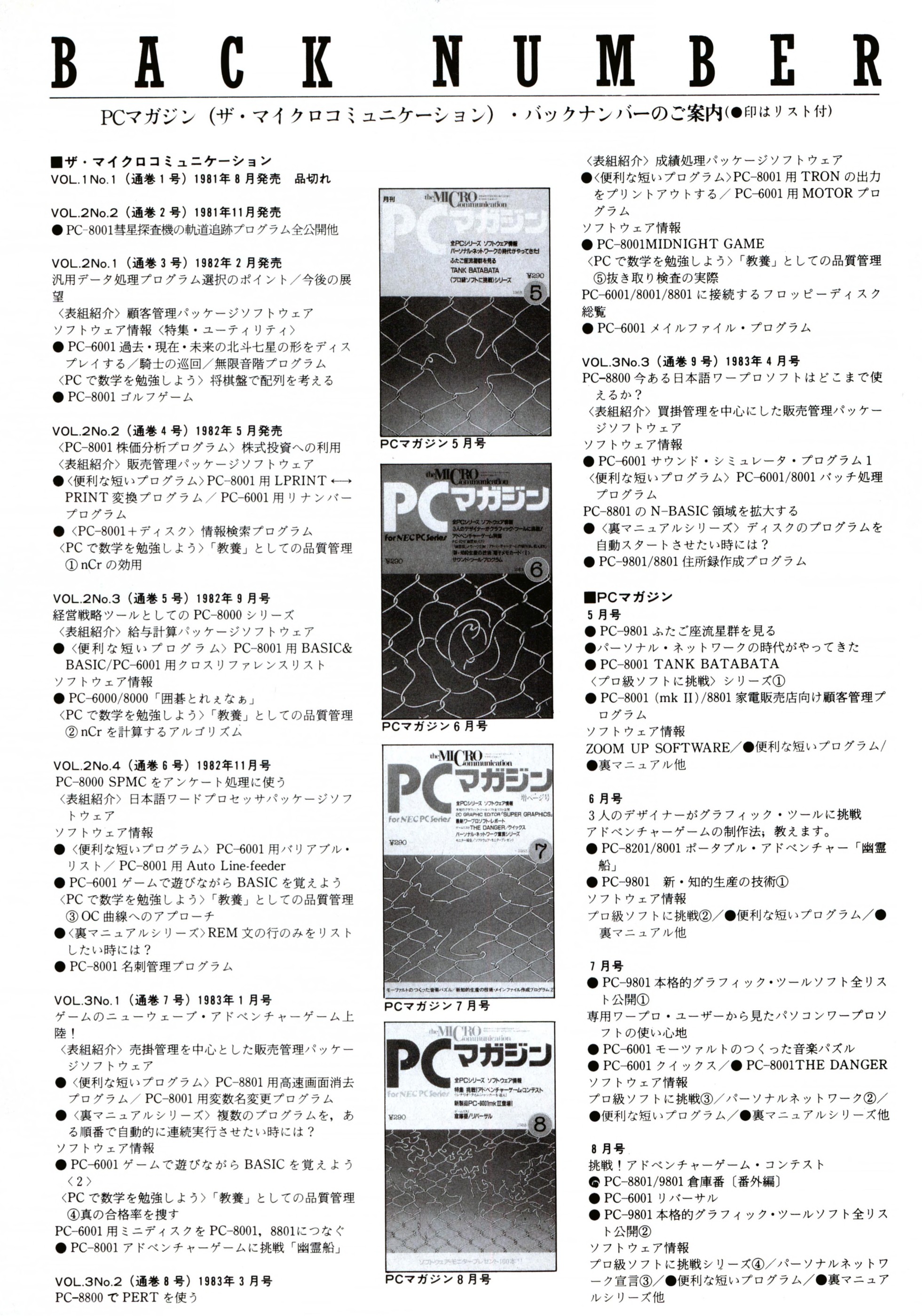
Included during the newspaper phase was one marked January 1982 (published one or two months before).
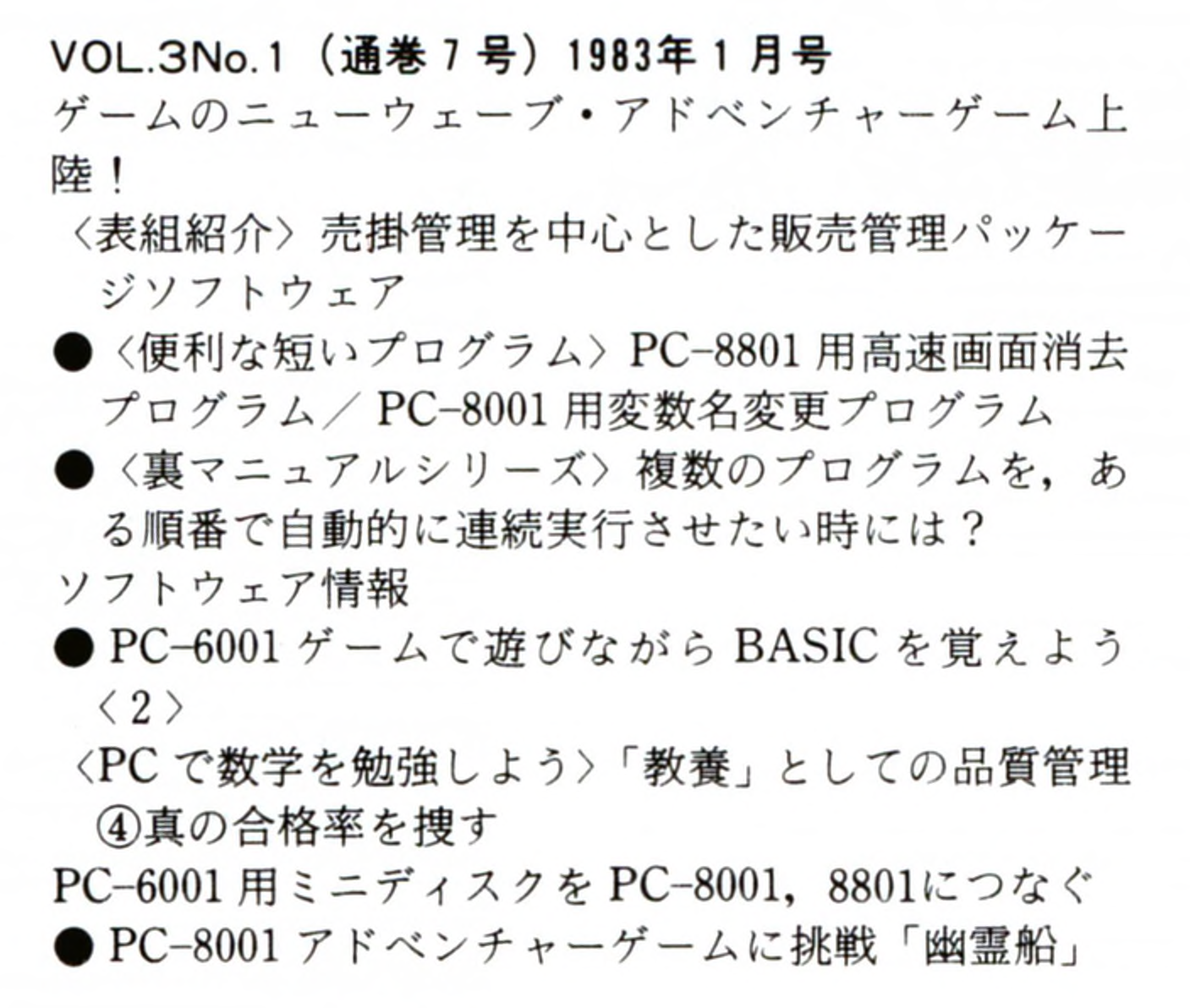
The very last line has our game: Yuureisen, or The Phantom Ship, by Yasuhiro Kume. It was for PC-8001, the same machine Omotesando was on. This gets listed in archives as Yuureisen, but I’m giving it in translation for English audiences. I could have used Ghost Ship as the translation of the title, but there’s the faint possibility that some inspiration came from the 1950s animated short, or the 1960s manga and anime, and in both cases they include Phantom in their official English translation.
I unfortunately don’t have a copy of the original printing, and as far as I can tell nobody else does either. Tabloid newspaper format does not lend itself to preservation unless done actively. The Game Preservation Society in Japan has copies of all the magazines and none of the newspapers.
The game was reprinted in one of the magazines (June, by the time they went monthly), but the reprint is for a machine we haven’t had on this blog yet, the PC-8201. The one-digit difference hides that this is a much different system. The PC-8201 is a portable computer, NEC’s answer to the Tandy 100.
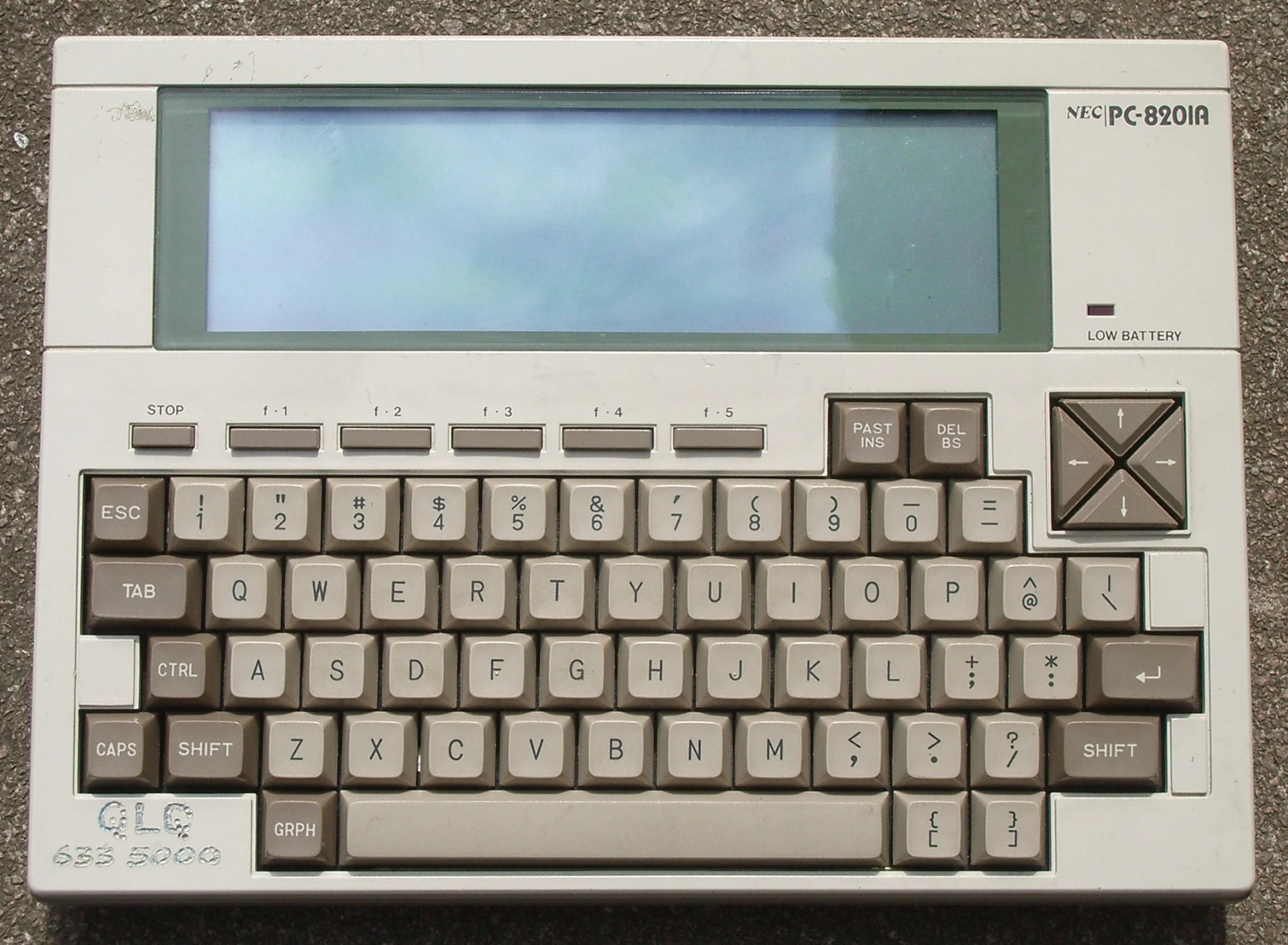
A NEC PC-8201A, from Reddit.
The game was actually published by Shinkigensha on tape before the June issue came out (price 3500 yen, shipping 240 yen), and the BASIC source code had bugs! In addition to the PC-8201 version, the June article has fixes for the tape release, and tells the readers to retype the BASIC lines with the fixed versions.
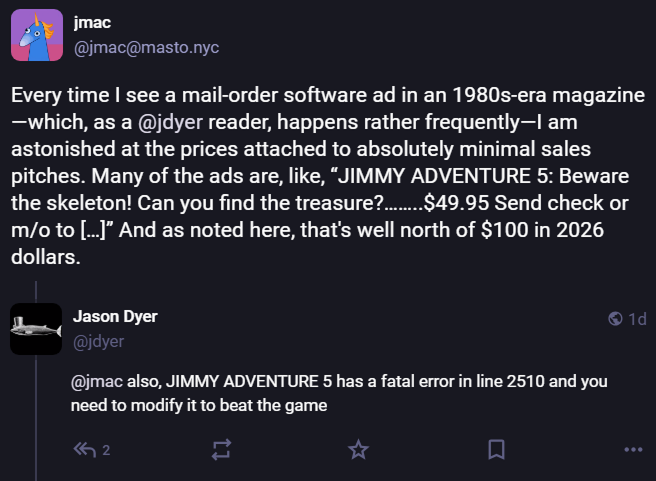
When I made this joke a few days ago, I didn’t realize it applied to this game.
In case you are curious, here are the two changes:
Correct: 2220 IF NN<>5 THEN PRINT “* アシヲ イタメマスヨ!”:PLAY “o7c4”:GOTO 1130
Incorrect: 2220 IF NN<>5 THEN PRINT “* アシヲ イタメマスヨ!”:BEEP:GOTO 1130
Correct: 2740 IFPC(P2,J)>10000 THEN D1$=D$(8-INT(PC(P2,J)/10000))+”ニ ススメル”
Incorrect: 2740 IFPC(P2,J)>10000 THEN D1$=D$(8-PC(P2,J)/10000)+”ニ ススメル”
(The missing INT rounds to a whole number; this sounds like a bug that could crash the game.)
One last thing to highlight before diving into gameplay; this is from a 1992 issue of LOGiN magazine:
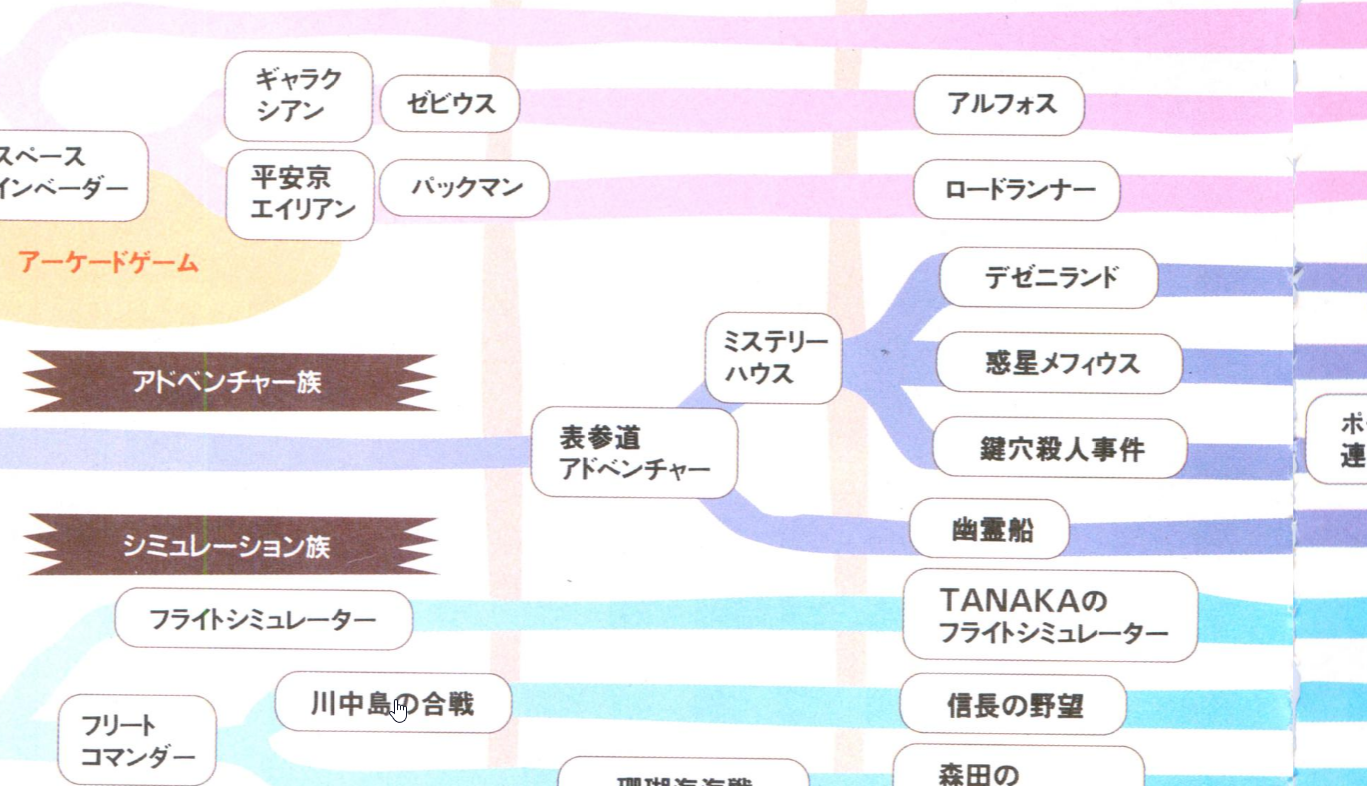
The image shows a branching chart of Japanese game history, subdivided into various genres. The middle blue timeline shows adventure games, starting with Omotesando Adventure, branching up to Mystery House and various other games on top. Branching down from Omotesando is one game, the only other text-only game listed: 幽霊船 (The Phantom Ship).
This is the first text-only adventure game in Japanese, and it was considered notable enough to be listed in a magazine 10 years later as one of the foundational games of the adventure genre as a whole.
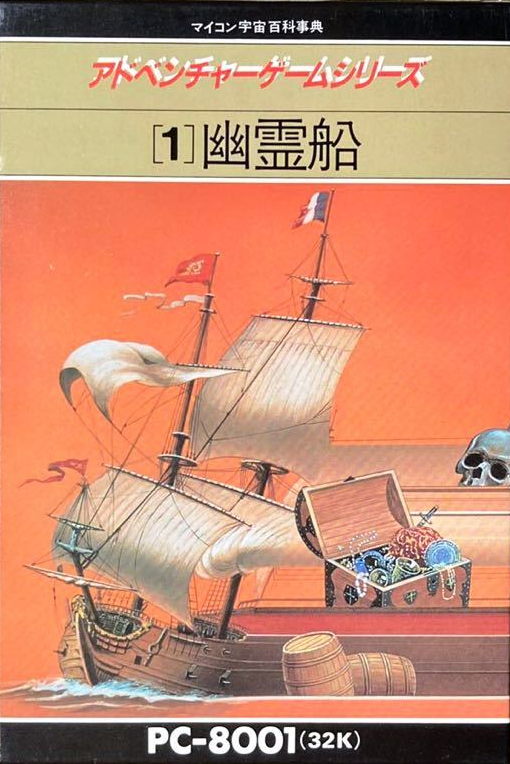
Cover of packaged version.
There was an accident on your ship, and as you drift in the Pacific Ocean, an old sailing ship appears before you. You “manage to climb up to the figurehead at the bow of the ship”, and this is where the game begins.
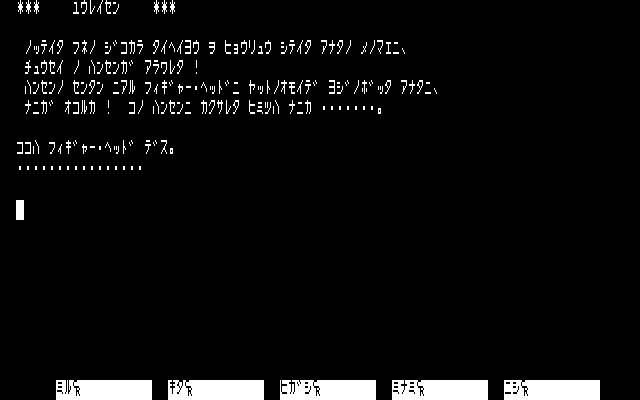
The function keys are enabled (the game also lets you change their assignment). By default they’re look, north, east, south, west, open, left, right, up, and down in order.
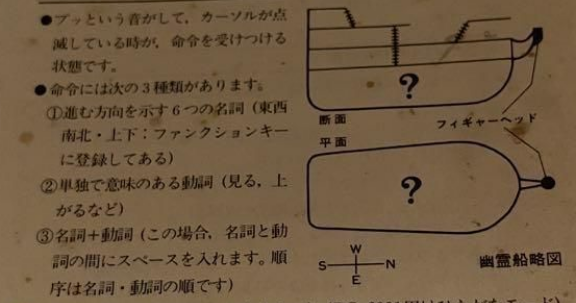
The instructions (see above) include a general map (the black point on the right is the figurehead) but also helpfully specify how to parser works: noun, followed by a space, followed by a verb.
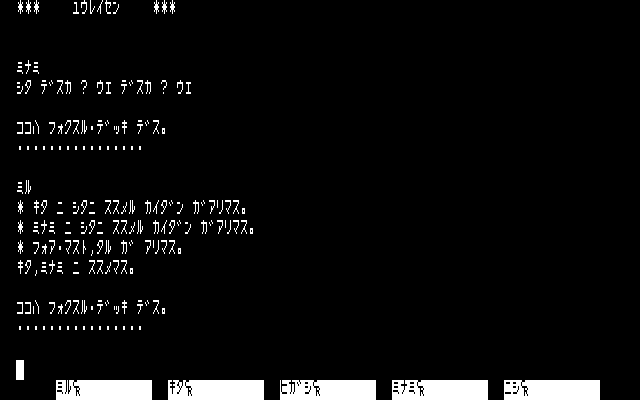
Moving on, I did LOOK to find that the game mentioned the exit was to the south, to a stair that goes up or down. Going south, the game prompts you (rather than having a stairs “room”) which of the two ways you wish to go. Up leads to a forecastle, which has exits to the north and south to stairs, and a barrel (タル) by the foremast. (Or maybe barrels. Japanese needs more context; for example you could put the equivalent of “many barrels”. Just “barrel” on its own could mean one or many. This is non-trivial in an adventurer sense, for a single container you might expect to open, but a whole pile of them is more likely to be scenery.)
At the opening stair, picking “down” instead leads to the north upper deck, including this text.
* キタ ニ ウエニ ススメル カイタ゛ン カ゛アリマス。
* タイホウ,ガイコツ ガ アリマス。
キタ,ミナミ ニ ススメマス。
* There is a staircase to the north that leads upward.
* There are cannons (or is a cannon) and skeletons (or a skeleton) here.
You can go to the north or the south.
Later the game uses “pile of skeletons” so I think it’s skeleton singular, but cannon is ambiguous; generally speaking I’d expect there to be multiple cannons in a section of ship. Parsing the line タイホウ,ガイコツ ガ アリマス literally you get
cannon(s), skeleton(s) exist here
There’s even more trouble in just this room (and the forecastle room) in that it was entered via an up/down stair, but to get back to the stair (and the figurehead) you just go back north.
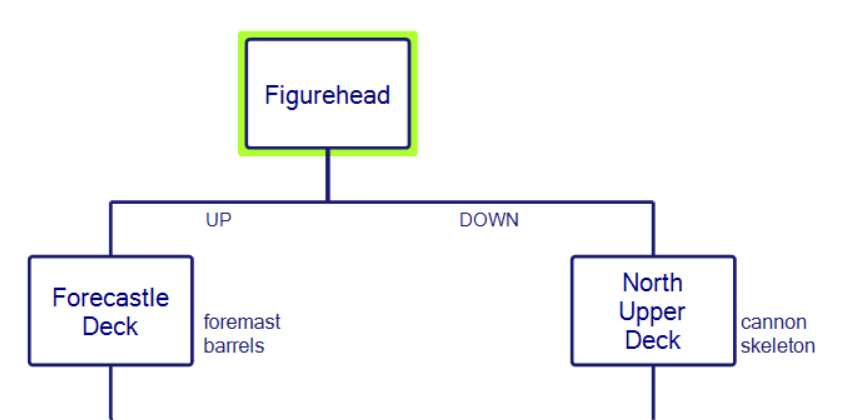
It feels like there’s a room you pass through while going south (even though it exists via simply an up-or-down prompt), but the room doesn’t exist and doesn’t get mentioned when going back the other way. This turned out to be non-trivial for mapping, especially because there are also directions that lead to left-or-right forks. Expanding the map a little:
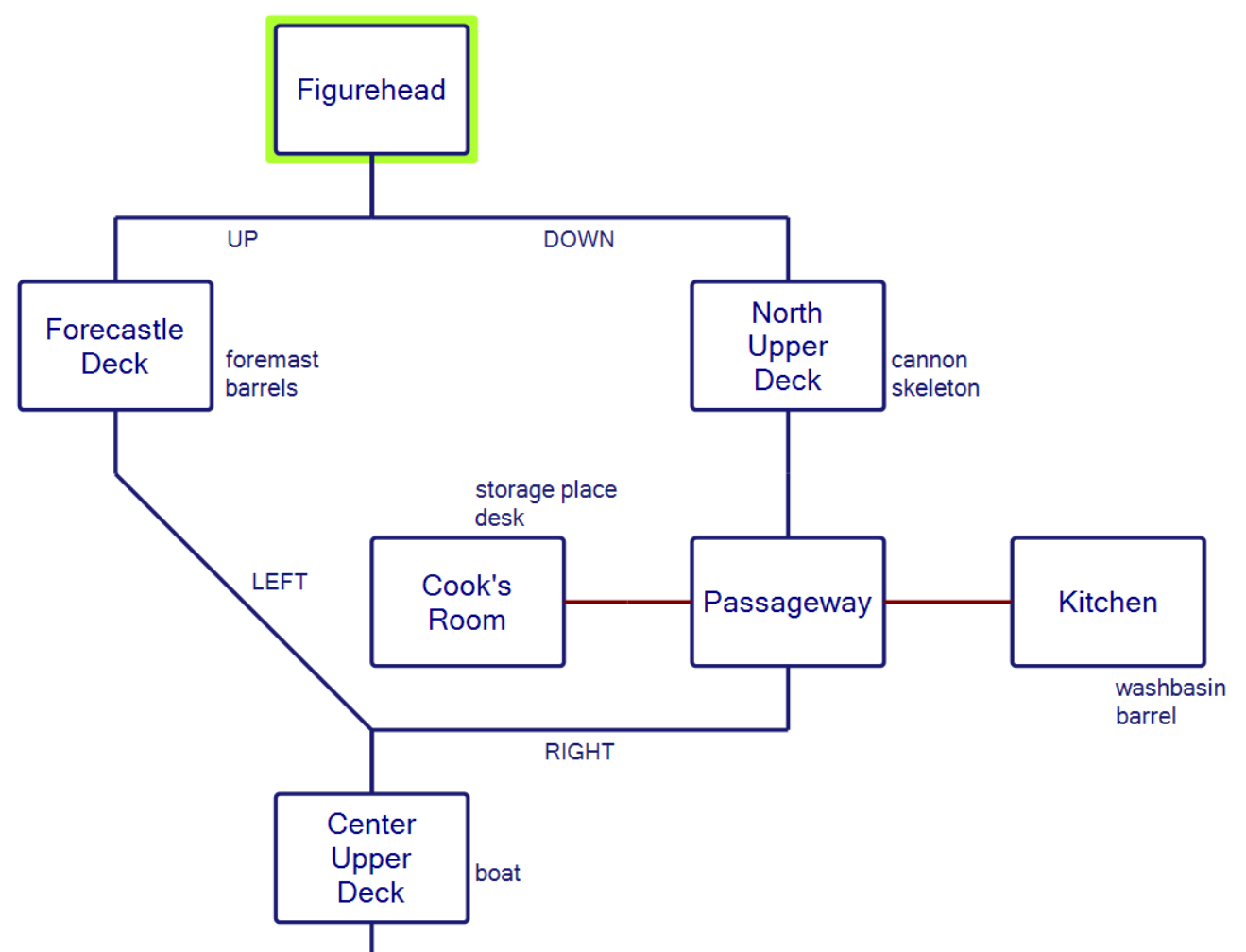
Going south along either the up-stairs or down-stair paths eventually re-merges at the center upper deck, and then going north has the game prompt you for if you mean left or right. I was baffled for a full hour with multiple connections like this I originally had going the wrong way.
This is all compounded by the fact that I’m not good with ship terminology. For example, at one point I came across a “mizzenmast” (or rather “mizzen masuto”), which I could read off the katakana (having run across masts already I knew what “masuto” was) but I did not know I was looking at an actual English word so I wasted time translating a “mizzenmast” into “mizzenmast”.
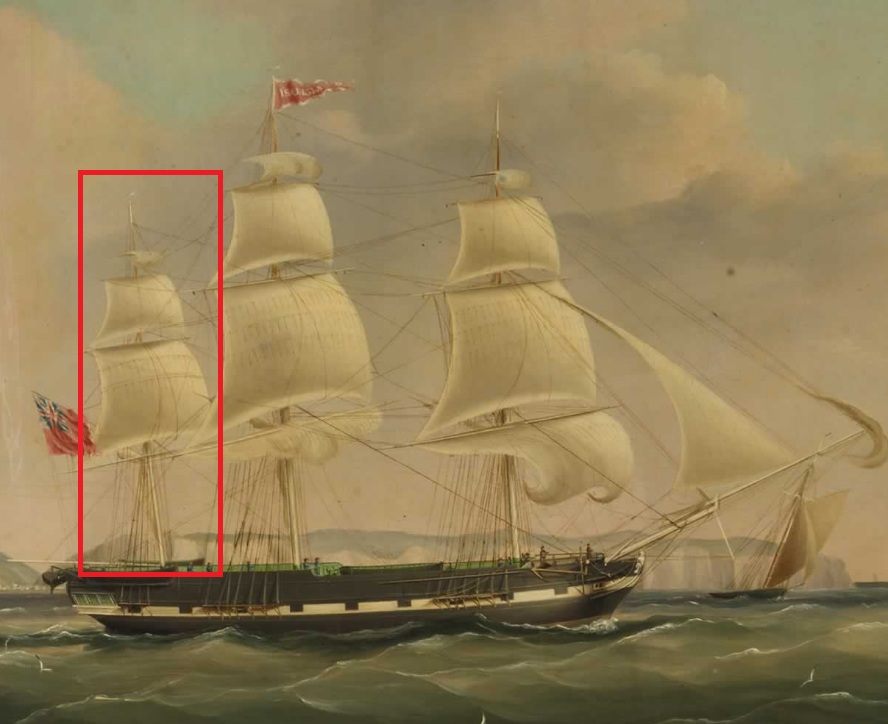
It’s this one. I’m a landlubber, ok? Image source.
All this is to say I’m going to leave off here and continue with having everything mapped out next time (and maybe the game finished, if it’s straightforward enough). I can say this is not a game about obvious threats; there’s skeletons but none of them have risen up attacking with swords. There’s obvious locked doors at the back, er, stern of the ship, so I assume any rising action comes from there. This may end up like Death Dreadnaught where exploration and atmosphere are largely the point.
Special thanks to f_t_b (for scanning assistance) and the Game Preservation Society (especially Joseph who helped locate the June article).


 Renga in Blue
“Included during the newspaper phase was one marked January 1982 (published one or two months before).”
Should be “January 1983”. I believe the exact publication date was 11/20/1982.
Based on typical code dating vs. publication dates of the era (something I’ve been deep diving on recently for another project) I’d say he’d likely have completed the game by the end of September ’82, if not before.
One thing to note is that The Micro Communication was actually published under the “Micro House” banner, rather than Shinkigensha. The latter only shows up in period computer magazine ads after they started publishing computer books and software. Micro House even had a different physical address and phone number, and is the company listed for these ads in the I/O ad indexes, perhaps implying a more complicated origin story/relationship with Shinkigensha itself. Maybe you could link to the page references I made in the Puzzle Adventure comments, when I originally mentioned my research on this.
In any case, I think the unpreserved status of these early issues is the most likely reason that the true origin/dating of this game seems to have been completely forgotten, even in Japan.
I was going to toss this ad in my next post and also the picture of the company I’ve got
I also haven’t discussed the author really at all yet either
Your troubles with nautical vocabulary remind me of someone’s idea to write IF set on a pirate ship where every verb-noun command would be replied to with “You [verb] the [noun]. Yarr!”. I think “belay mizzenmast” (which makes no sense) was one of their examples.
Glad to help with the scans! One quick thing tho – its Pasokon Sunday, not TV Sunday. パソコンサンデー is the official program name.
I’ve seen it called that and I’m not sure where it comes from. I’d kill for a boxset, as many episodes are missing.
huh, I saw it that way enough times it seemed like it was the “official” English translation
how likely it is the episodes are still in an archive somewhere?
other than random uploads, pasokon Sunday switched networks a couple of times so its most likely restorable in chunks should these networks decide to do so. Very much a “keep circulating the tapes” situation. Given the sheer volume of episodes I don’t think we’ll see complete sets, but I expect more to pop up from time to time.
Hmm, did I say that??? My conclusion is actually the opposite, that the two-line input was purely for linguistic considerations, NOT technical ones. As far as I know every instance of two-line input (Omotesando, Cosmo Cross etc.) has been when the input language was English, never for Japanese (I hesitate to use sweeping declarative statements like “all” or “every” due to the huge amount of lost media there is from this period, but at least from the games that are extant and accessible this holds). Again, it is only my theory, but I believe this is to make things more accessible/intuitive to native Japanese speakers, where it is a hard-and-fast rule that the verb always comes at the end of a sentence or subordinate clause, whereas the order of subject, direct and indirect objects and is actually highly flexible, so long as the proper grammatical particles are used.
I really would highly recommend giving the name of the game in Romanized Japanese alongside the unofficial translation. I was halfway through your post before I realized you were covering a game I had already beaten! Anyone searching for coverage of this game would likely use a Romanization of its official title before looking for an unofficial translation. The latter is a completely subjective thing, and multiple translations are typically possible between languages as fundamentally different as Japanese and English. Like you said, it could also be translated as “Ghost Ship”, and this is a very straightforward instance. Use double vowels instead of macrons, because they are hard to type and break most filename handlers (i.e. “Yuureisen”. This is the actual spelling most ROM archives use.)
The nautical stuff threw me for a loop here and there too… I’m somewhat ashamed to admit that I did not know the correct pronunciation of the word “forecastle” until I saw it transliterated into katakana. (Hint: it is not, in fact, pronounced like “four castle”!)
hm, I misread the comment I had linked then – I’ll just cut that section, it isn’t important
if double-u is easier for SEO I can switch to that; I’m not messing with the top title but I was going to list both of them on the All the Adventures page
generally speaking as long as every name that needs to be searched for is on the page somewhere Google can find it just fine (which is why I mentioned Ghost Ship, in case someone searches for it that way)
I’m afraid this generalization wasn’t true to begin with. Just as many (if not more) early Japanese adventures that use English input take it in standard simultaneous two word verb-noun form. See Dreamland, Mio’s Mystery Adventure, etc.
I do agree with the idea of using both romaji and a translation in the post titles, though: Yuureisen (“Ghost Ship”).
I’m hoping at some point to do a really thorough breakdown of the various parsers we’ve seen, it certainly does seem more chaotic than it needs to be
just keep in mind the only Japanese adventures I’ve played are the ones on the blog, so I’m relying on y’all if there’s general trend to spot until I get deeper in
one interesting thing is how Icarus (and the lost Odyssey game) has Kanji text but Katakana input – is there anything else comparable from this time?
Not that I know of offhand, but this line from the old PC-8801 Game Library description of Odyssey is interesting:
“日本語のコマンドで漢字に変換などして入力しながらゲームを進める。”
huh, that suggests they used a different strategy maybe?
one day!
Changed to “uu”
One other odd things I’ve been noticing is that some search engines have entirely different search results with hiragana vs. katakana vs. kanji. I’ve had pages where I search for in katakana, find it, and the page is written in kanji, but if I search the exact same text in kanji it doesn’t come up.
Ironically, “mizzen” originally meant “middle”. Yet here we are, with the mizzenmast being the rearmost mast of the ship instead of its central mast.
that genuinely puzzled me too! my Actual Boat experience is so minimal I don’t have a lot of personal context either
There can be others behind a mizzen, too, if that helps, depending on the rig. Some ships have four masts or even more.
just to let everyone know I’m alive and still working on this
busy work week + I had to pretty much check every verb because it isn’t obvious what to do next
Jim Gerrie here (You’ve used a few of my MC-10 ports),
Any idea on where I can get the tape or find a scan or listing of the BASIC source code? I’d like to try converting this one to English (or more accurately have my son do the translating).
with some help from Gunther Schmidl:
https://github.com/jasonbdyer/classic-basic/blob/master/Yuureisen.txt
Pingback: The Phantom Ship / Yuureisen: Mounds of Verbs | Renga in Blue
The program ends at line 3990, but it seems likely there are some additional lines of code.
Any scan? Even a bad one? Sorry to be a pest. Thanks Jason and Gunther!
Jim
You’re right, there is more.
https://codeberg.org/gschmidl/interactive-fiction/src/branch/main/typein/yuureisen.txt
You’ll have to change the codepage to ANSI 932.
Got it. 932. Thanks so much for your help!
Jim
I don’t think this is right – the later part of the code is talking about things like equipping a party
I tried doing LIST from the one I’ve been playing and the lines are different in the later part
if I have to I can do this the slow way with a bunch of screenshots
That’s strange, I got it directly from the disk image! I’ll try again.
hmm, I may be just shifting the character set wrong (I’ve been using notepad++ for this in the past). looking t over carefully, all the characters are mangled, and you can sometime find what sort of seems like real text
I’ve completed my translation to English and port of the game to TRS-80 MC-10. I’ve also completed the game, so it can be done. But of course I cheated by playing the game from the code side out, and not as it really should be played. It’s a complex adventures with lots of subtleties. Here’s a video with me demonstrating a few:
https://youtu.be/ADIAa7lXU2s
Thanks for all the detailed discussion of the game. It really helps when trying to unpack the code and do the translation. Or I should say tweak the translation, Copilot did most of the heavy lifting for me, but I used your analysis Jason to tweak things when it was unclear.