This one was from a while ago, and while I’m not replaying (I beat the game, just not with a full score) I did check a walkthrough that was posted last year (after I had finished) because I was still bothered by the mazes.
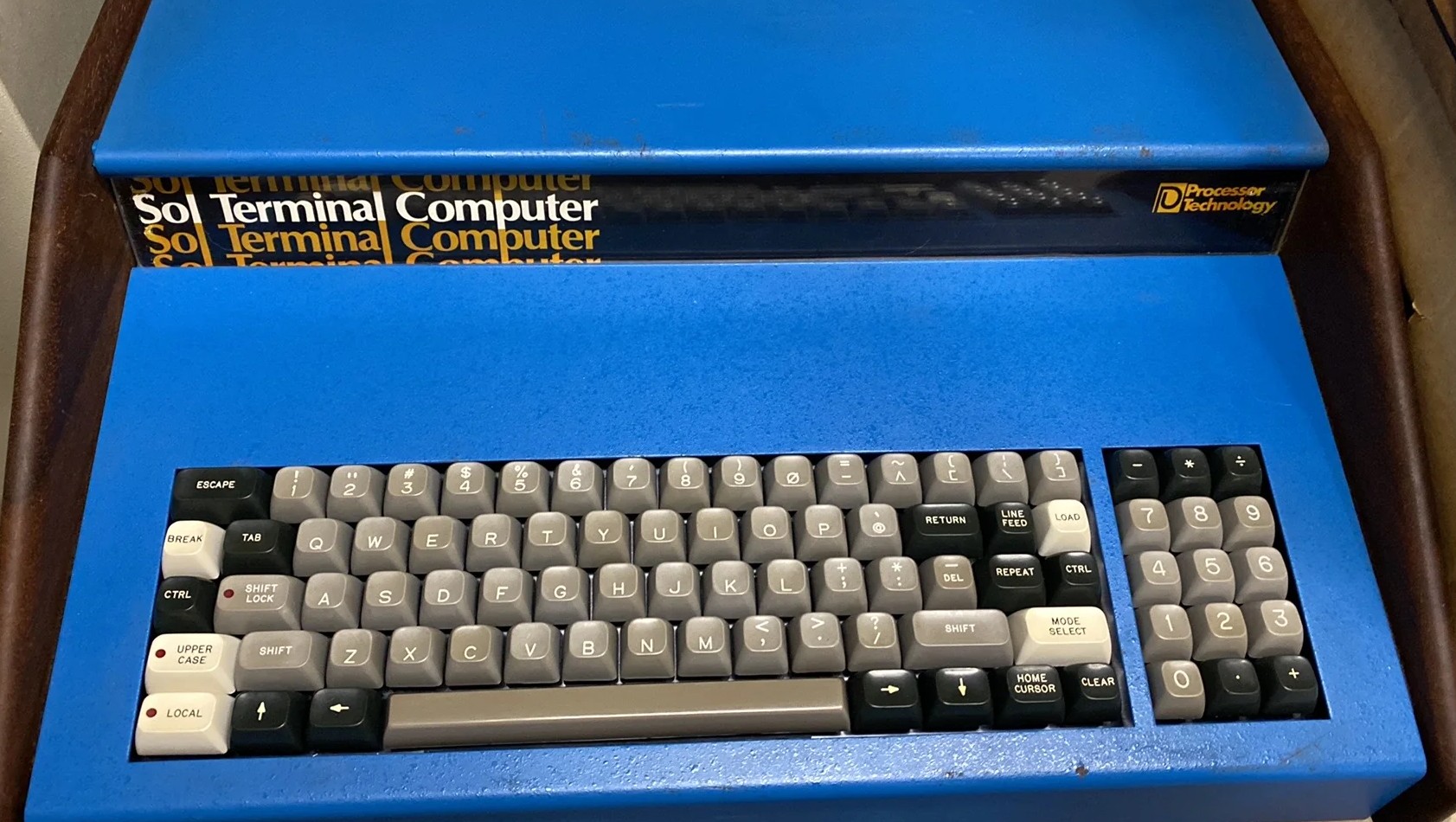
From Bonus Life Computers, $1999.99.
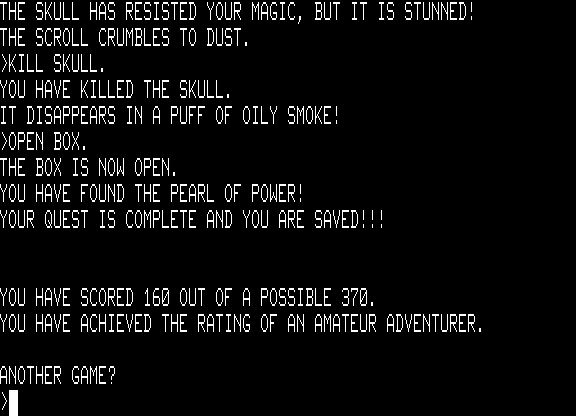
It was a game on the Sol-20 that was clearly heavily inspired by both D&D in general and Tomb of Horrors in particular. It has the finale with the demi-lich that’s only a skull. As it now has come up in two adventure games (Skull Cave and Epic Hero #2), I think it’s worth it to go into a brief aside on the history of Tomb of Horrors itself, then I’ll return to the new(-ish) discovery about the mazes. This combines information from Playing at the World by Peterson, Gygax’s foreword to Return to the Tomb of Horrors, and Dungeons & Dragons Art & Arcana: A Visual History.
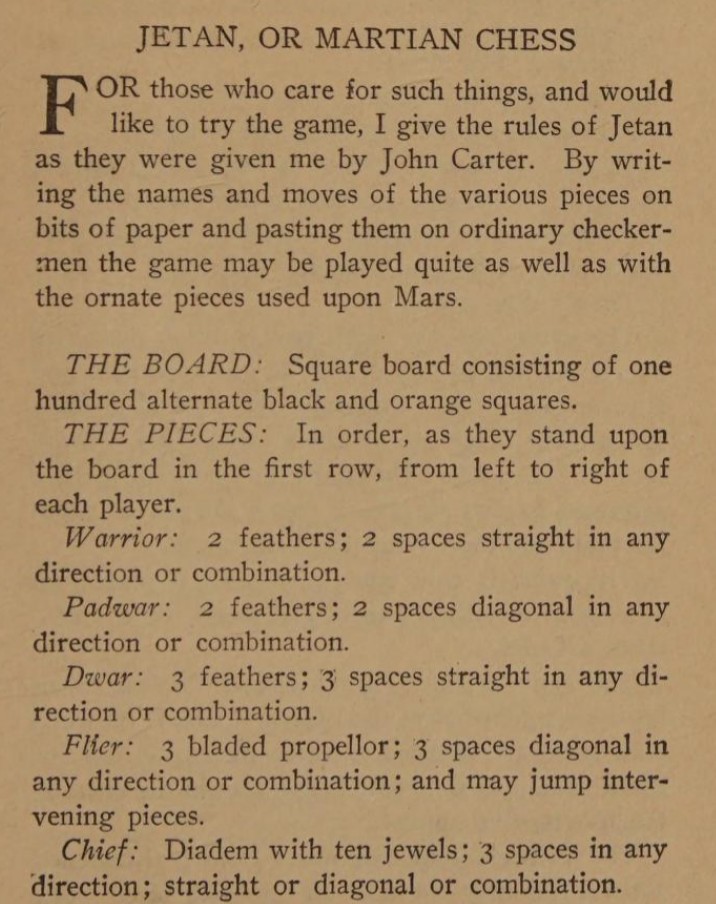
Alan Lucien was part of the same wargaming circles as Gary Gygax, joining the International Federation of Wargaming in 1969 and serving as one of their Senators in 1970. He also wrote an article in the same year about the board game Jetan, invented by Edgar Rice Burroughs for his John Carter series. (Excerpt below from The Chessmen of Mars.)
Gygax ran a play-by-mail game space-combat game (originally by Tullio Proni, revised by Gygax) called The War of the Empires. It ran for two years starting in 1969; Lucien tried to restart the game after it lapsed. Lucien was clearly known to Gygax as he gets mentioned in a letter by Gygax as potentially having interest in the newly-designed Dungeons & Dragons.
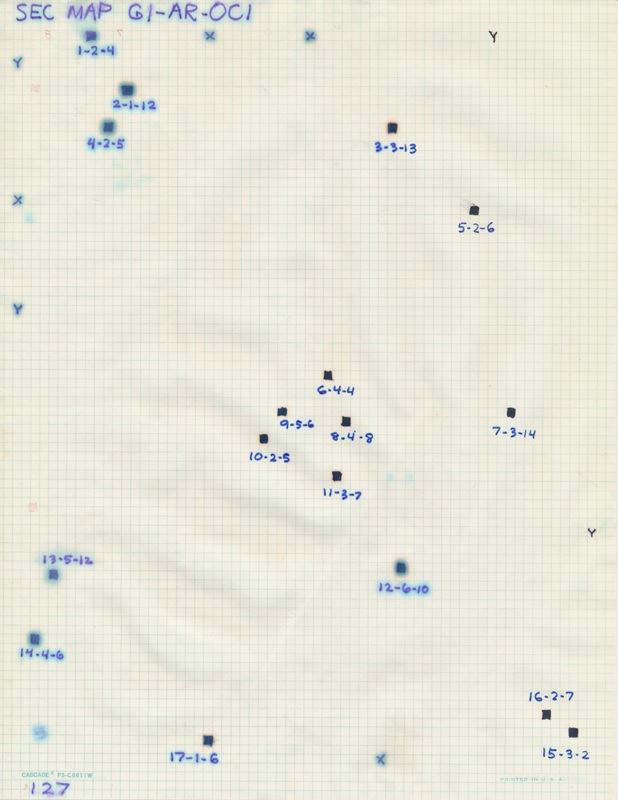
From Jon Peterson’s blog.
Lucien was indeed interested, and ran a Dungeons & Dragons campaign in California. In 1975 he sent to Gygax a new dungeon (handwritten on four pages, not including the map on graph paper): Tomb of Ra-Hotep. It was themed around an Egyptian tomb with many traps.
Passage turns into crawl space, and 6 [the end] contains 5-20 cobras! Can’t turn or run — crawl backwards away. Treasure is Ring of 3 wishes / Delusion (very hard to guess this one!) and Scroll of 7 cleric spells.
The final enemy, Ra-Hotep the lich, has a “jackal stick” with a Sphere of Annihilation at the end.
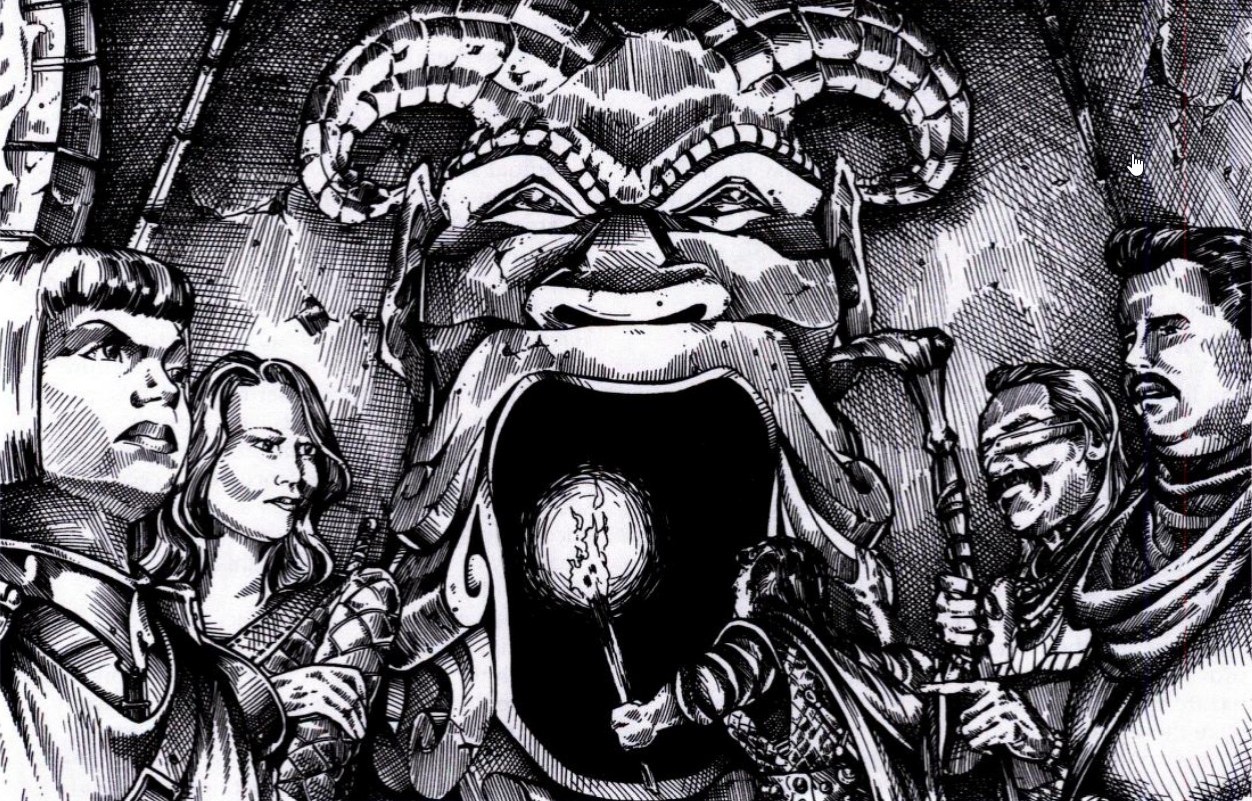
The sphere later got moved to a devil face at the end of the starting hallway. Source. The sphere causes instant annihilation to anything that touches it.
Gygax got back to Lucien (February 1975) that he had “reorganize[d] your excellent tomb area” and ran it through a trial. Quoting Gygax:
From his basis I developed the material that was to become the Tomb of Horrors, and I admit to chuckling evilly as I did so … Specifically I had in mind foiling Rob Kuntz’s PC, Robilar, and Ernie Gygax’s PC, Tenser. To make a pair of long tales truncated, Rob, by expending a lot of ore servants, managed to get through to the final encounter, and as the skull of the demilich rose to assail the one daring violation of his sanctum, Robilar swept all immediately visible treasure into his bag of holding and escaped. Ernie likewise managed to attain the ultimate, destroyed Acererak, and likewise left laden with loot.
All this eventually resulted in a “competition game” at the first Origins convention in the summer, where players were given two hours to get as far as they could through the Tomb of Horrors. The rules reflect the set in 1975, including mention of the later-scrapped character classes Divine and Mystic. The final enemy was now an unnamed lich that was merely a skull (that would become Acererak in the published version of 1978). Illustrations were included to be used during gameplay, made by a local 14-year-old, Tracy Lesch.
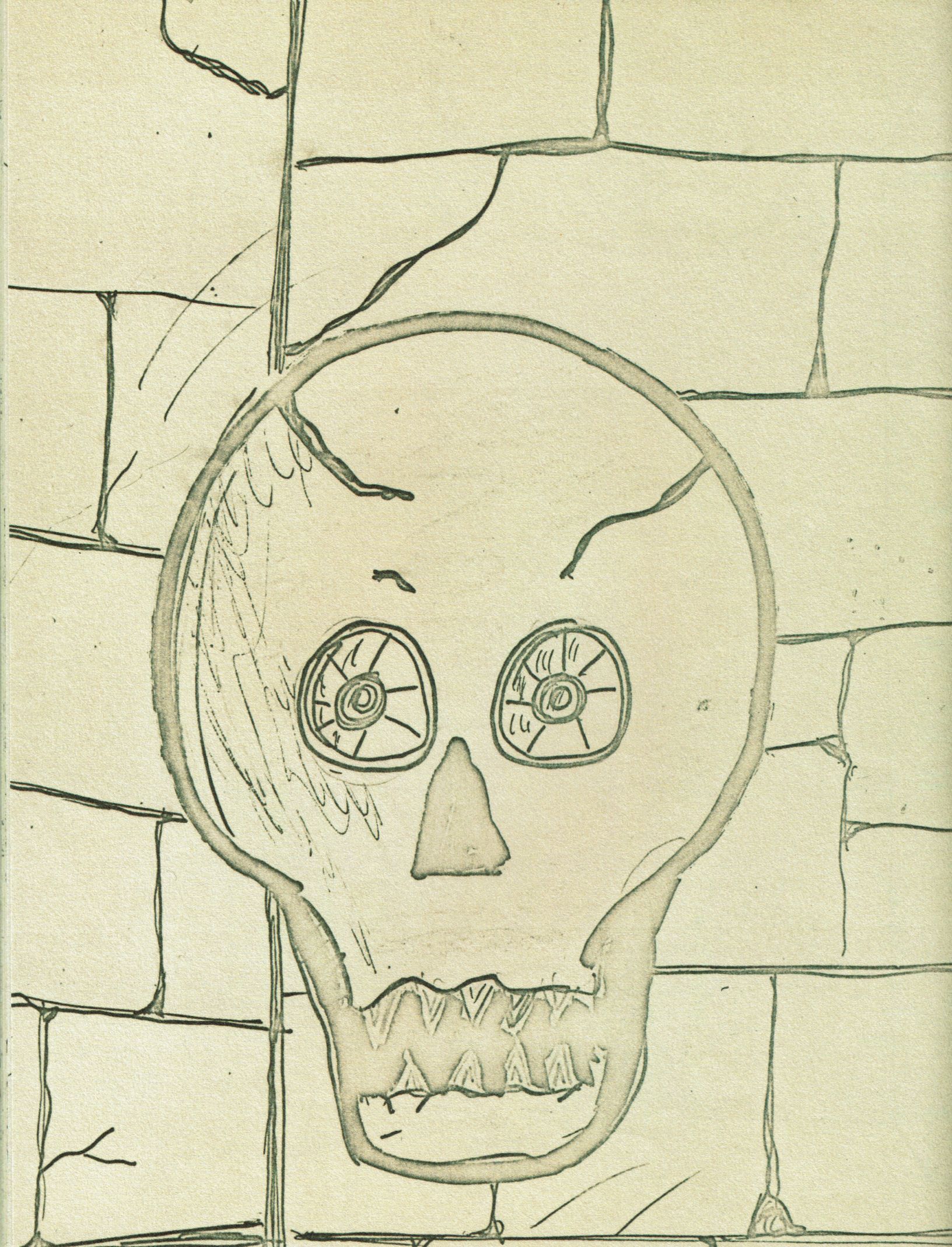
Lesch’s illustration of the lich at the end.
The illustrations were a genuinely novel element, but for my purposes I’d like to emphasize: so was the gameplay style. This was a game not about combat so much as puzzles. (I’ve run Tomb of Horrors before as a Dungeon Master, and one of the players was clearly getting irritated at the lack of combat rolls.) So much of the dungeon feels oriented around methods of survival while working out traps and magical items that it comes off more as an “adventure game” (in the computer-genre sense) than a “RPG” (again in the computer sense). The final battle against Acererak involves such an overpowered set of abilities that to win a player needs to do something clever rather than just attack.
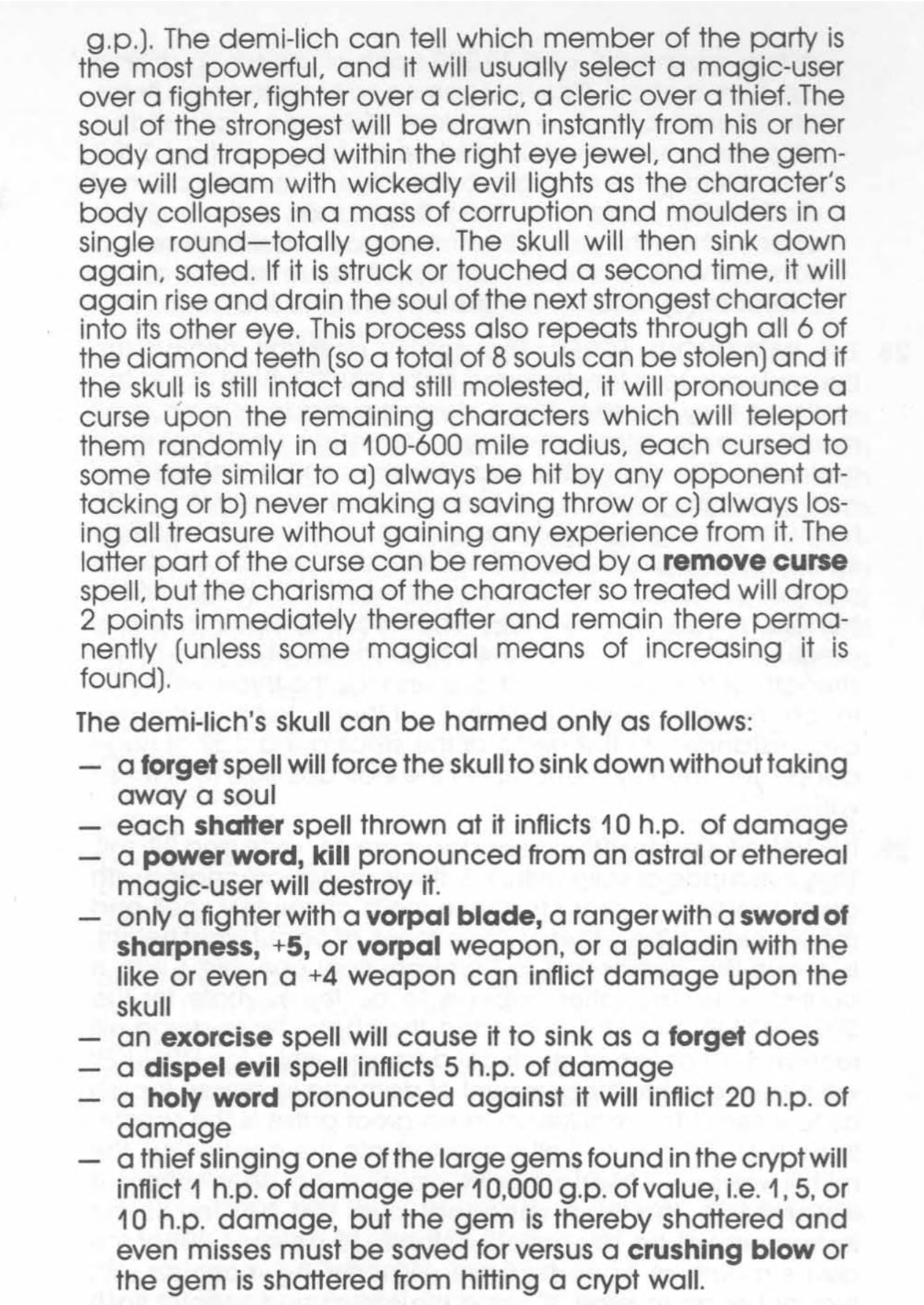
If touched (or struck) the lich targets the strongest character and sucks their soul.
This was true in the competition as well; one team took a cursed crown/scepter pair meant to trap players, and put the set on the demi-lich, vaporizing it. (The problem with having your villain lair full of deathtraps is they can be used against you!)
When D&D became popular, while some adventures tried to embrace it as much as possible (see: Cornucopia) others struggled because combat in adventure games just isn’t that interesting except for small segments. (Zork I has memorable combat, but it uses the combat system for the troll and the thief and nothing else. Not a standard dungeon crawler!) Adventure games lean so hard into the player being more of a “trickster” than a “warrior” that it became routine in this era for weapons to be red herrings. The one famous D&D campaign whose gameplay matched this sense was Tomb of Horrors, so it doesn’t surprise me to see two explicit references (there may have been more general inspiration elsewhere).
Let’s get back to that Sol-20 game.
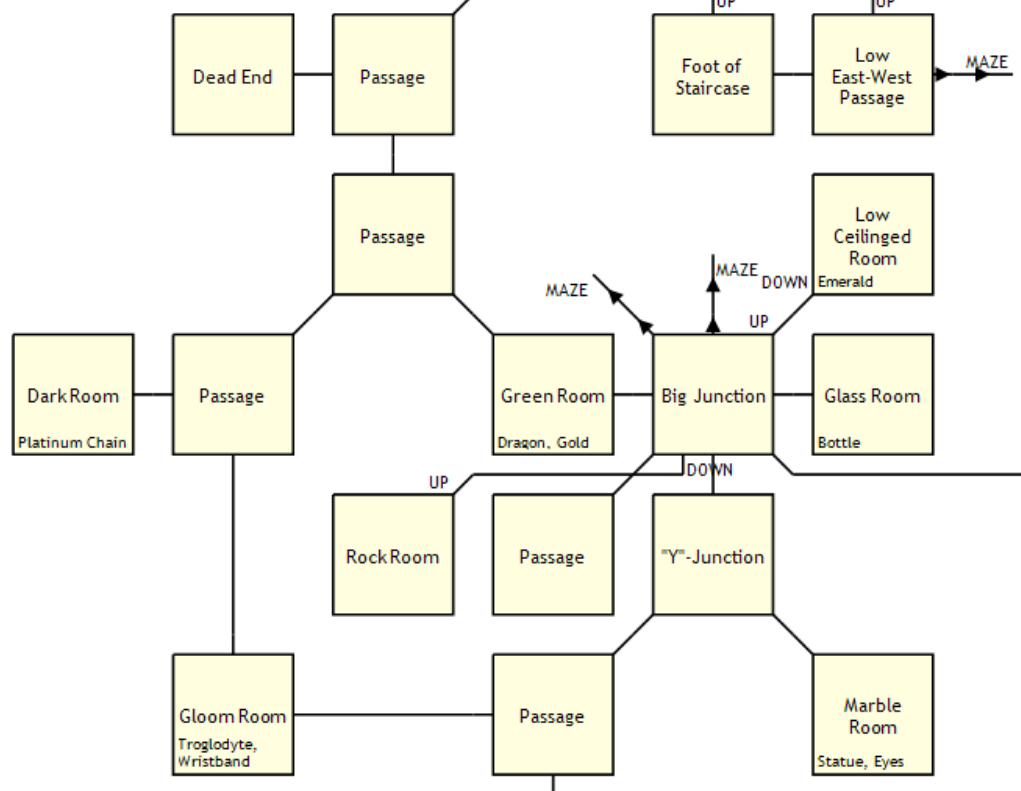
Map from impomatic.
The map is divided into a north area and a south area; the north area has a maze of passages “all different” and the south area has a maze of passages “all alike” (where a thief resides, and likely is meant to be the Zork thief). The problem is both mazes are, as I stated in my previous post, literally unmappable.
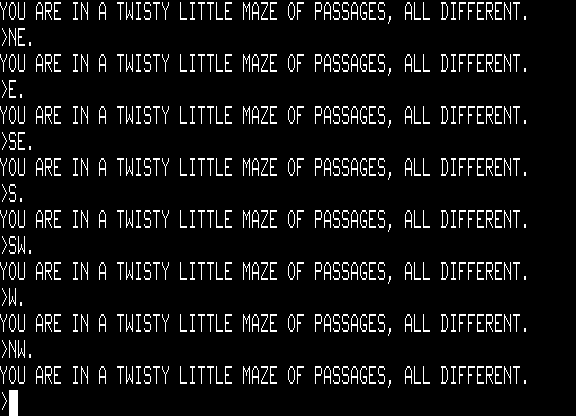
You cannot drop items (they get teleported away), and there are no sound clues or other messages. You might ask: how did the walkthrough (by benkid77) manage? By hacking the binary code of the game.
Each maze is a single room. There’s a series of five bytes giving the answer to maze 1 and six giving an answer to maze 2. There’s no representation of movement; the game simply checks the last five (or six) directions taken, and if they match the answer, the player is moved to the exit.
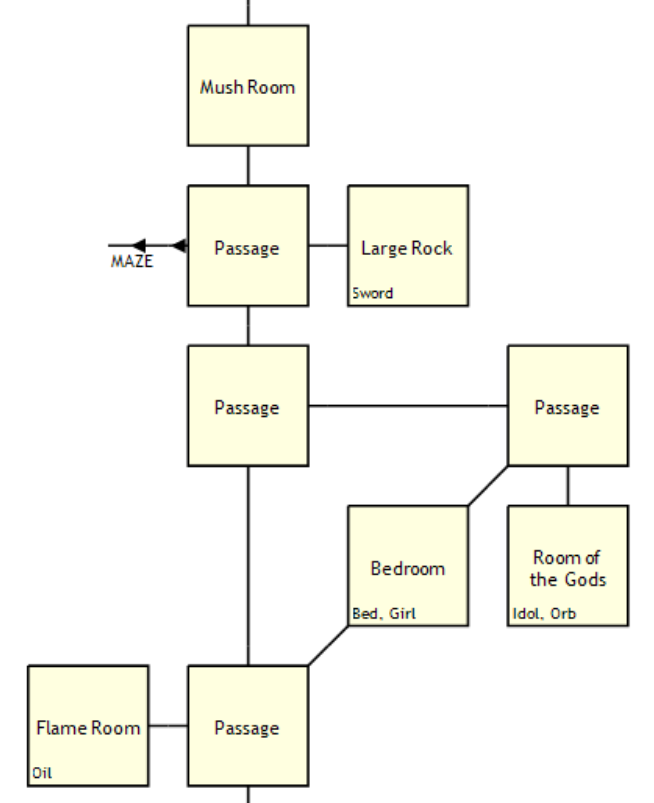
The part of impomatic’s map with the link to Maze 2, with the thief. There is no map of the maze because a.) there aren’t even any “rooms” in the normal sense and b.) benkid99 hadn’t done his hacking yet when this map was made.
Letting benkid77 take over:
There are three routes out of the first maze and two out of the second maze.
Four out of the five have been shown in the walkthrough above. For completeness, the fifth is from maze 1:- U, W, D, S, S -> Low east-west passage. But this was surplus to requirements.The 32 maze route and destination bytes are found at game file offset (and therefore memory location) 0BA0:
Maze 1, the “all different” maze:-
0BA0:
02 02 02 02 02 16
S, S, S, S, S -> Witt’s End0BA6:
01 03 06 02 0A 13
N, E, D, S, SW -> Big Junction0BAC:
05 04 06 02 02 0A
U, W, D, S, S -> Low east-west passageMaze 2, the “all alike” maze:-
0BB2:
02 03 02 03 02 03 2A
S, E, S, E, S, E -> Passage (to the east of Flame Room)0BB9:
07 05 04 01 06 04 26
NE, U, W, N, D, W -> Thief’s Lair
He goes on to ask “how the player would find these routes without disassembling the game.”
The odds are astronomically unlikely to stumble upon the correct sequences and usual mapping methods do not work here. I wonder if there may have been some additional documentation or hints accompanying the game, or some other clues I might have missed?
The “some other clues” is the kicker here: does anyone want to give it a try? You’ll likely need to play the game or at least watch the video of the complete walkthrough (meaning this is not something I expect people to solve in five minutes in the comments, but you never know). Even if there really is no answer (maybe the author had a plan but never finished; keep in mind this is an “unpublished” game) I still thought this was worth highlighting for how outrageous the setup is.
Coming up: a story that begins in the depths of WW2.


The direct Zork and Adventure references here and talk about D&D and combat elements reminded me of something I had meant to mention that you might want to cover at some point, just in case you weren’t aware of its somewhat convoluted history:
It’s a huge game called Quest, originally for PDP-11 (but it’s complicated) that mashes most of Adventure and Zork together, and then adds quite a bit of original content. It’s similar to Plato Adventure in that way, but bigger and much more polished. The original version of the game itself dates back to 1980-1983, but it was later updated a bit and used as the basis for an adventure game creation system, also called Quest. The full history can be read in Xyzzy 14 (“Tales from the code front”).
The PDP-11 version is available in a couple of archives, but is somewhat redundant as the author is still around, and maintains a site where you can download a DOS version of the full system and the game itself:
https://www.conroyhome.net/alan/ab/index.htm
One interesting thing is that he added a bit of a pseudo-RPG element to it, with more combat and a kind of leveling system, based on how far you’ve gotten into the game, IIRC. That’s one of the reasons this article reminded me if it.
While on the subject of benkid’s videos, Gunther recently pointed out to me that he also recently covered The Halls of ZK, an unusual mainframe adventure that’s sort of an internal parody of DEC. I had it pegged in my mind as mid/late ’80s for some reason, but in checking out its github, I realized that it actually dates back to at least 1983, so another one you could cover soon-ish.
have you been able to get the Quest off the website to run? I can unarchive it but then the program just doesn’t want to start
also where did you get ’83 from for ZK?
Yeah, I have Quest running in Dosbox. IIRC, you have to unpack the authoring system, then unpack the game in the same directory and run it with “QUEST”. It won’t work as a stand-alone.
The ZK ’83 reference is here:
http://hallsofzk.org/features.html
The version on github from ’85 is 2.0, it seems.
This also reminds me: I was able to unearth some CDC Cyber stuff a while back, including early ’80s NOS versions of Adventure 366 and Qork (and a 500 point Adventure extension from ’78 that was of previously unknown provenance). They should ostensibly run on the DTCyber simulator, so I can send those your way whenever Qork is on the horizon.
Qork I actually had maybeish November but I think you can assume the gigantogame is going to throw off any estimates enough I don’t really know
huh, weird on the ZK. So v1.0 was 1983 but they also claim on the file “written by William Lees and Edmund Sulliva sometime in August 1985.” (?) I assume the 1985 is for the v1.1 but it’s always annoying when the same site has two contradictory things
I also have a Windows version of Qork that I compiled from the Fortran source.
“One interesting thing is that he added a bit of a pseudo-RPG element to it, with more combat and a kind of leveling system, based on how far you’ve gotten into the game, IIRC. That’s one of the reasons this article reminded me if it.”
Tbf even Zork did this a little bit; how much damage you can take in combat increases with your score.
I’ve actually got Qork, there’s a native Mac version (along with Adventure 366) on the IF Archive. Just never got around to playing it. just from a quick glance it clearly was forked before the final version of Zork, because I can’t find the big tree with the egg in the forest like I remember from Zork. Maybe I’ll have to play it; it’s been a while since i’ve played any type of Zork game.
I assume this other 500-point Adventure is *not* the one you’ve brought up along with Thisala, correct?
No, the version in question is actually the long lost original of JAZE_XXX on the Adventure family tree. A later conversion of it had been preserved as BECK0500, but by that time most of the details of its origins had been lost. The original was found on an old Cyber magtape that someone sent me, after Gunther was able to extract the files. A scan of the code revealed the previously unknown place and time of creation (late ’78), as well as the unusual fact that it was actually paired with a copy of standard Woods 350, where you could select the original or the new “advanced” version via a menu.
I might as well take this time to update some other Adventure news:
Gunther and I found a couple of previously unknown IBM mainframe versions, but we haven’t been able to get them running yet. One was written in Australia in 1981 and has a few crazy additions, like a spaceship and the Orac computer from Blake’s 7 as a usable item.
We also found what may be a slightly different/later version of Long 751 on another Bitsavers tape. The billboard text is different from what’s in the version that Lanhawk found, and there seems to be at least one additional parser command. There are problems getting it running though (missing files), so we’ll have to look into it again in the future.
Related to that: Still waiting on the ICM to do anything about the commercial version of Long 751 and the other Compuserve material we’ve found so far in that archive. It’s been extremely frustrating, which is all I’ll say about that for now…
I’m probably forgetting a bunch of other stuff, but I’ll give one little teaser here:
Myself, Gunther and Explorador have all worked together on something really interesting. Unfortunately there are major technical hurdles in getting things running, so it may be a long time before anything comes of it. But for now, I’ll just say that in terms of early mainframe adventure game history, it doesn’t get much bigger than what we found…
Oh, that version? I’ve never played largely because I saw the source files already…
Btw, would you be willing to help (either here or privately somewhere else) get Thisala etc. running? I’m not sure what the best way to get it done would be, since I’m not seeing Mac support on the website. (I tried looking on the two versions of SimH on Github, but while “Nova” is there, I don’t see “MV” as an option, so I can’t just build it like I did with the HP for Warp.)
Hmm… I’m no expert on this, but I can’t see any real options for running the MV emulator natively on a Mac, as it’s not currently supported in Open SIMH. That would mean having to use something like Parallels to run the Windows version, it seems. If there’s a better option than this, I’m not sure what it would be. Sorry!
I should say, regarding Thissala, since Jason also mentioned it:
I hacked away at it myself for nearly a month before writing that article, and was only able to access about a third of the map, if the in-game description of “close to 1000 locations” is to be believed, with a relatively low score, based on my estimate for what it should have been counting deposited treasures.
The problem is that the game was obviously a work in progress, with various areas appearing to be unfinished. Many more items and treasures are visible in the plaintext part of the code, but my guess is that whatever else was implemented may not actually be accessible, short of disassembling the whole thing to try to figure out what’s going on. So expecting this to be a Warp/Ferret (despite the fact that it may have been a direct inspiration on the latter’s creation within DG) type of epic puzzle-fest will most likely lead to disappointment. It’s more like “can this fussy parser be hiding some exact wording that will break me out of this cage?”, on a large scale. I’m hoping that a few more minds chiming in with ideas might provide a breakthrough that proves me wrong here, but I’m skeptical. There are also some strange recurring bugs, although I was able to find ways around them. In any case, it should prove to be an interesting experience, for at least a little while…
By the way, I was finally able to locate copies of FisK, a game that you would most likely be very interested in, as it was certainly a major influence on Warp. Unfortunately, there are all kinds of problems surrounding it, both technically and legally.
Oh, well, there’s always the chance that something eventually does come out. (I mean, I technically do have a Windows machine also, but that’s for a RL job, and i’m pretty sure I can’t just download new software on it.)
Another thing that’s probably helpful to understand: I’m a screen reader user, and that sometimes has trouble with emulators (or at least, it did years ago the one time I tried something.) The terminal is a system application, so as long as it’s just text in the terminal window I’m all set to go. Most modern IF interpreters work just fine anyway, and I play most newer games in a browser anyway. I’ve got plenty of newer games i’ve been meaning to try, but if any of these mainframe discoveries are runnable in a terminal, I’d love to try some more; certainly playing adv751 and Warp was fun.
Speaking of playing games: i did play more of Qork, though i’m still pondering a few things. The new areas are certainly in interesting spots.
@Jason: If you’re taking suggestions, when you do Qork, I’d suggest you play the earliest mainframe version of Zork as a sort of prologue; I did last year after stumbling on it on IFDB by accident, and it was a neat experience even if I had to keep reminding myself that this was still before “get all” was implemented.
In some direct video game references:
-The skull seems to be the inspiration for the skull-liches in Ultima.
-Zelda 1’s mazes work the same way as Skull Cave’s, in which you have to go in a particular series of directions, but going any other directions beforehand won’t ruin your attempt at the maze. For instance: The Lost Woods requires up-left-down-left, but you can have done anything before that, so left-left-down-up-left-up-left-down-left will work.
-A comment on CRPG Addict has indicated that the files for the MUD database/”server”/”campaign” ROCK, a 1983 work based on none other than Fraggle Rock, have been recovered and are playable online. I consider this notable because as Fraggle Rock was a 1983 show to begin with, this is one of the “firsts” in interactive fiction – fan fiction of a currently-active franchise, after the Hitchhiker’s Guide fan-games, the first for a MUD/MUSH, and the first of a non-book medium. It also significantly precedes all other Wikipedia-listed fan-MUDs, with Discworld MUD, PernMUSH, and Star Wars MUD only coming along in 1991, with AmberMUSH trailing quickly behind in 1992. I admit there are probably earlier non-Wikipedia examples, but this is still a huge find.
The link is at: https://dec10.uknet.net/
Haha, yeah that was me with the ROCK comment. I posted it there because the Addict said he’d be doing the original MUD in a few months, and that guy has it running now closer to how it originally appeared. Not sure he’s really interested, though. I didn’t mention it here because I don’t think MUDs are generally on the menu.
For what it’s worth, the in-game INFO text in ROCK says it was originally created in ’84 and updated in ’88, which is a bit at odds with the dates in the link that Bucsa found, but who knows. I did poke around in it a bit and it’s definitely odd.
As long as we’re talking MUDs, another lost early British one was recovered not long ago:
https://github.com/edwh/advent-pdp11/tree/master
Interesting story behind that one, and I weirdly happened to be in contact already with some of the people involved in this, as I had been investigating some early versions of Adventure that were also recovered from an ancient ICL 1900 mainframe located at that same school!
You can convert all the game bytes to ASCII and there’s nothing there to explain the direction sequence needed to get out of the fake mazes.
“[Alan Lucian] also wrote an article in the same year about the board game Jetan…” — I don’t suppose you have a link to, or title of, that article? …Yes, that was the one thing I chose to focus on from this post.
unfortunately no – it’s mentioned in Playing at the World and I think was printed in International Wargamer but copies of that don’t seem to be online
I did some digging here, and I don’t think that article would have been in International Wargamer. Lucien (note the spelling) was only credited as a “Senator” in the January through March 1970 issues, and never as an article author. A complete index of issues is here:
https://tomeoftreasures.com/forum/viewforum.php?f=430
What seems more likely is that this article was published later that year in Lucien’s own early space gaming fanzine, the short-lived “Galactus”, or in Lewis Pulsipher’s similar “Supernova” zine, where he seems to have been a regular correspondant. I got these references from Supernova issue 7, which unfortunately seems to be the only issue available online. Galactus is presumably lost entirely.
By the way, it seems likely that Lucien would have been introduced to this subject by a number of articles and letters about Jetan in Don Miller’s “The Gamesman” zine from the late ’60s, a few of which are preserved online.
could always email Jon directly and ask, his email contact is mentioned on his blog
https://playingattheworld.blogspot.com/
Aha, https://books.google.com/books?id=OgviEAAAQBAJ&pg=PA334 (Playing at the World 2E volume 1, page 334 note 15): “[Lucien’s] long association with the IFW [International Federation of Wargaming] included his early interest in the game of Jetan, which he wrote-up for the July 1970 issue of Interplanetary Communicator (2).” From nearby context I think the parenthesized “(2)” means “Interplanetary Communicator issue number 2,” but I’m not sure.
That makes sense. Read the first two pages of Supernova, which explains the whole situation with Interplanetary Communicator and all those old zines, including Lucien’s involvement with them. Note also the following article is a reprint of a Don Miller piece, strengthening that Jetan connection.
Check out the LOTR-based Diplomacy variants they were playing, too. These guys were fantasy gaming even before Gygax came out with Chainmail.
https://archive.org/details/supernova_7-1970-11-29/mode/1up