Peter De Wachter pointed out I may not have found the “real treasure”, so I ended up giving Dracula’s Castle one more visit.
I had also been thinking of this door
Je staat nu op een lange wenteltrap die omhoog en naar beneden gaat. Voor je zie je een vreemd gevormde deur in de wand met in het hout van de deur ‘DIT IS SESAM’ gebrand. Een zwaar gebonk is achter de deur hoorbaar.
You are on a long spiral stair which goes up and down. There’s a strange door in the wall with “this is sesame” burned into it. Behind the door you can hear a heavy thumping.
and the fact the VAMPIRANIA message didn’t seem to make any sense (I thought maybe it was a “Rosebud” in Citizen Kane type situation, but it didn’t match any of the lore.)
VAMPIRANIA, in fact, was the magic word to open the door, leading to:
Je bent nu in de kruiskamer. De wanden zijn hier met bloed besmeurd en er liggen hier restanten van dieren. In de hoek ligt het geraamte van een onvoorzichtige avonturier. Een groot vuur verspert de doorgang naar een ernaast liggende kamer. Er is slechts 1 uitgang, de zware houten Deur.
Er is een gevaarli jke kruisspin hier.
You’re in a cross room. The walls are blood-smeared and there are remains of animals. In the corner is the skeleton of an adventurer. A fire blocks the passage to an adjacent room. There is only one exit, the heavy wooden door.
There is a dangerous spider here.
The spider is defeated via a bottle of poison water.
De fles valt kapot op de grond. Het gif stroomt uit de fles en de spin, die natuurlijk uitgedroogd was van al die jaren wachten op een prpoitje, vliegt op de vloeistof af. Op het moment dat ze het gif aanraakt sterft de spin.
The bottle falls to the ground. The poison flies out and the spider, parched from many years of waiting, flies at the liquid. The moment she touches the poison, the spider dies.
That leaves the fire, which was probably the most interesting puzzle (for me) in the game. I had found much earlier that I could tote around a large suit of armor, but had never found any use for it. If you wear the armor you can walk through the fire.
Je bent nu in de schatkamer. De wanden lijken licht te geven door een vreemde weerkaatsing van de gloed van het vuur. Hoog bovenin deze ruimte is een gat in de muur in de vorm van een latijns kruis. Er komt lucht door naar binnen.
Er is een schatkist, vol met gouden munten hier.
You’re in the treasure room. The walls give a strange reflection from the glow of the fire. High up there is a hole forming a cross.
There is a treasure chest full of gold coins here.
So, there was some treasure more interesting than the gold necklace. Now, had this been all there was, I might have just added some comments to my previous post and let it be, but I wanted to share the endgame message:
Alle dorpelingen en ook de TROS (Transylvania Radio Omroep Stichting) zijn aanwezig om je te feliciteren.
All the villagers and the TROS (Transylvania Radio Broadcasting Foundation) are here to congratulate you.
Carried off by cheering elves, right?
Er zijn ook enkele heren van de belasting- dienst aanwezig die willen weten wat er in de kist zit die je bij je hebt.
There is also some gentlemen from the tax service present who want to know what is in the box that you have with you.
Huh, that isn’t too bad, but none of my other adventures required registering capital gains …
Ook blijkt dat zojuist de vampieren tot de beschermde diersoorten worden gerekend zodat je je binnenkort voor de rechter moet verantwoorden. Er zijn enkele leden van de aktiegroep ‘Stop de Vampierenmoord’ aanwezig, die je aggressief bejegenen. Het blijkt dat ze allemaal een zwarte jas aan hebben…
It also appears that the vampires have just become a protected species and you will have to answer to the court soon. Some members of ‘Stop the Vampire Murder’ action group are present and harass you aggressively. They all are wearing a black jacket…
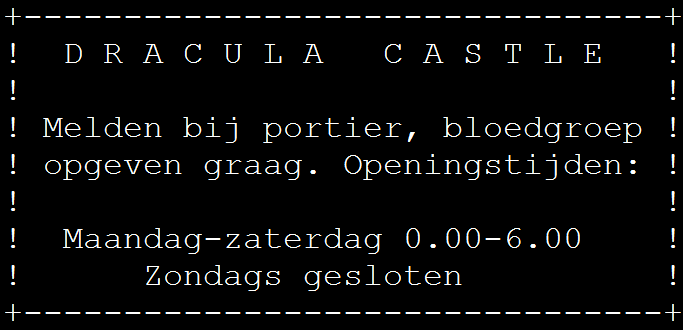
Report blood type to doorman. Opening hours Monday to Saturday, midnight to 6 AM. Closed on Sundays.
I did need to check the walkthrough for some things, but they were generally things I would have gotten stuck on no matter what the language.
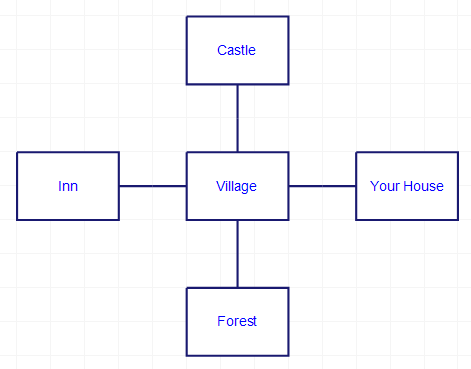
For one thing, there’s a looping structure in terms of returning to locations I wasn’t really expecting. The overall superstructure of the map looks like this:
For most of the games of this era, we’d grab the things in the starting house and be done with it. This isn’t like that; the intent is to go in and out of Dracula’s castle and return to the house multiple times. I did catch one loop: you have to get a ladder from the castle and bring it all the way to the start to reach the attic of the house. However, I entirely did not expect an underground section to the house, and you can eventually dig all the way up to Dracula’s Castle from that direction.
Je bent nu in een vochtige kelder. Het plafond is hier zo laag dat je niet rechtop kunt staan. Er zit een nauw gat in het plafond waardoor je omhoog zou kunnen klimmen. De wanden van graniet, maar naar het noorden is de wand erg zanderig. Je staat tot aan je enkels in modderig water.
Er is een vlijmsscherpe bijl hier.
Er is een kleine houten doos hier.
You’re in a damp basement. The ceiling is so low you can’t stand straight. You can climb up a narrow hole in the ceiling. The walls are granite, except the wall to the north which is very sandy. You are up to your ankles in muddy water.
There’s a sharp axe here.
There’s a little wooden box here.
The forest maze is another place most games would not have used twice, but after getting the axe mentioned above, you can return to the big tree and get wood to make a cross.
In addition to the I-needed-the-walkthrough issues above, I had trouble figuring out what verb to use to kill Dracula at the end, but we’ll get to that.
…
After grabbing my starting gear (lantern, bread, milk, coin) I went over to the nearby Black Hand Inn. I bought some garlic from the proprietor and he told me they had “had enough” (referring to vampire attacks, I assume) and mentioned a hidden stair.
Je bent nu op de donkere zolder van de herberg. Via een trap kan je naar beneden. Er hangt een sterke geur, alsof hier een lijk enige maanden heeft liggen rotten. De vloer is vol bloedvlekken. Er is echter geen lijk te zien. Een vreemd gevormde steen is in de muur gemetseld.
Er is een zware kist met een dikke laag stof op de bodem hier.
You’re in a dark attic of the inn. You can go down a flight of stairs. There’s a strong smell like a corpse has been rotting here for several months and the floor is covered in bloodstains. However, no corpse can be seen. A strangely shaped stone is in the wall.
There’s a heavy chest with a thick layer of dust here.
The chest contains a handy guide to vampires, including the note that “the vampire is very scared of the powerful cross, and the best are made of wood”.
After visiting the inn I scooped up the “wooden wedge” and “large machete” from the nearby forest, then entered the castle. In addition to a food serving hall and two bedrooms, I found a tower with a mysterious door …
Je staat nu op een lange wenteltrap die omhoog en naar beneden gaat. Voor je zie je een vreemd gevormde deur in de wand met in het hout van de deur ‘DIT IS SESAM’ gebrand. Een zwaar gebonk is achter de deur hoorbaar.
You are on a long spiral stair which goes up and down. There’s a strange door in the wall with “this is sesame” burned into it. Behind the door you can hear a heavy thumping.
… and a courtyard with a helpful ladder.
Je bent nu op een binnenplaats van het kasteel dat als kerkhof dient doet. Er zijn hier vele graven waarvan sommige open zijn. Van anderen is het grafdeksel weggeschoven. De meeste graven zijn echter intact. De enige uitgang is een poortje aan de westkant.
Er is een lange ladder hier.
You are now in a courtyard of the castle that serves as a graveyard. There are many graves here, some of which are open. Others have their cover pushed away. However, most are intact. The only way out is a gate on the west side.
There’s a long ladder here.
I took the ladder back to the starting house (as I hinted at earlier), found a “stuk dik touw” (piece of thick rope) and then was fairly stuck.
According to the walkthrough, I needed to sleep in the bed at home. There was no message I recall that said the player-character was tired, just it needed to happen for some reason. However, when I tried it nothing useful happened.
It turns out I missed an encounter with Dracula earlier in the castle (you need to use the ladder to reach it). Both these actions I pulled directly from the walkthrough.
>GOOI KNOF
Dracula sist en deinst achteruit. Hij wordt duidelijk afgeschrikt door de geur van de knof look. Hij kan zich echter tamelijk snel herstellen.
->BESCHIJN DRACULA
Dracula valt je nu aan en slaat zijn mantel dreigend in de lucht. Zijn scherpe hoektanden zijn nu zichtbaar, je loopt voor- zichtig achteruit. Dan valt hij aan en probeert in je nek te bijten. Plotseling verstijft hijen valt neer op de grond. lichaam wordt eerst grijs en zwarte rook omgeeft hem. Als de rook optrekt is er niets meer van zijn lichaam overgebleven.
Je hoort echter in de verte een sinistere lach.
>THROW GARLIC
Dracula hisses and pulls back. He is put off by the smell of garlic; however, he can recover quickly.
>SHINE DRACULA
Dracula now attacks. His sharp fangs are now visible. He attacks and tries to bite your neck. Suddenly he stiffens and falls to the ground; his body becomes grey and black smoke surrounds him. You hear a sinister laugh in the distance.
I … don’t know what’s going on with that second part at all. I assume you’re using the lantern, but it doesn’t do anything. It’s possible the result will happen no matter what the action is?
After this encounter, going back and sleeping in the bed did something useful.
>GA SLAPEN
Je wordt midden in de nacht wakker door gerommel, dat vanonder het bed li jkt te komen. Als je uit het bed stapt verdwijnt het gebonk als bij toverslag.
>GO BED
You are woken in the middle of the night by a rumbling under the bed. When you get out, the sound disappears as if by magic.
Now you’re able to find a basement underneath the bed. While later adventure games are plagued with these “obscurely set off some kind of story trigger before the plot can move on” problems, this is almost too sophisticated a mistake for a 1980 game. (It could be this is an artifact of the 1982 revision, of course, but even 1982 is a little early.)
After a side trip to make a wooden cross and grab a shovel, I managed to dig into where Dracula’s coffin was lurking.
Je bent nu in een graftombe diep onder het kasteel. Een smalle een trap gaat omhoog, halverwege de trap is een ijzeren hek geplaatst. Een i jzige tocht gaat door merg en been. Er staan enige houten grafkisten in deze kamer, die allemaal op elkaar lijken.
Voor de trap zit een ijzeren hek
Het i jzeren hek is gesloten.
is een zware doodskist met in gothische letters de tekst ‘D R A C U L A’ hier
You are now in a tomb deep under the castle. A narrow staircase goes up, where an iron gate has been placed halfway up.
The room’s cold goes through your marrow and bone.
There are wooden coffins that look all alike.
There is an iron gate in front of the stairs. The iron gate is closed.
There’s a heavy coffin here with ‘D R A C U L A’ written in gothic letters.
Unfortunately, it’s not a simple matter of popping open the coffin and staking him — opening it wakes Dracula up. Dracula then flees and you have to give chase. Eventually, you catch up, and the cross is as effective as advertised:
>TOON KRUIS
Aaaargghhhh’ ! Van schrik deinst de vampier achteruit.
Hij gaat tegen een muur staan en houdt zijn handen voor z’n ogen.
>SHOW CROSS
Aaaargghhhh’! The vampire backs off, scared. He stands against a wall and holds his hands in front of his eyes.
Then you can stake the vampire, except … I had no idea how to communicate this. Perhaps I was just making a verb-conjugation typo? The walkthrough told me to SIA WEDGE (“hit wedge”?)
De vampier gilt en valt neer. Even blijft het lichaam roerloos, om dan plotseling te worden omgeven door zwarte rook. Een zeer snel verouderingsproces begint en na enkele seconden lijkt het alsof er een eeuwenoud lijk voor je ligt. Dan vergaat het en blijft er slechts stof over.
De stof waait door elkaar en lijkt op een bepaald moment letters te vormen. Vaak kun je de tekst VAMPIRANIA lezen. Dan verwaait het stof totaal en blijft er geen sporr van deze toch eens zeer indrukwekkende dracula over.
The vampire screams and falls down. The body remains still for a moment and is then surrounded by black smoke. A fast aging process begins and in a few seconds it looks like an aeons-old corpse is before you. Then just dust remains.
The substance blows together and forms letters. You can read the text VAMPIRANIA. The dust then blows away completely and there is no trace of Dracula.
If you try to leave now, you find the heavy front door is “gesloten” (closed). You need to take an alternate exit.
I admit to exhaustion here and just used the walkthrough for the end (a little bit of an escape sequence). I wasn’t able to trigger a “you have won” message but it’s possible there is none. I killed Dracula, I found a “gouden halsband” (golden necklace) and I made it back home, so I think it’s safe to call this one wrapped up.
…
Keep in mind this is likely the very first text adventure in Dutch, and for that, it’s very impressive.
I somewhat wish I could find the 8K Commodore Pet original; almost certainly the room descriptions would have been mere room names (as the author’s webpage indicates, it had “very concise text”), which might be less involving to read but would have made my life much easier in translation. I’m also curious if the plot structure is exactly like the original; it’s a very unusual one for the era no matter what the language. I suspect the author had at least played The Count because (other than the obvious vampire plot similarity) Scott Adams was the only other author from this era working with interlocking plot elements quite in this fashion. Compare, for example, the defeat of Dracula with taking down the wizard in Wizard and the Princess. In the latter game, you meet and defeat the wizard in one room. In Dracula, you not only meet the antagonist early (before you can defeat him) but once getting the upper hand you have to give chase through his castle before making the final blow.
…
I have no idea what I’m playing next (I might just bop something off my remaining 1980 list completely at random) but at least I get to return to English! I do have one last question for any Dutch speakers out there. At the death of Dracula there is the scene with the text “VAMPIRANIA”. Is this referring to some Dutch-specific lore? I’m not sure what meaning it has.
This has been about Dutch, but I’m going to start with Russian.
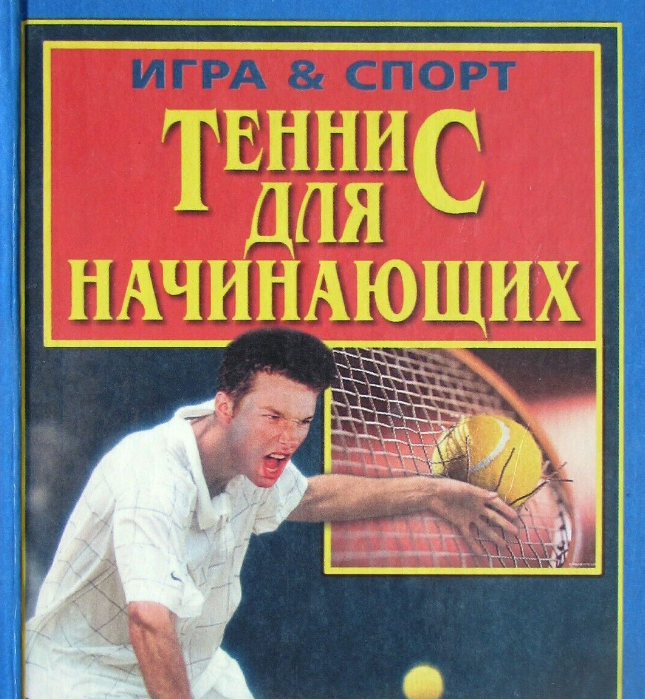
Suppose I asked you what the word класс means. Perhaps you could make a guess (knack?) and perhaps you could even guess correctly, but unless you already know the Cyrillic alphabet, it’s still just a guess.
Using the above book covers as a guide, can you tell what класс means now?
I learned Cyrillic this way about 15 years ago via a series of pictures which started with words you could figure out from English knowledge, eventually moving through the entire alphabet. (I can’t find the webpage that did this anymore — I doubt it’s still extant — but it was brilliant.)
Ever since then I’ve wondered about the possibility of learning a language almost entirely like a puzzle, with the slow accumulation of content. Playing Dracula in Dutch feels a little like that; obviously, I’m looking up words I don’t know, but occasionally I luck into a sentence where I can figure out 80%, and the remaining 20% get added to my mental bank.
For example, upon entering Dracula’s Castle, the first sentence is parsable:
Je bent nu in een immense hal van het kasteel.
From the same description:
De zware deur naar buiten is open.
Trying to “sluit deur” (close door):
De kasteeldeur is met geen mogelijkheid te bewegen.
Looking at the room again, I noticed the door was still open, so I assumed the above message conveyed something along the lines of the “zware deur” being too large or heavy to close.
Later, I found a “zware gesloten kist” and tried to take it:
Die is absoluut niet te tillen.
With knowing that “zware” was heavy/big I was able to guess what was going on here and what “te tillen” meant, especially with the “absoluut niet” (absolutely not) phrase in there.
While I have made it farther in the castle, progress in general still feels minor, so I’ll report back on the actual events of the game next time.
I’ve been playing parser games for so long it’s often tough to for me to put myself in the head of a beginner who types things like >PICK UP THE RAPIER PLEASE and gets the response “You don’t see any such thing” even when the item is clearly in the room. (I just tested this on a real game — Kerkerkruip — and that’s what happened.)
Playing in a foreign language is a great way to recreate this feeling. I got the opening hints
SLUIT RAAM (“close window”)
KLIM GAT (“climb hole”)
LEES BRIEF (“read note”)
KIJK (“look”)
GA ZUID (“go south”)
and worked out a few more things like NEEM (“take”), but I’ve generally had enormous difficulty communicating anything at all.
For example, I found a traditional maze, the kind that needs dropping items to map:
For the life of me I could not drop an item. I tried every single word in a dictionary I could find, and then out of frustration
I still have no idea other than DROP in English how to drop stuff. You might think that LATEN VALLEN BROOD could do it but that really needs to be used as a two-word phrase (I think?), and this is a parser than only takes two words at maximum, including both the verb and noun. Relatedly, the order always has to be verb-subject, even though Dutch often prefers subject-verb; the phrase really should be BROOD LATEN VALLEN.
Here’s what I found at the end of the maze (I give both the Dutch room description and my best shot at a translation):
Je bent nu in een donker woud. Hoog in een zware eikenboom is een kleine hut gebouwd. De takken van de boom hangen laag genoeg om erin te kunnen klimmen. Er zijn vele voetstappen in de grond te zien.
You’re in a dark forest. There is a small cabin built high in an oak tree. The branches of the tree are low enough to climb. There are many footprints around on the ground.
Fortunately, I had the earlier hint to KLIM for climb and was able to KLIM BOOM (climb tree) to get in:
Je bent nu in een kleine hut bovenin een boom. Een van de planken, waaruit de vloer is opgebouwd, is afgebroken, zodat je daardoor naar beneden kunt. Je hebt van hier uit een prachtig uitzicht over het uitgestrekte bos. In de verte kan je het dorpje met de herberg zien. Een smal pad vanuit het dorp slingert het bos in. Ver links van het dorp kan je het kasteel van Lord Dracula zien. Door een vreemd schijnsel ziet het kasteel er spookachtig uit. Een smal pad loopt de heuvel op naar de ingang van het kasteel. Verder is de wand rondom het kasteel zo steil, dat het pad in feite de enige ingang vormt.
Er is een houten wig hier.
Er is een zwaar kapmes hier.
You’re in a little cabin in a tree. One of the floorboards is broken so you can get down. You have a beautiful view of the vast forest. In the distance, you can see the village with the inn. A narrow path from the village leads in the woods. Far to the left of the village you can see the castle of Lord Dracula. The castle has a strange light and looks spooky. A narrow path runs up the hill to the entrance to the castle. The wall around the castle is so steep that the path is the only way in.
There’s a wooden wedge here.
There’s a big machete here.
I could not get out of this room! Again, dictionary attempts failed me. I knew N (Noorden) W (Westen) O (Oosten) and Z (Zuiden) worked for directions, and I eventually found by luck that L is the one-letter abbreviation to “go down”. It is short for … I have no idea. I did also find that H means up, and I’m guessing that’s just shortening “omhoog” to the H since O is already taken.
I did get a little farther and explored Dracula’s Castle (with bedrooms helpfully marked SLAAPKAMER 1 and SLAAPKAMER 2) but I haven’t solved any puzzles yet; hopefully next time?
In all three cases, I played in English. Dracula Avontuur is (probably) the first original non-English game made for home computers, and (probably) the first text adventure in Dutch for any system.* It has never been translated, so I have to play it in the original Dutch.
The objective (as given by a note in your house) is that Lord Dracula has a great treasure, and you want to try to go get it. I’m glad it’s that and not “open parliamentary proceedings with interpretive dance” or “solve progressively harder sets of anagrams” because I’d have no idea how to solve that kind of puzzle in Dutch.
I’ve had to puzzle out what to type rather like I was playing The Gostak (which is a 2001 IFComp entry where the language itself of the game is a puzzle, and you have to infer what everything means). Thankfully, the game had mercy on me early and gave some possible sample commands…
Ik geloof, dat je niet helemaal begrijpt wat de bedoeling is.
Je moet steeds opdrachten geven van 2 woorden, je kan bijoorbeeld nu intypen:
SLUIT RAAM ,om het raam te sluiten
GA ZUID ,om naar die slaapkamer te gaan
KLIM GAT ,om te proberen dat gat boven je te bereiken
INVENTARIS ,om te zien wat je bij je hebt
LEES BRIEF ,om dat briefje wat op de grond ligt et lezen.
KIJK ,om nog eens te zien waar je bent en wat je kan doen.
…and for fun, for any non-Dutch speakers out there, what do you think they say?
Is “duivelaarsmunt” a normal Dutch word?
I’ve only made a smidge of progress, so I’ll get more into my gameplay process in my next post. So far I’ll describe it as “fun but exhausting”.
(*) There is another candidate, also in Dutch, but it could have been written anytime from 1980 to 1981, so I’m going to wait until I’ve done more research before playing it.↩
Upon arriving at Oldorf’s Castle, I found a wide-open area with no enemies or obstacles, just things to look at and secret passages to open.
Puzzles remained relatively simple. There was a room with “SHAZAM” on the floor, and while it didn’t do anything in the room it was in, saying SHAZAM in an adjacent room with suspicious footprints led to a skeleton key.
In a closet, going “UP” stated I wasn’t strong enough, but switching to the Strongman let me enter a secret room and find 5 gold coins.
Eventually, after looting everything I could find, I found my way down some stairs to “Snotgurgle’s Small Palace”.
You see a valuable cross upon entering the room, but need to realize that since your party isn’t automatically taking it, the cross must be out of reach. Using MOVE TABLE and MOVE CHAIR as the Strongman resolves the situation.
In addition to a talking pillar (where my Cleric’s ability to SPEAK came in handy) I found the surreal “Plains of Oxyxidies”.
Heading north, I had to do battle with a “Opthaplebian Eye-Sentry”:
I had to use the Wizard’s catch-all CAST ability here. It always felt uncomfortable to use since it can substitute for “real” puzzle solutions, but the manual does state there are scenarios where only the Wizard can succeed, and I’m pretty sure this was one of them.
After defeating the Eye-Sentry I found some magic mushrooms and took one. The game helpfully says “BAG LIMIT = 3: POSSESSION LIMIT = 1”.
If you come back here twice you can grab the other two mushrooms. However, if you’re holding more than one mushroom, later someone confiscates all of them, because you exceeded the possession limit. I guess this was meant to be a drug joke.
After the strange trip to Snotgurgle’s, I found my way to “Lynxor’s Caverns”. It was the only place of the three that felt properly protected. I had to use my gladiator to KILL a buzzard upon entering, and to take down some snakes later.
I had missed the “Sceptor” from Snotgurgle’s on my first playthrough.
There was only one place I got “properly” stuck, and that was a door requiring a tiny key. Scenarios where there is a puzzle to solve but it’s not certain where the puzzle might be can be very trying, although in this case I needed to just go to a “Merlinian Room” a few steps away and have my Magician cast MAGIC.
Having grabbed all that I could find, I went to “Sunshine” (the Wizard needed to CAST to pop open the last door) and made my exit:
For fans following the discussion in my last post, the Elf does get used one more time, but it’s in a way consistent with just sending the Elf solo to grab some gold in a small hole.
…
Without the character switching, this game would have been fairly bland; even though you could theoretically switch any time to test (say) if the Magician’s MAGIC skill does anything in a particular spot, the odd character restriction led me to only try it in appropriate places, and the game was set up in an easy enough way that it was never too difficult to work out what those places were.
I did also appreciate the solve-everything spell the Wizard had, especially since it didn’t *quite* solve everything (for example, at one point you encounter Lynxor’s “pets” which look like Egyptian cats, and while the Wizard can take down one of the pets, the Magician has to take out the other). I never did get close to running out of Strength; the game was relatively generous with it.
Weirdly, one thing I did miss was picking up items. While it seems like a convenience to dispense with needing to get stuff (and in general, why would your party leave behind treasure?) fighting my way to a ruby and then being denied the actual act of TAKE RUBY made the game feel slightly less like an adventure; less like I was “in a world”, so to speak.
Oldorf’s Revenge clearly had some grounding in RPG lore, and this game represents another “alternate universe” route that adventure game history skipped over. CRPG players are used to the many-characters-in-one aesthetic, but here it was a rarely-seen oddity. The good news is the same schtick shows up in the second game from Highlands Computer Services: The Tarturian. To get there, we’ll need to make it to 1981, and we are getting closer! I’ve got a challenge I’ve been putting off, but now is the time.
Je bent nu in je eigen huis. Er is een slaapkamer op het zuiden en een kleine hal oostelijk. Er is een deur die naar het westen leidt. De deur staat op een kier en een gure wind blaast zand en stof naar binnen. Door een raam kan je een bos zien.
After the initial puzzle I mentioned last time, there’s a fairly wide-open area bottlenecked by a toll bridge where you are asked to pay 50 gold coins.
The CAST action of wizards might be the “solve everything” spell, except the need for cold, hard, cash.
This is a way to force the player to explore the entire opening area, because there are exactly 50 (no more, no less) gold coins spread out amongst the map. In some cases they are in wide open places (in which case the game will say YOU HAVE FOUND 5 GOLD COINS with no fuss) and in some cases things are a little more secret.
Also note that, in general, there is no need to TAKE things; if the “party” finds something interesting they’ll grab it automatically. I do have to put “party” in quotes because of a very weird puzzle type in particular. In two places on the map there was an entrance “too small” for most characters to get in. If you switch to the Elf you can make it through:
However, the entire party follows along with the Elf. While you could suppose the crack scene above is just the Elf working solo, there’s another room which undercuts that idea:
You can’t reach this vault without the Elf. Then, if you try to say KIN, the game claims the character can only speak in their own language. The solution is to switch to the Cleric who can TRANSLATE and find out the word actually means GOLD, and if the Cleric then says GOLD, 5 gold coins appear and are added to the communal stash.
But how did the Cleric get in the vault? I can only assume that when switching characters, you really are “working solo” so to speak and you’re pulling them out from some magical reserve. Yet, this contradicts the idea of a shared inventory; later you get a magical sword, and while it makes sense to be held by the “party” it doesn’t make as much sense that the Elf is toting it around.
I think it’s possible the authors had two conceptual models going on at the same time but didn’t bother to resolve the tension. I’m going to assume it’s a traveling party still and the Elf somehow has the power to “pull in” the rest of the party. However, I’ve been stopped before in puzzle-solving by having the wrong visual image, so I have to keep in mind there really may be only one character in the world at a time.
This scene is the result of the Gladiator wielding a sword using KILL twice, once for each hand. It possibly is meant to evoke the Black Knight from Monty Python and the Holy Grail.
For the most part, all the gold was easy to gather, but I was stuck for a long time at 45.
I had made a wrong assumption in thinking all the important clues would be textual, but there is one room where you need to refer to an item that is only in the picture (like Mystery House).
There’s gold in here! You need the Strongman to get it.
The fortunate thing is that the character skills in this game don’t seem to require nouns, so just LIFT works and you don’t have to play guess-the-noun.
After gathering all the gold, I made it past the toll bridge over to Oldorf’s underground castle.
This has been fun enough so far; I’m just hoping I don’t have to super-optimize my character swaps in order to finish the game (remember, you can only swap to each character 5 times at most).
One thing I haven’t mentioned yet: what is the objective of the game? Even this far in, I have no idea. It’s not mentioned in the manual, nor the opening screen. Who is Oldorf? Am I supposed to be killing him or her? Just stealing stuff and running away? The advertising says you are “looking for treasure” but given the initial treasure search was simply to get by the opening toll bridge this isn’t following a classic treasure hunt style at all.
We’ve seen the name Highlands Computer Services (the duo of Butch Greathouse and Garry Rheinhardt) before; they published the graphical version of Goblins in 1981.
Oldorf’s Revenge was their first game (and unlike Goblins, they wrote this one themselves). It was originally called “Wizard” (and there’s a disk image floating around named that) but they changed the name to avoid clashing with On-Line Systems over Wizard and the Princess. Like Goblins, it’s for Apple II and has full graphics (“over 100 Hi-Res pictures”). Unlike pretty much any other adventure game I’ve seen, you play not a single protagonist but a full party of seven adventurers, each with their own special commands:
The gimmick is that you can change which character is active at any time with the command “C” (although you get a limit of five changes per character) and various obstacles can only be resolved via a particular party member; most obviously by their skills, but the manual does say “Sometimes the right person saying a clue word is all that is needed” so I assume it’s not always a simple correspondence between specialty and puzzle. The manual also says the WIZARD is the most powerful character and may “try and cast a spell at any time, but if the situation did not warrant it, he may not be allowed to or it may cost you considerable strength.”
Regarding strength, you start with a pool of 100 shared amongst all the characters, and while I haven’t thwacked it down to 0 yet, I assume that means YOUR QUEST IS OVER.
The “5” to the next of each character indicates how many times left you can switch to that charcter. I’m ok with a shared strength pool, but I don’t see any plausible in-universe explanation for the restriction to how often each character is used; I think the authors might have feared a “lawnmower” approach to puzzle solving but it still strikes me as clunky.
The first puzzle is a good illustration of the party system:
The door is locked, but you can either
a.) UNLOCK DOOR with the Thief, which uses 2 strength points
or
b.) CAST with the Wizard, which uses 12 strength points
BREAK with the Strongman seems plausible but it doesn’t work.
I think the downside of all this flexibility is that there might not be much object interaction outside of the skills, but I’ve only played for a short while so I don’t know yet. Onward!
There’s also a Commodore PET version from the same year. The Commodore version mentions what the room exits are in each location while the Apple one does not. Given some of the room descriptions imply the player should be hunting for exits, I assume the Commodore version was written second, but given the added feature was put in by the author himself I’m happy to roll along with the easier version (you can also play the PET version online).
The opening defines the main character as male, which is actually unusual for 1980 — Aldeberan III did it, but you were playing a particular character from fiction. Here, you are a “country boy” engaged to be married to “Brunhilde”. You could “stay home and watch TV but then you’d never get lost in the forest and find high adventure and learn to become a man and what the meaning of life is.”
There is no “quest” at all given; you’re just hanging at your shack, and you have the option to go into the forest. Sometimes you’ll see a will o’ the wisp.
You have multiple opportunities to go back to the shack and I suppose quit the game outright, although the game itself goes meta in the instructions and notes “I’m sure you’ll go along with the obvious and get yourself lost.” A good number of the room descriptions describe the mental state of the player avatar as opposed to giving any actual scenery.
Eventually, the map settles into an “all directions possible, only one is correct, the wrong ones send you backwards” pattern.
The twist is that a will ‘o the wisp always shows you the correct way; that is, this is meant to be maze-as-narrative as opposed to maze-as-obstacle-to-map. This continues until:
A BLUE WILL ‘O THE WISP BECKONS FROM INSIDE THE CAVE
YOU’RE IN FRONT OF A LARGE CAVE ENTRANCE WHAT APPEARS TO BE A HUGE POT OF GOLD IS SITTING IN THE CAVE. YOU’LL BE RICH! YOU CAN GET YOUR MOTHER HER OPERATION! YOU CAN BUY SHOES FOR YOUR SISTER! BOY ARE YOU LUCKY!!!
…
Fantasy adventure games have always had a tinge of the anti-heroic.
In a typical CRPG, you might have a warrior who is especially good at lopping off heads, a wizard who can toss fireballs, a thief who can break through locks, and so on. The character(s) will usually have the right equipment to use their skills and if they are lacking anything, a few sessions battling low-level enemies and a trip to the local town will usually fill the gaps.
In an adventure, the protagonist typically has absolutely no resources other than what is lying around, is not particularly good at any action, and often needs to defeat enemies via improvisation, setting monsters against each other, or running away.
At their most competent, the stereotypical adventurer is a crafty trickster character; at their least, they are a bumbler who gets by on luck, passing through dangerous situations by having just the right items to squeak by.
I’m guessing you can predict already which end of the spectrum the protagonist of Will ‘O the Wisp falls on.
…
?ENTER CAVE
*** BANG *** !!! AS YOU ENTER HERE, THE GOLD DISAPPEARS IN A FLASH, AND A HUGE SET OF STEEL BARS DROPS INTO PLACE LOCKING YOU INTO THE CAVES.
A BLUE WILL ‘O THE WISP DANCES OUTSIDE THE CAVE’S ENTRANCE
YOU ARE IN THE CAVE. THE EXIT IS BARRED BY HUGE STEEL BARS AND TRY AS YOU LIKE YOU CANNOT GET THEM OPEN. NOW YOU’LL MISS YOUR WEDDING AND BRUNHILDE IS GOING TO CRY VERY LOUDLY WHEN SHE FINDS OUT.
I really like that the game didn’t just start here; the player had to navigate a map the size of some entire other games before reaching this point.
Upon entering the caves, there’s three large open areas.
In the center is the “cave complex” map, which includes a classical maze and is all-round a pain to map. There’s one lovely death gag that results from you listening to the narrator:
In the southeast corner is a “castle” map, with the
ALL POWERFUL ALL KNOWING ALL KIND ALL DRUNK MAGICIAN RALPH. HE ALONE HAS THE POWER TO GET YOU HOME TO SWEET BRUNHILDE.
Inside the castle, you can find both a magic carpet and a crystal ball. If you take either one before meeting Ralph inside, the result is ignominious for our “hero”:
I’D LIKE TO HELP YOU, BUT THAT IS MY TREASURE THAT YOU HAVE THERE, AND I DISLIKE A CLUMSY THIEF. SO SAY GOODBYE QUICK CAUSE YOU’RE A GONER !!! AND WITH THAT HE KILLS YOU !!!
In other words, this is an adventure game like Crystal Cave with a section where it’s crucial that you don’t pick up stuff. (Not like there’s much to take in the game overall — other than the aforementioned items there’s a bottle, an empty beer can, some bat guano, and a banana peel.)
Assuming you don’t steal Ralph’s treasure before meeting him, he offers to help.
I’LL HELP YOU OUT… BUT FIRST I NEED A FAVOR. THERE IS A CERTAIN WITCH UP NORTH THAT I ONCE ANGERED AND SHE HAS ENCHANTED MY MAGIC STAFF AWAY FROM ME
SHE TURNED IT INTO A BROOMSTICK AND I WANT IT BACK! SO IF YOU CAN STEAL IT FROM HER, I’LL SHOW YOU HOW TO GET OUT OF HERE.DO YOU WANT TO TRY???
(There’s a very Wizard of Oz feel to this request, which will be relevant in a second.)
If you agree to the request you get teleported back to the central cave section. You have to trudge through the maze to reach “EVIL WITCHES LAND”:
YOU ARE AT THE EDGE OF THE EVIL WITCHES LAND. THE EVIL PRUDENCE DOES NOT SEEM TO BE ANYWHERE AROUND. THAT IS GOOD FOR YOU SINCE SHE COULD TURN YOU INTO AN UGLIER TOAD THAN YOU ALREADY ARE.
A SMALL POOL OF WATER COLLECTS HERE
OBVIOUS EXITS: N S E
A bit more trudging and then you finally find a blacksmith with Prudence. The witch doesn’t do any particular action there and I was in fact at first confused — I thought somehow she wasn’t there in person. I finally realized I had to deal with Prudence, that is, solve a puzzle. This is the first and only puzzle in the entire game. You gather the water you see earlier in a bottle, then:
?THROW WATER
OK! WHY NOT?
AUURRRRGGGHHHHH!!! SCREAMS THE WITCH !!! IN HER HASTE, THE WITCH FALLS INTO THE BLAST FURNACE!! HELP !! I’M SMELTING… SMELTINGG… IS THE LAST SHE BREATHS.
She leaves behind a BROOM which you can cart all the way across the map back to Ralph, who is pleased an agrees to send you back.
CHECK YOUR BELONGS LATER HE CACKLES
>POOF!< YOU ARE STANDING UNDER A LARGE BEAUTIFUL SPREADING TREE.
YOUR INVENTORY IS AS FOLLOWS
BOTTLE
BROOM
A GOLD WEDDING RING IS IN YOUR POCKET
FOR YOUR SWEET BRUNHILDE FROM THE GREAT
MAGICIAN RALPH
GUANO
PEEL
CAN
YOUR BELOVED BRUNHILDE IS RUNNING TOWARDS YOU THROUGH THE FIELD IN SLOW MOTION… LIFE IS BEAUTIFUL ONCE AGAIN AND ALL IS WELL. I HOPE YOU'VE ENJOYED YOUR LITTLE EXCURSION.
This was nearly a pure navigation game, like Dante’s Inferno, but I appreciate that there managed to be a sense of narrative even given this restriction. It had the will ‘o the wisp opening, the threatening maze, the straightforward castle (where the only real obstacle is to remember to not steal treasure) the slightly trickier witch area, and then the one and only puzzle; the map was extensive enough this still took several hours to complete.
The slightly-better-defined main character and snarky “narrator voice” also are pretty unusual for 1980. Like Mad Scientist, the author dumped almost all parser interaction, leaving the space for extensive room descriptions that read as if they’re telling a story on their own.
I got the highest rank possible, so I think it’s safe to call this done.
Clearly, the best room in the game.
How to Win
In the end, I had to treat this like a strategy game, and that included just resetting altogether if the opening configuration was unfavorable.
1.) Pick a “long” time limit even though a shorter limit gives a point bonus; the extra time to pick up gleeps ends up making up for the loss.
2.) Keep track of the sledgehammer when you find it. When you encounter the guard with his back turned, KILL GUARD WITH SLEDGEHAMMER. He’ll drop a bottle (keep but don’t drink it; it’s Lugi pheromone and you’ll die via “lust-crazed Lugimen”).
3.) When you meet the sick Lugiman, be sure to >SPIT.
4.) Your pockets hold a maximum of 15 gleeps. When you find the bag, make sure you transfer all your gleeps to the bag as you go. You should be able to rack up over 100 if you wander the map long enough.
5.) Feel free to grab the acetone and apply it to the keys if you find both; on my “winning run” I ended up not going through this sequence. If you do get the keys and find the car, you can OPEN TRUNK at get some nitroglycerin inside. The nitro can be thrown at some carnivorous plants (assuming that room exists) for bonus points. If you START CAR after removing the nitro you will escape the embassy; this is an alternative to the balcony.
6.) Try to visit every room; this may require a lot of repetition, but since gleeps appear at random as you keep cycling through rooms, you’ll be gaining points as you go. The extra bonus for visiting all 35 rooms is 80.
7.) You don’t have to visit the emperor to get that 80-point bonus. I still don’t know what to do in that room (his dog is very interested in your empty acetone can if you have one, but that doesn’t stop the guards from shooting).
8.) Don’t touch the half-eaten sandwich (that seems like it might be the actual source of the plague and not the unhealthy Lugiman? I never was quite able to work out the pattern.) If you have a small creature latches itself to your leg and you have the gum, THROW GUM will catch its attention: “The scaly thing on your leg leaps for the gum, begins chewing it frantically, and, in a state of ecstacy, passes out on the floor.” You can’t escape via balcony if it is attached (as far as I can tell, for the car escape it doesn’t matter).
****************** YOUR SCORE ******************
For escaping: 100 points
Killing the guard: 40 points
Dealing with
unhealthy Lugiman: 40 points
Difficulty of game: 0 points
Objects picked up: 50 points
Bringing out gleeps
and alien objects: 176 points
Rooms explored: 105 points
Finding every room: 80 points
___________
TOTAL SCORE: 591 POINTS.
**************************************************
Your accomplishments are called “astounding!” The president himself decorates you. You have a great future, just beginning, in the CIA.
The Sense of Humor
There are very few comedy-style games in this era. Probably this game’s closet comparison is Haunt, but while that game has a goofy premise it doesn’t really try to make outright jokes. So if nothing else, I appreciated the surreal splashes in Lugi like a room where lizards are filling out paperwork or the deadpan Adventure reference:
You’re in the Hall of the Mountain King. Anyway, that’s what it looks like.
Really, what does a Hall of the Mountain King look like?
You attempt to translate from the Lugonian:
There was once an explorer [lit. conqueror] named [ “PF”isQ” ]
Whose [shoulders? hips? knees?] were exceedingly brisk
So swift was his action
That [? “Ra!oyguo”, prob. scientific term] contraction
Diminished his [? Ancient High Tongue: cattleprod] to a disk.
The “Ancient High Tongue” is what pushes this joke over the top for me. Unfortunately, I’d say the other raunchy jokes swing and miss (including the fact you can urinate or defacate anywhere, and FART makes a blinding cloud of gas in most rooms).
I do want to re-emphasize: adult and/or gross-out elements are part of nearly every mainframe game from this era that’s not based on Adventure. (The only exceptions are the British games like Acheton which copied the Adventure format, and the non-English games Stuga and Ringen.) I am assuming this had to do with them being created by college students of a particular age but also them not having any commercial aspirations.
Could An Adventure-Roguelike Be Satisfying?
By “Adventure-Roguelike” I’m not meaning a RPG/roguelike that happens to be in text adventure form (like Kerkerkruip or any MUD that lends itself to single-player); I’m meaning a scenario where puzzles form the primary gameplay, yet the environment is still highly generative.
I’ve already delineated the main issue in a previous post: when the environment is randomized, it’s very hard to solve puzzles in an exploratory, systematic way. I see a few fixes that are already present in Lugi in some form; they just need to be amplified a little:
Fix #1: Make very few (or no) events have immediate-game-ending be the consequence of failure. It could drain some resource if a situation is handled unsuccessfully (like health or time); this will allow and encourage more experimentation. Lugi does already have a few parts where you just “lose time” as opposed to losing the game, but for the most part, failure means death.
Fix #2: Amplify the ability to have multiple solutions. Again, Lugi does a little bit of this (note the two entirely different methods of escape) but in a case where stakes are higher, I think it’s more important to accept any reasonable puzzle solution as working either completely or partially. (Perhaps a “less optimal” puzzle solve could burn a little of a resource, but less than if the puzzle was failed altogether. Lugi has this happen with the guard with his back turned; if you don’t have a sledgehammer but do have the nitroglycerin, you can kill the guard with the nitro, except the guard will be able to signal an alarm reducing your overall time.)
and relatedly, Fix #3: Have emergency items that can substitute for puzzle-solving. This sort of technique shows up the Brian Moriarty games Wishbringer and Beyond Zork; for example, in Wishbringer, while every puzzle is solvable without using it, applying one of the wishes from the Wishbringer stone will work for any puzzle. Beyond Zork had a (limited charge) wand of death that could be used to defeat an enemy in lieu of a puzzle-solving method.
What I’m not certain about fixing is the static nature of the puzzles themselves. Lugi does a valiant try at making each map give the player slightly different resources to work with, but in the end I was still repeating the same actions and as opposed to solving through things in different ways. It may be the real fix is to simply embrace strategy and RPG elements. Lugi is such a singular game, and it’s hard to know if the premise could work without more examples.
Lugi ran on Stanford’s Low Overhead Timesharing System; this is one of the custom memory controllers Stanford used (since LOTS needed more users than a standard DEC mainframe could handle).


 Renga in Blue