A great deal of news has hit recently so I thought a summary was in order.
…
Little Misfortune is out today. It’s by Killmonday Games, the same company that made Fran Bow (link to buy the game). One of the authors, Natalia Martinsson, was the keynote speaker at NarraScope 2019 (video of the keynote here).
Led by her new friend, Mr. Voice, Misfortune ventures into the woods, where mysteries are unraveled and a little bad luck unfolds.
…
Yesterday saw the release of AI: The Somnium Files, by Kotaro Uchikoshi, the same director as the Zero Escape games. (link)
In a near-future Tokyo, detective Kaname Date is on the case of a mysterious serial killer. Date must investigate crime scenes as well as dreams on the hunt for clues.
…
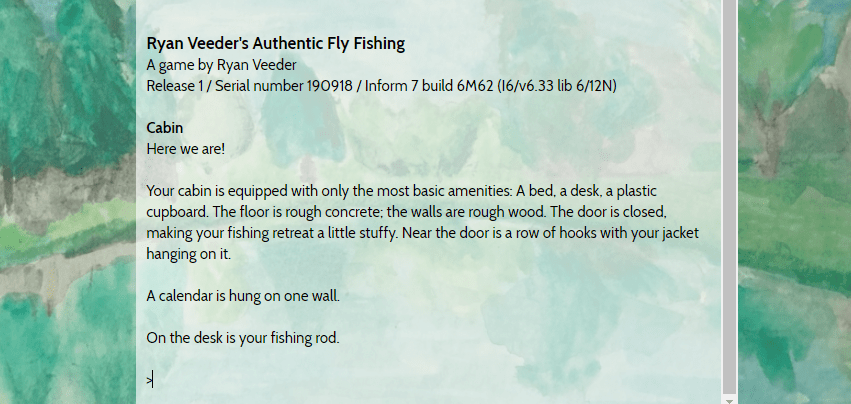
Last week, Ryan Veeder released Ryan Veeder’s Authentic Fly Fishing, a parser-based text adventure. It has a world that changes over time so if you play over multiple days you’ll see events like weather changes. (link to play here)
I call Ryan Veeder’s Authentic Fly Fishing a “game,” but it’s not the kind of game that has conditions of failure or success. And it’s not really a proper story, with a beginning, middle, and end. I like to think of Ryan Veeder’s Authentic Fly Fishing as a place you can visit once in a while, to get away from whatever other stuff you have going on. I hope you’ll play for a while today, and maybe come back tomorrow, and then go on visiting as often as you care to, until you don’t care to any longer.
…
Also last week, Kate Willaert published an article about The Sumerian Game from 1964, the “lost predecessor” of Hamurabi. The project was initiated by Bruse Moncreiff, written by Mabel Addis, and programmed by William McKay. Unlike the stripped-down Hamurabi (which was written later based on a description of the original), it has a strong narrative “voice” …
I lean heavily upon your wisdom, Luduga, but I am also here to help you. Tell me, if your population is increasing, would you expect the quantity of grain fed to your people to 1-increase 2-decrease?
1
Of course it should increase. Forgive me if my questions seem simple. It is my duty to urge you to see the relationship among the items in your Steward’s reports.
… and had a slideshow with voiceover meant to be played before starting!
The article also includes a link to a final report giving a full description of the game (full enough someone might be able to recreate the original, sans some of the colorful text and slideshow). As a bonus, if you keep reading, there are more games from the same series; after The Sumerian Game came The Sierra Leone Game (authored by Walter Goodman):
… he felt that the economic problems of newly-independent African countries were important for pupils to understand. Sierra Leone in 1964 seemed like a representative African state where political factors were less critical in determining economic developments than in other African lands. We were also fortunate to have Frank Karefa-Smart from the Sierra Leone U.N. staff avaiable for consultation.
…
Over the Alps is an 80 Days-style game for iOS that is coming soon to Apple Arcade with writing by Jon Ingold (Heaven’s Vault, Make it Good) and Katharine Neil (Astrologaster). It is set in 1930s Switzerland. (link)
Uncover a hidden family history and play your role in a classic story of espionage, double-crosses and adventure.
Avoid leaving footprints, and drop diversions in your wake to stay one step ahead of the Swiss Police who are hot on your tail.
…
This is “old news” (it came out in May), but out of the adventures I’ve played this year so far, my favorite has been Detective Di: The Silk Rose Murders. (link)
A thrilling point-and-click adventure game where you play as Di Renjie, ancient China’s most famous and gifted investigator, as he tracks a serial killer in the heart of the Tang Dynasty’s capital city.
I’m including the video of this one because the music is great.
…
Finally, the Interactive Fiction Competition 2019 is fast approaching; the games come out October 1st. This is the 25th running of the competition. There’s still time to donate money or prizes.
I’m not typically big on landmark numbers, but excluding Before Adventure and my non-chronological entries, this is my Game #100.
Consequently, I decided to try a game that I’ve been looking forward to playing ever since All the Adventures kicked off in 2011.
In the 1967 TV show The Prisoner, the unnamed main character (played by Patrick McGoohan) has resigned a mysterious organization, and he is kidnapped and taken to “The Village”. He is given the designation Number Six and referred to that way by others in the Village — a fully working, albeit creepy and conspiratorial seaside town. Throughout the TV show, various people (all of designation Number Two, and a different person in almost every episode) try to wrangle free the secret of why he resigned.
David Mullich had been programming freelance for Edu-Ware when he mentioned his intent to create a game based on the TV show mentioned above:
However, I didn’t intend to make a direct adaptation of the TV series; I just wanted to make a game that explored some of the same themes. But Edu-Ware thought that they needed to at least loosely tie the game to the TV series to sell it. So, I wrote a game about the player being imprisoned on a place called The Island (instead of The Village), which is run by an authority figure called The Caretaker (instead of Number 2). As with the TV series, the game’s goal was to find a way to escape without revealing why you had resigned from your former job.
By 1980 Edu-Ware had already seen legal trouble; the year before, without permission or licensing, they made the games Space and Space II which were essentially computer versions of the Traveler role-playing game by Game Designer’s Workshop. They stopped production and settled out of court. It’s interesting they decided to risk the same unlicensed angle on The Prisoner, but as far as I’m aware they got away with it this time without even the thought of a lawsuit.
I’m a large fan of the TV show, and I’ve had to resist the temptation to do a Jimmy Maher-style Parts 1 to 3 giving the history of the show before making it to the game. (I will say you can watch the whole thing for free on the Internet Archive, if you want.)
Rather appropriately, the game is very, very, strange, and has as its central idea something exceedingly rare for computer games. In most games, there is some action you want to accomplish. In The Prisoner, there is an action you don’t want to accomplish.
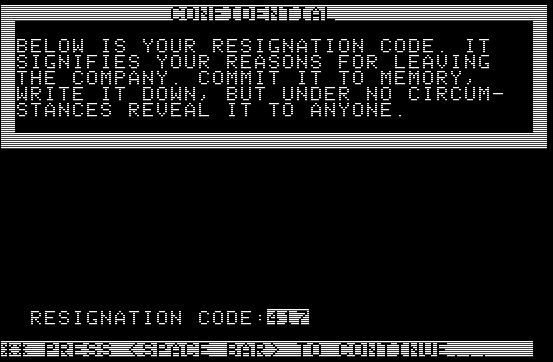
Right at the start, you receive a three-digit code. If you at any point divest the three-digit code you lose the game.
The game tries very, very, hard to get you to divest the code. More on that in a later post.
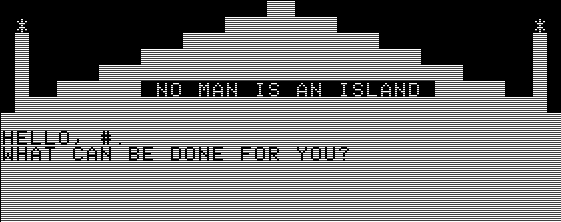
After getting the code, you are given a list of cities to fly to, but in the middle of typing, the screen stops and you (represented by a # mark) find yourself in THE CASTLE, #1 ISLAND SQUARE.
This is a maze where the walls are initially invisible, but you can bump into them to reveal them. U, D, L, and R move the character up, down, left and right respectively.
Once reaching the right of the maze, you are asked WHO ARE YOU (with one choice, predictably, being the forbidden 3-digit code) and then told THE CARETAKER WANTS TO SEE YOU AT YOUR EARLIEST CONVENIENCE, #.
The top-down view is maintained, but the keys U, D, L and R don’t work anymore. It took me a while to puzzle the keys are N, S, E, and W once outside. There are no instructions for this, and it seems to be quite intentional.
The “C” shapes are buildings, and they are given numbers as you walk by. You start in building #6. Heading directly north (you can scroll to another four buildings) I found the buildings #1, #2, #16, and #17.
Nothing is labeled; you have to go in a building to find out what it is. I tried building #2.
Below this message you can type free-form messages in a prompt. I tried out some nonsense, and the game encouraged me to GO ON and that what I said was SPOKEN LIKE A TRUE ISLANDER.
I have no idea what building #2 is. I love it.
Now, I’m not sure if I’ll keep loving the game going farther on… ? I will say I had to crank up the speed rather a lot, because on original Apple II speeds this game runs ludicrously slow. As in, I’m fairly sure that getting to the first room would have taken 10 minutes of waiting. (I’ll go back and time it later.) So this isn’t the true original experience, and I’m ok with that.
There is, incidentally, an “improved” version of The Prisoner called The Prisoner II released in 1982. I have heard it is “essentially the same game” and I will test it a bit alongside the 1980 version. My guess is this will be a game about information so it will be helpful to have a second source.
a.) coined the term “interactive fiction” (trademarked it, even, when publishing with Adventure International? although that apparently didn’t stick)
b.) wrote “conversational parser” games which looked for keywords, like Eliza; Two Heads of the Coin was a “pure conversation” game while Local Call for Death included a scene with a world model
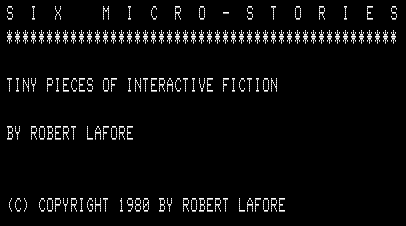
This was sold as #1 in the Interactive Fiction series, but given Six Micro Stories was advertised as an “introduction to the world of Interactive Fiction” it’s possible this was as situation like Mission: Asteroid where game #0 was written after games #1 and #2 (or in Lafore’s case, game #1 being written after games #2 and #3). It’s also possible this is a collation of earlier experiments by the author, or maybe he had some of the scenarios already written and added three more. Unless some other evidence surfaces I don’t think it’s worth the energy to speculate; just note the internal copyright here is 1980 and the copyright on the other two games is 1979, although they didn’t start getting sold overall until 1980.
The structure for the six parts is to
give some prompt that the player responds to
with a back-and-forth with from one to four or five sentences
and then the micro-game ends.
There’s a “starter program” where you pick a gender and name (I went with MALE and being named “BOBA FETT”) and then it goes through the six stories in a prescribed order stating
WE HOPE YOU ARE READY TO BECOME A FICTIONAL CHARACTER!!
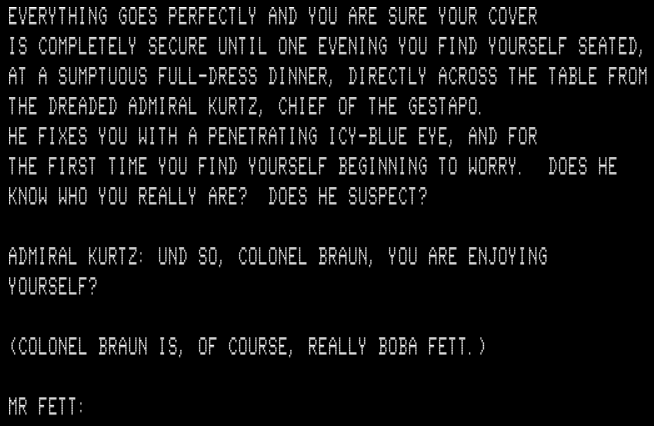
The Fatal Admission casts the player as an American spy in the Third Reich, who is posing as Colonel Braun, a “decorated Luftwaffe air ace”.
In history, there is no Admiral Kurtz. There is a Colonel Kurtz from the 1979 movie Apocalypse Now, suggesting Robert Lafore plucked the name from the movie.
After saying YES or NO, the story continues:
TELL ME–I UNDERSTAND YOU ARE WITH THE 57TH FLIGHT WING IN DUSSELDORF. DO YOU HAPPEN TO KNOW THERE A CAPTAIN EIDERDOWN? HE IS AN OLD SCHOOL COMRADE.
(AGAIN HE FIXES YOU WITH HIS ICY GAZE. WHY IS HE ASKING YOU THIS? IS IT SOME SORT OF TRAP? YOU WISH YOU HAD VOLUNTEERED FOR SOMETHING SAFER, LIKE SUBMARINES.)
It seemed glaringly obvious that the story was going for the “ha-HA, there is no Captain Eiderdown, you are a spy!” kind of twist, so my first time through I just tried to say NO, I DON’T.
ADMIRAL KURTZ: NOT SURPRISING, SINCE THERE IS NO SUCH PERSON. BUT THERE IS ALSO NO 57TH FLIGHT WING, IN DUSSELDORF OR ANYWHERE ELSE. YET YOU, COLONEL, LET ME SUGGEST THAT THERE WAS!!
Er, I did? The result of my NO was being dragged off and executed.
The game wants you to more specifically deny the premise of the question.
I admit the turn of story here seemed so implausible I thought of saying NO, but I ran with YES and indeed became a courier for many top-secret documents that were able to be fed directly to the Americans, and Mr. Fett was able to retire to in glory after the war ended.
Upon further contemplation, the story really doesn’t make sense — the main character here would definitely know what flight wing they were with as part of their cover story, so not only is their unawareness of what trap is being set absurd, but Admiral Kurtz’s use of trickery related to the flight wing as the one and only method of determining if he’s talking to a spy just went over the top.
The story did have the virtue of understanding essentially everything that it needed to, parser-wise. I suspect there’s a way to deny the 57th Flight Wing exists and have the computer not understand, but I wasn’t able to find it.
…
Following grim war with infatuation, we have Encounter in the Park. If you are using a female character, the game informs you that this particular story only works with male perspective, so you are temporarily named HENRY. (“PERHAPS YOU CAN PRACTICE YOUR ROLE-REVERSAL ABILITIES.”) The game also neglects to mention that Henry/whoever is of hetero orientation:
YOU ARE STROLLING THROUGH GOLDEN GATE PARK IN SAN FRANCISCO ONE SUNNY AFTERNOON WHEN A LADY ON ROLLER-SKATES GLIDES PAST YOU ON THE SIDEWALK. HER EYES HAVE A PERCEPTIVE LOOK TO THEM, WITH PERHAPS A TOUCH OF ARROGANCE.
SHE IS WEARING SHORTS AND HAS LONG BROWN LEGS AND HONEY-COLORED HAIR DOWN TO HER WAIST. SHE IS IN EVERY WAY YOUR IDEAL. YOU GAZE AFTER HER IN DUMBFOUNDED ADMIRATION.
This does not describe my ideal, and no doubt it isn’t the ideal of many readers, but the premise is to roleplay.
AT THE CORNER JUST AHEAD OF YOU SHE HITS A SLIPPERY SPOT AND FALLS — GRACEFULLY ENOUGH, BUT SHE DROPS THE BOOKS SHE HAS BEEN CARRYING. IT IS THE OPPORTUNITY YOU HAVE BEEN WAITING FOR, PERHAPS THE OPPORTUNITY OF A LIFETIME. YOU SPRING FORWARD AND RETRIEVE HER BOOKS AS SHE PICKS HERSELF UP. YOU NOTICE THAT ONE OF THE BOOKS IS “COUPLES” BY JOHN UPDIKE.
(Unlike Admiral Kurtz, this is an actual Updike book.)
BOBA: DO YOU LIKE THE UPDIKE BOOK?
THE LADY: I LIKE HIS WORK A LOT.
BUT YOU KNOW WHAT I LIKE BETTER? “PHANTOM MARRIAGE,” BY GASTON DUPERIE. HAVE YOU READ IT?
This is a trick, just like the last story. If you say YES: “YOU DID? I MADE UP THE WHOLE THING. YOU CERTAINLY ARE A GULLIBLE TYPE, AREN’T YOU. WELL, I’VE GOT TO GO — I’M TEACHING A CLASS IN NUCLEAR PHYSICS. BYE!”
Saying NO continues the conversation:
BOBA: NO
THE LADY: TOO BAD. DO YOU LIKE SPY STORIES, THEN?
If you say “YES” to liking spy stories, she runs off in a huff and your main character goes off and joins a Zen Buddhist monastery, which seems like an overreaction. Also, this is probably referring to John Le Carre novels, which were excellent in the 1970s, so this lady clearly doesn’t deserve Henry/Boba/Whoever.
BOBA: NO
THE LADY: WELL, THAT’S SOMETHING, I GUESS.
If you don’t offend the lady past this point, she invites you to ice cream, and eventually, you end up on the beach with her on Bali in “COSMIC BLISS”. OK then.
I admit to never having all that stellar a playthrough, although the source code is an interesting read. This micro-game (and most of the others, really) seem highly sensitive to individual experience; it’s possible to type full sentences and having a pleasing conversation and finale, and it’s possible to have something weird and stunted that nevertheless leads to “cosmic bliss”.
I think the main issue isn’t strictly the Eliza system of finding keywords and pretending they reflect the entire sentence, but that the conversations in Six Micro Stories are all high-stakes and short. With the investigation sequence of Local Call for Death, if you make a deduction the game doesn’t understand, it doesn’t feel like you’ve broken an entire story; you can try again, and if you’re having trouble with phrasing, Lord Colin will often suggest something to help out. Here, the main character can be murdered via parser failure.
Perhaps, as a general principle: if communication failure in a story is possible, the story must be of the kind that gives a little slack.
…
I’m not going to spoil the exact details of the remaining stories, but just to summarize:
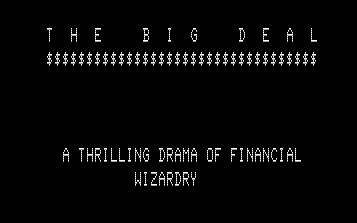
The Big Deal casts the player in negotiations to sell their company, but their company is secretly near-bankrupt. A lot of the conversation involves numbers (which the parser can grok just fine) and there’s even a “secret ending”, so I found it the most successful of the stories.
The Empty World involves a doomed 747 plane. You might not even get a chance to type a sentence on this one; if you type enough characters you get “interrupted” and the plane crashes.
In The Unexpected Question, the player’s Ph.D depends on them successfully communicating what art is.
NOW, WE HAVE DECIDED THAT YOU ARE NO DOUBT ADEQUATE IN COMPUTER SCIENCE, SO WE ARE NOT EVEN GOING TO QUESTION YOU IN THAT FIELD. HOWEVER, WE DO REQUIRE THAT OUR GRADUATES BE WELL-ROUNDED. WE ARE THEREFORE GOING TO POSE TO YOU A SIMPLE QUESTION FROM THE LIBERAL ARTS. YOUR ANSWER TO THIS QUESTION ALONE WILL DETERMINE YOUR SUCCESS OR FAILURE IN THIS EXAM. PLEASE RESTRICT YOUR ANSWER TO TWO LINES.
DR ZEROUGH: HERE IS THE QUESTION: WHAT IS ART?
ANSWER CAREFULLY, MR FETT.
Out of all the games, I found this one to be filled with the most non-sequiturs in terms of what I typed versus what the game actually thought I typed. After a few honest tries (and failures), I managed to pass the exam with more-or-less gibberish.
Finally, The Guilty Look has the player surreptitiously returning a piece of stolen silver and being caught in the act. I was never able to get a bad ending on this story.
…
The easiest way to play these is online (via this link; if you click on the “speaker” icon at the bottom you can turn off the disk sounds), but note that you’re started in the middle of the sequence (at The Empty World). As this is the sort of game where playthroughs can vary wildly, I’d really like to hear some stories. Did Encounter in the Park come across naturalistically? Did anyone have an actual sensible discussion of art? Is there a way to communicate, well, just about anything in The Guilty Look?
I got past my dilemma from last time and finished the game; I had run into something I (now) call The Parallel Universes Problem.
Suppose you are a happy adventurer going from point X to point Z and manage to do so without any obstacles. However, you later restore a previous game (because you got eaten by a bear, say).
After restoring, you try going from point X to point Z, but get stopped in the middle at point Y this time. Something different happened! What changed? Perhaps you had picked up an item in universe #1 but didn’t realize it; perhaps there was some secret timing element that you lucked out on the first time. Either way, you ran across the frustrating situation of being in an alternate universe without being aware something had changed.
With Kidnapped, I was stalled trying to get by the kidnapper, who was in a vault counting money. I needed a dollar to get a string from a vending machine.
I had tried:
A. shooting a gun at the kidnapper; the gun turns out to be full of blanks and doesn’t work.
B. stealing the money; the kidnapper spotted and killed me.
However, I didn’t realize with action B that I wasn’t holding the gun at the time. If you are, then you automatically threaten the kidnapper with the gun (but don’t shoot it!) the same time you GET DOLLAR.
I’ll come back to the implicit action embedded in GET DOLLAR, but the important point is I didn’t realize the scenario of universe A was different from universe B. In contrast to my abstract X-to-Z scenario, at no point was the puzzle solved; I had done the correct action for solving the puzzle but only if the conditions that I thought held (that I was living in universe A, holding the gun) were true.
I’ve been stuck on games with this sort of issue multiple times without having a name for the problem, but I figured now is good a time as any to bestow some nomenclature.
…
The above wouldn’t have been a problem had the game let me WAVE GUN or POINT GUN or THREATEN KIDNAPPER or some such, but this is a typical BASIC 16K parser here; I eventually gave up and tried GET DOLLAR for the alternate result, even though I was sure I had tried it already.
The game also does implicit actions with keys and doors; UNLOCK is not understood. You just have to go straight to typing OPEN DOOR if you have the right key, and the game assumes it gets applied in the process of opening.
Having the implicit actions done for me tricked into a false sense of complacency when later jumping between floors while holding MARY POPPIN’S UMBRELLA:
UMBRELLA WASN’T OPEN!
YOU NOW LOOK LIKE A PANCAKE!
I assumed OPEN UMBRELLA wasn’t needed since keys and guns are both used automatically. Oops. Back to level 9 for me.
(I incidentally never got save states working, but on the “upside” it means I experienced the game as originally intended. It did lead to a slightly longer game and some tension where I was worried I would wreck my game on floor 2 and have to repeat everything. Fortunately, the difficulty overall stayed low.)
Things only got wackier from there. You have to put out a fire with sprinklers but subsequently, your clothes get wet and you have to discard them. You then use KNITTING NEEDLES and a BALL OF YARN and end up with a FINE SUIT, which suggests to me the main character really IS Mary Poppins.
The reason you can’t just keep going naked is you need go in an office with a key and — I am quoting directly here — SEXY, YOUNG GIRL OFFICE WORKERS.
YOU FORGOT YOU WERE NAKED
YOU BLUSH AND RUN OUT
This is also the sort of game where you don’t know how to swim, but there’s a nearby BOOK you can READ on how to swim and immediately after you’re backstroking like an expert.
Near the end, you find out the fate of the kidnapper.
For the very last obstacle, the front door is locked, but no key is in sight. However, a piano is nearby, and if you make the leap and TAKE KEY while in the room…
WE ALL KNOW PIANOS HAVE KEYS
…you can make it to victory. I admit to being very surprised here, since we’ve only seen wordplay shenanigans in one other game, Quondam, which is one the hardest games I’ve played, while Kidnapped (even without a save game feature) is one of the easiest.
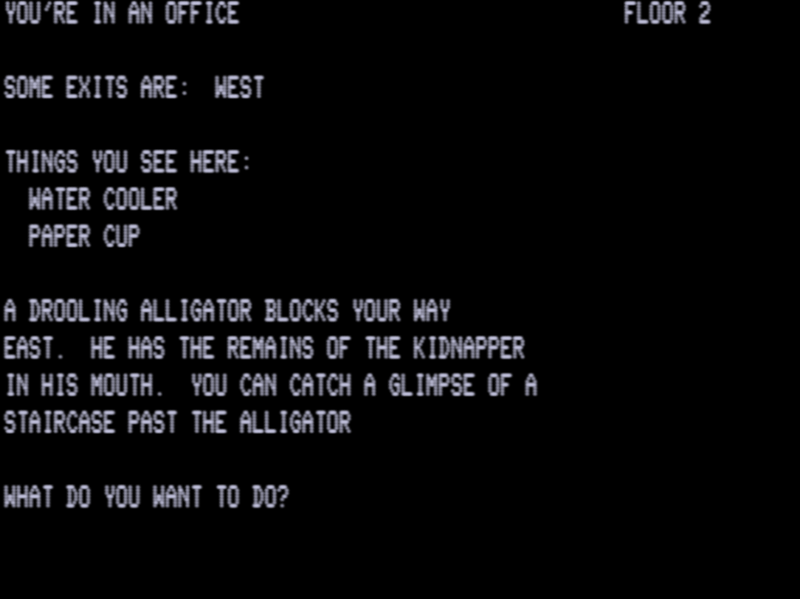
The kidnapper is elsewhere, busy counting the ransom money. Your only job is to escape from the building, floor by floor. You must beware of the kidnapper, and stay alive. Many traps have been set, so be careful!
According to a note in the source code, Peter Kirsch wrote Kidnapped in June of 1980. It was published as a type-in for Softside magazine in December of 1980. (Dr. Livingston and Mad Scientist, which we’ve looked at previously, were both from the same magazine.)
Unlike a lot of authors of type-in programs we’ve gone through lately, Peter Kirsch wrote more than one adventure game. The CASA Solution Archive credits him working on 23 of them because of his later involvement with “SoftSide Adventure of the Month” which went through over 20 games before Softside finally folded in August 1984. I’m not sure how many he ported versus wrote personally, but that’s still a tie for most adventure games I’ve seen associated with one person (the legendary C64 author Dorothy Millard also has 23 to her name). Despite being one of the most prolific adventure game authors ever, I’ve never encountered any interviews with Mr. Kirsch nor any mentions in history books.
Kidnapped came before the Adventure of the Month series started and is probably his first game.
Softside, December 1980.
The premise is: you find that you’ve been kidnapped and are on the top of a 9-floor building where you need to make your escape. You work your way down from 9 to 1, and every floor is separate, so Kidnapped could be considered a set of 9 distinct mini-adventures.
The mini-adventure concept ends up being a good gimmick! Structurally, the tiny areas give a (slightly) modern feel to the proceedings, in that you can essentially ignore map-making if you like, nor do you have to keep track of a large system of interlocking parts, nor do you have to wander through a maze (at least of what I’ve seen so far).
The first floor (floor 9) is shown above. There’s a key on a ledge outside that your fingers can’t quite reach, but there’s a nearby broom that lets you GET KEY. With that key, you can open a cabinet and find a flashlight and electrical tape. There’s also an elevator where the button doesn’t work, but if you drop a chair nearby, you can clamber up to a “crawlspace” with two live electrical wires. You need to wait until midnight (there’s a helpful clock in a different room) for a scheduled power outage, and then you can TAPE WIRE. (If you attempt this too early you get electrocuted.) After taping the wire you can finally use the elevator which takes you down one floor, and in the process you discard your items before entering floor 8.
In the department of nitpicks, note that:
a.) the item discarding doesn’t necessarily make sense here, but for ludic purposes I just rolled with it. Besides, at least two of the later exits are through windows, which definitely could be a situation where an inventory is impossible to have.
b.) somehow the power needs to turn on again after fixing the elevator, but the timing is unusual here. Time advances with each turn until midnight, but “freezes” just past midnight so you can fix the elevator. Then the flow of time resumes again after the elevator is fixed. This may sound terribly odd, but it isn’t too far off modern games with “plot timers” that don’t trigger until the player character has reached a certain location.
The next few floors are straightforward puzzles along the lines of: here is a broken step, you have a piece of wood and superglue, what do you do?
However, I have gotten stuck on Floor 6. The map has a gun, a balloon, a helium tank, and a vending machine which requires $1 to get a piece of string. There’s also a ledge you can walk on and reach a “vault” where you find the kidnapper counting money.
If you try to shoot the gun you find out it is only blanks and the kidnapper kills you. If you try to take a dollar and run the kidnapper spots you and kills you. There’s also a locked door but no sign of a key on this level.
What really doesn’t help is that there is no save game feature. I’m playing on the original TRS-80 version, and I suspected with one of the other ports (like the Atari) I could at least use save states, but the only Atari copy I’ve found gets me strange errors upon booting. Every failed attempt that kills me off sends me through all the steps to get from levels 9 to 6 before trying again, which doesn’t lend itself to lawnmower-testing of verbs or really any kind of typical adventure game experimentation.
The main reason was a complete lack of red herrings. Every item ends up being useful, and you don’t have to waste time realizing, e.g. a frisbee is just there to kill you.
(Complete spoilers for most of the game follow this point.)
Last time I left off mentioning a “haunted jar” I didn’t know what to do with. I had tried to OPEN JAR and was told the lid was stuck. This was a hint I was supposed to get it open by any means necessary.
Very close to the start there’s a “crushing” room adopted straight from Deathmaze.
However, unlike that game (where it’s a red herring trap), here if you’re holding a “metal rod” the walls stay open. You can drop the jar and leave and the walls crush the jar and release a ghost, which says the word “mevar” as it leaves. (This is unfortunately somewhat inconsistent, since the crushing doesn’t work on other objects; fortunately the first thing I tested it on was the jar, otherwise, I could have been led far astray in solving the puzzle.)
Armed with that word, I used the other magic word I knew (PTOOII) to teleport to a sword, and MEVAR to escape the place with the sword. From my last post, I originally thought the sword was just a trap, but again, I was in Deathmaze mentality; here is where I started to suspect Labyrinth was instead a no-red-herrings game.
Once I got the sword I was able to take down the “ugly man” who had been attacking me in a particular corridor. Past the corridor, I found a “maiden” who (after carrying her for a bit) turns into a “witch”. The witch then turns the player into a monster who guards the witch in the same spot the ugly man did, and eventually you die via another adventurer. Strange loops.
I did say “eventually” — there’s a bit of lag time between picking up the maiden and having her invoke her witch powers. If you’re wearing the roller skates, that’s enough time to skate over to where a nearby cave bear is. I had yet to play a game where I fed a “maiden” to a bear, but there’s always a first time:
This yields an emerald. The emerald isn’t useful yet, and here I was stuck, basically only having the cave gnome to deal with. I ended up doing the text adventure version of “click every item in inventory and try it out”; I listed out every verb and item and ran through essentially every combination.
I finally hit upon SAY MEVAR (previously used to escape the area with the sword) as causing the gnome to “temporarily freeze”. Any action after killed me, so I had to reset my “try everything” list and lawnmower through until I hit upon THROW SALT which causes the gnome to “dissolve”. I think the idea is the “freezing” is meaning literally a block of ice, so the salt makes it … melt faster, I guess … even though the gnome can break out of it almost immediately otherwise. Bleh. This was one of those puzzles where even though I solved it entirely on my own, I would have been better looking up the solution and saving time.
By killing the gnome I got some coins; using INSERT COIN on a nearby vending machine yielded some matches, which I was then able to light a lantern with. (If you try to light the lantern with a torch, the game just claims torches can only light other torches. I have no idea why this would be the case. I honestly think the torch mechanic made more sense in Deathmaze and it was just a holdover here from using the same engine.)
With the lantern I was able to get through the “fog” which normally attracted a minotaur near the very start of the game. (The lantern disappears after you use it.)
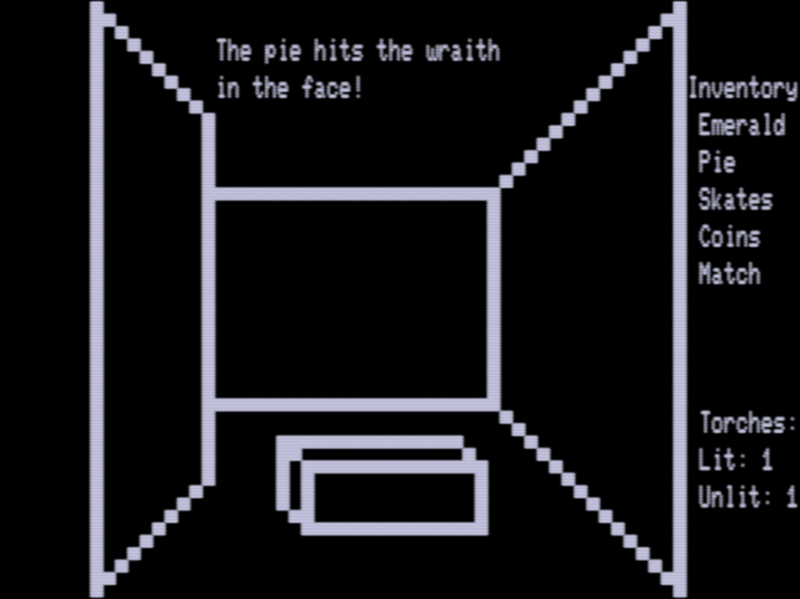
After the fog comes a “wraith” who is defeated via cream pie.
The same map also has a “ruby” and a “fan”. Upon returning to the “main area” from this maze, the minotaur was suddenly attracted by the fact I was holding the ruby and emerald at the same time, and killed me two turns later. The best way I found around this was to TAKE BOX instead of TAKE RUBY (this trick was needed in Deathmaze for the snake) so you can carry the ruby around without the minotaur “sensing” it.
Since I had the minotaur coming to me, I needed a method of killing it. I admit spending an inordinate amount of time back at the “crushing” machine trying to trick the minotaur into stepping inside, but I couldn’t logistically find a way to have the minotaur step in and escape (I tried to time out a teleport via PTOOII, but it just wasn’t working). I finally had to resort to my one hint of the game, although I probably should have realized the issue — there was a map section I hadn’t visited yet.
I had mentally thought “hm, interesting they didn’t use it this time” but still never came to the conclusion I could sneak in that area, since I had checked all the nearby walls thoroughly. It turns out I wasn’t done with the vending machine yet. KICK MACHINE caused it to swing open to a dark area.
By dark area, I mean “so dark even the torch doesn’t work”. This led to an experience likely familiar to old-school CRPG players — stumbling around hitting walls and trying to map out a “permanently dark” region. This was made doubly annoying by a.) a pit which dropped you in the fog (and recall, I had already used up the lantern) and b.) the fact there’s an item hidden around, but you can’t see it. This required typing OPEN BOX in random locations until reaching a hit, which was a DEVICE way in the corner. Using PRESS BUTTON revealed the device was a lightsaber.
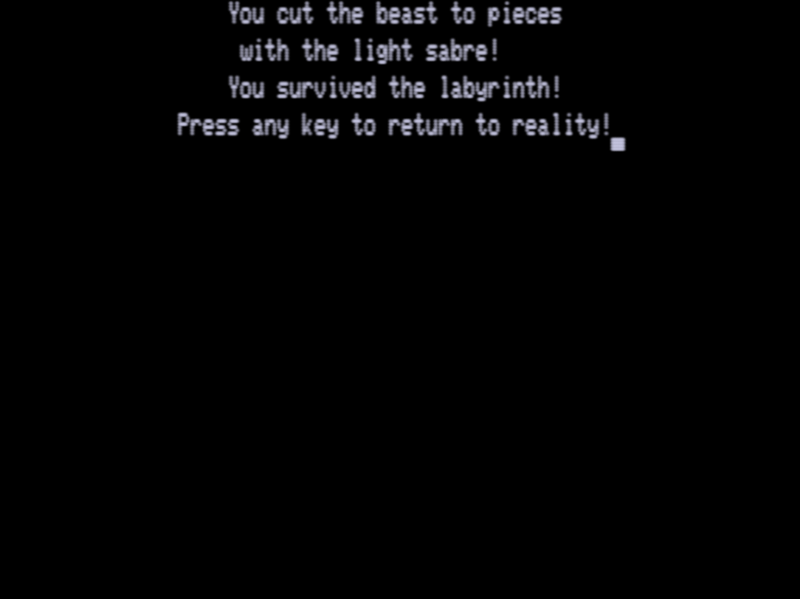
I opened the box I’d been toting around with the ruby, and while holding the ruby and emerald, the minotaur came just like before, but this time I had THE FORCE on my side:
A winner is me! You might have noticed I mentioned a “fan” but never used it yet I claimed a complete lack of red herrings. I essentially skipped a puzzle. You can drop another coin in the vending machine and get a battery, then apply the battery to get the fan to run. The fan will get rid of the fog (so the pit in the dark area is no longer deadly, just annoying). I sidestepped having to worry about the fan because of the ruby-in-box trick letting me tote both gems all the way over to where the lightsaber was.
To loop back to my comparison of this game with Deathmaze: I still hold that Deathmaze had a stronger plot. This is despite the razor-thin “your only job is to escape” opening. There was a genuine arc: opening bottleneck -> progress to level 4 -> defeat of the monster on level 4 -> teleport to level 5 -> fight with the monster’s mother -> grand finale with the exploding maze. Labyrinth, while much tighter on puzzles (despite a few teeth-gritting moments like the cave gnome) didn’t have that kind of dramatic tension, and while the sense of humor was roughly the same, the atmosphere of Labyrinth was generally sillier.
Still, if you had to play one of the two games, without hints? Definitely pick Labyrinth over Deathmaze.
It took me quite a while to suss out how the teleporting system in Labyrinth works. Partly this is due to my prior experience with RPGs like Wizardry and The Bard’s Tale, where the general rule is that entering a square is what causes an effect to happen. (Labyrinth came out before either, so it doesn’t surprise me it’d do something different, but I still found the entire concept I outline below hard to wrap my head around.)
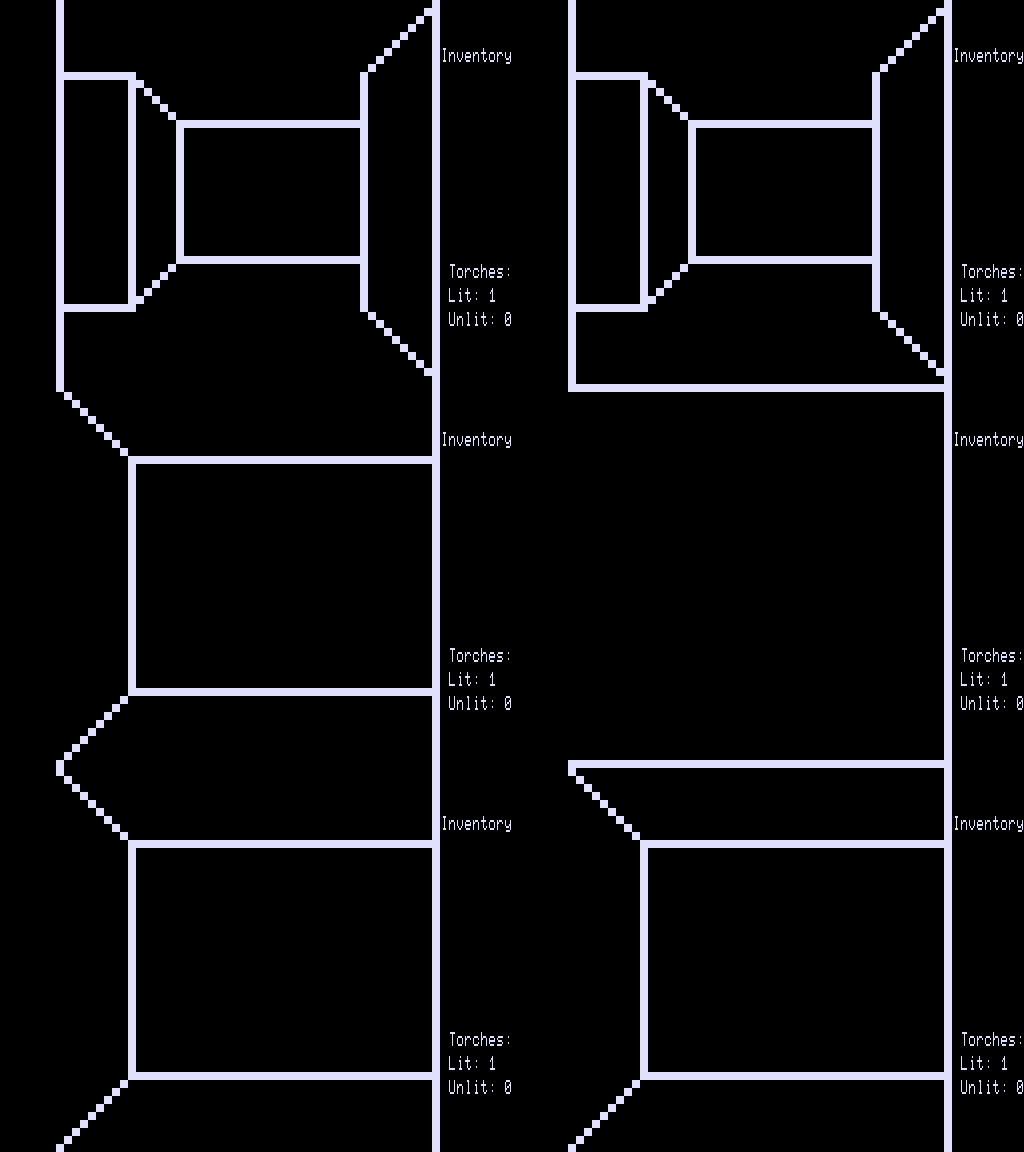
Here is an animation of passing through a corridor and turning around. Notice how the path back seems to have changed.
I originally created my map assuming square X would teleport me to square Y, but I kept running into inconsistencies trying to match everything up; I was getting errors like corridors overlapping with other corridors.
The way the game actually handles teleports is that if you stand in the relevant square and look in a particular direction, the teleport triggers. I puzzled this out by taking an item (salt, in my case) and repeatedly dropping and trying to pick it up as I walked through one of the mysterious corridors; eventually, I narrowed down the exact instant the teleport happened, which was when I turned, not when I stepped.
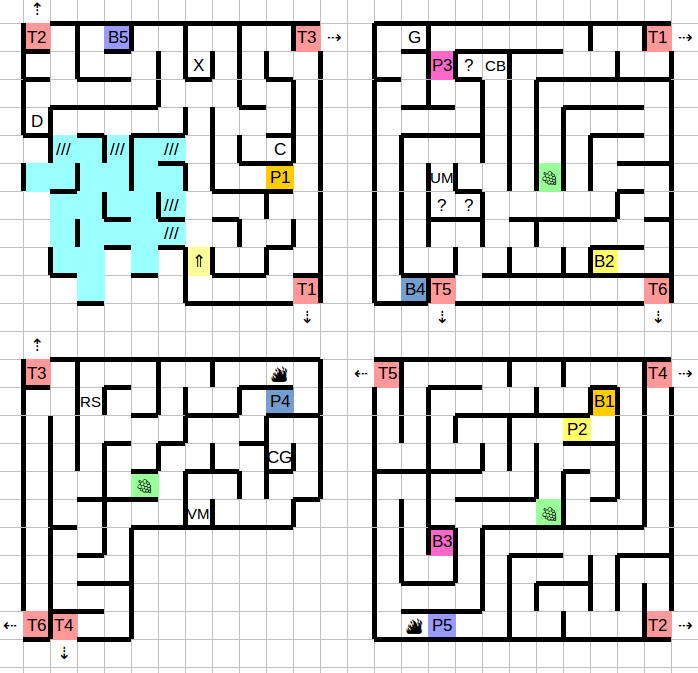
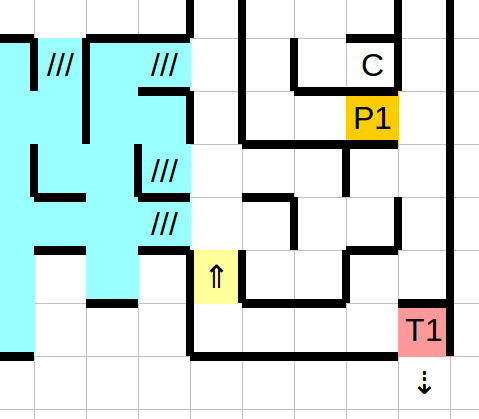
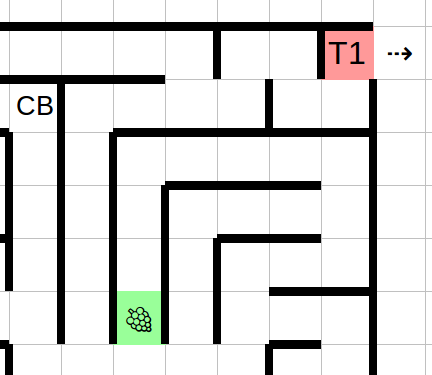
For example, if you go to the position marked “T1” and turn south…
you end up in the other position marked “T1”.
You often get your “compass” turned in the process, so you’re facing towards the “open direction” of the map you’re on when you land. In this example, if you start at the first T1 and teleport you stay facing south. However, if you try to teleport back again by turning east, you’ll land at the original T1 facing west. If that was confusing to read, double that confusion; that’s how confusing it is to play.
I can say with confidence now that “levels” is the wrong way of looking at the map — it’s really just a big strange loop. You can fall through a pit and walk your way back to where you started, so the “pits” serve more as a different method of teleportation rather than realistic geographic movement. This is in contrast to Deathmaze 5000 where one of the puzzles involved climbing up a pit to a previously inaccessible section (where the map layout itself gave a hint this was possible).
Speaking of contrast, in the department of geography-as-narrative, I found Deathmaze’s 5000 simple trudge-down-the-levels to be a little more dramatic than Labyrinth’s open world. The former game starts with a bottleneck puzzle, and while you can get down to level 4 by essentially skipping most things, there’s still a feeling of an organized “story”. I can mentally remember level 1 as That One With Lots of Items and an Invisible Guillotine, level 2 as having Attack Dogs and a Snake, level 3 as The Square on the Wall, and level 4 as Where you Finally Have to Meet the Monster. I don’t have a similar characterization for the sections of Labyrinth, other than the start being right next to the fog which hides the minotaur. It’s more of a blur and less of a story.
Admittedly, there is the utter cruelty of the one-way-travel effect to Deathmaze which makes it easy to leave an item behind, but this has the side effect of reducing possible options: for example, I knew I didn’t need to use any items below level 2 to handle the snake of that level, since there was no way to return to it.
With Labyrinth, every item is open to solving every puzzle, and I haven’t solved any yet. The open puzzles are
a cave bear who attacks
an ugly man who attacks
a cave gnome who attacks
a vending machine which attacks, er, I mean needs a coin
The items I have are
roller skates
a steel rod
a cream pie
salt
a lantern
a haunted jar, whatever that is
a book
The last item has the word PTOOII. If you SAY PTOOII you get teleported to an area with a sword, but with no way out. I suspect this is simply a trap (especially since the sword would be useful for all the puzzles listed up to and including the vending machine; clearly I should intimidate it into giving me a soda).
I don’t see any obvious connections (can you throw a cream pie at a bear? will the bear care?) so I’ll probably have to just start testing things at random.
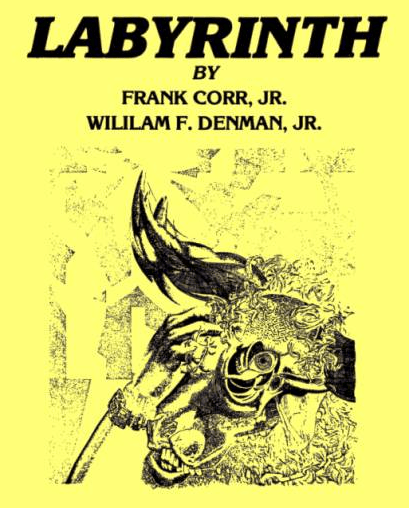
We’ve previously played Reality Ends by William F. Denman, Jr. and Deathmaze 5000 by Frank Corr, Jr. For Labyrinth, William and Frank teamed up to re-use the Deathmaze engine for another 3D adventure.
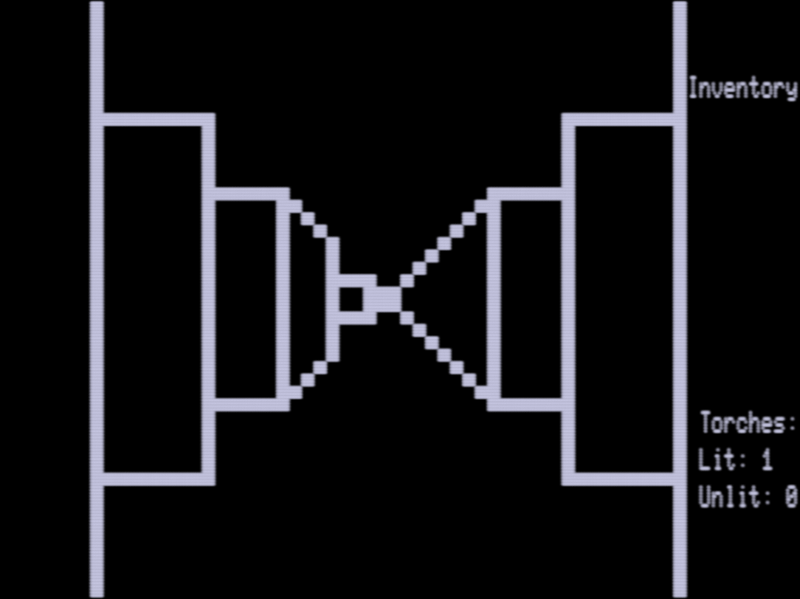
The movement system is identical. There’s still a torch that slowly runs out and a hunger system. Every item is still in a “box” to make it easy to represent.
Unlike Deathmaze where the goal was just to escape, here the goal is to hunt down and kill the minotaur. I ran across the minotaur rather quickly.
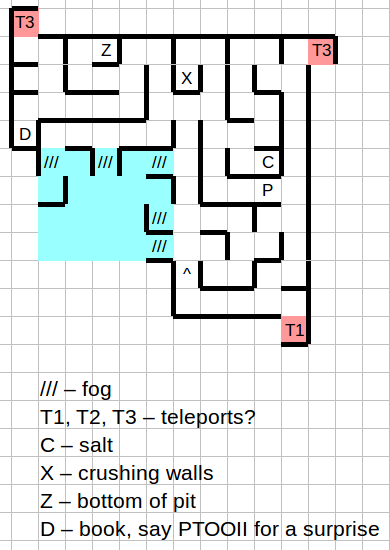
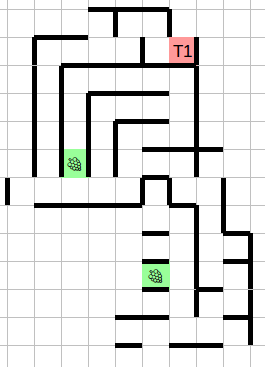
The P is a pit you can fall down; note also the Z which is the bottom of a pit, indicating we are starting at the middle of the maze instead of the top or bottom.
If you stay in any of the “Fog” locations for long enough eventually the ground shakes and the minotaur appears. (This is a lot like the Deathmaze monster, but the previous game didn’t have an entire chunk of the very first map marked as a danger zone.)
The maze is more confusing this time; notice the “teleport” locations. Sometimes you can take a step in one direction and find when turning around that the landscape has changed behind you. I ended up making this map past one of the teleports; notice there’s a symmetry which suggests somewhere along the line I managed to loop back to where I started.
The grapes are FOOD. I’m pretty sure it’s the same box in both places.
There’s no obvious initial sticking puzzle like the calculator from Deathmaze. Just getting to the point where I have the boundaries mapped might take a while. If you’re eager to “read ahead”, Will Moczarski covered Labyrinth last year at The Adventure Gamer.
The AX at the beginning is entirely a red herring. The TROLL is a red herring. The FLUTE that you can use to charm a snake is a red herring (you get bit with or without using the flute beforehand). The stone IDOL is a red herring. The RAT is a red herring.
House of Thirty Gables is like a con as a text adventure game, and appropriately, one of the most infamous con artists in early computer history makes an appearance.
…
While he had already started his career in crime at least 10 years before, “Colonel David Winthrop” (aka Harry Hunt, aka Jim Anderson) first turned to computers in 1975 when he joined the Southern California Computer Society.
The Southern California Computer Society was formed that very summer as “a group of computer hobbyists and enthusiasts who are determined to build home systems and share their understanding and dreams with a world which has become dependent upon and soon must become familiar with those fascinating and perplexing machines called computers.”
Out of the 184 starting members (179 men, 5 women) 83 had interest in a group purchase; while it was possible to get a reasonably priced Altair 8800 at this time, more powerful computers were still very expensive.
They eventually gathered $7000, which “went to a vendor … who never vended.” This, combined with litigation involving a publisher, led to the SCCS’s dissolution a mere 2 years later.
The $7000, of course, went to the Colonel; around $33,000 in 2019 after inflation. This was a tidy payday, but he was just getting started.
On its surface, the advertisement above was a good discount for its time.
The picture is a mock-up; there are no parts inside.
The Colonel had refined the basic scam idea from the SCCS’s “group purchase” — get people to spend money for non-existent hardware, take the money, and run. The extra twist here is that the company is real. He hired four other people to form DataSync; they didn’t know they were part of a scam.
However, this time the police had caught up with him, and he was arrested the month before the advertisement above came out. That wasn’t enough to stop the Colonel, who instructed the receptionist to read, verbatim:
I must inform you that the DataSync Corporation advertisements currently appearing in the magazines are fraudulent and the man responsible is now in jail. We do have every intention of producing a 16K RAM and a low-cost video terminal that are similar electronically and cosmetically, but you have to be aware that the advertisements are false.
Our expected shipping date for the new DataSync DS-16K RAM is approximately July 28th, and the expected shipping date on the DA-100 Terminal is September 15th. Knowing this, would you still like to place an order for superior products from DataSync Corporation?
Most of the people calling in still put in an order.
The Colonel clearly had a knack for persuasion. He pleaded guilty to 3 charges of felony theft and was sentenced to 32 months in prison. After six months he used his knack to wrangle himself a transfer to the minimum-security Chino State Prison, where he then performed a prison break the very next day (February 26, 1978) by just walking away.
…
The Colonel was on the run. In their June 1978 issue, Kilobaud Magazine reprinted a bulletin from the Santa Maria Police Department.
His method of operation has been to move to a town under a new identity, rent a house with an option to buy and to make contacts in his field of endeavor (recently, computer hobbyists). Hunt will generally begin his operation by soliciting backing for product design from private parties. Often he will sell his qualifications so well that it is the victim’s idea to ask Hunt to design a product for him.
Despite this detailed description (with five mugshots!), the Colonel still wasn’t done scamming the computer world, and in 1979 he returned for his biggest score.
…
This time, the Colonel set up base in Tucson, Arizona. In January 1979, the unwitting Perry Pollock signed a contract to make a company called World Power Systems, Incorporated.
Perry Pollock’s job was to provide venture capital and credit. (He was the one with the good credit.)
The scam ran a little different. World Power Systems started like a real company. They bought equipment from suppliers, and they always paid on time. They took orders for merchandise and actually shipped what was promised. At first.
They started to fall behind in shipping; they blamed suppliers and told customers to please be patient. Orders were still being sent, just with a delay.
In the meantime, because they had bought equipment and paid for it on time, they built enough confidence with suppliers to ask for items on loan.
You might see where this is going, but the final phase never quite happened. The ideal scenario for the Colonel, as described in Kilobaud October 1979:
Eventually, everything would come to a head. The creditors would threaten to go to the police and courts for their money; the customers would threaten to go to the Better Business Bureau and the police to get their equipment. At this point Phase IV would be initiated. This would entail cleaning out the bank accounts, shifting the merchandise around from one location to another and leaving a confusing trail as to its exact location — and setting up a fall guy.
However, the heat went on too early, due to the efforts of two computer enthusiasts, Bill Godbout and John Craig (the latter being the former editor of Kilobaud). The Colonel decided to try to take the money and run; carting off allegedly around $250,000 in merchandise (over a million in 2019 dollars after inflation).
He (with his wife) was in the middle of dying his hair when the police found him.
…
So, back to the game.
It turned out I really only had two puzzles left to resolve since last time. The first involved finding an antidote for a snake bite, and as a number of commenters pointed out, the cryptic MAREZEDOATS… hint the game gave was a reference to a song.
If the words sound queer and funny to your ear, a little bit jumbled and jivey,
Sing “Mares eat oats and does eat oats and little lambs eat ivy.”
“Eat ivy” at the end was the key — while not an object in the game, there was a room described as having ivy.
YOU ARE IN A LARGE DAMP ROOM. THE WALLS ARE COMPLETELY COVERED WITH IVY.
A NARROW FOREBODING PASSAGE LEADS WEST.
A GLOOMY PASSAGE LEADS NORTH.
A WIDE MISTY PASSAGE HEADS SOUTH.
EAT IVY
YOU CHOKE DOWN SOME IVY.
YOU SUDDENLY FEEL MUCH STRONGER.
This is the only spot in the game which lets you interact with something in the room description as opposed to being an object on a separate line. This would annoy me more except I’m fairly confident now the intent was for the player to use the hint, as opposed to it being only-for-those-who-give-up.
I say this because of the crushing ceiling scene.
>GET COIN
YOU HAVE THE COIN.
A HEAVY STEEL GRATE SUDDENLY COMES CRASHING DOWN IN FRONT OF THE ONLY EXIT.
Nothing helps here. The ceiling lowers over a series of turns:
YOU HEAR A RUMBLING SOUND AND THE CEILING SUDDENLY LOWERS A FOOT. THE CEILING HEIGHT IS NOW ABOUT 4 FEET.
THE CEILING LOWERS ANOTHER FOOT. CEILING HEIGHT IS NOW ONLY 3 FEET!
YOU SEEM TO BE HAVING A BIT OF TROUBLE. I WILL GIVE YOU A HINT BUT IT WILL COST YOU A GOLD COIN.
DO YOU WANT THE HINT? YES
THE HINT IS: PMPH IS THE WORD.
THE CEILING DROPS AGAIN! CEILING HEIGHT IS NOW ONLY 2 FEET.
If you then SAY PMPH:
YOU SAY “PMPH”.
CHUCKLE, CHUCKLE. MAN ARE YOU GULLIBLE.
THE CEILING DROPS TO WITHIN 1 FOOT OF THE FLOOR! YOU ARE FLAT ON YOUR STOMACH.
The game eventually offers another hint
YOU SEEM TO BE HAVING A BIT OF TROUBLE. I WILL GIVE YOU A HINT BUT IT WILL COST YOU A GOLD COIN.
DO YOU WANT THE HINT? YES
I APPRECIATE YOUR TRUST.
The second “hint” opens the gate so you can escape, but this entire sequence is a red herring; the hints are the only way to escape (if you say NO to the hint you get crushed) and by the end of the scene, the player has gained one gold coin but lost two.
Speaking of being trusting, let’s return to a man with a coin I mentioned last time.
YOU ARE IN A SMALL ROOM WITH YELLOW TILE WALLS.
A TUNNEL HEADS SOUTH.
THERE IS A MAN WITH A FRIENDLY SMILE OFFERING YOU A GOLD COIN.
If you try to take the coin, he takes all your money and leaves you with a WORLD POWER I.O.U. That means the Colonel is here, commemorated in text adventure form. You can “kill” him, but he just poofs away with his money.
The solution is to KISS him. He still poofs away, but leaves the gold coin behind. (If someone has misconceptions about the player avatar’s gender or sexuality, I could see this puzzle being a problem; my main issue was I wasted a lot of time trying to solve the crushing ceiling puzzle instead without spending any coins and assuming this puzzle was the red herring.)
This left me with 60 points and still short. However, the last 20 just come from returning to the surface.
YOUR SCORE IS 80 OUT OF 80.
The owner of Instant Software (who published this game) was Wayne Green. He was also the editor of 80 Microcomputing, a hobbyist publication of the kind that suffered misfortune via the Colonel. While 80 Micro was started too late to join in the “fun”, it really feels like a large chunk of House of Thirty Gables was meant as a sort of catharsis via inside joke.
Enter the House of Thirty Gables. But come prepared — for fun! Inside, you will encounter all sorts of weird goings on. Serpents, dragons, wild bears and sulking trolls are just a few of the strange creatures you may run into on your adventure through this House. There are tereasures to be found amid the foreboding surroundings, but it’s going to take some real thought to figure out how to gather them… and stay alive!
Bill Miller did multiple board game conversions for TRS-80 (Backgammon, Chess, Gomoku) and made an Eliza clone (Dr. Chips) but this is his only adventure game. It was published through Instant Software and it’s also their only adventure game (although an ex-employee made The Programmer’s Guild which published quite a few more).
If you’re thinking “haven’t we played a game with this title before?” you might be thinking of Greg Hassett’s House of the Seven Gables. Additionally, if you want to find and download House of Thirty Gables, you have to look for the file marked House of Seven Gables (19xx)(Greg Hassett)[CMD].zip which has been misfiled for a very long time. (It took me an hour of searching and the realization “wait, Greg Hassett didn’t convert anything to machine language until he wrote Enchanted Island” to find it.)
Given the treasure-hunt premise and simple opening (see above) I thought I’d be in for a cozy traditional fantasy jaunt, but in what is becoming a common pattern for this blog, House of Thirty Gables took a hard left early. The closest comparison I can think of is Will ‘O the Wisp, which intentionally depicted the main character as bumbling.
After a few opening rooms where you can grab an ax and an apple comes the first “enemy”.
YOU ARE IN A SMALL DAMP ROOM.
A DAMP CRAWLWAY GOES EAST.
A PASSAGEWAY HEADS NORTH
A DIMLY LIT STAIRCASE LEADS UP.
A SINISTER TROLL SULKS IN THE CORNER.
When I first went through I just walked by the troll with the assumption I’d deal with it later, but eventually out of curiosity I tried KILL TROLL.
KILL THE TROLL WITH WHAT? AX
ONE MIGHTY BLOW FROM YOUR AX HAS KILLED THE POOR INNOCENT TROLL.
If you then LOOK:
A POOR MURDERED TROLL LIES IN THE CORNER.
Shortly after this comes another floor, which includes a dwarf which attacks at random, classic Adventure style:
YOU ARE SUDDENLY CONFRONTED BY AN ANGRY DWARF.
However, if you try to throw the ax:
YOU SEEM TO BE VERY INEPT AT AX THROWING. THE AX BOUNCES OFF THE WALL AND FALLS HARMLESSLY TO THE FLOOR.
Alternately, if you simply try to KILL DWARF and specify with the AX:
THE DWARF IS TOO NIMBLE FOR YOU TO KILL HIM WITH THE AX.
On the same level, there’s a snake guarding an emerald.
YOU ARE IN A LARGE GLOOMY ROOM.
A TUNNEL HEADS WEST.
A TUNNEL HEADS SOUTH.
A LARGE EMERALD RESTS IN THE CORNER.
THE EMERALD IS GUARDED BY A DEADLY GREEN SNAKE.
You’ve got a flute you can play…
THE SNAKE IS MESMERIZED WHEN YOU PLAY THE FLUTE.
…but finishing the puzzle and taking the emerald results in you being chastised for your greed.
YOU HAVE THE EMERALD. HOWEVER, YOUR GREED HAS BEEN VERY COSTLY. YOU HAVE BEEN BITTEN BY THE DEADLY GREEN SNAKE. YOU WILL PERISH IN 10 MOVES UNLESS YOU CAN FIND AN ANTIDOTE.
There are 80 points total. The emerald above yields 10 points, and a ruby from a different part of the map yields another 10 points. All the rest of the points I’ve gotten have come from “gold coins”. Gold coins are spread about mostly at random (kind of like Oldorf’s Revenge) and each one is worth 5 points, so a fair amount of treasure comes from just exploration rather than solving puzzles. The extra gimmick this game has is that the gold can be spent for hints. Continuing the situation above with the poison, if the 10-move limit gets close:
YOU SEEM TO BE HAVING A BIT OF TROUBLE. I WILL GIVE YOU A HINT BUT IT WILL COST YOU A GOLD COIN.
DO YOU WANT THE HINT? YES
THE HINT IS: MAREZEDOATS…
I’m not really sure how to read the hint here; based on other hints I don’t think it’s an anagram or cryptogram. (Relatedly, there’s a stone idol elsewhere with the word TLOLOC on it; trying to SAY TLOLOC doesn’t do anything, so I suspect it may be “encrypted” in the same way.)
Even though hints were a part of original Adventure, this is the first I’ve seen of actual treasure items being used as hint currency. This becomes common later with the Professor Layton games, but that’s much later (the first game came out in 2007), so, good job 1980.
My max score at the moment (not counting getting the emerald which I still die from, or a gold coin from a room where the ceiling crushes me from above) is 45 out of 80, so I know I must be missing a section. I have no idea how, though, because the game is extremely clear as to the exits; they’re always listed as seen in the room descriptions above, each exit on its own line, so there’s no real way for me to have missed something. Except, I must have missed something, right?
Other than the puzzles above I have yet to use a DEAD RAT (where you are continually told “THERE IS A TERRIBLE SMELL” if you tote it around) and I have to reckon with A MAN WITH A FRIENDLY SMILE OFFERING YOU A GOLD COIN where trying to TAKE COIN results in
THE MAN DISAPPEARS IN A PUFF OF SMOKE.
YOU SUDDENLY FEEL LIGHTER.
and your gold coins have vanished and your inventory now has AN I.O.U. FOR 10 GOLD COINS SIGNED BY WORLD POWER SYSTEMS. The I.O.U. is worth 0 points.



















 Renga in Blue