From the Commodore cover of the game, via Mobygames.
Some of this progress was, admittedly, sheer luck in timing. The game continues its pattern of having time be important, and one particular moment I solved what was potentially a very tricky puzzle by accident.
Last time I had left off on killing a shadowy figure, who I still haven’t fully figured out yet. If there’s something special to do there I figured I might need an item elsewhere, and I still had puzzles to nudge at. Specifically, I took the opportunity to puzzle over the Scenic Vista.
Scenic Vista
You are in a small chamber carved in the rock, with the sole exit to the north. Mounted on one wall is a table labelled “Scenic Vista,” whose featureless surface is angled toward you. One might believe that the table was used to indicate points of interest in the view from this spot, like those found in many parks. On the other hand, your surroundings are far from spacious and by no stretch of the imagination could this spot be considered scenic. An indicator above the table reads “IV”.
Mounted on one wall is a flaming torch, which fills the room with a flickering light.
I thought there had to be something else to the table, so I kept trying out verbs until hitting paydirt…
>turn table
You can’t turn that!
>feel table
You touch the table and are instantly transported to another place!
Sacrificial Altar
This is the interior of a huge temple of primitive construction. A few flickering torches cast a sallow illumination over the altar, which is still drenched with the blood of human sacrifice. Behind the altar is an enormous statue of a demon which seems to reach towards you with dripping fangs and razor-sharp talons. A low noise begins behind you, and you turn to see hundreds of hunched and hairy shapes. A guttural chant issues from their throats. Near you stands a figure draped in a robe of deepest black, brandishing a huge sword. The chant grows louder as the robed figure approaches the altar. The large figure spots you and approaches menacingly. He reaches into his cloak and pulls out a great, glowing dagger. He pulls you onto the altar, and with a murmur of approval from the throng, he slices you neatly across your abdomen.
**** You have died ****
You find yourself deep within the earth in a barren prison cell. Outside the iron-barred window, you can see a great, fiery pit. Flames leap up and very nearly sear your flesh. After a while, footfalls can be heard in the distance, then closer and closer…. The door swings open, and in walks an old man.
He is dressed simply in a hood and cloak, wearing a few simple jewels, carrying something under one arm, and leaning on a wooden staff. A single key, as if to a massive prison cell, hangs from his belt.
He raises the staff toward you and you hear him speak, as if in a dream: “I await you, though your journey be long and full of peril. Go then, and let me not wait long!” You feel some great power well up inside you and you fall to the floor. The next moment, you are awakening, as if from a deep slumber.
Endless Stair
There is a lamp here.
…or at least a very amusing death. This indicated I could use the table to teleport to the four different places being viewed. Other than the instant-death one there was one in the main dungeon proper (which can be used to transport objects out of the area, since ordinarily you have to jump in the lake which doesn’t let you).
>touch table
You touch the table and are instantly transported to another place!
Damp Passage
This is a particularly damp spot even by dungeon standards. You can see a crossroads to the west, and two nearly identical passages lead east and northeast. A stone channel, wide and deep, steeply descends into the room from the south. It is covered with moss and lichen, and is far too slippery to climb. The channel crosses the room, but the opening where it once continued north is now blocked by rubble.
Additionally, I found a room which I think comes straight out of Zork I. Remember I mentioned the crystal ball from mainframe Zork showed an area that was in Zork I so it couldn’t quite match the puzzle; this seems to be at least a nod to that.
Timber Room
This is a long and narrow passage, which is cluttered with broken timbers. A wide passage comes from the east and turns at the west end of the room into a very narrow passageway. From the west comes a strong draft.
There is a broken timber here.
Finally, most importantly, I found the Grue Repellent I had been looking for!
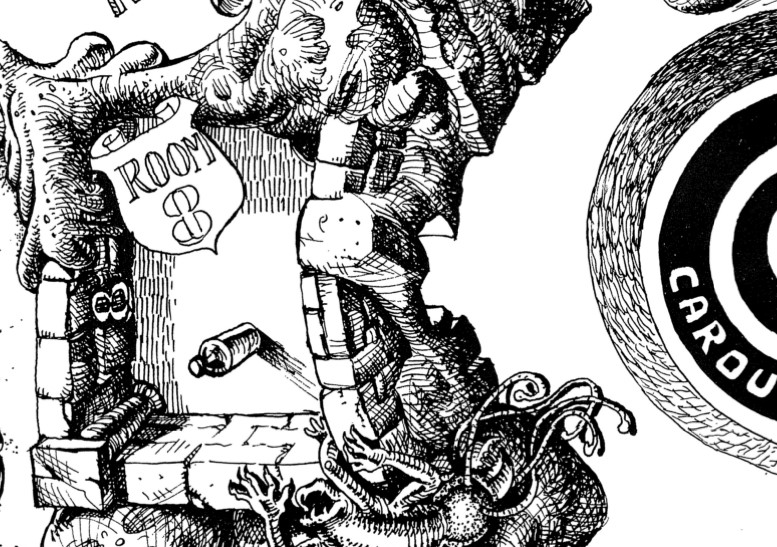
Room 8
This is a small chamber carved out of the rock at the end of a short crawl. On the wall is crudely chiseled the number “8”. The only apparent exit, to the east, seems to be a blur and a loud, whirring sound resounds through the rock.
A spray can is in the corner. In large type is the legend “Frobozz Magic Grue Repellent.”
This room is adjacent to the Carousel from Zork II.
While, again, you can’t jump in the lake with objects, what you can do is apply the repellent right before popping into the lake (which I imagine rubs some it off, but not all of it) and then head into the dark cave where I remembered walking through some grues.
From the Zork 3 manual.
While they don’t hold particular terror now I remember this being one of the most unnerving parts of the game back when I was 12 or so, which is how the existence of repellent stuck in my mind in the first place.
>apply can to me
The spray smells like a mixture of old socks and burning rubber. If I were a grue I’d sure stay clear!
>enter lake
The shock of entering the frigid water has made you drop all your possessions into the lake!
On the Lake
>s
Southern Shore
You are on the south shore of the lake. Rock formations prevent movement to the west and thickening swamp to the east makes the going all but impossible. To the south, where the beach meets a rock formation, you can make out a dark passage sloping steeply upward into the rock.
>s
It is pitch black.
>s
There are sinister gurgling noises in the darkness all around you!
It is pitch black.
The ground continues to slope upwards away from the lake. You can barely detect a dim light from the east.
That horrible smell is much less pungent now.
(I had to repeat this sequence a couple times until I found “south” was the appropriate exit. The dim light from the east makes the next step easy.)
>e
Key Room
You are between some rock and a dark place, The room is lit dimly from above, revealing a lone, dark path sloping down to the west.
To one side of the room is a large manhole cover.
The light from above seems to be focused in the center of the room, where a single key is lying in the dust.
The key is one that’s always shifting if you try to examine it. It seems to be a “master key” of sorts.
>examine key
The key is round and thin, more like a pencil than a key.
Strange, though. The key seems to change shape constantly.
>examine key
The key is a long and heavy skeleton key.
Strange, though. The key seems to change shape constantly.
Past the key is the bit where I got very, very, lucky. Normally you can then just walk your way to a water slide which goes down to the Damp Passage viewable from the table earlier. After X turns in the game (this is a global timer but I haven’t bothered to figure out what X is) is an earthquake that hits the caverns. If you wait too long to get through this section the passage is cut off. I managed to view the event while it was happening:
Water Slide
You are near the northern end of this segment of the aqueduct system. To the south and slightly uphill, the bulk of the aqueduct looms ominously, towering above a gorge. To the north, the water channel drops precipitously and enters a rocky hole. The damp moss and lichen would certainly make that a one-way trip.
There is a great tremor from within the earth. The entire dungeon shakes violently and loose debris starts to fall from above you.
The channel beneath your feet trembles. At once, the channel directly to the south of you collapses with its supporting pillar and falls into the chasm!
I might have puzzled out that this was essentially a softlock from my being too slow to get through this section, but I’m not so sure. I might also have caught on due to the earthquake also having a positive effect, as you’ll see in a moment.
Incidentally, if you don’t set up the torch first in the Damp Corridor the room is dark and you inevitably become grue bait. However, revival is forgiving and doesn’t drop score. This is doubly odd given the softlock I just mentioned. I think it isn’t about gameplay cruelty (or lack thereof) as much as plot; it makes sense the Dungeon Master is trying to help, but he can only do so much.
Moving on, I decided to try my newly-found key out on the rusted door branch I couldn’t get through. The obstacle seemed like rust, not the lack of a key, but I thought it was worth a try anyway.
Great Door
This is the south end of a monumental hall, full of dust and debris from a recent earthquake. To the east is a great iron door, rusted shut. To its right, however, is a gaping cleft in the rock and behind, a cleared area.
The “cleft” is new! It happens when the earthquake damages the caverns.
>e
Museum Entrance
This is the entrance to the Royal Museum, the finest and grandest in the Great Underground Empire. To the south, down a few steps, is the entrance to the Royal Puzzle and to the east, through a stone door, is the Royal Jewel Collection. A wooden door to the north is open and leads to the Museum of Technology. To the west is a great iron door, rusted shut. To its left, however, is a cleft in the rock providing a western route away from the museum.
To the north is a time machine (!) which I’ll talk about next time. I instead want to discuss the royal puzzle.
>s
Royal Puzzle Entrance
This is a small square room, in the middle of which is a perfectly round hole through which you can discern the floor some ten feet below. The place under the hole is dark, but it appears to be completely enclosed in rock. In any event, it doesn’t seem likely that you could climb back up. Exits are west and, up a few steps, north.
Lying on the ground is a small note of some kind.
>read note
Warning:
The Royal Puzzle is quite dangerous and it is possible to become trapped within its confines. Please do not enter the puzzle after hours or when museum personnel are not present.
The Management
>d
Room in a Puzzle
You are in a small square room bounded to the north and west with marble walls and to the east and south with sandstone walls.
So: this is Sokoban. The actual puzzle game was designed in 1981 and released in 1982, but this puzzle was present wholesale in the mainframe Zork, so it came beforehand. (I’m almost 100% certain Hiroyuki Imabayashi, inventor of Sokoban, had no chance to see the game. The Sierra On-Line Apple II adventures made it over the ocean early but not Zork.)
You start at the upper left, and push sandstone blocks (the lighter ones on the map). The X has a depression which contains a book with an elegant description.
The book is written in a strong and elegant hand and is full of strange and wondrous pictures. The text is in a tongue unknown to you and is penned in many colours. Some of the words seem to change colour as you read them. The book itself is very old and the pages dry and brittle.
(Why British spelling, I wonder?)
You can use the book at a door with a narrow slot to escape (that’s on the bottom row of the map) but it consumes the book. The right way to get out and keep the book is to push the block with a ladder attached to the west side so it is positioned in a way you can climb back up the way you came.
You need to clear space more or less as shown. What makes this interesting in a puzzle sense is both blocks in the top row are restricted to that row via Sokoban-rules, so you don’t have enough room to push the ladder over via a direct route.
>u
With the help of the ladder, you exit the puzzle.
Royal Puzzle Entrance
Lying on the ground is a small note of some kind.
I’ll get into the other exits from the Museum (a Technology Museum and a Jewel Room) next time, and possibly get all the way to the endgame? I’m still worried about another secret or holistic timing element (like the earthquake) I haven’t run into yet.
When playing adventure games — any genre of games really — I sometimes have “moments of recognition” where systems click together and a secret pattern is revealed.
With adventure games, this can include recognizing a technical restraint or common usage; a recent example would be Seek where it took some time to realize all action happened between rooms and USE worked as a verb with absolutely everything (even though other verbs were acceptable). Patterns might be a little more abstract, like recognizing a design tendency of the author; for instance, some of the Cambridge mainframe games like Hamil have very little in the way of “just scenery” rooms, so if there’s an unusual detail, there’s a fair chance it has some real significance (like dust on the floor being poison).
Katakombs might have went fully-on moon logic with its puzzle where you give sugar to a dragon, but once the pattern is established it becomes easier to recognize you might want to give salt to an elephant (even if still not terribly logical).
Art from the early Zork Users’s Group map. From the Gallery of Undiscovered Entities. Not how I envisioned the Dungeon Master.
With Zork III I already mentioned a scene where you go down a ledge, find a chest, and have someone ask about tying the rope to the chest. You then wait a bit, and climb up to find the man has already raided the chest and hands you over a staff he supposedly found in the chest. (The staff doesn’t fit back in the chest, so: suspicious.) There’s then a delay while he looks at his valuables and then leaves.
You can incidentally kill the man and take the valuables, but they are literally just described as valuables — there’s absolutely no point in having them.
The important thing on the sequence is that you have to WAIT. You not only need to WAIT for the man to come back with the rope, but you need to wait to have the whole sequence trigger in the first place:
Cliff Ledge
This is a rock-strewn ledge near the base of a tall cliff. The bottom of the cliff is another fifteen feet below. You have little hope of climbing up the cliff face, but you might be able to scramble down from here (though it’s doubtful you could return).
A long piece of rope is dangling down from the top of the cliff and is within your reach.
A large chest, closed and locked, is lying among the boulders.
>wait
Time passes…
>wait
Time passes…
At the edge of the cliff above you, a man appears. He looks down at you and speaks. “Hello, down there! You seem to have a problem. Maybe I can help you.” He chuckles in an unsettling sort of way. “Perhaps if you tied that chest to the end of the rope I might be able to drag it up for you. Then, I’ll be more than happy to help you up!” He laughs again.
Now, when I first ran across this I was examining things so it was quite natural to hang out for two turns, but it did start to lead me to suspect that there’s a general plot thread of patience, and in a practical sense, it may mean persistence and repetition could be the key to solving some puzzles.
I vaguely recalled seeing a ship somewhere in the game, so I went to the Flathead Ocean and waited. After six turns:
>look
Flathead Ocean
You are at the shore of an amazing underground sea, the topic of many a legend among adventurers. Few were known to have arrived at this spot, and fewer to return. There is a heavy surf and a breeze is blowing on-shore. The land rises steeply to the east and quicksand prevents movement to the south. A thick mist covers the ocean and extends over the hills to the east. A path heads north along the beach.
>look
Flathead Ocean
You are at the shore of an amazing underground sea, the topic of many a legend among adventurers. Few were known to have arrived at this spot, and fewer to return. There is a heavy surf and a breeze is blowing on-shore. The land rises steeply to the east and quicksand prevents movement to the south. A thick mist covers the ocean and extends over the hills to the east. A path heads north along the beach.
Passing alongside the shore now is an old boat, reminiscent of an ancient Viking ship. Standing on the prow of the ship is an old and crusty sailor, peering out over the misty ocean.
I did quite quickly come up with the next part, even though it is spectacularly unfair, or at least requires you to use some knowledge from Zork I.
The Land of the Dead, as depicted on the Zork User Group map for Zork I. Also from the Gallery for Undiscovered Entities.
Specifically, there’s a book that later gets used in combination with a candle and bell at the Land of the Dead.
COMMANDMENT #12592
Oh ye who go about saying unto each: “Hello sailor”:
Dost thou know the magnitude of thy sin before the gods?
Yea, verily, thou shalt be ground between two stones.
Shall the angry gods cast thy body into the whirlpool?
Surely, thy eye shall be put out with a sharp stick!
Even unto the ends of the earth shalt thou wander and
unto the land of the dead shalt thou be sent at last.
Surely thou shalt repent of thy cunning.
It was essentially a joke phrase in Zork I, and in Zork mainframe (which I was actually thinking of) the end game has the Dungeon Master ask where the phrase “Hello Sailor” is useful; the proper response is “nowhere”. Due to that, it was irresistible to try:
>say “hello sailor”
The seaman looks up and maneuvers the boat toward shore. He cries out “I have waited three ages for someone to say those words and save me from sailing this endless ocean. Please accept this gift. You may find it useful!” He throws something which falls near you in the sand, then sails off toward the west, singing a lively, but somewhat uncouth, sailor song.
The boat sails silently through the mist and out of sight.
There seems to be zero indication in Zork III itself to do this. I could check the Invisiclues to see if there’s an official explanation but I’ve managed to steer clear so far so I’ll wait until I’m done / actually stuck. (If this is really the case, the upsetting part isn’t the carry-over of knowledge as much as the lack of clarity it could even happen; Savage Island Part 2 uses information from Part 1 but it requires a password from the end of part 1 to even get started, marking it as clearly a continuity of work.)
The sailor drops off a vial. I’m not sure what to do with it yet.
>examine vial
It is a small, transparent vial which looks empty but is strangely heavy.
>open vial
The vial is open. There is a sweet odor from within the vial, apparently coming from a heavy but invisible liquid.
You can drink it with no apparent ill effect, but no apparent good effect either. I originally suspected it might be the grue repellent but there’s no way to apply it to the skin, and I vaguely recall the repellent is straightforwardly labeled as such.
Moving on: I was able to apply the patience pattern to another puzzle entirely.
The Land of Shadow, from the Zork III ZUG map.
The Land of Shadow had a figure that attacks. Repeated attempts at combat did not seem to be going anywhere, so I assumed this involved a puzzle of some sort. Maybe we’re not supposed to attack the shadow at all, but make peace with it?
Land of Shadow
Through the shadows, a cloaked and hooded figure appears before you, blocking the northwestern exit from the room and carrying a brightly glowing sword.
From nowhere, the sword from the junction appears in your hand, wildly glowing!
>kill figure with sword
A good stroke, but it’s too slow.
The hooded figure attempts a thrust, but its weakened state prevents hitting you.
>kill figure with sword
A quick stroke, but the hooded figure is on guard.
The hooded figure attempts a thrust, but its weakened state prevents hitting you.
>kill figure with sword
A good slash, but it misses by a mile.
You are wounded by a lightning thrust!
I decided, after the other events that involved WAITing, to just be persistent. After about 50 or so exchanges — certainly enough that it would indicate in most games we were barking up entirely the wrong tree — I finally won.
>kill figure with sword
A sharp thrust and the hooded figure is badly wounded!
The figure appears to be badly hurt and defenseless.
The hooded figure attempts a thrust, but its weakened state prevents hitting you.
>kill figure with sword
The hooded figure, fatally wounded, slumps to the ground. It gazes up at you once, and you catch a brief glimpse of deep and sorrowful eyes. Before you can react, the figure vanishes in a cloud of fetid vapor.
Now, even though this caused my score to go up by one, I’m not sure this is quite right — there’s the message right before about “badly hurt and defenseless” which may mean we need to do something special there. Even knowing that it is possible to reach that state with nothing other than KILL FIGURE WITH SWORD is progress, though.
Speaking of score: it is now at 3. One point for picking up the lantern (at the very first room!) one point for getting the sword (which involves doing nothing, more or less) and one from the combat I just mentioned. I originally thought it might be a set of 7 items but now I’m not so sure. The score certainly feels much different than any other Infocom game.
I did manage to solve one more puzzle. The old man that appears at the engravings I mentioned last time is also something of a patience-event; I only met him on a repeat visit to the room.
>ne
Engravings Room
You are in a room with passages heading southwest and southeast. The north wall is ornately carved, filled with strange runes and writing in an unfamiliar language.
>sw
Damp Passage
>ne
Engravings Room
An old and wizened man is huddled, asleep, in the corner. He is snoring loudly. From his appearance, he is weak and frail.
Going by the logic maybe we are supposed to “prove our worth” and the usual fairy tale thing of proving kindness to strangers, I took the bread that had been laying out in the open by the tree and gave it to the man.
>wake man
The old man is roused to consciousness. He peers at you through eyes which appear much younger and stronger than his frail body and waits, as if expecting something to happen.
>give bread
(to the old man)
He looks up at you and takes the waybread from you. Slowly, he eats the bread and pauses when he is finished. He starts to speak: “Perhaps what you seek is through there!” He points at the carved wall to the north, where you now notice the bare outline of a secret door. When you turn back to the old man, you notice that he has gone!
This leads to a new area that I recognize from the mainframe Zork endgame.
>n
Button Room
You are standing at the southern end of a long, dimly lit hall. To the south, stairs ascend into darkness. To the north the corridor is illuminated by torches set high in the walls, out of reach. On one wall is a red button.
>n
Beam Room
You are in the middle of a long north-south corridor whose walls are polished stone. A narrow red beam of light crosses the room at the north end, inches above the floor.
The corridor continues north and south.
>n
Hallway
This is a part of the long hallway. The east and west walls are dressed stone. In the center of the hall is a shallow stone channel. In the center of the room the channel widens into a large hole around which is engraved a compass rose.
The hallway continues to the south.
A large mirror fills the north side of the hallway.
The button normally just goes click with no effect. I remember having to block the beam with an object, for some reason.
>put lamp in beam
The beam is now interrupted by a lamp lying on the floor.
Putting the lamp in the beam and then pressing the button again:
>push button
Click. Snap!
This has an effect in the mirror room:
Hallway
This is a part of the long hallway. The east and west walls are dressed stone. In the center of the hall is a shallow stone channel. In the center of the room the channel widens into a large hole around which is engraved a compass rose.
The hallway continues to the south.
A large mirror fills the north side of the hallway.
The mirror is mounted on a panel which has been opened outward.
I haven’t had time to investigate further, but I can say: glorious forward progress! The game does seem to be aiming at a compact experience, so I don’t expect this to go much longer than two more posts.
One last, brief note for now. You can download any version of an Infocom game here, but if you download Zork 3, do not download the last one listed (r25-s860811). Instead download the one right before, marked “Masterpieces version”. I’ve found r25 to sometimes crash when taking an object (one you aren’t allowed to, but the game isn’t supposed to crash!) and the prior version I have had no issues with.
As in a dream, you see yourself tumbling down a great, dark staircase. All about you are shadowy images of struggles against fierce opponents and diabolical traps. These give way to another round of images: of imposing stone figures, a cool, clear lake, and, now, of an old, yet oddly youthful man. He turns toward you slowly, his long, silver hair dancing about him in a fresh breeze. “You have reached the final test, my friend! You are proved clever and powerful, but this is not yet enough! Seek me when you feel yourself worthy!” The dream dissolves around you as his last words echo through the void…
Infocom followed Deadline (which I played last year) with two games in time for the Christmas shopping season: Starcross, a hard sci-fi game where you play a black hole prospector, and Zork III, the finale to their best-selling trilogy.
I do want to emphasize “best selling” here — we have very good data from 1981 to 1986 that shows 378,987 units sold. Hitchhiker’s Guide to the Galaxy was second at 254,249. The importance is in, essentially, the critical mass: it left a mark that makes it remembered today amongst even “normal” gamers in a way that one of the critically acclaimed games like A Mind Forever Voyaging or Trinity didn’t.
To put it another way, for most of this blog’s existence the reason the average person found it is that they were looking up something about Zork. (This has now been outdone by Cain’s Jawbone, which I should get back to this summer for an encore performance; people are still editing the commentary document.) So I’m looking forward to giving the trilogy a proper farewell. Given the games essentially started from the mainframe version and I first wrote about mainframe Zork in 2011, this has been essentially a 12-year odyssey.
The general wisdom is that Zork mainframe was split into 3 parts in order to form the trilogy. That’s only sort-of correct; Zork I and mainframe Zork quite clearly match, Zork II grabs some puzzles and arranges them in a much different geography and with a brand-new overarching plot involving a demon, and Zork III grabs most of the remaining puzzles as well as a section of the endgame. Since the end of Zork mainframe matches Zork III (to the best of my memory, I haven’t played Zork III since 1990) in one sense Zork III actually matches more closely the original source material.
But only in a sense: certainly the framing is not around gather-the-treasures in the same way. One remarkable thing I remember is that there are only 7 points possible, and getting all 7 points does not mean you’ve reached the end of the game.
Endless Stair
You are at the bottom of a seemingly endless stair, winding its way upward beyond your vision. An eerie light, coming from all around you, casts strange shadows on the walls. To the south is a dark and winding trail.
Your old friend, the brass lantern, is at your feet.
>score
Your potential is 0 of a possible 7, in 0 moves.
You embark on the journey, as the above clip indicates, by starting at the bottom of a staircase, the same one found at the end of Zork II. There’s an “old, yet oddly youthful man” that speaks to us, but the game is otherwise evasive. Even the advertising copy is evasive; Issue II of The New Zork Times states “The greatest challenge [of Zork III] is figuring out what is going on and what you are there for.”
Without a treasure directive, the only thing to do is: explore.
>turn on lamp
The lamp is now on.
>s
Junction
You are at the junction of a north-south passage and an east-west passage. To the north, you can make out the bottom of a stairway. The ways to the east and south are relatively cramped, but a wider trail leads to the west.
Standing before you is a great rock. Imbedded within it is an Elvish sword.
>get sword
The sword is deeply imbedded in the rock. You can’t budge it.
This moment made me glad, because it means I didn’t remember everything about the game; I don’t remember this moment at all.
In fact, I don’t remember enough that I have yet to solve a puzzle, even though I’ve mapped out the initially accessible areas. Let’s take a tour:
You start at the stairs and junction; the sword, incidentally, isn’t really a puzzle, as it will simply appear in your hands later. Just to the east of the junction there’s a small area with “stone channel” that is “too slippery to climb” (this might be a puzzle, but I suspect this is just an exit rather than an entrance) as well as an “engravings room” which echoes a similar room in Zork 1.
Engravings Room
You are in a room with passages heading southwest and southeast. The north wall is ornately carved, filled with strange runes and writing in an unfamiliar language.
An old and wizened man is huddled, asleep, in the corner. He is snoring loudly. From his appearance, he is weak and frail.
The wizened man — who I suspect to be the Dungeon Master — incidentally is here at random. You can wake him but I haven’t gotten anything useful to happen from it.
>wake man
The old man is roused to consciousness. He peers at you through eyes which appear much younger and stronger than his frail body and waits, as if expecting something to happen.
Down an adjacent branch is a crystal grotto leading to a rusted door which I am unable to open.
Crystal Grotto
This is a chamber of breathtaking beauty. Mighty stalagmites form structured shapes of rock, encrusted with crystalline formations. Phosphorescent mosses, fed by a trickle of water from some unseen source above, make the crystals glow and sparkle with every color of the rainbow. There is an opening to the west, and a man-made passage heads south.
>s
This is the north end of a large hall with a vaulted ceiling. A long, tiled hallway leads north through a tall arch. Although the origin or purpose of this room is unclear, there is a large rendering of the Royal Seal of Lord Dimwit Flathead carved on the wall.
>s
Great Door
You are in the southern half of a monumental hall. To the east lies a tremendous iron door which appears to be rusted shut.
I do like the brief moment here of Lord Flathead for building atmosphere and setting, but I don’t know if it has an significance other than marking the door as leading to something Royal-related.
Down a south branch is an area with a view of an aqueduct and a lake. The aqueduct seems to be merely for scenery.
Aqueduct View
This is a small balcony carved into a near-vertical cliff. To the east, stretching from north to south, stands a monumental aqueduct supported by mighty stone pillars, some of which are starting to crumble from age. You feel a sense of loss and sadness as you ponder this once-proud structure and the failure of the Empire which created this and other engineering marvels. Some stone steps lead up to the northwest.
The lake’s icy waters cause you to be “nearly paralyzed” and drop any items you have. This makes it impossible to carry your lamp; this is meaningful as the south shore has an exit but is dark.
Southern Shore
You are on the south shore of the lake. Rock formations prevent movement to the west and thickening swamp to the east makes the going all but impossible. To the south, where the beach meets a rock formation, you can make out a dark passage sloping steeply upward into the rock.
>s
It is pitch black. You are likely to be eaten by a grue.
>e
Oh, no! You have walked into a den of hungry grues and it’s dinner time!
(In one of the few things I remember clearly, I’m fairly sure grue repellent is used here, but I don’t know where to get it and if we have to be concerned about the lake washing it off.)
There’s one more shore you can visit that has a “Scenic Vista”, a table that switches between four scenes like a surveillance camera. They are marked I, II, III, and IV. I do not remember this part of the game at all.
I:
>examine table
The surface is pale and featureless, but slowly, an image takes shape!
You see a passage cluttered with broken timbers. An extremely narrow opening can be seen at the end of the room.
The image slowly fades.
II:
>examine table
The surface is pale and featureless, but slowly, an image takes shape!
You see a tiny room with rough walls. Chiseled crudely on one wall is the number “8”. The only apparent exit seems to be a blur.
The image slowly fades.
III:
>examine table
The surface is pale and featureless, but slowly, an image takes shape!
You see a wide room with two nearly identical passages leading east and northeast. A wide channel descends steeply into the room and seems to be blocked by rubble.
The image slowly fades.
IV:
>examine table
The surface is pale and featureless, but slowly, an image takes shape!
You see the interior of a huge temple rudely constructed of basalt blocks. Flickering torches cast a sallow illumination over an altar still wet with the blood of human sacrifice, its velvet covers stained and encrusted with gore.
The image slowly fades.
This seems to be invoking one of my favorite puzzles of original mainframe Zork, where you gaze into a crystal ball and see a scene with coal dust, and since the room is one not previously visited, you need to induce from the clues where the room might be. However, since the section of the game that had this room was already used in Zork I, the puzzle must be arranged differently here.
To the west there are three areas; first, a Land of Shadow made of multiple rooms (see the map) and where you hear “quiet footsteps” while walking about before being confronted.
Land of Shadow
You are in a dark and shadowy land. All around you are gentle hills and eerie shadows. Far above, shrouded in mist, you can barely make out the ceiling of the enormous cavern that spans this entire land.
Through the shadows, a cloaked and hooded figure appears before you, blocking the northwestern exit from the room and carrying a brightly glowing sword.
From nowhere, the sword from the junction appears in your hand, wildly glowing!
Any attempts to engage in battle fail. This uses a similar system of combat to the duels with the Thief in Zork 1, but you and the shadow are evenly matched. Interestingly enough, if you drop your sword the figure picks it up and hands it to you.
(It is faintly possible this figure is also the Dungeon Master.)
To the far west there is an ocean. Sometimes there is a ship but I haven’t been able to get its attention.
Flathead Ocean
You are at the shore of an amazing underground sea, the topic of many a legend among adventurers. Few were known to have arrived at this spot, and fewer to return. There is a heavy surf and a breeze is blowing on-shore. The land rises steeply to the east and quicksand prevents movement to the south. A thick mist covers the ocean and extends over the hills to the east. A path heads north along the beach.
To the northwest there’s a cliff under a gaping hole where sunshine is visible, with a piece of bread and a rope you can climb. Climbing the rope leads down to a ledge with a locked chest. After waiting briefly a man offers to help:
At the edge of the cliff above you, a man appears. He looks down at you and speaks. “Hello, down there! You seem to have a problem. Maybe I can help you.” He chuckles in an unsettling sort of way. “Perhaps if you tied that chest to the end of the rope I might be able to drag it up for you. Then, I’ll be more than happy to help you up!” He laughs again.
After sufficient waits the man does, indeed, come back:
>wait
Time passes…
A familiar voice calls down to you. “Are you still there?” he bellows with a coarse laugh. “Well, then, grab onto the rope and we’ll see what we can do.” The rope drops to within your reach.
>grab rope
You grab securely on to the rope.
The man starts to heave on the rope and within a few moments you arrive at the top of the cliff. The man removes the last few valuables from the chest and prepares to leave. “You’ve been a good sport! Here, take this, for whatever good it is! I can’t see that I’ll be needing one!” He hands you a plain wooden staff from the bottom of the chest and begins examining his valuables.
The chest, open and empty, is at your feet.
This may be the optimal result? I suspect something else is afoot here. But all I have for now is a sword, a staff, and some bread, and a smattering of puzzles that don’t want to budge.
The simulation occurs in the era when Napoleon is just beginning to emerge as the power in France. Acting as Ezekiel Breckenridge, a spy in His Majesty’s Service, it is your task to offset the intensity of these chaotic times in order to secure the interests of king and country.
— From the manual
The Apple II started to become an educational powerhouse quite early, especially when MECC (the Minnesota Educational Computing Corporation, they of Oregon Trail and Lemonade Stand) started to go all-in on the platform. But of course, there were more companies other than MECC trying to get on the action, like Spinnaker, a highly professionalized company founded strategically and based on venture capital; we’ll eventually get to them and their involvement with “Bookware”.
Superior Software (also located in Minnesota like MECC), despite targeting the same market, is not in the same category: it was the solo effort of Stephen Cabrinety, who was 16 years old at the time. His company came out with three “simulation” games.
Softalk, December 1983.
Legendary Conflict and Quest for the Scarlet Letter both seem to be genuinely enough on the simulation side that I won’t be playing them; The Breckenridge Caper, on the other hand, despite also being described as a simulation, is clearly an adventure game, with a map to explore, items to find, places to search, and puzzles to solve.
Via the Museum for Computer Adventure Games. I think a Simulation would be easier to sell in this case than an Adventure; “simulation” was a common word amongst history educators at the time, as classroom simulations became popular starting in the 1970s; having a Revolutionary War classroom game, for instance, where has half the class start as Revolutionaries and half start as Loyalists.
By 1798, while Napoleon was ambitious but hadn’t yet declared himself First Consul (1802) or Emperor (1804). He went on a campaign in Egypt — disrupting the British who used it as a route to India — and the game seems to be set right when Napoleon is still en route from France to Egypt.
A French diplomat described as a “Robespierre idealist” has made contact with the British and claims information about French military movements; your job is to meet the diplomat and obtain what he has.
The entire game is set on a pair of long streets in the city of Portsmouth, where the diplomat is supposed to make an appearance. The geography is on a circle, as you can go either LEFT (L) or RIGHT (R), and if you move enough times you loop back to where you start. There’s one side street reachable via an ALLEY (A). Most locations are by a building where you can then type ENTER and go inside; the buildings then either have everything happen in prompts, with no physical location, or have an room described by the game (where you can pick up items or SEARCH). If you study the map I have some exits marked by “x”; those are the ones that aren’t “real rooms” in the sense of an adventure game.
A portion of the overall map, the starting room is marked in green. This was taken while my gameplay was in progress, and the rooms marked in the corners are the one I’ve already used SEARCH on.
While the game actions are clearly adventure-related — you’re keeping an eye on time and hunger, but both are adventure standards — it is curious how it still feels slightly adventure-adjacent. Almost as if in an alternate universe with no Crowther/Woods Adventure, simulations would be another route to eventually develop adventure games (maybe without compass directions?)
Some places just sell things; you can get food or a place to stay at night, for instance. Some places are intended to allow you to grab items, either right out in the open or after a SEARCH.
Two items you can find are a RAZOR (at a barber shop) and a ROPE (at some stables) which can help find off some robbers who attack if you try to wander around at night; you can, however, simply avoid the night altogether.
The initial goal is to figure out what the diplomat looks like. The game isn’t fully clear on the plot here but it seems that the diplomat has already been in town long enough for a few people to notice; one way to find him is via a clothing shop where the diplomat has bought a disguise.
However, the clerk needs to be bribed in order to talk; you can go to a silversmith and buy something silver for 100 pence that will make the clerk happy.
Much simpler is to go in a coffeehouse; with coffee and a newspaper, you find information in a newspaper that identifies what the diplomat looks like.
Either way, the next task is tracking the diplomat down. The easiest thing is to simply run across him randomly; while checking the disk file later, I found content indicating there’s a magic scroll somewhere (!?) that can also be used to locate him.
The password bit is curious — there’s a couple places in the game where you can find phrases. You can donate at a church to get MAY GOD DELIVER THY SOUL. You can give money to an almanac maker to get AVARICE IS THE ROOT OF ALL EVIL.
As seen earlier, searching in some shipyards gets TIP THE TREE OF EVENTS AND SHAPE THE FUTURE OF THE ENTIRE WORLD. The actual phrase comes from searching at a newspaper and searching and finding a plaque: PRIDE IS CHIEF DETERRENT TO PROGRESS.
Typing that phrase (in whole, and without a period mark) is the password. It is unclear why a random plaque in a location the diplomat just arrived at would also be a password, and why we as the spy who was supposed to make contact never was told about it but — let’s just move on.
The problem with moving on is: I don’t know what to do here. This essentially is the end of the game already. I tried killing enough time that the “48 hours” we have runs out, and if that happens you lose. You can also get game over in other creative ways, like being recruited to the navy.
It could be as simple as declaring we’re finished but with a command I’m not understanding? In any case, I checked the file after and saw the winning message was
THREE CHEERS FOR A HERO OF THE WORLD! YOUR EFFICIENCY IN PERFORMING YOUR ASSIGNMENT HAS ALLOWED BRITISH NAVAL FORCES TO BLOCKADE CAIRO HARBOR AND THUS DEFEAT THE FRENCH ARMY COMMANDED BY THE ‘CORSICAN MONSTER’.
Which is good enough for me.
The game somewhat oversells its educational value; the instructions claim the need for SOME KNOWLEDGE OF EUROPEAN HISTORY AND ENGLISH LITERATURE. Perhaps I’m missing something in one of those two items in order to trigger the end game, but really, the setting was very loose on accuracy. Still, importantly, the setting felt different, and the “simulation” orientation led to some aspects (like optional encounters and puzzles) that were unusual for adventures at the time. This is another case, like Nellan is Thirsty, where innovation is triggered by aiming for a different audience than is normal.
Cabrinety unfortunately died young: of cancer in 1995. He’s still well-remembered, though, because he had been building a computer collection since 1975 and founded the Computer History Institute for the Preservation of Software in 1989, essentially the first of its kind. His collection now resides at Stanford.
It’s taken more than a decade to comb through the 800 or so file-size boxes of games and other software (another 150-odd mini-fridge-size boxes of hardware remain), but processing of the Stephen M. Cabrinety Collection in the History of Microcomputing at Stanford is now nearly complete. Eric Kaltman, who has been chiefly responsible for cataloging the collection, says the value of the assemblage is that it reflects not only “things that existed,” but “how people interacted with them.”
In addition to realia such as the Odyssey “brown box” (the very first video game console) or the Pong home-version game controller, early computer magazines—at one point Cabrinety subscribed to 60 different publications, according to his sister—reveal “perceptions of the media at the time, where people thought computers were going.” The intervening years have seen video games and interactive entertainment emerge as a dominant expression of culture, Kaltman says. “It’s good to be able to show a history and track a lineage, see trends emerge.”
Right away I discovered that software was not at the top of the food chain. My people didn’t work in headquarters with everyone else. Instead they were exiled a few miles down the road to an abandoned shopping center. They shared a building with the cable-cutting operation. The programmers created software while listening to the constant CHUNK, CLUNK, CLANK of the cable-cutting machines. I learned that the previous year there was talk of moving software all the way up to Maine. A crazy idea — luckily it fell through.
For you non-computer people you need to understand that separating the software people from the engineers who design the hardware was very wrong. Software is the heart of a computer. A computer is useless without the basic stuff that my people developed: the operating system, programming languages, data management software, communications, etc. But DG didn’t see it that way. Its roots were hardware. Software was a necessary evil, created by hippy-freaks.
I had left off last time on a space station, the Liberator, invaded by ooze; we needed to escape through a teleport, but we couldn’t get it working. There were three parts to the issue.
First was something the Ferret Authors hinted at directly via email, although not through the game:
The Liberator is a high security area so you need all protocols in place.
This was referring to an event long back in Phase 10 where we found a communicator, which notified us that we had “failed to register with The Department”.
The communicator emits three short beeps followed by: “Area Scan commenced. Scan Completed. One humanoid detected in vicinity. Continuing. Automatic Personnel Identification Procedure initiated. APIP completed. Continuing. Agent identified, Darkins, B. O. Message Retrieval Service activated. Standby…. Latched. Continuing.
This is your automated message service. You have one new message as follows: Darkins, you have failed to register with The Department for an excessive period. According to standard protocol you must text the first 8 characters of your Security Pass Number to 80085 immediately, whereupon you will be notified regarding your court hearing. Failure to comply will result in immediate termination. This message has been deleted automatically”.
I had tried, at the time, to type 80085, and a few random security pass numbers besides, but never got anywhere; I assumed it was essentially a goof. But apparently, this was the part of the hold-up for reaching the glorious finale.
One thing I did manage to wrangle out is the likely possibility the Security Pass Number we wanted was way off a pass back in Phase 1.
This is because the message specifically said “first 8 characters” which only makes sense if a.) there’s things other than just numbers and b.) there’s a natural cut-off at 8, which there is for the pass. In other words, we needed to send
R4E339I0
to the number 80085.
Mustelid discovered we needed to dial the number 80085 followed by whatever ID number we needed all in the same string. However, the string
80085R4E339I0
does not work; there’s a second trick that also must be applied. We already had needed to use a special “old cell phone text message” style to put in some codes, where pressing 2 once could get an A, pressing 2 twice could get a B, and press 2 thrice could get a C.
So 80085R4E339I0 is close, but the part after the 80085 must also be given in text message code. The letters were simple enough to change to numbers (R, for instance, becomes 777), but still,
type 800857774333394440
doesn’t work. The digits got converted but not the numbers! In the “text message mode” typing “4” once would be assumed to be the letter G, not the digit “4”. The way to make it through (and I realized this due to behavior on an old phone of mine) is to keep pressing: once you’ve cycled through the letters, you make it to numbers. That is, 4 is G, 44 is H, 444 is I, but 4444 gets the actual digit “4”.
-> type 8008577744443333333333999994440
Typed.
The communicator emits a beep followed by a series of tones. After a short pause you hear a voice that says “Confirmed”.
Phew. All that work for a minor message that only affects things at the very end of the game.
With that out of the way, we needed to then set something or another in the navigation room, followed by using the teleport. The old “mica rectangle” that had been used to activate the controls at the lake were useful here; you can put it in a slot at navigation, then type ESCAPE FROM HOT ITV as the destination. (We learned this from doing anagrams of Blakes 7 epsiodes, and if you don’t remember how that goes, I’ll link to the post from last month.)
Lude
Navigation. West. Keyboard. Slot. Ooze.
Exits: —W ——– —
-> put mica in slot
Done.
You are starting to feel hot.
-> type ESCAPE FROM HOT ITV
Typed.
Faintly, off in the distance, you hear “Confirmed”.
Then, wearing a teleport bracelet from all the way in phase 9, you can re-use the mica rectangle at the teleport room.
Thatch-Wade
Teleport. East. West. Up. Bench. Control Panel. Slot. Ooze.
Exits: –EW ——– U-
Score increment of 20 points.
You are starting to feel very hot.
-> PUT MICA IN SLOT
Done.
You feel as though you have been through a slightly strange, out of body, experience.
Escape from hot ITV
You are in the escape pod for a high-gain constant acceleration max-thrust Interstellar Transport Vehicle. Affixed to the floor is a square object with an ornate hatch. On the hatch is engraved a logo. On top of the object is an illuminated red button marked “Initiate Launch Sequence”.
There is an embroidered sampler here
There is an elm trunk here
Score increment of 50 points.
There’s still an obstacle here: the button just goes “Click.” when you press it, no launch! The hatch is from the “Ferrigo Energy Utility Corporation.” which specifies to “Use approved fuels only.”
You might remember from back on the ground level there was a whole scene with a train crashing revealing some irradiated pellets. Through cunning trickery I was able to carry the pellets without dying of radiation sickness by putting them in a leather wallet, but an update to the version of Ferret from the authors put a stop to that technique, so either there was another way to carrying the pellets or they were a red herring.
They were a red herring.
The whole point of the train scene was to pick up the timber shards that result from the door of the warehouse crashing in. You have to take those shards up to the spaceship.
-> open hatch
Opened.
-> look in hatch
Peering inside you can see:
a fuel chamber
-> put shards in chamber
Done.
-> close hatch
Closed.
-> push button
Click.
An ethereal voice intones “Starting automated launch sequence.”
There is a shallow rumbling followed by a gentle grinding.
The voice continues: “Initial checks complete. Status is: ‘continue’.”
The volume of rumbling increases as does an incidious vibration.
A siren blast makes you jump. An unpleasant odour pervades the escape pod. “Launch sequence interrupted. Invalid parameter setting. Attempting shutdown. Cannot complete shutdown as program ‘sludgepest’ will not terminate. Would you like to terminate ‘sludgepest’ manually? Error, user requires termination not interrogation. Semantic overload. Who wrote this code? It’s rubbish. Abort sequence. Fail over. Fall over. Start again. Rebooting.”
Suddenly there is a jarring thump as the escape pod cover is explosively ejected from the ship, rapidly followed by the escape pod. You start to feel light-headed (and light-bodied) as the escape pod is blasted into free space. You lose consciousness for an indeterminate period of time. As you drift back into the land of the living (if you can call this living) you are overwhelmed by feelings of inner knowledge, but also the need to, to, what is it, er, wait! As the Guru says, wait and enlightenment will follow. There is another sensation. You sense the need for a new beginning, to start over. You intuit that you will gain new knowledge by revisiting and reviewing your journey as in rereading an old diary can shine new light on past experiences and yield new insights. Anyway, enough of this woo, woo, the launch sequence appears to have failed but at least you escaped. But from what and to what?
Escape from hot ITV
You are floating through space in the escape pod from a high-gain constant acceleration max-thrust Interstellar Transport Vehicle. Affixed to the floor is a square object with an ornate hatch. On the hatch is engraved a logo.
On top of the object is an illuminated red button marked “Initiate Launch Sequence”.
There is an embroidered sampler here
There is an elm trunk here
-> examine sampler
OVNER NA WYR OVN
-> examine trunk
The wooden trunk is heavy and about the size of an old-fashioned Dansette gramophone player. Engraved into one side of the trunk is the word AMGINE.
(The sampler’s message is Welsh, “Fear that knows no fear.” I take a Welsh sidetrack later, as you’ll see.)
Waiting long enough then results in The Final Challenge, and things were about to get very strange indeed:
The klaxon repeats its earlier trick, and so do you, followed by a disembodied voice intoning: “Red Alert! Red Alert! Routine surveillance has detected an automatic teleport rescue scan. The living contents of this vessel will be teleported to the nearest habitable planet or spacecraft. Locking on to scan. Prepare for automatic teleportation in 5, 4, 3, 2, 1 seconds.”
You feel disoriented (what a surprise), very tired and the need for sleep….
Quarantine Central
A featureless, senseless, disorienting, isolating chamber.
Score increment of 20 points.
The Guru incants:
111. Lastly, if the end is opaque, compare Phase 16 room manes with Blake’s 7.
This is a lot to take in:
a.) This is the final room, where we are supposed to do one thing to win.
b.) This one thing related to the “Guru incant” message. The game has entered “Guru” mode, and if you restart from the beginning, every time your game’s score increases you get one of the “Guru” messages. This means you have to play all the way through, all over again, from the beginning.
Resuscitation Chamber
This room contains a number of box-like machines. There is a door to the west. To the left of a display are three illuminated buttons, one red, one orange, one green. In the centre of the room, atop a metal plinth is a large chest. The lid of the chest is closed. Fixed to the side of the chest is a brass plaque.
Exits: –E- ——– —
There is a large box here
The Guru incants:
80. a science fiction book had saved Darkins from starvation in the tiny
Even worse….
-> hint
GLORY(ULTIMATE) = POINTS(MAX) & MOVES(MAX(2500)) & SOLUTION(FINAL)
c.) As the hint from the final room indicates, we need to have all the points and have an optimized turn count.
Part c was a little tricky on both counts. I already had part of a walkthrough written, and it took about an hour or so to write one for the rest, and then another hour to optimize my gameplay. My walkthrough scrounged every item possible like a packrat, since it was unknown what items were needed to solve what. Now that we had finally solved things, we could start to ignore picking up certain items (like the picnic box I carted all the way from phase 8 to phase 17). You also don’t need to hit any “information” things whatsoever; there’s nothing where information changes on a piece of paper between playthroughs.
In addition to optimizing, we were missing 30 points. The authors gave over a list of their point values at each phase which led us to realize we weren’t done yet with the Reactor.
Control Centre
You are in a brightly lit, partially derelict control centre set in solid rock. Most of the apparatus has been destroyed, however some still appears viable. There are three buttons, coloured red, orange and green; two switches, coloured blue and yellow; two knobs, one green, the other red; one lever and two digital gauges, one orange, the other blue. There is a steel door to the east.
This was a phase which consisted mainly of manipulating a device which opened doors on a grid; the main goal was to find a rod which could then be used to unlock a door.
I’ll discuss the pink rooms in a moment.
There were some fun deaths involving wandering in the nuclear area too long or opening too many doors (causing a meltdown) but this was otherwise one of the easier Phases, and it didn’t seem like it held any secrets. However, along the edges of the reactor proper, there were a series of dark rooms. Back when I first passed through the phase I checked through every single dark room and found nothing. What I did not do is check if the dark rooms had anything unusual happen if you tried other exits.
-> w
Nuclear Core
You are in a very warm room.
Exits: N-EW ——– —
-> n
You are in the dark.
-> drop orange pin
Dropped.
-> d
You are in the dark.
-> get orange pin
Taken.
-> drop orange pin
Dropped.
-> u
You are in the dark.
-> get orange pin
I can’t see anything like that around here.
To parse what just happened: if you go down in the dark room you loop back to the same room. If you go up you end up in a different room. (I had to boot up an old version of Ferret to test this — the current build doesn’t let you pick up dark things in rooms.) This meant I was onto something, but I needed to bring light to the dark room. The nuclear rod (the one we got to open a door) turned out to be the answer:
-> get rod
Taken.
A terrible feeling of nausea radiates through your body.
-> n
Dark Tunnel
-> l
Dark Tunnel
You are in a gloomy tunnel cut in sheer rock, with a stairway leading up.
Exits: -S– ——– U-
-> u
Dark Tunnel
You are in a gloomy tunnel cut in sheer rock. There are stairways leading up
and down.
Exits: —- ——– UD
-> u
Dark Tunnel
You are in a gloomy tunnel cut in sheer rock. There is a stairway leading down.
Exits: N— ——– -D
It only glows if exposed to enough radiation, so for the first time around I had to actually hang it in Death Area for a little bit to make sure it got glowy enough. (More safely, you can just drop the rod, leave to the dark room which is safe, then come back and get the rod all charged up.)
Unfortunately, the above sequence leads to a dead end!
-> n
Dark Tunnel
You are in a gloomy tunnel cut in sheer rock. There is a stairway leading down.
Exits: -S– ——– -D
-> d
Dark Tunnel
You are in a gloomy tunnel cut in sheer rock. There is a dark stairway leading
up.
Exits: —- ——– U-
However, there were other dark rooms, so I just needed to test … all of them! By tediously switching around doors using the machine (you can’t just open all of them because it causes the reactor to melt down).
This took a while; I found the right room second to last:
In my defense, it is a little harder to get to than some of the other rooms because you are at the limit in terms of number of doors you can safely open. Finally making it through:
Dark Tunnel
You are in a gloomy tunnel cut in sheer rock. There is a dark exit to the
south, and a brighter exit to the north.
Exits: NS– ——– —
-> n
Cutting
You are in a rock cutting. There is a dark tunnel to the south.
Exits: NS– ——– —
-> n
Cutting
You are in a rock cutting.
Exits: NS– ——– —
This gets absolutely nothing except for 30 more points. You can pass through to end up at the very start of the level and walk back round to the door that needs the rod to be unlocked. But remember, those 30 points also give a Guru message!
51. near death experiences appeared to mitigate against the annual review. The
I suppose now is the right time to explain the Guru messages. They don’t appear in order; for the first 87 they appear in alphabetical order as you’re playing through the game, but the numbers easily let you sort them into a story afterwards. After 87 they can be found directly in order (although some puzzles can be done in slightly different sequences, so even then there can be a little jumbling).
This is brilliant and awful at the same time. Brilliant in that the story of the game is recounted in a way that has us recount our steps, and awful in the requirement of forcing players to play the whole game over again. I’ll get back to this point, but first, let me give the entire Guru story. Feel free to skip down past the quote, though.
1. Bob Darkins couldn’t remember. That was the problem. A
2. vast void, no content, no context, no reference points. The fall from grace
3. that consisted of tumbling free from the resuscitation chamber was the
4. start of time as far as Bob was concerned. He had no option, he had to get
5. on with this life or perish. According to the plaque on the resuscitation
6. chamber the unknown virus might make perishing the odds-on favourite but he
7. didn’t even know if the plaque applied to him. He realised that his amnesia
8. was not absolute, as he could read, but the extent of his memory loss was
9. unquantifiable without further data. He wasn’t sure he even recognised his
10. own name.
11. Darkins had led an extraordinarily ordinary life. His only claim to fame
12. was that he had managed to contract an unidentifiable virus which had
13. completely baffled the medical authorities. At the time the process of
14. freezing bodies until a cure could be found for any untreatable ailment was
15. gaining momentum and the associated costs were tumbling, especially for the
16. rogue outfits that simply dumped the frozen bodies. Darkins invested a
17. small inheritance on his personal incarceration and hoped for the best.
18. Apart from hosting a malignant foreign body Darkins possessed a very vivid
19. imagination, far too vivid for his own good.
20. The complete lack of bodies was a mystery. Darkins had not seen a single
21. human, alive or dead in his travels. Apart from the occasional skeleton
22. there was very little evidence of life, current or previous, on the planet.
23. The escape from the house had been difficult. Vague recollections of bombs,
24. timers and ticking triggered partial memories of special operations, armed
25. forces, military intelligence and the overwhelming need to follow orders.
26. Maybe that explained the pass he found belonging to the Militech, was he a
27. member of a military research team? Was the house a research facility, HQ,
28. barracks, safe-house or what? Too many questions. The strange place with
29. the circular arrangement of rooms was a concern. It appeared to be
30. protected by a strange force that compromised the magnetic field of the
31. area and its surroundings. Could he have received special training that
32. allowed him to find the way through? Would he ever find somebody that could
33. answer his questions and fill in the blanks? Those mazes and tunnels added
34. to the feeling of being tested. Was he still in training or was this a real
35. mission on enemy territory, possibly a foreign research installation. That
36. would fit. But what is the objective? Would he know when he found it, or
37. would mere survival be the prize? The cathedral was a total anachronism.
38. Darkins could not remember religion be practised in his lifetime, or was
39. that just the amnesia. The monastery accentuated the mystery. Was he on a
40. different planet? The computer devices built into the pins indicated a
41. significant level of technology but nothing that exceeded his experience or
42. advances that could have been made while he was frozen.
43. Darkins was an average family man, some would even say militantly dull. A
44. mousey wife, 2 mousey children, a suburban dwelling with 3 bedrooms, 2
45. cars, 2 jobs in his life, 3 best mates, 2 glasses of wine a day, his whole
46. life was counted in 2’s and 3’s.
47. The revolving walls stirred memories of his training. Eliminate the
48. impossible, then work on the possible. If there’s no exit then make one, as
49. he had to do in the ravine. Thoughts of surveillance intruded. Was he being
50. watched, assessed even? Surely this isn’t a performance appraisal. No, the
51. near death experiences appeared to mitigate against the annual review. The
52. transporter curtain was a concern. What fragments of physics he could
53. recall made any form of matter transfer impossible, or brought death in an
54. instant. Assuming that event was some form of teleportation then that would
55. indicate this was a different planet, or worse, a different universe.
56. But the coloured rooms were more reminiscent of Ancient Egypt, maybe the
57. planet had a rich history of many lost civilisations like dear old Earth.
58. Was the shimmering curtain some form of trickery, an illusion possibly?
59. The Nuclear Core indicated an industrialised civilisation at least to the
60. Third Universal Technology Level, reinforced by the use of multiple forms
61. of transport such as trains, planes and helicopters. But then some areas
62. were definitely Universal Era Stage 12 Impressionist (a shop selling furs,
63. for example) virtually prehistoric by modern reckoning. Where was this
64. analysis coming from? Darkins must be experiencing flash memory post-trauma
65. refreshment syndrome causing isolated synaptic connections to join into
66. larger configurations.
67. Was it 42 or 43? The answer could determine if Darkins was in his home
68. Universe or a near parallel clone. The relationship of 43 (or 42) to the
69. Great Universal Model of How Everything Works and Why (GUMHEWY) is unclear,
70. even today. The number 17 appears to have more influence than any others in
71. the latest research.
72. Alien presence was quite apparent. The automaton and cyborg were
73. definitely unearthly, possibly indicating post-apocalypse invasion or, at
74. the least, visitation. The drongoid could have been some form of genetic
75. and radio-active mutation, it certainly belonged in the horror comics.
76. There were so many inconsistencies, teleportation mixed with shops from the
77. pre-harmonised era, archaic office blocks with sentient post-modern
78. architecture. It didn’t make sense.
79. The most remarkable episode had been in the escape pod. Only the memory of
80. a science fiction book had saved Darkins from starvation in the tiny
81. life-raft floating in space. He had recalled how an escape pod had
82. activated its survival beacon which had been traced by an automated
83. recovery drone, which, once it located life, automatically honed into range
84. and teleported the body to the nearest habitable planet. If only he could
85. remember the sequence of actions that was needed, maybe he had done what
86. was required inadvertently without realising the consequences. He did,
87. however, remember the piece of text that had led him to the solution:
88.
89. Shell rocks Home would have illuminated
90. Rues cocoa tune Slip could have sniffed it
91. Coone club Imports would have got it last
92. Lip rim paw Hole could have smoked it out
93. Yes, let wimp Order would have been spiffed off
94. Cure hero Pilot could have sensed the plot
95.
96. There was a common theme there somewhere. For the life of him he struggled
97. to find it. In the beginning there was a pod for resusitation, now there
98. is a pod for rescue, is that the link?
99.
100. The thoughts of the Guru so enunciated are an intimate description of your
101. recent times which form an allegory for life: birth, the adventure of the
102. journey of life and place of final rest, safe, free from disease. To reach
103. your destiny you will need to expostulate according to the following code:
104.
105. _4_55_91_17
106. 31____92_72
107. 93____84_51
108. ______48__6
109.
110. Unfortunately, not all of the code survived the ravages of time….
111. Lastly, for those with OCD, compare Phase 16 room manes with Blake’s 7.
Remember, Ferret is divided into “phases” due to the technical requirements of the Data General Eclipse 16-bit that it started on. The phases were all given to different authors who worked essentially independently, so while there was clearly some coordination going on, there was also a random smattering of genres in the post-apocalyptic world, and the Guru section here gives a chance to try to gather all the threads together.
Thoughts of surveillance intruded. Was he being watched, assessed even? Surely this isn’t a performance appraisal. No, the near death experiences appeared to mitigate against the annual review.
The ultimate goal at the end is given as a sort of transcendence: “The thoughts of the Guru so enunciated are an intimate description of your recent times which form an allegory for life: birth, the adventure of the journey of life and place of final rest, safe, free from disease.”
I (and everyone playing along, although I gave a save file if someone wanted to skip ahead) finally made it to the last room with full points and a low enough turn count for the final victory to be at hand. And then … we were stumped. For quite a long time. I immediately suspected the numbers in the code referred to Guru lines, but I originally was thinking of whole words. It took a little while to come across the idea of just using the initial letters…
sics

a_la

y_an

__ic
…and, then what? This gets, if reading top to bottom, left to right, SAY _I___ CLAISANC where Google Translate determined Claisac meant “weed” in Welsh.
I and others did a deep dive into Welsh; I tried looking for a five-letter word that would fit in the blank where the second letter was “I”. This got nowhere for a long time.
The Guru text mentioned “not all of the code survived the ravages of time” so I assumed that was referring to the blanks. In addition to the Welsh-diving I spent a long time trying to find a numerical pattern to recover them.
The wrong assumption was that the missing code was in the blanks. The blanks are intentional! The code is missing lines below.
As theorized by Sha1tan in the comments:
sics

a_la

y_an

__ic

__mt

___u

___a

___r

___y
That is:
Quarantine Central
A featureless, senseless, disorienting, isolating chamber.
-> say i claim sanctuary
‘i claim sanctuary’
The disorienting feeling you are experiencing crystalises into a total sensation of discombobulation. You feel, sense, hear, you can’t tell which, an ethereal voice. Thoughts form in your mind and you realise you have reached a point of completion, an all-consuming peace pervades your soul. You have arrived. The end is nigh. Well done, the puzzle is complete, you can sleep peacefully again, no more to be troubled by the furious, ferocious, bare-fanged Ferret erupting from your frightening nightmares.
Phase 17 (Illumination)
Mode: Guru
You have scored 1670 (out of 1670) points in 2439 moves.
Rooms visited: 769. Rank achieved: Chief.
The End.
(As pointed out by the authors after, just typing i clai sanc into Google will immediately get that as a suggestion. I never thought to try it; that required realizing “i” was a complete column as opposed to a letter followed by three missing unknown letters.)
…
Let’s back way, way, up, to the philosophy of art.
Is there really any such thing as good or bad art?
At its most radical, we can say all aesthetic judgements are entirely arbitrary, and for the aliens of Zebulon V, maybe the work “Spewing Rubik’s Cubes” from Boston’s Museum of Bad Art is a masterpiece.
This sort of radicalism is particularly puzzling in the case of games: it is quite possible to have a game that nobody can play, perhaps due to a crash, or an almost literally impossible puzzle. It seems like on technical grounds alone, there has to be some kind of judgment.
And yet–
I’ve discussed before The Tower of Druaga. It’s a Japanese arcade game that is near-impossible to win on one’s own, because many of the 60 floors require doing arbitrary actions, like not touching a chest until after killing monsters in an arbitrary order. The video below gives an entire walkthrough with explanations.
Yet, people have beaten the game, and still beat the game. It was intended for arcades, as a collaborative effort. Sheets and notebooks were placed at the arcades and as people discovered new things, they got added to the sheets, so the next players could get a little farther, and discover something new. It was game as community effort.
Actual Druaga arcade sheet. From @waisar on Twitter. The historian Alexander Smith thinks that the secrets and warp pipes of Super Mario Bros. were directly inspired from Druaga.
So with that preface, this all means some of the moves in Ferret might be a bit more reasonable under the aegis of community: no, you don’t have to actually make a walkthrough, because there are multiple other players, all who can help provide what they already have. (One of our actual players, K, never used save files, but instead did a running walkthrough; this was made easy through some tools the games provides.) Some outrageously difficult puzzles are less outrageous when multiple people are passing the same steps.
Well, some. We still needed hints quite a few times. I am still hesitant to judge “good or bad”, just “different gameplay experience”. I do think there are points the game went too far; I won’t recount the sins of the Mastermind puzzle again, and the mathematical puzzle involving pipe flow was almost unbelievably cheeky, even with the “mass mind” approach.
I showed this to some people who weren’t playing; they assumed there was some sort of joke or trick. There isn’t. The authors sent me a full mathematical solution.
Still, the whole point of stretching boundaries is to have a different and unique experience, and Ferret provided that. It did essentially topple Quondam as the world’s most difficult adventure, although in a lateral way that makes them hard to compare. Quondam had every single step fraught with peril, in a manner of horror vacui; by contrast, Ferret has many large open spaces, and is completely unafraid to toss out red herrings.
Ah, the red herrings. I’m still not sure what to think about them. I think the ones that landed best had some “resolution” despite being red herrings, like the code from the sewer that deciphered an entire fake floor code much later. I can think of a couple other cases where I’d be hesitant to take the herrings away, because they gave certain puzzles an edge (like the 2s and 3s lines from Guru, which felt out of place and were tempting as puzzle fodder but entirely irrelevant to the solution). Some herrings really did seem like loose parts and wasted time. I still haven’t come up with a way to articulate which is which, but that’s because no adventure I’ve played before has ever had so comprehensive a catalog.
I’m sure there’s more to be said about so dense a game, and maybe the players — who numbered among the many — can give their thoughts in the comments. (Even if you only provided a single comment way back months ago, you were part of the game-space, so don’t be shy!) For now, I really am tired, after six months of this epic that took 40 years to write, and I think I’ll be taking that place of final rest now.
We’re essentially at a turning point for the Softside Adventure of the Month series: they numbered up to 20, and we’re at number 10.
From Softside, March 1982.
They were, to recap, a monthly series for Atari, Apple II, and TRS-80 connected with Softside magazine; mysteriously, only the Atari versions survive on many of the games. (Well, not that mysteriously on Apple II, since distributions seems mainly to have been on tape. Not a single disk has surfaced from the series on any platform that I know of, and Apple II tape preservation is terrible. I don’t think it is from modern norms either, I think it is due to it being in the top price category, allowing for disks, so people moved on from tapes much faster than with other platforms.)
Peter Kirsch is the one most associated with the series and seems to be the one who arranged the ports for when submissions came in. He also wrote three of the games so far, Arabian Adventure, Jack the Ripper, and Around the World in Eighty Days. His general operating procedure has been to focus his games around “cinematic scenes”, as opposed to open structures. This is genuinely not a common thing for this time; Crowther/Woods Adventure set the standard (gather 15 treasures, wander anywhere) and adventure games so far have generally followed this idea. Even the generally linear games like Arrow of Death haven’t generally been centered around reactive scenes, where there is a crisis (being attacked by enemy X) that is averted, immediately throwing the player into another crisis.
James Bond stories are very much series-of-cinematic-scenes fodder; 007 must defy death in some situation, and after doing so must face another situation, followed by another, etc. Every once in a while he stops to drink or gamble or seduce. So I wasn’t surprised at all when James Brand Adventure came up next on my queue that this was another Peter Kirsch jam.
As the ad I put earlier explains:
The President’s life is in danger. As James Brand, you must save his life and destroy the evil Dr. Death. Your life is constantly on the line; each move you make could be your last.
You start in a minimalist “headquarters”, without a chance to talk to Q or M.
You do have a Q-like gizmo, although it is a little hard to figure out at first.
Specifically, the parser stubbornly refuses to allow you to refer to the “SMALL SUITCASE” in inventory. It can only be referred to as a CASE. Once you do so you can open it to find a car key, but also LOOK at it to find that there are red and yellow buttons. The red button blows a smokescreen, and the yellow button shoots a knife.
Entering the car and starting it leads immediately to a danger and the scene shown: it is being remotely out of your control. I’m pretty sure this happened in a real one of the movies and Bond did something cool like hit an ejection seat button. In this game, you just turn the key to shut off the ignition.
Immediately after you end on a road where you attacked by a jousting motorcyclist wearing a suit of armor, and no, I’m not making this up.
You have about five moves to react; the best action, fortunately not hard to suss out, is to activate the smokescreen. This causes the attacker to fall off his or her bike so you can steal it.
The next part of the game lands you in a small urban environment with two scenes, buth with people trying to kill you. One involves a house with a bomb.
This isn’t too terrible a scene; all you need to do is walk out rather than read the note in order to survive, and the effect when the explosion happens (the second screen, where the text animates by inverting) is clever. Unfortunately, the whole point for going through that scene is to go back in after the explosion and find a quarter.
The author has caught the high-stakes right-action-to-survive feel of Bond, but it still does Adventure Game things, and it is about to get worse. To get to the next part of the plot, you find on another street you get slipped a node from “Madame XXX” which asks you to meet her at the Kit Kat Klub. If you go to do so:
Going back to your inventory, you’ve been toting around two cyanide pills. You can PUT PILL before sitting down to try to sneak it into Madame’s wine, but she notices and swaps the drinks.
After a large amount of parser struggle I hit upon SWITCH GLASSES. This switch-back is sufficiently stealthy somehow to work, despite Madame noticing the initial sleight-of-hand, and the poison kills her.
However, there seems to be no point to the scene: you get no information or items, not even a quarter. The scene is necessary because, nearby, there’s a HOT DOG STAND that doesn’t open until the Madame scene happens, and you need a hot dog.
I’m leaving in some of my struggle to purchase a 25 cent dog.
Before moving on: yes, as stated, “the reason to go through a scene to kill someone is to buy a hot dog” sounds absolutely absurd, but clearly what the author had in mind is a scripted series of events. Yes, as coded, one thing follows another, but my guess is that’s because whatever movie was going through Kirsch’s head ran in that sequence and he never even thought of it as cause and effect.
Back to the hot dog. So now I bought one; what was the purpose? Well, to feed a clam that was under a lake, which gives up a key that can be used to launch a speedboat.
It is my understanding this sort of thing happened all the time in the Reagan era.
The speedboat lets you get DEATH ISLAND. There’s a bit with a blade-boomerang aimed at your head…
…and then, for some reason, at the tree in the same room you can get on it and find a silencer for your gun.
The silencer is necessary to kill a guard up ahead without alerting other guards. Then you can sneak into Dr. Death’s palace only to fall immediately into a trap.
Looking at the backglass reveals a tilt light; the right command here is TILT MACHINE which causes the “ball to go out of play”. Then you can wander around the pinball machine, climb into a hole, foil some gas coming out of a vent using the trick-knife from your briefcase…
…and eventually end up in the lair of Dr. Death, who challenges you to pool.
There’s no way to get an actual pool scene here; PLAY POOL or the like doesn’t work. If you look at the table it mentions the 8 ball looks different; it is really an explosive and you can pick it up and throw it, killing the guards. Then Dr. Death takes a hostage:
Oh, you thought events so far have been goofy? Get ready for the best/worst puzzle in the game.
That bit about being sleepy: that’s supposed to be a cue to YAWN. (No, I didn’t figure this out on my own; I used Dale Dobson’s walkthrough at Gaming After 40. He didn’t figure it out either, he just checked the source code.)
After this glorious scene you can make your escape by grabbing some tacks, and as guards with swords are chasing you, drop the tacks.
But we’re not done yet! The whole issue, remember, is the assassination of the President of the United States. We can escape the island now, getting by a hungry crocodile via using a stick we found back in the palace…
…and find ourselves at, by wild coincidence, a golf course that the President happens to be playing at. There’s a nearby sewer you can dive into and find that at the hole of the course, there is a bomb wired up.
Fortunately, there’s an exposed red wire, and if you go back to the CLUBHOUSE on the golf course you can grab a “razor”. Then razor can be used to CUT WIRE and save the day.
Yes, this was bad in all sorts of ways. I was genuinely looking forward to James Brand given that Kirsch’s prior game Around the World in Eighty Days was one of the strongest of the whole Adventure of the Month series. James Brand was one of the weakest.
While Eighty Days still had a sensibility of a fast-driving plot driven by scenes, it still spends enough time to create geography at each location that it leans into the adventure format just enough to work. James Brand treats its locations with minimalist detachment and really just focuses on immediate danger-scenes. Brand also has aspirations for interesting character actions like swapping poisoned glasses that aren’t supported very well by the parser, whereas Eighty Days mostly stayed within the author’s technical chops.
In other words, it was an experiment in a different genre that just didn’t work given what a parser in BASIC is capable of.
I’ve got one more one-shot upcoming — a very curious one with a completely different setting than anything else we’ve seen — and then we’re going to make it to a substantial landmark, something that might even be, dare I say it, an actual good game. (After the sequence of Jungle Island -> Inferno -> James Brand, I can only hope.)
Oh, and I might as well give a light Ferret update. If you haven’t been following along, we are past all the spaceship part and onto the very very last puzzle, which hinges on deciphering a 16-number code. I have a feasible decipherment which might indicate we just need to SAY something to win, but the thing to say is in … Welsh? Check the thread if you want to know more. Please: if you have any thoughts, add them, because my brain is utterly melted.
To recap from our last visit to what appears to be the only game from the Software Emporium of Tulsa, Oklahoma:
We were tossed into The Inferno, a place where a legendary warrior had been spirited to years before, with the goal to escape. The basic problem was quite a lot of death, some of it random, like Yog-Sogoth’s Chamber where the titular creature may or may not be in, and I found the chances of dying to be more than 50%.
From the Museum of Computer Adventure Games.
I combed quite a few times over the map with no luck other than:
a.) looking at a shelf twice; the first time got me some rusty armor, but the second got me a sundial (with markings from 1 to 12)
b.) blowing a horn that I had found at an idol, opening a new passageway.
Blowing the horn at the wrong place summons a moose:
I was stuck enough I was suspecting some sort of technical error in the game itself; while I’ve gotten a little farther I haven’t ruled that out. To investigate further I decided to dive more into the actual bytes of the disk, but my usual tool (CiderPress) fails to recognize any kind of regular disk formatting. Using a different tool (Apple II Disk Browser) revealed sectors that were frankly all over the place.
I originally thought I saw the telltale signs of BASIC code, but without a good way to extract the code I couldn’t read it; now I’ve tangled with enough sectors of the data I’m not so sure. Things aren’t necessarily stored in sequence; I found the verb list of the game, but in two parts stored non-adjacently, as if the disk has some sort of baroque copy-protect system.
Incidentally, the verb list is (excluding the usual words):
It looked like nearly all the game text was still stored as plaintext so I could painstakingly read everything, but I really do prefer to solve my adventure games the normal way (by thinking and experimenting in the game itself), rather than via reverse engineering.
So I took one more gallant whack at the game and tried, yet again, tackling the collapsing bridge. This was a bridge right to the east of the starting point that I could never get across; the review I referenced last time seemed to hint at something random…
…I had already tried roughly 20 times to cross without luck before finally concluding I needed to do something puzzle related. But as I was fully stumped, I decided to go for it another 10 times. On try number 30:
A miracle! Nothing happened! But why? I was carrying the “hooves” and “horn” from the idol but otherwise hadn’t done much to modify the parameters. I had switched the game system from Apple IIe to II+, but had died on II+ mode nearly has many times as on IIe. I still don’t know what’s going on here: maybe the programmers genuinely and legitimately wanted to put a game section that you only had a 3% chance of entering without dying?
The other side of the bridge is, strangely enough, not so deadly, and mostly contains interesting items: a basket you can latch, a rock, soot, some firewood, a workbench with a mold for a sword, a basin with some water, some books in the Library of Cthulhu I can’t read, and a cabinet with bottles.
Not sure if the parser is being broken or if this is a “research puzzle” where you need to specify a particular book.
At least one of them outright kills you. I’m not sure what the use of the bottles is but I’d like to take one with me to fill with water; however, they get smashed when you drink them, and the game doesn’t want me to just empty one out.
Despite one successful pass over the bridge, it is still possible to get killed by the bridge going the other way. Also, the orc still randomly whomps me.
I’ve certainly played games (both old and new) that locked some content behind RNG in such a way that it is possible to get unlucky repeatedly (see: Adventure 500) but I’ve never had such an egregious abuse happen before. I’m still suspecting maybe there’s a setting off in the emulator causing bizarro randomization settings.
I might pull through with a win on this using save states, but please don’t be shocked if I just move on to the next game.
Every once in a while rather than playing a game I try to dig up a lost or unknown game. Recently I decided to take a shot and the wildly obscure 1979 adventure game Jungle Island, as published by Aladdin Automation, Inc (“a division of Aladdin Computer Corp”).
I first found out about Jungle Island scouring through old issues of Creative Computing; it is mentioned in an ad in the November 1979 edition, and I also found the same ad in an October 1979 issue of Byte. The game has an entry in MobyGames, presumably by someone (who goes by “vedder”) reading the same ad.
The game list is not that impressive: Math-Ter-Mind, Lunar Lander, Craps, Mastermind, Tic-Tac-Toe, Jungle Island, Stix, Super Pro Football. Nearly all of them had public domain versions already (here’s a 1976 port of Mastermind done by David G. Struble, printed in Creative Computing!) but that didn’t stop the folk(s) at Aladdin from writing hyperbolic prose for the ad copy.
Aladdin’s Stix™ can be played with 2 to 5 piles of sticks and between 1 and 19 sticks in each pile. The object: to be the one to pick up the last stick. Sounds simple? Yes, but you’re playing against the computer. Take heart, though, because you can control the degree of difficulty in this update of the ancient game of Nim. Stix™. Another first release from the Aladdin Old Favorites™ Series.
Nim had so many computer variants by this point. The 1939 New York’s World Fair even had an electro-mechanical version which you can argue (with some semantic hand-waving) was the first video game.
(Picture from Popular Science Monthly, 1940.)
Jungle Island was described in the ad thusly so, hoping the game would be the first in a series:
Now, I managed to find the game mentioned in Vanlove’s 1981 Apple II/III directory …
… which was sufficient to know it was a tape game. I also suspected, based on finding a 1980 directory, and the exact address and suite of the company, that they were out of the location by that year.
Unfortunately, Apple II tape preservation is not in a good state. The folks most interested in Apple II tapes are Antoine Vignau and Olivier Zardini at Brutal Deluxe Software, and they do have an Aladdin section. These are the two games they have:
STIX
8K version. By James J. Justin.
TIC TAC TOE
8K version. By Mike McDonald.
(I’ve inquired if they have pictures or other information from the cassettes themselves, but haven’t heard word back yet.)
These companies tended to have one person (the founder) write all their software, so seeing two names was a bit of a surprise. I had no luck hunting for James J. Justin, but a Mike McDonald does show up in a couple places from that era as an author for articles in Practical Computing. But Practical Computing is a British magazine; what would Mike McDonald be doing contributing Apple II software to an obscure California company? (While Apple II products made it to Japan, it was not really a thing in the UK.)
Initial Filing Date	08/28/1978

Status	Forfeited - FTB

Standing - SOS	Good

Standing - FTB	Not Good

Standing - Agent	Not Good

Standing - VCFCF	Good

Inactive Date	06/01/1981

Formed In	DELAWARE

Foreign Name	ALADDIN COMPUTER CORPORATION

Entity Type	Stock Corporation - Out of State - Stock

Principal Address	N/A

Mailing Address	1300 MARKET ST

WILMINGTON, DE 19801
So not a California mailing address but Delaware! And also defunct quite quickly, as suspected. The initial filing does present the possibility Jungle Island came in 1978 (which would be super significant, in the same company as Adventureland). But also oddly, the 1980 North American Register of Business puts an entirely different business at 1300 Market St:
I normally would say I’ve hit a dead end otherwise, but there was one other angle possible: were these products only for Apple II? If the McDonald of Tic-Tac-Toe who was ripped off from I’m sure was well-paid is the one from the UK, then the game really needed to originate on a different platform. More curiously, the Math-Ter-Mind part of the ad mentions a song feature that is only present in the Apple II version of the game, suggesting other platforms.
And can you believe … I’m pretty sure I found it? Voila, the TRS-80:
1. The name, while elongated in this version (and a “MYSTERY ISLAND” on top), still matches (no other TRS-80 game that mentions Jungle does).
2. The game is less than 8K, that is, it fits on an 8K tape just like the other Aladdin games we have physical copies; the book also specifies 8K.
3. There’s a lack of Aladdin branding, but nearly the entirety of the catalog seems likely to be repurposed work anyway.
4. It fits the description given in the book of having three routes to go on starting the game followed by “which will you choose???” also suggests a sort of “choose your own adventure” feel as opposed to a discrete adventure-space, which also matches the gameplay. (There are technically only two starting directions, east and west, but it looks like from the opening screen there ought to be three.)
5. While the ad copy doesn’t mention hunting for treasure, the ultimate goal of the game is escape (you escape by helicopter). You can in fact completely skip the gold, it doesn’t matter at all.
So while the South American setting does not quite match the ad picture which suggests an African setting, I’m fairly confident this is the same game. (Also, this game has leopards, which are only an African thing, so clearly zero research was done anyway.)
Regarding the “choose your own adventure” feel, typing E gets you eaten by a shark. You can’t type W to go back.
The connectivity is pretty random, as I’ll illustrate with two more screens:
For some reason, one of the branches asks you to figure out a “word” made up by direction letters.
The game wants SNEW.
Eventually, YOU SEE A HELICOPTER LAND IN THE JUNGLE AHEAD. I tried typing ENTER HELICOPTER and the game crashed. Checking the source code, you need to type anything other than a direction (more on this in a moment) followed by GET IN or CLIMB IN.
This one’s coded extremely sloppy. It is sloppy enough I might be tempted to believe it was a 1978 product, maybe it did beat Adventureland? I’ll only bestow it that if I can find some more concrete evidence, so I’m leaving it in 1979 for now.
270 PRINT “YOU ARE STANDING ON THE EDGE OF A DEEP CANYON”
271 INPUT N$
272 IF N$”JUMP”GOTO 170
273 CLS
275 CLS
276 PRINT”THAT WASN’T TOO SMART!!…YOU’VE JUST JUMPED OFF A 300 METRE CLIFF….AND YOU’RE NOT TOO WELL RIGHT NOW!…… TRY AGAIN..PRESS ‘ENTER'”
In this scene, the game asks you to make some input; if you type JUMP, the game kills you, otherwise it moves you to 170:
170 PRINT”YOU ARE AT THE WALL OF THE VILLAGE….A TOUGH ”
171 PRINT “VINE HANGS FROM THE TOP”
Here, the game accepts, N, S, E, W, and CLIMB VINE. The directions all lead to the same place, “YOU HEAR THE CHANTING OF 100 WARRIORS.” CLIMB VINE leads you to
400 PRINT”THE VINE BREAKS!! YOU HEAR WARRIORS APPROACHING!”
401 INPUT V$
410 IF V$”RUN” GOTO 220
420 PRINT”YOU’RE RUNNING AS FAST AS YOU CAN!”
430 INPUT T$
440 IF T$”N”,”S”,”E”,”W” GOTO 310
450 PRINT”IT IS NOT ADVISABLE TO RUN THROUGH THE JUNGLE”
460 INPUT Q$
470 IF Q$”HELP” GOTO 280
480 PRINT”YOU FALL INTO A MANTRAP FULL OF HUNGRY LEOPARDS.”
490 PRINT”YOU’RE FINISHED……TOO BAD……IF YOU WOULD ”
500 PRINT”LIKE TO BE REINCARNATED, PRESS ‘ENTER’……”
Here, you are prompted for a string; if you type anything other than RUN, the game says
YOU’VE FALLEN INTO A MANTRAP INFESTED WITH
DEADLY SNAKES!! … YOU’RE FINISHED..
PRESS ‘ENTER’ TO TRY AGAIN………..
If you do type RUN, you are told you are running as fast as you can and must make another input. If you do a normal direction now, you go to “THE WARRIORS CHASE YOU THROUGH THE JUNGLE!!!!” If you instead type anything else, anything else at all, even nothing to do with running, the game warns you about running through the jungle (!?). Typing HELP right then will send you to the scene with finding the helicopter, otherwise, you end up in the mantrap of leopards.
Even Edward Packer at his wackiest never had logic like this.
If you really want to try a chance at the bespoke coding frenzy, the game is playable online here. I did not show you the scene with getting the gold, so there’s still something left to discover.
Despite the game being exactly as dodgy as I expected, I think it is fascinating how many companies felt obliged in this 1979-1980 era to try publishing one adventure. Clearly whoever was coding this was out of their depth but they still plowed ahead with the promise of using the computer to enter another world for a while, or at least attempting to cash in on the prospect.
Let’s loop back just slightly to a game I missed from 1981. It is rather obscure; it wasn’t listed on any of my regular sources until after I had already locked my 1981 list into place. (An eternity ago, 2019.) This is perhaps understandable, as The Software Emporium hails from Tulsa, Oklahoma and this is their only game.
From the Museum of Computer Adventure Games.
I don’t have author names or biographical information otherwise. The manual thanks Rainbow Computing, Inc. (an Apple II publisher out of California), Crowther and Woods (there’s a fair chance the authors only saw Adventure before writing this) and “our wives for their help and patience”. There’s also a phone number but I haven’t been brave enough to test out if a 42-year old phone number still works.
This is animated, with the little dragon walking by.
After the graphical intro, there’s a long scroll full of lore. If you want to watch it in real-time, I’ve embedded a video below.
In times of old, there was a “divergence” between swordsmasters and wizards, such that those who used one method of power could not use the other.
The greatest wizard at the School of Magic in the East, Cossa, became interested in the dark arts. A great warrior came to prominence at the same time, and due to the wizard’s cruel deeds, the two ended up in a showdown; the warrior came to the wizard’s palace, slaying foul creatures as he went.
The warrior and wizard went to blows, the warrior using an elven sword passed down from his ancestors that could defend against spells. The warrior approached for a final blow, but the wizard cast a last-minute spell while dying, opening the ground beneath the warrior and sending him into the Inferno.
You are not playing the warrior, but someone else who has been tossed into the Inferno.
Maybe he’ll be corrupted into a Dark Knight for a final boss battle.
The game, after various bits of instructions, tells you that YOU HAVE BEEN GRANTED 500 LIFE POINTS FOR THIS TRIP TO THE INFERNO.
The life points serve as the “lamp timer” for the game; they continuously go down as you walk around the environs. (This is, at least, somewhat fair in a verisimilitude sense, even if old-school game design.) Your life points can decrease by getting hurt for other reasons; most obnoxiously, there’s an orc that wanders about and serves and sort of the game’s dwarf/pirate. If the orc wanders in you have a chance to fight or run. I have yet to win a fight, but based on the screen messages (and a comment in this review) I know it is possible to win, but with your life points still having sustained damage.
Death results in another animation:
Other rooms can be deadly as well. For example, one room is Yog-Sothoth’s Chamber; there is a random chance the creature in question will be in.
While the game has a line that describes explicit exits, the game has quite a few “secret exits”, so you have to test all eight cardinal directions plus up and down in every single room. This is not fun combined with the random chance of orc-death. Red connections in the map below are secret:
Points of interest include:
– A bridge that collapses and kills you.
– A mirror that kills you if you break it.
– A “hexagonal cell” with a basilisk that kills you.
– A “ballroom” that asks you to join the dance. The dance, strangely, does not kill you, but says YOU FEEL VERY STRANGE! and reduces your precious life points by a whopping 150.
– Astaroth, who doesn’t kill you, just blocks your way.
– A creature being cooked in a vat that wants us to put the fire out.
I don’t have much to work with; there’s an IDOL that falls to pieces when I look at it, leaving DUST, HOOVES, and a HORN; there’s some rusty ARMOR on a shelf that I have been unable to de-rustify. That is everything.
So far the game has felt slightly gamebook-like, where each room has a special “encounter” to deal with, and the authors avoided the mega-expansive feel of their much-admired Adventure. Based on the review I mentioned earlier, the game also lacks in mazes, and only includes one “trick maze” not meant to be mapped. I hence expect further developments to be interesting, even if completely and totally unfair.
(Also, since the game is hard to search for, here’s a link to a playable version online. I’d recommend downloading it and trying on an emulator with speed cranked to high, but not to highest; if you crank it too far the death messages zip by too fast to read.)
No progress, alas. We have failed to reach the endgame.
Sorry, Link.
I thought of maybe likening this post to the ending of Blakes 7 (which has a super-high body count and the evil Federation wins) but maybe The Little House on the Prarie is more appropriate. After 8 regular seasons and a 9th “New Beginnings” Season there were some TV movies, including A Last Farewell, where an evil tycoon buys up Walnut Grove. The response of the townspeople is to blow everything up.
Having the sets blown up meant that it was of course the last piece of Little House of Prairie TV made, but oddly enough, it was not the last TV movie. Despite shooting earlier, the special Bless All the Dear Children showed after the explosive finale.
Such as it is here: we’ve been playing Ferret since the start of October, all the way to the end of January, setting a new record (Warp, even given the fact I broke it in two parts, took three months to finish). The patience of my dear readers desperately hoping for an Apple II game with a soothing phosphor beam or maybe some janky ZX Spectrum art has been pushed long enough, and I need to write about new games. But we really are one room away from the endgame (we know this, not just guessing) and we have some folks determined to see things to the end, so action will continue in the comments here.
How do we know we’re one room away? Well, in an earlier version the authors made an error which let us jump into phase 17 early. I’m going to wait until the last post proper to share too much, but you land in the escape ship we’ve been trying to get to, and end up in a disorienting place similar to Adventure 550. Then something slightly unhinged happens and maybe even transcendental which seems to be some sort of grand meta-puzzle. So it is worth waiting for, and I’m hoping to write up The End, on, say, February 28. (No promises, though. Maybe it’ll even happen sooner.)
Anyway, on progress: we kind of devolved. The game was updated today to 10.30, and we found that the trick of putting radioactive pellets in a leather wallet no longer worked to protect us. (I mean, fair, that wouldn’t work in real life: but the game has had a few bits of science fantasy so it didn’t feel too absurd either.) So that means we are back at square one as far as what to do with the broken warehouse.
Shadow of a Warehouse
A large open area exhibiting the ground shadow of an immense warehouse. The remainder of the warehouse is to the south. To the north is a fenced lane. To the west is a set of railway tracks, to the east is the rear end of a train locomotive which appears to be sinking very slowly into the ground.
Exits: NS-W ——– —
There are some shards of timber here
Score increment of 10 points.
-> s
Warehouse
A large open area in the remains of an immense warehouse. There is another
large open area to the north.
Exits: N— ——– —
There is a thallium receptacle here
-> open receptacle
Opening the thallium receptacle reveals:
some radiant pellets
Maybe the pellets are a red herring and we really want some broken wood? Maybe there’s some alternate way to carry the radioactive material with us? (If the latter is true, we could just use a prior version to make it through.)
Incidentally, the update did fix the map, so we can reach all the rooms whilst in space that we are supposed to. As predicted, the Escape from Hot ITV room is the missing one, although now you can see the location via asymmetry:
I don’t have too many other insights to share. I’ve tried naming locations to teleport to in every way I can think of, and typing in the same manner. I’ve tried stuffing various random items into slots rather than just identity cards and those don’t work either. I’ve tried eating the ooze.
Not such a good idea. Your stomach starts to implode. You are being positively gut-wrenched. As you start to suffer from severe convulsions you realise that maybe it wasn’t such a good idea to eat something that might be poisonous.
It’s time to meet the big Ferret in the sky.
I’ve tried various actions with the space suit, but there’s no pockets in the suit and you can’t wear the teleport bracelet at the same time as the suit.
Finally, I tried various whacks at the mysterious Blake sarcophagus message. Let me just give all that text again, in case any puzzle solving maven has some idea even if they’ve not been playing Ferret at all.
Clue #1
The sarcophagus glisters and sparkles in a most tremendous way. You are bedazzled and, not to a small degree, hypnotised by the beauty of the object. Strange that such wonder should be associated with the morbidity of death. Any road up, you may be interested in the inscription on the side of the gaudy object which reads:
The Most Exulted
The Highmost
The Leader of Freed Men
The Champion of the Underdog
The Most Betrayed of All
Put to Death this Day
ABCDXY0123789
By Federation Termination Order
May his Magnificence Rest in Peace
Clue #2
Mong the Magnificent, King of Throb, Ruler of the Vibrations, Artisan of the Pulsating Wobblers was universally revered for his insights into the art of personal pleasure, usually of an exotic nature. It is assumed that he had discovered some incredibly good blow before coining this wonderful quip, full of deep thought and liberating enthusiasm:
“It could be that 0123789 is a number pure and simple, representing, say, the number of days since a given start point, possibly denoted by some other equation. Alternatively, it could be symbolic, with, for example, 9 and 0 denoting some simple code, one that often stares people in the face.”
Or, just maybe, Mong has sustained such physical and mental abuse in pursuit of hedonistic pleasure that he had gone completely barking.
Clue #3
Yo, ya kno’ that Graham geezer and his massive number. Well, like, X is the spot an’ it’s the last free digits, dig it?
Clue #4
Blap, blap. This is fierce. Y, oh Y, does the posse go mental when I jive some symbols at ’em? All I said was “pi and mash”.
Clue #5
It appears that a builder from some distant time in the past (the language appears to be ancient estuarine) has left his calculations inscribed for posterity on the wall.
Wifdf = AX
Hiftf = BY
Lemff = 9782C310
Clue #6 (possibly irrelevant, but here just in case)
I need to explain this before I expire. My life’s research has led me here. Sadly, I think my mind has been failing over the most recent years, things not having the clarity they used to possess. For what it is worth, and I hope it is worth something, otherwise my life has been for nought, my findings are as follows. Please pass on to Prof. Anderson of the Anthropology Department of Springfield University if you can.
“Every story of lore had three protagonists, they say. Let’s call them A, B and C. These lovely three were not related but they were from the same family, which means they are related, if you see what I mean. The first degree of freedom is the order of significance, which, in this case only, is reverse alphabetic order with a small, but significant, amount of moistness. Now, each of A, B and C can represent an individual digit, number, equation or some combination of some or all of the parts. Suffice to say the permutations are nearly endless, but in this case, think of some bears with a propensity to sugary conserves. The second degree of freedom is magnitude, for which an analogy with the late 20th century telephone will suffice coupled with the standard innuendo. The third degree of freedom is position within the arithmetic equation (or it is not how big it is, but what you do with it, to use televisual allegory). In this case we need to look to X and Y. If X is larger than Y then B is below the line, whereas if you are playing bridge it would be definitely above the line, if not straddling it. If Y is larger or equal in magnitude to Y then all are above the line with a straightforward multiplier effect. Not forgetting, of course, the geographical offset.”
One more Data General Eclipse ad for good measure. Computerworld, Nov. 15, 1976.