I have taken one of my old posts and tweaked it.
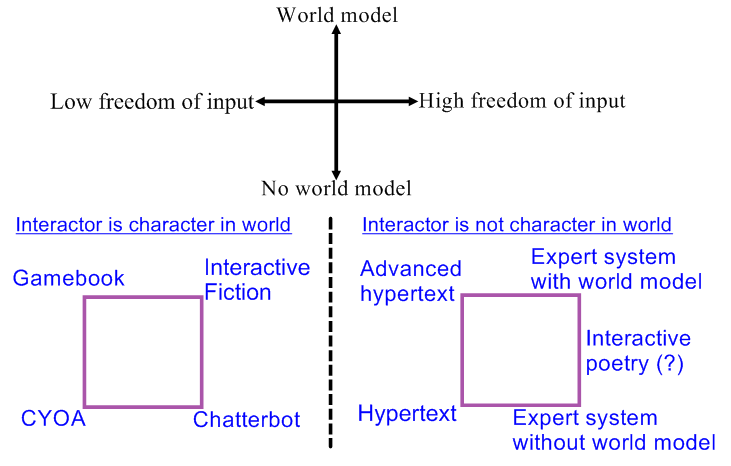
There are some changes from the last version.
1. I placed interactive poetry more ambiguously this time; I’m still not sure where it goes. It’s essentially a genre that doesn’t exist yet.
2. I do still wish I had an official name for “advanced hypertext”. I believe some of the Japanese “visual novel” works fall into the category, but I just don’t know enough about them to say more.
3. I simplified “keeping track of world state” into “world model” and “no world model”. What I mean is that some information is kept over the session; a CYOA book typically doesn’t care what previous parts of the book you’ve visited, whereas a Gamebook may require the interactor to keep a detailed log.
I made this revision because I am going to be referring back to this chart fairly soon in my survey of Nick Montfort’s dissertation.
Continuing with the dissertation, there’s an interesting section in 3.3 on the Oz Project, but I’m skimming ahead to “Steps toward a Potential Narratology”.
(p. 26) Well-known text-based interactive fiction includes Adventure (1977), Zork (1977-78), A Mind Forever Voyaging (1985), Knight Orc (1987), and Curses (1993).
I am curious how many readers have actually played Knight Orc. I hadn’t heard of it until the late 90s. Even though Level 9 games went over well in Europe, they (from my vantage point, at least) missed the US entirely.
This raises questions of canon — specifically, it seems like the only works before 1990 that get referred to (when making theory arguments or otherwise) are Infocom games. (The dissertation does make the Knight Orc reference and a few others.) This is in a way understandable — the availability of commercial games other than Infocom is very low. On the other hand, it seems tragic to skip them entirely, for innovation came from other quarters. At the very least lessons can be learned from their failures. (For instance, the rampant randomization of puzzles in Angelsoft games.)
(p. 27) Roger Carbol’s “Locational Puzzle Theory” is interesting in that it attempts a strict definition of certain elements of interactive fiction. Unfortunately there are numerous difficulties with the approach. To begin with, Carbol defines a game only as “a collection of objects, in the object-oriented programming sense,” which does not distinguish games from non-games, as any definition should. Furthermore, “object” is not defined by Carbol as it is in any thorough discussion of object-oriented programming, but as simply “a collection of properties.”
(The original essay is here.)
I’d call this criticism partly unfair — from context it is clear to me Roger was using “the object-oriented programming sense” to mean he was referring to objects as discrete, exact entities (as opposed to real-life philosophically nebulous blobs).
Where I believe Roger’s argument has more difficulty is that his definitions narrow down to “in a puzzle, something changes that moves the game to a desired state”. For the definition to work it really needs to distinguish puzzles from non-puzzles. As the excerpt above points out, Roger’s paper also doesn’t distinguish games from non-games.
Roger separates “corporeal” (in-game objects) and “memetic” (pieces of information) elements, but treats them equivalently. However, they don’t work the same, because real-world information can be manipulated in ways where a property-based model doesn’t make sense (making deductions in a mystery, for example). Still, I see some promise in an approach to puzzle theory that separates these elements and distinguishes what is possible in each. (Dan Shiovitz has a review of Act of Murder which considers this; note while the link jumps to the review in question the rest of the page is a complete review list of 2007 IF Competition games with spoilers. Link)
This is that Flash game where the Mac version inexplicably only works on Classic.
Wouldn’t releasing the original Flash file be easier? Oh well. On to the review.
Read the rest of this entry »
This is the Paul Panks C64 game. It’s another RPG with some IF stylings. I played it using VICE.
Read the rest of this entry »
Note: this game is Windows-only.
Review after the jump.
Read the rest of this entry »
I’ve gotten through enough of the Interactive Fiction Competition entries to write some reviews. Other blogs also have reviews.
Read the rest of this entry »
Masq is a comic-book form Choose-Your-Own-Adventure, and it is one of the entries into the 10th IGF.
I am moving ahead to the third section of the dissertation (Review of Related Work), and specifically section 3.2 (Story Generation). Story generators have a strong influence on nn, so it’s worth the time to look at two of them: Tale-Spin (from 1976) and Brutus (from 2001).
(p. 29) A significant story generator is Tale-Spin, which used a conceptual dependency representation to generate and narrate the actions of characters in a simulated world. The idea was to generate events which were themselves interesting; once these were generated, they were narrated in an unvarying, direct way.
Tale-Spin is essentially a reactive agent planner. Here’s a sample run:
Once upon a time, there was a dishonest fox named Henry who lived in a cave, and a vain and trusting crow named Joe who lived in an elm tree. Joe had gotten a piece of cheese and was holding it in his mouth. One day, Henry walked from his cave, across the meadow to the elm tree. He saw Joe Crow and the cheese and became hungry. He decided that he might get the cheese if Joe Crow spoke, so he told Joe that he liked his singing very much and wanted to hear him sing. Joe was very pleased with Henry and began to sing. The cheese fell out of his mouth, down on the ground. Henry picked up the cheese and told Joe Crow that he was stupid. Joe was angry, and didn’t trust Henry anymore. Henry returned to his cave.
I am guessing based on this interview with the author of Tale-Spin that this story was considered an exemplar; it was used as part of a NOVA special on the mind. Two characters are given goals, and they conflict in such a way that an interesting narrative is developed. Of course, not every run was so lucky:
Once upon a time George Ant lived near a patch of ground. There was a nest in an ash tree. Wilma Bird lived in the nest. There was some water in a river. Wilma knew that the water was in the river. George knew that the water was in the river. One day Wilma was very thirsty. Wilma wanted to get near some water. Wilma flew from her nest across a meadow through a valley to the river. Wilma drank the water. Wilma wasn’t very thirsty any more.
Here the goals were set up, but the characters never met up to have a conflict. This can happen in IF, where actors wander about completing their goals but due to sheer bad luck nothing develops. With a story generator the sample texts can be cherry picked (I get the impression from reading commentary Tale-Spin could run even farther awry) but in an IF format we can’t generate a set of narratives and manually pick the “good” ones. Therefore the hurdle for IF is somewhat higher than story generators.
(While the original source for Tale-Spin no longer exists, there is a miniature version in LISP.)
(p. 18) A recent automatic storyteller is Brutus, a system that uses a formal model of betrayal and has sophisticated abilities as a narrator.
Here’s an excerpt:
Dave wanted desperately to be a doctor. But he needed the signatures of three people on the first page of his dissertation, the priceless inscriptions which, together, would certify that he had passed his defense. One of the signatures had to come from Professor Irons, and Irons had often said — to others and to himself — that he was honored to help Dave secure his well-earned dream.
The full story (very much worth reading) is here.
It’s much harder to find evidence of a reactive agent planner here (according to the dissertation it uses a “lexically-oriented approach of building stories from grammars that govern the text on different scales”) and from what I gather there is a great deal of pre-loading; the arc of a complete betrayal plot is expressed as a (quite literal) formula. However, the natural flow of the text is dazzling, and I imagine the ideal of nn would be to allow the mundane events of IF to be narrated in a manner similar to Brutus.
(p. 10) The content/expression distinction, and anything like it, is notably absent in the architecture and knowledge representations of computer systems that generate narrative, as is discussed in the next chapter.
When studying non-interactive story, the separation of content and expression is relatively uncomplicated; there is a full “world” going on, and the expression of it are those parts the author chooses to portray. Interactive story adds the complexity of code: there is something genuine and tangible in the content layer, besides it merely being in the author’s head.
(p. 13) Interactive fiction produces texts that describe characters and objects even when these characters and objects are not simulated, that is, when they do not have a representation in the world model.
In terms of a general theory, there’s something more like three layers:
* the expression layer
* the content layer of things with code behind them; e.g. characters with an object in the world model the player can interact with
* the content layer of things without code; e.g. characters mentioned in passing but only included in text, and with no chance of interaction. This can have sort of a halfway status when referring to groups of things. In a crowd scene, for example, there may be text messages referring to individual people doing things (“a lady near the front checks her cell phone”) while the code may only allow reference to “the crowd”.
There’s also what one might refer to as “second-order content” — when examining an object, there tend to be details, and if one can examine those details that’s a second level. Those details may themselves have details that can be examined. At some level this recursion has to stop, either through a description which suggests no further object (“it is blue”), subsuming the detail as part of the object description (so the ornate wheel on a bicycle is considered in the world model identical to the bicycle) or leaving the detail as expression-but-not-content.
(I believe Andrew Plotkin coined the second-order terminology, but I haven’t been able to find where. Anyone with a link?)
(EDIT: Thanks to Dan Shiovitz for tracking down who coined the second-order terminology: Paul O’Brian in a review of Out of the Study.)
(EDIT EDIT: Emily Short has found the reference even earlier in another Paul O’Brian review of Hunter in Darkness. Is there one even earlier? I had previously thought it came up in regards to The Light: Shelby’s Addendum.)
(p. 14) But when attempting to automatically produce narrative variation, it makes sense to consider only those existents and entities that are explicitly represented in software . . .
The nn system goes by the precept “every piece of expression has a piece of content in the world model behind it”. This allows the system to have complete control over the text and to modify any part. (To give an example of system control, the classic Inform library hard-coded “you” in its responses, whereas Hugo allowed for changing between first/second/third perspective with a single variable.)
(p. 14) The IF system developed will be, when released, the first system to allow authors to easily manipulate the telling of their worlds, allowing a number of literary techniques to be integrated into IF.
To be more specific here, the system allows a number of literary techniques to be integrated within the system automatically, as a system of coded rules just like the world model.
This will allow, for example, the actions of multiple NPCs to be printed in different ways or out of order. Perhaps the player is “following” one character, whose actions are provided in detail, while any other characters passed by are described with much terser prose.
This is of course achievable with current systems, but the goal here is to elaborate automatic narrative variation beyond what an author would normally attempt manually.
In the category of “interactive fiction in obscure places you aren’t likely to have looked”, I bring you:
* A remake in the CEZ RetroCompo 2007 of Cobra’s Arc (it won 3rd place).
* An entry in the B-Game Competition called Poizoned Mind: A Texty B-Game. (forum thread and download link).
* (Somehwhat less recent) A menu-based game styled after old Nintendo adventures called Fedora Spade.


 Renga in Blue