Archive for the ‘Video Games’ Category
1981 saw 7 games published by Softside for the Adventure of the Month Club (June, July, August, September, October, November, December), a series curated by Peter Kirsch. The series was for TRS-80, Atari, and Apple II; it seems whatever game was used (contributed by readers of Softside, or written by Kirsch himself) was then ported to the other platforms by Kirsch.
With Windsloe House Adventure all 3 ports are available, but it’s fairly certain the TRS-80 is the original. The first line of TRS-80 source code gives the author as David Steenson, another in the long line of authors who tried their hand at one and only one adventure game.
The author’s name is scrubbed out of both the Atari and Apple ports (“(C) 1982 SOFTSIDE PUBLICATIONS”), but I’m still going to stick with the Atari version due to an unusual control decision with TRS-80: after a “special message” the game pauses and asks you to hit the “CLEAR” button as opposed to ENTER or RETURN.

TRS-80 Model 4P keyboard, via eBay. Notice the placement of CLEAR compared to ENTER.
My emulator mapping for CLEAR isn’t terrible (the HOME key) but it feels very alien to use (and it has to be done often). Both the Apple and Atari versions sensibly just ask you to hit ENTER/RETURN to get out of a paused screen.

From Softside, January 1982.
The text is a bit tiny, so let me help you out:
In the dungeon of Windsloe Mansion the world-famous Pumpkin Man is being held prisoner. An underground passage connects the mansion to the Blair house, whose owners have agreed to assist you in rescuing the prisoner. Will you succeed in overcoming both the human and the supernatural creatures who are rumored to inhabit Windsloe Mansion?
The premise feels kind of askew; we’re rescuing a Pumpkin Man from a haunted house? That’s sort of like rescuing a koopa from Bowser Castle. The bit about the Blair is an odd toss in, but essentially where in a town with two houses (Windsloe and Blair) and the front door of the Windsloe’s is locked, but there’s a (not-hidden) passage in the Blair’s house that connects.
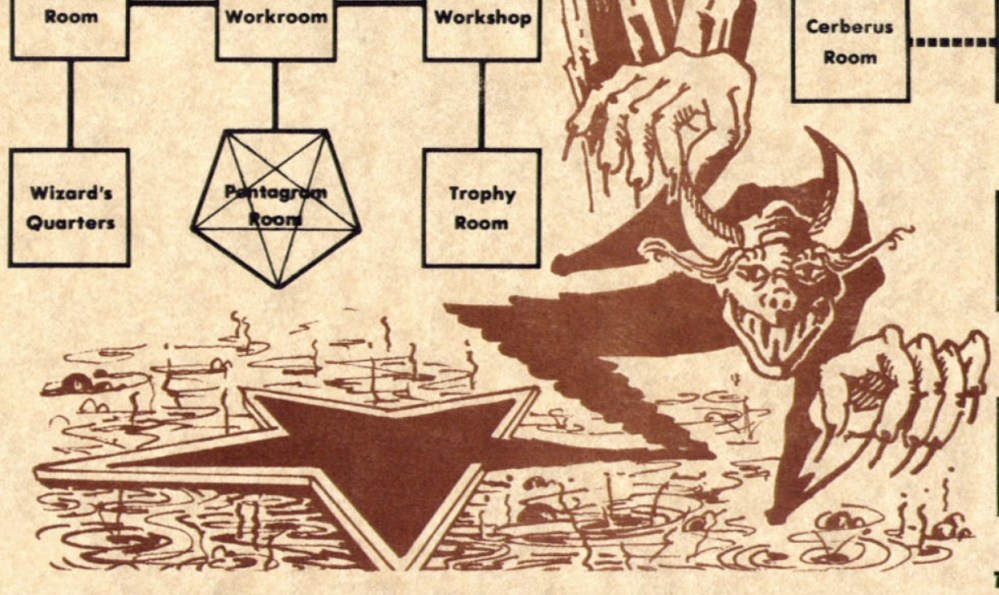
The map below shows the layout. White is the starting town, yellow is the Blair house, red is the main part of the Windsloe house, purple is the secret underground portion.

The interface is one we haven’t quite seen before.

To the top is the room description, to the left an oversized place to list objects (they’re listed just going down, not left-to-right, so it needs a bit of room). Any results of actions display below WHAT DO I DO?
The “directions” can be thought of as a light board; if NORTH isn’t possible that word is turned off but everything else stays in position, so it isn’t exactly a “list”. Below it is where names of monsters flash, and below that, the PRESS RETURN prompt which flashes whenever the game is waiting for you to finish reading a message (which on TRS-80, remember, is CLEAR). I’ve demonstrated this with the animation below:

Other than BLINK tags no longer being used for good reason, the method of enemy display is a serious problem, due to the lack of persistence. If for some reason you miss the name, or want to step away from the computer and step back, there’s no way to tell what you’re facing, and while some of the enemies are “neutral” and just there to give out points if you eliminate them, some of them kill on the very next move unless you do the right action. (Also, this is entirely not the original author’s fault, but if you have the emulator speed cranked to maximum, like I did first testing the Apple II version of the game, you can have an enemy name blink without even seeing it. I died from a werewolf without any understanding of what was going on.)
There’s a touch of surrealism to the opening rooms. You start on a sidewalk and go south and suddenly find yourself AT A CHINESE RESTAURANT where you see a FORTUNE COOKIE. Somehow, simultaneously, you are walking outside the buildings, and are simultaneously inside them. This is a fair shorthand but I was a little baffled at first, since it seemed like I was swapping through parallel universes as opposed to traversing a map (and it clearly wasn’t meant to be like Invisible Parties where each room really is a universe).

Some of the locations you can just grab their items (FORTUNE COOKIE, GHOST NEUTRALIZER, HALLOWEEN APPLE, VIAL OF POISON, WOODEN STAKE) but two of them you have to BUY (you start the game carrying MONEY) and the first time I found this out the shopkeeper killed me for stealing. Sometimes vague-metaphorical representations of locations can be a little too vague.
With the money you can get a .45 AUTOMATIC and a CAN OF DOGFOOD, both which are deadly in the right circumstances.
The fortune cookie can give fair warning to the above, but you have to figure out how to open it, and that’s easier said than done. EAT and BREAK don’t work; I finally came across SMASH, which is not the typical behavior I think of with fortune cookies. This gives a common theme across the game of there being an enormous amount of parser struggle. The GHOST that came up in the animation earlier — you might think it a small matter to apply the GHOST NEUTRALIZER. I tried all sorts of things like PUSH and SWING and ACTIVATE and the like, but no, the right command is NEUTRALIZE GHOST.

Here’s another example that ought to be easy to handle. You have a MALLET and a STAKE, surely the vampire should be easy to kill? After much struggle I came across HAMMER STAKE. Note how with the ghost you are making the direct object the enemy you are defeating (GHOST) whereas here you are directing your action onto an item you are holding, where the verb implies the other item. This wouldn’t be so bad except sometimes it isn’t obvious what defeats an enemy. There’s a giant wasp, would the first thing you think of be to SWING SWORD?
As the above is starting to hint at, the overall goal, other than rescuing the Pumpkin Man, are to eliminate as many enemies as possible. The enemies are essentially all worth points, but only one of them (which I’ll get into) is necessary to kill.

I never did kill the werewolf. The game was unclear about this but you need to fashion some bullets. It is also possible to just get by using SWING SWORD, where the game says “NOTHING HAPPENS.” I think it is an actual bug but I choose to believe you scared the monster off.
It took a long time to realize all the above, getting mostly lost in the nebulous parser, so I did my usual tactic of testing words to make a standardized verb list and come up with:
CUT, READ, OPEN, EAT, RUB, THROW, SHAKE, POUR, SMASH, FEED, PUT, MOVE, MIX, BURN, INSERT, SHOOT, BUY, GO, SWING, GIVE, POINT.
Once I finally had everything figured out, my actual game narrative was:
Step 1) Grab or buy all the various items around town; to recap, that’s a wooden stake, a ghost neutralizer, a .45 automatic,
some dog food, a vial of poison, a halloween apple, and a a fortune cookie which contains a warning about the apple. Also, I got an “audiotek” from Windsloe’s Porch which apparently was used for cracking safes.
Step 2) Wander the Blair House checking for things. There’s incidentally a Party Room filled with people but none of them can be talked to or interacted with (not even a “hey, good luck thwomping the ghosts!” Next to the party was a bedroom with a safe, that I could crack with the audiotek (PUT AUDIOTEK -> “on what?” -> SAFE) and find an amulet which never seemed to do anything at all. I also found poison darts, a cue ball, a pool cue (which turned out to be a blowgun for the darts), a crowbar, a steel sword, and a NOTE that says GIVE TO DAVE.

Certainly seems important, but no idea if this has a secret effect or if the author ran out of time.
Not everything can be carried at once so I made small piles in the Windsloe house to grab from when I wanted to test something out.
Step 3) Get mostly lost and confused in the Windsloe house. A bathroom had a head with a sign saying “SHAVE ME” but even with a razor in hand it didn’t understand my attempts to SHAVE HEAD (more on that later). I did finally work out how to NEUTRALIZE GHOST and destroyed two floating around for points — they didn’t actually present a threat. This is where I realized I could get by the werewolf by swinging a sword and find the witch lair with an “incubator” (??) and Witch Windsloe.

Step 4) Hunt around for a secret using the MOVE verb from my list and finding I could move a bed to spot a trap door.

Step 5) Get killed by a moss creature that pulls me in the trap door.

Step 6) Restore my game, then check for more items laying around, and settling on the bottle of acid in the kitchen on the moss creature.
THE BOTTLE HITS AND DESTROYS THE MOSS CREATURE!
Step 7) Find and destroy a vampire (screenshot from earlier) and a threatening dog (POISON FOOD / FEED DOG, I told you the dog food was deadly).

I don’t think the toad is used for anything — this is another optional kill.
Step 8) Find a locked door in the dungeon and some rope. I was able to use the rope (THROW ROPE) to get back up the trap door, but I had nothing that would work on the locked door, so went wandering again.
Step 9) Experiment with a bunch of items before realizing I hadn’t used the note yet (I tried it on the crowd of the party, failed to get a reaction, and decided I was running into another verb communication problem). The one outside location that didn’t have an object was Dave’s Tobacco, and I feel rather silly not thinking about it. By giving the note to Dave I got a packet, and the packet had a key — the key needed to get through the dungeon door.

Why the Blair House would have a note that would convince Dave to hand over a key to a dungeon I don’t know, nor do I know why Dave would have the key in the first place.
Step 10) Break back into the downstairs area and use the key, finding the pumpkin man. He’s considered an “item” so you just pick him up and take him outside, and the game is over.


Despite some enemies left un-killed, I decided I was satisfied stopping there and went to check what Dave Dobson wrote. I found I had missed:
Thing 1) The cue ball is an alien egg. You can put the alien egg in the incubator at the witch to get an alien who then attacks. Then you can kill the alien with the poison darts.
THE DART PIERCES THE ALIEN’S HEART!
Thing 2) You can take the blade from the apple and unite it with the razor in order to shave the head. (Understandable in retrospect, but I didn’t realize the razor lacked a blade in the first place.)
THE HEAD SAYS THANK YOU AND A QUARTER POPS OUT OF HIS MOUTH
The quarter can then be used on a pinball table to get flint
TWO PIECES OF FLINT FALL FROM THE BOTTOM OF THE MACHINE!
and the flint can then be used to a light a stick, which can be used to burn the witch. (The last part isn’t random — there’s a book saying you can kill the witch with a flaming stick — but the other two parts sure are.)
Thing 3) The Blair’s front porch has some loose boards that can be pried out with the crowbar. I actually suspected this but had zero luck with the parser so gave up, but that’s because I didn’t try LIFT PORCH (!?!?!??)
SILVER INGOTS!!!
The ingots can then be melted in a crucible to make silver bullets, which then go in the .45 automatic gun, which then can finally kill the werewolf (rather than just scaring it off).
I don’t feel bad about spoiling any of those.
The overarching theme was a decent sense of humor vastly undercut by extreme communication difficulties. I had to play Windsloe like a meta-game rather than really getting into any sort of narrative or flow. I did appreciate the ability to skip almost everything, because it let me feel like I had least had some success before punting away the rest of the game.
(But, LIFT PORCH? Really, not using the boards as the noun? I’ll end with a screenshot from the TRS-80 version so you can see what I’m talking about.)

I finished Time Zone. And yes, the final hour count below is real. If you’ve arrived to this post from elsewhere, please read the prior posts first for this one to make sense.
HOURS PLAYED: 24

The control panel of the time machine, in the Japanese PC-88 version of Time Zone, via Youtube.
There are already informal clubs and discussion groups of Time Zone players throughout the country. If you have a computer and a phone attachment (called a modem), you can check the Micronet Apple user’s group on the Compuserve network for details on such groups.
— The World’s Longest Game, Neil Shaprio, Popular Mechanics, July 1982
Time Zone was perhaps was a victim of its own marketing. Not only does it proclaim itself as the longest game ever made, but in the article I mention above, Ken Williams claims the size will be a feat never to be duplicated. The manual even says calls can’t be made for hints for several months but they won’t be needed until then.
Compared to monsters like Warp and Hezarin, however, it is easy. Items resolve obstacles in a simplistic way. Combinations are rarely needed. There are several tricky verbs but never at the absurd-to-find level of Ulysses and the Golden Fleece. Despite some unfair moments, the game takes care to be fair elsewhere. What makes the game take as long as it does is the staggering size, and more importantly, the sheer number of red herrings.
I think the most stuck I ever felt in the game was at the very start, in the Prehistoric Era. I kept returning over and over to see if I had missed something. I kind of did miss an Easter Egg; in a lake, the game asks you CAN YOU SWIM? and if you type anything other than yes or no, it asks I SAID, CAN YOU SWIM?

The prompting is to get you to type YES, which lets you swim ashore. Swimming also lets you escape the T-Rex adjacent to shore.

I spent an absurdly long time originally trying to chase away the dinosaur, thinking he was hiding some item, but I hadn’t caught the vibe of the game yet: if an enemy seems far too powerful to beat, and especially if any input seems to get intercepted (it doesn’t try to “understand” what you typed, and will react to nonsense just like regular commands) the right action is to let go and walk away.
There are a fair number of places where angry indigenous people want to murder you, and the best course is to leave them alone.
Catching this vibe was one of my major breaks in the game. The other, accompanied by literal breaking a window, was probably the only moment of complete lateral thinking, and it wasn’t too out-of-bounds: the window is clearly a separate object from the door, and the main understanding was that Ben Franklin being away from his print shop was an opportunity to be exploited. I was here to save the Earth, not to be nice.

The end goal of all the time jumping was not to resolve paradoxes, or plant trees meant to be used years later in a puzzle, but rather just to gather objects. It’s a scavenger hunt where every loose item applies at the end. In a way, it was very glorious and satisfying to see, say, a lance pilfered from a knight I murdered via boomerang (obtained from aborigines in Australia, thanks y’all) be used to clear away laser mines. Certainly it didn’t hold up to fridge logic, and the majority of the items from the time jumping could have been grabbed by the protagonist swinging by a store. I had to suspend any notion of object absurdity and roll with it, and then it was possible to have fun.
Mind you, there are still design issues aplenty, and I’ll mark some more off later, but let’s get into my final push, as I was close to reaching the last disk of the game.
…
Last time I was stopped by needing a military ID and a stone block. Rather quickly after I picked up playing again, I resolved the stone block, simply by virtue of typing USE followed by each item in my inventory.

I can’t say this was illogical, it’s just checking the possibilities was faster than thinking through it.
This led to a small sewer maze the requires the gas mask (for the last time). There’s a too-high grate similar to the one I saw earlier, but this time the ladder was able to reach.

Sneaking into the military base, I quickly found a disk change — the last disk side of the game! There was also a military ID in a desk, which allows passing back and forth the front receptionist (and shuttling over my big pile of items in order to be a bit closer but also so I wouldn’t have to keep disk swapping in order to test Just One More Item).

In addition to the ID I found a file folder with a diagram outlining the Evil Plan, which I think was just for fun lore.

Quite close to the plans I found … Ramadu, the Big Bad himself!

You can blast him with your laser gun but it is loud and guards find you. If you dally more than one move (or just try to leave) he screams and guards find you. This puzzle was technically solvable the moment I found it, but I saved it for later thinking I might find a stealthier weapon deeper in the compound.

Nearby in a different direction was a safe, whose lock yielded quickly thanks to Katherine the Great’s hat pin.

Is this an amusing moment or just silly? Again, this works if you’ve bought into the scavenger hunt construct, and it really is glorious having all the places you’ve visited come back, albeit in object form.
The safe had a password, which I was able to give to two guards further along.

Right before reaching the two guards was this empty shed, which will be important later.
The game still can’t resist giving rooms for color, and there was a computer room which was unnecessary and a telescope room which was there just to gaze upon the Earth.


Nice exoplanet lens!
The only other way through seemed to be a guard by a door where the game didn’t even let you try using KILL (it just states it would be a bad idea). I was running very short on items I hadn’t used yet so even though the next step sounds like a stretch, it took me only a few minutes of noodling to find.

That’s GIVE FLOWER, one found back in the main city with the man-eating plants. If this was a step that made part of a larger combination, or if the unused-item count was very high, this puzzle could be more distressing, but emotion at the time was just “hah!”
Getting past the guard led to a maze. Stepping inside, I was fried by a laser mine.

As I briefly mentioned earlier, the lance from the knight back in Sherwood Forest is useful — type USE LANCE and you’ll hold the lance out and use it as a tester, and then any subsequent mines will be set off by the lance rather than your body.

The maze had only two locations of note. The first was a circle with a button where standing within the circle and pushing the button teleports directly to the time machine. (You don’t even need the gas mask — you can ENTER MACHINE right away and not worry about the air being breathable.) I (correctly) assumed this was the escape route.
The other location was a door with a slot that required an ID, but the military ID wasn’t high enough level. So, I was at the end of the line — I needed to get at Ramadu who I assumed had a personal card leading to the last area.
The setup with Ramadu gives you exactly two turns to act. Knowing that the laser gun was too loud, I tried CLOSE DOOR, then KILL RAMADU, then WITH GUN as prompted.
By the time I reached WITH GUN I was already dead. I tried all the different weapons I had accumulated — boomerang, sword, knife, even just a rock — to see if any would work. None did. Finally I realized something that only comes naturally from playing a bunch of two-word parser games — would be possible to skip typing KILL RAMADU and just go straight to WITH GUN? It was.

Simultaneously the worst and most satisfying puzzle of the game? It was great to kill the Bad Guy, and interesting to think about the closing the door being useful, but this felt like a parser exploit. Typing KILL RAMADU shouldn’t have taken up any time.
The desk had Ramadu’s personal ID, so I booked it over to that maze … and got killed by the password guards who discovered my laser gun! D’oh. Fortunately, the solution there is just a matter of dropping the gun after the deed is done.

However, as I approached the flower-loving guard, there were footsteps approaching, and right before being able to dive in the maze, I was caught by a search party. I figured perhaps this was a matter of speed, and tried to optimize my steps, but no matter what I did, I was found one move before entering the maze. I tried hiding in a nearby supply room.

I finally realized a.) there was not necessarily a need to rush and b.) the empty shed I had seen earlier might make for a hide-out spot. I was right on both accounts:

Having evaded the search party, I was able to make it past the flower-guard and into the special locked room in the maze. There, I found the diabolical weapon.

Here I was thankful I figured out the dynamite puzzle at the last moment, and I knew exactly what to do. (Thanks also to Voltgloss for watching out for me on that one, even though I ended up figuring out what I was missing myself.)

Kablooey! You can’t go back out the maze the way you came in, but fortunately I already had the route to the teleporter and knew what it would do.


Back in the time machine, I jammed the “go home” button, and somehow everyone found out what happened in the past while I was busy saving the Earth.


In the old games, they were stories that you experienced from your own eyes. Like in Time Zone — you’re just walking through the trees outside your home, and suddenly there’s a time machine. It’s never been there before; it’s just suddenly there. What is this? You don’t even know what it is. This funny-looking machine… You look closer, then climb inside, look at the controls, and before you know it, you’re off on an adventure. But it’s just you.
— Roberta Williams, from DeMaria’s High Score! Expanded: The Illustrated History of Electronic Games 3rd Edition
It’d be a nice, clean moral to say Time Zone marked the end of an era, but it didn’t really — lots of games before had more expansive plot ambitions, and lots of games after went with the simplicity of throwing the protagonist in a scenario where their main motivation is exploring and gathering items. Certainly nobody else tried it with so many red herrings.
Moments like on the Christopher Columbus ship where you blindly pick access to three areas (and only one is correct) are not good pieces of design. (Although it isn’t nearly as brutal as the choice from the very start of Ulysses where you find out if you’re right or wrong only near the end of the game.) The OPEN SESAME bit which requires just bringing in outside lore is not good design — although I logicked through it by thinking “would Roberta Williams require applying outside fairy tale lore without in-game prompting?” and coming up with an emphatic YES.
(By the way, the cave is optional! The gold is only useful for giving to the thief, but as I mentioned last time, you can let the thief shoot you. This also lets you skip finding the second item from the trader in Morocco.)
However, as I hope I proved through my own journey, that doesn’t mean the game was unreasonable to solve. Compared against Roe Adams’s solve-in-one-week-with-no-hints, yes, that story is perfectly plausible. (Even given the slower disk loading and Apple II draw time — the drawing in Time Zone isn’t super-slow but it still takes enough time I’d say the playtime needs to be tripled for a 1982 playthrough.) While I did check hints to see if some red herring zones were, in fact, red herrings, at no time during the gameplay did I check how to solve a puzzle — I did it entirely on my own.
The aura of un-solvability was helped along by the massive size and seems to have been created and encouraged by the Ken and Robert Williams themselves, but at a basic level, the game is all about reaching higher places with ladders or lifting heavy blocks with iron bars or making fire with sticks or trading perfume to Cleopatra for some Egyptian money which then goes to a fruit seller who explicitly requests Egyptian money and then taking the food and using to survive a trip that explicitly says you need food.
(The bit with Catherine the Great dropping a hat pin when enough moves have been given in the right location is a jerk move, though — any player who dithers around a few turns will find the hat pin, but if someone just happens to leave early there’s isn’t an explicit puzzle to solve, so the pin is incredibly easy to miss. I could see someone killing Ramadu yet unable to get into that safe.)
My allergy to declaring games good or bad is partly from an art-historical-analysis standpoint — I’d rather focus on the evolution of design trends than deliver concrete numbers. Time Zone gives a particular dilemma, because I can absolutely say nobody should play this, yet I did have genuine fun throughout, and red herrings (and the tinge of racism) aside, I can’t say my time was wasted. The game asked — what if you really could go anywhere at any time? — and tried to answer it. Open worlds need a bit more to do and as one of the first large-team computer projects, this was maybe too ambitious to fill content the way Roberta Williams really dreamed of, with a game that didn’t end. Deeper truths were yet to be revealed, but Time Zone at least glances off of them.
…
Don’t fret, Apple II fans: I’ll be taking a breather for a bit (for what I hope are obvious reasons) and will get off a few short entries on the still-chugging TRS-80 market before returning, this time in a game with good art (seriously!)
I do have one request: if you liked what you read, please share. Use the all-entries-in-chronological-order link. I’m just here for sharing the joy of adventure games, but I’d like as many people as possible to see.
Plus, to be honest, you’re perfectly fine skipping playing Time Zone and reading about it instead.
Good progress! Again, I’m not stuck, just at a stopping point where I wanted to write things down.
HOURS PLAYED: 21

From the October 1982 issue of Jeux et Stratégie, via @Christ_Thibault on Twitter. The other games the article mentioned they expect the reader to be familiar with? Mystery House, which had a French translation, and Softporn Adventure, which did not, but apparently everyone played Softporn Adventure, even in other countries.
Speaking of the ending, I’ve been vaguely handwaving about an evil Ramadu who wants to do something evil, but that’s mainly because the game itself handwaves in the intro text. Fortunately, the manual is fairly explicit:
The evil Neburite ruler Ramadu fears that the Earth will very soon become the superior race in the galaxy. This must not happen. His plan is to strike now, before the Earth is advanced enough to defend itself against an attack. So Ramadu has built an awesome ray gun, and aimed it directly at the distant Earth.
It seems that unless something is done, if Ramadu is not stopped and his weapons destroyed, Earth will never see the year 4082.
Unlike that TI-99/4A game I played last, the ray gun is at least on another planet. I’m not sure what the point of the bad guy who wanted to destroy the Earth while they were on the Earth was.
…
I’m going to give my narrative a little out of order. I made slight progress, then got stuck, and this turned out to be fortunate as I went back and re-checked one place I was still suspicious about, North America 2082 AD. It turns out I was missing one item, and this item was entirely useless for the thing I was stuck on, but still, I might have plowed ahead much deeper before realizing my mistake if it weren’t for the early stuckness.
This was back where I found a key under a mat that mysteriously didn’t go in the door it was at. It didn’t seem to go into the house or the car the room adjacent, either. The useless key was so thoroughly bizarre I stared hard at the picture until I realized the trunk was drawn in as a separate part of the car.

Yes, you can UNLOCK TRUNK, as opposed to UNLOCK CAR where it just says it doesn’t fit.

I still have yet to use the dynamite.
…
4082 AD starts pretty rough with a bit of parser noodling.

At least my start. I was never able to get the grate too high to reach and I think it is either a red herring or it requires an item deeper in the map.
Any attempt to BREAK GRATE gets
YOU CAN’T BREAK THE GRATE. IT IS TOO STRONG.
The trick here is to refer directly to the RUST, not the GRATE itself. You can SCRAPE RUST and the game asks what with; if you scrape with the wrong item, the game tells you
IT WOULDN’T WORK. YOU NEED SOMETHING TO POUND THE RUST OFF WITH.
You need to explicitly specify WITH HAMMER (yes, the stone hammer from 10000 BC, thanks, cavemen!) and get it open, or you can USE HAMMER.
USING THE STONE HAMMER, YOU POUND AT THE GRATE UNTIL MOST OF THE RUST HAS FALLEN OFF. YOU CAN PROBABLY OPEN IT NOW.

This puzzle was in the weird scenario of trying to be fair (it certain gets explicit about the hammer being the tool of choice) and technically being logical (yes, I can see why scratching the rust surrounding the grate is different from the grate) but still not terrific game design. I certainly walked away for a long time — a good chunk of the game, in fact, since I saw the grate early, all you need is the torch — thinking I would need some heavy-duty smasher. It’s almost a problem of the limited perspective of text environment vs. graphics. The whole rust thing isn’t visual at all; at least the trunk, once I spotted it, was distinct visually, and the game even zoomed in on the final solve. I suppose a zoom-in here would have been optimal, so you could see brown material around the grate crusting it in as opposed to just lining the grate itself.
Surprisingly enough, this is not the bit I had gotten super-stuck on and took the side-trip to find the dynamite. That will be just a little later.

Past the grate, I found another set of rooms leading to a manhole. Continuing the theme
THE MANHOLE COVER HAS RUSTED TO THE EDGE OF THE MANHOLE.
Trying to SCRAPE RUST here with the HAMMER just gives the response IT DOESN’T WORK. Trying to use the sword says
THE SWORD IS WAY TOO BIG TO SCRAPE THE RUST AWAY.
Again, interesting the game is being almost explicit in hinting an item. Keep in mind lots of players would be missing items at this juncture (…I still might be missing one, to be honest…) I could also see a player chipping away at 4082 AD as they go along, revisiting when they get new items to see if they work on the next obstacle. That strategy wouldn’t have worked for me because the manhole requires one of the last items I found, the KNIFE.

Above, there is a dead end with a wallet containing an ID card. The air is breathable but trying to open the door says THERE’S NOTHING OF INTEREST IN IT.

I wasted an enormous amount of time here, even though the “nothing of interest” is a clear signal to stop poking, because I thought there wasn’t any other place to go. I tried climbing the wall, making lots of noise, doing USE on every object in the game. No dice. This was my super-stuck moment, and when I looped back and found the dynamite, I thought “ah-ha! I have to blast a hole to get to the next area”. Alas no: nothing still happens.
If you are astute, you might be laughing right now, because on one of my earlier screenshots there’s a big hole. I read the hole as being just from the grate I entered, but the picture is pretty clear it’s a different hole.

As shown, you can tie a rope to make further progress. If it wasn’t for my lack of observation skills, I wouldn’t have found the dynamite, which of course itself required observation skills to find. That’s not “irony” but I’m not sure a better phrase, “sheer luck”?

Moving on, the rope led to a stream which lead to another vent, this time with no obstacle to opening it. Inside the vent was breathable air so I was able to drop the gas mask. (If you keep the mask on you get blasted later by startling a guard who isn’t expecting it. Incidentally, there is a time limit to the air, but it’s pretty generous. However, I can see someone who noodled around a bunch, especially someone who tried to make progress on 4082 AD early, softlocking their game without realizing it until much later. 1982 GameDesign™ strikes again.)
The vent leads to a corridor where you hear footsteps, but can go hide in a closet. Finally a dynamic event! This was honestly neat as the first encounter with a Nebruon native (not so neat is they blast you with a ray gun if you don’t hide).

After this encounter you spot (another? the same?) guard moving forward, but this guard gives you time to blast it with your gun (from the thief in 2082 London) and steal his uniform.

If you don’t steal the uniform, you’ll quickly get mowed down by ray gun fire later. Specifically, once stepping outside the military compound you’re in to the city, you get arrested for suspected murder (that part’s ok) but then the police
NOTICE YOU ARE DIFFERENT FROM EVERYONE ELSE, AND KILL YOU
Assuming you don’t seem too much like a funny-alien to the residents of the glass-dome-town you’re in, you’ll still invariably get yourself arrested on suspicion of murder (the body disappears, much like The Colonel’s Bequest) but fortunately they don’t take your stuff so you can just saw through the window bars.

After you’ve sawed through, the police stop caring about you unless you shoot someone else. Maybe there’s some unspoken cultural rule about escape is equivalent to a get-out-of-jail-free card.
One step out of prison reveals a (different) thief. At least I would assume different, unless they time-traveled too.

The thief is accepting of the GOLD stolen from the secret cave back in Baghdad, and for a while I assumed that was the correct move, but you can keep the gold by going with the “YOUR LIFE” pick. The thief shoots you but a nearby hospital rescues you, and as long as you have the ID card swiped from the wallet, they’ll swipe that at point of service.

I haven’t tested yet but I’m guessing lack of ID card here leads to another funny Sierra death.
From here, the game is relatively open. You can explore the town you’re in, which has multiple gardens, two of them with man-eating plants that chomp you.

I do want to emphasize for essentially any player who has gotten this far, this is just another funny background death, kind of like white noise, not a terrible game design moment. I’m at maybe 100 save files by now. The major sin is more technical in that the game doesn’t have the kind of rewinding features that modern games do; nobody except maybe Hezarin has even chanced upon a one-move UNDO option yet.
There’s a shop that will let you buy a flashlight and charge it on your ID card, two secretaries that need to see your ID otherwise you get blasted, and a menacing government building.

The building has a third secretary who not only needs an ID but also a military ID to get farther inside, which I don’t have. The only other item I have to noodle with is a nearby concrete block.

However, as I said already, I’m really just stopped rather than stuck, there’s plenty of map to poke back through and I feel confident something will wiggle loose. I was aiming for a win by end of February and I don’t think that’ll quite happen, but maybe the luck of the adventure gods will grace me again.

The future city portion of the map. Marked rooms are places where I’ve tested the dynamite.

Part of the poster that came with Time Zone. From the Museum of Computer Adventure Games.
I made gigatons of progress and may in fact be ready for the final push on 4082 AD and the evil Ramadu.
This was partly a domino effect: solving one puzzle gave me an item where I was familiar enough with the other zones I knew where it went and was able to quickly move on to the next. I also got past a few stopping points, including me (of course) missing a few map squares.
Also, the reduction of combinations made some of the puzzles that required no objects at all easier to solve. It felt a little like “luck” but I made multiple solves of this sort in a short time span, indicating this really was a factor.
Speaking of short time span:
HOURS PLAYED: 18
Last time I left off in frozen Russia in front of two guards who killed me if I tried to kill them first. One of my first acts was to try to prod around the guards a little in case I could get a hint from EXAMINE or find out I could refer to SNOW while standing there or some other obscure action.
Not too many turns in (4? I wasn’t counting) I got a surprise.

In actual play, most players will hang around the short time it takes for this to trigger. It still is a tick on my Bad Design list akin to my issue with linking events to random number generation, but I at least see the goal here to make a dynamic event, which is not something the game has done well at — the time zones are generally frozen in place.
That’s Peter the Great and Catherine the First, and yes, history buffs, try not to think about it too hard. She drops a hat pin, which I still have to find a use for and I’m guessing is being saved for 4082.
However, at the time I didn’t know that, so I cheerfully took my newly-acquired hat pin and tried it on every locked door/gate I still had to deal with, including the one at Napoleon’s mansion in “1700” AD Europe.

USE PIN was no luck, and after a bit of pondering I wondered if this was a circumstance like breaking the window at Benjamin Franklin’s place; I tried to climb the fence, and got murdered immediately.
But … the way the map is laid out, it has rooms for each of the sides of the walls. So there are three more places I could try climbing!

On the west side wall it led me to, predictably, a big empty hedge maze. Because Roberta Williams loves you and wants you to be happy.

I combed over this three times.
The east side drops to death, but the north side works!


With comb and perfume in hand, I knew immediately what my next destination was: Cleopatra. I’ve lost track how many times I’ve visited trying to hawk my wares (6?) but one of these clearly was what the game had in mind for a gift.

A mere screenshot with words cannot convey the triumph I felt at this moment.
The money let me buy some dates from a local seller (the game is explicit that “she wants Egyptian money”) which then let me travel deeper in the desert, because previously I was dying of thirst (easily solvable via the Nile river) and hunger (only solvable with the dates).

This led me to a big pyramid, with a large stone concealing a tomb.

The tomb had a shield, and if you’ve been reading carefully enough my previous posts, you might remember in Ancient Rome I was having trouble being tossed in an arena where the game specifically says you need a sword and shield. I’ve had a sword from a samurai for a while, so it was finally time to take on Ancient Rome.

On my way over I was typing too fast and discovered two locations I hadn’t seen before. Instead of going into the arena you can go west to a bath as shown here, or east to the Senate. This is _quite_ fortunate and possibly my luckiest moment in the game, as I accidentally prevented myself from My Nemesis, aka Being Stuck by Missing a Room Exit.
The entry into the arena was slightly anticlimatic, as it just says in text (on facing a gladiator) WITH YOUR SWORD AND SHIELD YOU QUICKLY MAKE MINCEMEAT OF HIM and the game lets you know you are now invited to see Julius Ceasar, meaning you can go into the Senate chambers which I only quite recently had found the location of.

With access to the chambers you can also enter a “Library” which doesn’t let you read the scrolls (you don’t know Latin, apparently) but does let you steal a ladder. If that sounds doubly-anticlimactic, you’re kind of right, except for an … easter egg? … which I’ll get to last.
With the ladder I once again hit all the various puzzles I was stuck on, like a chasm in South America (which I believe is now a red herring) and a grate that’s too high in 4082 AD (the ladder is too short). One of my uncrossable gaps was in North America, where I had been getting charged by buffalo. I knew the ladder would be no good against a stampede, but I figured the ladder might help me cross a ravine the game mentions after solving the first puzzle.
But that required the solving the first puzzle! And I admit to being stuck enough here I was tempted to give up and finally use Real Hints (as opposed to confirming if a particular time zone was useless) but once again hit my Nemesis and ran across a “gulley” I had somehow missed. Just like the stampede in the Stone Age with hiding in the tree, I was able to GO GULLEY and evade the stampede.

Ready to take my ladder to work, I went and … found a bridge. The ladder’s still for later.

He shoots you if you try to approach with weapons, but as long they’re not in your inventory you’re fine getting by.
I was then able to follow the Pattern this game has and TRADE with yet another person, this time the comb from 1700 AD Europe being swapped for a bow and arrows.

This struck me as immediately related to another long-standing thread I hadn’t worked out, that of Sherwood Forest and Robin Hood. I decided to take a stop by the Merry Men who I had never been able to get to respond before, and came across TALK ROBIN. He’ll then give you a task to prove yourself worthy, and I’m not sure if this would have worked before the bow and arrow because I think I never quite phrased a parser command like that (I did my parser addresses to the MEN but not straight to ROBIN).

This drops you in a maze of trees, because why not.

Again, not really a puzzle, just an obstacle, and I quickly came across the dryad I was supposed to kill.

This felt like a moment that belonged in King’s Quest.
After that success, Robin tells me that I need to steal some money from the sheriff’s office. This had one of the locked doors I had long tried to bring various lock-picking implements to without success, but I had suspicion that you can circle around the back, with a window blocked by bars. (Mainly because Napoleon-area followed the exact same pattern.) LOOK WINDOW shows the money:

Still thinking in terms of Robin Hood theming, I looked at my inventory and especially the bow and arrow, and decided to try tying the rope to the arrow (it helped I tried something similar not long ago in Burglar’s Adventure).

First try! On a total high now, I took the money back to the Merry Men, who then grabbed the bag and left.
And… nothing. No reward. No items dropped.
After some facepalming, I wondered if in fact you were supposed to steal the money to use elsewhere as opposed to give it to Robin Hood. I still had a trade hanging around the same time zone but not area (in Baghdad) who was selling camels yet never liked any of the items I offered for trade, including the cash.
Blerg. I decided to move on. (I’ll get back to the cash soon, though.) I still had a hot ladder where I was unclear where it went, and the Africa area which asks you to build a raft I figured might have a tree to climb somewhere (maybe to get some vines to finish the raft?)
And here I reached another bit of “luck”, but again I think it’s simply from starting to have not many places left to visit. While the game gives you three logs, and I had rope and a saw which seemed relevant, the game always told me I couldn’t make a raft. However, I wondered if the game just needed the tools to be held and the logs to be in the room, so I shifted all the logs to the same place and tried MAKE RAFT as I had done many times before.

It worked! I’m still not quite clear what items were needed to be held, or if it really just the logs all have to be sitting together in the same place. I was able to use a long pole I had found way back in 50 BC to row across.

I want to emphasize it really helps the game has a generous inventory limit. It’s something like 16, and when combined with the objects-are-zapped-for-being-brought-too-far-back thing, it was roughly my normal max the whole game. So rather than having to ship objects back and forth to test things I usually had them with me, like the long pole which survives in any period, including the prehistoric age.
Exploring Africa, I got eaten by a lion in the jungle (an oddity I’ve nitpicked about before) and by some cannibals … again.

At least they give warning this time.
I also fell into a hole with an elephant skeleton. That ladder I had been wondering about turned to be useful to get out, but the game says the skeleton is too big if you try to get it.

The fact this was a puzzle inside a puzzle made me think there was no way this could be a red herring. Putting on my “what cliché would Sierra use” hat I decided to try to refer to the elephant tusks, which indeed are considered a separate object. The sword is too clumsy apparently to break the tusks off (?) but the stone hammer from very very long back — my oldest acquisition — worked to get the tusks in hand.
I had lots of wandering back and forth now trying to work out what to do next. The camel trader in Baghdad did not want tusks. I was rapidly running out of useful places to go. In one of the Africa zones I had been dying of thirst, and I was still valiantly holding on to hope for a water container, but I went “let’s try it” and somehow ran into my Nemesis yet again and found it was possible to survive a walk due north until arriving at a trader.

This was also the moment I realized this was in Morocco. In any case, the tusks worked! I was able to trade for the knife. And I’m going to condense a bit of meaningless wandering checking time zones after here (this is when I found the easter egg I’ll write about last) and say I eventually came back to the trader who had a rug for trade, and took the item I had been trying to trade away for ages, the silk.

Because I was out of zones, and because it actually seemed logical, I made yet another trip to the camel trader … who wanted the rug! Hurrah! With the camel I was able to survive a trip through the desert to the OPEN SESAME place (I’d been there before but couldn’t survive a trip back) and found gold inside. I still don’t know what the gold is for.
Oh, and the bag of money. Still was puzzled there, but I decided to return it to the Merry Men again, and for some reason this time around rather than me wandering around finding nothing I got assaulted in the next room over by a knight.


Lance in hand, I was … done? Maybe? I still had 2082 AD North America being useless, with the locked door having a key next to it that doesn’t work. I also figured, given that a ladder that looks like the right size does nothing, the chasm in South America was also a red herring. There’s also a polar bear that appears to intercept any command you try to do, which reminded me of the pterodactyl nest in pre-historic times and a couple other known-red-herring-spots.
So it’s time for the far future now?


I’m coming, Ramadu, maybe. There’s two grates blocking my way, one that’s rusty and one that’s too high, but I haven’t gone through my inventory testing things for a while.
(If there’s something significant I’ve missed mentioning, now is when I’m willing to take a hint, but just “you’ve missed something”, please no details. It is even possible I just forgot to write about it, I have way too many screenshots to keep track of.)
Let’s finish with the easter egg. (At least I think it is — I didn’t get an object from the whole sequence.) While prodding at time zones I made a visit back to my boy Caesar, and he’s had better days.

I had recently acquired a knife from Morocco, so I decided to try to KILL BRUTUS and … it worked! In technicolor blood!
The game even lets you get away with it.

I decided to go for broke and KILL SENATE.

The game doesn’t say you lose, exactly, just that you’re now playing Grand Theft Auto 3 and really have swerved a bit from Time Zone.
I mean “breakthrough” both figuratively (as in I got through some blockers and made good progress in the game) and literally (one major help was by use of the verb BREAK).

From an old eBay auction. “Combines the talents of master adventure authoress ROBERTA WILLIAMS, the artistic abilities of Terry Pierce, Michelle Pritchard and Barry Blasser, and the programming knowledge of Rorke Weigandt, Eric Griswold and Bob Davis. The project was directed by Ken Williams, the original designer of the Hi-Res Adventure Series. We at On-Line Systems have put our best into TIME ZONE and we are confident that this will be the best adventure that you will ever play!” I do like how they took care to give the people working on the game credit, since this is one of the first computer games with a “team” working on production.
Before digging in, I will have to confess I consulted a hint page … kind of. I looked at the map page of Sierra Chest, mainly because a couple maps were bugging me (although mainly the South America one with the cannibals and the one with the sniper) and I wanted a confirmation on my suspicion that they were red herrings. They were indeed — they don’t have to be visited, ever — and along the way I also confirmed I had Pre-historical and Stone Age finished (by this point, I’d been so thorough in both I knew I would need a hint if any more progress was possible).
Other than that, I’m still solving everything on my own. My first solve was on my list but I really should have had it placed earlier on my queue; I had found a second piece of jade digging in 50BC Asia and I wanted to loop back and give it to the same peasant that I gave jade to before to see if I could get more rice.
I could not get more rice. But I could get the rope he was wearing. D’oh!

It then struck me, most obviously, that the whole sequence in 2082AD Europe I had a little off. With that area I had been getting robbed by a thief, who left a rope, and I could tie the rope to a police dog, and then I assumed the dog would track the thief somehow but I just had the wrong verb. No, my default assumption for this game should be: if someone takes all your stuff, you’ve lost.
The rope from 50BC is identical to the one you can get in the future, so that one can be tied to a dog before seeing the thief. Then you can free the dog upon meeting the thief and it will prevent the thief from ever robbing you, leaving behind a gun.

I did some tests (including zapping locked doors I was still stuck on), but as is common for guns in adventure games, it hasn’t been of use yet. I suspect it may be intended for Far Future.
Speaking of having sequences off, I also realized the 1700AD scene with the Declaration of Independence I had a wrong premise on. The way that part worked my first time through is I visited a courthouse, saw a group signing the Declaration (including Benjamin Franklin) and Benjamin Franklin later opened his print shop. There was also a reference about how since you aren’t working for him you can’t go in the back room. I assumed either I a.) somehow would get a job or b.) somehow would get something printed. It occurred to me — mainly because of the thief-softlock — perhaps this was simply a softlock-timing issue, and your goal is to break in the print shop while he’s distracted with the whole signing-thing. I was right, and discovered in the process the game processed BREAK WINDOW.
This let me raid the back room which had a kite and a skeleton key (I needed the saw from Australia to break in a chest for the key).

After the raid, it starts to storm (the only time in the game there’s been a “dynamic change” like weather). You can then, if you like, tie the key to the kite and try flying it outside, which kills you.

I do want to emphasize this wasn’t really a cruel moment: I clearly visualized what was up before I did this, so saved my game beforehand in order to experience the joy of another novel Sierra death.
I tried the skeleton key a bunch of places — there were still locked doors in 2082 AD North America, Asia, and Australia — and found it worked on the padlocked warehouse in Future Asia Tokyo.

Whether you find the presence of only one yen in the warehouse to be irritating or totally hilarious might depend on your mood, but I was on a rush and experienced the latter. This was a meta-adventure moment, the amount of effort put into stealing Benjamin Franklin’s stuff only to get a single yen from the future being a sort of participatory comedy.
The yen allows you to go in a restraraunt and order some food. The menu has three items, the first being 1 yen; you can go through the scene, get served your food by a waiter, and leave.

This is the wrong move, though. You want to pick one of the options that is too expensive, so the waiter gets mad and sends you into the back room to wash dishes (has this ever happened in real life before?)

While in the back you can open one of the drawers and steal some matches, which is the whole point for the scene. It might seem (from a distance reading perspective) rather easy to miss the drawer in the image and also realize it is openable, but note that it is clear that there had to be some purpose to the whole process of reaching the back room; if it was a random drawer in a sea of un-openable ones this moment would have been dubious, but as it was it took me about 30 seconds to assess what was going on.
The matches work on lighting the torch! That means my whole side-process with a separate save file in order to light the torch with the sticks from the Stone Age can now be bypassed. I can merge the progress with 50BC Rome and so forth with everything else.
I made one more bit of progress, and that was by following the break-and-enter theme some more. I tried smashing a window in North America but it wasn’t useful…

This is where the key under the mat was. I suspect the whole future North America area is a complete red herring although I haven’t tossed it off my list as complete yet.
…but I could smash a window in future Australia, and steal a coat. Just a coat. (I might now turn back to the absurd object sourcing problem, but to be honest, I’m surfing on the game in enough a meta-sense I wasn’t bothered and just treated it like a scene from Time Bandits.)


Spend too long in the house and you get caught by police.
I already had two locations (50BC Alaska and 1700AD Asia) which needed coats on my list. I haven’t tried Alaska again yet (I’m still getting stopped by a polar bear) and I should mention Antarctica is still too cold with the coat, but I had a good time in Russia.

KILL KOSSACK. WITH SWORD.


Two guards are in front of the palace at St. Petersburg and they murder you if you try to attack, so I’m stuck getting in.
I would say I’m not Stuck, though, and I’m just taking a break because I wanted to finish a write-up. Game’s fun, weirdly enough? Especially now that I know I don’t have to mess with the cannibals. I’ve trimmed down my list of ages I think are finished, and it looks gratifyingly smaller to deal with (with the “hide row” feature, not the delete button).

HOURS PLAYED: 14
I think my play experience in the last 3 hours (new total, 10.75) is most aptly illustrated by a moment where I found a new area.
The 2082 AD Asia section seems more elaborate than the others because it is broken into distinct sections. You start at a “Civic Center” and can hop on a subway, where you get to — by prompted voice command — choose between North, East, South, and West side stations. When I was first mapping, I went East, and then went South. By going South, the subway returned me to the Civic Center, so I assumed the South Station was simply the one you start at, and moved on.

I was wrong. If you are at a “branch” of the subway, then no matter what direction you specify, you will go back to the Civic Center. I guess it was too much to code having the subway go back be something that happens automatically, rather than require the player say something which isn’t even interpreted correctly.
This meant there was an entire South Side I hadn’t mapped. Exciting! And…

…I found nothing. Absolutely nothing.
There was an enormous amount of poking at things and trying to get something new to happen, and failing. The one puzzle I managed to solve — and I did earnestly solve it, not just luck out — was back in Past Asia at a samurai that was attacking. I had a boomerang that I couldn’t THROW so I had put it out of thought in that area, but then it occurred to me the game was probably looking for KILL (when the aborigines first get introduced you are warned they might kill you with their boomerang) and it worked, yielding me a sword.

Way back when I dug up a piece of jade (this is the temple where they used kung-fu if I tried to steal an emerald, allegedly 50 BCish) I also found I could dig a second time to get a second piece of jade. I have found nobody else other than the rice seller who wants jade, though.
Things I tried included
- Combing over Future Los Angeles with the key again — the one that doesn’t fit in the door that it is sitting at — looking for something, anything, that might budge. I guess it’s a red herring, but it’s more mystifying than even usual (more on those in a second).
- Getting something stolen by the thief, taking the rope, getting the police dog, and going over every square in Future London again looking for the dog to react.
- Picking areas at random and testing map areas in case I missed anything else, like the South Side of Future Tokyo.
- Taking every item I could over to Cleopatra to see if I could get some kind of reaction.
The game is big enough I know there are still things I can test. The sheer size of Time Zone is one part of what makes it resistant to is the “grinding” type puzzle solve. The point-and-click equivalent is where you visit every location and try to “use” every item on every visible object. This potentially is a good thing, if it weren’t for knowing that very likely some of the puzzle solves will be very arbitrary.
A second part that makes it resistant is the “dual realities” problem I’m facing. I still haven’t been able to light the torch without using the sticks that were necessary in the stone age to get a stone hammer. So I can choose between either a hammer or a lit torch. I am 96% certain the Stone Age section is not a red herring and there really is an alternate way to give light, especially because MATCHES is a recognized noun through the game.
(Oh, you know how verbs don’t get recognized across disks? Because the objects can move across time zones, the nouns are more universal, so it’s easier to play guess-the-noun to theorize if something really exists.)
A third part is the sheer number of red herrings in general. While I can’t absolutely confirm anything in particular is a red herring, I had heard before playing there were entire time zones that could be skipped, and I’m assuming some apparent puzzles really shouldn’t be bothered with. For example, the 50BC Alaska Polar Bear does not let you react, at all, and there are very few rooms: does this mean the entire location shouldn’t be bothered with? (On the other hand, cold-weather clothes are needed elsewhere, and it feels like if any placed had some you could steal, it’d be 50BC Alaska.)
I wish there was a way to narrow things down for certain. I have an intuition of what I can just pass by but I could easily be mistaken. For example, one of the South America areas has an avalanche you can hide from in a cave, followed by a gorge that can’t be crossed.

The presence of the avalanche makes me thinks that this is a real puzzle solvable by some item or another (not the rope, I tried it in the screenshot above). But what if the game is mean enough to put puzzle sequences leading to dead ends? What if this happened maybe not even by design, but because they were exhausted from working on the game and needed to get it out the door?
The upshot of all this is I am very close to starting to consult hints. I have not yet, nor do I want to yet, but I’m going to declare that I’ll do two more passes, and if nothing breaks free, I’ll start to declare open season. (If nothing else, I know some of you have been itching to drop hints in the comments. Just a little longer!)

From an old eBay auction.
I’ve been doing some puzzle-solving, but “doing” might be more appropriate, because I’ve had to make an “alternate-universe” save where I do something in what’s likely the wrong place in order to unlock a couple areas. In other words, I’ve probably (intentionally) softlocked my game in order to see into the future.
Ok, yes, this one’s messy. Let me put my “Hours played” up front this time.
HOURS PLAYED: 7.75 (+2.5 change)
Mapping brainlessly and only solving puzzles by lucky shots on the run = fast. Combing over every area and trying to solve things = slow.
I did, as threatened, make a spreadsheet.

One thing I can conclude for near-certain is that objects do not just move forward in time for solving puzzles. Quite a few things go backwards, and in the case of Cleopatra, I was able to
a.) get a bag of rice from 50 BC Asia by giving jade to a peasant
b.) take that rice up two zones to 1400 AD Asia to trade the rice for some silk
c.) take the silk back to Cleopatra in 50 BC Africa.
You normally get stopped by a guard who says you need to bring a gift, but lets you pass by if you have silk. Interestingly enough, if you then try to give the silk to her, you are told she has enough silk already. I’m still not sure what to do.

In the department of really-odd-things, when combing over Los Angeles 2082 AD I found something extraordinarily strange: a key under a mat at a locked door.
And I’m not joking about the strangeness, because the key does not go to the door it is at. Nor does it go to the locked car a room nearby. Or the other locked house. Or the locked padlock in Asia 2082 AD that is the same color. Or the locked door in 2082 Australia. I really don’t know what’s going on. Am I having a parser issue or is this just a bizarre troll on the game’s part?

It would be bizarre for the key in Los Angeles to open a padlock in Tokyo, but the situation is already strange.
My biggest “progress” was, as mentioned before, somewhat illusory. I was nursing a burnt-out torch from the Inca, and trying to look across all time and space for a way to light it (…never mind one of the locations you can stop by is your very own house in 1982…) and tried, on a whim, to skip the Stone Age setup of trading fire for a stone hammer. I brought the fire to 1982 AD instead.

And yes, this works: you can light the torch. (You cannot take the torch back to the Stone Age, it is too far back in time and goes poof.) Having done this unlocks three brand-new dark areas. First is the far-future where I made a smidge of progress to find two grates.

The second grate is too high to reach. Remember I had to sacrifice the stone hammer to get the light, so it would be hilarious if the solution to this rusted grate is to hit it with a stone hammer.
Second is in the Middle East behind the OPEN SESAME cave. I was able to walk in and grab some gold. I can’t get out because of dying of thirst, but I’m fairly certain that’s because I skipped trading for a camel (I don’t know yet what the merchant wants).
Finally there’s a dark labyrinth at Rome. Inside the labyrinth were some tweezers, and I was able to go to the lion and USE TWEEZERS to get a thorn out of its paw. The lion let me by and consequentially I got to a top level area overlooking the arena.

Unfortunately exploring further had me thrown in a different gladiator portion where I died with no sword or shield. I don’t know if that means I will find them in other time zones and bring them forth.
I did make one further discovery not dependent on the torch in 2082 Europe but it didn’t yield me much. I had assumed that getting the police dog is what dropped a rope in my inventory, but no: for some reason when you meet the thief and he takes your stuff (or doesn’t, if you have an empty inventory) he leaves a rope behind. Then you can TIE ROPE to the dog when first getting him and he won’t run away. This lets you walk around Future London with a dog trotting behind, which sounds pretty neat, but unfortunately I haven’t found any use for this. My initial assumption was I would find the thief’s lair, but in no location in down did the dog perk up and start sniffing or the like. I even tried taking the rhea egg (from way in the past, 50 BC Australia) and throwing it at the thief so it would make a trail, but no dice.
This still doesn’t feel like a lot for 2.5 hours, but other than organizing my documentation I hit a lot of things not working. I tried visiting 1000 AD Africa which had logs and a river but where the game said I didn’t have enough to make a raft, and I still don’t, even with a rope and saw. (To be fair to the game, the picture of the rope is kind of small, more dog-leash size than wrap-around-some-logs style.) I had plenty of other simply failed theories. I assume the boomerang gets thrown … somewhere? Even though most places don’t understand THROW BOOMERANG? The only era with a promising message was 1000 AD Europe (with Robin Hood) which had a slightly different message indicating I was just in the wrong room, but I still couldn’t get anything to come from it.
Adam L. asks me what the difficulty is like. I can’t say I’ve solved any stereotypically “tough” puzzles yet, although that doesn’t mean they aren’t there. If there really is some strange finagling with fire, for instance, that’s a circumstance of generally “simple” action (making a fire) being made complicated by forming unexpected dependencies between puzzles. It may be that the sharp stick all the way back in the prehistoric age that I blew on a tiger in the Stone Age is actually also useful in 1400 AD in a “simple” way, but I didn’t have a chance to find out because I already lost the item. So that’s one facet of difficulty, and it does get multiplied by the sheer size of the game making it hard to test theories out.
I don’t doubt there are a few puzzles difficult for their own sake as well, although there is a limit; there’s no complex daemons except for the very occasional bit where an enemy chases our hero (like the slavers on the Ivory Coast). In that case it may be possible to walk somewhere in particular to help with a solve (like how you can outrun a mountain-slide by hiding in a cave) but I don’t expect the same crazy juggling we’ve seen in, say, Hezarin.
I still have many theories to test, so I’m not quite ready to consider hints yet.
I’ve now done a survey of every single era and continent in the game. Oddly, except for the finale area, this means I’ve likely seen most everything in the game. There are a couple puzzles that gate off areas that are very clearly only single-room areas; in a good number of cases there doesn’t seem to be any rooms blocked off at all.

From Mobygames, a disk from the Japanese FM-7 version.
Just as a reminder, I’ve so far tromped through Prehistoric Age, Stone Age, 50 BC, and 1000 AD. Also, the game does make it clear from something later that the dates are approximate landing points; one time landing in “1400” there was explicitly a date given of 1492 (…betting you can guess already what that’s about…) so the time machine obviously is dealing in approximation. That means if a location is off plus-or-minus 100 years I wouldn’t call it an inaccuracy, but don’t worry, faithful readers: there are still legions of historical errors to nitpick over if you’re so inclined.
1400 AD (kind of)
My same map layout as before, with North America-Europe-Asia on top and South America-Africa-Australia on bottom.

North America results in me getting run over by a stampede of Buffalo. There’s also a ravine that appears to require some manner of rope or ladder or the like to travel over it, although I get stampeded before I can test anything.

There’s a herd of dodgy art in the game, but I kind of like this one.
South America lands us in the Andes (again) with a deadly rockslide (you have enough time to hop into a nearby cave)…

…and going down farther leads to a gorge that is (at present) un-crossable. I appreciated that the map wasn’t in a grid!
Europe lands you in 1492, where you can sign up for the crew of the Santa Maria. You explicitly have to say where you want to work (sails, hold, or galley) and I’m pretty sure only one of them is correct, because Game Design ™.

The correct option is to work the sails, because it lets you get up to a parrot and a telescope. Looking through the telescope lets you see a distance farmhouse, which you can’t otherwise find; then leaving the ship and going to the farmhouse yields an “iron bar” which is useful in 2082 AD.

For those looking to change the timeline, no, you can’t attack Christopher Columbus.

If you’re looking at this screen, I’m fairly sure you’ve softlocked the game.

I think you can take the parrot with you too, but I don’t have anything resembling parrot food.
Africa you land in a desert and then die from the heat.
Asia comes to a forest area located near to a “silk shop”. I was able to trade the rice I had gotten from a peasant in Past Asia for some silk. I haven’t used the silk anywhere yet.

That same continent has one obstacle remaining, that of a samurai. Of course, it is possible this is simply a trap and you’re supposed to avoid the place you get attacked? There are a couple deaths that definitely seem to be just for grins, but if there’s a turn pause before death (as happens here) I’m going with the assumption it is a puzzle rather than a premonition of later Sierra products.

Australia is a maze. Just a maze. There is nothing in the maze.

I wasn’t sure until I had the above experience, but I 98% now believe there are continent/time combos which are just absolute red herrings.
1700 AD

North America lands you at the Declaration of Independence.

Also, Ben Franklin is in his “print shop”, and you can’t go back to the back room if you’re not an employee, which suggests we get a job somehow? Also he has bilocation because he is simultaneously with the signing of the Declaration, if you compare the images.

South America is at the Amazon, and there is a river with crocodiles, and a village with “cannibals” who eat you.
Europe lands you at Paris in the time of Napoleon. Notably, just southwest of the time machine landing spot some thieves do a spot of robbery. I don’t know if there’s a puzzle there, as they can be easily avoided. Maybe you can later track them down and find a new object amidst their lair?

Napoleon is in a palace. The front is barred, so it may be the only puzzle in this area is to get inside.
The Africa landing spot is the Ivory Coast, where there’s a slave ship offshore and if you wander long enough you get shot by someone with a musket. There’s also a deadly snake that can kill you as well. (There’s a rustling as you are being followed, so I was hoping to time things so the snake grabbed the enslaver who is never seen, but I haven’t gotten that to work.)

Asia lands you in lots of snow, and you die of cold. There’s a bridge leading to a new place so it definitely is a puzzle rather than a trap.
Australia has quite a few grazing sheep, and a man on a horse who will shoot you if you come by assuming you are rustling sheep (not a bad assumption given how adventurers are). There’s also a barn with a padlock you can break with the iron bar from Italy 1492; inside there is a saw.

You can also take the padlock you break off with you.
2082 AD
The future is mostly boring paved streets.

North America, Los Angeles in particular, has as its only obstacle a locked house (and the boredom from mapping streets).

South America is a bit weirder. You land in Buenos Aires where it specifically says the streets are abandoned; I think the assumption in other places is that there are people that just aren’t depicted. If you wander the streets long enough you get shot by a terrorist sniper.

Europe, I’ve already discussed: you can get a rope from a runaway dog, and there’s a thief who stops you with a gun.
Africa drops you in Egypt again where there’s a dam in the desert. A guard shoots you for trespassing if you try to get by.

Asia is in Tokyo, which has a little variety with a subway that you can use to go to four sub-areas. One area has a locked warehouse, and one has a restaurant which requires yen to enter.

It feels weird doing an epoch-making jump across time and space only to be stymied by a lack of local currency and a locked door.
Australia actually looks kind of nice to live in! But the only thing to do here adventure-wise is stare at another locked door, at a house.

Honestly, the future era gave me the impression Williams was running out of ideas, or the company as a whole was running out of time. South America was interesting, at least, but I wonder if that’s another red-herring age.
Oh, and I did drop by The Far Future, where the Main Bad Guy awaits. I won’t do a full write-up yet but I’ll note the first obstacle is needing a light source, which I have yet to rustle up (I haven’t encountered any place to re-light my burnt out torch from South America).

So, that’s it for my grand tour. I am busy now making a spreadsheet listing each time zone as well as obstacles still to be overcome, and then I’ll try testing a bunch of theories. It does feel like (given I managed to squeeze in three complete eras in less than 1000 words) I’m leaving things out, but not really; there just are so many rooms that aren’t classical rooms in the adventure sense, just background fluff. You can sense the same sort of grid design in King’s Quest games 1 through 5 inclusive, but I think the difference with those is that they are packed with content; there are a few “just scenery” places in those games but for the most part every location has something interesting to look at or interact with. (If you’d like to make a more direct comparison, think of the “ocean” squares from some of those games; I remember Rosella swimming around empty ocean looking for just the right spot to find a whale or something.)
HOURS PLAYED: 5.25
There are some games that have loomed as dark, brooding hulks, games I have known about for a long time but have never touched.

I’ve been afraid of Time Zone ever since roughly I knew the All the Adventures project would be a thing, back in March of 2011.
“Audacious” is the right word. After Roberta Williams polished up her trilogy from 1980 (Mystery House, Wizard and the Princess, Mission: Asteroid) she wanted to make a game that kept going and going and going. From a Computer Gaming World interview, not long after release:
It’s not an easy game. And it’s not for beginners. It takes a really long time to get through TIME ZONE; even for someone who knows the answers. If I sit down to test TIME ZONE, it takes me a good week to go through it one time while testing it and I know the answers! Make sure you have GOOD maps. Use your imagination. Don’t give up. It’s going to take a LONG time.
I might get into details on the creation of Time Zone while amidst my playthrough, although Jimmy Maher already essentially has it covered. What I’m more interested in is the story of Roe Adams III, reviewer for Softalk, who (according to Steve Levy’s book Hackers) “went virtually without sleep for a week” to beat the game before declaring it “one of the greatest gaming feats in history.”
Just how plausible is this? Unfortunately, Hackers is a book that must be taken with several grains of salt (and as far I’ve been able to reckon, all later tellings of the story derive from it) but it does seem plausible to finish the game in the 150-odd hours that a week-with-very-little-sleep and no hints whatsoever would have entailed.
I’d like to test the theory, a little. Unlike most of my playthroughs, I’m going to keep a timer. Usually I don’t do this because
a.) I often play “off-and-on” and may dip in a game for five minutes to test a theory before leaving to do something else
b.) Sometimes an insight can occur “off the computer” so there is some element of “playing” even when the game is not at hand
c.) I don’t like time pressure in general
but I really am curious what the actual modern time to beat would be while avoiding hints as much as possible. Now, keep in mind I am using an emulator so I don’t have to worry about load times, but I also won’t have quite the “immersion experience” that Roe Adams III did, so maybe they’ll cancel each other out? One thing I do have going is that Roberta’s last substantial game, Wizard and the Princess, I managed to complete entirely without hints and found it basically fair, despite other accounts finding it much less fair. So possibly, I’m on the right wavelength for this.

The credits have a few more people involved other than just these, but apparently Terry Pierce did the lion’s share of the art.
I am still somewhat a sucker for the “pastoral opening” to an adventure game.

Let’s just go on a walk! And find out quite immediately after that we experienced a vivid dream.

Why we are uniquely able to defeat the evil ruler of the Planet Neburon I am unclear on, but I assume some technology like the TARDIS is afoot, where the time machine always goes where it needs to be.
It begins.
HOURS PLAYED: 0
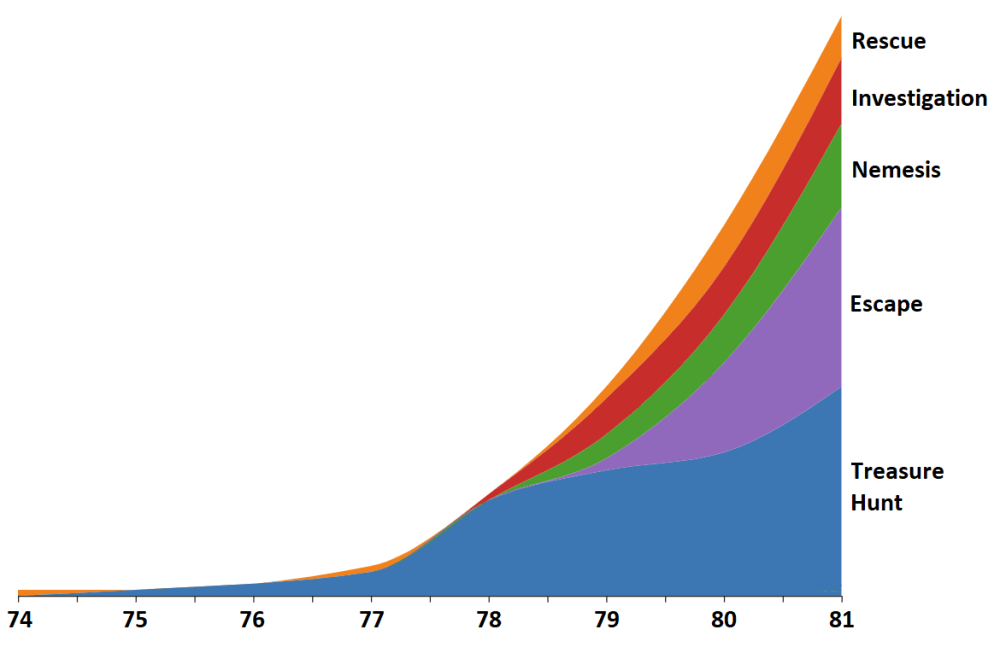
Here are the plot types of all the adventure games I’ve been able to play up to 1981 (which would be “nearly all” of them except for a couple stragglers):
Note that some of the categorizations are approximate and impressionistic; for instance, I called Cyborg which I just played an Investigation since that came off as the main plot thread, even though it is also technically a Rescue as well. However, it isn’t vague hand-waving either, as I did genuinely play and write about all the games listed.
The main intent is to show the evolution of the Treasure Hunt category, games following in the footsteps of Crowther/Woods Adventure where X treasures must be located and placed in a central location. It can certainly feel like Oh No Yet Another One whilst playing through, and the graph gives a little perspective: there are lots more Treasure Hunts in absolute number terms, but as percent of all adventure games, the number is decreasing.
Also — and I didn’t notice this until I made the chart — the Escape-style plot has been slowly increasing to now be about equal in proportion to that of Treasure Hunts. They tend to be very simple (Deathmaze 5000 just says “Your only goal is to leave Deathmaze. Alive.”) so I’m not surprised, and the only thing I would have perhaps expected to be bigger is the Nemesis category, since “find Foozle X and defeat them” also has a certain simplicity to it, although it perhaps is a bit genre-restricting.
I contemplating splitting the categories since the five I chose don’t represent every plot, but they do still grab a good sense of what was going on in adventure games in this time and further splits would just make the data hazier.
My last update I updated my list of “curious firsts”:
– First use of relative direction: Mystery Mansion
– First use of landmark navigation with no compass: Empire of the Over-Mind
– First defined player character: Aldebaran III
– First use of choice-based interaction in a parser game: Stuga
– First dynamic compass interface: Spelunker
– First dynamic puzzle generation: Mines
– First free-text conversation in an adventure context: Local Call for Death
– First adventure game comedy: Mystery Fun House
– First adventure to use graphics in every room: Atlantean Odyssey by Teri Li
– First Tolkein adventure conversion: Ringen by Hansen, Pål-Kristian Engstad, and Per Arne Engstad
– First Lovecraft game of any type: Kadath by Gary Musgrave
– First graphic adventure with some action solely in the graphics: Mystery House by Roberta Williams
– First adventure written specifically for children: Nellan is Thirsty by Furman H. Smith
– First “stateless” CYOA game written for computer: Mount St. Helens by Victor Albino
– First 3D graphic adventure: Deathmaze 5000 by Frank Corr, Jr.
One of them from last time is now uncertain due to a newly found 1980 game!
– First adventure game that involves traveling back through time:
Odyssey #3, Journey Through Time by Joel Mick and James Taranto
OR
Galactic Hitchhiker by A. Knight
Technically, every game has some kind of first (as long you are descriptive and specific enough in what the game is first of) so I could make the list much longer with 1981 games, but I only have two I think are worth noting:
– First adventure game with outside third-person character movement: Castles of Darkness by Michael Cashen
– First adventure game with conversation menus and an action mini-game: Cyborg by Michael Berlyn
That’s not to say there wasn’t innovation, but games are starting to build off other games enough it is hard to be clear-cut as to the “first” moniker. For example, Hezarin had a fair number of “set pieces” where action and puzzle solving went over multiple turns in a way that seemed unlike other games, but even technically Crowther/Woods Adventure could be said to have such things (if you’re running away from dwarves, say). The apex of the Treasure Hunt concept (by 1981, at least) is arguably Zork II with the demon and its wish but that’s an innovation of progression more than being “first” (saying “first freeform wish being made to a character in the world” is starting to get far too specific). Sometimes the solid development of an idea is much more interesting and important than its initial iteration (just compare, say, Street Fighter 1 to Street Fighter 2).
I also made some lists when I stopped at the 1980/1981 boundary, and it is with some regret that I am not adding to #1:
1. Games everyone should play
Crowther and Woods Adventure, 350 points (1977)
Zork I by Tim Anderson, Marc Blank, Dave Lebling and Bruce Daniels (1980)
I’ll be honest here, there’s lots of funny quirks you have to cope with for games of this era. On the other hand, I’ll fully endorse so more games for list #2:
2. For adventure enthusiasts
Crowther and Woods Adventure, 350 points (1977)
Voodoo Castle by Alexis Adams (1979)
Local Call For Death by Robert Lafore (1979)
Kadath by Gary Musgrave (1979)
Empire of the Over-Mind by Gary Bedrosian (1979)
Zork I by Tim Anderson, Marc Blank, Dave Lebling and Bruce Daniels (1980)
Wizard and the Princess by Ken and Roberta Williams (1980)
Gargoyle Castle by Kit Domenico (1980)
Deathmaze 5000 by Frank Corr, Jr. (1980)
Will ‘O the Wisp by Mark Capella (1980)
Adding, in no particular order:
Zork II by Marc Blank and Dave Lebling
The continuation: the wizard is not as good as the thief from Zork I, but his undoing is extremely satisfying.
Cyborg by Michael Berlyn
My main problems were technical, and mostly resolved if you play the PC or Macintosh version. A fascinating merge of theme and medium.
Palace in Thunderland by Dale Johnson and Ken Rose
I honestly thought I’d see more tightly-wound, clever, murderously hard puzzle-fests in miniature by now, but at least there’s this one.
Frankenstein Adventure by John R. Olsen Jr.
This manages to make its puzzles, plot, and action fit together seamlessly, and there’s one scene I still find unnerving.
The Black Sanctum by Ron Krebs, Stephen O’Dea, and Bob Withers
This felt like like a dynamic world with encroaching snow and sinister monks, where the plot moved ahead of its own accord.
3. Things I personally enjoyed quite a bit that didn’t make the above list
Trek Adventure by Bob Retelle (1980)
Crystal Cave by Anonymous and Kevin O’Gorman (1980)
Dracula Avontuur by Ronald van Woensel (1980)
House of Thirty Gables by Bill Miller (1980)
Odyssey #3, Journey Through Time by Joel Mick and James Taranto (1980)
The two new additions here are mainly because of difficulty. And yes, I really did end up enjoying them both, even if they were self-flagellation to play:
Hezarin by Steve Tinney, Alex Shipp and Jon Thackray
Madness and the Minotaur by Tom Rosenbaum
4. Some bonus games for historians
Also known as games I had trouble fully enjoying, but I recognize still did fascinating things.
The Count by Scott Adams (1979)
The Prisoner by David Mullich (1980)
To which I add:
The Institute by Jyym Pearson, Robyn Pearson, Norm Sailer, and Rick Incrocci
Galactic Hitchhiker by A. Knight
As I always disclaim with these kind of lists, I always feel bad the moment I make them, as there are still worthy contenders left out, and I still feel a fondness for the bad games and the evil games and the games with erratic spelling (even that game from a high school sophomore, and if the author ever shows up in person, I’m sorry).
…
So, what’s ahead for 1982? Well, a whole bucketful of games. CASA Solution Archive lists 233 games, and I already know of some missing. (I also know of some I wouldn’t count as adventures, or I’ve already played under a different year, but the overall balance has always been to increase slightly.) I am tentatively planning a change of format for some of the less notable games where I combine entries; if I don’t have as much to say about Treasure Hunt #452 I will try to condense things down. I’m still not sure how well this will go, but we’ll see?
You have some things to look forward to, though:
– The finale of the Zork trilogy
– Andrew Plotkin’s first game (!)
– Three new Acornsoft games
– The first adventure games in Japanese (at least 4 of them)
– The start of Level 9 (which we should have seen in 1981 but their game Fantasy is still lost, sadness)
– Giant mice that smash Chicago
– An adaptation of a game seen within a BBC game show
and lots more besides!