Archive for the ‘Interactive Fiction’ Category

A few months back I listed the Innovation 13, a set of 13 adventures I was going to play out of the usual chronological order from the All the Adventures project.
It’s time to finally play one of those. It not only has graphics, but parser and point-and-click!
By 1989, Roberta Williams was already a veteran game designer; in addition to writing in the text adventure era she had already finished the first four King’s Quest games and the edutainment title Mixed-Up Mother Goose.
This was her first mystery adventure since Mystery House (1980). It was made right before Sierra switched to an all point-and-click interface (no typing at all, that is). Commands are still typed in via a parser, but clicking the mouse is available to move places and to examine items. Since moving and examining are the main activities of the adventure (at least so far) the game really feels 60% point-and-click and 40% parser.

You play as Laura Bow, a young journalism student in the 1920s. You’re tagging along with your friend Lillian to a family reunion at the island estate of Colonel Henri Dijon.
I assume murder and mayhem ensue — there are a number of other characters and nearly all of them seem to dislike the Colonel — but I haven’t done much yet other than explore.
I would like to take a moment to confess: I am very bad at adventure game mysteries. The major ones all seem to depend a lot on time; various events happen at various times, and if you’re not in the right place at the right time you’ll miss some crucial clue. The idea is to replay enough times that an “optimal route” of information is built up as you decipher the movements of the various characters. Theoretically, this sounds fine by me; in practice, I can never figure the mystery out. I never even finished The Witness (1983) which is notorious for being one of the easiest of the Infocom games. I’m hoping by writing about the experience I’ll get over my issues? We’ll see.
I gathered all the necessary treasures, but the endgame wouldn’t trigger. Cross-checking with the source code, I’m definitely at maximum, so I must have run into a bug; I can call this one done. (Also, the source code indicates an essentially identical endgame with Adventure 350, so I’m not missing anything.)
Before I made it to the end I was going to call this post “Annoyances” because I ran into legions of them. Case in point: gathering the necessary treasures isn’t just a matter of dropping them in right room. There’s a safe that stores most of the items. However, some of them don’t fit, but *do* fit in the pirate chest (it is unclear how one would know the pirate chest can contain extra loot and is an acceptable holder). Some don’t fit in either so really are just dropped on the floor. One of them (a radium stone) is radioactive and can only be stored in a special container; the score only increases when storing the stone in the container and it doesn’t matter where the container goes in the well-house. The only way to figure all this out (other than spoilers) is to keep an eye on the current score and test every possibility out.
You might remember last time an outdoors location that was reached by going north from a certain location where the destination was chosen via random number generator. The game does it again on an important indoors section, going south from the East End of Long Hall:

(Rant Mode On) Again, I should note the room-exit based version of this doesn’t seem to be a Thing outside of ports of Adventure, but in other adventures I have seen characters and/or objects only appear in certain rooms based on a random chance. Suppose, as a game designer, you want an Event to occur in a certain central location. Since the location is central, you expect the player to pass through 10 times, and you set the Event to happen with 25% probability. Surely the player will see it?
75% to the 10th power is 5.6%, so approximately 1 out of 20 players will never see the event by random chance! Don’t be lazy: engineer things so the event may seem random but the player is guaranteed to see it in a timely manner. (/Rant Mode Off)
The sad thing here is that the annoyance is followed by the best puzzle in the game, and in fact the best instance of re-appropriation of an object I’ve seen any of the Adventure variants.
You’re in the Cloakroom. This is where the dreaded Wumpus repairs to sleep off heavy meals. (Adventurers are his favorite dinner!)
Two very narrow passages exit NW and NE.
A lovely silken cloak lies partially buried under a pile of loose rocks.
In the corner, a Wumpus is sleeping peacefully.
The Wumpus stays asleep until you grab the cloak, at which point it starts chasing you. You have about six moves to somehow escape or defeat the Wumpus. As is tradition, I will not solve the puzzle here, but I did leave enough information in this post (as long as you’re somewhat familiar with original Adventure) to figure things out. Answers in the comments are welcome.

From Dennis Donovan’s map of Adventure 751.
Back to annoyances: I ran into two deadly guess-the-verb issues in a row. I’ve tried to argue before that guess-the-verb is rarer than the reputation of old adventures suggests, and then a game like this comes along and asks me to exit a boat:
>EXIT BOAT
I don’t know in from out here. Use compass points or name something in the general direction you want to go.
>LEAVE BOAT
I don’t know in from out here. Use compass points or name something in the general direction you want to go.
>OUT
I don’t know in from out here. Use compass points or name something in the general direction you want to go.
>U
There is no way to go in that direction.
>ESCAPE BOAT
I don’t understand the word escape.
>QUIT BOAT
What do you want to do with the boat?
I pretty much rammed through every verb I could think of until I came across this, which is so bizarre it might be a legitimate bug.
>PULL BOAT
Dropped.
Immediately after this there are some bees where I wanted to get to their hive. I had some flowers where I thought >GIVE FLOWERS, >THROW FLOWERS, or some variation thereof would work. It eventually came down to >FEED BEES which I guess sort of makes sense, but I don’t think is the word most people would use.
…
One infamous aspect of 350 point Adventure is “the maze of twisty passages, all different” which contains a vending machine that dispense batteries for the battery-powered lamp. It was a way to extend the time allowed for solving puzzles, but since getting the batteries required using rare coins (and thus destroying a treasure) the vending machine was useless for anyone who wanted a high score.
One consequence of expanding the map in Adventure 501 is that the battery-powered lamp doesn’t have enough charge to get through every puzzle, even in the most optimized route. In this game there are “lead slugs” you can find which work in the vending machine. However, the map is big enough that once the lamp starts going out, there often isn’t enough time to go pick up the lead slugs and trudge all the way to the maze. I lost one of my “final runs” just from getting in an impossible scenario here, and on my subsequent attempt made sure I picked up the batteries early before I even needed them. This isn’t outrageous, but it did surely count as an Annoyance.
(Adventure 550 had a similar conceit of needing a lamp recharge, but there was a magic word that recharged the lamp when it got low and the magic word could work anywhere. Therefore, the annoyance was neatly avoided.)
I suppose if there’s anything positive I can grasp out of this experience, it’s that a coherent map is a pleasing thing. The expansion allowed many gaps to be filled in, and many more routes to be created to get from points X to Y. It led to routing decisions: if I want to reach object Z, do I use a boat, do I walk in from the bridge going the other direction, or do I teleport in with the ruby slippers? (Predictably, they’re just a Wizard of Oz reference; wearing them and typing >CLICK works.) The general feel of Adventure 501 was exploring an real environment, not a node graph.
I’d still recommend Adventure 550 over this one, though; it didn’t suffer nearly as many annoyances.

And that’s it! I can say I have played and written about every adventure game of the 1970s. I’ll likely make a summary post at some point and dive into 1980, but before that, I’m going to do something entirely different.
In yet another episode of Whose Version Is This Anyway?: I mentioned in my first post that there was two later branches that was derived off Adventure 501 (a 551 point version and a 751 point version). There’s a part involving a spider and fly in the port I’m playing which is not in either branch, leading to the theory that this particular version was modified by an anonymous person off of David Long’s no-longer-in-existence original. The addition is very slight, so it’s perfectly fine to call it the “same game”, but it has a silly/annoying scoring trick I wanted to point out:
You have entered Haunted Chamber. A cold wind whistles eerily throughout the room. Strange chords from an unseen organ echo from all over. A passage leads east and a small hole leads south. There is a giant spider in the eastern corner guarding the door. He is grinning at you.
>THROW FLY
The spider grabs the fly, wraps it in silk, and proceeds to quietly munch on it, leaving the door unguarded.
This obviously loses the fly, but it also loses points. Even though the description of the fly doesn’t have the patented exclamation mark at the end (like all the other treasures do) it gets points if stored as a treasure.

I had explored the outdoors at the very beginning of playing this game, and had concluded there weren’t any additions. I apparently missed going west two times from the starting room, because there’s an extensive outdoors section:

I originally went north from the “Jumble of Large Broken Rocks” where I was led to the “High Cliff”, dutifully marking my map and assuming I had reached a dead end.
Soon after, I had reached the point of stuckness that I decided to peruse the Dennis Donovan map excerpted at the top of this post. The map really is a pleasure to look at, and it makes the game feel like a real location far more than any other map I can recall. It’s also useful for meta-solving; consider this portion on the lower-left corner:

This is technically of the 751-point version, although there only seems to be one small portion that doesn’t match with Adventure 501. This was sold commercially at the time; no high-resolution scan was available until earlier this year when Arthur O’Dwyer happened upon a copy.
I never found a “Thunder Hole” on my map, but it certainly looked like it was accessible. I made a return trip and found that going north from the “Jumble of Large Broken Rocks” also can go (simply at random) to the “Thunder Hole” area instead. Argh! This kind of trick I’ve only seen in Adventure variants, and I am deeply grateful nobody else picked up on it the way other authors ran with mazes.
Adventure variants are named after their high score. This is imperfect when more than one version has the same top score, and especially confusing in the case of Adventure 501:
>score
If you were to quit now, you would score 45 out of a possible 505.
To clarify (?), the game doesn’t have a hard-coded high score; it’s determined by the events / treasures placed in the game. At one point this port (by Scott Healey) showed a maximum score of 622; after fixing a bug, the high score went down to 496. After fixing another bug, the high score went up to 501. Now it seems to have floated to 505.
According to David Long’s own information (circa 1978) the high score should be 501. So I’m sticking with that, especially since Adventure 501-ish doesn’t sound like a good title.
Updates:
1. I managed to solve one significant puzzle: the sword in the anvil.
You are on a narrow promontory at the foot of a waterfall, which spurts from an overhead hole in the rock wall and splashes into a large reservoir, sending up clouds of mist and spray.
Through the thick white mist looms a polished marble slab, to which is affixed an enormous rusty iron anvil. In golden letters are written the words: “Whoso Pulleth Out This Sword of This Stone and Anvil, is Rightwise King-Born of All This Mountain.”
There is a narrow chimney on the east side of the promontory.
A gleaming sword is stuck into the anvil!
When this happened in Adventure 550 a boost of strength was required. Alas, brute strength here doesn’t help.
>PULL SWORD
You grasp the sword’s handle and give it a mighty heave, but with a loud clang the sword blade shatters into several fragments.
The golden letters give a hint. Earlier, I found a new area by the Hall of the Mountain King:
You are on the east side of the throne room. On the arm of the throne has been hung a sign which reads “Gone for the day: visiting sick snake. –M.K”
An ancient crown of elvin kings lies here!
If you wear the crown, pulling the sword gets a different result:
>PULL SWORD
Taken.

2. As I predicted, there was a large section past “Dante’s Rest” (map shown above). The trident has been moved from its original spot in Adventure 350 to this area.
You are on the eastern shore of the Blue Grotto.
An ascending tunnel disappears into the darkness to the SE.
There is a jewel-encrusted trident here!
>WEST
You can’t swim. You’d best go by boat.
There may be another area with the aforementioned boat. The strangest part past Dante’s Rest is the Rotunda:
You’re in the Rotunda. Corridors radiate in all directions.
There is a telephone booth standing against the north wall.
The telephone booth is empty. The phone is ringing.
>ENTER BOOTH
As you move towards the phone booth, a gnome suddenly streaks around the corner, jumps into the booth and rudely slams the door in your face. You can’t get in.
You’re in Rotunda.
The phone booth is occupied by a gnome. He is talking excitedly to someone at the other end.
There’s a horn and a lyre elsewhere that I’ll try out later to see if I can annoy the gnome enough to get him to leave, but as the setup resets whenever you leave the room, I suspect the solution has more to do with outrunning the gnome than chasing him away.
3. One portion of the game, the section past the troll chasm, looks entirely unchanged at first; no special passage through the lava this time.

From Kim Schuette’s The Book of Adventure Games.
However, there’s one slight difference that has me stumped. I think it may qualify as a new category in my mod taxonomy, but I don’t know what the word for it would be.
Normally the “tasty food” from the opening of the game serves to make the bear happy, but this occurs instead:
>FEED FOOD TO BEAR
All you have are watercress sandwiches. The bear is less than interested.
I don’t have a good answer. This and the phone booth are the only two puzzles that seem to be available. That doesn’t discount the possibility of hidden puzzles; combing over all the prior rooms is a good way to procrastinate while I’m stuck.
This version of Adventure (by David Long) marks the last one of the 1970s I’m writing about. There are a few that are essentially direct ports I have skipped, but I’ve played all of them that modify Crowther’s original game in some fundamental way.
501-point Adventure has a tangled history, but I’ll simplify things down to say this was the basis of a “lost” 751-point version by David Long in 1980 (it was on Compuserve, and died when Compuserve did) as well as a 551-point version by Doug McDonald from 1984. I’m playing the version at Gobberwarts.
A difference between this version and all the others pops out right away:
You are inside a building, a well house for a large spring. Off to one side is a small pantry.
There is a shiny brass lamp nearby.
There is a leather sack here.
Taped to the wall is a faded poster.
>READ POSTER
The poster has on it a picture of a short, fat wizard with a bushy red beard and a white painted face. He is playing an electric guitar. The caption reads: ‘LOOK OUT KISS!! Here comes WIZZ!!!! Brian Baas lead singer and vocals. Playing at a Woodstock near you!’
>GET POSTER
Hidden behind the poster is a steel safe, embedded in the wall.
I thought for a brief time you were denied the typical food / water / keys at the start of the game, but the pantry can be entered.
>ENTER PANTRY
You’re in the caretaker’s pantry.
There is food here.
There is a bottle of water here.
It contains:
Clear water
There is a large black fly here buzzing around rather lazily.
There are some keys on the ground here.
Note how the bottle “contains: clear water” as a separate entry, as opposed to water just being an object. This game has a “proper” container system where in order to, say, free a bird from a cage, you have to >OPEN CAGE before getting the bird out, or if you want to pour the bottle of water, you have to >OPEN BOTTLE first. In a way, this makes for stronger simulationism, but it’s also more of a pain in practice to type two commands with something that previously only needed one. In short, improving the underlying system made the surface parser worse. For a container system to be an actual improvement, it needs “assumed actions” like in the Infocom parser — that is, if you POUR WATER without having opened the bottle, the game says “(first opening the bottle)” to avoid the tedium of typing an action that was clearly implied.
In any case, I haven’t run into too many more differences yet. There’s these two areas early on…

…but neither as of yet seem to be extensive or interesting (given I found no treasure or item associated with the “Haunted Chamber” I suspect I’m missing something).
I also found a sword in an anvil (very similar to the sword in the stone from Adventure 550) and a chasm called “Dante’s Rest” where I suspect the rest of the rooms are hidden. I will report back my results next time!
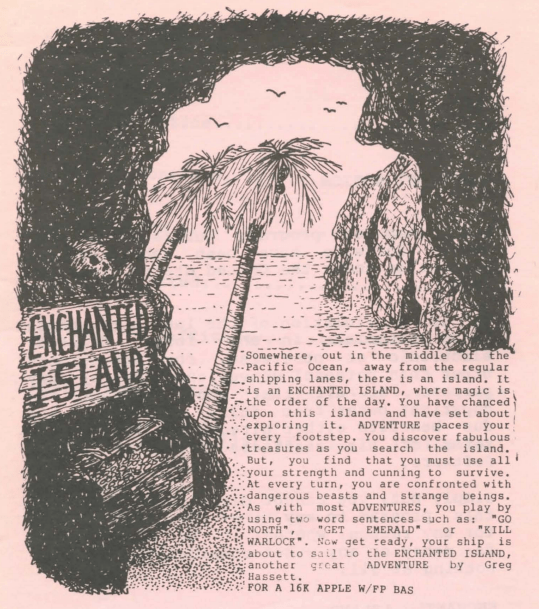
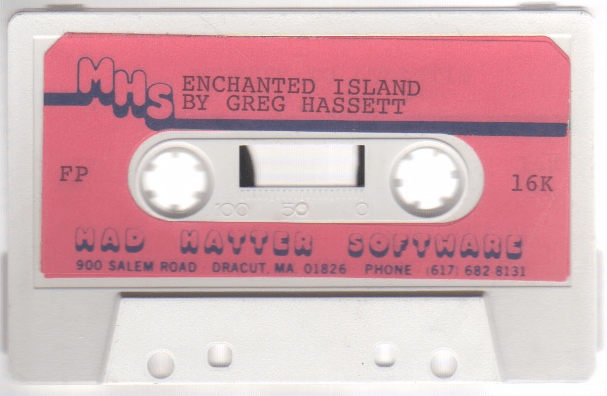
Enchanted Island is the last of the Greg Hassett games from 1979, making it his 6th published game. He was still 13 or 14 at the time. You find yourself on an island (with the usual cave and jungle) and need to collect treasures.
There’s not much I would call “evolution” in his games just yet; the structure feels a lot like Journey to Atlantis. Specifically, there are a lot of rooms with a.) a treasure and b.) some sort of enemy preventing you from taking it. The enemy needs to be chased away, pacified, or subdued, and then the treasure is available. Thus, the gameplay feels like finding the right key for the right lock.
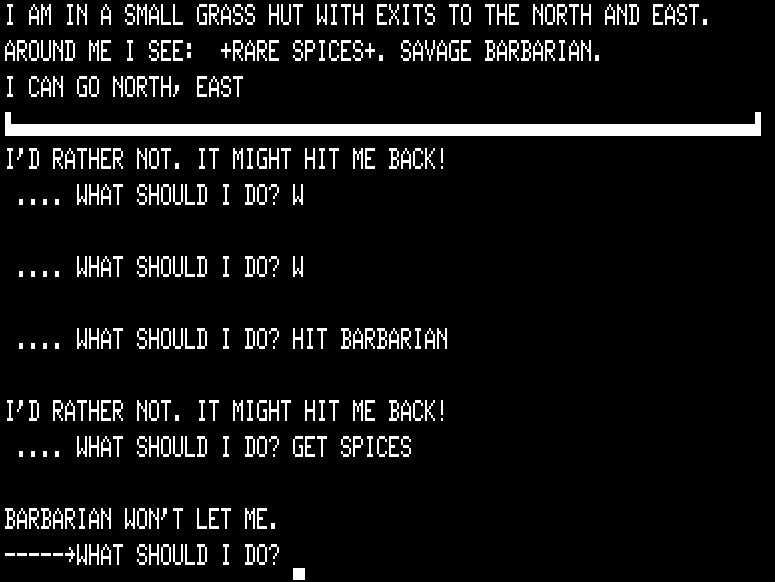
A lot of the connections between enemy/obstacle and the treasure they guard are arbitrary enough that the game has to give pretty explicit hints.
Holy smokes, a tiger! Barbs like ban… (The inky on the rest of the note is too faded to read.)
The message above is from a note in a bottle. If you give the barbarian a banana, it eats it, drops the peel, and leaves.
One of the hints in the game mentions a secret word of “BIMBO”. (I’m not sure why that choice of word. Given the incongruence with the rest of Mr. Hassett’s work I’m tempted to think the author didn’t realize at the time it had a known meaning.) The secret word is essentially the only interesting puzzle, because it took me through several phases:
Phase 1. It didn’t work anywhere.
Phase 2. Later in the game, I got it to work, and it teleported me to a “dead end” in the caves. I figured that was the full effect.
Phase 3. After getting stuck I decided there might be more to the magic, and tried it a second time after reaching the dead end. It teleported me into a previously inaccessible jungle area.
Phase 4. Later, I couldn’t get the magic word to work again. I was unclear what conditions the word did or did not work, and it took some experimenting to realize one of the treasures (a ruby) was allowing the magic to work when I was holding it.
The above sequence incidentally suggests why even simple adventures in general aren’t just locks and keys — or at least describing them as such is too reductive. The “key” for the lock of the magic word was the ruby, but it wasn’t clear what the key was (if it was an item, even) and it wasn’t clear what the key did.
The route to 140 out of 140 points was fairly straightforward, except for an issue with the parser. One of the enemies is a “bear”, and the response to >HIT BEAR is just “I’d rather not. It might hit me back!” (like the barbarian mentioned earlier). I figured that was that and looked for peaceful resolutions, scaring the bear, applying some magic at the bear — no dice. I finally resorted to a walkthrough and found that I could ATTACK BEAR and drive it away, even though my player avatar was too scared to HIT BEAR!
Most would likely shelve this under “guess-the-verb” but the situation is messier; rather than needing to guess a verb, the game split ATTACK and HIT into two distinct actions and the player needed to realize they were *not* considered synonyms, even though the default “you can’t hit” message strongly suggests that attacking is fruitless, too.
In other news, we are now officially almost done with the 1970s. Only David Long’s 501 point version of Adventure remains!
Ok, fine: there’s a non-English Tolkien text adventure from 1979 earlier than LORD I have a lead on, and there was a translation, and I even have a lead on the translation, but I haven’t fully snagged it yet. I’ll loop back during 1980 if I hit paydirt.
This is the last Wander system game I had left (the other two were Castle and Alderbaran III). It was written by Nat Howard as opposed to Peter Langston (who wrote the other two as well as the Wander system itself).
The date is admittedly a guess; Peter estimated “somewhere between 1974-1978”. There’s an Alderbaran III reference so it has to be after 1977; the actual date on the most recent revision is 1980.
The map is based on the Widener Library at Harvard (shown below). This makes it mark the starting point of the long tradition of interactive fiction based on actual university surroundings (The Lurking Horror being based at MIT is the best-known example).

Through the wonder of Wander, you are going to explore the remains of a world after Chaos has had its way with it. There are treasures to be had here, but there are also undreamed of dangers. The ghosts of the people who once ruled this world are there still, and the products of their godlike meddling have survived them. Be cautious, daring, and sneaky.
You’re at the foot of the stairs of a huge pillored building. There is a faint inscription on the stone crosspiece above the pillars. Walkways go to the south, east and west.
There is a leather sack here.
The post-apocalypse is a convenient way to avoid dealing with coding active NPCs. Once again, the premise is to collect “treasures”.
I wish I could say it’s a pivotal game somehow, but it’s incomplete, buggy, and full of in-jokes. Some I can’t fathom even after extensive Internet searching, like this chapel where the treasures get deposited:
You’re inside what was once a very, very, socially prominent church. Murals on the wall show the ‘prophet of WWXII’, called ‘Bo Diddley’ by some, performing the Miracle of the Unclasped Hand. Which happened on the very ground on which you now stand!!!!!!
There is a door to the north.

The actual chapel in question has a WWI memorial, but that doesn’t cause the Bo Diddley reference to make any more sense.
A sample bug:
KILL GNOME
The black sword pulses in your hand and begins to hum evilly at the unfortunate gnome. The gnome pales, and leaps at you, hoping to score with the knife. The sword snarls, and forces your arm up, spitting him.
His body vanishes.
You’re in a square chamber 5 cubits by 7 cubits by 8 cubits high. The top of a spiral staircase pokes out of the floor here.
There is an evil gnome here, waving a knife at you!
If I could digress a bit into some coding minutae:
Inform, TADS, Hugo, and a few other interactive fiction coding systems enforce the idea that the words that mean actions are separate from the actions themselves, and actions happen to specific objects in the world. (It’s possible to break both paradigms, but it takes some effort.) That is, if you want to code the ability to >SMELL FLOWERS in a particular area, you need to code a Flowers object that will then link with the Smell verb. Conveniently, this means that SNIFF and any other plausible synonyms will already work (presuming they’ve been matched with the action in the first place) and the flowers can be referred to by other verbs, even if not every use is helpful.
Wander lets you hard-code an action in a room, allowing for terrible habits. You might remember >DROP DIRT from Alderbaran III even though no such object was being held (I suppose the assumption being it was “nearby” somehow). Library runs into parser nonsense early with an elevator sequence:
E
You’re in an elevator used by the building staff at one time. The elevator was controlled by buttons. The buttons are labeled ‘up’ and ‘down’
There is also an oddly-shaped keyhole on the panel with the buttons.
UNLOCK PANEL
Your keys stick in the lock, and the doors close
You’re in an elevator used by the building staff at one time. The elevator was controlled by buttons. The buttons are labeled ‘up’ and ‘down’
There are some keys stuck into an oddly shaped keyhole on the button panel.
PUSH UP
under construction
library elevator
PUSH DOWN
The elevator plummets with a squeal of old machinery.
You’re in an elevator used by the building staff at one time. The elevator was controlled by buttons. The buttons are labeled ‘up’ and ‘down’
There are some keys sticking out of an oddly shaped keyhole on the button panel.
OUT
You can’t leave, the doors are locked.
library elevator
N
You can’t do that now.
GET KEYS
Can’t get keys
TURN KEYS
You can’t do that now.
UNLOCK PANEL
You can’t do that now.
MOVE KEYS
You can’t do that now.
The *only* thing that works is the command >LOCK. Just the word, alone, with no reference to the keys. Argh!
LOCK
The doors open, and the keys fall into your hands.
Science fiction references abound without any attempt at coherency.
You’re in the Star-Trek room. This was quite a tourist draw in its time. Its a mock-up of the Enterprise bridge. Nothing works, of course. The weapons control board is lit, and a button marked ‘Photon Torpedo FIRE’ is blinking.
There are some Vulcan Ears here.
There’s a reference to Adventure, but even it is inscrutable, with a button that arbitrarily ends the game:
You’re in a room used to give demonstrations of computer games. There is a dessiccated corpse still seated at a console, which still displays the words ‘How? With your bare hands?’ There is a bright red button here marked ‘off.’ There are exits to the west, north, and south.
PUSH BUTTON
That’ll teach ya….
You wandered to 12 places in 23 moves.
There is one aspect that I think might be a First for adventure games, and that’s the sack from the very first room. It can contain items, and works as a way around the inventory limit of the game. Also, getting items back from the sack is amusing:
ENTER SACK
You struggle into the sack and then fall in!
You are inside a leather sack. There is some light above you.
There is a wicked looking inscribed knife here.
As far as I can tell, the score goes down rather than up when you deposit a treasure. (The three treasures are, according to the source code: A first-edition Gutenberg bible, a Capt America #1 comic book, and an orchid.) Scanning the code there doesn’t seem to be an end sequence, anyway. Perhaps someone who attended Harvard might glean a little more here, but I think I can safely call this one done.

Second floor of the library, via Wikipedia.
Robert Arnstein returns, who we know and love as the author of Haunted House.
In my survey of modifications to Adventure, I didn’t mention reskinning which adds a new coat of paint, so to speak, to an old game. For example, replacing all the dragons in Skyrim with Thomas the Tank Engine, or replacing fantasy trappings with an Egyptian theme.

Instead of entrances being blocked by debris, they are blocked by sand. Instead of a pirate stealing treasure, it’s a mummy.

The atmosphere isn’t bad; many rooms that were nondescript piles of rocks now have titles like “Chamber of Osiris” and “Room of Bes”. The snake is chased off by you throwing a bird god statue which comes to life.
There are no magic words. The place that was “Y2” now has a panel that you can “read” and it will move you to the entrance. READ PANEL will move you back again.

The tight entrance leading to an emerald the size of a plover’s egg is in, but the portion that had the “dark room” is out (hence, no marginally unfair magic word puzzle).
The bean stalk that needs to be watered is in, but there’s nothing past it other than treasure.
It was an challenge in 1979 to port Adventure to home machines (pulled off by Gordon Letwin and released commercially as Microsoft Adventure, but the programming was allegedly very complex). Pyramid 2000 takes a different route of simplifying things down, which would seen cheap and reductive with the original game; the reskin allows it to omit and remix freely without feeling awkwardly cut.
Keep in mind for many this was their first exposure to Adventure. It attained enough love from TRS-80 owners at the time that there is an extensive fan page and also a virtual reality remaster on Steam.

Yes, you read that right. It runs on the Vive and Oculus Rift. It’s still in early access. This is a screen shot. (UPDATE NOTE: the game is “finished” and out of early access.)
In any case, this isn’t a difficult game, so I’d only recommend trying it if you’re curious what it feels like to have a fantasy game be modified with an Egyptian motif.

If you’re at all curious about any of the Adventure variants from the 1970s, play this one. Other than David Long’s (which I haven’t played yet) I can definitively call it the fairest of the lot; for the most part I reasoned through the puzzles, tried actions that seemed logical, and found success. Even with two new mazes (and one not-really-a-maze) I got the buzz of feeling like I was Adventuring and not just jumping through abstract hoops.
However, if you do play, you should spoil the ending puzzle. It is absolute rubbish in a way I’ve never seen before in an adventure game and I am unlikely to see again. This is not an exaggeration.
(Note that below I will be spoiling more than just the ending.)

Via Everygamegoing. Even though the year is wrong, I like the comment about how the aim of an adventure is to “discover the rules.”
A lot of what I had left to wrangle was logistical. Let me detail an example, because this sort of thing happens rarely in modern games.
Just like 350 point Adventure, there is a limit to how long the lamp lasts; there’s also an inventory limit of 7 items. Each time I reached the well house and could turn the lamp off, it felt I had reached “home base” and could plan my next foray. As this game is larger than 350 point Adventure, I had to make lists, like this one which involved going up a large beanstalk on multiple occasions:
1st foray
leave axe at reservoir
bring keys, food, rod for 3rd foray, but drop off at nest
2nd foray
lamp
axe
ring
sculpture
opals
trident
pearl
3rd foray
lamp
axe
ring
keys
food
rod
eggs
The lists included items I knew I would need or predicted I would need for a particular section of the map. This particular plan turned out not be a perfect setup, because bringing the “eggs” on the 3rd expedition turned out unfortunate:
As you reach the middle of the bridge, the troll appears from out of the tunnel behind you, wearing a large backpack. “So, Mister Magician,” he shouts, “you like to use magic to steal back my hardearned toll? Let’s see how you like a little of MY magic!!” With that, he aims a tube running from the backpack directly at the bear and pulls a trigger. A spout of magical fire roars out and singes the bear’s fur; the bear bellows in pain and dashes onto the bridge to escape. The bridge shudders, groans, and collapses under the weight, and you and the bear plunge down into the chasm.
This also influences puzzle-solving. I ran across one puzzle where I quickly suspected I needed a certain item but didn’t get an opportunity to test my theory until several hours later. Also, a puzzle that was I had to solve early in the sequence involved eating a mushroom to get strength, allowing me to pull a sword out of a stone. The strength is temporary, but it lasted long enough it potentially was needed for a second puzzle. So in my puzzle solving I had to account for not only what items I currently had and which ones were in storage, but which ones were from the past.
Before I start ranting about the end game, let me set up a prior puzzle:
You are in a small room whose walls are covered with an elaborate pattern of arabesque figures and designs.
There is a small, tightly-sealed earthenware flask on the ground here. It has the words, “London Dry” written on the side.
I think the resemblance with a similar object in Acheton is just a coincidence, especially because the container doesn’t have gin:
The flask’s wax seal crumbles at your touch. A large cloud of black smoke pours out, solidifying into the form of a twelve-foot Djinn. “AT LAST!” he says in an earth-shaking voice, “I KNEW THAT SOMEDAY SOMEONE WOULD RELEASE ME! I WOULD REWARD YOU FOR THIS, MORTAL, BUT IT HAS BEEN THREE THOUSAND YEARS SINCE I HAD A SOLID MEAL, AND I’M NOT GOING TO STAND HERE CHATTERING WHEN I COULD BE OUT EATING A SIX-INCH SIRLOIN STEAK. FAREWELL.” With that, he somewhat rudely explodes back into smoke and drifts quickly out of sight.
So rude. In a different section, you find a room with a pentagram, which allows for a much more helpful answer:
> THROW FLASK
You have set the flask down in the center of the pentagram.
> OPEN FLASK
The wax seal breaks away easily. A cloud of dark smoke pours up from the mouth of the flask and condenses into the form of a twelve-foot Djinn standing in the pentagram. He pushes experimentally at the magical wall of the pentagram (which holds), and nods politely to you. “MY THANKS, OH MORTAL,” he says in an incredibly deep bass voice. “IT HAS BEEN THREE THOUSAND YEARS SINCE SOLOMON SEALED ME INTO THAT BOTTLE, AND I AM GRATEFUL THAT YOU HAVE RELEASED ME. IF YOU WILL OPEN THIS PENTAGRAM AND LET ME GO FREE, I WILL GIVE YOU SOME ADVICE THAT YOU MAY ONE DAY WISH TO POSSESS.”
> OPEN PENTAGRAM
The pentagram’s magical barrier sparks fitfully and goes down. The Djinn stretches gratefully and smiles at you. “AGAIN, MY THANKS,” he says. “MY ADVICE TO YOU WILL TAKE THE FORM OF A HISTORY LESSON. WHEN RALPH WITT, THE ARCHITECT AND CONSTRUCTOR OF THIS CAVE, WAS VERY YOUNG, HE BECAME VERY INCENSED THAT HIS NAME WAS AT THE END OF THE ALPHABET. HE FELT (FOR SOME REASON) THAT THE LETTER W BELONGED NEAR THE BEGINNING OF THE ALPHABET, AND THAT ALL OF THOSE “UPSTART LETTERS WHICH UNFAIRLY USURPED THE BEST PLACES” SHOULD BE FORCED INTO EXILE AT THE END OF THE ALPHABET. HIS INSTINCT FOR MATTERS MAGICAL AND MYSTICAL LED HIM TO APPLY THIS STRANGE BELIEF INTO THE CAVE’S STRUCTURE WHEN HE EXCAVATED IT. YOU HAVEN’T YET BEEN AFFECTED BY HIS STRANGE HABITS, BUT YOU SHOULD REMEMBER THIS. FAREWELL, AND GOOD LUCK.” With that, the Djinn evaporates into a cloud of smoke and drifts rapidly away.
That second portion is a hint for the endgame. It’s not even a bad hint for what to do; the absurd bit we’ll get to in a moment.
After getting all the necessary treasures, the endgame starts like every other variant: an announcement the cave is going to close, and then:
The sepulchral voice intones, “The cave is now closed.” As the echoes fade, there is a blinding flash of light (and a small puff of orange smoke). . . . As your eyes refocus, you look around and find…
But then things vary:
You are in a small cylindrical room with very smooth walls and a flat floor and ceiling. There are no exits visible anywhere.
So, when given this much minimalism, the general approach is to try everything, including magic words:
> xyzzy
Nothing happens.
> plugh
Nothing happens.
The magic words are the key, and the Djinn’s hint really is enough to suss out the necessary trick. You need to recite all the magic words in the game, in backwards alphabetical order.
Still not at the howler yet: in normal circumstances it’d be possible to run across the solution organically; when stating the correct word last in alphabetical order, the game says “Ok.” rather than “Nothing happens.”
However, you need to recite all the magic words in the game, and not just all the magic words that have appeared in the game. From my last post, I mentioned getting a magic word with a sceptre, and as an aside I mentioned the word was not fixed. The word is in fact drawn from a set of five possible words, and you only get one, but you need all five in the endgame.
So you need to save and restore the sceptre scene at least five times (probably more due to random chance) to try to extract every possible magic word, because all of them will appear in the endgame. (I gather from Arthur O’Dwyer’s notes — the person who ported the game version I played — that the original version set the word at the start of the game so you would need to play the game through to that point at least five times.)
To add even more pain, the first word needed — ZORTON — is one off the random five list. So, unless you got that word in your play-through, you aren’t going to see the “Ok.” message at all. At least if XYZZY (the next reverse alphabetically) had started the set there would be a hint of the correct action path.
This is so staggering I deep-searched the source code just to make sure I wasn’t missing something. The best I can figure is: at the time mainframe games tended to be group activities. You can imagine an entire math department tackling the game at off hours. The group has all reached the endgame, and word of mouth has spread that the number theorist in room 602 got a different message than everyone. People confer notes and realize the effect of ZORTON. Compiling together the efforts of 10 people, they manage to realize a full magic word list and finally lead the way to triumph.
I admit a bit of fascination with puzzle games designed to be solved with groups, either intentionally (as in the case of The Black Watchmen) or unintentionally (as happened with the adventure Blue Ice, which was intended to be part of a contest that never happened and required a whole forum to solve it). With Adventure 550, though, it’s just a broken puzzle. This is a pity, because after saying the last magic word there’s a section with an existential vibe I found satisfying. You are sent back to the start of the game, but the wellhouse is now empty. The world feels lonely. There’s only one last task:
At your feet all the water of the stream splashes into a 2-foot slit in the rock. Downstream the streambed is bare rock.
>D
You plunge into the stream and are carried down into total blackness.

You find yourself sitting on the edge of a pool of water in a vast chamber lit by dozens of flaring torches.
The floor is covered with thick layers of precious Persian rugs!
Rare coins, bars of silver, and lumps of gold and platinum are strewn carelessly about!
There are diamonds, rubies, sapphires, emeralds, opals, pearls, and fabulous sculptures and ornaments carved out of jade and imperishable crystal resting on display shelves, along with rare Ming vases and ancient Indian turquoise beads!
A flotilla of ruby-encrusted toy boats is floating in the pool of water beside you!
A network of golden chains supports a fantastic Iridium crown!
There is a display case on the wall filled with a fantastic selection of magical swords, which are singing “Hail to the Chief” in perfect pitch and rhythm!
There are a dozen friendly little dwarves in the room, displaying their talents by deftly juggling hundreds of golden eggs!
A large troll, a gigantic ogre, and a bearded pirate are tossing knives, axes, and clubs back and forth in a friendly demonstration of martial skill!
A horde of cheerful little gooseberry goblins are performing talented acrobatics to an appreciative audience composed of a dragon, a large green snake, a cute little bird (which is sitting, unmolested, on the snake’s head), a peaceful basilisk, and a large Arabian Djinn.
Everyone turns and sees you, and lets out a heart-warming cheer of welcome!
You have scored a total of 550 points, out of a possible maximum of 550 points. During this game of Adventure, you have taken a total of 476 turns.
All of Adventuredom gives tribute to you, Adventurer Grandmaster!

Partial map in progress.
So the most significant thing I’ve done since last time is make my way across the “breath-taking view”. In the original it was just a fancy description, but in Adventure 550 it holds a secret:
You are on the edge of a breath-taking view. Far below you is an active volcano, from which great gouts of molten lava come surging out, cascading back down into the depths. The glowing rock fills the farthest reaches of the cavern with a blood-red glare, giving everything an eerie, macabre appearance. The air is filled with flickering sparks of ash and a heavy smell of brimstone. The walls are hot to the touch, and the thundering of the volcano drowns out all other sounds. Embedded in the jagged roof far overhead are myriad twisted formations composed of pure white alabaster, which scatter the murky light into sinister apparitions upon the walls. To one side is a deep gorge, filled with a bizarre chaos of tortured rock which seems to have been crafted by the devil himself. An immense river of fire crashes out from the depths of the volcano, burns its way through the gorge, and plummets into a bottomless pit far off to your left. Across the gorge, the entrance to a valley is dimly visible. To the right, an immense geyser of blistering steam erupts continuously from a barren island in the center of a sulfurous lake, which bubbles ominously. The far right wall is aflame with an incandescence of its own, which lends an additional infernal splendor to the already hellish scene. A dark, foreboding passage exits to the south.
> wave rod
The earth begins to shudder violently, and smoke flows up from the gorge beneath your feet. With a violent >GLOP!<, the volcano belches out an immense blast of molten lava which flies into the air above the gorge and suddenly solidifies into a fragile-looking arch of wheat-colored stone that bridges the gorge.
I confess I had to spoil this part. In particular, the wall-of-text literally hid an important clue I missed (Across the gorge, the entrance to a valley is dimly visible.)
The rod in the original you could wave to form a bridge, but it was to a location that was accessible a different way. Most walkthroughs just skip it. This is the first case I’ve seen where Adventure 550 does repurposing, resusing an old item for a new purpose. There’s no way to know for certain if the rod will work without experimentation, but at least in this case it makes sense — the rod makes bridges, you’re in an area where a bridge would come in handy, the rod works to solve the puzzle.
Magic in adventure games can be a danger zone for puzzle design. It’s too easy to force the player to stand in random spot X and wave necklace Y to solve a puzzle; without strong hints it’s a matter of trying everything everywhere.
This game does give hints, even if they’re a bit jarring. Do you remember “Stand where the statue gazes, and make use of the proper tool” from last time? Also, the Donaldson reference with “Witt Company Tool Room — Melenkurion division”?
You are standing at the north end of the Valley of the Stone Faces. Above you, an incredible bas-relief statue of an immense minotaur has been carved out of the rock. At least sixty feet high, it sits gazing down at you with a faint but definite expression of amusement. Between its feet and the floor is a rock wall about ten feet high which extends across the entire north end of the valley.
> MELENKURION
Rock silently crumbles off of the wall in front of you, revealing dark passages leading northwest, north, and northeast.
Oof. This was sort of pleasing and displeasing at the same time. I honestly wouldn’t have zeroed in on “Melenkurion” as a magic word without the pop culture reference, but in retrospect the “tool” can’t refer to anything else.
On the top of the map you might notice some “catacombs”. That’s another maze with one of those all-or-nothing structures I wrote about in Adventure 500, where going the wrong direction takes you backwards, and there is only one right direction. Mapping it was tedious, and hidden inside I found this:
You are at the eastern end of the Audience Hall. There is a large dais rising out of the floor here; resting upon the dais is a strange-looking throne made out of interlocking bars and rods of metal.
Resting on the throne (“sitting” isn’t really the right word) is an incredible skeleton. It is fairly humanoid from the waist up (except for its incredible size and four extra arms); below that, it resembles the body of a giant python, and is wrapped in and around the bars and rods of the throne. Clutched in one bony hand is a long sceptre, ornately encrusted with sapphires!!
> GET SCEPTER
You pluck the sceptre from the skeleton’s bony hand. As you do, the skeleton raises its head and whispers “Remember — BLERBI!” in a foreboding tone; it then sags to the ground and crumbles into dust which drifts away into the still air of the cave.
(The magic word is not fixed — I went through the scene again later and got a different one.)
I might have thought the skeleton would put up more of a fight, and indeed it does if you try to take the sceptre back across the bridge:
As you reach the center of the bridge, a ghostly figure appears in front of you. He (?) stands at least eight feet tall, and has the lower body of an enormous snake, six arms, and an angry expression on his face. “You’ll not have my sceptre that easily!” he cries, and makes a complex magical gesture with his lower right arm. There is a brilliant flash of light and a vicious >crack<, and the bridge cracks and plummets into the gorge.
This was admittedly an excellent death. I have trouble describing why it made me laugh with delight rather than groan in pain, but it may have had to do with me realizing the likely solution.
You see, the magic word works to open a giant walk-in safe. (There is no indication why — this was a moment of random-necklace-waving, so to speak.)
> BLERBI
>ker-THUNKscreeeeeeeeeeeeeeeeeeeeeeeeeeeeeeeeeeeeech<
The (somewhat rusty) safe is now open.
Here’s the thing: there’s also an exact identical safe past the bridge, below the Hall of the Mountain King. I could see exactly where this puzzle was going, so the dramatic scene of the skeleton was simultaneously accompanied by the gears clicking in my head.




 Renga in Blue