(Continued from my previous posts on Catacombs, which you probably should read before this one if you want the full background.)
Last weekend, I received a message from Marcel Ingram Lansing that one of the most sought-after Commodore PET games had been rescued.
Specifically, Colin Haynes had copies of both Catacombs and Goblin Towers by Brian Cotton in Commodore PET disk format. They’re part of a series of five adventures from the author published by Supersoft starting in early 1981. Goblin Towers we already had in something close to the original form, but Catacombs we’ve only had as a broken DOS port from five years later which is impossible to beat.

Catacombs is one of the earliest commercial British text adventures, and given how many they eventually came out of the country, it’s not exaggerating to say a landmark has now been preserved.
LONG ASIDE: The first ad for Catacombs was from February 1981. Based on Gareth Pitchford’s research, we know of four (or maybe three) adventure games from earlier that were sold “commercially” (to at least some extent) of British origin.
1. Just one month earlier the magazine Computing Today had a classified ad for Dungeons of Death on the Commodore PET; the description makes it unclear if it’s an RPG, quasi-RPG, quasi-adventure, or adventure.
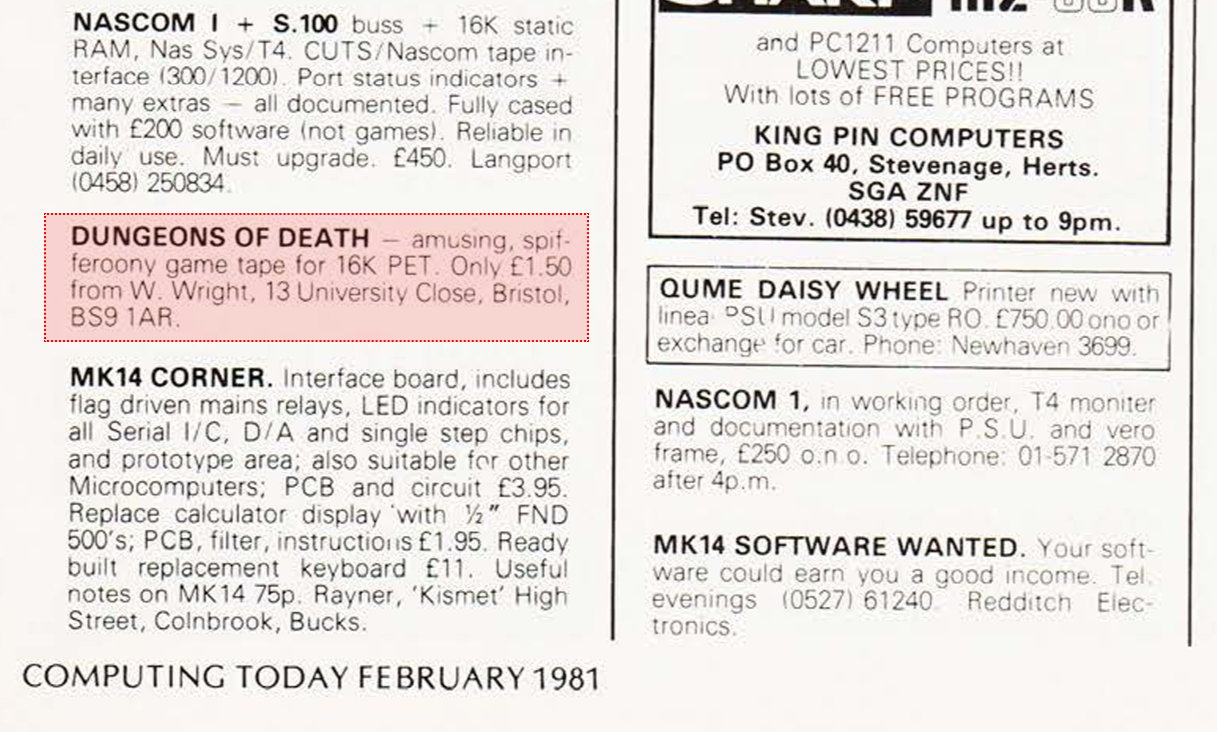
“Amusing, spifferoony game tape for 16K PET”. Source. Remember, for newsstand magazines the actual month is roughly one off from the one printed.
2. There’s an ad in Personal Computer World November 1980 for a mysterious game called Toxopholy by the equally mysterious Spider Software out of Croydon, Surrey. It was written for Apple II, which was not a common computer in England. (Not unknown either, to be clear!)
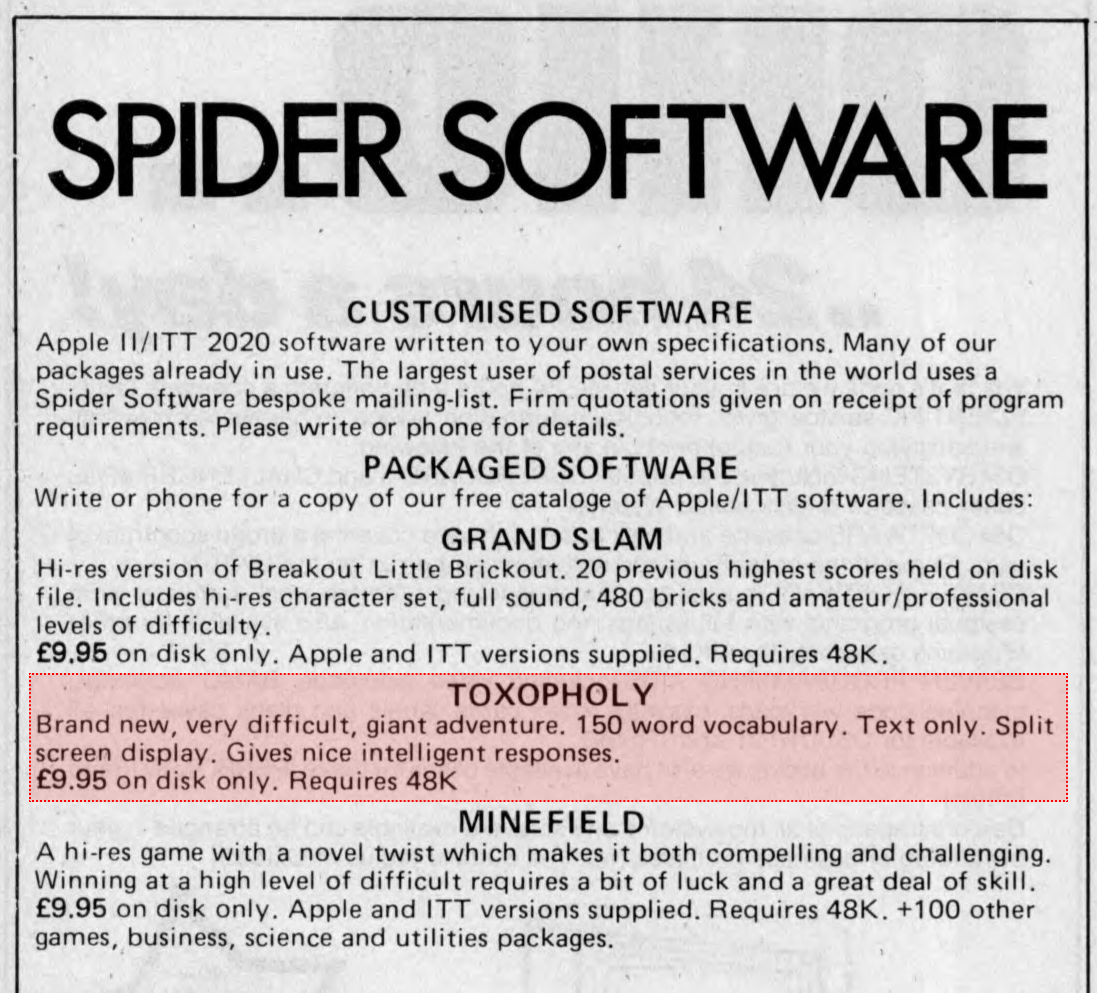
Given another ad from Spider Software elsewhere which includes games like Wizard and the Princess, they clearly were more of a “publisher” of Apple II software, although the Toxopholy ad is so early that game may still have originated with them.
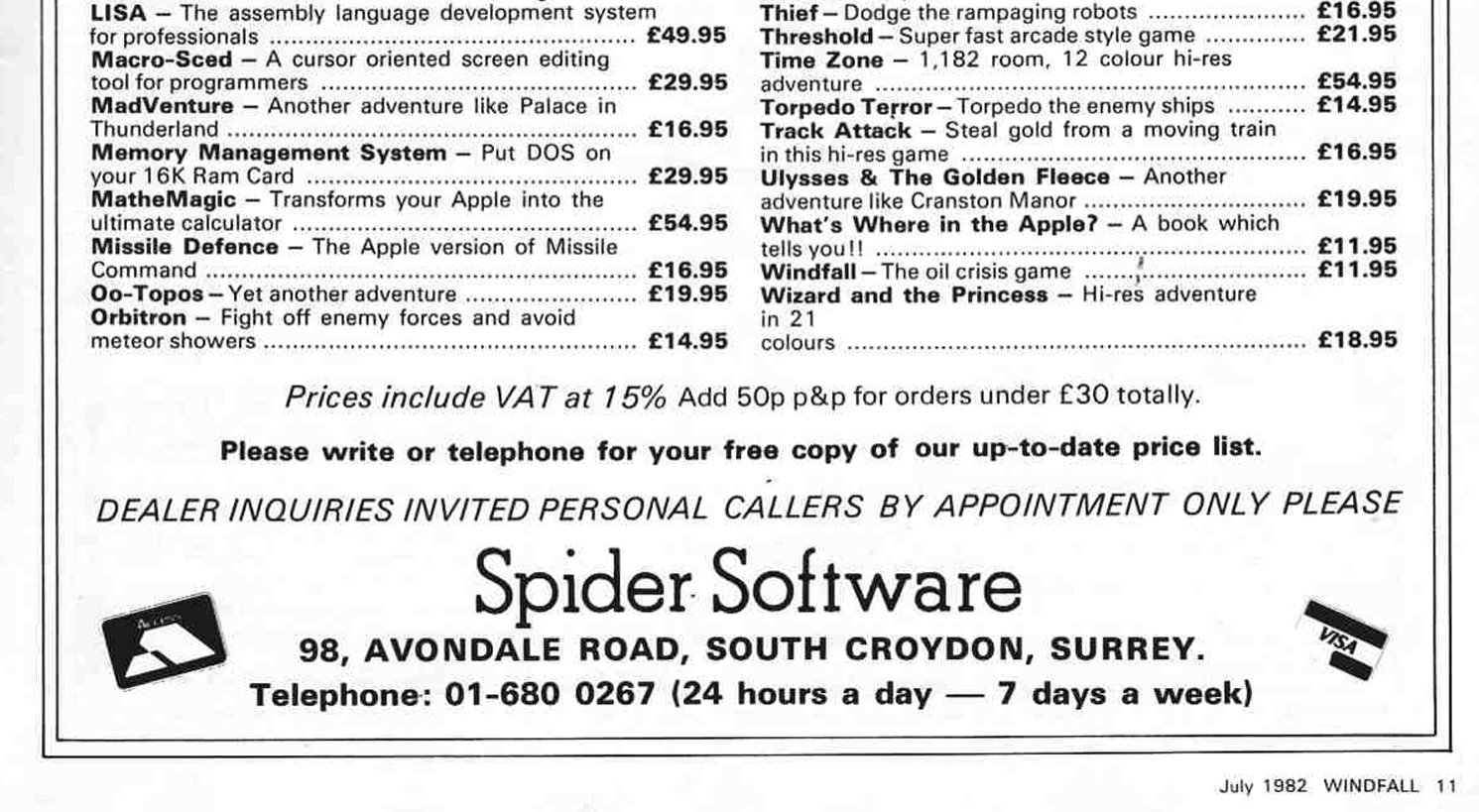
From Windfall July 1982, an Apple magazine from the UK. Notice that Toxopholy is no longer advertised.
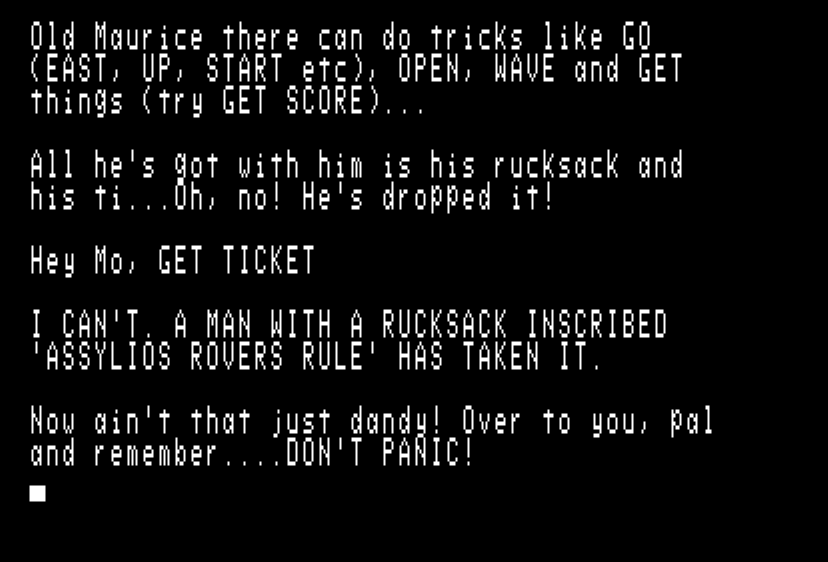
3. We know more about Galactic Hitchhiker for the UK101 than the other games, because I’ve played it and written about it here already. It is remarkable for having the “computer avatar” have its own voice and attitude, and is story-driven in a way rare for 1980. It was first advertised a month before Toxopholy.
4. There was an early adventure game by none other than Games Workshop, the company most known for Warhammer 40K and with 2025 revenue of £565 million. The earliest ad anyone has been able to find for their adventure appeared in a July 1980 issue of Practical Computing (so out by June) which puts it as the earliest commercial release of an original text adventure from Britain we know of.
Our own version of this classic computer moderated fantasy adventure game in which you explore an underground dungeon populated by snakes, trolls and menacing little goblins which constantly bar your way. As you explore, you give the computer commands such as – get gold, open lock, drop bottle, kill goblin etc. – and tell it which way you proceed. The computer responds with your revised situation and awaits your further instructions.
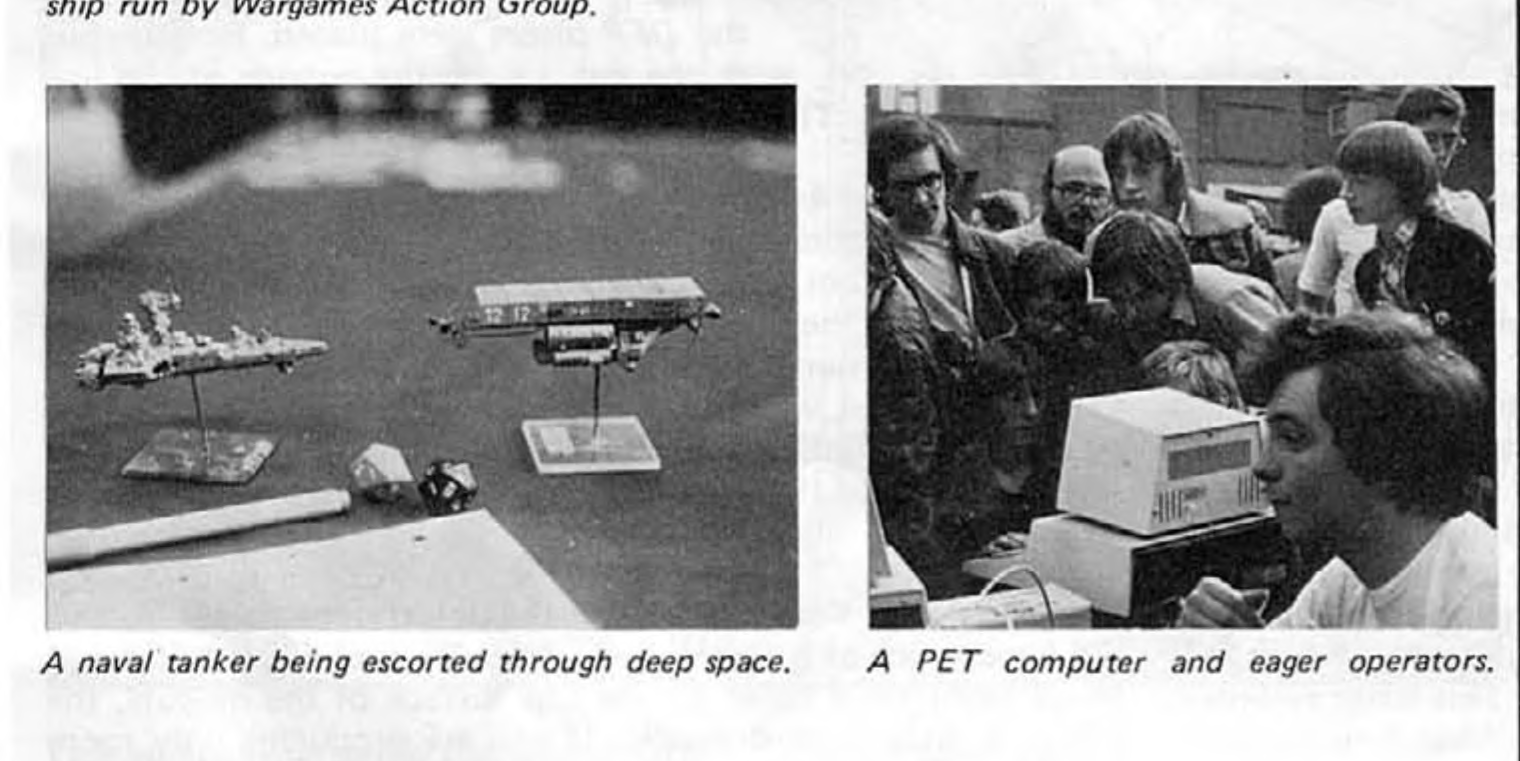
White Dwarf Issue 22 (Dec. 1980/Jan. 1981) mentions Games Day ’80 with pictures; Adventure was being shown off on a Commodore PET.
None of this undercuts Catacombs in importance. None of the games just mentioned had wide distribution; Steve Jackson describes sales of the PET games as a “disaster” (the biggest seller, a Star Wars game, sold 60 copies), and Dungeons of Death appearing once in a classified means it might have sold in the single digits. While the Cotton games didn’t quite have the reach of, say, Planet of Death, they still had a second printing by Supersoft, and generally got into the UK gaming consciousness; the only places on the Internet you can find Toxopholy mentioned as even existing are my page and Gareth’s.
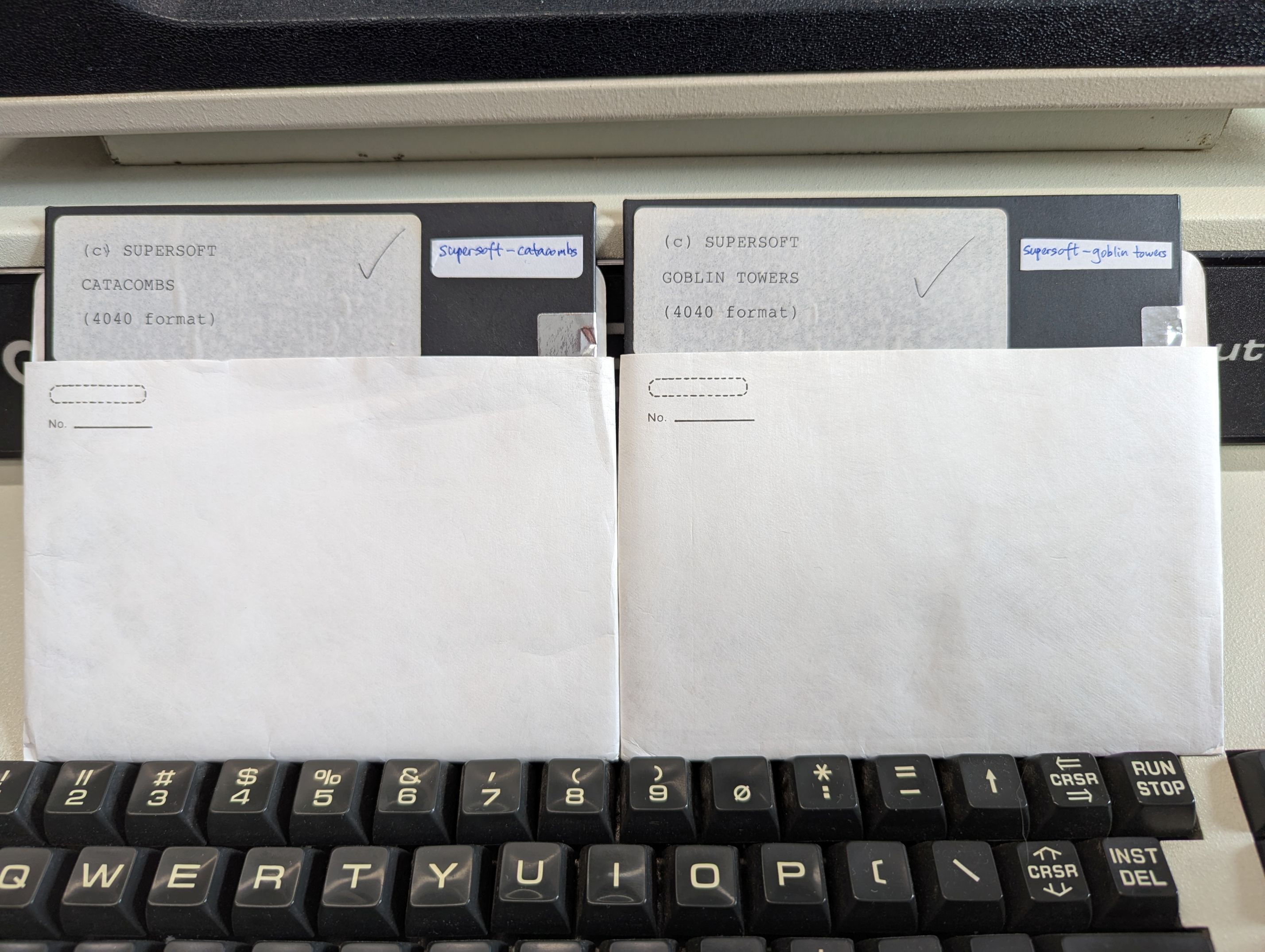
Returning back to the recent rescue: the disks for Goblin Tower were easy to copy, but Catacombs was a tricky case because the disk seemed to be corrupted. There’s a long account here (along with downloads!) of what happened, but to shorten the story, Brian Cotton used text files for each individual room, and wanted to make sure the player couldn’t read them.
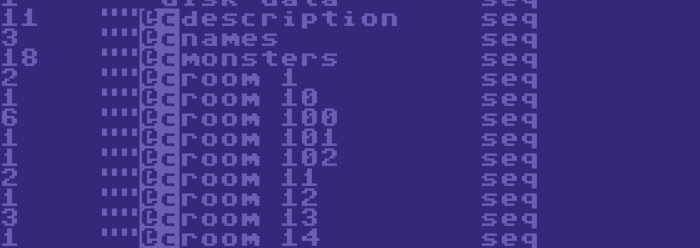
DirMaster is able to list the file correctly, but trying to take the directory on a real Commodore PET just produces corruption. What’s happening is the extra ” character followed by the @C which is sufficient to garble the text (when looked at with a PET) into junk. Furthermore, Cotton didn’t want people realizing the trick through the game’s BASIC source code. From Marcel’s video:
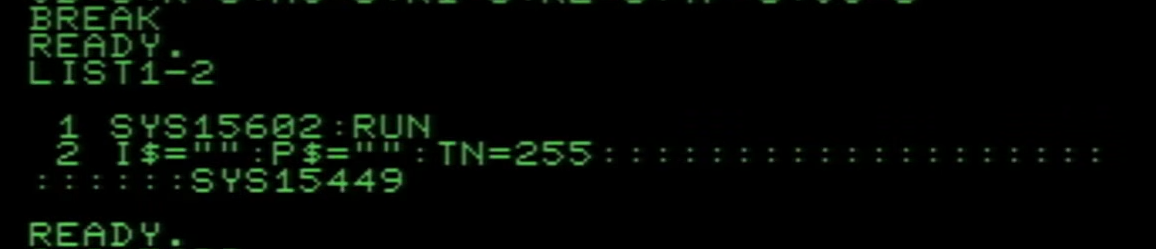
Look closely at line 2, which has a string of colons like this: “::::::::::::::::::::”. If run alone, that’s just a string of non-commands, but prior to that line there’s the SYS 15602 line. What that does is call a different spot in memory which overwrites the next line of BASIC source code while that code is running.
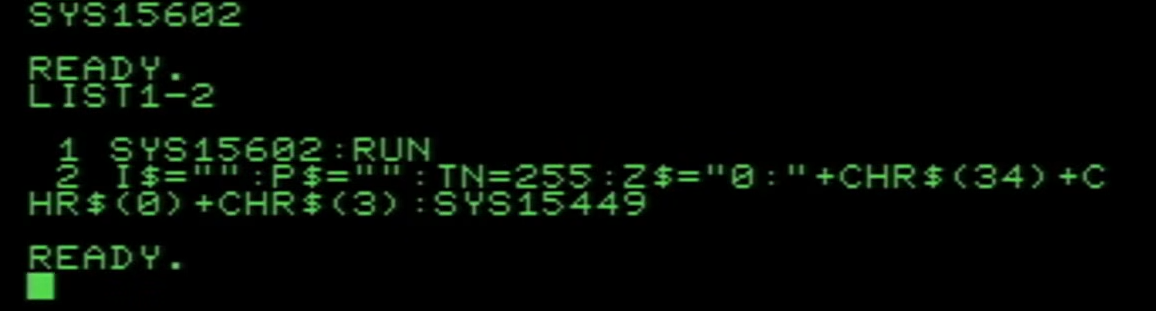
The spot filled with colons has been transformed into Z$=”0:”+CHR$(34)+CHR$(0)+CHR$(3). This provides a string that the game then uses to read the name of any text file representing a room, putting those characters at the start. Then, immediately after Z$ is assigned, the game covers its tracks by calling SYS15449, which rewrites the line of code that was just called back into a string of colons.
The web page includes the original version (which does run emulated) and also the “cracked” version with everything changed into plain-text. The issue for preservation is that it took a little more than a simple file-copy to preserve the disk (check the link for details). For us from here, though, we can focus on the game itself!
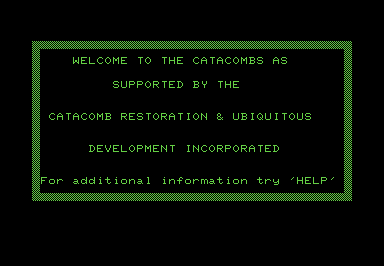
The game is genuinely close to its large Classic Quests iteration, although there’s one immediate change you can see from the start.
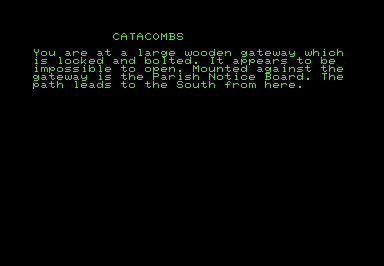
The result of READ BOARD.
The game has ASCII art! There’s files marked “pic1” through “pic11” (or to be more exact, funky characters followed by pic1 through pic11) and each one is an image that has a mere text description in the DOS version.
Your job is to explore the church that you start at and the catacombs beneath and retrieve all the treasures.
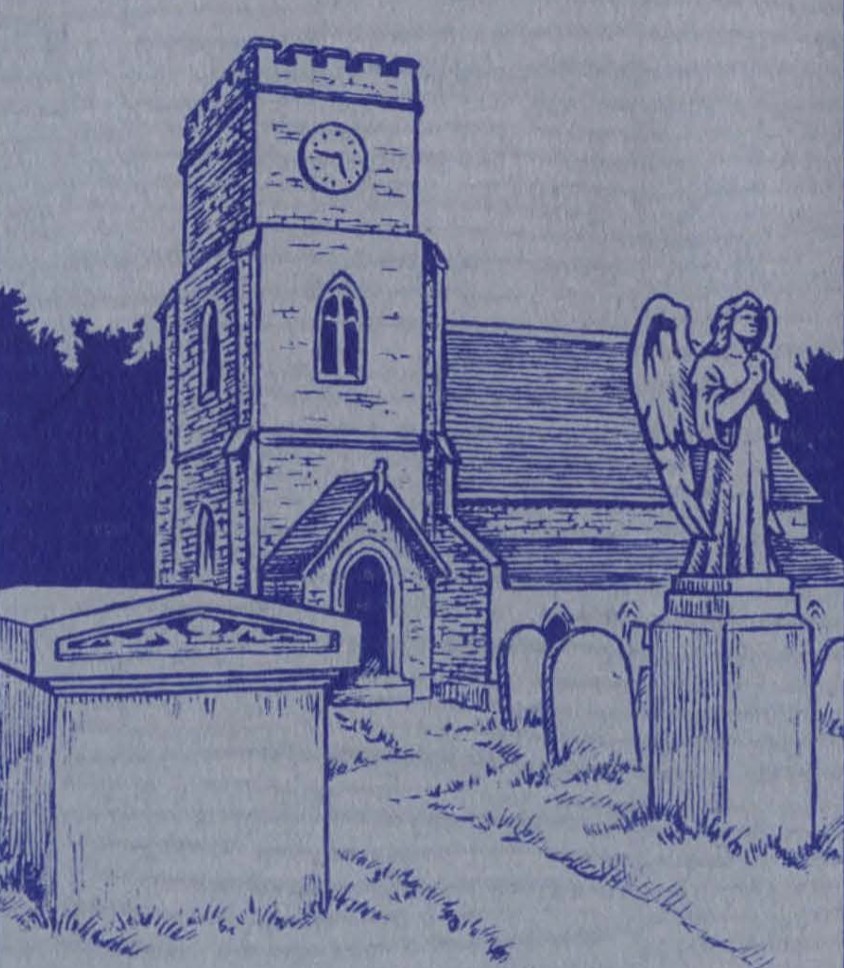
At least at the start, the game is very similar to the Classic Quests version, with room descriptions at least matching. However, inside the church, the book in the Classic Quests version uses text…
While the page is quite legible the content seems not to make much sense, however I can make out something about entering Heaven with the aid of certain holy writings.
…but uses ASCII art here. There’s no hint indicated like in the DOS version.
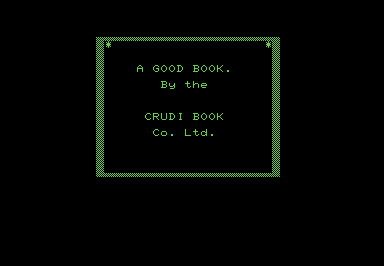
The map outside seems to be a slightly different maze than before (I probably will not map it out, but I’m always morbidly curious when a game undergoes slight changes). The keys are hidden under a lectern in the church just like before, and they unlock a tomb in the same way.
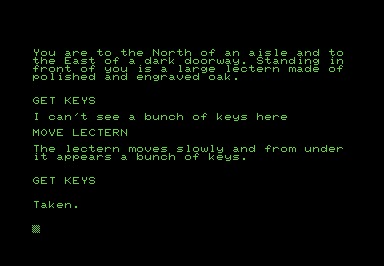

Inside is a coffin with a sword and lamp. The lamp lights with LIGHT LAMP but does not turn off with DOUSE LAMP (as the Classic Quests version) but rather OFF LAMP.
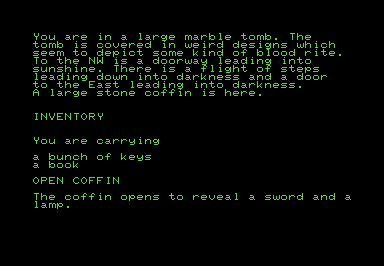
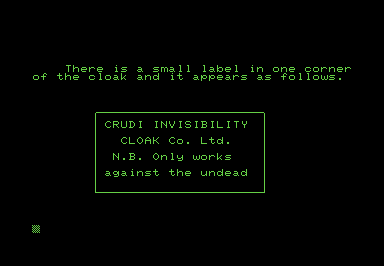
Just to the east is the vampire staked with the cloak, and the cloak has ASCII art. I haven’t tried messing with the vampire yet; in the current DOS version, you get a container for holy water from the church, then throw it at the vampire to kill it so you can safely take the stake, but the stake is used for absolutely nothing. It may not have the same behavior in the original!
Down is an OBOLUS coin as before, but again, some slight bit of art.
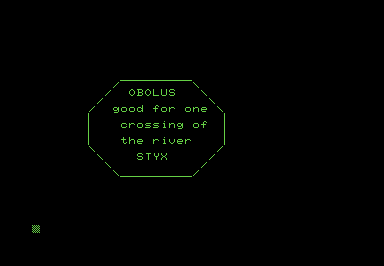
Just adjacent is the river with Chiron; I remember having to intentionally give a coin over in the DOS version (which is wrong to do! the coin is a treasure and you can cross the river a different way). Here, if you wait a turn at Styx, you will automatically cross.

One last difference I’ve noticed is that something that was previously broken definitely is here: the hooded rider. This was a rider that was supposed to appear randomly, but examining it would cause death.
You have looked upon the Dark Angel. This is the angel of death: to be more specific, your death. It has cost you your life to look upon it.
This game doesn’t let you examine! I’m not sure if I’m supposed to do something different here. It’s curious if it was added just for the DOS port.

Just as a reminder, other than this scene (which should result in some manure) I had a non-working flamethrower, no way of getting by a spider web (probably uses the flamethrower), a zombie and purple sphere with no clear use, and no way of pulling a “plug” in the water. On the last one, quoting Alex Dijkstra:
You need to remove this to get to Neptune’s bedroom and the Elysian field without paying Charon.
That is, previously the coin was getting used anyway because the alternate method wasn’t working! More investigation (and probably a finish) next time.


 Renga in Blue
I have new research/information related to some of the topics covered here that will be presented as part of an article soon-ish.
One interesting thing that was revealed by the preservation of these disks is that Catacombs seems to have been released slightly later than the initial ads would suggest. There’s an internal code date of 3/29/81, which would indicate that the game probably didn’t start being sold until at least April of that year. Jumping the gun with this sort of advertising isn’t that surprising, as Supersoft sold heavily through direct catalog marketing, like a number of other early UK software houses (CDS, for example), so saying something was available while it was still finishing up development and listing it with a price as currently available kind of fell under the “now taking orders” umbrella and wasn’t considered illegitimate, even though people would start grumbling after a while if the delays became too lengthy.
It’s also equally likely it got updated. It isn’t like they were mass printing these things.
That’s certainly possible, but in those cases you’ll generally see a “v. 1.5” or something like that attached to the date. The exact line here is:
“03/29/81 PRIMARY SUPERSOFT/BC”
Goblin Tower is just:
“B.COTTON COPYRIGHT 1981”
The disc label states “4040 format”, perhaps an earlier release didn’t work on a 4040 drive. My question is why would a British company use the US date format?
I would think 3040 would most likely be the initial release and through special circumstances he made a 4040 version, which could result in a date-without-new-version-number situation (US date format still ????)
From what I remember it’s something like a single byte in the header that makes the two not be compatible
That’s also certainly possible, although for various reasons I find my interpretation of the code/release date issue to be more likely.
The thing that strikes me as the most curious is why he went to such great lengths to prevent “cheating”. There was still barely any domestic UK home computer adventure game market at that point, and it seems his own main reference point was Zork, so I’m not sure why he would have felt compelled to do that.
Well, the 4040 had already been available since the previous year and Supersoft was one of the major PET-oriented companies in the nascent UK market. I’ve seen a number of other Supersoft PET disks and they all have various specifications like this on their cheaply printed labels. I’ve also worked with one personally that has one of these label “revisions” and can confirm that the internal code date of the disk is from the first release of the game in question.
It has to be remembered that these Supersoft magazine ads are all actually solicitations for direct order, and then subsequently getting on their catalogue mailing list. At this early date the games weren’t being distributed to “shops” for regular consumer purchase. At best they would maybe show up at a few of the “authorized PET dealers” that were scattered around the UK. So they were most likely already prepared for providing these slightly different versions to suit customer specifications immediately from launch. The paid magazine ads had limited available space and generally only mention minimum requirements (“with disks”, “needs DOS 2.5”, etc.). The catalogues likely had longer individual descriptions with stuff like “please specifiy 3040 or 4040 drives”.
TLDR: There’s no evidence that they were re-dating code at the time for minor hardware differences, and it’s more likely that they were simply advertising what seemed like a novel new product they had in the immediate pipeline in order to generate advance interest and orders.
If you want to see Death type:
EXAMINE HOODED (you can complete the command with either RIDER or FIGURE but this is unnecessary)
I could point you to my post at CASA – https://solutionarchive.com/phpBB3/viewtopic.php?p=13672#p13672 – where I give some advice on VICE PET settings and how to avoid a potentially game locking bug. However I will give the more important points here.
First set the disk drive model to CBM 4040 as this gives a quicker response than the CBM 2031.
Secondly, when using snapshots I found that selecting “Save attached disks” caused an error when I attempted to reload the snapshot. So instead I did not select “Save attached disks” when saving and on re-starting VICE I attached the disc image after I loaded a snapshot (once the disc image is attached you do not need to attach it again so long as you do not quit VICE).
Thirdly, do no GET CLOAK … WEAR CLOAK … DROP CLOAK because this messes up the inventory limit. Instead, just WEAR CLOAK … DROP CLOAK, if you do pick up the cloak you must drop it before attempting to wear it. This bug may also apply to other items you can wear.
I’m curious as to why you’re doing everything manually when VICE is generally just drag and drop? I’ve been working on a few different preservation projects over the last year with it for both PET and Vic, and have never needed to attach/run things manually unless I wanted to mess with disk contents within the emulator. These two games seem no different.
There are some bugs and quirks with snapshots/savestates in VICE, to the point where a report had to be made to the VICE team for issues with the PET snapshots specifically, and I believe they’ve taken a look at it to address in the next release.
Rob, are you addressing me? I couldn’t get any snapshot saved with “Save attached disks” selected to load, so I saved snapshots without selecting “Save attached disks” and after loading the snapshot attached the correct disc image manually. As for my instructions at CASA, it is general information, I do not know which emulator anyone reading the post is using so I posted something that should work with any PET whether it is emulated or real.
Ah, ok. Since you specifically mentioned the VICE snapshot issue I assumed that all your instructions were meant for it.
In the PET preservation project I’ve been involved with (which uses different system settings) the snapshots won’t work at all, so we had to resort to in-game save/load, which thankfully works fine.
Pingback: Catacombs: Looking Upon the Angel of Death | Renga in Blue
just an addendum from idle searching on Spider Software
https://archive.org/details/PracticalComputing1982June06/page/n39/mode/2up
this page includes Richard Bartle writing about MUD1, Sytris writing in about their conversion of mainframe Adventure for Nascom also quoted by Gareth here…
http://8bitag.com/info/syrtis-adventure.html
…and a short note from Spider Software by Dick Williams, doing a phone number correction. This is the first I’ve seen a name associated with the company.
I’ll spill the beans here a little: Well over a year ago, I did a deep dive on early UK home adventure game research, kind of trying to expand on the work that Gareth had already done and see how much more I could turn up.
I found a bunch of stuff, but by far the most interesting thing was that I discovered what’s almost certainly the first UK home computer adventure (it predates all the others by months, except for one mysterious thing from 1979 that has a provocative title but could really be anything as there are no details), and it was very likely written by the same guy who did Toxopholy/Toxophily (they spelled it both ways) and was the other person behind Spider Software (along with Williams), whose story I was also able to mostly unravel. It’s all a bit complicated (including a version that was sold in the US!), and I’m sure you’ll be shocked to know that the game itself is also still lost, so my plan is to kind of shoehorn all of this info into the PET preservation article I have coming up (to be published soon-ish by GTW64) in the hopes that someone involved might see it and come forward, or maybe be able to track these guys down to see if we can get these games preserved
Hi – I’m very glad to have been able to help a little bit in resurrecting the original. It makes me happy that others are getting something from this.
Colin.
I’d like to thank you personally for helping to preserve these games. Aside from the inherent historical value, having these available has also been helpful in a similar effort I’ve been involved in.
Thank you, it was absolutely fantastic to get to play this! It fills in some gaps in understanding how they were made.
Colin, I’ve just noticed your comment. Thank you for your part in preserving these games. After struggling with a bugged “Classic Quests” version of Catacombs it’s a pleasure to play a version that can be completed.
fyi there is a comment on this Youtube video from the original owner/player of these diskettes (Andrew Hornsby):
Colin.
Thanks for the heads-up! I remember that Andrew actually popped up both here and on GTW64 last year to mention that he still had these disks. I was already involved in trying to preserve one of the other lost Supersoft PET games, so I was hopeful that something like this would eventually come to fruition. Thanks again for helping to make it happen.
I’m re-posting Andrew’s comment here just because it’s so great. The “birthday adventure” part is priceless:
“What a great video!
I’m the person who sold those floppies to Colin on ebay last year. If anyone happens to be interested, I can share some of their backstory…
They were part of my father’s estate and he had kept them safe in his garage for many years (much to the annoyance of my mother!) until his death in 2023. My dad was a trainer with British Telecom in the 1980s and used PETs extensively in his microprocessor training courses. I think it was a really exciting and enjoyable time in his life and he could never bring himself to part with his hardware and software from the time.
Catacombs and Goblin towers were actually my 10th birthday present in 1984. If I recall, each game was well over £30 and it felt like a very generous present at the time. My dad had written a “birthday game adventure” on the PET for my birthday which was effectively a treasure hunt where I had to solve clues to find new secret locations. In the final location was my present, Catacombs and Goblin Towers. Such a fun birthday morning for a 10 year old at the time! I used to enjoy playing the classic Adventure game, but getting Catacombs was a new level of difficulty altogether. When going through my dad’s stuff, I was delighted to find he had kept the disks, along with so much more.
As a point of interest, I managed to copy the catacombs disks to a D64 image using a VIC 1541 drive with ZoomFloppy. It worked first time and ran fine in the emulator, but obviously kept all the obscured file names.
I found this video really fascinating to understand the technique used to make the files difficult to read and how you managed to make it all readable. Really great detective work and fixing! As a kid, when I got stuck on the game it was indeed very difficult to cheat, but I ended up using disk editing software to view the disk sectors and desperately try and get some clues. The list of verbs was quite useful I seem to remember. Funnily enough, at the time I did feel a bit guilty for trying to cheat, but the game was very tricky for a 10 year old and back then there was no internet to turn to for hints. This solution of decoding the files makes thing much easier, and I shall go and download a copy now.
Finally, I don’t know if you’ll see this comment Colin, but thank you so much for sorting through all the disks and uploading to the community all the items missing from the internet archives. I’m so pleased that you ended up with the collection and are able to spend the time on them that they deserve – time that I sadly didn’t have. My father would have been surprised and delighted to know that his collection is of such value to enthusiasts all these years later.”