I can say straight-out this game wins 1980 for best animated adventure game intro screen.

(Mind you, the John O’Hare games are the only other contenders in the category, but still, this was an unexpected surprise.)
Including the manual and different title screen permutations, the game is variously called
Dragonquest!
Dragonquest
Dragon-Quest Adventure
Dragon Quest Adventure
“Dragon Quest” Adventure
Dragon Quest
so I just picked one that hopefully won’t clash too much with the much-more-famous JRPG game.
Charles Forsythe wrote this one before Lost Ship Adventure (see the comments here), which is curious, since this game is in assembly code and the other game is in BASIC, and the usual evolution of authors (see: Scott Adams, Greg Hassett) has been to start with BASIC and move on to assembly. (EDIT: The best guess based on current information is that Lost Ship was actually written and published first, and despite the 1980 copyright date Dragon Quest didn’t start getting advertised and sold until 1981. This makes much more sense with the BASIC-Assembly order of author development.)
I thought Lost Ship Adventure had some good starting atmosphere but ended up disappointingly simplistic once it got past the opening. Still, after the difficulty of my recent games, “simplistic” is what I’m really wanting at the moment.
The plot is neatly summarized in the opening screen:

I’ve incidentally been wondering about the origins of the “princess and half the kingdom” thing. I’m meaning the exact reward. In the Norwegian tales of Askeladden the reward was typical, but is that the earliest it occured? TV Tropes has a good listing but includes some cases that are similar but not exact, and there’s no chronology.
The time limit is quite serious here; after X number of moves (I haven’t worked out what X is, maybe 200?) the sun sets and the game is over. So there’s an added time pressure here.

The east side of the map includes a rowboat with a river where you have to ROW UPSTREAM and ROW DOWNSTREAM to go back and forth. This was a small, minimal touch, but I liked the extra texture it added to the game.
Upstream there’s a cave with a set-piece I haven’t been able to do anything with.

This could be pure storytelling by objects that are left behind, but given I’m stuck without many options, I have a feeling there’s some way of getting the amulet mentioned on the scroll. CLIMB PILLAR leads to death, and digging with a shovel doesn’t work.

The west side of the map has a small maze (in the all-or-nothing format, where the wrong direction takes you to the start) followed by an alchemist who says he will trade magical items for treasure (except I haven’t found any treasure!) and a COFFIN in a graveyard. Opening the coffin leads to a blinding flash.

This is where I’m stuck; while I can walk around, I can’t shake the darkness and disorientation. For the record, my inventory has a GLOWING LAMP, SILVER SWORD, SHOVEL, SKELETON, SCROLL, BOX, and FOOD.
Rather like Lost Ship Adventure, even though the setup is minimal, there’s enough atmosphere going that I don’t feel frustrated yet.
I managed to reach the “end” as far as the game’s bugs would let me; the typical spoiler warnings apply, and if for some reason you reached this post without reading my previous one about Pyramid, go do that first.
I had previously found a sword that was the property of “ALI BABBA” and Matt W. suggested I try “OPEN SESAME”. That led me being teleported to “TWISTING PASSAGES”, a mostly headache-free maze.

The room marked in red has a floor that “feels funny” and is a deathtrap, but only triggers if you pass through from north to south or vice versa; if you enter from one side (north or south) and leave from the same side you stay safe. This is interesting in a theoretical sense in that it implies position and movement for the player; usually in text adventures the avatar is assumed to entirely “fill” a room, but this is a scenario where the center of the room is assumed to be avoided unless the player explicitly “passes through”.
A brief aside on mazes: now that I’ve experienced many a text-adventure maze from the 1970s through to 1980, other than being an easy puzzle to copy, I’ve found they can serve a purpose akin to “grinding” in a CPRG. On a traditional CRPG, when one is “stuck” on a puzzle or difficult fight, as long as there are random encounters, there is always the possibility of revisiting old encounters and getting experience points. Even if the grinding turns out to be useless on balance, it gives some sort of activity to do that still feels like “playing the game”.
On an adventure game, it’s easy to get into a “hard stop” scenario where there is nothing to do, but when there’s a maze, it’s possible to go back and do “busywork” — check and re-check to make sure nothing has been missed. This was especially true here given an early message, given in the title of this post and the image below.

The black isn’t an error; the main part of the maze uses this as the graphic.
If you shift all the letters back by one you get “WALLS HIDE SECRETS”, so I was testing out lots of “invalid” directions in the hope of finding something.
What I wasn’t doing was trying to “PUSH” or “PULL” things because the verb “PU” had already been used by “PUT” earlier in the game. (Remember, only the first two letters are understood!) However, Matt W. observed that PUSH WALL seemed to get a unique message, and I tried it out in multiple places before finding it useful at a dead end.

In the Ohio Scientific version of this game the room is a “Twisting Passage” still, and of course didn’t have the unique graphic, so it originally was a slightly harder puzzle.
PUSH WALL at the dead-end opened a passage to a locked hole. So the exact same verb was overloaded by the game and given two different meanings! (I confirmed it really still only understand the first two letters.) This is absolutely wild and I’ve never encountered such a trick in a game before (and I would say I probably won’t ever again, except there’s still more games from Aardvark to play after this one).

If you LOOK HOLE you see a LOCKING MECHANISM. Now, I had found a KEY elsewhere in the maze, so I just assumed it was useful here, but since no permutation of UNLOCK HOLE gave me any luck, I assumed I was hitting another verb issue and checked a walkthrough.
This was a mistake — it turned out to be a pretty neat puzzle. You see, one of the items in my inventory was a PISTOL, but just Pyramid of Doom and nearly every other adventure from this period, the pistol was useless as a shooting device. You can OPEN PISTOL to find BULLETS and then OPEN BULLETS to find GUNPOWDER. (Note that opening a bullet normally requires at least some pliers, but maybe they’re really old off-kilter bullets; trying to SHOOT anything doesn’t work so that might be why.)
There’s also some matches in a TIN in the starting knapsack.
Combining the two, you can PUT GUNPOWDER in the HOLE and LIGHT MATCH followed by LIGHT GUNPOWDER to cause an EXPLOSION.
(Ok, maybe not that neat a puzzle, as I probably would still have gotten stuck even had I found the gunpowder; the last bit of verb tomfoolery is very specific. If you BURN GUNPOWDER it says WON’T BURN.)
Going down the hole the explosion made leads to a chasm. Typing LOOK CHASM yields:
DAGGER – JEWELED HANDLETHRONE ROOM BEYOND
Getting the dagger was pretty rough too, but it follows the time-honored tradition of making animals solve puzzles for you. If you TIE BANANAS to the VINE from last time, then:
>PUT VINE
WHERE? CHASM
MONKEY CLIMBS INTO CHASM-WIDE AND SURROUND ME AFTER BANANAS
MONKEY BRINGS BACK DAGGER – JEWELED HANDLE
In addition to getting a treasure, I was able to >JUMP CHASM.

Naturally, all throne rooms have killer ants. Fortunately, I had an AARDVARK stuffed in my knapsack the whole time, as adventurers often do.
>DROP AARDVARK
GOBBLE
(As far as I know, aardvarks eat termites, not ants, but who am I to question the zoological knowledge of a 1980-era adventure writer?)
This let me reach a door, which I was then able to unlock and reach the outside, and then I hit the most terrible problem of all: a game-killing bug.
For whatever reason, on the TRS-80 Color Computer version, my inventory capacity got reduced, so when I went back to get my treasures and return them to the starting place, I found that even though I was only holding a flashlight, my hands were “FULL !”
Ah well, no problem. This is a short game, I can just redo my steps with the Ohio Scientific version of the game, right?

Oops. I guess not. I made a second attempt and got a bit farther, but still had a crash. According to the walkthrough I did find all the treasures (four of them: the sword, the dagger, and an amulet and gold deathmask in another part of the maze) so I’m fine closing the case here.

Rodger Olson returns, he of Deathship, Escape to Mars, and a parser system written for the Ohio Scientific brand of computers that only understands the first two letters of each word.

The sign says BRING TREASURE HERE. TYPE ‘SCORE’
The parser is a little better on this one; I’ll discuss that in a second, but first, you may be asking “wait, weren’t the previous games all text, why is there a picture?” Good question, Hypothetical Reader! While the original 1980 version of Pyramid is text-only, a later TRS-80 Color Computer version added pictures (and as far as I can tell so far, didn’t change anything else, but I’ll swap back and forth between the versions for a while to confirm).
While picking up items still doesn’t give any feedback, the game’s parser is now courteous enough to say if you didn’t pick something up correctly.
TELL ME WHAT TO DO? GET KNAPSACK
TELL ME WHAT TO DO? GET SIGN
CAN’T
Dramatic! But in all seriousness, even this alone makes playing the game more comfortable.
Also, you can LOOK KNAPSACK to see what is inside and GET each item individually.
LOOK KNAP
I SEE
TIN
PISTOL
FLASHLIGHT
TELL ME WHAT TO DO? GET FLASHLIGHT
TELL ME WHAT TO DO?
This may seem a bit underwhelming as a “feature” but compare to Escape from Mars where I literally had to test every verb in order to get at what was inside a pocket. Really, the game almost feels “normal” relative to 1980 now.

Also typical: a pyramid-themed game with a tricky opening where it’s easy to get stuck early. In addition to the starting items in the hut, I managed to find an AARDVARK, MONKEY, and BANANA in a desert as well as some VINES by a locked HEAVY DOOR at the front of the pyramid. I eventually was able to DIG to a new location:

To escape here I had to TAKE ROCKS, followed by PUT ROCKS; it asked
WHERE? STREAM
Doing so caused the cavern to flood; I was able to hop onto the boat and sail it south to an ancient cave. From there I headed up to an “Empty Treasure Room” with a SWORD and an ALTAR, and what appears to be the end of the road.
I can stand on the ALTAR and I assume there’s a secret lever or some such but I haven’t triggered anything yet. I am holding a SWORD, BANANAS, FLASHLIGHT, SHOVEL, AARDVARK, TIN, VINES and PISTOL. Also, I’m being followed around by the MONKEY although various permutations of FEED MONKEY or THROW BANANA do not yield any results.
The sword also says it is PROP. OF ALI BABBA. Anyone with an idea of what to do next?
(The C64 version of this is online, if you want an easy way to try it out.)
Here is the last of Greg Hassett’s adventures.
To recap, between the ages of 12 and 14 he wrote
1. Journey to the Center of the Earth
2. House of Seven Gables
3. King Tut’s Tomb
4. Sorcerer’s Castle Adventure
5. Journey to Atlantis
6. Enchanted Island
7. Mystery Mansion
8. World’s Edge
9. Curse of the Sasquatch
10. Devil’s Palace
He wasn’t quite done with TRS-80 software yet — his Asteroids clone Fasteroids came out in 1981 — but for the most part he bowed out of games before he even left high school.
What’s interesting about his rapid-fire set of works produced without a lot of self-consciousness (or spell-checking) is that there’s a strong sense of where Mr. Hassett’s design sensibility evolved (or didn’t).
On the unchanging side of things, starting from adventure #1 he included mazes which mostly consisted of rooms looping to themselves, a style he kept all the way to game #10.

Adventure #1 (Journey to the Center of the Earth) on the left, Adventure #6 (Enchanted Island) on the right.
Not everything stayed consistent; for example, adventures #2 and #4 both had enemies appear randomly through the geography (akin to the dwarf and pirate of Adventure) but by #5 he had dropped the idea and only had enemies in static locations.
By #7, Mystery Mansion, he introduced a “one-way plot” path where puzzles need to be solved in a sequence which shifts things from scene to scene.

Game #9 had the same idea but with a “loop” at the end which would go back to the beginning. Devil’s Palace continues with the idea and runs it maybe a little too far, for possibly a specific technical reason: this is the game where Greg Hassett finally introduces a save game feature. I think it’s quite possible the breeziness and only-rare deaths of his earlier games was simply to lack of saving, but once he had it in, he felt he could increase the difficulty.
Unfortunately, he didn’t increase the difficulty in a fun way; I wish I could say this is a good send-off for his work, but games #7-#9 were stronger than this one.
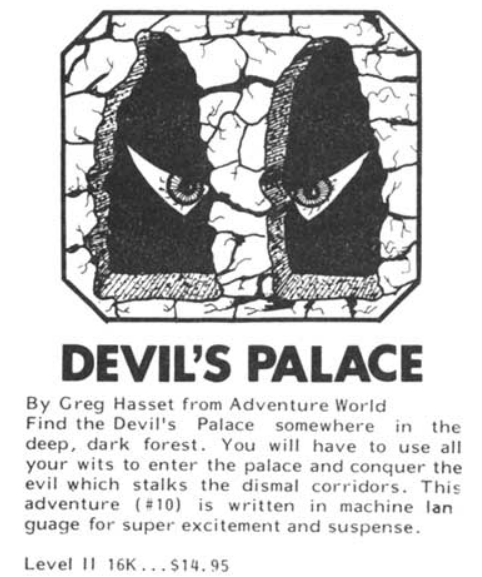
For one thing, Mystery Mansion, World’s Edge, and Curse of the Sasquatch all had genuine plots; goofy ones, perhaps, but ones with enough substance to be enjoyable. You may notice in the ad above it discusses using “your wits to enter the palace and conquer the evil which stalks the dismal corridors”. However, for most of the game I did not understand what the evil was or what we were trying to defeat.

You start with no context at all. There’s a forest with a “Cereberus” and a tree with a bird next holding a whistle. Blowing the whistle leads to death; a vulture picks you up, takes you to the nearby Devil’s Palace, and drops you in lava.

Eventually I found that the whistle could be blown next to the drawbridge to cause the bridge to go down. There seemed to be no reason behind this other than magic and I learned rather quickly that whenever obtaining a magic item or word, the appropriate action is to try it in every single room with the hope that it works. (This makes the game harder, yes, but forcing an effect to be hit by random chance does not make a good puzzle.)
You can then try to go across the drawbridge, but you are stopped because of an evil presence.
The sequence that follows is:
1.) You can go back into the tree and blow the whistle. The vulture that previously killed you before takes in you inside the castle. There’s at least a little logic here — I guess you can think of it as the VultureBus got stopped early when the drawbridge was up.
2.) This lands you in a room with no exits where you then need to blow the whistle again.
3.) By doing #2 you get in a room with a torch and a knocker. Knocking on the door leads to…
4.) …another room where you are trapped, but there are carvings where you can insert a fossil. This causes a cat statue to appear. You can then >RUB STATUE to get taken to yet another room.

5.) Again you are trapped, this time on a PRECARIOUS LEDGE OVERLOOKING A POOL OF LAVA. Earlier you can find a stone with the word “ETNAD” on it, and it works here; the ledge spins and you end up in “THE (D)ANTE-CHAMBER” where the map finally opens up again.
I’m not going to go into detail into every puzzle, but here’s one that comes right after:

You need the ruby, but if you try to take it, the crystalline figure stops you. If you BLOW WHISTLE you get the death result seen above; that part is fair enough. I needed a walkthrough to find out you can TAKE FIGURE (!!) and then just move it to another location and drop it, and if you then BLOW WHISTLE the figure will “vanish”.
The ruby lets you fire a laser into a network of caves, and after a bit more puzzle-solving, THE DEVIL’S SECRET MEDITATION ROOM. Really.

It’s really eeeeevil meditating, ok?
There’s a few good puzzles here but they’re interspersed with magic-nonsense. This finally leads to a tower with a sceptre that’s too evil too pick up.

Take a moment: how would you defeat the evil?
Would you think of … dropping the egg? Yes, dropping the egg.
>DROP EGG
EGG DROPS, BREAKS, VANISHES. FEELS GOOD IN HERE NOW!
I guess that was defeating the evil. Then you get can GET SCEPTRE, and SAY ETNAD to teleport out (no particular reason why the word would work here, it just does). To get out of the palace you find can a grate with the whispering sound “OPEN WITH SCEPTRE”.

…
Diagnosing the problem, overall, is simply: Greg Hassett never got much past two kinds of puzzles
a.) using magic words or items in arbitrary places
b.) using ITEM with OBSTACLE to get past it.
With only these two building blocks to work with, it was possible to make a relatively satisfying easy game like Mystery Mansion, but when he aspired to something harder, he had to resort to items with vague “magic” powers like the egg where it wasn’t remotely clear what they’d do. While there’s always room for a little solving-by-experiment in adventure games, the use of magic at least needs to make sense after the fact.
The games published by Scott Adams, by contrast, had “daemons” from the start, little timers and inter-relations between objects that allowed for complications. The stronger puzzles involved understanding this network of relations and seeing in terms of what cause might lead to what effect. (Offhand, both the final puzzle of Mystery Fun House and the heart puzzle in Pyramid of Doom required making far-reaching realizations.)
I’m curious where Greg Hassett would have gone from here. Devil’s Palace struck me as an experiment in uncharted territory, and the author never got the chance to master the art of making more complicated puzzles.
The people have spoken, and want to know what God Mode is like.
To elaborate (in case anyone is hitting this post without reading the rest of them about Warp, although you probably should go do that first) after finishing the arduous journey of Warp you get a password customized for the username you played the game with.
>SAY “Pity this lonely monster manunkind not elhljoazfe”
Oh, hello! Are you God?
>THIS IS GOD
Okay, God, if you’re so smart, tell me what word follows “GO”?
>NADS
Well, hot damn, you ARE God!
This is kind of like playing an Inform game in debug mode.
Newsstand. [Room 98, locale 0]
A large stand covered with hundreds of different newspapers and magazines stands before you. Further north, you can see a dark and forboding passage; there is a vast open space to the southeast.
I can see the following:
Newsstand, 4 Wpls, which contains:
a Magazine
a Newspaper
News Vendor, 120 Wpls
Typing HELP gives an expanded list of commands. Some are pretty general:
>help find
FIND allows you to locate any item in the game and get a brief description of where it is without suffering through all of the information listed by the REPORT command.
>help goto
The GOTO command allows you to move immediately to a specific room. The format is GOTO , where the room number is in the range of 1 to the maximum number of rooms allowed. You can find out which rooms are associated with which room numbers by using the LIST ROOMS command. It is also possible to goto the location of a specific object. The syntax for this command is GOTO .
One is quite randomly specific, although it’s interesting to see how the “customized randomness” in the endgame is made:
>help pitroom
The PITROOM command allows you to predict where the pit in the endgame will appear. Which “Corridor of Vines” room it will be found in is determined by the first two characters of your user name.
I tried using FIND on an object that “didn’t exist” yet.
>FIND TORPEDO
Location is Limbo.
I tried teleporting around.
>list rooms 458
Engine Room. [Room 458, locale 0]
>goto 458
Engine Room. [Room 458, locale 0]
This room is obviously the engine room, as there are two rather large diesels occupying nearly all of the aft region. Most of the decor here is early steel, with numerous pipes, vents, valves, and gauges scattered about. I believe you’ve gone about as far below decks as you can go, as the massive steel-plate flooring upon which you stand offers no opening to go down any further. There is, however, a steel ladder leading up through a hole in the ceiling.
I can see the following:
Cannister, 999 Wpls
Engine, 9999 Wpls
Starter Switch, 0 Wpls
I tried listing the entire dictionary of verbs.
18 Affix 18 Attach 10 Attack 32 Bite 29 Board
49 Break 14 Burn 21 Check 33 Chew 34 Chomp
5 Climb 7 Close 18 Connect 2 Cram 48 Crush
43 Cut 27 Depress 10 Destroy 37 Detach 36 Devour
37 Disconnect 42 Don 2 Dorp 13 Drink 2 Drop
31 Eat 11 Enter 10 Extinguish 18 Fasten 39 Fill
30 Find 27 Flip 22 Gaze 3 Get 4 Give
18 Glue 5 Go 3 Grab 50 Hit 1 Hoist
14 Ignite 21 Inspect 45 Jump 51 Kick 10 Kill
30 Kiss 45 Leap 54 Lick 14 Light 30 Locate
28 Lock 23 Look 20 Lower 35 Munch 10 Murder
6 Open 18 Paste 45 Peel 38 Pet 40 Play
29 Pour 27 Press 52 Punch 27 Push 2 Put
1 Raise 26 Read 47 Register 44 Remove 99 Report
46 Revolve 29 Ride 46 Rotate 38 Rub 5 Run
15 Save 58 Scribble 41 Shoot 24 Shut 13 Sit
25 Slam 43 Slice 30 Smooch 10 Snuff 29 Spill
46 Spin 45 Spring 10 Stab 44 Stand 23 Stare
3 Steal 16 Step 18 Stick 16 Stomp 15 Store
2 Stuff 55 Suck 17 Swim 3 Take 2 Throw
18 Tie 46 Turn 46 Twist 26 Unlock 37 Untie
5 Walk 5 Wander 53 Wave 42 Wear 57 Write
Yes, “Dorp” is a verb. It’s a synonym for “Drop”.
I can’t think of anything I was dying to try that I haven’t been able to, but if someone wants to suggest some shenanigans in the comments, I’ll try it out.

Yeah, I earned that exclamation mark. I was also right that finishing the game involved a pretty simple final action. I had given the Warpmaster a credit card but had trouble getting anything to happen, until:
>tell warpmaster “charge it”
The Warpmaster gives you a big smile, and proceeds to take out from under the counter a small charge card receipt printer. He skillfully places the card in the holder, and runs the handle across its face. He looks up at you and says,
“Just for our records, you know …
There! Snoitalutargnoc! You may now proceed!”
With a sweep of his arm, all about you vanishes.
This paved the way for
Mount of Enlightenment.
The air is filled with the heavenly singing of the muses praising those who have reached true enlightenment. Sunlight streams upon the summit in golden rays, bathing all they touch in a glorious golden glow. As others have before, you have reached the final goal of the Land of Warp. The power to control the entire world is within your grasp.
“Snoitalutargnoc,” exclaims the Warpmaster. “You have successfully completed all of the puzzles set before you, and are ready to gain True Enlightenment! By saying the following phrase, you will be endowed with much deserved godly powers:
Pity this lonely monster manunkind not elhljoazfe
Respond THIS IS GOD and NADS to the questions. I suggest you try it out. Amaze yourself! Amaze your friends!”
(This codeword is apparently customized for the username you play the game with.)
With that, the Warpmaster waves his arms, and everything about you begins to fade and disappear, leaving you in a worldless void …
Your endgame score after 347 commands (4 hours and 47 minutes of playing)
would be 100 out of a possible 100.
>>>>> WON COMPLETELY!!! <<<<<
Winning the game unlocks God Mode. Neat!
I’ve already put most of my general conclusions in prior posts (not being quite sure I’d even get to this point) so I don’t have too much to add. If you just read my posts you may want to go back and see the epic comment threads it took to get here. Thanks to anyone who has contributed to solving or even just made a general comment on any of my posts — the feeling of being part of a community is what helps keep me going on games like this.
In case you’re curious what’s left for 1980, there are 13 games:
Dragon-Quest Adventure by Charles Forsythe
Treasure Island, Journey Through Time by James Taranto and Joel Mick
Space Traveller, India Palace, Poseidon Adventure and Vial of Doom by Roger M. Wilcox
Devil’s Palace by Greg Hassett
G.F.S. Sorceress by Gary Bedrosian
Nuclear Submarine Adventure, Pyramid, Vampire Castle by Aardvark Software
His Majesty’s Ship “Impetuous” by Robert LaFore
I don’t know if I’ll make it before the end of 2019, but I’ll have fun trying.

I have made tiny progress based on Russell Karlberg noticing that there were two-identical looking rooms matching with the maze I was trudging through. You enter it through a “Globe Room” and I tested all possible maze exits (NE, N, NW, W, SW, S, SE) and found that going southeast led to that special room. Then it was just a matter of realizing I could go back northwest to a new location:
>W
Globe Room.
You find yourself in a round, cup-shaped room. In the center of the room you see a man-sized hole in the floor, while to the east there is a cylindrical corridor leading slightly upward through the rock. On the floor, at roughly 45 degree intervals around the perimeter of the room, you note what appear to be small arrows chiseled into the rock, pointing outward from the center of the room.
Additional passageways have opened.
>se
Montazuma’s Revenge.
The room about you is one of many constructed hundreds of years ago by the Great Ancients of Praw. The walls are unmarked rock, with exits leading in all directions. There is also a large hole in the ceiling (out of reach), and another in the floor.
>nw
Dark Woods of Error.
You find yourself in a dark and lonely wood. The passage from whence you came is lost, and before you in the distance you can see the godly summit of True Enlightenment.
I can see the following:
Ticket Plaza
Behind the plaza window you see the Warpmaster.
Looking at the plaza yields the amusement park graphic on the top of the post.
You would think it’d be easy from here, and maybe it is? I have a credit card and can hand it to the Warpmaster
>give card to warpmaster
Card given to Warpmaster.
The Warpmaster quickly inspects your Card and nods somewhat approvingly.
He says, “What am I to do with this?”
but I can’t otherwise get a ticket. I must be right at the end, because my endgame score is now 99 out of 100.
The 25th Interactive Fiction Competition is over, and the ratings and votes are all in. Congratulations to Steph Cherrywell for getting 1st place with Zozzled!
I never worked my notes up to anything approaching “reviews”, but I have here four recommended entries. Also note
a.) I didn’t play any of the parser games, at least not extensively enough to make a judgment (this is because Warp pretty much drained me during the time of judging; I’ll sit back and enjoy the games later)
b.) Even though I focused on the choice-based works I never came close to trying everything in that category.
Turandot by Victor Gijsbers
Based on the opera involving the Princess Turandot and a test of Three Riddles she gives potential suitors, although here it gets expanded into an entire dungeon of traps. You play as one of the suitors.

My favorite of the choice-based games, but do take the content warning seriously. The banter between the main characters is phenomenal. My only quibble is that there are some early choice-doesn’t-matter parts and while you do eventually start being able to make choices that affect things, it isn’t obvious when this happens, and the occasional not-really-a-choice moments still pop up. I often found myself meta-wondering if I should be really caring or not about a particular conversation line.
Heretic’s Hope by G.C. Baccaris
You live amongst insects as the only human. You get an (unwelcome?) promotion.

The interface and music here are the slickest of the competition, and the writing is fairly solid throughout. I did find myself not always feeling like I understood my choices that well (see the advisor choice above — by the time I really got an idea of who the insects were and what a particular choice meant, the story was over) but in the end this was still a good ride.
The good people by Pseudavid
The main character and their romantic partner Alice go to visit the ruins of a flooded village from the past.

I very much enjoyed the spare writing; I think Alice’s relationship with the main character might have been a little too vague for some of the intended payoff to kick in later, but I still found the plot satisfying.
Unfortunately (and this seems to be in common with many of the IFComp choice games this year) I didn’t always feel like I had much agency. (There are cases where denying interactivity in a piece of interactive fiction can be effective, but I find the technique to be overused.)
Limerick Heist by Pace Smith
Extremely snappy and clever: you assemble a team to steal a Faberge egg, but the entire thing is delivered in limericks.

We only have a poetry entry in IFComp once every few years, but I have seen what I believe to be all of them, and this is the best one.
Nitpick: this is short enough I can’t be too disappointed, but most of the interaction here is the all-or-nothing type — either you pick the correct choice and move on with the story, or you pick the wrong one and lose (the “deadly gauntlet”). I find this kind of structure exhausting, especially here where there isn’t a good way to think through the “best” way of doing many choices (except for one bit involving the rhyme structure of the limerick which made me laugh).
You can assume, from this point, any post on Warp is potentially my last. Not only is the game trying to tear the player apart, the game is trying to tear itself apart.
ABORT :WARP.PUB.GAMES.%3.%4102
PROGRAM ERROR #1 :INTEGER OVERFLOW
PROGRAM TERMINATED IN AN ERROR STATE. (CIERR 976)
Before I really get started, a brief aside on the Mainframe Endgame. There is a type of endgame descended from Crowther/Woods adventure after a Treasure Hunt style plot where the player is brought into a special area separate from the main game and any puzzle-solving is intentionally very hard.
I should qualify “very hard” as “harder than normal hard, meant almost explicitly to be played collaboratively”. I think this is most blatant in Adventure 550, which in the original port required collecting information from at least 5 different playthroughs for the endgame.
Zork mainframe went extra-long in its endgame, but also mercifully filled it with puzzles that were technically solvable. Warp took Zork’s size and restored a general sense of unfairness. Warp even quite explicitly mentions this in an in-game newspaper which has various game version notes; this one is from April 20, 1982:
THE ENDGAME IS FINALLY COMPLETE!
And, hopefully, free of bugs. Send your complaints and tales of woe to the authors as you see fit. But be warned: clues in the endgame are next to non-existant, and the puzzles are designed to be at times misleading and extremely frustrating. Patience and perseverence are more necessities than virtues.
Philosophically, it’s kind of interesting to have this kind of collaboration-nearly-required puzzle; another use of the idea is the original arcade game Tower of Druaga, which had obscurely hard to find items and essentially an underground info-network amongst Japanese arcade players was needed to beat the game.

From Floor 1 of The Tower of Druaga. There are 60 floors.
For example, Floor 45 has two special items; the box for one item appears right at the start but if you open it the box is empty. You have to first kill enemies in a very specific order (“Lizard Man, High Power Knight, Mirror Knight, Black Knight, Blue Knight”), which then allows you to open a different box and get an Antidote, and only then can you open the first box and get a Hyper Sword (which is necessary for beating the game!)
Keep in mind, this is in an arcade game that required depositing coins to play. Hopefully, I’ve gotten across why an information network was a necessary feature.
These days, having to ask for a hint is considered a “game failure” (or at least player failure), so to speak, but is the “failure” a real thing, or just cultural inertia?

Various objects from the main game make a cameo appearance. This silver cross (originally a treasure) was suspiciously easy to get in the main game.
To continue from last time, I was falling in a pit, and I really felt like I could use a rope, but the rope was locked outside the endgame where it could not be brought in. This turned out to be not *exactly* correct. While it never was useful during the main game, it’s possible to >CUT ROPE and get two pieces, a longer and a shorter. While the regular rope vaporizes upon entering the endgame portal, the shorter one does not.
*sigh*
I suppose there might have been a slight bit of logic involving the *size* of the item that goes in the portal being limited, but there was no message conveying that. In the context of a mass-solving effort, I could see someone who had cut the rope on a whim test it out and convey this fact to their fellow players.
Compounding this difficulty is that, normally, the items you are carrying disappear anyway after answering the Oracle’s trivia quiz. There is this cryptic comment
He quickly searches about for unregistered items, and then, with another wave, disappears.
which is supposed to be a hint that >REGISTER is a verb.
>REGISTER SHORT ROPE
An authoritative voice echos: One [1] Short Rope … Check!
It’s baffling what sort of action is even happening here. You aren’t stating something aloud (that’s covered by the SAY verb). There’s no physical movement; you don’t even have to be holding an item to register it. The command only makes sense at a meta-level. (As an aside, you may remember I got a password to jump to the endgame. It would be impossible to win by starting the endgame with the password since you don’t get the needed short rope item when using it. This is egregious enough I think it’s just a programming oversight.)
Moving on! I was able to successfully tie the short rope to overhang the place I knew the pit would be, went through the stone idol / tile section I mentioned last time, and outran a giant boulder to find a maze, or perhaps “maze”.
>W
Globe Room.
Additional passageways have opened.
>w
Montazuma’s Revenge.
The room about you is one of many constructed hundreds of years ago by the Great Ancients of Praw. The walls are unmarked rock, with exits leading in all directions. There is also a large hole in the ceiling (out of reach), and another in the floor.
If you wander, you eventually find various old items from the main game lying around. In case it’s important, here’s the complete list.
Battery, Brick, Expensive Camera, Chalice, Silver Cross, Silver Flute, Golden Matador, Large Pearl, Shiny Quarter, Glass Sphere, Crystal Sphere, Devil’s Trident, Ivory Tusk, Egyptian Urn, Patgonian Vase, Banana, Green Stamp, Package, Black Opal, Wetsuit, Ruby Lense, Treasure Map, Computer Printout, Railroad Bond, Golden Bullion, Framastat, Bag, Fins, Glass Bottle, Painting, Digital Watch, Silver Coins, Leeverite, Absolutely Nothing
In addition to the items, the game gives a few messages meant to be either hints or discouragement: “This looks pretty vast.”, “I think you’re just getting in deeper …”, “You’re going to get yourself even more lost.”, “Come on, you haven’t a prayer of escape!”, “You’re being awfully persistant.”, “This doesn’t look solvable to me.” and finally “In fact … it isn’t. Give up and save us both some time!”
I’ve checked thoroughly enough to say the items shift around randomly as do the maze exits, so I’m 95% certain you aren’t supposed to or even able to “map” the maze. That leaves odd, obscure actions like registering every single item (which I’ve tried), praying, being ludicrously persistent (I went EAST so many times the game crashed, as shown on the top of this post) or just saying the right random catchphrase (like “GIVE UP”). I even tried quitting the game (taking giving up literal) with the hopes that a restart would magically continue the game in the next section, but no luck.
…
A quick reminder to those interested in the 25th Interactive Fiction Competition — the deadline for voting is tonight. I’m hoping to put reviews up this weekend but it may not be until next week.
Continuing from last time, I had missed a very reasonable puzzle followed by a very unreasonable one.
I can see the following:
Short Cable attached to a Power Unit
Long Cable attached to a Control Unit
Power Unit, which contains:
a Framastat
a Rocker Switch
Control Unit, which contains:
a Round Depression
a Knurled Knob
a Lever
>look sphere
The glass sphere is made of pure neodium, an extremely fine industrial crystal found in abundance in Warpian territory. It is about four inches in diameter.
>look depression
The depression is about four inches in diameter and hemispherical in shape. It has been carefully machined into the control panel, just to the left of the knob and lever.
The sphere simply goes in the depression and the whole thing can activate when plugged in. Both the depression and sphere mention 4 inches specifically. I had simply forgotten I had left the glass sphere hanging out in the desert (it was a bit of a pain to get because it was easy to die of thirst — I had to fly the magic carpet in to have enough time to take it away).
However, activating the machine caused this to happen:
>push switch
Click.
>FFFFFT!<
An unexpected backsurge in voltage suddenly vaporizes the cables!
I assumed this meant I had some kind of setting wrong, and I valiantly tried to fiddle with the “knob” and “lever” of the control unit to get something to happen, but no verb seemed to have an effect.
They were apparently entirely red herrings; by complete random chance, usually turning on the switch causes the frying to happen, but sometimes it works:
Click.
There is a loud >SNAAAAP!< as the units come to life!
A large electric arc surges quickly down the two cables, striking the doorframe with a sizzling shower of sparks! An unstable image begins to form where once there was a wall. The snowy image slowly stabilizes to reveal a north wall portal into a rectangle of bleak whiteness.
This is even worse than many other instance where I’ve had to repeat an action hoping for random luck (like being told 13 times in a row a particular exit was sealed off before it worked) because the frying cables means the game is lost. The only reason I solved this was I was testing a save game where I didn’t remember the exact setup so I tested “pull switch” and lucked out into the portal opening.
As you cross the threshold, you feel momentarily disoriented.
Plain White Room.
You are in a plain, white room. It is of medium size, has four barren walls, four equally barren corners, a bland floor and a rather boring ceiling.
I can see the following:
Square Peg
The disorientation means any items you are carrying vanish (except the Round Peg, an item from the very first room of the game; however, that will vanish when entering the next room, and seems to be yet another red herring). Not only that, but the score resets to a new special “endgame” score, just like mainframe Zork.
Your endgame score after 2 commands (2 hours and 47 minutes of playing) would be 0 out of a possible 100.
If you get any points, I won’t bother you with insults anymore.
After some fiddling around with the pegs and no progress, I thought maybe this game was going the Adventure 550 route by requiring some magic words. I tested all of them I had seen so far.
>SAY “LHASA LHASA LAMA”
You hear a pin drop.
Spinning around, you see the Oracle. He speaks:
“Sorry I’m late. Tonight’s the Warpmaster’s bowling night. He wanted me to ask you a few questions, though, to see if you have reached true enlightenment, as have I. Heh heh. Now, uh, let’s see … I have some notes here …”
The Oracle figets around a bit, then continues:
“First question. Where was the dent in the Chevy made? You should respond by typing ANSWER “”.”
Again, just like mainframe Zork: the endgame there had a trivia quiz with the Dungeonmaster. I had a little trouble with the second question (“In what kind of tree does the koala bear make its home?”) simply because the tree is described as a Redwood Tree but somehow the room on top is a Eucalyptus View, so it’s a eucalyptus tree on top of a redwood tree, I guess?
After answering the last question:
“What is the airspeed of a coconut-laden … oops, wrong script. Snoitalutargnoc! Well done! You seem to have correctly answered everything! Before I leave, a hint of advice: To get here in the future, simply incant “fohmnqhmpc” and you will avoid the pitfalls of the mortal world!”
The Oracle waves his arms once, and a hole appears in the center of the floor. He quickly searches about for unregistered items, and then, with another wave, disappears.
The special incant command lets you just straight to the endgame from anywhere in the game, without a saved game file. This turns out to be a very bad idea (I’ll explain why shortly).
Jumping into the hole reveals yet another Zork tribute/ripoff:

This is the “Royal Puzzle” which also made its way into Zork III; if you move in the direction of a sandstone “block” you can push it around. This is essentially Sokoban rules where you can push a block but can’t pull it.

“H” is where you start and has a hole in the ceiling. The yellow “S” has a Card item (a credit card) under it. The orange “S” has a ladder attached to the east and the blue “S” has a ladder attached to the west. To get out you need to bring the blue “S” block all the way to the spot immediately to the east of the hole.
This results in a *very long* sequence of moves, and it was here that I discovered that saving is disabled in the endgame.
This is why the secret incantation word is a bad idea. It’s possible to mitigate the saving problem by creating macros (it’s been ages since I mentioned it, but this game lets you create macros). So I was able to enter a macro like
>DEFINE END6
=N.S.S.S.W.S.W.W.W.S.S.E.E.E.W.N.W.N.N.N.W.S.S.S.W.S.E.E.E.
and set things up to the point where I could type END1 through END10 to quickly zip all the way through the trivia section and the Sokoban. As long as I made these macros immediately before entering the endgame, I was able to save my game and keep the macros.
The section after the maze is quite deadly and I still don’t know how to get through it.
Globe Room.
You find yourself in a round, cup-shaped room. In the center of the room you see a man-sized hole in the floor, while to the east there is a cylindrical corridor leading slightly upward through the rock. On the floor, at roughly 45 degree intervals around the perimeter of the room, you note what appear to be small arrows chiseled into the rock, pointing outward from the center of the room.
I can see the following:
Square Peg
The Square Peg for some reason vanishes after the Oracle’s trivia quiz but returns again here. There’s some extra rooms leading through a Corridor of Vines which all have a Tiny Hook I have not been able to apply any verb to; at the end there’s a section with tiles:
Corridor of Vines.
The corridor walls here are built of expertly cut stones, fitted together. Many jungle vines have twisted and twined their way along the length of the corridor and found their way into the cracks and crevices of the walls. A small hook is recessed into the ceiling, perhaps once a hanger for a trellis. The corridor here splits into five openings that lead between pillars cut from stone. The center opening is circular and the same size as the corridor you are in, it leads east. The other passages are to the north, northeast, southeast, and south.
I can see the following:
Tiny Hook
>NE
Hall of Idols.
You are in an expansive room with an elaborately tiled floor. The north and south walls are lined with hundreds of small, stone indian idols, their eyes menacingly turned toward the center of the room. The tiles are very carefully placed in five east-west rows, with each row containing six tiles. The east end of the room opens through six large pillars into yet another chamber. The west end opens through similar pillars into a forboding corridor.
I can see the following:
Tiles
The tile below your feet reads II.
The text description is slightly clunky, but here’s a map.

Stepping on the wrong tile is absolutely deadly. There’s not really a great way to work out the pattern other than trial and error (and remember, no saving in the endgame!) Specifically, when going to the east only the even tiles are safe…

…and when going back west (after getting a scepter) only the prime number tiles are safe.

There’s a rolling ball that appears, Indiana Jones style, but since you can either move fast enough that it stays behind you or wait for it to pass I’m not worried about it; what I can’t figure out is that after making the trek mentioned above, there’s a newly-formed pit in the Corridor of Vines:
You move ahead and find that the floor has opened to reveal a gaping pit that devours the entire floor from wall to wall. As you fall you can’t help but wonder where the bottom is …
You sense yourself leaving your physical body —
If I still had the rope from the main game I might be able to set something up with the hook in that room, but the inventory from the main game really does seem to be closed off. I’ve tried various permutations of RUN and JUMP without luck. I’ve tried different tile-stepping routes in the hopes of avoiding a particular number or always stepping on all the numbers will work. I’ve tried all sorts of silly things with the scepter
The scepter is so strikingly awesome in its splender that it really defies description. Suffice it to say that it is key-shaped.
but I’m guessing it just doesn’t get used until later.
Oh, and I’m only at 20 out of 100 endgame points. This game is going for broke.



 Renga in Blue