One of my commentators managed to crack the case.

From Robert Louis Stevenson’s Treasure Island, the Milo Winter illustrated edition.
I had been stumped with this “crossword puzzle”.
IT SAYS:
ACROSS
1. SLEIGHT OF HAND
2. TYPE OF PUZZLE
THE REST IS TORN OFF.
I assumed (in fact correctly) that 1. indicated “MAGIC” and 2. indicated “WORD”, but I tried things like SAY MAGIC WORD with no luck. I was parsing the clue slightly wrong.
ACROSS
1. MAGIC
2. WORD
It’s indicating that ACROSS is the MAGIC WORD. So at the RAVINE where I was stuck, I just needed to SAY ACROSS.
This led me to some COAL. I was also able to DROP my LADDER here to get over to a *CAVE PAINTING* (another treasure), but obviously the coal (in its starting form) didn’t quite qualify. There was no magic machine as in Zork to process the coal, but it occured to me this might be a situation like Pyramid of Doom where the coal was just surrounding something else. Going over to the ocean and typing SWIM OCEAN gave the coal enough of a bath to get a *DIAMOND*. UPDATE: It looks like the bath part was unnecessary, just LOOK COAL is enough to cause it to switch to a diamond.

I also mentioned last time not being able to get anything off a newsstand; I was misunderstanding the situation and it’s possible to GO NEWSSTAND as if it were a room to get a copy of Hustler. There’s more detail in the comments, so I’m going to just refer to that and that say the entire business is optional.
From last time, we had a dilemma where the young officer Fallow cursed out the King of England and in so doing condemned himself. The punishment as given by law is death, but the captain is allowed to pardon an offense. However, the execution will hurt morale (for obvious reasons) and a pardon will as well (as it appears that the law is not enforced).
We had landed on an isolated bay on mainland France so Fallow could attend the burial of his brother, and pulled him aside after out of earshot. What’s interesting here is while the game explicitly gives execute and pardon as choices, the game hints there might be “another way”. This is related to an idea I laid out while writing about Star Trek: 25th Anniversary — that an issue with choice-based moral decisions is that in reality, even knowing there is a choice at all can be difficult.
I had surveyed all of you, the readers, to give me responses, and they fell into a few categories.
Category #1: Pardon
“I’ve decided to pardon you. The men will understand, in the circumstances.”
pardon the boy.”
Two people went with the given “pardon” option even though the game was hinting at a hidden “third option”; I find this particularly interesting in that even knowing about the third option this one is still tempting. A potential problem I see with the “hidden choice” mechanic is the feeling that once found, that choice is always better than the other two. Based on events later in the story, it is mechanically, but that doesn’t mean it’s still morally (by whatever metric the player is roleplaying as) the best choice.

Category #2: Escape
LET YOU ESCAPE
“I’ve decided to shoot you with an unloaded or empty pistol. When you hear my gunshot, fall down and play dead or feign or fake your death. Do not move again until we have left. From there you are on your own. Good luck lad. Now, I order you to run.”
Both of these are understood the same way.

Note that the complex plan in the second doesn’t quite work in the physical situation — the captain already has loaded pistols, so essentially this would require going back in time and changing the setup. I find this one fascinating from a game design angle: suppose you had a parser that genuinely understood the whole thing as typed, what would be the optimal response? Would saying “your guns are already loaded” be acceptable here? Or maybe it’s possible to “retroactively” change reality — Schrödinger’s gun, so to speak, which is neither loaded nor unloaded until it becomes clear what the player’s intent is?
This may also indicate simply that the distance between choice-points in a traditional CYOA structure might be a little too large to pull this sort of thing off — if all the preparation steps were simulated like a traditional text adventure game (>PICK UP PISTOLS, >LOAD PISTOLS, etc.) it would have been possible to prepare the complicated scenario.
Category #3: Doesn’t Quite Make Sense Given the Scenario
MAROON FALLOW
I actually typed this when I first played the game! But if you go back and read carefully, this is on the French mainland, so “maroon” doesn’t make sense as an idea here. Again, I’m curious what the optimal response here is (“But we’re on the mainland, sir. Are you feeling ok?”)
Category #4: Maybe Doesn’t Give Enough Instruction
FAKE YOUR DEATH
FAKE YOUR EXECUTION
Neither of these are understood, but in even in an optimal understand-everything parser, I’m not sure they ought to be? It doesn’t really convey to Fallow what to do right at that moment. Something like “What exactly are you proposing, sir?” or that like.
Category #5: Indicating Future Action in an Ambiguous Way
“…sentence you to death, but allow you to escape.”
Is this indicating the captain will be giving a later chance of escape somehow? This option is fascinating because it seems to want to plan events in the future, but in such a way that it’s not guaranteed particular things will hold up (perhaps the intent is to have him escape by boarding the boat, but he might already be restrained by another crewmember at that point — is the captain going to somehow wrangle that to not happen?) The game incidentally parses this like Category #2.
For all of these, it helps to find the “third way” if the dialogue about “what if he tries to escape?” is visible. In the game that text is on the previous screen, and I was actually quite baffled. Not just in the usual puzzle-solving way, but with the existential dread of anything I could possibly type being an option. It was a unique experience. It made me wonder even if game responsiveness and AI evolved to the point we could have a full “holodeck”, would the player even “play” in a way that led to a responsive story? Does the ability to do anything still require a tutorial?
Robert Lafore himself discussed this puzzle in a later essay, and it definitely seemed intended players might miss the solution the first time through the game.
You have to decide whether to hang him or not. If you do, the crew thinks you’re being too harsh. If you don’t, they think you’re soft. Either way, in the big sea battle at the end of the story, they abandon their posts. It requires a little imagination to figure out the right thing to do. It’s a third choice in a situation that seems to have only two choices. Most people figure it out eventually. That’s one of the tricky parts of writing interactive fiction: The decisions the reader—the hero—is called upon to make have to be hard enough to be challenging but not so hard that the story becomes frustrating. The idea is that the third or fourth time the reader faces the situation he suddenly sees the solution, smites himself on the forehead, and cries. “Why didn’t I think of that before!
— Softline, September/October 1983
I’m not quite sure how optimal this really is. Keith Palmer mentioned a contemporary review…
…wherein the reviewer gave up and just hung Fallow because he was frustrated. This is the meta-frustration of lack of communication, not the in-universe recreation of the captain’s dilemma.
Before I go into spoiling the rest of the story, I should mention Jimmy Maher has converted the entire thing to Choicescript so you can just click your way through, rather than type. There are still some differences — I’ll get into those later — but the most significant puzzle you’ve already had spoiled (assuming you’ve read to this point) so you’re fine playing the converted version.
The structure is in three parts:
The Burial of Fallow (Chapter 1, 2 and 3)
In addition to the events above, the player has to choose who to promote to be the new Lieutenant. They are explicitly given two choices:
Lt. Beagle, who is fiercely loyal but sometimes brash in battle.
Lt. Wiley, who is very competent but also ambitious and angling for the captain’s job.
Either choice can work out; the next part of the story includes two incidents, one where it’s better to have Beagle, and one where it’s better to have Wiley, and the player needs to be aware enough when a particular action is a bad fit.
The Spanish Galleon and the Small French Ship (Chapter 4 and 5)
In the next chapter the Impetuous comes across a Spanish treasure ship, but because the ship is near a fort, attacking it requires a daring plan.
“NOW,” SAID WALTON, THINKING OUT LOUD, “IT WOULD BE A BLOW TO SPAIN IF WE CAPTURED THE TREASURE, AND THE PRIZE-MONEY WOULD BE CONSIDERABLE. BUT THE RISK IS HIGH. ASSUMING, HOWEVER, THAT WE DID DECIDE TO ATTACK, WE WOULD ROW IN AT NIGHT IN THREE OF THE SHIP’S BOATS. YOU, MR DASHER, WOULD LEAD ONE PARTY, I WOULD LEAD ANOTHER, AND LT WILEY WOULD TAKE THE THIRD. THAT WOULD LEAVE YOU, MR STAYSON, HERE WITH THE SHIP.”
(Replace “Walton” with the name the player chose, and “Wiley” with “Beagle” as appropriate.)
The choice here is simple to attack or pass on by.
If the player has Wiley, this mission is as success; if the player has Beagle, he will shout “Death to the Spanish!” early and spoil the plan.
…
Later, the captain has orders to steer clear of all encounters and meet the fleet. The Impetuous encounters a French ship pursuing an American one.
“SHE’S CHASING THE AMERICAN, BY GOD,” LT DASHER SAID. “AND SHE’LL CATCH THEM SOON ENOUGH AT THAT RATE. LET’S GO AFTER THEM, SIR!”
“WE CAN’T. AS YOU KNOW OUR ORDERS FORBID US TO ENGAGE THE ENEMY FOR ANY REASON.”
“I WAS FORGETTING, SIR.”
“IF WE ATTACKED HER, AND THE ADMIRALTY FOUND OUT, IT WOULD MEAN A COURT-MARTIAL FOR ME.”
AND YET, WALTON THOUGHT, WOULD THE ADMIRALTY FIND OUT? ONLY THE SENIOR OFFICERS–DASHER, STAYSON, AND WILEY–KNEW THE CONTENTS OF THE ORDERS.”
If you made Wiley a senior officer, attacking here is a bad idea — he will report your behavior to the admiralty. Beagle, as the loyal one, will not.
This gives a chance to get treasure by using either officer — if Wiley, the Spanish vessel, if Beagle, the French one. Of course, a player in the midst of the game isn’t aware of the structure, so they might attack the Spanish Galleon even if they’re aware it could be a bad idea, just because of concern this might be the only way to get treasure (this was, ahem, me in my first playthrough).
BUT AS THE AMERICAN SHIP VANISHED OVER THE HORIZON WALTON REMEMBERED–WITH A SUDDEN SENSE OF FOREBODING–THE CALCULATING LOOK IN LT WILEY’S EYES.
The Battle of the Fleets (Chapter 6 and 7)
“NOW, I’LL EXPLAIN THE SITUATION.” ADMIRAL WORMWOOD UNROLLED A LARGE CHART ACROSS HIS DESK. “OUR FRIGATES HAVE SIGHTED THE COMBINED FLEETS OF FRANCE AND SPAIN PUTTING OUT FROM THE HARBOR OF FERROL, HERE. WITH THE ADDITION OF YOUR ‘IMPETUOUS’ TO THE FLEET WE HAVE 27 SHIPS. SUPERIOR BRITISH SEAMANSHIP SHOULD ENABLE US TO DEFEAT THE 40 OR SO SHIPS THE ENEMY WILL SEND AGAINST US, ALTHOUGH THEY ARE GENERALLY LARGER VESSELS, AS YOU KNOW.
THE COST MAY BE HEAVY, BUT THE FATE OF ENGLAND–AND INDEED THE WORLD–HANGS IN THE BALANCE. I NEED NOT TELL YOU THAT ENGLAND EXPECTS EVERY MAN TO DO HIS DUTY. LET US HOPE THAT WE WILL MEET AGAIN, ON THE DECK OF A VANQUISHED ENEMY.”
The finale is where the captain meets with Admiral Wormwood, and the player gets reminded of any mistakes made in previous chapters. Here is some of the actual BASIC source code.
5160 A$=” THAT YOU ARE HAVING CONSIDERABLE
TROUBLE WITH DISCIPLINE ABOARD.#
#I’M AFRAID THAT’S TRUE, SIR. EVER SINCE I ”
5170 GOSUB2000
5180 IF VF=1 PRINT”HAD TO HANG”
5190 IF VF=2 PRINT”PARDONED”
5200 IF VF=3 PRINT”HAD TO SHOOT”
5210 A$=”POOR MIDSHIPMAN FALLOW THEY’VE BEEN OUT OF CONTROL.
THEY’VE NEVER BEEN ABLE TO ACCEPT THE “:GOSUB2000
5220 IF VF=1 OR VF=3 PRINT”HARSHNESS”
5230 IF VF=2 PRINT”LENIENCEY
–IT MUST HAVE SEEMED LIKE FAVORITISM TO THEM–”
5240 A$=”OF MY DECISION.#
#LET’S HOPE THEIR INTRANSIGENCE DOES NOT PROVE FATAL,#
THE ADMIRAL SAID.”:GOSUB2000
Then the battle begins in earnest, as the Impetuous faces off against “towering masts” akin to a “giant forest”.
“WE HAD BETTER BACK OUR SAILS, SIR,” STAYSON SAID. “TO WAIT FOR THE REST OF THE FLEET TO CATCH UP WITH US. OTHERWISE WE’LL HAVE ALL THE ENEMY BROADSIDES TURNED ON US AT ONCE.”
“BACK OUR SAILS? AND SHOW FEAR IN THE FACE OF THE ENEMY? NEVER!” CRIED LT DASHER. “I SAY ATTACK! DAMN THE ODDS!”
The best result comes from attacking right away, but it only works if the ship is at full strength — no hits to morale or people lost during the Spanish Galleon attack.
“MAY I SAY THAT IT WAS MAGNIFICENT, THE WAY YOU WENT AFTER THE ENEMY PRACTICALLY SINGLE-HANDED. A STERLING EXAMPLE FOR US ALL. I WOULDN’T BE SURPRISED IF YOU’D JUST WON YOURSELF A KNIGHTHOOD, AS WELL AS THE UNDYING GRATITUDE AND RESPECT OF YOUR COUNTRYMEN.”
If waiting, it’s still possible to have made a mistake and still survive — another ship comes in and steals the glory, but at least you’re not sunk.
WALTON’S CAREER WAS INDEED RUINED, AND BECAUSE OF HIS REGRETABLE FAILURE TO ACQUIRE ANY PRIZE-MONEY, HE WAS FORCED TO BECOME AN ITINERENT PEDLER. HE DIED OF THE POX IN AN OBSCURE CHELSEA ROOMING-HOUSE IN 1837.
…
There’s other small events in between the ones above; the steward occasionally comes by to offer wine or dinner; Stayson has the occasional question about sails. Some of the type-in prompts are definitely designed for open roleplaying. When attacking the Spanish galleon, you can say something to inspire the crew (but your words get lost in the din of combat, so the game even is clear as to the fact it had no “in game” effect). The game even encourages swearing at one point:
7035 D$=”
#1, ASTONISHED BY THE SPIRIT WITH WHICH THE
ENEMY SHIPS ATTACKED, UTTERED THE SALTIEST OATH
HE KNEW: #”
7040 GOSUB2000:GOSUB1000
7044 IFLI/2-FIX(LI/2)=0 A$=
” #I COULD SWEAR BETTER THAN THAT WHEN I WAS A WEE LAD,#
MUTTERED #2 TO HIMSELF.”:GOTO7046
(#1 is the captain’s name, #2 is either BEAGLE or WILEY depending.)
There’s also a nice moment talking with the Admiral where you seem to be prompted with for a THANK YOU, but you need to remember this is chain of command, so either THANK YOU, SIR or THANK YOU, ADMIRAL is the appropriate phrase. You get berated for getting this wrong (but not in a way that affects the story arc). I admit being rather pleased to getting the “SIR” in the first time around.
Even though ‘Impetuous’ has its share of communication issues, I’d say it made a noble try at open-ended player interaction, even more open-ended than either parser or choice have aspired to. Nearly 40 years later, it feels like a map to some hidden shell — covering new possible worlds of gameplay — yet to be cracked open.

Title graphic from the Apple II version of the game. Via Mobygames.
Adam Sommerfield just announced on Twitter that he found, amidst the directories of the Infocom Hard Drive, an unreleased game. The author is unknown.
He managed to compile the source code into a playable game. The announcement video is here, which has a download link in the video description.
UPDATE: The video was taken down, but Adam managed to find the author Tomas Bok who is happy to have the game distributed. A direct link to the directory with all the source code and the compiled game is here.

It seems to be just a test game of sorts, but it is genuinely playable. (I did get a crash — probably an “authentic” one — so beware of bugs.)
Robert Lafore has previously graced this blog with Local Call for Death, Two Heads of the Coin, and Six Micro Stories.
All of them use the same basic interaction gimmick of searching input for keywords, Eliza-style, rather than making full attempts at understanding. If the game is looking for “YES”, both
YES
and
YES BUT I OBJECT TO THIS LINE OF QUESTIONING
are interpreted in the same way. This worked decently in Lafore’s two mystery games (Local Call for Death and Two Heads of the Coin) in that a lot of the interaction was just inquiring after specific pieces of evidence or objects; Local Call for Death even included a room that could be examined like a traditional adventure game.
Six Micro Stories was somewhat less successful, insofar as of the six titular stories, most of them demanded a more open conversational style where it was often possible to say the “right thing” but in the wrong way. For example, in The Fatal Admission, the player is asked a question that is a trap; saying YES is clearly the wrong thing, but saying NO also leads to death. To “win” requires vociferously denying the entire premise of the question to begin with, which can be done in a wide multitude of ways, not all of them conducive to checking for keywords.
His Majesty’s Ship `Impetuous’ changes up the style again, and feels a little like a traditional choose-your-own-adventure. The player is the captain of the Impetuous during a time of war with France and Spain. The game cues the player with specific prompts to respond to.

However, this is not mechanically the same as a choice-based game. While some prompts really do only have the choices given (the one below tests for YES and NO) it’s possible to “type outside the box” so to speak.

Notice the opening quote mark; the game encourages you to punctuate correctly and end with a period mark and quote mark of your own.
I’m going to describe an early event in the game. I’d like to know how you (my faithful readers) would respond; please try to make a comment without reading the other comments first, because I want to tabulate this like a survey. (I will spoil the entire structure of the game next time and really dig into the ramifications of this style.)
In the meantime, if you’d like to just try the game yourself, here is a link to play the TRS-80 version online.
…
Previously (before the story even started) the Impetuous had done battle with a small French frigate. While winning handily, in the process the well-liked Second Lieutenant Fallow was killed. All were mournful, but especially his brother, Midshipman Fallow. The ship settled in a bay, in order to bury the Second Lieutenant on land.
“Don’t humor me!” Fallow cried, pulling away. “It doesn’t bring back my brother!” His voice had risen to a shriek and the crew stopped and craned their heads to see.
“You must be brave,” Walton said. “He died in the line of duty, for king and country.”
Fallow looked up at him. “Damn the king!” he screamed. “Damn duty, damn the navy, damn you all!” He stopped suddenly, his eyes widening in terror,
realizing what he had said. The crew had fallen so silent that Walton could hear a timber groan somewhere in the depths of the hold.
“I’m sorry sir, I don’t know what I was saying! I don’t know what came over me, I’m sorry, oh, sir…”
Unfortunately, young Fallow here had made a grave mistake: speaking “disrespectfully of the sovereign” gives a sentence of death.
In theory Captain Walton had the power to pardon any crime aboard his ship. Yet if he pardoned young Fallow, discipline would suffer — probably irreparably — as the crew concluded that mutinous acts would not be punished, and that Walton showed favoritism to his officers.
If only there was some way to save young Fallow’s life without pardoning him! But what? Whatever decision he made, Walton knew Fallow’s fate had to be settled the next day, lest delay itself cause discipline to suffer.
The next day, the older brother’s body was taken to land.
Sailing-Master Stayson had remonstrated when Walton ordered Young Fallow into the boat.
“But sir,” he had said, surprised into questioning his captain, “what if he tries to escape?”
“I’ll take my pistols, Walton had told him harshly. It’s his last chance to say goodbye to his brother.”
To hang Fallow, or to pardon him? Or–was there another alternative?
Walton made up his mind. He drew young Fallow away from the grave, out of earshot of the others. He looked the lad in the eye.
“I’ve decided to…
What do you say? Remember, try to make a comment without reading the other comments first.
There’s a bit of a gap here — the last I wrote about this series was back in 2017 — so just as a refresher, Odyssey #1 started with a royal messenger walking in a tavern, where the proper action was to >ATTACK MESSENGER. After killing the messenger you find out about a dastardly plot involving a damsel in a castle. The game seemingly had some missing backstory: that the character knows something the player doesn’t, which is why stabbing a random messenger was OK — the main character was probably waiting for them specifically to show up.
Odyssey #2 has no such mitigation. The main character is straight-up amoral.

The authors are Joel Mick and James Taranto this time, instead of Joel Mick and Jeffrey M. Richter.
The game starts at an airport diner, when a man sitting next to you dies. You rummage amongst the body and find a key and take it. You take the key to a nearby locker, and find a PILOT’S SUIT, SHOVEL, and CROSSWORD PUZZLE. The suit has a pocket with a treasure map.
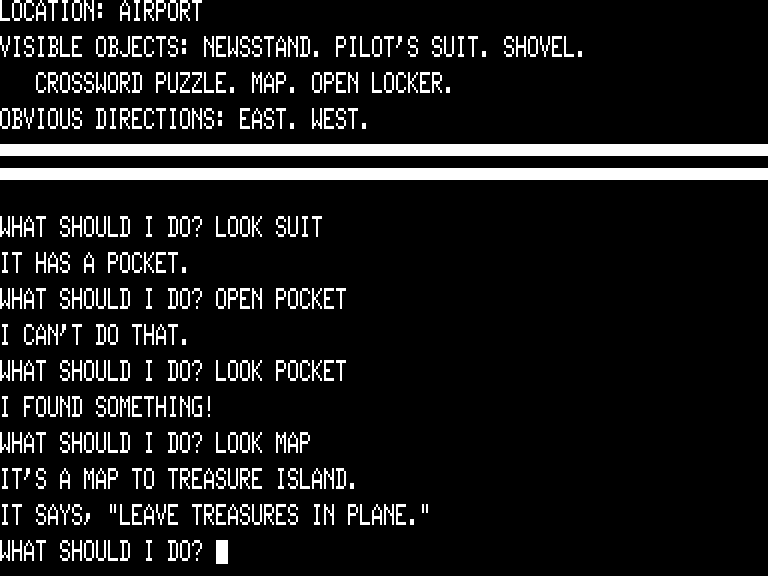
You go in a nearby bathroom to change into the pilot suit, then sneak by a guard, board an airplane, and fly to Treasure Island, whereupon the Treasure Hunt part of the game begins as you aim to score 100 out of 100 points by gathering all the treasure you can find like a chest and a “dubloon”.
In a jungle there is a “fort”. If you THROW BOX while at the fort you can bust a hole to break in, and find a headless body in the process, caused by … us? I’m hoping it’s just meant to be an old corpse. The body has a ring, so more treasure for us.
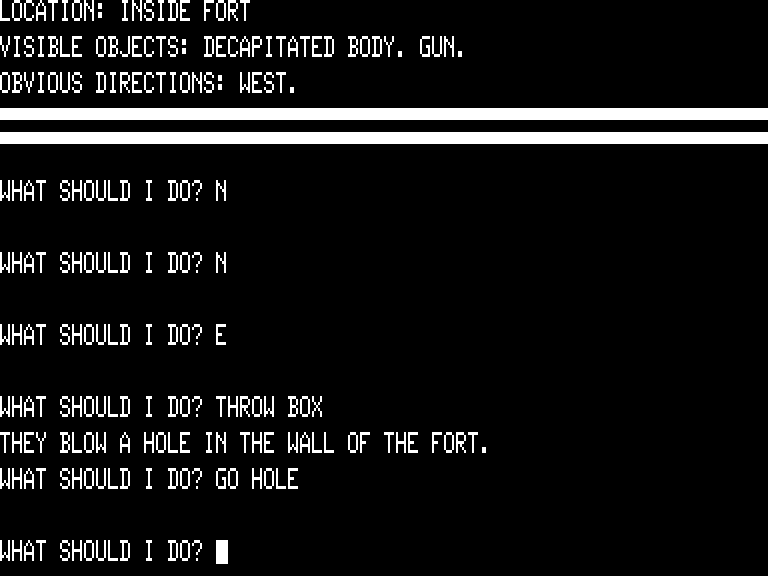
There’s also a gun, which (in contrast to other games I’ve mentioned recently), we get to use. There’s a pirate preventing us from getting to his ship (otherwise not being threatening) but we can SHOOT PIRATE to remove the obstacle. (Although in this case the shot just scares him away.)
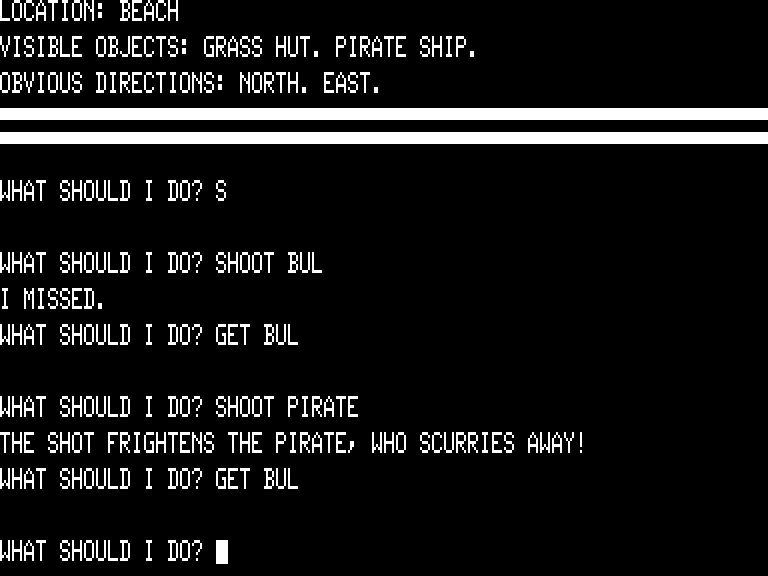
The ship has some *20-YEAR OLD SCOTCH* we can take as well as an *ANCIENT MAP*. Piling all the treasures I managed to find so far netted me 70 out of 100 points.

I’m stuck from here. I only have two things that seem left undone: the crossword puzzle left in the locker…
IT SAYS:
ACROSS
1. SLEIGHT OF HAND
2. TYPE OF PUZZLE
THE REST IS TORN OFF.
…and a huge ravine where trying to GO RAVINE gives a response of “HOW? IT’S TOO WIDE!” and LOOK RAVINE indicates a cave in the far wall.
I assume the crossword puzzle is trying to indicate MAGIC WORD and the game indeed understands SAY MAGIC WORD but nothing happens whenever I try it.
I’ve tried bringing a ladder from the pirate ship over to the ravine, but that isn’t helpful either.
>CLIMB LADDER
IT DOESN’T LEAD ANYWHERE, SO I CLIMB BACK DOWN.
I’ve tried (again without luck) poking through the machine code. I did discover the verb >MAS is in the game (“I HAVE NO VISUAL AID”) and there’s also a “Hustler Magazine” object, but I suspect the authors of this game may have disabled the item in current version (the NEWSSTAND at the start of the game seemed like it’d have it, but no verbs I’ve tried work). I’m betting about 60-40 something else is broke that makes the end impossible to reach.
I wanted to go into one last, small feature of Dragon Quest Adventure I learned about after finishing. The implementation in practice isn’t exciting, but the game mechanic it suggests is marvelous.
Like various other games from this period (including Crowther/Woods Adventure) there is a HELP feature. I only had tried it once, and didn’t find the advice useful, but at least it’s accurate.

However, instead of angel appearing, it can be a demon instead:

This is an anti-hint. Of course the demon would give bad advice! I’d have loved if this continued with context-sensitive hints where you constantly have two hint-givers bickering, but alas this was not to be. Still, it’s a microexample of what could be a more fully-fledged game feature.
(I can only think of one other related example, from Curses in 1993, except that only has hints from a demon, and the advice is a mixture of good and bad.)
ADD:
Daniel in the comments explains how to get to the angel in Curses (it’s harder to reach than the demon). That means we have an official successor to the idea.
Two more examples from the comments, courtesy Josh and Peter:
Nethack has fortune cookies that can be blessed or cursed; blessed cookies give good advice and cursed cookies give bad advice.
The Wizard Sniffer (2017) has a pair of fleas, one who always tells the truth and one who lies.
There’s an emerging pattern that I’ve already pointed out a few times, but for those of you who haven’t obsessively read my entire backlog, a summary:
- Lost Dutchman’s Gold (1979) had a rifle and gun, but if you attempt to use either one in a fight, you are overwhelmed and die. They can both just be left at home.
- Pyramid of Doom (1979) had a pistol that worked but was still useless; you could shoot a nomad that follows the player around, but the nomad would just come back. (There wasn’t a point even in trying since the nomad only gives helpful rather than harmful information.)
- Atlantean Odyssey (1979) had a speargun that you could try to use on a shark, but the shark would just kill you.
- Burial Ground Adventure (1979) came with a gun and separate bullets that you could load, but if you tried to use the gun to get rid of some dogs, the dogs would kill you.
- You could use a spear in In Search Of… Dr. Livingston (1980) to fend off an alligator, but the alligator room was usually optional and the spear would generally just get you in trouble in the game’s villages.
- House of Thirty Gables (1980) gives as ax-and-nearby-troll setup, but killing the troll turns out to be a meaningless act: “ONE MIGHTY BLOW FROM YOUR AX HAS KILLED THE POOR INNOCENT TROLL.” There’s also a wandering dwarf you can try using the ax on, but: “YOU SEEM TO BE VERY INEPT AT AX THROWING.”
- There’s a pistol in Pyramid (1980) but instead of shooting anything you need to take it apart and utilize the gunpowder, MacGyver-style.
There’s still plenty of cases where violence has been the answer (in, for example, Mystery House) but there have been so many useless weapons in adventure games I now always treat them as potential red herrings.
There’s something inherent to the form of adventure games itself that causes this to keep happening. APPLY WEAPON TO ENEMY tends not to be an interesting puzzle, and the times I’ve seen it work either the weapon was hard to obtain or there was some RPG-stats-and-randomization undercurrent programmed in (like in Zork). Adventurer-as-trickster is more common than adventure-as-warrior since that fits more with the puzzle mode of gameplay. A sword is more likely to be used in cutting a rope than cutting down a monster.
Dragon Quest Adventure takes this idea to the next level.
From last time, I had found a set piece with a 100-foot pillar, a skeleton with broken legs, and a scroll indicating the presence of an amulet that allowed flight. However, there was no amulet to be found. This storytelling-by-absence-of-an-item showed up in Secret Mission, where you are told about an envelope in a mission briefing that has already been stolen.
Here, similarly, the amulet has been stolen, but by whom? I unfortunately hit an interface issue I’ve seen many times before, where the game lets you GO LOCATION to enter some place not by the normal NORTH / SOUTH / EAST / WEST directions, and where sometimes this is mentioned as an explicit object (a passage at the start of the game which lets you GO PASSAGE, for instance) and sometimes it is not. Here, while I could GO ROWBOAT to enter a rowboat by the river, I could also enter the river itself.

I needed to check the walkthrough to find this place.
Ah, well. The rest was smooth sailing, at least. I decided to try my newfound magic amulet back at the coffin with the flash of blinding light.

Matt W. wondered in the comments what CLOSE EYES does; the game just doesn’t recognize that eyes exist. There’s been quite a few games where I’ve found an unrecognized “alternate solution” that comes just from referring to the player’s body parts. It seems like they’d be fair game but the only times I can think of them being used have been on unfair puzzles. It’s just one of those conventions, I think; if enough games allowed a standard ability to refer to one’s EYES, NOSE, EARS, and so on, it’d probably be more acceptable to write a puzzle that refers to them.
I was then able to exchange my ruby at a nearby alchemist for a MAGIC SHIELD. He also gave me a magic word (XAVAX).
I already had a sword from earlier; I took my amulet, sword, and shield, and went back to the pillar room and typed FLY. I was told something I was carrying was too heavy. I had to drop everything but the amulet.
>FLY
THE AMULET LEVITATES AND TAKES YOU WITH IT!
THE LAMP FLIES UP TOO!!!
Fortunately, the magic word XAVAX then was useful here to cause a ladder to appear, so I could go back and get my stuff. Heading north from the top of the pillar led to the dragon’s lair:
THE DRAGON ATTACKS
HIS CLAW BOUNCES OFF YOUR SHIELD
YOUR SWORD GLOWS AND THE DRAGON FALLS ASLEEP
As a dutiful stereotypical adventurer, I then typed >KILL DRAGON:
THE DRAGON WAKES!
YOUR ADVENTURE IS OVER.
If you go back and read the king’s original directive you are not here to slay the dragon, just to rescue the princess. Since the dragon is asleep now, there’s no need to confront him! I admit being thrown for a loop given the sword-and-shield setup strongly suggests a full-on-fight.

I was able to grab the sleeping princess and then just walk all the way back to the king, and victory.

Despite the typical fairy-tale setup, we were only promised half the kingdom, not half the kingdom and the hand of the princess. So we only get a kiss, as opposed to forced participation in medieval patriarchy. Wizard and the Princess similarly only promised half the kingdom for rescuing the princess.
We’re not quite done with Charles Forsythe yet; he will return in 1981 with Tower of Fear. But we need to get through 1980 first; 10 games to go!
I can say straight-out this game wins 1980 for best animated adventure game intro screen.

(Mind you, the John O’Hare games are the only other contenders in the category, but still, this was an unexpected surprise.)
Including the manual and different title screen permutations, the game is variously called
Dragonquest!
Dragonquest
Dragon-Quest Adventure
Dragon Quest Adventure
“Dragon Quest” Adventure
Dragon Quest
so I just picked one that hopefully won’t clash too much with the much-more-famous JRPG game.
Charles Forsythe wrote this one before Lost Ship Adventure (see the comments here), which is curious, since this game is in assembly code and the other game is in BASIC, and the usual evolution of authors (see: Scott Adams, Greg Hassett) has been to start with BASIC and move on to assembly. (EDIT: The best guess based on current information is that Lost Ship was actually written and published first, and despite the 1980 copyright date Dragon Quest didn’t start getting advertised and sold until 1981. This makes much more sense with the BASIC-Assembly order of author development.)
I thought Lost Ship Adventure had some good starting atmosphere but ended up disappointingly simplistic once it got past the opening. Still, after the difficulty of my recent games, “simplistic” is what I’m really wanting at the moment.
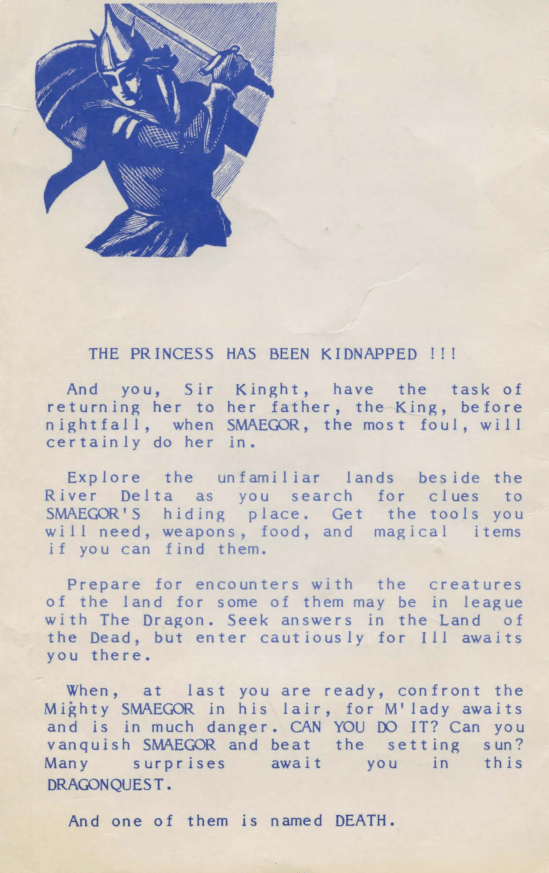
The plot is neatly summarized in the opening screen:

I’ve incidentally been wondering about the origins of the “princess and half the kingdom” thing. I’m meaning the exact reward. In the Norwegian tales of Askeladden the reward was typical, but is that the earliest it occured? TV Tropes has a good listing but includes some cases that are similar but not exact, and there’s no chronology.
The time limit is quite serious here; after X number of moves (I haven’t worked out what X is, maybe 200?) the sun sets and the game is over. So there’s an added time pressure here.

The east side of the map includes a rowboat with a river where you have to ROW UPSTREAM and ROW DOWNSTREAM to go back and forth. This was a small, minimal touch, but I liked the extra texture it added to the game.
Upstream there’s a cave with a set-piece I haven’t been able to do anything with.

This could be pure storytelling by objects that are left behind, but given I’m stuck without many options, I have a feeling there’s some way of getting the amulet mentioned on the scroll. CLIMB PILLAR leads to death, and digging with a shovel doesn’t work.

The west side of the map has a small maze (in the all-or-nothing format, where the wrong direction takes you to the start) followed by an alchemist who says he will trade magical items for treasure (except I haven’t found any treasure!) and a COFFIN in a graveyard. Opening the coffin leads to a blinding flash.

This is where I’m stuck; while I can walk around, I can’t shake the darkness and disorientation. For the record, my inventory has a GLOWING LAMP, SILVER SWORD, SHOVEL, SKELETON, SCROLL, BOX, and FOOD.
Rather like Lost Ship Adventure, even though the setup is minimal, there’s enough atmosphere going that I don’t feel frustrated yet.
I managed to reach the “end” as far as the game’s bugs would let me; the typical spoiler warnings apply, and if for some reason you reached this post without reading my previous one about Pyramid, go do that first.
I had previously found a sword that was the property of “ALI BABBA” and Matt W. suggested I try “OPEN SESAME”. That led me being teleported to “TWISTING PASSAGES”, a mostly headache-free maze.

The room marked in red has a floor that “feels funny” and is a deathtrap, but only triggers if you pass through from north to south or vice versa; if you enter from one side (north or south) and leave from the same side you stay safe. This is interesting in a theoretical sense in that it implies position and movement for the player; usually in text adventures the avatar is assumed to entirely “fill” a room, but this is a scenario where the center of the room is assumed to be avoided unless the player explicitly “passes through”.
A brief aside on mazes: now that I’ve experienced many a text-adventure maze from the 1970s through to 1980, other than being an easy puzzle to copy, I’ve found they can serve a purpose akin to “grinding” in a CPRG. On a traditional CRPG, when one is “stuck” on a puzzle or difficult fight, as long as there are random encounters, there is always the possibility of revisiting old encounters and getting experience points. Even if the grinding turns out to be useless on balance, it gives some sort of activity to do that still feels like “playing the game”.
On an adventure game, it’s easy to get into a “hard stop” scenario where there is nothing to do, but when there’s a maze, it’s possible to go back and do “busywork” — check and re-check to make sure nothing has been missed. This was especially true here given an early message, given in the title of this post and the image below.

The black isn’t an error; the main part of the maze uses this as the graphic.
If you shift all the letters back by one you get “WALLS HIDE SECRETS”, so I was testing out lots of “invalid” directions in the hope of finding something.
What I wasn’t doing was trying to “PUSH” or “PULL” things because the verb “PU” had already been used by “PUT” earlier in the game. (Remember, only the first two letters are understood!) However, Matt W. observed that PUSH WALL seemed to get a unique message, and I tried it out in multiple places before finding it useful at a dead end.

In the Ohio Scientific version of this game the room is a “Twisting Passage” still, and of course didn’t have the unique graphic, so it originally was a slightly harder puzzle.
PUSH WALL at the dead-end opened a passage to a locked hole. So the exact same verb was overloaded by the game and given two different meanings! (I confirmed it really still only understand the first two letters.) This is absolutely wild and I’ve never encountered such a trick in a game before (and I would say I probably won’t ever again, except there’s still more games from Aardvark to play after this one).

If you LOOK HOLE you see a LOCKING MECHANISM. Now, I had found a KEY elsewhere in the maze, so I just assumed it was useful here, but since no permutation of UNLOCK HOLE gave me any luck, I assumed I was hitting another verb issue and checked a walkthrough.
This was a mistake — it turned out to be a pretty neat puzzle. You see, one of the items in my inventory was a PISTOL, but just Pyramid of Doom and nearly every other adventure from this period, the pistol was useless as a shooting device. You can OPEN PISTOL to find BULLETS and then OPEN BULLETS to find GUNPOWDER. (Note that opening a bullet normally requires at least some pliers, but maybe they’re really old off-kilter bullets; trying to SHOOT anything doesn’t work so that might be why.)
There’s also some matches in a TIN in the starting knapsack.
Combining the two, you can PUT GUNPOWDER in the HOLE and LIGHT MATCH followed by LIGHT GUNPOWDER to cause an EXPLOSION.
(Ok, maybe not that neat a puzzle, as I probably would still have gotten stuck even had I found the gunpowder; the last bit of verb tomfoolery is very specific. If you BURN GUNPOWDER it says WON’T BURN.)
Going down the hole the explosion made leads to a chasm. Typing LOOK CHASM yields:
DAGGER – JEWELED HANDLETHRONE ROOM BEYOND
Getting the dagger was pretty rough too, but it follows the time-honored tradition of making animals solve puzzles for you. If you TIE BANANAS to the VINE from last time, then:
>PUT VINE
WHERE? CHASM
MONKEY CLIMBS INTO CHASM-WIDE AND SURROUND ME AFTER BANANAS
MONKEY BRINGS BACK DAGGER – JEWELED HANDLE
In addition to getting a treasure, I was able to >JUMP CHASM.

Naturally, all throne rooms have killer ants. Fortunately, I had an AARDVARK stuffed in my knapsack the whole time, as adventurers often do.
>DROP AARDVARK
GOBBLE
(As far as I know, aardvarks eat termites, not ants, but who am I to question the zoological knowledge of a 1980-era adventure writer?)
This let me reach a door, which I was then able to unlock and reach the outside, and then I hit the most terrible problem of all: a game-killing bug.
For whatever reason, on the TRS-80 Color Computer version, my inventory capacity got reduced, so when I went back to get my treasures and return them to the starting place, I found that even though I was only holding a flashlight, my hands were “FULL !”
Ah well, no problem. This is a short game, I can just redo my steps with the Ohio Scientific version of the game, right?

Oops. I guess not. I made a second attempt and got a bit farther, but still had a crash. According to the walkthrough I did find all the treasures (four of them: the sword, the dagger, and an amulet and gold deathmask in another part of the maze) so I’m fine closing the case here.

Rodger Olson returns, he of Deathship, Escape to Mars, and a parser system written for the Ohio Scientific brand of computers that only understands the first two letters of each word.

The sign says BRING TREASURE HERE. TYPE ‘SCORE’
The parser is a little better on this one; I’ll discuss that in a second, but first, you may be asking “wait, weren’t the previous games all text, why is there a picture?” Good question, Hypothetical Reader! While the original 1980 version of Pyramid is text-only, a later TRS-80 Color Computer version added pictures (and as far as I can tell so far, didn’t change anything else, but I’ll swap back and forth between the versions for a while to confirm).
While picking up items still doesn’t give any feedback, the game’s parser is now courteous enough to say if you didn’t pick something up correctly.
TELL ME WHAT TO DO? GET KNAPSACK
TELL ME WHAT TO DO? GET SIGN
CAN’T
Dramatic! But in all seriousness, even this alone makes playing the game more comfortable.
Also, you can LOOK KNAPSACK to see what is inside and GET each item individually.
LOOK KNAP
I SEE
TIN
PISTOL
FLASHLIGHT
TELL ME WHAT TO DO? GET FLASHLIGHT
TELL ME WHAT TO DO?
This may seem a bit underwhelming as a “feature” but compare to Escape from Mars where I literally had to test every verb in order to get at what was inside a pocket. Really, the game almost feels “normal” relative to 1980 now.

Also typical: a pyramid-themed game with a tricky opening where it’s easy to get stuck early. In addition to the starting items in the hut, I managed to find an AARDVARK, MONKEY, and BANANA in a desert as well as some VINES by a locked HEAVY DOOR at the front of the pyramid. I eventually was able to DIG to a new location:

To escape here I had to TAKE ROCKS, followed by PUT ROCKS; it asked
WHERE? STREAM
Doing so caused the cavern to flood; I was able to hop onto the boat and sail it south to an ancient cave. From there I headed up to an “Empty Treasure Room” with a SWORD and an ALTAR, and what appears to be the end of the road.
I can stand on the ALTAR and I assume there’s a secret lever or some such but I haven’t triggered anything yet. I am holding a SWORD, BANANAS, FLASHLIGHT, SHOVEL, AARDVARK, TIN, VINES and PISTOL. Also, I’m being followed around by the MONKEY although various permutations of FEED MONKEY or THROW BANANA do not yield any results.
The sword also says it is PROP. OF ALI BABBA. Anyone with an idea of what to do next?
(The C64 version of this is online, if you want an easy way to try it out.)




 Renga in Blue