By Allyn Chen, Hannah Turner, Laura Weber, Shirley Park, Will Hagen, Chris Klug, and Scott Stevens. Intended for Android tablet, but read on computer with the BlueStacks interpreter (instructions here).

I really have to put “read on computer” rather than “played” — this is literally a 97-page ebook. The various illustrations throughout can be touched (or in the case of an emulator, clicked) so sound effects occur or things move. Touching the image above causes a glimmer from the father’s eyes in the rear view mirror. Some images can be “rolled” to a slightly different perspective by tilting the tablet (the emulator I used simulated this effect with the mouse).
After a traumatic incident involving mean girls and a collage, Sarah and Summer’s father tells a story, “a whole new one with treasure, toads, swamp witches … inter-species linguistic communication, acts of courage and valor.” And, most saliently for the title, Cat Scratches, cats with wings. The frame story is not forgotten, returning with the usual devices of interruption and objection (“At this point, Sarah interrupted to demand details on how Scratches could possibly know about human class systems from the middle ages.”)
However, the book is dominated by the inner story and is pretty much a straight fairy tale that only moderately held my interest; I cared more about the reactions of Sarah and Summer, which made for a stronger narrative (sample: at one point Summer catches herself listening to the story and hopes nobody else in the car notices).
I’m afraid the interactivity didn’t add much for me. I’ve seen some spectacular ebook effects with other works (like Alice for the Ipad) but here the occasional random disjoint sound effect or stiff animation removed me from the world rather than adding to it.
BONUS POST-REVIEW THOUGHTS: After some musing I have two suggestions I want to address directly to the authors.
First, the sound design could be more layered. I could see sound working throughout the entire fairy tale section as long as it is not as simplistic as “this is the page where crows play” and “this is where you can click and hear a cat”. In games set in a three-dimension world, there are multiple sound sources with volume based on proximity; a similar technique could work here.
Second, the animations could carry over pages to feel less like isolated set-pieces. For example, on one page you have a feather that floats by and off the page; the next page could have the feather continue moving from where it left off.
By piato. Finished. Used the walkthrough once. Played on iPhone.
Duel is sort of a mash-up of Invisible Parties and the endgame combat of Acheton. You participate in a duel of mental summoning and have a limited list of moves like “a memory of madness” or “a memory of mastery, painfully won” that each can be only used once. Thus this is a game of timing responses to your opponents attacks.
The nature of the overarching puzzle requires repeated plays. Hence: a lot of repetition of text and clicking. The “madness” summon is particularly noteworthy with an epic three-page story given before confirming. There likely is a more elegant way to handle this (possibly code acknowledging when text has been seen before and compressing it second time around) but since links are placed consistently at the end of the text it’s easy to breeze through.
The puzzle otherwise was quite enjoyable to work through and there was a lovely twist based on the summon being out of the protagonist’s memory. I would like to discuss one particular part in depth, but it is a heavy spoiler, and I don’t recommend reading until after you’ve tried the game yourself.
H
E
R
E
I
N
.
L
I
E
S
.
S
P
O
I
L
E
R
.
S
P
A
C
E
/
M
A
D
N
E
S
S
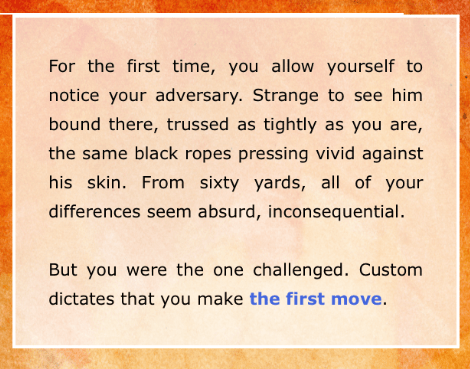
I was stuck on summoning the golem because the enemy destroys it almost immediately upon summoning (this is where I needed the walkthrough). What I needed was to ignore a directive given by the text, that custom dictates that you make the first move. I somehow had got the impression it was a requirement, but the only way to win is to ignore this and start the game by waiting. You are told “How unorthodox” but still can continue with the action (or inaction, rather).
One of favorite puzzle-types are ones which undermine unconscious assumptions; this was a perfect example.
By Nick Junius. Finished. Played on computer with the Gargoyle interpreter. Used walkthrough multiple times.
Straight up on loading I read…
You awake to the iciness of the floor on your hands, staring up at a nondescript ceiling. How you found yourself here is a mystery, why you’re here even more so.
…at which point I want to hop in a time machine, jump in front of the author’s computer, and shout “nooooooo” in slow motion.
Yes, everyone: it’s another amnesia game.
I anticipated Unknowable Things, Cryptic Messages, and The Vaguely Metaphorical Gadget of Arbitrariness being needed to solve the Poorly-Described Puzzles That Nevertheless Indicates Deep Feelings. I was not disappointed.
>x inscription
The glowing inscription reads as follows:
“This place…it’s almost alive…this room almost feels like a heart. Why would a structure need a heart? Am I an intruder? I was brought here…against my will…I think…was it against my will? It has to be.”
Fine: if treated like a pure puzzlefest, does Recorded hold up?
Still no. It suffers from what I call Magical Object Syndrome, which was common in the early days of adventure games. Basically, there’s some mystical object like a wand or necklace or trident which requires some manipulation like WAVE or RUB to activate, but it only works under special conditions. Unfortunately, because it uses magic rather than physics, there is no logical way to know what those special conditions are. The better games bridged the gap with some sort of hint in the form of a poem or whatnot, and the worse ones required the player to experiment, which might involve testing the object in every room in the game.
I hit the walkthrough early and it turned out the first object I needed to use was activated via TOUCH (I had already tried RUB and a few other things). Note that the object is still being held. You are touching an object you are already touching. I guess?
The other puzzles were equally mysterious. While it is possible the inscriptions like the sample above provided the aforementoned hints, even working backwards I can’t find any sense to what happened and particularly why (avoiding spoilers here) the last object needed to finish the game appears.
To end at least on a positive note, I did like this moment, which is only possible in a mystic-energy type game:
> take flame
Even before you reach out to grab the flame, you hear something, almost like the howl of the wind in some far off place. There was definitely meaning behind it and you decide it’s best not to disturb the flame. Someone, or something, obviously cares for it.

By Fred Snyder. Completed. First attempted on iPhone, then played on computer with Firefox browser. Used walkthrough once to overcome a parser issue.
Hector smirks. “I seem to remember you were an okay second-story man.”
“I was never a man.”
“You know what I mean, lady. You wanna see your brother again, you got a job to do. The workprint for your brother. What do you say?”
Second Story is a parser game with a web interface. (See: Gamefic.) It doesn’t work on iPhone (“‘Examine’ is not a verb I recognize.”) so I switched to computer.
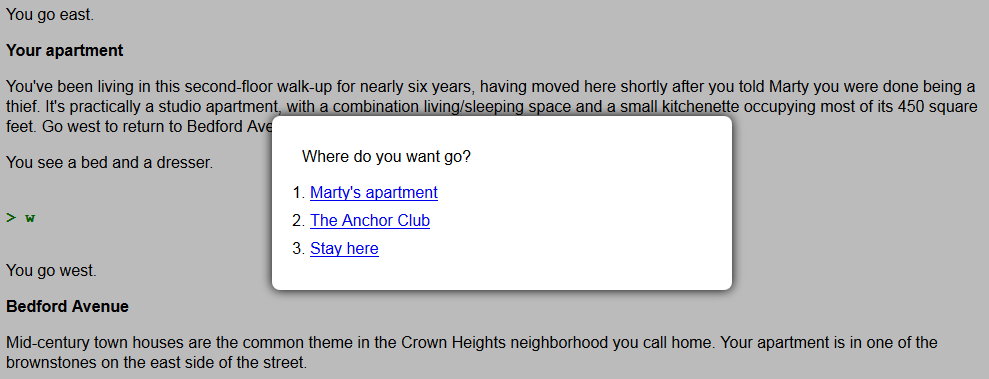
The interface does one nice trick with menus: they are displayed as a popup and you can click on the option you want with your mouse.

You play a retired thief who gets pulled in for one last job.
Unfortunately, the parser isn’t as powerful as the typical Inform/Tads/Hugo game. >EXAMINE BED in the protagonist’s apartment gave me a blank response, and “get” is unrecognized as a verb (I had to use “take”). There are also a fair number of unrecognized nouns.
There’s very little character to the room descriptions. After a scene with distracting a guard and breaking in a room, the player is rewarded with:
A windowless room with a desk. Suitable for student conferences and not much else.
You carefully shut the door behind you.
All the lengthy prose is reserved for the “cutscenes” with conversation; this drains out the atmosphere.
The puzzles were straightforward (simplistic, even) until I reached a point I needed to use a ladder to progress, and I could not figure out the appropriate phrasing to place the ladder where I wanted. After about 15 minutes of struggle I resorted to the walkthrough.
There was a clever trick at the end with ensuring a safe ransom exchange, but the verb problems and minimalist prose had yanked me out of the story’s reality enough by that point I didn’t really get to appreciate it. It feels like author made some dialogue cutscenes and built a world around it, rather than the other way around, leading a flat parser experience.
By Bruno Dias. Completed; played twice on iPhone, twice on computer.
A place like this must have a pretty serious security system installed, if the owner is stuffing it full of his precious things. You could never crack it.
But tonight, there is a scheduled power cut. You scan the neon-washed darkness above for the telltale blue light of a police drone, gripping the cold weight of crowbar in your left hand.
Cape, as the title might suggest, is a superhero story. It is set in a near future of drones and paranoid surveillance. The structure and atmosphere reminded me strongly of the TV show Daredevil.
Some raving before the ranting: both the writing and presentation are excellent.
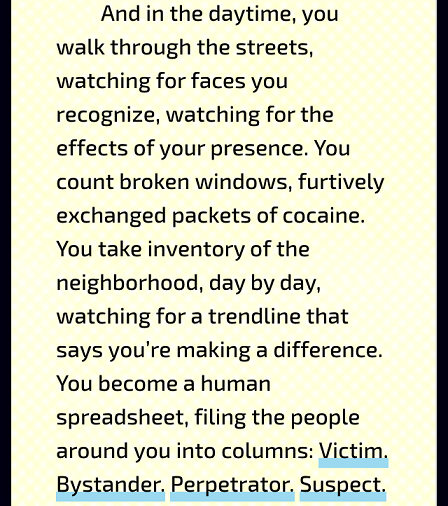
Cape works perfectly on a mobile device, where all prior text is kept as a running scroll that can be rechecked at any time. The game enters “newsprint mode” for an occasional background story. Links that inspect or change (in yellow) and links that advance (in blue) are clearly marked. Gender and nationality are unobtrusively chosen while looking at a passport (with an option for leaving the gender blank).
The author is also talented at vivid phrases (“neon-washed darkness”, “the cold weight of crowbar”).
Alas, the game is a bit of a choice desert. In a superhero game I would expect to be empowered, but I instead watched someone else automatically break out maneuvers and tactics with a mostly irrelevant choices in the middle about how to treat my foes. Threaten strongly or weakly? Doesn’t matter, they’ll skip town afterwards either way. Fight immediately or try to talk first? You’ll get in a fight anyway.
Another sample:

The paragraph above is sort of a “musing choice”, giving a prompt for the character’s internal dialogue. However, it is not obvious that the choice does this, nor does there seem any compelling reason to pick one over the other even after knowing this fact.
They take all kinds of shapes and sizes. Many are young. Your eyes fall on the Irish kids running furtively through the street. Refugees of one of history’s rhymes, they are just barely old enough to remember a better time. The drug cartels love them. They love them because they’re angry, and hungry. They know how to run, and how to fight. And most of all, they’re white, and English-speaking; and so they walk unseen through the clouds of police UAVs and cop suspicion, ferrying drugs and money, the arteries of a hidden economy.
(Lovely touches to the writing! But can you even tell which of the four choices I clicked to get the message above?)
Even the simple act of picking things to look at didn’t seem to matter. An early choice has the player search downstairs or upstairs, but somehow doing so results in finding the exact same items.
There’s a “timed search” technique of restricting the number of items the player looks at, with an interruption of plot, but it comes across as more denial of agency rather than presentation of difficult choices.
As far as I can tell via my multiple plays, there’s only one real choice near the end which affects the ending. Unfortunately, in a way this is worse: after so many false choices and redirections it was not obvious this was a point I needed to think hard about the ramifications of my actions.
I still recommend Cape as a piece of fiction; I was just disappointed with the “interactive” part.
I’ve heard rumor this will be the biggest IFComp ever. The previous record holder was 2000, with 53 entries.
I am almost certainly not reviewing all of them. This is not just because of the sheer volume but also because I have professional writing obligations at this time (a totally different kind of writing, but it does use some of my precious brain fluids).
In my previous review sets (2007 and 2014) I just started dropping words down without preamble, but I figure it might help to form some thoughts beforehand this time.
Q: You don’t use numbers?
A: There’s a couple reasons for this, the primary being I tend not to have any numbers until I’m at least halfway through comp-play. I rate based solely on a should-X-be-rated-higher-than-Y system where after I gather enough games I start to get a general idea of positioning, but where I will sometimes shift entire tiers just to fit something in.
Also, I just happen to like the simplicity of Dan Shiovitz’s three-tier system (Highly Recommended / Recommended / Not Recommended) but even placing in that system requires I stew for a while.
Q: What’s with the quotes? I notice you like to start your review with a quote from the work.
A: When I’m talking about prose specifically, I think it’s only fair to lay out some of the prose in question.
Additionally, excerpts can sometimes convey the plot in a sort of shorthand that doesn’t require me to just paraphrase the game’s blurb.
Occasionally in a bad game there might nevertheless be a slice I want to preserve. Everything eventually drops out of my memory except for the part I saved.
Q: Why are some of these so short?
A: I am cursed/blessed with a compact writing style where after writing 3 sentences I automatically want to rewrite them into 1. Plus, to reference Dan Shiovitz again, some of his best reviews are only a few sentences long.
There’s also the nasty syndrome of “not knowing what to say” which I might weave around this year by not worrying about reviewing every entry.
Q: So what do you judge based on?
A: I hate being tied down on this, but I give weight to both traditional story metrics like “are the characters and plot well-made” but also “does the interactivity make sense”?
Q: How does interactivity “make sense”?
A: It’s hard to describe because different works set up different expectations. I enjoyed Venus Meets Venus from last year but I caught fairly early on it was going to be a “kinetic story” and I shouldn’t expect to to have any agency. In a story where the player is the protagonist, I’d expect more freedom and less railroading.
Given I enjoyed Deadline Enchanter which was a parser game where literally the only commands that worked were the ones from the in-game walkthrough, there is room for latitude. (It was designed as an “artifact from the world universe” so the weird restriction made sense, but it was the sort of trick that only works once.)
Q: I’m an author! Could I ask you more about a review you wrote?
A: You can find my contact info on the About tab.

A new collection by Porpentine is on Greenlight and awaiting your vote.
Eczema Angel Orifice is a compilation of award-winning interactive fiction by me, Porpentine Charity Heartscape! They’ve been exhibited in museums, profiled in the NYTimes, taught in college classes nationwide, and now I’m trying to get them on Steam, truly the ultimate goal of any artform!
Just to prove trying to put interactive fiction on Steam is not a futile effort, Hadean Lands (posted back in January) has been Greenlit!
Still needing votes are:
Tin Star
https://steamcommunity.com/sharedfiles/filedetails/?id=425999310
Jack Toresal and The Secret Letter
http://steamcommunity.com/sharedfiles/filedetails/?id=371862595
The Shadow in the Cathedral
http://steamcommunity.com/sharedfiles/filedetails/?id=371866777
Mainland had been approved on Steam Greenlight (I think due to longevity — it had been on there a while) and has just appeared on the service.

Click here to go to the Steam main page
Note that the “parser” is somewhat hybridized. You type a verb you want to use and the initial letters you type are used to generate suggestions that you can click (essentially like texting).

However, to finalize picking a verb you have to click, you can’t just type. The space bar does nothing.

After clicking a noun, there’s an option to continue using “with” or to simply enter the command.
Despite the oddities, this is good news for followers of commercial interactive fiction. Steam opens a vast new audience for text adventures. The game is free-to-play and should gather curious people that might normally not buy it.
At the time of this writing there’s a weird bug that makes the game hard to install. If you have the Steam service installed, clicking here should do the trick. (NOTE: The game is Windows-only.)
Not long ago three text adventures appeared on Steam Greenlight. They still need your votes, but there’s a new *ahem* sheriff in town:

Tin Star is one of the very best choice-based interactive fiction games I have played. If you have a Steam account and care about the future of commercial interactive fiction, go vote for it!
Link to play a demo of Tin Star online
Link to vote for Tin Star on Steam Greenlight

(For the opening of this saga, you might want to read Anthony’s post first.)
There is a text adventure creation system that dates back to before Crowther wrote ADVENT.
I’ve been stalking a copy of Wander for months now; I made a blog post about it and some other games I’ve been tracking down. Anthony read my post and reached out to the author Peter Langston, who has been enormously helpful and managed to find a friend (Lou Katz) who had an archived copy in email, but it only contained a demo version of one of the games.
I had the vague suspicion it might be in a public place if I knew where to look. Indeed: Doug Merritt has found a copy of Wander buried in a software distribution from the Usenix 1980 conference. It includes all four games mentioned in my “lost mainframe games” post.
NEW: This is an update archive which includes all worlds (except advent) and should compile out of the box. Saving and restoring are fixed. Also now fixes a one-line typo that prevented compiling.
Here’s a binary for Windows 32-bit, made by Jayson Smith.
Here is the advent “world” as a separate file which is a Wander version of the Crowther and Woods Adventure. It seems more like a demo than the other games; Peter only made a partial conversion.

Part of the “castle” world for Wander.
These are by Peter:
castle (1974): you explore a rural area and a castle searching for a beautiful damsel.
a3 (1977-1978): you are the diplomat Retief (A sf character written by Keith Laumer) assigned to save earthmen on Aldebaran III
tut (1978): the player receives a tutorial in binary arithmetic.
One of the games is by Nat Howard:
library (somewhere between 1974-1978): You explore a library after civilization has been destroyed.
Also, Peter himself did a very incomplete port of Crowther and Woods Adventure called advent dated at 1981.
There’s one “missing” game. Lou Katz (who I mentioned earlier) wrote “a department store world, trying to make a computer game that would appeal to girls.”
Now to address some questions (note to Peter: please let me know if anything is off!) —
Was it really from 1974?
To quote Peter:
As I remember I came up with the idea for Wander and wrote an early version in HP Basic while I was still teaching at the Evergreen State College in Olympia, WA (that system limited names to six letters, so: WANDER, EMPIRE, CONVOY, SDRECK, GALAXY, etc.). Then I rewrote Wander in C on Harvard’s Unix V5 system shortly after our band moved to Boston in 1974. I got around to putting a copyright notice on it in 1978.
The early version in HP Basic was possibly from 1973; Peter isn’t sure. The move to Boston is a distinct event, though, so 1974 as a start date is is definite.
Note: Peter Langston’s legendary Empire was from 1971.
Did it look like its current form in 1974?
Peter says “the concept didn’t change, but implementation got better and the worlds got easier to create”. He doesn’t have a good recollection, though, so he can’t answer questions like “which features got added first” and “did anything get tweaked after the release of Adventure”.
Probably the best way to verify the early state would be to somehow track down the HP BASIC version, which was never revised post-1974.
Do we have to rewrite the history books?
Er, sort of. Wander never really had the same impact as Adventure; Peter notes that in his games distribution Empire, StarDrek and the Oracle attracted all the interest.
What else is there to do?
There’s a need for modernization and ports. (People have been mentioning Github; if someone wants to start one, feel free to do so and toss a note in the comments section.)
Finding the original BASIC version would be huge; we’d know exactly what things were like at the earliest stage of the development of the adventure game.
For my part, I’m going to play the games and blog about them in my All the Adventures project.
What about other mainframe games?
Ok, this is my question. If you’re interested in this sort of thing, you can refer to my lost mainframe games post and see if you can find any of the others. LORD is particularly tantalizing but I don’t know where to even start searching for an archive from Finland.