This is another game by Peter Langston using the Wander system. (For those who haven’t read about it yet, Wander is a system for writing text adventures originally from 1974, before Crowther and Woods Adventure.)
The first Wander game I played, Castle (original version 1974, current version 1978-ish) felt a bit conventional; without the oddness of the parser it’s not obvious it’s a “side branch” in the history of adventures. This is not the case for Aldebaran III.
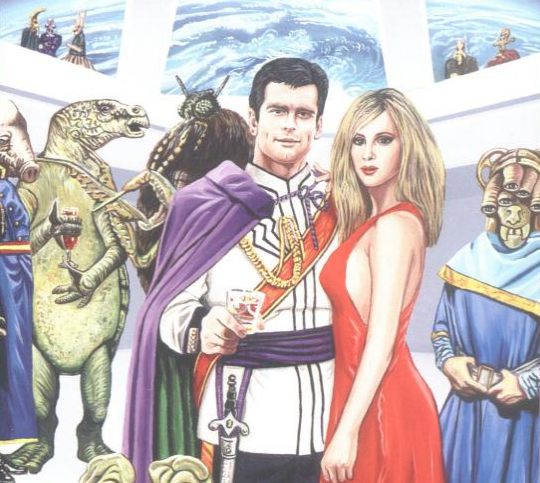
Aldebaran III is based on the stories of Keith Laumer, and specifically his intergalactic diplomat Jame Retief. Hence, it’s the first adventure game where you are playing a well-defined character, rather than “yourself”.
Keith Laumer was a diplomat himself (stationed in Burma) and consequently this is a bit like Ian Fleming and John le Carré going from working in intelligence agencies to authoring spy novels. His stories about Retief are satirical and contain jokes that are (apparently) funnier to those who have been in the real-life diplomatic corps.
Just Imagine …
You are traveling as First Under-secretary to the Ambassador for the Corps Diplomatique Terrestrienne, (CDT). Your direct superior, Mr. Magnan, has managed to duck out of the action and leave you as sole assistant to his superior, Ambassador Pouncetrifle. (The Ambassador is a classic bungler and would, if left on his own, mess things up badly.)
You have been sent to Aldebaran III where you are to avert an uprising against Terran nationals expected at the end of April.
The “Just Imagine…” is a strong cue that we are, in fact, roleplaying, a fact emphasized further by checking the papers we are holding:
READ NOTES
Page 1
Aldebaran III is an eighty-four percent earth normal planet which revolves around a brilliant red star, (Aldebaran, or Alpha Tauri). A III has an atmosphere consisting of 52% nitrogen, 26% helium, 20% oxygen and 2% other gases, (by volume). The period of revolution of A III is 18.628 Earth Standard hours which is expressed in local time as 24 hours. The axis of A III tilts less than a degree with respect to the ecliptic, (47.6′), providing virtually no variation in season and length of daylight, (sunrise is at 6:00 Aldebaran Standard Time, sunset at 7:00 p.m. A.S.T.).
… (the notes continue, but your interest wanes)
Note the last part “your interest wanes” — the character you are playing is bored, which is a good way even in modern games to avert having to write a lot of text for something that should be book-length.
The satirical approach to procedures from the original stories appears in the game, at least in this early encounter:
You are in a low-roofed customs building with long tables stretching between a door at the east and a door at the west. A large sign reads
   +---------------------------------+

   |    --> SHOW PAPERS HERE <--     |

   |     --> PAY DUTY HERE <--       |

   |  HAVE YOU ANYTHING TO DECLARE?  |

   +---------------------------------+
in a dozen languages. A serious-looking customs official is eyeing you.
“Your papers, pleese”, lisps the official
SHOW PAPERS
“Hmm, a Terry” mumbles the official
“Have you anything to declare?” snaps the customs official
NO
“If you really have nothing to declare you may leave.”
Customs
W
“I don’t believe you’ve declared that credit card”, admonishes the official.
Customs
DECLARE CREDIT CARD
“Yes”, says the official sliding it down the counter and muttering to himself, “credit card — five credits”.
The parser is still as broken as Castle’s (I keep typing GET but the verb is unrecognized, it insists you use TAKE) but the main character still makes the experience feel weirdly modern.
I don’t know how long / difficult this is, I suppose we’ll find out next time!

Via Giant Bomb.
I’ve stored 13 treasures. On a scale from 0 to 100 that rates a 100. Well done.
So for the 13th treasure, I checked in a few of Voltgloss’s hints he provided on my last post. I had a hunch I was stuck on something not worth banging my head over.
I was not wrong.
…
Ok, what is it with early adventure games and goofy giant oysters? There was the one in Crowther and Woods Adventure that could be pried open with a trident (and only a trident), the one in Adventure 500 you just had to drop near water, and the one that waged mortal combat in Spelunker.
With this game, early on you find some “dried camel jerky”. There are some nearby starving rats who will gratefully eat it, and subsequently not attack you. I assumed that was that.
However, oysters like dried camel jerky … too?
WHAT SHALL I DO? FEED OYSTER
Oyster makes a slobbering noise
Visible items: Small Nomad, Pistol, Archway, Giant Oyster, * BLACK PEARL *
I can’t adequately express my state of mind about this puzzle so let me throw around some question marks: ? ???? ?? ?? ? ? ?? ? ? ???? ????
I mean (?), I guess a super-huge oyster (????) might eat something other than plankton (??), so this sort of (??????) makes sense (??).
No, no it doesn’t. But at least it was the last puzzle!

Progress update: I am shifting Warp, which I previously dated as 1979, up to 1980. I was always a bit tentative about it (I discuss the issue in my first post) because while the coding technically started in 1979 nobody outside the authors touched it until 1980. I also shelve HAUNT by John Laird (which has a copyright date span starting at 1979, but wasn’t really in a recognizable form until 1980) in that camp.
This leaves me with either 5 or 6 games to go to be entirely done with the 1970s:
1977
a3 by Peter Langston
1978
Library by Nat Howard
Tut by Peter Langston (this a binary arithmetic tutorial in the Wander system and may not be worth a post)
1979
Enchanted Island by Greg Hassett
Adventure 550 by David Platt
Adventure 501 by David Long
I might loop back and snag a few “supplemental games” which aren’t exactly adventures (like a full post on Hunt the Wumpus, and an obscure related game from the same year called Caves) but probably not until I’ve already started 1980.
Last time, I had found a “throne room” with an “Iron statue of Phraoah” that killed me. There was a mural with the hint “Seek ye well the HEART of Iron” and trying to >TAKE HEART gave the message “Pharoah’s heart is red like yours, yet evil has darkened it!”
I have now solved this puzzle. Voltgloss mentioned in the comments this is the “defining puzzle” of the game. Since I’m going to spoil it, you should turn away now if you plan on playing Pyramid of Doom in the future.
I was stalled, and did my common procrastination tactic of browsing for more images to use in blog posts. Surprisingly, my act of procrastination broke open the case!
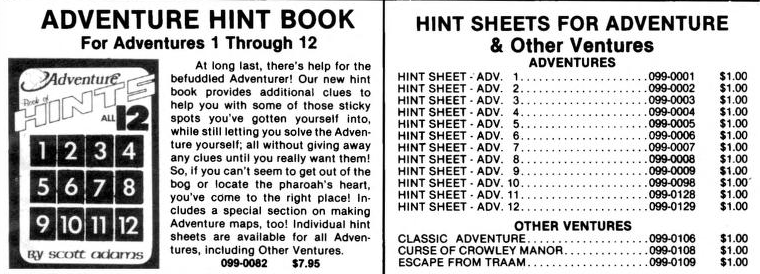
This is from the second catalog (1980 I believe) for Adventure International products. Specifically note the phrase “So, if you can’t seem to get out of the bog or locate the pharoah’s heart”. I assumed (via the somewhat deceptive parser response to >GET HEART) that the heart was in the throne room, but upon reading this comment I tried >GET HEART in an entirely different room and got the same message. It must be a hard-coded “hint”; and to be fair, while it led me astray at first, I wouldn’t have solved the puzzle without it.
So: considering the whole map, is there anything “darkened”? I did find a lump of coal in a fireplace, and had even tried using it in the throne room to no avail, but the word “darkened” suggested to me it could be cleansed somehow.
If you recall the pool of liquid that gave me trouble at the start of the game, I took the coal in the water and typed >CLEAN COAL.
The result: a ruby. Ah!
Alas, holding the ruby, rubbing it, waving it, etc. seemed to not do anything to the pharaoh. I decided I needed to destroy it. I utilized a nearby pool of acid:
WHAT SHALL I DO? THROW RUBY
OK Ruby falls into pool of acid, burns up.
Checking back in the throne room:
I’m in a throne room
Obvious exit: DOWN
Visible items: Small Nomad, Chain hanging from ceiling, Chest, Wall Mural, Pile of Melted iron
Pulling the chain reveals a secret staircase, and after a little trouble, I was able to get up to 12 out of 13 treasures found. The only issue: is the 13th treasure the ruby that I melted in acid? I’m not getting that back.
I don’t know if that means I solved the puzzle in the wrong way, or if the ruby just “doesn’t count”. I’m still stuck on the other puzzles from my last post (the giant oyster and the purple worm) so unless both are red herrings, I’m missing something else important.
But, close! Hoping for a victory post next time.
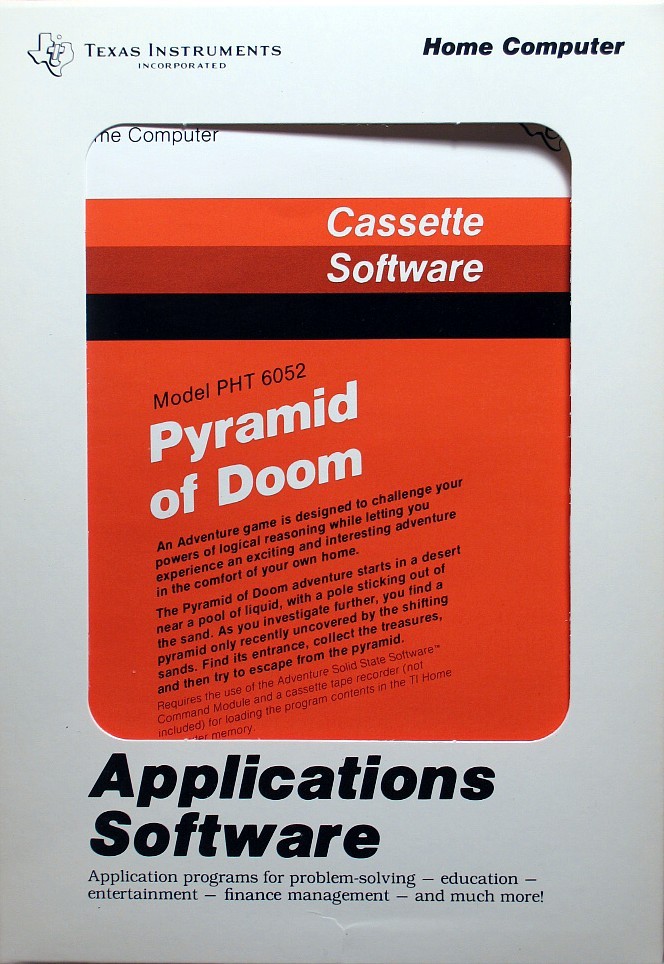
Via Giant Bomb.
ONE
Going back to the moment of entering the pyramid, recall from last time I had trouble finding the “large key” leading to the main door due to a parser issue. Given someone who doesn’t have the issue and finds the large key right away, I believe the “intended” first method of entering the pyramid was this:
WHAT SHALL I DO? unlock door
Large stone falls on me!
To prevent this from happening, you have to dig and find a secondary small door; upon unlocking it, the large door can open safely.
I know traditionally the “diegetic plot” of an adventure is the one that goes through without deaths, but I’ve come to think this paints an incomplete picture. This particular death is amusing enough that it’s hard to imagine it won’t be “in the head” of the player, making the environment seem more dangerous. On the surface, the player is walking through a door. Underneath, the player is avoiding a death-trap. Without both branches simultaneously, part of the story is missing.
TWO
One of the puzzles I solved since I last checked in involved a room of mirrors, and was in several parts.
I’m in a long, narrow passageway
Obvious exit: SOUTH
Visible items: Small Nomad, Bricked up doorway, Rope
First, to get in requires busting through the bricked up doorway. There’s an iron glove nearby, and if you wear it, you can >PUNCH DOOR
OK Crash!!!
!!! That’s quite a glove, there.
Heading into the door:
Mirrors EVERYWHERE! Light blinds me, so I shut it OFF!
The room description is then just “It’s too dark; I can’t see.”
You can go in any direction (NORTH, SOUTH, EAST, WEST, UP, or DOWN) although only one of them (EAST) leads to a new room. When entering the new room you have to remember to turn your flashlight back on.
I’m in a dressing room
Obvious exit: WEST
Visible items: Small Nomad, * GOLD SCARAB *
However, there’s yet another treasure, back in the mirror room!
WHAT SHALL I DO? FEEL
I feel a coin on the floor
Regarding the sequence as a whole, it strikes me as one of those where parser is stronger than a hyperlink-interface, in all three parts: A.) The idea that you can straight-up punch a door is hilarious and not even that hard to work out, but having the option “punch door” pop up would be much less satisfying then coming up with the action unprompted. B.) The hidden room based on direction-in-darkness which requires manually lighting up the flashlight after testing a direction would feel lawnmower-y if the six possible directions were available to click; I originally figured the coin was the only treasure (where the exit SOUTH went back as I expected) and only discovered the dressing room after later experimentation. C.) I have no idea how feeling in the darkness would work in hypertext without some persistent FEEL verb that works in every room; having the verb pop up in the dark room only would ruin the surprise.
THREE
I have discovered 9 out of the 13 treasures. The places I am obviously stuck on are:
1.) A “giant oyster” who blocks my entrance through an archway.
WHAT SHALL I DO? go archway
Oyster won’t let me
I am unclear how this works. I guess the oyster is … wedged in somehow?
2.) A “purple worm” that I found in a room with a dead explorer:
WHAT SHALL I DO? open portal
Nomad: `RUN YOU FOOL!`
WHAT SHALL I DO? SHOOT WORM
Doesn’t bother him.
Purple worm devours me.
Note the nomad’s warning, which is provided even before opening the portal. I theorized earlier the nomad might be helpful; I guess this (and stuck point #3) might be the reason the nomad has been around in the first place?
There’s a nearby pool of acid which I suspect might make a nice home for the purple worm, but I haven’t been able to get it to move around, so that might be a red herring.
3.) I’ll just let my transcript explain this one:
I’m in a throne room
Obvious exit: DOWN
Visible items: Small Nomad, Iron statue of Phraoah seated on throne, Chain hanging from ceiling, Chest, Wall Mural
WHAT SHALL I DO? read mural
Mural: Seek ye well the HEART of Iron.
WHAT SHALL I DO? pull chain
I hear a hollow laugh. . . The sound of machinery.
[In the room description, the statue changes to “standing statue”.]
WHAT SHALL I DO? pull chain
Nomad: `RUN YOU FOOL!`
I hear a hollow laugh. . . The sound of machinery.
[The description changes to “Iron statue, slowing advancing. . .”]
WHAT SHALL I DO? shoot statue
OK Missed…
Iron Statue tears me apart!
I’ve been puzzling over the “HEART” of Iron hint. I read over the Wikipedia article on iron in case this is some external reference, but I don’t think so.
ADD: Found this immediately after posting.
WHAT SHALL I DO? get heart
Pharoah’s heart is red like yours, yet evil has darkened it!
It still isn’t helping me out, though.
FOUR
Before I sign out, I wanted to share the blurbs from the 1979 and 1982 releases of the game:
1979: From jewels to gold – 13 treasures are concealed in this ancient pyramid. Watch out for the nomad and beware the curse of the pharaoh!
1982: An Egyptian Treasure Hunt leads you into the dark recesses of a recently uncovered Pyramid. Will you recover all the treasures or more likely will you join its denizens for that long eternal sleep?….
Notice how the first one seems to set the nomad up as an enemy? The nomad is still the only one I can use the pistol on, who as I explained last time comes back after disappearing in a puff of smoke. I think it’s possible the pistol is either a giant red herring or used in a very unconventional way, which I can throw some respect for.
As predicted, my issue last time was not from a “difficult” puzzle as much as silly and frustrating situation. I ran into both a parser issue and a visualization issue simultaneously!

From the first area of the game, I could >GET LIQUID to fill my canteen, but >ENTER LIQUID and >GO LIQUID both result in “I don’t understand” messages. This led me to visualize the pool as something small (maybe the result of a spill). However, if you >ENTER POOL instead
I’m in a Pool of water
Obvious exit: EAST
Visible items: Large key
Clearly the intent was for the pool to be visualized like some sort of oasis.
Let me repeat for emphasis: The *exact same item* has to be referred to a LIQUID if we’re wanting to get water to drink, or a POOL if we’re wanting to jump in. I know the classical complaint with old parsers is guess-the-verb, but they can be bad in much different ways. (Related: my post on a part of Acheton that was guess-the-noun.)
In any case, once I got past that part, things opened up:

So far, everything I’ve seen is very traditional (including the objective of “gather all the treasures”), with the exception of the small nomad.
I’m in a sitting room
Obvious exit: NORTH
Visible items: Small Nomad, Ashes, Basket, Fireplace
The nomad discovers the player fairly early on in the game and follows them everywhere, silently watching but never doing any actions.
WHAT SHALL I DO? talk nomad
The nomad stuck out his tongue at me.
WHAT SHALL I DO? kick nomad
The nomad stuck out his tongue at me.
Now, it is possible to shoot the nomad…
Got him!! Nomad vanishes in a puff of yellow smoke.
…but the nomad shows up again shortly after, and continues following the player like nothing has happened.
Will the nomad help with an obstacle? Will they hinder the player at a specific time? Or perhaps both will happen? Does the nomad represent uncomfortable stereotyping or is the disappearance in a puff of smoke enough of fantasy-universe remove it doesn’t matter?

Let’s finish with Scott Adams for 1979!
Except, well, this isn’t Scott Adams, but rather the only game ever made by Alvin Files. Alvin had worked out how the Scott Adams Adventure system worked, and wrote a game on his own. He sent it to Mr. Adams, and after minor tweaks, it was released as Scott Adams Adventure #8.
This is one of those early-difficulty games: there are four desert rooms, a small hole I can enter, and I have no idea what to do to get the game started.
The style of starting with a tight area containing a difficult puzzle can work on occasion. Christminster is a text adventure from 1995 with a very devious timing puzzle in the first four rooms. Once solved the resolution is glorious. (On the other hand, it caused some people to quit playing.)
I wrote a level set called A Quiet Place for the game DROD where I made the first room high-pressure just as a way of throwing down the gauntlet — if someone couldn’t beat it, they were best off playing some easier levels first. Also, the tight pressure was a thematic device throughout (as the Youtube video I just linked explains, “everything wants me dead. Immediately.”)
To pick a less obscure (and only slightly less relevant) example, the first boss of Dark Souls is legendary for being extremely difficult. That is, extremely difficult for someone approaching the game as a standard RPG button masher; the repeated deaths are intended to train the player that yes, you might need to dodge and aim your attacks to win the game. By the end, the player has either quit or undergone a sadistic sort of tutorial which sets the tone for the rest of the game.
Unfortunately, I’m not sure it’s really the case here that the puzzle is supposed to be classically “difficult”; the resolution may end up being just silly and frustrating. (The difficulty overall of the game is advertised as “Moderate.” Savage Island, which will come in 1980, starts with a small difficult section but is “Advanced” and clearly intended to challenge the player.)
I’ve got access to:
- A canteen, and water
- A shovel
- A flashlight
- A tiny key, which I found by digging in one of the desert rooms.
- A stone; READ STONE tells me “Confusing. Part appears missing.”; taking the stone causes “the sound of machinery” and a “door with large keyhole” to appear.
- In the same place as the stone I can DIG to make a hole, and then enter the hole to find a tiny locked door. The tiny key unlocks the tiny door (again causing “the sound of machinery”) and that’s the point I’m stuck. I can’t get any more machinery sounds and the door is too small to enter.
- There’s also a “small nomad” that appears not long after starting the game who follows the player around, but I haven’t found any use for him yet. Other than TALK NOMAD (which ends up being fruitless) I can’t interact with him at all. I suppose maybe he’s small enough to fit in the door, but this isn’t an Infocom game where I can say >NOMAD, ENTER DOOR.
- Oh, and finally, there’s a sign that states “He who defiles to tombs of Egypt shall surely perish!” Not likely useful, but when I’m this stuck I’m willing to try anything.
I’d be willing to take hints, but if you post one, ROT13 format only please. I’m going to keep at this for a while yet.
(You may wish to read my series on the original Adventureland before this post.)
The manual informs us:
“SPECIAL SAMPLER” Never tried ADVENTURE? This special inexpensive sampler complete with 3 Treasures is a cut-down version of our large Adventureland. Guaranteed to supply hours of enjoyment: Try an ADVENTURE today!
Somewhat less kindly but still accurately, R. Serena Wakefield calls it “An abbreviated version of the full Adventureland, probably one of the first examples of crippleware in history.”
In essence, it is Adventureland with a.) no dragon eggs b.) the fish is just a normal fish, not golden and c.) the lamp is removed so the part of the game where you are supposed to go underground just cuts off.

This experience might be very disorienting as an introduction to adventure games, because many of the things that are part of the main game are left in! Previously essentially game items are now red herrings. There is flint and steel, skeleton keys, a bottle of water, mud, swamp gas, and the dragon from the original game (without the dragon eggs).
Even stranger: the opening part of the game has you climb a tree to find the skeleton keys, then chop the tree down and enter the stump. In the regular game, if you chop the tree down first, you hear something falling in the swamp; there’s a definite signal something “went wrong”.
TIMBER. Something fell from the tree top & vanished in the swamp
However, since the skeleton keys just open the door to the dark area, they are entirely useless in this game! So the signal that the player did something bad is misleading.
While many games genres have demos, even today, adventures never seemed to pick up on the trend. (I believe some of the Myst games had demos, but those are the only ones I can think of off the top of my head.) It’s just too hard to figure out where to cut. Also, one of the primary aspects of an adventure is to seed information and items in the early phases of a game where their presence may just be confusing in a demo.
Anyone recall any other particularly prominent adventure game demos?
EDIT: Some demos mentioned in the comments:
Space Quest 6 demo (This one is essentially a new mini-adventure to go alongside the regular one.)
Full Throttle demo (This includes 3 separate sections from the regular game.)
Mini-Zork (This was released relatively late in Infocom’s history, 6 years after Zork I.)
Day of the Tentacle Demo (Not exactly a demo, more of a preview video.)
Secret of Monkey Island demo (Also apparently a mini-adventure, as opposed to part of the regular game.)
The Over-Mind is no more!

More than 1000 years ago there were a pair of planets, blue and red, hanging close in each other’s sky.
The blue planet was inhabited by the king Alcazar Rex, who ruled in peace with the help of four ministers: Gerald the Green, Rubin the Red, Byron the Blue, and Griffin the Gold.
Griffin was minister of the tax, and while the kingdom prospered, he worked constantly. One night, in a dream, he was spoken to by a dark angel. The angel spoke of a “tireless servant” in a “bright crystal city” in the form of a “smooth sphere of shining gold”.
Griffin found the city in his dream and located a golden sphere. Upon touching it, the golden sphere awoke:
I am Servant-Mind, to thee tireless slave.
The work of dull tasks forever I save.
Provide me the records kept in thy care;
Then I shall compute for each the fair share
Of taxes owed. Yet I can do much more:
Alcazar’s nation wastes goods by the score.
By my plans this will end. Thus shall it be,
If all confidence is given to me.
So it was done. The Servant-Mind gradually was given more and more information, and started to take over all the tasks of the kingdom.
Servant-Mind corrupted the ministers with false promises of power; as soon as the time was right, it declared itself Over-Mind and became a tyrant.
The Over-Mind summoned demons to protect itself; Alcazar Rex was unable to defeat them. The old king fled (via magical device) with his daughter to the red planet, where he built a tower and was able to live in safety.
With magical foresight, Alcazar cast a magic spell so his daughter would sleep, and the same for Griffin the Gold, now filled with regret. Griffin he put in a cave in order to be discovered by a stranger who would rescue the kingdom in 1000 years.

One implication of the plot is you can teleport between the two planets.
I mention all this to note that the the main enemy is, essentially, a static object. Here is the final showdown:

There are multiple ways to deal with the demons (including just shooting them, although you’ll need an ally for backup with that approach) but once the Over-Mind is alone you can pick it up and take it places. This results in a final dilemma of how to destroy it, as opposed to how to fight it (I’ll spoil the method how a little bit later).
. . .
While this is not one of the explicit goals of my project, I’ve mentally tallied along the way what I might consider “required curriculum” for a designer who wants to learn from studying interactive fiction. In addition to the original Adventure (for historical reasons) I’d tag The Count and Local Call for Death as having innovation that’s still relevant today.
Empire of the Over-Mind also belongs on the list.
Mind you, partly as a cautionary tale — anyone who claims compass directions became the norm in text adventures purely because of cultural inertia should try this game and see how often they find themselves going in circles because they accidentally went through a “wooden door” rather than a “trap door”. I did say in my last post the lack of compass directions gave an otherworldly feel to the game, but really, the negatives far outweigh the positives here.
But! The number of alternate solutions is really impressive. Take this late-game section, which is full of goblins:

It’s necessary to enter this area to get goblin ale, which helps protects against the pain the Over-Mind can inflict when you get close. However, you can enter by a.) using a climbing kit from above b.) using a pistol to blast in from the bottom or c.) teleporting in via a box which moves the player to random locations.
While there, you can deal with the many goblins via d.) using the PYRO spell word and summoning a flame salamander, who can help fight them e.) with a friendly dwarf ally, who also is talented at goblin-killing f.) by shooting them with a xenon pistol or even g.) evading them altogether.
As I came close the the end-game I experimented with a.) through g.) inclusive. I’m not even sure I’ve found every possibility; there are, for example, three stones whose use I was never able to discern.
There might even be more than one way to defeat the Over-Mind. I first tried using the black box to teleport to many different locations to find one that was deadly. In the end I used lava:

The Deluxe version (which I linked to at my first post) has some very different elements, so if you’d like to play the game yourself, I’d recommend that one; likely not much has been spoiled. According to the manual, the only thing that is really the same is the Poem of the Over-Mind itself.

(The entire map is shown above. Click for a larger view.)
Two last postscripts: I managed to finish without hints! I don’t know if you noticed how on longer games I invariably make a statement along the lines of “and then I had to get a hint” or “and then I found a map of the game” but in this case I did this one entirely on my own.
Also, the inventory system is designed so there is a difference between “carrying” and “holding”. You can “>HOLD OBJECT” to make OBJECT your current item. I was initially confused as to why >FILL WATERSKIN led to a message that I didn’t have the right object; I had to >HOLD WATERSKIN first before I could use it. It does make sense, it’s just very unconventional.
I’ve played games with mixed thoughts before. I don’t think I’ve ever played a game where the things fascinating about it were the exact same things that were frustrating.
Let’s take the map; here’s just a snippet:

Remember, there are no compass directions; you go places by the name of the connection. Not only does this make the map take a lot longer to make (due to having to label absolutely everything) but I had multiple cases where I had rooms that clearly linked in some close pattern but ended up on opposite parts of the map due to me having no idea which direction to go.

For example, here the “Oasis” and “Desert” link together. I clearly needed to orient the bottom section flipped up rather than down.
Still, the concept threw me into a sort of other-worldliness that ended up being appropriate for the game. Once I had sufficient mapping done, navigation gave me a singular feel which I haven’t experienced in any other adventure game.
Let’s backtrack to that 1,592 word poem. Clip below:
Alcazar buried his friend in the sand.
While he was digging, cold revenge he planned
Against Over-Mind. In a secret room,
He worked alone to seal Over-Mind’s doom;
Removed the enchantments, canceled the role
They had in giving Over-Mind control
Of the weapons, so that when completed,
By its own snares it could be defeated.
Then he shut the room with black iron cold,
And only his daughter the pass-spell told.
I bounced very hard off the act of reading the whole thing in one go, and in fact I still haven’t. It’s not even badly written (or at least, as bad as it could be) but I had to struggle through in small doses.
There are indeed some important hints within, including one which I needed for essentially the first puzzle.
But still — the process of returning to the poem to comb for more hints ended up feeling like I was playing an alternate reality game, searching for hidden messages. While this is technically true of many Infocom games that include “feelie” materials, they never quite elicited the same notion of cipher that the Over-Mind poem does.
The manual mentions multiple solutions to things, and it isn’t kidding. This is mainly because of roaming enemies.
The enemies are in the style of Lords of Karma, with the major exception that you have no working attack command. There is no sword or dagger or other weapon. (There’s a xenon blaster later in the game and the SHOOT command is recognized, but the blaster doesn’t work and I suspect it never will work.) [EDIT: I got the blaster working. It has limited energy, so the next comment about resource management still stands.]
The intent is to use magic items and allies you find on the way, both which are limited resources.
For example, there is, early on, a chance to summon a flame salamander. The salamander provides light and is fairly good at defeating enemies. However, the flame salamander can only be used once, and when it leaves, it takes one of your items with it. If it’s a useful item, it means you have lost the game, although because of multiple solutions it’s unclear what a useful item is!
I’ve done reloading and optimizing in a way that closely resembles Hadean Lands, except without the reassurance I can backtrack any mistakes. I’ve enjoyed the narrative feel that resulted, and the non-linearity, but it’s simultaneously annoying to not know if I’m in a “dead adventurer walking” scenario.

The people (all two of them) have spoken, and I’m using the earlier rather than the later version. (The TRS-80 version, because the speedup on my emulator avoids both spastic blinking cursor and dropped keyboard input issues.) I do want to be clear I’m fine with “remake” versions, as long as the gameplay is essentially intact, and especially if the original author is involved.

However, despite the organized user interface of the 1986 edition as shown above, I find myself gravitating to minimal UI: just text and a parser.
A curiousity: the development of first-person shooters went from heavy background interface to gradually letting things go until it was (is?) considered admirable to have no interface at all. Text adventures underwent the opposite, gradually adding elements until arriving at the complexity of the interface below used in the Legend games.

Is more really more when it comes to a text game, though?
. . .
In any case, Empire of the Over-Mind introduced three novelties that make playing it more difficult than usual.
1.) The placement of items is at least somewhat randomized. In the first room of the game upon multiple reboots, I have found: a waterskin, a stick, a golden leaf, or nothing at all.

2.) The game comes with a 1,592 word poem that contains information required to beat the game. The original looked like this:

Thankfully, I have an ASCII version I was able to put on my phone for better readability.
Clever Servant-Mind had this long foreseen
And protected itself. Gerald the Green,
By false promise of power corrupted,
Had natural life vilely disrupted;
And, with the magic of a leaf of gold,
To animate or dispel he did hold
Control over plant and skull long dead,
To serve as sly traps for the sphere of dread.
Then for amusement at living man’s pain,
Servant-Mind had Gerald horribly slain.
I’m not going to do an intensive evaluation right now of Mr. Bedrosian’s skill at verse (maybe later), but it isn’t bad. At the very least the poem gives enough about the rise of the Over-Mind that it feels like an actual foe with motivations rather than Generic Baddie #295.
3.) There are no compass directions in this game. You have to state you want to go down a PATH or to a CLIFF or whatnot.

This makes me feel slightly uneasy and lost. On a couple occasions I accidentally went back to a previous location because I was confused, and there are some items meant as scenery that can’t be traveled to but it isn’t obvious until you’ve tested it out.
Still, while even original Adventure let you navigate by landmarks in some cases, they were only used in special cases; dispensing with compass directions completely is very rare for the era (I believe Battlestar does it in 1980, but I haven’t reached that year yet).