I have occasionally heard the word “archaeology” applied to the rescue and documentation of old games. (This very blog is even mentioned in a book titled Retrogame Archaeology.)
I’m not going to quibble; however, if I think of “real” archaeology, I think of exploring and digging in sites that may have other things built on top of them, and where the entirety of the original is not recoverable but where inferences can be made based on that which remains. So far, nothing I’ve done (like helping preserve Wander or Journey) has been like that. It’s been more like finding some secret book in an archive and placing it on display.
Playing Ringen is the closest to archaeology I’ve done. It was translated and ported to a MUD, where expansions and additions were made, so trying to work out what Ringen from 1979 was like is necessarily uncertain.
There’s enough clues I can make some guesses, so let’s give it a try.
…
VikingMUD (based on the more general LPMud codebase) has a variety of built-in verbs that have to do with combat and social interaction. You can attack monsters or wield and unwield equipment; you can form parties with other players and DEFEND them from attack; you can smile, wave, comfort, and so forth, and the general effect is to produce an effect other players in the room can see.
This is essentially different than the standard text adventure model, where verbs are more universally related to object interaction. In such a model, if you can RUB RING, you can try the verb RUB on any item in the game (and may get an unhelpful response, but it’s still clear the verb exists as an action).
You can do puzzle use of verbs in the LPMud, but they’re specific and custom to a room (or object), not universal across the game. The game might allow UNLOCK DOOR in a room specifically oriented for it, but UNLOCK anywhere else will get a response of “What?” (The only comparable games I’ve played are the Wander ones, like how in Aldebaran III there’s a BRIBE verb that exists while in jail.)
The fact all verbs are custom means, in practice, that puzzles reliant on verb-object interaction are heavily curtailed. One hurdle is technical difficulties. Suppose the game author wanted the player to WAVE FEATHER. WAVE is a social verb and expects to be used in that fashion (WAVE AT FRIEND) so the desired format may not even be parsed correctly.
Additionally, in a game design sense, an act like WAVE FEATHER in a specific spot would be too hard for the player to come up in practice without heavy text-hinting. There is an early spot in the Ringen portion of VikingMUD with this kind of text hint:
Long road. You are walking along a hard and flat path through the Hollin forest.
There is a big sign here saying something important. An old root of a tree.
There are two obvious exits: east and west
A wicked woman with her nose stuck in (he he) the tree-stump
The woman says: If you aid me, I’ll reward you, I promise!
>PULL WOMAN FROM TREE
You try to pull her out, but you fail!
You’re simply not strong enough!
The woman says: If you aid me, I’ll reward you, I promise!
Note that only this very specific phrasing (PULL WOMAN FROM TREE) is even recognized. I suspect the solution simply involves raising the “strength” statistic of my character. This happens to also be the first quest given in the Adventurer’s Guild in the game.
1: Witch quest (unsolved, 59)
2: Orc Slayer (unsolved, 69)
3: Forgotten Word (unsolved, 82)
4: Bright boy (m/f) needed! (unsolved, 82)
5: A girl and her teddybear (unsolved, 94)
6: Quest for the murderer (unsolved, 97)
7: Sheriffs key (unsolved, 98)
These facts combined together suggest to me the task here was designed solely for the MUD system. That’s not to say it’s impossible this scenario didn’t appear in Ringen (maybe there was no “strength check” and the action automatically worked?) but it feels very MUD-specific.
The ogress with the riddles who I mentioned in my last post probably also wasn’t in the original game. The character is most likely Fuithluin (with a misspelled name?) who didn’t appear in known Tolkien lore until the Book of Lost Tales in 1983. Ringen was made in 1979. ADD: See this comment; in an old Usenet post, Pål-Kristian Engstad confirms he added the ogress himself, although he didn’t get the idea from Tolkien:
I can’t help feeling a bit touched by your friends information. I have coded Moria in two MUDs; Genesis and VikingMUD, where I have placed an ogress as a part of a quest.
There is nothing in the works of J.R.R. Tolkien which supports this idea, and I have only made this creature up from my imagination. It might or might not be very Tolkienish, but it always made the players wonder. I have personally always felt that the passing through of Moria was too briefly explained in Tolkien’s works, but that is in a way nice, since it allows to _imagine_ what actually is there (or might be there).
This leaves the dragon puzzle, which I’ll quote the full context of:
You have entered a big hall. On the walls hang some faded flannel carpets, and there is a huge wall-to-wall carpet on the floor. The air is filled with a stinching smell of sulfid, and thick smoke streams out of an opening in the northern wall. There are two additional openings in the western and eastern walls, though not as frightening as the one in the north.
There are three obvious exits: east, north and west
>n
You are in the dragons lair!
A dragon, fifty yards long, lies here sleeping in a huge room. Fire and sulfur streams out of its big nostrils as it breathes. It grunts and stirs asleep, but if you value your life, you should not disturb it. Instead of passing it, consider retreating slowly to the south, through the opening. It looks like there is an opening northwards too, behind the dragon, but I do not advice you to try to go there!
There are two obvious exits: north and south
The dragon fums with rage and sends a cload of fire towards you.
You’re blown back into the big hall!
You are badly hurt as you hit the cold wall…
It did not even open its eyes, so it is evident that it has a very keen sense of smell.
It is impossible to pass the dragon now, so I propose you find a way of fooling its nose, that is, if you really want to pass.
In a text adventure, I’d be tempted to find some mud I could roll around in, or masking perfume to wear, or even somehow capture the smoke smell from the big hall. There aren’t any manipulatable items in Moria I’ve been able to use, and the verb >RUB is considered a social one (that is, it wouldn’t normally be overridden by a bespoke puzzle use).
(Also, of all the puzzles, I’d really like to know the solution to this one, so if anyone knowledgable happens to be stopping by, drop a line in the comments?)
…
Taking out the puzzles, that leaves the geography: what was part of the original game? My source indicates the game was expanded in addition to translated.
The general layout does feel more MUD-like than adventure-like. What I mean is that there are portions of the map that look like this:
It’s not the presence of a dead end here that’s at issue as much as how long the path leading to it is. This is perfectly normal layout in MUD design, because you might have some jockeying with monsters where having nine rooms of space to maneuver is genuinely different than just two. Additionally, social interaction means that “plain” locations may become important, as the players create their own meaning.
However, this is still a shot-in-the-dark guess; the expansions made when the game was translated may consist only of adding rooms “along the edges” and not making hallways longer or the like.
Other than that, I would guess the “main rooms” are essentially like their originals. This one in particular (which I’ve quoted before) feels much more adventure-like than MUD-like due to the reference to the main character’s feelings:
You are standing by the window. You have a majestic view over the scenery from here. From this spot high up in the mountain you can see past mountains and valleys out in the free, and the clear full moon shines upon the landscape. Southwards the Misty Mountains extend, and to the west there are the grassy plains of your homeland. (Sniff!) You cannot squeeze yourself through the window, but there is a hole in the floor here, and a spiral staircase in the south end of the room.
The lore details also strike me as someone trying to “write from a book” so to speak. For comparison, here’s a portion of the first fully extant Lord of the Rings-based adventure (LORD, from 1981, made in Finland but written in English):
You are now in the great living-room. On one wall, there hangs the picture of Old Took’s great-grand-uncle Bullroarer, who was so huge (for a hobbit) that he could ride a horse. He charged the ranks of the goblins of Mount Gram in the Battle of the Green Fields, and knocked their king Golfiabul’s head clean off with a wooden club. It sailed a hundred yards through the air and went down in a rabbit-hole, and in this way the battle was won and the game of Golf invented at the same moment.
There is an exit to the east. Delightfull odours can be smelled from the western end of the room.
(Text courtesy Juhana Leinonen, who was at the Finnish Museum of Games and sent some pictures; the game isn’t available anywhere else at the moment.)
…
I’m closing the case on this one for now. I have a lead on a contact so I may write about this game more in the future, but I’m happy at the moment to flee to the comfort of single-player gaming.
I managed to find a torch and do a little mapping, this time with the actual names of places attached.
I didn’t find anything that remarkable, but here’s some of the scenery. Upon entering the main complex:
This must once have been the main junction in the Mines of Moria. There are exits everywhere. Westwards there is a rough opening which leads to the top of a wide stairway. To the north and south there are wide openings. To the east, there is a small round hole, which may be 6 feet (2 meters) wide, but it is still small when compared to the other exits. In the floor, just near your feet, a steep shaft leads down into the deep. Small steps have been made out of the rock, but it looks dangerous all the same. A steep spiral staircase rises from a corner of the room.
There are five obvious exits: down, east, north, up and west
After a bit of exploring:
You are standing by the window. You have a majestic view over the scenery from here. From this spot high up in the mountain you can see past mountains and valleys out in the free, and the clear full moon shines upon the landscape. Southwards the Misty Mountains extend, and to the west there are the grassy plains of your homeland. (Sniff!) You cannot squeeze yourself through the window, but there is a hole in the floor here, and a spiral staircase in the south end of the room.
I found King Durin’s Hall, but it was already raided.
King Durin’s Throne Hall! It is said that the King of the Mountains used to keep his court here, before the trolls took over almost all parts of Moria, and made it uninhabitable for dwarfs and humans. By the western wall there still is standing the grand throne of the King, but no one is ever here. To the south is a portal to a smaller room, and to the east a wide passage.
I also ran across an ogress who wanted to pose riddles; I declined as I was still mapping at the time.
You’re in the rat trap. Left-overs lie scattered on the floor and hords of small mucky rats run to and fro. West there is a white-clothed opening of pentagonal cross-section, but a little down to the south, there is a square door. On the door there is a little yellow sign:
“Nothing ventured, nothing gained.”
There are two obvious exits: south and west
>SOUTH
This is the dwelling of the ogress. It is a dark cave with a crackling fire-place in a corner of the room. The walls are covered with soft carpets, and the only exit is to the north, where you came from.
There is one obvious exit: north
An old wicked ogress
>
The ogress turns her hideous face into a grotesque grin.
The ogress asks: Are you prepared to answer three difficult and fatal riddles?
I found the eastmost point of Moria and the exit, which is a little more ignominious than you might imagine.
The corridor ends! The corridor gets aborted here, due to a peculiar looking wall. There is a shimmering curtain in the north wall.
There is one obvious exit: west
a bulletin board (7 unread)
>
examine curtain
It is the exit out of the Mines, since it is not finished. Just enter it, and you will end up in the village.
Indeed, testing the curtain, it leaves the whole Ringen area. In case you are curious about the bulletin board (a built in system for the MUD) …
Thread: YEAH!!!
FIRST!!!
lol
… you aren’t missing anything.
Finally, I suffered death by bat.
The Bat Cave. Up under the roof there hangs thousands of small vampire bats. The floor is covered with bad-smelling excrements, and it is an intense vapour here. Some of them beasts moves and and wheezes load. I would higly recommend you to get out of here, or else you would end up being a non-volantary blood-donator.
There are four obvious exits: east, north, south and west
a big bat
a bat
a bat
a bat
a bat
You notice Big bat approaching you with murder in its eyes.
You notice Bat approaching you with murder in its eyes.
You notice Bat approaching you with murder in its eyes.
I actually managed to run away before all my hit points were gone, but later on when mapping I came back to The Bat Cave from a different way (without realizing the exit went that direction!) and was thusly slain.
I was then without a torch, but I had a suspicion that I could visit the ogress of riddles even in the dark, so I went back with a “guest” character and found her dwelling was lit. I was then challenged to what turned out to be Tolkien trivia.
The ogress turns her hideous face into a grotesque grin.
The ogress asks: Are you prepared to answer three difficult and fatal riddles?
>say yes
You say: yes
The ogress says: Thank you, here comes the first:
Round it is, made of purest gold.
A creature covets it more than anyone other.
The Lord of Darkness. What is his name?
>say Sauron
You say: Sauron
The ogress says: Excellent! Here’s the second:
A dwarf made The Great Western Gate.
What was his name?
>say Narvi
You say: Narvi
The ogress says: You know your things, I hear.
Now to the last, and decisive riddle:
Deep in the Mountains, in the heart of Moria.
Ogress and witch, what is my name?
>say Fuithluin
You say: Fuithluin
Ogress says: Wrong, so wrong fool!
Ogress says: Hmm, what should the punish be? Hmm… What?! Do I not have the
mushroom?
Ogress says: This must be your lucky day. I can’t transform you to a toad,
yet…
Ogress says: Out, out! You miserably fool!
That last one’s pretty obscure and only from the Book of Lost Tales (ogres don’t come up as a topic in the main Lord of the Rings books, and they get only a passing mention in The Hobbit). I’m fairly sure my answer is correct but I haven’t been able to find any alternate spellings. Anyone have an idea? I may be wrapping this one up soon even if I can’t resolve this puzzle (or the dragon one I mentioned last time) just because there’s not really a “quest” to solve in order to escape Moria.
Part of the depiction of the door from the book Fellowship of the Ring.
Last time I left off at this famous door:
You are standing under a polished vertical wall.
As the moon shines upon the grey face of the rock, faint lines appear, like slender veins of silver running in the stone. At first they are no more than pale gossamer-threads, so fine that they only twinkle fitfully where the moon catch them, but steadily they grow broader and clearer, until their design can be guessed!
In the book and movie, the Fellowship opens the door using the Elvish word for “friend”. (Quoting from the book, “the elven-tongue of the West of Middle-earth in the Elder Days.”) Thanks to Mike Taylor, I realized I couldn’t spell Elvish correctly.
>say mellon
Suddenly the star shines out briefly and fades again. Then silently a great doorway gets outlined, though not a crack or joint has been visible before. Slowly it divides in the middle and swings outwards inch by inch, until both doors lay back aginst the wall.
>east
You run into the mountain!
A dark place.
A deep sound roams through the room, followed by a shock of damp air! Something has shut the Hollin Gate! You are trapped in the Mines of Moria! The only way out seems to be on the other side of Moria, the Eastern Gate by the Dimrill valley.
The problem: this is the total kind of darkness, and I had no torch. Fortunately, there were no pits for me to fall into or grues to eat me or the like, so I did some mapping by “feel”, that is testing every direction in every room.
>w
A dark place.
>w
You can not go that way.
>u
You can not go that way.
>d
You can not go that way.
>n
You can not go that way.
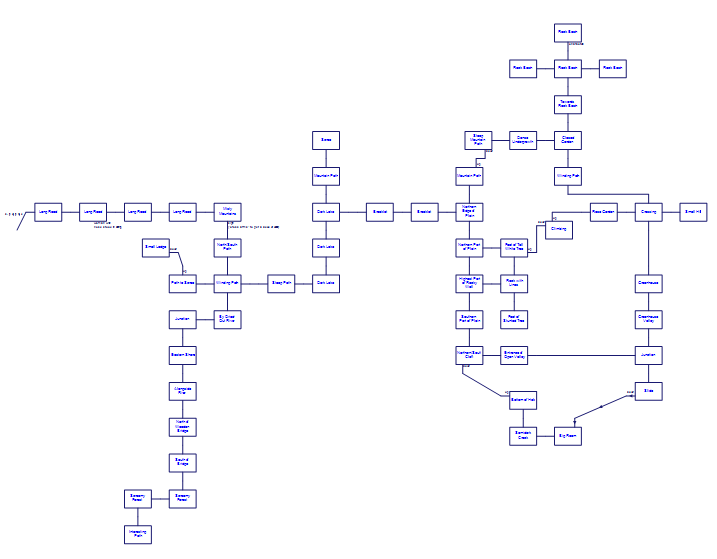
I have no idea the room names, but “Cave” is the default in Trizbort, and that seemed as good a name as any.
The map is of course so far incomplete, and I got stopped by a dragon (I couldn’t see the dragon in a description, but I still saw the result):
The dragon fums with rage and sends a cload of fire towards you.
You’re blown back into the big hall!
You are badly hurt as you hit the cold wall…
It did not even open its eyes, so it is evident that it has a very keen sense of smell.
It is impossible to pass the dragon now, so I propose you find a way of fooling its nose, that is, if you really want to pass.
Now, VikingMUD (which I’ve been playing on) does have torches, but you have to buy them … which means I need a real character, not a guest … which means I have to get some money … which means playing the “main” part of the game … which means I might (gasp) have to interact with other players. Eek!
Actually, it’s ok — I’ve played many MUDs in the past — but it does feel a little weird trying to document a single-player old text adventure embedded in a multi-player social game, so I was a bit thrown for a loop. It looks like I’ll need to slay at least a few monsters before I can go back into Moria.
According to the one and only source I’ve found, Ringen was originally written in Norwegian by an author going by “Hansen”, probably at the University of Tromsø. (ADD: This is not quite accurate — I now have updated posts as the original game has been found. You can jump up to the new posts in sequence here, or keep reading until reaching the 2025 posts for the full story.) It’s based on the area around Moria (shown above) in Tolkien’s Lord of the Rings books.
Late in the 1980s it was translated into English and ported to the online MUD Genesis by Pål-Kristian Engstad, and in 1991 Per Arne Engstad took the same area and added it to VikingMUD.
While I’m not generally writing about MUDs — although I did write about MUD1 a little — I made an exception here because the original source is lost. Genesis MUD has since done major modifications to its Tolkien area, but VikingMUD’s is roughly like it was in 1991, so I played that game (as a guest) and went through to the “Ringen” area (from the newbie room, go south, east four times, north four times, then east once).
So far all I’ve been able to do is explore above-ground.
Long Road. A fairly broad and flat road it is, and it seems to continue eastward for quite a while. Surrounding is the mighty Hollin forest, or Eregion, as elves liked to call it. It is not to be confused with the Great East Road further north, which leads to the hobbit Shire, since this one probably will lead to the Redhorn Pass, and not to Rivendell, where Elrond holds his house.
There are two obvious exits: east and west
>EAST
Long road. You are walking along a hard and flat path through the Hollin forest.
There is a big sign here saying something important. An old root of a tree.
There are two obvious exits: east and west
A wicked woman with her nose stuck in (he he) the tree-stump
The woman says: If you aid me, I’ll reward you, I promise!
The woman says: Please help me get free from the stump!
Other than the scenario above, which might be a puzzle (?) all I’ve seen so far is scenery, things to examine, and orcs that want to kill me.
You are on a path that winds along side a dried out river. This once was the mighty Sirannon-river, which came gushing and foaming from the Misty Mountains. The path goes up, steeply to the east, where it meets some steps in the rock. To the north the path gets wider. A small footpath leads west towards a scree. The dried out river continues somewhat south.
There are four obvious exits: east, north, south and west
Urk arrives searching for human flesh.
Urk screams uglily and starts bashing and slicing you!
You notice Urk approaching you with murder in its eyes.
The enemies are the “mobs” from the MUD system I’m playing on. They did kill me twice but otherwise I’ve been able to basically ignore them and get on with looking around the map. I’m considering them “outside the game” so to speak, assuming they aren’t really part of the original Ringen. Of course, the original game may have had some sort of enemies and combat system, but it would have been different than the MUD’s system, and without hearing from the author or translators it’s impossible to know details.
I did run into Bilbo Baggins …
Bilbo Baggins arrives.
Bilbo says: Think about it! The whole party was lost!
Bilbo says: Howdoyado that? Oh, see you later, ok?
Bilbo Baggins leaves east.
… although he seems to be just a “peaceful” wandering character; I wasn’t able to get any interaction out of him.
The literary-adaptation angle otherwise seems to be restricted to geography and map references.
You are wading across a green and slimy brooklet The stones are very slippery, so take care not to fall! The main path continues east and west.
There are two obvious exits: east and west
>EAST
This is the east side of a green brooklet. The path continues east between some gentle slopes.
There are two obvious exits: east and west
>EAST
This is the northern edge of the plain in front of the Misty Mountains. Paths from the west, north and south meet here, and to the east there is a long and narrow wall of rock. To the south however, a plain covered with soil, pebbles tussocks opens, and to the south-west extends the Sirannon Lake.
I’m not discounting the possibility there’s something else hidden though, because the sign near the old woman mentioned earlier has this:
This is the new area made by Sir Rogon. Please use ‘bug’ and ‘typo’if you find my English terrible.
It is rumoured that great treasures and terrible monsters dwell under the Misty Mountains, in dungeons called Mines of Moria. If you only could find the entrance!
The closest I could find to a possible entrance is the famous “friend” door.
You are standing under a polished vertical wall.
As the moon shines upon the grey face of the rock, faint lines appear, like slender veins of silver running in the stone. At first they are no more than pale gossamer-threads, so fine that they only twinkle fitfully where the moon catch them, but steadily they grow broader and clearer, until their design can be guessed!
There are three obvious exits: north, south and west
I haven’t found any command that works here. It’s possible Ringen is just meant to have some open exploration and that’s it, but I suspect there’s at least one thing hidden I haven’t unearthed yet.
So, last time I discovered EXAMINE ROOM was needed to find hidden objects in rooms. (It turns out this was mentioned in the instructions, sort of, as a suggested command.) I also discovered that part of the reason I had trouble referring to objects is they wanted to be referred to by adjective, so to pick up “CHARRED WOOD” I needed to type GET CHARRED rather than GET WOOD.
At this point it seemed like all I needed was to clean up: visit and EXAMINE ROOM at every place on the map, grab the things I needed, and leave. There was one slight wrinkle.
so I found a CEREMONIAL MASK in my first room and put it on.
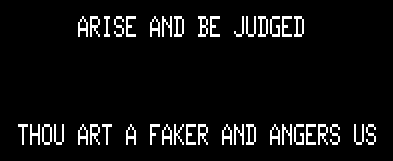
However, shortly thereafter I was surrounded by a blue light and fell asleep; then I had the message on the top of this post. The gods sent me to the shrinking-walls-of-death room.
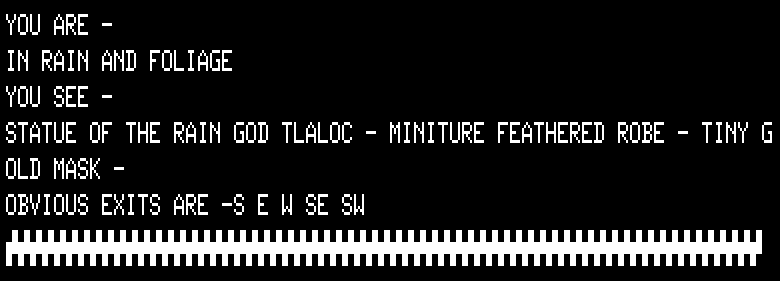
It took a bit of exploration to realize that there is more than one mask, and many of the masks are fake. To win, you need the “FEATHERED MASK OF GOLD” specifically; there are also fake crowns and robes.
The robe and mask here are both fake.
I was also foiled by the fact an EARTHQUAKE occasionally happens at random and kills the main character. Again, it states the gods are angry, but I have no idea if there’s any logic to this; one time the earthquake happened before I even entered the temple.
Finally, there’s also an odd trick regarding jaguars:
There are two rooms that have “3 jaguars”. One of the rooms (the one above) has an endless supply of jaguars, and if you try to EXAMINE ROOM to find anything secret the jaguars will kill you. In the other room with “3 jaguars”, the jaguars don’t attack at all; hence, EXAMINE ROOM works fine. I have no idea if this is supposed to be a pun and the jaguars are supposed to be statues or something?
CONGRADULATIONS to me, I guess. This game was interesting in theory that this was essentially an open-world game where you’re just supposed to collect things and avoid tricks and traps along the way, but the myriad problems just led to frustration.
To end on a positive note, I’ll have to admit the “fake treasure” conceit was really fascinating. It did give a unique feel to the final stage of the game.
…
I’m not sure what I’m playing next — Lugi is still going to have to wait, so I might try a different mainframe game, or some oddity from the Apple II or … well, if people have been anxiously awaiting anything in particular, feel free to suggest in the comments.
Playing Temple of the Sun by Jack Powers led me to wonder, philosophically, what I really mean when I judge the quality of an adventure game. How much is based on context and what I’m used to, and how much is truly bad in an intrinsic way; that is, some design choice that is a poor call no matter what alternate gaming universe I might be writing from?
Just as an experiment, I’m going to mark game design flaws with
(C) this is probably because I’m used to it from other text adventures but it still annoys me
(U) this is probably reviled even amongst the aliens of Universe #5612 who type by vibrating their squid-tentacles
(?) I have no idea if this is really universally bad or not but it still made me feel unpleasant at the time
As my intro might have hinted, I’m going to tear into this one, but first, let me be positive on the introduction setup. Our previous encounters with ancient ruins (see: King Tut’s Tomb, Pyramid of Doom) had us raiding treasures without a care or even a “it belongs in a museum!” line. To be fair, this is just the games being flatly equivalent to all the other treasure collect-a-thons of the time.
Temple of the Sun has a slightly different conceit:
Our goal is to enter an ancient temple and do the rituals needed to become a shaman. The implications are: the main character is doing something as part of a culture, not as a money grab. The end result is still picking up treasures, but at least the motivation is slightly different. The SCORE command straight-out lists what you already have and what you still need to beat the game:
I initially thought this meant the parser experience would be nice. I was very, very, wrong.
Here’s the opening screen. The “Dark Entrance” can’t be referred to or entered. It’s just “scenery” but is supposed to represent the south exit. (?)
I had a bit of confusion thinking the starting place had two exits.
Incidentally, just S or SOUTH doesn’t work, you have to type GO SOUTH. (C)
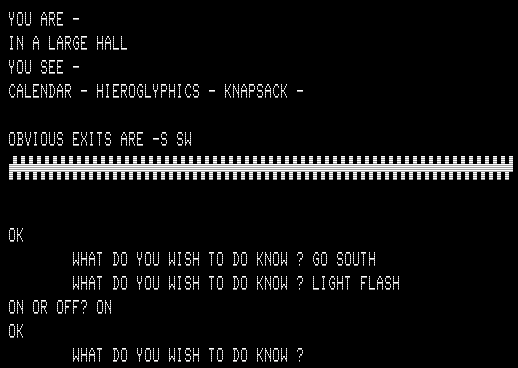
The next place has a “calendar”, “hieroglyphics” and “knapsack”. Both READ CALENDAR and READ HIEROGLYPHICS have the same response, and I spent a fair amount of time re-confirming there was no way to get a different message by referring to either in a different way. (?) I suppose it could be implying a calendar was in the form of hieroglyphics, but I still get the uncomfortable impression this is just a bug in one of the first rooms of the game. The message you get
IT SHOWS A SHAMAN SKINNING A DEER TO MAKE A POUCH AND APRON.
is kind of nice; there are other hieroglyphs throughout the game that indicate what you’re supposed to be finding. This is only undercut by the fact one of the basic commands of the game already states exactly what items you need to get. (?)
Also, TAKE KNAPSACK doesn’t work. (U)
SORRY BUT YOU CANNOT TAKE KNAPSACK
Oops! Checking the verb list at LIST, the word is GET …
YOU CAN ONLY WEAR IT.
… huh? The object is modeled in a way that wearing the knapsack is the same thing as picking it up, and you can’t be carrying the knapsack. (?) I also could not find a way to open it or look inside. (U)
Moving on to the southwest, I find a room with shrinking walls and die. Oops.
I’ll see this room a lot. There’s a turn (or two?) before you die suggesting there’s a way out, but if you use the command PRAY (which seems to be the games “hint” command) the game just suggests quitting and trying over. (?)
Restart! Back to the knapsack room, then south:
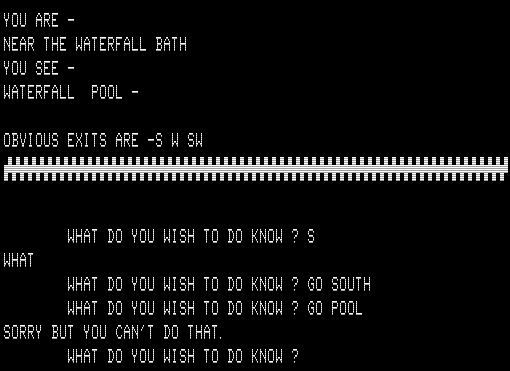
>GO POOL
SORRY BUT YOU CAN’T DO THAT.
Oh, SWIM is a verb off the list, ok. (C)
>SWIM POOL
YOU SEE A LARGE TUNNEL
The room description didn’t change other than OBVIOUS EXITS are now just “UP”. This felt uncomfortable and I was confused for a while if I was still in the same room somehow. (C)
>SWIM TUNNEL
YOU HAVE JUST ENTERED THE MOUTH OF A LARGE TURTLE. YOU NEEDED MORE SALT, BUT YUMMY.
Yay, death traps! Let’s accelerate things a little with a map:
Note how in the upper left corner there’s a bunch of one-way arrows leading to one room. This is the shrinking walls room which always killed my character, and once I realized the layout was a grid (mostly) I was able to predict what was going to happen, but I still had to test to be sure.
The “mostly grid” part led to far more annoyance than the map needed to; there are a fair number of “one-way” places where you have to detour to get back to where you start rather than just going there in a single step. I’ve seen plenty of crazy map connections in my day, but the fact this was almost a perfect grid made the whole setup more grating than usual. (?)
I have no idea how to get the game to recognize any input regarding the steel box either.
There were lots of items that seemed like you should be able to take them or manipulate them, but the game just either flat out refused to recognize the input or responded with SORRY YOU CAN’T DO THAT … YET without any good reason at all the action might be prohibited. (?) In some cases, I suspect this response applied to some actions that were never intended to happen in the future. (U)
Near the end of my play session, I had no idea how to get most of the items (like the mask) mentioned from the SCORE command. Out of curiosity I checked the start of Gaming After 40’s writeup and found (in the non-spoiler section) something which made the game completely different.
Most critical objects are randomly hidden in the game world — the player must EXAMINE ROOM in every location to unearth these items. I had to dig into the code to figure out why so many necessary items didn’t seem to be available.
Erf, argh! This would have been helpful to include in the instructions, perhaps? (EDIT: I read carefully through the start game instructions and it does get included as an example suggested command.) I tried EXAMINE ROOM immediately after this and found two of the important items in the room my character was in. Then I was annoyed enough I decided to call it for a day.
Hopefully I’ll finish this off next time; otherwise, I’ll be making the squid aliens take over on this one.
As predicted I was quite near the end, but I had to do the extreme measure of opening the data file with a text editor to get there. It was worth it for the ending (which, I’ll be honest, is not something I’d ever expect to say for a Greg Hassett game, but here we are).
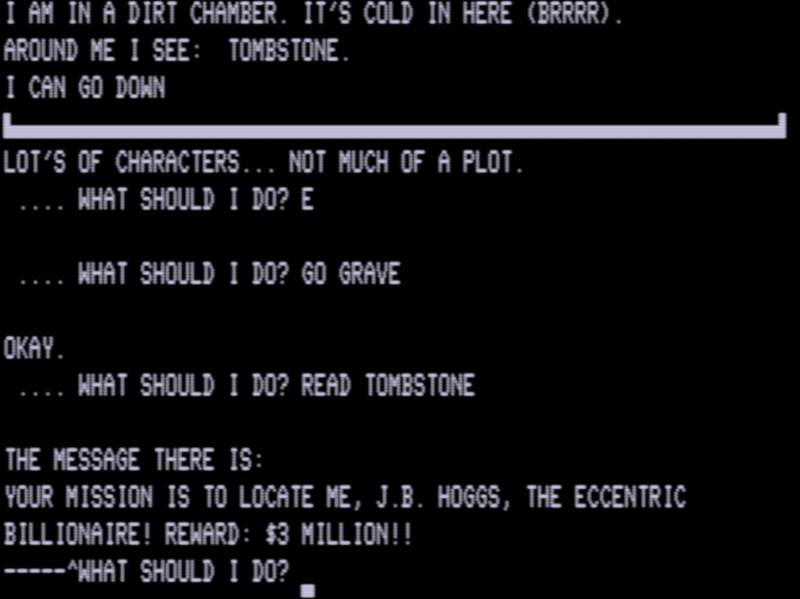
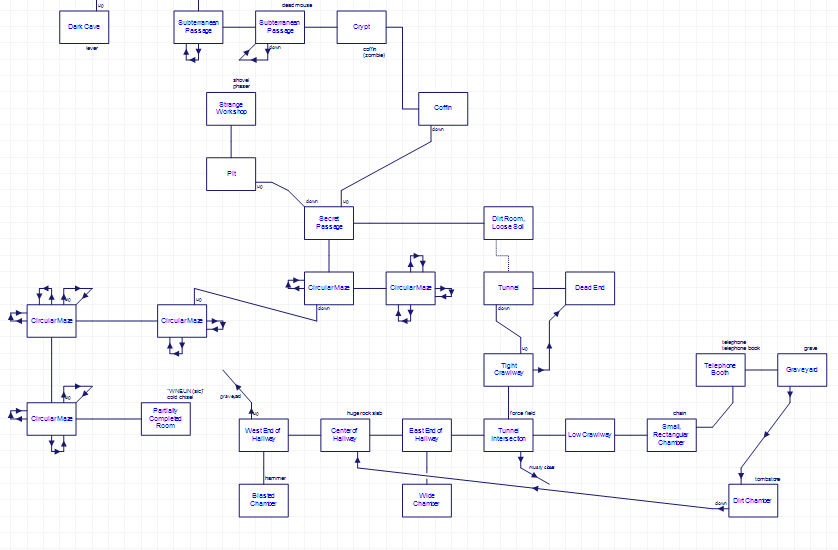
After the shenanigans in my last post, which included bringing down a force field with a phaser and chiseling a dime out of rock, I made it to a graveyard where I found out the objective of the game:
Nearby was a phone booth with a phone book. (Conveniently, the faux-dime made out of rock worked on it.) I suspected that the goal above would be reached via dialing the right number, but no permutation of >READ BOOK yielded a number; it wasn’t possible to look up the name HOGGS or the like.
Fairly soon I was out of obstacles, except for a large rock which didn’t have any writing and didn’t yield to any of the adventurer commands of TWIST / TURN / PULL / etc. After fruitless wandering back and forth I decided to open the file in a text editor and hope for the best.
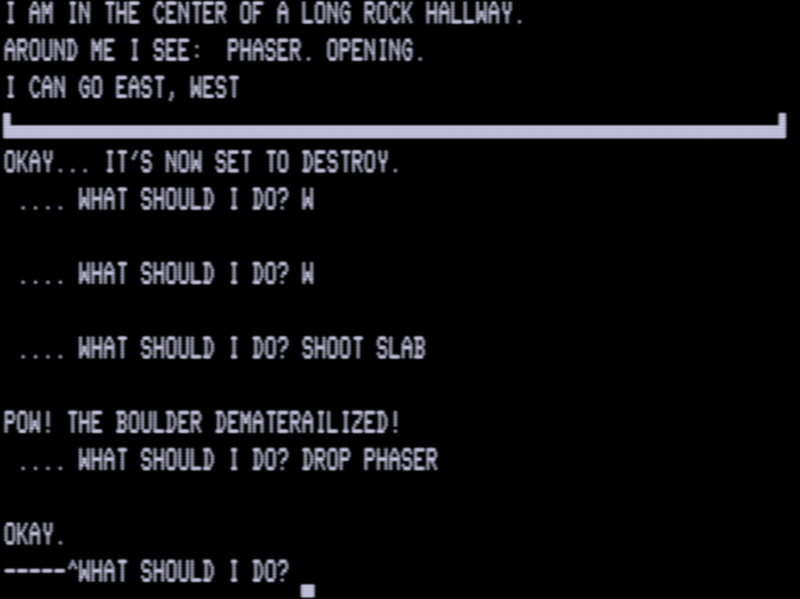
I had overlooked my Star Trek references: if a phaser is in a game, *always* check it for multiple settings. Specifically, >LOOK PHASER revealed it had settings for REVERSE (the default) and DESTROY. I changed the setting to DESTROY and went back to the large rock:
This opened up a new passage into some secret archives.
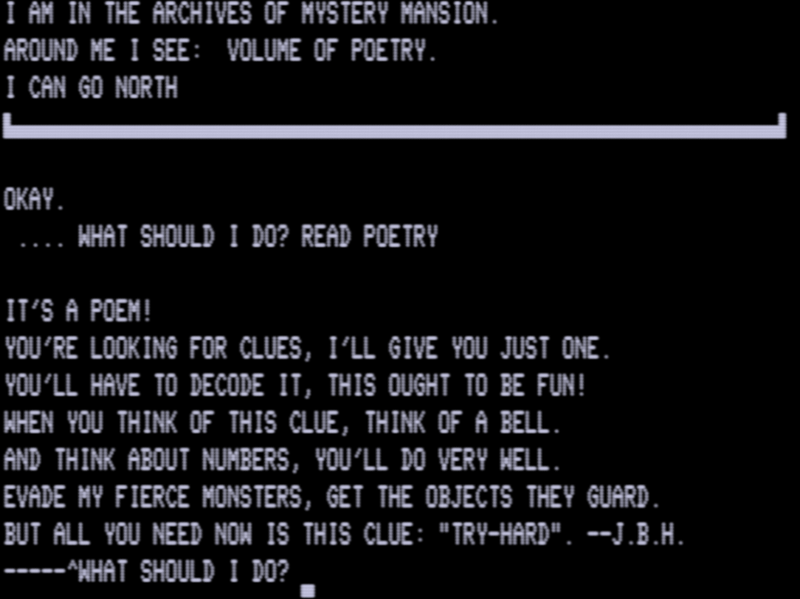
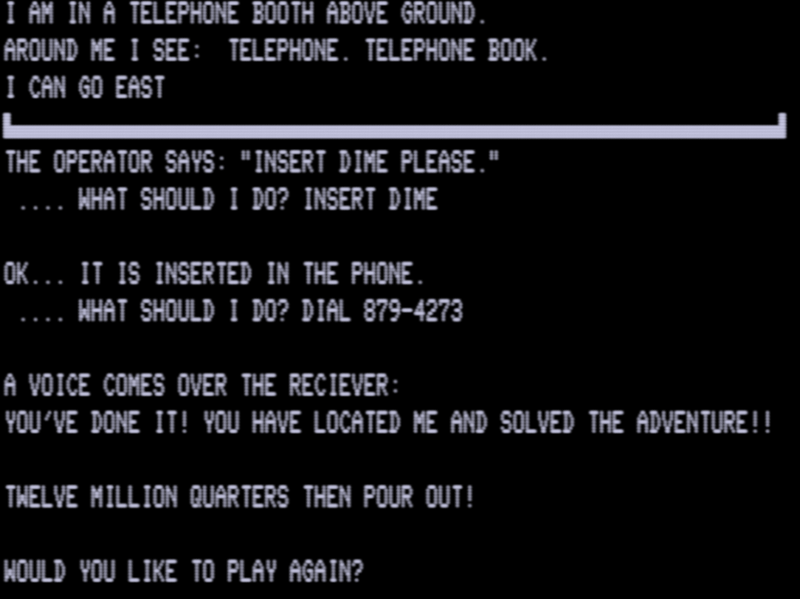
Fortunately, letters on keypads haven’t gone out of date yet, so I was able to convert the clue into a number, and the glorious ending.
Just for reference, a quarter is about 5.67 grams, so 12 million of them would weight 68 metric tons or just a bit lighter than a large dinosaur. It’s going to be fun toting away the haul! (This is assuming the main character even survived the deluge.)
Most games from this era had perfunctory endings. I suppose this one did as well — just three sentences! — but the Monkey’s Paw style twist was enough for me to be happy. (I liked Zork’s ending as well as Local Call for Death’s, but I can’t think of any others from 1980 or before that were memorable.)
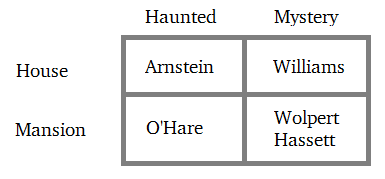
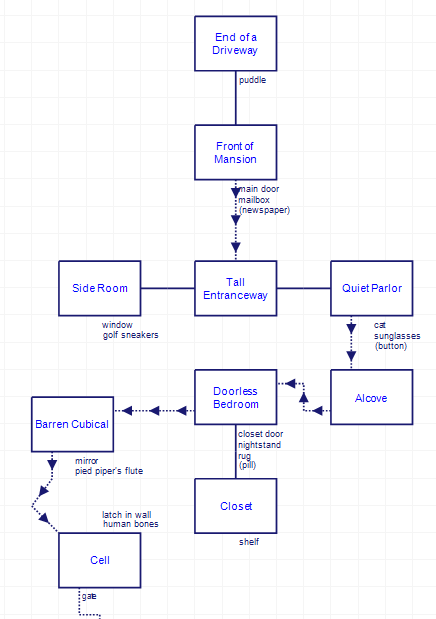
Here’s a handy guide for keeping track of spooky domicile text adventures.
(Before I get started with the game itself, I’d like to thank Brian Decker for letting me know he found Greg Hassett had released his games into the public domain, leading Ira Goldklang to upload the entire set to the internet. Mystery Mansion wasn’t available anywhere until last year when this happened.)
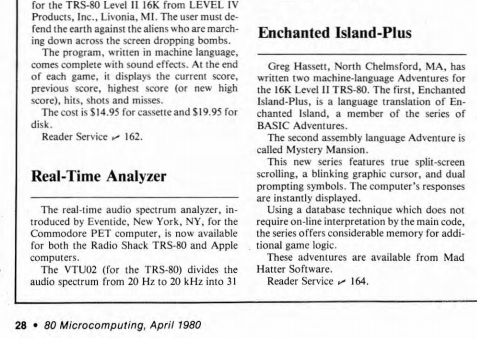
This was Mr. Hassett’s first game done originally in machine language. He ported his prior game Enchanted Island to machine code and called it Enchanted Island Plus, but it was still essentially the same game; Mystery Mansion was designed from scratch in machine language.
Ad from Micro 80 magazine.
The premise is simply that “you have been called by a strange dream to a huge mansion. What you are doing here is part of the mystery.” There’s no treasures to collect, but not a lot of direction, either. I didn’t feel like the game was as aimless as Battlestar, because there’s enough tightness to the geography that it was always clear where the next obstacle was.
It does come across as a better game than his previous ones, by a multiplier. It’s nice in a “scientific” sense because he doesn’t change that much of his style; since Mr. Hassett essentially changed only one variable it’s more obvious what led to the improvement. The puzzles are still quite simple (you have poison, cheese, and an evil rat: what do you do?) His main innovation was to be more careful with the structure.
The game starts in a linear way: passing through a door or secret passage causes it to close, so you’re moving from small area to small area. There’s one point where you can leave something behind. It was genuinely interesting (and not, as I would expect, irritating) to solve this puzzle, in that I had to think of not just the tools I had, but a tool I could have had access to in the past had I approached a certain situation differently. This violates the essential rule in adventure game design that you can’t block progress by a prior action, but this is a special scenario in that a.) it happens near the start and b.) it takes about 60 seconds to get back to the puzzle in question. (This kind of design can still be very, very painful.)
After the linear section, the map opens up to a slightly larger but still blocked section. The left section opens up via a lever, and solving a puzzle there allows passing a zombie, opening up the third and largest section.
The overall effect is a sort of overlapping going on where solving puzzles leads to doubling back over the game’s geography in new ways. Even with very basic room descriptions …
… the structure gave enough of an “adventurer feel” that playing the game felt like exploring an environment, rather than filling in a bunch of map boxes.
I did finally discover why my character was summoned to the Mansion, but I’m stuck on what might be the last puzzle, so I’ll save talking about that for my next (hopefully last) post.
My last update promised I would get to the mainframe game Lugi soon, but in the process of trying to set it up I made a new discovery regarding Warp.
Brief reminder: Warp is a gigantic mainframe game with 1216 points possible on the HP3000. It has an unusual parser that allowed “conditional” statements and macros. The only way I had of playing it was via a telnet server, so I was paranoid it would eventually disappear forever.
In May of last year, a genuine expert at the HP3000 (Big Dan the Blogging Man) made a “packaged” version of the HP3000. If you’ve tried the Digital Antiquarian’s TOPS-10 in a Box, this is similar: you just download and run.
which is the games account, and then you can RUN WARP to play Warp offline! Bill Wolpert’s Mystery Mansion from 1978 is on there too (RUN MANSION) so you can emulate it running on the original hardware rather than using a port.
To quit, press CTRL-A to enter console mode, then type SHUTDOWN.
I never saw a “*** You have won ***” message, but I managed to kill Darth Vader, so I think I can call this one done.
Okay, maybe you need more backstory, but note I’m still as confused as you are.
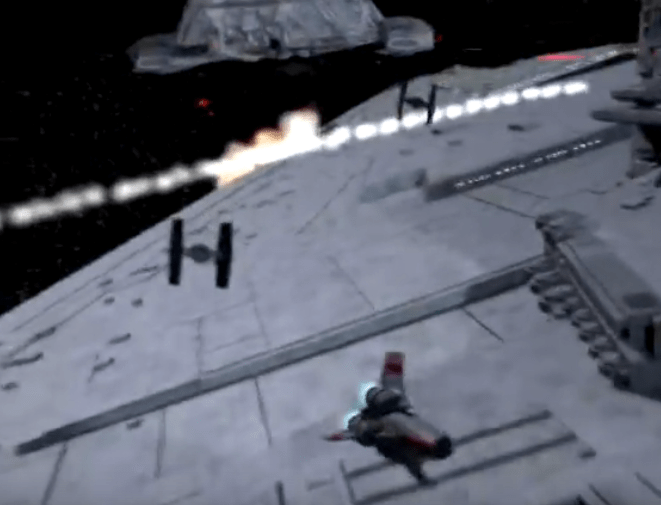
To commemerate the moment, here’s a fan video where TIE Fighters and Vipers do battle. Sadly, I could not find a crossover video that also tossed Fantasy Island into the mix.
My first breakthrough came from a game of guess-the-noun.
You are at the clubhouse.
The clubhouse is built over the most inland part of the lagoon. Tropical bananas and fragrant frangipani grow along the grassy shore. Walking across the short wooden bridge, we enter. Along one wall is a bar with only a few people seated at it. The restaurant and dance floor are closed off with a 2 inch nylon rope.
There are some matches here.
An old-timer with one eye missing and no money for a drink sits at the bar.
I happened to have some coins so I tried >GIVE COINS or >GIVE COINS TO OLD-TIMER or >GIVE COINS TO MAN or a bunch of different permutations. Fortunately, the right action is strongly hinted in the text, but I still had to look at the source code to find the answer.
>give coins to timer
coins:
Given.
He fingers the coins for a moment and then looks up agape. `Kind you are and I mean to repay you as best I can.’ Grabbing a pencil and cocktail napkin…
‘This map shows a secret entrance to the catacombs. You will know when you arrive because I left an old pair of shoes there.’
I managed to find the right place, procure a lantern to explore darkness, and after some crawling and a ladder I came across:
Out from the shadows a figure leaps! His black cape swirls around, and he holds a laser sword at your chest. ‘So, you have come to fulfill the Quest.
Ha! Your weapons are no match for me!’
You look tired! I hope you’re able to fight.
>shoot man
With his bare hand he deflects the laser blast and whips the pistol from you!
He attacks…
I’m afraid you have suffered some minor abrasions.
I admit I was distracted at first by the notion I was supposed to fulfill a “Quest” I hadn’t heard anything about. I only realized after a couple failed combat attempts that I was dealing with this guy:
I got very stuck here — the laser quite easily blasted any other enemy I had come across but didn’t work on Vader — so I kept exploring both the game and the source code. I found out I could >USE AMULET:
The amulet begins to glow.
A light mist falls over your eyes and the sound of purling water trickles in your ears. When the mist lifts you are standing beside a cool stream.
You are on the bank of a stream.
The stream falls over several small boulders here and continues on left.
(Incidentally, you can do this from the very start of the game, while you’re on the Battlestar, and skip flying the Viper entirely!)
Continuing:
You are at the thermal pools.
Several steaming fumaroles and spluttering geysers drenched by icy mountain waters from a nearby waterfall heat half a dozen natural pools to a delicious 42 degrees. Enchantingly beautiful singing seems to flow from the water itself as it tumbles down the falls. There is a mossy entrance to a cave ahead.
A flower-like young goddess is bathing in the hot mineral pools. She is watching you, but continues to steep and sing softly.
Because this is also Fantasy Island, giving a diamond ring and kissing is sufficient to make a plot dump happen:
She cuddles up to you, and her mouth starts to work:
‘That was my sister’s amulet. The lovely goddess, Purl, was she. The Empire captured her just after the Darkness came. My other sister, Vert, was killed by the Dark Lord himself. He took her amulet and warped its power. Your quest was foretold by my father before he died, but to get the Dark Lord’s amulet you must use cunning and skill. I will leave you my amulet. which you may use as you wish. As for me, I am the last goddess of the waters. My father was the Island King, and the rule is rightfully mine.’
She pulls the throne out into a large bed.
You get a medallion after this scene to go with your amulet. The game still never quite says “This is your Quest!” but that might be intentional — I don’t find any “final message” for winning the game whilst diving through source code, so it’s possible things are supposed to be a little freeform and you can ignore all this lore if you want.
A bit after this scene I was hanging out with Mr. Roarke and Tattoo when this happened:
You are at the sea plane dock.
Native girls with skin of gold, clad only in fragrant leis and lavalavas, line the dockside to greet you. A couple of ukulele-plucking islanders and a keyboard player are adding appropriate music. A road crosses the clearing ahead. There are some tables set up right.
An unctuous man in a white suit and a dwarf are standing here.
A swarthy woman with stern features pulls you aside from the crowd,
‘I must talk to you — but not here. Meet me at midnight in the gardens.’
It seems to just be an event that triggers some time after the goddess scene and doesn’t happen anywhere in particular.
Later in the gardens:
The swarthy woman has been awaiting you anxiousy. ‘I must warn you that the Island has anticipated your Quest. You will not be welcomed. The Darkness is strong where you must search. Seek not the shadows save only at night, for then are they the weakest. In the mountains far from here a canyon winds with ferns and streams and forgotten vines. There you must go. Take this rope.’
(I never found a use for the rope, but I didn’t find the canyon either.)
In any case, I set to work trying to kill the Dark Lord/Vader, which after many failures involved the secret Jedi technique of “studying the source code”. I found that most of the weapons in the game (there’s a chain, a knife, a halberd, and a mallet) do very little damage, a rusty broadsword does a reasonable amount of damage, and a two-handed sword does the most damage.
I first tried to bring the two-handed sword to Vader, but it’s so heavy I needed to drop every single item not being worn. Unfortunately, this includes the laser blaster, and any attacks by elves on the way were deadly without the blaster. (It also included the lantern needed to see, but this wasn’t as much a problem since I knew what route to take when underground.)
Rusty broadsword vs. laser sword it was. I also dropped everything else I was carrying right before the battle because it looked like from the source code that the amount being carried factored into the combat result. Voila:
>kill man
His ribs crack under your powerful swing, flooding his lungs with blood.
He attacks…
You emerge unscathed.
>kill man
You swung wide and missed.
He attacks…
I’m afraid you have suffered a minor puncture wound.
>kill man
A bloody gash opens up on his right side.
He attacks…
You emerge unscathed.
>kill man
The steel bites home and scrapes along his ribs.
He attacks…
You emerge unscathed.
>kill man
With a mighty lunge the steel slides in, and gasping, he falls to the ground.
You have killed the Dark Lord.
A watery black smoke consumes his body and then vanishes with a peal of thunder!
It’s too dark to see anything in here!
I returned to the goddess but had no reaction. The source code indicates a “talisman” the Dark Lord had but I didn’t see one. (It also indicates a scene where the Dark Lord runs to another place and you have to give chase, so it’s possible some spots are just broken.) If you wear the amulet, medallion, and talisman all at once the game claims you are now a “wizard” and I suppose something fun might come out of that, but I’m satisfied with the result I have.
Incidentally, the “score” of the game tracks PLEASURE, POWER, and EGO as three separate scores. Shooting stuff raises power; romancing goddesses raises pleasure, and … I’m not sure on ego, but giving the coins to the old-timer boosted that one.
…
I can charitably say this was ambitious. Unfortunately, the same ambitions led to issues. It’s like all of them were half-way to a good thing.
By dropping puzzles, the game had a startlingly modern flavor, but there was a major lack of things to do. There was no examine command or way to manipulate any of the scenery; there was no way to have conversations with any of the characters, and in the few cases a verb was required picking the right one was often a struggle. On top of that, it didn’t really drop all puzzles, so the few that remained — like realizing what weapon would be good in a fight against Vader, or figuring out the right parser command to hand over some coins — were rather bad.
The fairly loose approach to the plot was admirable in a let-the-player-do-what-they-want sense but it led to major out-of-order confusion, and I’m still really not sure what to think of the main character (I guess he stopped caring about the Battlestar being in crisis).
I’m glad to see experiments like this, but I’m also glad to leave them behind for something more traditional. I’ll probably be hitting another TRS-80 game or two before getting back to a mainframe game, specifically the thought-to-be-lost-forever-recently-found game Lugi.












 Renga in Blue