Since last time I’ve walked around an island very confused, not just because of the still-horrendous mapping, but because of being entirely unclear what the game has turned into. There’s a reference to “Huggies” which suggests modern Earth …
You are in a secret nook beside the road.
Hidden from all but the most stalwart snoopers are some old clothes, empty beer cans and a trash baggie full of used Huggies and ordure. Lets get back to the road behind you.
… random battles …
There is a fierce woodsman here brandishing a heavy mallet.
>shoot woodsman
The Woodsman took a direct hit!
You have killed the Woodsman.
The road crosses the lagoon here.
Strange mists rising from the water engulf a rickety old enclosed bridge here. Spider webs catch our hair as we pass through its rotting timbers. I felt something drop on my neck. The road delves into the accursed forest ahead and behind you.
A dead woodsman has fallen here. He was savagely murdered.
A heavy wooden mallet lies nearby.
… a modern house …
This is the front lawn.
There is a small fountain here where the driveway meets the lawn. Across the driveway, right, is an ornate white house with and elegant woodworking. The bargeboards are carved with fylfots, the ancient symbols of luck. Even a bell tower has been built here. There is a road behind you which turns into the driveway.
… and finally, a place that led to an astonished/horrified revelation.
The natives are having a festive luau here. Beautiful dancers gyrate in the torchlight to the rhythm of wooden drums. A suckling pig is sizzling in a bed of coals and ti leaves are spread with poi and tropical fruits. Several natives have come over to you and want you to join in the festivities. There is a light burning in a bungalow left.
A kerosene lantern is burning luridly here.
An unctuous man in a white suit and a dwarf are standing here.
There are some ripe papayas here.
There is a ripe pineapple here.
There are some kiwi fruit here.
There is a ripe mango here.
A native girl is sitting here.
The “unctuous man in a white suit and a dwarf” in particular was the clue.
This is a Battlestar Galactica / Fantasy Island crossover game.
The basic premise of the TV show: guests can travel to the island to live out any fantasy they want (although the ramifications can be along the lines of “be careful what you wish for”). A sampling of the plot lines from the show:
The Boxer: A boxer named Billy Blake (Ben Murphy) wants to win a match despite the fact that it would kill him.
Ghostbreaker: A librarian named Elliot Fielding (Ken Berry) can’t get his ghost-busting guide published. To prove his skill, he lives out his fantasy where he must exorcize a real ghost.
The Over the Hill Caper: A blackmail victim named Spencer Randolph (Ray Bolger) and his aging buddies reunite their gang to defeat their blackmailer.
Aphrodite: Professor Alan Briar (George Maharis) is a picky man who wants the perfect woman. He ends up meeting Aphrodite: Goddess of Love (Britt Ekland).
I have still no idea what the goal might be, or even if this game has an ending. I’m going to call it and say — finished or not — next time will be my last post.
In previous text adventures I’ve played involving a compass, taking the compass “activated the interface” so to speak and let you use north/south/east/west as directions. Battlestar decided otherwise:
You are in the old garage.
This is an old wooden building of the same vintage as the stables. Beneath a sagging roof stand gardening tools and greasy rags. Parked in the center is an underpowered Plymouth Volare’ with a red and white striped golf cart roof.
There is a length of heavy chain here.
There is a compass here.
The keys are in the ignition.
>-: get compass
compass:
Taken.
>-: use compass
Your compass points right.
You still have to go ahead/back/left/right, now you just get to USE COMPASS in every room and try to decipher what the compass directions might be. The room descriptions are unchanged.
The road leads to several large buildings here.
There is a clubhouse left, a large barn and stable ahead, and a garage of similar construct to the barn behind you.
This strikes me as the author sticking with a noble pursuit in versimilitude, without considering the fact that the whole process of navigating with relative directions has been a sort of anti-realism, jarring at every step. (I can’t exactly be upset, though — this was so early in adventure game history it was hard to say what the result of such an experiment would be.)
As a more general point, though: having to communicate with the computer via some sort of interface always adds a level of unrealism. The player isn’t literally “in the story” — in this case they’re reading a constructed set of prose, drawing a map (maybe), and typing a response — which is why an attempt at adding verisimilitude can in practice reduce it, especially if the player “loop” goes haywire.
In the days before the darkness came, when battlestars ruled the heavens…
Three He made and gave them to His daughters,
Beautiful nymphs, the goddesses of the waters.
One to bring good luck and simple feats of wonder,
Two to wash the lands and churn the waves asunder,
Three to rule the world and purge the skies with thunder.
In those times great wizards were known and their powers were beyond belief. They could take any object from thin air, and, uttering the word ‘su’ could disappear.
In those times men were known for their lust for gold and desire to wear fine weapons. Swords and coats of mail were fashioned that could withstand a laser blast.
But when the darkness fell, the rightful reigns were toppled. Swords and helms and heads of state went rolling across the grass. The entire fleet of battlestars was reduced to a single ship.
Well, we’ve seen a Star Wars game, we’re definitely going to see some Star Trek games, but what about fan games for other franchises, like, say, the 1978 TV show Battlestar Galactica?
From the Internet Movie Database. (The pilot for the TV show was given a theatrical release.)
As the long timeframe of creation implies, this is another mainframe game. The manual page claims it was written “in 1979” so I’m guessing the bulk of the writing happened earlier rather than later. I was also somewhat excited to get to this one, because of this comment (also from the manual):
… it’s slightly less of a puzzle and more a game of exploration. There are a few magical words in the game, but on the whole, simple English should suffice to make one’s desires understandable to the parser.
I was thinking maybe this would be a proto-version of a late-era Telltale game, dispensing with the idea of “puzzles” and reducing things to exploration and action. That’s sort of accurate.
I. The Plot
You awaken amidst chaos.
This is a luxurious stateroom.
The floor is carpeted with a soft animal fur and the great wooden furniture is inlaid with strips of platinum and gold. Electronic equipment built into the walls and ceiling is flashing wildly. The floor shudders and the sounds of dull explosions rumble though the room. From a window in\ the wall ahead comes a view of darkest space. There is a small adjoining room behind you, and a doorway right.
The first phase of the game has you wandering the Battlestar and finding a lot of dead people. Example:
This is the maid’s utility room.
What a gruesome sight! The maid has been brutally drowned in a bucket of Pine Sol and repeatedly stabbed in the back with a knife.
The hallway is behind you.
There is a knife here
The maid’s body is lying here. She was murdered!
Or:
This was the seen of a mass suicide. Hundreds of ambassadors and assorted dignitaries sit slumped over their breakfast cereal. I suppose the news of the cylon attack killed them. There is a strange chill in this room. I would not linger here. The kitchen is right. Entrances ahead and behind you.
And yes, it’s a little excessive. The bizarre thing is
a.) it’s unknown why you survived, given nearly everyone else around you is dead
b.) there are lots of explosions and bodies and stabbings and so forth, but no enemies.
I can chalk up (a.) to dumb luck, but (b.) really started to bother me — I’m still unclear about what was going on. The “cylons” mentioned in the second excerpt are the robot antagonists of the TV series but they are mentioned nowhere else in the game (I searched the source code to confirm this). There are enough knifings elsewhere it doesn’t seem like the main catastrophe is a robot attack. Also, would the “hundreds” of people in charge really decide spiking their breakfast cereal is better than, well, taking charge? Everyone still alive is for the most part mutely running around in panic, except for someone guarding a thermonuclear weapon (which you can activate by shooting it and killing everyone, but otherwise seems to serve no purpose).
All this time, we’re still in our pajamas, or possibly pajamas and a robe.
> i
You are holding:
amulet
coins
= 2 kilograms. (3%)
You are wearing:
pajamas
robe
You are in perfect health.
In the end, there’s not much to do on the Battlestar. You can pick up some items, including the aforementioned amulet
The amulet is warm to the touch, and its beauty catches your breath. A mist falls over your eyes, but then it is gone. Sounds seem clearer and sharper but far away as if in a dream. The sound of purling water reaches you from afar. The mist falls again, and your heart leaps in horror. The gold freezes your hands and fathomless darkness engulfs your soul.
but you can’t talk with anyone or learn anything really. I suppose the intent is to soak in the atmosphere. The only thing to do is to get to a Viper ship and fly off.
Then things get really weird, but first I need to mention …
II. Relative movement
… the most painful aspect of the game. None of what happened above came out remotely smoothly, because the game eschews compass directions.
The compass directions N, S, E, and W can be used if you have a compass. If you don’t have a compass, you’ll have to say R, L, A, or B, which stand for Right, Left, Ahead, and Back. Directions printed in room descriptions are always printed in R, L, A, and B relative directions.
We’ve had movement with relative directions back in 1978 with Mystery Mansion, but it took a mercifully short time to find the compass and have everything switch to compass directions. Here, I have yet to find a compass and I’m a good chunk into the game. Not only does the direction of ahead/back/left/right change as you walk around, it changes sometimes when you just do an action, like picking up an item. You have to watch the room description like a hawk as it changes, from, say
A door is behind you.
to
A door is left.
I stopped trying to “map” in the full sense but just filled my page with a set of room interconnections. I can’t tell you exactly how many times I accidentally went back and forth between rooms when I was intended to go somewhere else, but I’m fairly confident (without exaggeration) it’s nearing the triple digits.
If you accidentally go in a direction that doesn’t exist, you still turn in that direction and cause all the other directions to change (I didn’t understand this until after I was done with the ship). So you might type >LEFT and be told you can’t go that way, and type >LEFT again immediately after and enter a door.
III. The Plot, Continued
So you jump in a Viper and take off — I’m not sure if the frame story is supposed to be you are running away, or being brave and getting help, or what.
You are in space.
You get no directions in space, so you have to wander more with the R/L/A/B system and get lucky. And you really do have to get lucky, because one of the things you can find is a “small blue planet”, where trying to land is disastrous.
You are flying through a dense fog.
A cold grey sea of mist is swirling around the windshield and water droplets are spewing from the wingtips. Ominous shadows loom in the darkness and it feels as if a trap is closing around us. I have lost all sense of direction.
All directions from here are just “You are flying through a dense fog.” The only recourse is to quit the game.
Another possible find when flying around space: a mini-game.
It’s the glory of ASCII combat. You can maneuver your targeting with U/D/L/R and it moves sluggishly, kind of like a game of Lunar Lander; the goal is to hit F (fire torpedos) when the enemy ship is in the center of the screen.
After a couple tries I lucked out and found the real destination:
You are orbiting a tropical planet.
It’s just another planet, only this one isn’t a trap; you can go down and land.
Feather palms outlined by mellow moonlight and a silvery black ocean line the perimeter of the island. Mighty mountains of emerald and amethyst rise like jagged teeth from black gums.
Then there’s a lot of forest and jungle to wander through. If you take a long time night can fall, and you can fall asleep from exhaustion.
You drop from exhaustion…
………………………………………………………………….
You are awakened abruptly by the sound of someone nearby.
A fiendish little Elf is stealing your treasures!
-: shoot elf
The Elf took a direct hit!
You have killed the Elf.
A watery black smoke consumes his body and then vanishes with a peal of thunder!
You are flying through a dense fog.
There is a knife here.
Yes, an Elf. Somehow we’ve wandered into Adventure.
I think making progress now is just a matter of making my way inland on the island. The relative directions confuse me so much it’ll likely be by luck and then maybe … something will happen? It’s disconcerting not knowing if I’m playing a hero or a villain.
From the July/August 1980 issue of Recreational Computing Magazine.
This is another type-in game, but one with a more general ambition:
The Nellan is Thirsty version of The Enchanted House computerized fantasy simulation (CFS) is intended for children to play.
Specifically, the article and game by Dr. Furman H. Smith are meant to outline a more general “fantasy simulation” system that other games can be written for. (The author wrote Deliver the Cake in the same system a year later, and a planned third installment entitled Deposit the Chair never came out because the magazine was discontinued.) The very same issue of Recreational Computing included a long essay by Eamon author Donald Brown (Eamon being much more successful than The Enchanted House was) and a theory article by Dennis Allison about incorporating speech input and smell-o-vision into games. The magazine had Big Ambition going.
In any case, this is the first explicitly-for-children adventure game I’ve encountered chronologically. I played the C64 version from 1982 which was more easily available than the original.
Let’s pretend that you are in an enchanted house. You should use one or two words to tell me what you want to do. I’ll suggest messages at first.
If you have a question while you’re inside the house, type HELP.
Are you the only person playing?
Please type yes or no
If you state “no” the game asks you to give the names of everyone playing. I stated I was “Zog”, and then:
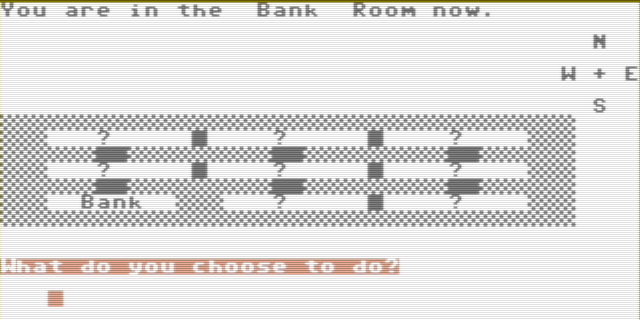
You are in a room called the Bank.
A giant carpet on the floor says:
Welcome Zog.
A screen says that your visit will last for 72 scoots. 2 scoots have passed. To leave this room, type GO NORTH.
The BANKER, Mr. Klinkoyn, looks happy.
There is a magic MAP here. If you TAKE the MAP, you may CONSULT the MAP.
What now, Zog?
Notice the explicit tutorial instructions in the game world. While this is typical for modern games it’s never been very common with text adventures. Recently Hadean Lands has an explicit step-by-step tutorial to start the game as does Counterfeit Monkey but it’s only shown up in the recent “high production value” games.
After TAKE MAP and CONSULT MAP:
Heading NORTH:
Now you are in the White Room — the walls are white. There is a wall to the west. You know that the Bank is through the south doorway. There’s a door to the north and a doorway to the east.
A white RABBIT is here. She hops to you and says. << I am Chula. Welcome to the Enchanted House, my friend, Zog. >> She hugs you and says: << I have a present for you in the Gold Room. If you say TAKE RABBIT, then you can carry me to the EAST. >>
The game continues a very friendly/helpful atmosphere all the way through, and you can both use a general >HELP command or >CONSULT (name of character) to get assistance.
Oh, it’s hot in here! You are in the Hot Room and if cold MILK were in this room, it would be warmed.
The MAP shows the doorways.
On the floor is a COUPON. It says on the COUPON that if it is DROPped in the Store while the machine is working, you will receive one blue bowl.
>SOUTH
You are in the room where Nellan lives; this room is called the Cat Room.
Nellan the CAT is here. She nearly fills up the room because she’s as big as an elephant (really!!). In a soft polite voice she says: << I’d love to have some nice cold MILK. Many of my friends have tried to deliver cold MILK here and many have failed. Perhaps you, zog, would be kind enough to try. I must warn you. It will not be easy. >>
A voice says: << Type HELP if you need help. >>
Here we have the dramatic climax: how to deliver cold milk? (There is, fortunately, an alternate way to this room that avoids the hot room. I could see children having a little trouble, but the game definitely goes out of its way to make things simple.)
In-game maps (with marked locations) and tutorials are taken for granted in nearly all modern games, but here it took “writing for kids” for these two innovations to occur. Does anyone else know of a comparable scenario? (That is, a game feature that was added “for children” that later became standard in all games?)
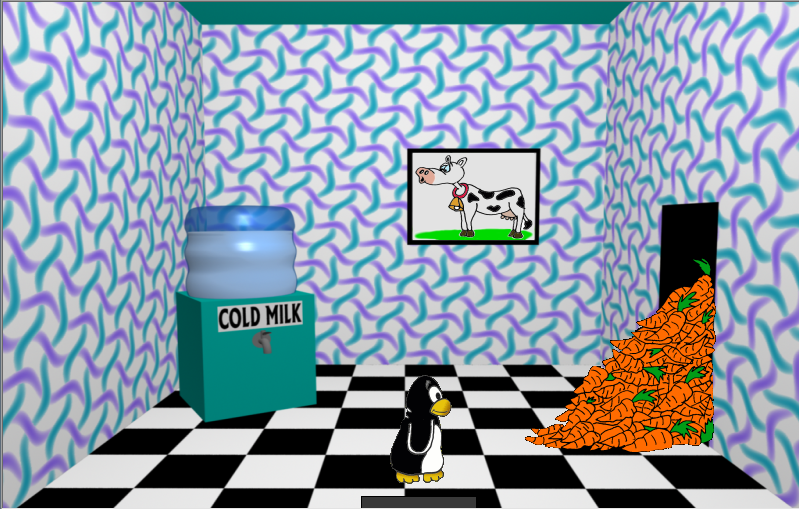
Geoffrey Draper recently converted Nellan is Thirsty into a point-and-click adventure game with voice acting. “I discovered the game in the late 1980’s, and I thought it was pretty neat. In the early 2000’s, I felt a sting of sadness as I realized that future generations would likely never see this game — first, because the C-64 is a dead platform, and secondly because modern gamers rarely have the patience for text adventures anyway.”
Dante’s Inferno was a type-in by Gerard Bernor printed in the January 1980 issue of Softside which tasks you with stealing your contract with the devil from Hell itself. (It states a 1979 copyright date in the source code, so 1979 also works as a date, but I’ve found no evidence of a commercial release prior to the magazine appearance so I’m listing this game as 1980.) The print copy called it a “CompuNovel”, a term used very sporadically elsewhere (ex: page 5 of this February 1980 issue of Softside in an ad for Lost Dutchman’s Gold) and one that died out by 1981.
Rather like Quest from 1978, it has no parser, just navigation: specifically the keys F, B, L, R, U, D for Forward, Backward, Left, Right, Up and Down. This is *not* a relative position game, though (that is, “left” and “right” don’t change based on which way you’re facing) – these directions can be treated like the regular north/south/east/west on a map, which is good, because the game is essentially a large maze.
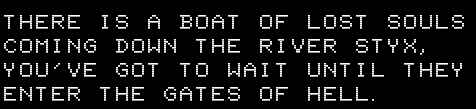
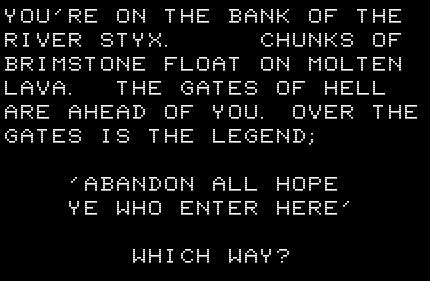
The game uses pauses for dramatic effect, starting with the screen below:
Keypresses don’t work for a few seconds; you have to actually wait for the first location to appear.
I did find this more enjoyable than Quest, insofar as that the genre of a journey through Hell made the idea of a torturous labyrinth with slightly random layout thematically appropriate. There were a lot of “dead ends” (an easy way for the author to add map locations without having to add extra room descriptions) and there was the usual “going one direction and then going back the opposite way may not take you where you started” business, but all this worked well with the atmosphere.
After about 30 minutes of wandering, I found the “records” and was able to pick up a box of contracts. (Not just mine, the whole box! Guess a whole swath of people are gonna escape the devil.)
But then, a twist!
Rather by accident, Dale Dobson over at Gaming After 40 had an even better experience than intended. At the moment this happened, the TRS-80 speaker let out a “horrendous, screechy white noise” that caused him to jump out of his seat. Unfortunately, this was just a bug. Otherwise it would mark the first use of a sound cue in an adventure game.
A bit more navigation is required to find a different records room, where the contracts have been moved to. (It’s a little unclear why the incubi leave the main character alone otherwise; maybe in the end they appreciate a bit of mischief.) Unfortunately, trying to then go back the way you came has the route blocked off (either by a narrow hall where you can’t carry the contracts, or Satan himself).
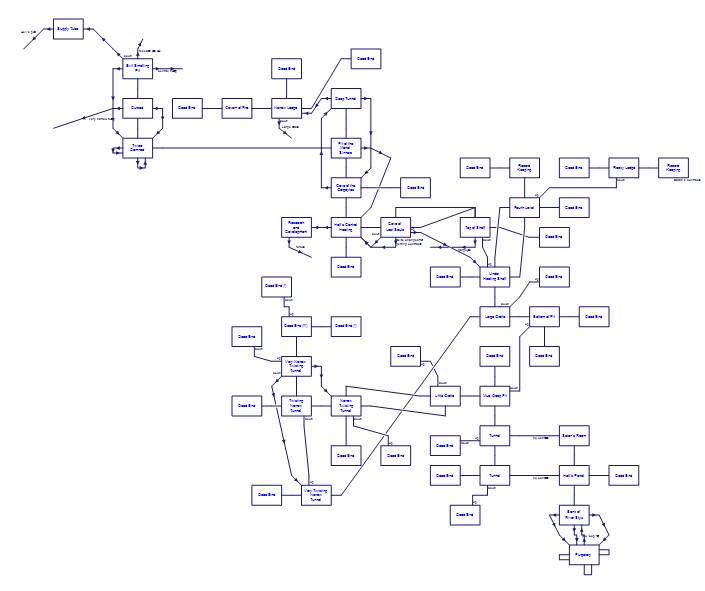
Click on the image for the full map.
There’s a little more drama after that point: the route you then need to take is down an “evil smelling pit” (in the upper left corner of the map above). However, the “cave of lost souls” room which was on the way seemed to have all its exits reconfigured, so I needed to find an alternate route.
My move count was high, but I was trying to do very careful mapping.
This game hit over its weight class. The narrative frame made what normally would be the drudgery of mapping into a paranoid journey. I guess the lesson is: if your gameplay is going to be minimal, pick a theme that matches.
This glorious picture is from the magazine. I appreciate the “S” on his necklace.
Cover of the Atari version of the game, via Mobygames. There’s something in this picture that really doesn’t make sense with the game, but I’ll get to that later.
My tingly puzzle-sense helped. I had, in fact, gone down a wrong path.
Last time, I mentioned using flying to get by a lion, and that feeling like overkill. The actual solution needed was
>GIVE BREAD
THE LION WOLFS DOWN THE BREAD AND THEN WALKS AWAY.
I should have figured: adventure games are notorious for zoological oddities. Lions are carnivores, but I should have tried the bread anyway. At least it wasn’t quite as painful as feeding dried camel jerky to an oyster.
I think this may be the first puzzle I’ve encountered chronologically with a “you can solve the puzzle with the wrong item” sort of resource-management puzzle. (I think this sort of thing is ok as long as you’re in the right mentality for it; I could see why it would irritate someone who was stuck for a long time. It also has the feature that some people wouldn’t realize the puzzle existed at all, since anyone who tried the bread first wouldn’t have used up the power of flight.)
In any case, by getting past the lion without using up my power of flight, I was able to use it on the north beach of the island to get to another beach, and some mountains.
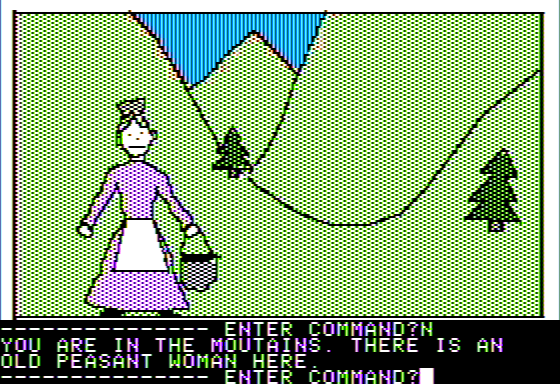
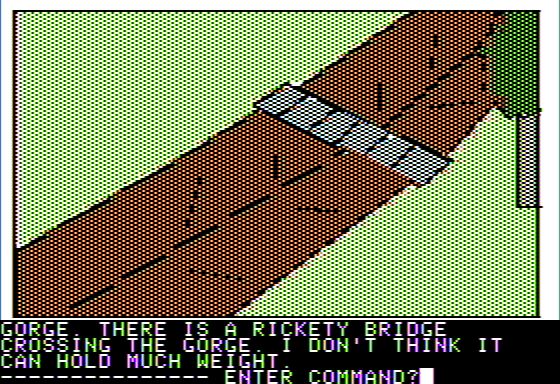
After a brief scene with the woman above (where she just warns you about a giant in the mountains, and seems to be in the game purely for flavor) I came across a bridge that reminded me of King’s Quest II.
I remember that game having a limit to the number of crossings; probably it had a weight limit too (it’s been a while since I played). In any case, my instinct was that I couldn’t carry any items across at all without dying, and I was correct.
But, you need your stuff. What to do? There was a locket I had found earlier with LUCY written inside, where saying LUCY led to
EVERYTHING YOU ARE CARRYING DISAPPEARS.
YOU HAVE NOTHING LEFT.
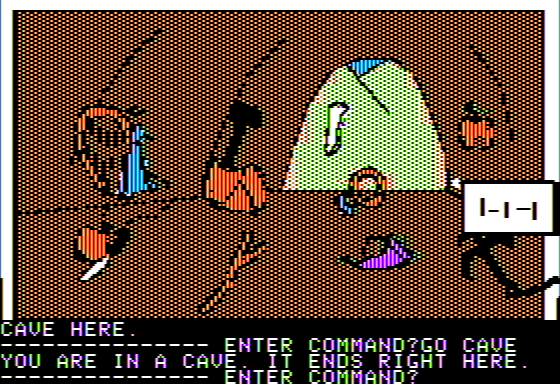
I guessed this wasn’t just a trap and filed it for later. Upon finding the chasm (and remembering the business with the gnome where you lose some items and then find them again) I decided to try LUCY out and keep going. Lo and behold, all my stuff ended up just past the chasm in a nearby cave. How … convenient?
Fortunately GET ALL works in this case so I didn’t have to remember the names of all my items.
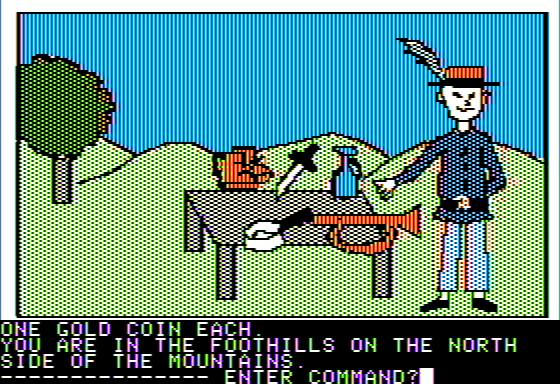
Fairly soon after, I came across a “peddler”, selling a set of items for one gold coin each.
The problem is you only have one gold coin, and the peddler disappears after you buy an item (or even just leave without buying anything).
This could have so much cruelty if it were not for the fact the puzzle you need the item for occurs immediately after this scene.
To the game’s credit, after seeing the moat obstacle, I realized immediately what item I needed from the peddler. (I’ll spoil the puzzle, but in a little bit – try to work it out on your own first.)
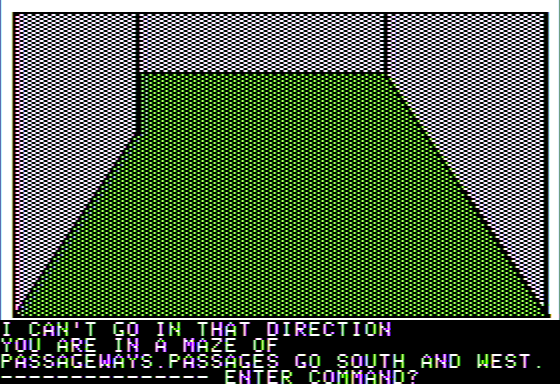
In any case! Inside the castle, there was a bit of a maze, although fortunately one where everything was “oriented normally”…
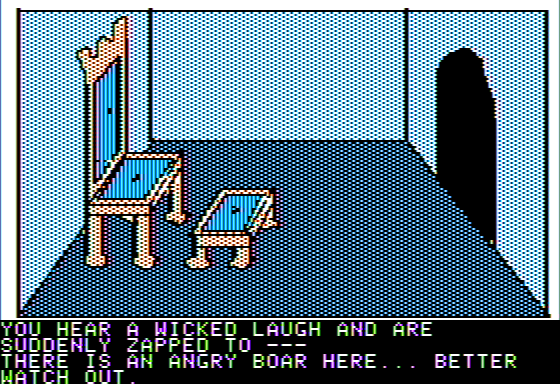
… and occasionally the wizard would ZAP me over to another room. (I liked the flavor here – it led to an “active antagonist” without having to code in all the bells and whistles of an actual moving NPC.)
I found a spot where I could PICK LOCK to unlock a door in the maze, and came across this scene in a tower:
… followed by one of the most ignominious boss deaths in the history of video games.
I had been toting a ring around where RUB RING would briefly give my character fur. I wasn’t trying take out the bird here, I was just curious what would happen.
It wasn’t clear to me at all what happened until I started wandering and found the wizard zaps had stopped. The wizard was in the form of a bird, and I had just eaten him. Burp.
Well! This was followed by kissing a frog (who was the princess), and using some magic shoes.
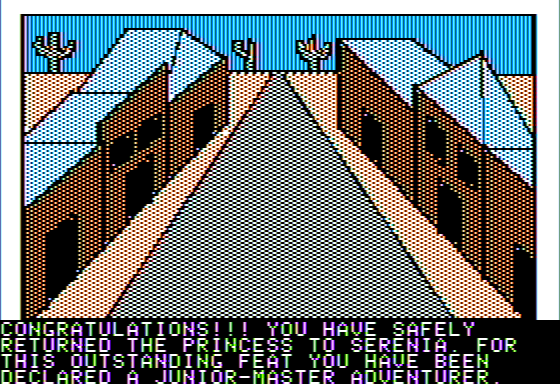
Wait, wasn’t I supposed to get half the kingdom, or something? Oh well. (I strongly suspect that “prologue” text which mentioned the kingdom thing was written after the game. Either that, or the king was lying.)
In any case! I found this fairly light and breezy after the suffering that was Goblins. (Incidentally, regarding the charge that this game borrowed from Goblins? I found nothing plausible in this sense. Previous games had used magic words. There’s a harp in both games you can use to befriend an NPC, but that’s not a strong similarity at all. I really tried to stretch and find some comparisons, but I think the angle’s a dud.)
Er, I suppose? To some extent? The parser is vastly better than Mystery House and I don’t recall any point I had to fight with it. There are certainly places you can “bust” your game and make it unwinnable, but with nearly every instance the issue is immediately obvious, and the two cases where it isn’t (the lion and the peddler) have the consequence very shortly after the mistake. He had trouble with both the “split note” puzzle (from my last post) and getting through the drawbridge (which was the trumpet; yes, it has to be “magic” for the puzzle to make sense), both puzzles which I solved almost immediately.
I’m hardly a super-expert at this, despite my experience; for example, the only Scott Adams game I’ve ever beaten hintless (of the 9 I’ve tried so far) remains Pirate Adventure. I think it’s just: interactive media is hard to evaluate, and everyone will have a different experience. A puzzle that is endless frustration for one person can be a mild conundrum for another.
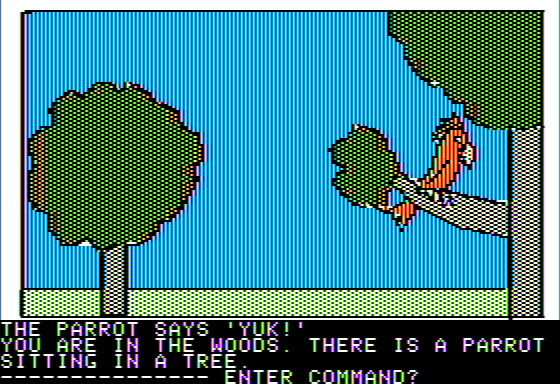
That sounds almost trivial written out, so let’s pick on a specific example from Maher’s post. There is a scene where you need to feed a parrot a cracker, and he points out the parrot-cracker cliche is US-specific. Fair enough.
Although: if you give the parrot another item other than the correct one, it says “YUK!” So there’s a strong clue a food-type item is needed. Parrots are even willing in real life to eat crackers (although they aren’t recommended), so at least it’s an improvement over lions eating bread.
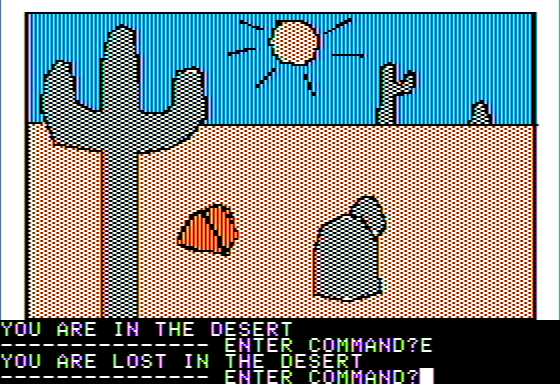
But there’s definitely a catch: what if someone hasn’t found the cracker in the first place? It’s hidden in a cactus in the desert.
You can >LOOK CACTUS to find THERE IS A HOLE IN ONE CACTUS but the puzzle really requires noticing the visual, which I could see someone missing entirely. So for the player who missed the object, what would their play experience be like? They’d get a lot of YUK, presumably, and maybe try various ways of killing or capturing the parrot. The action could easily devolve into the stereotypical sociopathic adventurer. And this is just with one (relatively straightforward) puzzle! There are plenty of moments where one missed object could cause headaches.
One could argue adventurers should always be on the lookout for hidden items (especially when they’re stuck on a puzzle) but it’s still undeniable the experience of a player who already has the cracker vs. one who does not would be vastly different.
On the (other) other hand, having “safety railings” all throughout adventure games can be irritating and undermine the experience. Part of the joy is in discovery, and part of the appeal of parser games in particular is the freedom to type anything. Every adventure games with puzzles involves a certain level of risk, and perhaps it’s simply impossible to make every player happy. Still, it seems like there should be some objective measure for saying if a puzzle is fair or not, despite reviews often being all over the place. I try my best when evaluating if a puzzle is good or not by putting myself “in the head” of other players who might have had different experiences, but just how wide a latitude do I need to give? How meticulous and patient a player can I assume? My only definitive conclusion from such thoughts has been “I have a headache now.”
I legitimately enjoyed Wizard and the Princess, and I’d say it’s still worth a try for the curious (especially King’s Quest fans). Just save liberally, ok?
(Oh, and the thing that doesn’t make sense with the picture from the top of this post: it looks like the wizard is summoning the bird, or controlling it, or some such. But he’s shapeshifted into the bird in the game and it doesn’t make sense to depict him and the bird at the same time. Small nitpick.)
Wizard and the Princess by Ken and Roberta Williams is considered the “zeroth entry” in the King’s Quest series.
Wizard & Princess can be considered the “prequel” to King’s Quest I, since Roberta took many of her fantasy visions from this game and put them into the landmark series. King Graham even returns to Serenia in King’s Quest V.
— From the King’s Quest Omnipedia, quoting Interaction Magazine, Fall 1994
From the back of the original packaging, via the Museum of Computer Adventure Game History. Sometimes “The” appears in the title, sometimes it doesn’t. I’m considering the version without “The” to be the canon title since it’s used that way in The Roberta Williams Anthology from 1997.
The art is much upgraded from Mystery House; it almost looks “good” now?
Well, at least I can tell it’s a scorpion.
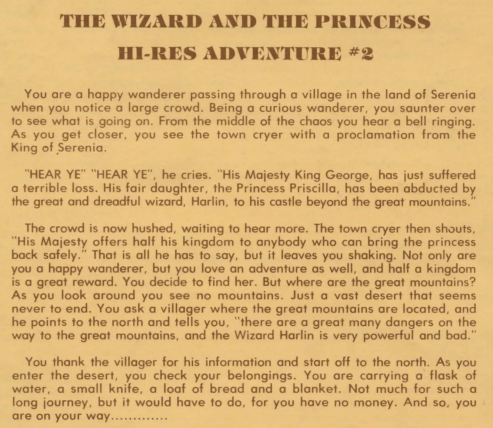
As explained in the text-dump above, you are a “wanderer” who hears about a princess that needs rescuing; questing ensues. In nearly any other context this would be unremarkable, but it’s actually unusual for 1980: note that there is no treasure hunt involved. While we’ve certainly seen some non-treasure-hunting plots from Scott Adams and others, this is the first fantasy-genre game I’ve come across in this project that dispensed with collecting treasures entirely. The structure is instead what I’d call a “biome journey”. So far, from my first session:
Desert -> Forest -> Ocean -> Island
As the progression implies, I’ve managed to make good progress right away. I consider this positive! Even if things get harder later, a structure that “eases in” starting with simpler puzzles is a general improvement over hitting the player with a brick right away. (Also note as consequence: this post contains more spoilers than my usual intro post.)
Maybe the first puzzle is a bit rough. The C64 printing of the game (circa 1984) came with this hint card, because presumably too many people were getting stuck right at the start. Specifically, you start in the “Village of Serenia”
where just north there is a rattlesnake
and just south is a desert maze
and you have nothing else other than an inventory of a flask, a pocket knife, bread, and a blanket. As a grizzled 1970s adventurer I tackled the maze right away, and found that while most of the desert rooms that contained a “rock” had a scorpion behind (that would kill you if you tried to take the rock), one of the rocks had no scorpion and was safe to take. You can then throw this rock at the rattlesnake and continue the journey.
More desert followed, blocked by a chasm. A magic word was required to get across, which was given as a visual puzzle (I’ll leave the solution to you, the readers).
Then came some woods, and a gnome that stole some of my stuff. It wasn’t too hard to retrieve. I could see someone getting stuck by trying to stop the gnome at the point-of-stuff-getting-stolen as opposed to accepting that it would happen and moving on with the plot from there.
I had to get past a lion by … drinking a vial that let me fly? This was odd. I mean, yes, if you could fly, lions wouldn’t pose too much trouble, but it almost feels like overkill. I’m slightly worried there is a second solution and I need to save the flying for later.
Finally, I took a boat out to an island and found a harp. I have no idea what to do with the harp. I seem to be stuck from here. There is another beach on the other side of the island (from where I landed the boat) but I die if I try to swim north, and I can’t seem to bring the boat to this spot. I’m not sure if I’m supposed to go backwards now and try the harp in one of the places I’ve already visited, or if the biome journey can continue. (The “prologue text” indicates the wizard is to the north, so I suspect I’m in the right place, just I need the right action.)
Yes, I finished, for real. I honestly thought I was going to have to write a “I throw in the towel” post, but not this time. I’m a little late for the contest.
YOU CAN WIN A THIRTY DOLLAR CASH PRIZE BY PLAYING GOBLINS.
THE PRIZE WILL BE AWARDED TO THE PERSON WHO CAN WIN THE GAME USING THE LEAST NUMBER OF MOVES.
THE WINNING ENTRY MUST BE POSTMARKED BEFORE JULY 1, 1982. AFTER THAT DATE YOU CAN STILL WIN A THREE DOLLAR PRIZE.
The game had two pieces of suffering left for me.
First, there is a “book” where reading it just says
THE BOOK IS WRITTEN IN A LATIN DIALECT.
However, if you >READ COVER, you get the response below:
This is a magic word hint. IGPA manipulates an Egyptian scarab which you normally can’t pick up, but IGPA will teleport it to your current location.
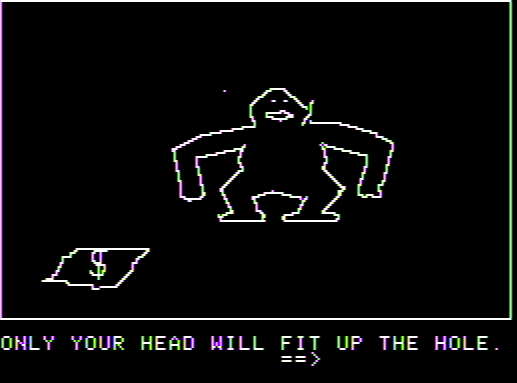
Second: There’s a scene with an ogre that I used as the very first picture of my series. If you try to take the money next to the ogre he will fling you away.
You can go a little past this part and “poke your head up” to see the money from a maze that goes underneath this spot.
However, if you take the money here the ogre will just kill you. It turns out, even though you can’t see it, you can still >GET MONEY while in the room underneath.
The ogre will then give chase, but you can maneuver in the maze in such a way a passage collapses and the ogre gets buried under rocks. (This puzzle in itself wasn’t bad, it was just the action that set the sequence off that was unfair to find!)
These events had such a blatant disregard for the standard rules of the parser I had to stop playing for about a week after I got through them. I really shouldn’t be getting this upset at a 40-year old game. Somehow I got through Philosopher’s Quest and Quondam without feeling this rattled, but despite their cruelty, those games fell in the narrow range of fair play. Asking to get an item that is not present or read a book cover as a separate command from reading a book were more like interface missteps. After spending a long time on a puzzle, finding out you missed a solve due to “interface” is like getting part-way through a crossword puzzle and finding out that half of the words are random gibberish.
Positive interlude, since this post is otherwise negative: I liked this moment where you ride a tiny dragon.
Two more events of note: there’s a note where the pin attaching the note is a treasure. (Below is shown the game picture after “TAKE NOTE” – there is no text description of the pin.)
This seems clever in a subversion-of-expectations sense? I don’t know if it was quite implemented correctly – it still seems like the puzzle would be fairer in an all-text game (more on that in a second).
There was a spot where you could LOOK GROUND (unprompted, of course, argh!) and find a ring; RUB RING then turned you invisible and let you get away from the goblins following you around. Part of my issue was realizing I was getting followed around in the first place; again, as a text-only game I would have been less befuddled.
At the end of this animation you can see one of the goblins peek out. This isn’t consistent or regular, so it was very hard to understand I was being “followed” and not just that goblins were coming at random.
As mentioned back in my first post, Goblins was originally written in 1979 as an all-text game. We fortunately have a very good idea what it was like, because there’s a map of the 1979 version.
None of the “graphics only” locations are included here. A lot of the puzzles seem to be fairer (for example, the sign announcing royal visitor being welcome seems to be the exact same room you wave the boot); the pin and chased-by-goblins puzzles also seem easier. The fact everything is more compact with less “fluff” locations would (probably) lead to a more satisfying experience.
(Click on the image to get my full map of the 1981 version of Goblins.)
In any case, it’s good I have the old map, because I’ll be tackling Wizard and the Princess next; it allegedly ripped off (“a dozen similarities”) the 1979 version of Goblins. I’m just hoping if it did borrow some things, it borrowed more of the good parts (I suppose the atmosphere?) and less of the irritating parser abuse.
From the start of The Five Orange Pips by Arthur Conan Doyle:
When I glance over my notes and records of the Sherlock Holmes cases between the years ’82 and ’90, I am faced by so many which present strange and interesting features that it is no easy matter to know which to choose and which to leave. Some, however, have already gained publicity through the papers, and others have not offered a field for those peculiar qualities which my friend possessed in so high a degree, and which it is the object of these papers to illustrate. Some, too, have baffled his analytical skill, and would be, as narratives, beginnings without an ending, while others have been but partially cleared up, and have their explanations founded rather upon conjecture and surmise than on that absolute logical proof which was so dear to him.
Sherlock Holmes is oft-stated to always conclude things based on airtight deduction, having a set of facts whereupon to build a case where there can be no other conclusion. However, quite often the character relies on abduction, which instead a probability-based guess based on circumstances. Later, in the same story, a young man arrives:
“Give me your coat and umbrella,” said Holmes. “They may rest here on the hook and will be dry presently. You have come up from the south-west, I see.”
“Yes, from Horsham.”
“That clay and chalk mixture which I see upon your toe caps is quite distinctive.”
The supposition made here is most likely correct, but hardly the only possible one; perhaps the man stole the shoes from someone else who resided in the area. Still, Sherlock Holmes’s inference is the best explanation, likely enough that the reader doesn’t notice it’s not an “absolute logical proof” in the same manner as mathematically proving that 1 + 1 = 2.
To summarize: with deduction, we have fully known rules and circumstances that when together force some kind of conclusion. With abduction, we have circumstances where we have to infer the chain of events, but it’s a probabilistic guess.
…
By the treehouse where all the treasures are stored in Goblins there is an “old boot”. There is no more detail other than that.
After long frustration I ended up checking a “hint sheet” that was given with the game, and found this:
Submarine. The sub may be surfaced by waving the boot (which was originally fished from the sea) at the beach where the fish is carrying the welcome sign. Be sure to bring the compass when using the sub or all is lost!
I went to the place with the welcome sign …
… and found WAVE BOOT had no effect, nor did any other attempt at using a magical item. No, it turns out you have to be in the bay just north of this part of the beach, and then the action works.
This happens to be an unusually prominent spot for me to highlight an issue with adventure games. I feel like a lot of adventure game writers think they are writing puzzles which will be solved via the process of deduction, but the player needs to use abduction instead.
The author knew the boot was fished from the sea, but somehow failed to convey this fact. The author knew the nature of the boot’s magic. The author knew the boot’s magic could be activated via waving. The author knew the “royal entrance” was next to the sign, but not right at it. If given all those facts, it’s possible to logically conclude both that WAVE BOOT is the right action and where it should be done; without these facts, the player is instead using abduction. They can see the crime scene after the fact and can only make their best guess about what to do.
This isn’t necessarily a bad thing; a confirmed conclusion from abduction can be highly satisfying. However, it needs to be a most likely conclusion, not one plausible theory out of ten. Many authors are tentative about giving “excess hints” to a puzzle in a game, but they have to keep in mind the player is always working via abduction, and making a puzzle solution 10% more likely to be correct isn’t the same as “giving a puzzle away”.
Chronicon Apocalyptica: Copyedit. Releasing Jan 10? A 10th Century adventure; The X-Files meets The Name of the Rose, as you travel through England solving the mysteries of an ancient tome, and investigating myths while staving off conflict with Vikings. A sophomore outing from @r_davis, author of Broadway: 1849.
Untitled Superlatives Sequel: Beta. Picking up after the conclusion of The Superlatives: Aetherfall , you work for the Conclave, an interplanetary diplomatic force as you hunt down the mysterious assassin who killed your predecessor. By Alice Ripley.
Platinum Package: Draft revision. In the elite world of high net-worth individuals, someone has to make the impossible happen. By Emily Short.
Exile of the Gods: Draft review. A sequel to Champion of the Gods.
Drag Star: Draft revision. Make your costume, make your face, throw your shade…all to discover, who is the most fabulous drag star of them all?
Fool!: Draft revision. As a jester, you must make your way from the local fair to the court of the king. Put on your motley, tune your lute, and sharpen your wit: to be remembered as the greatest fool, you must put your competition to shame.
Astral Troopers: Draft revision. As a newly appointed sublieutenant of the Astral Corps, you must work to put down a rebellion on the remote planet of Cerberus.
Untitled Grand Academy for Future Villains Sequel: In progress. Picking up after the school-rending conclusion of Grand Academy, face a new school year, new enemies, of course your mom , and perhaps acquire a true villainous destiny.
The Darkling Watchers: In progress. The US Government employs the spirits of the dead as spies? Another mindbending outing by Paul Gresty, author of The ORPHEUS Ruse and MetaHuman, inc.
Pon Pará and the Great Southern Labyrinth: In progress. The first in a new trilogy by Kyle Marquis, author of Empyrean, Silverworld, and Tower Behind the Moon.
Social Services of the Damned: In progress. In a city overrun with trolls, demons, witches, vampires, werewolves, and other supernatural beings, someone has to handle the paperwork! You’re a social worker whose job is to mediate disputes and lay the occasional smack-down on uppity entities when they break the rules or endanger the human populace.
Six Months to Vesta Station: In progress. You’re the captain of a long-haul spaceship in the 24th century, and a wealthy man has paid triple your usual fee to carry him and his mysterious cargo with no questions asked. On the long voyage, navigate your crew’s personalities, interplanetary politics, the asteroid belt, and your ship’s resources as you uncover secrets and conspiracies.
The Esper Smugglers: In progress. As the captain of an airship, you must negotiate with and resist pirates and corporate forces seeking to exterminate the Esper race.
180 Files: The Aegis Project: Draft revision. Winner of the ChoiceScript Competition. As a spy, you must uncover a nefarious plot to destroy the world!
A Tale of Two Cranes: Draft revision. An epic saga of Three Kingdoms-era China. Second place winner of the ChoiceScript Competition.
Heroes of Myth: It’s easy being the most famous and powerful heroes in the world when evil has been vanquished and your cups are constantly full with other peoples’ wine. But when evil raises its ugly head once again, you’re forced to confront the fact that you’re a fraud that’s been grifting the realm for years. Maybe, just maybe, you’ll rise to the occasion.
Psy High: High Summer: A sequel to Psy High by @ladybird. How will use your powers of clairvoyance to make the best summer ever for the kids at a summer camp?
Sunless Skies is a gothic horror roleplay game with a focus on exploration and exquisite storytelling.
The only thing between you and the waste-winds, storms and cosmic lightning is your engine. Tend and upgrade it, buy weaponry and exotic equipment, and keep her hull in good shape to hold the hostile Heavens at bay.
A Choose Your Own Adventure inspired by White Wolf’s World of Darkness, Twin Peaks and H.P. Lovecraft.
The legendary STEINS;GATE visual novel series returns on February 19th with STEINS;GATE ELITE.
STEINS;GATE ELITE follows a rag-tag band of tech-savvy young students who discover the means of changing the past via e-mail using a modified microwave. Their experiments in pushing the boundaries of time begin to spiral out of control as they become entangled in a conspiracy surrounding SERN, the organization behind the Large Hadron Collider, and John Titor, who claims to be from a dystopian future.
Cubus Games is planning on the 3rd game in their Heavy Metal Thunder series called Slaughter at Masada.
Slaughter at Masada takes place on Mars, a brutal warzone where three sides are vying for dominance. Masada has been under siege for three years, and to overcome despair the people trapped in Mount Olympus have embraced a deadly philosophy of WAR FOR THE SAKE OF WAR. They are surrounded by Invader berserkers – criminal psychopaths too dangerous to be trusted inside spaceships. And now the Black Lance Legion has arrived to break the siege and recruit the fighters of Masada – even against their will, if necessary.
In a magical Melbourne cafe, the dead return for one last night and one last cup of coffee.
Pseudavid, who previously got 6th place in IFComp 2018 for The Master of the Land is working on The Good People:
A horror drama about climate, drowned villages and rural legends.
The developer thev1nce previously worked on a mobile game entitled Somewhere: the Vault Papers (trailer above) is working on a new project called Cloak and Data that “will deal with espionage and IT security.”
David Cornelson (previously of Textfyre, cover art from their release Shadow of the Cathedral above) is working on a new parser game called Zombie Salsa.
… a traditional parser-based puzzle fest with a side of horror and humor.





















 Renga in Blue