Author Archive
I’ll be frank up front: this is not Roger M. Wilcox’s finest hour.

For some side nitpicking before the main event, “king of the jungle” doesn’t even make sense as a phrase since lions prefer savannahs (or at least dry forests). However, the photographer Bruno D’Amicis recently (2012) caught some photos in Ethiopia at the Kafa Biosphere Reserve of lions in a rainforest. Back in 1981 when Wilcox wrote this, there were no known actual lions in jungles.
This is his fifteenth adventure game, after The Staff “Slake” and Medieval Space Warrior, and this one really comes off as throwing out ideas and puzzles at random, even moreso than his prior games. That is, while In the Universe Beyond was triply weird, at least it was a weird with a good sense of humor where you can attach some plants to your spacesuit for oxygen and the CENTER OF THE UNIVERSE is an item you can pick up.

As explained in the intro above, your goal is to hunt a lion. Nearby there is a dead native with a note explaining the lion “is actually a mutation of a lion due to nuclear testing” and is “his projected image in material form”.
Additionally, there’s a load of inventory items to scoop up, like a medicine kit, a bucket and cow (you can milk the cow and churn the milk to get buttermilk), a shield, a sparker, a rod of cancellation, and an ancient scroll.
>READ SCROLL
A silvery line extends from your finger, and ignites a fireball in midair.
If the last two made you go wait, what? they did for me as well, because fantasy elements get tossed in here; the scroll and the rod are from a “wizard’s hut” and there’s a “held portal” you can TOUCH while holding the rod to unlock it and reach a “pool of oil” and a “fine cloth”.
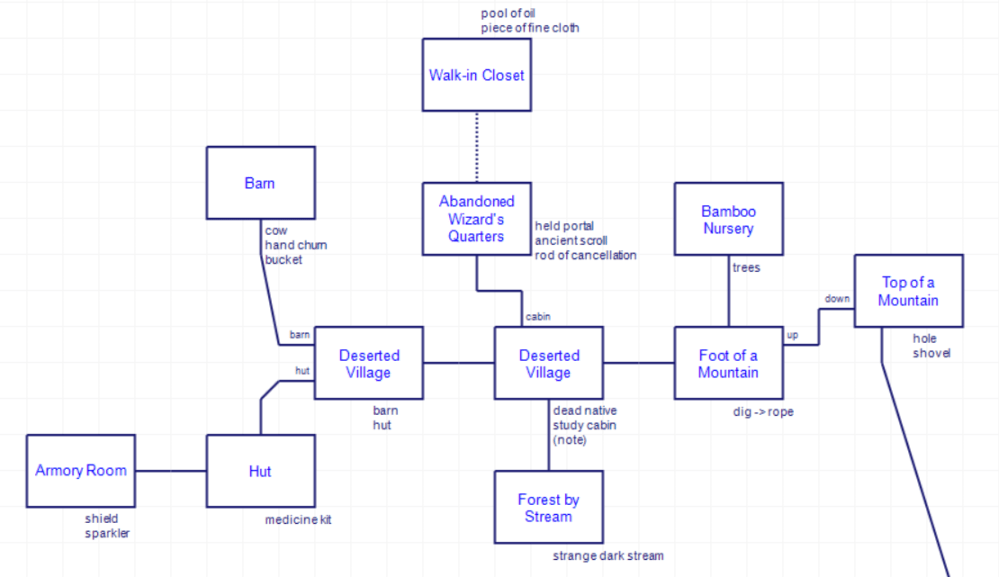
Other than finding a shovel and digging a rope I got stuck for a good long while on the map portion shown above. There’s also a river with dark liquid that I wasn’t able to interact with, a bamboo forest, and a hole with snakes where GO HOLE leads to death.
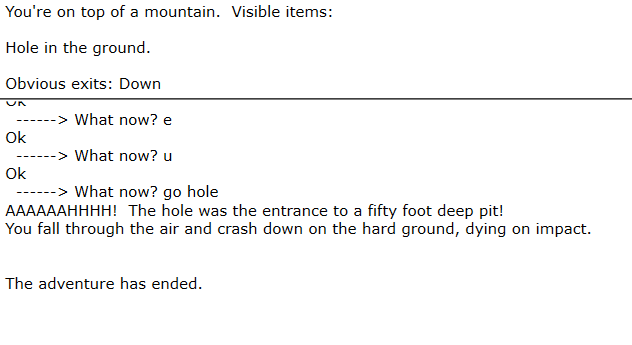
I finally realized I could BREAK TREE in the forest to get a piece of bamboo — which sounds ok in retrospect, but I had tried lots of verbs with that similar idea with no luck, and assumed I needed a tool of some kind — and then trying to TIE ROPE / TO POLE led to:
Sorry, it slips off.
I had to look up a walkthrough to realize that you can TIE ROPE / TO BAMBOO, just not to the POLE, even that it is described as a “bamboo pole” so obviously the real noun here is pole and aaaaargh.
With the rope-tied-to-pole in hand I was able to GO HOLE without dying (after fruitlessly attempting actions like dropping the bamboo and typing CLIMB ROPE) where I found snakes in a pit. Nothing I tried helped so I looked up help again, and found that the scroll I already mentioned (“A silvery line extends from your finger, and ignites a fireball in midair.”) is the key.

Yes, you need to AIM DOWN (POINT DOWN also works). Yet another new verb! Even moreso, this is a “preparation verb”, which sets up to “hold a pose” for action after. I admit I’m struggling to think of examples of this that were anything other than confusing; there just isn’t enough feedback to know the basic READ SCROLL message is being affected by player state, or that even would be a mechanic that would work.
The same construction happens shortly after with a snake that shoots laser beams and your shield (which you need to have POLISHed first using the cloth, and that’s the only verb that will work).

Also note how in the first instance the point/aim mechanic indicates a direction while in this case in indicates what object is being pointed.
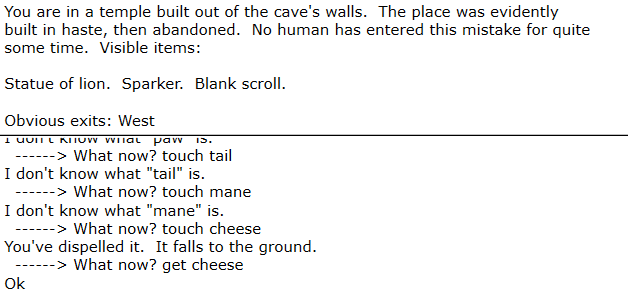
There’s then a small area with a lion statue holding a piece of a cheese (??) and you can use the rod of cancellation to get the cheese (???? cryptic but I got it anyway).
Then there’s a force field that kills you unless you’ve drank the water from the strange river (which turns out to have been lead?) However, to drink it and not die, you need to have drink anti-toxin first from the medicine kit. But if you drink the anti-toxin:
You got heartburn! You’re dead from an ulcer.
The way to resolve that, of course, is to drink the buttermilk first, which is sufficient to survive drinking the anti-toxin, which is sufficient to survive drinking the lead, which will then let you go in the force field.
Look, I don’t know anymore. The lion is behind the force field, who is easy to defeat because of course it likes cheese.

This wasn’t tough to solve since I was out of items and the stone lion had the cheese, but it doesn’t make the experience any less surreal.
Again, teenaged author, not even attempting to publish these, just a series of private games which lets us peek in on what people were writing for fun, etc. so I’m not going to linger. But as a small piece of analysis, he tried out a new mechanic (POINTing as affecting a command after) without much prompting, mashed sci-fi and fantasy together in way that led to incoherence rather than a plausible setting (Medieval Space Warrior at least had a structural transition) and even when the puzzles were easy they were along of the lines “oh, I guess that worked” as opposed to being pleasing moments of logic or plot.
I managed to finish, so as usual previous posts are needed for context, and complete spoilers ahead.
Before I get into the gameplay, a bit of history. Forbidden City happens to be (via an unofficial translation) one of the only text adventures ever published in the USSR, and I’m not sure if the original author (Demas) even knows about it.
Aaron Reed recently wrote about P.R.E.S.T.A.V.B.A., a parody game published in Czech for the ZX Spectrum which includes a copy of Marx’s Kapital in a toilet and an inspiring newspaper editorial that is required to solve a puzzle (“YOU IMMEDIATELY ACQUIRED A TASTE FOR WORK, WHICH IS AN ESSENTIAL HONOR FOR ANY SOCIALIST CITIZEN TO DO.”) Jim Gerrie has translated the game into English so you can go play it yourself. For obvious reasons — the Velvet Revolution was still a year away — the game was distributed slowly and the author Miroslav Fídler intentionally mangled the source code to hide its authorship.
That’s not the case with Město Robotů (Robot City) from 1989, which had sponsorship from the Czech government, and is a direct translation of Forbidden City.

Image from Spectrum Computing. Despite the official nod for the game itself, the cover artist, Kája Saudek, was banned from mainstream media.
The game, programmed by Vít Libovický, was released as part of a contest by Zenitcentrum Beroun, a center for computing run by the state. There were ads on Czechoslovak Television and in the press. It went for sale “early” before it was meant to be playable — a password to unlock the game was given on air on September 21, 1989, but the password turned out to be easy to crack and the contest had to be cancelled, so winners were drawn by lottery instead.

“A science fiction computer game. Produced by Zenitcentrum to celebrate the 40th anniversary of the Pionýr Organization of the Socialist Union of Youth.” Screenshots (and the information about the game) from an article in the book Gaming Globally.
As a side note, the contest inspired a second game a year later from students at the Electrotechnical University in Pilsen: …and what about that?! It is set in a time after the Soviet bloc fell. It involved the main character, a journalist, being tasked to write about Brazilian coffee and discovering a conspiracy in the process. Instead of being a parser game it used hypertext (inspired by, of all things, the help system of Turbo Pascal). I have not been able to find a copy of the game or screenshots.

A print advertisement. While the game itself has one friendly robot, as you’ll see, there’s overall much more violence than the picture indicates.
Back to the Forbidden City! And not the 1981 original, but the mid-80s Macintosh port, which — with the exception of a few textual messages — is very close to the TRS-80 version.
I had been stuck on an area that it turned out I had entirely mined out for resources already — my miss was assuming that the dark area that the monorail passed through needed to be skipped and returned to. One of my objects already was capable of being a light source.

TWIST was not on my standard verb list (it is now). I had already tried TURN and ROTATE, neither which work.
In my taxonomy of guess-the-verb
Struggling to Communicate (know to do something, but unable to convey it)
Receiving Bad Information (a verb which could be considered a synonym gives a misleading message)
Hidden (not realizing there was a verb that wasn’t guessed correctly)
this mostly fits under “Hidden”, but I will say (unlike back in Hezarin where I tried to YELL, found the verb lacking, and decided that wasn’t a solution) there was very little intention in my attempting “turn” on the rod. In truth, I visualize twist as a slightly different action (turning the two ends in opposite directions). I suppose the dangling question is: was there any way of me solving this without looking up the answer outright, which I did? A “focus on fiddling with the rod” hint might have done it — I might have even consciously though “what if I twist both ends” — but this still seems like a stumble in a gameplay sense without some extra in-game nudge. The description of the rod from The Staff “Slake” comes to mind, which explicitly says “Its bottom seems worn from tapping against the ground” as both an action and verb signal; maybe the rod could have a similar message about smudges or the like.
Moving on: I found a grotto with a control panel where a yellow button let me open a “dead end” that had tokens and a hostile robot I had to SHOOT with my laser.

Past this point there was a continuous stream of robots appearing. They could appear at any moment and there was no restriction as to how many times a robot would appear in a row, and while they only sometimes (randomly) kill the player, I had to essentially stop to SHOOT ROBOT every time one appeared. This was both intense and annoying. Certainly in a plot sense it made the whole thing more dynamic (and more like the game’s original cover) but there were moments were stopping to shoot was fatal and there’s a limit to laser shots (90) so what was originally slow exploration turned into a mad race (and given the puzzles end up being “decipher what these mystery buttons do” genre, there was an unfortunate clash).
With the tokens in hand, I was able to take the monorail to the third stop, scarf up all the items, and then a fourth and final stop, which had a box with two buttons and a nuclear reactor with a red key.

The reactor makes you irradiated but there’s a nearby decontamination room with a button that cures you; the timing is very tight so you can’t make any stops on the way (that includes shooting a laser at a killer robot if they’re following).
Having raided the fourth station, I took my newfound red key, took it back to the dark station, and after INSERT RED and TURN RED on a control panel the lights for the underground stayed on (which is good, because the light source doesn’t have much juice). I incidentally did not get the TURN on my own and it is the only part of the game where this is required, even on other key locations.
With the power on I was able to use one of those beam-activated doors I had been encountering to enter an underground building.

The building featured a “teleportation station” between floors…

This uses the magnetic card I had been toting around. Also, if you take the green radiation stone in the lead container you get fried, so you have to leave it behind.
…an unmoving robot in a storage room, a robot assembly room, and a security outpost.

The “cartridge” from the robot assembly could be put into the unmoving robot to make a new robot buddy that would follow me around. In the security outpost I found a vent by LOOKing and was able to unscrew it with a screwdriver found on one of the other floors (if you stay too long or have a hostile robot chasing you, the robots at the security station notice and kill you). Through the vent I found a place where I could insert my green key I had been toting around for a while and use it to disable the robots continuously chasing me. Whew!

(This sounded short and smooth, but it took many attempts with lots of false attempts and deaths from the random hostile robots that kept appearing.)
I’m not going to detail every event that happens (and lever that gets pushed, and beam of light that turns out to be fatal rather than helpful, …) but I eventually found a place I could use the “overload” feature of my laser (since I didn’t need it to zap hostile robots anymore)…

…and a control room where Helpful Robot Buddy hit some buttons, although I wasn’t clear what they did…

…and I eventually wound up at a spaceship.

Just in case you forgot, we had crash landed before, so our goal is to get off the planet. It wasn’t clear until this moment.
There’s some very awkward confusion about what buttons to push where — the endgame really is all about deciphering the effect of buttons — and I eventually realized the “small box” that came from near the irradiated plant with two buttons worked here. To get the spaceship moving it needed power, which turned out to be in the form of the radiation-laden stone from the lead container I had to leave behind while teleporting around. (After consulting some more hints I realized there was a room I could leave it in and a lever I could pull to make sure it was accessible from a different floor. This turned out not to be hard, necessarily, but I was getting lost in a swarm of buttons by then.)
However, the green stone is still radioactive and will still kill you after exposure! This was a nice bit of parallelism in the previous puzzle where I thought, perhaps, there was some sort of decontamination process. However, it turns out your robot buddy is still around, and you can get it to take the stone out and put it in the power for you. You still can’t be standing around, but if you go back to the “launch control station” you can operate the robot there.


In principle I was ok with the late-game puzzles; in practice, I kept dying from things exploding or getting sucked into space or just getting confused from various other wrong-button-press actions.
Still, like with all the Demas games, there were lots of strong ideas, and the weird-alien-techno-planet atmosphere came off well. If I had to rank the games, this is the best one — if nothing else, holding to a consistent set of ideas in a way that felt like puzzle actions and plot were the same, as opposed to puzzles being a way to view more plot. I honestly wish he had kept writing — this was a small burst of creativity from when he was very young, and this will be the last game we see of his.
(Unless I expand the project past adventures to action education games. Not happening, though.)

Art by Craig Sadler, including all the nice Macintosh screens you’ve been seeing.
Disk for the Macintosh port of Forbidden City, via Mobygames.
Yes, it’s yet another “I didn’t make much progress, but I’m going to try writing anyway” post (a tradition going back to Zork, Philosopher’s Quest and Gargoyle’s Castle). There’s both a walkthrough and hints, but I’ve been resistant because:
a.) I finally got the Futuria file extracted so I can play on a regular Mac emulator (I learned about exciting details like the difference between Apple’s Macintosh File System and Hierarchical File System, experienced the world’s most unhelpful error messages, and finally resolved my issues when I switched to PCE which happened to have the right utilities built in). The amount of effort I put in to get the game to play normally makes me hesitant to just speed through.
…okay, maybe that’s it. A variation on the sunk cost fallacy. The graphics are appealing and the parser doesn’t seem nightmarish (although given the previous game made some awful parser choices, I shouldn’t rely on surface appearances). I suppose I shouldn’t have to excuse patience, which is a … virtue? … but it means a slower blogging schedule.
As usual, I made a full verb list:
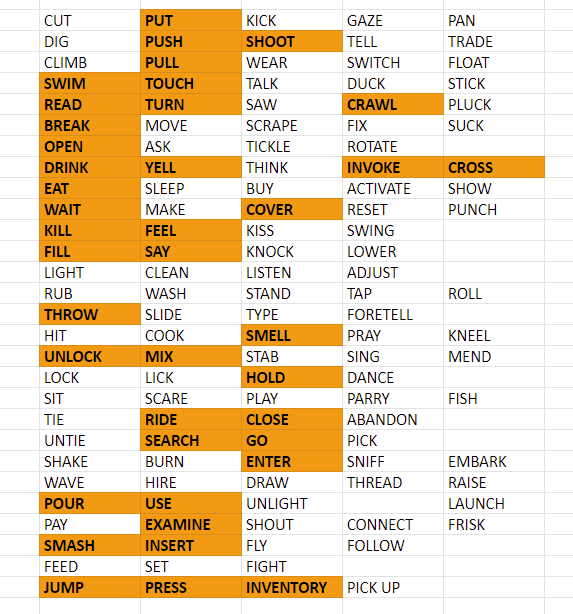
Nothing too remarkable to observe but I need to remember USE is in play as sort of a dread wild card (when the game throws in the towel in trying to figure out how to parse an action, USE is the go-to). I also need to keep SMELL in mind, and what’s INVOKE doing there? I think I’ve had that on a grand total of one previous game, the kind of verb like SCRAPE I only leave on the list due to stubbornness. It could be some different verb, but the parser is taking the first four letters, so it has to start INVO. (>INVOICE DRUNK PERSON FOR THE DAMAGES MADE TO THE BAR)
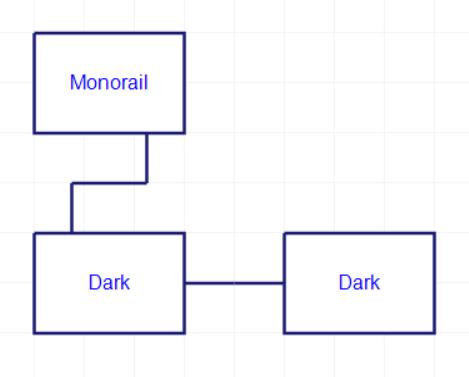
I am stuck with a monorail I can’t move because a voice asks for a coin; I’ve used one to pass through two stops (the second one was underground and dark) but the monorail won’t move any farther without another.
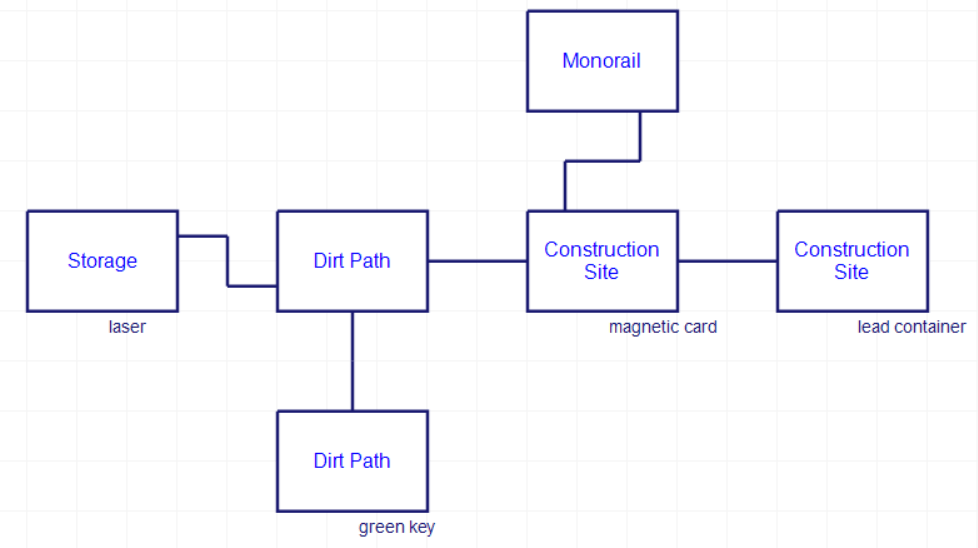
I suppose a reason b.) for being resistant to hints is that the map I’m stuck on is so small. It is possible I missed something earlier, but even including the dark area at the second monorail stop (where I already tried stumbling around, grabbing items off the ground I couldn’t see, etc.) I’m thoroughly scoured everything before this point.
My items available are
Beaker (full of oil): I already used to lubricate a lever in the monorail so it would move, but the beaker can be emptied and filled with another fluid (assuming one comes up).
Green key: Nothing locked yet.
Canister (made of lead) containing a glowing green stone: Radioactive! You die after holding the unshielded stone for enough turns but there isn’t a need I’ve found so far to ditch the container. It is possible the stone is intended as a light source (for the underground area) but I haven’t been able to move the monorail back to it.
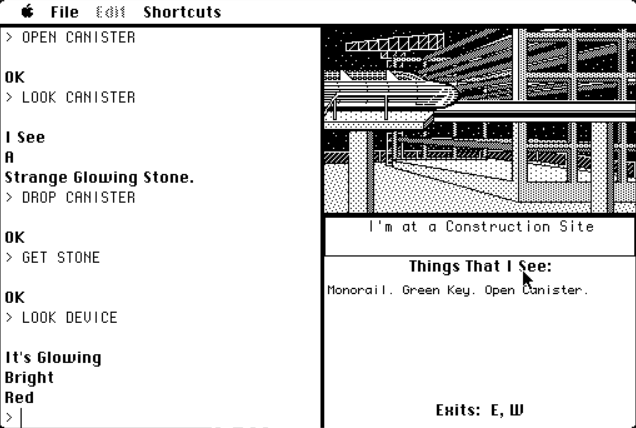
Strange Device: Normally glows green, but as noted in the screenshot above, it glows red when radiation is near.
Chemicals: They explode when you MIX them. I haven’t been able to get any other result.
Plastic Rod: “Deadly fumes fill the air” when you BREAK it.
Plastic Card: “Seems to be magnetic.” I’ve tried using it to rescue the coin used earlier to move the monorail to be able to move it again, no luck with any verbs.
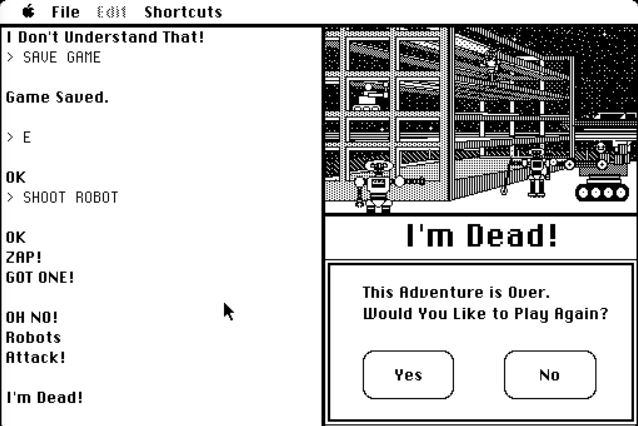
Laser Pistol: “There’s a small knob on it and 90 charges.” The knob sets it to overload and explode (you have enough time to drop and run away). You can shoot one of the robots at the construction site but then they all attack and kill you.
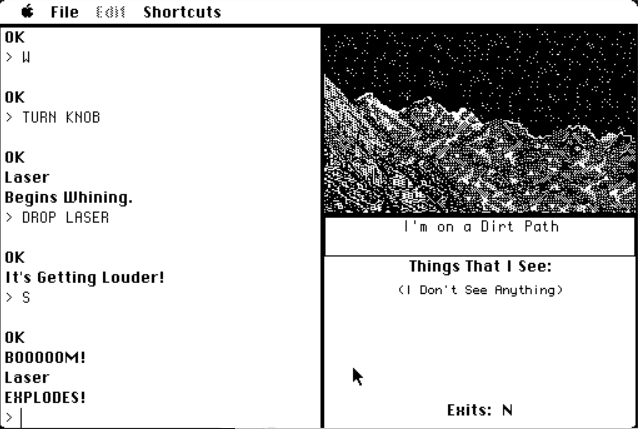
I’m still suspicious of the magnetic card, even though I’ve technically run through the entire verb list I’ve made. However, I’m also thinking there might be only one coin; the one I found is described as a “Small Token” as opposed to using some sort of color and COIN works as a synonym; for other items where there are multiples, the parser asks you explicitly to refer to the item by color (that includes, for example, the green key, even though there are no other keys nearby).
If the coin is irretrievable, that leaves either hacking the monorail with some other method, or even just moving on (perhaps at the construction site with the robots). I sincerely doubt the monorail is meant to be ignored now, though, as the “dark area” includes a two-room map; but maybe there’s a loop back to that area?
Going in a “wrong direction” leads to the player character falling and breaking their neck.
I’ve already shown a screenshot of what happens when you try to shoot a robot; if you try to blow them up by setting the laser pistol to explode nothing happens (you can’t throw the pistol at them like with the cube). They’re said to be building a nuclear reactor so possibly the stone will help “make friends” with them — although my efforts towards this so far have been for naught. Still, my intuition tells me the stone is just intended as a light source (meaning the timing of getting sick and dying leads to a timer for how long you can stay in the dark area).
I’m happy to take suggestions if you haven’t played before, but please no outright hints from anyone who has checked the solution (for now).
Here is the finale to William Demas’s very busy 1981 (see: Timequest, The Golden Voyage, Forbidden Planet), just squeaking in at the end.

From the January 1982 edition of 80 Micro. I’m considering the magazine lag time to be one month, and copyright on the game itself lists 1981.
Just like its predecessor, this one talks in its TRS-80 original incarnation, and the talking is absolutely terrible.
(If the audio player doesn’t show above, click here to listen. The sounds are “Welcome to Forbidden City”, “Password Please”, and “OK”. I cut off there, because the gameplay is followed by “OK” about 10 more times.)
Additionally, it also had a conversion to Macintosh several years later, under the name Futuria. I’ve having some emulation troubles with both the TRS-80 and Mac versions (can’t save my game in the former, can only play an online emulated version of the latter because Diskcopy on my virtual Mac doesn’t want to recognize the file) so I’m muddling my way through with both versions the best I can.
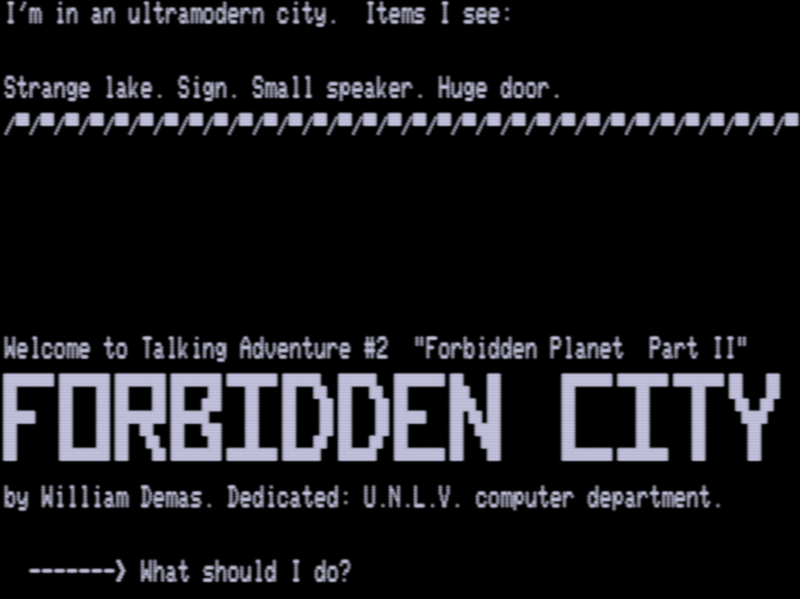

The action continues directly from the previous game, as (after crash landing on a planet) we arrive at a mysterious city. I assume the object is to find some sort of space vehicle and escape (although who knows, maybe we can become God of the Robots and settle down).
After some minor opening shenanigans involving a codeword to open the front door (“The Password is: 3 15 19 13 9 3”) and a long tunnel, you arrive in a city where the doors will kill you.

The map is pretty tight here; there’s just a few buildings, one guarded by a robot, and a monorail. The robot is unfortunately of the same type of enemy NPC in the previous game that attacks when a random roll hits, which means it can attack and kill you on sight (since you need to get by the robot once before taking it down, this means you can have “unwinnable” randomness).
Just past the robot is a cube with a red button that explodes on a timer.
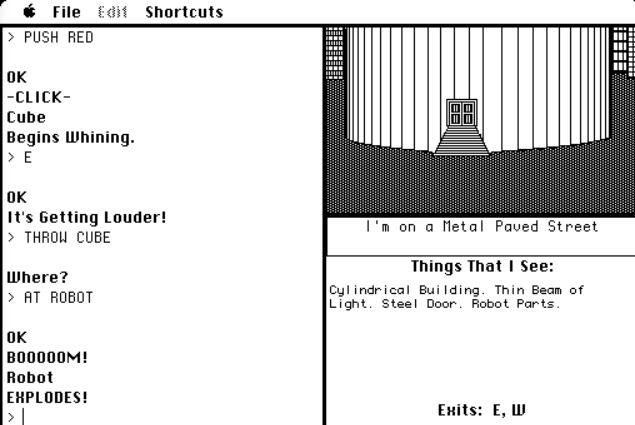
I was stumped for a bit on the electrocuting doors until I tried “FEEL BEAM” with the beam of light just outside — this caused the door to open.

The steps are FEEL BEAM, ENTER DOOR. Don’t try to enter the door without using the beam first or you’ll die. This seems unnecessarily hazardous, but there might be some later backstory that explains why the doors are trying to kill you.
I managed to collect a BEAKER, CHEMICALS (that explode if you try to mix them)…

…a PLASTIC ROD (that lets out deadly gas if you break it), a STRANGE DEVICE (“It’s glowing / light / green”), a COIN, and some OIL from the exploded robot (into the beaker). I was able to use the coin in the monorail and the oil on a lever inside to get it to move. It eventually slowed down and stopped in a tunnel that was entirely dark.
I tried valiantly to get a light to come on, but failed; however, I missed the fact that the lever could be moved another time to get the monorail to another destination, this time outside of the tunnel.

Nearby the new monorail stop are a green key, a magnetic card, and a laser pistol just lying around, and some robots that appear to be building a nuclear reactor…

…but since the monorail asks for a coin to move it again, I’m stuck here. I do have some strong suspicions about what to try next but this felt like a good place to stop. I will say, despite the frustrating amounts of death (I’ve forgotten to open doors and subsequently died three times now) the design has been relatively smooth (I especially liked the obviousness of “just move the monorail past the dark place” which still took me a few beats to get), and the map is constrained enough I haven’t feel the despair of sprawl I sometimes do on these games.
Short update today, but any superfans (or just regular fans) of Alkemstone may enjoy
the new Google Sheet, linked here, with every image and theories placed next to them.
It’s everyone-can-edit so feel free to annotate to your heart’s content. I’ll go back sometime next week and squeeze in some of the older observations.
Casey Muratori (who made the interactive map last year) also has made a Github archive for Alkemstone.
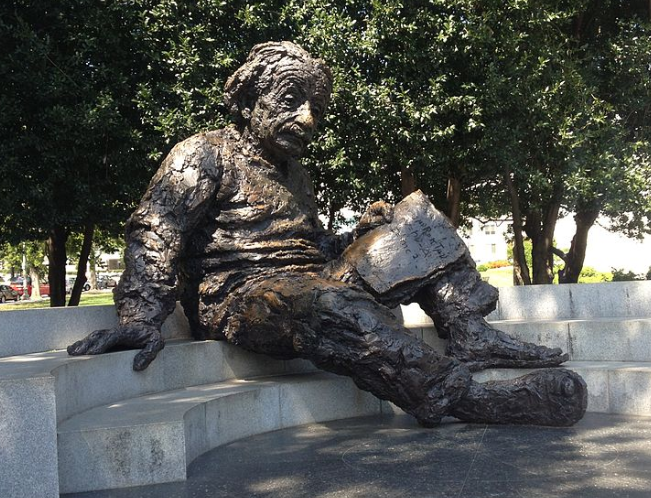
I don’t want get too deeply into clue theories at the moment from the previous thread (there’s quite a few), but Christopher Drum’s observation that the Einstein statue has a star map is surely worth mentioning, and that it shows the stars at April 22, 1979 at noon — when the statue was dedicated. There are enough astrology references it feels relevant.
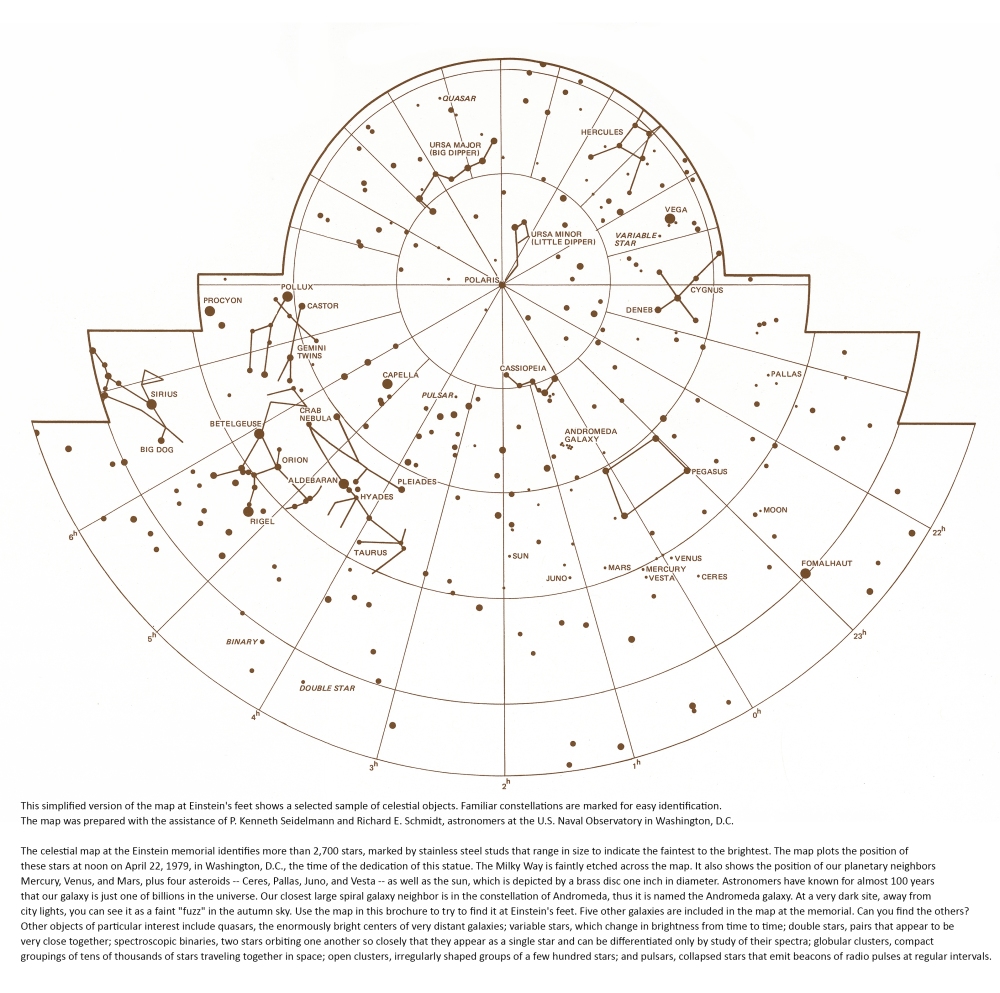
In fact, if you want to make a giant leap in the dark that is almost certainly wrong:
– start from April 22 (it is “just past winter” yet within Easter-range as hinted at other clues)
– go to the Washington Monument (which Andrew McCarthy observed is roughly a tenth of a mile high matching the DENVER/10 clue and acts like a sundial)
– wait for some particular time for the peak of the shadow to hit a particular spot
– search at the spot!
But what time? Noon won’t exactly work. The most obvious time reference is “TIME IS RELATIVE BUT SEVEN HOURS SHOULD BE ENOUGH” — seven hours starting from what time?
The search continues! (Also, I will be playing other games, and giving updates at intervals rather than just writing about Alkemstone.)

It has been a while since I’ve posted about the Apple II game Alkemstone (and some reading this might have arrived from elsewhere without seeing my previous posts) so a brief summary/recap:
Alkemstone was a game released in 1981 by the company Level-10 with a $5000 prize attached (later upped to $7500) where the titular “Alkemstone” was hidden somewhere in the real world, and the clues on where to find it were hidden inside the game. It was confirmed fairly recently by the lawyer in charge of certification that nobody has claimed the prize. The company that sponsored it is long defunct, and the object buried was not valuable in itself (you didn’t even need to extract it to get the prize, just explaining the location of the Alkemstone was enough), so solving the mystery is only of historical interest, but still — a 40 year old mystery nobody has cracked!
Last year I did a playthrough of the game, which involved running around a maze and finding clues that flashed at irregular intervals on the walls, ceiling, and floor. I managed to extract quite a few clues, but I knew (because someone on Mobygames found a clue I hadn’t) that there were still clues I was missing. I just didn’t know how many.
May I present to you:
To clarify, a reader (Andy Boroson) did some hacking at the game file itself and managed to extract the locations of the clues as well as a method of stopping the invisible-flashing-clue effect from happening. This led to him making a complete map…
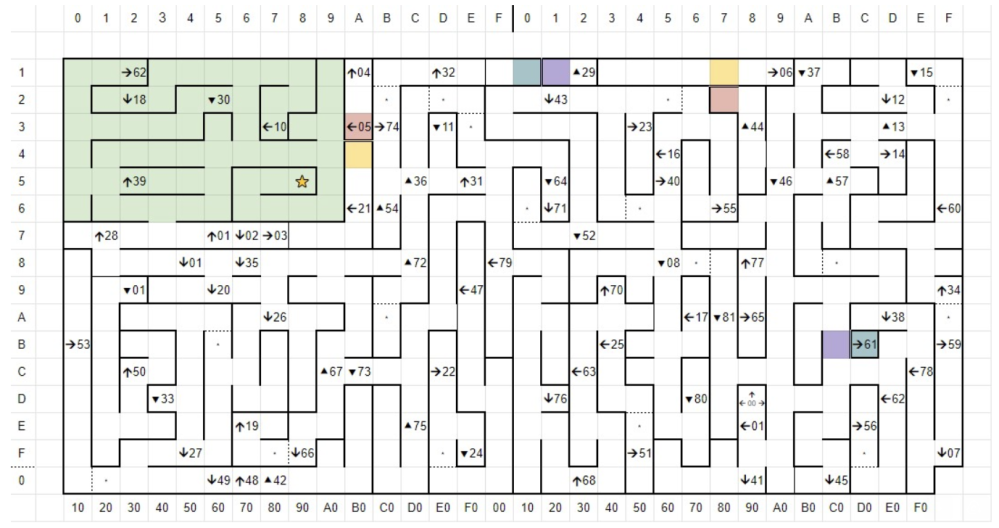
… and the file of images above. They are given the numbers matching the map above; some of the sequential numbers clearly go together (even if they aren’t placed together on the map) so the numbers themselves may serve as a clue. There are 80 clues (84 listed, but one of them is blank, and likely removed some time during development; 3 are “special coded” to be findable at the same location, marked “00” on the map) and I managed previously to find about 3/4 of them, but some of the missing ones have what seem to be essential information, so it is quite possible it was not feasible to crack the mystery until now, the moment I post this.
The ZIP file preserves the screenshots in a complete fashion, so I’m going to survey them numerically and clip images together when possible. (That is, what shows up as separate clues I have merged into the same image, for compactness; again, if you need “clean” images, refer to the ZIP file.) Additionally, some of the text clues are stored as text, so I’ll just give those in text format.
Are you excited? I’m excited.
Just as a note ahead of time, the main guess/presumption based on the clues is that the treasure is hidden somewhere in Washington, DC. However, there is nothing I’d call certain confirmation on this. I will say it is near certain (based on a trio of clues I’ll get to last) that the treasure is in a public place somewhere, meaning it should be in an urban environment, not hidden in some random place in the wilderness.
When booting Alkemstone, this is the first thing visible upon entering the maze…
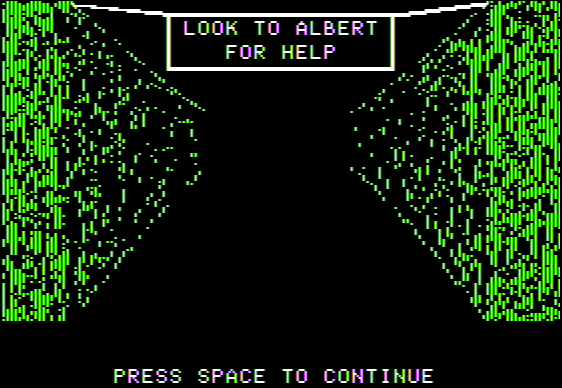
There’s no “hanging banners” style messages other than this one.
…which is certainly reminiscent of the Albert Einstein statue in Washington DC, which was finished just in time for it to be part of the game (1981).
#1 John F Kennedy
#2 Stonewall Jackson
#3 Zachary Taylor
The #1 and #3 clues are names of US Presidents, while the #2 clue is the name of a Confederate General. This suggests historical US sites rather than something dealing directly with the Presidency itself (like the numbers attached to each president).
#4 (on left)
#5 (on right)

Both suggesting wordplay, and #5 is new. There are multiple anagrams using the letters P, I, N, E, S so I’m not sure which one to prioritize, but I should point out the author’s previous game included an ambiguous anagram puzzle as well.
#6
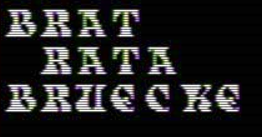
Bruecke is “bridge” in German but rata isn’t anything in German, but maybe it is wordplay leading up to that. (The Rs being lined up is intentional.)
#7 What You Don’t Do To Go
#8 (written as a fraction) DENVER / 10
Again not sure, although I have suspicion #8 is referring to Denver being the “Mile High City”, that is, the clue refers to a 10th of a mile. I haven’t had luck with zipcode or the like.
#10 Calentadora de dedos del pie
#11 Wo Adler sich sammeln
#10 is “toe warmer” translated from Spanish. #11 is “where eagles gather” translated from German.
#12 JOB
#13 TESS
#14 MARIA
The one and only puzzle I’m certain we have the real solve for. Roger Durrant pointed out that both names appear in the song They Call the Wind Maria from the musical Paint Your Wagon.
A way out here they got a name for rain and wind and fire the rain is Tess the fire’s Joe and they call the wind Maria
“JOB” is a “typo” but it may have just been an honest mishearing. (I don’t think it’s a clue, but you never know.)
#15 144
I theorized long that this possibly references the fact that with 12 zodiac signs you can pair them with another 12 to get 144 angles (there’s zodiac symbols elsewhere). However, I haven’t found any confirmers to put this guess at high confidence.
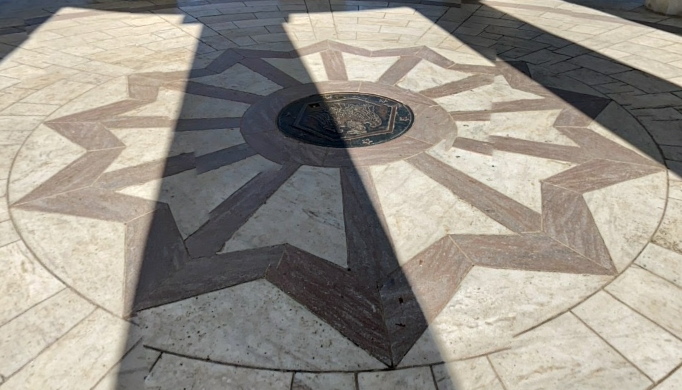
I also pointed out the War Memorial in Washington DC had a 12-arrowed floor that could be interpreted in a zodiac direction sense.
#16-#22
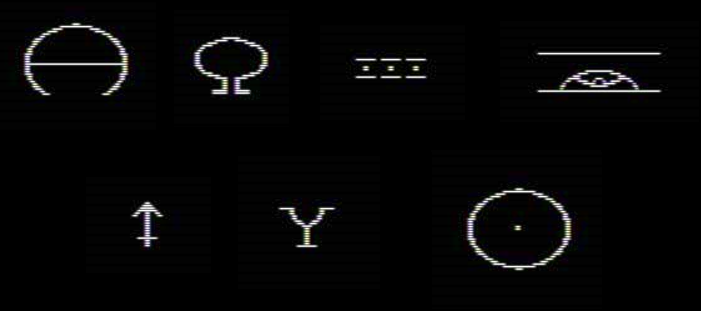
All 7 images appear in roughly the same spot when drawn, so there may be some relation.
#23

Not quite in the same place as the previous clues, so might be distinct. Possibly hinting as to a time of year, that is, Easter (there are later references to this as well).
#24
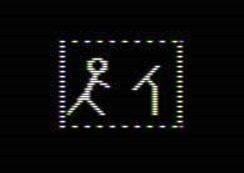
Hinting a place with a famous speech? Or perhaps a current place (at least current for 1981) where speeches can be made.
#25 BLACK OR WHITE They Are All The Same To Me
This is where the internal number I think is helpful — it certainly seems likely #24 and #25 are related, perhaps referencing the I Have a Dream speech?
#26 Don’t Smell The Salt
#27 THOSE THAT SEEK TO FIND MUST FIRST SEEK TO PASS
#28 Seemanns-warnung
#26 might mean avoiding the ocean. #28 is “sailor’s warning” in German. I’m not sure if #27 is connected.
#29 The First To Recognize The Second
#30 For Us It Is Already Here
#31 Of All This One Is Equal
Not sure on any of these.
#32 WITH GIN YOU BEGIN THE END
More wordplay? I feel like there’s got to be word fragments being glued together at some point (“join” is a clue later).
#33 For the One You Seek The Two Are Known The Three Are There
Again not sure.
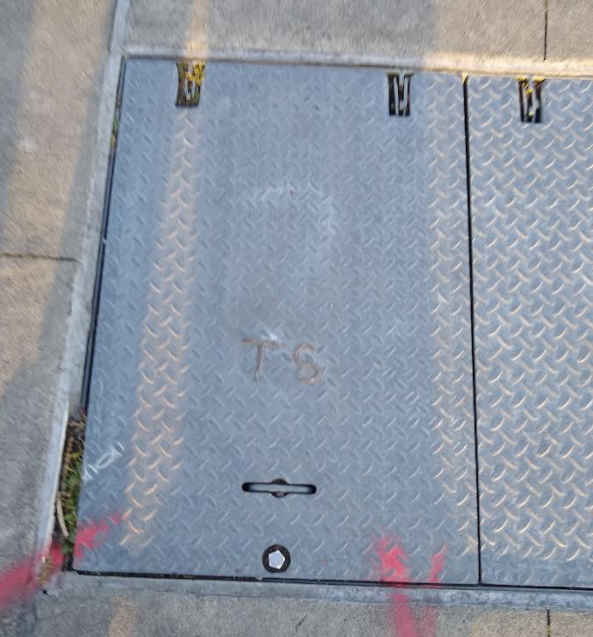
#34
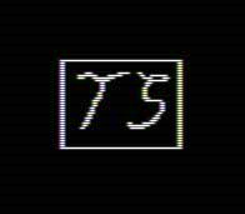
The two theories I’ve heard are a.) the signature of TS Eliot and b.) (courtesy Casey Muratori) a metal access panel.
#35 My first is sixth My second is content Followed by the rest Finally a child could play
One of those riddles indicating letters in positions, perhaps, or word fragments being mashed together? I could see “the rest” being the literal “day of rest”, either “sat” or “sun” depending on your theology.
#36 -CIDE
Another word fragment clue. If it is the same as #35, is SLIDE (“a child could play”) somehow tweaked to be CIDE?
#37 join
Again, internal numbering adds some information; this probably refers to #35 and #36, at least.
#38 Coat Of Blue
Possibly the Civil War song.
#39

Look between the pillars?
#40 ONU
Another word fragment?
#41 To Start Anew
Feels very crossword-clue to me.
#42

Bees tend to be popular in rebuses for the sound “-be-” getting put somewhere.
#43 Don’t Go When Winter Blow
#44 Warmer Than Others
Referring back to the potential Easter clue, this might refer to a time of year. Easter has to (no matter the year) land after winter. This also might be simply fitting in with rebus logic somehow (the fragment “apr”, for instance).
#45
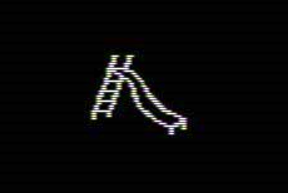
Redundancy with the child playing clue?
#46 GPI
#47 FTN
#48 pnijure
#49 BUSH
Not sure.
#50
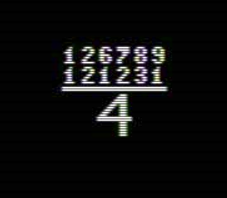
I’ve played with this one quite a bit (add the numbers on top, then divide, subtract then divide, etc.) without much luck.
#51 Nothing Runs Like A Deer / And It Is A Beaut
The “Nothing Runs Like a Deere” slogan has been around since 1972 for the company John Deere, but I don’t know if the intent here is a pun or something else.
#52 It’s Best To Rest
Another resting reference.
#53
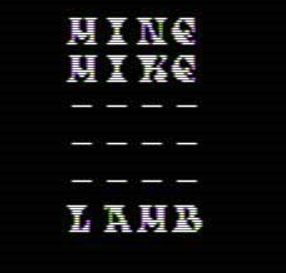
A word ladder? Don’t know what clue this indicates, though.
#54
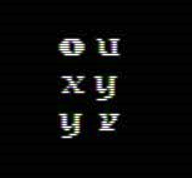
#55, #56
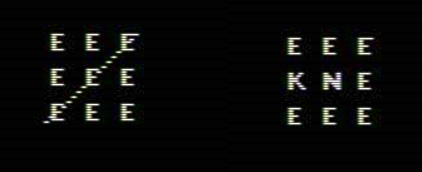
The best I could come up with here is a reference to the Battle of Wounded Knee, but I have no idea what that would indicate.
#57, #58
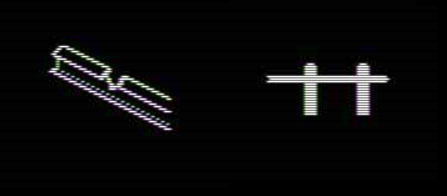
Is the first picture of a train or something else?
#59 It’s Not Right
#60 The road is clear But you may have to leave it To find your way
Is this referring to directions at the actual site, or literal wordplay still?
#61 KAMM
#62 CIBURA
More word fragments, perhaps?
#63 Don’t Tread On Me
Another American History reference? All four words are written on separate lines so it could be the initial letters DTOM.
#64, #65

5 is the base? Don’t know what the deal is with those parallel lines on the 5 then, if that’s the case.
#66 This Is Almost The Age of AQUARIUS
Another day of the year reference?
#67 TIME IS RELATIVE BUT SEVEN HOURS SHOULD BE ENOUGH
#68 THAT WHICH GOES DOWN / MUST COME UP
#69 follow your nose / where taylor goes / but not too far / you’ll find a scar
The last clue may refer to some specific site involving Zachary Taylor, although it is unclear what.
#70 ONE SHOULD BE TEMPORATE IN ALL THINGS
This might intentionally be related to time rather than a misspelling of temperate.
#71 Wherever You May Roam There Is No Place Like Home
#72 a billion stars may show you the way
These (plus clue #81) might reference specific museums in Washington DC. The ruby slippers from The Wizard of Oz are at the National Museum of American History, the stars might refer to Phoebe Waterman Haas Public Observatory (or that might just be another astrology reference so the clue goes with #66 etc. instead).
#73 Large And Small – Can’t See Them At All
#74 THE SUN ALWAYS RISES / THE SUN ALWAYS SETS
#75 WHOLE BUT NOT COMPLETE
#76 DO NOT OVERLOOK ANYTHING
#77 After Awhile We All Pay The Price
#78 MIDDLE AGE IS THAT TIME WHEN THE BROAD MIND AND THE NARROW WAIST TRADE PLACES
#79 THE HIGH AND THE MIGHTY MAY BE OF VALUE
#80 97914
#81 If You Want A Scene / Holocene and Pleistocene Might Do
#81 might be the Smithsonian Museum of Natural History.
Finally, not with regular numbering, there are three clues in the same dead end (corresponding to the three walls). I’ll give the pictures this time:
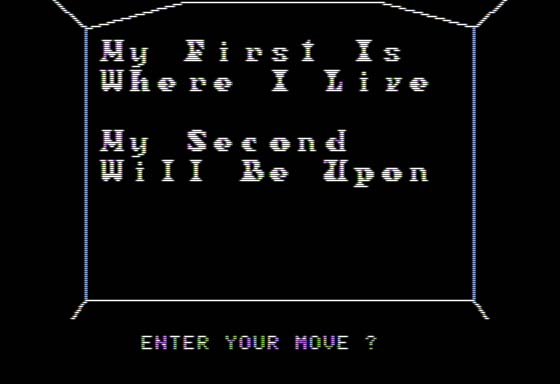
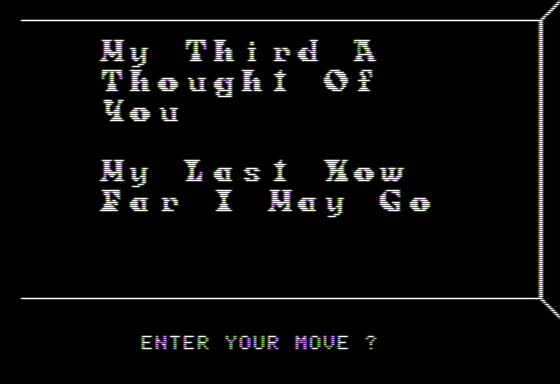
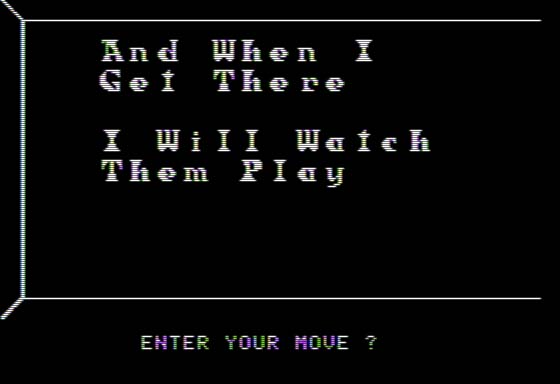
Due to the status in the game, I suspect this is a meta-clue showing the structure of what is being solved for “Where I Live” is one set of clues, “Be Upon” is a second set, “A Thought of You” is a third set, and “How Far I May Go” is a fourth. All this is still guesswork, though.
While the “watch them play” feels most likely a park, it is possible this refers instead to “play” as in music; either way, not wilderness? (Although maybe you could stretch with a particular named rock monument.)
I’ve skipped some speculation from my previous posts, so if you’re looking for more inspiration, feel free to read those as well as the comments which include some more ideas. It’s fair to say the puzzle is still wide open at this point.
ADD: I put everything into a Google Sheet. It has all the images in miniature and a place to enter speculation.
Well, I held up some dignity.
As usual for my end game posts: spoilers for absolutely everything, and you’ll want to have read the rest of the series first.

Via the Museum of Computer Adventure Games.
I figured out two cheeses that were very important.
1.) Normally, if you save your game immediately before going into a room talking to the Oracle, you will always get the same piece of information. However, if you do an extra turn (going in an impossible direction, for instance) the random generator will “rotate” and the Oracle will give a different clue. You can repeat this process (restore save, run into a wall twice, go east, talk to oracle; restore save, run into a wall three times, go east, talk to oracle; etc.) in order to eventually pump the Oracle for all the possible hints. On the saved game I was using as my “final run” (no particular logic, I just decided enough was enough) I managed to extract these relations:
powerring: belrog
truthring: lightring and flute and akhirom
shield: dagger
lightring: powerring and rope and nergal
vial: talisman and mitra
skull: okkan
sword: rope
defeat satyr: sword and negral
defeat troglodyte: spellbook and crom
defeat sprite: skull and powerring
defeat minotaur: sword and shield and powerring
defeat scorpion: talisman and powerring
defeat nymph: flute and okkan
(The one monster I never saw a hint on was the nine-headed hydra, but it has its own special circumstances.)
Some of them cause dependency chains; for example, you can’t get the truthring without the lightring, flute, and akhirom spell; you can’t get the lightring in order to get the truthring without the powerring, rope, and nergal spell, and so forth. (Nergal isn’t an item, but a spell — that explains away my confusion last time, since it’s just a magic word and not a noun.) It would have been utterly impractical to play without the list above.
2.) Perhaps even more important than #1, the earthquakes that happen at random and block exits do happen based on time passing, but they are not inevitable. That is, there is some random chance at minute X that an earthquake will occur, and if you get unlucky, you can restore a save game from far enough back and find the next time minute X passes there is a different result (that is, no earthquake).
Despite a few workarounds (the powerring lets you just plow through blocked exits, for instance, and the spell CROM clears them out but it takes a while to get) this was the key that made the game playable. It is possible (as Voltgloss indicated in a rot13 hint) to “wait out” a blocked exit (they eventually “rotate” places based on further earthquakes), but the end result is often followed by yet another blocked exit immediately after, and it becomes too hard to track monsters that move around (and in the early part of the game, items can move around as well as long as the sprite is still alive).
Even with these extra edges to my game, playing was very difficult and intense. The main issue is that inventory capacity is very tight; in practical circumstances you can carry at most three items, but sometimes even two or one. Inventory is especially hard to juggle when a JUMP or just climbing up a staircase is necessary. For example, to get to the “escape room” where treasures are stored, you just need to go UP from the very first room of the game. I found a ruby out in the open, and carrying the ruby and only the ruby, I wasn’t able to make it up the stairs! I had to make a full loop around — as I mentioned last time, there’s a pit in the bottom floor that will go to the right place. Even then, the JUMP at the end to the last location can be unsuccessful!
To make progress, the first thing I did was go after spells. I did, finally, manage to get the mushroom and food together after great effort. (Remember, this first step isn’t mentioned in the original manual, only the one for the Dragon! I’m not sure how anyone back in the day made any progress.)

Fortunately, as shown above, you get a “thread” to follow for all subsequent spells. To “activate” each spell requires bringing an item to a particular room and the previous spell; the rooms are all described as “crackling with magic” and are spread across the map almost entirely at random.

Green-marked places crackle with magic. I think it is always 1 room on the first floor, 3 on the second, and 4 on the third floor.
Getting to each step was essentially like solving a logistics puzzle. For example, Nergal requires a vial. The vial needed a talisman to get (and a previous spell I already had, Mitra) so I had to loop around, get the talisman, then take the talisman to the place I knew the vial was lurking (the minotaur lair) which only had one way out, down to the maze level. Then I tried to jump from the maze to the first floor, but I kept dropping the vial in the process. I ended up not quite having enough strength (it’s a depleting resource; it can be reduced by getting hit by monsters, failing jumps, and casting spells) so I had to leave the vial behind, grab some food, and loop back and keep my fingers crossed I could handle getting the vial to the first floor.

Once I finally managed it, I wasn’t done yet! I had been eliminating “magical crackling” rooms (only one spell per room), but I still needed to figure out the right one to take the vial to.
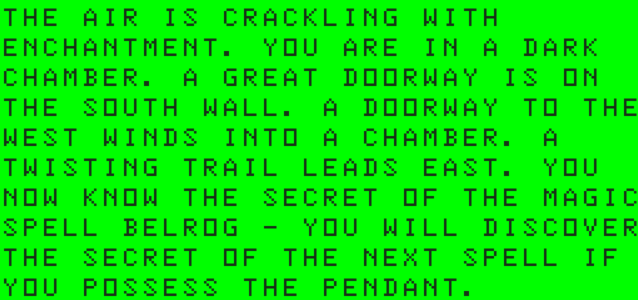
Up to here the spells had been, in order, VETAN, MITRA, OKKAN, AKHIROM, NERGAL. I hadn’t gotten any of them to do anything yet! (I figured it out later, and they’re mostly very specialized.) However, BELROG (as obtained in the screenshot above) turned out to be intensely handy, because it forced a jump into working. This meant all the spots I had trouble navigating because I would drop an object trying to go in a particular pit or over a particular chasm I could just spell my way over.
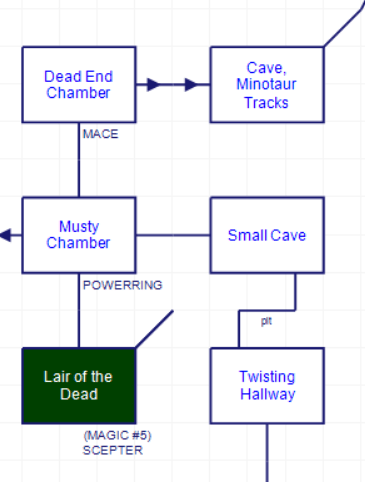
Quick example: this portion on the northeast corner of the third floor map is only reachable by jumping over a pit, but the pit was such that I couldn’t jump over with nearly anything in my inventory. So I would have one essential item but be stuck in getting it to that area. With BELROG I could get it over no problem. The only downside is it eats up health.
BELROG made the actions after go a bit smoother. I managed to get CROM and then finally ISTHAR without too much trouble after. Despite me looking forward to CROM because of the earthquake issue (remember, CROM clears blocked passages) I ended up not needing it because of Cheese #2! ISTHAR, on the other hand, originally gave me a surge of joy — it teleported me directly to the forest where all the treasures go! But it stopped working, and I found it later it only gives a couple uses before being entirely gone (the spell does not “regenerate”).
Still, after ISTHAR, I had the full set of 8 spells, and each spell gave me 10 points, so I already had much more progress than from the 0 I had before. Next I wanted to take down the monsters; each of the monsters (except one, which I’ll get to) had a treasure, so I knew I had to take them down. I figured, even if I made no more progress, I couldn’t leave a game called Madness and the Minotaur without killing the minotaur.
I wanted to go after the sprite first, so I didn’t have to be paranoid about items being shifted around the map any more. (In practice, it didn’t happen much, I think because I was very tight and efficient as far as saved games go due to avoiding earthquakes.) This required getting the skull and powerring, both which fortunately only required spells to be in inventory (so I didn’t have to juggle the “required item tree”).

The treasure dropped lands in an adjacent room.
I wanted to tackle the nymph next, but the nymph required (in my iteration of the game) a flute, and the flute was in the room with the nine-headed hydra, and the hydra is unique amongst the monsters for pushing you out of the room when you try to enter. So I tried valiantly to handle the hydra (given I had no oracle hint) but failed enough to look up hints; there’s a fixed solution here.

That is, you’re supposed to use an action on a noun that is not present in the room the action is done in. This breaks one of the implicit adventure rules pretty hard, but given how tough everything else was, I couldn’t be disappointed.

Once I tied the hydra up I could go in, but even the walkthrough I consulted had me confused; it indicated you could STAB with the DAGGER, but that was unrecognized. Using the sword was futile, as shown above. I eventually resorted to trying every spell (I remembered the manual saying one of the spells could defeat monsters) and hit paydirt.

The NOTHING SPECIAL HAPPENS is a bug — that’s what the spell normally does, and the fact it worked here didn’t override the text.
The most difficult monster after was the minotaur. This was because three items were required (sword, shield, powerring) and remember the weight limit is extremely tight. I essentially had to max out to full health (with a mushroom) and race as fast as I could with the three items to the right spot. I failed the first time (an item gets automatically dropped when your strength no longer sustains your inventory) but managed it the second by optimizing my movements even tighter:

For my last monster, I was stuck longer than I should have been. I saved the satyr for last, which the oracle reported I needed the sword and negral spell for.
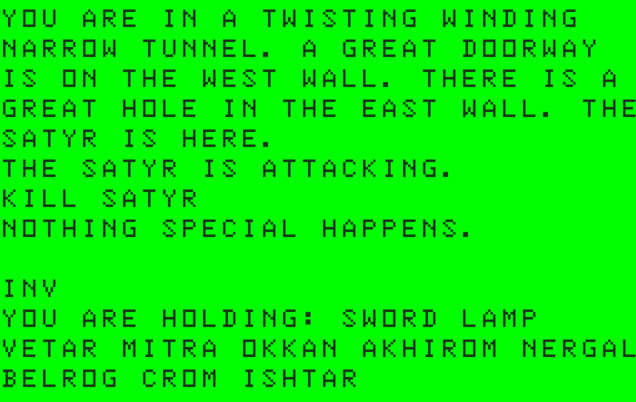
I baffled for a long time before realizing I had, in fact, killed the satyr — that’s the message when a monster doesn’t have an item. One of the six randomized ones (not including the hydra) has no treasure, so the satyr was skippable on the map I was playing. (I was fooled for a while thinking the Oracle was lying to me — the manual hinted that could be the case — but the Oracle can’t lie. I’m guessing it was a cut feature, since the truthring is an item that exists but does nothing mechanically in the game.)

So the next step would normally be to go find all the treasures … but I’m honestly fine stopping here. I’ve got a little loot (shown above), I’ve eliminated the threats, I got a full bevy of spells. I think I can call the expedition a success.
I did look up some of the treasures, and there is a little puzzle-solving involved. Unfortunately, the brutal inventory limit makes it very hard to experiment, and find things like:
- there’s a parchment with music, and a flute; if you take them to a room where you hear “music” on the maze level, and play the flute, a ledge appears; with the rope you can get a treasure from the ledge
- there’s a packrat with an item that it will give you if you are holding some other specific item; the specific item it wants you to be holding is randomized
- there are two openable “crypts” that require all items dropped and the player to be at full strength, although one you can use for a powerring for (not the other!)
- there’s an item in a random spot in the first level that can be found by turning the lamp on in a particular room (!?)
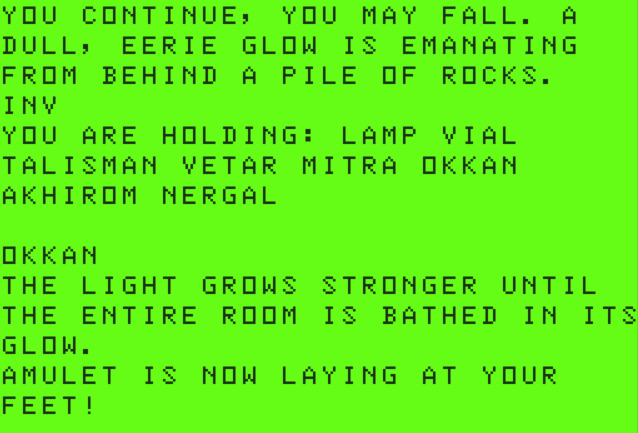
- there’s some glowing rocks where an amulet appears if you cast OKKAN, which is used nowhere else (I solved this one, but never bothered to get the amulet on my “final save”)
Despite — or perhaps because of — the majority of the game being dominated by logistics — figuring out which route to get to the next item, juggling inventory, keeping enough saves to handle if an earthquake happens — this was distressing to play in a unique way, like the game came from an alien world with different ideas about “entertainment”. Oddly, the game can be forgiving in certain aspects; the food, for example, randomly appears somewhere else after you eat it, so you never “run out”; the lantern has a pretty forgiving oil timer, plus there’s an URN with extra oil and after you get the last spell POOLS OF OIL start randomly appearing (and if you use one up, another randomly shows up elsewhere). So the game tried hard to be “fair”. It also made every effort to make the mere act of traversing the map painful, and over half of my expeditions ended in failure as I couldn’t make it over a pit, or an item I expected to be able to take got stuck, or I just simply got confused in the maze.
In a design sense, the prominent question is: did any of the randomization work?
1D4D: 1A ; TROGLODYTE
1D4E: 45 0B 38 80 ; AX, SCEPTER, MITRA
1D52: 23 7D 80 ; SPELLBOOK, CROM
1D55: 43 07 3B FF ; DAGGER, SHIELD, NERGAL
1D59: 1D ; SATYR
1D5A: 46 3B 80 ; SWORD, NERGAL
1D5D: 44 2B 38 80 ; MACE, LIGHTRING, MITRA
1D61: 23 77 FF ; SPELLBOOK, VETAR
1D64: 1E ; MINOTAUR
1D65: 46 07 2A 80 ; SWORD, SHIELD, POWERRING
1D69: 44 0F 0B 38 80 ; MACE, VIAL, SCEPTER, MITRA
1D6E: 45 3B FF ; AX, NERGAL
The above is clipped from the source code. This indicates the different combinations possible for different monsters, and it does seriously change some of the sequences — just needing the ax and nergal spell for the minotaur would have meant I could kill him relatively early in the game, for instance, and not have to finesse with great difficulty in order to carry three items at once.
However, the randomization essentially set a “strategy game” background, as the “adventure game” parts — like the layout of the map itself, and some of the puzzles — were fixed. The overwhelming difficulty of the game makes it hard for me to evaluate how successful it really was. I could see with some nudges to a lighter difficulty the system being more successful. There’s at least one more chance to try out the idea, as there was a follow-up game to Madness and the Minotaur. Quoting John Gabbard again (I quoted him back at my first post):
The first program I wrote for Spectral was Keys of the Wizard. I use the term “wrote” very loosely, because the underlying code was from Madness and the Minotaur and most of the “writing” I did was in the form of map changes, dictionary changes and room descriptions changes. There were a few code changes and additions that changed the way battling creatures worked, and that gave a few of the creatures the ability to “catch your scent” and follow you, but it was mostly Madness code.
So, we’ll see if Keys of the Wizard holds any redemption for the ideas. I can say personally this game made for a weary week and I’m glad for the time being to put myself to more traditional pastures.
I’m going to say this is my second-to-last post on Madness and the Minotaur. Next will come fire or glory. Which is more likely?

As this will be relevant later, here’s Nergal, Mesopotamian god of plagues, war, and death. Picture by Neta Dror, from the collection at The Israel Museum in Jerusalem.
95% chance fire. I still haven’t gotten the first spell yet, that is, the first thing the game needs you to do.
I did, at least, managed to put the jigsaw puzzle of the map mostly together. I realized, from last time, that I didn’t need to “teleport” to the maze level from the 8 by 3 block I mapped out if I shifted things over a bit, and had the “slide down a row” effect happen on the edges.
It didn’t quite make an 8 by 8 map like it was supposed to, but I took the guess I had part of the map wrong (due to randomness or just confusion) and indeed, once I fixed my small error, I came up with a complete 8 by 8. Behold.

In other words, I was mapping the fourth level all along, so the two parts connected! I was also able to make it to a “great forest” that connected directly to a pit:

I’m passing on discussing the other 8 by 3 chunks of the maze, which are all similar to the first one I mapped with a few random teleport exits; I’m not sure if it’s worth deciding the exact logic since the main thing required is to visit enough rooms to find all the items.
I already had the Great Forest mapped: it’s the place where the treasures go, and is directly over the starting room! So this is where you can loop from the fourth floor back to the first floor relatively reliably, assuming you can make it through all the squares without being stopped.
It’s that “assume” that is a giant conditional there. I lucked out on my traversal, but sometimes when testing out the maze I have my passage stopped by a room of “strong magic” and I’ve been completely stuck.
I was originally wondering what kind of system the game has for preventing impossible scenarios. Now I’m thinking that, more often than not, the game presents impossible scenarios. Let’s consider my current dilemma, which I know from Manual #2: finding a mushroom and food, and getting back to the first level to find a room “crackling with energy” which should have the first spell.
The food seems to always be on the first level, and the mushroom on the third. Here is one attempt at getting the mushroom:

The enchanted aura is technically helpful — it is supposed to heal you — but it also teleports.
I keep getting stymied for one reason or another; there are two “direct routes” passages from floor 1 to 3 (where you can go straight down twice) but often (on my random reroll of the map) they are both blocked, and any longer route usually has either magic or some monster (like a hydra) that prevents getting through.

The two I circled are mostly straight paths to the mushroom area. The one to the right is one-way, so it requires getting back up a different way.
I have managed to get both food and mushroom, but then found I couldn’t get back to the first level; for example, one time I took the route starting from the Large Empty Hall circled above (where I can’t go back the same way) and found myself completely blocked in.
I may still be missing some exits, but given this is all happening on the very first puzzle, what’s to stop the same issue with happening for any of the others? And what should I be doing after, anyway? Remember, puzzle solutions are randomly generated. I can ASK ORACLE on the spare chance the oracle appears…

I have no idea what the “Nergal” is. The only definition I’ve seen is the god shown on the top of this post. Is it a statue of Nergal, maybe? I can’t imagine we are toting around a literal god. It might just be a made-up name for an undescribed magic gizmo, of course.
…but that’s only one of multiple puzzles, and importantly, there doesn’t seem to be any logic to the connections. I took a bunch of new game starts and made a beeline for the gazing pool in the northwest, which indicates what is required to “solve” getting the spellbook.
skull and flute
mushroom, goblet, belrog
powerring and nergal
pendant and crom
It may be it is possible to deductively reduce some puzzles based on other puzzles, like Clue; it may be possible to leverage saved games to be near and oracle and somehow get different clues at each ASK ORACLE; it may be there is no good method to figuring things out at all. The main issue is I’m expecting an adventure game to have some sort of consistent inner physics, either real or magical, and this breaks that to such an extent I’m just not finding the experience that enjoyable.
But maybe things will improve if I can just solve one thing. (Technically … I did! There’s a shield on the wall on the first level that is “too high” to reach. One time I was able to take it anyway, and I realized after some elimination that it was from carrying the dagger. The dagger doesn’t always work for that, though. In one universe, you could imagine reaching up with the point of the dagger just high enough to reach the wall, but in another, you can’t do that for no apparent reason, nothing described by the game itself, anyway.)

Another failed attempt to escape with the mushroom.
I’ve got a little better grip on the overall map, although I’m not done sorting it out yet.

I used this isometric drawing tool.
Blue parts represent “normal” rooms, grey rooms are the Maze where every room looks alike.
I made a guess (after the four maps from my last two posts) that the structure matched the image above, but when I got into one of the 3 by 8 layers by entering from a “small library” on the first floor I found myself confused and worried there was teleporting between floors or my concept was wrong altogether.
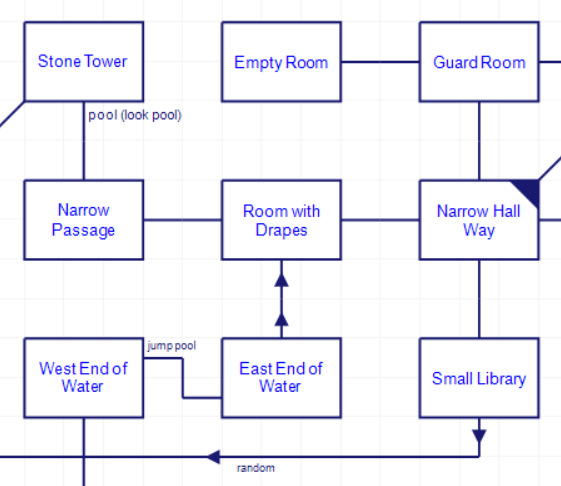
The passage marked “random” is what I’m referring to — it always seems to go to somewhere in the maze, but after some testing one of the consistent rooms was a room with a scepter, so that was the starting point I used. On one of the other random starts I found a goblet that I knew later was on the same floor, so I think that the teleporting on this exit really does only happen within the first floor, not between floors.
The map strongly resembled a 3 by 8 block without any barriers, and where every exit went up or down. I found out from testing that going up or down four times looped back to the room I started in, so I think the maze just wraps around.
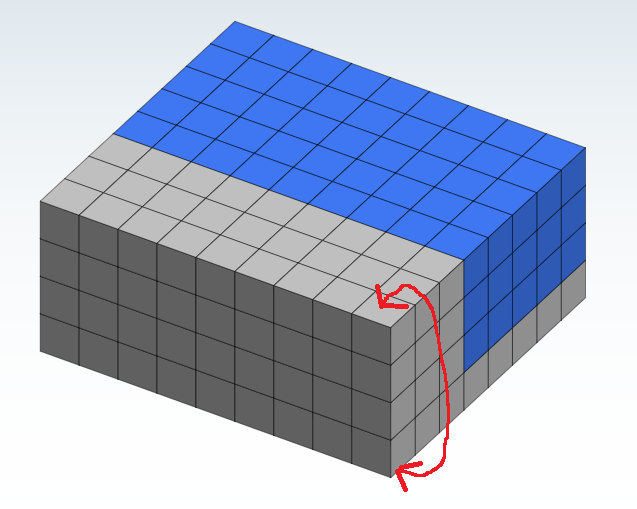
However, it wasn’t quite a 3 by 8 block, and it certainly didn’t just loop east-west; going west repeatedly did not go back to the scepter. I puzzled for quite a while and found the author had just done a slight perturbation.
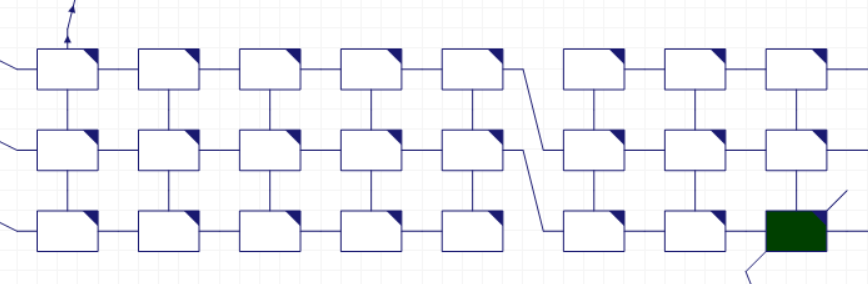
The green room is the scepter room, the exit to the northwest goes to a maze room on the bottom floor, and the west and east do wrap around.
One slight twist was all it took for me to be puzzled for over an hour. What I find interesting about this setup (other than it not matching any other maze we’ve looked at for All the Adventures) is how, from the author perspective, this seems like a minor change. I expect the author misestimated the level of difficulty. In practice, the small “offset shift” made it easy to become confused and made the maze quite difficult, a little like navigating a moebius strip.
Having said all that, I’m still not totally sure I have the floor mapped right, because of one slight detail: when entering the small library immediately before entering the maze, the game does a long pause; the sort of long pause that indicates something is being fiddled with from behind the scenes. Is the maze slightly tweaked before entering? Is the pause just from randomizing the south exit? Is there some other obscure technical reason for the pause? I still find it possible that everything I think I know is still wrong.
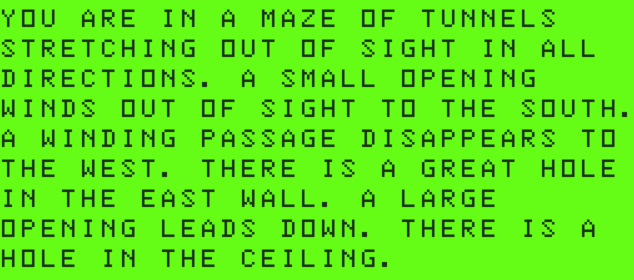
One last detail: it is easy to get confused reading the description since it recurs so often. Do you see that there’s no north exit? Remember that room descriptions just repeat if you can’t go a particular way, so it is possible to visually miss the lack of north, try to go north, add an entirely wrong space on the map, and go on a completely impossible tangent.
As I alluded to in my last post, there are two manuals to this game, one for the original TRS-80 Color Computer version and one made a year later for the Dragon computers (for the European market, similar hardware to the Color Computer).
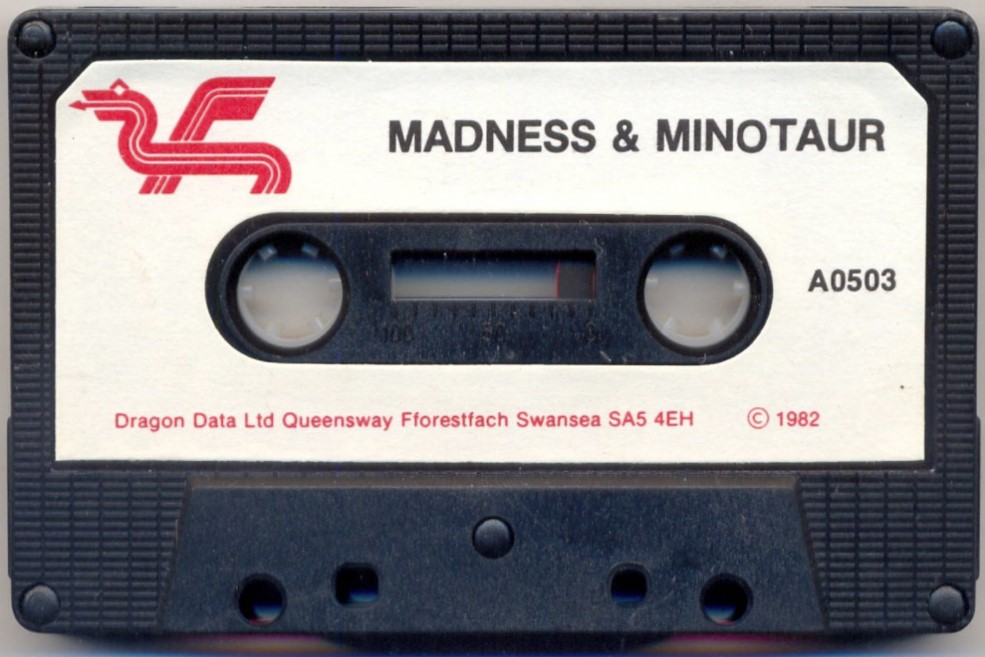
From World of Dragon.
I’ve already squeezed most of the juice out of the original manual except for a few tidbits:
- The sprite (which I’ve met on the first floor) moves items randomly, but can’t do this in the “first floor room with music”. I have yet to find a first floor room with music.
- JUMP can be reduced in effectiveness if you are carrying too much.
- The lamp runs out of oil and is refillable.
- The spell CROM can help if passages are blocked (and it is possible for an earthquake to block you in entirely).
However, the second manual includes different information! It reads as if the porters (Dragon Data Ltd.) decided the game was too ridiculously hard as-is and added some more pointers.
- Spells are learned in rooms that “crackle with enchantment”. You learn the “first spell” by taking the food and the mushroom to the enchantment room on the first floor.
- Actions, even important ones, can sometimes only randomly work, although important actions should only need repeating a few times.
- Some passages will send you to random rooms “depending on circumstances”.
- Monsters are killed by typing KILL MONSTER while holding the right objects (the object information comes from the Oracle).
There’s also a complete verb list; in addition to the standard ones there’s
EAT, ASK, KILL, HELP, TIE, GRAB, JUMP, DRINK, RUN, CLIMB, PLAY, FILL, OPEN, STAB, THROW
The vast majority of gameplay centers around movement and getting items, so it’s good to know the exceptions like PLAY or TIE that might come up.
Having said all that, other than mapping part of the third and fourth floors, I still haven’t made much progress. Here’s what I have of the third floor:
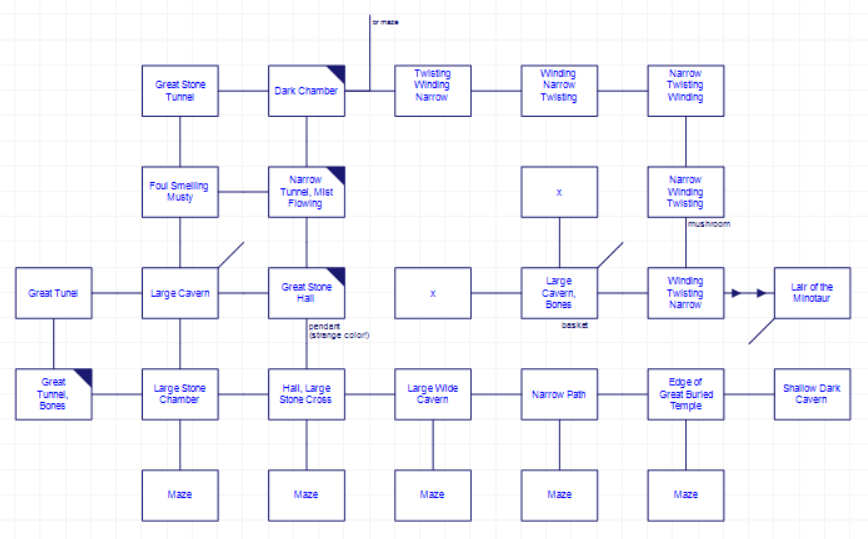
Assuming everything is lined up the same as the previous maps, I’m missing the first row. Exits from the fifth row going south all led to a Maze (I think, all to the same Maze, but I’m not certain, so I haven’t mucked with that part of the map yet). I managed to make a full circle to a Lair of the Minotaur…

…but otherwise didn’t run across much. Going of a different direction rather than entering the lair led me to a room where magic kept pushing me out.
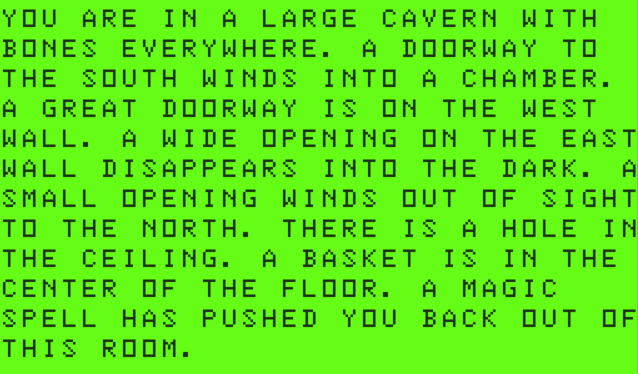
Usually when I’ve been told “a magic spell has pushed you back” I’ve been able to enter a room with enough persistence; trying to re-enter enough times and the magic doesn’t trigger. However, in this case, I tried many, many, times with no luck — I suspect a spell may be absolutely necessary to enter here (but possibly only on this random iteration of the map!)
It is also possible for magic to “greatly” push you, in which case you get teleported and not just pushed back, and usually lose an item while you’re at it.
Down from the minotaur lair I made it to a level that was just Maze, so I decided now was a good time to try mapping it (especially since I suspected I was dropped into a “regular” section and not randomly dropped somewhere).
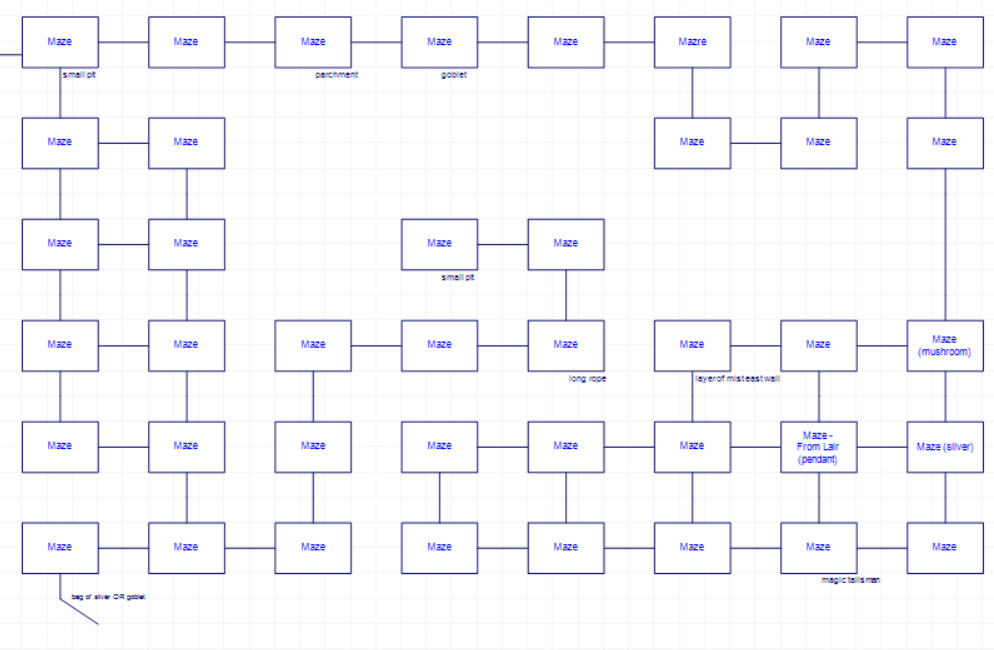
The “long passage” to the right indicates things are likely a bit off, and the layout is made doubly weird by the southwest corner, where I realized when going south I wasn’t walking in a new location but rather teleported to an old one (I could confirm by dropping objects in those places and looping back around). More than that, the teleporting happens to at least two different rooms! The “depending on circumstances” from the manual about passages going to different places is coming to bite me here, since the circumstances as to why it goes to destination X vs. Y are very unclear; even if it turns out the choice is made by some object I’m holding, is that choice of object itself random, or is there some clear system of navigation I can use here?
Here the property wasn’t too painful, but on a later attempt to loop back to the minotaur lair I found one exit that had given me progress before suddenly teleported me instead.

That is, going east from the Dark Chamber normally is the path to the lair, but I got zapped to the maze instead for no apparent reason.
I decided before trying to finish my play session I needed to try getting the first spell, that is, getting the food and mushroom as suggested in the manual and finding the spell room on the first floor. I failed even at this.
You see, I first made reloaded my save game where I made it down to the maze with a mushroom. I had found that you could JUMP PIT in the northwest corner to escape, and after some more convoluted pathing ran back up to the first floor. I didn’t have the food yet, but it had already generated on the first floor so I’d figure it’d be an easy matter of grabbing it and finally getting a puzzle solved. No dice.

I had lingered too long mapping: now nearly every passage I tried was blocked! The earthquakes that had been happening as I was playing, in real time, slowly were closing the map off, and it was impossible to continue. The earthquakes mean that the game is completely real-time, not just semi real-time; that is, it isn’t just speed in individual rooms that matters (like outrunning the fog) but over the entire game. Typing fast is going to be required.
I took another run, this time grabbing the food quickly and making a beeline for the third floor (which seems to always be where the mushroom is) but then I couldn’t get out! This was a variant where I couldn’t enter the lair (for reasons I already explained) and another passage going up that seemed to be a straight shot to the first floor had a “strong magic” that kept pushing me out. I eventually could get to the first floor but not while also holding the mushroom (as the magic knocked it out of my hands).
Even using an explicit hint from the manual as to what to do first, I haven’t yet been able to accomplish the task! I’m still going to avoid looking at the walkthrough (I need to try mapping the stranger parts of the maze first) but I predict it will almost be inevitable at some point.


 Renga in Blue