The story so far:
PRISM was a storydisk/game released by a business software company, International Software Marketing, in 1982. Inside are clues that lead to real life buried treasure: three golden keys. Back in January of this year, I wrote a series about the game and the commenters of this blog took a swing at solving the puzzles.
My original posts used the Apple II version (which still seems to be the original intended platform), but an Atari version surfaced as well (thanks to Atarimania). By comparing the two versions it became clear there was nothing special hidden in the layout of the text-only pages.
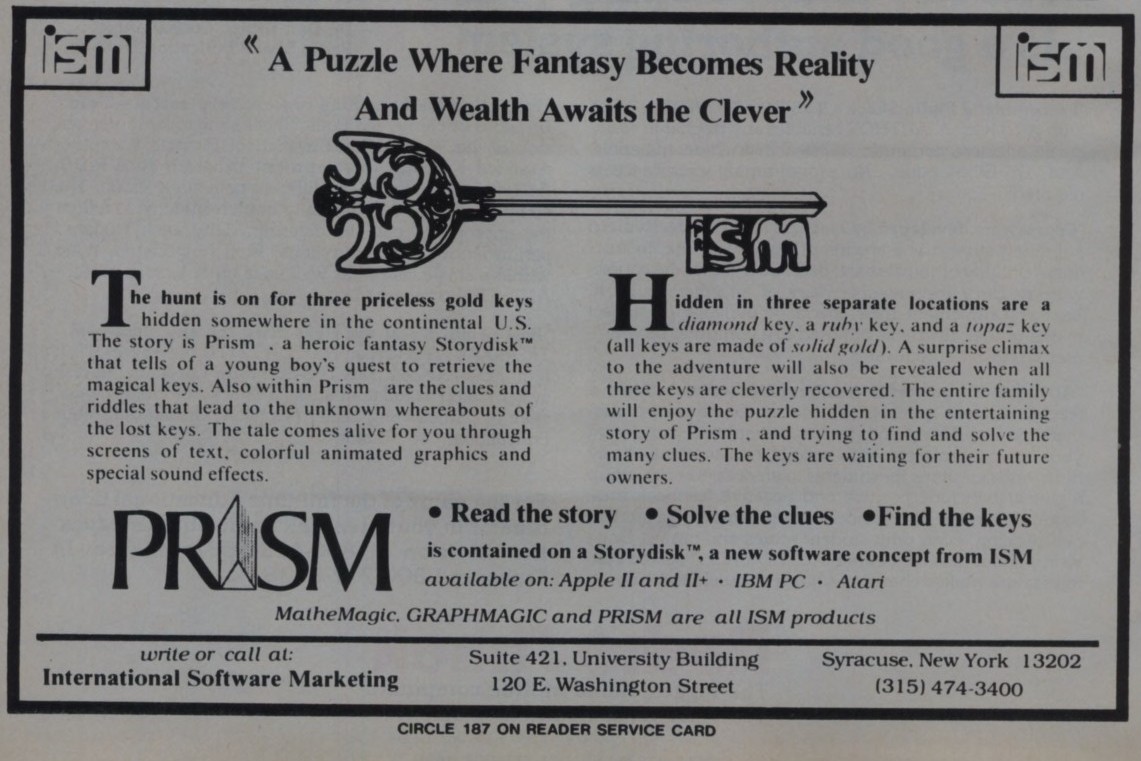
Via the January 1983 issue of Creative Computing. This is the first mention I’ve seen of a “surprise climax” that will be revealed when “all three keys are cleverly recovered.”
I wasn’t expecting to do any updates this week, but: back in February, velvetfistironglove had pointed out a mention of an IBM PC port in PC Mag, and linked to a CP/M version which might be related. (I had filed this away but I was burnt out on PRISM enough I figured I’d return to it later.) A few days ago, LocalH picked up the baton, and found that the CP/M file was for the Toshiba Pasopia computer, or more specifically, their T100 computer which launched in the United States. The only catch is the file did not want to run.
After some more work (from Rob, gschmidl, and the crew of folks who worked on rescuing Mystery House II including bsittler and eientei) it became clear the issue was the embedded copy protection, and after ripping that out, the storydisk/game became playable. (Download here.)
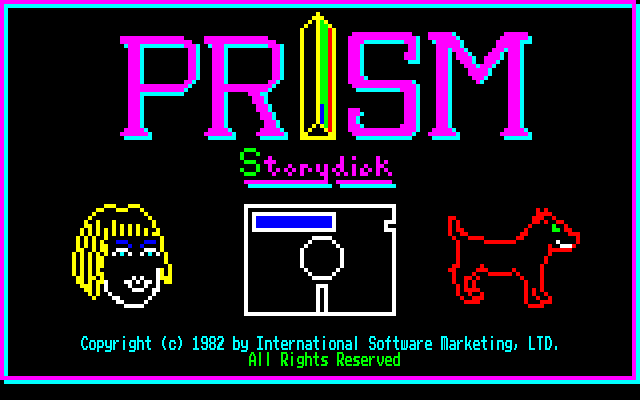
At least one of the puzzles is made harder, but a certain important aspect may have been made easier. (I have to hedge since we don’t actually know any answers for certain!) I will go through the new content just like I did with Atari, but I first want to explore how the program ended up on the ultra-obscure Toshiba T100 to begin with.
The early 80s were a graveyard for Japanese companies trying to import their computers into the United States, computers like the Fujitsu Micro 16s, the NEC TREK, the Panasonic JR-200, and the Sanyon MBC-550, which was allegedly IBM PC compatible but failed to run a great deal of IBM software. Epson did well selling printers but failed outside of Japan with their portable HX-20.
Toshiba had a long history with computers by this point, with work dating back to the 1950s with the TAC developed at the University of Tokyo and the TOSBAC series of mainframes developed in the 1960s.
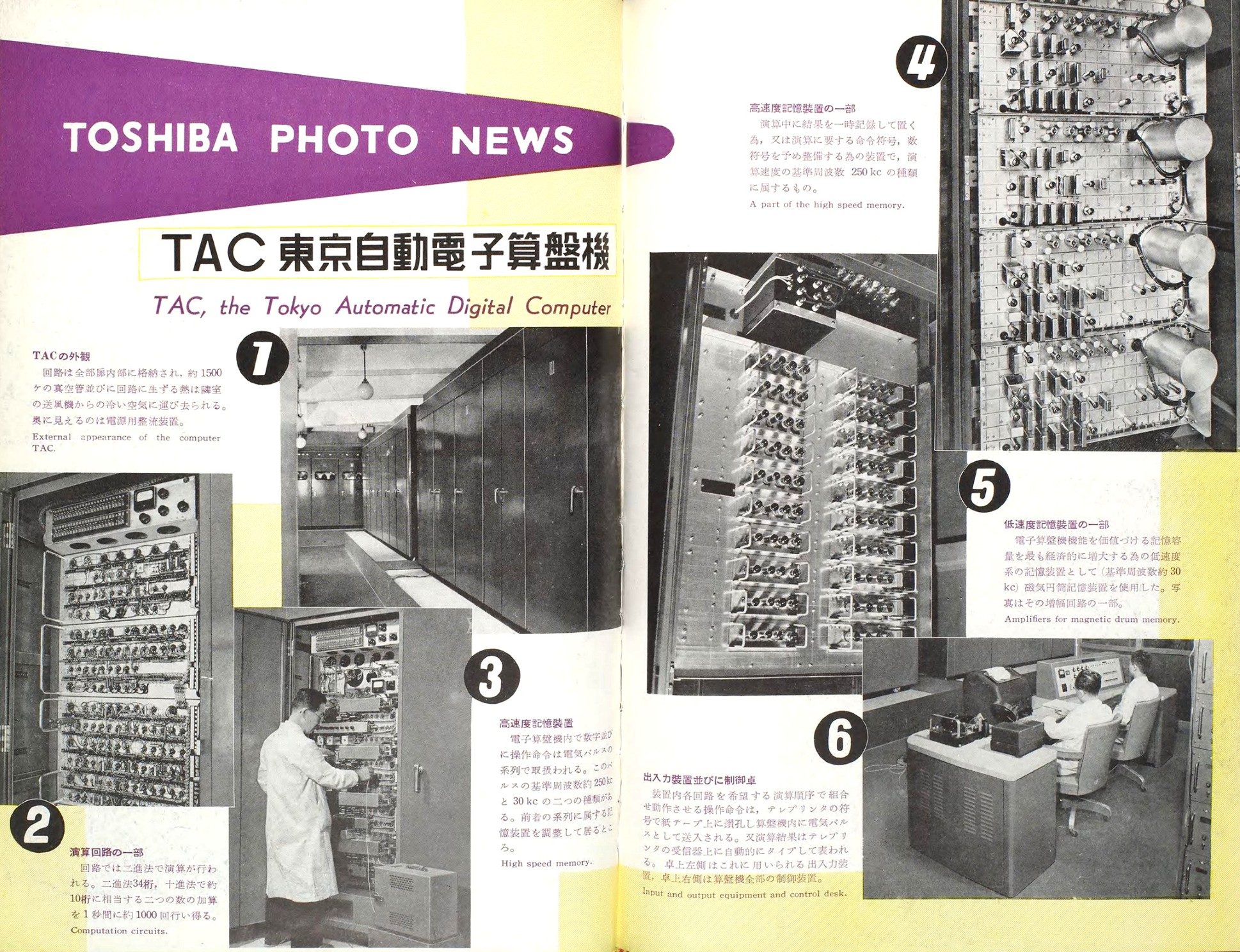
From a 1954 Toshiba Corporation journal.
However, a long history does not indicate commercial success for personal computers; while they did well with the Pasopia and Pasopia-7 computers in Japan, they never broke the top sales echelon over the heavy hitters (NEC PC-88, Fujitsu FM-7, Sharp X1, MSX). Like all the other companies, they wanted to give their shot in the United States; to do this, they hired Sorel Reisman, who had recently moved to the United States. Reisman was hired from IBM Canada to work with Discovision in California; it quickly became clear it wasn’t going to work commercially so he started shopping for another job, finding one when he met the Vice President of Toshiba.
Toshiba had just gone into the computer business here, and they had just started a division called the Computer Systems Division. The guy who was heading that up, I met him. They had essentially two groups; they had the printer group and they had the computer group. This was in 1981 Toshiba was trying to get into the computer business here, they wanted to compete with the IBM PC, which had just been launched — this was in 1981 — they wanted to bring their wonderfully better-manufactured personal computers over here (to the US) and compete against the IBM PC.
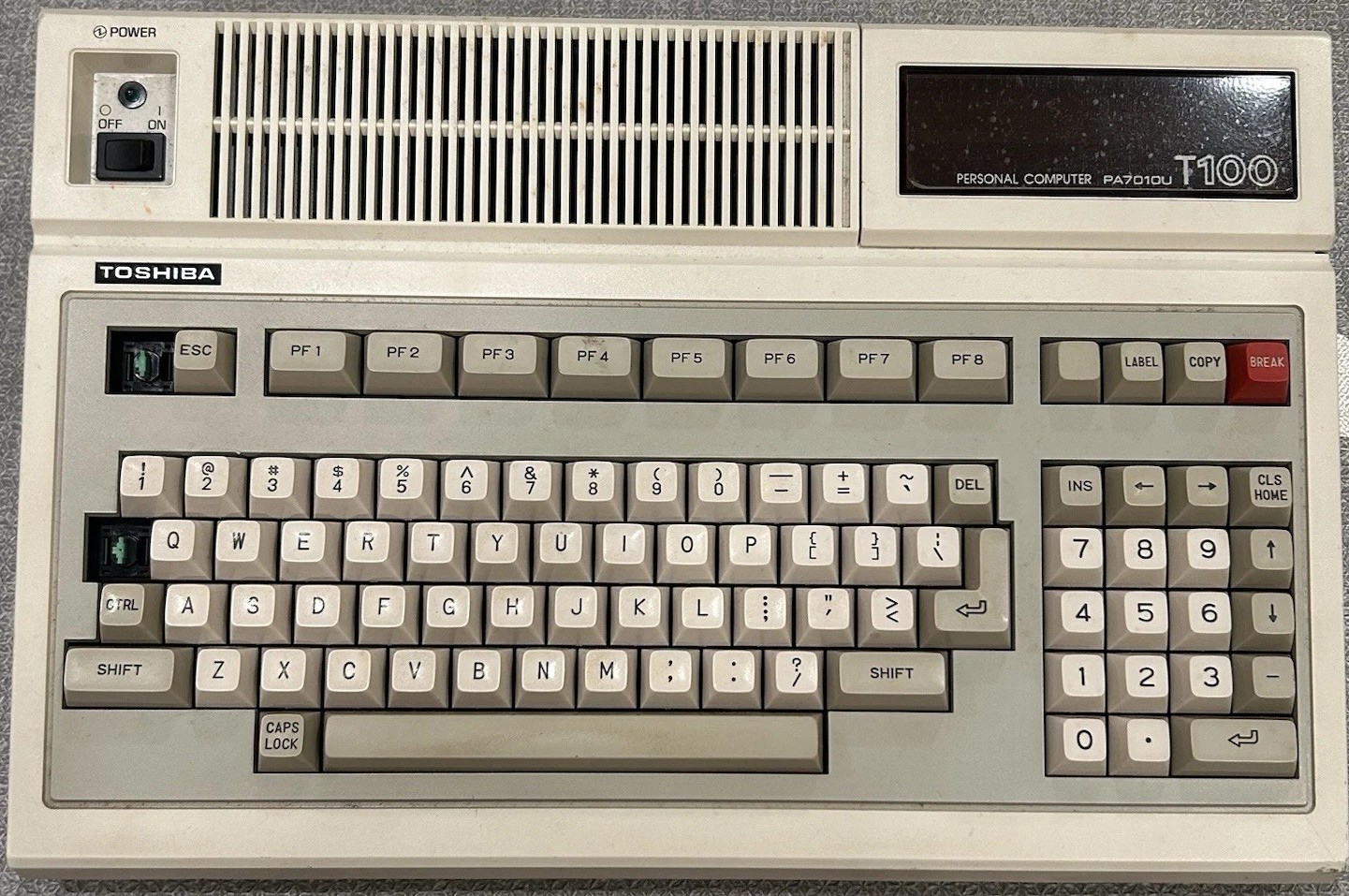
The T100, a Pasopia with some tweaks for the American market. From an old eBay auction. There’s a blank key on the top row (next to “LABEL”) because that was the kanji key in the Japanese version.
He was hired to head the computer division starting in 1982, but ran into an issue nearly all the Japanese companies were slamming into: software. The system used CP/M which is technically cross-compatible with certain software, but this still wasn’t the same thing as IBM compatible. As Reisman points out, clients were wanting to run Lotus 1-2-3 (the big spreadsheet software after VisiCalc) but couldn’t, so they weren’t interested.
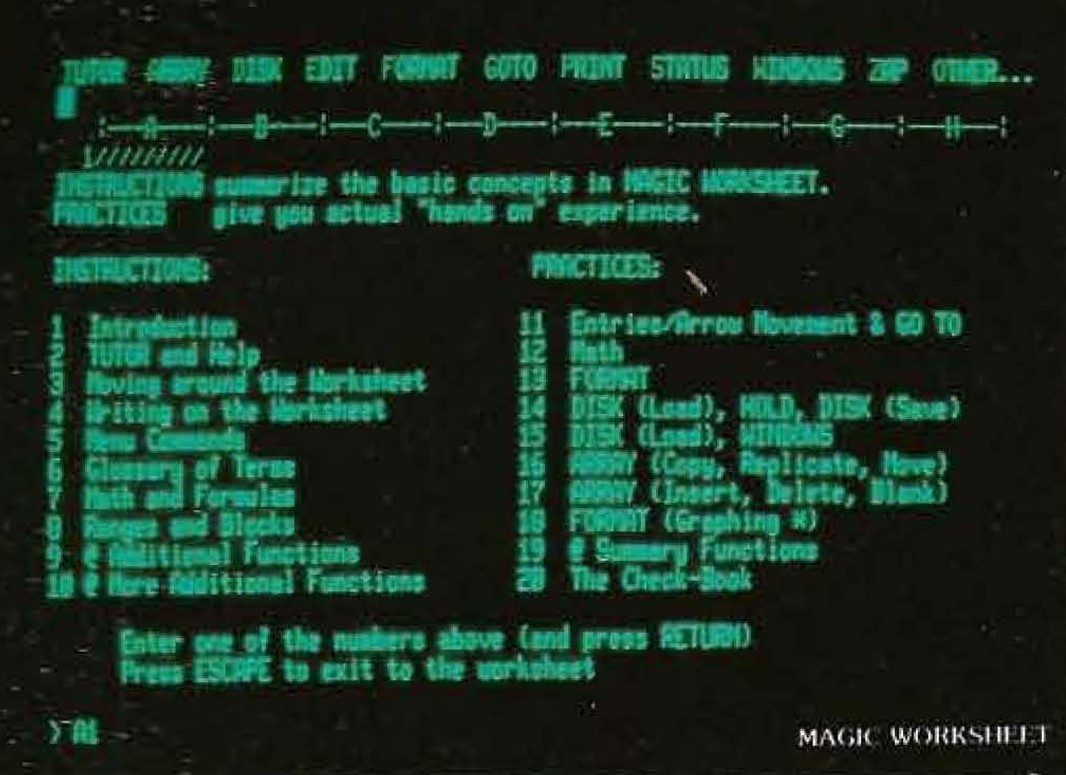
Instead of Lotus, the computer came with Magic Worksheet, software barely anyone cared about. From a 1983 Multitech catalog.
In July of 1983 they tried “re-introducing” the computer to the market as “portable” by adding a LCD display, although coverage had a tone of skepticism (“the T100 runs solely on 110 AC cord power, rather than on AA batteries, thus limiting its usefulness in long distance travel.”)
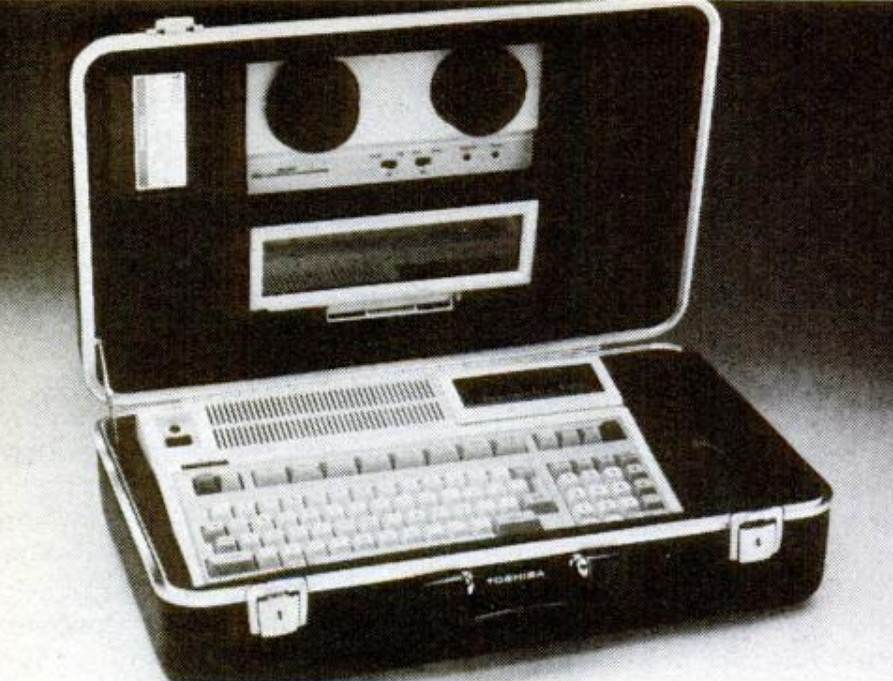
InfoWorld Jul 18, 1983.
To take a stab at the software gap Toshiba introduced products scrounged from supportive developers, which is why they ended up hooking up with International Marketing Systems, and getting their Mathemagic, Graph Magic, and Prism software as part of the $1600 package. (Rob pointed out the connection a long while back.) Toshiba discontinued the T100 only a year later, in 1984, so this all represents a fast-moving blip in computing history. (They took another stab with the portable T1000 in 1987; learning their lesson from last time, they made it actually IBM compatible.)
While (as I already indicated) we don’t have the DOS version of PRISM, the T100 version is likely close, although modifications to the graphics would still be needed. The source code turns out to be pure BASIC. (Link here. A few characters are off.) The copy protection involves checking for an (intentional) error on the disk, and if that error is present, allowing the program to go forward; once this check was removed the game could run. The fact the porting isn’t 1-1 and that the CP/M port came after the other three versions is important: it means that this is essentially a “version 2” of the software. As LocalH points out, two typos are fixed.
I notice that “Hubert’s” and “ecstasy” are correct in this version (surrounding the “TRET” screen, on pages 20 and 22) but “gazing redly” is still written exactly that way on page 20.
(I never thought “gazing redly” was a typo, given the story’s theming.)
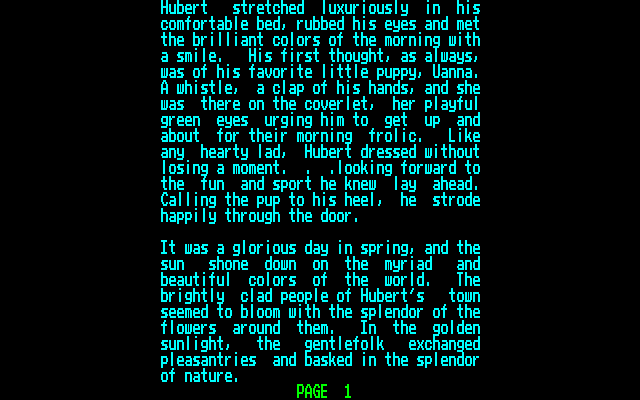
An easier-to-read font compared to Apple and Atari.
You can see a very curious difference from the first graphic, and the part that I alluded to earlier that makes for a harder puzzle. Apple and Atari first:
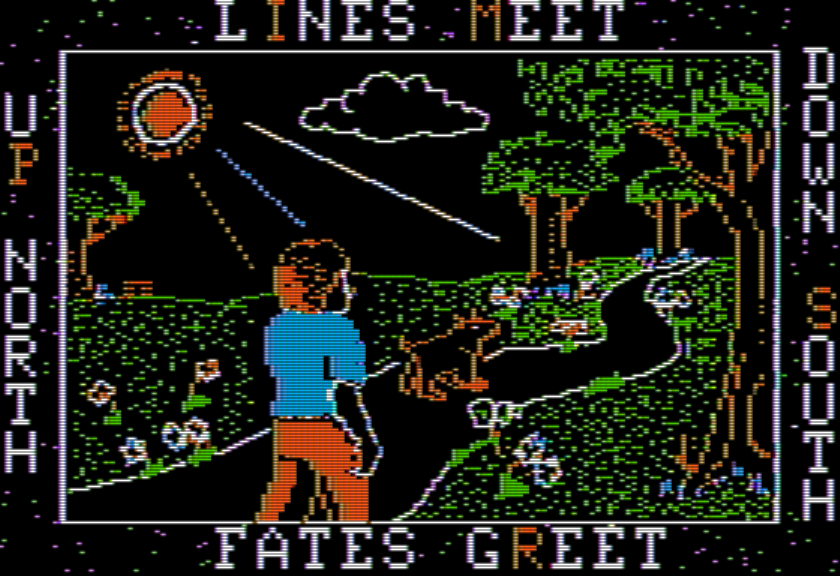
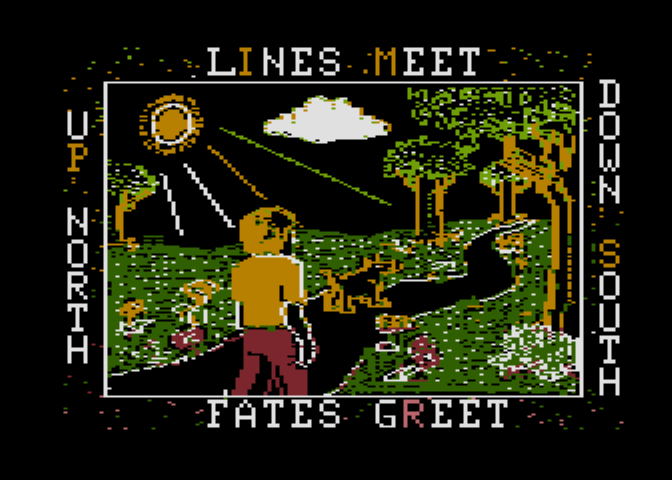
Now, the T100 version of the same:
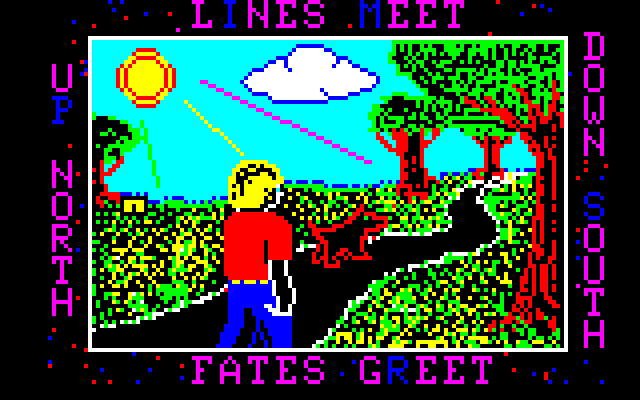
Everything is much more chunky. Positions have been slightly altered (and assuming they didn’t mess anything up, it means some positional elements to the images have to be unimportant). The I Ching reference is much muddier now:
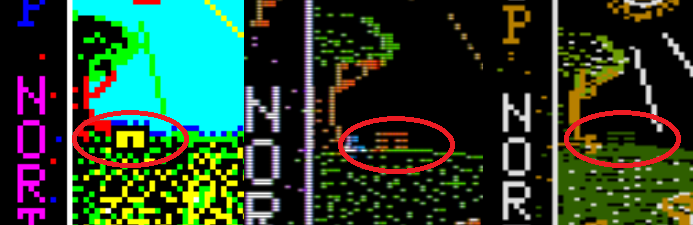
Without the rows-of-lines element, I would not have the symbol identified as from the I Ching at all! Additionally, in the “broken tree” picture, as you’ll see later, the symbol is moved from a spot next to the tree to the corner. This suggests two things: a.) that the symbols really are important, important enough they spent the time to render it here despite the difficulty and b.) the exact position of a symbol is not important, but rather that it marks a particular page.
Enough preface; here’s the rest of the images. If you want to download them as a pack (including the text) I have them all zipped together here.
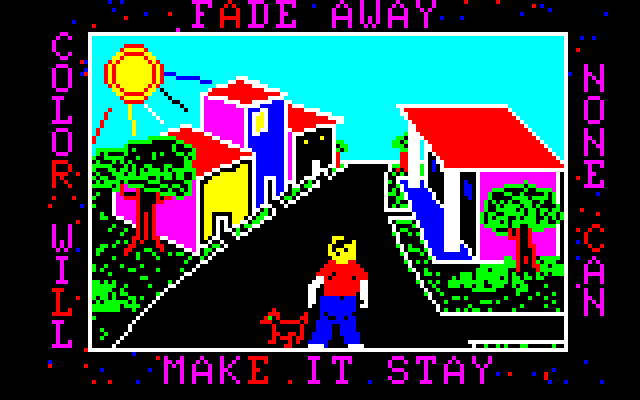
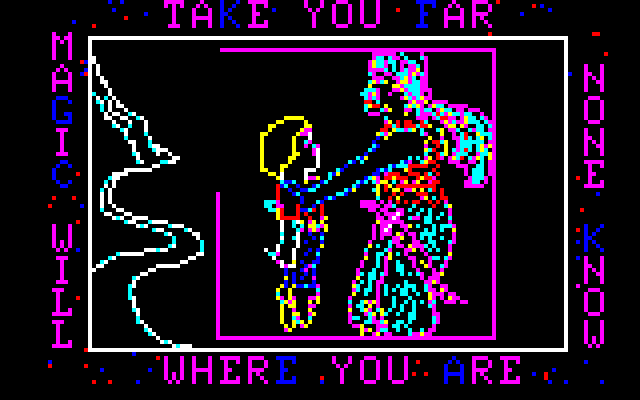
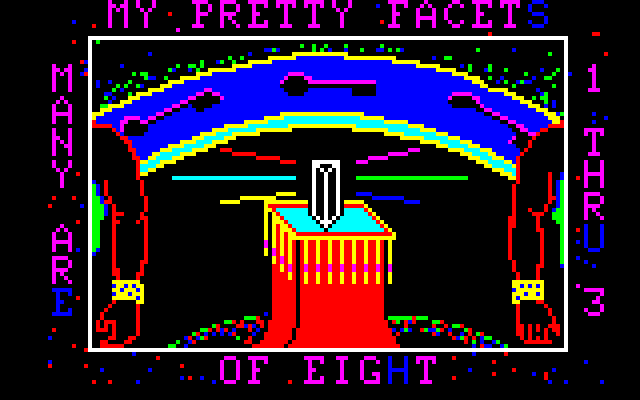
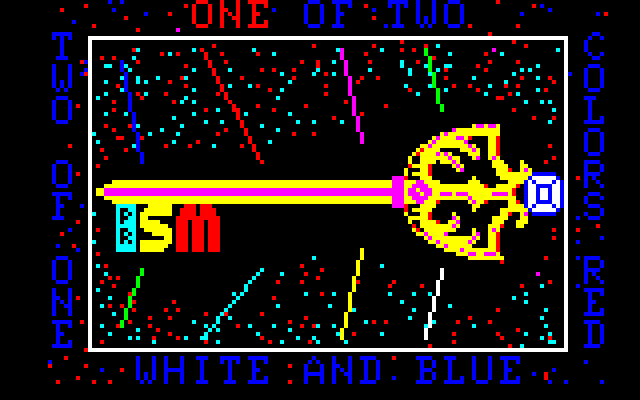
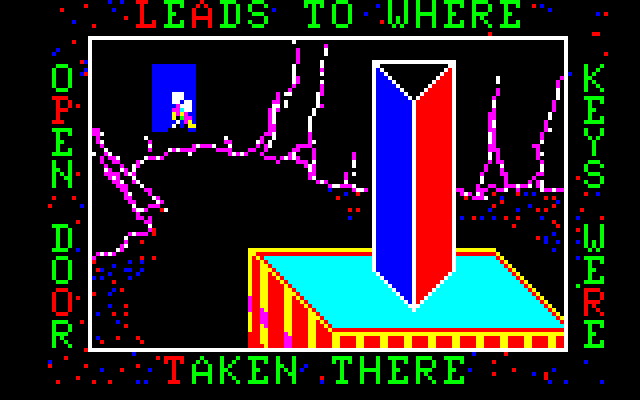

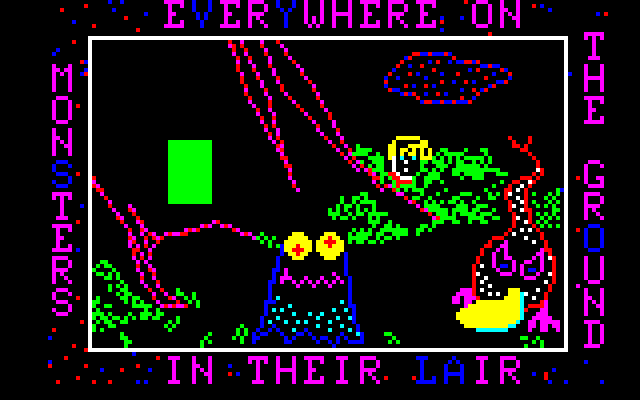
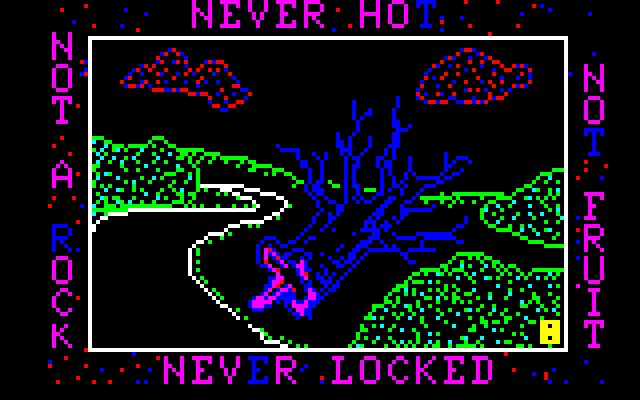
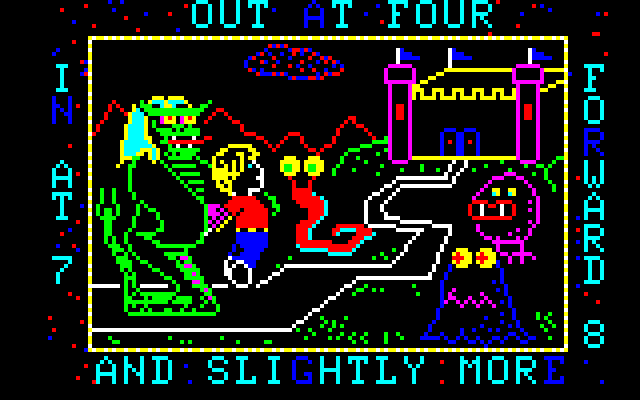
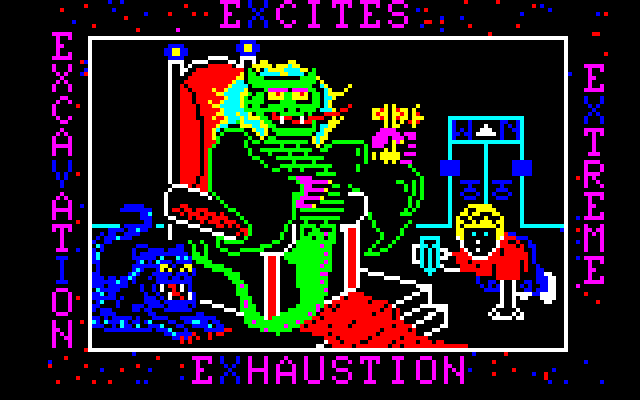
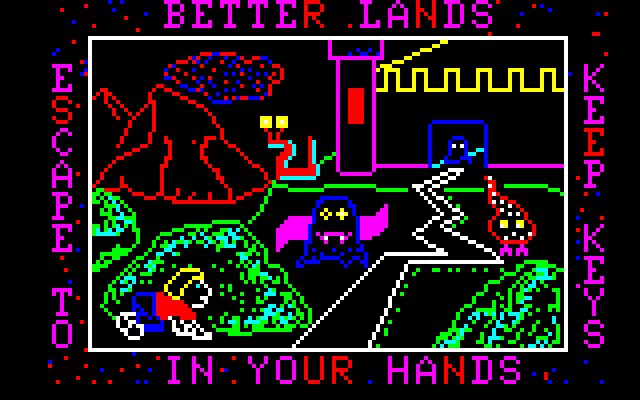
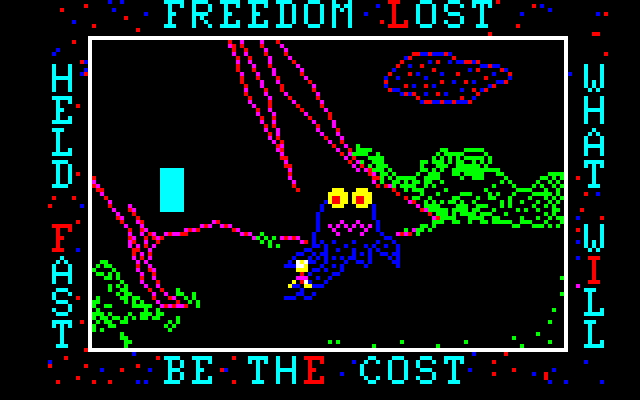

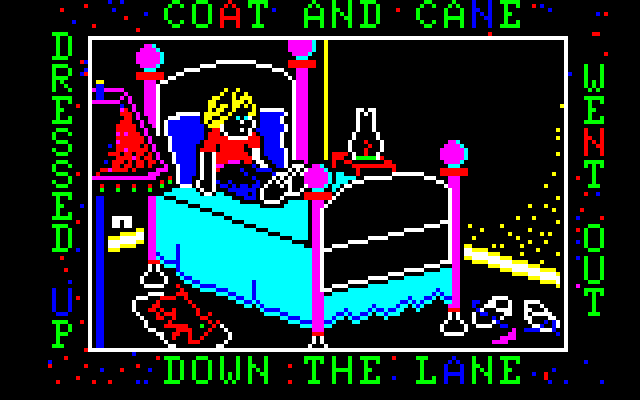

Besides the positional shifting, the other big change of note is the colors. The highlighted letters are now only either red or blue! I’m not sure if that really means the exact coloring is unimportant; it may be the developer simply lost control given hardware restraints (just like the Atari had some odd colors based on what row of the screen it was drawing). At the very least, any solution needs to be at least somewhat compatible with this variation (keeping in mind, like the I Ching puzzle, it’s possible some clue or clues were lost).


 Renga in Blue

the content here wasn’t relevant enough for me to include in the main text, but this post about the never-released Commodore HHC-4 (a rebranded Pasopia Mini IHC-8000) is very good
https://oldvcr.blogspot.com/2024/10/the-unreleased-commodore-hhc-4s-secret.html
Totally irrelevant coincidence, but the joke I made about the Prism monster art resembling several well-known characters of the era (Pacman ghosts, Cookie Monster, etc.), takes on a strange new twist here:
That orange/red googly-eyed snail-like thing looks almost exactly like one of the main monsters from Enix’s Door Door, which had a Pasopia version that came out right around the same time this version of Prism would have!