The review that mentions PRISM (Creative Computing, May 1983) only lists the game for Apple II, and PRISM barely got any mentions later, so I didn’t even think about a second port until Atarimania asked in the comments about it. To be fair, that version is rare enough it gets a perfect 10 from its Atarimania listing. Given there are three eBay listings of the Apple II version right now as of this writing (one, two, three) I think it likely the Atari version didn’t sell as well.
After some emulator issues I did get the game to work, and there are enough differences it’s worth downloading the set if you’re trying to work out PRISM in earnest. For now, I’m going to put all the art-screenshots (but not the text-screenshots, which you can find in the file if you want to delve for cryptograms or whatnot).
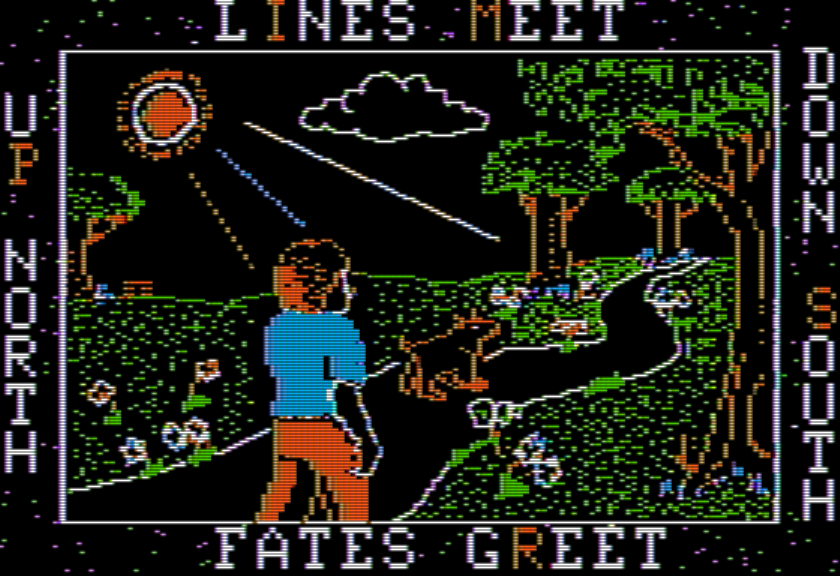
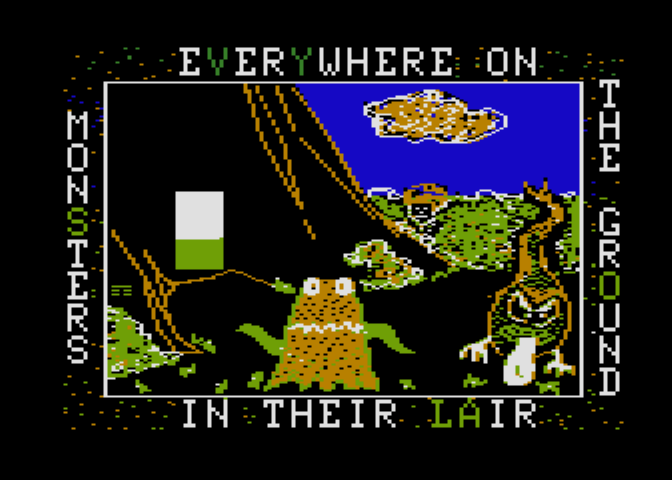
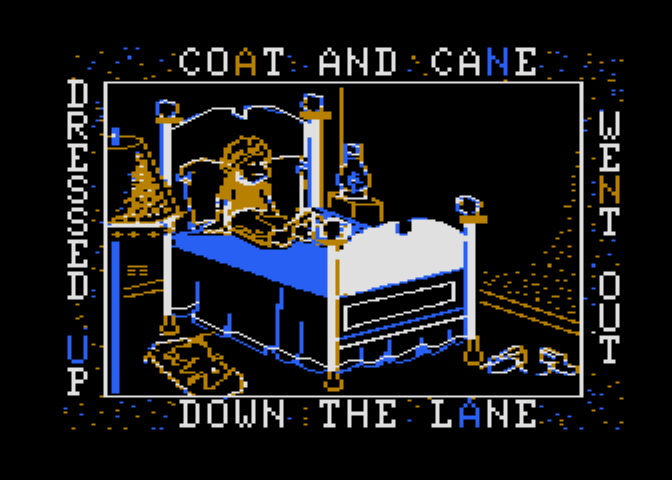
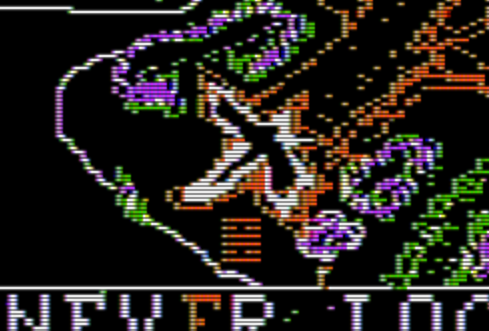
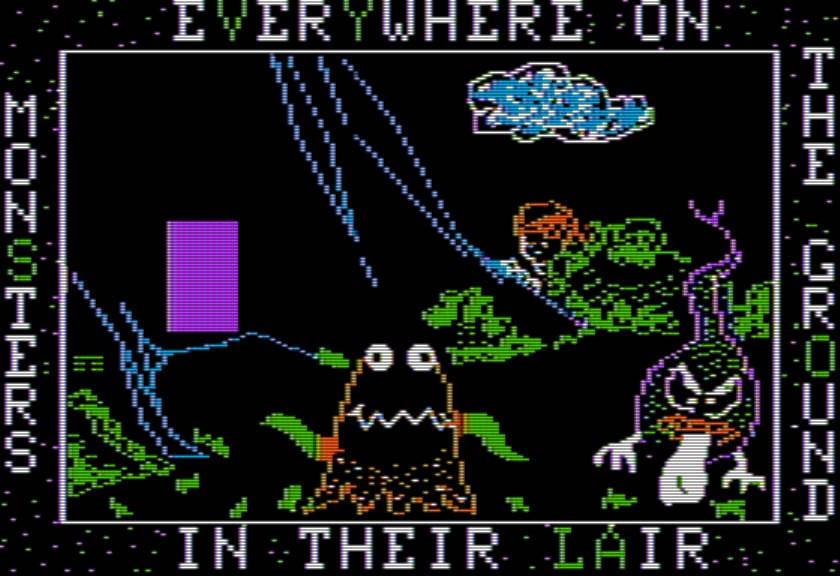
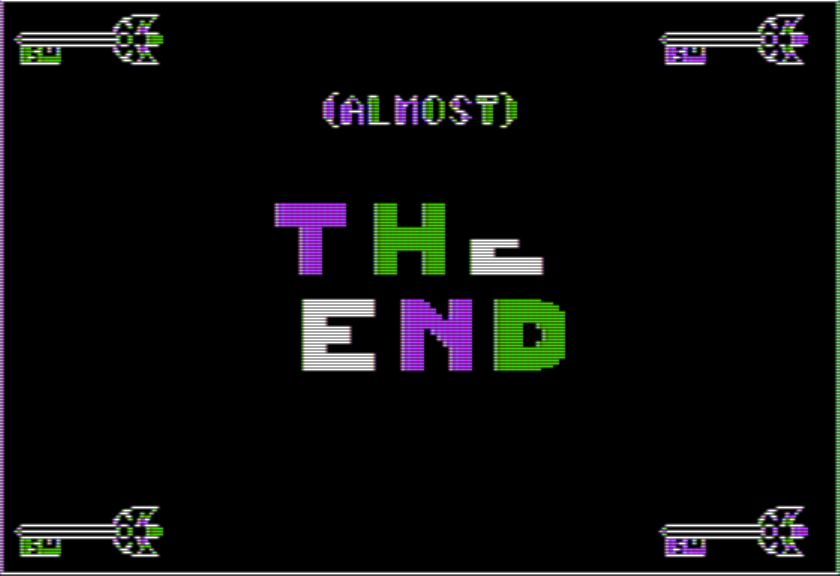
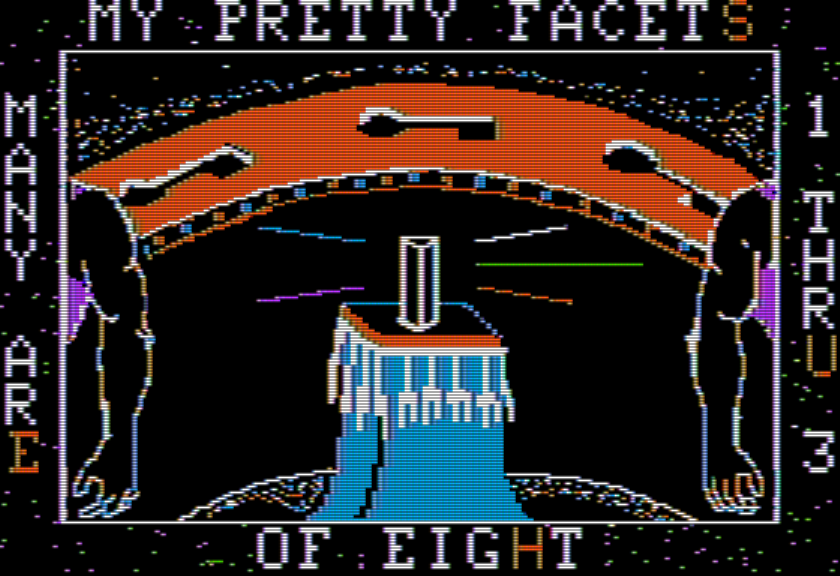
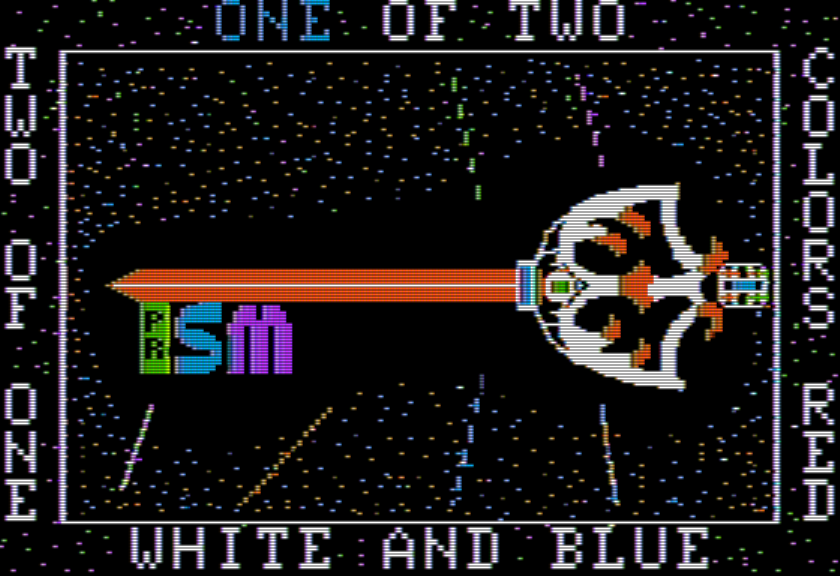
Just to make clear what I mean by differences, here’s the first screen of the Apple version…
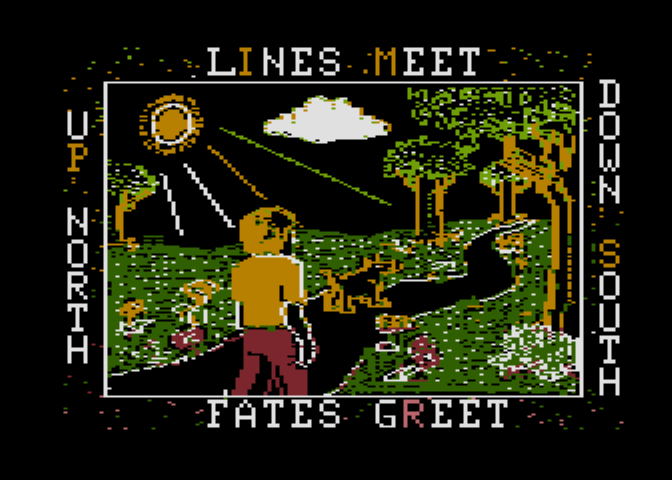
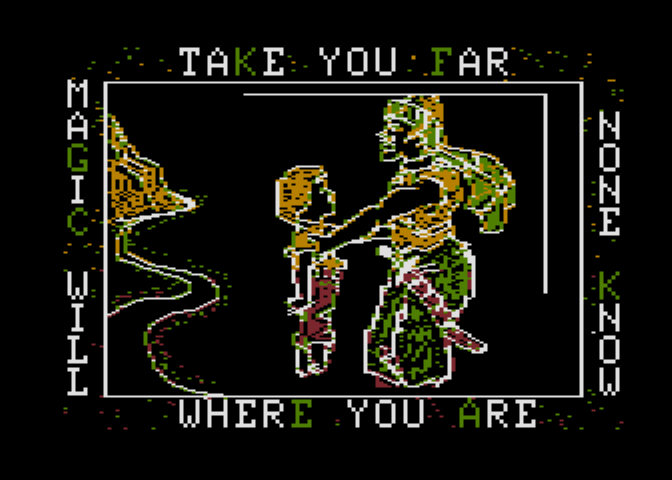
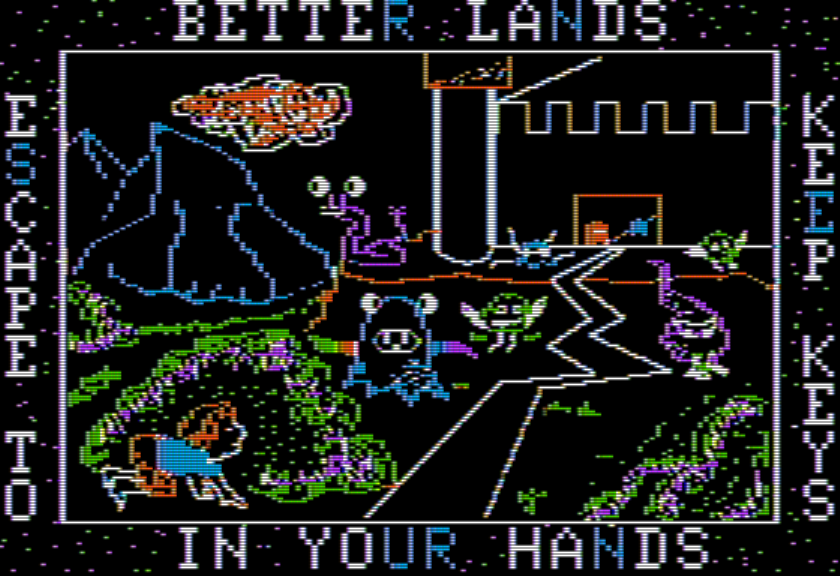
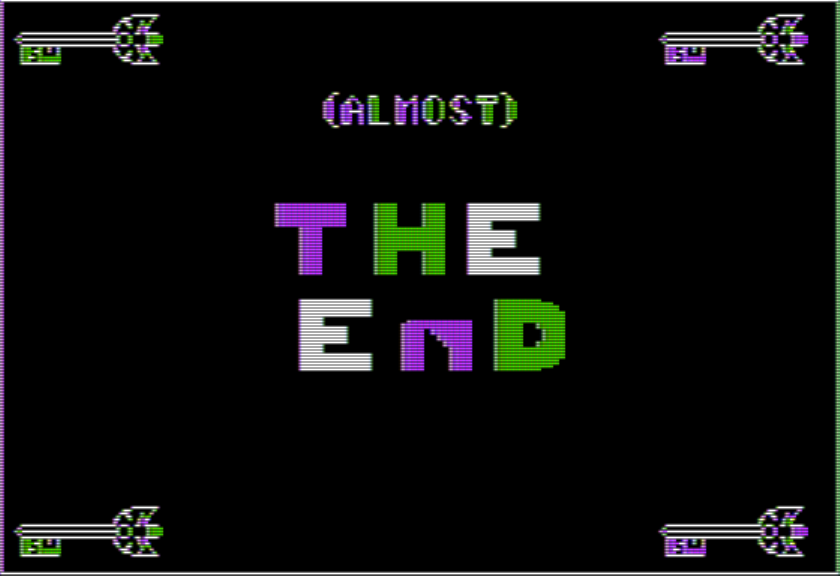
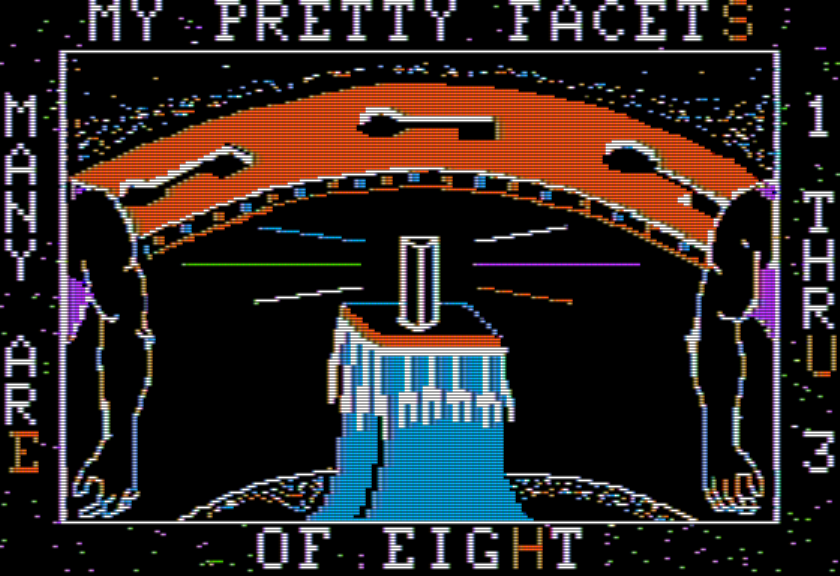
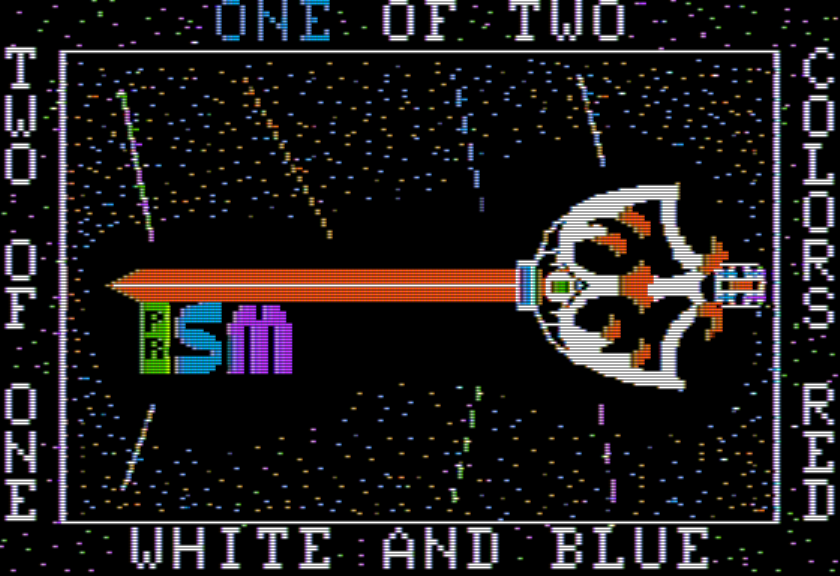
…and the first of the Atari version.
PIMS are a different color than the R, which is not the case for the Apple II version. I had been thinking of the exact colors of the letters as highly significant, but maybe not. (Or the puzzle is broken on one platform but not the other!)
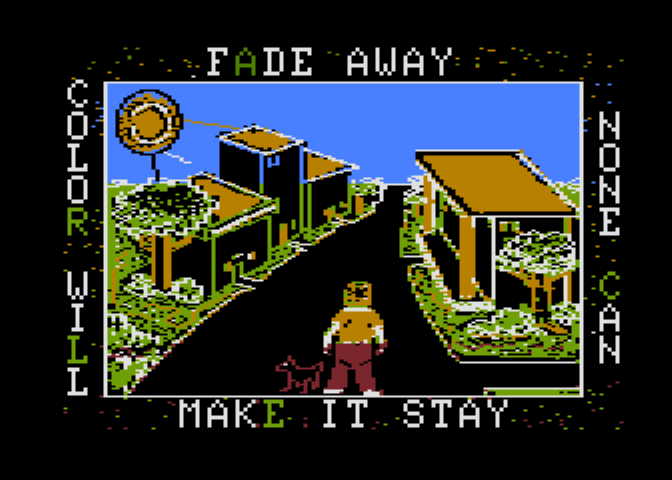
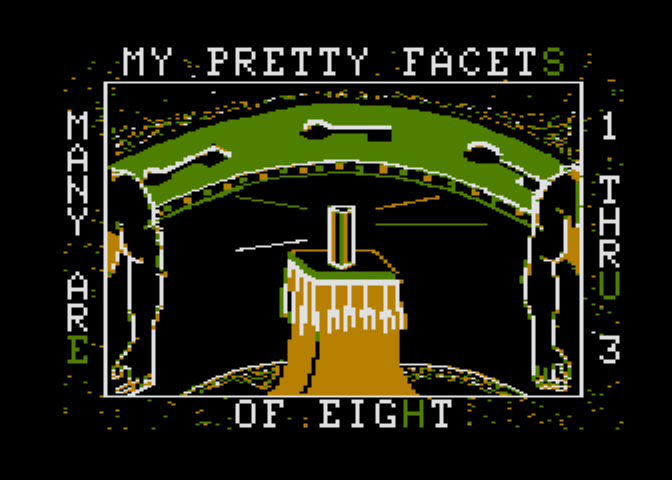
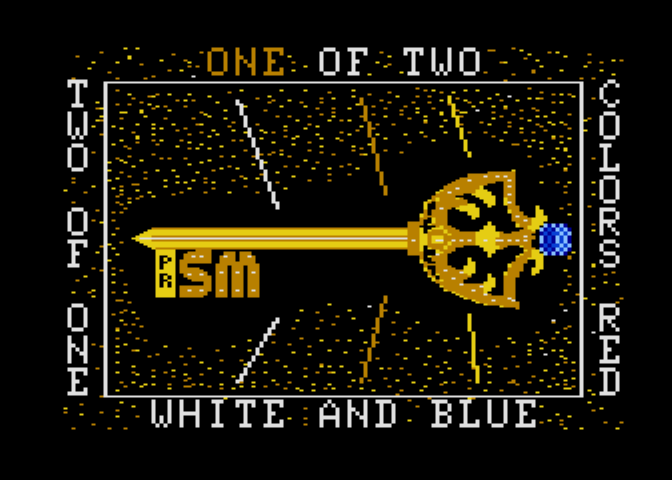
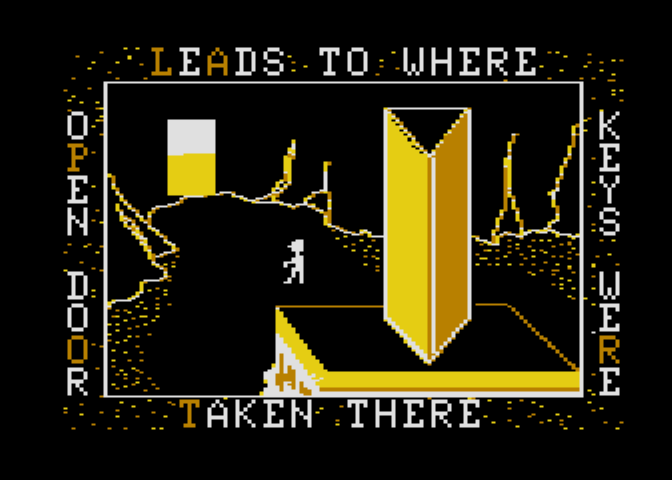
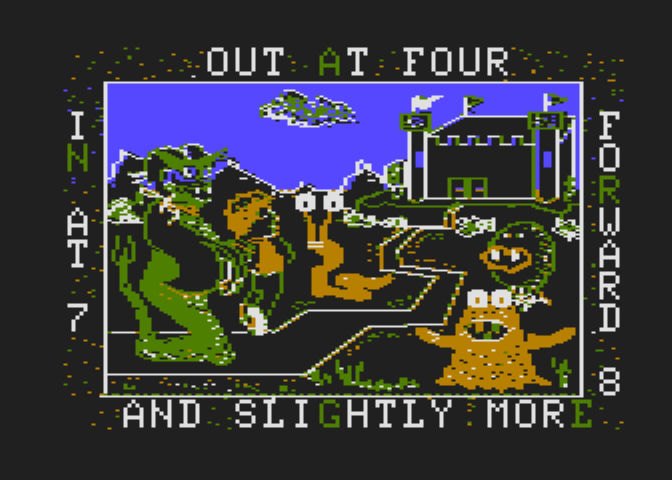
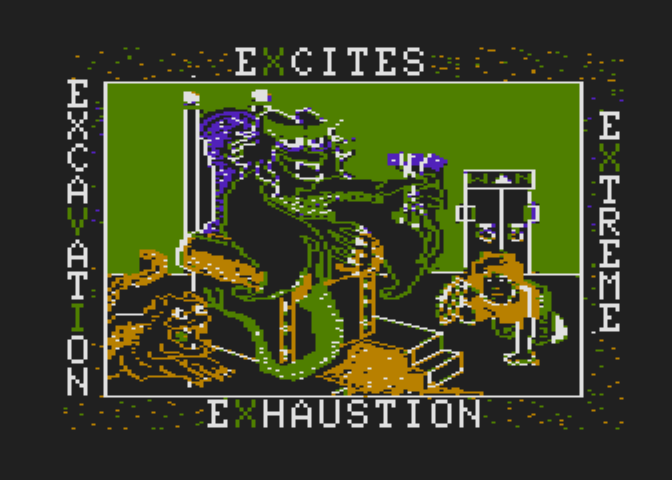
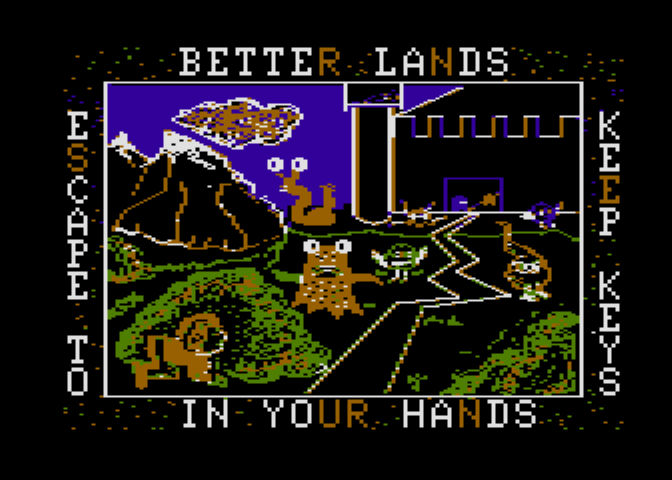
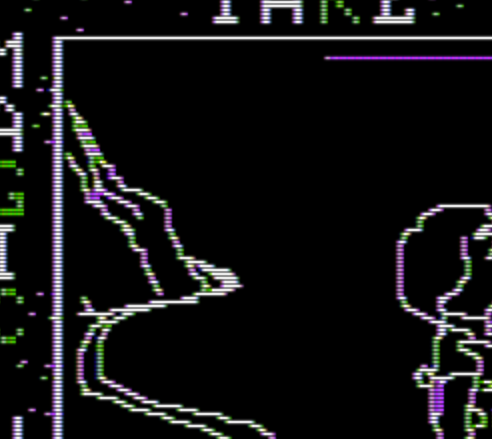
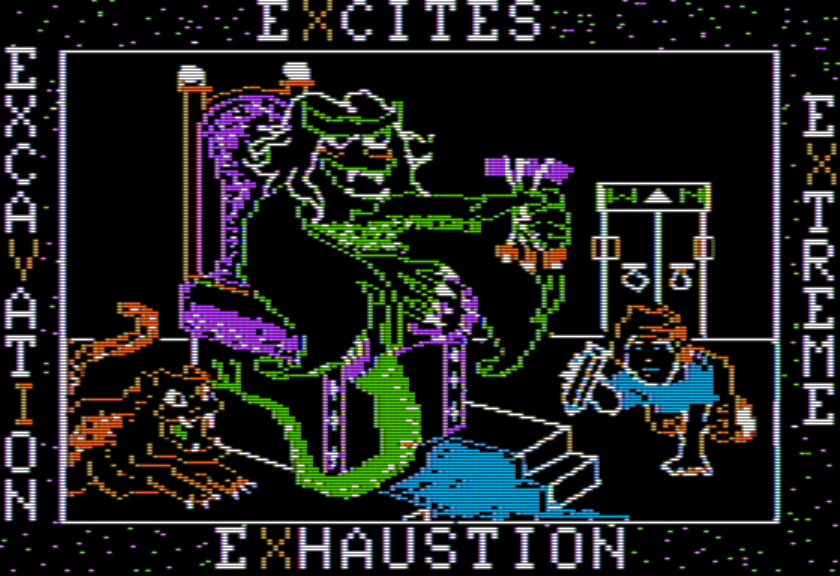
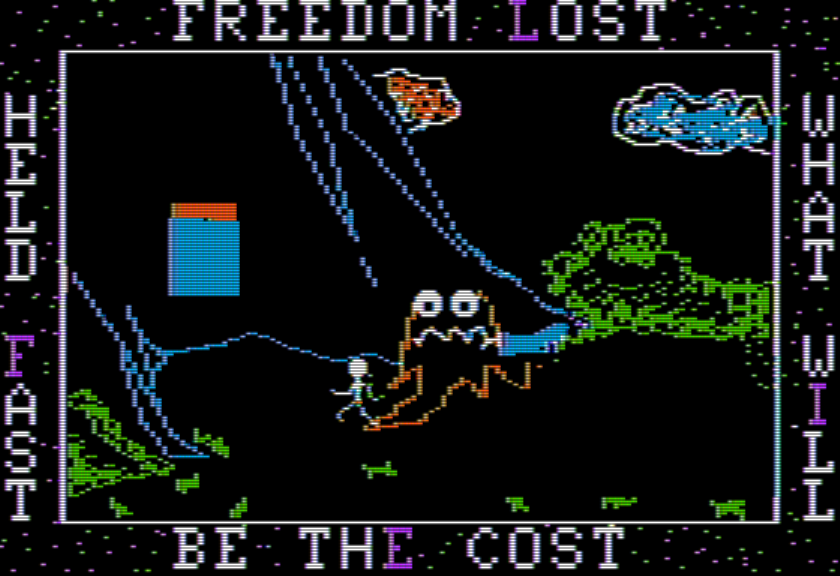
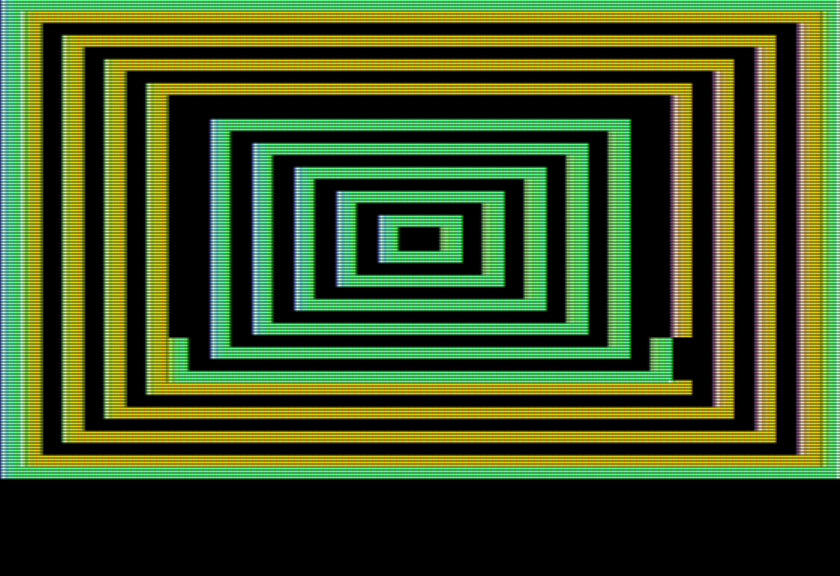
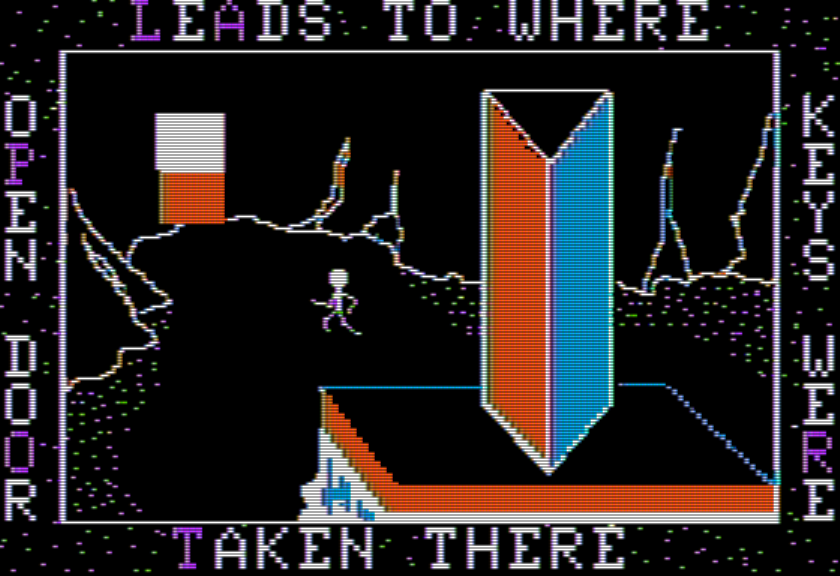
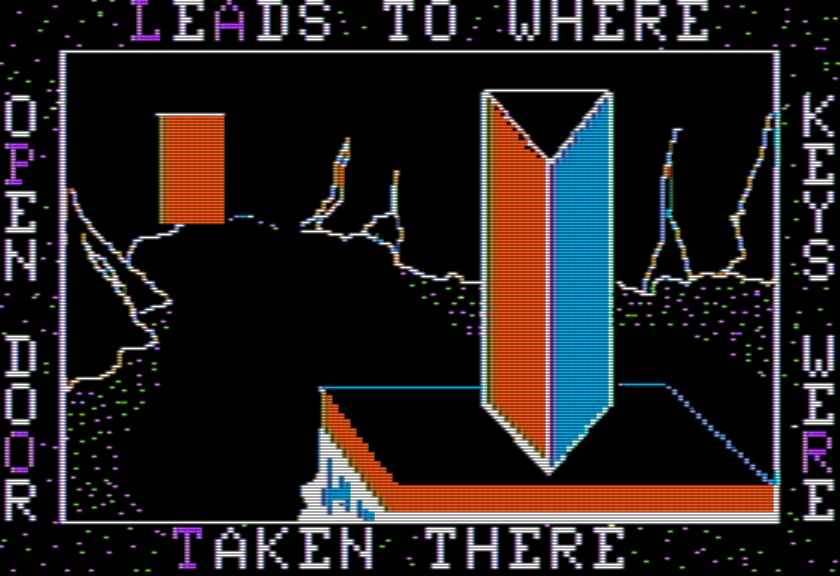
Here’s the remainder of the images, including a brand-new image for Atari (you’ll know it when you see it).
One last observation is the sound is different. The opening of the Atari version has a better melody, and there’s no “random music” going on at the XXXVI picture.
If nothing else, this clears up the squinting I was doing at some of the Apple II screens trying to see if the “noise” meant anything (that doesn’t even appear in the Atari shots). I don’t know what to think about the color changes. Look at the tree: it’s TRE + T now! If you consider just the blue letters, you get T from that page plus UNA from the last page. The only time red appears is the “R” at the start.
Coming up: some TRS-80 Color Computer games which should hopefully be less trouble!
This is my last post on PRISM for now; just like with Alkemstone, if something comes up worth posting about I may return.
Some things to get out of the way first: I have a set of screenshots downloadable here and a video here (I’ve also embedded it below). This is for anyone who wants to check the actual letters of the text or check frames of the color cycling as suggested in the comments. I haven’t had luck with either but I also haven’t pushed that hard.
There is sound but most of it is irritating. The one interesting part (in a treasure hunt sense) starts at 3:06 in the video where there is “music” which seems to be generated completely at random. That could of course signal some kind of coded information. (More on this later.)
I also had the question (brought up by Arthur O’Dwyer) what I thought the chances are the game is “broken”. I certainly don’t think it is intentionally so (this is a business software company that had four people make the game, they’d be risk-adverse about making a complete ruse) but it is still possible unfortunate typos slipped in which wreck something. For example, from the packaging that I quoted at the very start:
PRISM is an ISM Storydisk which tells the wonderous tale of the theft of the three ancient Keys of Color, and the adventures of the young boy who must seek them in the monstrous kingdom of Yolsva, Plane of Darkness. All is chaos, and the story contains many levels of hidden meaning through which the Keys may be found and reunited with the prism. When this occurs, and only then, can the mysterious and magical ending of PRISM unfold.
Yolsva is spelled Yolvsa in the game! This worries me both at a general level (if that’s a mistake, what else might be?) but also at the level of this specific name being odd enough it might be part of a clue. (Alkemstone had a typo in a clue where Jo was spelled Joe, so there’s precedent at least.)
I tried focusing my efforts on one page in particular, which feels quite central to the puzzle.
shamhat pointed out in the comments the part of the tree next to the double-fire symbol looks like a phoenix.
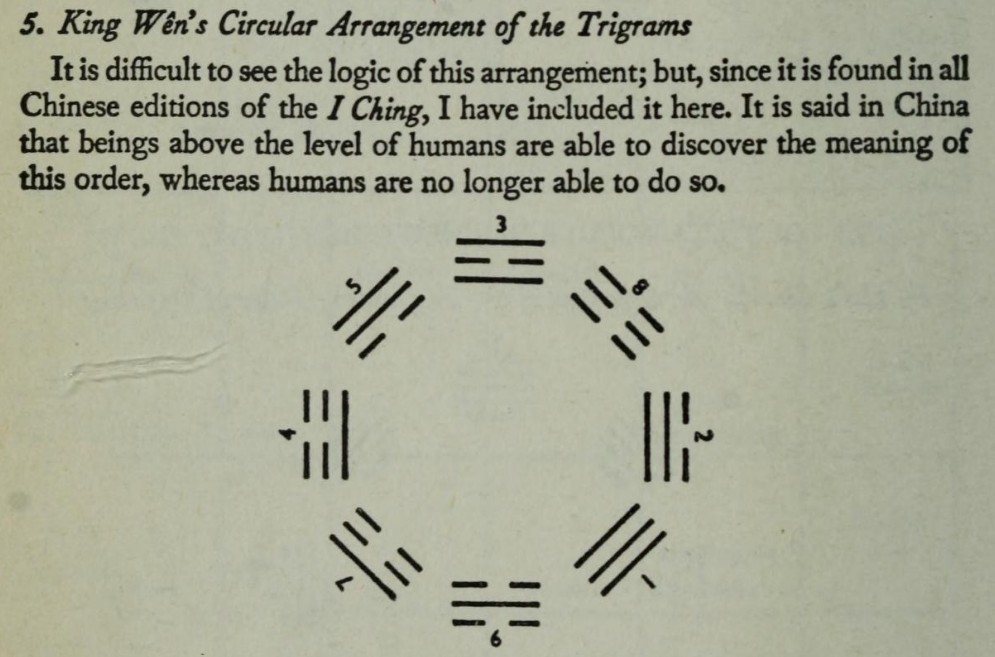
I spent a while researching the I Ching, or more specifically, the I Ching as understood by the authors in New York in 1982. There were a lot of “new age” style books from the 1970s so they could have been drawing from them.
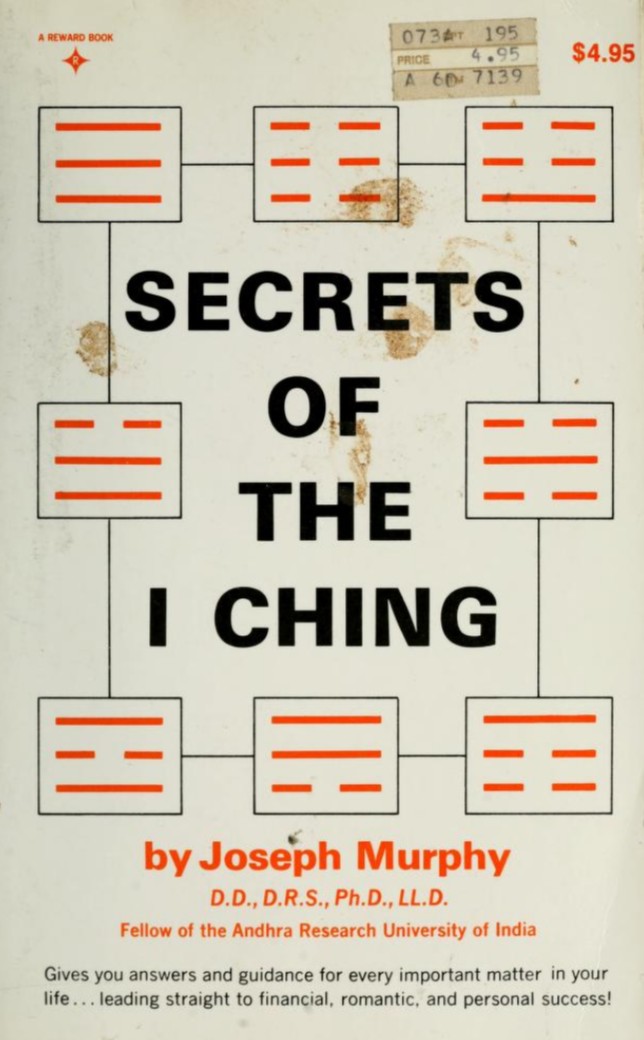
From the 1970 book Secrets of the I Ching by Joseph Murphy, “one of the world’s best known authorities on helping people with mystic methods.”
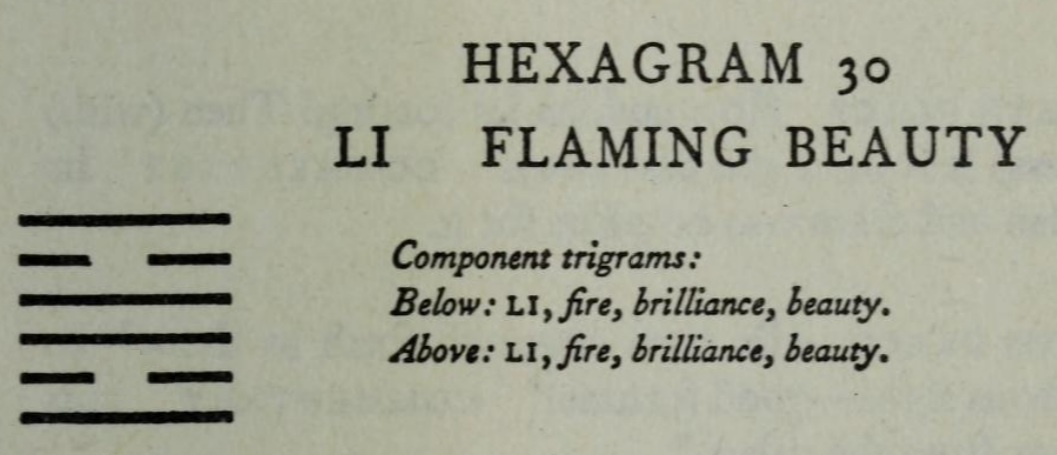
The reason I say the particular slide I highlighted is central is that it has the double-fire symbol, also known (in the 1927 translation by Wilhelm) as The Clinging.
This hexagram is another double sign. The trigram Li means “to cling to something,” and also “brightness.” A dark line clings to two light lines, one above and one below— the image of an empty space between two strong lines, whereby the two strong lines are made bright. The trigram represents the middle daughter. The Creative has incorporated the central line of the Receptive, and thus Li develops. As an image, it is fire. Fire has no definite form but clings to the burning object and thus is bright. As water pours down from heaven, so fire flames up from the earth. While K’an means the soul shut within the body, Li stands for nature in its radiance.
Later Wilhelm writes:
What is dark clings to what is light and so enhances the brightness of the latter. A luminous thing giving out light must have within itself something that perseveres; otherwise it will in time burn itself out. Everything that gives light is dependent on something to which it clings, in order that it may continue to shine.
A more scholarly breakdown from 1979 by Iulian K. Shchutskii (Researches on the I Ching, Princeton University Press) mentions a translation of “Supreme Success”. Many books vary — which is unfortunate for getting into the heads of our authors, who may have been referring to some lost hippie zine — but both “success” and “perseverance” seem fairly universal.
Another common interpretation I found (not universal, but common enough it’s a safe assumption the authors were thinking of it) is that I Ching symbols refer both to directions and to times of year.
Unfortunately, interpretations again vary, but it generally seems to be earth is east and fire is south (earth I’ve seen northeast, also, or even at “center”); the important part also is that north/south/east/west are simultaneously associated with the various equinoxes. That means we can use the shadow method to find a digging spot. While I could see getting lucky with hiding one item by using some very distinct landscape clue (like a particular rock at a cave over a patch of dirt) with three items I find “dig where the shadow’s tip is at the _____ equinox” to be much more likely.
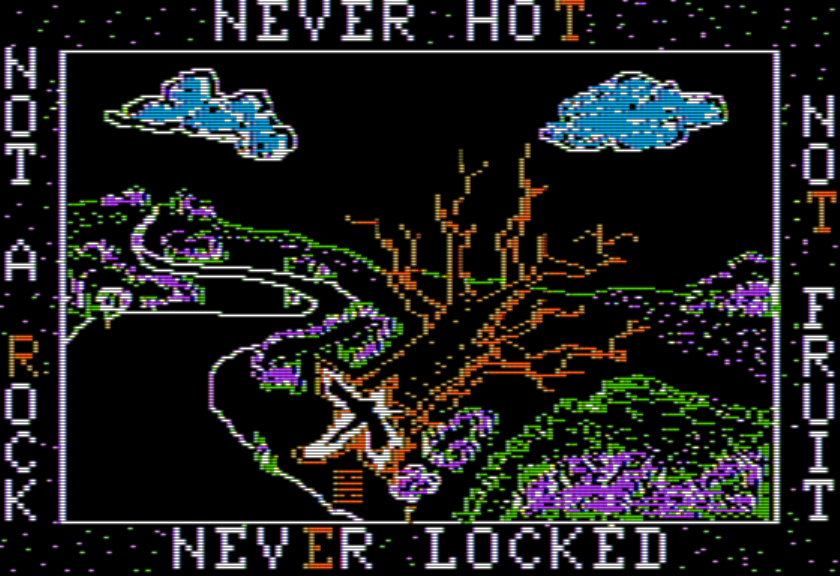
Going back to that fallen tree, my guess for NOT A ROCK / NEVER HOT / NOT FRUIT / NEVER LOCKED is that the answers are drawn from I Ching elements.
Heaven, the Creative
Lake, the Joyous
Fire, the Clinging
Thunder, the Arousing
Wind, the Gentle (Wood)
Water, the Abysmal
Mountain, Keeping Still
Earth, the Receptive
1 THRU 3 OF EIGHT could also be referring to these eight in particular (it may be the I Ching elements are associated in the game with a color as well).
I tried fitting the mysterious letters CGKFKEA as well. I had less luck (even looking at Chinese transliteration). It could refer to the composer Cage, who was very much into the I Ching, and the “random music” I referenced earlier could actually be a clue to him. His Book of Changes (1951) was formed via aleatory methods directly from the Chinese text.
Special thanks to everyone who contributed theories; and of course you are welcome to continue! I did manage to do multiple updates on Alkemstone after I “finished” so it quite easily can happen here as well. Additional thanks to Jeremy Salkeld for advice on I Ching translations.
Nobody is easy. Almost nobody, that’s the tricky part.
On the night of August 7th, 1979, I set off with Bamber Gascoigne, who was chosen to witness the burial. Once at the right spot, I cut a turf about ten inches square with my knife, then dug down until I’d made a hole to the depth of my elbow. There was a moment of panic when my trowel hit rock, but it turned out to be just a small stone. In went the pot with the gold, then the earth and the turf. I watered the spot to encourage the grass to grow again. As Bamber and I shook hands over the burial ground, the moon came out from behind a cloud and, I like to think, shone down a blessing on us.
The grand “thousands (or or tens of thousands, or more) participants / only one winner” treasure hunt seems particularly daunting to manage if it is meant to go over a large chunk of time. It is unclear if Masquerade’s multi-year span was accidental or intentional. Certainly, when Williams designed the puzzles and hid his hare, he fretted over the puzzle being too simple, as explained by the witness Bamber Gascoigne:
Kit had explained to me the basis of his puzzle, but even with that privileged information I was unable to make it work out. The cause of my growing uneasiness was the thought that if it was in fact impossibly difficult, then I was the only person in the world in a position to form that opinion. Kit considered it very possible, even perhaps dangerously easy, because he had invented it.
The game had the right density of red herrings to baffle the public; more than “he had invented it”, I think the reason Williams thought the puzzle was easy is he knew exactly which elements were red herrings. The excess of extra text and riddles (including hiding a hare in every picture) made it easy to project almost any answer whatsoever.
They are far more complex than anything I had imagined, yet they fit the book. It’s a scientific principle that if you want something to work badly enough, you organize the facts so that it does. I watch people allowing themselves to be twisted round and round. In the long run, solving the book is a matter of trial and error.
— Kit Williams quoted in The New York Times, The Legend of the Golden Hare, November 15, 1981, while the hare was still buried
One issue (which applies also to Alkemstone and PRISM) is that the puzzle requires indicating an exact spot. This was long before public GPS use. Even getting somewhere in the ballpark isn’t good enough; a small field is too hard to dig without more information. Williams managed this (possibly with incorrect measurements) by using a particular day and a particular time and the exact position of a shadow. Based on what we know about Alkemstone, I’m guessing a similar idea. With PRISM, I’m not sure; PRISM’s job is made more onerous by having to give the location of three items.
People have been using clues to guess states (and I’ll get to that) but somewhere, somehow, there has to be something at a numerical level. Perhaps it is the shadow trick again (given the product’s theme of light). Is there some other way to do it?
Or it could be the puzzle is broken by unclear directions, like the stereotypical pirate map “forward 50 paces, then right 60 paces” which isn’t very exact at all. I had at least vague concern that this screen might be like that, although there’s a theory from the comments I’ll get to later that treats the puzzle as wordplay.
All this relates to another issue: how close are the keys to each other? There is no rule that says they need to be spread out across different states, and in the review I referenced last week the author asked specifically that question (with no answer received). I could see some particular landmark being marked which then gets re-used three times for three different shadow points, for instance.
I think part of the reason Pimania had a superior puzzle from what we’ve seen so far is it did not require an exact location; it was able to use fairly general symbolic language without getting into the nitty gritty of exactly how many meters forward from spot X to get.
I bring all this up not just because theorizing is part of the point of this blog, but also because it may help in forming a solution. Thinking backwards, we know three exact locations have to be clued somehow. (Maybe in a flawed way, but even the most self-deluded of puzzle-setters would know they can’t just indicate a particular park somewhere.) There’s not a lot of emphasis on time of year (like there was on Alkemstone — which is why I suspect that game was using the shadow method); if a game was not using the shadow method, is there some other compact way to represent three entirely different digging spots?
I note that the majority of the “twisted round and round” answers that I’ve seen referenced for Masquerade fail the criterion of giving an actual spot to dig. (From the NYT article: “Among the most common ‘solutions’ Williams receives are: Stonehenge, the Greenwich Observatory and the Hill of Tara in County Meath, Ireland.” I suppose you could claim you meant the “high spot” of a hill but even that would tend to be ambiguous. To be fair, some of these were sent to the author trying to go “fishing” for information with the hope they’d get feedback that they had the right area, just they needed to refine down to an exact spot.
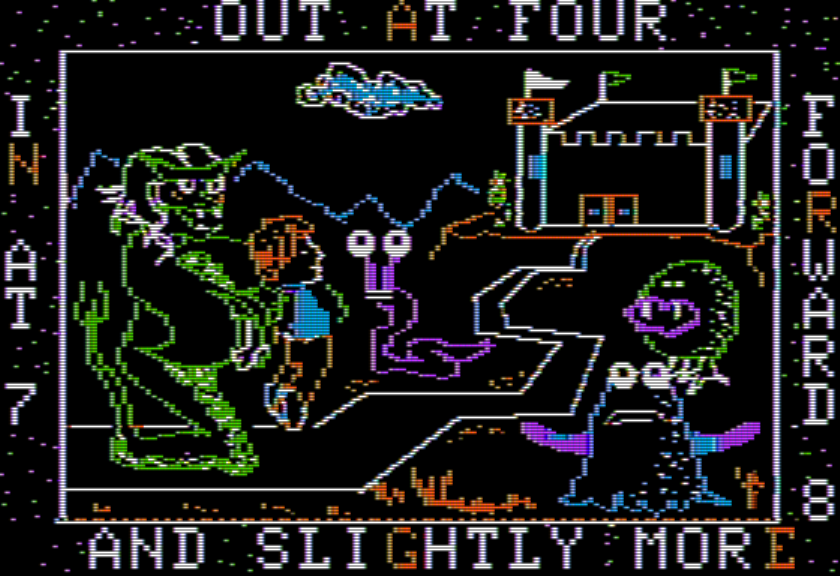
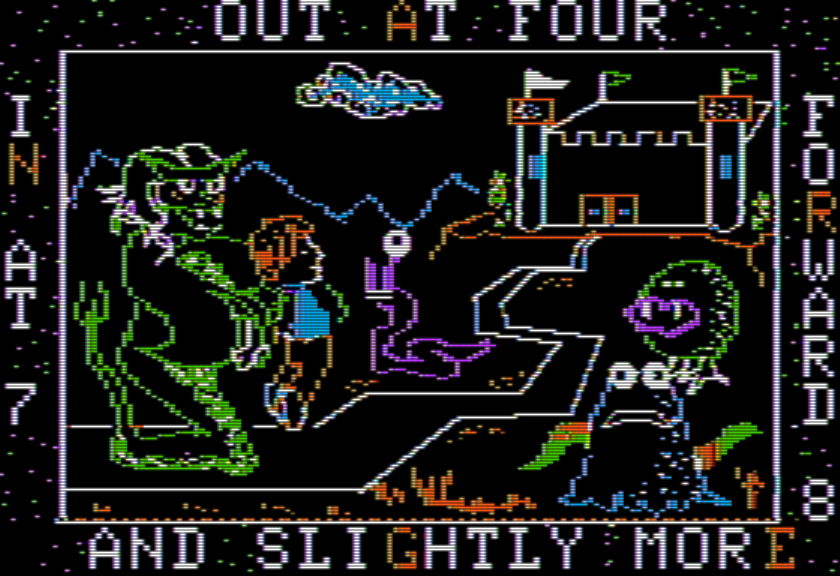
Swerving back to looking at the actual content, we had various theories trying to interpret the different side messages. Regarding that “In at 7…” message, John Myers had a promising theory:
The word “rerouting” has “out” at position 4, “in” at 7 and means “forward” (as in to forward mail) and is slightly more than 8 letters. No idea how this fits into the puzzle if it is correct though.
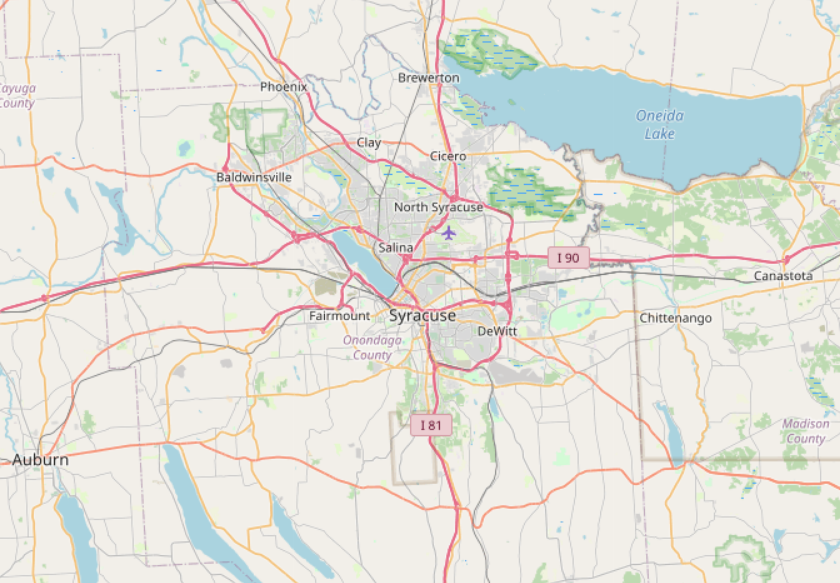
That is, the word being built is _ _ _ O U T I N _ like a cryptic crossword clue. I’m not sure where to go with this information, though; it might suggest US map routes, but not what to do with them. Syracuse is incidentally at the intersection of I81 and I90:
Aula and Aspeon tried to interpret messages as US states:
Also, “TWO OF ONE” comes before “ONE OF TWO” because the only always-sensible reading order is left/top/right/bottom. This makes the text rhyme at the halfway point and end (here TWO/BLUE) with the only exception on the page with “1 THRU 3 / OF EIGHT”. There are several states with eight-letter names, but only in “Oklahoma” all of the first three letters can point to other states; O for Ohio, K for Kansas (34th state, so XXXIV) and L for Louisiana.
“IN AT 7 / OUT AT FOUR / FORWARD 8 / AND SLIGHTLY MORE” is probably cluing South Carolina in a similar way: letters 6-7 of Carolina are IN, letters 2-4 of South are OUT, letters 6-8 of the full name is CAR, and there are a few leftover letters. (S/H/OL/A)
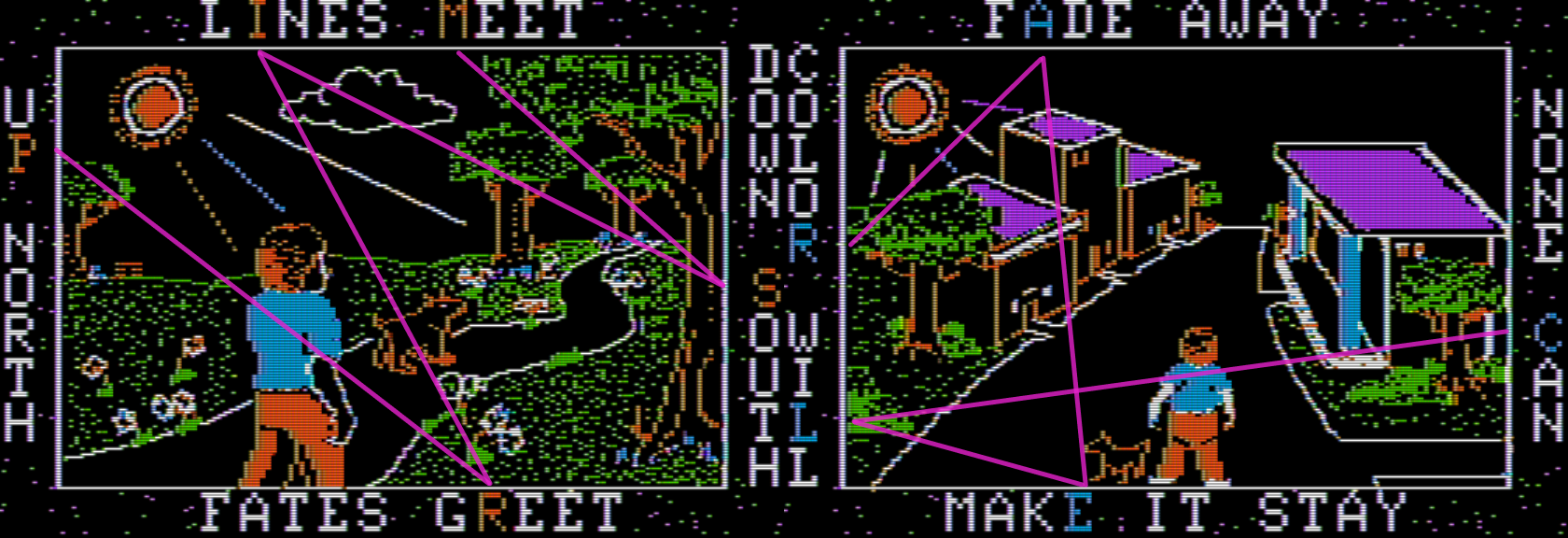
In more expansion of the “maybe some clues indicate states” idea, Rob suggested that “Up north / Lines meet / Down south / Fates greet” was in reference to some kind of state lines (like the “four corners” area around Arizona/New Mexico/Colorado/Utah) and Matt W. though perhaps “Fates greet” could be Truth and Consequences, New Mexico.
Morpheus Kitami tried to organize the letters based on color (using, as Aula points out, the proper order of starting left and going clockwise):
Red: PIMSRNESUHRTTENAREGVIXXX
Blue: RLACENONESRNENUR
Green: GCKFKAEUASVYOLA
Purple: APOLARTFLIE
With anagrams of
Red: PRISM HUES GRANE XXXVI (NRTTE extra)
Blue: CLEAR ONE RUNNERS (N extra)
Green: YOLSVA
Purple: POLAR LIFE
(The green is excluding the “GCKFKEA” text.)
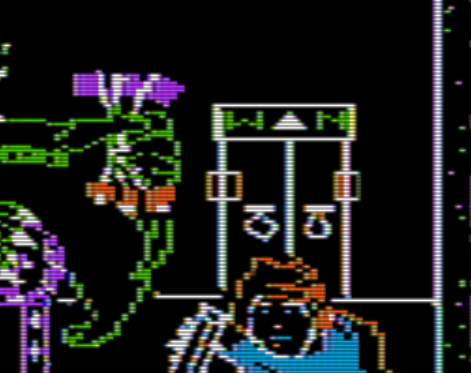
He also highlighted what he calls an “elevator”…
…although I admit I just thought of it as a door with the text over it. Intuitively, I do think there’s a fair chance this is a real clue, perhaps indicating whatever we find will have “west” amount indicated first and then “north” amount after. Or perhaps the up-arrow can be interpreted as a mountain, because there’s a few I Ching symbols scattered throughout, all of them referring to Gen (Mountain).
There’s a similar symbol at the fallen-tree picture. (It could be two versions of Li or Fire stacked on top of each other.)
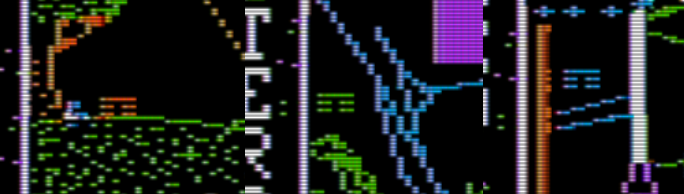
There’s enough mountain references in the art I got suspicious, but other than my guesswork going nowhere, it was failing the basic question of how do you indicate three exact spots? One could imagine very expensive surveying gear somehow being placed at particular heights but it seems like you’d need to still convey a large amount of information in order to mark where X is.
Even the “mystery anagram” page which is fairly sparse has part of a mountain in the picture.
I’m definitely going to be making at least one more post — I am determined to organize the information into some sort of (likely spectacularly wrong) theory so I can at least encapsulate what the authors may have been up to. More ideas in general are of course welcome.
In the meantime, anyone with a theory on NOT A ROCK, NEVER HOT, NOT FRUIT, NEVER LOCKED? I might throw this one out to social media because it seems plausibly standalone. It doesn’t work like a “riddle” since there are plenty of things that fulfill all four categories, but is there something themed around the contents of PRISM that would work best? Or maybe a set of five things (or more), where four out of the things are excluded neatly by the “rock/hot/fruit/locked” phrases?
The colored letters have different kinds of colors. Maybe instead of one word per page, it’s one sentence from all the differently colored letters. All the purple, blue, green, etc. This could be for each key, maybe this connects to the words on-screen?
…
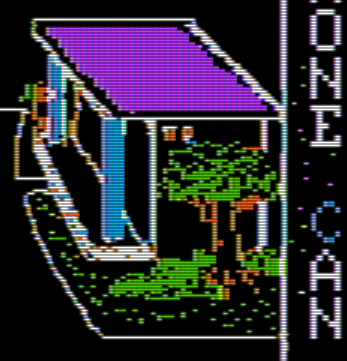
There are some pictures in real world locations, perhaps this is intended to be a clue? Is there a building that looks like the two pillar building in Syracuse?
Morpheus is referring specifically to this one:
From ern2150:
33 letters? 3 keys, is that enough to spell city/state abbreviations?
From Alastair:
Up north / Lines meet / Down south / Fates greet.
Is there a northern US state (or state or town) where lines of some sort (roads, railway lines, whatever) meet, and for a southern state where “fates greet” makes sense?
I think a good approach is to think of “small” mysteries, individual questions that might be answered or theorized about even if we don’t have a good approach to finding keys yet.
a.) What are the green letters KFGCEAK from the third image used for?
Most of the pages easily anagram. This one doesn’t, and another page you’ll see today doesn’t.
b.) What does 1 THRU 3 / OF EIGHT refer to?
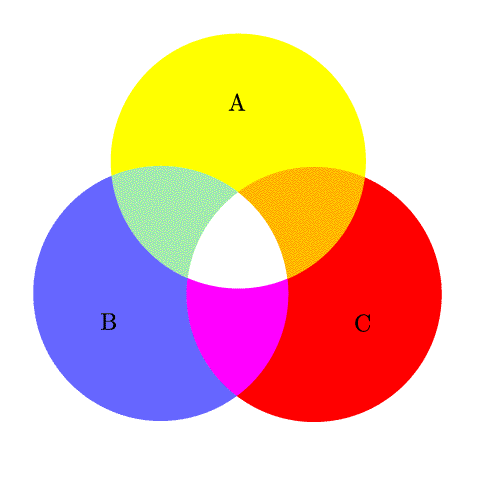
I would guess the “standard” Venn diagram with red, green, and yellow circles overlapping. (Especially given the packaging says “each represents a primary color” in regard to the keys.) This makes seven colors, eight if you include black. The list (red, blue, yellow, green, magenta, orange, white, black) does seem to represent the full color spectrum of the game.
Perhaps something that’s colored in green (like the mystery-anagram) refers to blue and yellow keys specifically, but not red?
c) What does ONE OF TWO / TWO OF ONE / COLORS RED / WHITE AND BLUE refer to specifically?
Maybe the magenta part of the Venn diagram?
I want to do some big-picture analysis in my next post, so rather than waiting I’m giving the entire rest of the story. Get ready:
Yolvsa, Plane of Darkness. A hot, silent wind blew over the desolate landscape, and colors more hideous than the boy had ever imagined painted the cruel specter.
Rising from the bleak surroundings, Hubert discerned a reptilian tangle resembling nothing in his experience except a grotesquely upturned tree. Waving above its misshapen body, he beheld a vision of wildly twisting purple tentacles… monstrously flashing green teeth… yellow tongues flapping wordlessly in an impossible world of terror.
YOLVSA.
Now, Hubert’s only contact with his familiar, secure world was the PRISM he had so hastily thrust into his pocket. Sensing more than feeling the heat now emanating from it, he pulled it out and held it in his hand. From the mysterious crystal now came a pale, pulsating light.
Instinctively, Hubert knew that he was nearing his goal, and that the PRISM was guiding him inexorably toward it. Determined now to meet with success or accept his fate, the lad prepared to follow the all-compelling crystal wherever it led.
At that instant, the parched torrid wind arose with a roar, sweeping before it every pebble, jot of earth, and the hapless Hubert. Desperate, with no other shelter visible, he reached out to grasp a limb lashing in the tempest. He had found concealment behind the torturously twisted limbs of a mutant tree where he made himself as small as possible and inwardly quaked as he waited.
TRET? This is the other one that fails to anagram. The side text also doesn’t match the story or picture at all, suggesting a stand-alone riddle.
Huberts efforts were to no avail. A creature of unfathomable deformity, grotesque in feature and limb, materialized at his side and cast him to the ground. Grane, prince of Yolvsa, keeper of the thousand names of horror, gazed redly at the small, prone human.
With a malignant sound that the boy could only compare to laughter, the creature stared down at Hubert and, at last, spoke. ‘The Protectors send a mere child to do their bidding. O, powerless being, we of the darkness will teach you to confront the forces of Yolvsa. Away to my stronghold, where you will meet your inescapable destiny.’
The entrance to the stronghold of evil; a seething, snarling mass of unspeakable forms crying out for a share of the treat. Hubert could not mistake the fact that he was to form the basis of a savage ceremony. How they howled in the throes of unwholesome ecstacy!
(Note: “Huberts”, “gazed redly”, and “ecstacy” are transcribed correctly. Gazing redly could of course be a clue.)
GRANE, the name of the prince. Again the side text is more irregular than normal.
With monstrous majesty, Grane led the boy through a labyrinth of chambers and corridors into a vast, cold space. In it stood a twisted throne of immense magnitude upon which Grane seated himself. His red eyes stared down from his sinister face.
‘Resign yourself, whelp. Although you are an insignificant figure, you may yet furnish an interesting tidbit for my extremely large fangkat. Come, my lovely. . .
From the recesses of the darkest corner of the chamber slinked an indescribable apparition, a being of incredible hideousness and all too apparent appetite. Brave as Hubert was determined to appear, he quavered under the malicious stare of the creature.
With little hope of escape, Hubert’s glance darted wildly about the throne room, alert to any means of salvation. Transfixed with terror, he was still aware of the PRISM, now burning in his pocket. Its ancient purpose aroused at the nearness of the keys. Like a thing alive, it demanded to be set free! Hubert drew it forth, and like an extension of himself, flourished it in the faces of the Yolvsa horde.
XXXVI, that is, the number 36. (Or 34!)
As if with a will of its own, the PRISM whirred above their heads in the hands of the intrepid lad. The Keys were near, and Hubert would have them whatever! As swiftly as the thought had come, a glint of bright metal struck his eye.
‘A mere talisman — that trinket — will avail you not,’ raged Grane, ‘and we taunt you as you stand before us. Behold! The Keys are here in my hand — your first and last sight of them.’ He raised the keys in his twisted hand, daring the boy to marshall his last spark of courage and make a futile attempt to defend himself.
Hubert knew not what he did, but the PRISM guided his hand in a flashing arc. As he brandished it in Grane’s face, it glowed with a white-hot force which seemed to be drawn from the Keys the monster held. Enraged in the face of the burning crystal, Grane gave a mighty roar. . . and an eruption of color — the brilliance of the spectrum — burst upon the assemblage. Half blinded by the intensity, Hubert nonetheless heard the clatter of metal tinkling at his feet as Grane swayed on his throne of terror.
Hubert, his hands sprawled along the floor, felt desperately around him for the keys, trying to retain the direction of their ringing in his ears. After what seemed an eternity, his groping fingers felt a small metal object and, suddenly, Hubert had the magic keys of color grasped firmly in his trembling hands.
I still find interesting the notable lack of yellow.
Driven only by instinct, the boy crawled around the chamber, seeking the great iron doors which meant a passage to freedom. The PRISM, its colors shining with brutal intensity, masked his intent as he made his hurried way through the anarchy of Grane’s throne room.
Hubert reached the doors shakily, drawing great gulps of the fetid air into his aching chest. Quickly realizing he needed his sight, he pocketed the PRISM, extinguishing its blinding brilliance. As his eyes adjusted to the relative darkness, he hastily scanned the maze of corridors confronting him, struggling to recall Grane’s course when they entered. The awful sound of naked claws scraping and clattering on stone, spurred him to action.
He ran! He ran with a speed as great as his terror. First left, then right, then right again and miraculously, the great doors of the stronghold loomed up before him.
Out the door he flew, eyes wild and lungs burning from the noxious air. From within the loathsome building came the sound of a mighty bell, sounding the alarm to the minions of Yolvsa. Hubert jumped from the path and skittered down the embankment just as the pursuing creatures burst through the gates howling their terrible curses.
RUNNERS?
His forward motion carrying him, Hubert lunged–but in the same instant was pulled back sharply. Around his ankle wound a hot, purple tentacle dragging him relentlessly, remorselessly, back into the Plane of Darkness!
LIFE.
With his overtired mind and body reaching their utter limits, Hubert made the most important decision of his young life: If he could not survive, he would, at least, cheat Grane and his malignant forces of their victory.
Drawing back his arm, he hurled the Keys and the PRISM together, with all his might, through the rapidly narrowing space. The world he, himself, would never again behold would yet have its beauty restored.
Even as he swooned, a mightily sinewed arm reached through the prortal and pulled the boy across the threshold. A rush of cool, sweet air, and the darkness closed about him…
(Note: “prortal” correct.)
In the quiet of his own room, in his parent’s humble home, Hubert awoke as from a dream. There were no Keys, no sign of the glowing PRISM. Was it, then, a dream, or had he really seen and done the fantastic deeds he remembered now? And yet, as he roused himself wearily from his bed and silently pulled on his shoes — a single blade of grass, colored in a loathsome shade of purple, dropped from a shoelace. Hubert acknowledged his playful puppy’s kisses and, his face set in a mask of determination, finished dressing and headed out the door, Uanna barking and following close behind.
In a sequestered cavern, beyond mortal reckoning of time and space, a PRISM still glows quietly in the semi-dark.
Color of an uncertain brightness has returned to the world, but the rich tints and intense hues of a bygone time are only the stuff of legends, living in the memories of the very old.
Is the quest unfinished? Does the PRISM still burn to be reunited with the Keys of the spectrum, lost by Hubert’s heroic throw? You and I know, that somewhere on this terrestrial plane, the answer lies hidden. Will you follow the fearless Hubert and complete the task? To the Protectors of the PRISM falls the duty and honor of reuniting the keys with the PRISM and reaping their colorful reward.
With a little animating on the letters.
Hopefully there’s enough to chew on now! If nothing else the pages with “non-sequitur” phrases could really use some speculation. I’ll get into wild-analysis mode next time and try to sort things; one big question is “are the three keys all hidden by the same code, or are they clued in three entirely different ways?”
(OK, if you combine the two “unanagrams” you get KFGCEAKTRET which can make “keg fact trek” or “tack fret keg”. I don’t think either of those are intended.)
I was unable to wrest any hints from ISM. Are the keys more than one hundred miles apart? Five hundred? No comment. Are the clues in the pictures only, in the pictures and inscriptions, or in the text, pictures and inscriptions? No comment. The only help I got, which I pass on to you, is that the keys are in the 48 contiguous states… somewhere.
I did think it possible, given the office in England, that this might be a cross-continental game (enabled by having three keys!) Apparently not.
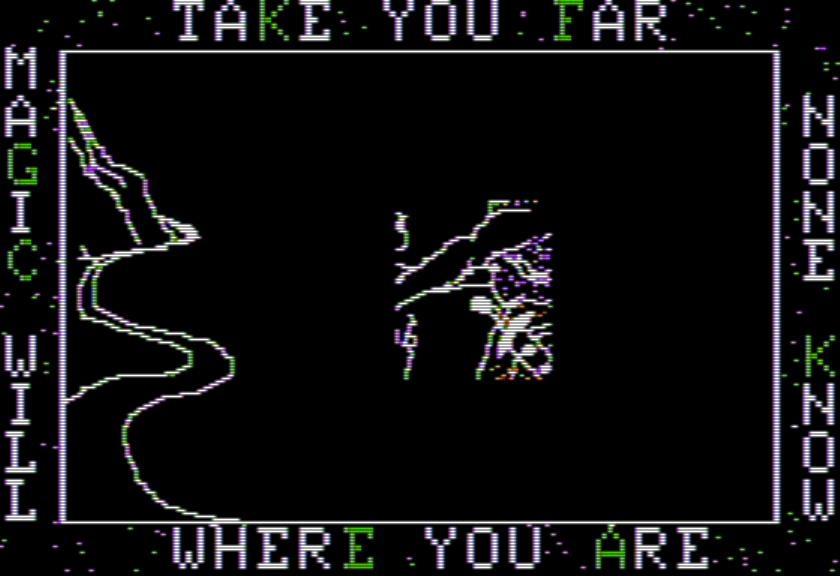
My commenters last time (ern2150, Voltgloss, Gus Brasil, arcanetrivia, matt w) noted that two of the graphics screens seem to involve anagrams; the letters of PRISM in the first and CLEAR in the second. The third, mystifyingly, seems to have no equivalent (I even checked the rest of the story in case of a proper name that matched).
I’ve added connections to the letters in case the idea is to make a shape that spells something out or keep an eye on what parts of the picture the “lines meet” at. In addition to this being open to interpretation, if the line idea is right, it isn’t clear what point each vertex should be touching (the center of a letter? right on the edge of the frame?) Perhaps the third non-anagram page is supposed to be more of a code?
One other major point to mention is that the three keys are given as Blue, Red, and Yellow, yet the colors of the screens are Red, Blue, and Green. Colors after are Red, Blue, Purple, Green, Red, Red, Orange, Blue, Purple, and Multicolor. While I’m not officially up to Multicolor yet, I wanted to share that screen early just because it is so notable.
The colors have their usual Apple II muddy effects going on so I can’t be certain, but I think the “A” on the page bottom is the only place a letter is colored yellow. (The anagram here, by the way, is Uanna, the name of the dog. The name is so unusual surely it is a significant clue? The review I mentioned earlier thought the dog’s name was Vanna, but cross checking a word starting with “V” later indicates the game definitely meant Uanna.)
In addition to maybe suggesting “up”, “advance”, “north”, “north”, “advance”, the presence of UAANNA here is notable in that it means this hunt is not exactly like Masquerade. (Again, no solution was published 1982, so there’s no way ISM could have copied the solution part, just the words and colored letters on the border.) The text in Masquerade was completely a red herring. (There were some riddles, but they led nowhere.) Here, the text seems to have at least a little relation to one of the images.
I’m going to pick up the story now all the way up to where Hubert enters the “other world” and the player is requested to swap disks.
Suddenly, Hubert found that he was standing in a vaulted cavern bathed in an eerie, muted light. Bewildered, Hubert glanced about for a familiar sign or friendly face. As his vision cleared, he beheld the figure who had brought him to this strange place, standing alongside a similarly dressed companion.
‘Why have I been brought here? Where am I, and who are you?’, asked Hubert of the steadfast guardians. Nothing met Hubert’s ears but the most profound silence. Then, suddenly. . .
‘You are the True Protector of the PRISM,’ pronounced a voice from the vastness. ‘You alone can retrieve the Keys and restore the powers of the PRISM to your world.
Even as the voice reverberated, the last vestiges of color were draining from sight. Boldly, the lad raised his eyes to the space above and asked again, ‘Where is this place, and why am I here?’.
From the void came the reply, ‘The location is of no matter. Only the fact that you are here, and you are the chosen Protector. Unto you has been given the task of restoring the keys to their hallowed resting place. Only then will color return to the world. Behold the PRISM, Lad, and see its despair.
As though his sight were guided, Hubert looked upon a pedestal in the center of the cavern. On it lay a translucent object of great beauty, as colorless as a tear. Above it on a shelf were three empty keyholes.
Animated rays like the sun was animated.
‘Find the keys, my boy, and return them to the Cavern of Color. Only then can the joy and beauty of color be restored.
Accepting the disembodied voice, brave Hubert asked, ‘Where have the Keys gone, and why am I chosen to search for them?’.
‘You are the chosen of the PRISM, for only the small and pure of heart can pass through the portal. Among your people, age brings wisdom of a sort, but with it a loss of the magic born into every child. No one of full growth, therefore, can slip through the walls of the world and bring back the beauty that has been taken from you. Ask no more questions, for even now the access narrows and further delay would mean all would be lost.
Red, White, and Blue are the colors mentioned here. White = yellow somehow?
‘You must summon all of your courage for this journey’, the voice continued. ‘Dark forces of great power will be arrayed against you. Grane, prince of Yolvsa, has breached the portal and stolen the keys to add color to his evil wastelands. Yet, he foolishly left the prism behind, not knowing its power of focus. Take the PRISM, Hubert. Go and be swift! For even as I speak, your moment is quickly departing. Behold, the portal!’
Piercing the darkness, Hubert beheld an aperture of odd configuration, rapidly diminishing, even as he stared. Clutching the PRISM tightly, he plunged into the darkness.
The anagrams HUES and PORTAL are there; other than that I’m going to keep any analysis for now in the comments.
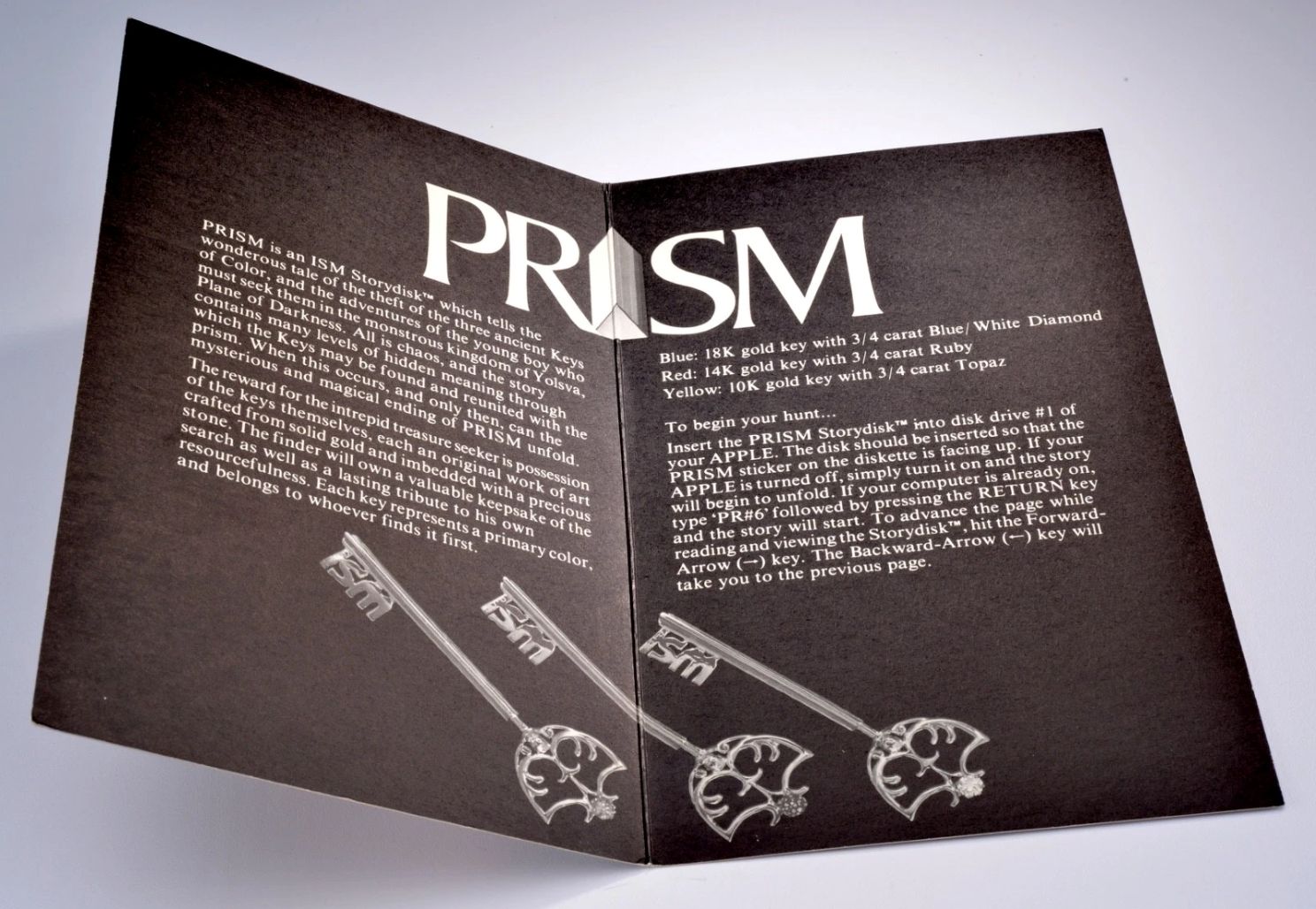
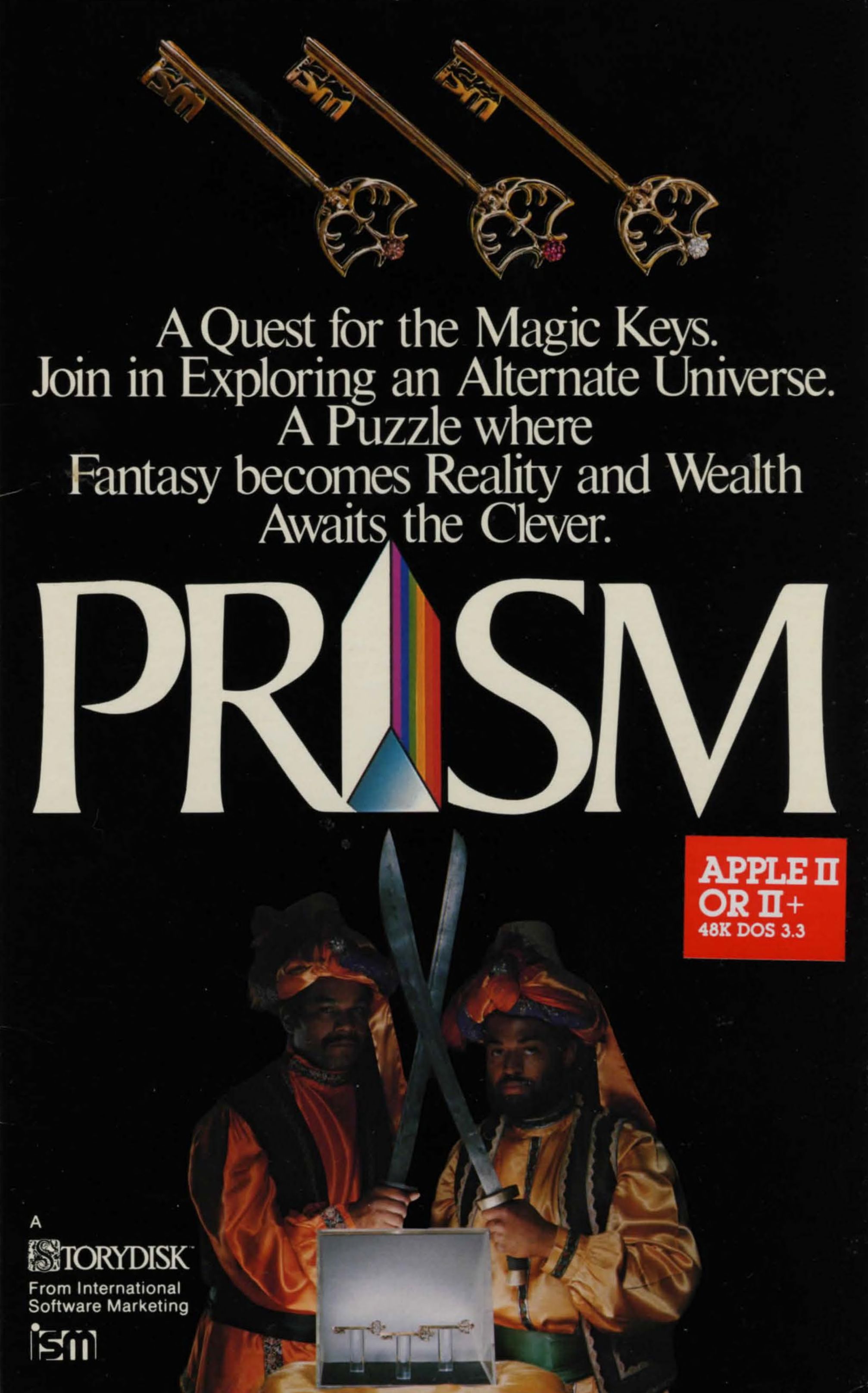
PRISM is an ISM Storydisk which tells the wonderous tale of the theft of the three ancient Keys of Color, and the adventures of the young boy who must seek them in the monstrous kingdom of Yolsva, Plane of Darkness. All is chaos, and the story contains many levels of hidden meaning through which the Keys may be found and reunited with the prism. When this occurs, and only then, can the mysterious and magical ending of PRISM unfold.
— From the instructions for PRISM
Six years ago this blog tackled the game Alkemstone (1981), a contest leading to a buried treasure with clues in an Apple II game (the Alkemstone itself did not have value, but you could win money from the company for finding it). A year after Alkemstone there was another Apple II program, but this time hiding real buried treasure. As far as anyone knows this treasure is still buried.
In 1980, Stephen Brightbill founded International Software Marketing, Inc. in Syracuse, New York. They launched with the product MatheMagic in 1981, software that “harnesses the power of your Microcomputer to perform simple arithmetic to sophisticated mathematics.” It had versions for DOS, CP/M and Apple II and sold for $89.99.
Where this put them on their main product line was a 1982 extension, Graph Magic, which allowed for “figures in graphic form and full color”. From there they followed with Color Magic and essentially pivoted to graphic presentation software for the duration of their lifetime (folding in 1992, according to Brightbill, due to “competition” and the “rise of Windows”; they were DOS-only by this time).
The “International” part of the name is significant as while it might have been a little aspirational, they did list a UK office branch in their ads. This connection means they likely had strong familiarity with the book Masquerade which was still being a smash hit at the time.
I bet you can do something with books that no one has ever done before.
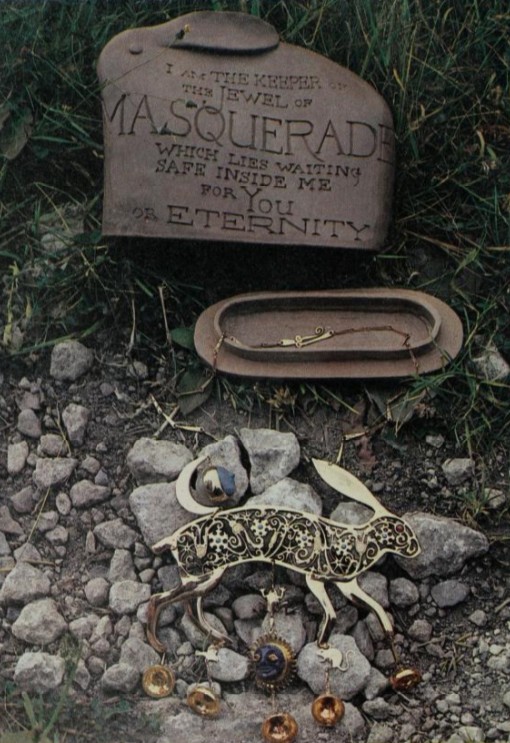
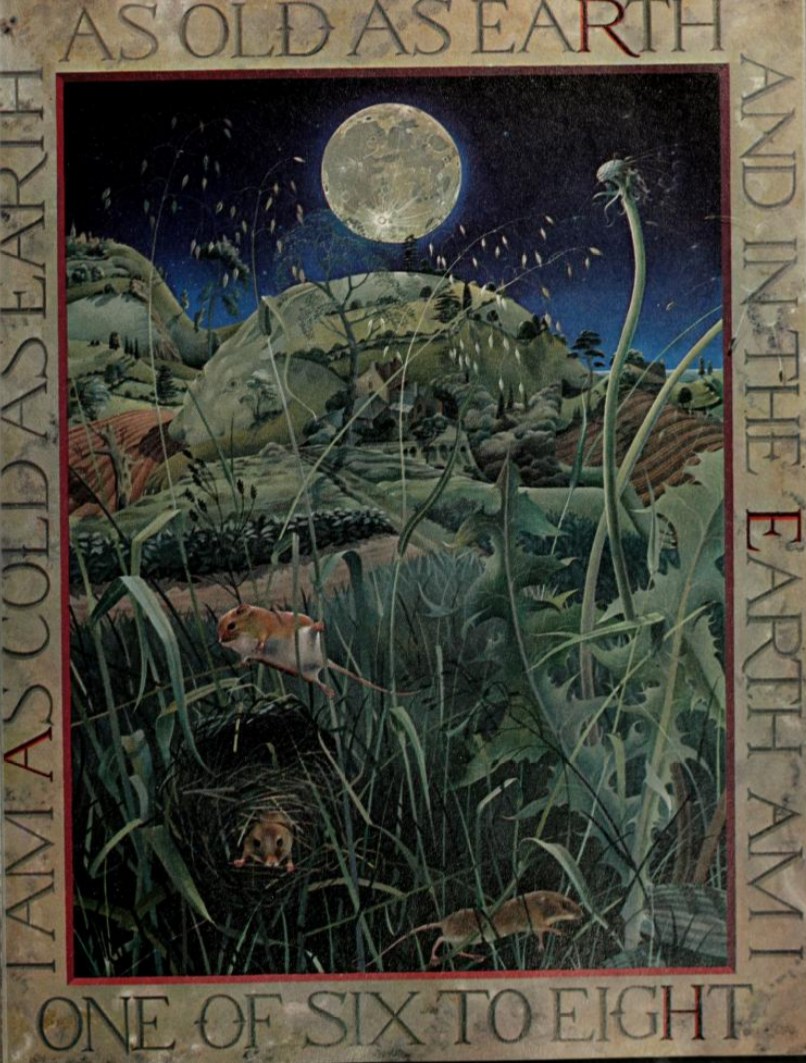
I’m not giving a history of Masquerade but rather deferring to Jimmy Maher; the important points are that it was a real-life treasure hunt for a buried hare designed by a real jeweler, and the hints to find it were inside the pages of a lavishly illustrated “children’s” book.
We’ve already encountered several “contest games” on this blog, including the previously mentioned Alkemstone, but also Krakit and Pimania. While it is almost certain they happened because of Masquerade-mania, none of them tried to match the form factor. Alkemstone had clues hidden in a first-person maze, Krakit just had a series of puzzles on ZX81 (and no buried treasure!), and Pimania was an adventure game where the clues suggested a particular time and place to go (but again, nothing buried).
That’s not the case for PRISM. PRISM has not just one buried treasure, but three: keys designed by the Syracuse Jewelry Manufacturing Co.
Blue: 18K gold key with 3/4 carat Blue/White Diamond
The people involved (besides presumably the CEO) are all listed. Mark Capella and Ronald Roberts are “co-designers”, Mike Sullivan did art, and Carol Keller did editing. We’ve seen Mark Capella here before; Mike Sullivan of Microstar Graphics later did the disk magazine PC Life. Relevant for today, here’s Sullivan’s “Musical Christmas Disk” called ‘Twas the Night Before Christmas disk from 1987 (if it embeds correctly, it is interactive and you can try it right in the browser):
If you’re wondering how a business-software company got involved with making a game, in some sense, it isn’t a game at all. The software is merely a “Storydisk” for Apple II which is a “slideshow” much like the ones people could make with their own software. It presents a book that bears strong similarity to Masquerade and hence PRISM represents the closest thing Masquerade had to an actual clone.
Now, a huge disclaimer: just like Alkemstone, it is quite possible the contest landed somewhere too ambiguous to solve (explaining why they never announced a winner, even though the company lasted for ten more years). On the other hand, we discovered things out of Alkemstone nobody had seen before, and there’s three locations rather than just one, so it is still faintly possible something of real money value may come from this exploration. I cannot prevent anyone searching on the basis of information here. I will state myself outright if I find anything myself personally I will be donating it to a gaming museum like The Strong. I cannot speak for anyone else. You can assume anything posted here is public.
The pages that do have art have some animations, so while I’m going to be showing pages from the “book”, there’s going to be a little more going on than with Masquerade; it’s even possible there’s “hidden keypresses” or the like which are part of the game. At least in general the only options are “left arrow” and “right arrow” to move between pages.
Not including the start and end, there’s forty pages total. I’m going to just give the first seven for now, but I’ll give out later sections in larger chunks. I expect to make at least six posts and possibly a few more; feel free to chime in with theories in the comments about what’s going on.
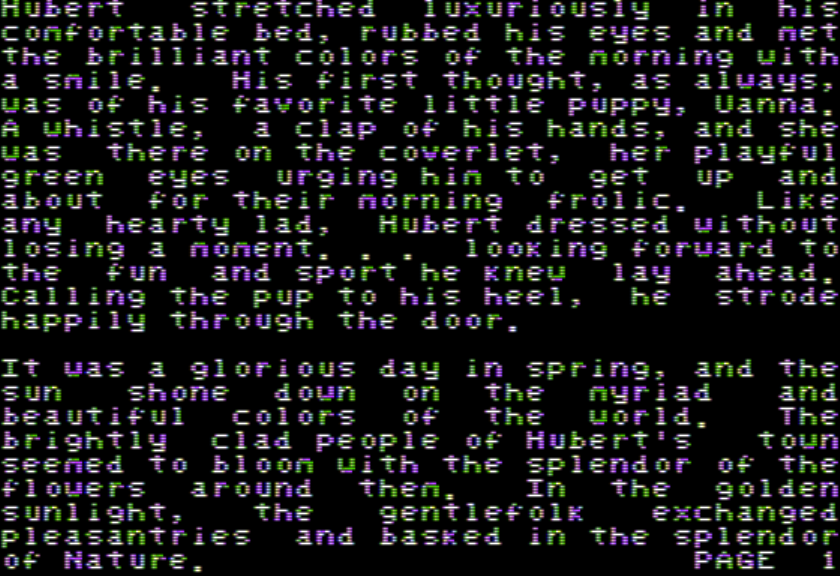
For the text-only pages I’m going to give text rather than screenshots, although I did want to show the first page off as an example.
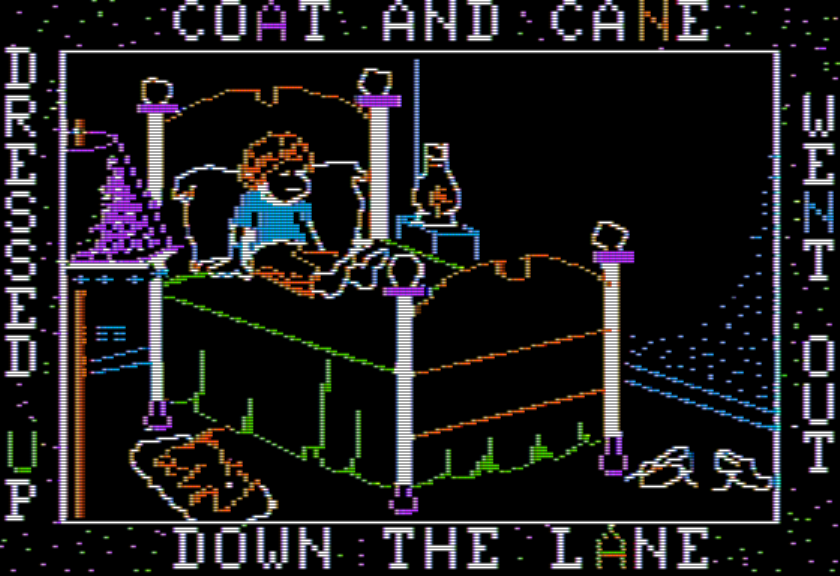
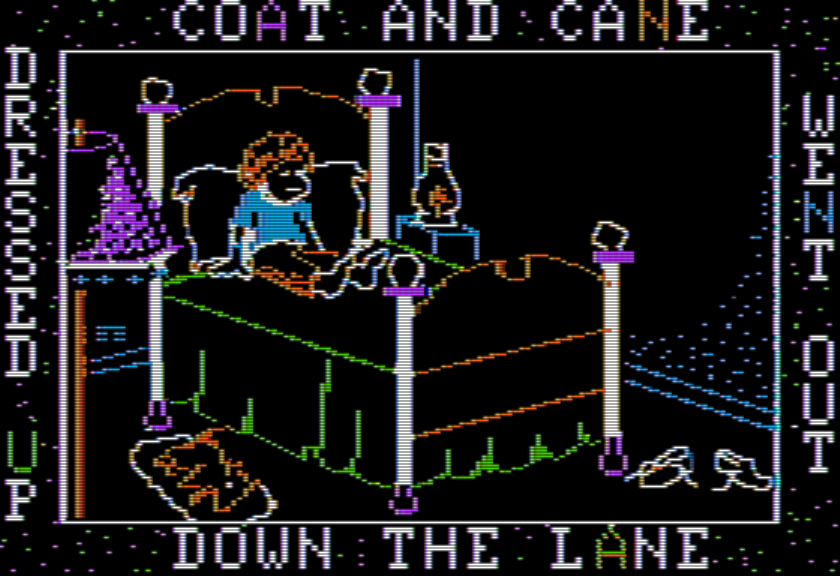
Hubert stretched luxuriously in his comfortable bed, rubbed his eyes and met the brilliant colors of the morning with a smile. His first thought, as always, was of his favorite little puppy, Uanna. A whistle, a clap of his hands, and she was there on the coverlet, her playful green eyes urging him to get up and about for their morning frolic. Like any hearty lad, Hubert dressed without losing a moment… looking forward to the fun and sport he knew lay ahead. Calling the pup to his heel, he strode happily through the door.
It was a glorious day in spring, and the sun shone down on the myriad and beautiful colors of the world. The brightly clad people of Hubert’s town seemed to bloom with the splendor of the flowers around them. In the golden sunlight, the gentlefolk exchanged pleasantries and basked in the splendor of Nature.
I find the transcription much easier to read!
The rays do some color cycling.
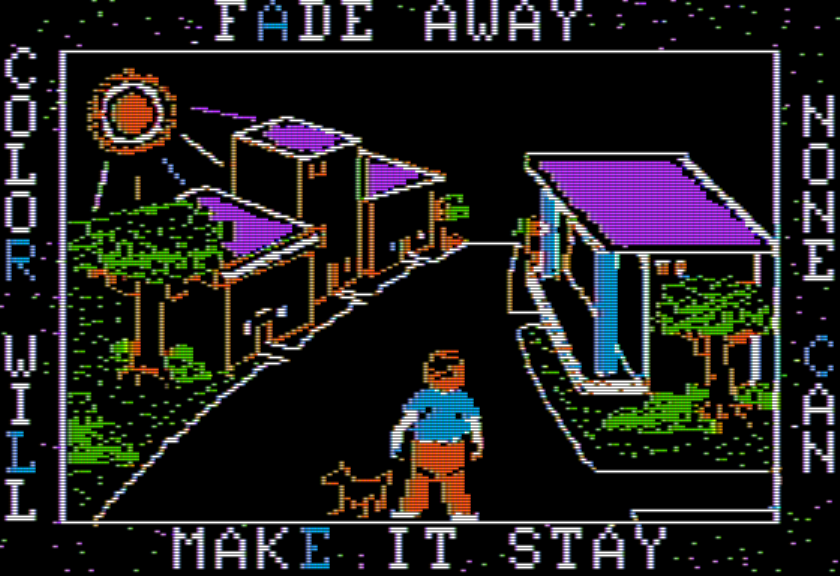
The first graphical page; notice the words along the border as well as colored letters. These are both clones of Masquerade, although there is no implication they get used in the exact same way (the solution hadn’t been released yet of the original book!) Hence we have the curious situation of someone copying what a puzzle looks like but quite possibly doing something very different with it.
Hubert, a small but sturdy lad, smiled as he watched the congenial fellowship of his townspeople. Around them, the festively colored birds chatted as they built their nests, and the animals lazily stretched their muscles after a satisfying winter’s nap. With Uanna following close behind, the boy whistled as he strode down the road, with not a care in his mind.
And it was then that. . . A sudden hush descended upon the street. Hubert cast an anxious glance about, then started in disbelief. Around him, HIS WORLD WAS CHANGING !!!
Two more text pages (page 5 and page 6), and then I’ll give the image after, and that’ll be enough for today.
Where the warm golden sun had beamed, only a white blaze appeared. The gaily clad people looked down at themselves in disbelief as the colors slowly drained from their brilliant clothes. Before their eyes, their splendid world was turning black and white and every shade of grey in between!
Young Hubert felt a chill run through him as he witnessed this stupendous horror. ‘How can this be?’ he wondered. Even the animals seemed to sense the transformation as they scampered back into their burrows. The townsfolk silently dispersed, shaking their heads in wonderment.
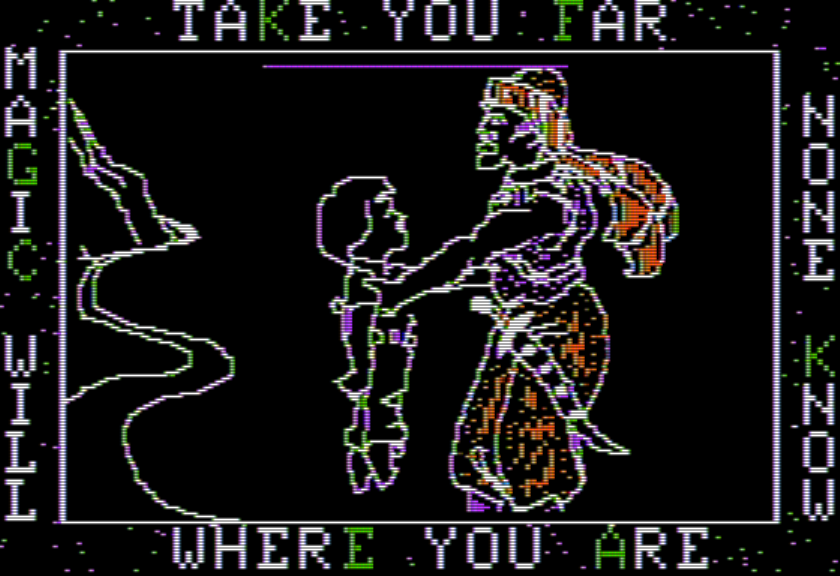
Suddenly, Hubert found himself alone on the stark, black pavement, his puppy pressed up against his leg in her anxiety. The once, and so recently colorful world was rapidly beginning to resemble the pallid grey images on one of his grandmother’s old photographs. As he turned the corner in the direction of his home, he found himself confronting the gigantic figure of a strangely garbed individual. The apparition wordlessly reached for Hubert and as he lifted, they both seemed to fade into nothingness.
The above images animates with the two figures disappearing:
I’m stopping here (page 7) to give people time to comment and will continue on page 8 next time.




 Renga in Blue
