The cover above references a “fountain of youth”. This indicates that the fountain I ran across roughly 20 minutes into playing is the objective of the game! I don’t know if that means all we need is a container, but given the divine thunderbolt that killed me, I’m guessing there’s an extra procedure involved. In either case that makes for an interesting structural concept: showing the game’s objective early.
Speaking of interesting structures: as I theorized before, The Golden Voyage has more than one island. Once I realized the general pattern I found it satisfying to navigate.
This is the map the boat is on; you SAIL to the island you want, drop anchor, and explore. (As a side observation, while I understand the use of loops here to make the ocean feel wide and open, I feel it to be frustrating and unrealistic. Honestly, the only loops that were OK were in Adventure, simulating real cave exits that went nowhere; loops on most other text adventure maps have felt like crutches.)
Just like Timequest, the division of space makes for themed mini-areas. I already mentioned the jungle with the cave and the fountain:
To the west of the opening city I discovered a “small island” apparently without obstacles other than the ever-present scorpions. There’s a “skeleton” in the opening room that I thought might have been the animated kind, but no: it’s just an inert skeleton.
You can even pick it up and take it with you. Other than the skeleton, there’s a shovel, a box with “medicine”, and a sword.
The game made up for its lack of animated skeleton with an animated statue on a third island.
This led to a colorful combat scene:
It took me a long time to find the syntax get off the staircase. It’s WALK UP or WALK DOWN. GO STAIR says “please be more specific” and for the life of me I don’t understand why UP and DOWN don’t just work.
Past the statue was a temple with an altar, where PRAY opens a secret passage.
The inside was dark, but fortunately, on the jungle/cave island I had used my newly-found shovel to dig up a rope and a torch. Inside the temple passage was a large block (not sure what to do with that) and a curious stone which “appears to be broken” and “has strange markings”. You can find another stone just like it in the rubble of the defeated statue, but I haven’t been able to unite the stones in any way.
Other than that, I’m dealing with a locked ornate chest I can’t open … and that’s it. The list of obstacles suggests to me I’m missing a hidden puzzle somewhere, or maybe my island map is inaccurate and there’s another place to sail to.
Still, referring back to the structure, the gameplay is pleasing enough I’m enjoying myself so far and not about to reach for hints yet.
I want to clear up a misconception I’ve seen elsewhere about Golden Voyage, #12 in the Scott Adams series.
— backtrack that, I’m going to let Scott Adams himself do it. This is from an audio interview on the Atari 8-bit Podcast; you can listen to the relevant portion from the man himself or just read the transcript below.
Kevin Savetz: Based on your feedback that you get, what do you think is your most enduring adventure game?
Scott Adams: Probably Pirate Adventure, a lot of people remember that and connected with it. That, I get a lot of response from. Voodoo Castle, which I didn’t do as much of the writing as my wife back then, tried to write an adventure and I had to clean it up with her. It has more of a woman’s touch to it, and that seemed to resound with a number of people. Another one that was popular has an interesting story behind it. That’s Pyramid of Doom. That was adventure number eight. That’s set in the sands of Egypt, a lot of people remember that and the Purple Worm. They know a lot about it. The interesting thing is I didn’t write that one at all.
I got a submission in the mail from somebody saying, I wrote this adventure game, take a look at it. It runs on your engine. I’m going what, wait a minute I never released an engine, I never told anyone how my engine works, it’s totally proprietary you couldn’t have.
I took it and started playing it and sure enough, he did it on my engine. It was a decent game. I contacted him, his name is Alvin Files, he’s still around, he’s in Oklahoma now, retired. He’s a lawyer and he was just interested in it.
He took my machine language, disassembled it, figured out what it was doing, and figured out my language, which is awesome. He’s not the only one that did that. Another fellow did it which is, I think it’s number 12 in my series, Golden Voyage, by William Demas. He did the same exact thing. In both cases neither one knew each other and neither had contacted each other.
I worked with them and I thought this is so amazing if they’re able to do it, I want to get their stuff published. I’ll give them publishing rights, I’ll give them royalties, and I’ll edit it with them because they were still rough gems, and I’d learned a lot of things about how an adventure should flow and so forth. I worked with them from that point of view. It’s amazing what they did.
So Golden Voyage, like Pyramid of Doom, is not really “by” Scott Adams, although his name is on the credits.
Misspelled, even. I am not making this up.
Ravenworks in the comments has the theory this was just due to a bad read, as the difference between “o” and “g” in ASCII is one bit.
Demas was busy in 1981 with Timequest (which we’ve already seen) and Forbidden Planet (which will be coming up later in 1981).
The king lies near death in the royal palace – you have only three days to bring back the elixer needed to rejuvenate him. Journey through the lands of magic fountains, sacred temples, stormy seas, and gold, gold, GOLD! Can you find the elixer in time?
— From the back cover of the game, and yes, elixir is spelt wrong twice
I tossed this game in now while Ulysses and the Golden Fleece was fresh in my memory. Just like that game, you start in a small “town” area where you buy things, although the merchants in The Golden Voyage are a bit more bloodthirsty.
I haven’t seen a beatdown like this since Nethack. This amuses me rather than bothers me design-wise since it’s so easy to reset the situation. Ulysses and the Golden Fleece just says “YOU HAVE TO BUY IT” if you try for the five-finger discount.
Nearby is a palace, where you are given your quest and a giant bag of gold with a minimum of fuss.
This lets you go back and buy the sandals as well as a compass, telescope, and stone tablet (with a picture of a cave). But since this is a lot of gold, it also lets you buy an entire boat.
Just like Ulysses and the Golden Fleece, I had a hellacious time trying to launch the thing. That game I eventually hit upon GO OCEAN, which doesn’t work here.
The proper command is SAIL (direction), that is, SAIL NORTH or SAIL SOUTH or SAIL EAST or SAIL WEST. I was stuck for so long I thought maybe I was missing a crew or putting the sail somewhere in particular.
You incidentally can climb the mast to get to a crow’s nest, and go in the cabin to find a cot you can sleep in and have time pass.
Moving on, if you SAIL EAST twice and LOOK TELESCOPE while in the crow’s nest, you find land.
If you’re not wearing the sandals, the scorpions bite you and you eventually die.
However, there isn’t much more to see; you can go in the jungle (two rooms) and find a dark cave. The game had a slight delay before showing the usual “you can’t see” message, so I was able to assess there was a fountain inside with a strange liquid.
I’m stuck here although I’ve got a two ideas for experiment:
a.) Check sailing in different directions; it’s possible there’s only one island, but if this is anything like Ulysses there are more. I know TORCH is an accepted noun and given the jungle island seems to only have the cave (which I peeked into by less-than-official methods) I suspect I’m missing an area.
b.) Mess around with PRAY, which is an accepted verb. I tried putting the tablet in the fountain and praying after with no result, but maybe I need to use a different item?
For reference, here’s my verb list (verbs that work are marked in orange):
All videogame genres have norms; some are obvious (first-person shooters using WASD keys) and some are less visible (the lack of softlocks in modern adventure games). They can, of course, evolve (see softlocks in older adventure games) but they can feel as organic as the air, and it takes a off-kilter game that violates the norm to make them apparent.
…
The first two of the Softside Adventures of the Month (see: Arabian Adventure, Alien Adventure) both cadged liberally off movies, and I can tell you from peeking ahead that the September through December 1981 installments do relatively the same, but Treasure Island Adventure is a one-off: a traditional treasure collect-a-thon. It’s also Pete Tyjewski’s only game.
Softside, August 1981.
The “goal” is simply to find the pirate’s treasure, and if you want to declare victory with just that objective, you can. There’s a traditional building-with-vault to stick it in.
However, every single item in the game counts for points. So if you’re actually going for a maximum point total (258), you’re scavenging everything to bring back, not just ostensible treasure items. Specifically, the treasure chest is 50 points, three other treasure items are 20 points each, everything else is 2 points each. Oddly, some of the 2 point items are described as treasures, like a gold ring or a gold shield, equal to the “garbage” items which also count for 2 points, like a parchment giving the author’s name.
This is deep in the game, and the author’s name isn’t given elsewhere.
In addition, the game adds a point for every room visited (like Adventure 500) and it has a point bonus for finishing within a certain turn limit (like Adventure 430); handling both and getting all the items requires some serious routing.
Above-ground is very, very, plain, and establishes a minimal room-description style.
The only items are a keg of “whale oil”, a lamp, and some matches; those all go together to make a light source (FILL LAMP / LIGHT LAMP) which I’m fairly sure is unlimited.
Incidentally, the verb list is very small; other than lamp lighting, you can move around, pick up and drop, examine things, read things, and say words. That’s it. The experience is akin to Chaffee’s Quest (1978) in being mostly exploration and finding a treasure, but the game manages to eke out puzzles in the form of requiring items to be held for certain effects, and two magic words.
The sparse style is thrown for a loop by a couple rooms inside.
I think the norm being broken here was something like “at most 4 objects to a room”. A snath is a handle of a scythe.
I admit being somewhat boggled when I first hit these; I had spent a long time making my outdoor map (I still can’t guarantee it’s error-free) so the transition to having a cavalcade of items was both notable and confusing. Especially because so many of the items are “useless” except for the 2-point count. For example, in the Armory, the sword is useful, and only the sword.
This sword is magic
The runes say
ASTO REBLOF DOF
DESTO MARKO BLODD
I’ll get to the meaning of that in a second. There’s a gold coin two rooms away with a similar message (accompanied by an absolutely useless coil of rope).
The coin is magic, the runes are:
IFTO GOOTOO ROPTO BLUTU
MORTO FLORTO GORTO BORTU
Map-making remained slow because directions were usually but not always mentioned in room descriptions, which means I had to keep testing them all. Eventually I came across a maze, and progress was even slower. (I would say this was penance for skipping the maze in Castles of Darkness, but I had played through this part before Castles. I had shelved the game a while due to exhaustion before I got back into it two days ago.)
Inside the maze I found … nothing. Absolutely nothing. Similar to Microworld, this is because there was going to eventually be an object in the future, but I still felt a sliver of despair upon mapping the last unmarked exit with nothing to show for my efforts.
Another section of the map led me to Hell.
Hell is kind of tiny. Must be the Sartre kind of hell.
You need to have asbestos boots to cross a red hot iron bridge inside. (Just in your inventory, they’re apparently assumed to be worn — as I indicated earlier, tiny verb set. Compare with the bit in The Golden Baton where I got messed up due to having an invisibility cloak in inventory but not being worn.) Within Hell there’s an arch which requires a wizard outfit. Specifically: a robe, hat, and the 2-foot rod with a rusty star; yes, you use it as a costume, not as a magic item.
When I attempted to go farther the game said “You must have known a pirate and have a treasure to enter.”
Off in another direction there was a “scholar’s cave” with a treasure map, a book, and a parchment. Here’s the map:
The parchment is the author credits I mentioned earlier; the book translates the sword and the coin.
If you have this weapon, and say vargay, no door will ever, bar you way
If you have me with you, and say valoor, I will reveal, A secret door
The map indicates where to try VALOOR:
This led me to the desired treasure chest.
You are in a little nitch
There is a very large treasure chest here
Upon which the game threw another curveball similar to Quest: the routes back were either blocked by the wizard, who had come back…
…or used holes that the chest couldn’t fit inside.
I wandered a bit and the pirate came to steal and re-hide his treasure.
Suddenly Long John and the pirate leaps out of the gloom and takes the treasure
HAH, he shouts, found me treasure, did you. Well this time I’ll hide it better!
He dissappears into the darkness with the treasure
Fortunately, I had already mapped the maze, so it was a straightforward matter to reach the “more secret” hiding spot and get the treasure chest back. The chest is fortunately only stolen from you only once. (Aside: although we’re really the ones stealing the chest, right? I’m sure the pirate didn’t get his bounty through bake sales, but I get no sense the protagonist has a noble cause in mind.)
Having both the chest in hand as well as the encounter with Long John, I finally was able to go back into the lounge of Hell.
I’ve been taking a pass commenting on typos, but I can’t resist pointing out buccaneer is spelled wrong twice, and in two different ways.
This led to a (mercifully) tiny maze and an alternate exit which bypasses the wizard giving a straight shot to taking the chest to the vault.
The other valuable treasures are a Ming vase (it’s the Adventure puzzle where you have to drop a pillow first), a crown (that you get from a cage of the wizard that locks behind you; you use the magic word on the sword to get out) and an anvil (which if you EXAMINE tells you it’s secretly golden, which sounds kind of not-useful for an anvil).
When Dale Dobson tried this, he took a crack at optimizing, but threw in the towel. I tried a little, but unlike Madventure, it started to feel tedious rather than a tight puzzle; so, I’m going to stop here as well. I will say I appreciated the sheer oddness of a treasure hunt that was both simultaneously sparse (only 4 “meaningful” treasures) and packed (every item gives points) at the same time, where weapons are useless for killing, where one of the main antagonists only appears as something to avoid, and where a heavily restricted verb set nevertheless put forth a few tricky puzzles.
There were a few struggles remaining, but light has returned to the world.
Plus, I got to experience some Apple II voice synthesis.
From the Gallery of Undiscovered Entities.
I had left last time on a bridge. I had an umbrella with M. Poppins on it, and the bridge was the right point to go flying. After OPEN UMBRELLA:
The new area has gloves which contain a boulder-removal cream, remarkably pertinent to the bridge dilemma. Using OPEN UMBRELLA again flew me over outside the castle, and I was able to walk back and apply the cream, getting rid of the boulder.
I then got a bit stuck until I realized that in addition to feeling for secret doors in the cardinal directions, I could FEEL UP and FEEL DOWN. sigh Thus began checking every single room in the game.
One room led down to some treasure and a “tarnished lamp”. Rubbing the lamp led to the voice synthesis: “THE MAZE, THE MAZE, THE MAZE”.
I tried to record the sound but was having trouble; I’ll update this post if I can get a video to work later.
This bit is optional — it’s supposed to be a hint as to where to go next.
The maze being referenced I found past another hidden staircase:
Some descriptions of various rooms:
I’M IN A EERIE, WINDING MAZE OF ROCKY, DARK PASSAGES ALL ALIKE
I’M IN A EERIE, ROCKY MAZE OF DARK, WINDING PASSAGES ALL ALIKE
I’M IN A WINDING, EERIE MAZE OF ROCKY, DARK PASSAGES ALL ALIKE
The four adjectives can be recombined in 24 different ways, so yes, there seem to be 24 different rooms. I started to map hoping things would hold sanity, but quickly realized that wasn’t going to be the case.
From The Book of Adventure Games by Kim Schuette.
I figured I’ve proven myself enough in other games that I know how to map a maze, so I just looked up the route. The only thing to find in the maze was a STRING. Once you have the string, the flexible yew pole from earlier can combine to MAKE BOW. I also found some ARROWS on looking at the dartboard I mentioned last time.
(Incidentally, the genie’s hint changes after you’ve gotten the string to “BREAK BALL”, which refers to an event at the end of the game.)
I knew when I had my bow and arrows where to go next: a dragon I found off another secret door.
This is animated; you walk in, he breaths fire, you run away.
Here I was horribly stuck, because the pattern was to enter the room and get chased off without being able to type anything. I poked at the hint sheet again and found the clue LEAVE THE CIRCLE.
Huh? The only thing I could think of was a ring I hadn’t used yet.
A RING WITH STRANGE SHAPES ON IT
I went ahead and dropped it off before entering the dragon room, and found I was able to react to the dragon rather than just run away. I was able to SHOOT, run away, SHOOT, run away, and SHOOT for a third time to slay the dragon. The accumulative damage being needed to slay the dragon was quite satisfying, but I had no idea what the ring was doing.
I found from commenter Odkin that my lack of sound earlier caused me to miss a clue: the game says BEWARE when you pick up the ring. That still makes the moment it happens kind of random, but it does impressively make for a second sound-based puzzle.
Past the dragon was a room of fire; I had a big roll of asbestos that I laid out in a way that reminded me of Kaves of Karkhan.
This was followed by one last locked door and me banging my head some more. I went ahead and spoiled: I missed the fact there was a bird earlier I could WHISTLE to and it would drop a MEDAL.
The medal has the description
ONE SIDE READS “A IS 26, B IS 25, Y IS 2, Z IS 1”
THE OTHER SIDE READS “AT LAST! IT OPENS!”
I already applied the code, but that last part of the text indicates the medal is also useful on locked doors. USE MEDAL opened up to the last room.
The wizard fries you unless you take the pill-of-lightning-resistance first, but TAKE PILL is easily followed by KILL WIZARD. You can then SMASH BALL (matching with the genie’s hint) to win the game.
Before signing out, I’d like to quote Kim Schuette, whose map I showed off earlier, writing in the early 80s:
The game offers a degree of animation and occasional spoken words, but some of the graphics leave a lot to be desired, particularly small and difficult to differentiate objects. Travel from location to location is on the slow side. Also, the limited vocabulary often makes progress frustratingly slow.
I can’t disagree with most of this? I think on some original screens the objects would look like a blurry mass (which really are tiny, check out those gloves on the first screenshot) and the trudging animation did start to get tiring when I had to keep looping back and forth (emulator turbo speed for the win, though). I find the comment on the parser most interesting, in that Mr. Schuette has tolerated quite similar (he called Savage Island Part 1’s parser “limited but adequate”, for instance) but I’m also guessing he didn’t use my “ram through a big verb list before getting too far in the game” method and just happened into run into issues by happenchance; I think USE MEDAL at the very end was quite a serious case in point (I’m still unsure what is being done with the medal, there).
In an analytical sense, the game had some pretty bad moments — needing to search every wall, floor, and ceiling, the tedious maze, the need to refer to clothing — but I still found the experience relatively fulfilling, I think just due to sheer originality. The 3D aspects of Deathmaze and other Med Systems works gave them an adventure-from-another-universe feel, and the same is true here. The intense focus on searching and occasional random combat (I left out some in my narrative where you just types KILL ORC or KILL WRAITH a bunch of times) yet utter refusal to incorporate “classic” CRPG elements like stats made the game feel quite different, and that’s not even including the unusual 3rd person animation aspect. I unfortunately can’t recommend the game for general play (it leaped off the cliff with the maze) but it’s still worth a peek from those fascinated by adventure game history. There’s an online version at the Internet Archive; at the very least it’s interesting to walk around the environment a little and see what protozoic 3rd person adventuring is like.
I was already planning on this follow-up post to discuss the sound, but what I did not expect is what is likely the first sound-based puzzle in an adventure game. That is, a puzzle reliant on literal sound made from the computer, not as described in text.
To continue from last time, I had a key I couldn’t reach. Hidden in one of the many cracks of the rooms was a parchment that read
OPEN LOCKS WHOEVER KNOCKS
I originally tested this on doors (the usual use in adventure games) but I realized the locked chest might be KNOCK-able.
The chest had a METAL BAR and STRANGE RING. When you pick up the ring it is described in inventory as a RING WITH STRANGE SHAPES ON IT. The bar is described as a METER LONG BAR. (This is a general pattern of the game; the initial description of an object is less detailed than what you see when the object is being held.)
I was able to get the key with the bar (it was magnetic), which let me open a door to … a dead end.
As the game’s HELP indicates, you won’t get anywhere fighting this troll, its skin is too tough.
I was seriously baffled for long enough I pulled up the game’s hint sheet, but it led me to being even more baffled.
From the Gallery of Undiscovered Entities.
The puzzles seem to roughly be in a sequence, and the one after using the key is CAN’T STOP CLICKING NOISE? Wait, clicking noise?
I knew there was sound (I had tested it and found in combat you could hear things; video below from Highretrogamelord)…
…but the game was silent otherwise, so I had shut it off (I sometimes play in scenarios where it would be impolite to have weird booping Apple II sounds, and to be honest, I’m not wild about weird booping Apple II sounds). After you hit the dead end, and assuming you can hear the Apple II’s noises, whenever you take steps, you hear (as the hints indicate) a clicking sound.
I still was somewhat baffled, although I did find LISTEN was giving a hint. If you LISTEN normally:
I DON’T HEAR ANYTHING
If you LISTEN after the clicking starts
STANDING HERE, I DON’T HEAR ANYTHING
Even though it isn’t mentioned as inventory, you’re supposed to look in your SHOE.
SOMETHING FELL OUT!
Inside there was a coin. Gah!
The only reason this is semi-fair is that there was a reasonably long puzzle sequence to get to that dead end, so I knew there had to be a secret of some sort. I don’t know if I would have ever got the idea of checking clothing on my own (I had to poke at a walkthrough, it’s not even clear from the hint sheet).
The coin’s magic word (EXCELSIOR) can be used on the second castle to open it.
There are some interesting items inside, like a ENVELOPE with a PILL where the envelope indicates you should eat the pill when lightning is about to strike. There’s a strange umbrella (PROPERTY OF M. POPPINS) and a “short, flexible yew pole” (I SEE NOTCHES ON BOTH ENDS). There’s also a dartboard on a wall (I have tried to throw the pole but no dice; maybe I need to assemble a full dart with items later).
I solved one other puzzle, but I need to rewind a bit first — remember when I said VANISH worked to get rid of a wraith? That was incorrect. Even if you don’t HIT WRAITH your character still is fighting, so what happened was I tried SAY VANISH at the same time my character coincidentally hit the wraith and it ran away. On a second playthrough (I was testing things out) I didn’t have the same effect and was baffled. Whoops.
So VANISH was still in play, but I got to use it here.
You can lift the cage (there’s a rope and pulley) but the wraith kills you. If you SAY VANISH first — remember this message came from the charm — it causes your character to go invisible. (Since the game is in third-person perspective, this is done purely graphically!)
This lets you get by the cage and get stuck by a large boulder, or at least that’s where I’m stuck at the moment. It seemed like a good stopping point.
As we get deeper into adventure game history, it is harder to pick out “notable firsts”, but I think Castle of Darkness has to qualify on some level. It is the first adventure to make extensive use of animation and the first the graphically represent the player character from a third-person perspective; in other words, a direct predecessor of the entire “point-and-click” genre.
From the Gallery of Undiscovered Entities.
It is the only game by Michael Cashen, and the only product published by The Logical Choice, a store chain in Baltimore. Quoting Michael himself:
Like a lot of small computer stores, back in those days, The Logical Choice had a meeting room where we fanatics gathered and discussed various problems. A big topic was how to maximize memory (64K RAM was huge then) and I figured out how to tap into the Apple II’s graphics in ways I could get a lot of bang for the byte. Castles of Darkness grew out of those methods since I could now fit a lot of information on a 5″ floppy disk. George, the owner of The Logical Choice, contracted to publish it and had to talk me out of writing a cassette version: I felt sorry for the many who had not yet graduated to floppy disks (most owners of the first Apple II’s transferred information with a standard audio cassette – and my Apple II Plus was one of the first: it had the serial number 00109).
This is “castles” plural, so you start out in front of two of them, here to break “the curse of the Evil Wizard Grimnacht”, who has plunged the world into perpetual night and captured a princess.
IT IS OUR HOPE THAT YOU, BRAVE SOUL, WILL FIND THE WAY TO END HIS CURSE.
While all action is viewed from a far third-person perspective, the game is not free-roaming; you still put in parser commands, and the character animates when moving around or fighting enemies. A sample:
A pickax is the only helpful item to start; on the far east you can DIG ROCKS to find a secret passage (this took about fifteen minutes of noodling to find). Inside there is an orc; combat is just a matter of KILL ORC over and over, but the animation makes the game feel slightly lively about it. I then got stuck until realizing the interface concept here: you need to often refer to directions. FEEL NORTH reveals a secret exit, and OPEN NORTH is the way to open it. (I quit in frustration at an early play-through by trying to OPEN DOOR.)
The need to feel for secret walls is extensive enough this feels slightly RPG-ish.
Also interesting is the graphical conceit: rather than each location being custom, like in the On-Line Systems games, there are a set of “standard” graphics that get mixed and matched. A sample, so you can see the re-use.
I found a charm with the message 5-26-13-18-8-19-4-12-9-16-8-18-13-12-13-22-9-12-12-14. The numbers (when matched to the alphabet backwards) spell out VANISH WORKS IN ONE ROOM. This was useful when I encountered a wraith.
Typing SAY VANISH causes the wraith to poof. I’ve also encountered a troll which I can’t put a dent in (although he’s not blocking anything, so maybe you’re just supposed to avoid him), some locked doors and a locked chest, and a key I can’t reach.
The game mentions 78 indoor rooms, and I’ve got 19, so I’m about a quarter of the way in.
We’ve encountered CLOAD with CIA Adventure (1980) and Frankenstein Adventure (1981), both which were relatively solid games (Frankenstein is legitimately good). The Troll’s Treasure is from the September 1981 issue of the TRS-80 magazine-on-tape.
Via Ira Goldklang.
The Troll’s Treasure is credited in the source code to Richard Moffie of Canoga Park, California. It is, as far as I have been able to find, his only game or product related to computers of any kind.
It is another “intentionally compact” game, taking 11K of space, and it pares down the verb set to directions and this list:
I did use my verb chart to figure these out, which is good because RUB and MAKE would have been annoying to look for in a verb-space where most of it is negative.
The goal is to find five treasures. There’s not much in the way of gimmicks here except for the titular troll, which I’ll get to.
This is a case where a straightforward walkthrough represents an extremely simple plot, but in actual play I did things out of sequence enough — and had to comb over previously visited rooms enough — that my personal journey felt different. I’ll give the straightforward plot first:
You start by finding a invisibility potion (floating in the sea nearby), a rope (in the sack from the opening room) and a diamond (on a large shield in a cave, treasure #1). There’s a cottage with some ghouls who chase you out, but a swing of the invisibility potion will let you sneak in and steal food and a sword.
The food is helpful for a nearby inn, where there’s a “mysterious stranger” who looks hungry. Give him the food and he’ll explain the treasures need to go into the inn (somewhat meta, yes) and he leaves and hands you some keys.
Everything else is then blocked; there’s a unswimmable river with some logs. The key is to drop the rope and MAKE RAFT, which will let you GO RAFT to the second part of the game.
There’s a locked house; the keys let you break in and find a jade statue (treasure #2) and a silver ring (treasure #3).
There’s also a cave with some gold coins (treasure #4). Grab the coins and a troll appears whom you can kill with the sword and find a gold necklace (treasure #5). Return all the treasures to the inn and you win.
Here’s my actual playthrough:
I started by finding an invisibility potion, a rope, and a diamond. I wasn’t sure where the diamond went. I tested multiple locations by typing SCORE and eventually found the inn was the right place. I was unable to TALK STRANGER or do anything like that so I was stuck there.
It took me a long time to realize you could GO STRANGER to get closer.
I found a place with the description:
You are in a clearing in the forest. There is a cottage ahead to the south.
Going south:
You are at a one room cottage.
For a rather long time I interpreted this room as being in the cottage. Yes, it says “at”, but I was thinking the “cottage ahead” meant going south would put me inside the cottage. Eventually I would realize GO COTTAGE was possible, but let me continue my actual sequence–
I had thought of making a raft fairly early:
You can’t do that…yet!
I was holding the rope that went with the logs; the game needs you to have dropped them. Amidst the wandering I messed around with a spider, which I didn’t even mention in my straightforward walkthrough:
The spider isn’t aggressive; here I am experimenting with the invisibility potion to see if I can get anything useful to happen. I suspect the author had some plans for the spider but dropped them.
After being stuck for long enough I went back, decided a raft had to be the answer, and realized the game wanted me to have dropped the rope. (Note I still hadn’t gone into the cottage yet.)
Taking the raft across, I found the locked house (but no keys, remember you need the food from the cottage to give to the stranger. I found the cave, grabbed the gold coins, and started being chased by a troll. I was able to make it to the raft but if I went back the troll was waiting for me.
I experimented with the invisibility potion, which did work on the troll temporarily.
I had some theory maybe I could trick the troll into bashing the door in.
Eventually — using my honed-by-1980/1981-games senses — I tried the command HELP in various locations, expecting the game to perhaps be one of those cases where the HELP text is 100% essential information. I came back across the cottage area and got this:
They can’t attack what they can’t see
I honestly thought I had hit a bug; it still didn’t strike me until later that I wasn’t in the cottage! Once I finally puzzled it out (after a few more visits), getting the food and sword made most of the game fall easily. I killed the spider (again, no purpose to it), fed the stranger, got the keys over to the house…
…and got tricked by another optional location. The HELP tells you magic can assist, and I realized I hadn’t used the RUB verb yet. RUB RING teleports you to a set of random locations, and was fun to play around with; finding the effect isn’t strictly necessary to winning, though.
Getting the troll’s treasure came last, which is weird since it’s in the title, but the game does such an elaborate job with the troll chasing you, I assumed that chasing had to be part of the puzzle; that I was supposed to outwit the troll rather than killing it. At least, the sequence was a little more epic: I had run off via the raft, and saved the final cleaving for a return trip:
One necklace deposit later, and it all was over.
Here’s the curious thing: so many of my issues above were essentially game flaws. GO STRANGER in particular was straight-up bad, as was the initial response to MAKE RAFT. The cottage was half my fault but the game is inconsistent about locations: the cave with the diamond and the troll cave you just enter via compass navigation, as opposed to GO CAVE.
Yet, if I hadn’t had the issues, I think the game might have been a little duller experience? I walked back and forth enough across the map that it started to feel like a place, and even though the troll can be defeated in the first move, having a significant amount of gameplay dedicated to being chased made it a more interesting foe. I’m reminded a little of how in the original Cranston Manor I spent wasted time in almost objectively bad geography, but the weird obtuseness led me to spend time and “feel” the world. Even a sloppy and “bad” finesse can serve a good purpose (especially if the 1981-era author doesn’t know a better substitute).
The CLOAD text mentions a feature I never used: only the first and last word are recognized so TAKE THE SWORD is understood rather than just TAKE SWORD. Something of a budget parser.
I’ve been trying to wrap my head around what went wrong with this game. Described in a general way, the plot seems interesting:
1.) gather a crew and make it to the Island of Storms
2.) find a potion from the Island for use against Neptune, and go deeper to reckon with a dragon and then Pluto, god of the underworld
3.) meet and defeat Neptune
4.) have a close encounter with the Sirens
5.) find the island of the Fleece, embark with your crew in tow
6.) chase off the Harpies with magic
7.) use an enchanted sword to defeat skeletons
8.) trick the Cyclops and take out his eye
9.) free Pegasus, liberate the Fleece, and fly to victory
I get the sense Bob Davis sketched out these scenes in a macro-sense, then tried to implement them, thinking in terms of what parser commands would cause what actions, but never coming down to the level of what a player (with no foreknowledge of what should work) will actually be doing.
The Sierra parser of this era has always been weak, but the puzzles for Hi-Res Adventures #0 through #3 have all needed relatively simple actions; I finished #0 through #2 without any hints at all. The ambition of enacting the scenes above pushed the parser past its limits, and despite some nice ideas in a holistic sense, it made for the worst experience I’ve had with any Sierra game. (I’ve only played about half, though, so don’t ask me how it holds up against Codename: ICEMAN.)
The most hideous issue I sort of worked my way around, but in a way I can’t imagine a normal player handling:
This is my “standard verb check” sheet. There are some wildly nonstandard verbs but I’m too lazy to take them off, and while I have them roughly ordered from common to less-common it’s not exact. Early on in Ulysses and the Golden Fleece I did my usual method of trying to test all the verbs out, but ran into difficulty because the game was coy about if a verb was even possible. I eventually realized the pattern, but it took a while (EAT is recognized, PULL is unrecognized):
>EAT BLAH
I DON’T KNOW HOW TO EAT A BLAH
>PULL BLAH
I DON’T KNOW HOW TO PULL SOMETHING
>EAT COIN
I DON’T UNDERSTAND THAT.
>PULL COIN
I DON’T KNOW HOW TO PULL SOMETHING
“I don’t understand that” means the game did understand that, just it was an action that didn’t work. From an author perspective, it seems totally fine, but from a player perspective, it’s easy to interpret the response as the verb being unavailable. Even when I was aware of this issue I got fooled a couple times. You also need to be aware of slight differences in response, ex:
>USE ROPE
HOW?
>USE WAX
AND WHAT?
The second prompt only happens with the wax, so is a clue that the wax needs to be USEd somehow.
…
I’d like to continue from last time, but I need to rectify a mistake first. Not, as I thought it would be, a mistake in skipping the lantern from the store (that turns out to be right!) but in handling the dragon with the wrong item. I threw some magic dust to scare it away, but that dust is needed later; you need to bribe the dragon with gems instead.
Again, a similar situation happened in Wizard and the Princess; it really seems intended to duplicate the same flavor. With the dragon defeated the correct way, it was time to handle the great canyon.
I looked this one up. I might have gotten it had I not been fooled by the image of the giant condor which I picked up in the ocean.
A reminder: big but not enormous.
The condor is supposed to have (I guess?) a LOT of feathers. So you can PLUCK FEATHERS and then USE WAX followed by AND FEATHERS to obtain WINGS.
With our Icarus cosplay we can FLY to the next area. There’s some reins hiding under a rock, and more dangerously, the god Pluto.
He turns you into stone after a few turns, unless you happened to keep that magic dust from the dragon; THROW DUST is all that’s needed to drive him away.
Then you need to pass through the wall of flames from last time, but through the back side (which is slightly less flame-y, but still dangerous).
I tried various permutations of using the water from the spring I gathered earlier, but no dice. The wine is the key here: you can POUR WINE followed by ON ME to sufficiently drench yourself to survive the fire … somehow … by magic?
Note that POUR WINE anywhere else says I DON’T UNDERSTAND THAT. So solving required knowing a.) that pour would behave differently in that exact spot and b.) that the command wouldn’t outright pour on the ground — like POUR BOTTLE does from the other side of the fire — but instead would prompt for a target, allowing you to pour the wine on yourself.
I was able to escape back to the boat, having my bridle, rein, and bottle of spring water in tow. I knew from the whispered message back on the mainland that the potion would somehow help with Poseidon, who arises while trying to travel north from the island:
THROW BOTTLE (I DON’T UNDERSTAND THAT).
Nope, you just POUR BOTTLE, and then it prompts where, so you have to specify it should go in the ocean.
AS YOU POUR THE MAGIC POTION INTO THE OCEAN, NEPTUNE GASPS AND IN A GREAT UPHEAVEL, PLUNGES TO THE BOTTOM OF THE SEA.
Despite the off-kilter graphics, this moment could have been epic, but pouring a bottle from far away being the thing that defeats a god just came off as goofy.
The manual hints it helps to know mythology. It helped with the Icarus bit (kind of) and it’s supposed to help here. Trying to evade the island — which you can do by just following the directions above — is bad. You want to pass by, but you need to tie yourself to the mast, and have your crew put wax (you have some left over) in their ears.
Sounds great described that way, but first, you have to get closer (otherwise the commands don’t work), and then:
>TIE ROPE
TO WHAT?
>TO ME
DO YOU MEAN TIE YOURSELF TO THE MAST?
>YES
O.K.
>HOLD WAX
O.K. THE WAX IS NOW SOFT. WHAT DO YOU WANT TO DO WITH IT?
>WAX EARS
YOU HAVE PUT WAX IN THE EARS OF YOUR MEN.
Look: sometimes a two-word parser just isn’t up to the task. For a part where I knew exactly what to do (well, not HOLD WAX, but whatever) this was inordinately hard.
When hearing the sirens, you get an obtuse hint:
MANY SEARCH BUT NONE WILL FIND, PRICELESS TREASURE LEFT BEHIND. PRISON STEEP, THE KEEPER’S CRUEL, THEY BUILT THE KEY OF SUPPELTUEL.
That was giving you a magic word. SUPPELTUEL is useful later.
On to the next (and last) island! There’s a cryptic message on a tree…
and nearby a cage.
It wouldn’t be as simple as just saying SVENEESAS, of course. You’re supposed to anagram for some reason: SEVENSEAS. (I mean, yes, I see how one actually spells something and the other doesn’t, but I’m not seeing the in-universe motivation for the garbling of the message on the tree.) Saying this causes a peal of thunder and scares the Harpies away. You can then free the man who gives you a magic mallet.
Nearby is the famous cyclops cave.
Just like in the story, you can give him some wine. Unlike in the story, he then asks what is used to make more. You have to respond GRAPES and the cyclops takes off to find some, sealing the cave behind him. While he’s out he leaves a TRUNK behind, and you can SHARPEN TRUNK with the sword in your inventory. When he gets back you can then USE TRUNK followed by IN EYE.
(Again, notice: from an author perspective, this seems like pretty good action, but the leaps of verb choice required are enormous.)
Your crew is hungry, but the cave has some sheep; you can MAKE FIRE, KILL SHEEP, and COOK SHEEP to get some tasty grub and their quest can continue, even though they don’t help you at all except for the boat part, which already is over.
Elsewhere on the island you run across some skeletons.
So this combines the chest we haven’t been able to unlock from the start, and the word ECEELF found in a note in a bottle. Now, and only now, saying ECEELF causes the chest to unlock. We can then look in and find an enchanted sword, to use to fight the skeleton.
But why do this two disparate things work together, and why do they *only* work in this particular location?
North of the skeletons is a blank cliff wall where SUPPELTUEL comes into use (no particular reason, that’s just where the word works). This opens the way to find Pegasus and the Fleece.
Fortunately, the last part of this game is straightforward, assuming you picked everything up: GIVE REINS, GIVE BRIDLE, USE HAMMER (which breaks the chain). You can then fly Pegasus up to grab the fleece, and then fly again to go all the way home and completely abandon the crew who I assume are just hanging out waiting for you without knowing what’s going on.
Phew. I feel like this game might have worked better in the point-and-click era, where we could combine objects without worrying about bizarre syntax stretches or just how to convey “hey I want the crew to have some wax in their ears”. I do gather there might be snippets of this style arise in the mammoth Time Zone, but we’ll have to wait until 1982 before reaching what is likely either the apex or the nadir of Sierra’s early work.
I’d like to emphasize a transparent parser would have made the game enormously better, even with the intentional softlocks (like the object choice right at the start!) There were just too many circumstances where I was either misled by the text, or where I knew what I wanted to do but couldn’t work out the convoluted custom method the game wanted me to do it.
Two puzzles down, five billion to go. Or something like that. Maybe more like five billion rooms.
From Mobygames.
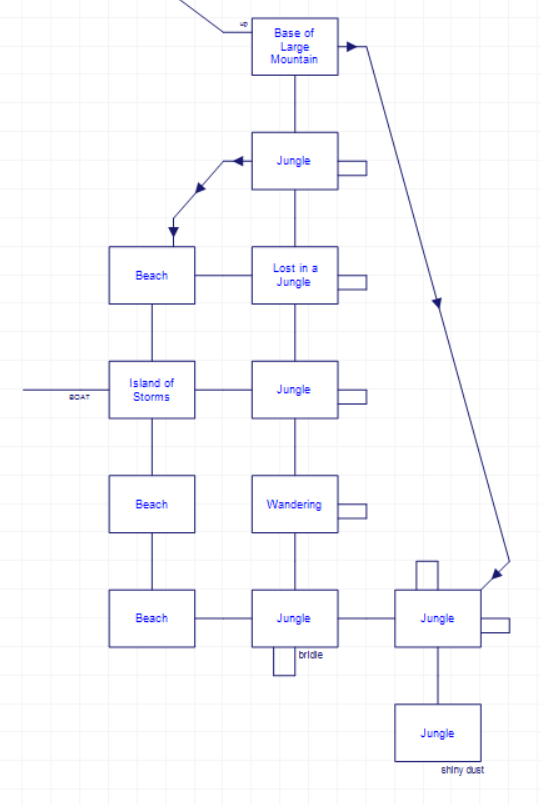
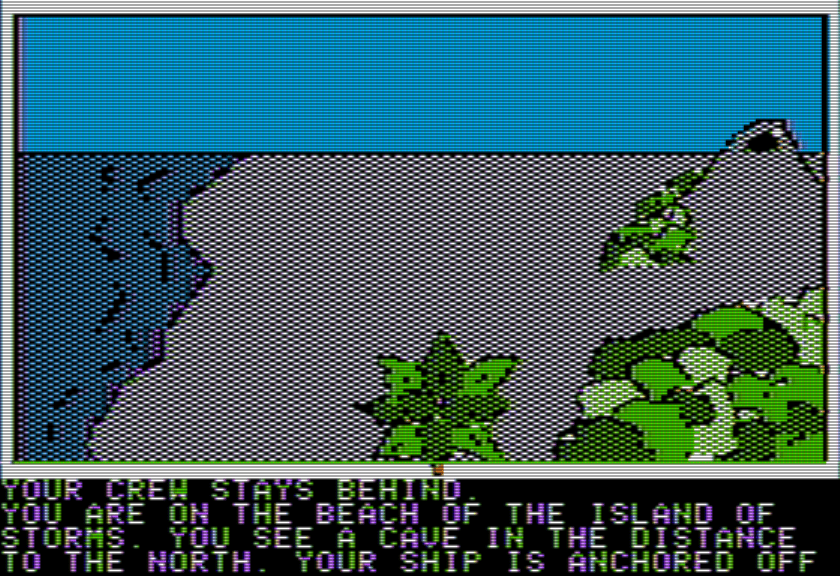
I landed at the Island of Storms to find a jungle. Let me linger on the map a moment:
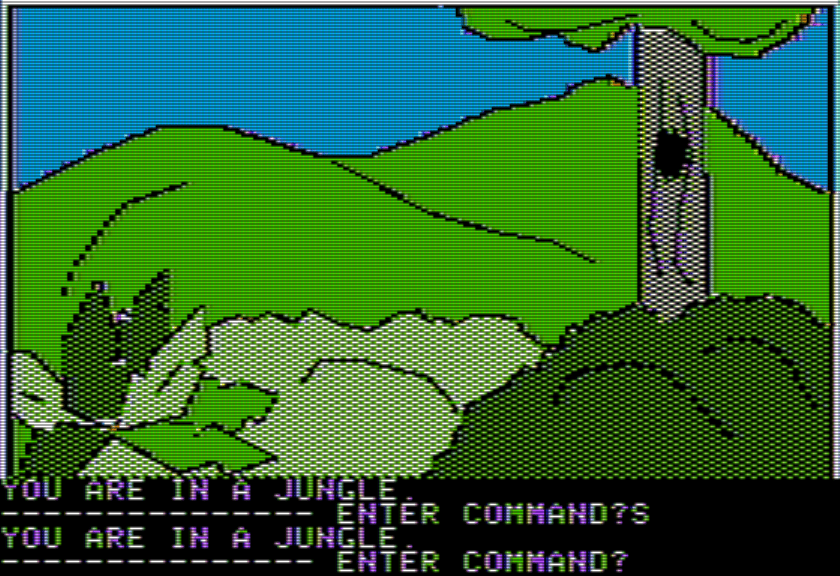
There really seems to be an effort in featuring the map (here and in other parts of the game) as being “graphics” locations where the text is unimportant. In a modern 3D-environment world, it’s not implausible to have scenery for scenery’s sake. To modern eyes, the graphics just aren’t that great, so the effect is more drudgery. The jungle only serves two purposes: to have a “bridle” in one location…
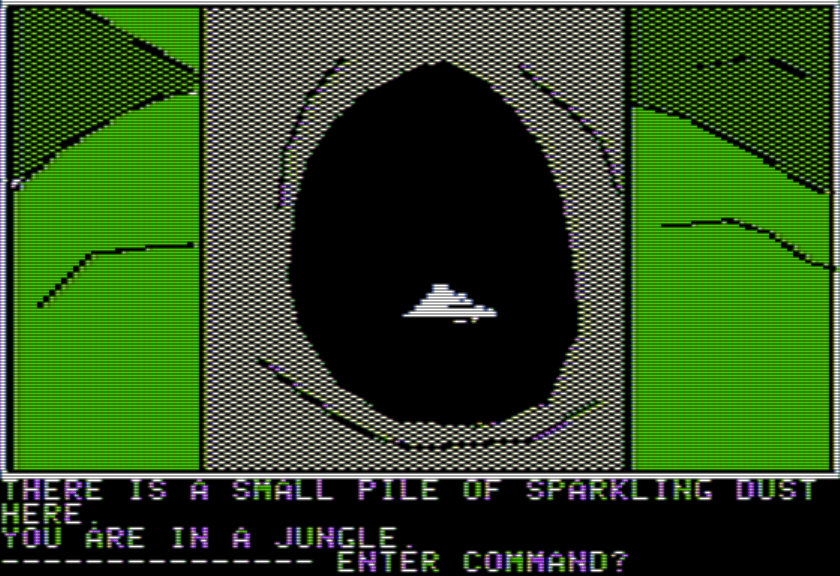
…and some magic dust in another. The tree’s hole in the picture indicates you can LOOK HOLE (I admit my willingness to check this came directly from the same puzzle appearing in Wizard and the Princess).
Time Zone (allegedly, as I haven’t played it yet) goes ridiculously far in having large maps with only one or two important rooms, so this is likely a preview of 1982. I should note King’s Quest 1 through 4 have something of the same style, but a lot more density to “interesting” aspects of the scenery, and the presence of a third-person avatar adds a weight to locations that are merely there to look good.
North of the jungle is a cave.
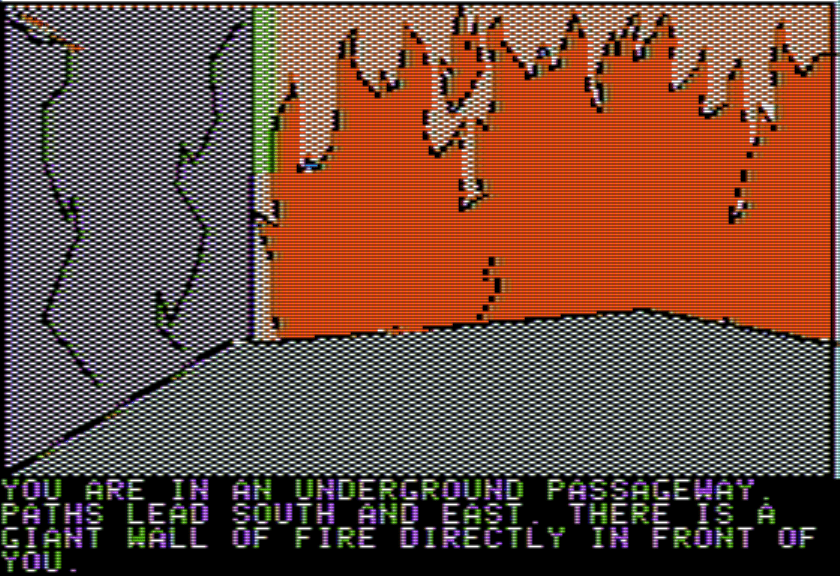
Lots of the rooms are “fluff”. I found a spring where I could fill my empty bottle with water — I haven’t managed to use it yet — and a giant wall of fire.
Interestingly enough, while I can’t POUR WATER anywhere else, I can at the wall of fire, but the game still tells me NOTHING HAPPENS and going inside just fries my player character.
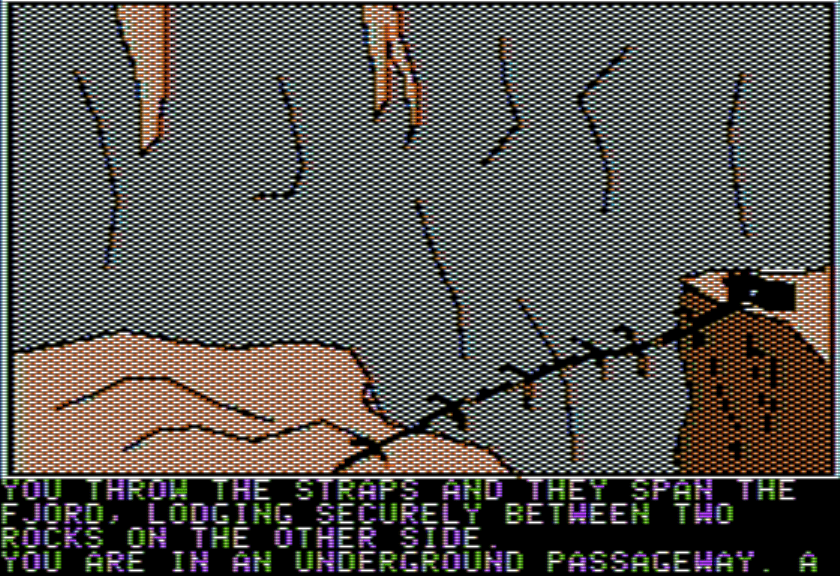
Out of the giant lump of items from the store back at the starting town, I had noticed I could TIE STRAPS (leather straps) and further specify WITH ROPE. The resulting item was not well described, but I reached a fjord I couldn’t pass, so I gave THROW STRAPS a try:
This is a one-way journey, since the straps break when you cross.
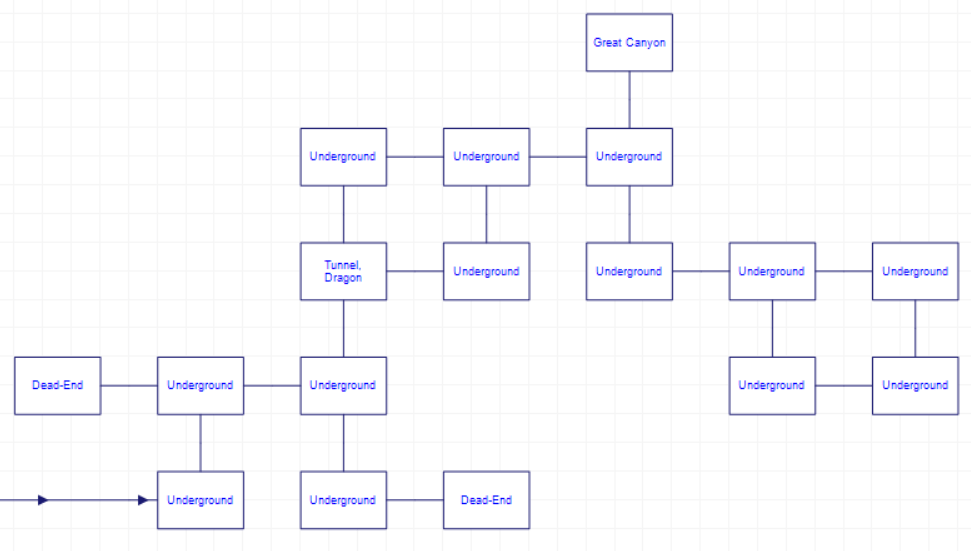
The cave gets even more boring here…
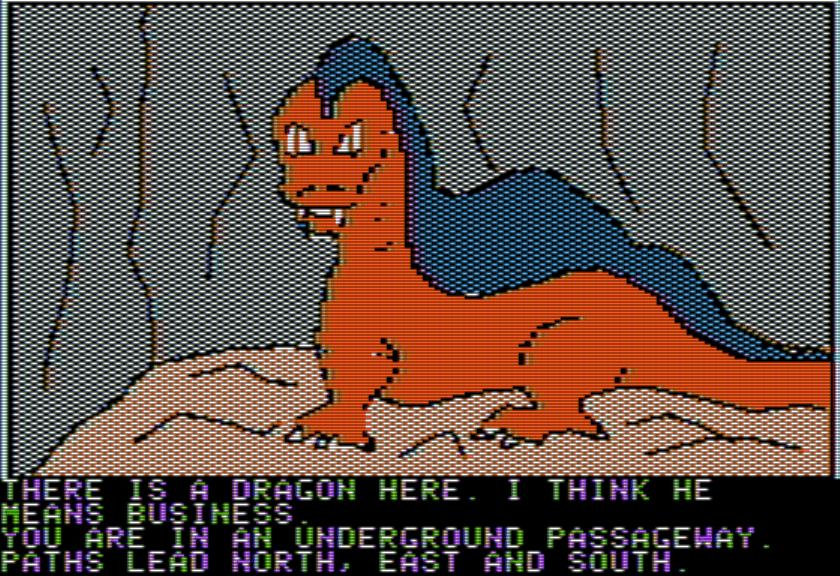
But there is a dragon. I was able to THROW DUST and scare it off.
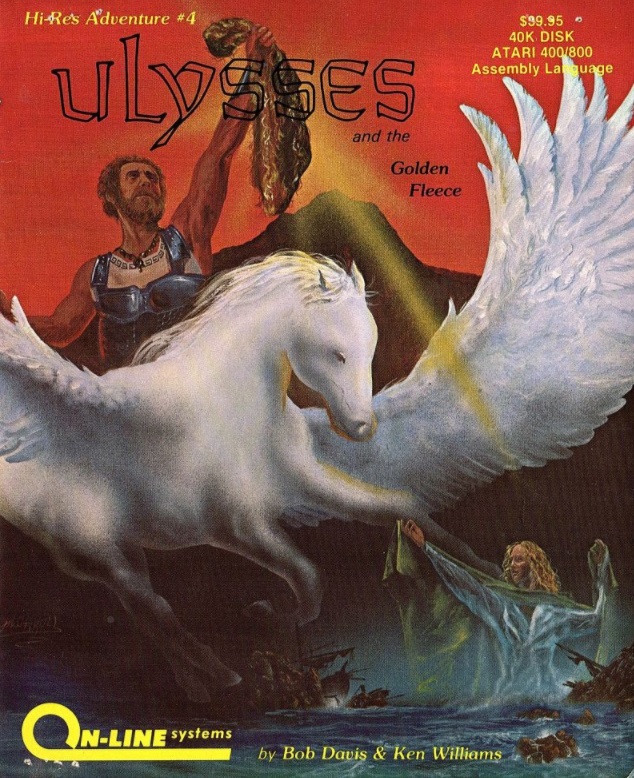
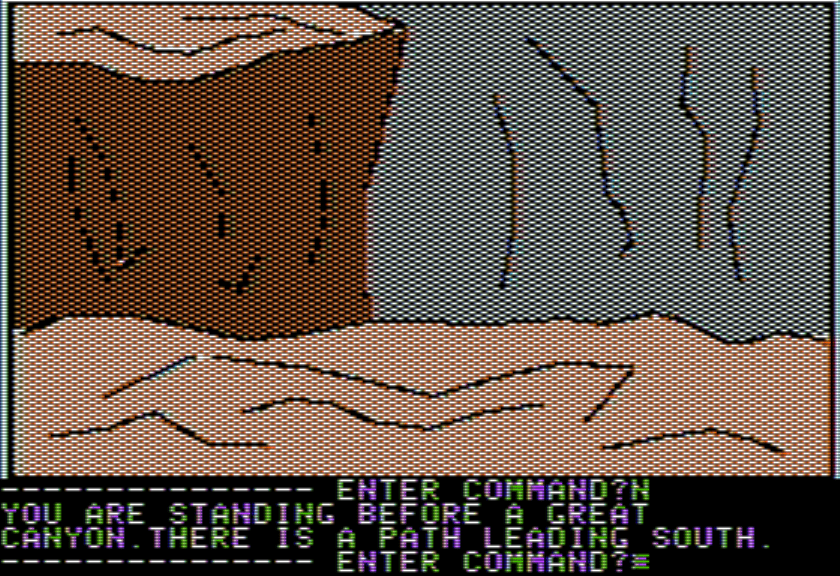
I finally encountered a GREAT CANYON. I suspect I might summon some flying critter and use the bridle on it, but I haven’t had any luck with summoning a griffin or Pegasus or whatnot (the game’s cover at the top of this post might be a hint).
I was able to MAKE FIRE as long as I had the wood and flint from back at the store. You may remember I passed on the wood the first time around; to test this theory I had to restart the entire game and pick another item to leave off my shopping list (I went with the LANTERN for now — really no idea). Unfortunately the fire doesn’t attract anyone’s attention, so I’m stuck here (and at the earlier wall of fire, which may not even be really a puzzle).
Remember, logic will not always work because the gods are not always logical.
— From the manual for Ulysses and the Golden Fleece
Just a bit of progress, but I got to the Island of Storms. After GO OCEAN I came across a legion of nearly-indistinguishable rooms.
In some places I was “LOST” and some I was “WANDERING” but essentially the only way to map things out was testing second-order exits (that is, checking exits coming from a unfamiliar room to see if they lead somewhere familiar).
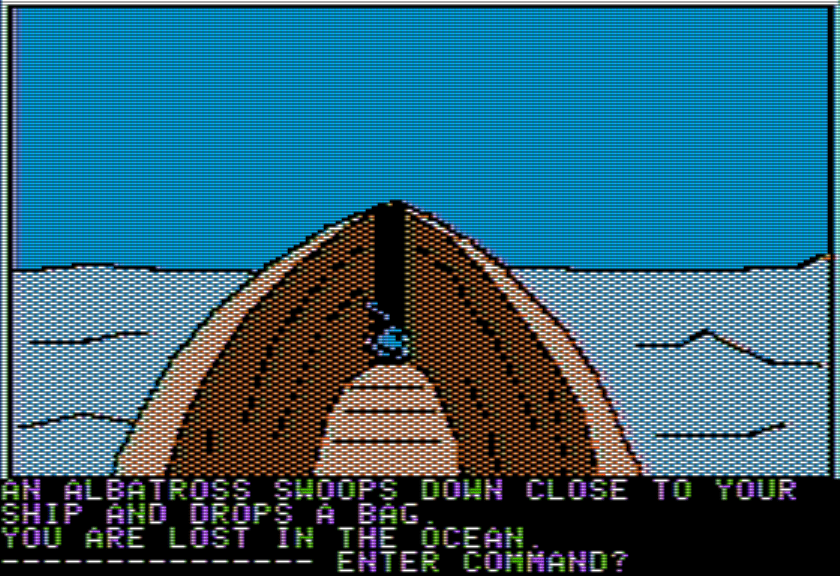
I did have a condor run into the mast…
…and had a bag of gems drop into the ship.
There’s also a what I don’t think is supposed to be a puzzle as much as an obnoxious softlock.
A GIANT SEAGULL SWOOPS DOWN OVER YOUR SHIP AND CARRIES OFF EVERYTHING YOU OWN.
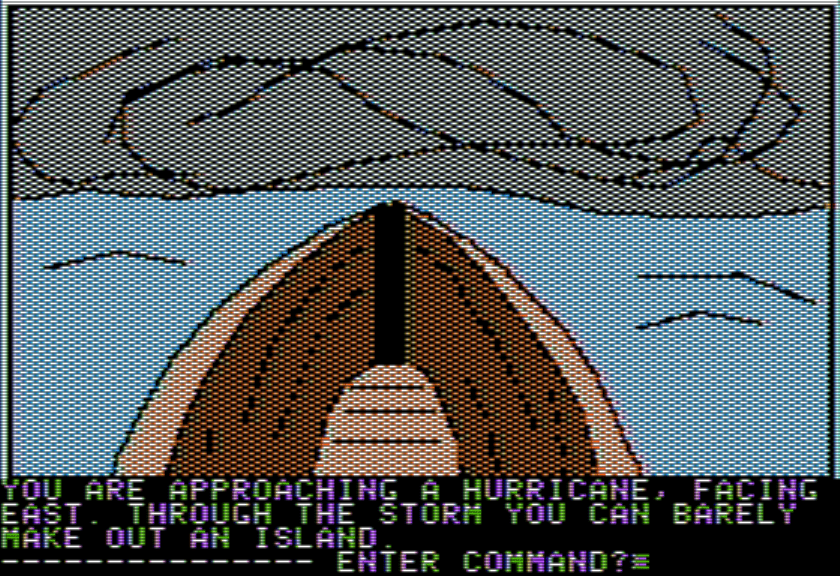
Most importantly, there’s a storm that kills when you try to enter.
So that’s reasonably colorful, but I kept wandering for long enough — and finding what *might* be new locations, but not being sure because I couldn’t drop any items — I figured there had to be a gimmick.
I broke down and looked up a hint. I was very close. There was a guard on the docks:
I had tried to GIVE COIN and the game asks ARE YOU ATTEMPTING TO BRIBE A GUARD? and then repeats the room description.
I had read this as a rhetorical question, but this is the game prompting you to say YES, whereupon the guard gives you a map.
Look, Crowther/Woods Adventure had a similar rhetorical question, but it was asking you to do something improbable and cool, and didn’t obfuscate the interface by repeating the room description after the question was asked. I seriously did not have an inkling I was even being prompted. The Adventure puzzle also had the rhetorical question on a clear and direct obstacle where there was no way past. This was on a side obscurity; the guard isn’t even mentioned in the room description!
The map has directions to go from the storm to the island.
I’m feeling like Bob Davis had played Wizard and the Princess and tried to copy the “biome journey” but wanted to make the whole thing meaner. We’ve got the 7-out-of-8 item choice from the store (I suspect I won’t know which item is the right one to leave out until much later in the game), the not-talking-to-guard softlock, and the seagull softlock. Wizard and the Princess had softlocks but they felt… nicer? Like the peddler who only sold you one object, and the place it got used was *immediately* after. Taking the same idea to its extreme, there’s no reason structurally why the gap between choosing item and using it can’t be very long, but in terms of fun and kindness to the player, there’s a clear limit.
The ocean maze felt like the desert from Wizard and the Princess except there was no difference between the pictures whatsoever. (Mind you, I squinted hard just to check.)
And while I’m stopping here, once arriving on the island there’s ANOTHER maze, in a jungle. Look, On-Line Systems, the desert was the BAD part of the game — you had to print a card with a hint just for that puzzle in later editions of the game, remember? Grr.










 Renga in Blue