Your Habitat is a huge complex designed to house a bustling, self-sufficient human society. The reality, though, is that your habitat runs like music that has gone on long after the singers have fallen silent. M8 forever fulfills its countless imperatives that now serve a “society” with a population of just 1.
I really wanted to like this one. Icepunk gave me a early-90s-BBS-door-game vibe with the ANSI art (as seen below; the writing is vivid as well). However, I couldn’t even bring myself to finish.

Read the rest of this entry »
You call all the tourists to you, “Listen, everyone to me, I’m going to shut off the exterior lights. We’re going to take the opportunity to look up at the universe.” Everyone tilts their heads up expectantly. The lights dim before turning off (so as not to be frighteningly sudden) and then it’s there. Nothing but the uninterrupted universe. No sun, no lights, no atmosphere, no reflection from Earth. Just the unending, beautiful eternity. There are audible sighs and gasps. You’re certain you hear someone sniffling back a few tears, but you give them the benefit of not checking whose audio trace it was.
Dating sims have never appealed to me, in that the situations tend to the unnatural. You just HAPPEN to be stuck at a school where everyone in your class is the appropriate gender for romance, and you have just-so opportunities to meet with the person of your choice and get to choose correctly or incorrectly from a list of choices where your goal is to match the personality of the character you want to romance enough to gain “love points” and eventually get an Achievement.
Lynnea Glasser’s Creatures Such as We (written in ChoiceScript) strikes me as falling out of an alternate universe where dating sims were instead story scenarios with natural opportunities to meet and befriend and possibly get closer to, like real life.
Read the rest of this entry »
Tim Delbrock has been your best friend since junior high school. He is your favorite fellow student. You have known each other for a long time. He is a part of your best memories. It was just a question of time until he became the boyfriend of your younger sister Gina. You really appreciated that development.
I wasn’t grabbed by the blurb/intro text of Simon Deimel’s Enigma, but I did find the concept interesting: you are frozen in a traumatic moment with a sort of amnesia, and have to recreate everything in the scene by examining and thinking about it.
Read the rest of this entry »
One could argue that instead of 1975 with Adventure, the history of interactive fiction began in 1971 with The Oregon Trail.
The Apple II version is the most familiar, but the earliest was an all-text simulation.
60 PRINT “THIS PROGRAM SIMULATES A TRIP OVER THE OREGON TRAIL FROM”
65 PRINT “INDEPENDENCE, MISSOURI TO OREGON CITY, OREGON IN 1847.”
70 PRINT “YOUR FAMILY OF FIVE WILL COVER THE 2000 MILE OREGON TRAIL”
75 PRINT “IN 5-6 MONTHS — IF YOU MAKE IT ALIVE.”
80 PRINT
85 PRINT “YOU HAD SAVED $900 TO SPEND FOR THE TRIP, AND YOU’VE JUST”
90 PRINT ” PAID $200 FOR A WAGON.”
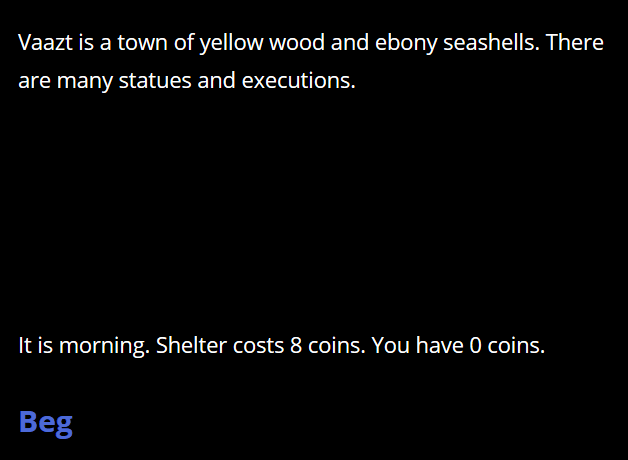
Even though The Oregon Trail does not have room-exploration, it tells a story in text, and the strategy interaction is duplicated in modern days by some works in Twine (the most notable possibly being Horse Master). Porpentine’s Begscape falls in the same genre but deconstructs it.
Read the rest of this entry »
July 3rd: French circus ship ‘Circ Du Mer’. No casualties. Booty: half-ton impractical costumery. Three tons carnival tickets. Troupe of trained monkeys. Assured tickets good for shiny new penny-farthing if taken to Paris; costumery may be usable as fine napkins. Monkeys to be released at next landfall.
Do not be alarmed: while 1930s adventure novels includes tropes that one might call uncomfortable, this offering from Steph Cherrywell is in essence a very silly adventure romp starring a “modern woman for the Thirties!” with nothing concerning.
Read the rest of this entry »
I remember when I was younger being boggled by a part in the gamebook GrailQuest 4 (circa 1985) called “The Wallbanger Ritual”. Enacting the spell (in the book) required wearing a peaked cap (for real), burying a paper with the word WALLBANGER on it (again, in real life) and eating some soup (seriously).
Of course, nobody ever got the real soup, but it made an impression a on me that an interactive narrative would somehow require actions far outside the space of the book. I never have found anything comparable until now: Porpentine’s new work With Those We Love Alive.
Read the rest of this entry »
Fallthru feels like it came from an alternate universe where puzzle-based interactive fiction never really existed, and the market was dominated by games modeled after MUDs with unobtrustive room descriptions and a highlight on equipment and combat.
This cover is from the paperback version of the novel; the game is shareware and does not have a cover.
This is appropriate given the backstory, painted in minimally by the game’s manual: you have fallen into the universe of Faland from your own, and your quest is to find the way out.
The territory of Faland is comprised of several million square legons, one legon being the distance King Mordat of the Ancients was able to walk in 1000 paces while traveling on a good road over level ground. Most of the territory is sparsely inhabited with the bulk of the population living in and around five farm settlements. It is in the most northeasterly of these, Or’gn, where most foreigners gain entry into Faland and where this pamphlet is available.
In my last post I mentioned making a map using graph paper, but it turns out even that is too much.
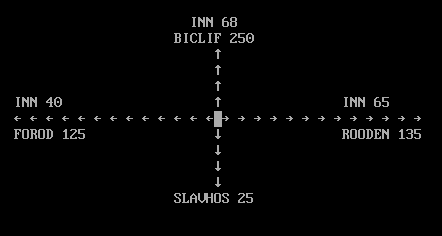
This is a sign just outside the starting town of Or’gn. The numbers represent actual numbers of steps, so reaching Biclif to the north by walking requires typing N for north 250 times. (I am not kidding.) I am very much hoping there is a horse or other alternate form of travel coming.
In the meantime, though, I’m just writing down coordinate points of important places, setting Or’gn at (0,0). From the sign above, for example:
Inn (-40, 0)
Forod (-125, 0)
Inn (0, 68)
Biclif (0, 250)
Slavhos (0,-25)
Inn (65, 0)
Rooden (135, 0)
Unfortunately, the alternate universe in which Fallthru exists also is the universe where parsers never developed, well, much of anything. There’s fortunately a command list, but it’s taking a while to get the hang of it. I keep wanting to TAKE to pick up items but GET is the only one accepted. Here’s a transcript with commentary:
In the dining area of an inn. The innkeeper is nearby. Water is free and meals can be ordered. The innkeeper can tell you the price. The lobby is north.
>hi
Meals cost 33 ems each. Put down your money before you order.
Thun is the name given to the massive cleft from which Fariver springs at its origin. The snowy griven abounds in the lands around it.
I found out from the command list that “hello” or “hi” will talk with a character. There is no other conversation option.
The innkeeper also gives a random piece of lore with conversation. This tends to happen with most of the characters.
>i
20 ralls in hand
>drop ralls
Nearby you find:
1 ralls
The unit of currency is the “rall”. 100 “ems” make up a “rall”.
>buy meal
MEAL not in context.
>buy water
There is nothing for sale here.
After studying the command list some more, I realized I had the wrong verb here.
>order meal
The innkeeper lays out a sumptuous feast and scoops up your money.
Nearby you find:
67 ems
>eat meal
You have no food at hand
>order water
WATER not in context.
>order 1 water
The innkeeper takes your money and lays out a packet of food.
Nearby you find:
1 lbs food
Ordering food causes the “hunger” stat to instantly go up, while ordering water gave me an item I can tote around. (I think food and water are just treated as synonyms, which is why the parser behavior here is a bit odd.)
As frustrating as things are so far, I’m not ready to give up yet. It is possible things *might* go smoother once I’m not struggling every couple minutes to work out a command.
So it has been ages since I’ve whacked at Acheton (with various excuses, some more feeble than others) but it happens that The CRPG Addict is reaching a text-adventure-CRPG called Fallthru from 1990. I figured simulblogging would get the juices flowing again. It’s far off from my chronology, but I always planned to start intermixing some out-of-order games just to keep things interesting.
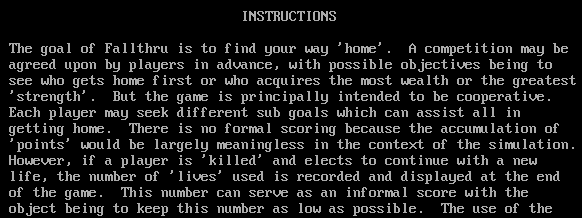
Fallthru is not just a text adventure CRPG, but a multiplayer text adventure CRPG. You pick between 1 and 3 players, and each character gets a set of turns to do in sequence before control switches to the next player.
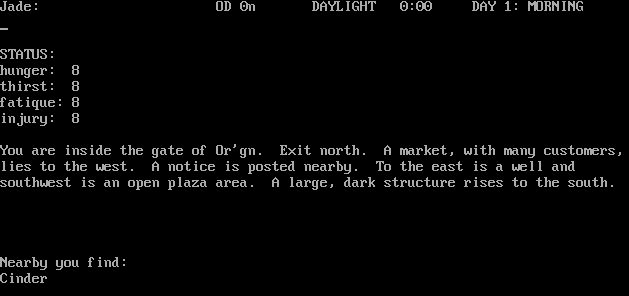
(“Cinder” is player two. After a set number of turns — I got 24 on one try, but I don’t know if some actions vary — play will switch to Cinder.)
Given there are allegedly 80+ hours of gameplay (according to this review of the novelization of the game, anyway) I believe I’ll be stuck with single player only.
There are also allegedly thousands of rooms, but they seem to be of the no-description style:
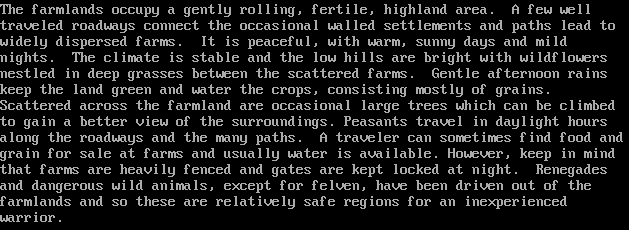
You are in a slightly rolling region of well kept farms.
You are on an east-west road.
>west
You are in a slightly rolling region of well kept farms.
You are on an east-west road.
>west
You are in a slightly rolling region of well kept farms.
You are on an east-west road.
>west
You are in a slightly rolling region of well kept farms.
You are on an east-west road.
>west
You are in a slightly rolling region of well kept farms.
You are on an east-west road.
This isn’t as bad as it looks simply because it doesn’t present itself as scrollback; the window gives the room description and it will change when necessary. I am having to get used to a related psychological shift: the map should be done on graph paper with one-room-per-square where most of the rooms are unremarkable.
Despite minimal room description, there’s large chunks of texts you can get through the “info” command which works like an encyclopedia for the world universe.
I’m going to try mapping things out a bit and I’ll report back in with my next post.
(Note to any visitors from CRPG Addict: I fairly quickly decided this wasn’t an adventure game and moved on. I did later do the entirety of Quarterstaff which is a true RPG/Adventure hybrid.)
Marcus pushes the sheaf of poetry towards Veronius. He doesn’t need more of an invitation than this.
Veronius sits down at the table and holds up the sheets of the poem one after another, reading aloud.
Veronius has two reading aloud voices: a ringing, theatrical one when he is declaiming one of his own poems for an audience, and a more sedate and more pleasant tone used for cases where he doesn’t already know what the next line is going to say. He is using the second voice now.
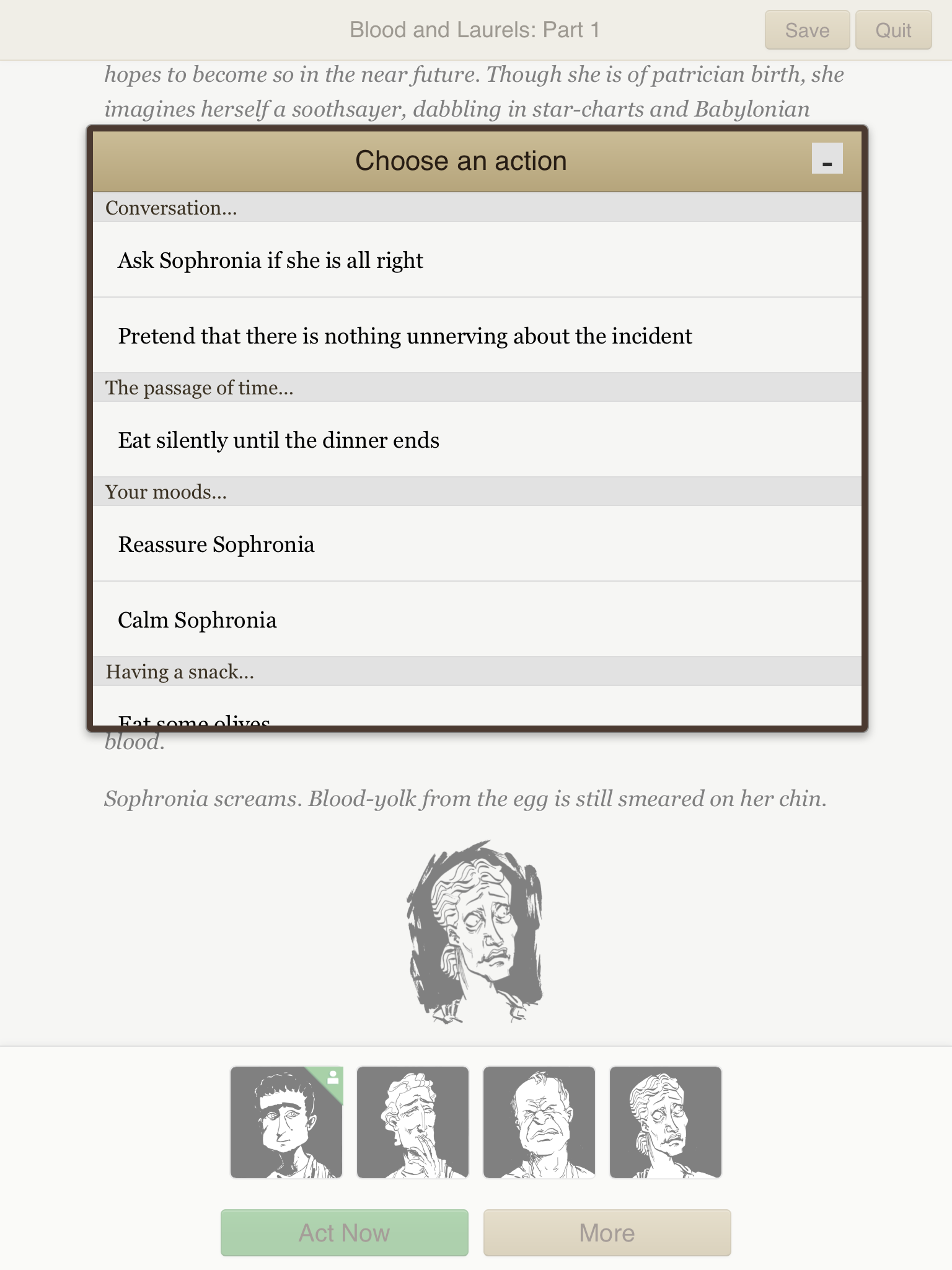
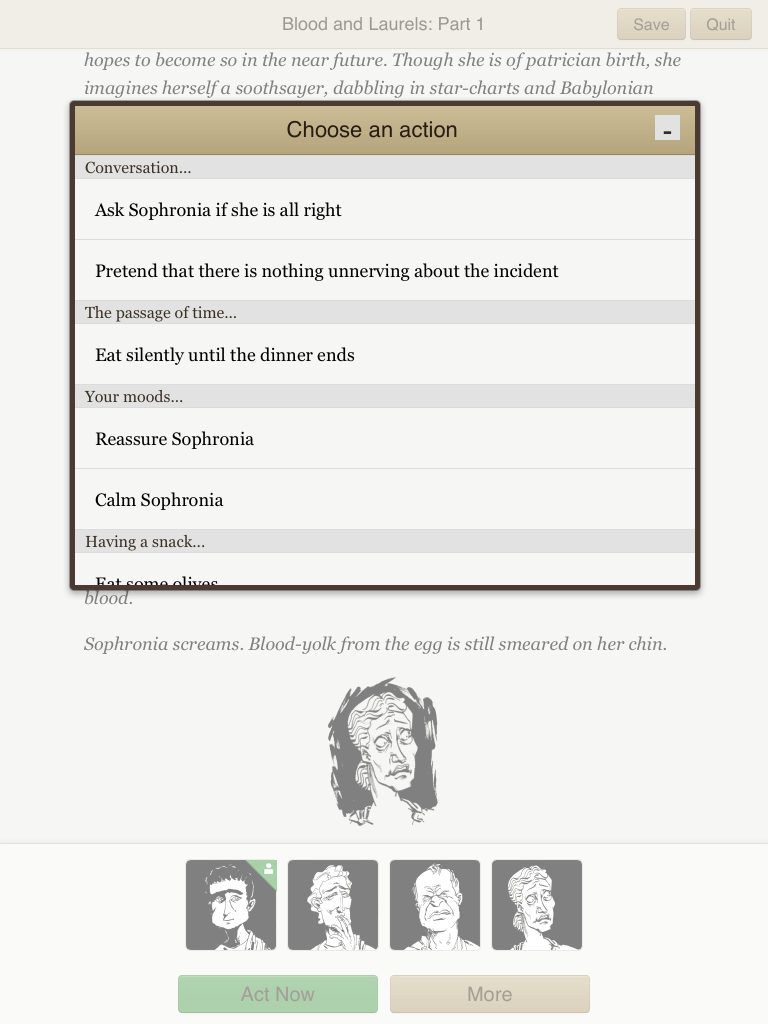
Blood & Laurels is a large, ambitious project using an engine designed by Richard Evans with writing by Emily Short (with many others involved, including Graham Nelson).
It involves the era of Rome where bloodthirsty Emperors did insane things. If you’re familiar with I, Cladius it has very much the same vibe. Except, of course, rather than being a static book, you get to direct how the main character Marcus chooses to act. Scheming your way to the top is possible, as well as getting murdered and everything in between.
A great deal of the writing feels like a traditional CYOA, only with shorter bursts of text between choices and with the number of choices amped up significantly (the website claims there’s at least 10 times more text than you’ll see on a single playthrough).
The plot and writing are spectacular; this is some of Emily Short’s finest work. I say this not only to indicate you should totally buy this if you can (it’s only on iPad on the moment, unfortunately) but also because I’m about to spend the rest of this review grousing about the Versu system itself and I don’t want people to get the wrong impression.
When playing something that “generates stories” like The Sims 3 or Dwarf Fortress, I don’t get the same resonance that other people do, possibly because I’ve done enough programming that all I see are gears and wires. While I don’t enjoy experiencing the generated stories directly, I do enjoy reading are stories about other people’s generated stories. See, for example, the spectacular Alice and Kev:
I mentioned that Alice is feeling stressed out now that she’s a teenager. When she was a child, she used to always get her homework done on time, and worked hard every day at school. She would often come home from school feeling strained, and the only way she could relax after working that hard was by cuddling her teddy.
She’s too old to cuddle teddy now. All she’ll do is hold him, but gets no enjoyment from it. She can’t even pretend that somebody loves her any more.
I need human mediation. For me watching mechanical parts converge (even if I get to choose how to direct them) is not a story, but a person can later come and tell a story about (or essentially inspired by) the mechanical world.
Even though Versu — the engine behind Blood and Laurels — has AI design by Richard Evans (who did the AI design for The Sims 3) I hoped the play experience would have the element of human mediation is built in the software. That is, I’m imagining the actors in the story are doing their thing in a mechanistic-universe way, but that information is reported by Emily Short who acts as an intermediary and reports with smooth and compelling prose.
This dream happened on occasion. The stars aligned such that the prose and the choices meshed in such a way that I felt I was experienced a “text holodeck”.
However, I’m fairly certain the parts I felt inspired by were heavily scripted. When Versu as an engine clearly took over — for example, during one gruesome scene I also had options to flirt with one of the characters — it hit solid as a rock. Options for flirting and conversational actions flitted in and out as possibilities and often I would want to follow up one action with another on the menu I was just using, only to have it removed for no apparent reason. At one point a ‘slave was waiting for me to say something’ when I was in fact trying to hide and eavesdrop and the slave shouldn’t have seen me at all. Elegant prose clashes with stock responses in terrible ways:
Marcus: And for that you would allow him to turn the City over to destruction?
Gila (to Marcus): It’s too bad you’re feeling irritated.
So while Blood & Laurels is extradinarily impressive as a piece of interactive fiction, I remain unconvinced about the potential of the Versu system in general. It is possible this is due to a mismatch; Blood & Laurels has many scenes involving only Marcus and one other character, and the elaborate AI is built to handle much more complicated character situations. Also, despite my grousing there were long sections of prose that were logical and non sequitur-free.
It’s also possible Blood & Laurels simply lurks in the uncanny valley. While chinks in interaction are common enough in parser IF that I can skid by them, the narrative thread in Blood & Laurels is strong enough that the cracks are jarring and exaggerated. In that case, all the Versu engine needs is an extra push.

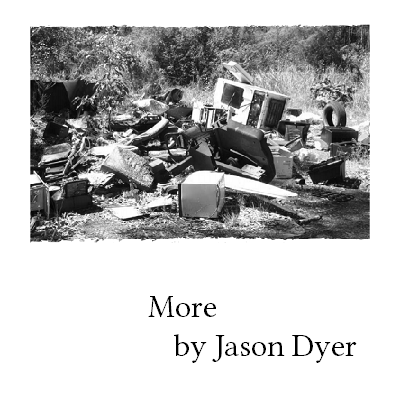
First straight to the point: you can download Version 2 of More at this link. Alternatively, you can play through your browser. This will eventually show up at the IFDB page.
I’m still up for a Version 3 if any issues crop up, so if bugs arise you can either email me [jason followed by a dot b dot dyer, at gmail.com] or just drop a comment on this blog post.
time to… reflect! —
I. All of You Are Awesome
To be frank, I’ve been out of the normal IF community loop of late. I have been posting to my All the Adventures project, but opining about interactive fiction from the 1970s isn’t exactly keeping track with modern trends.
I don’t know if y’all noticed, but holy cow your writing. I’m going to blame it on Twine/Undum/other CYOA forces. The community’s XP level in “Writing Prose” has taken a major upgrade. Even the humblest of works had some smashing sentences tossed in the mix. Possibly this trend has been invisible to the participants, but for someone who has barely touched IFComp since 2007 it was very noticeable.
So, if I drop out of things for another 7 years, when I pop back up there will be AI characters so reactive they will beg you to not end the story because then they will have to go back into the little box, right?
Hello?
II. On using all 8 songs for More
I started with this song, which I knew had to be my setting
Joey Jones – Grandaddy – Broken Household Appliance National Forest
but it suggested to me no characters or plot, so I kept listening in circles, and realized these three combined together to make an excellent tale:
Emily Short – Stephen Sondheim / Madonna – More
Peter Orme – The Smiths – Girlfriend in a Coma
Miguel G. – Sinead O’Connor & Shane MacGowan – Haunted
At that point I thought I had my song set, but I got severely stuck in designing The Puzzle and so went back to the songs I hadn’t used to see if inspiration struck. Lo, a song I still don’t understand but with groovy lyrics:
Neil – Arcade Fire – No Cars Go
So … there! Great! Done! I sent on the first-draft version, knowing that I was going to add depth to the story before the contest deadline. Enter writer’s block; myself, lurching forlorn over a keyboard with no notion or clue how to fill in the relationship. I had parts, but not an entire story. The remainder of the songs came to the rescue:
Royce Odle – Jethro Tull – The Witch’s Promise
Sam Kabo Ashwell – Patty Griffin – As Cold As It Gets
Ryan Holman – Lorrie Morgan – Five Minutes
This was not done on a dare or personal challenge. It just happened that way. I know some of the song-submitters have undervalued their contribution — don’t. More as it exists would never have happened without the entire list. So, great thanks to everyone.
III. A beta-tester shout-out as well
William Samuels, Jason McIntosh, and Royce Odle came in with quick turnarounds and extremely useful comments. I was worried on the testing-time aspect but this group blazed through in record time. Thanks!
IV. Random theoretical bits
One-puzzle game: I thought of having an adversary for the main character to deal with while they were trying to find the money, but that messed with the meditative quality of the work. So it was nearly always planned to have only one puzzle. This is partly inspired, oddly enough, by a fan mission for Thief 2 called Calendra’s Legacy where the first part involves a mission that can be done in 5 minutes (if you go straight for the goal) or 4 hours (if you explore). Obviously I didn’t ape that structure exactly (it was more like 20 seconds to go straight to the goal versus 10 minutes if you mess around) but the idea of having an ending that is easy to get to but having the story show up in the non-essential bits has always interested me.
I also find it interesting that one-room and one-move interactive fiction games are genres in themselves, but one-puzzle is not considered a Thing.
Stream of consciousness: The last chapter of Joyce’s book Ulysses has prose that reads thus:
married woman or a fast widow or a girl for their different tastes like those houses round behind Irish street no but were to be always chained up theyre not going to be chaining me up no damn fear once I start I tell you for their stupid husbands jealousy why cant we all remain friends over it instead of quarrelling her husband found it out what they did together well naturally and if he did
I did not go all out, but I did include some character-perspective stream of consciousness in the prose. This comes up straightaway, where the PC rambles:
Once you had an argument with Tommy if it was possible for something to be beautiful and ugly at the same time, and he said no, and you said Toaster Hill, and he said ok sure you’re right which is weird because your arguments usually lasted longer than that.
The “you” is there to sustain that this is clearly a “role-playing” perspective; you aren’t meant to control from a distance. The rambling indicates the character has a state of mind that goes on tangents, for obvious and current reasons:
> x me
You’ve got bloodstains all over so you don’t want to look too close.
> x blood
no no no no no no no no
On the conflux with Tea and Toast: The fact this Shufflecomp entry also featured toasters was a complete and random coincidence. The first line of the Grandaddy song mentions a toaster. There was no way out of it!
V. A final request
I did in fact release something else recently:

At last check (and I do have download statistics so I am not exaggerating) it has been downloaded by two people. If you liked More could you give this a try? I promise it won’t take more than five minutes of your time. Download from the IFDB over here. (ADD: If if-archive is being flaky, you can download here.)