I expressed in an earlier post disappointment that most games in the adventure genre copied their model from Crowther and Woods meaning we didn’t get as many odd experiments as early CRPGs.
However, there is one person who seems to have gone completely his own way: Robert Lafore.
He wrote five games in an “Interactive Fiction” series published by Adventure International (the Scott Adams company) which are unlike most anything from the era.
Interactive Fiction 1: Six Micro Stories (1980)
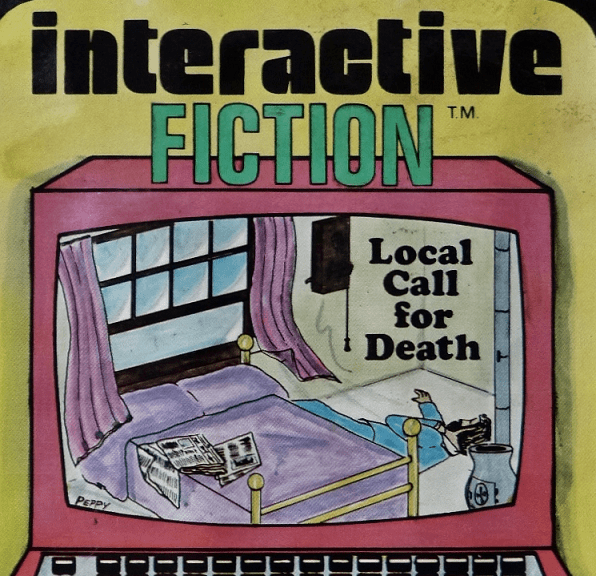
Interactive Fiction 2: Local Call for Death (1979)
Interactive Fiction 3: Two Heads of the Coin (1979)
Interactive Fiction 4: His Majesty’s Ship Impetuous (1980)
Interactive Fiction 5: Dragons of Hong Kong (1981)
The dates are very definite because they show up in the source code from the author himself. It appears Six Micro Stories was written third, even though it was published as if it were first. The ad copy suggests it is a good introduction to the format, although I find it weirder and more experimental than the 1979 games.
Speaking of the ad copy, I think it’s interesting enough to reproduce in full. This is from the Summer 1980 Adventure International catalog; keep in mind this is not referencing their entire library of adventure games, but just these Robert Lafore creations.
INTERACTIVE FICTION
WHAT IS IT?
Interactive Fiction is story-telling using a computer, so that you, the reader, can actually take part in the story instead of merely reading.
HOW DOES IT WORK?
The computer sets the scene with a fictional situation, which you read from the CRT. Then, you become a character in the story: when it’s your turn to speak you type in your response. The dialogue of the other characters and even the plot will depend on what you say.
IS IT A GAME?
No. In a game the situation is rigidly defined and you can select from only a limited number of responses. But in Interactive Fiction you can say anything you like to the other characters. (Of course if your response is too bizarre they may not understand you.)
IS IT IMPORTANT?
Interactive Fiction is the artform of the future. Just as the birth of the novel had to await the invention of the printing press, so does the widespread use of micro-computers make possible Interactive Fiction.
In all previous literature the information flow was one-directional: from the work (novel, story or poem), to the reader. Now the computer provides the medium to change this. The reader, instead of merely absorbing it, can now influence the story, explore it in his own way, become a part of it. The story will be different each time, blending the imaginations of reader and writer. And this is only the beginning. Technology will soon permit Interactive Fiction to become a verbal medium, as synthesized speech and speech recognition techniques eliminate the need for typing and reading. The user will be able to actually speak with the other characters in the story. Later, holography and animation will permit the user to “see” the characters he is talking with and we will have Interactive Movies!
Don’t miss this opportunity to participate in the birth of a new artistic medium.
For the game I’m going to be discussing:
Local Call for Death is a detective story in the style of Lord Peter Whimsey. Considerably more challenging than the above program [referring to Six Micro Stories], this one will put your analytic skills (and social savoir-faire) to the test.
The Scott Adams adventure games show up earlier in the catalog. Esentially, the writer(s) of the catalog considered the concept of Interactive Fiction an entirely different idea than adventure games.
So, back to the game — it feels like an evolutionary route from the genre of “solve it yourself” mysteries that date back to at least 1929 with Ellery Queen’s The Roman Hat Mystery. I was also reminded while playing it of reading one of the old Two-Minute Mysteries books.
All responses are “open prompt” where you are essentially typing what the main character says.

Later on, the game is even very picky that conversations have in complete sentences. I admit this won me over and had me role-playing reasonable wodges of text, even though I am certain (via the most advanced AI a TRS-80 can muster) the game was simply responding to key words.
To start the game off, though you are prompted for a name, gender, and background location

and then thrown into a setting that tries very hard to be British.

There’s the occasional prompt for verisimilitude (asking what you do in America, and if you play bridge) but otherwise the opening scene runs on a straight track.
Later there’s a crime scene:


At this point you are allowed to type single words corresponding to examining items in the scene. (Hint: Type ROOM to go back to looking at the whole room if you get stuck.) This gives a feel of an actual investigation.

I shall quibble that about half the words I tried were unrecognized, but this section was otherwise solid. Then Sir Colin starts asking you probing questions. This is where the complete sentences come in. You have to attempt to logically justify various arguments about who did the crime and what the evidence is.

And part of the time, the magic worked — I typed a totally logical argument, and Sir Colin not only understood it the way I meant but it advanced the plot.

There were also times here I struggled to communicate, but it honestly wasn’t as bad as some guess-the-verb experiences I’ve had (typing >GET UP from the opening room of The Count still burns). If you struggle for too long Sir Colin will even prompt you with suggestions.
There are also moments where you will be prompted to go back to examining the scene to help make more deductions.
I am intentionally being a little vague with spoilers (please note the game makes the identity of the murderer terribly obvious, so I’m not spoiling there, the proof is the hard part) because this game was enjoyable enough I’d recommend it for playing. (I’m quite serious — I was shocked by how good it is.) Even though it’s a circa-1979 TRS-80 game there is fortunately an easy way to play:
When asks for date, just hit ENTER. Then type BASIC, and ENTER again. There will be two prompts (“How many files?” and “Memory Size?”) where you can hit ENTER leaving them blank. Finally, type RUN “STORY” and ENTER one last time. Things will take a moment to load.
There is no save game feature so give yourself about an hour before you sit down with it. You’ll want to take notes.
The end is worth getting to — Sir Colin does a very satisfying period-mystery-appropriate spiel where he lays out all the facts.

If you like the era, Christopher Huang has very recently written two interactive fiction mystery games set in the same era (and a traditional book, if that’s more your style).
Cheerio!
I was indeed close to a win last time, although I did need a hint to pull it off.
First off, while staying awake with the no-doz pills I went to have a face-off with Dracula, but he never came out of bat form.

This led to some tense chasing about the castle, but unfortunately I realized Dracula would not be trappable in bat form. I did find after he left his coffin I could go in …

… and I suspected I could fiddle with the lock somehow, but none of my objects worked.
This is the point I needed a hint. If you recall I mentioned an oven with “sunlight and heat” and I suspected I had to toss Dracula in somehow. I had a visualization problem, because it never crossed my mind I could *enter* the oven. It’s a solar oven that only works during the day, and going in night revealed a nail file.
This bit of annoyance led to the most clever moment in the game. You can make it in Dracula’s coffin on Day 2 and break the lock with the file, and then come back in Day 3 after he has gone to sleep and open the coffin (which is no longer locked).
Using preparation to outsmart Dracula felt like a perfect merge of action and narrative.

I want to take a moment before moving on to praise Scott Adams’s use of absence to tell a story. Secret Mission had the opening briefing describe a manila envelope that was not there, implying something had gone wrong. The Count takes this even further with an omitted first act (what did happen before the first day?) and nights where the protagonist sleeps while other things go on — items are stolen or removed, and the PC is harmed. This leads to a plot where half of it is reconstructed by evidence in a way unique to the medium.
Certainly The Count is the most coherent of any of the games I’ve played so far. Alas I didn’t find it quite as fun as, say, Voodoo Castle, or even Zork. The sparse structure led to too many moments were I felt completely constricted and couldn’t come up with any action at all that was helpful. Additionally, while the timed structure of The Count is very clever in retrospect, in practice I had a lot of annoyances of having to save and restore and restart and save and restore and restart. So while I might recommend a play, and it isn’t even that hard a game comparative to other works at the time, there would be no shame in using a walkthrough to see it to the end.
So my best reconstruction of the plot is that the main character was sent to destroy Dracula (see: angry peasants outside who kill you if you try to leave) but there is some sort of vampire-spell when Dracula is awake that forces the PC to sleep. The first time around results in just being tucked into bed and the tent stake in our inventory being overlooked (maybe there was other equipment, too, so he was busy with that). The next day Dracula senses his mistake and makes sure the stake goes away (unless it’s hidden; more on that below). He also gets hungry (maybe our neck was secretly smeared with barbecue sauce and it needed 24 hours; maybe the day before Dracula already ate) and our neck is bitten, with vampirism resulting in 48 hours.
We’re hence either on a suicide mission or killing the source will cure the vampirism — either way it’s safe to say the end result of this game will be killing Dracula, meaning I need to find him during the day. Well, I found him, although the pun injury is severe:

I am fairly certain I am close to the end and just need to get my sequence of actions down. I have a set of items that seem kind of vampire-hunting-ish:
Tent stake
Rubber mallet
Dusty clove of garlic
Torch
No-doz tablets
Sulfur matches
Cigarette (that summons the coffin)
Note that the cigarette is from a package that arrives on the second day, after the neck bite, hence a first day kill would be impossible.
At the moment I can’t open the coffin:
Sorry I can’t do that
Its LOCKED from INSIDE!
I suspect this part is simply a matter of timing; I think Dracula himself will open the coffin and I need to use the no-doz tablets to be awake for the event.
I did manage to figure out how to keep the stake from being stolen. There’s a locked door downstairs, and I managed to PICK LOCK with a paperclip helpfully attached to a postcard that arrives the first day. Inside are the no-doz tablets on the list above. If I leave the stake in the room and lock it behind me, the stake is still there the next day.
There is one more item which may aid in vampire-killing, which involves an oven.

I am unclear why an oven would emit SUNLIGHT but that seems strangely specific to mention. I could foresee somehow getting Dracula upstairs and … tossing him in? Maybe the stake immobilizes but doesn’t kill (there are so many vampire mythologies it is hard to know what’s getting used here).
In any case, I hope to have BIG WINNER attached to my next post on this game. Fingers crossed.
A chronology —
Day 1: I have no neck bites and a tent stake in my inventory. If I look into a mirror I see:
TODAY I look healthy…
A bell rings part of the way through the day (“DING-DONG”) at which point a postcard arrives just outside the castle.
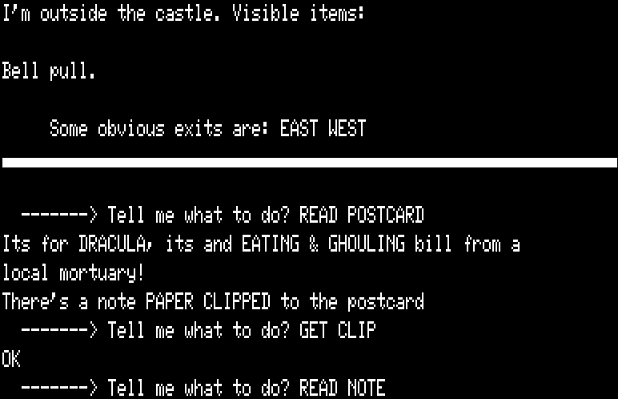
At the end of the day after the sun sets, I fall asleep and end up in bed.
Day 2: I now have neck bites (98% sure these are guaranteed to happen), and my tent stake no longer in my inventory (“I’VE A HUNCH I’VE BEEN ROBBED!”; 50% sure this is supposed to be hidden somewhere to prevent this from happening).

A bell rings again and there’s a letter and a package.

Day 3: I awake in bed again. If the cigarettes or blood from the package were in my inventory, those are now gone (although if I have a single cigarette, that remains).
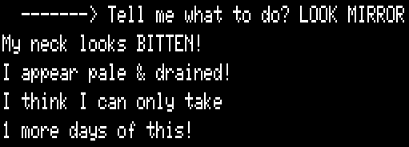
There are no new special events that I know of.
Day 4: I am a vampire! (Game over.)
I did make a bit of progress — I managed to get to a room underneath the starting room by tying a sheet to the bed. This leads to a room with a Dracula portrait that can be moved to reveal a dark tunnel. Unfortunately I have no portable source of light. If I try to light one of the cigarettes the game complains that I don’t have any matches. I’ll have to search around; my guess is there’s a secret item somewhere. Other than getting a source of light, I’m trying my best to find a hiding place for the tent stake.
The experience overall is far from anything I’ve played so far; Secret Agent had a few dramatic elements like The Count, but still was a collect-a-thon at heart; with this game it feels like the author intended a narrative where the puzzles are incidental, as opposed to designing a puzzle sequence with some narrative attached.
I could go back to Warp some more, but I’m rather exhausted of gathering treasures. The next Scott Adams game off my list has a reputation for being experimental and not just a treasure grab, so I decided to go for it next.

Despite the “what are you doing here” setup from the cover this does not seem to be amnesia.

Rather, this is a case where the in-game character has knowledge that the player doesn’t, and part of the gameplay is simply deciphering what’s going on. It’s quickly established The Count means the vampire Dracula.

(Footnote.)
The objective is (probably?) to destroy him

but if that’s the case, why are we sleeping at the castle? And how does that match with the cover which indicates this might be a love story of some sort? Perhaps the main character intended to destroy Dracula but fell enamored instead? If so, is this voluntary or involuntary? If involuntary, why did we get “tucked in” apparently by Dracula without any physical damage?
Also experimental: the main map is tiny even for a Scott Adams game

and it seems like the main notion is that time advances to sunset, at which point you get sleepy and awake in bed. Day Two below:

Is the neck bite necessary to the story, or am I supposed to prepare Day One so it doesn’t happen?
It’s highly disconcerting to play a game without even knowing the player character’s motive (or if there was an original motive that changed). It’s a dream where you are dropped as an actor in a play and everyone else expects you know the lines but you have no idea what’s going on.
The only thing resembling a “puzzle” is there is a room visible underneath the window of the opening room, and it appears like the game wants you to get there somehow. Still, the whole thing is refreshingly odd and I might just spend some time mapping out if any changes happen when time passes. I’m suspecting an Infocom-mystery-game setup where certain things only happen at certain times and it’d be useful to get a map of the schedule.
Footnote: This is a bit of a side rant but I have to say — what’s up with the spelling and capitalization of Scott Adams games? “ADVEWNTURE?” This isn’t even version 1 I’m playing; nobody ever noticed the extra w? And why does “afternoon” have the spelling “AFternoon”? More than once in the game? And why does that sort of odd capitalization happen in multiple games? Is there some genuine technical reason? It’s been driving me bananas in every Scott Adams game. Also, tip for future players: the way to get out of bed is GET UP. Not STAND, UP, OUT, GET OUT, EXIT, or a dozen other variants that would seem to work. I spent about 40 turns at the start of this game just trying to do basic movement. It’s the first time in a while I hit a genuine guess-the-verb puzzle that took me more than one extra turn to resolve. My journey through the 1970s in general has hit much less guessing of the verb than the reputation of old text adventures suggests.
(Click the image below for the complete map, except for mazes.)

(Click here if you’d like to read the whole sequence of posts leading up to this point.)
I actually rattled this game around a few times in the interim period since I made my last post, but got enough nowhere that I finally consulted a walkthrough. Fortunately it turned out to be one of those chains-of-causality situations where a single hint led me through nearly the entire game (except for two bits at the end which I will share soon). The game is one of those where items and things don’t necessarily exist until they are ready to, and I had simply never quite got through the first part of the “quest chain.”
The chain starts with the Victorian lady wanting her dog. I am certain you don’t remember what I’m talking about, so here’s a clip:
> make tea
You drop the teabag in the cup, add boiling water, and brew up a fine cup of tea.
> n
An old lady in a wheelchair glares at you as you enter a living room. Her gaze softens as it alights on the cup of tea you’re carrying. “At last!” she exclaims. “How I’ve waited for a decent cup of tea – even if it doesn’t have a saucer,” she adds. She grabs the cup from you greedily and drains it. “Aaah, that’s better. And now I wonder if you could be so kind to little old me and find my little lost dog for me? He ran out a while before you came in. I’m very worried because he hasn’t had his din-dins yet. I do hope he hasn’t gone to play up the cliffs again. Do find him – I would be SO grateful.” She shoos you gently back into the kitchen again.
After a convoluted set piece involving a large plank, I had gotten to the point where I had the dog but the Victorian lady’s house was now blocked off. I had been carrying a dog biscuit to keep the dog from running off, but that turned out to be wrong; I needed to plant the biscuit near the house, so the dog would run off and forge a path through the undergrowth that I could then follow as an alternate route back to the Victorian lady. Whereupon …
The old lady beams as you enter. “What a delightful little doggy,” she smiles, taking it from you. “But my dog was shaggier than that. Could you try again, please?”
As you leave the room, you see the dog running into the dark passage to the north. He yelps once, and is then silent.
… the dog search continues. I discovered fairly quickly the next dog in the danger room sequence of riddles (I had suspected given the empty rooms I was waiting for a quest trigger there) which led to a much more straightforward delivery …
“Another dog!” says the old lady. “But that’s not mine either, I’m afraid. I’ll look after it, though.” She takes it from you. “My dog was much shaggier than that one,” she tells you, as she pushes you back towards the kitchen.
As you leave the room, you see the dog running into the dark passage to the north. He yelps once, and is then silent.
… and yet more dog hunting. Again I found the next dog in short order; it was near the Tower of Babel area in a “Gloomy Cave” that smelled of dog. Surely this is the one?
“Wrong again,” declares the old lady, “but you’re doing well. Give him to me. My dog was extremely shaggy and answers to the name Spot. Off you go!”
As you leave the room, you see the dog running into the dark passage to the north. He yelps once, and is then silent.
This time there happened to be dog footprints leading back to the danger room, so a literal hop, skip, and jump later …
“Oh dear, this is difficult,” says the old lady, ” but this dog still isn’t shaggy enough. Could you try again, just for little old me?”
She takes the dog from you and pushes you firmly towards the kitchen. As you leave the room, you see the dog running into the dark passage to the north. He yelps once, and is then silent.
… and I really started to wonder how far the game is pushing this. In any case, the only dog-related item I hadn’t used yet was a kennel that was empty … and was still empty. However, I could hear happy barking. >GET ALL yielded an invisible dog in my inventory (I swear I am not making this up). Fortunately there was a nearby brown paint trap I had long been dying to know the purpose of, and a few steps later, finally, finally:
“Oh hooray!” shrieks the old lady, grabbing the dog, “My darling little Spotty-wotty! I should have told you he was invisible – no wonder you were having trouble finding him. I’ll make you a beneficiary in my will,” she declares, and writes something on a document. “I’ll just go and blot it,” she says, and starts to wheel her chair toward the passageway to the north. “It’s a pity the lights are so unreliable here – gas lights were so much better,” she mutters as she disappears into the murky passage.
There is a sudden cry of “AAGH!” from the passageway, and an equally sudden thump. Everything goes still.
You are in the living room of the bungalow. The windows are boarded up
in here, too. The only exits are north, through a dark passageway,
and south to the kitchen.
> n
You are in the hall of the bungalow. To the north there has been a small earthquake recently, and a big pit has opened up. The old lady and some dogs are lying at the bottom. She must have stumbled onto the pit in the dark, fallen in, and broken every bone in her body, poor dear! The only safe exit is back south.
There is a will here, naming you as beneficiary.
I’ve heard of amoral adventuring, but this tops anything I can remember, even though the adventurer is actually just trying to be helpful the whole time. In any case, the will can be turned (at a nearby solicitor’s office, of course it can) into a cheque which counts as a treasure.
There is a large, stuffed albatross here!
There is an ancient treatise by Socrates here!
There is a fine silver chain here!
There is a valuable cheque, made out to you, here!
There is a treasure chest here!
There is an erratic but valuable antique clock here!
There is a stuffed platypus here, encrusted with jewels!
There is a valuable platinum-edged portrait of
Maurits Escher, who is portrayed holding
a valuable platinum-edged portrait of
Maurits Escher, who is portrayed holding
……
……
…… here, here, here!
A piece of sausage is curled up here.
There is an inlaid slipper wrought with the finest filigree here!
There is a gold tooth the size of an egg here!
There is a bronze trophy, marked “Riddle Champion of
Brand X”, here!
There is an exquisite ivory tusk here!
> score
If you were to stop now, you would score 289 points out of
a maximum of 300.
After multiple checks, I did indeed have all the treasures; I just somehow lost 10 points. Deciphering the mystery required a complete replay and reference to the walkthrough.
I found out I went through a particular section called the Garden of Eden wrong. There’s a snake with a tempting fruit you can eat, and eating the fruit causes you to “fall from grace” so to speak and land in the North of Eden – East of Eden area I wrote about once.
I assumed eating the fruit was a necessary part of the script, but it turns out doing reduced my score. After harassing the snake enough times by trying to take it (!) the snake gets mad and leaves and there’s a route to leave the garden of Eden without eating the fruit.
Oif. Replay was fortunately fairly fast (this is not Acheton length) so I corrected my loss of points, returned all the treasures to the correct place, and …
> score
If you were to stop now, you would score 299 points out of
a maximum of 300.
… still didn’t have a CONGRATULATIONS YOU ARE WINNER screen. Huh. At this point I confess to weariness; I went straight for the walkthrough. There’s a magic word “BLACH” from one of the very first rooms that’s been useless the entire game.
> blach
You have scored 300 points out of a maximum of 300.
WELL DONE! YOU’VE CRACKED THE WHOLE GAME!
YOU GOT THE POINT AT LAST!
Mission accomplished?

One, and most importantly, this is a rotten hard and randomly unfair game. In fact, it has the reputation of being one of the nastiest of the Phoenix/ Topologika games, and it thoroughly deserves it. The other games of this origin want you dead; this one wants you dead _now_, and if at all possible, for you to suffer in the process. You can die at the game’s slightest whim.
— Richard Bos
I think you can probably guess I am not going to recommend this game to play. The main quest line is a terrible shaggy dog joke, death is rampant, and the puzzles are filled to the brim with unfair.
Yet —
As a whole experience, to sum up, I enjoyed myself. The world is truly random, but somehow I started to grasp a logic to it where of course a puzzle could be solved with a literary allusion and why yes of course I’m hearing an invisible dog that I need to drop a bucket of paint on. This may simply be a sign I was on this game too long, and while I enjoyed myself, I’m also very glad to move on.
(That includes, by the way, the imaginary worlds gamejam, which has not been forgotten and is at this very moment the subject of a much-edited draft. Soon!)
Progress!
One of my issues from my last post was an albatross that stays tied to one’s neck. Apparently what’s needed to divest it is a story:
> e
Wheeeeeeeee…. Ooof!
As you slide, one of your possessions tumbles away from you. You can hear it falling into the distance.
As you drop into the room, you catch sight of a burly workman carrying three “Caution” signs over his shoulder. “I say,” you begin, “I’ve got this frightfully interesting story about an albatross. You simply must hear it!” So saying, you pour forth your tale. The workman is fascinated and thoughtfully suggests you switch your lamp off while you continue. This you do, and the two of you sit in the darkness for a while. After a while you come to the end of your story. The workman, visibly moved, shakes you by the hand as you relight your lamp, and then moves off carrying his warning signs. The load around your neck feels much lighter.
I admittedly only was down there because I thought the item-falling-away effect from sliding just might apply to the albatross, but I’ll take random luck as a win here.
I’m still persisting, though, and I’ve been thinking hard about persistence when there is no apparent progress. This is an issue that applies to my professional life as well as my hobbyist life.
The main trick, I think, is to make explicit: even when nothing is resolved, eliminating possibilities is still progress.
By that I mean while attempts X, Y, and Z may have failed, in the process we have learned that X, Y, and Z don’t work to solve a particular puzzle. Normally this doesn’t provide any user feedback, unless the user makes that feedback visible.
The Tower of Babel puzzle is on the high end of frustration. Here is my record of trying to solve it.

> n
You’re at the tower of Babel – a most imposing construction that seems to stretch up to the very heavens. Hundreds of people are milling around looking very friendly but confused. The atmosphere is most bewildering; it becomes difficult to understand yourself think after a while. A road leads north and south from here.
> climb tower
Before you can do anything the atmosphere of confusion seems to take control of your senses. You find you can no longer understand the language you are speaking.
You’re at the tower of Babel.
At this point the “>” parser disappears and nothing seems to help.
w
A man in a white coat shows professional curiosity as you make your utterance.
You’re at the tower of Babel.
n
A nearby trade-unionist, straight from the shop floor, bellows ‘Kadima hapoel!’ in your ear.
You’re at the tower of Babel.
s
A young woman is amused by your remark. ‘Rotse lishtot mashehu?’ she asks, pointing towards a hot drinks machine.
You’re at the tower of Babel.
jump
Some children burst into laughter and start copying your accent.
You’re at the tower of Babel.
blach
On hearing your words a passer-by offers you some wurst and asks, ‘Ooluy ata raev?’
You’re at the tower of Babel.
inv
You attract the attention of a passing group of troubadours. ‘Shir itanu!’ one exclaims at which they all start singing (in an assorted collection of keys, of course.)
The only other hint seems to be in a different room.
> d
You are in a smooth corridor hacked out of the living granite (whatever that means… I mean, whoever heard of living granite anyway? Oh, sorry…). There is a hole up, and round passages lead east and west. There are some words hacked out of the living (ahem), which read “WORDS IN TOWERS HAVE OTHER POWERS”.
There’s a few angles to work this problem.
I. Say the right magic word(s)
Other problems in this game have been solved by a single word like THINK or STEINBECK, so perhaps that’s the trick.
think
steinbeck
coleridge
jump
blach
pray (verb not even recognized)
any of the riddle answers
all of the riddle answers in the order encountered
II. Prepare immunity to confusion beforehand
bring gas mask
temporary deafness or blindness somehow?
III. Prepare a “time bomb” to startle out of confusion
Bringing the exploding case to the Tower
The case will eventually explode and kill the player, but it doesn’t help with escaping the Tower.
Lighting a match, having it burn out while at the Tower.
It hurts the player’s finger in another scene but here the match just burns to ash.
bring the shaggy dog
IV. Decipher the statements being made
It’s faintly possible the phrases the characters are saying are not gibberish, but coded language, and deciphering that language will allow escape.
Kadima hapoel! -> trade-unionist
Rotse lishtot mashehu? -> pointing to hot drinks machine
Ooluy ata raev? -> offered wurst
Shir itanu! -> right before singing
Checking every possible rot1-25 rotation
Attempting to say any of the words
Attempting to say any of the words backwards
Supposing a 1-1 cryptogram
. . .
Having the lists not only provides the feeling of momentum, but also prevents an issue I’ve had before: getting stuck on a puzzle because I thought I tried a particular action, but I hadn’t (or at least not in a certain exact way).
Additionally it’s possible the setup requires an item I haven’t seen yet — so it isn’t good for me to linger absolutely — but it means that if I leave and come back I have a better memory of what already has been attempted.
I finally had a session of Philosopher’s Quest where I got nothing accomplished whatsoever.
Such events lead to the downward spiral of hints and eventual clinging to a walkthrough. So I’m going to put my best effort and compiling my ideas and making a plan.

From the manual of the 1987 version of Philosopher’s Quest.
I’m going to list puzzles and places I’m stuck on, although in an abbreviated style; check my prior posts for my details.
Bees: Trying to swim in the ocean results in a swarm of the bees forcing a dive in the ocean. This is ok with the aqualung but I suspect it might be possible to also get by the bees.
Dropped bucket: The giant bucket used in the plank puzzle blocks the way to an entrance I need to get into to deliver a shaggy dog.
Danger room: While I can pass through all the riddle rooms, I haven’t got anything to happen as a result.
Dog cave (& kennel): One room involves a cave where a dog obviously was staying, and another involves a kennel. I haven’t been able to use either.
Albatross: At one point you get an albatross on your neck. It seems like it maybe is a treasure, except it is impossible to get off.
Whale escape: I still get dissolved by acid here.
Tower of Babel: This location leads to my character being confused and not able to go anywhere or say anything.
Brown paint: There’s a room that dumps brown paint on you that flakes off. I haven’t found any effect.
Stars: There are three rooms with painted stars, but responses to magic words or waving items are so random I suspect these might be red herrings.
While it’s possible there’s item reuse (the keys have been used twice already), here are the items I haven’t used yet:
Explosive case: This case will blow up all the items in a room but I haven’t made it useful yet.
Driftwood: I can set it on fire but it burns away immediately and doesn’t seem to be of use.
I also have the magic word “BLACH” which hasn’t done anything and I suspect might also be a red herring.
Plan:
What it says on the box; while my last post linked every entry into the gamejam individually, here’s a ZIP file with all of them at once with a few updates.
ALL THE GAMES
If you were fast on the trigger downloading, the three that got updated (which you can still grab individually from my last post) were Garbage Collection, Gaia’s Web, and Synchronicity.
I’m going to post author responses next week, so get them in! (Although if you’re late it’s ok — I can add them to the post.)
I will also at the same time reveal the authors of the original reviews (those that said it was ok to reveal, that is) and any pseudonyms of the entries (that, again, said they are ok with revealing) so if you want to reveal early in your own enigmatic way, you can either enact a ritual with an ox skull and post it on Youtube, or talk about it in this new int-fiction thread.

You will receive a randomized list of five imaginary games created by other participants in the jam. You are to pick one (or more) and make
a sequel
a prequel
a fan fiction
a critical response game
a sidequel
a remake
a demake
a parody
an artifact of some genre category never before seen by humans
or if you are feeling bold and it is even practical, duplicate the game as described.
Reviews that inspired particular games are given next to their download links.
Some authors are still working on responses, so I’m going to give time before I start putting up those and discussing the forthcoming book. (Further details at the original gamejam post.) In the meantime, enjoy!
ShadowCast
by GuoBruce
Poster 1
Poster 2
Download
Shadowcast
Plasma light has aided storytelling for millenia but Shadowcast seeks to reverse that relationship.
Seachange
by Alex Butterfield
Download
FIRE NEXT TIME (Seachange). The weird thing about it is that it’s a game about dragon-riding where you don’t get a dragon until about a third of the way in, and don’t get to ride it until the final scenes. The protagonist, a fourteen-year-old kid from somewhere in the Appalachians, finds herself in possession of a dragon egg stolen from the Confederates: a well-managed dragon is about as powerful as an ironclad warship, so everybody wants their hands on it, and most of the game is about eluding capture and making it to Union lines in a region of very dappled loyalties.
The dragon battles are appropriately chaotic adrenaline fun once you get to them, the richly detailed setting provides plenty of interest for the otherwise mediocre run-and-sneak sections, and the soundtrack is the best of the year (even if much of it is about a century too modern). But the best part of is – well, it’s been thoroughly spoiled by this point, so there’s no harm in spoiling it again: you start out by crafting your character, picking out clothes and hairstyles and jawlines, doing the usual thing of crafting someone awesome. And then the game breaks the bargain and applies that appearance to your best friend, Callie/Cal from the next farm over. You’re Midge, whether you like it or not. Midge is gangly, slouches a little, has unmanageable hair, and is not doing a great job of passing off the black part of her ancestry as Cherokee. Your first feeling about her is a reflex shit, this isn’t what I asked for, which is pretty much what Midge feels about herself. Whenever Cal shows up in the story again, it prompts this involuntary twinge of… something, I don’t know if envy is the right word. I found this element a lot more convincing than the girl-and-her-pony relationship with Smoke, which totally soft-pedals everything else we know about dragons in this world.
A Game Played by Galaxies
by James Wood
Download
A GAME PLAYED BY GALAXIES
There is no way to describe the vast and complex feelings of two galaxies as they fall into one another, each ripping the other apart and being ripped apart by the other. To us it may seem like an act of violence or sex; from the perspective of the galaxies, however, it is more accurately described as a game–a game played over millennia, the ultimate end of which is one’s destruction and recreation as a new being entirely. The rules of this game, defined as they are by vast timescales, immense forces, and impossible distances, are beyond our understanding, but in images of these colliding galaxies we can perhaps game some sense of the joy and virtuosity, even humor, with which galaxies play these games–reaching towards one another, siphoning off in spirals, peeling off long cotton-like threads of one another’s arms; old stars collapsing, new stars flaming into existence, two black holes–hungry mouths–straining towards one another in the dark, orbits set into motion and disrupted, continual flux, continual play, a game with billions of pieces and two impossible ancient players, who know that playing this game will be the last thing they ever do.
The Interrogation
by Sharang Biswas (with Soundscape by Rebecca Drapkin)
Download
Soundscape to go with the game
The Prosecution
Based on the name alone, I was kind of hoping for a game where you play an ace prosecutor — why do defense attorneys always get the cool stories? — but in this case you’re the one being prosecuted. The police haul you in for questioning about a robbery, there’s a text entry prompt, and well, go for it!
This is one of the best attempts I’ve seen at handling really free-form textual input. The trick, of course, is that it’s carefully constrained — if you get too far off topic the interrogator will pull you back on course, and for the most part you’re just answering their questions. But it accepts a lot more than just “yes” and “no” answers; experimentation is definitely rewarded!
The courtroom format (assuming the case gets to court) makes for an interesting twist on the notion of choice. The main outcome is whether you’re convicted or not; but do you “win” by escaping conviction? Or by figuring out what actually happened? Or by casting the blame on someone else — or by *protecting* someone else?
The actual story is pretty good too. There’s a *lot* of stuff going on, and it’ll take you a while to unpick it all, but nothing stretched the limits of my credibility too far (except for possibly the arrangement with the puppies — you’ll know it if you find it). One thing I especially like is that all the characters have a well-written inner life, and they’re all working away to forward their own agenda, both during the robbery and even during the trial itself.
Despite the complexity, the difficulty curve isn’t too great. Some secrets are very hard to uncover, but most of the obvious endings can be achieved without too much trouble. I only hit one ending that seems to require knowledge from multiple playthroughs (I can’t figure out how Oscar can determine where both Sarah *and* Raul were at the crucial moment… but I could be missing something.)
If I have one complaint, it’s that the PC might just be a little *too* three-dimensional! It’s nice to have a PC who’s not a cardboard cutout, but you only need one or two quirks to make an interesting character; Oscar has enough quirks to, I don’t know, keep an entire army of psychiatrists in work. The case would work just fine if he were dialed back a bit.
Dreamland Revised
by EpicNightmare
Download
Cover art
Dreamland (Wonderland’s Alice)
This is some new VR/AR thing I looked at last month. The gimmick is it’s a game that you play in your dreams. I found the concept intriguing, so I hooked up the ol’ REM Enhancer and downloaded the game’s app to it. At first, I couldn’t tell if the game was working (REME and other dreamtechs can be pretty buggy), but a few days in, I started having the trippiest dreams. A woman, dressed all in white with no eyes, asks me if I have visited the “Quartzian Palace”. Far off in the distance, I see a castle that glows in many colors, but the way there always seems to be blocked by a chasm. Over many nights I struggled to find a way there, sometimes through bizarre dangers, often through places of great and strange beauty, until one night, I finally managed to find a way into the palace…
Aaaand it turns out the ending is some serious “Don’t forget to drink your Ovaltine!” bullshit. Like, seriously. Watch it on Youtube if you don’t believe me. It’s such a shame, because the game was so cool up to that, but I honestly cannot recommend this game in good conscience thanks to that ending.
I deleted the app off my REME the next day. I’m still getting ads in my sleep. Goddammit.
Darkest Words: Soldado
by Doug Egan
Download
Darkest Words
You may remember last year’s FireSheet which was essentially just an actual spreadsheet program, but obtuse and cryptic enough that using it even for the simplest purpose required massive amounts of decoding (and most likely heavy reference to the wiki).
Darkest Words takes the “normal application, but obfuscated in a way that allows gamelike interaction” idea and turns into a language training game. However, the language in question is unreal, bizarre, and at times has been noted to change based on if it was night or day. A crowd of obsessives have at least detangled the basic grammar, but a great many mysteries remain, even in the interface itself.
Our Bleak-Ass Writing Competition at the Ragged Verge of Spacetime
by Laura Michet
Download
Spelunking the Soul
Perhaps it’s conceited to review the fruits of one’s own efforts, but given the other 3 humans still in existence are the authors, I am the only one left who can review it. My name is Bernardo Contrarius, and full disclosure I commissioned the writing of this interactive fiction.
It was all made possible by the creation of the first functioning time machine in 2066. In my youthful enthusiasm, I used the device to fulfil a lifelong dream. I plucked Jules Verne, Lewis Carroll and Edgar Allen Poe from the heights of their respective careers and brought them together to collaborate on a single, definitive work of interactive fiction.
Unfortunately, in the process, I irreversibly destroyed the timeline leading to our now being trapped in the void, living in a milesquare field of gradually fraying reality.
But it was all worth it.
The result was Spelunking the Soul, the greatest work of interactive fiction ever written. Carroll’s unbridled whimsy and Verne’s scientific inquiry are tied together by Poe’s wonderfully macabre insights. The result is an epic work that spans the breadth of imagination and the depth of the human condition. The final choice is a moral and existential catch22 that leaves me torn to this day and will doubtless continue to gnaw at me until our little patch of universe collapses into nothing.
I give it 10/10. It’s sublime I just wish there were more people around to appreciate it!
Violets
by Jessica Hammer
Download
Darling, Yes (Bromeliad)
A neural novel featuring achingly beautiful people having heartfelt conversations about synaesthesia and sharing long-lashed glances – so far, so Bromeliad. What raises Darling, Yes head and shoulders over its predecessors … well, suffice to say that a revelation about the way the protagonist’s mind works changes everything. It throws all your previous interactions into disarray and makes you wonder and doubt the entirety of Bromeliad’s back catalogue. We found ourselves dwelling on it for days afterwards.
We’re not going to spoil it with more details so to sum up: look, just play it, all right? The only hint we’ll give you is: try accepting Rodrigo’s offer of violets after the second afternoon tea. What ensues is heartwrenching and amazing and gorgeous and there are so many moments like this at every turn. Seriously, what are you doing reading this? Play it already.
Garbage Collection
by Matt Weiner
Download
Garbage Explorer
It sounds like a joke. In fact, it started out as one — specifically, as an image macro on various game dev boards, expressing disdain for the popular “explorer” genre by showing where it would wind up as people run out of new things to make explorers about. There’s also an implicit element of critique of explorer fans there, effectively saying “You didn’t really care about steam engines when you bought Steam Engine Explorer, did you? You just wanted another explorer game. So it doesn’t matter what the subject matter is. And that means you’d even play an explorer of a mouldering garbage heap.”
But the thing is, the anonymous author of Garbage Explorer decided to take the idea seriously, and the result is possibly the purest expression of the explorer genre there is. Like all genres, it’s loosely defined, but if there’s one thing that separates explorers from mere sims is the degree of implementation of unnecessary detail. An airplane sim will give you the experience of flying an airplane, but an airplane explorer will let you take it apart. A sim will simulate damage states to individual subsystems to the extent that they affect how the thing functions; an explorer will implement individual stripped screws for no other reason than that this is what the fans want. Well, with a garbage heap, there’s no functionality to get in the way of the explorer experience. There’s nothing but hundreds of individual pieces of garbage and insanely detailed damage states. Everything has individual smells and stains, which can be altered via contact with other pieces of garbage. Everything squishes convincingly under pressure, both alone and in piles. It’s a quite impressive feat of engineering for a solo work.
It’s also quite gross. Mostly it takes a childish, great-green-gobs-of-greasy-grimy-gopher-guts delight in its grossness, but every once in a while I got a description that made me regret the action that provoked it. In a perverse way, this adds to its fascination. When trying something new and unlikely, I don’t just think “I wonder whether this is implemented?”, but also “I wonder how far it will go this time?”
Gaia’s Web
by Nigel Jayne
Download
S.hip of Theseus
I was so pleased to see VM Straka’s Ship of Theseus adapted as a game; he’s a criminally underrated writer. S.hip of Theseus is one of the most interesting experiments I’ve seen since the House of Leaves ARG disaster, so naturally I was excited to see what the developers did. The manner of adaptation feels like an homage to its source material: the game blends traditional IF tools with new technology as you piece together the multinational conspiracy at its heart. Most notably, the game tracks your progress via drone surveillance, which is used to trigger later levels and make information assimilation more difficult. (Flooding my department was a nice touch of verisimilitude for which I applaud the anonymous designer.)
Where S.hip of Theseus shines is the incorporation of multiplayer format; in Act 2 you’re paired with another player, and so the narrative shifts. Clues are possible to destroy, depending on how careful a reader you are – or your partner is. (There’s been a lot of complaining about the procedurally-generated pairing lists, but the developers quite rightly pointed out that it’s possible to rig a simple last-in-first-out stack to ensure two friends or lovers are paired together. Though I can’t imagine why you’d want to – being responsible for a loved one’s implication in a major government conspiracy? If you get the [REDACTED] ending, you won’t even find out for a good 5-7 years if they can forgive you.)
by Joey Jones
Download
“Unreal City”
As you wander the streets, every bar you walk into has a different procedurally generated social ecosystem, and in any given one you can level up from shunned stranger to grudgingly accepted regular to… well, it depends on what there is to do there. The vibe is Fallen London meets No Man’s Sky, but where Fallen London lets you live a flaneur’s power fantasy, here you’re going to be trying to carve out a niche or two for yourself somewhere. Some reviewers have complained that it promises a vast social universe, but establishing credibility in a new place is so tedious that they wind up frequenting the same place. But isn’t that how we live our lives?
Oh, and it’s an afterlife sim where your decisions mold your character in a way that eventually manifests itself on your physical body–think Alasdair Gray’s Lanark. The “spying for the heavenly authorities” plot took long enough to get off the ground that I never bothered.
Mayfly
by Christopher Brent
Download
“Mayfly”
You have one day to explore a giant randomized text overworld with NPCs and treasure dungeons, which goes far beyond what you can reach in a day. The NPCs aren’t the point; they have the depth of the background figures in Knytt Underground that wander around and stare at the sky sometimes. The randomized treasure dungeons aren’t the point either; after the third time I used a key in a lock to lower the water level in a canal, I could reverse engineer the version of ConceptNet the author-s were using to generate them. The point is to use your single day to explore what interests you, whether that means getting as high as you can for the best view, examining one bit of landscape as much as you can, or even staring at the sky with the NPCs. I found it strangely moving when the Tutorial Fairy returns at the end to ask what you liked best about your day, though I knew my answer would make no difference. (UPDATE: Apparently your answers get recycled into NPC dialogue for other players. I like that less.)
The Final Labyrinth of King Minos
by Ariadno
Download
The Last Rites of Doctor Wu
by MaximumOD
Download
Iron–Blooded
While this isn’t the first fan game I’ve been fortunate enough to receive over the years, I must say this little text game from princexmum was deviously designed to hit all my buttons. (princexmum, if you’re actually a secret telepath, thanks for using your powers for good and also please stop reading my mind now :P)
So you remember the sarcastic Kejia doctor in BLAMELESS STEEL who repairs Garrison’s chassis at the end of Chapter 6? The one who literally never shows up again? She was another unfortunate victim of “make it up as I go along”-itis, along with aetherite (oh, yeah, that…) and the Jade Society (so secret that they forgot their own existence!). But never fear — princexmum is here to rescue us with IRON–BLOODED, a hilarious, action-packed short game that shines a light on some of the good doctor’s own adventures. The writing is *fantastic*, full of sardonic wit and surprising turns of phrase, and the puzzles — though actually quite complicated on a mechanical level, with lots of fiddly moving parts that could have been very frustrating — are so well clued that I never really got stuck.
A note: When I excitedly linked IRON–BLOODED to Rue (who joined me wayyyy after Chapter 6 and is not to be held responsible for my youthful writerly indiscretions), they asked me whether the plot was similar to anything I’d originally had in mind for Dr. Ka. Honestly? I hadn’t much of *anything* specific in mind for Dr. Ka at the time — and I would certainly be pleased if IRON–BLOODED became solid fanon.
Sub Way
by B. Pearlstein
Download
Sub Way (Sam Guss)
Heads up: this is not an entry-level augury. Guss has provided the setting details and code necessary to get the game started, but you’ll need to provide your own sheep and duck. All told, the start-up costs for this title ran me over $400, in addition to the game itself. Of course, Sub Way also requires a certain familiarity with standard oracular procedure– die-casting, leaf-reading, livers, cards, and dream-interpretation all make an appearance. Anyone with at least a high-school-level of forecasting skill should be able to get to the end of the game.
Because, let’s be honest: Sub Way isn’t doing anything exciting with the form. The actual augury gameplay is pretty routine, and if you’re looking for some really tricky and thrilling predictions to execute, you’ll be disappointed. As a mood piece, though, this is sublime. Guss eschews a “realistic” fictional future in favor of a highly-stylized one where everything seems to exist barely outside the realm of the possible– a really weird feeling to have in a genuine augury. Everything’s a little too dark, a little too apocalyptic. Prussia doesn’t exist. People use buttonless cellphones. New York has below-ground tramlines. Divining such a profoundly false future feels really, really odd. I’d love to know more about how Guss pulled it off.
If you’re looking for a chance to play, Guss will be releasing a patch that updates the game for next month’s lunar calendar. Though the forecasts are a little boring, the story is great, and anyone with the luxury of eight free nights in March (and some extra budget for livestock) should give it a shot.
Synchronicity
by Cat Manning
Download
The Manhattan Alternative (1996)
“Defusing World War III” has been a strong core gaming genre since 1982’s grim time-travel thriller “Skyshine”, but The Manhattan Alternative was the first to introduce first-person full-motion video to the well-worn formula. You play Captain Mark Rogers of the US Time Marines, tasked to save humanity by (of course) stopping 1945’s Trinity experiment. But the formula shifts once you get to the Gadget: a freak thunderstorm catches you in the detonation, and you are flung into the Quantum Shell: an infinity of parallel universes, in each of which a different disaster threatens Earth. (By ‘infinity’ we actually only counted five, but, well, there’s plenty of room for sequels.)
The ensuing mystery will have you pursued by rogue Time Marines, a beautiful Russian agent, and an inexplicably radioactive roadrunner bird, each with several hours of recorded dialogue (the roadrunner is entirely subtitled); but the heart of the game is assembling map fragments to the next energy slot in the Quantum Shell and solving that world’s disaster.
We were particularly amused by the ‘hellhole capitalism’ world where pills for exotic diseases cost $1000 a dose, as given the winds of utopian socialism that swept Cortezia in the 1980s, it’s such an ancient, outlandish scenario. But I suppose even unlikely ways for the world to die are still worth protecting against.
Two stars, unfortunately: the video is endearing, but doesn’t actually play very well on today’s hardware, and the core gameplay won’t engage you much. But the sequels (Manhattan Transverse and Manhattan Synchronicity) are the ones on which this series’ reputation truly rests.



 Renga in Blue


