I wanted something strictly traditional to trudge through, so I poked through my game list and came across Crystal Cave, a game from an unknown year and an unknown author but one that was made by modifying the original Crowther/Woods source code to Adventure. We have access to it because Kevin O’Gorman ported it to C in the late 80s from UNIVAC FORTRAN, of all things.
Boy howdy, did it break “traditional” in half.
(Year and author unknown-ish — I found someone asking about it in March 1984. 1980 is a decent educated guess. I also have a strong suspicion who the author is and may even be able to verify 100%, but I’ll get into that in a later post.)
If UNIVAC is ringing a bell, you may have heard about it as being the world’s first commercially sold computer. Here’s a spot from an educational video (1950-1952ish) explaining how the keystrokes on the keyboard are turned into electrical impulses.
By 1980 (or so) our code in question was running on a UNIVAC 1100, which had at least moved past vacuum tubes. It was still bulky.
Image from the public domain.
We’ve certainly seen many variants of Adventure now:
This isn’t like any of those. This is a brand-new game which just used the original source code as the base for writing a text adventure. There are very few elements unchanged (most notably, the dwarves seem to be identical to original Adventure).
The port I was playing gave me warning: while the game has some similar elements to Adventure it very intentionally deviates from them in their use, almost like a running joke. Acheton (1978) played with this idea a bit …
You are standing in the depression.
There is a 3×3 steel grate set in the ground nearby.
The grate is open.
> d
You fall into a well. The water is icy cold, and you rapidly die of hypothermia.
… but Crystal Cave grabs the idea, runs with it, vaults over the wall with it, lights it on fire, does an arts-and-crafts project with the remains, then lights it on fire again just for good measure.
You are standing before a barn at the northern end of a road. To the east is a pasture. To the west and north are woods. There are well-worn paths in several directions.
A Boy Scout compass is lying nearby.
>in
You’re in the barn. It has been converted to quarters for spelunkers.
There are electric lights, and a number of mattresses strewn about.
There are some keys on the ground here.
There is a shiny brass lamp nearby.
Your wallet is here, containing 1 dollar in change.
There is a shower here.
There is a cola machine in one corner. The instructions read:
“DROP CHANGE HERE TO GET A COLA.”
Here’s the start. Nothing too unusual so far, except the standard-issue bottle you get at the start of the game comes out of a cola machine.
Where things get odd is upon arriving to the caves:
You are at a stream exiting from a cliff. A sign says:
“CRYSTAL CAVE PARKING LOT.
PLEASE FOLLOW PATH BESIDE STREAM
NORTH TO CAVE ENTRANCE.”
> n
You are at the mouth of the cave.
Ranger Rick cautions you not to take or break anything in the cave.
The gate is locked, and guarded by a Ranger. A sign says:
“PAY RANGER FOR ADMISSION”.
> pay ranger
You are inside the entrance. A stream exits here. A path runs beside the stream.
The gate opens easily from the inside. A sign says:
“PERSONS LEAVING MUST RE-PAY TO REENTER”.
There is an ancient indian pot here.
Let’s back up to be clear: the opening is designed like a realistic visit to an actual National Park. (Except the reference to Ranger Rick suggests you’re talking to a raccoon, but that never gets spelled out.) The opening section is filled with realistic cave features. Like here …
You are in a long flat room, sloping along a trench in the floor. There is a hole in the ceiling, but you can’t reach it.
There are gypsum flowers here.
… or here:
You are at the intersection of three passages. One rises slightly, one drops rapidly.
There are helictites on the walls.
If you try to touch any of the features, they break and Ranger Rick shows up to chastise you.
The ceiling is covered with soda-straw stalactites.
> get stalactite
There is a Ranger behind you! He says:
“I told you not to take or break anything! Don’t do it again!”
You’re at clock shop.
The ground is covered with pieces of broken soda-straws.
Hence, as what I’m sure is a shock to adventurers everywhere, there are many “items” at the start that you must actively avoid taking and are there purely as realistic cave scenery.
This section is fairly extensive (it took me several hours) and the author clearly did some research; it takes a bit of a puzzle-solving leap (where it helps to know something about caves!) to break into the “inside section” where there are actual treasures you can get and dwarves and a dragon and so on; I’ll save that for next time.
My map of the “realistic” portion of the caves. The east side includes a lake with a boat. You can attempt to sneak into the far west side using a rope but Ranger Rick kicks you out.
ADD: Based on the conversation with Bob in the comments and some other research, I am moving the date to 1977. There is still a question mark attached, but that makes the game very early, before even the first wave of modified versions of Adventure like Adventure II came out. The game includes enough elements that are from the Woods version of Adventure (which we know wasn’t started until March 1977) that I’m not putting it any earlier than that; Bob graduated high school (where he saw the game) in 1977 so that does set a hard limit on there being some sort of version. The only way 1976 would be possible is if a portion of the game was based on the Crowther-only version of Adventure, but even then the majority of the game would have needed to be post-Woods.
On March 20, 1980, northeast of Portland, over the state line to Washington state, a series of earthquakes began at Mount St. Helens.
This was followed on March 27 by a pair of explosions, forming a crater at the north face; the volcano, previously dormant for over 100 years, began to spew ash.
Minor earthquakes and intermittent eruptions followed in the weeks after. The crater, in the meantime, expanded.
By April 30, the governor of Washington had signed an executive order creating “red” and “blue” zones of danger.
The Spokesman-Review, May 1, 1980.
While nearly all people were evacuated from the red zone, hundreds of scientists, campers, hikers, and curiosity seekers stayed in the blue zone five miles away. It wasn’t far enough.
From our viewpoint, the initial cloud appeared to mushroom laterally to the north and plunge down. Within seconds, the cloud had mushroomed enough to obscure our view … The pilot opened full throttle and dove quickly to gain speed. He estimates that we were going 200 knots. The cloud behind us mushroomed to unbelievable dimensions and appeared to be catching up with us. Since the clouds were billowing primarily in a northerly direction, we turned south, heading straight toward Mount Hood.
Hubbard: We could see half a mile of ridgeline. The cloud suddenly loomed over the ridge as a wall. It didn’t continue up but flowed down through the forest toward us. The front was a thousand feet high—boiling, gray, turbulent, coming very fast.
I dropped my pole and ran down the bank. I looked back and already it was almost on us, a hundred yards back. Bob ran just behind me, and I glimpsed Keith forty yards back running from the river into taller timber. Just ahead of me was a huge maple tree, four feet in diameter. I dove in behind it, Bob dove in, and it turned black.
Payne: It enveloped us, pitch black and indescribably hot. Thunder like heavy artillery close by lasted ten seconds—trees coming down, I think. Then came heavy rumbling and thunder from the mountain, and lightning in the cloud. A fierce wind knocked me back onto Mike. It lasted half a minute. It was like Navy boot camp when we jumped into water with fire on it, but this much hotter and longer.
As they scrambled to the car, a lahar from the eruption was speeding down the river towards them—hot mud from the volcano that had been cooled by the river until it was the temperature of bath water. Upriver from their campsite, they could see a train trestle holding back a mass of mud and debris. Their car wouldn’t start and they watched as the mudflow hit the train trestle, unleashing the debris that quickly engulfed their car. They climbed to the roof, the mudflow picking up the car and sweeping it upriver. Dergan and Reitan were thrown into the river, which had quadrupled in size, as their car drifted away like a boat.
All the people mentioned above survived, but not everyone did; in the end, 57 people died.
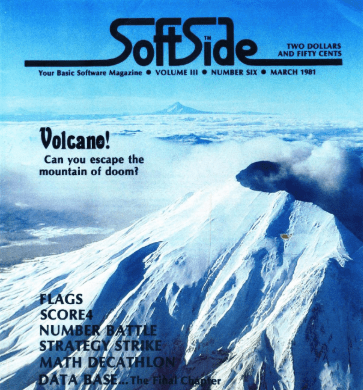
A month later, Victor Albino decided to write a game based on the events (originally, it appears, for the Commodore PET). In March 1981 it landed in the magazine SoftSide for the TRS-80.
Victor writes:
“Volcano” is an TRS-80 educational adventure game requiring at least 16K memory.
As one of the snow-capped jewels of Washington’s Cascade Range, Mount St. Helens ruled with majestic silence for 123 years. Then on Sunday, May 18, 1980 at 8:32 a.m., it erupted in a mammoth fury which paralyzed much of the Pacific Northwest.
…
Despite these elements and the odds, almost 200 people were saved from the mountain by brave crews in rescue helicopters. This program, based on actual eyewitness accounts, recreates the experiences related by these survivors.
If you had been one of those present near the mountain that Sunday morning, would you have managed to survive?
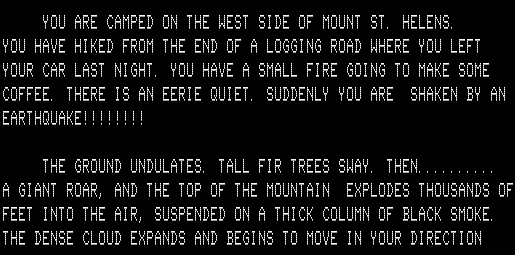
The TRS-80 version of the game is fairly serious about the educational angle, even giving a volcano diagram and a glossary of terms.
I’ve merged two screenshots here, with the four lines of text and the image that followed it.
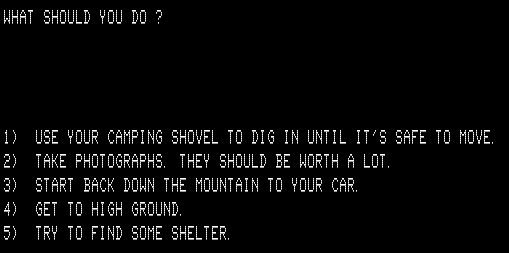
The game is also the first “pure” choice-based game written for a computer that I know of; that is, it could be rendered strictly as a Choose-Your-Own-Adventure book.
There is no “world state” or “inventory” because every wrong move you take will kill you. Under Sam Kabo Ashwell’s taxonomy, it’s a deadly gauntlet.
Here is the result of choice #1:
Choice #2:
Choice #3 (the correct one):
This is three screenshots merged into one.
I’m guessing you get the idea — by the end you get rescued by helicopter (depending on which version you’re playing, with a little animation to go with it).
This game ended up around 2 hours long; if you’re interested in trying it, the Commodore 64 version is fine (link to play online). As far as *if* you should play it — if the idea of playing the first gamebook-form computer game appeals to you, or playing the first Lovecraft game in any form, then yes, try it out.
Cover via ISFDB; after this point are complete spoilers.
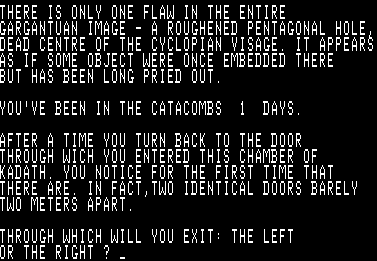
I. On the pentagonal map trick
Last time, I mentioned each main room of the game has five exits, and when you enter a room you specify where you go by a number (1, 2, 3, or 4) where the numbers represent the exits clockwise.
It worked for this game, but it wouldn’t work generally.
The map above is partial, but more or less represents my own game mid-play. I had mapped out the “Domed Narrow Band” room, “Two Bands” room, and “Domed” room. I just added the “Damaged” room and tried another exit, which brought me back to the “Domed” room.
But: where in the Domed room did I just arrive? There’s already a known connection (to the “Domed Narrow Band”) but I had no idea where the new passage is relative to the known one; that meant I couldn’t merge my new passage with what was there. In other words, the “known passage” could have been any number from 1 to 4. Figuring this out involved a lot of error and redraws of my map.
The author clearly knew his map was confusing and amplified the effect. You might go through a passage to a room and find there is a door to the left and a door to the right going back (that weren’t mentioned before) to find only one of them goes back to the original room … or even find *both* of them go back to the original room, but one of them is to a different exit (so the numbers 1 to 4 now correspond to entirely different places).
In fact, I’m fairly sure my current map is far off from the real one, so I’m not going to reproduce the whole thing here. It turns out the winning sequence is short so I just needed a sequence that worked, rather than thoroughly understanding how everything connected.
II. So far
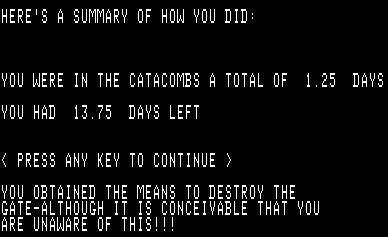
The game gives “progress reports” at regular intervals, and one more report when you die.
This was, in essence, akin to a “Story So Far” type update where a game gives you a running narrative of what’s happened so far if you restore a saved game file. (I most recently saw this in Heaven’s Vault, but it’s very rare in general.)
The reminder of days remaining serves to keep the tension up, and the mention of what items are found serves as fairly strong hints.
III. Instant death
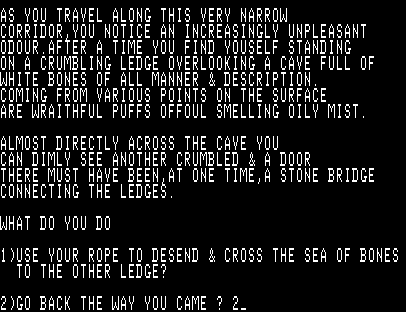
There are no shortage of places to die. Some of them require you to actively take the final plunge.
Where could so many bones have possibly come from? Maybe I should get closer and check it out?
Some of them are a little more arbitrary.
I went the wrong direction.
IV. How inventory is handled
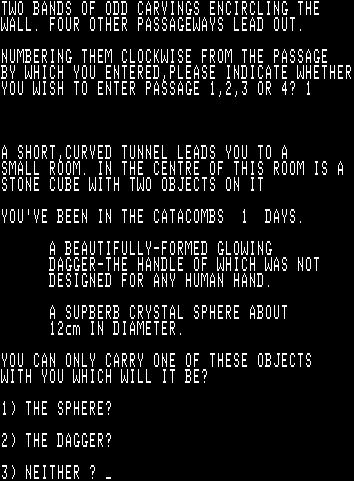
You’ll occasionally find an item; the game will either prompt if you want to take it with you, or in some cases if there’s more than one item, which one you want to take.
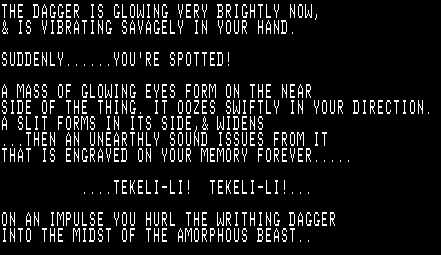
The “which item to take” complication keeps the puzzles from being too simplistic … but only barely. My first time through I had taken the sphere. Later I found an “AMORPHOUS BLOB” where my only option was to run away, and the game frets over my lack of a weapon. So … return to swap the sphere for the dagger, come back, and then I could use the dagger on the blob.
V. On winning
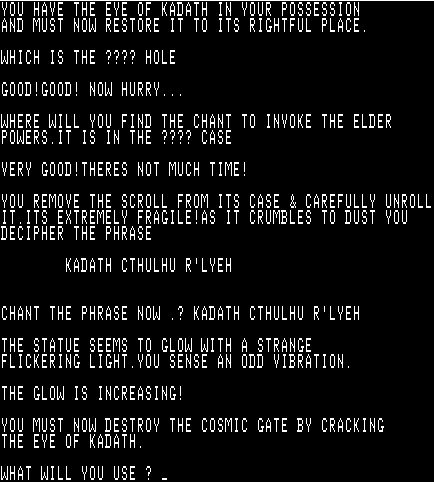
The start of the game states you need to
find and return the Eye of Kadath
invoke the Elder powers
destroy the Gate
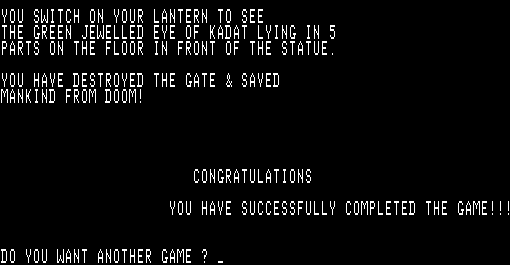
The “story so far” bits helpfully fill in when you’re ready, so it’s just a matter of going to the right location and … typing?
This felt weirdly like a trivia quiz, but I suppose the effect was better than having everything done automatically. Having to type the chant was a nice touch, except my first time through I messed it up because my emulator’s apostrophe button was a different-than-usual key, causing the universe to be destroyed. (Little did we realize humanity’s fall would be due to keyboard mapping.)
This game was just the right length to get across the Lovecraftian sense of dread and confusion without overstaying its visit.
VI. On the gamebook connection
My main question by the end was (and still is) “where did Gary Musgrave get the idea for this?”
While there are many gamebooks that came before, Kadath doesn’t resemble any of them that closely (and I hope the numerous re-inventions I mentioned in my short history attest to the fact it’d be possible to be writing in 1979 while still unaware of all of them). Primarily, the choice books before that point had each numbered section as a plot-point but not as a physical location in space, and the idea of returning to prior locations in loops would be doubly weird. If anything, he may have been familiar with the Tunnels and Trolls games, but even those emphasized forward progress and were more into RPG elements than puzzles.
In other words, this may have represented yet another re-invention of the gamebook form. Cave of Time (the first Choose-your-own-Adventure) wasn’t out until July of 1979, the same month this game was released. Could this have been made immediately after the author saw Cave of Time (assuming, of course, he saw it in the first place)? While possible, it seems too heavily morphed from the CYOA concept to be a rush job.
We have seen some menu-based adventure games: Treasure Hunt (1978), Quest (1978) and Mines (1979) all qualify. Even if Mr. Musgrave hadn’t played them, it wouldn’t be too complex a leap from menu-based adventure as a concept to a game with more active plot choices, attempted atmosphere writing, and choices involving an inventory.
There’s also some element of text simulation-narrative games, yet another genre I haven’t written much about. Compare the march of time to that of, say, Camel (link to play online).
You have travelled 0 miles altogether.
What is your command? 2
Your camel likes this pace.
You have travelled 9 miles altogether.
What is your command? 3
Your camel is burning across the desert sands.
———-W A R N I N G———- Get a drink
You have travelled 23 miles altogether.
Alternately, note how in early versions of Oregon Trail you have to type BANG correctly while hunting. Compare this to the ending of Kadath where you have to type the chant. (I never verified if the typing was timed, but the game did indicate you needed to hurry.)
Whatever the original source of creativity, I appreciated this game was rescued from the depths by being ported off the Altair. If you’re wondering when the first “straight CYOA game” for computer happened (that is, one designed specifically for computer that only goes from node to node, with no inventory or the like), we’ll need to return to 1980 and a famous disaster that killed over 50 people.
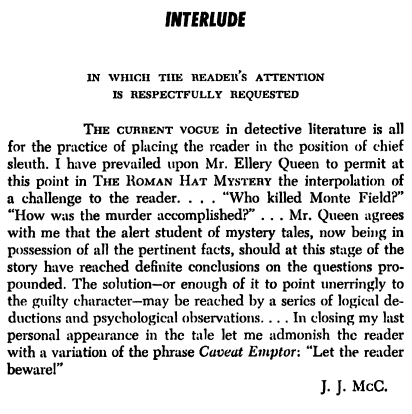
In a way, “interactive fiction” started before fiction was explicitly interactive. The mystery genre has always had an element of trying to predict who committed a crime before the ending is revealed. Ellery Queen (aka Frederic Dannay) appears to be the first person to explicitly cater to this tendency in The Roman Hat Mystery (1929).
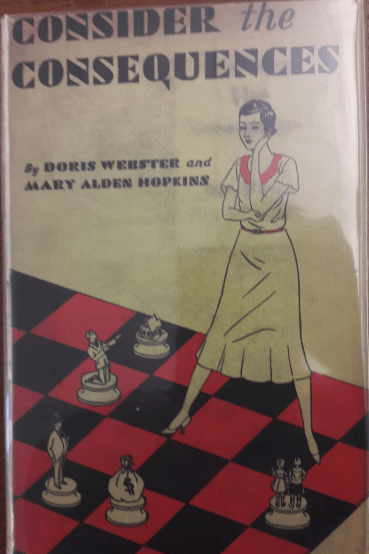
A “branching narrative” where the reader can choose which direction the story flows came shortly after, in 1930, through the book Consider The Consequences! by Doris Webster and Mary Alden Hopkins.
Both these types of books — mysteries with explicit attempts to let the reader find the solution, and branching narratives — occurred intermittently through the 20th century. For the purposes of Kadath, we care more about the branching kind, so let me highlight a few more:
Treasure Hunt by Alan George (1945): “A MAZE in Volume Form – A Puzzle – A Picture-Story-Book – A Brain-Tonic – An Absorbing Pastime with Hours-and-Hours of Interest”
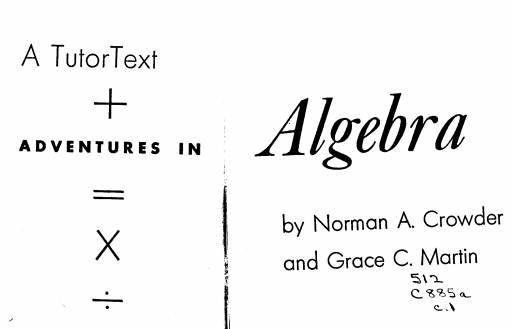
TutorText (1958-1972): A series teaching a wide assortment of topics interactively with titles like Trigonometry: A Practical Course, Understanding Shakespeare: Macbeth, and Understanding Stocks.
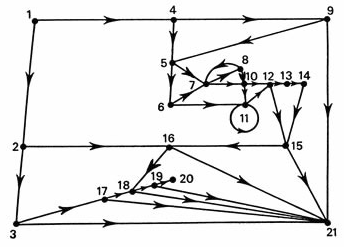
A diagram of Un conte à votre façon that was published with a collected volume of Oulipo’s work.
Lucky Les by E. W. Hildick (1967): “…by ingenuity and even more LUCK, Les survived in Miss Tabb’s boarding school where the pupils were fed on crusts and fried bootlaces! But what happened to him when he left school? Well, you can decide this for yourself.”
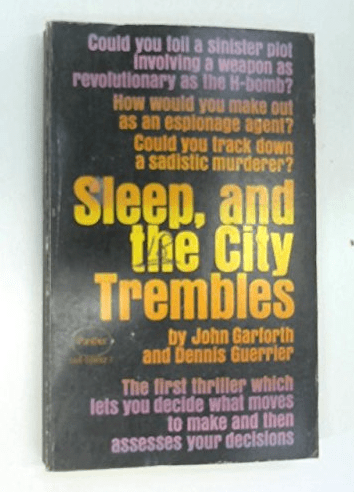
Sleep, and the City Trembles by Dennis Guerrier (“engineered by John Garforth”) (1969): He published three others the same year, including one where you could play solo Tic-Tac-Toe.
Via Amazon.
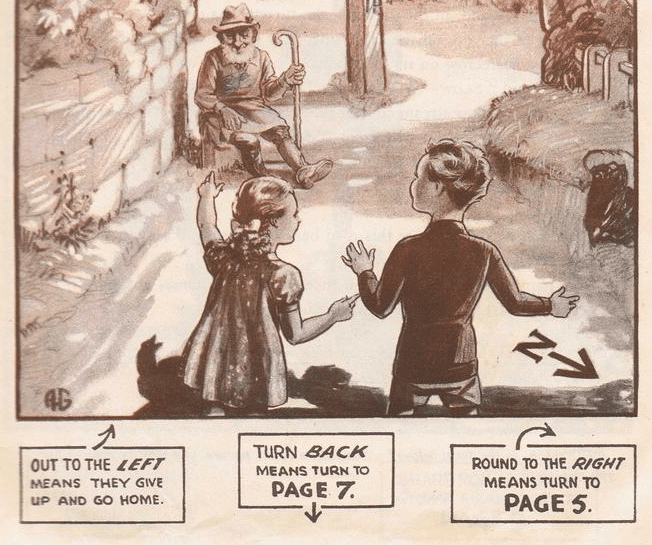
The twelve Tracker books (1972-1980): starting with Mission to Planet L and ending with Codebreaker International, with illustrations across every page of text …
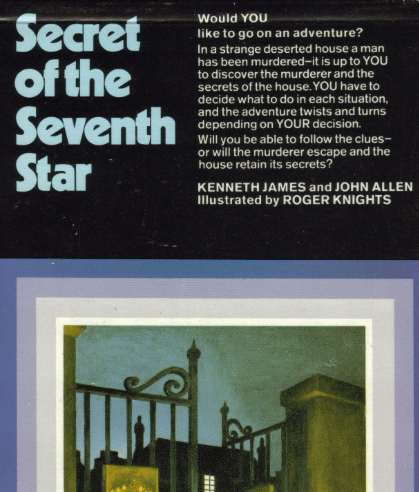
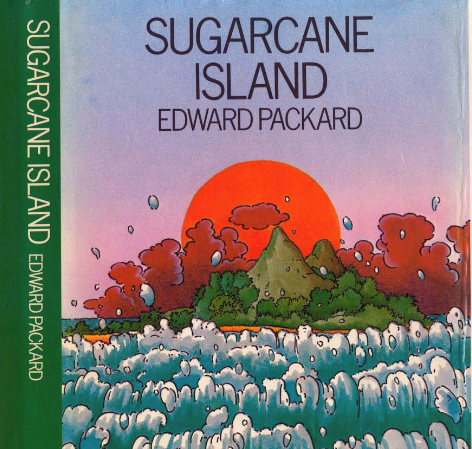
… and I know I’m leaving a few out, but I hope the point is made that there was quite a bit out there before Edward Packer’s Sugarcane Island (written in 1969, finally published in 1976) which eventually led to the Choose Your Own Adventure series and a much, much larger audience.
Curiously, most of the people working above seemed to have come up with the branching idea independently. This was an invention that surfaced multiple times with different inspirations.
1. Doris Webster and Mary Alden Hopkins previously wrote “party game” books like I’ve Got Your Number! which finds the “key numbers” of party guests via personal questions. The idea of “personality traits adding up to a number” creatively evolved into a book with fictional characters where decisions go from number to number (and thus different story parts).
2. Treasure Hunt extends the general idea of puzzle books for children so that the narrative itself is a puzzle.
3. The TutorText series came from the ideas of teaching machines (Sidney L. Pressey, 1926), branching programming (Norman Crowder starting in the 1950s) and programmed learning (B.F. Skinner around the same time).
4. The French “Oulipo” group did all sorts of experiments with text where the goal was to find “new structures and patterns which may be used by writers in any way they enjoy”. Queneau in particular was interested in textual permutations, with a book of sonnets where the lines can be rearranged, and a single story told in 99 different ways.
5. E. W. Hildick seems to have segued off the idea of cats having “multiple lives”, and his book is subtitled “The Adventures of a Cat of Five Tales”.
6. Dennis Guerrier was apparently familiar with the actual TutorText books (and thus would be the first person inspired to write branching text via already existing branching text), but he turned the non-fiction overlay into fiction.
7. I’m least sure about the Tracker books. Weirdly, the covers emphasize “you” going on an adventure, but the text is in first person (of the books I was able to check).
Edward Packer created the series of books out of an exchange he had with his daughters. He used to tell them stories each night about a character named Pete. One day, he ran out of adventures to send Pete on and he asked his children what they thought Pete should encounter that night.
To summarize, choice narratives were invented at separate times and derived from: adult party games, children’s puzzle books, educational learning philosophy, French experiments in text, the “multiple lives” of cats, and in-person storytelling.
All the above is in regards to stories “without state”, where the reader goes from section to section without keeping track of an “inventory” or “statistics”. (Of course, adding a whole lot of sections can essentially simulate keeping state, which is how it’s possible to make a book that plays tic-tac-toe.) With the introduction of roleplaying games in the early 1970s, it was inevitable that someone would eventually write a solo RPG. The same year that Sugarcane Island was published (1976) saw the release of Buffalo Castle by Rick Loomis for the Tunnels & Trolls system:
From one of the first pages of Buffalo Castle.
Dungeons and Dragons was/is the titan of the RPG field, and the first D&D solo adventure entitled The Solo Dungeon came out two years later in 1978 (written by Richard Bartle of MUD1 fame).
It’s worth lingering an extra moment here with a comment from the introduction:
It will offer a number of choices from which you pick out what happens … it is, in effect, a manual computer programme such as those used in certain ‘Teach Yourself’ books.
Despite all the history above (including the fact the D&D people knew about the Tunnels and Trolls people), the book references the TutorText series as a model for how the game works. In a way, by 1978 the form of gamebooks was just getting started, even though they technically dated back to 1930; they kept getting re-invented anew.
The Choose Your Own Adventure series proper launched in 1979: that’s when, finally, they got popular and people starting referencing other gamebooks in making their own.
1979 is also when Kadath was released, and where we’ll finish our story next time.
YOU STAND BEFORE A BLACK,& STRANGELY FORBODING DOORWAY AMID THE CHAOTIC RUINS OF THAT UNFATHOMABLE EVIL CITY OF THE ELDER ONES, THE DREAD – ‘YADDITH’.A CITY THAT DIED LONG BEFORE THE BIRTH OF MANKIND.
YOU & ONLY YOU,KNOW THE SECRET THAT WILL PREVENT THE RISE TO POWER ONCE AGAIN OF A FORCE SO DARK & EVIL,THAT TO DWELL UPON IT WILL SURELY BRING MADNESS
For those playing the home edition of our game Guess That Genre, yes, it’s our first — and what appears to be the very first — Lovecraftian horror game. The Commodore 64 port helpfully points out in the title screen this was originally written by Gary Musgrave in Altair Basic. (Altair, as in: the very first commercially successful “home computer”, more ancient than even the Apple 1. It seems appropriate for the game style.)
The C64 version also mentions the Altair version was written July 15th, 1979, and in 1981 it was ported to the Commodore PET by Robert Hennings before getting again converted for the C64.
So, naturally … I played the Exidy Sorcerer version instead. (Exidy Sorcerer as in: the computer introduced in 1978 and promptly abandoned by the manufacturer, with only a few die hard fans.)
Why? Well, the C64 version clearly had some scrunching for a 40 column version, whereas the Sorcerer (and the Altair) had more screen real estate to work with, so the Sorcerer port seems to be closer to the original Altair text.
A comparison: C64 on top, Sorcerer on bottom. Notice how the Dark Star’s name is lost in the C64 version. Also, some exclamation points. Those exclamation points surely are important to author intent.
Enough with the obscure computer parade: what is this like? In typical Lovecraftian fashion, you learn of a horror that must be stopped. In the words of the game, you must:
ENTER THE LABRYNTHIAN CAVERNS
FIND THE HIDDEN (& GUARDED) EYE OF KADATH
RETURN THE EYE TO ITS RIGHTFUL PLACE
INVOKE THE ELDER POWERS
DESTROY THE GATE THROUGH WHICH THIS UNIMAGINABLE EVIL WILL GAIN DOMINION
This game does not use a parser, but rather menus where you choose numbered options. However, unlike the simulation games of the era that used menus (Oregon Trail, Taipan, etc.) this sticks to an adventure game format with a map that allows backtracking and items and puzzles to solve.
Make the links clickable with a mouse, and you’ve got a Twine game.
The map design is so unusual I’m fairly sure it has never been used in any game before or since this one.
NUMBERING THEM CLOCKWISE FROM THE PASSAGE BY WHICH YOU ENTERED,PLEASE INDICATE WHETHER YOU WISH TO ENTER PASSAGE 1,2,3 OR 4?
You need to keep careful track of the clockwise numbering: if you enter, say, exit 1, and then go back, what was previously exit 2 is now exit 1, and what was previously exit 3 is now exit 2, etc. Laterally, this means the game mainly uses a pentagonal map system which makes me squee with delight a little. I love it when old games go for something completely off-center.
To illustrate further: when you start, the Cliff Overlook is at exit “1”, counting clockwise. If I went from Pentagon #2 to Pentagon #1 and wanted to go back to the Cliff Overlook, I would need to use exit “4” instead (since relatively speaking, it’s now the fourth room clockwise).
I don’t have a sense yet whether this will be a long game or a short game. The lengthy texts (for a home computer game) suggest this will necessarily be short, but the vagaries of a parser do take a lot of disk space, so it’s possible there’s a fair amount of game stuffed in here.
Via Every Game Going. Not the greatest cover; the game only has one stone head (and one that’s supposed to look like the protaganist).
What do we mean when we say a game is difficult?
I was warned, multiple times before starting, how ludicrously hard this one was.
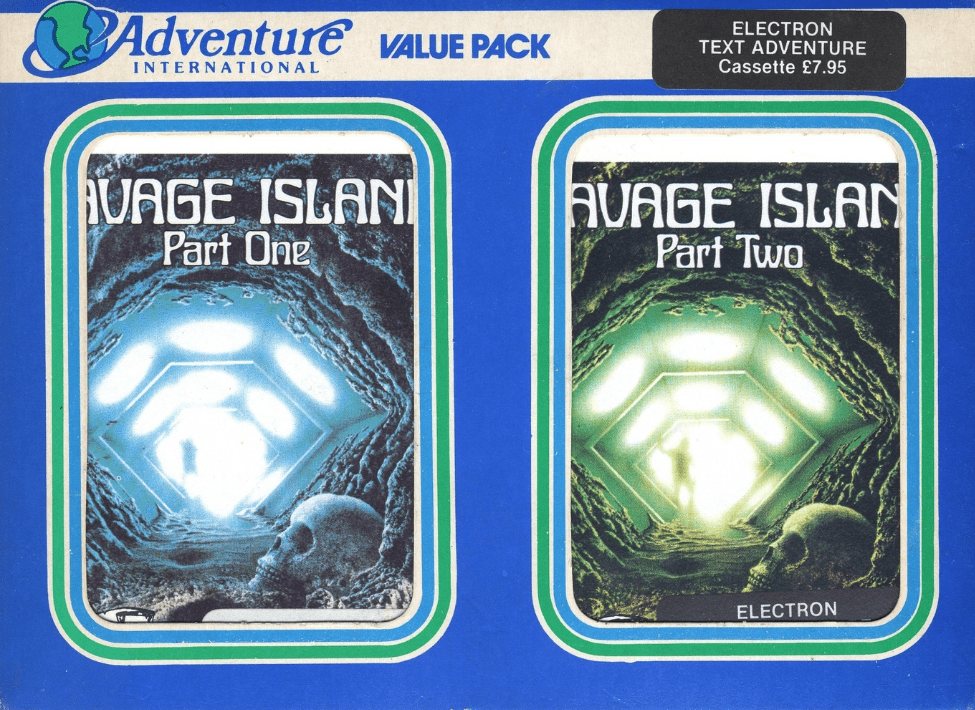
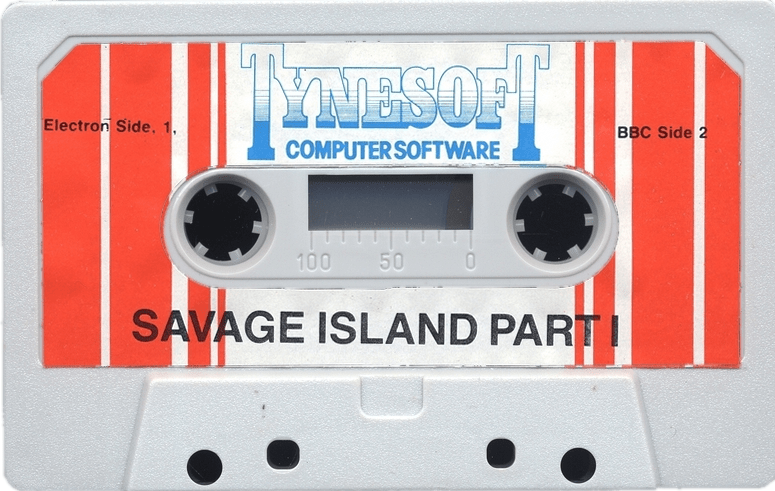
My heretofore-adequate Adventuring skills have been knocked down the stairs, dragged out the window and hung out for the vultures to pick at by the near-insurmountable challenges of Adventure #10: Savage Island (Part 1).
— Gaming After 40
I don’t think it’s quite up there with Philosopher’s Quest or Quondam. (If you want to be quantitative about it, I only needed two minor hints related to the parser to win this one, whereas for the other two games I needed … quite a few more hints.)
The thing that really makes this one tricky to handle is the looping and timing. You have to go through the same part of the map multiple times, with subtle differences in terms of items held. You have to anticipate ahead and time things out in a way that makes solving puzzles genuinely a matter of handling both time and space as opposed to just applying the right item in the right place.
Certainly, at the time this game was written, it was asking the player to do things far outside the norm. For me, the difficulty was mitigated by the fact I’ve beaten Hadean Lands (2014) before; I’m trying to think of other instances where a type of adventure game puzzle was intensely hard at the time due to its sheer novelty but later extensions of the idea made the initial instance more manageable. (Maybe within a series, like playing Myst after beating Riven is easier, even if you’ve never beaten Myst before?)
…
Continuing directly from last time, I was trying to work out how to move a stalactite with a “hinge”. THROW wasn’t a verb, although THROW COCONUT was one of the first things that occurred to me. Having discarded that possibility, I resorted to testing every verb-noun combination. Fortunately, I had found earlier (completely by accident) USE was a recognized verb:
This is about as frustrating as guess-the-verb gets: a.) I had figured out a logical solution, but discarded it because the logical method of conveying it (using a common adventure game verb!) was unrecognized so I b.) did the lawnmower thing with every verb and noun concluding with c.) finding I was right all along by accident.
Smooth sailing from here, thankfully: the action above led me into some metal halls with alien devices, including a force field where I was able to get my plastic block glowing.
This glowing technically forces one more loop: take the raft back to the dark maze, then finally get to see what’s in there — it turns out the YUCK message I was having before was from digging bat guano, where I found a wire. The wire could be brought back to fix the alien machine. (In practice, what I actually did was reload an earlier save once I realized what was in the dark maze and grabbed the wire without using a light at all. Unintended solution ahoy!)
The alien halls also had a display case with a miniature T-rex dinosaur and a full-sized caveman. You can bring both of them to life. (Yes, you can get them to fight, although this seems to be purely for flavor.)
The caveman, in particular, is what you need to get to the end of the game, although it was a touch unexpected:
Best password ever!
In the end, I enjoyed this a great deal more than the prior Scott Adams game Ghost Town, which was sunk by numerous bad design decisions (including ones, to be fair, that wouldn’t have been obviously bad design decisions until the game was made). This game definitely has its major frustrations in the use of RNG; a walkthrough would have to mention at multiple points “save here, and if you die in the next few moves, reload”.
In the case of the storm, rather more than a few moves. I’ve been trying to isolate why this didn’t annoy me more; I guess partially it’s personal preference (knowing what to do and having to redo it is less annoying than not knowing what to do and staring at a blank screen) but also the idea of the “possibility space” in the plot. With Pyramid of Doom there was an entrance that could kill you; even when the danger was defused, the tension of an alternate universe where that death exists remained. Here, the RNG was present to such a degree that the feeling of being able to be killed by nature at any moment was present even in those parts of the game where it was safe. Once I had a sequence down (through careful planning), being able to tread the razor’s edge to victory made me feel like a wizard.
From 1980 on, Adams is more interesting as a businessman and an enabler for others than as a software artist in his own right.
To be fair, from that year he only played Ghost Town (which he appropriately lambasted) when he made his conclusion. It’s perfectly fine to suppose Savage Island Part 1 took a few decisions too far (with parser difficulties to boot) but the structure is definitely original to an extent I can’t think of matching examples. Additionally, as Ruber Eaglenest points out, the game goes all-in on a man-vs-nature theme, and this is not a route many adventure games have taken. Strategy, roguelike, or survival, sure; as individual obstacles in adventure games, of course; but as an overarching theme adventures with a looming menace like the hurricane from this game are rare.
So I recently found out WordPress has amped up the ads on its free plan from sort of obnoxious to incredibly obnoxious.
I went ahead and spent my own money to make this blog ad-free, so you can now safely stop by without an ad-blocker.
(I’ve never gotten money from ads, it all went to WordPress. I don’t have a Patreon or anything of that sort, nor do I ever plan on getting one — just give me a plug amongst your friends and I’ll be happy. If you really want to spend money, there are creators who need more help than I do.)
My first revelation since last time was I could HOLD BREATH while in the lake, and SWIM DOWN to explore the bottom.
I found a knife and a small plastic block, although I couldn’t get them out of the lake; I kept drowning in the attempt.
I suspected the log would come in handy and had already tested it out; I was foiled by expecting to need an action like CLIMB LOG or such to indicate I was “riding the top of the log” so to speak. No, you just hold the log in your inventory, and you can swim through the lake holding whatever else you want, including a knife, fish bones, an empty bottle, and a partridge in a pear tree.
(To put things less glibly: the game only considered weight and buoyancy, whereas I was thinking of logistics and having enough arms. I had even tried holding the knife with my teeth like in pirate movies.)
Once I realized this, most of my problems were settled, except for a very evil part–
The log doesn’t appear until after the hurricane starts. So the sequence goes
1.) Store the rum in the cave (possibly being randomly mauled by the bear while doing so).
2.) Drop the bottle off and swim across the lake holding nothing; go over to the beach and wait for the hurricane to hit.
3.) Once the hurricane hits, grab a log. Go back to the cave and get the empty bottle.
4.) Use the log to ferry the empty bottle across the lake, then jump back to the beach and fill the empty bottle with seawater.
5.) Loop yet again back to the bear cave, use the hot floor to get salt from the salt water, give the salt to the bear, and finally wait out the storm in the cave (now that you’ll be safe from both wild animals and the storm).
The very evil part is that in addition to the bear possibly randomly killing you, and the hurricane randomly killing you in almost *any* room once it starts, the save game option is disabled while the hurricane is going on. I had to run through the whole sequence multiple times, hoping for good RNG; in my second to last try the bear mauled me right as I was about to give him some salt.
Grah. I’m being traditionalist here so I can report to you, my faithful readers, what the experience is like, but for anyone playing along, please feel free to use emulator save states as needed.
Anyhow! Once past this hurdle I was able to rescue the knife and plastic block (via another log pass) with the interesting dilemma that the log doesn’t fit in the west crevice to go over to the beach. If you carry the log while trying to climb up the volcano (which normally just sends you right back down) you drop the log while attempting this and it helpfully falls back onto the beach side of things.
I combined that log with another one the hurricane generated and some vines I cut from the jungle to MAKE RAFT. Launching it from the beach’s tidepool, I did PADDLE EAST and PADDLE WEST for a while until I came across an “atoll”. Remembering the cannon fire, I did WAIT and a pirate ship appeared.
…oh yeah, the rum. I forgot to bring that! Fortunately, I hadn’t “broken” my sequence too much and was able to shuffle the empty bottle back to the cave, fill it with the rum I had stored, use the log again to ferry the bottle back to the beach, make the raft again, find the atoll again, wait for the pirate ship again, and then GIVE RUM. The pirate accepted the gift and left; his bandanna fell off, revealing antennae (it’s an alien pirate), and he left behind a note as well.
I also found amongst my raft travels a cave with drawings and a hinged stalactite, although I haven’t been able to do anything with the latter yet (I suspect it may just be parser wrangling, though).
Whew, that’s a lot of progress! Again, feel free to speculate if you’re just playing along, and restrain yourself from hints if you’ve beaten this before.
Fight monsters, acquire keys to open doors, get life-boosting elixirs, powerful equipment and enchanted items, and defeat the boss at the end of each level. Use your wits to find the right path through each area and survive. Solve each puzzle to move forward with the story.
If you’re familiar with DROD RPG, this is basically the book form of that. Here’s a sample:
You keep track of attack, defense, health, and equipment for solving each puzzle. The pages of the book will be laminated so you can solve using a dry-erase marker.
The first four puzzles of the book are up, so you can test things out for yourself.
Link to Twisty Little Passages Kickstarter
The Kickstarter runs until June 13, 2019. It’s already funded, but there are bonus puzzles to unlock and so forth, and I figured y’all seem the types to be interested, so here you go.
I’ve been thinking of this game in terms of Andrew Plotkin’s A Change in the Weather. That’s a game with a slate of actions that must be done in time for a weather event, and various dependencies require a sort of choreography where things get in the right places at the right times.
I made a decent chunk of progress since last time, then realized in a way I hadn’t, because there was an action I missed. My sequencing is now thrown for a loop, and I don’t know how to fix it.
…
First, and most silly, is the fact that after DIG SAND / WITH HANDS, I could LOOK SAND, which yields seeing a hole, followed by LOOK HOLE which yields finding a bottle. I’d like to emphasize how little sense this makes in a mimetic context; if you make a hole when digging, you’d know by the act of digging, right? This isn’t like pushing a button and not seeing a result because things moved off screen, this is the direct result of physical action your player takes. I suspect Mr. Adams never even thought it was a puzzle.
The bottle contained rum, but I could empty it and fill it with saltwater. Then I took it to a room next to the bear cave and poured it out:
I’m on the edge of a hot rocky cliff outside the volcano
Visible items:
Puddle. Crevice.
Since the cliff is hot, the puddle of water evaporates to leave salt behind. The poor bear, who all this time had been “sickly” and trying to lick me when sweaty, was short of salt.
One happy bear later, I was able to go down in the dark maze, whereupon I used WAIT and found the hurricane passing (??). A little confusion, here: I guess this is meant to be a “dynamic schedule” that reacts to what puzzles you’ve solved, and since I found a good place to camp away from the hurricane, the hurricane came and went without a fuss. It’s not like I waited more turns than usual; the hurricane just passed by faster.
Darkness still approaches, but as I mentioned last time, I found an area west of the lake where I could SLEEP without interference from wild animals. Huzzah, survival to day 2! I also made it to the beach where I heard cannon offshore, but can’t find a ship. >GO SHIP does get an amusing response:
Sorry
not till
Congrats!
Except: in the events above I made a fatal error. Pause before going on; do you see it?
Public domain island picture, for spoiler space.
Before filling the bottle with seawater I had to waste the rum inside. On a hunch during a replay, I tried EMPTY BOTTLE at the stone basin in the cave (which I still hadn’t used yet):
Uh oh. The fact this works (and not with anything else) indicates that the rum needs to be used somewhere, and this is the method of preserving it. Normally this would be fine: I could just go and fill the bottle with seawater and be on my way. However, the volcano area’s lake is fresh water so doesn’t have any salt, and I can’t swim through the lake holding the bottle without drowning. Somehow I need to send the bottle back to the opening area so I can fill it with seawater and get my progress back on track. As is, I just sent myself back to Day 1, and I suspect not for the last time.
















 Renga in Blue